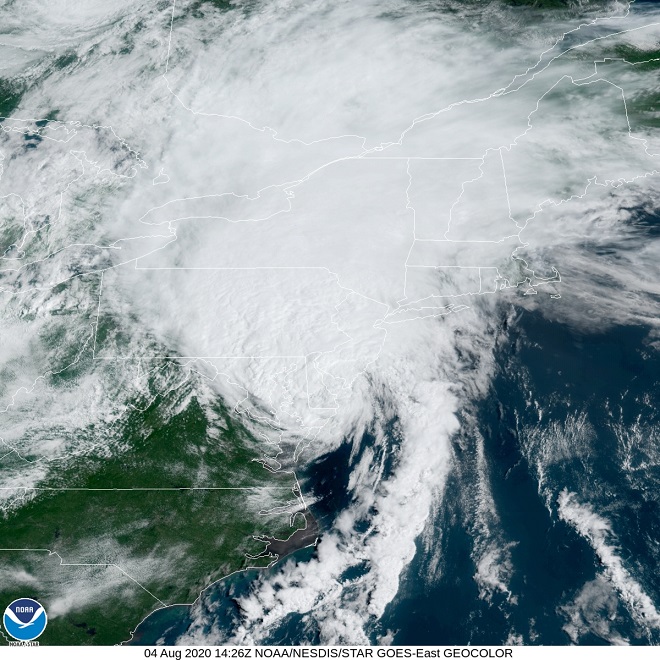
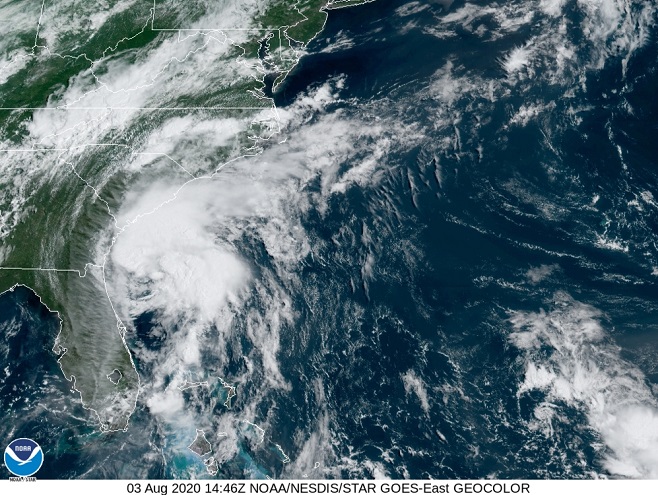
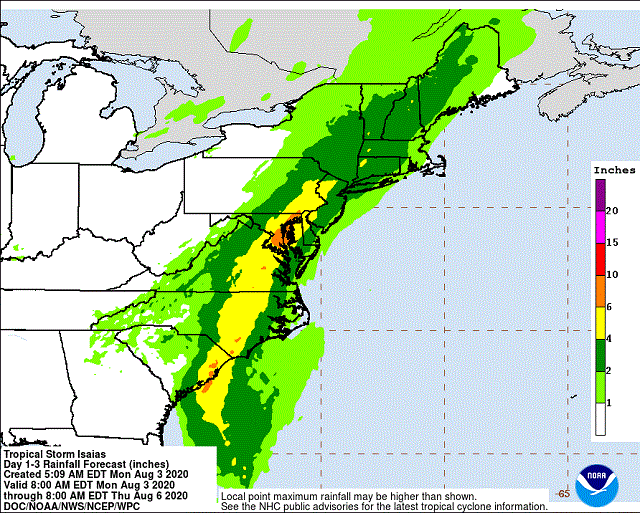
It’s been more than a week since Tropical Storm Isaias moved swiftly up the Atlantic seaboard leaving wind and flood damage in its wake. Here in the Lower Susquehanna River Watershed, the brevity of its presence minimized the effects.
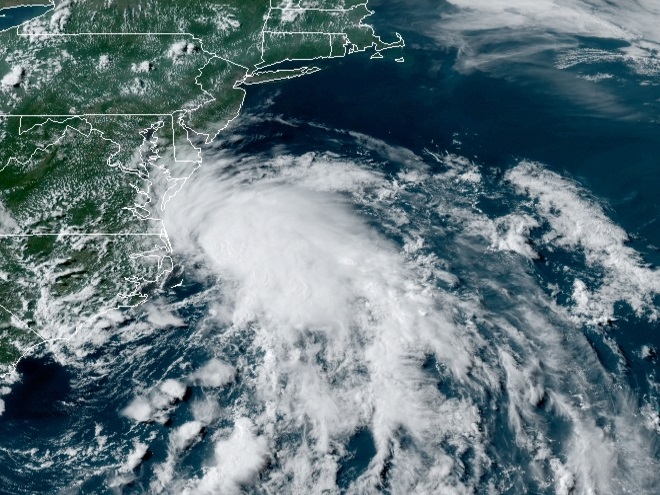
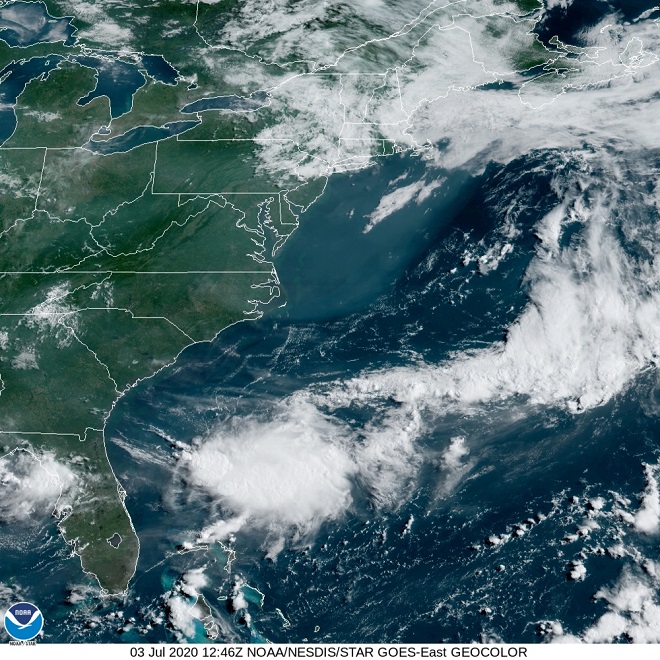
Tropical Storm Isaias moves north-northeast across the Delmarva Peninsula.
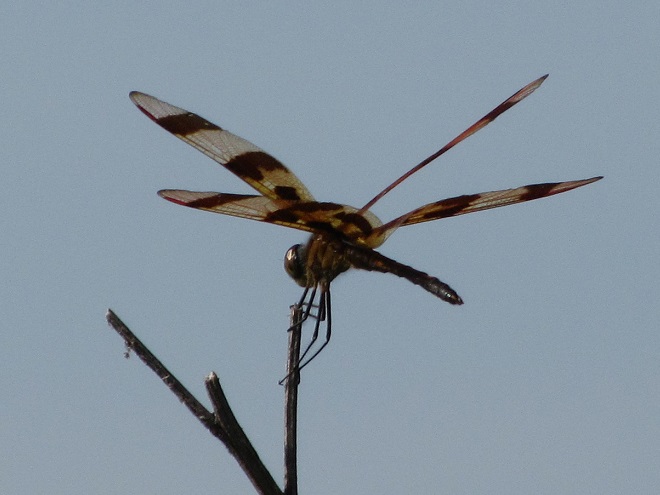
You may have noticed some summertime visitors flying about during these hot humid days that followed Isaias’ passing. They’re the dragonflies.
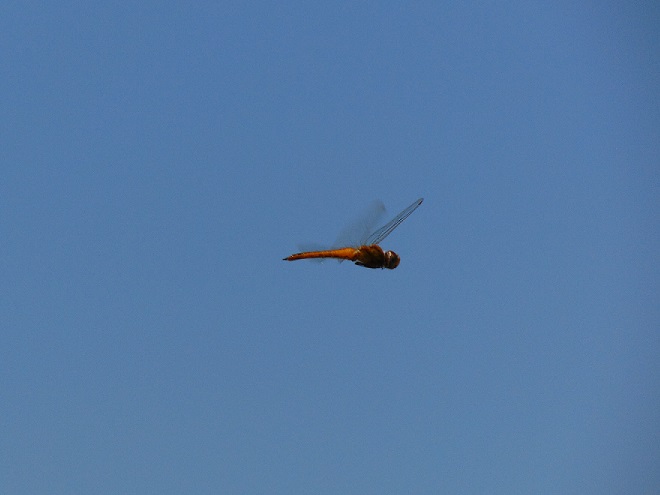
Our familiar friend the Wandering Glider is widespread throughout the valley right now—dropping eggs on shiny automobile hoods that look to them like a nice quiet puddle of water.
The Wandering Glider is a global traveler. Here in the lower Susquehanna valley, it is currently abundant around still water and in large parking lots.
Each of the other common migratory species is here too. Look for them patrolling the skies over large bodies of water and over adjacent fallow land and meadows where tiny flying insects abound. Did these dragonflies arrive on the winds associated with the tropical storm, or did they move in with the waves of warm air that followed it? Probably a little of both.
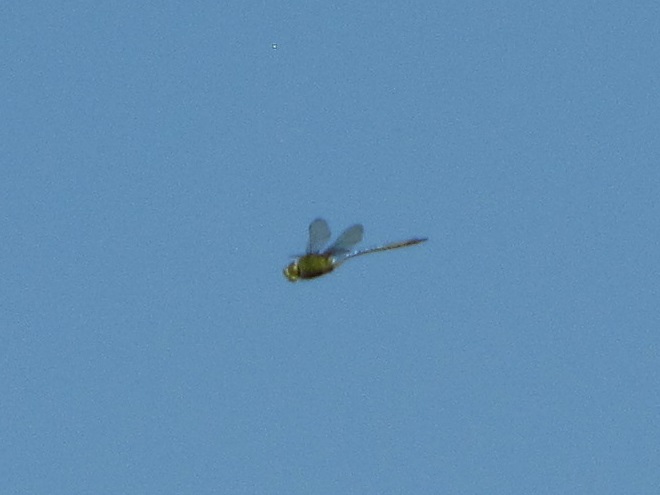
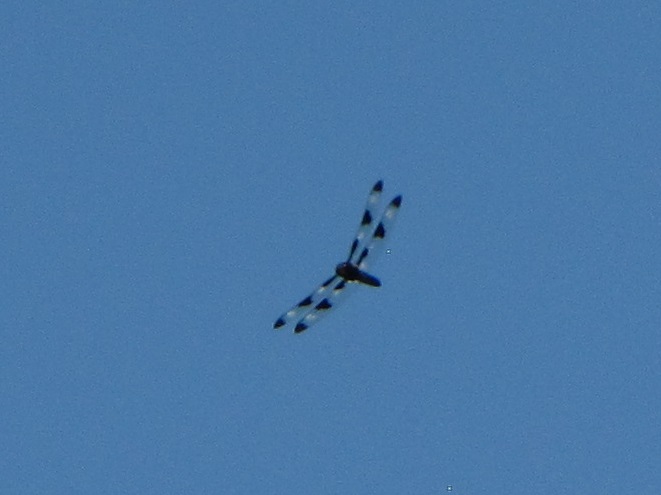
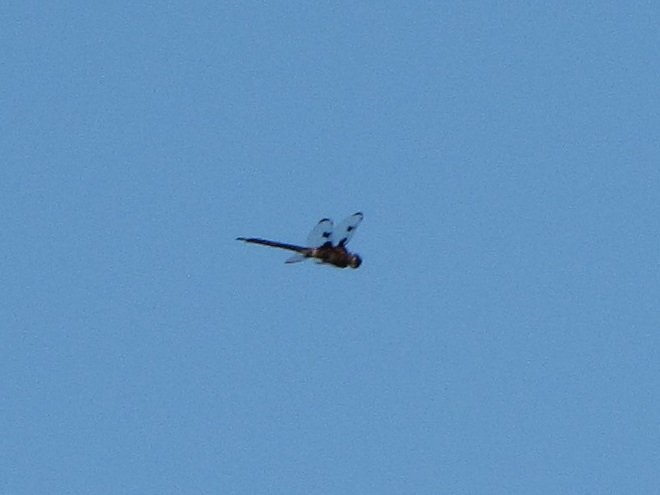
The Common Green Darner, a large dragonfly, can be the most abundant of the migratory species. Watch for high-flying swarms in the coming weeks.The Black Saddlebags is recognized in flight by the black base of each hindwing. These patches give the appearance of a pair of saddlebags draped across the dragonfly’s thorax.The Twelve-spotted Skimmer(Libellula pulchella) is a regular migrant.The Prince Baskettail (Epitheca princeps) can occur among mixed groups of dragonflies. Despite it rarely being mentioned as a migrant, its proclivity for non-stop day-long flight makes it a likely sighting among sizeable swarms.
Big swarms of dragonflies don’t go unnoticed by predators—particularly birds. The southbound migration of kites, Broad-winged Hawks, American Kestrels, and Merlins often coincides with the swarming of migratory dragonflies in late summer. Each of these raptors will grab and feed upon these insects while on the wing—so keep an eye on the sky.
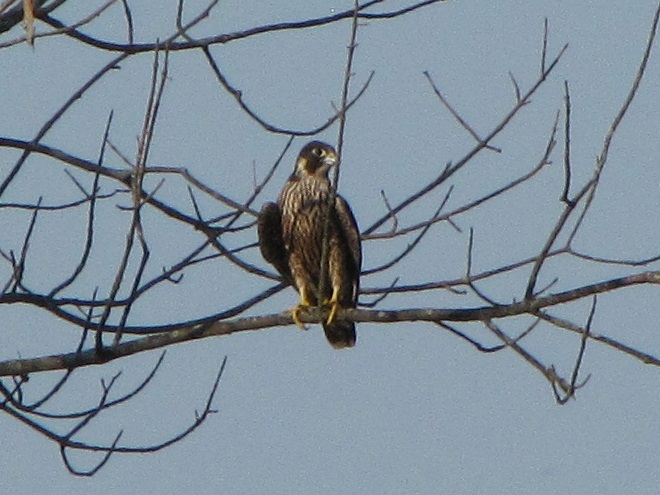
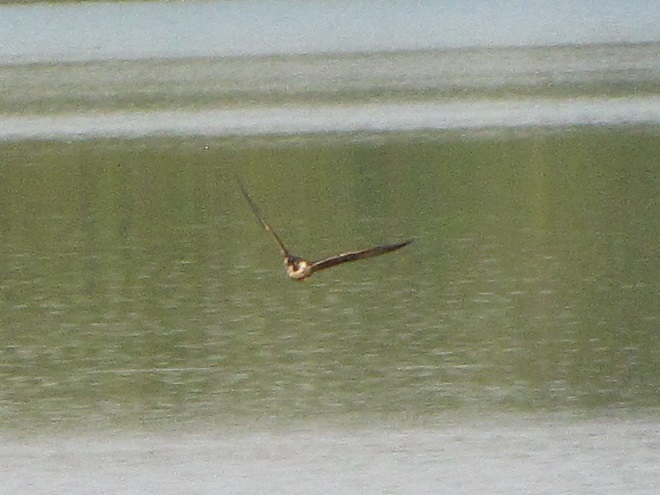
This Peregrine Falcon found the congregations of hundreds of dragonflies worthy of a closer look……and an acrobatic fly-by to disrupt the swarms. Fun, fun, fun, fun, fun.
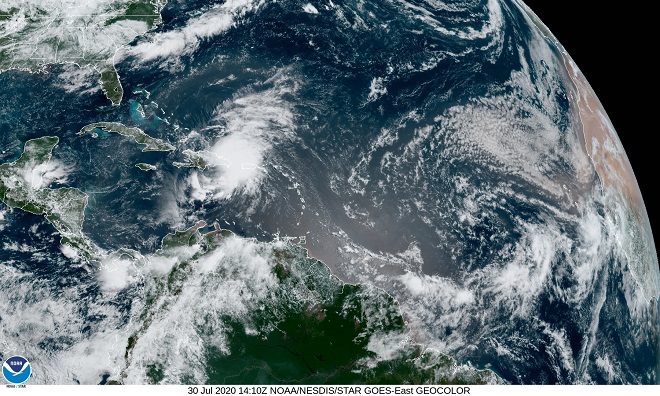
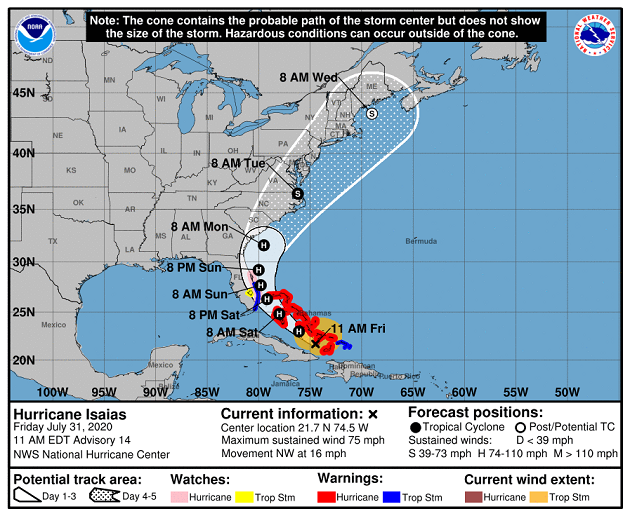
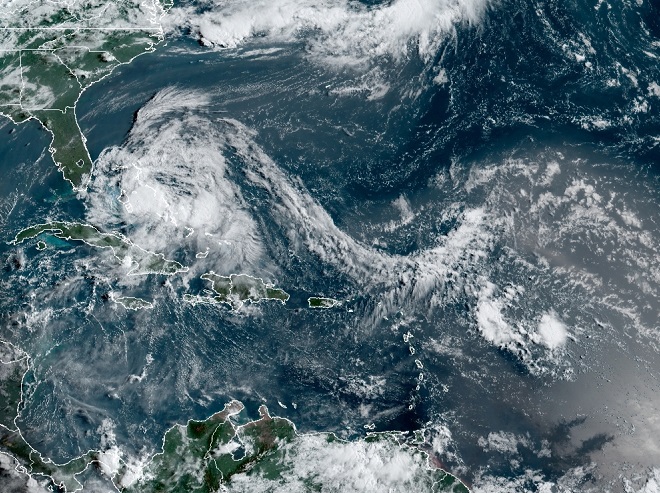
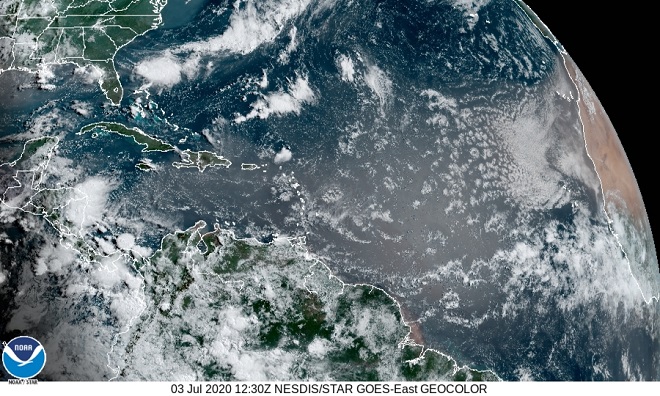
After threading its way through waves of Saharan dust plumes, Tropical Storm Isaias, or the remnants thereof, is making a run up the eastern seaboard toward the lower Susquehanna watershed.
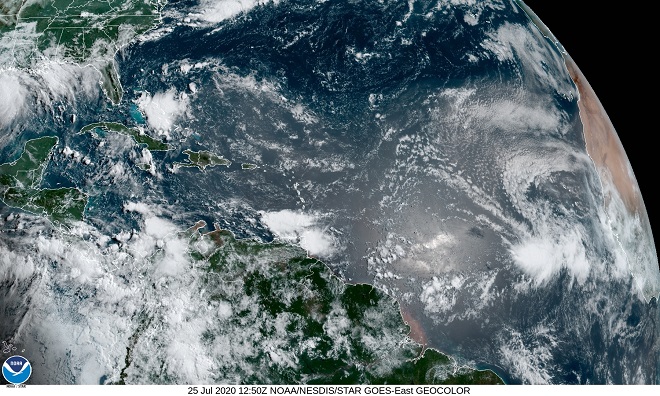
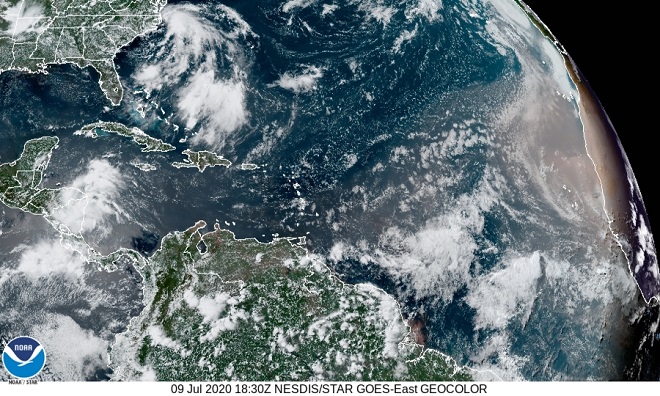
Isaias formed just off the northernmost tip of the South American continent. It drifted north in a narrow pocket between two waves of the Saharan dust plume and, on July 30, strengthened to tropical storm status while in the vicinity of Puerto Rico. (CIRA/NOAA image)In this image taken on Friday, note the position of the fast-moving dust plume that was to the southeast of Isaias just a day earlier. With the storm now clear of the dry Saharan air, it strengthens to become Hurricane Isaias. (CIRA/NOAA image)On Friday, the National Hurricane Center issues advisors expecting the strengthening Isaias to sweep the Atlantic coasts of Florida, Georgia, and South Carolina as a hurricane with winds of 74 miles per hour or greater. (NOAA/National Hurricane Center image)Then on Saturday, Isaias appears to be back in the dirt. Did the counterclockwise rotation of the atmosphere around Isaias draw in Saharan dust and dry air to weaken the storm? Whatever the cause, Isaias is downgraded to a strong tropical storm with maximum sustained winds of 70 miles per hour. (CIRA/NOAA image)The latest image of Tropical Storm Isaias. (CIRA/NOAA image)The latest forecast projects Isaias will briefly reach hurricane status later today before making landfall in South Carolina and again weakening. (NOAA/National Hurricane Center image)Tropical Storm Isaias is expected to bring heavy rain to the lower Susquehanna valley and the Cheapeake Bay region tomorrow (Tuesday). (NOAA/National Hurricane Center image)
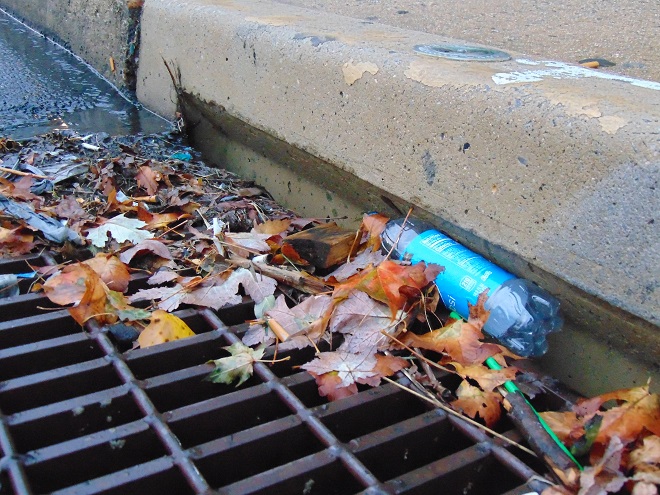
Heavy rain and flooding appears likely, particularly east of the Susquehanna. Now might be a good time to clean up the trash and garbage that could clog nearby storm drains or otherwise find its way into your local waterway. NOW is the time to get all your stuff out of the floodplain! The car, the camper, the picnic table, the lawn furniture, the kid’s toys, the soda bottles, the gas cans, the lawn chemicals, the Styrofoam, and all that other junk you’ve piled up. Get that stuff cleaned up and out of the floodway. And of course, get you and your pets out of the there too!
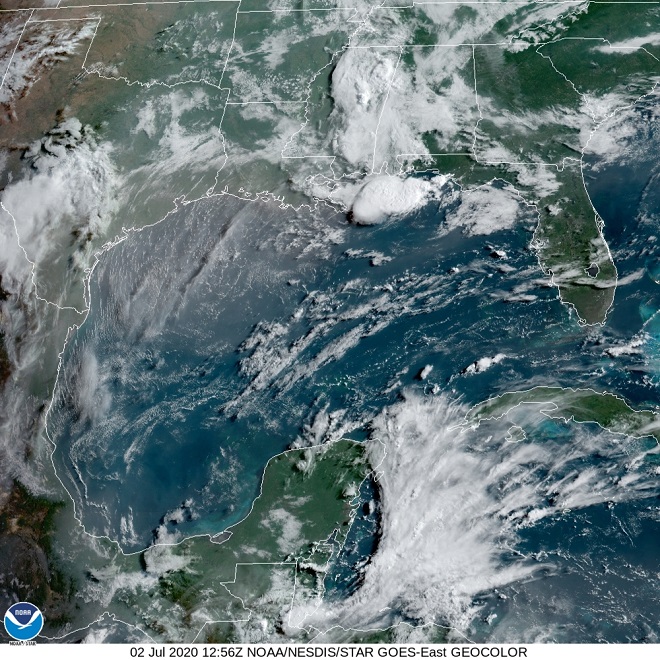
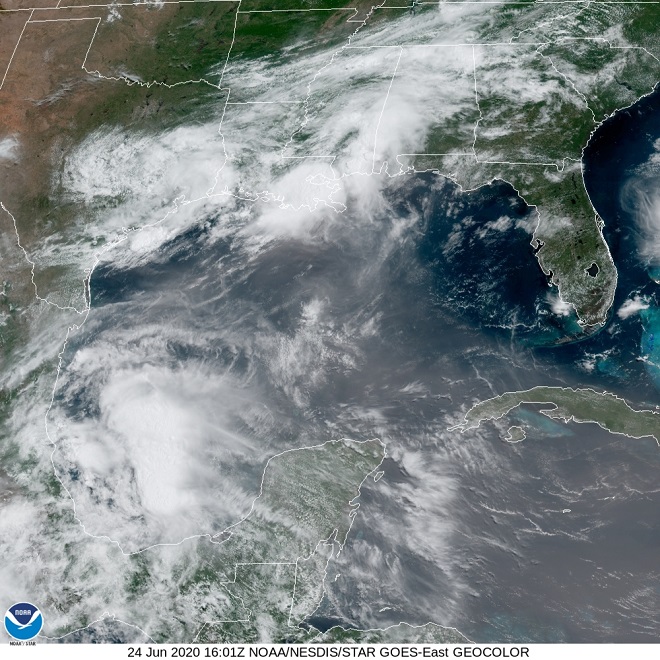
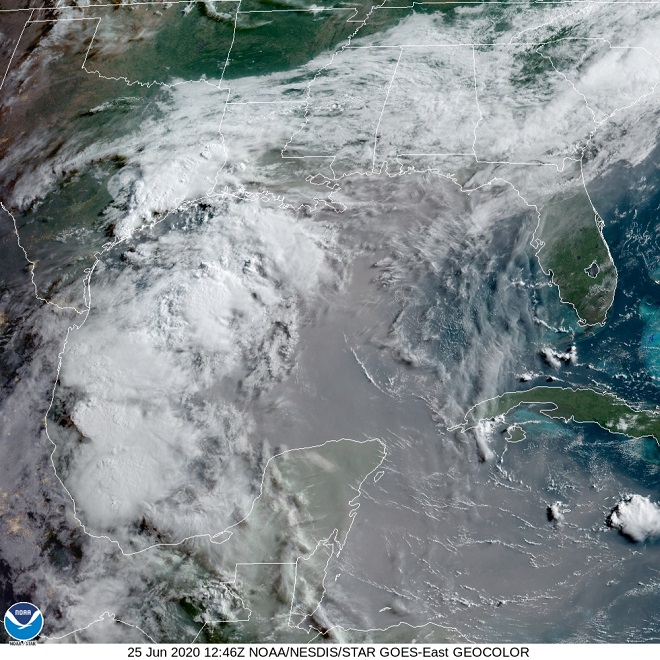
Have a look at the effect of the Saharan dust event of 2020 on tropical storm and hurricane development…
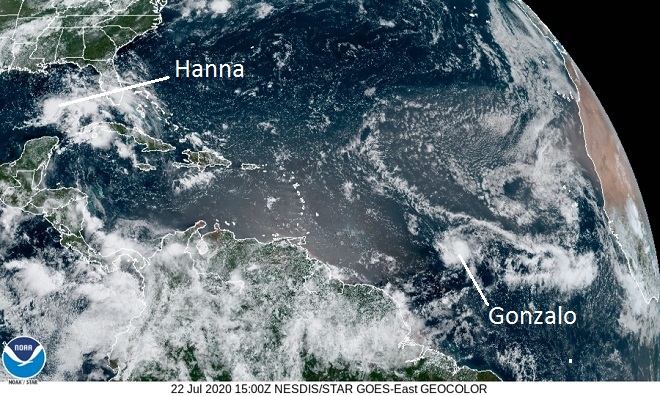
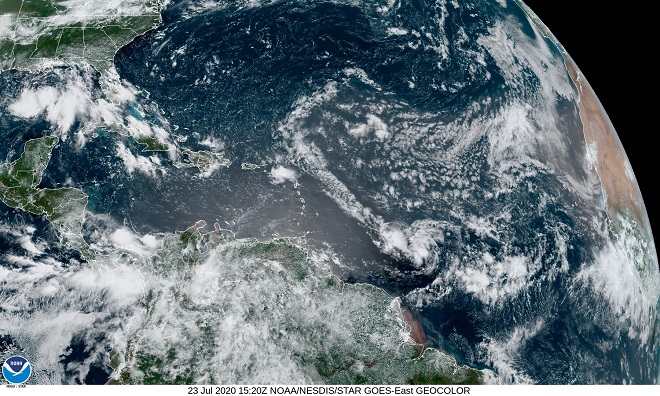
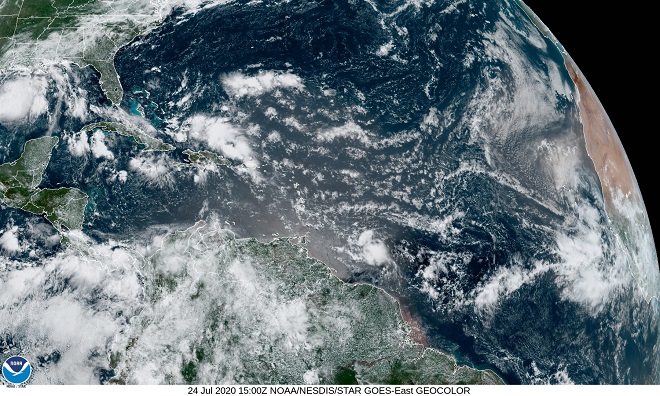
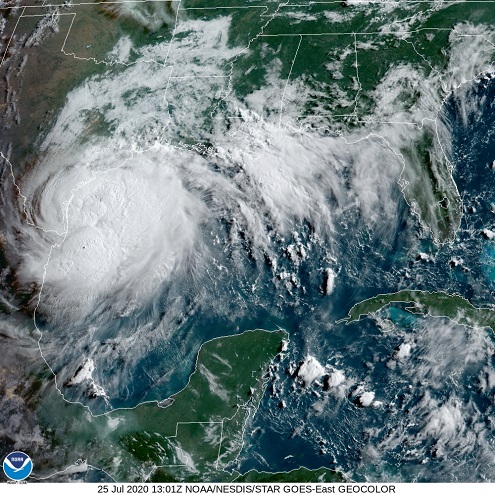
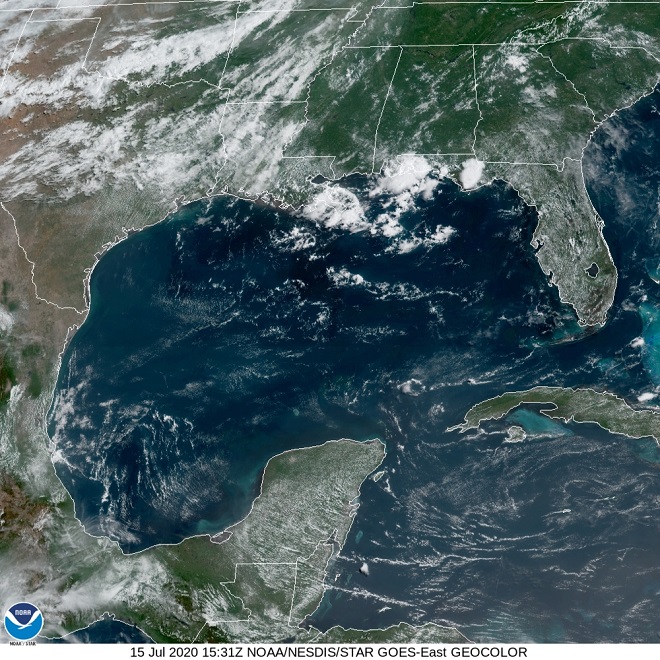
Wednesday- Earlier in the week, Tropical Storm Gonzalo developed in the Atlantic Ocean along the south edge of a gap between two waves of Saharan dust. Forecast models predicted Gonzalo would strengthen to a hurricane as it moved west into the Caribbean Sea in the coming days. A tropical depression in the Gulf of Mexico was also being monitored. Should it intensify, it would be named Tropical Storm Hanna. (CIRA/NOAA image)Thursday- Tropical Storm Gonzalo continues its westward track. Note the pinching of the two waves of Saharan dust around its north side. In the gulf, soon-to-be Tropical Storm Hanna gathers strength over the warm water, free of the convective restrictions imposed by Saharan dust. (CIRA/NOAA image)Friday- Tropical Storm Gonzalo is caught in the pinch of Saharan dust, diminishing its potential for growth. The system’s feeder bands are nearly gone. The forecast is downgraded; Gonzalo is expected to remain a tropical storm during its passage through the Caribbean. Looking more robust, Tropical Storm Hanna approaches the coasts of Texas and Louisiana. (CIRA/NOAA image)Saturday- With upper-level convection subdued by an overcast of Saharan particulates and dry desert air, Tropical Storm Gonzalo is becoming less organized and is forecast to be downgraded to a tropical depression within 24 hours. (CIRA/NOAA image)Meanwhile, Tropical Storm Hanna has strengthen to Hurricane Hanna. A humid atmosphere free of a dense plume of Saharan dust has allowed this storm to develop towering cloud convection, visible here just off the coast of Texas. (CIRA/NOAA image)
It appears that the Saharan dust cloud has at last wandered our way. The plume is presently advancing across Texas and the Mississippi and Ohio River valleys.
The stream of Saharan dust making a right turn across the western coast of the Gulf of Mexico into Texas and the Mississippi valley. The leading edge can be seen over Ohio approaching western Pennsylvania. During its long journey, the dry air in the plume has become too diluted to have much impact on the formation of convective clouds. (CIRA/NOAA image)A dense segment of the plume can be seen pushing into clear air over Tennessee and the southern Appalachian Mountains. (CIRA/NOAA image)
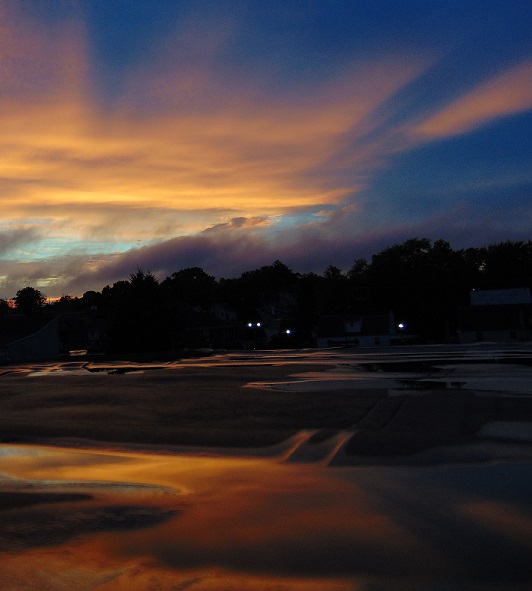
Be sure to get outside and have a look at the sunsets and sunrises in the coming days. They just might be a photo-worthy spectacle!
Tropical Storm Fay bringing rain and the possibility of flooding to the lower Susquehanna watershed. As of 3:30 P.M. E.D.T., the northbound center of circulation was just off Atlantic City, New Jersey. (CIRA/NOAA image)
Dust continues to be carried aloft on dry updrafts over the Sahara Desert. The plume is presently stretching for thousands of miles due west across the tropical Atlantic into the Pacific, leaving the United States out of the loop—at least for now.
(CIRA/NOAA image)
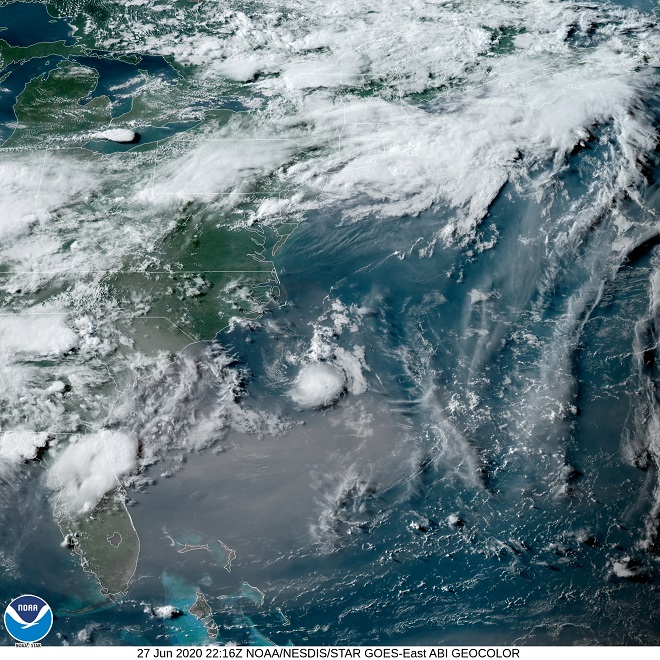
With no dry air to spoil the fun, the warm waters of the Gulf Stream off the coast of North Carolina are spawning some convective clouds in a low pressure system that could become tropical within the next day or so.
Tropical or not, it looks like a rainy weekend along the Mid-Atlantic coast. (CIRA/NOAA image)
Now that the heat and humidity is upon us, why not get out and take a look at the damselflies and dragonflies that inhabit the ponds, wetlands, and waterways of the lower Susquehanna watershed? These flying insects thrive in sultry weather and some species will breed in a body of water as small as a garden pond—as long as it is free of large fish. Check out some of the species found locally by clicking on the “Damselflies and Dragonflies” tab at the top of this page. We’ll be adding more photos and species soon.
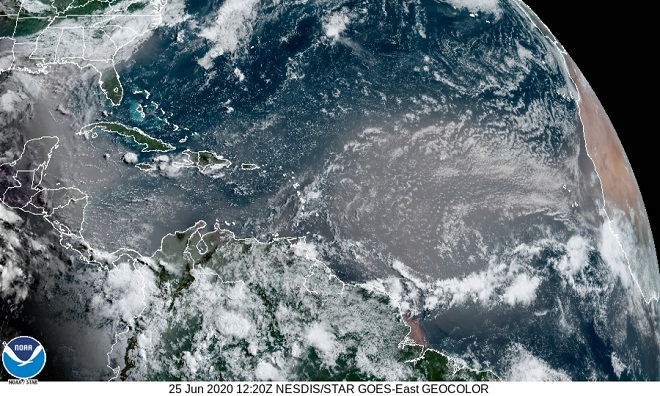
The overcast of Saharan dust that was as close to the Susquehanna valley as the Appalachians of Virginia and West Virginia has, for now, dissipated. This week, the plume of particulates followed a hairpin route originating with the Saharan updrafts, then flowing across the Atlantic and Caribbean only to make a 180-degree turn along the coastal areas of the Gulf of Mexico to return to the Atlantic via Florida, where it then drifted northeast—loosely following the path of the Gulf Stream.
The hairpin route of the Saharan dust cloud in the Atlantic. (CIRA/NOAA image)A 180-degree turn as the plume passes over the Yucatan Peninsula and shorelines along the Gulf of Mexico to cross Florida and reenter the Atlantic. (CIRA/NOAA image)
During the last several days, portions of the dust layer have been carried due west across Mexico into the Pacific.
Portions of the Saharan dust plume entering the Pacific Ocean off Mexico. (CIRA/NOAA image)
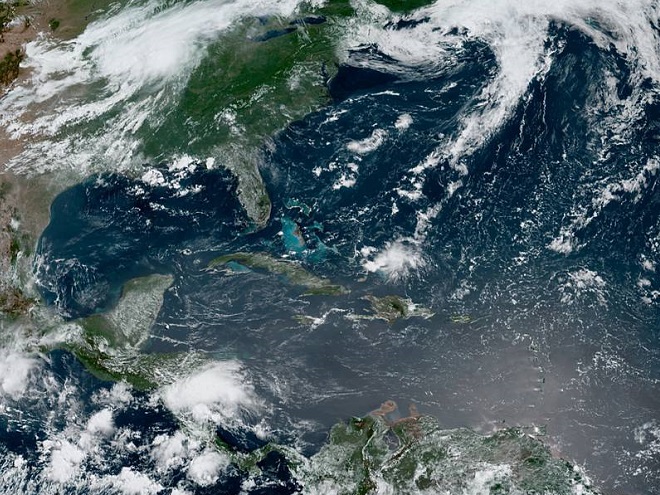
For the Susquehanna region, a low pressure system is in place for Independence Day. In the image below, the cloud of hazy humid air seen blanketing the northeast coast consists of air pollution, pollen, mold spores, “domestic particulates”, condensing water vapor—and little if any red-brown Saharan dust. For the gasoline and gunpowder gang, it’ll be a sticky-hot summer weekend for the celebration of their favorite holiday. Kaboom!
An opaque film of humid air over the Mid-Atlantic States and a diluted plume of Saharan dust drifting northeast after crossing Florida. (CIRA/NOAA image)
The latest satellite image shows the Saharan dust cloud now covering much of the southern United States including most of West Virginia and the Appalachians of North Carolina and Virginia. Due to the density of the particulate matter, air quality warnings have been issued by the National Weather Service for South Carolina, western North Carolina, and the Atlanta metro area.
As the plume of dust drifts east from the southern United States into the Atlantic…
(CIRA/NOAA image)
…yet more can be seen coming west from the African Sahara into the Caribbean Sea. It ain’t over til’ it’s over.
The Saharan dust cloud made its way across the Caribbean Sea and the Gulf of Mexico to reach the skies above the shores of the United States by mid-day yesterday. There, as seen in the image below, the dusty air mass encountered a storm that caused heavy rains and flooding in Louisiana.
(CIRA/NOAA image)
By this morning, the leading edge of the dust cloud encircled the gulf coastline and had spread east across northern Florida into the Atlantic. The latest satellite image (below) shows a dense dry core of the system covering the western Caribbean, the central gulf, and the Yucatan Peninsula.
(CIRA/NOAA image)
For the eastern Caribbean, there is a break in the action. But a second wave is on the way.
(CIRA/NOAA image)
Start watching the skies. Look for any increase in haze during the coming days. Then too, it might be interesting to compare the sunsets for one evening to the next. Over successive nights, take note of the stars and planets in the night sky. If the Saharan dust reaches the lower Susquehanna region with sufficient density, you may find that only the brightest celestial objects are discernible.
Dust carried aloft by hot dry air over the Sahara Desert continues to stream west into the Caribbean Sea. In this image, a dense band of the airborne particles can be seen passing over the Dominican Republic, Puerto Rico, and the Leeward Islands. North of these islands, note the development of puffy white clouds outside the border of the dust storm. The Saharan air mass appears to be effectively limiting convective cloud development within much of its course. No hurricanes for now.
What is the impact of the Saharan dust cloud on the affected islands? In Puerto Rico, the National Weather Service is forecasting visibility of four to eight miles in widespread haze through at least the next twenty-four hours. For the coming several days, the forecast daily high temperatures are expected to be in the low eighties—several degrees cooler than the normal high eighties and low nineties.
Stay tuned, we’ll keep an eye on the plume as it moves into the Gulf of Mexico.
Summer is nigh upon us. With the solstice just hours away, it might be fun to have a look at a satellite view of the earth while the south pole lies plunged into days of endless night, and the north pole suffers none.
(CIRA/NOAA image)
In the image above, darkness can be seen engulfing the southern Atlantic Ocean and southernmost Chile. The latter is the longitudinal equivalent of the lower Susquehanna valley. Today, it experiences nightfall more than five hours earlier than we, heralding the first day of our summer, and of their winter.
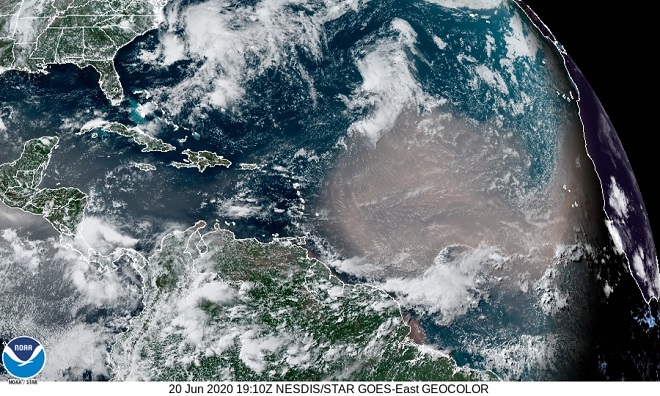
Just to the north of the South American continent, note the enormous tan-colored cloud over the Atlantic. What is that? From whence doth that cloud come?
(CIRA/NOAA image)
Closer inspection reveals an enormous plume of dust rising from the Sahara Desert in Africa and drifting west approaching the Leeward Islands of the Caribbean. (In the image above, Africa can be seen outlined in the darkness along the east horizon) Look closely and you’ll notice that the dust is obscuring the white clouds below it, indicating that it has reached altitudes high in the atmosphere. Particle fallout from Saharan dust clouds is known to fertilize tropical forests—including the Amazon (bottom center of image). Because they are composed of wind blown particles and not water vapor, Saharan dust clouds carry aloft not only minerals and nutrients, but microscopic and macroscopic life too.
Is this particular Saharan dust cloud going to impact the Amazon? What might the meteorological and biological effects of this cloud be if it continues into the Caribbean and even into the United States? Might we be showered by little pieces of the Sahara this summer? Will we see spectacular sunrises and sunsets? Time will tell.
Here it is—just as it happened, recently in the lower Susquehanna valley.
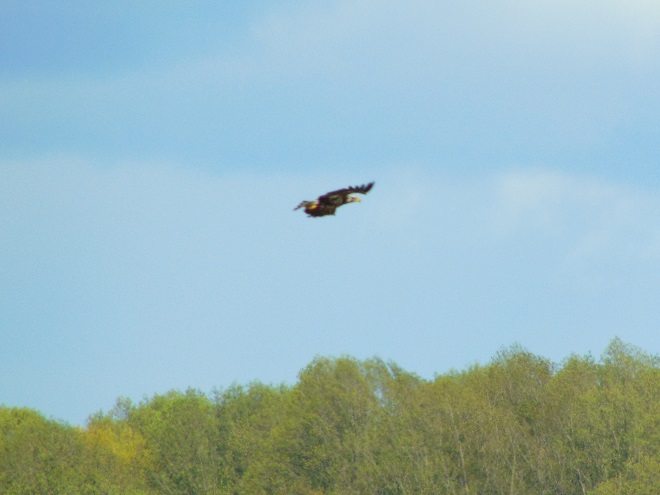
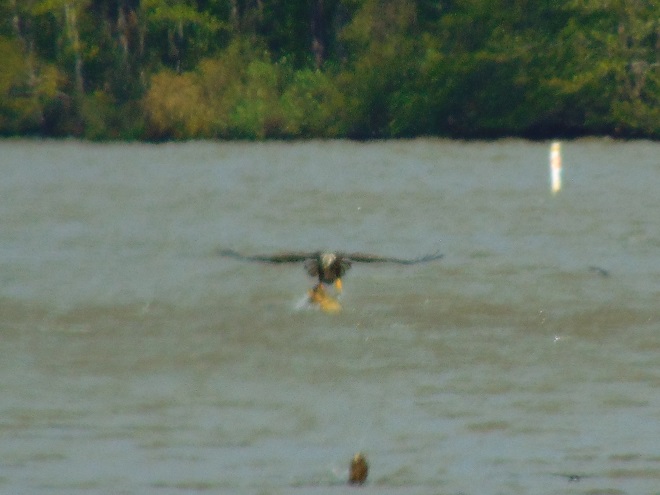
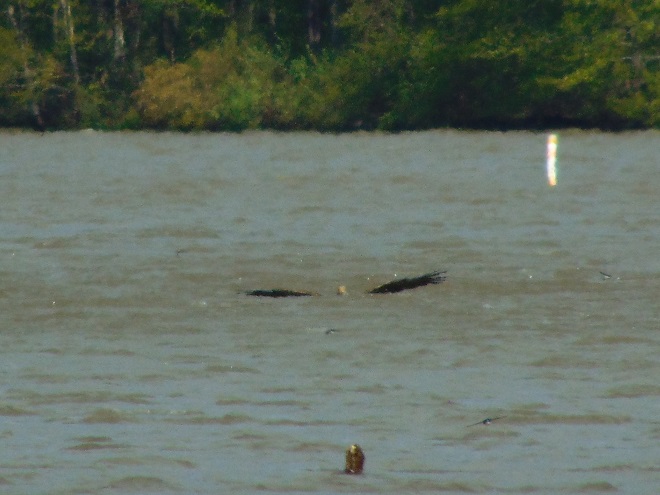
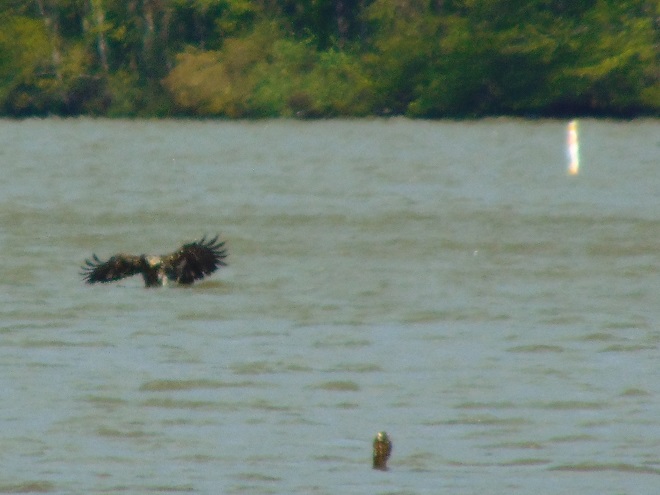
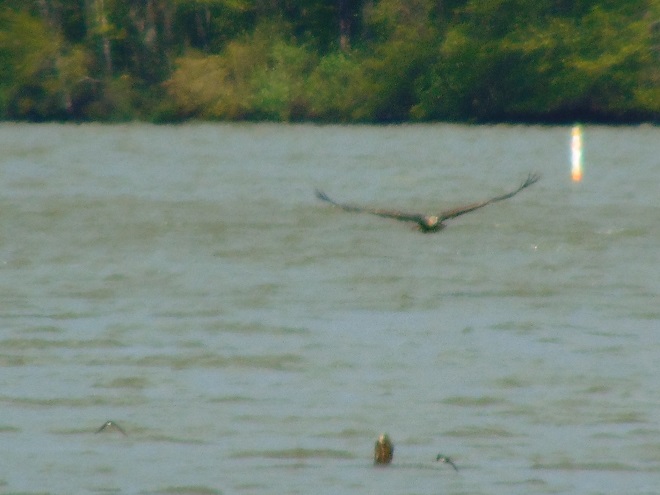
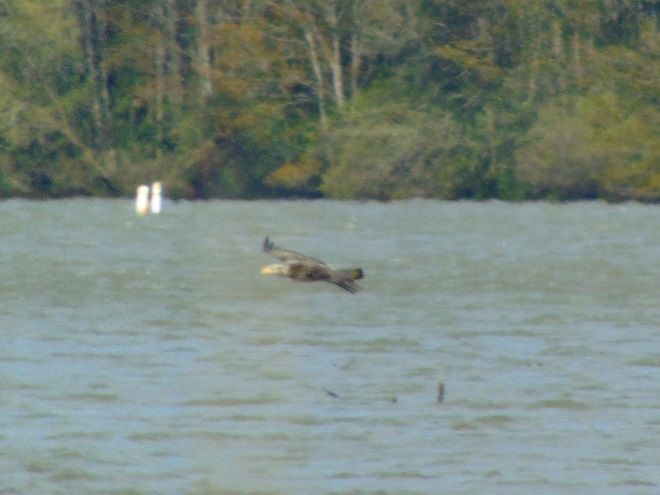
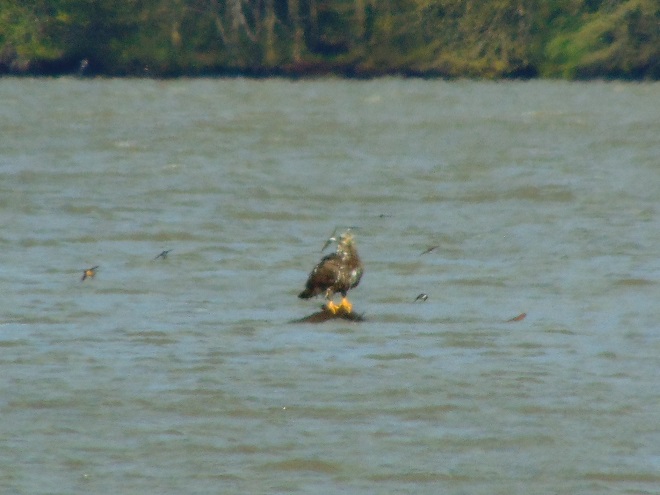
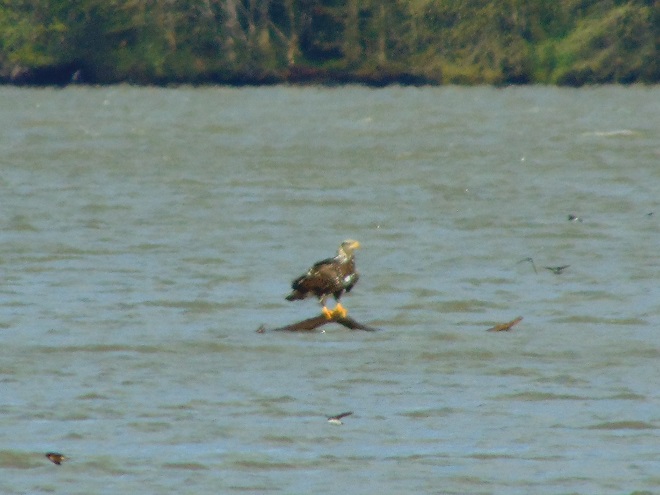
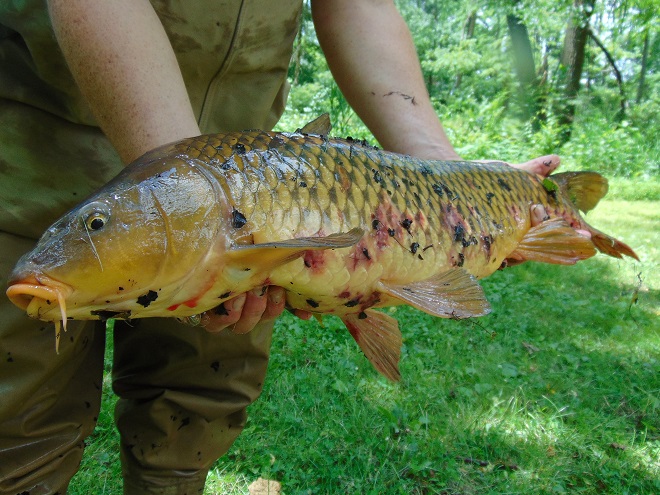
A Bald Eagle in search of a meal.The eagle glides in and grabs an unsuspecting Common Carp, the bird’s momentum and a head wind helping it to raise the fish out of the water. This particular carp appears to be eighteen to twenty-four inches in length. In that range, it could weigh anywhere from four to ten pounds or more.But as the eagle tries to flap its wings to carry the carp skyward, it loses lift, and the weight of the fish drags the raptor down. A carp exceeding twenty inches in length usually weighs more than five pounds, approximately half the mass of a male (about 9 lbs.) or a female (about 12 lbs.) Bald Eagle. From a dead stop, trying to extricate a submerged fish weighing half as much again as it does is an impossible task for this or any other Bald Eagle.The eagle fights briefly to pull the carp from the water, then abandons the effort to instead release its talons from the fish to prevent its own demise by drowning.Free of its hold on the carp, the eagle flaps its wings briskly to get up and out of the potentially deadly situation.Success!Both the eagle and, presumably, the carp survive the encounter.The eagle finds a nearby tree limb where it takes a much-needed break from fishing.Such an event may have been fatal to an inexperienced younger Bald Eagle. Though not an adult, this bird is no spring chicken. Its plumage, particularly its white head with a dark line through the eye (often called an “osprey face”), is indicative of a bird in its fourth year of life. By this time next year, it should be sporting a full set of adult feathers. In the meantime, it should stick to eating suckers; there are plenty of those to go around.Common Carp are classified as a minnow (Cyprinidae). They are indigenous to Europe and are raised as a food fish in many parts of the world. In the Lower Susquehanna River Watershed, Common Carp are an introduced species with negative impacts on native fisheries. Those exceeding twenty inches in length begin to gain girth and weight, sometimes reaching thirty pounds at thirty inches.
SOURCES
Sedaghat, Safoura, Seyed Abbas Hoseini, Mohammad Larijani, and Khadijeh Shamekhi Ranjbar. 2013. “Age and Growth of Common Carp (Cyprinus carpio Linnaeus, 1758) in Southern Caspian Sea, Iran”. World Journal of Fish and Marine Sciences. 5:1. pp.71-73.
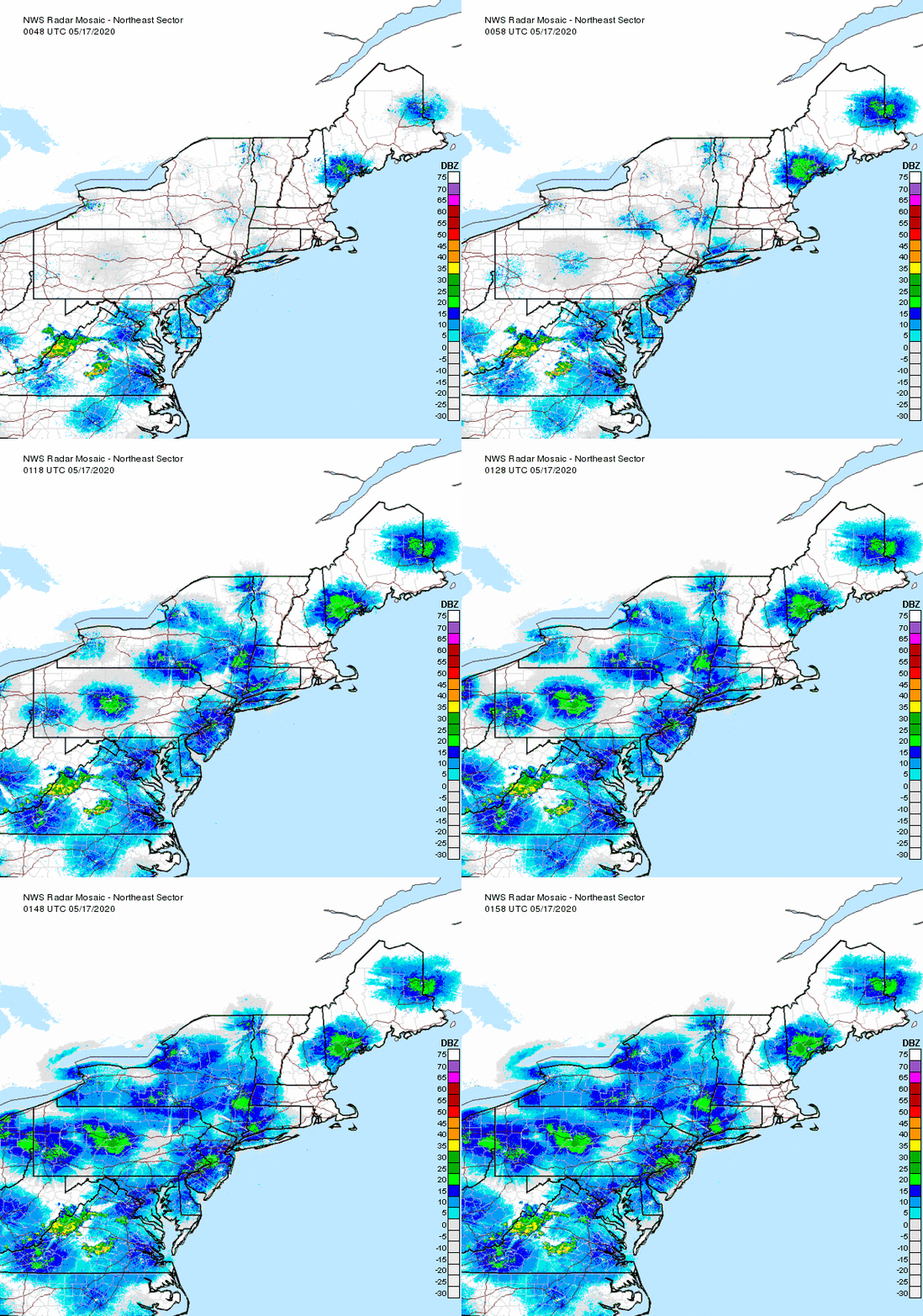
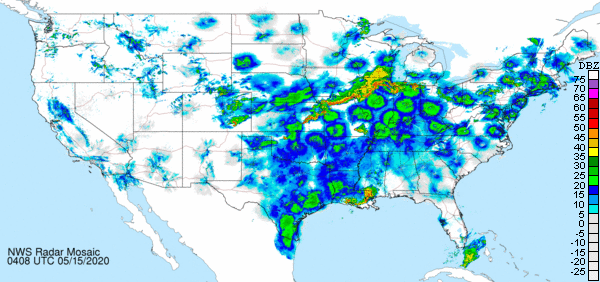
Birds on radar last evening. A dense liftoff of nocturnal migrants is indicated at radar sites across the northeastern United States. Rain showers can be seen in Virginia. (NOAA/National Weather Service image)
Today’s arrivals—Neotropical migrants found in a streamside thicket in the Lower Susquehanna River Watershed this morning…
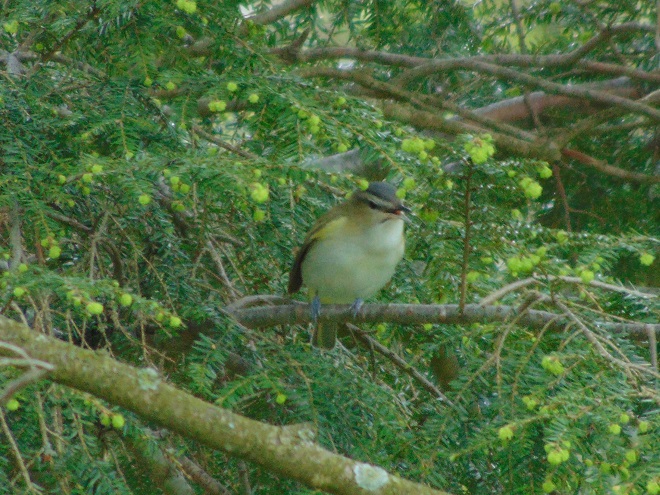
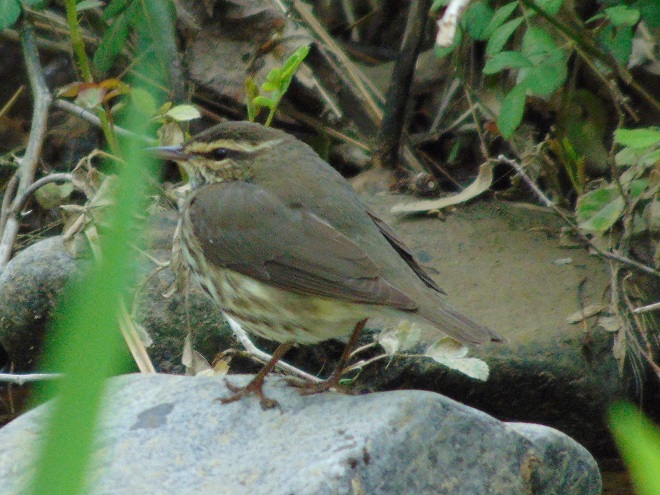
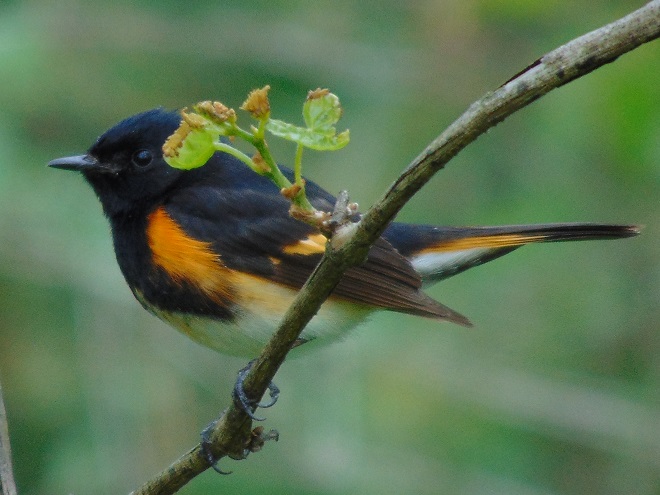
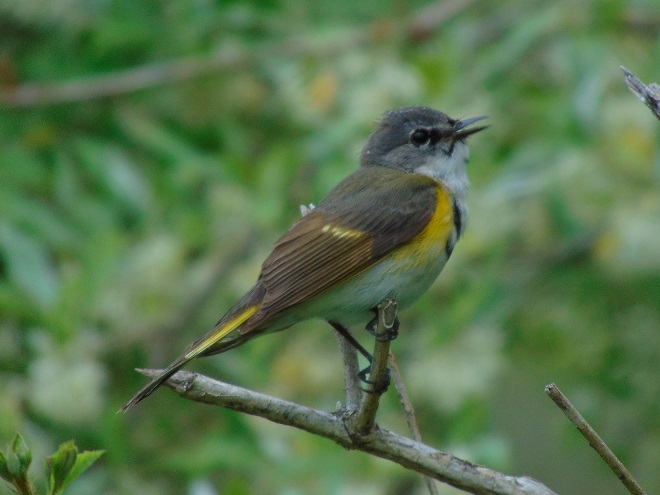
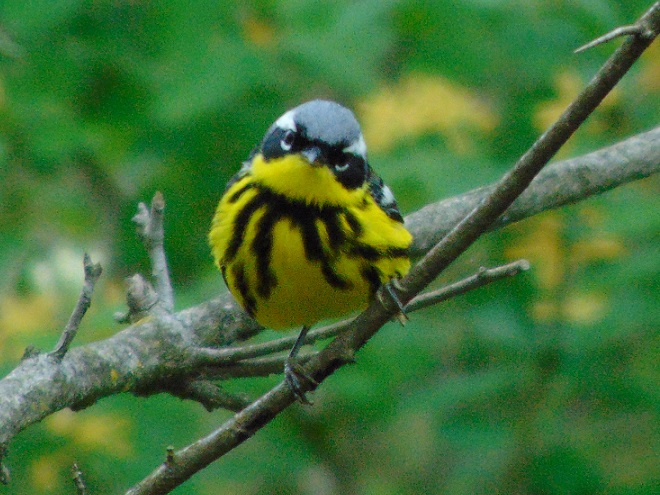
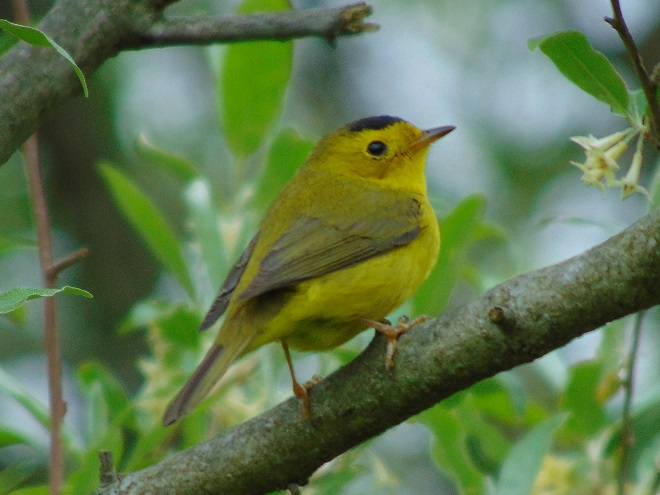
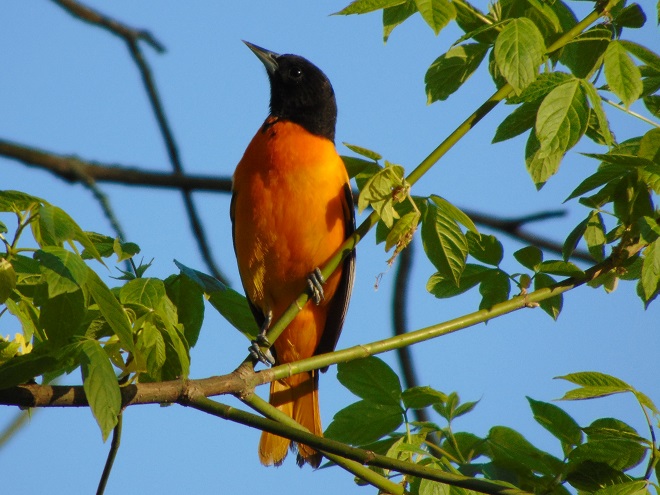
Red-eyed Vireos nest in forests throughout the lower Susquehanna valley.The Northern Waterthrush is a regularly occurring migrant that can be found in vegetated wetlands and along the backwaters of streams and rivers. Despite its drab appearance, it is classified as one of our Neotropical warbler species.The adult male American Redstart is unlike any other eastern warbler. It is easily recognized. Along the lower Susquehanna, redstarts nest in the dense understory of damp forests.The first-spring male American Redstart is similar to the female, but usually shows black markings beginning to develop on the breast and face. It is an energetic singer.In its strikingly colorful plumage, the Magnolia Warbler is a classic Neotropical bird. Locally, it is a regular migrant.The Wilson’s Warbler (Cardellina pusilla) forages in lowland thickets during its migratory stopovers. Riparian buffers along streams can provide critical habitat for this and other transient species.Baltimore Orioles continue to trickle in, creating squabbles when they enter nesting territories established by birds that arrived earlier in the month.
After nearly a full week of record-breaking cold, including two nights with a widespread freeze, warm weather has returned. Today, for the first time this year, the temperature was above eighty degrees Fahrenheit throughout the lower Susquehanna region. Not only can the growing season now resume, but the northward movement of Neotropical birds can again take flight—much to our delight.
A rainy day on Friday, May 8, preceded the arrival of a cold arctic air mass in the eastern United States. It initiated a sustained layover for many migrating birds.
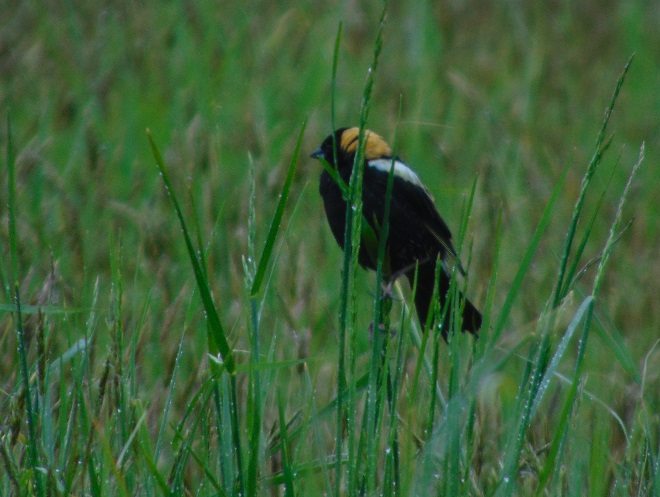
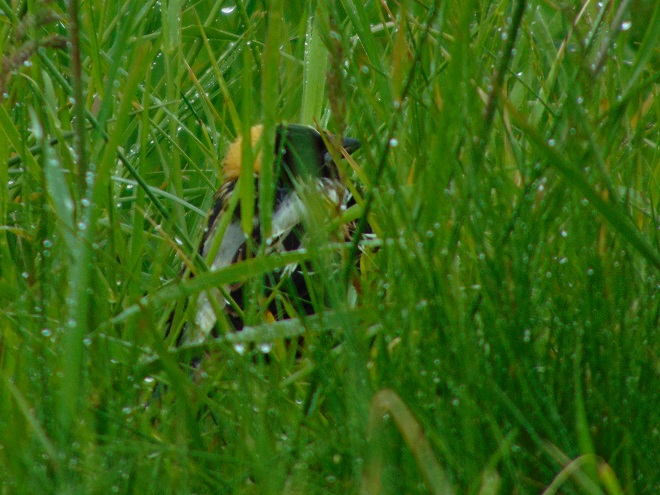
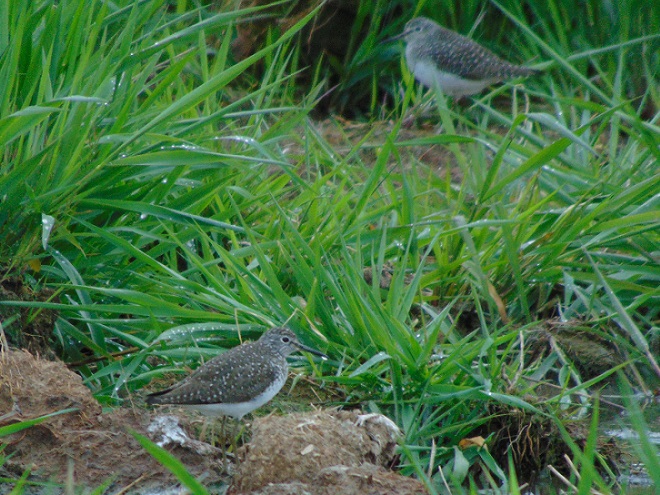
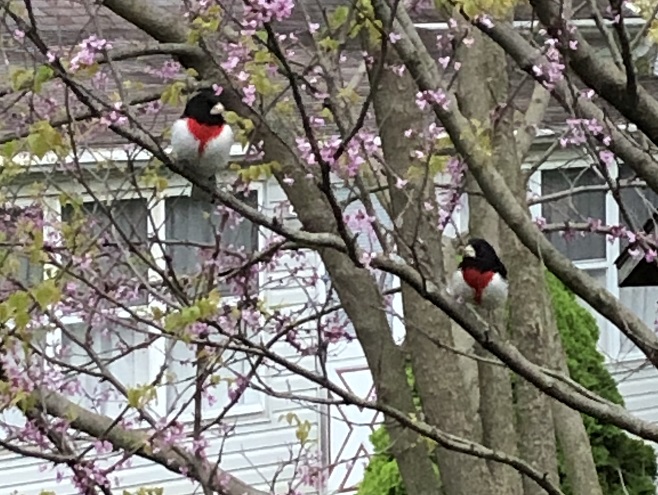
Bobolinks (Dolichonyx oryzivorus) in flocks of as many as fifty birds gathered in weedy meadows and alfalfa fields for the week.A Bobolink sheltering in a field of Sweet Vernal Grass (Anthoxanthum odoratum) during the rain on Friday, May 8th.Two of seven Solitary Sandpipers (Tringa solitaria) in a wet field on Friday, May 8. Not-so-solitary after all.Grounded by inclement weather, Rose-breasted Grosbeaks (Pheucticus ludovicianus) made visits to suburban bird feeders in the lower Susquehanna valley. (Charles A. Fox image)
Freeze warnings were issued for five of the next six mornings. The nocturnal flights of migrating birds, most of them consisting of Neotropical species by now, appeared to be impacted. Even on clear moonlit nights, these birds wisely remained grounded. Unlike the more hardy species that moved north during the preceding weeks, Neotropical birds rely heavily on insects as a food source. For them, burning excessive energy by flying through cold air into areas that may be void of food upon arrival could be a death sentence. So they wait.
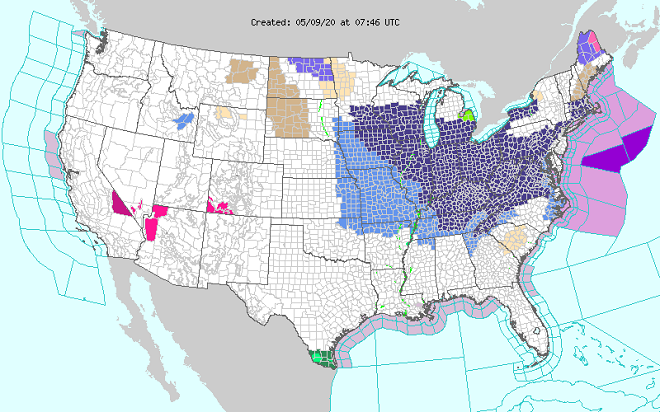
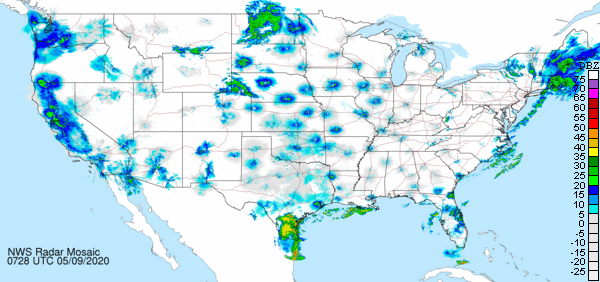
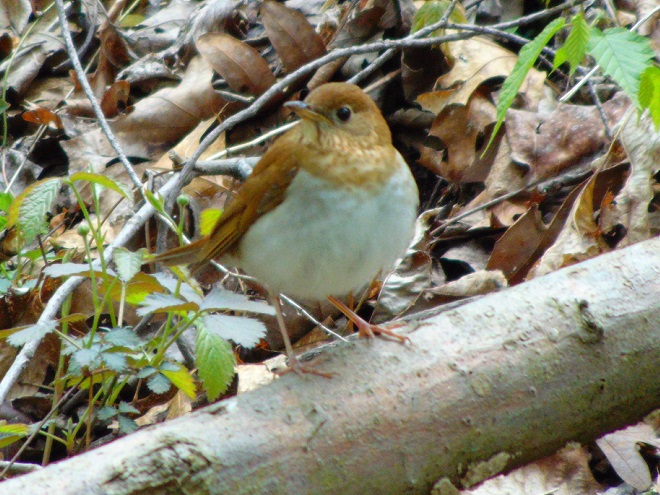
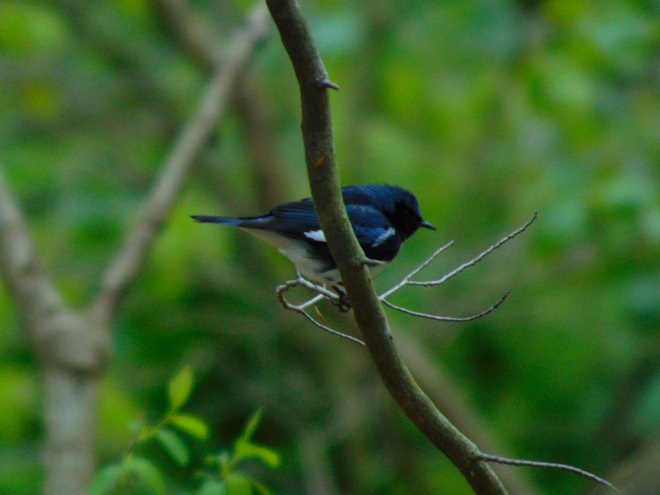
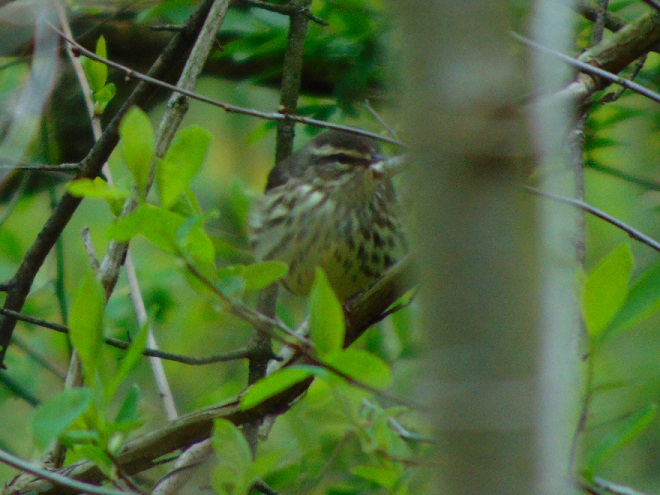
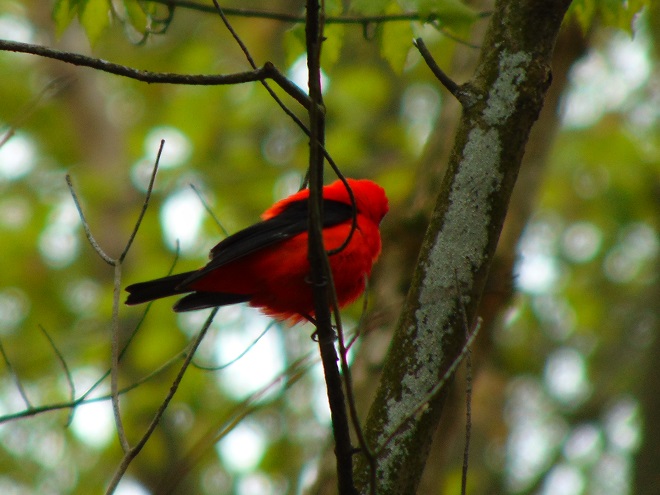
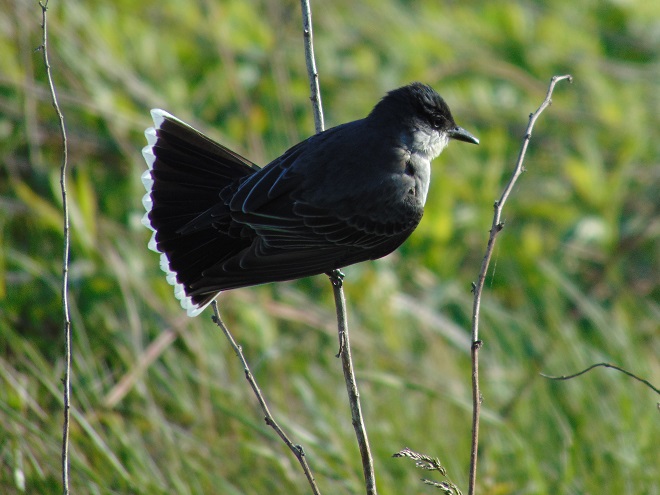
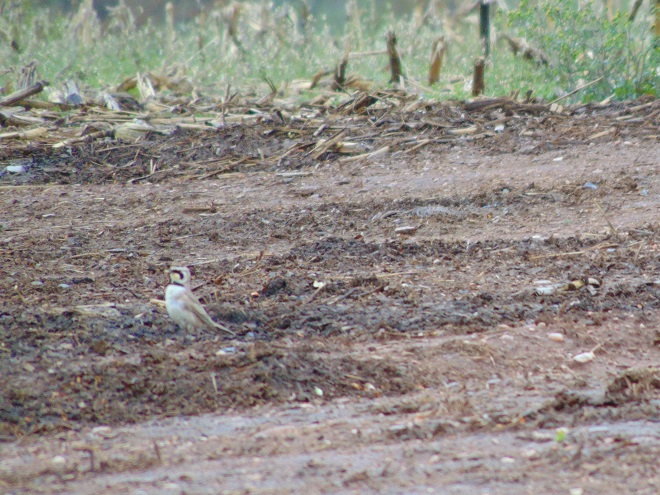
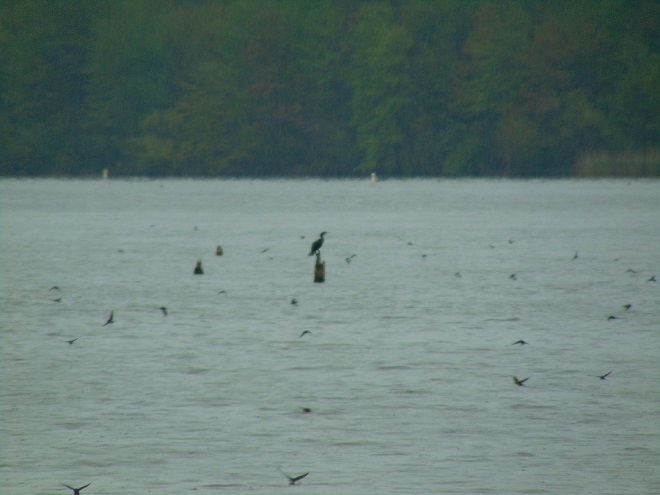
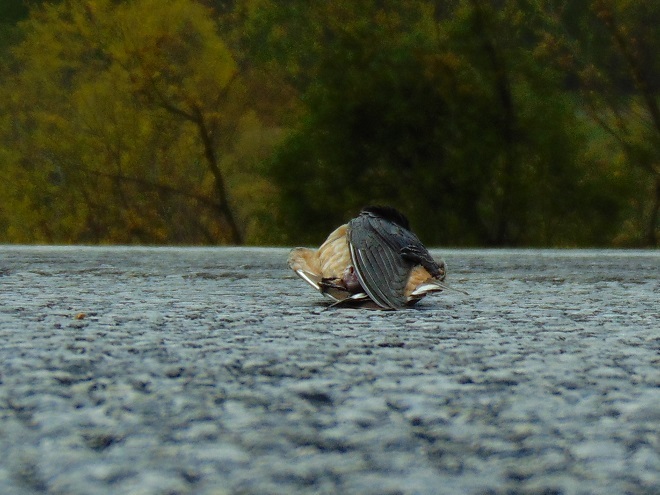
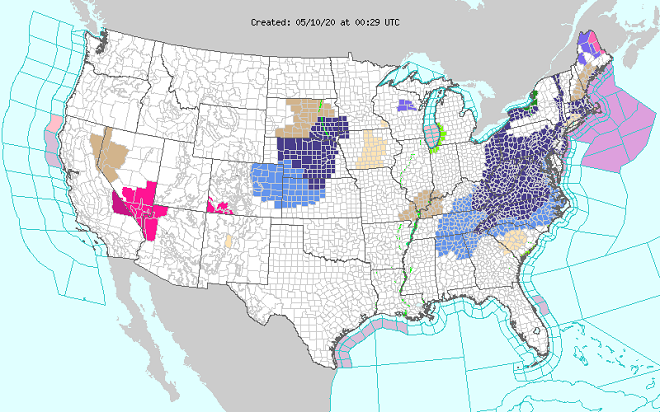
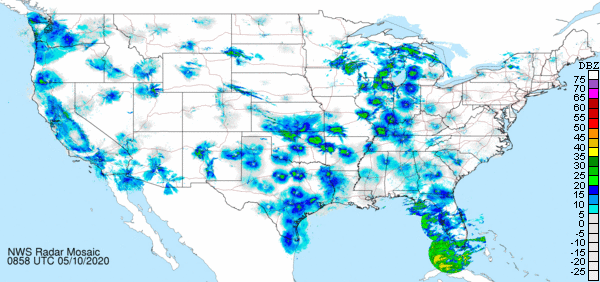
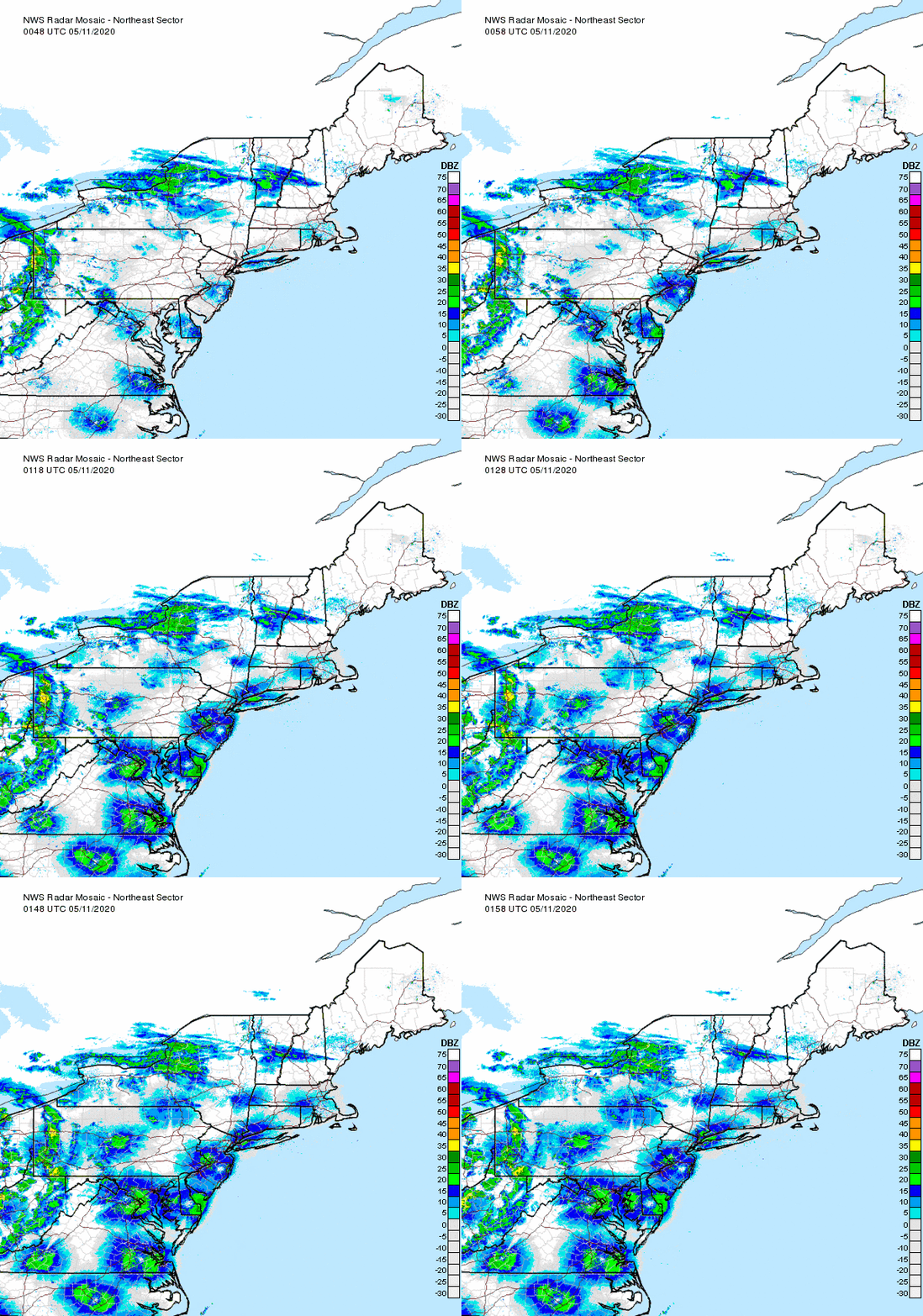
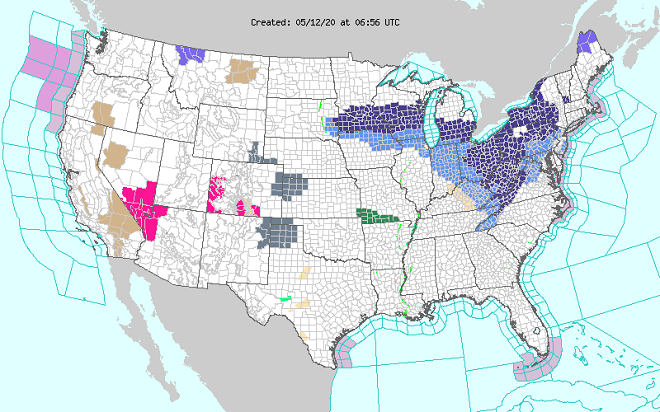
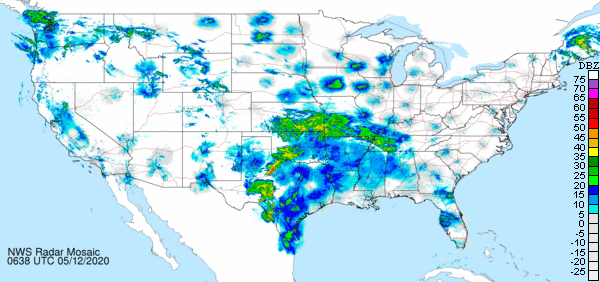
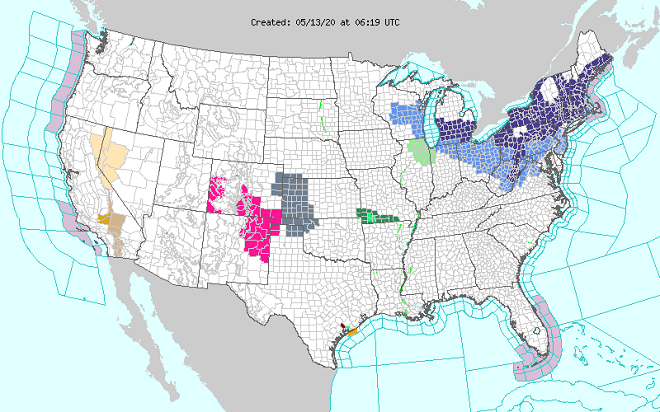
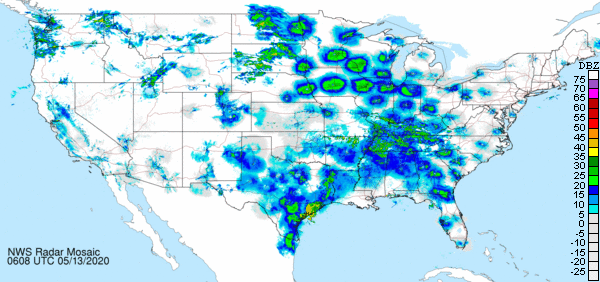
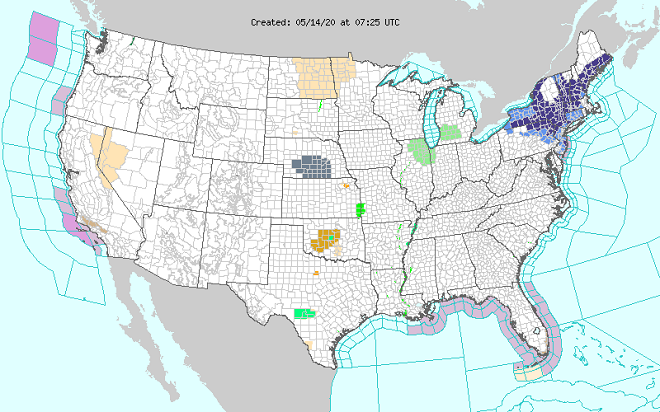
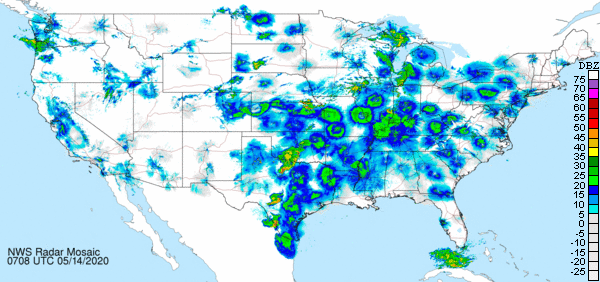
A freeze warning was issued for Saturday morning, May 9, in the counties colored dark blue on the map. (NOAA/National Weather Service image)This radar image from 3:28 A.M. Saturday morning, May 9, indicates a minor movement of birds in the Great Plains, but there are no notable returns shown around weather radar sites in the freeze area, including the lower Susquehanna valley. (NOAA/National Weather Service image)To avoid the cold wind on Saturday, May 9, this Veery was staying low to the ground within a thicket of shrubs in the forest.This Black-throated Blue Warbler avoided the treetops and spent time in the woodland understory. He sang not a note. With birds conserving energy for the cold night(s) ahead, it was uncharacteristically quiet for the second Saturday in May.A secretive Northern Waterthrush (Parkesia noveboracensis) remained in a wetland thicket.A Scarlet Tanager (Piranga olivacea) tucks his bill beneath a wing and fluffs-up to fight off the cold during a brief May 9th snow flurry.In open country, gusty winds kept Eastern Kingbirds, a species of flycatcher, near the ground in search of the insects they need to sustain them.Horned Larks are one of the few birds that attempt to scratch out an existence in cultivated fields. The application of herbicides and the use of systemic insecticides (including neonicotinoids) eliminates nearly all weed seeds and insects in land subjected to high-intensity farming. For most birds, including Neotropical migrants, cropland in the lower Susquehanna valley has become a dead zone. Birds and other animals might visit, but they really don’t “live” there anymore.Unable to find flying insects over upland fields during the cold snap, swallows concentrated over bodies of water to feed. Some Tree Swallows may have abandoned their nests to survive this week’s cold. Fragmentation of habitats in the lower Susquehanna valley reduces the abundance and diversity of natural food sources for wildlife. For birds like swallows, events like late-season freezes, heat waves, or droughts can easily disrupt their limited food supply and cause brood failure.For this Barn Swallow, attempting to hunt insects above the warm pavement of a roadway had fatal consequences.Another freeze warning was issued for Sunday morning, May 10, in the counties colored dark blue on this map. (NOAA/National Weather Service image)This radar image from 4:58 A.M. Sunday morning, May 10, again indicates the absence of a flight of migrating birds in the area subjected to freezing temperatures. Unlike migrants earlier in the season, the Neotropical species that move north during the May exodus appear unwilling to resume their trek during freezing weather. (NOAA/National Weather Service image)On Sunday evening, May 10, a liftoff of nocturnal migrants is indicated around radar sites along the Atlantic Coastal Plain and, to a lesser degree, in central Pennsylvania. The approaching rain and yet another cold front quickly grounded this flight.After a one day respite, yet another freeze warning was issued for Tuesday morning, May 12. (NOAA/National Weather Service image)And again, no flight in the freeze area. (NOAA/National Weather Service image)The freeze warning for Wednesday morning, May 13. (NOAA/National Weather Service image)And the nocturnal flight: heavy in the Mississippi valley and minimal in the freeze area. (NOAA/National Weather Service image)The freeze on Thursday morning, May 14. (NOAA/National Weather Service image)At 3:08 A.M. on May 14th, a flight is indicated streaming north through central Texas and dispersing into the eastern half of the United States, but not progressing into New England. (NOAA/National Weather Service image)The flight at eight minutes after midnight this morning. Note the stormy cold front diving southeast across the upper Mississippi valley. As is often the case, the concentration of migrating birds is densest in the warm air ahead of the front. (NOAA/National Weather Service image)
Today throughout the lower Susquehanna region, bird songs again fill the air and it seems to be mid-May as we remember it. The flights have resumed.
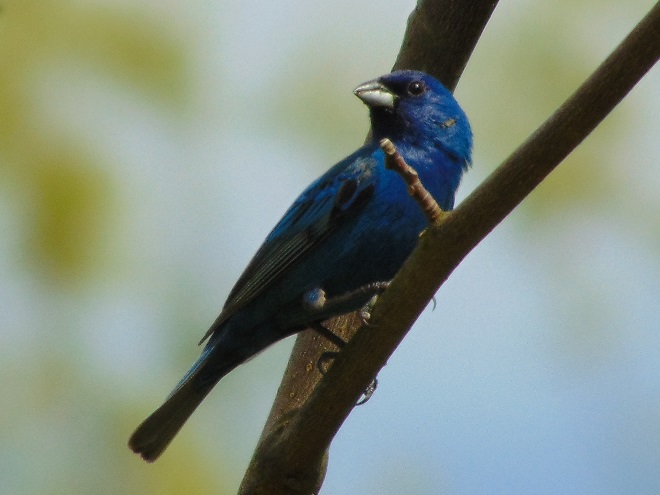
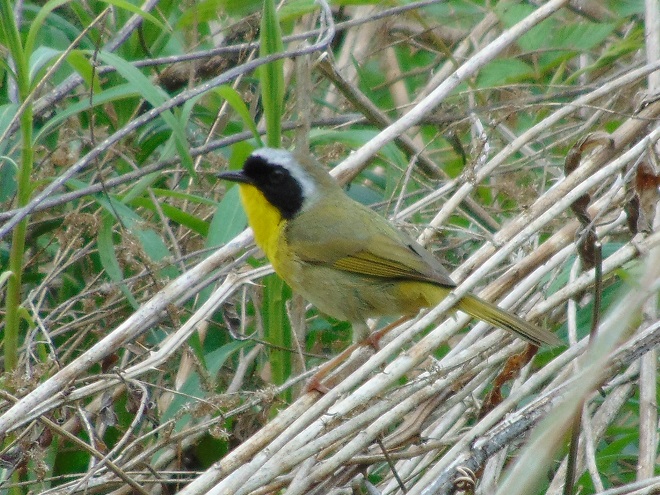
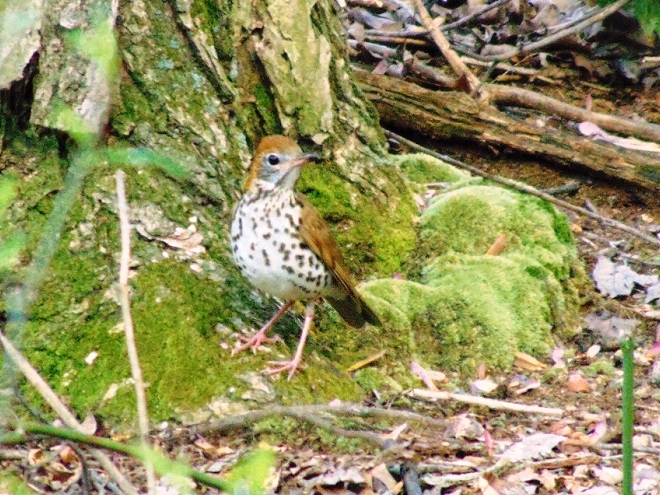
Indigo Bunting numbers are increasing as breeding populations arrive and migrants continue through. Look for them in thickets along utility and railroad right-of-ways.Common Yellowthroats and other colorful warblers are among the May migrants currently resuming their northward flights.The echoes of the songs of tropical birds are beginning to fill the forests of the lower Susquehanna watershed. The flute-like harmonies of the Wood Thrush are among the most impressive.Ovenbirds are ground-nesting warblers with a surprisingly explosive song for their size. Many arrived within the last two days to stake out a territory for breeding. Listen for “teacher-teacher-teacher” emanating from a woodland near you.
You need to get outside and go for a walk. You’ll be sorry if you don’t. It’s prime time to see wildlife in all its glory. The songs and colors of spring are upon us!
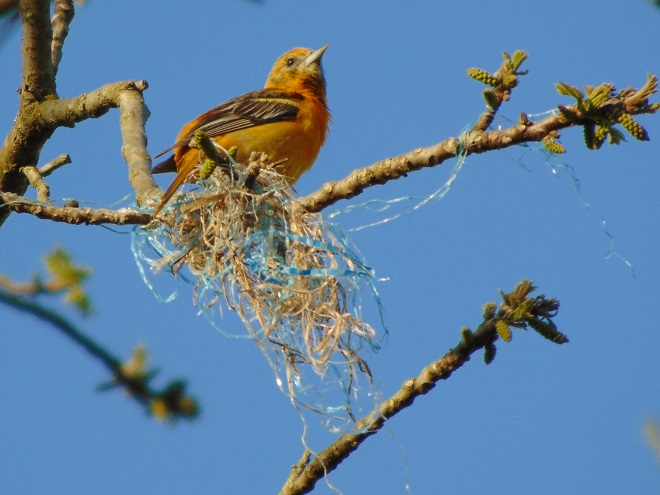
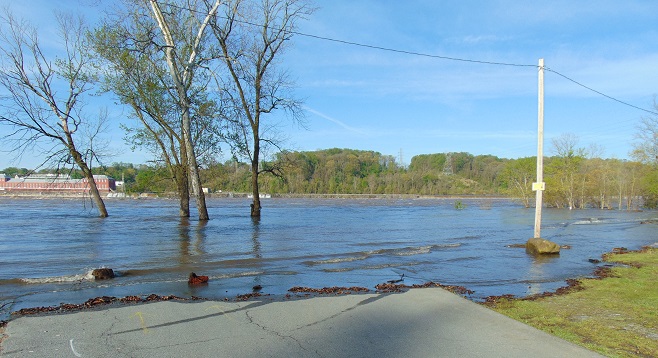
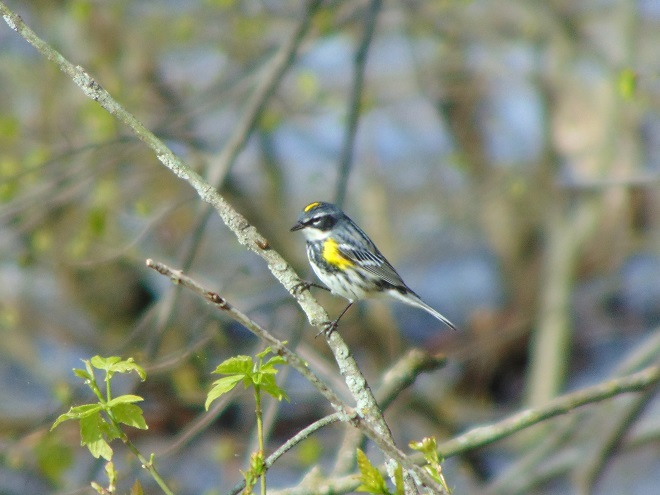
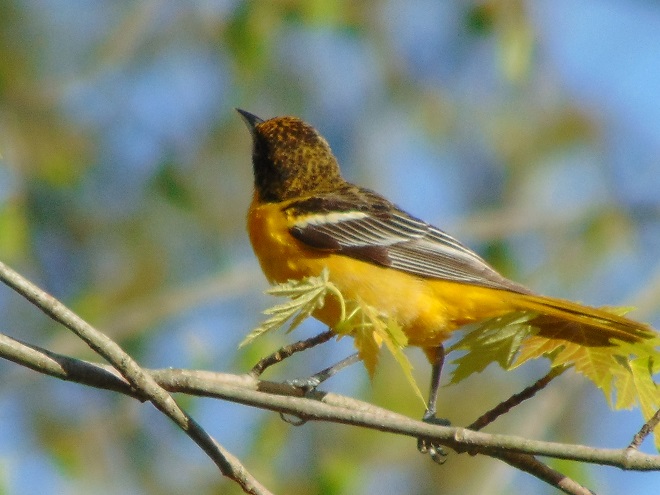
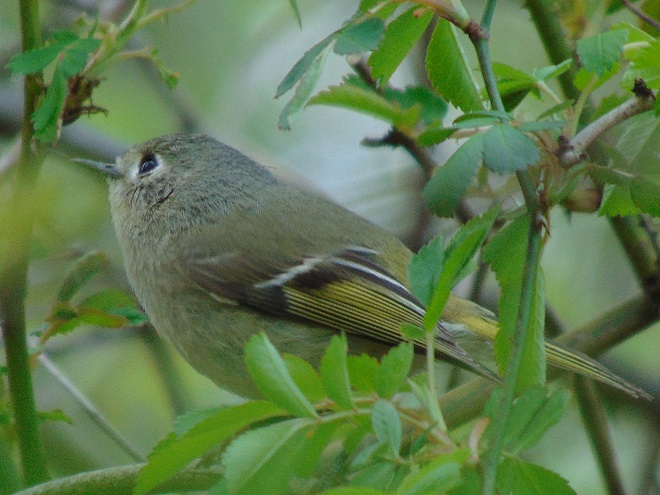
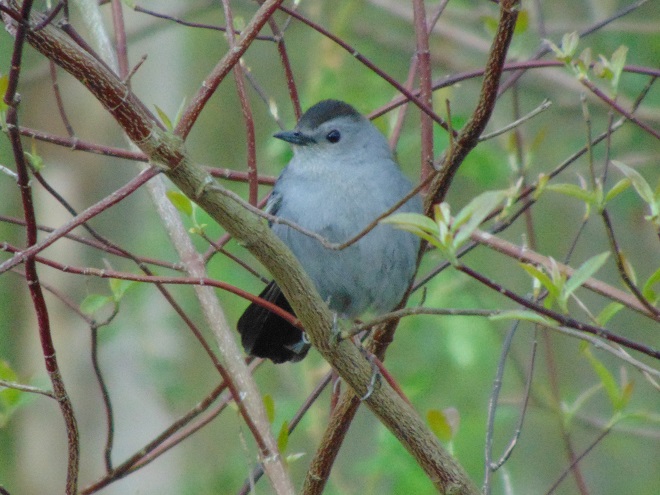
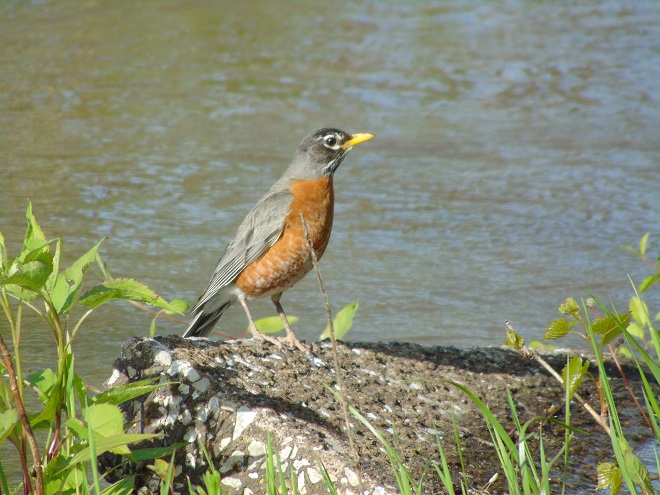
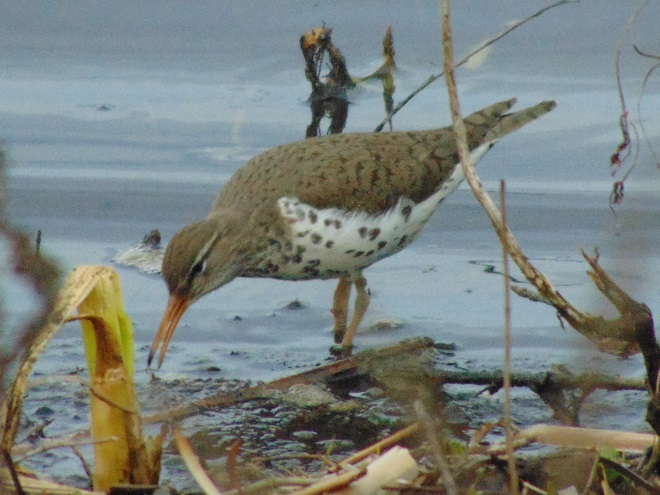
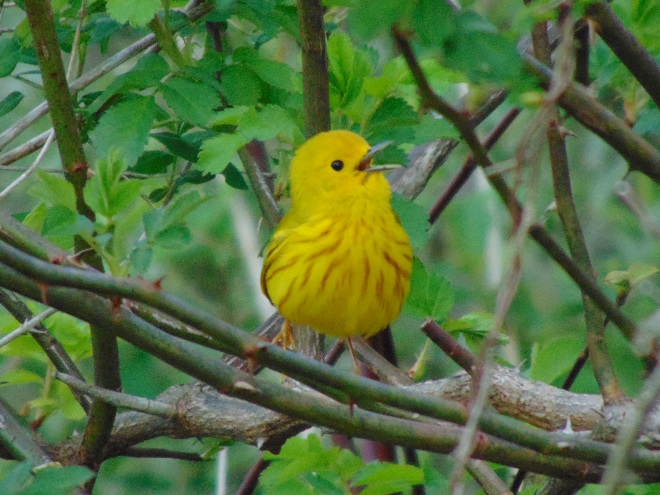
Flooding that resulted from mid-week rains is subsiding. The muddy torrents of Conewago Falls are seen here racing by the powerhouse at the York Haven Dam.Receding waters will soon leave the parking area at Falmouth and other access points along the river high and dry.Migrating Yellow-rumped Warblers are currently very common in the riparian woodlands near Conewago Falls. They and all the Neotropical warblers, thrushes, vireos, flycatchers are moving through the Susquehanna watershed right now.A Baltimore Oriole feeds in a riverside maple tree.Ruby-crowned Kinglets are migrating through the Susquehanna valley. These tiny birds may be encountered among the foliage of trees and shrubs as they feed upon insects .Gray Catbirds are arriving. Many will stay to nest in shrubby thickets and in suburban gardens.American Robins and other birds take advantage of rising flood waters to feed upon earthworms and other invertebrates that are forced to the soil’s surface along the inundated river shoreline.Spotted Sandpipers are a familiar sight as they feed along water’s edge.The Yellow Warbler (Setophaga petechia) is a Neotropical migrant that nests locally in wet shrubby thickets. Let your streamside vegetation grow and in a few years you just might have these “wild canaries” singing their chorus of “sweet-sweet-sweet-I’m-so-sweet” on your property.
If you’re not up to a walk and you just want to go for a slow drive, why not take a trip to Middle Creek Wildlife Management Area and visit the managed grasslands on the north side of the refuge. To those of us over fifty, it’s a reminder of how Susquehanna valley farmlands were before the advent of high-intensity agriculture. Take a look at the birds found there right now.
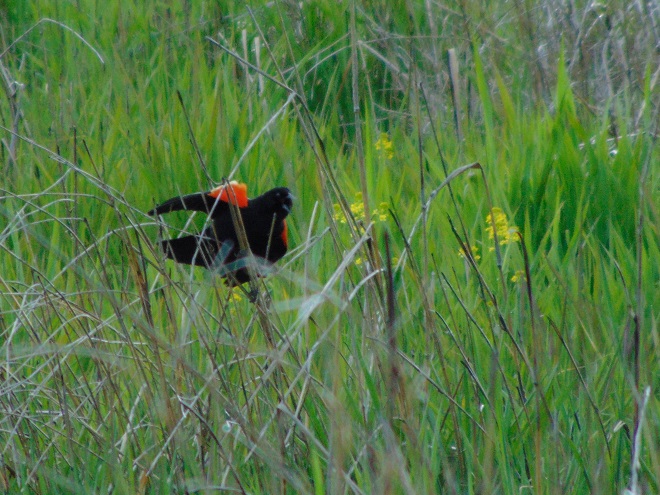
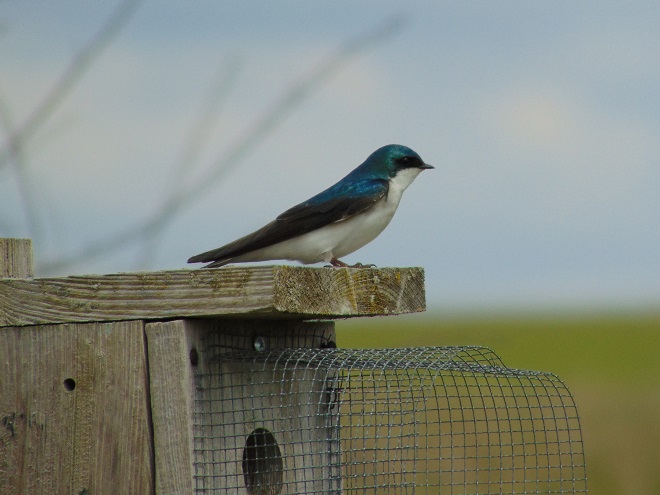
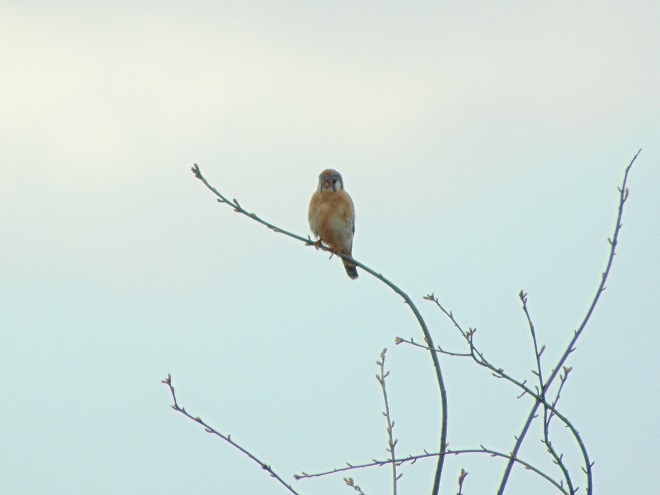
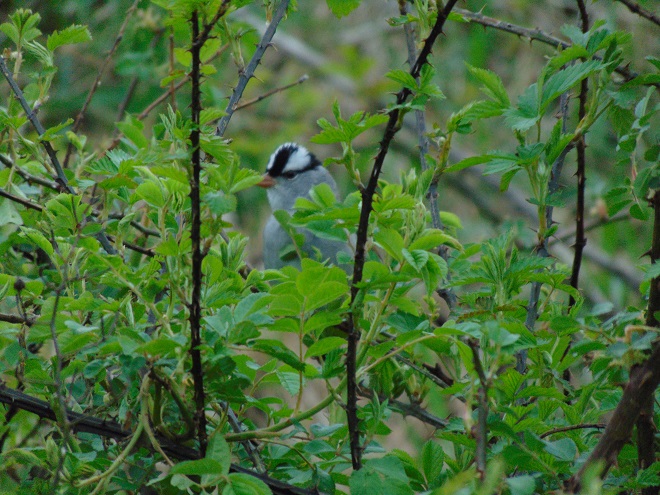
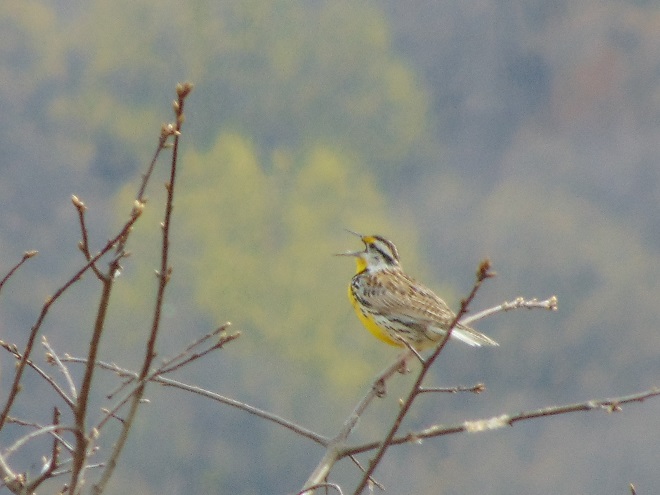
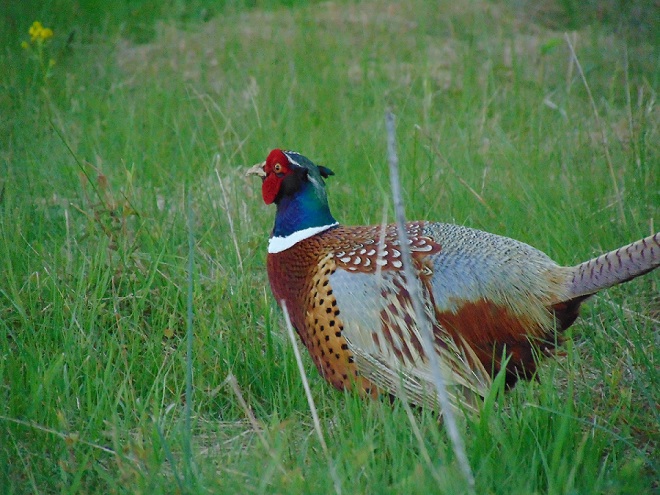
Red-winged Blackbirds commonly nest in cattail marshes, but are very fond of untreated hayfields, lightly-grazed pastures, and fallow ground too. These habitats are becoming increasingly rare in the lower Susquehanna region. Farmers have little choice, they either engage in intensive agriculture or go broke.Nest boxes are provided for Tree Swallows at the refuge.Numbers of American Kestrels have tumbled with the loss of grassy agricultural habitats that provide large insects and small rodents for them to feed upon.White-crowned Sparrows (Zonotrichia leucophrys) are a migrant and winter resident species that favors small clumps of shrubby cover in pastures and fallow land.When was the last time you saw an Eastern Meadowlark (Sturnella magna) singing “spring-of-the-year” in a pasture near your home?And yes, the grasslands at Middle Creek do support nesting Ring-necked Pheasants (Phasianus colcichus). If you stop for a while and listen, you’ll hear the calls of “kowk-kuk” and a whir of wings. Go check it out.
And remember, if you happen to own land and aren’t growing crops on it, put it to good use. Mow less, live more. Mow less, more lives.
And now, a few words from the old watersnake who happens to live down along the creek where last spring’s Earth Day events were held.
Northern Watersnake (Nerodia sipedon sipedon)
Hey! You! Yeah You! I heard that there won’t be an Earth Day celebration down here this week. What a ssshame!
Remember how much fun we had last year. All those kids ssscrambling down along the creek bank throwing ssstones and ssscreaming and yelling like they’re gonna sssack a city. I ssshould have had the sssense to ssslither away. But no, I just curled up and played it cool. But sssure enough, one of the little brats found me and bellowed out loud enough for the whole countryside to hear, “SSSNAAAAKE!”
Ah nuts. That’s all it took. Here they come. Poking me with a ssstick. Taunting and ssstabbing. Don’t you know that hurts? What did I ever do to you, you rotten little apes? I’m telling ya, I get no respect.
Think that’s bad? It got worse. Don’t you remember? After a dozen of the runny-nosed monsters had me sssurrounded, one of the brain-dead adults yelled, “…it might be poisonous!”
That’s all it took. The ssstones got hurled my way and the poking with a ssstick became beatings. Those rats tried to kill me! On Earth Day! I ssslid into deep water and barely escaped with my life.
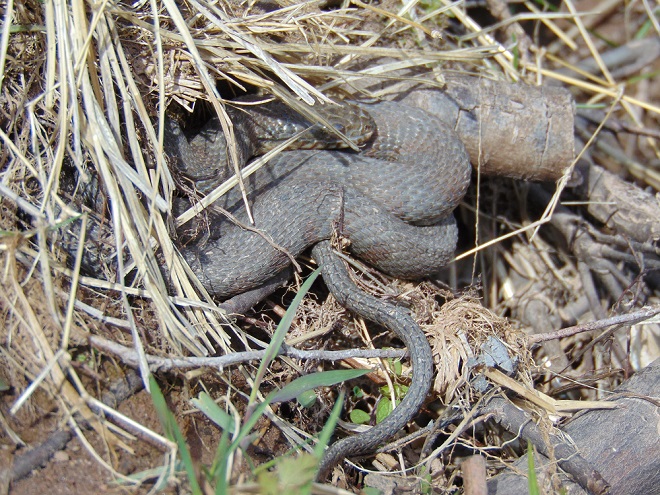
Now I want to tell you a few things—let’s get ’em ssstraight right now. I’m not, nor is any other watersnake in the SSSusquehanna valley, poisonous. Ssso don’t go villainizing me and those like me just because you have a monkey-like fear of us and need a sssocially acceptable reason to exercise your murderous instincts. Yeah, we know all about your manly tall tales of conquest that you ssshamelessly tell your friends and family after you kill a sssnake. Wanna be a hero? Then leave us alone! We and all of the native sssnakes of the SSSusquehanna valley, including the venomous copperheads and Timber Rattlesnakes, are minding our own business and just want to be left alone. Get it? Leave us alone! Don’t beat us with a ssshovel, mow over us, drive your car or truck over us, or ssshoot us. We have it bad enough as it is. You already buggered up most of our homes building your roads, houses, and lawns you know—so have a little respect. And one more thing, we don’t want be part of your pet menagerie. There’s no way we’ll “love you” or want anything to do with you, even if you do imprison us and make us sssubmissive to you for food, you sssick fascists. And that goes for you obsessive collector types too. We know you’re hoarding animals like us and calling your cruel little pet penitentiary a “rescue”. Yeah, we’re wise to that con too.
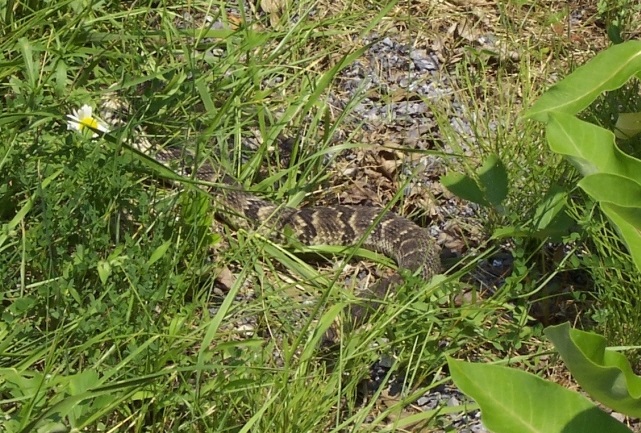
What’s left of a Timber Rattlesnake (Crotalus horidus) in a wild area of the Susquehanna valley. It made the fatal mistake of trying to cross the road when a simple-minded sociopath driving an oversize pickup truck was coming by. As you may have guessed, the conscientious driver braked and swerved to hit the snake.
Ssso we’ve heard you won’t be coming down to the creek to terrorize us this year. No Earth Day event, huh. Well good, because I can’t take another Earth Day. Let the sssquirrels and the birds plant the trees, they do a better job than you anyway. Ssstay at home where you belong—watching television or twit-facing your B.F.F. on that magic box you carry around. And if you absolutely feel the urge to be upset by a sssnake in your midst, go visit that neighbor with the “reptile rescue”, I’m sssure he has a cobra or some other non-native sssnake in his collection that really ought to give you worry—especially when it finally escapes that prison.
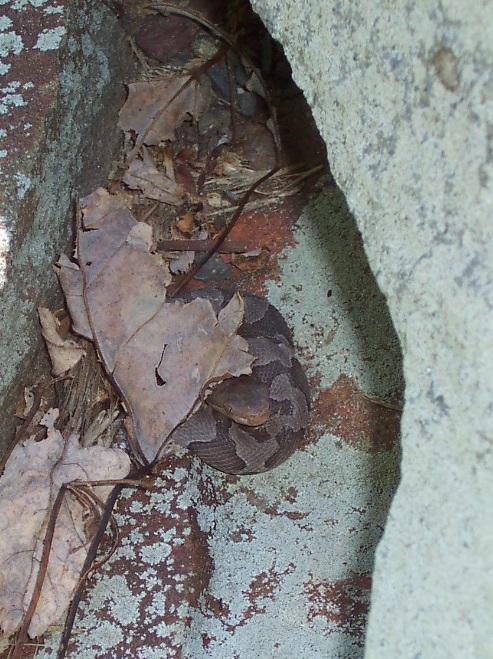
The snakes of the lower Susquehanna valley, including the Eastern Copperhead (Agkistrodon contortix), are very docile and just want to be left alone. That goes for the turtles and other wildlife too. How ’bout showing them all a little respect.
It’s interesting to watch germophobes—and now coronaphobes—in action.
Some germophobes are very sanitary. They’ve practiced aseptic measures for most of their lives and have learned how clean and disinfect themselves and their surroundings quite well. Good for them.
Then there are those germophobes who are really bad at it. They’ve had years and years of practice, but they still can’t get it right. The public restroom is their absolute worst terror. They’ll empty the soap and sanitizer bottles into the mounds of paper towels they’ve stripped from the dispensers on the wall. Then they’ll wipe and scrub the privacy walls, flushable fixture, counter top, and sink they intend to use. (They don’t seem to bother with cleaning the mirrors though; I guess they’re too busy.) The puddles of dripped water leave a trail from the sink to their chosen stall of comfort. Then more paper towels are hauled off to try to dry the sloppy mess they’ve made. Then comes the clincher—not daring to get near a dirty trash can, they flush the giant wad of paper down the toilet and clog it. In frustration, they flush again and again until finally, they flood the entire restroom with sewer water. Then they panic and scurry away without ever finishing the business they started, if you know what I mean. How does your editor know these things? Well, for several years your friendly editor was a repairman in a series of very busy travel terminals, and it was he who got the call to undo the damage. It was an absolute nightmare, and it happened almost every day.
Now that we’re under don’t-call-it-martial-law-martial-law and compliant types are wearing masks while they work or cure their uncontrollable cravings to shop, it’s getting difficult to separate the germophobes from all these coronaphobes and other mask newbies.
I suspect that the handful of people I see in public using a mask as it was designed and then disposing of it properly upon removal have had some sort of medical or laboratory experience sometime in their lives—or they’re one of the skilled master germophobes. Good for them.
The real challenge comes when trying to separate the bumbling germophobe from the new recruits—the sloppy coronaphobes and the not-so-inspired mask-wearers who have been coerced into donning a rag so that they can work or get food. They all share a set of common practices that make telling them apart impossible. First, they’re fussing with the mask. They’ve got their hands on it. They’re pulling it up. Then they’re pulling it down, moving it to their left, then to their right. Crud on their hands gets on the mask, and the creepy crawlies from the mask get on their hands. Mask to hands to everything they touch. It’s almost the equivalent of having their hands in their mouth before pulling them out to grab the door handle, merchandise, or money. Then there’s this common sight—they pull the mask down around their neck for a while, just to smear the stuff that’s inside the mask onto the outside surface, and vice versa. It’s a microbiologists dream (or nightmare) by now. Then they’ll walk around with the mask down over their mouth without it covering their nose, maybe for a half hour or so. Breathing all over the outside before reaching up and pulling it over their nose again. On and on this goes, sometimes for hours or maybe even the whole day. Best of all though is the removal of the mask. It doesn’t go into the trash. Nope, might need it again sooner or later. It’s on the desk, the papers, and the keyboard. Then, it’s hanging over the chair for a while to dry off a little bit. It’s on the dashboard, the car seat, or hanging around the rear view mirror. Look, the dog’s playing with it. Isn’t that cute. Yeah, swell. It might even end up in the grocery bag, but never ever in the trash. And for the life of me, I can’t tell if I’m watching a really fouled-up germophobe or a new amateur in action.
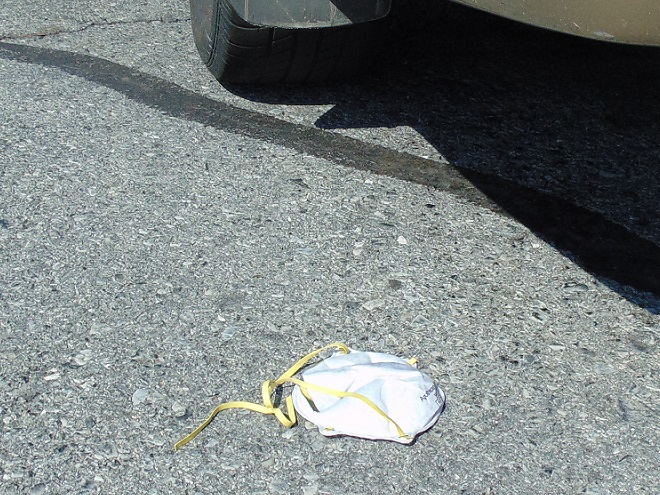
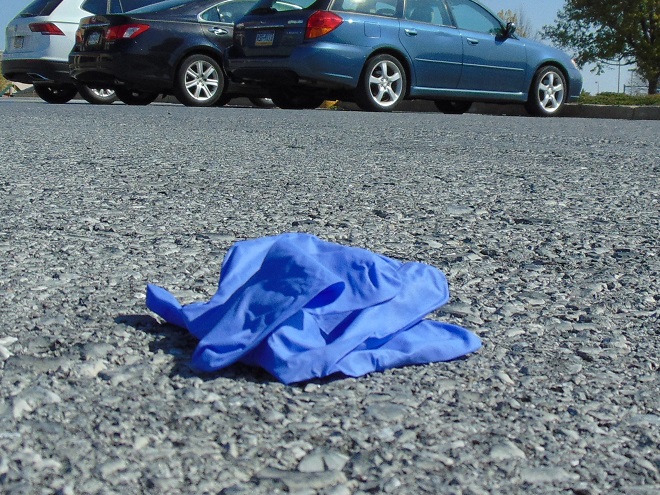
The new sign of a slob in local parking lots. Is it a coronaphobe or just a ticked-off shopper who is sick of being coerced into wearing these things?It’s a pretty good bet that someone tossing a mask and a pair of gloves before darting away is a coronaphobe.
Let’s face it—the use of masks by the general public is a placebo. They aren’t being used correctly and because of it, they offer minimal, if any, protection. Despite rhetoric to the contrary, people wearing masks voluntarily wear them in an attempt to protect themselves, number one, numero uno. These are the coronaphobes. They want to coerce others into wearing masks so that they themselves might be protected. The Republicrats, Democans, bureaucrats, and corporations running “Operation Boxer Shorts” (Objective: cover your @&&) have ignored the advice of researchers on the matter to go along with this silliness—to protect and/or further their own enterprise no doubt. The Centers for Disease Control say they reversed their own advice on masks-for-all not because there’s sound evidence that their effect outweighs their misuse, but because asymptomatic cases of Wuhan flu were discovered. As Foster Brooks used to say, “cockypop!” But okay, fine, so we’ll wear a mask, even though it’s more of a placebo than a prophylactic. We’ll do it just to make you happy. But could you at least pick up after yourself and wash your hands? Oh, and put the masks and gloves in the trash, don’t flush em’ down the commode. Thanks!
I keep wondering how all of this is gonna shake out in Sweden. You know, Sweden, where they didn’t have a lock-down to eviscerate small business and labor while fighting the flu. Yeah, Sweden, where they’re trying a defensive-offensive strategy—protect the most vulnerable (the defense) while allowing natural resistance to develop among enough members of the population to cripple transmission of SARS-CoV-2 (the offense). I’ve been very interested in that strategy. I’ll be watching.
Just in case anybody feels the need, here, again, are the sources on mask wearing.
SOURCES THAT APPARENTLY NOBODY READS
Broseau, Lisa M., and Margaret Seitsema. 2020. “Commentary: Masks-for-all for COVID-19 Not Based on Sound Data”. University of Minnesota Center for Infectious Disease Policy https://www.cidrap.umn.edu/news-perspective/2020/04/commentary-masks-all-covid-19-not-based-sound-data Accessed April 10, 2020.
Davies, Anna, Katy-Anne Thompson, Karthika Giri, George Kafatos, Jimmy Walker, and Alan Bennett. 2013. “Testing the Efficacy of Homemade Masks: Would They Protect in an Influenza Pandemic?”. Disaster Medicine and Public Health Preparedness. 7:4. pp. 413-418.
MacIntyre, C. Raina, Holly Seale, Tham Chi Dung, Nguyen Tran Hien, Phan Thi Nga, Abrar Ahmad Chughtai, Bayzidur Rahman, Dominic E. Dwyer, and Quanyi Wang. 2015. A Cluster Randomized Trial of Cloth Masks Compared with Medical Masks in Healthcare Workers. BMJ Open. 5:e006577. doi:10.1136/bmjopen-2014-006577.
Fifty years ago, the world’s attention was fixed on the fate of the Apollo 13 astronauts—Commander Jim Lovell, Lunar Module Pilot Fred Haise, and Command Module Pilot Jack Swigert—after an explosion disabled their spacecraft and changed a mission to explore the moon into an improvised operation to return them safely to the earth. Perhaps this anniversary comes at a fortuitous time. The story of Apollo 13 may have parallels and lessons pertinent to present-day events and the concerns of people in America and around the world.
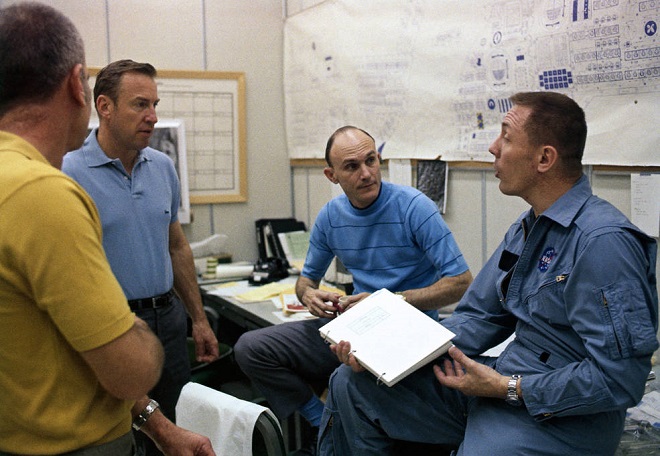
In April, 1970, Jack Swigert was a last-minute replacement for the original Apollo 13 Command Module Pilot Ken Mattingly after Mattingly was exposed to German measles (rubella) prior to the mission. Mattingly had been training with fellow backup crew members John Young and Charles Duke when Duke came down with the disease after he and his family had visited friends whose three-year-old son was suffering the effects of the infection. NASA was wary of contagions that could spread among the astronauts while isolated in a space capsule during a lengthy journey, possibly incapacitating the entire crew. Tests on the astronauts found that Mattingly, like Duke, had lacked antibodies to the rubella virus and could therefore become ill during the flight. Mattingly alone could get sick—Lovell and Haise, possessing resistance to rubella, could not. Nevertheless, the decision was made to substitute Swigert for Mattingly. Swigert proved competent for the late change partly because he had developed many of the emergency procedures for operating the Command Module. Mattingly, who never did get measles, along with Duke and Young, would be the crew for the Apollo 16 moon landing in April, 1972.
NASA preflight meeting discussing the replacement of Mattingly with Swigert just before the launch. Left to right: Chief of Flight Operations Donald “Deke” Slayton, Lovell, Mattingly, and Swigert. (NASA image)
Apollo 13 was launched as scheduled on April 11, 1970, at 2:13 P.M. E.S.T. and was on its way to a planned third landing on the lunar surface.
Launch of Apollo 13 using the Saturn V, the most powerful rocket ever flown. The Command Module would use the call sign “Odyssey”, the Lunar Module “Aquarius”. (NASA image)
After two successful landings, network television found no sensation in the story of yet another trip to the moon. There was little coverage of the mission’s first fifty-five hours. Then, fifty-five hours and just more than fifty-five minutes into the flight, and just two minutes after fulfilling Mission Control’s request to turn on fans to stir the oxygen tanks so that their contents could be measured, Jack Swigert radioed, “Okay, Houston, we’ve had a problem here.” Then Lovell repeated his message, “Houston, we’ve had a problem.” Within a minute, Fred Haise was listing some metering anomalies and alarm activations for Mission Control and added, “And we had a pretty large bang associated with the caution and warning there.” Apollo 13 was about 205,000 miles from earth—it was just after 10 P.M. E.S.T., April 13, 1970.
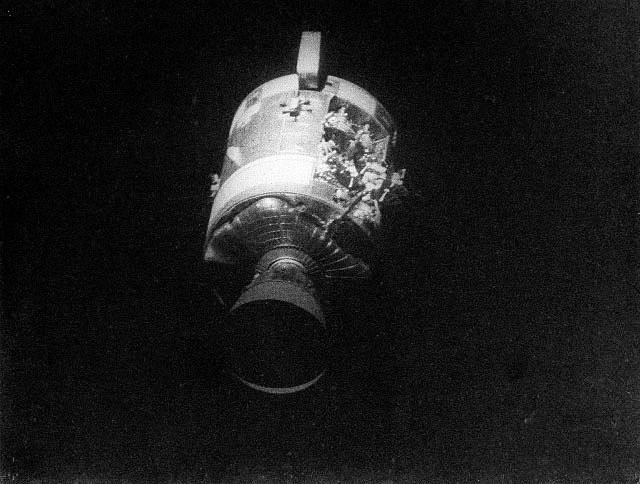
Thirteen minutes after the “bang”, Lovell radioed Mission Control while looking out the capsule’s window, “We are venting something out into the…into space.” Apollo 13 was losing it’s oxygen, and its electric supplies. They didn’t know it at the time, but oxygen tank number two had exploded and damaged either a valve or tubing on tank number one—the Command Module’s only other source of oxygen—and both were losing their contents into space. Two of the three fuel cells had failed as well. Without oxygen, the remaining fuel cell in the Service Module would fail to make electricity for operation of the Command Module. Worse yet, the astronauts would not be able to breathe. Without delay, engineers and scientists on the ground went into action to develop alternatives to the original flight plan.
The damage caused to the Service Module by the explosion of oxygen tank #2 wasn’t visible until it was jettisoned about five hours before Apollo 13 reached earth. (NASA image)
Power in the Command Module had to be conserved for reentry, so with just fifteen minutes of electricity remaining, Lovell and Haise moved into the “lifeboat”, the Lunar Module, and began powering it up while Swigert finished shutting down the systems aboard Odyssey to conserve its remaining energy for the end of the mission. Haise, who had spent fourteen months at Grumman’s manufacturing facility on Long Island, was intimately familiar with the Lunar Module’s operating systems. He powered-up essential systems and began calculating whether the consumables on Aquarius would last for the time it would take to go around the moon and “slingshot” back to earth.
To change the course of Apollo 13 from a moon orbit trajectory to one that would whip around the back of the moon and send them home, Lovell used the Lunar Module’s descent engine to perform a 35-second-long course correction burn. This burn commenced five hours after the explosion at 3:43 A.M. E.S.T. on the morning of April 14. Apollo 13 was then on a free-return trajectory to loop around the moon and return to earth.
Haise had in his possession notes from previous missions which he consulted to determine that they would run out of water about five hours before returning to earth. Fortunately, his notes also showed that the spacecraft’s mechanical systems could remain viable without water cooling for seven or eight hours. Astronauts reduced their water intake to six ounces a day, one fifth of normal, and attempted to compensate by drinking fruit juices and eating wet-packed hot dogs and similar foods. Their efforts to conserve water succeeded, but did lead to the crew becoming dehydrated.
For breathing, there was a sufficient supply of oxygen in the Lunar Module ascent stage where the astronauts would be taking refuge for the remaining four days of the journey. As a backup, there was oxygen in the two suits that were intended for the moonwalk and two more tanks in the ascent stage of Aquarius. Less than half of the oxygen supply was used during the return trip.
Procedures worked out by engineers and tested in a simulator on the ground allowed the crew to use only one fifth of the power normally required during the Lunar Module’s intended forty-five hours of useful life, thus enabling its batteries to last for a ninety-hour-long return trip and add charge to the Command Module batteries—with some energy to spare. To make it back to earth within the ninety-hour time window, the return trip would need to be shortened by nine hours.
The trajectory of Apollo 13’s loop behind the moon had carried them further away from earth than any other humans have ever gone. Two hours after swinging around the moon, Lovell prepared to perform a second burn with the Lunar Module’s descent engine—five minutes in duration—to increase Apollo 13’s return speed and shorten the time it would take to get back home. For navigational alignment during the burn maneuver, debris around the spacecraft made using the sextant to sight stars impossible. Scientists on the ground came up with coordinates allowing Lovell to use the sun as a navigation reference instead. The burn was a success.
Lithium hydroxide canisters remove the carbon dioxide gas, which is continuously produced by the respiration of the astronauts, from the atmosphere of a spacecraft. The Lunar Module’s canisters were designed to protect two astronauts for two days. Because it was being used as a “lifeboat”, Aquarius was hosting three astronauts for four days. After one and a half days of use by three men, an alarm warned that the carbon dioxide levels in the Lunar Module were getting dangerously high. Spare canisters from Odyssey could be used, but there was a problem—they were square, those used on Aquarius were round.
Engineers on the ground went to work using materials that would be available aboard the Apollo 13 spacecraft to improvise a solution. They came up with an adapter design using duct tape, a plastic bag, and cardboard to fabricate a “mailbox” that would attach square lithium hydroxide canisters to the round air handling tubes in the Lunar Module. After testing on the ground, the detailed verbal instructions for constructing the life-saving invention were radioed by Joe Kerwin from Mission Control to Aquarius. Haise and Swigert assembled and installed two of the life-saving devices. Carbon dioxide levels soon dropped back within acceptable parameters.
The makeshift adapters that were built to install square lithium hydroxide “scrubber” canisters on the round air supply tubes in Aquarius forever endeared duct tape to every Mr. Fixit on earth. (NASA image)
The astronauts endured a lack of sleep, heat, water, and food during the trip home. All were dehydrated and collectively they lost over thirty pounds of body weight. As they approached earth, the crew prepared to implement the new procedures for re-energizing the cold damp systems of the Command Module. Ground personnel had drafted and tested this set of startup instructions in just three days instead of the thirty days that such work usually requires. It was critical that the circuits that were energized did not collectively exceed the amperage available from the batteries on Odyssey.
Jack Swigert carefully brought Odyssey back to life using the new procedures, which were radioed, step by step, from Mission Control. Short circuits, feared due to the moisture that had condensed on all the cold surfaces in the Command Module, were not a problem. Improvements to the insulation on the wiring and electrical components throughout the interior of the space capsules following the Apollo 1 fire is believed to have safeguarded against any mishaps.
Four hours before reentry, at 8:15 A.M. E.S.T. on April 17, 1970, the Service Module was jettisoned and photographed as the crew got its first look at the damage caused by the explosion. Just an hour before reentry, Lovell and Haise joined Swigert in the Command Module. At 11:43, the Lunar Module was jettisoned and drifted away.
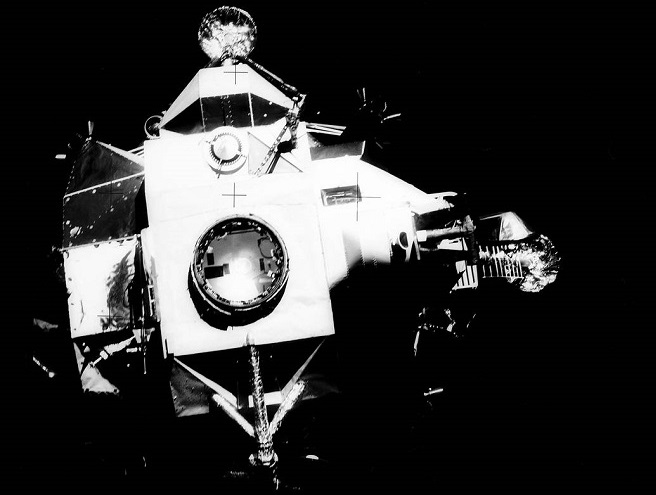
The Lunar Module Aquarius after release from the Command Module capsule Odyssey. Aquarius later reentered earth’s atmosphere and was mostly destroyed. The large pieces that survived descent splashed down at sea and sank. (NASA image)
Apollo 13 reentered earth’s atmosphere and experienced the usual communications blackout as the capsule sizzled through an envelope of ionized air. Mission Control and the world rejoiced as cameras televised images of deployed parachutes and a splashdown in the Pacific Ocean less than four miles from the recovery ship, the U.S.S. Iwo Jima, at 1:08 P.M. E.S.T. Possibly as many as one billion people were watching.
The crew of Apollo 13, (left to right) Haise, Lovell, and Swigert, on the deck of the U.S.S. Iwo Jima less than an hour after splashdown. (NASA image)Flight Director Gene Kranz and Mission Control celebrate the safe return of Apollo 13. (NASA image)
The families of the astronauts had traveled aboard Air Force One along with President Richard Nixon to Honolulu, Hawaii, and were waiting for the Apollo 13 crew when they arrived there from American Samoa on April 18. Nixon presented the men with the Presidential Medal of Freedom.
(NASA image)
“…The men of Apollo 13, by their poise and skill under the most intense kind of pressure, epitomize the character that accepts danger and surmounts it…Theirs is the spirit that built America.”
Among the greatest legacies of the earth orbit and moon missions were the scientific and technological achievements that allowed people to live and travel in space using a minimum of resources. Apollo 13 took these minimums to the extreme—using everything as effectively and efficiently as possible. It was one of the pinnacle achievements of the manned spaceflight program.
Fifty years later, are we embracing these and more recent innovations to live comfortably but wisely?
President John F. Kennedy, in his 1962 speech at Rice University, beckoned Americans to strive for a seemingly unreachable goal. A goal that would motivate a people to determine their own destiny and not have destiny determined for them.
(White House image by Robert Knudsen)
“…We choose to go to the moon in this decade and do the other things, not because they are easy, but because they are hard, because that goal will serve to organize and measure the best of our energies and skills, because that challenge is one that we are willing to accept, one we are unwilling to postpone…”
Kennedy urged his country to take the risk and go to the moon. Despite the dangers, despite the hesitations of the medical community, and in spite of the naysayers, they accepted the challenge and succeeded.
Have Americans lost the will to shape their own destiny? Are they content with blind obedience, mediocrity, and shopping with a dirty rag over their face? Let your friendly editor give you a hint. The people who happen to be front and center in the news today, fifty years after Apollo 13, aren’t rocket scientists. In fact, they have a hard time swallowing anything science has to offer, unless, of course, it can be twisted to back up their sneaky little schemes. But they’re the leadership—elected dimwits and entrenched bureaucrats—and they rule by consent of the governed. So the matter is decided. Look at the bright side though, at least the creeps have a career to protect, so we’ll always be certain of their motivation.
SOURCES
Lovell, James A. 1975. “Houston, We’ve Had A Problem; A Crippled Bird Limps Safely Home”. Apollo Expeditions to the Moon. National Aeronautics and Space Administration. Washington, DC. pp. 247-263.
SOURCES THAT APPARENTLY NOBODY READS
Broseau, Lisa M., and Margaret Seitsema. 2020. “Commentary: Masks-for-all for COVID-19 Not Based on Sound Data”. University of Minnesota Center for Infectious Disease Policy https://www.cidrap.umn.edu/news-perspective/2020/04/commentary-masks-all-covid-19-not-based-sound-data Accessed April 10, 2020.
Davies, Anna, Katy-Anne Thompson, Karthika Giri, George Kafatos, Jimmy Walker, and Alan Bennett. 2013. “Testing the Efficacy of Homemade Masks: Would They Protect in an Influenza Pandemic?”. Disaster Medicine and Public Health Preparedness. 7:4. pp. 413-418.
MacIntyre, C. Raina, Holly Seale, Tham Chi Dung, Nguyen Tran Hien, Phan Thi Nga, Abrar Ahmad Chughtai, Bayzidur Rahman, Dominic E. Dwyer, and Quanyi Wang. 2015. A Cluster Randomized Trial of Cloth Masks Compared with Medical Masks in Healthcare Workers. BMJ Open. 5:e006577. doi:10.1136/bmjopen-2014-006577.
For those of you who dare to shed that filthy contaminated rag you’ve been told to breathe through so that you might instead get out and enjoy some clean air in a cherished place of solitude, here’s what’s around—go have a look.
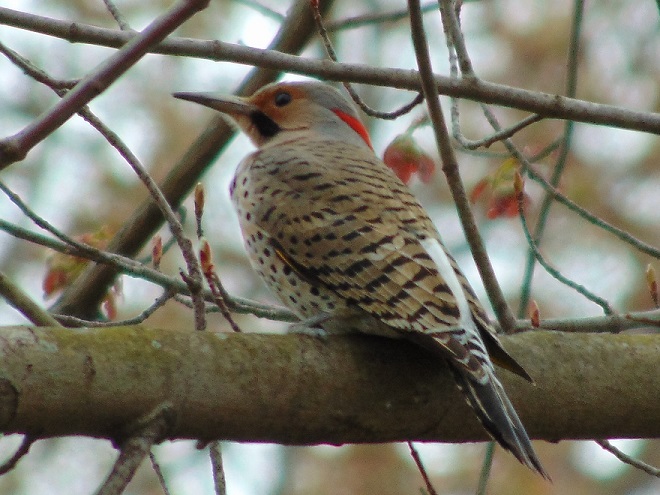
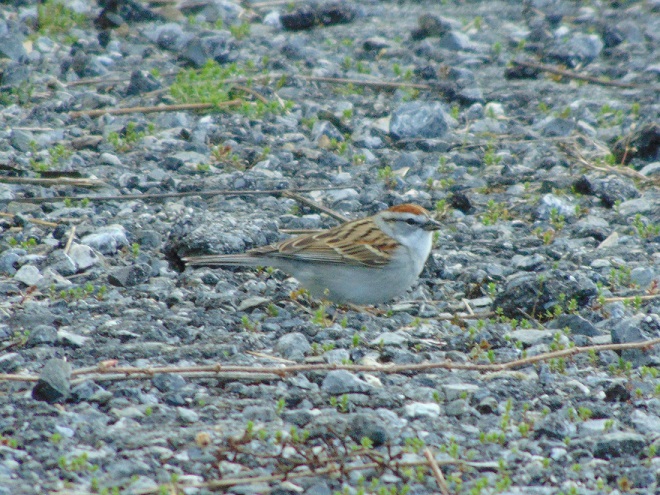
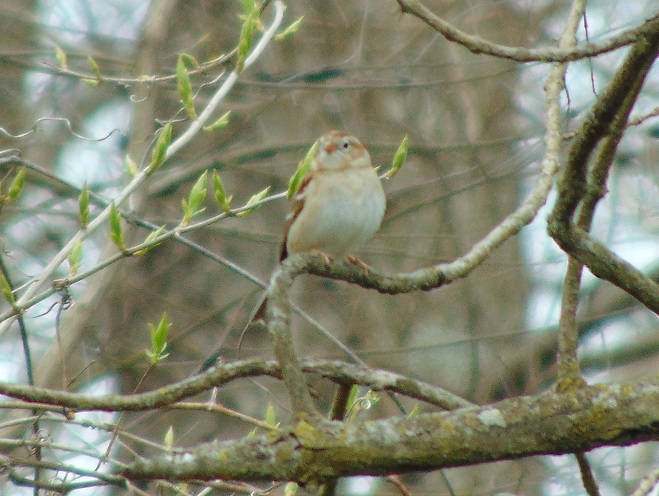
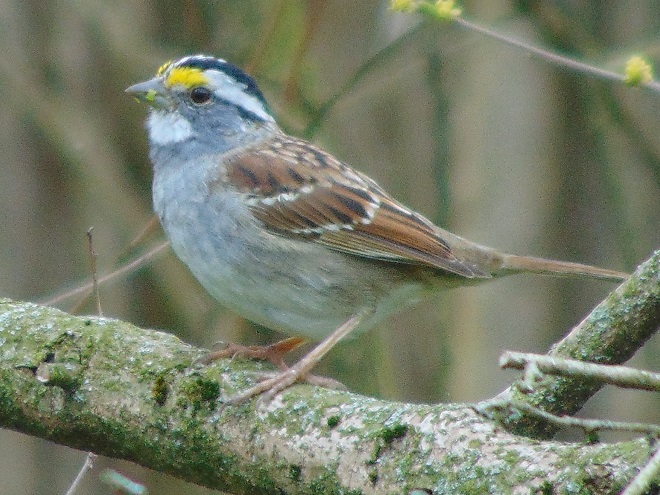
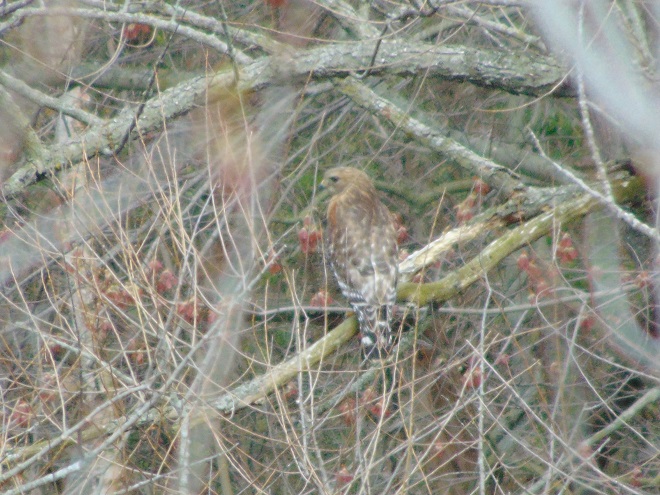
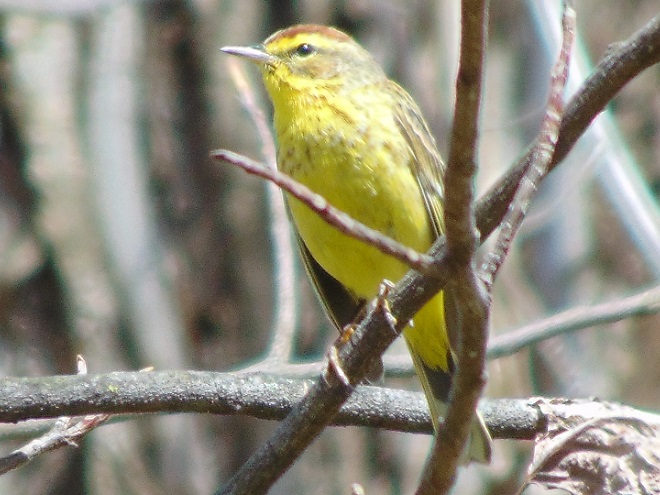
Northern Flickers have arrived. Look for them anywhere there are mature trees. Despite the fact that flickers are woodpeckers, they often feed on the ground. You’ll notice the white rump and yellow wing linings when they fly away.The tiny Chipping Sparrow frequently nests in small trees in suburban gardens. Lay off the lawn treatments to assure their success.Field Sparrows (Spizella fusilla) are a breeding species in abandoned fields where successional growth is underway.White-throated Sparrows spend the winter in the lower Susquehanna valley. Their numbers are increasing now as waves of migrants pass through on their way north.Northbound flocks of Rusty Blackbirds (Euphagus carolinus) are currently found feeding in forest swamps along the Susquehanna. Their noisy calls sound like a chorus of squeaking hinges.Migratory Red-shouldered Hawks are also making feeding stops at area wetlands.The Palm Warbler (Setophaga palmarum) is easily identified by its tail pumping behavior. Look for it in shrubs along the river shoreline or near lakes and streams. Palm Warblers are among the earliest of the warblers to move through in the spring.
The springtime show on the water continues…
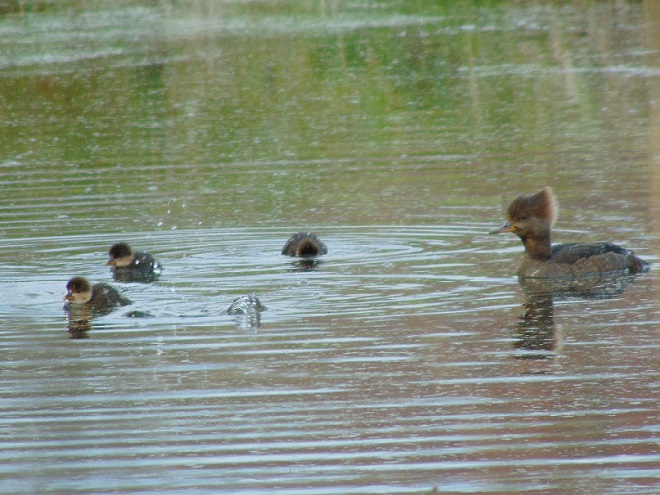
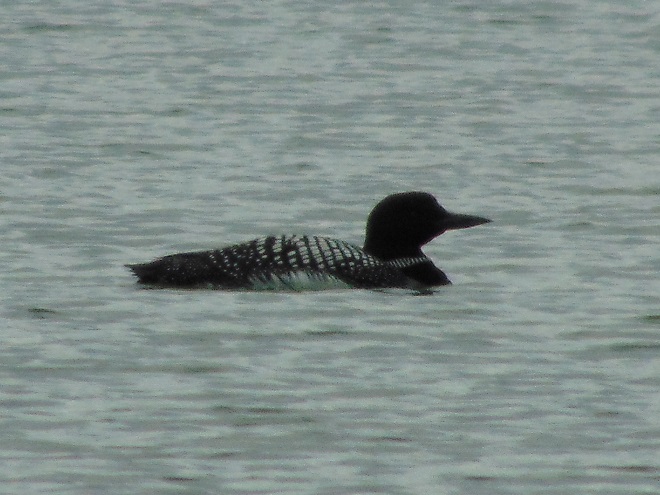
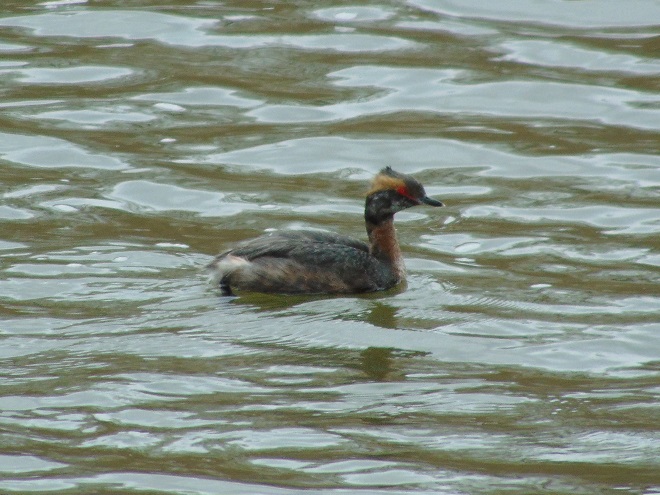
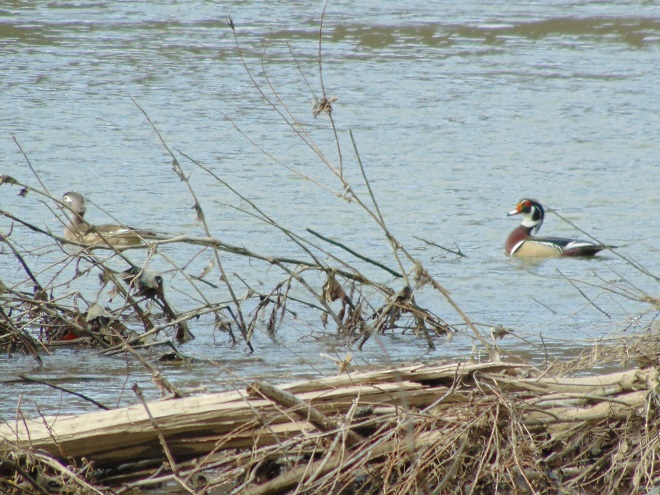
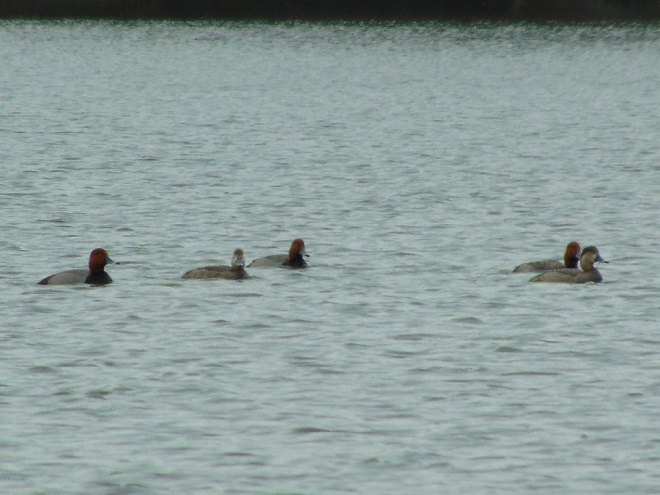
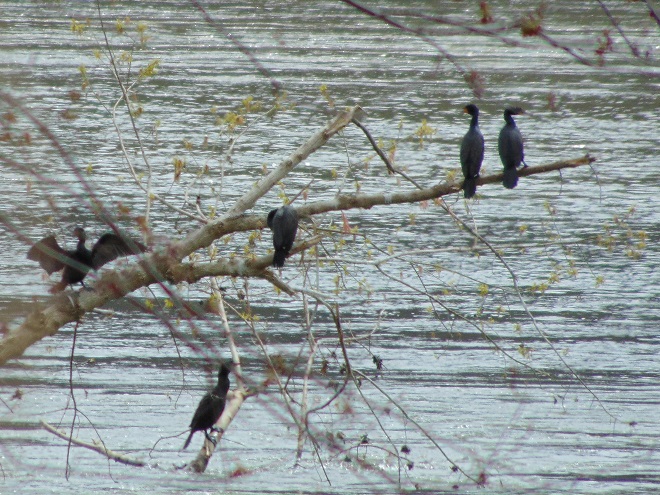
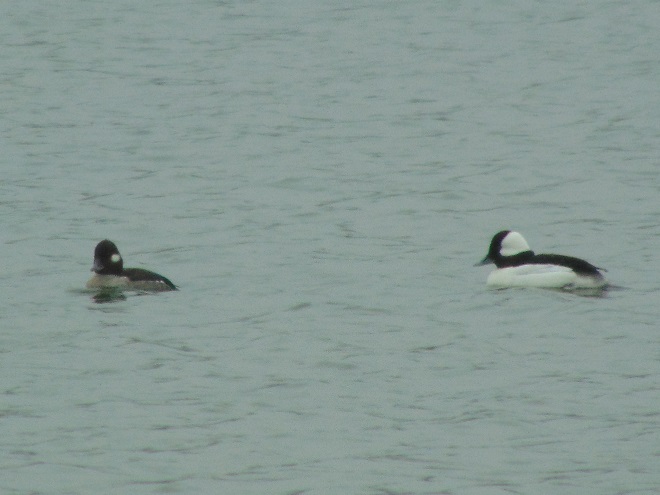
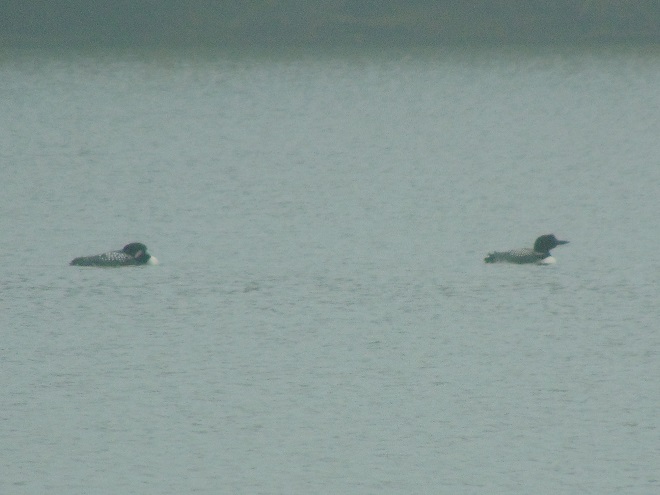
Common Loons will continue migrating through the area during the upcoming month.Buffleheads are still transiting the watershed.Horned Grebes are occurring on the river and on local lakes.Seeing these one-year-old male Hooded Mergansers, the bachelors, wandering around without any adult males or females is a good sign. The adults should have moved on to the breeding grounds and local pairs should be well into a nesting cycle by now. Hatching could occur any day.Like Hooded Mergansers, Wood Ducks are cavity nesters, but their egg laying, incubation, and hatching often occurs a month or more later than that of the hoodies. Judging by the attentiveness of the drake, this pair of woodies is probably in the egg-laying stage of its breeding cycle right now.Redheads (Aythya americana) are stopping for a rest on their way north.In spring, Double-crested Cormorants proceed up the river in goose-like flocks with adult birds like these leading the way.
Hey, what are those showy flowers?
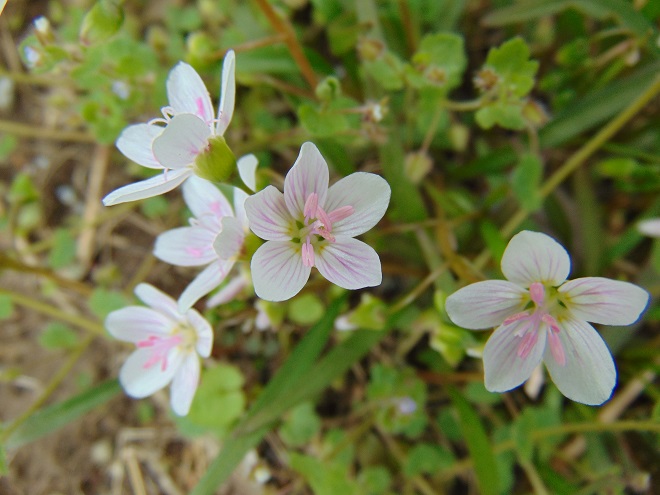
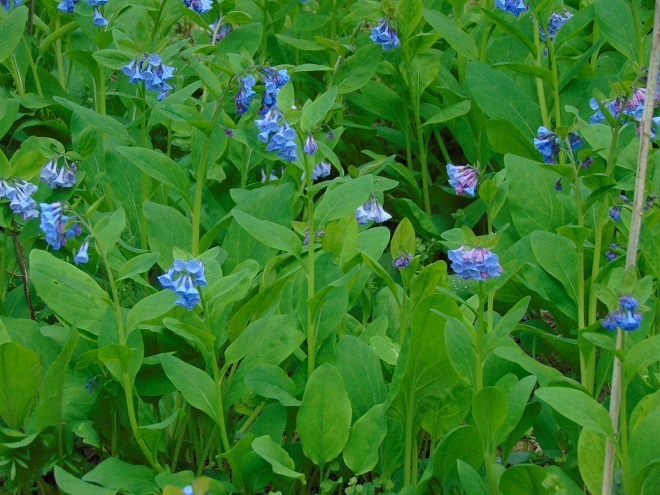
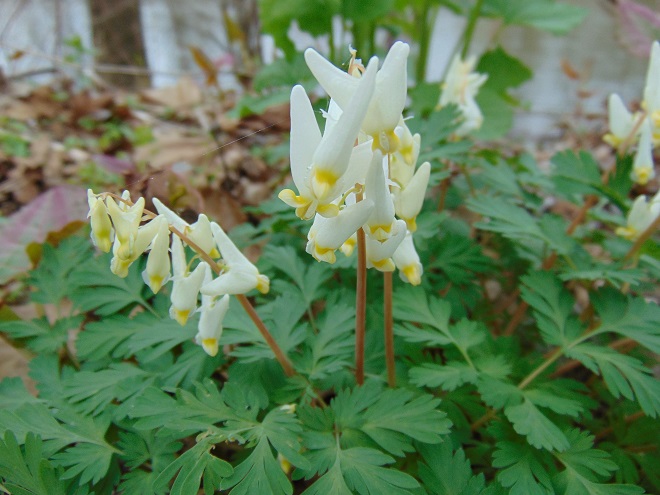
That’s Lesser Celandine (Ficaria verna). It’s often called Fig Buttercup. In early April it blankets stream banks throughout the lower Susquehanna region. If you don’t remember seeing it growing like that when you were younger, there’s a reason. Lesser Celandine is an escape from cultivation that has become invasive. While the appearance is tolerable; it’s the palatability that ruins everything. It’s poisonous if eaten by people or livestock.The Eastern Spring Beauty (Claytonia virginica) is a dainty native wildflower of riparian forests and other woodlands throughout the lower Susquehanna valley.The Trout Lily (Erythronium americanum) is beginning to bloom now. It’s a native of the region’s damp forests.Virginia Bluebells (Mertensia virginica) is not native to the Susquehanna watershed, but neither is it considered invasive. It creates colorful patches in riparian forests.Dutchman’s Breeches (Dicentra cucullaria) is a strikingly beautiful native wildflower that grows on undisturbed forested slopes throughout the Susquehanna valley.
As a public service to our susquehannawildlife.net visitors, Uncle Tyler Dyer has agreed to give us a summary of the news. Uncle Ty is currently in self-imposed quarantine and will continue to remain in isolation until the threat from SARS-CoV-2 passes. Despite his age, he’s not particularly concerned about exposure to the virus or the Wuhan flu; he’s worried about getting bit by one of the “friendly” dogs that are presently dragging their owners down the sidewalks and recreation trails throughout the Susquehanna valley on a daily basis. Worse yet, he dreads the thought of winding up in the E.R. because he got bit by one of their kids. So until the subdivision dwellers go back to work and school, Uncle Ty will remain, like always, out of sight.
To get the latest scoop, be assured that Uncle Ty will poll his many exclusive sources, most of them unavailable to mainstream news reporters. He not only knows people in high places, he knows high people in places.
Here’s the news.
Hey man, I’m Ty Dyer and here’s what’s happening.
The Flat Earth Coalition of Environmental Scientists is advising the public to be alert for an impending threat posed to those who exercise “social distancing”. According to a forthcoming report, if everyone were to maintain a distance of six feet between themselves and all other individuals, those persons around the physical periphery of the mass of humanity will be dangerously close to the horizon’s end. Despite the effects of COVID-19, the world population is still growing by more than 200,000 persons each day. Soon, the earth will become overcrowded and people will begin falling off the planet, possibly within the next several weeks. A spokesperson warned that pushing, shoving, and name-calling could precede the eventual dumping of the weakest from the crowd over the side to make more space. F.E.C.E.S. would not speculate on the fate of those who take the dump; however, those living near the rim are advised to wear a face mask and a parachute while doing their business. Critics were quoted as saying, “The F.E.C.E.S. movement is full of it.”
Meanwhile, the Face Mask Manufacturers Alliance is asking those who are not sick, are not healthcare workers, or have not been exposed to SARS-CoV-2 to stop misusing their products, particularly while there is a severe supply shortage. They warn users that their masks are designed to prevent those who have been exposed to the flu virus or another contagion from transmitting it to others by capturing the aerosols produced by breathing, speaking, coughing, or sneezing. For those who have no flu symptoms or other evidence of exposure, but who insist upon wearing a mask to prevent contracting the virus despite that use being an application inverse to its design, the manufacturers ask that you please turn the mask inside out before donning. To alert others of your status, you are requested to wear your outer garments inside out as well. If you are exposed to SARS-CoV-2, test positive for the virus, or have symptoms of the flu or other contagious illness, you are instructed to wear a mask as designed, right-side out, to prevent contaminating those around you. You can also then turn your clothing right-side out as well.
There is controversy in several northeastern cities today after police officers arrested dozens of people for failing to practice safe “social distancing”. Each of those cited was quickly released to avoid crowding of the precinct houses. The controversy arose when representatives of the cities’ vice squads insisted that enforcing “social distancing” laws comes under their jurisdiction. They reminded city officials that after all, it was the vice squads who for decades have made it clear that violations of “social distancing” laws are not victimless crimes. They then accused city governments of underfunding their operations in an attempt to force them to surrender “social distancing” enforcement to patrol officers while the limited resources of the vice squads deal with the lingering jumbo soda epidemic.
Astronomers today released a statement saying that in deference to the importance of safe “social distancing”, they would eliminate using Gemini as the name of a well-known constellation until further notice. The stars comprising the Gemini twins will now be divided among two new constellations called Hank and Marty. Scientists pointed out that the stars comprising Hank and Marty are actually many light-years apart; it is our vantage point on earth that makes the two men appear to be violating the practice of safe “social distancing”. Nevertheless, they didn’t want Gemini setting a bad example.
Radio broadcasters have announced that many classic rock and pop recordings have been edited and remastered to reflect increased awareness of safe “social distancing”. Here are a few of the slightly amended hits you’ll be hearing on the airwaves soon.
The Beatles—I Want To Hold Your Hand (But My Arms Ain’t Long Enough)
The Beatles with Billy Preston—Get Back (To The Tape Mark On The Floor)
The Beatles—(This Really Isn’t A Good Time To) Come Together
The Captain & Tennille—Love Will Keep Us Together (But You Better Stand Over There)
The Carpenters —(Not So) Close To You
The Jackson 5—I’ll Be There (Or Better Yet Over Here)
Michael Jackson—Beat It (extended remix)
Bette Midler—From A Distance (Remastered)
Olivia Newton-John—(This Is No Time To Get) Physical
Pink Floyd—Comfortably Numb (You Best Skedaddle)
The Police—Don’t Stand So Close To Me (32 minute extended remix)
The Police—Every Breath You Take (You’re Suckin’ In What I Just Exhaled)
Elvis Presley—Love Me Tender (From Over There)
The Rolling Stones—Get Off Of My Cloud (And Outta My Space)
Diana Ross & The Supremes—Someday We’ll Be Together (But Not Right Now)
The Temptations—I Can’t Get Next To You (Remix)
Will the firm friendly handshake share a destiny with cocktails in the workplace, smoldering ashtrays on the desk, and the annual holiday office bash? Coronaphobia, a rallying cause for the next authoritarian movement of do-gooders, is surely on its way. (National Archives-White House image by Oliver F. Atkins)
And that’s what’s going on for April 1, 2020. Ty Dyer saying stay home, don’t get strung up in the puppet show, and remember, there are two different Amazons out there, and the only good one is a river.
Fog and mist lingered throughout the day, as did the migratory water birds on the river and lakes in the lower Susquehanna valley. As a continuation of yesterday’s post on the fallout, here’s a photo tour of some of the sites where ducks, loons, grebes, and other birds have gathered.
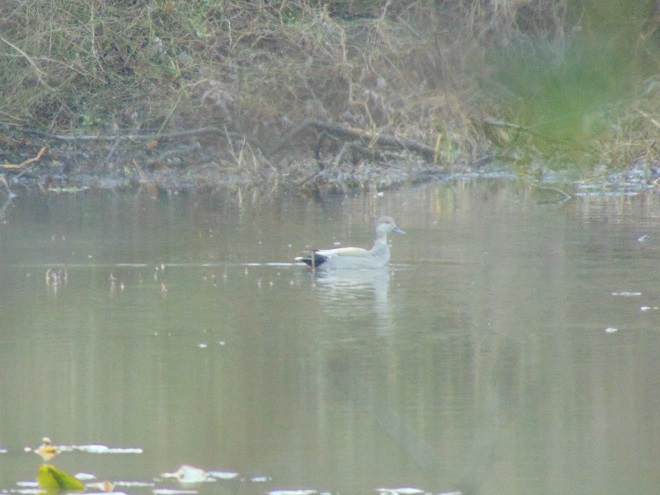
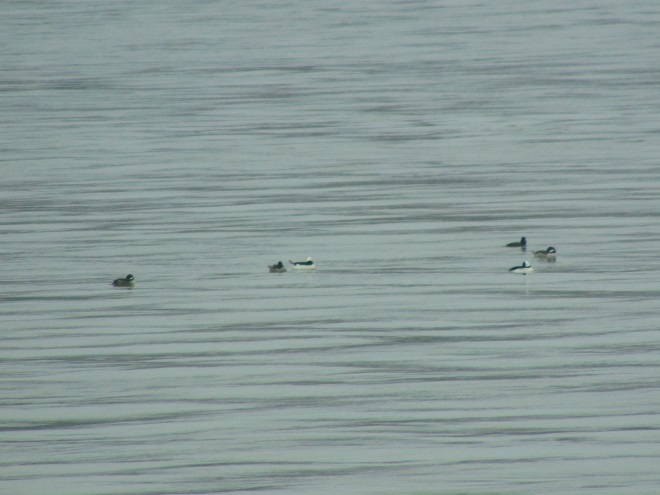
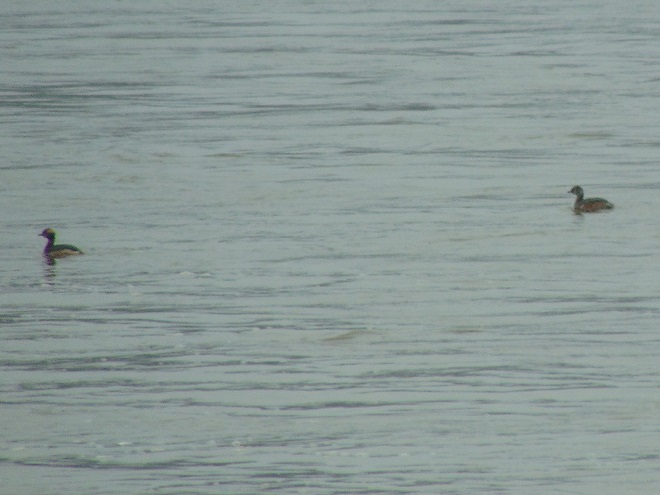
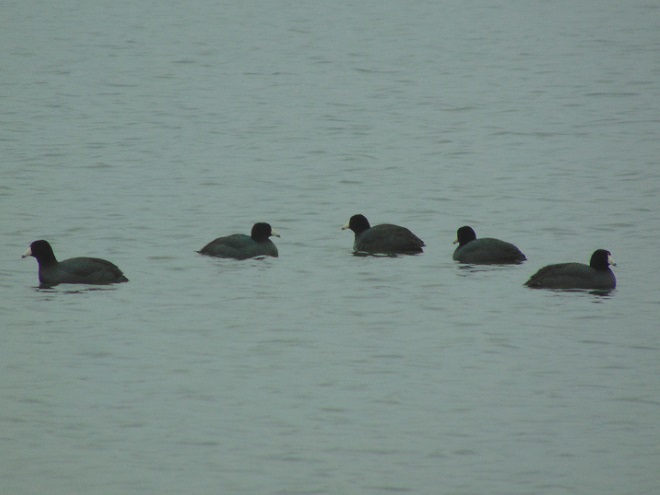
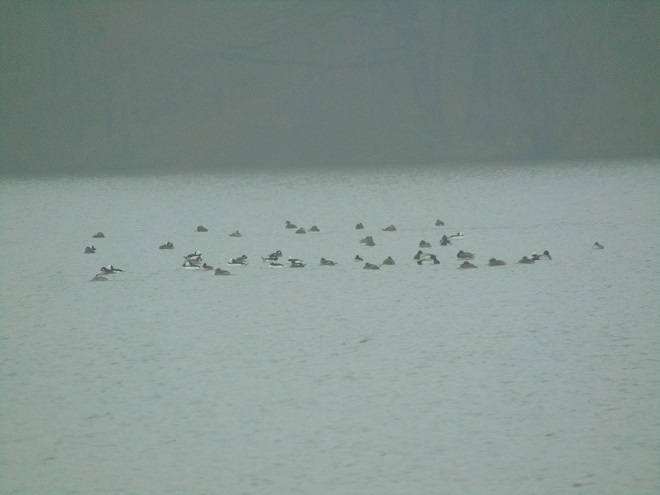
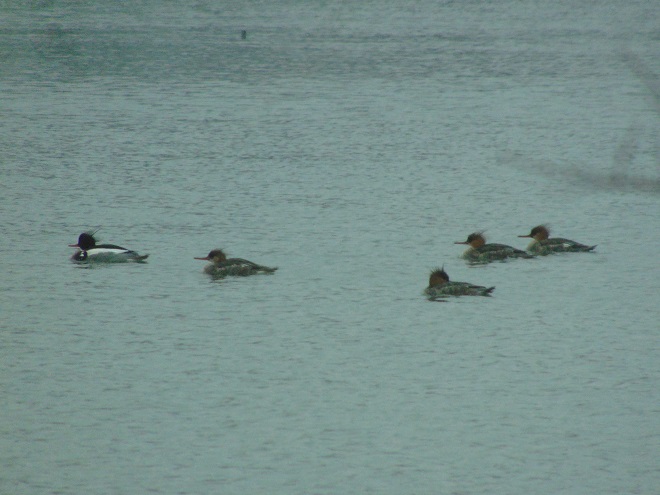
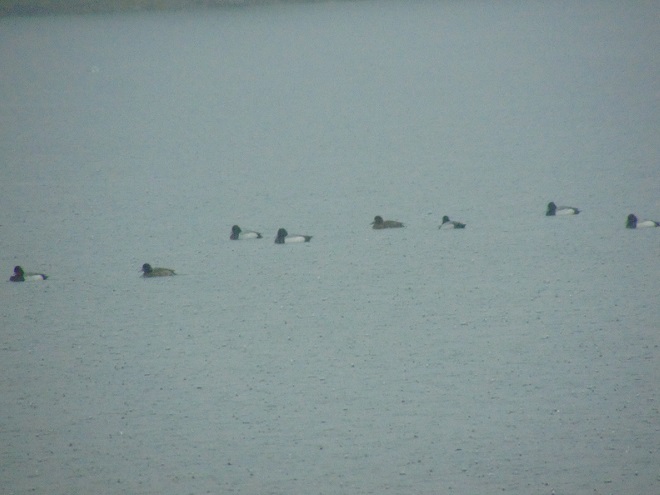
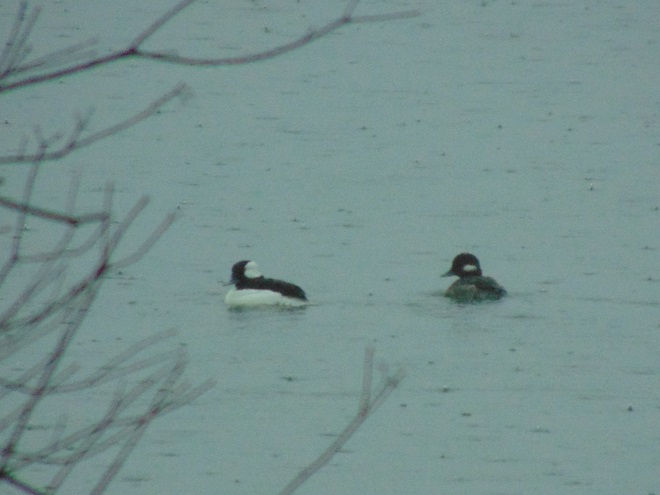
American Robins may have been a large portion of the northbound flight appearing on last evening’s radar images. Today, hundreds could be seen on soggy lawns where earthworms might be found near the surface. This flock was finding sustenance at Highspire’s Reservoir Park in Dauphin County.This drake Gadwall (Mareca strepera) and two hens had dropped in for a visit at the Highspire Reservoir Park.Hundreds of Buffleheads were on the fogged-in Susquehanna River at Harrisburg this afternoon. From Front Street and Maclay Street in front of the Pennsylvania Governor’s Mansion, they seemed to be everywhere in sight on the rain-swollen current. After passing downstream, flocks flew in a straight line formation just above the water’s surface as they made a short trip back up the river to then drift down through the channels once again.A portion of a raft consisting of about three dozen Red-breasted Mergansers floats by the Pennsylvania Governor’s Mansion. Several of the hundred or more Scaup on the river intermingled with these mergansers from time to time.A lone Long-tailed Duck (Clanqula hyemalis) near the aforementioned raft of mergansers. The Long-tailed Duck was formerly known as the Oldsquaw in North America. The common name used in Britain and Europe is now preferred.Two of at least a hundred Horned Grebes (Podiceps auritus) seen in the Susquehanna at Harrisburg this afternoon.American Coots (Fulica americana) at Memorial Lake State Park in Lebanon County.Buffleheads continue at Memorial Lake.One more Common Loon than yesterday at Memorial Lake.A mixed raft of diving ducks and grebes at Memorial Lake.A closeup of the same raft reveals Buffleheads, Scaup, Ring-necked Ducks, Ruddy Ducks (Oxyura jamaicensis), a Pied-billed Grebe, and Horned Grebes.
Local birders enjoy going to the Atlantic coast of New Jersey and Delmarva in the winter. The towns and beaches host far fewer people than birds, and many of the species seen are unlikely to be found anywhere else in the region. Unusual rarities add to the excitement.
The regular seaside attraction in winter is the variety of diving ducks and similar water birds that feed in the ocean surf and in the saltwater bays. Most of these birds breed in Canada and many stealthily cross over the landmass of the northeastern United States during their migrations. If an inland birder wants to see these coastal specialties, a trip to the shore in winter or a much longer journey to Canada in the summer is normally necessary—unless there is a fallout.
Migrating birds can show up in strange places when a storm interrupts their flight. Forest songbirds like thrushes and warblers frequently take temporary refuge in a wooded backyard or even in a city park when forced down by inclement weather. Loons have been found in shopping center parking lots after mistaking the wet asphalt for a lake. Fortunately though, loons, ducks, and other water birds usually find suitable ponds, lakes, and rivers as places of refuge when forced down. For inland birders, a fallout like this can provide an opportunity to observe these coastal species close to home.
Not so coincidentally, it has rained throughout much of today in the Lower Susquehanna River Watershed, apparently interrupting a large movement of migrating birds. There is, at the time of this writing, a significant fallout of coastal water birds here. Hundreds of diving ducks and other benthic feeders are on the Susquehanna River and on some of the clearer lakes and ponds in the region. They can be expected to remain until the storm passes and visibility improves—then they’ll promptly commence their exodus.
The following photographs were taken during today’s late afternoon thundershower at Memorial Lake State Park at Fort Indiantown Gap, Lebanon County.
A one-year-old male Hooded Merganser (Lophodytes cucullatus).Red-breasted Mergansers (Mergus serrator) are a familiar sight in saltwater bays, not so familiar on inland bodies of water.A small raft of Scaup (Aythya species).A pair of Buffleheads.A Common Loon that lands in a parking lot is unable to take flight again. It must be transported to a body of water large enough for it to run across the surface and get the speed it needs to take off and resume its flight. This Common Loon at Memorial Lake has selected an ideal fallout haven. It will have plenty of runway space when it decides to leave.A Pied-billed Grebe (Podilymbus podiceps) in a heavy downpour.
Migrating land birds have also been forced down by the persistent rains.
The tail-pumping Eastern Phoebe is a common sight around the lower Susquehanna valley right now. Many will stay to breed, often building their nests under a man-made bridge, porch. or other structure.
Why not get out and take a slow quiet walk on a rainy day. It may be the best time of all for viewing certain birds and other wildlife.
Wild Turkeys (Meleagris gallopovo) will often leave the cover of woodlands and forest to forage in the open during a rain shower.During the final hours of this evening, wind-assisted flights of northbound migrating birds are indicated as blue masses around radar sites south of the Mason-Dixon Line. These nocturnal flights may constitute yet another fallout in the area of the showers and storms shown passing west to east through Pennsylvania, adding to the existing concentration of grounded migrants in the lower Susquehanna valley. (NOAA/National Weather Service image)
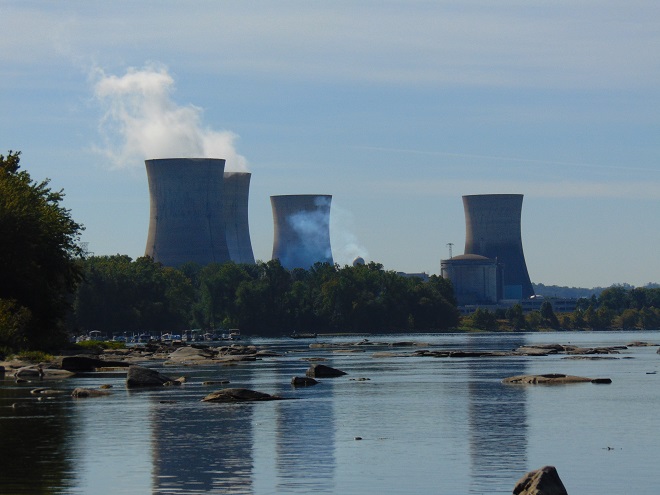
The remains of the Three Mile Island Unit-2 reactor building (right) and cooling towers (left) on September 20, 2019, the day the neighboring Unit-1 reactor was shut down for the final time, thus ending nuclear power generation at the site.
To avoid any theft of the limelight from the country’s miscreants who are currently using the year’s most worrisome virus strain , SARS-CoV-2, as a cover for wealth realignment and self-promotion, this week’s 41st anniversary observance of the 1979 nuclear accident at Three Mile Island has been cancelled. The planned community reenactment festivities will not be held this year.
We will not be recreating the run on the stores or the hoarding of toilet paper, ammunition, food, booze, smokes, prophylactics, and pet treats. Though not sanctioned by the official event, undocumented pharmaceutical distributors will still be vending product to the self-medicated at the usual locations, reminiscent of 1979 commerce.
The Friday night disco get-together featuring authentic vintage 8-track tape music is called off, which of course means that commemorative T.M.I.-2 anniversary t-shirts will not be available for sale this year. If you were thinking of attending, be assured that you can find audio of the Bee Gees’ “Stayin’ Alive” on the internet and play it three times just like it would have been repeated at the dance. You can find other event favorites online too, including the Trammps’ “Disco Inferno”.
The annual “evacuation excursion” to the mountains of Pennsylvania led by the gasoline and gunpowder gang to terrorize the countryside with four-wheel drive trucks, all-terrain vehicles, fireworks, and random weapon discharges is scrubbed. The traditional trash burning in the fire pit on Saturday afternoon and weenie roast scheduled for Saturday night are nixed. Regular participants will have to inhale and ingest their dose of dioxins somewhere else this year.
The consortium of local college drama clubs will not be presenting their popular horror play “It’s Gonna Blow Up”, featuring authentic rumors and supposition from actual news media reports about the 1979 accident. Mock briefings featuring posturing politicians trying to patronize their donors without endangering their reelection prospects will not be held and have been eliminated from the slate of activities—they seem too familiar to be of any interest. A slapstick comedy interpretation of bureaucrats trying to assume authoritarian power to implement an emergency plan that never existed has been postponed until a future event.
Speakers due to share their insights at this year’s gathering have been asked to return next time. We’re pleased that each has agreed. It’s a splendid roster of advocates both for and against nuclear energy, each of whom has shamelessly abandoned their integrity to sustain a do-nothing career that protects them from ever breaking into a sweat. As usual, these appearances will be scheduled as the final feature of the weekend to assure a prompt dispersal of the crowd.
We hope to see you all sometime soon. In the meantime, please remember to use the euphemism “essential workers” when referring to the expendable labor that is out there protecting public health and assuring that everyone can keep shopping. We as a nation would hate for them to realize their worth—they may expect to be better compensated.
As spring begins, our thoughts often turn, if only briefly, to the sun and the welcome effect its higher angle in the sky and the lengthening hours of daylight will have on our winter-weary lives. Soon, spring thunderstorms and warm humid air will make our crops thrive. Plant buds will open to reveal flowers and leaves, and wildlife will hurry to raise a new generation. We’re reminded that the sun is the source of earth’s life—and is its ongoing benefactor.
The rotation period of the sun’s outer layers, the convective zone and the visible photosphere, chromosphere, and corona, is approximately 25 earth days at the equator and as long as 36 days at the poles. Closer to the core, the rotation period in the radiative zone is about 27 days. Note the coronal streamers, filaments of plasma extending into space around the sun. (Image courtesy of Large Angle Spectrometric Coronagraph Experiment/Naval Research Laboratory Solar and Heliospheric Observatory Team)
Coincidentally, there was, during the first full day of spring, an explosion of plasma from the sun—a Coronal Mass Ejection. It happened to occur on the side of the sun currently facing away from earth, so the enormous cloud of magnetic energy won’t be affecting radio communications or electric transmission here.
Friday’s Coronal Mass Ejection can be seen in the following series of images. To protect the camera’s sensor, the direct light of the sun was blocked by an occulter at the center of each picture. The location of the sun’s disk is indicated by the white circle. In this set, the ejected plasma appears as a cloud emerging from behind the left side of the shield and racing millions of miles into space. The speed of a plasma cloud produced by a Coronal Mass Ejection varies. When directed at earth, some can reach our planet in less than a day—others may take several days to arrive.
(Solar and Heliospheric Observatory/Large Angle Spectrometric Coronagraph Experiment images)
Currently though, the term “Coronal Mass Ejection” may cause one to bristle and think of concerns other than the cosmos—Severe acute respiratory syndrome coronavirus 2 (SARS-CoV-2) and the Wuhan flu chief among them.
A Coronal Mass Ejection? (Centers for Disease Control image)
Well, perhaps the promise of warming weather and humid days will help assuage our anxieties.
Colds and flu are certainly more prevalent in winter than during the other seasons of the year. Cases of these diseases begin creeping through schools and workplaces just in time for the year-end holidays. They persist into early spring each year. Then, as we spend more time outdoors in the sunshine and fresh air of April and May, their incidence wanes. Soon the sneezing and coughing is mostly pollen-related and less often the result of transmitted viruses.
In addition to our liberation from buildings crowded with people, spring heat introduces another factor that is apparently responsible for subduing the rapid transmission of viruses—humidity. February and March are typically the driest months of the year in the lower Susquehanna valley. The air outside is cold and dry. The air inside a heated building can be worse.
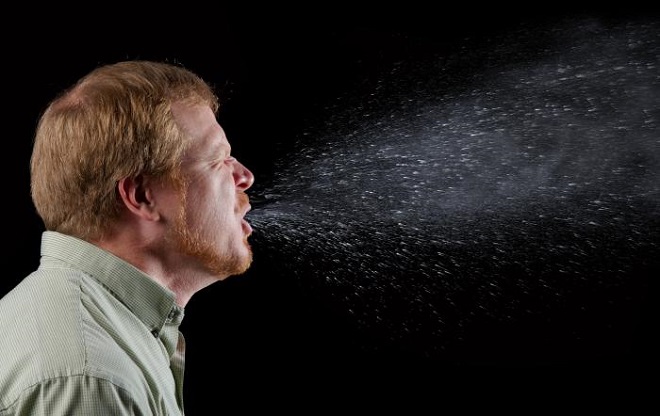
Researchers have found that viruses in aerosols produced by coughing, sneezing, breathing, and talking survive longer in drier air than in humid air. A NIOSH and CDC funded study (Noti, et al., 2013) mechanically “coughed” aerosols containing H1N1 virus into a simulated examination room. They discovered that “…one hour after coughing, ∼5 times more virus remains infectious at 7-23% RH (relative humidity) than at ≥43% RH.” This is a significant discovery and may shed light on why the end of heating season and the arrival of warmer humid springtime air coincides with the end of cold and flu season. The study’s analysis determined that “Total virus collected for 60 minutes retained 70.6-77.3% infectivity at relative humidity ≤23%, but only 14.6-22.2% at relative humidity ≥43%.” Specifically, they found that the greatest effect of higher relative humidity occurs during the first fifteen minutes after the cough, and that virus in droplets exceeding 4μM in diameter had the most significant reduction in that time—ninety percent.
It looks like a little global warming wouldn’t hurt right now.
So remember, respect the sun—fear asteroids.
SOURCES
Burnham, Robert, Alan Dyer, Robert A. Garfinkle, Martin George, Jeff Kanipe, and David H. Levy. 2006. The Nature Companions Practical Skywatching. Fog City Press. San Francisco, CA.
Noti, J.D., F. M. Blachere, C. M. McMillen, W. G. Lindsley, M. L. Kashon, D. R. Slaughter, et al. 2013. “High Humidity Leads to Loss of Infectious Influenza Virus from Simulated Coughs”. PLoS ONE. 8:2 e57485. https://doi.org/10.1371/journal.pone.0057485
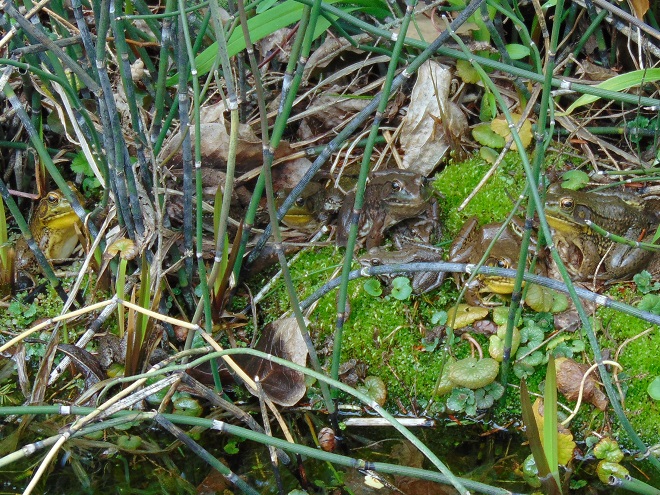
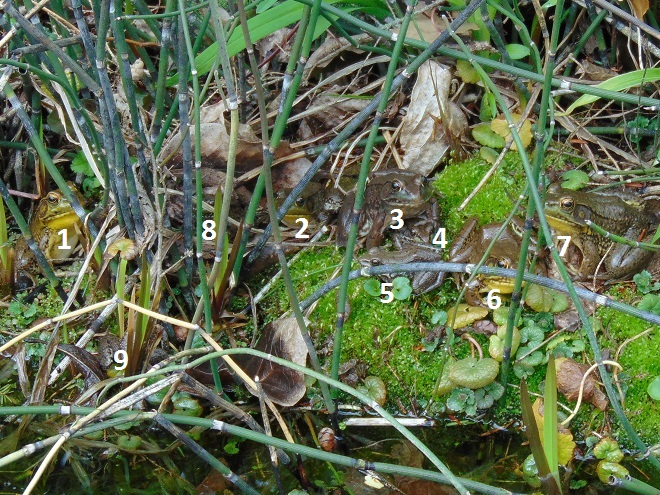
The mild winter has apparently minimized weather-related mortality for the local Green Frog population. With temperatures in the seventies throughout the lower Susquehanna valley for this first full day of spring, many recently emerged adults could be seen and, on occasion, heard. Yellow-throated males tested their mating calls—reminding the listener of the sound made by the plucking of a loose banjo string.
Here’s a gathering of Green Frogs seen this afternoon along the edge of a small pond. How many can you find in this photograph?
If you venture out, keep alert for the migrating birds of late winter and early spring.
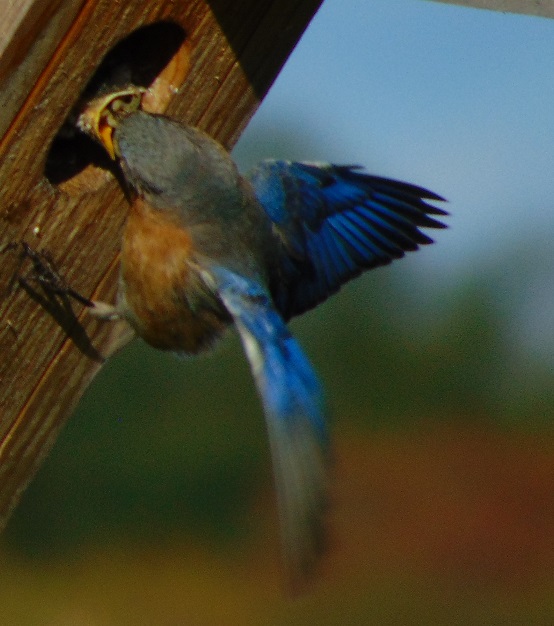
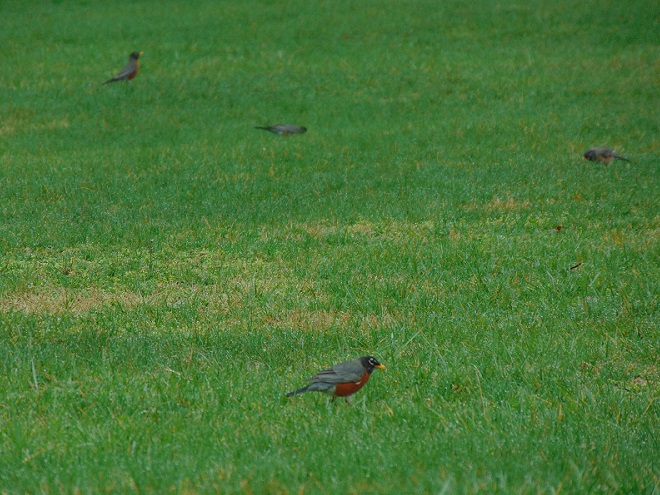
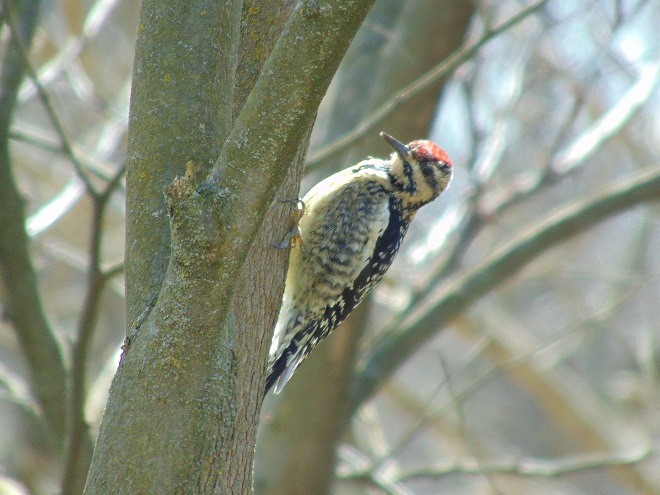
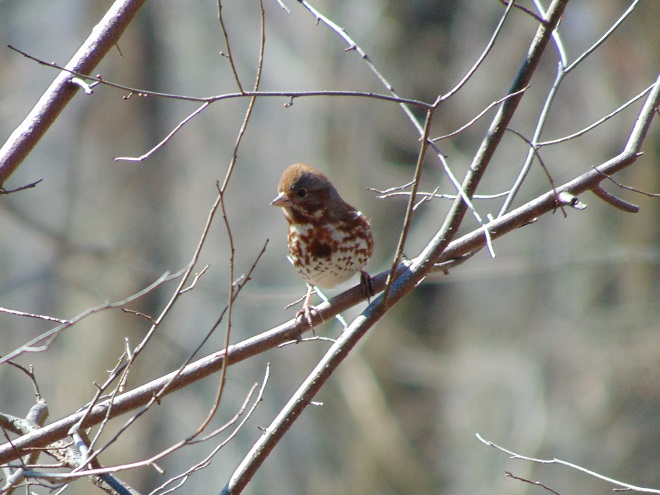
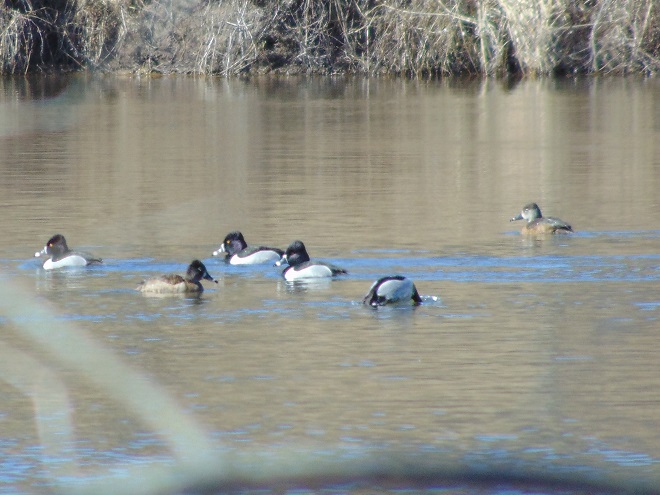
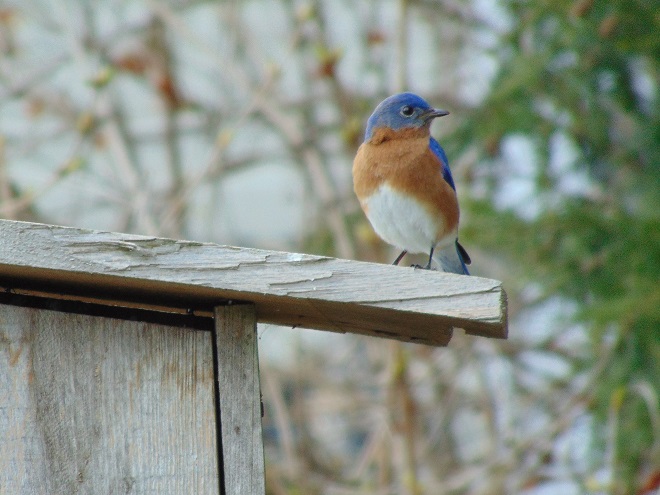
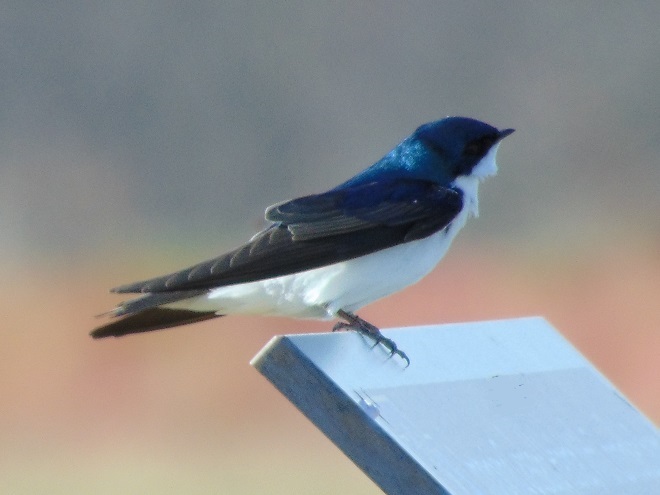
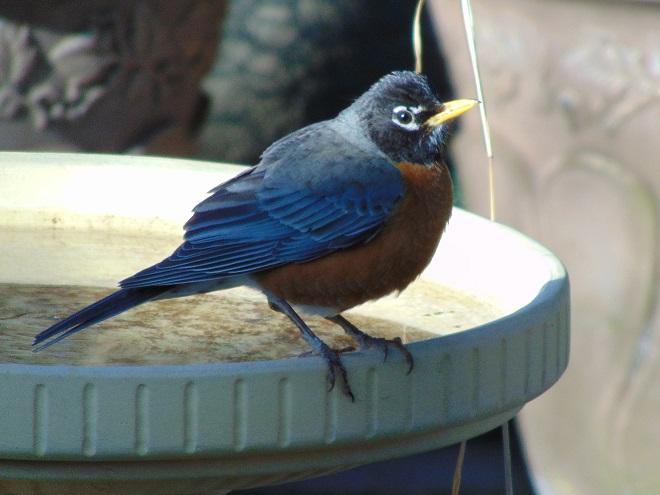
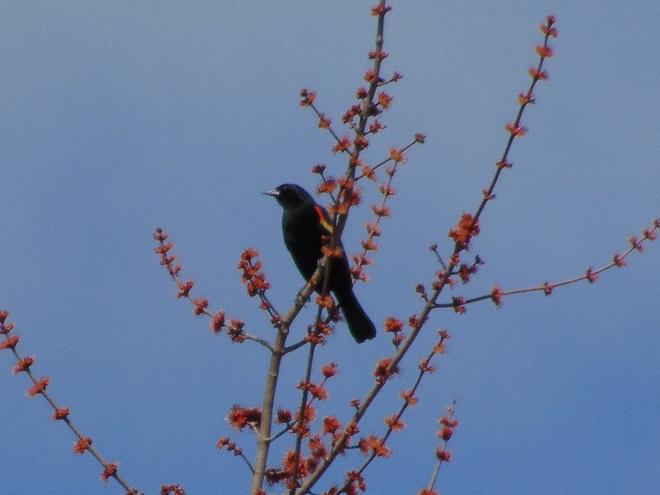
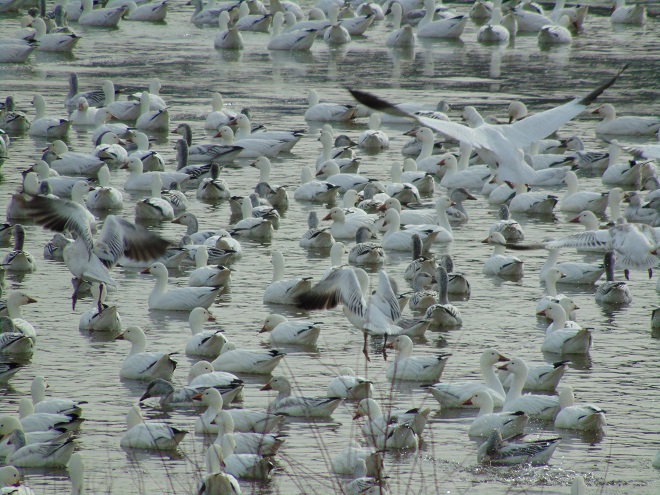
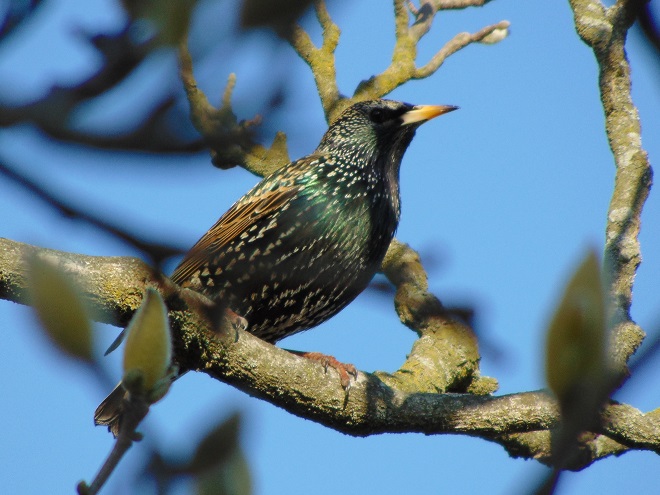
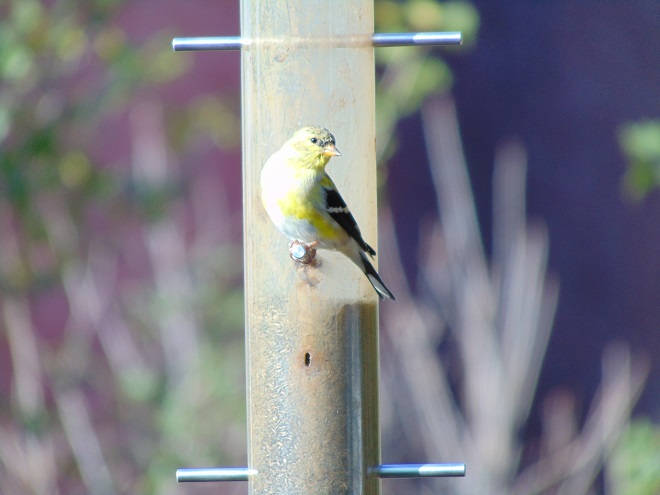
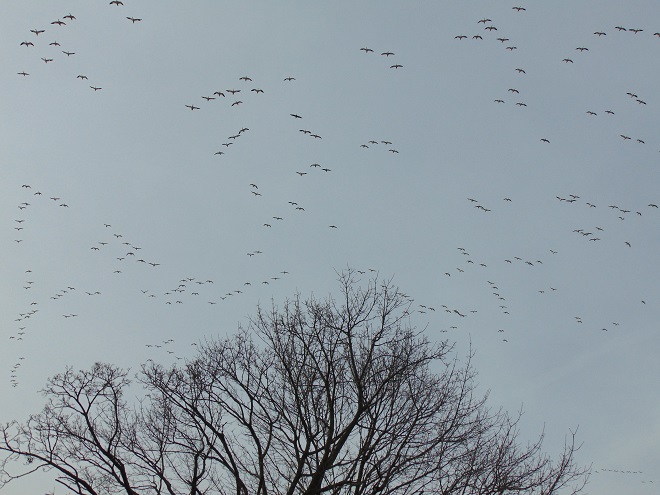
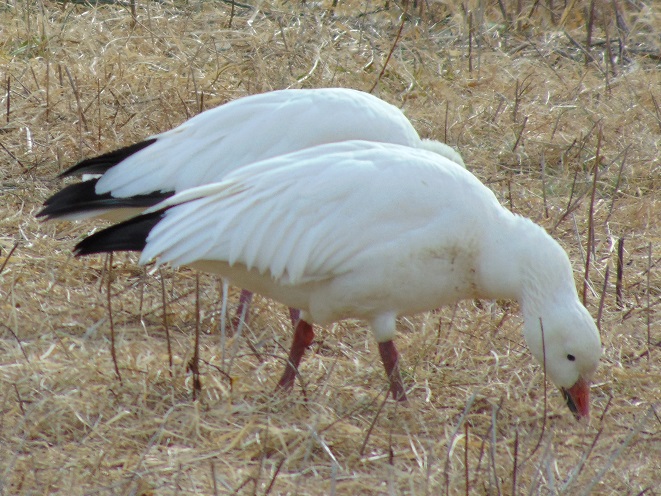
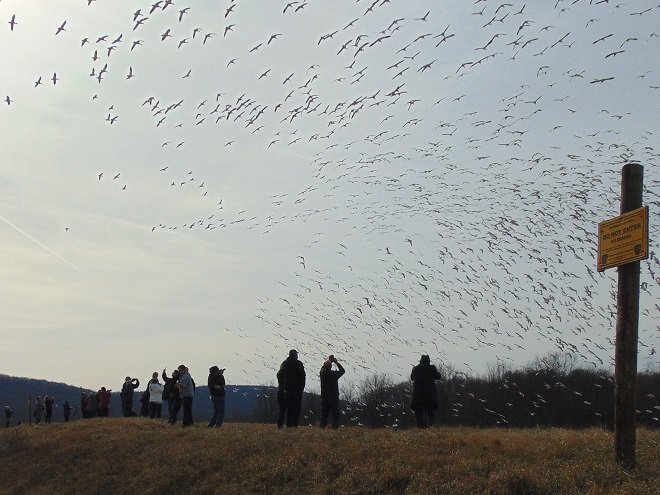
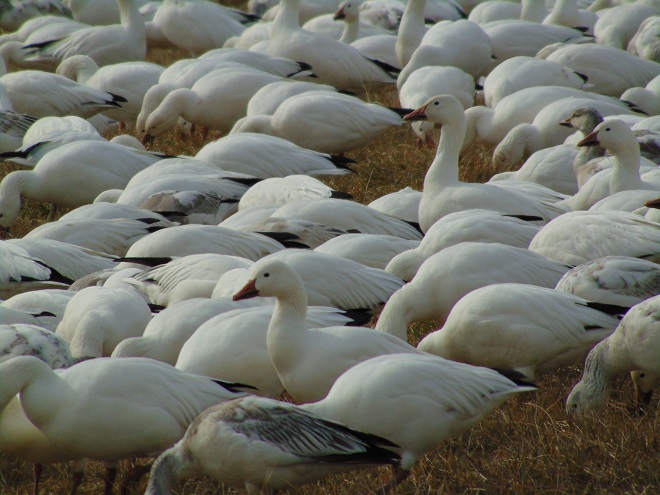
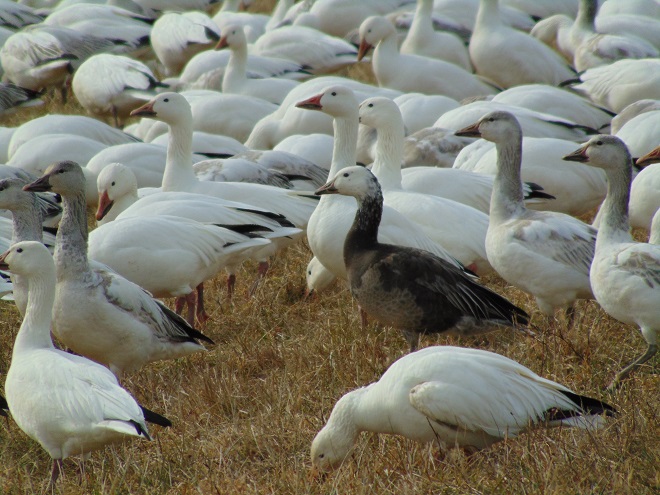
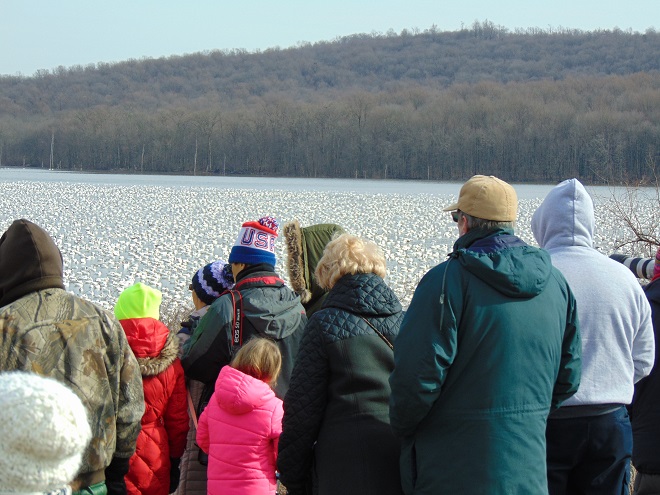
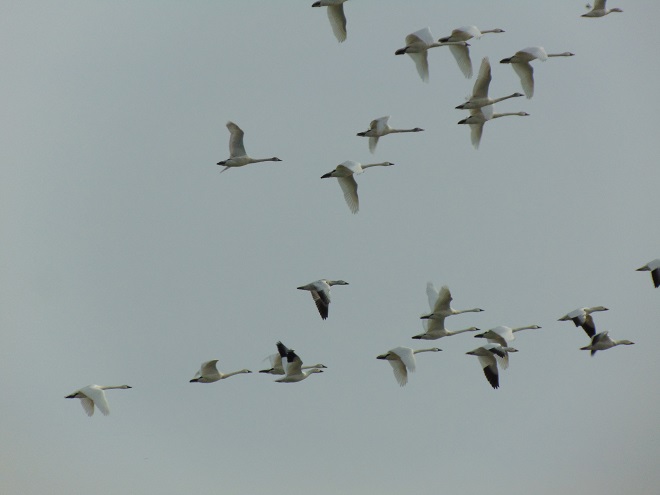
Yellow-bellied Sapsuckers are moving through on their way north. Look for them in mature trees in woodlands, suburbs, and city parks.The Fox Sparrow (Passerella iliaca), our largest sparrow, is a thrush-like denizen of shrubby forest understories and field edges. It is an early spring and late autumn transient in the lower Susquehanna valley.While stopping to rest and feed during their northbound spring journey, Ring-necked Ducks and other diving duck species visit wetlands and flooded timber along the Susquehanna River as well as clear ponds and lakes elsewhere in the watershed.Eastern Bluebirds are presently migrating through the area. Some will stay to breed where nest boxes or natural cavities are available in suitable habitat.Tree Swallows are now arriving. In open grasslands, pastures, and adjacent to almost any body of water, they will nest in boxes like those placed for bluebirds.Keep that bird bath clean and fill it with fresh water, the American Robin flights are peaking right now. Breeding males like this one are starting to sing and defend nesting territories.Red-winged Blackbirds, like other native blackbirds, are moving through in a fraction of the numbers that were seen in the lower Susquehanna valley during the latter decades of the twentieth century. They remain a common breeding species in pastures and cattail wetlands.And of course, keep an eye to the sky. There are still thousands of Snow Geese in the area.
If you’re staying close to home, be sure to check out the changing appearance of the birds you see nearby. Some species are losing their drab winter basic plumage and attaining a more colorful summer breeding alternate plumage.
European Starlings are losing their spotted winter (basic) plumage and beginning to display a glossy multicolored set of breeding feathers.An American Goldfinch in transition from winter (basic) plumage to bright yellow, black, and white summer colors.
So just how many Green Frogs were there in that first photograph? Here’s the answer.
If you counted seven, you did really well. Numbers eight and nine are very difficult to discern.
Happy Spring. For the benefit of everyone’s health, let’s hope that it’s a hot and humid one!
According to the most recent Pennsylvania Game Commission estimate, there are presently more than 100,000 Snow Geese at the Middle Creek Wildlife Management Area (W.M.A.) in Lancaster and Lebanon Counties. It’s a spectacular sight.
Noisy flights of Snow Geese, which can number from hundreds to thousands of birds, consist of strings of multiple V-shaped flocks. During late-February and early-March, they are a common sight as they make excursions from the lake at Middle Creek W.M.A. to feeding areas in the farmlands of the lower Susquehanna valley and back again.During the early 1990s, Snow Geese started moving away from compromised late-winter feeding areas in tidal marshes on the Atlantic Coastal Plain and began taking advantage of grazing and gleaning opportunities among grass crops (wheat, etc,), and more recently cover crops, in the almost predator-free high-intensity farming areas near the Middle Creek refuge.
If you go to see these and other birds at Middle Creek, it’s important to remember that you are visiting them in a “wildlife refuge” set aside for, believe it or not, wildlife. “Wildlife refuge”, many would be surprised to learn, is short for “terrestrial or aquatic habitat where wildlife can find refuge and protection from all the meddlesome and murderous things people do”.
It’s not necessary to cross the well-marked boundaries of the refuge to get a better look at the geese, swans, and other wildlife at Middle Creek. Nor is it necessary to blow your motor vehicle’s horn, clap your hands, yell, or make other noises to scare the geese into flying so that you might get a good photograph. Such disturbances cause the birds to expend the energy they need to continue their journey north. They also cause the Pennsylvania Game Commission to spend funds on crowd control that might otherwise be spent on improvements to wildlife habitat.By embracing the virtue of patience, observers can get spectacular views and take great pictures from outside the refuge boundaries.Photographers who stand quietly and make no sudden movements will find that the foraging Snow Geese will often approach well within the range of most cameras. All of these pictures were taken with an inexpensive model purchased at a Walmart.Intermixed within the flocks, there are usually good numbers of gray-mottled hatch-year (juvenile) birds and often a few examples of the dark brown “Blue Goose”, a not-so-rare color morph of the Snow Goose.Observers viewing tens of thousands of Snow geese from the Willow Point observation area at Middle Creek W.M.A.There are approximately 1,500 Tundra Swans at Middle Creek W.M.A at the present time. Compare their pure white plumage and long necks with the black-tipped wings and short stocky necks of the Snow Geese accompanying them in this image.Clamoring geese let observers know that a massive lift-off may be in the making. Cameras are made ready.Away they go with a cackling roar!Sooner or latter, the geese will engulf the patient observer within one of their swirling swarms.Marvelous! Go check it out.
Nothing says Happy Valentine’s Day like a really bad poem, so here it is…
FOR THE LOVE OF DUCKS
I like to feed the duckies
Try it and you’ll see
Aren’t they really lucky?
Relying just on me
My neighbors are complainin’
I can hear them talk
The mallards eat their garden
Let surprises on their walk
Dung stains on the carpets
They tracked it in the house
It’s from those ducks and not the pets
Can’t blame it on the spouse
I like to feed the duckies
Try it and you’ll see
Aren’t they really lucky?
Relying just on me
Tamed with bread and crackers
I gave them as a treat
I soon found maimed dead quackers
Lying in the street
A driver who intended
To miss the hens and drakes
Had their car rear-ended
When they hit the brakes
I like to feed the duckies
Try it and you’ll see
Aren’t they really lucky?
Relying just on me
The flock is very wasteful
Each bird a pound a day
Web-foots in a cesspool
Pollute the waterway
There are some kids playing
In that filthy ditch
Soon they’ll be displaying
The rash of Swimmer’s Itch
I like to feed the duckies
Try it and you’ll see
Aren’t they really lucky?
Relying just on me
These ducks they do not migrate
They’re here day in, day out
Aquatic life they decimate
No plants, no fish, no trout
Hurry! Hurry! Heed my call
Before it starts to rain
Ten more ducklings took a fall
And are stranded in a drain
I like to feed the duckies
Try it and you’ll see
Aren’t they really lucky?
Relying just on me
Have you people lost your minds?
I see you by your fence
These ducks are cute and I am kind
It’s you who’ve lost your sense
Beggars from the handouts
My God what have I done?
Their senseless habits leave no doubt
Their instincts are all gone
I like to feed the duckies
Try it and you’ll see
Aren’t they really lucky?
Relying just on me
Now I know just what to do
Like one would teach a child
I’ll feed the ducks at the zoo
And let the rest live wild
So if you feed the duckies
Beware of the spell
Or you will do the same as me
Loving ducks to death as well
—Ducks Anonymous, LLC
They’re cute, but if you really love waterfowl, then please refrain from feeding them. Hand-fed ducks soon lose their survival instincts. These clueless birds do dumb things like loiter in traffic and, perhaps worst of all, omit migration from their yearly life cycle. Daily plundering by year-round congregations of Canada Geese, Mute Swans, polygamous Mallards (seen here), and domestic waterfowl is decimating native plant and animal populations in waterways, wetlands, ponds, and lakes throughout the Lower Susquehanna River Watershed. For aquatic food chains and fisheries to recover, people must stop feeding (and releasing) these highly-impressionable birds.
Inside the doorway that leads to your editor’s 3,500 square foot garden hangs a small chalkboard upon which he records the common names of the species of birds that are seen there—or from there—during the year. If he remembers to, he records the date when the species was first seen during that particular year. On New Year’s Day, the results from the freshly ended year are transcribed onto a sheet of notebook paper. On the reverse, the names of butterflies, mammals, and other animals that visited the garden are copied from a second chalkboard that hangs nearby. The piece of paper is then inserted into a folder to join those from previous New Year’s Days. The folder then gets placed back into the editor’s desk drawer beneath a circular saw blade and an old scratched up set of sunglasses—so that he knows exactly where to find it if he wishes to.
A quick glance at this year’s list calls to mind a few recollections.
The 2019 bird list included 48 species, the 47 on the board plus Ruby-throated Hummingbird, which was logged on a slip of paper found tucked into the edge of the frame.
This Green Frog, photographed on New Year’s Day 2019, was “out and about” along the edge of the editor’s garden pond. Due to the recent mild weather, Green Frogs were active during the current New Year’s holiday as well.On a day with strong south winds in late February or during the first two weeks of March, there is often a conspicuous northbound spring flight of migrating waterfowl, gulls, and songbirds that crosses the lower Susquehanna valley as it departs Chesapeake Bay. These Tundra Swans were among the three thousand seen from the garden patio on March 13, 2019. A thousand migrating Canada Geese, 500 Red-winged Blackbirds, numerous Ring-billed Gulls, and some American Herring Gulls were seen during the same afternoon.This juvenile Cooper’s Hawk was photographed through the editor’s kitchen window. From its favorite perch on this arbor it would occasionally find success snagging a House Sparrow from the large local flock. It first visited the garden in November, the species being absent there since early spring. Unlike previous years, there was no evidence of a breeding pair in the vicinity during 2019.Plantings that provide food and cover for wildlife are essential to their survival. Native flowers including Trumpet Vine (Campsis radicans) and Partridge Pea provide nourishment for the Ruby-throated Hummingbirds that visit the editor’s garden, but they really love a basket or pot filled with Mexican Cigar (Cuphea ignea) too. The latter (seen here) can be grown as a houseplant and moved outdoors to a semi-shaded location in summer and early fall. But remember, it’s tropical, so you’ll need to bring it back inside when frost threatens.A Swamp Sparrow is an unusual visitor to a small property surrounded by paved parking lots and treeless lawns. Nevertheless, aquatic gardens and native plants helped to attract this nocturnal migrant, seen here eating seeds from Indiangrass. It arrived on September 30 and was gone on October 2.
Before putting the folder back into the drawer for another year, the editor decided to count up the species totals on each of the sheets and load them into the chart maker in the computer.
Despite the habitat improvements in the garden, the trend is apparent. Bird diversity has not cracked the 50 species mark in 6 years. Despite native host plants and nectar species in abundance, butterfly diversity has not exceeded 10 species in 6 years.
It appears that, at the very least, the garden habitat has been disconnected from the home ranges of many species by fragmentation. His little oasis is now isolated in a landscape that becomes increasingly hostile to native wildlife with each passing year. The paving of more parking areas, the elimination of trees, shrubs, and herbaceous growth from the large number of rental properties in the area, the alteration of the biology of the nearby stream by hand-fed domestic ducks, light pollution, and the outdoor use of pesticides have all contributed to the separation of the editor’s tiny sanctuary from the travel lanes and core habitats of many of the species that formerly visited, fed, or bred there. In 2019, migrants, particularly “fly-overs”, were nearly the only sightings aside from several woodpeckers, invasive House Sparrows (Passer domesticus), and hardy Mourning Doves. Even rascally European Starlings became sporadic in occurrence—imagine that! It was the most lackluster year in memory.
The Tufted Titmouse was a daily visitor to the garden through 2018. This one was photographed investigating holes in an old magnolia there during the spring of that year. There were no Tufted Titmouse sightings in the garden in 2019. This and other resident species, especially cavity nesters, appear to be experiencing at least a temporary decline.Breeding birds including Northern Cardinals may have had a difficult year. In the editor’s garden, a pair were still feeding and escorting one of their young in early October. The infestation of the editor’s town by domestic house and feral cats may have contributed to the failure of earlier broods, but a lack of food is also a likely factor.
If habitat fragmentation were the sole cause for the downward trend in numbers and species, it would be disappointing, but comprehensible. There would be no cause for greater alarm. It would be a matter of cause and effect. But the problem is more widespread.
Although the editor spent a great deal of time in the garden this year, he was also out and about, traveling hundreds of miles per week through lands on both the east and the west shores of the lower Susquehanna. And on each journey, the number of birds seen could be counted on fingers and toes. A decade earlier, there were thousands of birds in these same locations, particularly during the late summer.
At about the time of summer solstice in June each year, Common Grackles begin congregating into roving summer flocks that will grow in size to assure their survival during the autumn migration, winter season, and return north in the spring. From his garden, the editor saw just one flock of less than a dozen birds during the summer of 2019. He saw none during his journeys through other areas of the Susquehanna valley. Flocks of one hundred birds or more did not materialize until the southbound movements of grackles passed through the region in October and November.
In the lower Susquehanna valley, something has drastically reduced the population of birds during breeding season, post-breeding dispersal, and the staging period preceding autumn migration. In much of the region, their late-spring through summer absence was, in 2019, conspicuous. What happened to the tens of thousands of swallows that used to gather on wires along rural roads in August and September before moving south? The groups of dozens of Eastern Kingbirds (Tyrannus tyrannus) that did their fly-catching from perches in willows alongside meadows and shorelines—where are they?
Several studies published during the autumn of 2019 have documented and/or predicted losses in bird populations in the eastern half of the United States and elsewhere. These studies looked at data samples collected during recent decades to either arrive at conclusions or project future trends. They cite climate change, the feline infestation, and habitat loss/degradation among the factors contributing to alterations in range, migration, and overall numbers.
There’s not much need for analysis to determine if bird numbers have plummeted in certain Lower Susquehanna Watershed habitats during the aforementioned seasons—the birds are gone. None of these studies documented or forecast such an abrupt decline. Is there a mysterious cause for the loss of the valley’s birds? Did they die off? Is there a disease or chemical killing them or inhibiting their reproduction? Is it global warming? Is it Three Mile Island? Is it plastic straws, wind turbines, or vehicle traffic?
The answer might not be so cryptic. It might be right before our eyes. And we’ll explore it during 2020.
A clean slate for 2020.
In the meantime, Uncle Ty and I going to the Pennsylvania Farm Show in Harrisburg. You should go too. They have lots of food there.
With autumn coming to a close, let’s have a look at some of the fascinating insects (and a spider) that put on a show during some mild afternoons in the late months of 2019.
Bush Katydids (Scudderia species) are found in brushy habitats and along rural roadsides. Their green summer color fades to brown, maroon, and gold to match the autumn foliage where they hide. Bush katydids often remain active until a hard freeze finally does them in.The Eastern Buck Moth (Hemileuca maia) is fuzzy, appearing to wear a warm coat for its autumn expeditions. Adults emerge in October and may fly as late as December. Females deposit their eggs on the twigs of Bear Oak (Quercus ilicifolia), Blackjack Oak (Q. marilandica), or Chestnut Oak (Q. montana), trees that, in our region, seem most favorable for the moth’s use when growing on burned barrens and mountain slopes. The spiny caterpillars are known to feed only on the foliage of these few trees. In the lower Susquehanna valley, the Eastern Buck Moth is rare because its specialized habitat is in short supply, and it’s all Smokey The Bear’s fault.The Sachem (Atalopedes campestris) wanders north from the Atlantic Coastal Plain into the Susquehanna valley each summer. In some years they become the most numerous small orange butterfly of all, particularly around home gardens. The larvae will feed on Crabgrass (Digitaria species), but have not found success overwintering this far north. By November, adults begin to look pretty drab.From 1978 through 1982, the Asian Multicolored Lady Beetle (Harmonia axyridis) was introduced into the eastern states by the United States Department of Agriculture. It has become a nuisance in many areas where it swarms, sometimes bites, and often overwinters in large smelly masses within homes and other warm buildings. As you may have guessed, it’s possibly displacing some of the less aggressive native lady beetle species.On a chilly afternoon, a sun-warmed Bold Jumping Spider (Phidippus audax) pounced and dispatched this sluggish worker Honey Bee (Apis mellifera) that was trying to gather pollen from a late-season Purple Coneflower bloom. This spider is bold indeed.Under bridges, inside bird nest boxes, and sometimes beneath porches, the female Pipe Organ Mud Dauber (Trypoxylon politum), a predatory wasp, builds these elaborate nests composed of long rows (pipes) of nursery cells. Into each cell one or more paralyzed spiders is deposited along with one of the female’s eggs. When hatched, each larva will feed upon the paralyzed spider(s) inside its cell, then pupate. The pupae overwinter, then emerge from their cells as adults during the following spring. In the autumn, males often stand guard at an entrance to the nest to prevent parasitic species, including some flies (look at the fifth pipe from the right), from laying eggs on the pupae. These wasps are not aggressive toward humans.A Black-and-yellow Mud Dauber (Sceliphron caementarium) observes a neighboring nest of Common Paper Wasps (Polistes exclamans). The Common Paper Wasp, a species also known as the Guinea Paper Wasp, is a native of the southern United States. It is currently expanding its range into the lower Susquehanna valley from the Atlantic Coastal Plain. These two wasp species and the Pipe Organ Mud Dauber are known to regularly coexist. All three will take advantage of man-made structures for their nest sites. People using the picnic tables beneath this pavilion roof never noticed the hundreds of docile wasps above.Those moody Eastern Yellowjackets (Vespula maculifrons) can get very temperamental during warm autumn days. These wasps may appear to have no enemies, but away from areas impacted by man’s everyday activities, they do. The Robber Fly (Promachus species) hunts like a flycatcher or other woodland bird, waiting on a perch along the forest’s edge for prey to pass by, then ambushing it, yellowjackets included.The invasive Spotted Lanternfly, a native of eastern Asia, continues to spread destruction. It established itself throughout much of the east side of the lower Susquehanna River during the summer and fall of 2019. Their route of travel across the farmlands of the region intersects with plenty of vineyards to obliterate and few, if any, natural enemies. Expect them to begin colonizing the west shore en masse during 2020.In 2020, plan to roll a few Spotted Lanternflies over, enjoy the view, and wait for the crimson tide to pass. With any luck, they’ll peak in a year or two.
SOURCES
Eaton, Eric R., and Kenn Kaufman. 2007. Kaufman Field Guide to Insects of North America. Houghton Mifflin Company. New York, NY.
Late this afternoon, despite a cold bone-chilling rain, news media and crowds of onlookers gathered along the Susquehanna shoreline upstream of Three Mile Island at the small town of Royalton to catch a glimpse of the removal of a downed aircraft from the river. Back on October 4, a single-engine Piper PA46 Malibu was on the final leg of an approach to runway 31 at Harrisburg International Airport when it lost power. The pilot and passenger were uninjured during the emergency “splashdown” in the shallow water just short of the runway.
Recovery crews begin installing a set of slings around the downed plane’s fuselage. It rests on York Haven Diabase bedrock in water about three feet deep. Today’s heavy rains could raise the river level and float the plane into deeper water, so there is some urgency to complete its removal.The Sikorsky S-61 recovery helicopter arrived just as the rain subsided. Its hoist cables were quickly attached to the rigging that had been placed around the plane.Slack in the hoist cable and harness assembly was taken up.Then the aircraft was lifted slowly.The flooded fuselage was allowed to drain before proceeding, greatly reducing the aircraft’s weight and the load on the helicopter and hardware.The plane was transported to its original destination, Harrisburg International Airport, located just one mile away. The timing of the recovery was impeccable. Soon after its completion, a gusty wind swept down the river valley. Colder air is expected to blow in throughout the remainder of the evening and through the morrow. Meteorologists are calling the developing weather system a “bomb cyclone”.Not everything that finds its way into the river generates as much effort to recover it. It’s a case of no deposit/no return I suppose.
At 12:07 P.M., E.D.T. today, forty-five years and eighteen days after being commissioned into commercial service on September 2, 1974, the Three Mile Island Nuclear Generating Station’s Unit 1 reactor was shut down for the final time. There will be no refueling. There will be no more electricity furnished to the grid by the plant. It is henceforth a user, not a producer, of energy.
Here’s the final shutdown, in pictures…
Work began to build the Three Mile Island Nuclear Generating Station in 1968. In this photo taken on July 7, 1970, one can see that Unit One’s reactor containment building and cooling towers have been erected and that the excavation and early construction of the ill-fated Unit 2 is underway. (United States Department of Agriculture Agricultural Stabilization and Conservation Service image)11:15 A.M., E.D.T. Water vapor clouds rise from the Unit 1 cooling towers (left) during the plant’s final hour of electricity generation. Smoke in the center of the photo is from a diesel-powered auxiliary steam generator that is used during the shutdown process.11:40 A.M., E.D.T. Three Mile Island Unit 2 (left), and Unit 1 (right), just prior to the latter’s final shutdown. Unit 2 is presently in monitored storage. It has not operated since the 1979 accident. Unit 1 did not operate for 6 years following Unit Two’s shutdown. Since being permitted to restart, Unit 1 has continued to be a reliable pressurized water reactor electricity generating system.12:00 Noon Unit 1 in the process of shutdown. Control rods were inserted into the fuel assembly and “zero percent” generation was marked at about 12:07 P.M., E.D.T. By then, the heat release rate in the core had dropped to 10% of the level produced while a full-capacity reaction is occurring.Just after the reactor was placed in cooling mode, a press conference got underway at the Three Mile Island Training Center, site of all the press action during 1979’s Unit 2 accident. Dauphin County Commissioner Mike Pries lamented the eventual loss of 675 full-time jobs at the T.M.I. facility. He noted that if the plant were not now closing, 1,000 workers would be arriving to refuel and service the reactor. The local economy will now miss out on the 36,000 “room nights” of revenue previously generated by skilled labor remaining in the area for a little more than a month to complete a shutdown refueling.Dave Marcheskie, Exelon’s Senior Site Communications Manager at Three Mile Island, reported that by shutdown, Unit 1 had completed a record 709 continuous days of safe and reliable energy production. Despite being permitted through 2034, in 2017, Exelon Corporation announced plans to shut down the T.M.I. Unit 1 reactor early, citing an inability to operate the facility profitably while competing with natural gas-fired generators and subsidized producers including wind turbines.It’s always lots of fun at a Three Mile Island news conference when there’s a dissenting point of view. I’ll bet Uncle Tyler Dyer knows this guy, although he’s probably upset with him for not wearing one of the custom shirts he makes. Better luck next time Uncle Ty.12:59 P.M., E.D.T. Nearly one hour after shutdown, steam clouds continue to rise from the Unit 1 cooling towers. One thousand gallons per minute or more of water are circulating through the primary (reactor) cooling loop to absorb the energy produced by the “leftover” fission products that are decaying in the core.1:23 P.M., E.D.T. The last remaining heat from the core is transmitted by a primary cooling loop inside the reactor containment building to a secondary loop that would, when making electricity, drive the steam generator in the neighboring building. A third loop, which never enters the reactor, cools the condenser on the secondary loop, and finally surrenders its heat in the cooling towers. Unit 1 can use “once-through” river water to direct cool the condenser during shutdown.2:11 P.M., E.D.T. The cooling process progresses.2:29 P.M., E.D.T. Wispy water vapor clouds are gradually diminishing in density at the top of the Unit 1 cooling towers (right).2:29 P.M., E.D.T. Yes, that is a water skier behind the boat.2:33 P.M., E.D.T. The periods of time without visible steam clouds lengthen as the heat release rate from the reactor core continues to plummet toward a cold shutdown.Environmental monitoring will continue on and around Three Mile Island during the decades of cleanup and decommissioning to come.By 2074, as the centennial anniversary of Unit One’s commissioning comes around, the cooling towers and most of the other buildings at T.M.I. should be gone. By then, Three Mile Island may look more like it did during the years before construction ever began. By then, nothing but a historical marker will be left to tell future generations of the events that transpired during the power plant’s operating years. Here’s an idea for a sign to go with it: “Three Mile Island N.W.R. (Nuclear Wildlife Refuge), people keep out!” By 2074, maybe society will have enough sense not to build and live on beaches, in tidal estuaries, and in floodplains. Wouldn’t that be nice? (United States Department of Agriculture Commodity Stabilization Service image-November, 1956)