Clean rainwater flowing from the roofs of our homes and other buildings is a precious resource that is more often than not directed as quickly as possible into streets and storm drains to become contaminated runoff capable of polluting streams and aggravating flooding conditions. The prudent property steward will manage rainfall as the treasured commodity that it is—retaining on site as much of it as possible.
Whether you happen to be obtaining your domestic water from a community distribution system or from a private well, infiltrating the rain that falls on your roof directly into the soil is a good way to make sure it helps recharge the groundwater stored in the aquifer—banking it for future use.
Better yet, rain barrels provide a means of intercepting, storing, and dispensing a share of the precipitation from your downspouts before it is discharged into the ground. Water from rain barrels can be drained to hydrate garden plants, rinse the patio, wash the dog, or, in the event of an emergency, fill the need for non-potable uses that include bathing and flushing toilets. For potable applications such as cooking, drinking, and brushing teeth, roof water must first be filtered and disinfected.
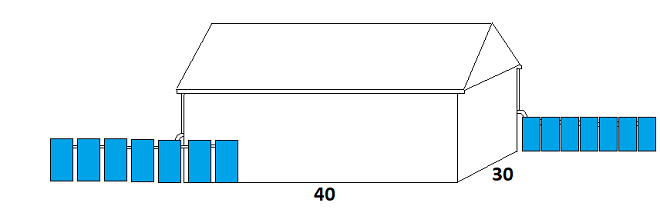
Rain barrels collect and save clean roof water for later use. For every one inch of precipitation, the roof on a house or other building with a footprint of just 1,200 square feet sheds enough to fill about fourteen 55-gallon drums. Live in a home supplied by a well? That’s over 700 gallons of soft water available as you need it, such as during a power outage when the pump won’t operate.
Here at susquehannawildlife.net headquarters, our goal is “no net runoff” from our little urban parcel. We use three rain barrels to catch discharge from the spouting system, then direct the overflow into three different management configurations.
RAIN GARDEN
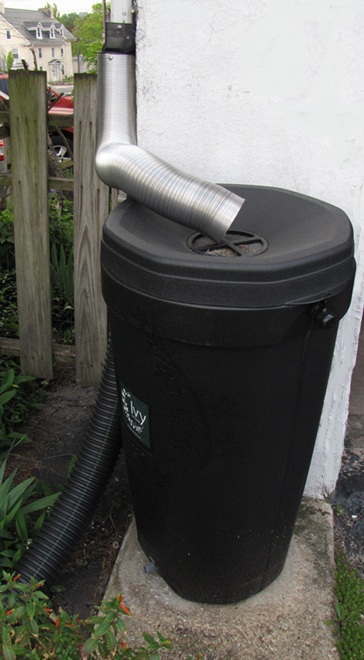
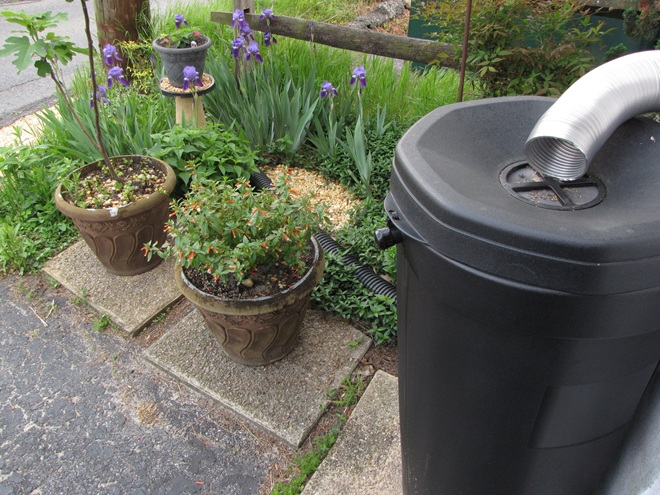
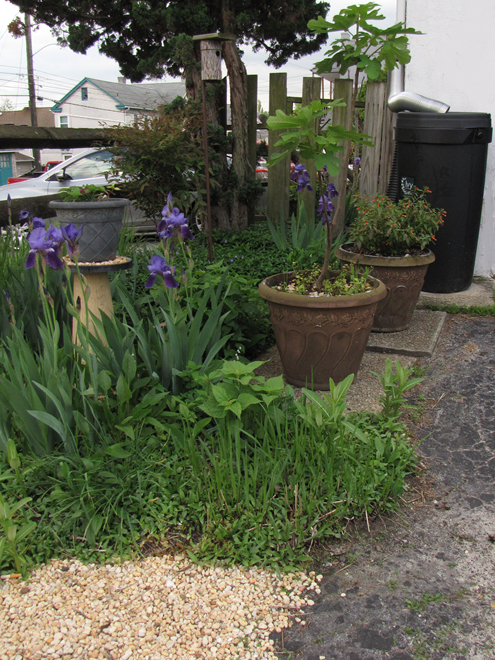
Precipitation from the downspout is captured in this commercially produced rain barrel. The overflow is directed into the black corrugated pipe……and spilled into the gravel bed in the rain garden to both water the plants and infiltrate into the ground to recharge our local aquifer.The gravel beds diffuse energy produced not only by water rushing from the barrel’s overflow, but from sheet runoff entering the garden from the driveway and neighboring street.
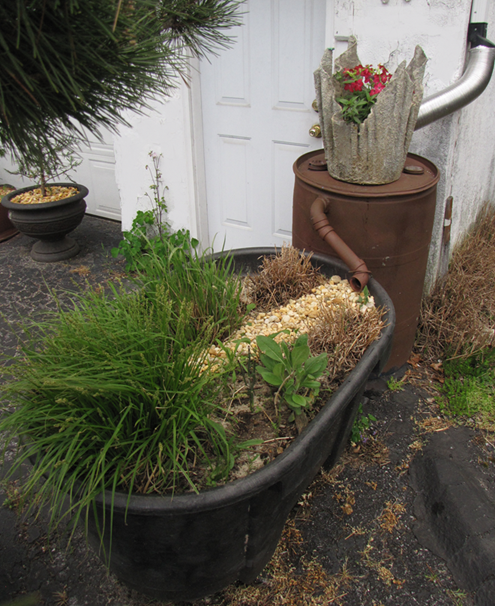
STOCK TANK PLANTER
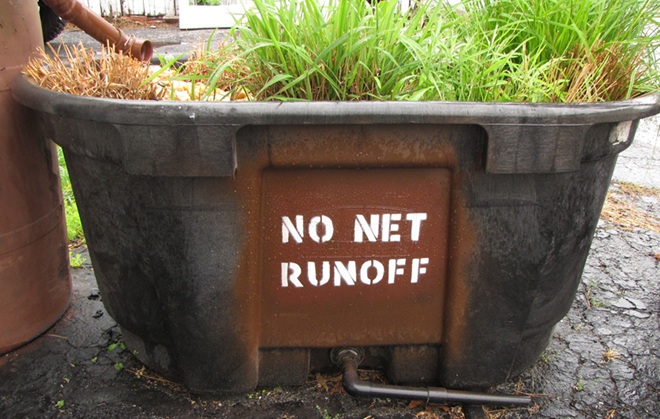
This home-brew rain barrel was fabricated from a 55-gallon drum originally used to ship and store car wash soap. We scrubbed it out, then plumbed it up with the overflow feeding a 100-gallon stock tank fashioned into a planter. The drain from the planter sometimes discharges a trickle of water into a porous area of the pavement where it soon percolates into the ground. In this “container rain garden”, we grow wildflowers, sedges, rushes, and warm-season grasses.
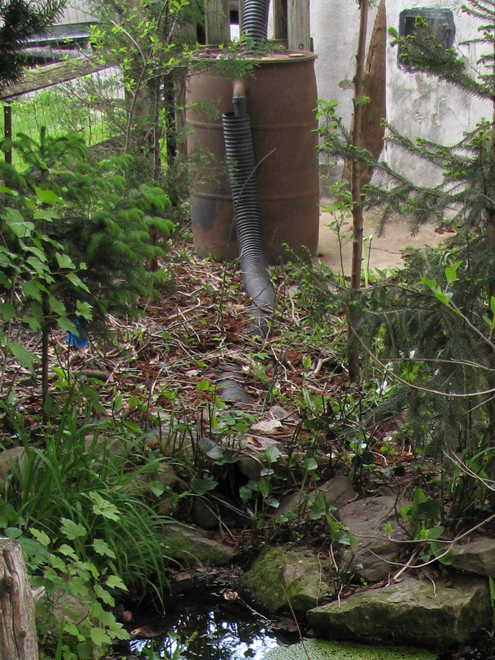
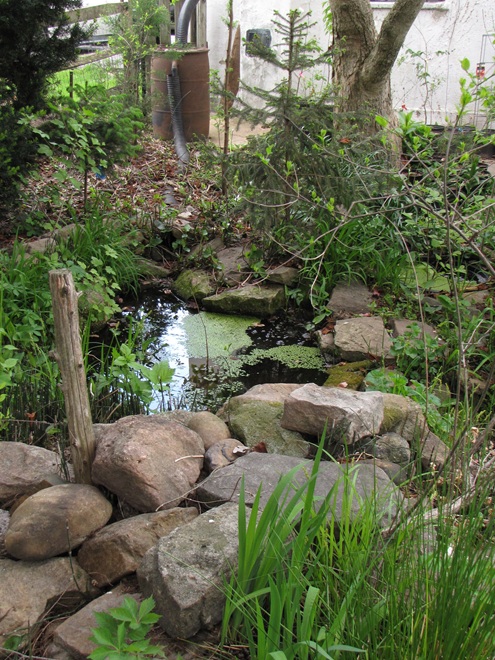
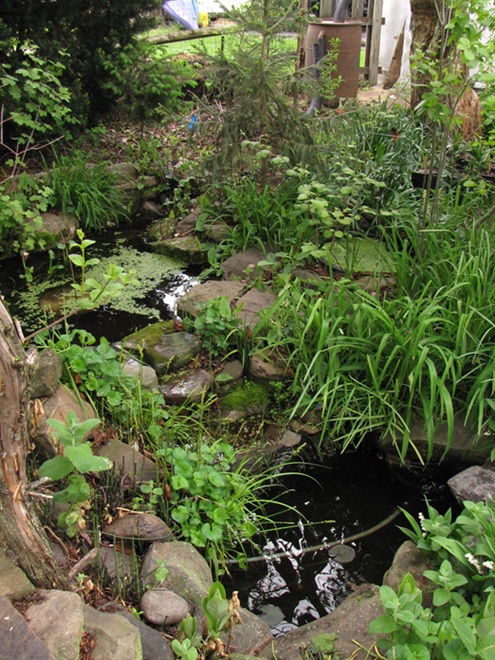
THE GARDEN POND/POOLS
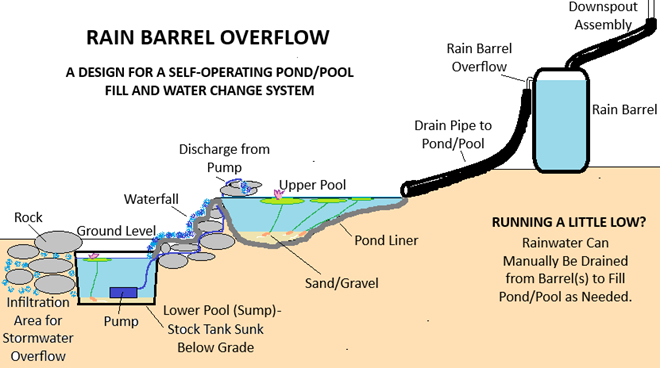
Here’s another rain barrel made from a soap drum. This one discharges its overflow into the upper pool of our garden pond.Upon topping off the barrel, clean roof water spills into the corrugated pipe and tumbles into the upper pool. Outflow from the upper pool cascades through the the riffles/falls……into the lower pool (bottom right). The lower pool consists of a 100-gallon stock tank sunk below grade level and surrounded by rock. Throughout the summer, a pump located in this “sump” circulates water to a spring-like feature in the upper pool. During a downpour, the lower pool will overflow into the encircling boulders, the level often rising half a foot or more above the top rim of the stock tank flooding the cap stones before receding as the excess water slowly infiltrates down through the gravelly soils. It’s a self-automated, hassle-free water change that helps keep our pools and their inhabitants healthy.Our garden pond stormwater management system keeps the pools topped off and the aquatic ecosystem thriving.
Why not give roof water management a try on your property? It’s a great project for exercising your ingenuity and creativity while doing something truly beneficial for the watershed within which you reside. Best of all, it’s really not that expensive to get started.
Currently in the Lower Susquehanna River Watershed, you can find these five species of herbaceous plants in full bloom. As they grow, they and others like them help to purify waters within their respective ecosystems by taking up nutrients—namely, the nitrogen and phosphorus that can lead to detrimental algal blooms and eutrophication in ponds, lakes, streams, and rivers.
(United States Geological Survey image by Virginia-West Virginia Science Center)The Marsh Blue Violet (Viola cucullata) is most frequently found growing in the wet soils of forest bottomlands, usually where springs first break the earth’s surface and begin slowly trickling away to form a small brook or join an existing stream. The blooms are recognized by their darker purple centers and their long stems.This particular Marsh Blue Violet was found at 750′ altitude in the running water at a mountainside spring seep on a south-facing slope in the Ridge and Valley Province.The seldom-noticed flowers of the Soft Rush (Juncus effusus), also known as the Common Rush, emerge from the sides of its quill-like stems. This wetland species is found in damp soils, sometimes in standing water, and grows in stiff, erect clumps that persist through winter. When found in pastures, Soft Rush is seldom of interest to cattle or other livestock. It therefore doesn’t lure these animals into muddy, puddle-prone areas. When subjected to heavy grazing in dry weather and flooding during wet spells, these puddle sites may host nearly pure stands of Soft Rush, the only plant able to thrive there. When it comes to nutrient uptake in these soggy sections of the meadow, the soft Rush is the lone ranger. Soft Rush seeds are available from Ernst Conservation Seeds in Meadville, PA, and are included in many of their mixes formulated for stormwater management basins and other wet soil applications.Larger Blue Flag (Iris versicolor) is a plant of wetlands and shorelines. It can be grown as an emergent in ponds and lakes where it will help to absorb nutrients from both the water and the underlying substrate.Larger Blue Flag is a native species in the lower Susquehanna valley.The Yellow Iris (Iris pseudacorus), also known as the Water Flag, is native to Eurasia and Africa. Seen here growing as an emergent among native Common Cattails (a superb water purifier), the Yellow Iris can easily escape cultivation and become invasive. The showy flowers and water-cleansing benefits of this plant make it attractive for use in the garden or farm pond, but considerations must be made for its aggressive growth and proclivity to escape to neighboring habitats. If you’re purchasing irises for transplanting, you’re probably better off sticking with the native Larger Blue Flag; it is far less vigorous and you’ll be able to grow other aquatic species along with it.In large ponds, lakes, and low-gradient streams, one of the best aquatic plants for sequestering nutrients and clarifying water is Spatterdock, also known as Cow-lily or Yellow Pond Lily. Spatterdock does best as an emergent in shallow water along the shoreline. It grows well in full sunshine and makes excellent habitat for wildlife. Depending on the nutrient load from fish, waterfowl, decaying vegetation, and other sources, plant cover may need to be as high as 30% or more of the surface area to keep algae from overtaking a lake or large pond. Spatterdock can often be used to help fulfill these needs while still offering open water beneath the leaves and between the stems for fish, amphibians, reptiles, and macroinvertebrates to thrive.Though probably not suitable for small garden ponds, Spatterdock (Nuphar advena) can be an excellent choice for helping to clear up the nutrient-loaded waters of a farm pond or lake. You can find it, the irises, and Soft Rush available through some pond nurseries and garden centers. If you can’t get them locally, check out retail and wholesale suppliers online, but remember to inspect any livestock you bring in from outside the area for hitchhikers like non-native snails (native snails are O.K.). To be safe, always quarantine and monitor your aquatic plants for 30 days. Tubers can be given a bath in 3% hydrogen peroxide solution for up to five minutes, then rinsed with water. Repeat the treatment as needed until no snails or eggs are seen. Another option: local pond owners who have them may be willing to divide some Iris and/or Spatterdock tubers and provide them for sale or gift to those who ask. Just a couple will get you started.
Here’s a look at some native plants you can grow in your garden to really help wildlife in late spring and early summer.
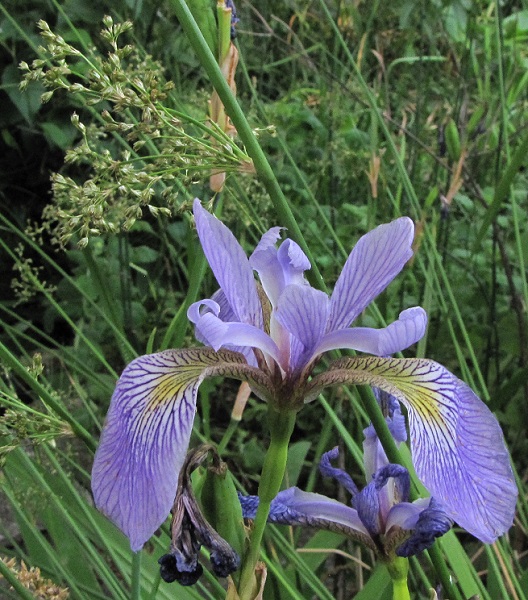
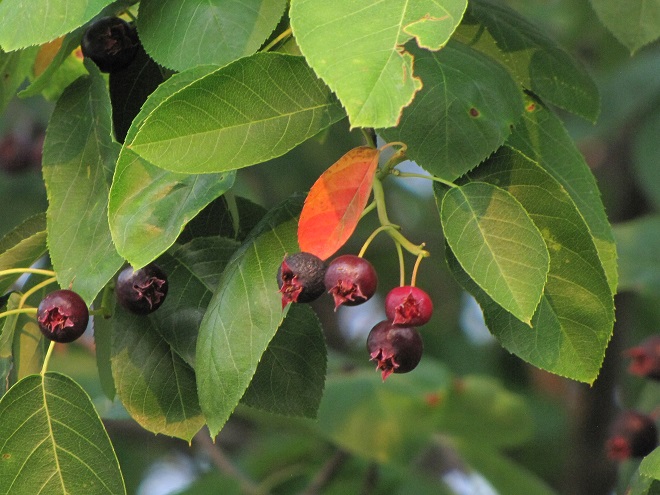
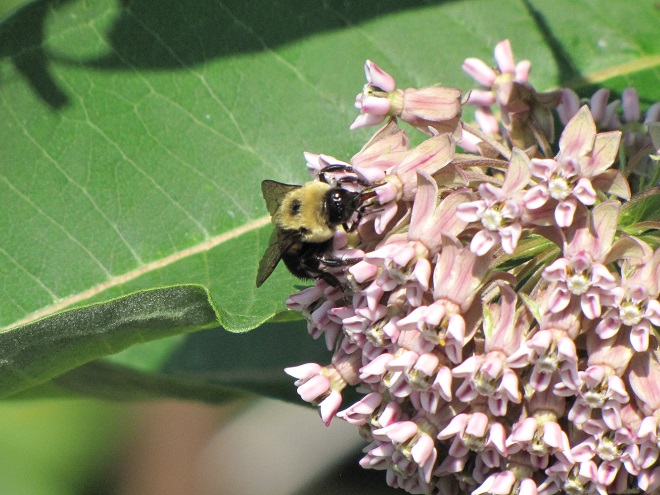
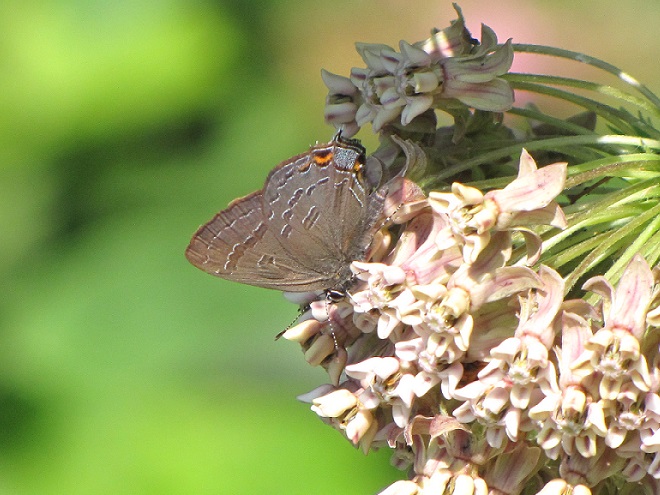
The showy bloom of a Larger Blue Flag (Iris versicolor) and the drooping inflorescence of Soft Rush (Juncus effusus). These plants favor moist soils in wetlands and damp meadows where they form essential cover and feeding areas for insects, amphibians, and marsh birds. Each is an excellent choice for helping to absorb nutrients in a rain garden or stream-side planting. They do well in wet soil or shallow water along the edges of garden ponds too.The fruits of Smooth Shadbush (Amelanchier laevis), also known as Allegheny Serviceberry, Smooth Serviceberry, or Smooth Juneberry, ripen in mid-June and are an irresistible treat for catbirds, robins, bluebirds, mockingbirds, and roving flocks of Cedar Waxwings.Also in mid-June, the fragrant blooms of Common Milkweed attract pollinators like Eastern Carpenter Bees,……Honey Bees,……and butterflies including the Banded Hairstreak (Satyrium calanus). In coming weeks, Monarch butterflies will find these Common Milkweed plants and begin laying their eggs on the leaves. You can lend them a hand by planting milkweed species (Asclepias) in your garden. Then watch the show as the eggs hatch and the caterpillars begin devouring the foliage. Soon, they’ll pupate and, if you’re lucky, you’ll be able to watch an adult Monarch emerge from a chrysalis!