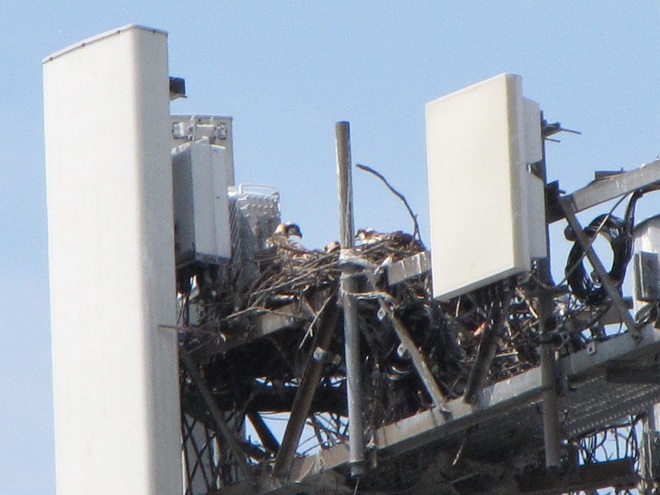
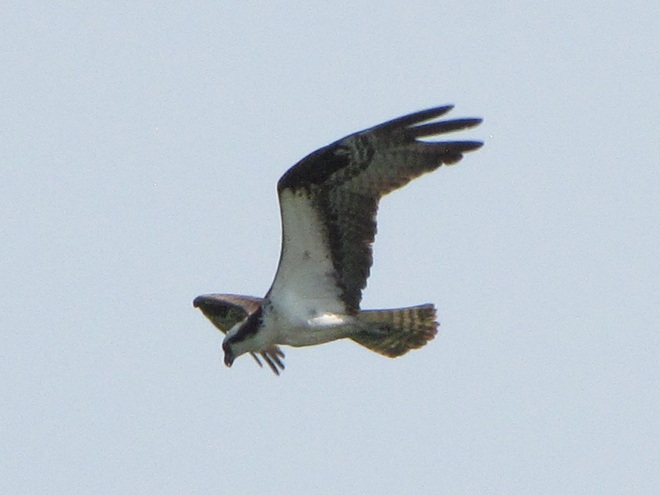
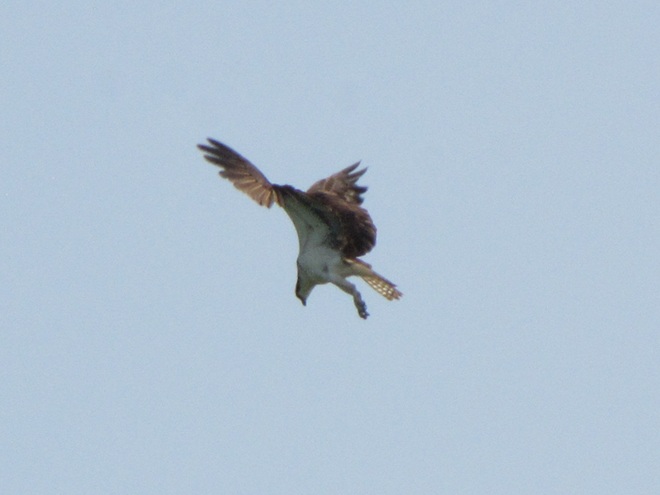
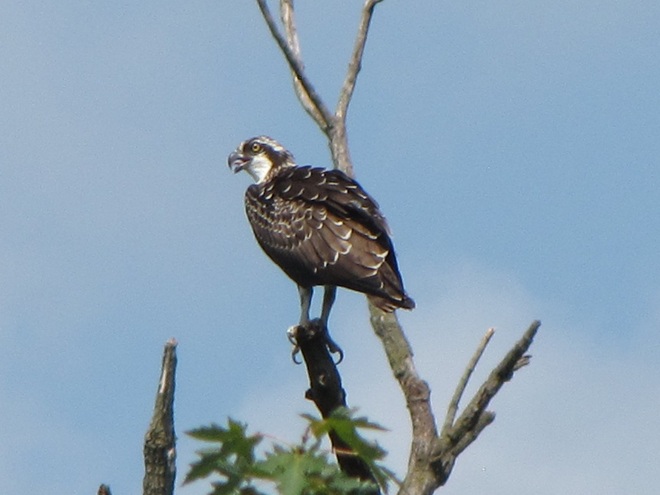
The cackle of Osprey nestlings emanating from atop this communications tower adjacent to Wildwood Lake in the Susquehanna River floodplain in Harrisburg, Pennsylvania, begins at sunrise and continues throughout the day. These fast-growing raptors are begging for food.The adult birds respond by searching endlessly for enough fish to keep these hungry mouths full, though seldom silent.Upon sighting a potential catch, the mature Osprey hovers before plunging talons and head first to seize its prey. The parents supplying their offspring in this particular nest were hauling in mostly non-native species, especially small Common Carp, fish that are easily located as they roam the shallows of the lake and nearby river.On recent afternoons, the oldest of the young has ventured off the nest into tree snags along the lakeshore where its cries for a meal in an attempt to intercept mom and pop before they have a chance to carry fish to its younger siblings in the nest.
Little do these raptors know that coming years may not prove so ideal for their reproduction here or elsewhere along this stretch of the Susquehanna. Within recent weeks, Northern Snakeheads, the dastardly demons that are decimating fisheries in the lower-most reaches of the river and its tributaries in Maryland, were reported in the Paxton Creek watershed in Pennsylvania—both at Wildwood Lake in Harrisburg and upstream in the impoundment at Susquehanna Township’s Boyd Park. The specimen at Boyd Park was caught by an angler on May 29th and destroyed. Upon being notified, biologists from the Pennsylvania Fish and Boat Commission (PF&BC) electrofished the lake on June 2nd and found no further evidence of non-native Northern Snakeheads there. Downstream at Wildwood Lake, county park staff reported sightings of a snakehead in the shallow waters of a flooded segment of the ruins of the Pennsylvania Canal on July 15th. The electrofishing crew from the PF&BC surveyed the area on the 17th and found no snakeheads. These reports follow an event in mid-October of 2023 when an angler caught a Northern Snakehead on the west side of the Susquehanna in an impoundment at Grantham Park on Trout Run, a tributary of the Yellow Breeches Creek. The angler, unfamiliar with snakehead identification, released the fish. After it was reported to PF&BC representatives, they and staff from Upper Allen Township, owners of the park, implemented “rapid response measures” to control the invasive pests.
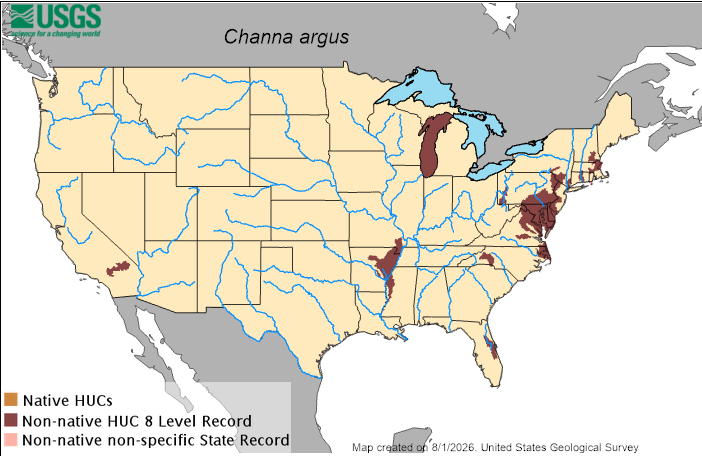
The latest map produced by the United States Geological Survey’s Nonindigenous Aquatic Species Program shows the range of the invasive, non-native Northern Snakehead. That range now includes the Lower Susquehanna River Watershed in Pennsylvania.
This news doesn’t mean the gig is up. Anglers should learn to identify Northern Snakeheads (see our “Fishes” page) and are required to dispatch them upon capture. It remains illegal to transport or possess live snakeheads. It is also forbidden to release/stock snakeheads or any other fish into Commonwealth waters without permission from the PF&BC.
Northern Snakeheads were imported from Asia as a food fish and escaped makeshift aquaculture attempts to become apex predators in numerous North American waters. They reproduce quickly as they expand their range and decimate both native and non-native fish populations. They are easily angled and excellent eating, but cannot be transported or possessed alive, so kill ’em when you catch ’em. Whether or not Osprey will be able to adapt to these altered fisheries remains to be seen. The presence of snakeheads could rapidly eliminate infested waterways from the nesting ranges of these and other piscivorous birds.
There are two Conewago Creek systems in the Lower Susquehanna River Watershed. One drains the Gettysburg Basin west of the river, mostly in Adams and York Counties, then flows into the Susquehanna at the base of Conewago Falls. The other drains the Gettysburg Basin east of the river, flowing through Triassic redbeds of the Gettysburg Formation and York Haven Diabase before entering Conewago Falls near the south tip of Three Mile Island. Both Conewago Creeks flow through suburbia, farm, and forest. Both have their capacity to support aquatic life impaired and diminished by nutrient and sediment pollution.
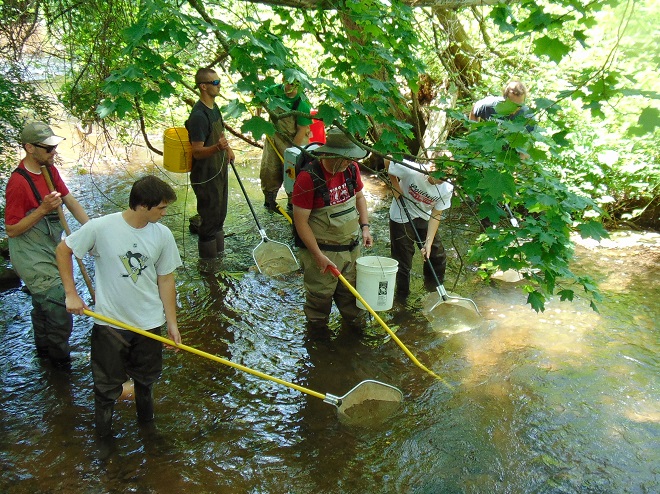
This week, some of the many partners engaged in a long-term collaboration to restore the east shore’s Conewago Creek met to have a look at one of the prime indicators of overall stream habitat health—the fishes. Kristen Kyler of the Lower Susquehanna Initiative organized the effort. Portable backpack-mounted electrofishing units and nets were used by crews to capture, identify, and count the native and non-native fishes at sampling locations which have remained constant since prior to the numerous stream improvement projects which began more than ten years ago. Some of the present-day sample sites were first used following Hurricane Agnes in 1972 by Stambaugh and Denoncourt and pre-date any implementation of sediment and nutrient mitigation practices like cover crops, no-till farming, field terracing, stormwater control, nutrient management, wetland restoration, streambank fencing, renewed forested stream buffers, or modernized wastewater treatment plants. By comparing more recent surveys with this baseline data, it may be possible to discern trends in fish populations resulting not only from conservation practices, but from many other variables which may impact the Conewago Creek Warmwater Stream ecosystem in Dauphin, Lancaster, and Lebanon Counties.
So here they are. Enjoy these shocking fish photos.
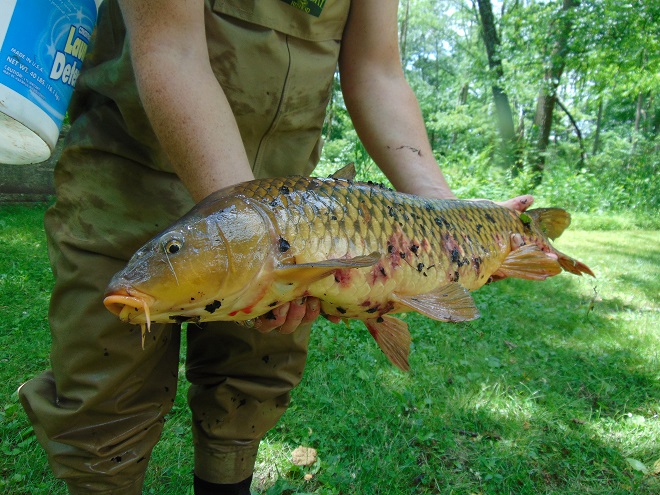
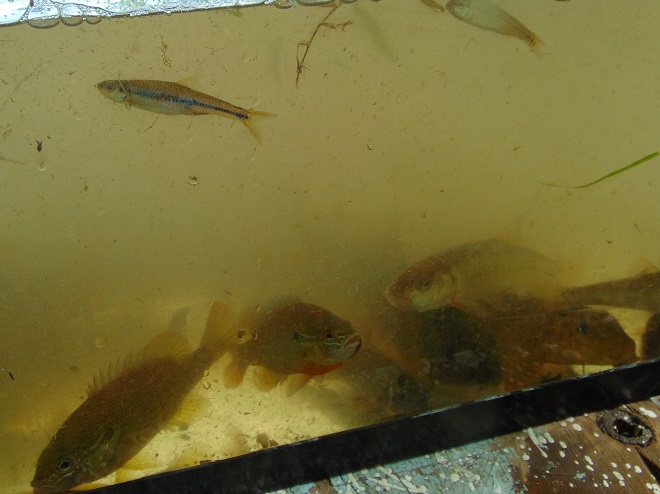
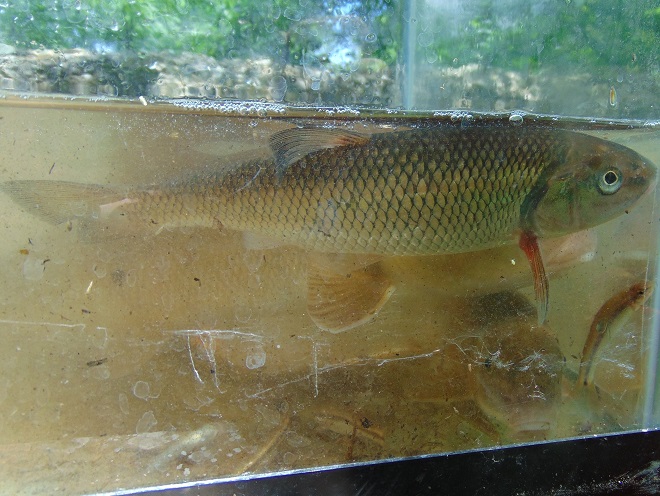
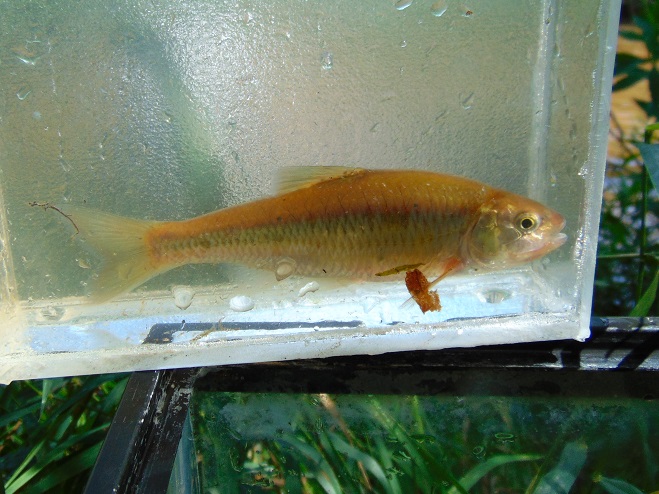
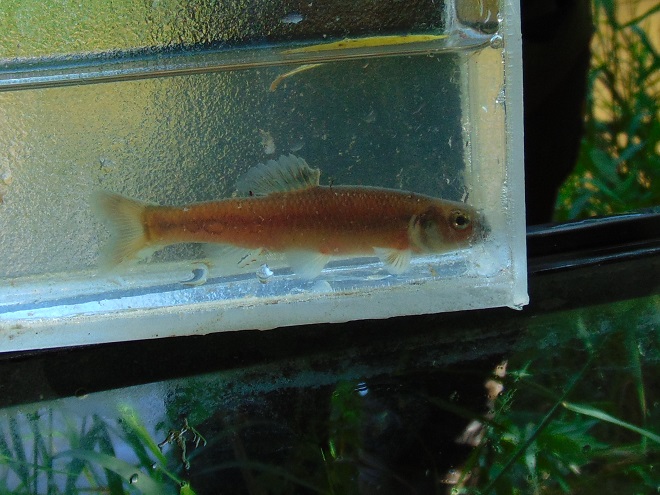
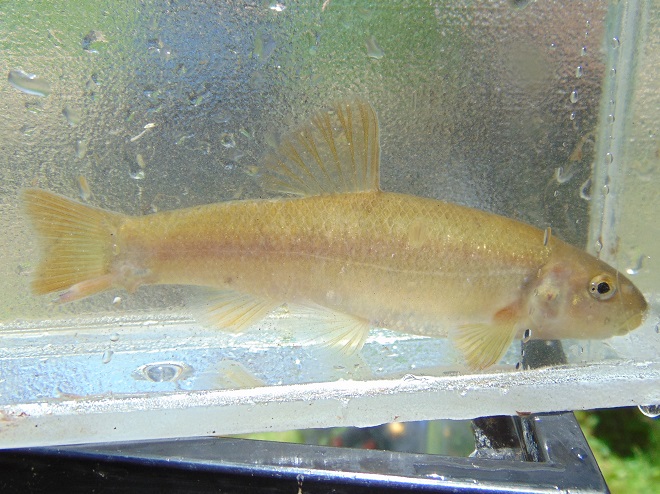
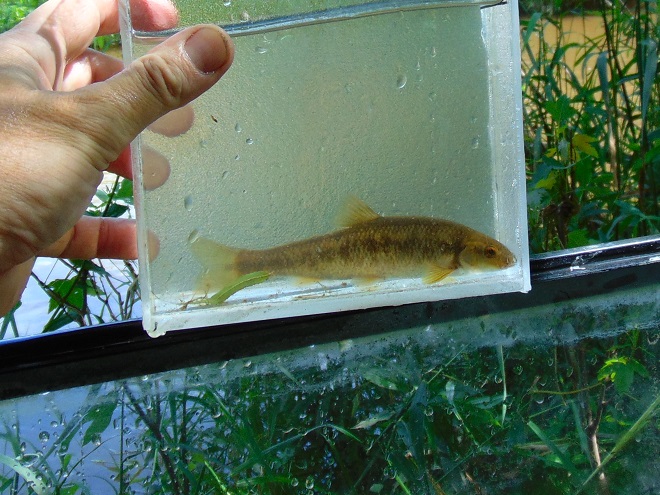
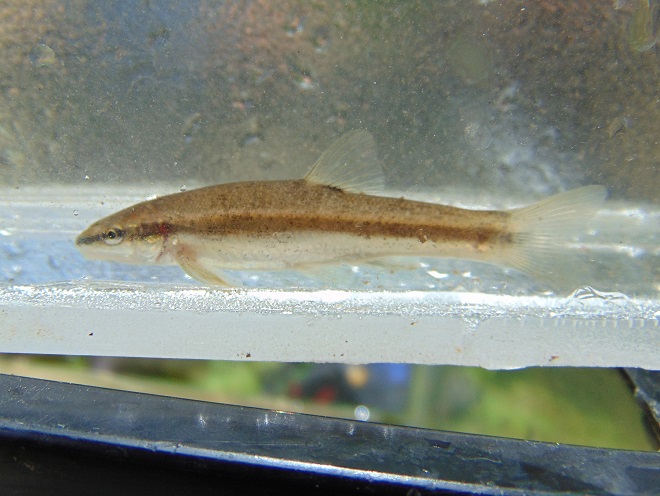
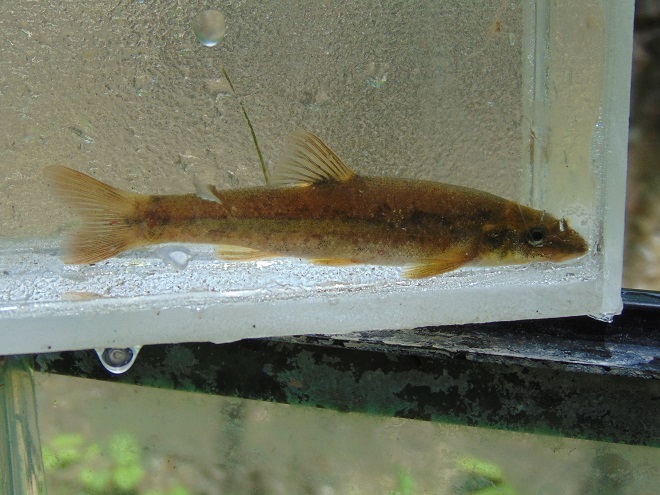
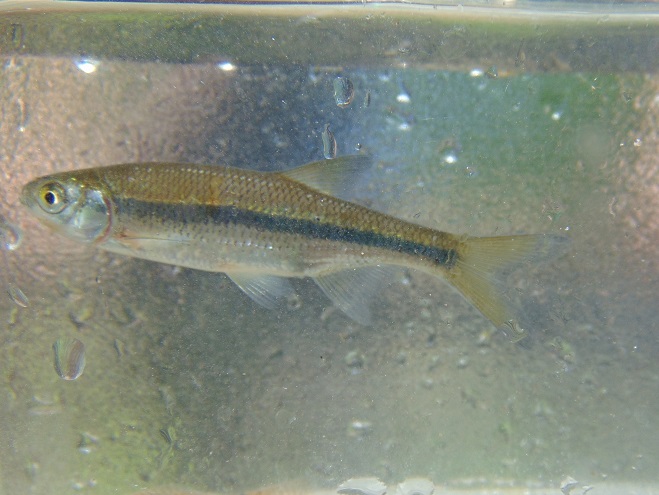
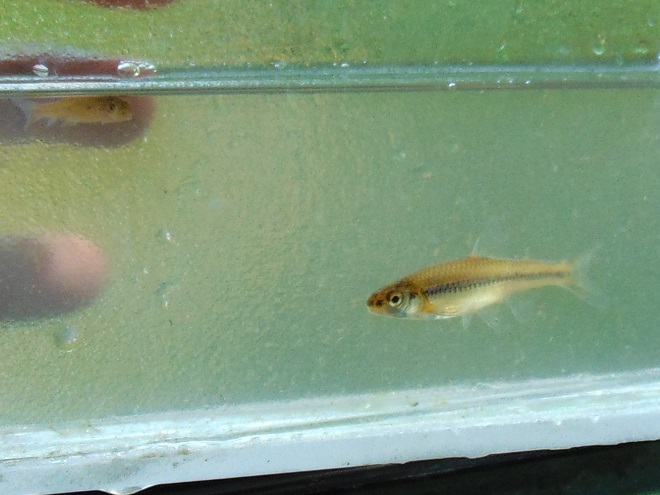
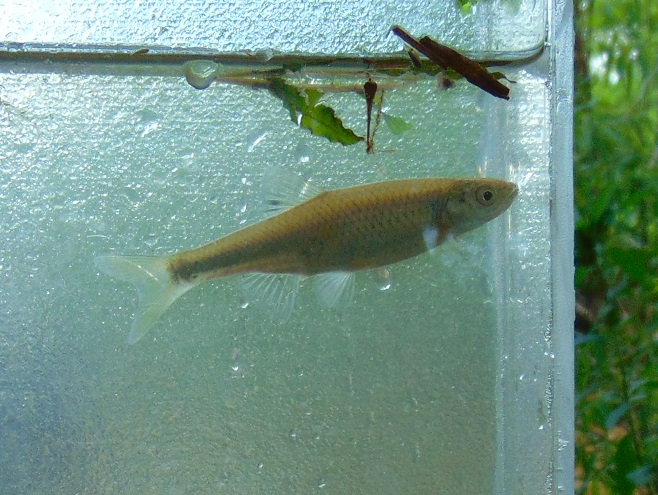
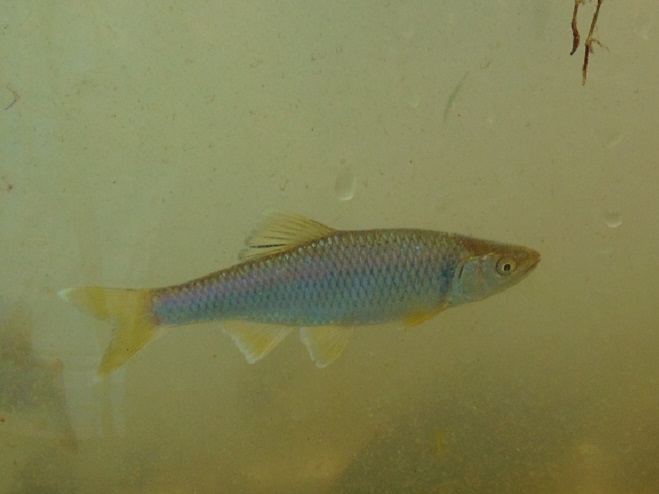
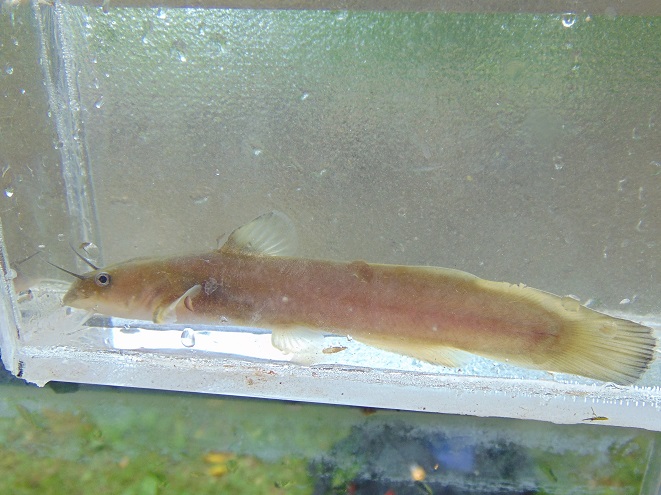
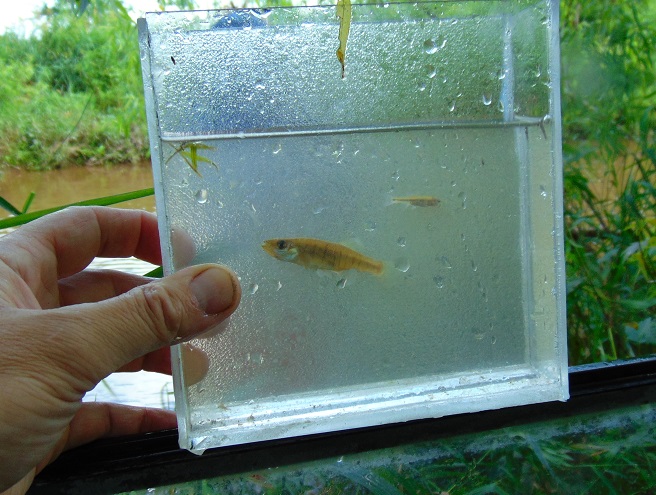
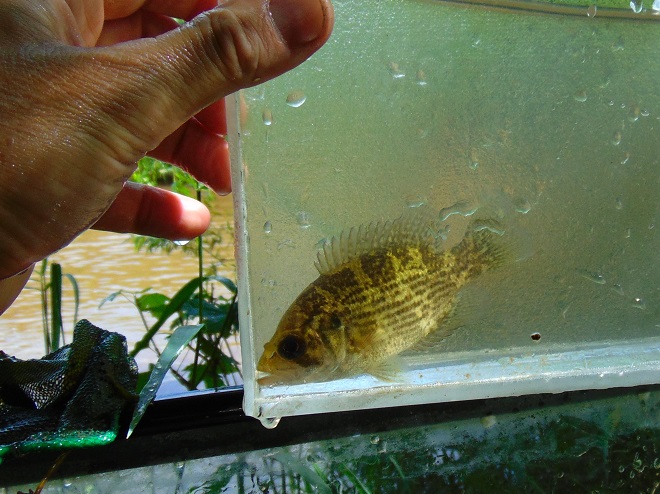
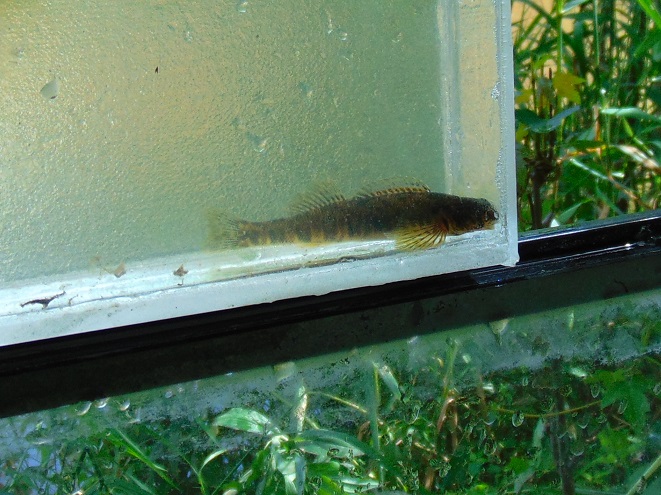
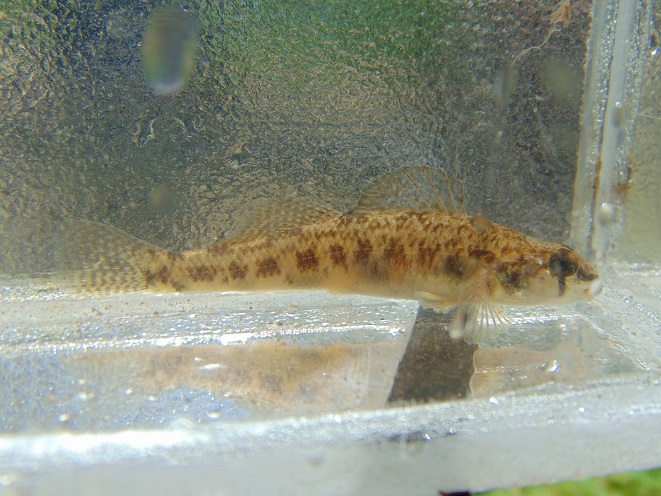
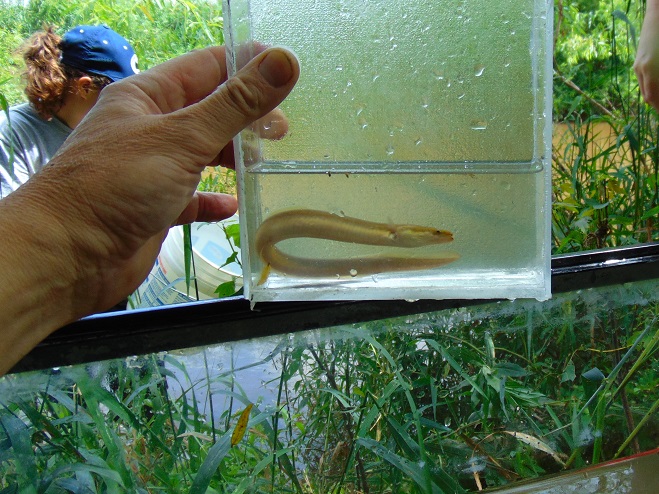
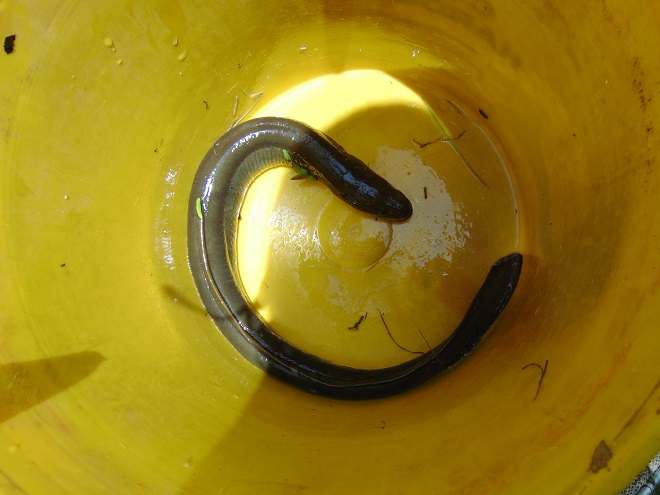
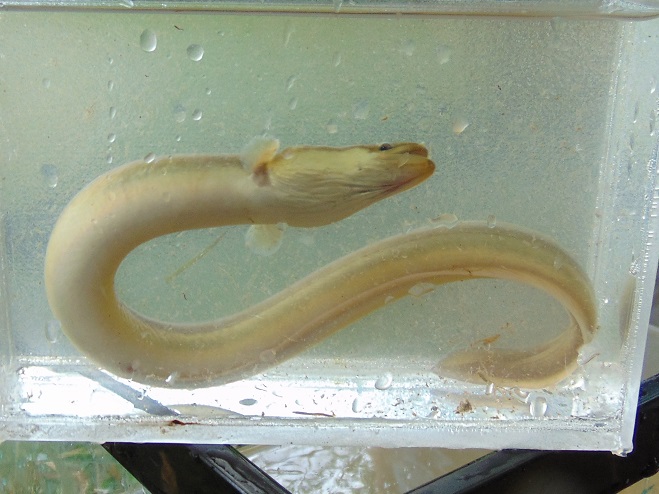
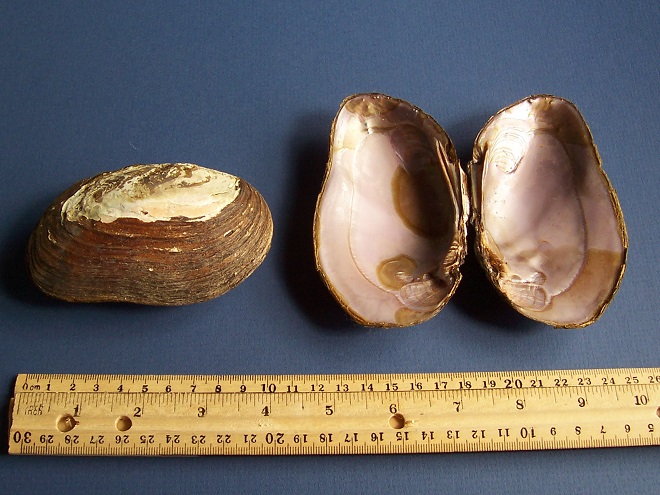
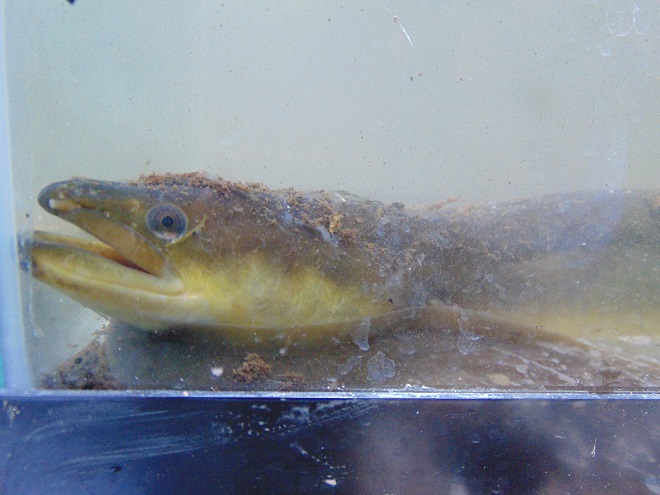
Matt Kofroth, Watershed Specialist with the Lancaster County Conservation District, operates the electrofishing wand in Conewago Creek while his team members prepare to net and collect momentarily-stunned fish. Three other electrofishing units operated by staff from the Susquehanna River Basin Commission and aided by teams of netters were in action at other sample locations along the Conewago on this day.Really big fish, such as this Common Carp (Cyprinus carpio), were identified, counted, and immediately returned to the water downstream of the advancing electrofishing team. Other fish, such as the Swallowtail Shiner, Redbreast Sunfish (Lepomis auritus), Fallfish, and suckers seen here, were placed in a sorting tank.Fallfish (Semotilus corporalis) are very active and require plenty of dissolved oxygen in the water to survive. Fallfish, Rainbow Trout (Oncorhynchus mykiss), and Smallmouth Bass (Micropterus dolomieu) were quickly identified and removed from the sorting tank for release back into the stream. Other larger, but less active fish, including suckers, quickly followed.Small fish like minnows were removed from the sorting tank for a closer look in a hand-held viewing tank. This Fathead Minnow (Pimephales promelas) was identified, added to the tally sheet, and released back into the Conewago. The Fathead Minnow is not native to the Susquehanna drainage. It is the minnow most frequently sold as bait by vendors.A breeding condition male Bluntnose Minnow (Pimephales notatus).The Cutlips Minnow (Exoglossum maxillingua) is a resident of clear rocky streams. Of the more than 30 species collected during the day, two native species which are classified as intolerant of persisting stream impairment were found: Cutlips Minnow and Swallowtail Shiner.The Central Stoneroller (Campostoma anomalum) is a benthic feeder in creeks over gravel and sand.The Eastern Blacknose Dace (Rhinichthys atratulus) is found in clear water over pebble and stone substrate.The Longnose Dace (Rhinichthys cataractae) is another species of pebbly rocky streams.A juvenile Golden Shiner (Notemigonus crysoleucas). Adults lack the side stripe and grow to the size of a sunfish.A Swallowtail Shiner (Notropis procne) and a very young White Sucker (Catostomus commersonii) in the upper left of the tank.A probable Spotfin Shiner (Cyprinella spiloptera).A breeding male Cyprinella shiner, probably a Spotfin Shiner. Show-off!The Margined Madtom (Noturus insignis) is a small native catfish of pebbly streams.The Banded Killifish (Fundulus diaphanus) is adept at feeding upon insects, including mosquitos.A young Rock Bass (Ambloplites rupestris). This species was introduced to the Susquehanna and its tributaries.The Greenside Darter (Etheostoma blennioides) is not native to the Susquehanna basin. The species colonized the Conewago Creek (east) from introduced local populations within the last five years.The Tessellated Darter (Etheostoma olmstedi) is a native inhabitant of the Susquehanna and its tributaries.The stars of the day were the American Eels (Anguilla rostrata).After collection, each eel was measured and weighed using a scale and dry bucket. This specimen checked in at 20 inches and one pound before being released.Prior to the construction of large dams, American Eels were plentiful in the Susquehanna and its tributaries, including the Conewago. They’ve since been rarities for more than half a century. Now they’re getting a lift.American Eels serve as an intermediate host for the microscopic parasitic glochidia (larvae) of the Eastern Elliptio (Elliptio complanata), a declining native freshwater mussel of the Lower Susquehanna River Watershed. While feeding on their host (usually in its gills), the glochidia cause little injury and soon drop off to continue growth, often having assured distribution of their species by accepting the free ride. Freshwater mussels are filter feeders and improve water quality. They grow slowly and can live for decades.American Eels are a catadromous species, starting life as tiny glass eels in the saltwater of the Atlantic Ocean, then migrating to tidal brackish marshes and streams (males) or freshwater streams (females) to mature. This 20-incher probably attempted to ascend the Susquehanna as an elver in 2016 or 2017. After hitching a ride with some friendly folks, she bypassed the three largest dams on the lower Susquehanna (Conowingo, Holtwood, and Safe Harbor) and arrived in the Conewago where she may remain and grow for ten years or more. To spawn, a perilous and terminally fatal journey to the Sargasso Sea awaits her. (You may better know the area of the Sargasso Sea as The Bermuda Triangle…a perilous place to travel indeed!)
SOURCES
Normandeau Associates, Inc. and Gomez and Sullivan. 2018. Muddy Run Pumped Storage Project Conowingo Eel Collection Facility FERC Project 2355. Prepared for Exelon.
Stambaugh, Jr., John W., and Robert P. Denoncourt. 1974. A Preliminary Report on the Conewago Creek Faunal Survey, Lancaster County, Pennsylvania. Proceedings of the Pennsylvania Academy of Sciences. 48: 55-60.