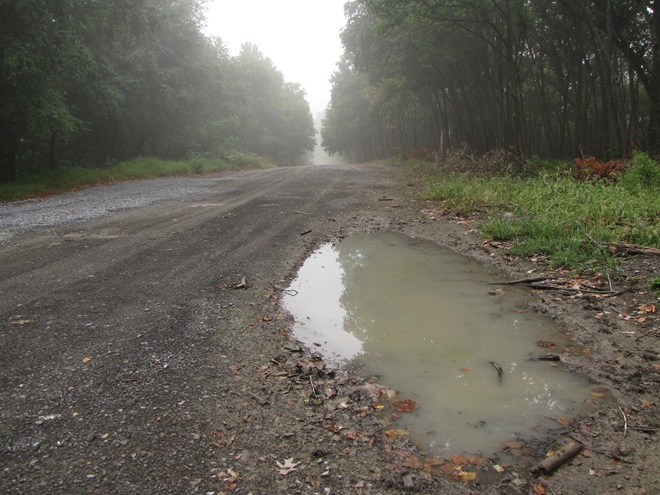
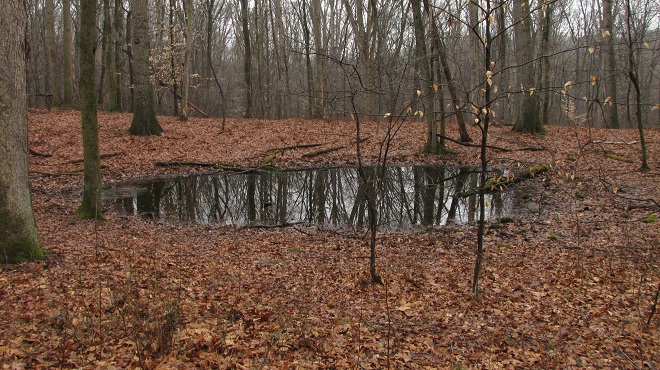
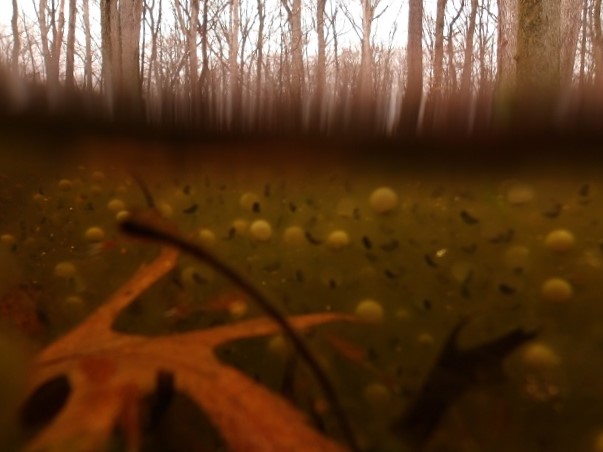
It looks irresistible—doesn’t it? To members of the gasoline and gunpowder gang and for exuberant youthful wannabes, this puddle alongside a forest road has “let’s go muddin'” written all over it. It’s an opportunity to rev ‘er up and slash on through to lay waste to those placid waters while draping the car, truck, cycle, or ATV with gobs of soggy slop. It’s an act of spectacular courage that afterward deserves a lap among one’s peers to display the cakes of dried muck worn as decorations of honor.
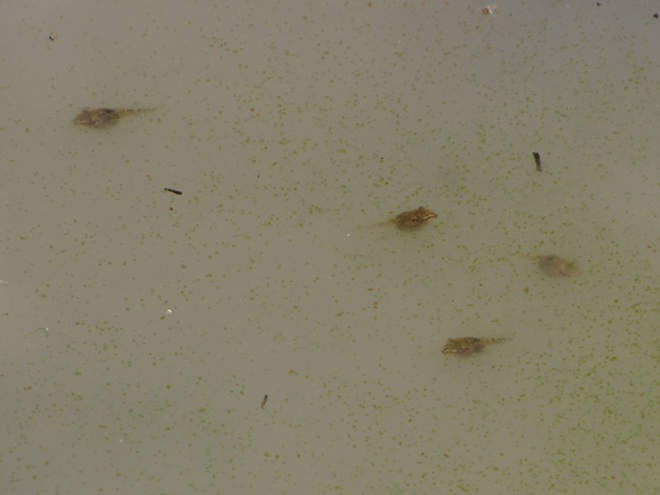
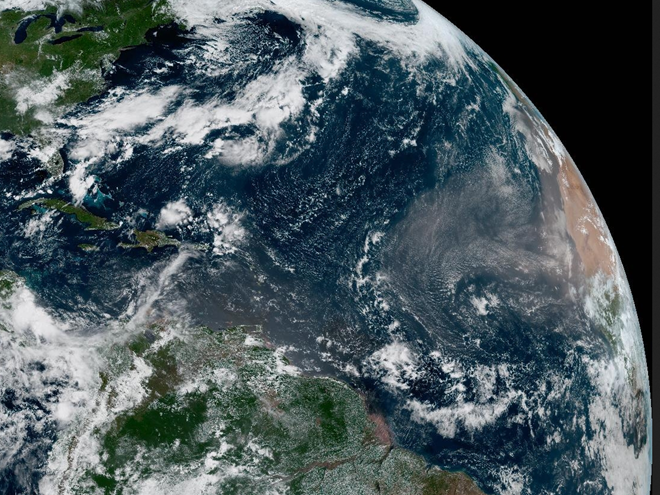
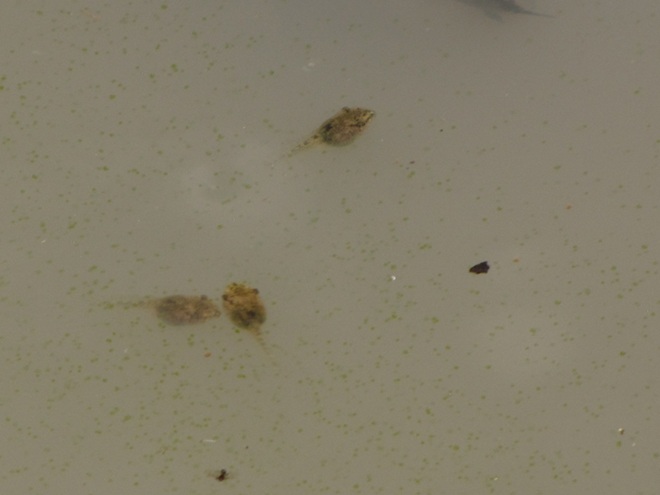
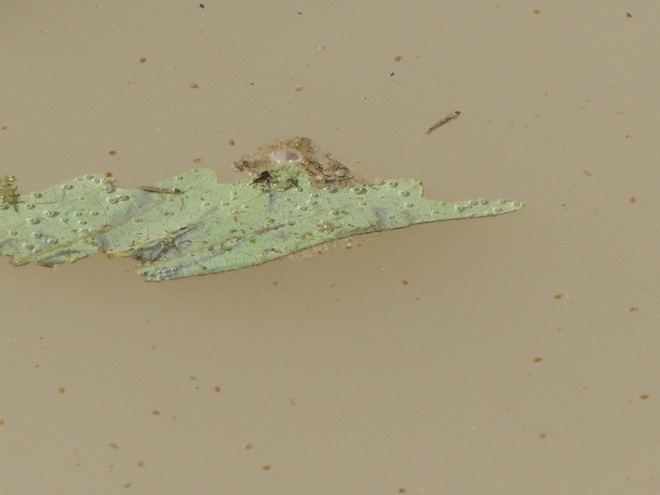
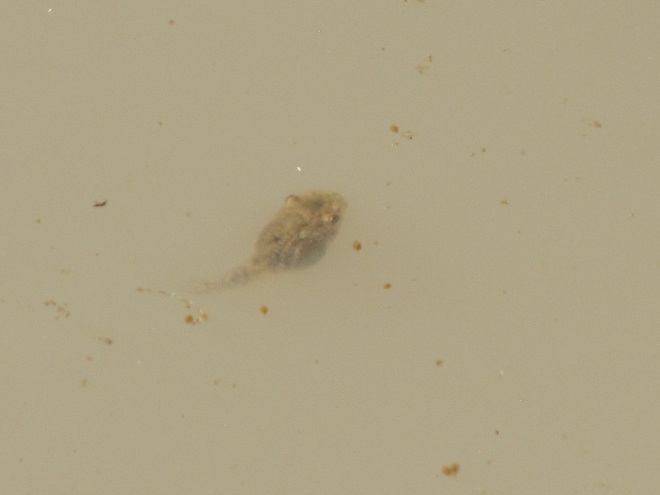
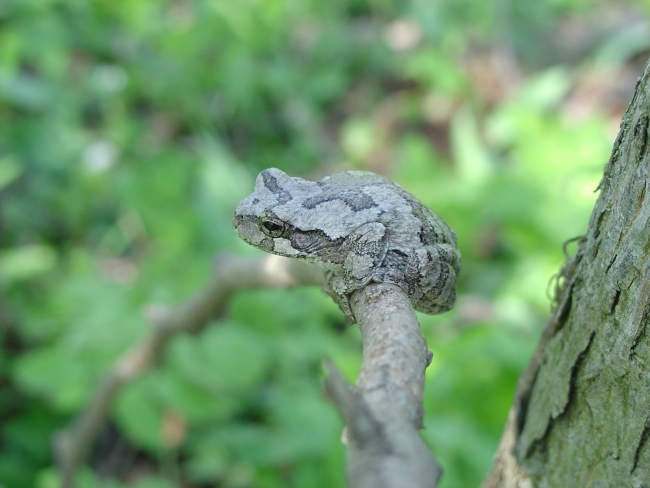
A pool of rainwater along a forest road isn’t a mud puddle until subjected to the hedonistic impulses of a dopamine-craving operator of a motor vehicle of other conveyance. In many areas, these puddles often provide the only remaining ephemeral waters available to reproducing amphibians and other forms of life. Their presence along linear roads may help prevent population fragmentation, facilitating genetic mixture to eliminate inbreeding among otherwise isolated colonies of toads, frogs, and salamanders.In this pool, we found about four dozen Gray Tree Frog (Dryophytes versicolor) tadpoles feeding on tiny green clusters of diatoms. Diatoms are microscopic phytoplankton that grow in almost any water that contains the silica necessary for the formation of their cell walls. During photosynthesis, diatoms generate as much as half the world’s supply of oxygen and fix enormous quantities of carbon dioxide. They may make up half the biomass of global oceans. As rain rehydrates dried up puddles along forest roads, diatoms are frequently the first sign of life to return.The dust clouds that blow from the African Sahara to fertilize the Amazon Basin and the waters of the Caribbean are largely the silicate-rich remains of long-dead diatoms. (NOAA/GOES-19 image)Live diatoms are an ideal starter food for small consumers like these Gray Tree Frog tadpoles.Tree frogs aren’t the only thing eating diatoms in the rain pool, Daphnia, seen here as rufous-brown specks, are a zooplankton often called “water fleas”. Their eggs are durable and can withstand periods when the puddle has no water. Another consumer of diatoms, and an ideal tadpole food, is mosquito larvae. They hatch within days of adults finding the pool and depositing eggs. Two worm-like Anopheles mosquito larvae are seen here, one in the water atop the upper middle portion of the leaf and the second floating to its upper right. In eastern North America, this genus of mosquitos includes the Anopheles quadrimaculatus complex, the Common Malaria Mosquitos from which the disease-causing Plasmodium parasites have been eradicated in our region.After starting life as primary consumers feeding upon diatoms, Gray Tree Frog tadpoles become secondary consumers, snapping up mosquito eggs and larvae as well as the plentiful Daphnia.A Gray Tree Frog tadpole feeding on Daphnia, a minute crustacean sometimes known as a “water flea”.The Gray Tree Frog tadpoles we found in this roadside pool will mature this fall to live an arboreal life among the trees of the forest. Next year, they may return to the same puddle ecosystems where they themselves were born to mate, lay eggs, and start a new generation. (United States Fish and Wildlife Service image by Sara Hollerich)
Knowing what you now know, how could you ever go crashing through a rain pool again? You wouldn’t want to leave your mother worrying that she raised an eternally adolescent jackass, would you? Or worse yet, a sociopath? After all, you’d never drive up on a sidewalk full of puppies, would you?
It may look like just a puddle in the woods, but this is a very specialized wetland habitat, a habitat that is quickly disappearing from the Lower Susquehanna River Watershed. It’s a vernal pool—also known as a vernal pond or an ephemeral (lasting a short time) pool or pond.
Viable vernal pools have several traits in common…
They contain water in the spring (hence the name vernal).
They have no permanent inflow or outflow of water.
They typically dry up during part of the year—usually in late summer.
They are fish-free.
They provide breeding habitat for certain indicator species of forest-dwelling amphibians and other animals.
They are surrounded by forest habitat that supports the amphibians and other vernal pool species during the terrestrial portion of their life cycle.
To have a closer look at what is presently living in this “black leaf” vernal pool, we’re calling on the crew of the S. S. Haldeman to go down under and investigate.
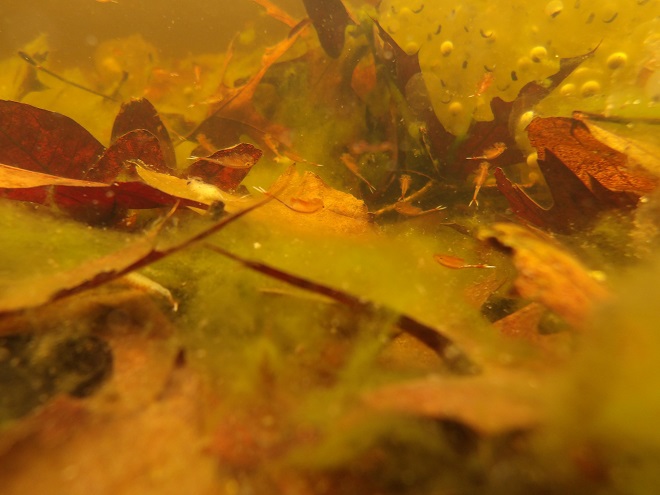
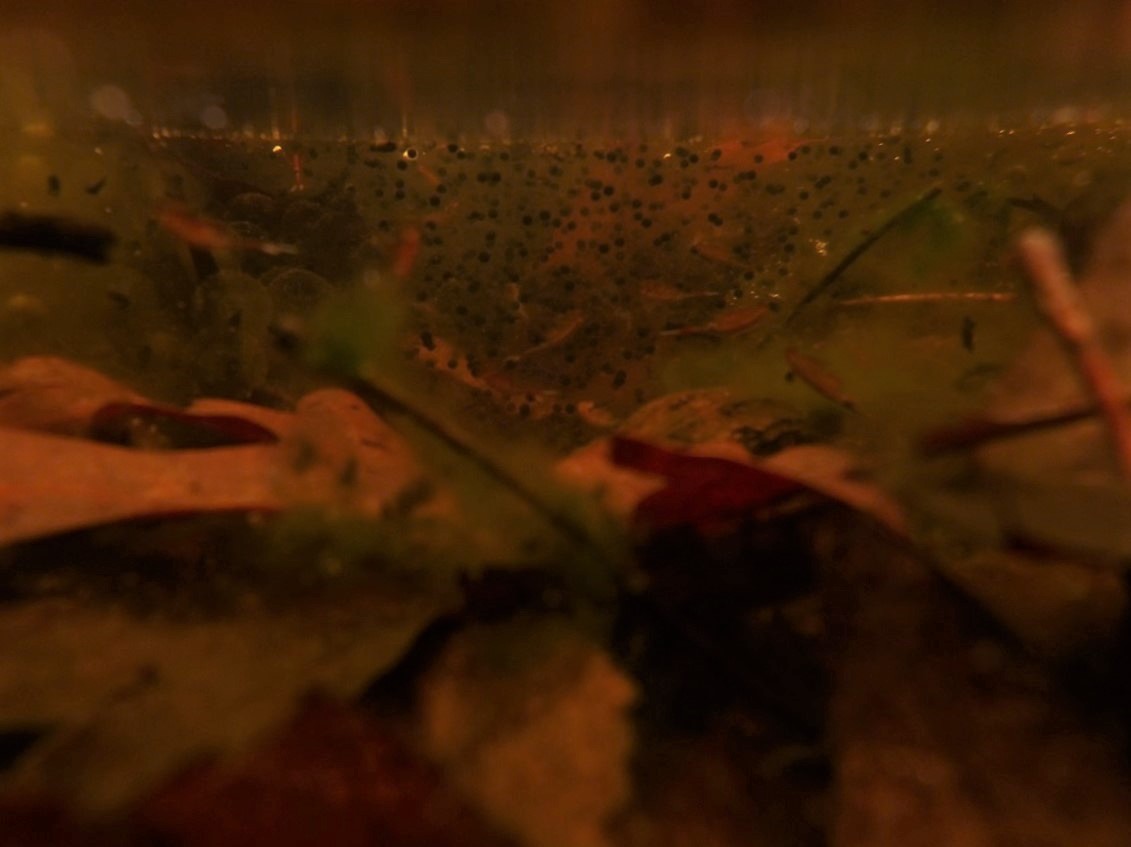
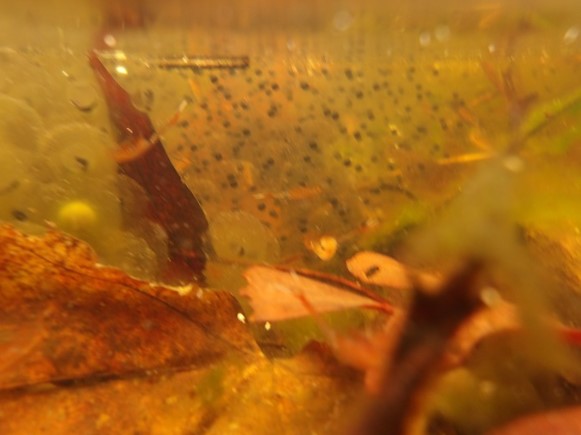
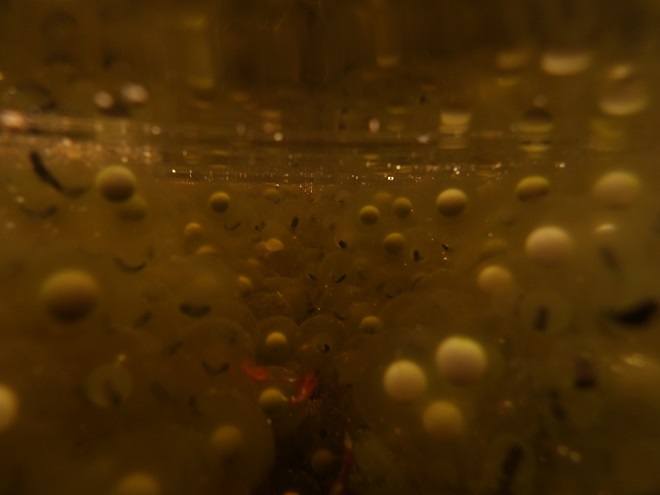
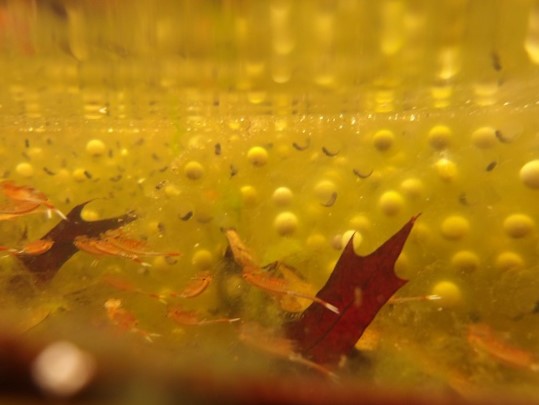
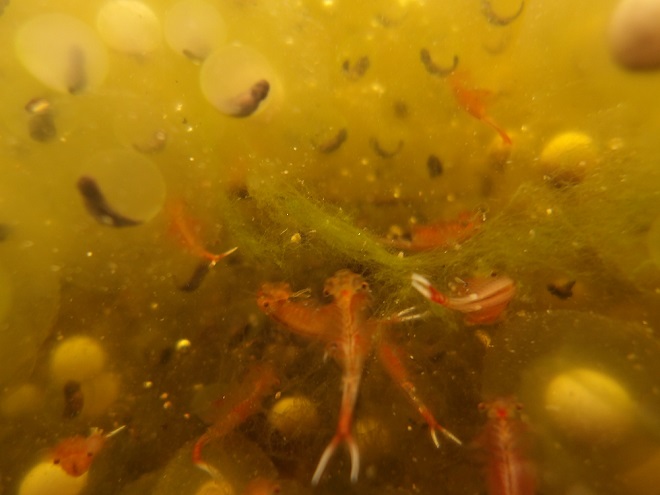
Along the surface of the pool we’re seeing clusters of amphibian eggs, a sign that this pond has been visited by breeding adult frogs and/or salamanders during recent weeks.Amphibian eggs and the white tail filaments of an invertebrate of interest, Springtime Fairy Shrimp (Eubranchipus vernalis), an endemic of vernal ponds.
Let’s take it down for a better look. Dive, all dive!
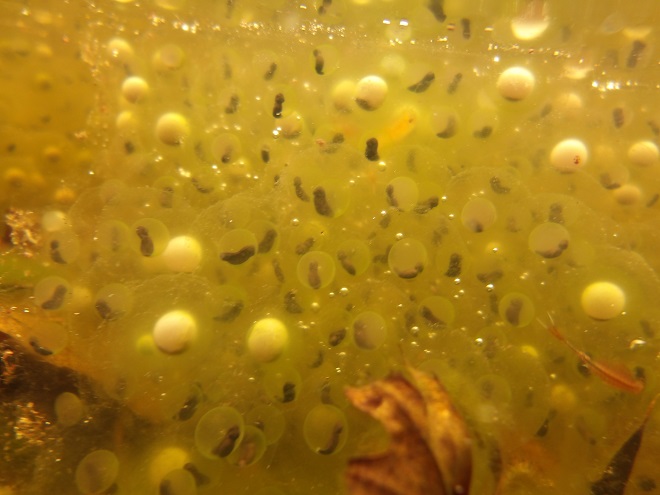
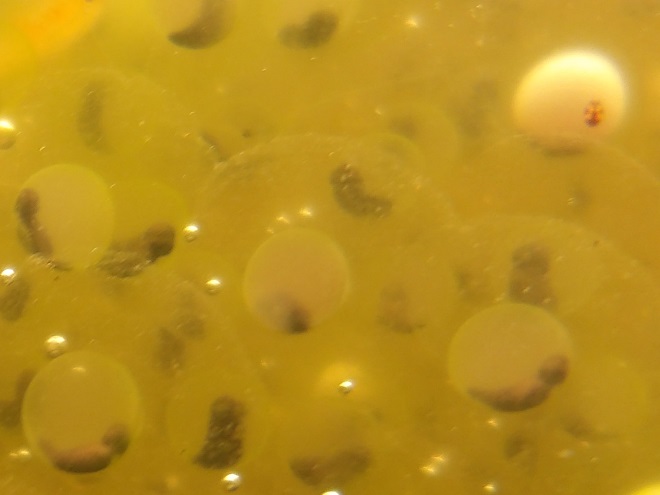
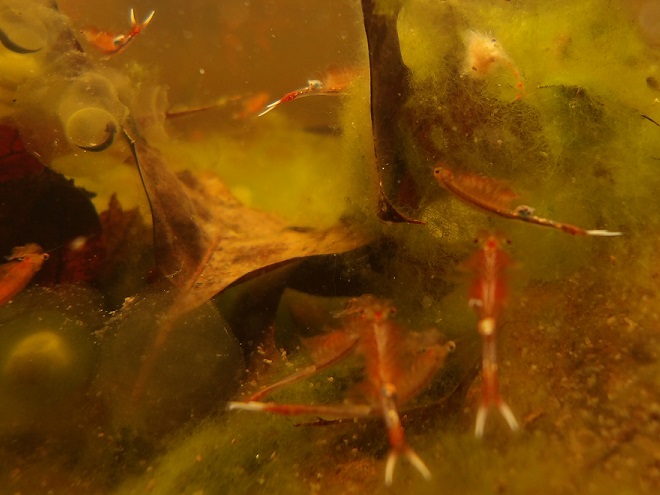
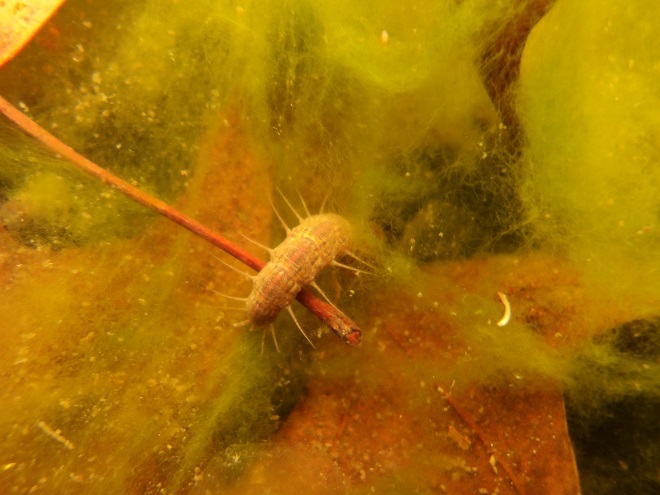
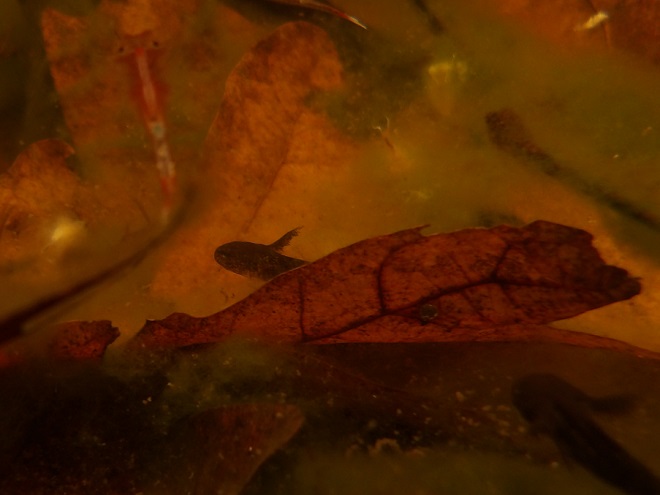
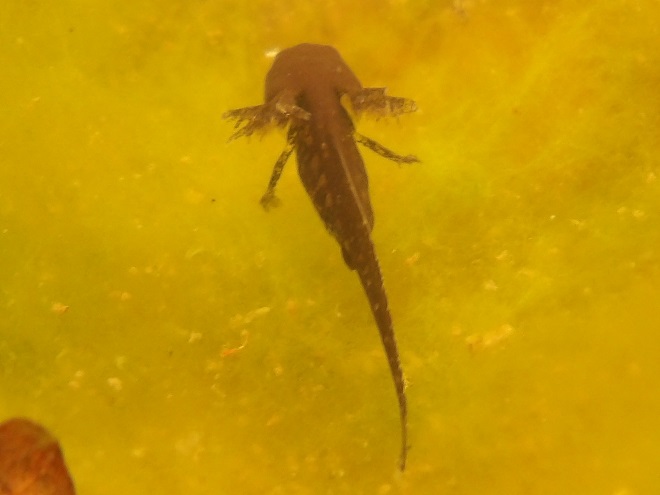
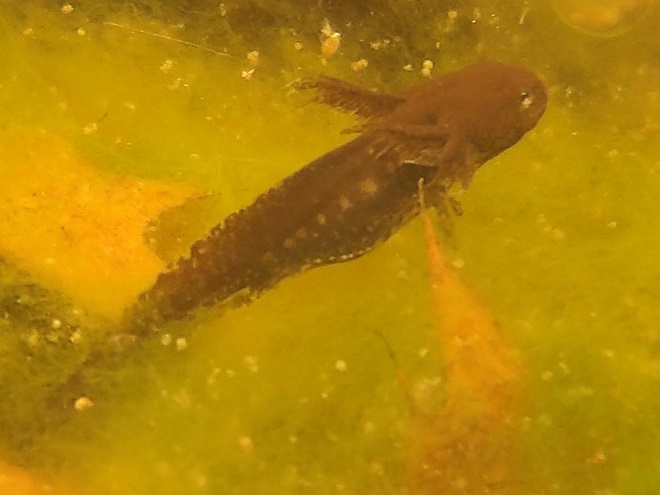
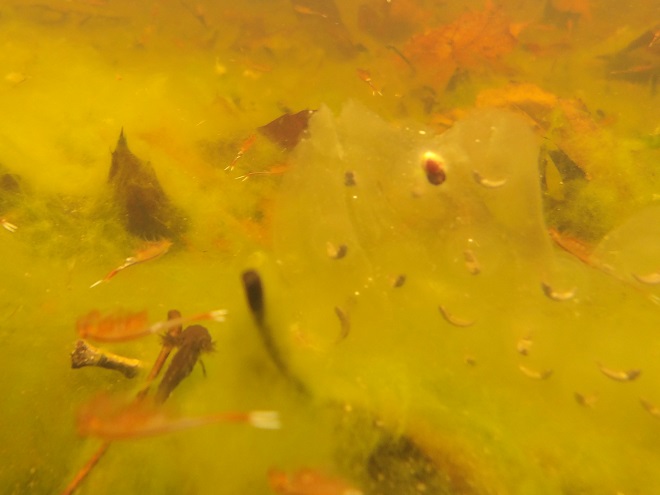
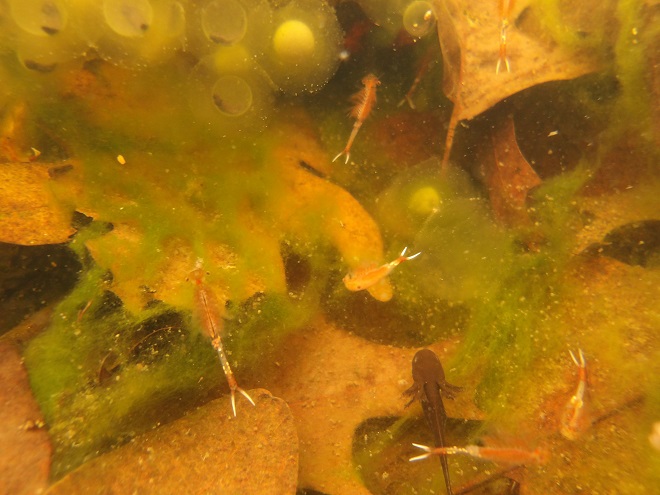
Algae provides food for the shrimp and other inhabitants of the pool. Leaf litter furnishes hiding places for the pool’s many inhabitants.These loose clusters of eggs appears to be those of Wood Frogs, a vernal pool indicator species.Clusters of Wood Frog eggs, the embryos within those in the center of the image less developed than those to the left.More Wood Frog eggs. Hatching can take anywhere from two weeks to two months, depending on temperature.Wood Frog eggs with developing larvae (tadpoles) plainly visible. The green color of the eggs is created by a symbiotic algae, Oophila amblystomatis, a species unique to vernal pools. The algae utilizes the waste produced by the developing embryos to fuel its growth and in return releases oxygen into the water during photosynthesis. Upon hatching, the tadpoles rely upon the algae as one of their principle food sources.A zoomed-in view showing development of the larvae and what appears to be a tiny invertebrate clinging on the white egg in the upper right. White eggs don’t hatch and may be infected by a fungus.Wood Frog eggs and Springtime Fairy Shrimp.Wood Frog eggs and Springtime Fairy Shrimp.Springtime Fairy Shrimp swim upside-down. Note the small, bluish clusters of eggs attached to the abdomens of these females. Springtime Fairy Shrimp live their entire lives in the vernal pool. After being deposited in the debris at the bottom of the pool, the eggs will dry out during the summer, then freeze and re-hydrate before hatching during the late winter.A damselfly larva consuming fairy shrimp. (Visible in the margin between the uppermost lobes of the dark-colored oak leaf to the right.)Getting in close we see A) the damselfly larva eating a Springtime Fairy Shrimp and B) one of several discarded exoskeletons of consumed shrimp near this predator.A fishfly larva (Chauliodinae). Mosquito numbers are kept in check by the abundance of predators in these pools.Springtime Fairy Shrimp and a Marbled Salamander (Ambystoma opacum) larva. The presence of these species confirms this small body of water is a fully-functioning vernal pool.Springtime Fairy Shrimp and two more larval Marbled Salamanders. The salamanders’ enlarged gills are necessary to extract sufficient oxygen from the still waters of the pool.The Marbled Salamander is one of three species of mole salamanders found in the Lower Susquehanna River Watershed. All breed in vernal pools and live their air-breathing adult lives under the leaves of the forest in subterranean tunnels where they feed on worms and other invertebrates. Photos of an adult Marbled Salamander and the other two species, Spotted Salamander (Ambystoma maculatum) and Jefferson Salamander (Ambystoma jeffersonianum), can be found by clicking the “Amphibians” tab at the top of this page.Marbled Salamanders lay their eggs during the fall. If the bed of the pool is dry at breeding time, the adult female will remain to guard the eggs until rain floods the pool. The eggs hatch upon inundation, sometimes during the winter.Marbled Salamanders, like all amphibians that develop in vernal pools, must complete transformation into their air-breathing terrestrial life stage before the pool dries up in the summer heat.A larval Marbled Salamander explores the bottom of the pool.A larval Marbled Salamander, Wood Frog eggs, and Springtime Fairy Shrimp, it’s an abundance of life in what at first glance may appear to be just a mud puddle.
We hope you enjoyed this quick look at life in a vernal pool. While the crew of the S. S. Haldeman decontaminates the vessel (we always scrub and disinfect the ship before moving between bodies of water) and prepares for its next voyage, you can learn more about vernal pools and the forest ecosystems of which they are such a vital component. Be sure to check out…
If you are a landowner or a land manager, you can find materials specifically providing guidance for protecting, restoring, and re-establishing vernal pool habitats at…