What better way to pass a bright, sunny afternoon than to beat the heat by loafing atop a bridge spanning a small coldwater stream? We just lingered in the shade cast by an overarching tree and watched to see what might come by…
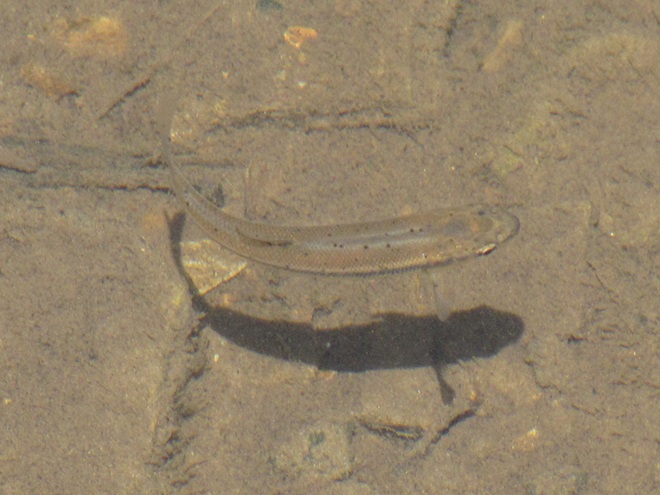
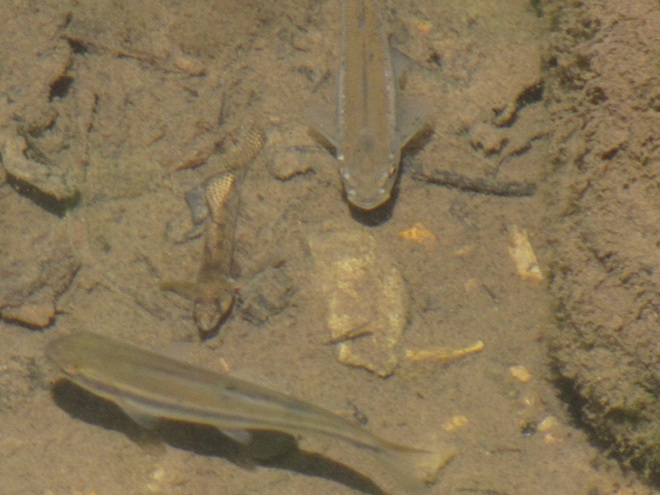
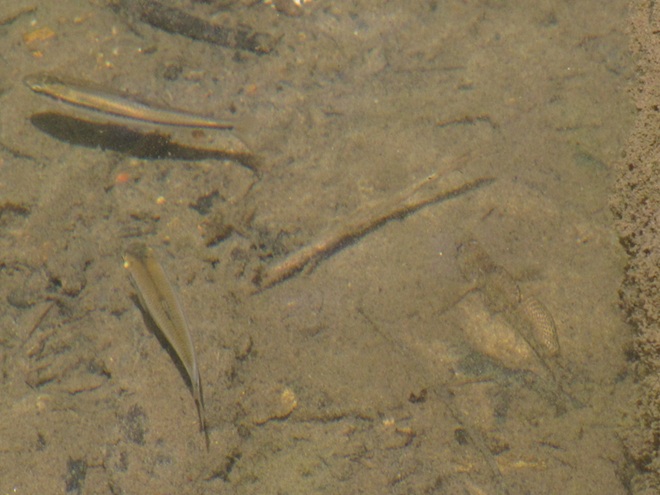
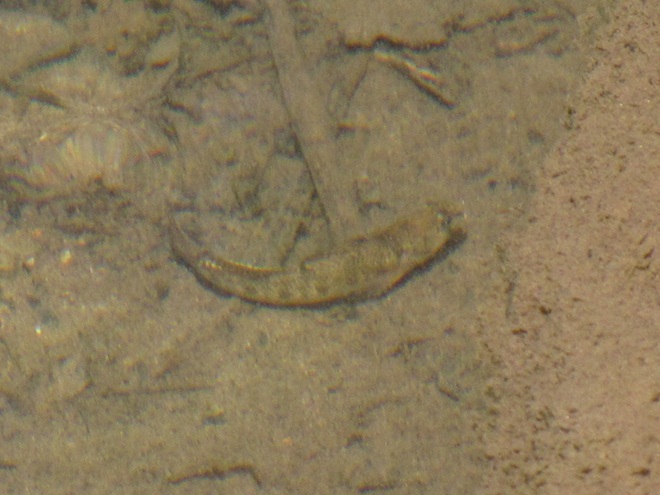
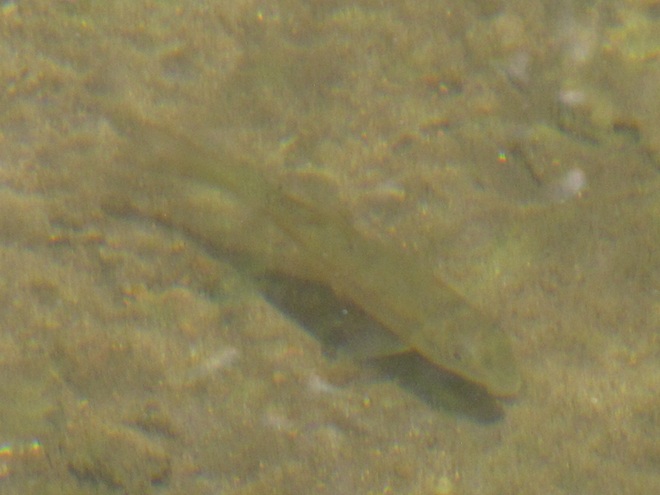
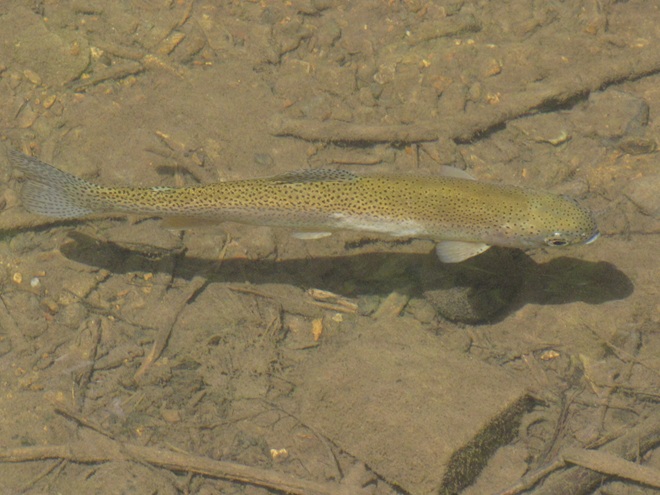
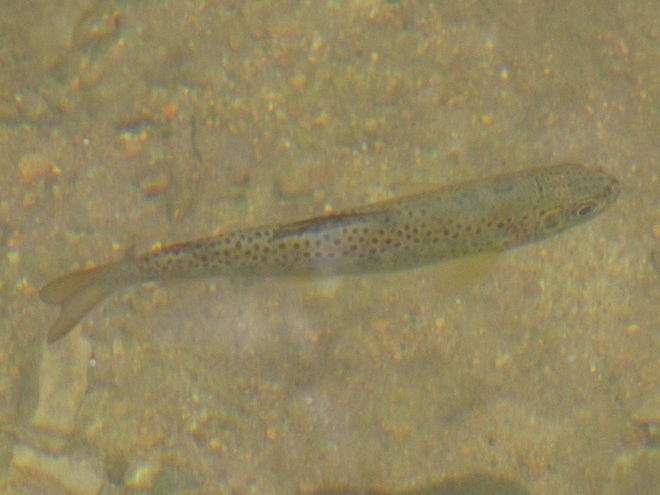
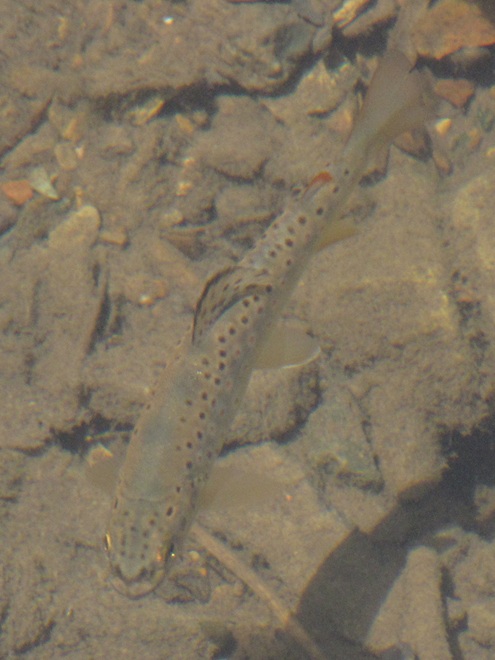
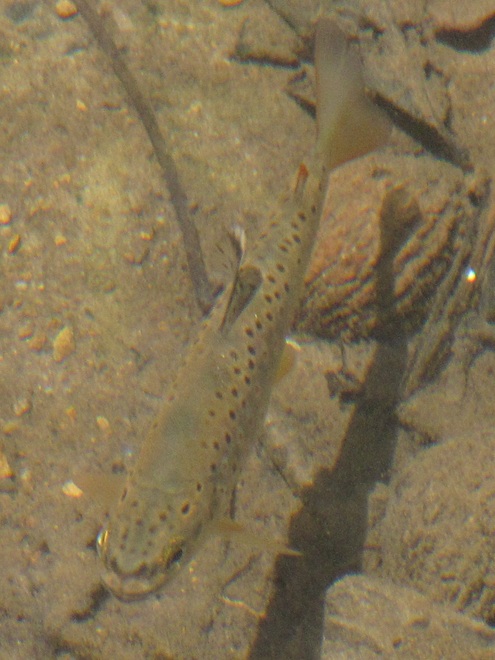
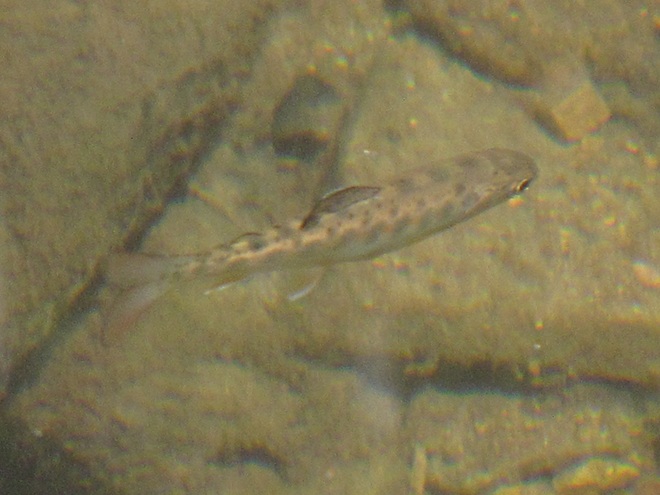
The Eastern Blacknose Dace is the most widespread and usually the most numerous minnow in coldwater streams throughout the Lower Susquehanna River Watershed. Sightings from our lookout at a crossing on the East Branch Standing Stone Creek, a tributary of the Juniata River, were in accordance with this generalization.The presence of these Eastern Blacknose Dace in close proximity to a male Tessellated Darter’s nest has him unfurling his flag-like dorsal fins in an attempt to intimidate the much larger minnows.He won’t be fully satisfied until they leave the area, so he’ll keep displaying his banners.Satisfied the invaders are gone, at least for now, he secures his sails, but continues to stand watch over the eggs, which are probably concealed beneath the boulder on the right.As it searches for invertebrates and other sources of food along the bottom of East Branch Standing Stone Creek, a juvenile White Sucker stirs up organic material derived chiefly from fallen leaves and other plant matter. Draining exclusively from dense woodlands in Rothrock State Forest, this waterway collects minimal quantities of water-polluting nutrients and sediments. The substrate is mostly sand, gravel, and cobble among boulders of various sizes.Except for some stormwater runoff from forest roads in its headwaters, the first significant source of thermal pollution on East Branch Standing Stone Creek as it tumbles toward the Juniata is a recreation impoundment at Greenwood Furnace State Park. This Rainbow Trout, which was probably stocked there for angling earlier this spring, is already showing the effects of warming water. As lake temperatures rise into and above the mid-seventies, trout become stressed and are especially susceptible to other factors that can prove fatal. These include parasites, poor nutrition, bacterial and fungal infections, and predation. Because they require well-oxygenated water to survive, trout are especially vulnerable to diminishing oxygen levels in warming and/or polluted waters, so hypoxia is a real concern. From our lookout just upstream from the lake, we watched as this struggling Rainbow Trout, apparently seeking refuge from the mid-day conditions in the sun-drenched impoundment, ascended the cold stream and took cover in some shade.In waters up the creek from the lake, trout with smaller proportions than those typically stocked for angling have been able to not only survive year-round, they are reproducing there. From our perch over East Branch Standing Stone Creek, we quietly observed this juvenile Brown Trout, a descendant of non-native individuals introduced in an attempt to establish a population of “wild trout” in the waterway.Brown Trout spawn in East Branch Standing Stone Creek in November. The eggs hatch within a month or two and the fry hide among the gravel, cobble, and rock of the stream bed. Still in its first year of life, this juvenile already resembles an adult, only traces of the vertical bars called “parr marks” remain along its flanks,……but this is still a petite little fish. Compare it to the walnuts on the stream bottom to the right. In a small stream, Brown Trout reach sexual maturity at a very small size, but could be in their third or fourth year of life when it happens.A population of the Susquehanna watershed’s native salmonid, the Brook Trout, lives and reproduces in East Branch Standing Stone Creek as well. This juvenile began life in much the same way and at about the same time of year as the non-native Brown Trout with which it will have to compete for survival. However, we noticed that this fingerling’s change in physical appearance is not as expedient as that of its introduced competitor. While telltale signs of an adult “brookie” are starting to show, the vertical “parr marks” of a young trout are still quite apparent, and will likely remain visible throughout its first year and beyond. Later in the summer, the dorsal surface of this fish will darken and the vermiculations of an adult Brook Trout should become evident. Most Brook Trout reach sexual maturity during their second year of life, so if all goes well, this could very well be one of next year’s breeders.
Greenwood Furnace State Park and East Branch Standing Stone Creek are located within Rothrock State Forest in northeastern Huntingdon County, Pennsylvania—just over Stone Mountain north of Belleville and the Kishacoquillas Valley on PA Route 305. To identify fish and other aquatic life in clear waters, you’ll need only a pair of close-focus binoculars or a camera with a telephoto lens. Polarized sunglasses really help penetrate the surface glare and shimmer, particularly on breezy days, making them a great fishwatching accessory for spotting your subjects of study.
While the heat and humidity of early summer blankets the region, Brood XIV Periodical Cicadas are wrapping up their courtship and breeding cycle for 2025. We’ve spent the past week visiting additional sites in and near the Lower Susquehanna River Watershed where their emergence is evident.
We begin in York County just to the west of the river and Conewago Falls in mostly forested terrain located just southeast of Gifford Pinchot State Park. Within this area, often called the Conewago Hills, a very localized population of cicadas could be heard in the woodlands surrounding the scattered homes along Bull Road. Despite the dominant drone of an abundance of singing Pharaoh Periodical Cicadas, we were able to hear and record the courtship song of a small number of the rare Little Seventeen-year Cicadas. Their lawn sprinkler-like pulsating songs help mate-seeking males penetrate the otherwise overwhelming chorus of the Pharaoh cicadas in the area.
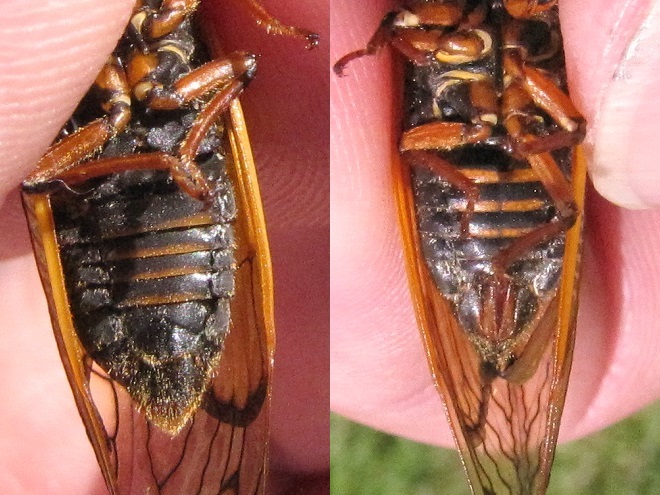
The Little Seventeen-year Cicada’s (Magicicada septendecula) thorax is black between the eye and the origin of the wings. It is the rarest of the three species of seventeen-year cicadas.The underside of male (left) and female (right) Little Seventeen-year Cicadas shows narrow orange edges on the abdominal segments.
From the Conewago Hills we moved northwest into the section of southern Cumberland County known as South Mountain. Here, Pharaoh Periodical Cicadas were widespread in ridgetop forests along the Appalachian Trail, particularly in the area extending from Long Mountain in the east through Mount Holly to forests south of King’s Gap Environmental Education Center in the west.
Pharaoh Periodical Cicadas along the Appalachian Trail on South Mountain, Cumberland County, Pennsylvania. Like the cicadas we visited last week on the east side of the Susquehanna, this population is surviving on lands with a history of timber harvest and charcoal production to fuel nearby iron furnaces during the nineteenth century.
While on South Mountain, we opted for a side trip into the neighboring Potomac watershed of Frederick County, Maryland, where these hills ascend to greater altitude and are known as the Blue Ridge Mountains, a name that sticks with them all the way through Shenandoah National Park, the Great Smoky Mountains, and to their southern terminus in northwestern Georgia. We found a fragmented emergence of Pharaoh Periodical Cicadas atop the Catoctin Mountain section of the Blue Ridge just above the remains of Catoctin Furnace, again on lands that had been timbered to make charcoal to fuel iron production prior to their protection as vast expanses of forest.
A Pharaoh Periodical Cicada on Catoctin Mountain near Catoctin Furnace south of Thurmont, Maryland. These cicadas are not part of a Brood XIV emergence, but are instead a population of Brood X (2021) stragglers.A female Brood X Pharaoh Periodical Cicada straggler on Catoctin Mountain. The website “cicadamania.com” notes, “Experts (Gaye Williams, State Entomologist of Maryland, John Cooley of UCONN) have confirmed that there will be no Brood XIV cicadas for Maryland.”
Back in Pennsylvania, we’re on our way to the watersheds of the northernmost tributaries of the lower Susquehanna’s largest tributary, the Juniata River. There, we found Brood XIV cicadas more widespread and in larger numbers than occurred at previous sites. Both Pharaoh and Cassin’s Periodical Cicadas were seen and heard along Jack’s Mountain and the Kishacoquillas Creek north of Lewistown/Burnham in Mifflin County. To the north of the Kishacoquillas Valley and Stone Mountain in northernmost Huntingdon County, the choruses of the two species were again widespread, particularly along the forest edges in Greenwood Furnace State Park, Rothrock State Forest, and adjacent areas of the Standing Stone Creek watershed.
A view of the sound-generating tymbal on a male Pharaoh Periodical Cicada at Greenwood Furnace State Park. Rapid vibration of the tymbals by a set of specialized muscles generates the distinctive calls and courtship songs of the various cicada species. When handled, these tymbals can produce a harsh “panic call”. This distress sound could startle a would-be predator and provide the cicada with an opportunity to escape.The sound organs comprised of ribbed tymbals and specialized muscles on the male Cassin’s Periodical Cicada generate a “panic call” as well as the distinctive calls and songs used to penetrate the droning choruses of the more numerous Pharaoh Periodical Cicadas with which it shares a seventeen-year flight.Using their specialized sound organs, Cassin’s Periodical Cicadas generate a courtship song that usually includes buzzy phrases and ticking notes (first sound clip). The buzzing and ticking helps the male Cassin’s cicada penetrate the songs of the more numerous Pharaoh Periodical Cicadas in the area (second sound clip). When synchronized into a chorus that surges in volume, the songs of Cassin’s Periodical Cicadas can overcome the overwhelming drone of the nearby Pharaoh cicadas (third sound clip).After mating and before the lives of these seventeen-year cicadas draw to a close, the females need to deposit their fertilized eggs into the small end twigs of suitable trees. On a small hawthorn tree (Cretaegus species) along the edge of the forest at Greenwood Furnace State Park, this Pharaoh Periodical Cicada is using her ovipositor to make a slit in a twig and place her eggs.Simultaneously on the same little hawthorn tree, this female Cassin’s Periodical Cicada is depositing her fertilized eggs.
Within the last 48 hours, we visited one last location in the Lower Susquehanna River Watershed where Brood XIV Periodical Cicadas have emerged during 2025. In the anthracite coal country of Northumberland County, a flight of Pharaoh Periodical Cicadas is nearing its end. We found them to be quite abundant in forested areas of Zerbe Run between Big and Little Mountains around Trevorton and on the wooded slopes of Mahanoy Mountain south of nearby Shamokin. Line Mountain south of Gowen City had a substantial emergence as well.
A Brood XIV Pharaoh Periodical Cicada near Zerbe Run west of Trevorton, Northumberland County, Pennsylvania. The following sound clip features the fading chorus of these cicadas and some of the nesting birds that may actually be preying upon them: Yellow-billed Cuckoo, Red-eyed Vireo, and Northern Cardinal.Brown leaves reveal the end twigs where female Pharaoh Periodical Cicadas have deposited eggs during the last several weeks. During July, the larvae will hatch and drop to the ground to start a new generation of Brood XIV cicadas. As subterranean nymphs, they’ll spend the coming seventeen years feeding on small amounts of xylem sap from tree roots. In 2042, during the next Brood XIV emergence, these nymphs will come to the surface and take flight as adults.Evidence of egg deposition among foliage on Line Mountain at State Game Lands 229.Accumulations of deceased Pharaoh Periodical Cicadas on Line Mountain.Fallen cicadas that show any sign of life are being snatched up by predators such as this Eastern Gartersnake (Thamnophis sirtalis sirtalis). Meanwhile, the remainder of the biomass is picked apart by scavengers or is left to reducers for breakdown into fertilizer and organic matter for the forest. Nothing goes to waste.
To chart our travels, we’ve put together this map plotting the occurrence of significant flights of Periodical Cicadas during the 2025 emergence. Unlike the more densely distributed Brood X cicadas of 2021, the range of Brood XIV insects is noticeably fragmented, even in areas that are forested. We found it interesting how frequently we found Brood XIV cicadas on lands used as sources of lumber to make charcoal for fueling nineteenth-century iron furnace operations.
The furnaces at Greenwood Furnace State Park required the daily cutting of one acre of timber to make enough charcoal to fuel the iron-making process. Did keeping thousands of acres in various stages of forest succession to supply the charcoal needs of these operations aid the survival of earlier generations of Periodical Cicadas on these lands? Or, after the furnaces converted to coal for fuel, did the preservation of many of these parcels as state, federal, and private forests allow the cicadas to find refuge from the widespread impacts of agriculture and expanding urbanization in adjacent lands? Maybe it’s a little of both. We always bear in mind that annual insects and other animals are more than one hundred generations removed from the negative or positive impacts of the early years of the industrial age, but only about ten generations have passed since populations of seventeen-year Periodical Cicadas were directly influenced by these factors. What do you think?
Well, that’s a wrap. Please don’t forget to check out our new Cicadas page by clicking the “Cicadas” tab at the top of this page. Soon after the Periodical Cicadas are gone, the annual cicadas will be emerging and our page can help you identify the five species found regularly in the lower Susquehanna valley. ‘Til next time, keep buzzing!