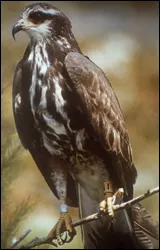
The Stewards of Inland Shorebird Habitat

As they travel between coastal wintering ranges and breeding territories in Canada and Alaska, vast numbers of shorebirds pass through the lower Susquehanna region each spring and fall—though few stop here to rest, feed, and provide us with an opportunity to observe them.  Prior to the construction of man-made dams and other alterations on our lotic (flowing) waterways including the river, shorebirds took advantage of lateral bars, stream deltas, and other alluvial deposits as places to loaf and re-energize.  Before they were drained and filled, some of the valley’s wetlands probably included sparsely vegetated flats where shorebirds could drop in for a brief visit.  Previous to their extirpation from our region, North American Beavers were the primary providers of quality habitat for shorebirds and other migrating waders on our lotic waters.  Their widespread network of dams, pools, and marshes maximized floodplain function by keeping streams thoroughly connected to their wetlands, nurturing plant communities that not only provided food and shelter for the beavers and other wildlife, but provided superb buffering against erosion while protecting against sediment and nutrient imbalances in lower Susquehanna waterways.
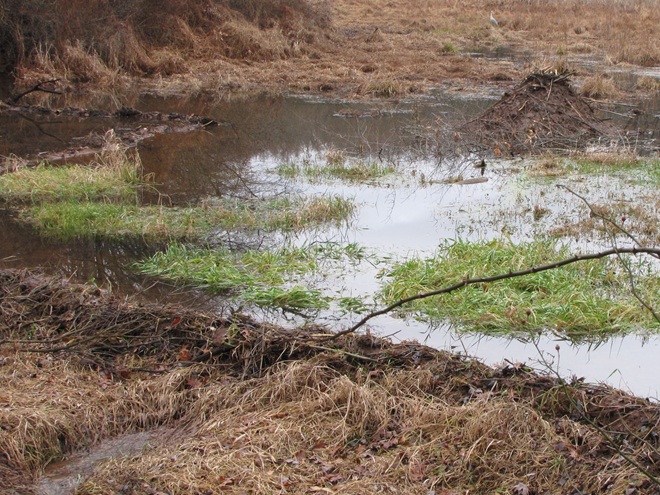
Beaver Dam and Lodge
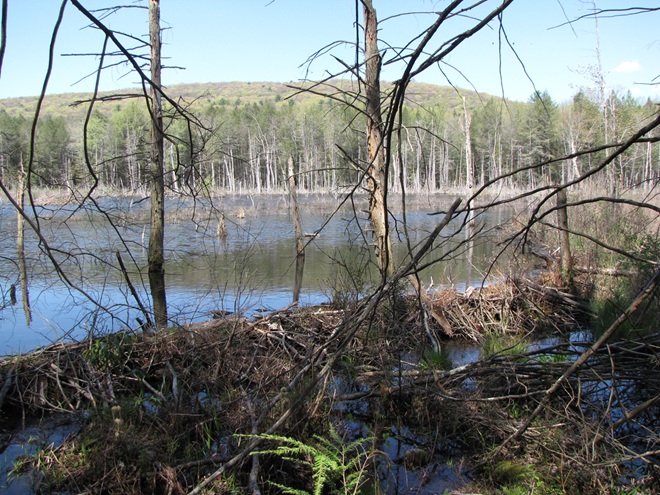
Beaver dams need not be large, particularly on low-gradient streams where a structure like this is sufficient to create a pool with depth adequate for building and maintaining a lodge and transporting leafy branches and other food items by water.
A beaver lodge assembled in a pool with less than three feet of water, deep enough to provide the family with a measure of protection against terrestrial predators.
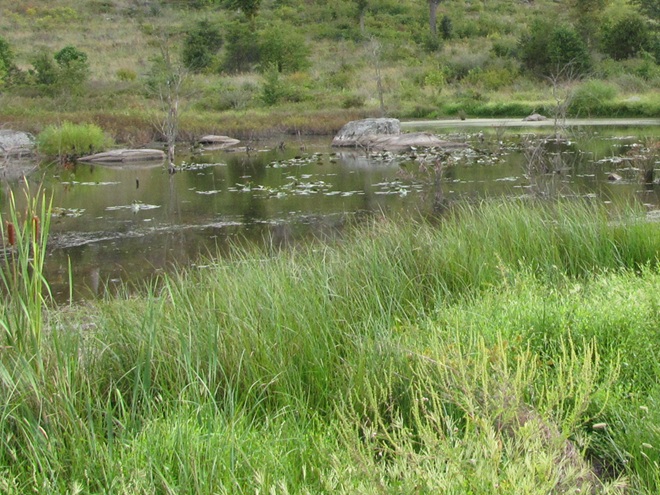
Beaver Pool
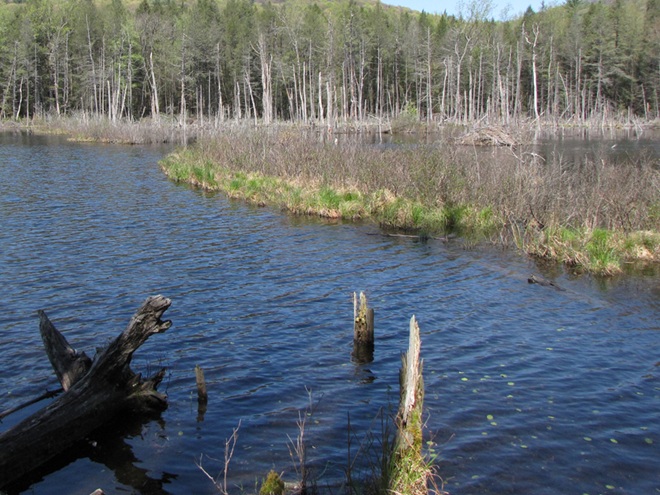
Beaver pool ecosystems provide homes for hundreds of species of plants and animals, including migrating shorebirds and other waders.
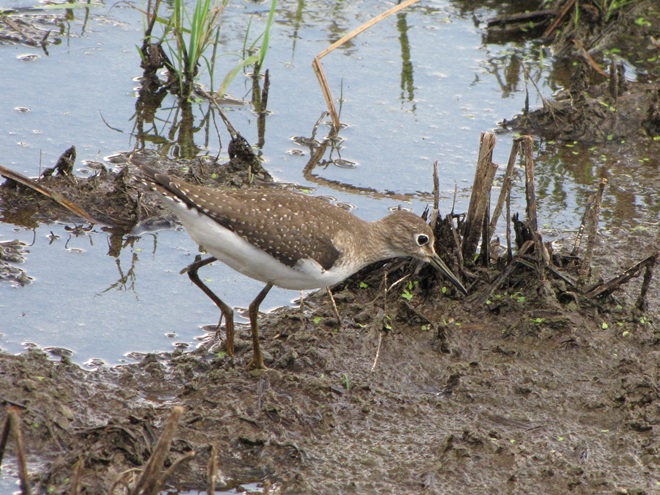
Solitary Sandpiper
Mud flats in the margins between emergent shrubs and herbaceous plant growth attract migrating shorebirds like this Solitary Sandpiper to the abundance of invertebrate life.  Seasonal movements of migrating shorebirds regularly coincide with the reductions of water levels in beaver pools which typically occur between May and September each year.
Least Sandpiper
During its southbound migration in September, a Least Sandpiper searches for arthropods and annelids as it visits a food-rich puddle along the periphery of a beaver pool.
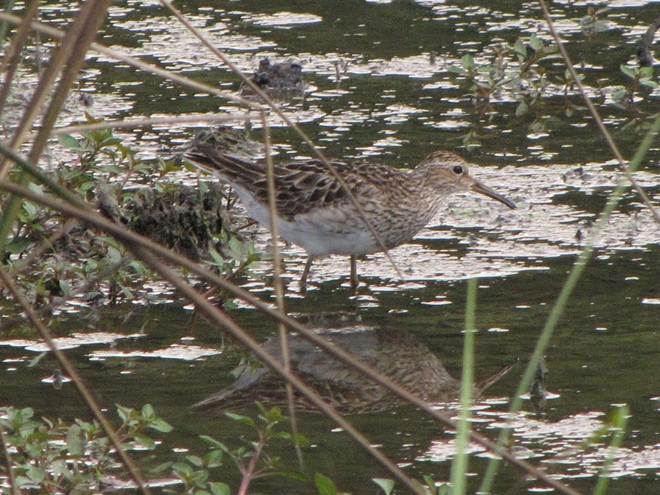
Pectoral Sandpiper
A Pectoral Sandpiper feeds in shallow water near a stand of Common Cattails in a beaver pool.
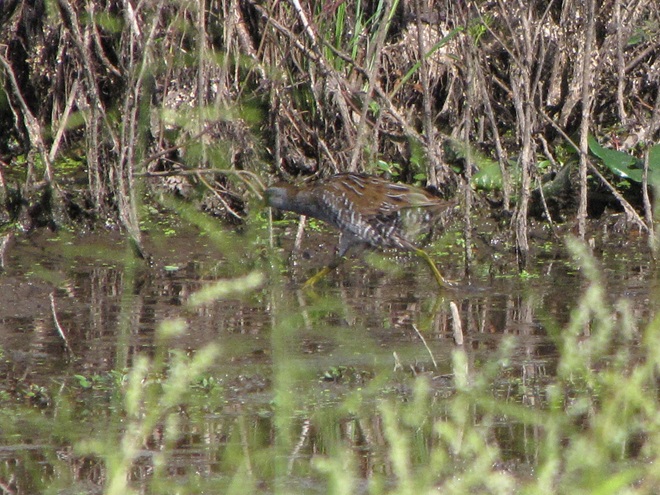
Sora
During migration, rails including the Sora are attracted to dense emergent vegetation in beaver pools.  Some will nest in these rodent-managed refugia.
Green Heron
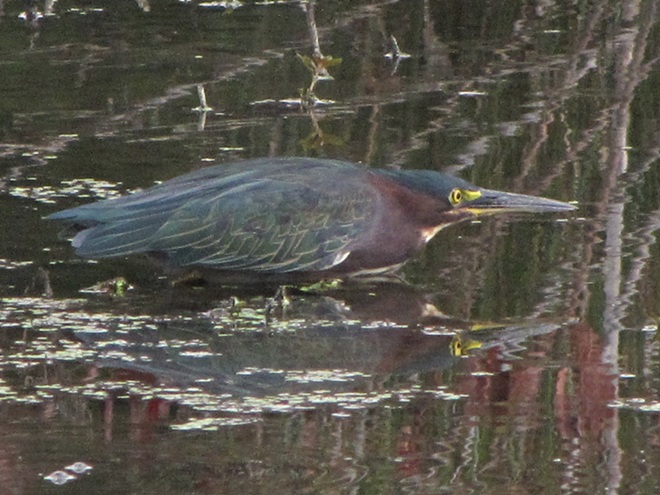
Green Herons visit beaver pools during migration and, due to the reliability of the food supply, will often nest in their vicinity.

So how did this happen?  How did the North American Beaver become a keystone species—an animal upon which the majority of other life forms within its ecosystem are so reliant?  Well, it’s largely due to the fact that our beavers aren’t particularly fond of a constant stream of noise.  More specifically, they don’t like the sound of running water in places where they intend to build and maintain a lodge.  And so, as they begin to place sticks, mud, limbs, stones, and other materials within a noisy riffle on a stream, they create a dam, and behind it a pool—a pool that is particularly advantageous for protecting their home and providing a means of conveyance for their construction materials and food supplies.
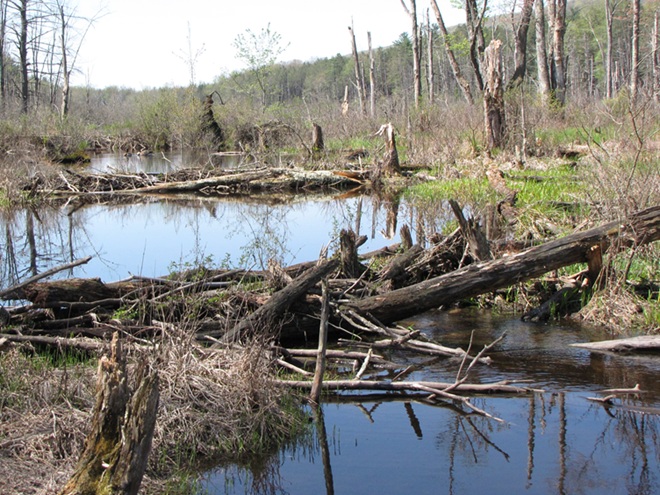
Cascading Series of Beaver Pools
On a high-gradient segment of stream, beavers will create a cascading series of pools. Because water filters through a beaver dam instead of spilling over it, the work of these meticulous rodents soon silences the sounds of water changing altitude.  No more sonorous riffle.
Beaver Dam
Quiet please.  High seasonal stream flow and damage from storms may create areas where water begins to erode the structure of the dam.  Where this condition persists, an adult beaver will soon mend the breach, just to quiet things down.  Why would beavers demand such a hush upon their domain?  Well, they have poor eyesight, but their hearing is excellent, and they rely upon it to detect danger.
Louisiana Waterthrush
The Louisiana Waterthrush (Parkesia motacilla), one of our earliest-arriving warblers, nests in forests along clear, high-gradient streams.  In mid-April, we found this individual and three others squabbling over a breeding territory adjacent to the series of cascading beaver pools shown in the previous images.
Brook Trout and Blacknose Dace
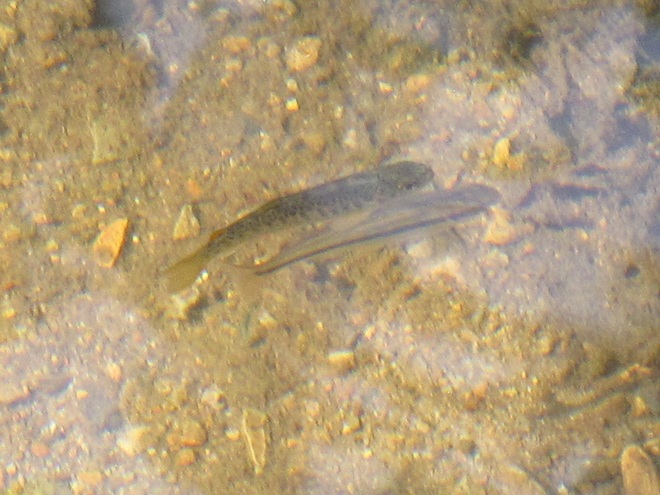
Native denizens of coldwater streams, neither the Brook Trout nor the Eastern Blacknose Dace has any difficulty finding its way through the voids in beaver dams to ascend and descend the sequence of pools.
Beaver Dam and Pool on Low-gradient Stream
On a low-gradient segment of stream, a dam just over a foot in height may be sufficient to create a beaver pool of considerable size.  Resembling the water-logged muskeg of the far north, well-established beaver pools form boggy habitats familiar to migrating shorebirds.
Water levels in the pools usually drop along with the stream’s base flow as soon as the effects of the spring thaw and rain showers subside.  Feeding areas in shallow water and on muddy ground are often revealed just in time for northbound shorebirds and other waders to stop by in late April and May.  These conditions often persist through the growing season and the fall migration of these birds which begins as early as late June and sometimes extends into October.
Tree Swallow at Natural Cavity
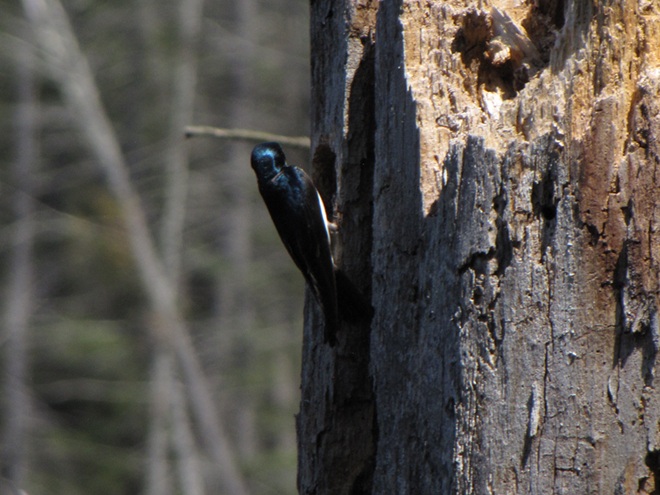
Where the pool inundates standing timber such as Red Maple and other species not used by beavers, the dead snags provide vital feeding areas for birds and other wildlife.  Cavity nesters like this Tree Swallow seldom find suitable natural housing elsewhere.
Eastern Newts Among Alderfly Exuvia
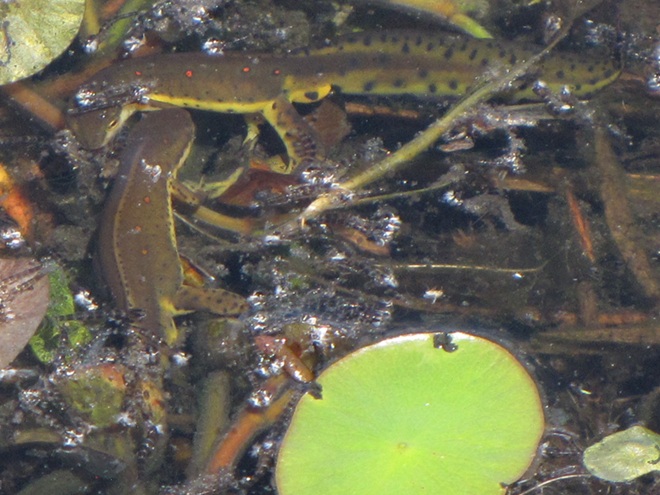
The mosaic of marshlands and braided stream channels within the beaver pool complex supports an abundance of aquatic life including these breeding Eastern Newts, seen here surrounded by the exuvia left behind following a massive hatch of alderflies (Sialinae).  Alderflies are a stream inhabitant during their larval stage and are indicator of clean water conditions.
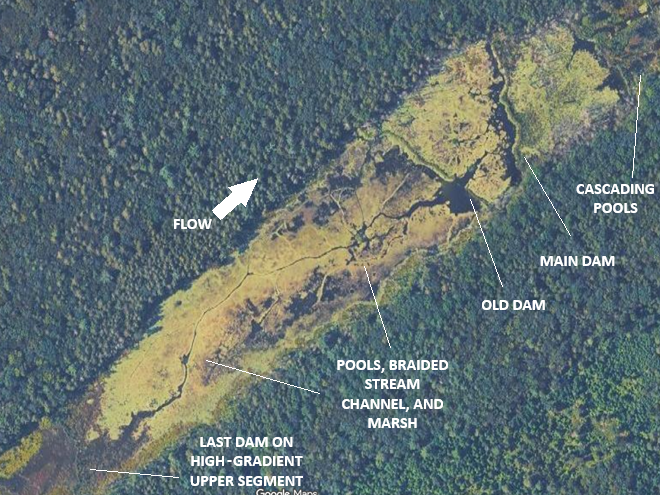
A modern-day example of the way fully functional stream floodplains used to look in the Lower Susquehanna River Watershed.  Though the pools may appear pond-like during the cooler and wetter months of the year, by summer the water levels behind the beaver dams recede as the base flow of the stream wanes.  Now the true nature of the marsh, shallow pool, and braided stream complex is revealed.  Unlike most man-made dams that set a fixed pool elevation regardless of flow by discharging water over the top of the structure or through a spillway or gate, beaver dams merely throttle the flow through their porous construction.  Unless the beaver begins plugging small leaks as fast as the stream flow ebbs, the water level in the pools will drop.  So they’re not left high and dry, lodges are located in the deepest pools, usually in close proximity to the dam and/or one of the stream courses.  Though not inundated during the dry season, the soil in the pool complex is almost always damp and plants grow vigorously there, sequestering nutrients and retaining sediments in beneficial deposition patterns that actually inhibit erosion of the riparian landscape.  These streams and floodplains retain their hyporheic zone and freely exchange water with the underlying water table and aquifer.  It’s the ultimate floodplain management system, and the beavers don’t even know their doing all the work.  (Google Maps base image)
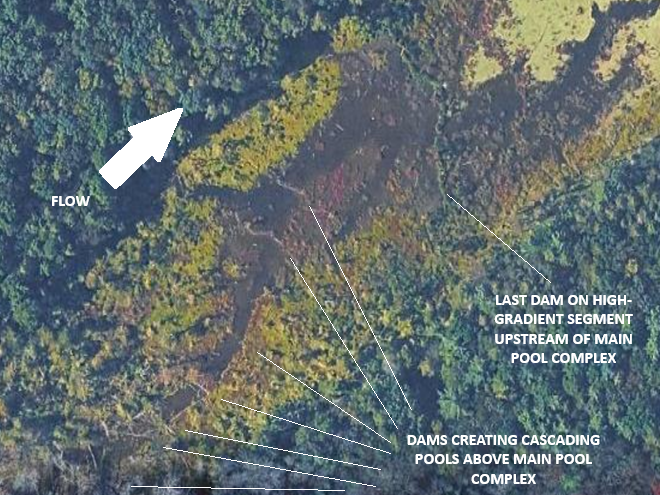
Where another high-gradient segment of stream enters the main pool complex, beavers have created an additional series of cascading pools.  The impoundments created by these dams help diffuse stormwater energy and process more nutrients and sediments within the floodplain’s wetland vegetation system.  (Google Maps base image)
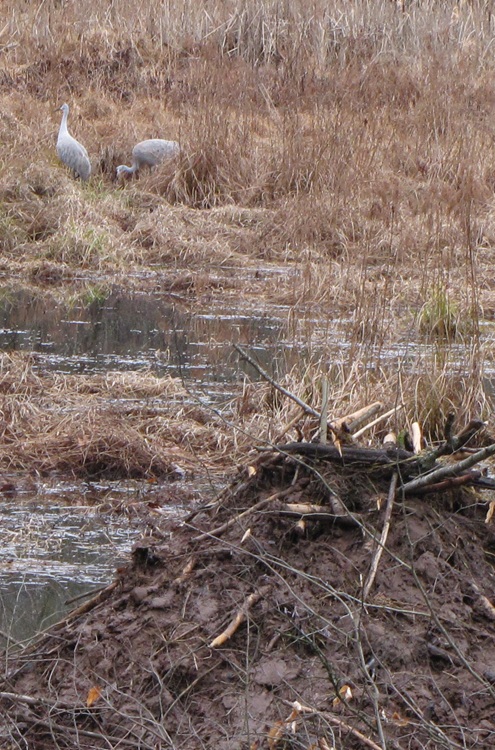
Sandhill Cranes in Beaver Pool
Beaver pools often refill as stream flows increase following autumn rains.  The stockpiles of vegetative foods that grew within the beaver’s domain through the summer then become flooded and are a prime source of nutrition for not only the beavers, but waterfowl during both their autumn and spring migrations.  Gleaning and probing Sandhill Cranes often find these habitats to their liking as well.

While North American Beavers have returned to the region, most live as “bank beavers”, residing in the river and larger creeks of the valley where they excavate shelters among the roots of Black Willows and other shoreline trees and shrubs.  Floodplain encroachment, legacy sediment deposits, and just plain human intolerance have all conspired to prohibit North American Beavers from performing their magic on smaller local streams.  For migrating shorebirds, this continued absence of beaver dam ecosystems has turned much of the lower Susquehanna valley into “flyover country”.  Those travelers that do stop to rest and feed concentrate at the few favorable locations such as the lateral bars and the hydroelectric dam-created delta at the Conejohela Flats on the river in Lancaster County.  But centralization has its drawbacks.  Migrants spending time at concentration points may have a greater chance of contracting and spreading disease.  Protracted heavy foraging can degrade these habitats.  And over time, features such the lateral bars and delta deposits, including those on the Conejohela Flats, transition into other habitats—riparian forests.  A more widespread selection of favorable stopover points for shorebirds, waders, waterfowl, and other migrants is certainly desirable.

IMITATION IS THE SINCEREST FORM OF FLATTERY

Until public sentiment sways in favor of the North American Beaver, wildlife managers are mimicking some of the attributes of their sound-inspired installations.
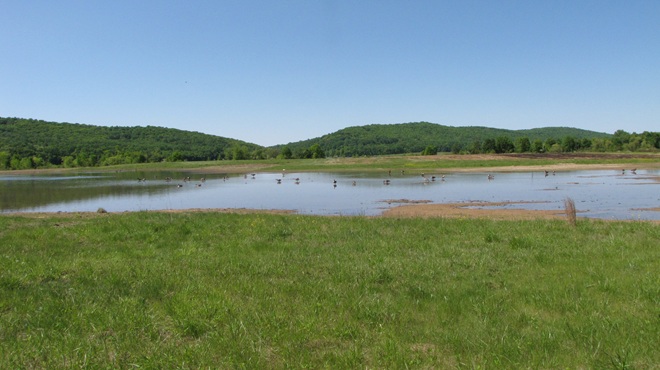
New Impoundment at Middle Creek Wildlife Management Area
Created by excavating a depression in heavy clay soils, this new impoundment at the Pennsylvania Game Commission’s Middle Creek Wildlife Management Area collects water directly from rainfall and from surface runoff.  Its depth at no point is greater than about two or three feet.  During the driest times of the year, this space will be a mudflat, and a haven for migrating shorebirds.

Shallow-water conservation impoundments designed, constructed, and managed for migratory waterfowl and waders including shorebirds are not what we typically refer to as ponds—though they are lentic (still) waters.  Similar shallow freshwater impoundments at our National Wildlife Refuges are referred to as pools by the United States Fish and Wildlife Service, but smaller versions like this example at Middle Creek very closely resemble the prairie potholes created by glacial scour in the north-central United States and adjacent portions of Canada.  Many populations of migratory birds are familiar with pothole ecosystems and, like the beaver pools and marshes, have relied upon them as waypoints along their journeys for centuries.

Pond and Lake Zonation
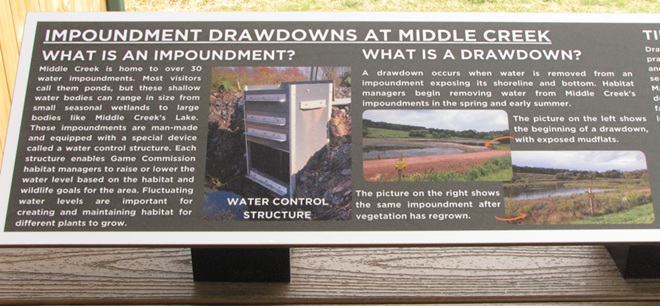
Impoundments most beneficial to migrating waterfowl and waders including shorebirds are shallow in depth.  They lack the deeper waters of a pond or lake and thus have no limnetic (open water) or aphotic zones.  Managed throughout as a littoral zone, impoundments grow plants in shallow water or on damp soil through the summer months to chew up nutrients accumulated in waste deposited by visiting birds.  This vegetation is then flooded from late fall through early spring as forage habitat for migratory waterfowl.  The timing of the fluctuations in water levels approximates those of the beaver pools and marshes on lotic (flowing) waters.
Impoundment Gate
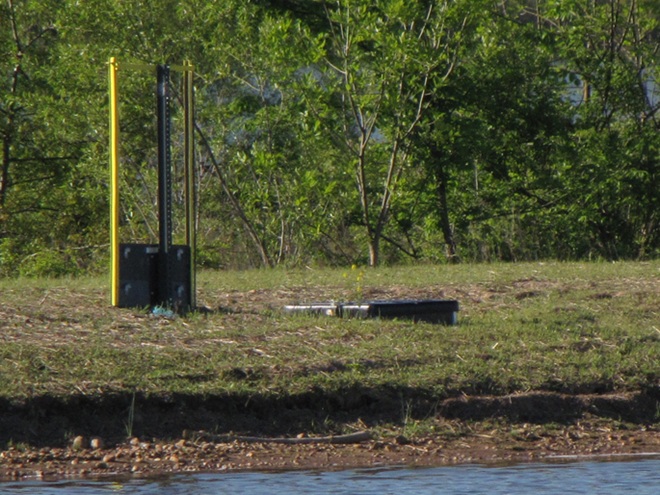
A gate assembly is a water control structure installed to provide seasonal management of the water levels in a conservation impoundment.  More than once, beavers have heard the sounds of tumbling waters inside these types of devices and tried to dam them up!

You’ve heard the line, “If you build it, they will come.”  Well, it’s true.  Here is a sample of the activity witnessed during the past two weeks at the new impoundment completed just several months ago at Middle Creek Wildlife Management Area along the tour route just beyond the “Stop 3” overlook.
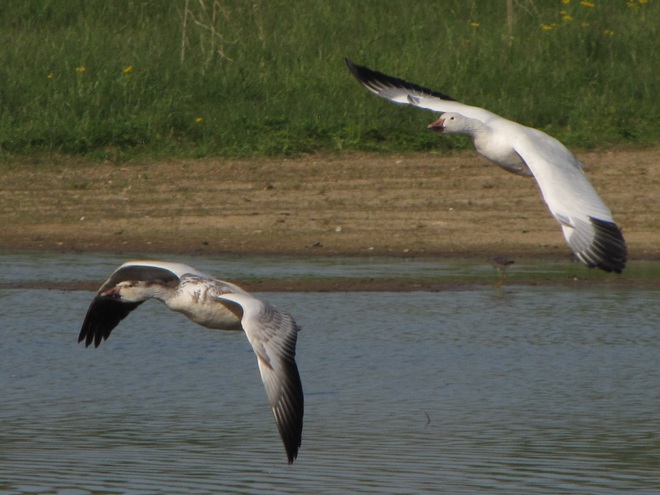
Snow Geese
The ubiquitous Snow Geese were among the first migratory occupants of the new impoundment.  A few are currently lingering in the vicinity.
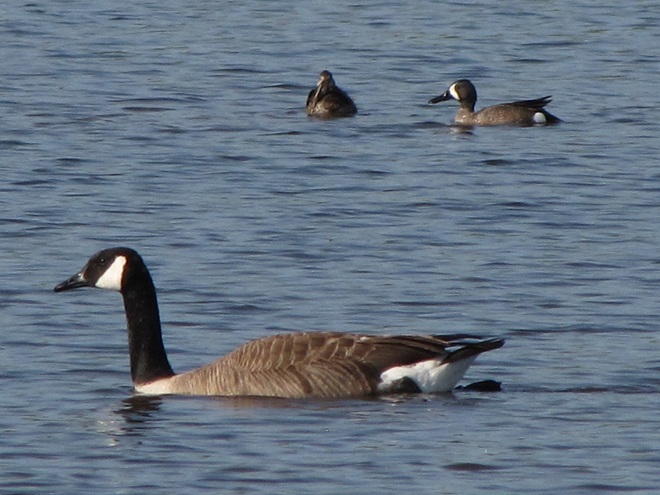
Blue-winged Teal
Ducks soon followed.  These Blue-winged Teal were among the last to pass through earlier this month.
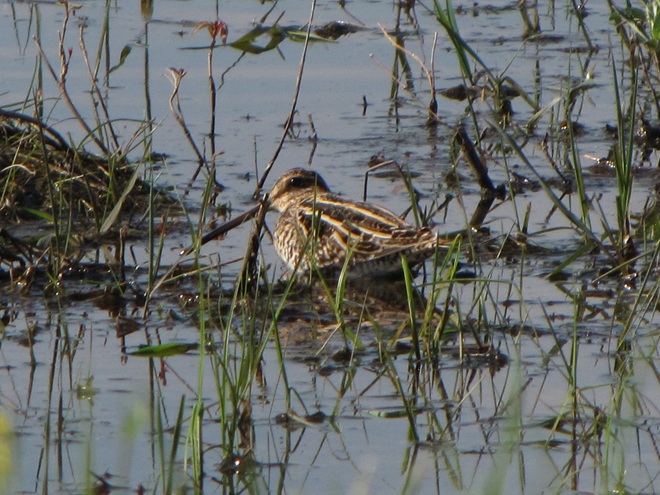
Wilson's Snipe
Wilson’s Snipe were among the first species of migratory shorebirds to visit the new impoundment at Middle Creek…
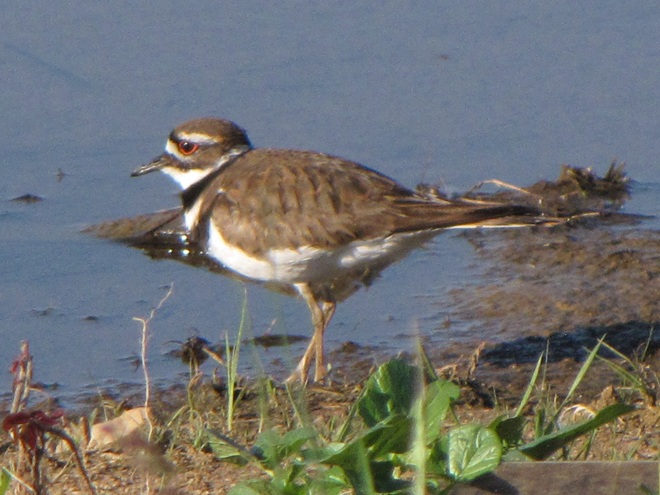
Killdeer
…as were Killdeer, a species which nests nearby.
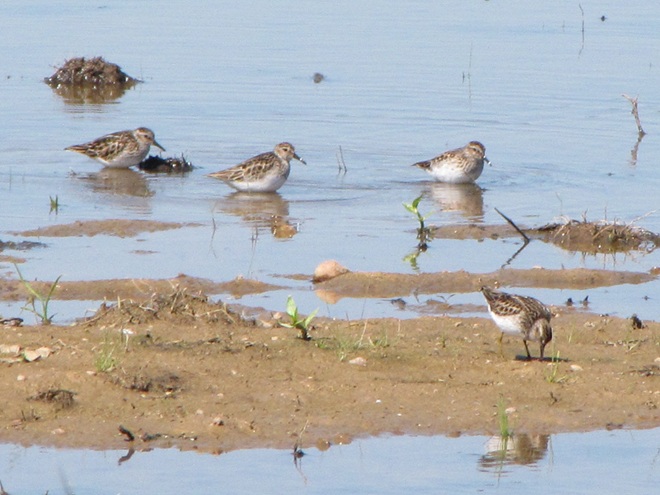
Least Sandpipers
Then, earlier this month, flocks of shorebirds including these Least Sandpipers were arriving to feed and rest.
Least Sandpipers
Least Sandpipers search for small invertebrates in shallow water and exposed soil.
Least Sandpiper and a Semipalmated Sandpiper
A Least Sandpiper (left) and a Semipalmated Sandpiper (right).
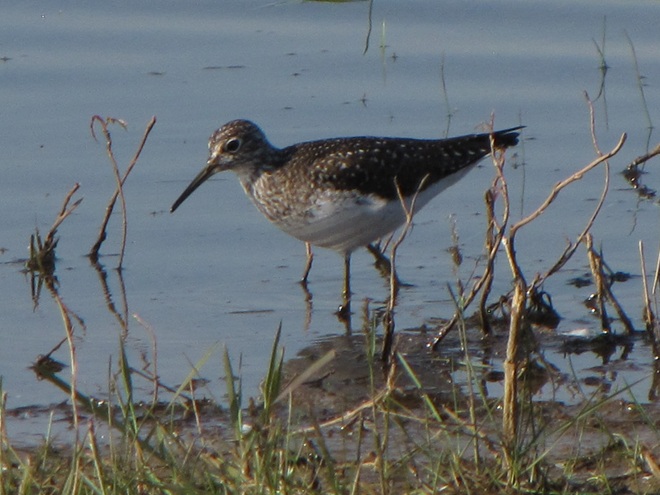
Solitary Sandpiper
Not all shorebirds seen by themselves are alone, and that includes the Solitary Sandpiper.
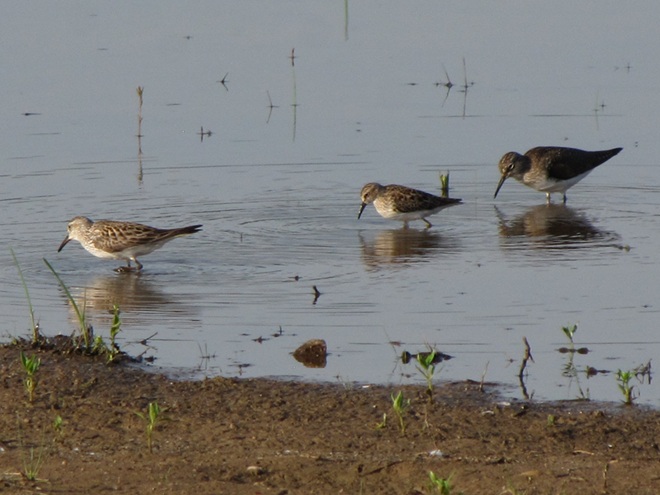
White-rumped, Least, and Solitary Sandpipers
Here’s a Solitary Sandpiper (right) feeding alongside a Least Sandpiper (center) and a White-rumped Sandpiper (left).
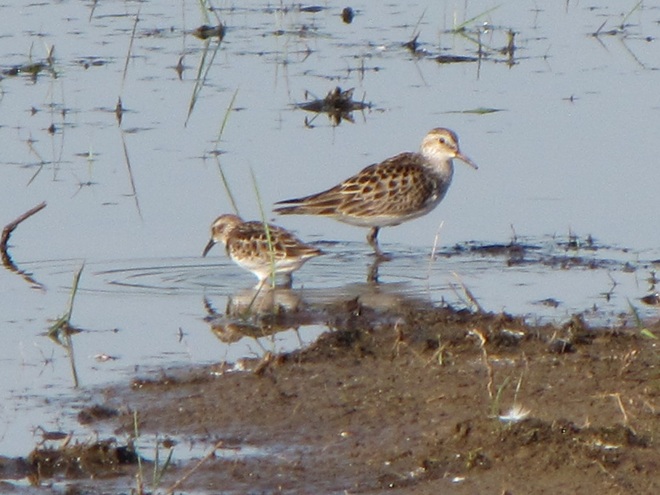
Least Sandpiper and a White-rumped Sandpiper
A Least Sandpiper (left) and a White-rumped Sandpiper (right).
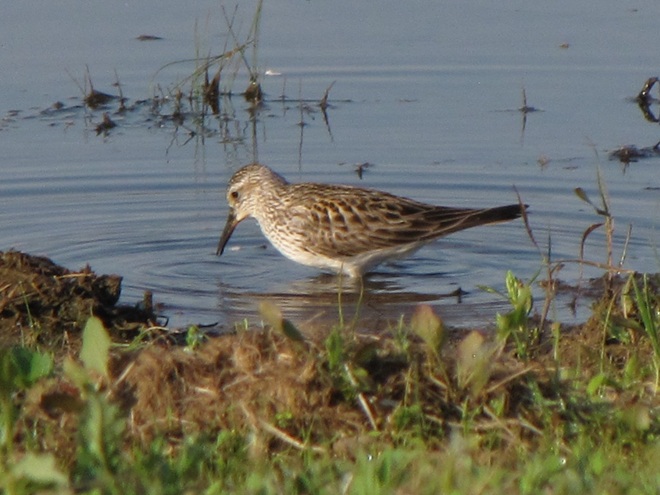
White-rumped Sandpiper
Rare in our area during spring, the White-rumped Sandpiper (Calidris fuscicollis) flies north using the central flyway, then heads south along the Atlantic flyway in the fall, when it tends to be more regular here.
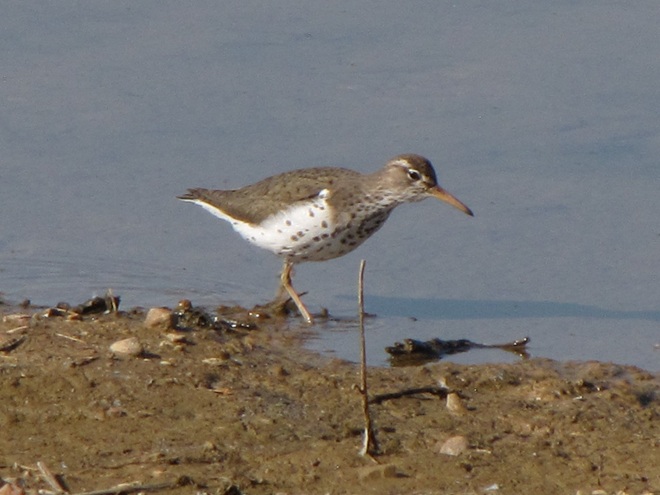
Spotted Sandpiper
Rocking and teetering along as it looks for food, the Spotted Sandpiper may be one of the easiest of shorebirds to identify.
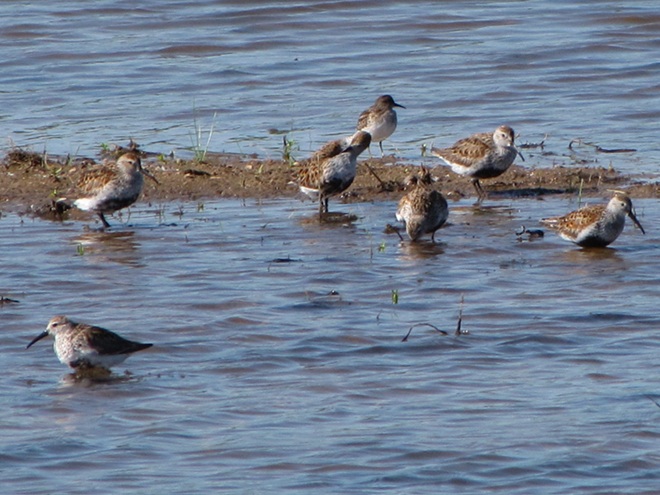
Dunlin
Chunky little Dunlin (Calidris alpina) with their conspicuously down-curved bills are another easy-to-identify species, particularly in the spring when their breeding (alternate) plumage includes a black belly.
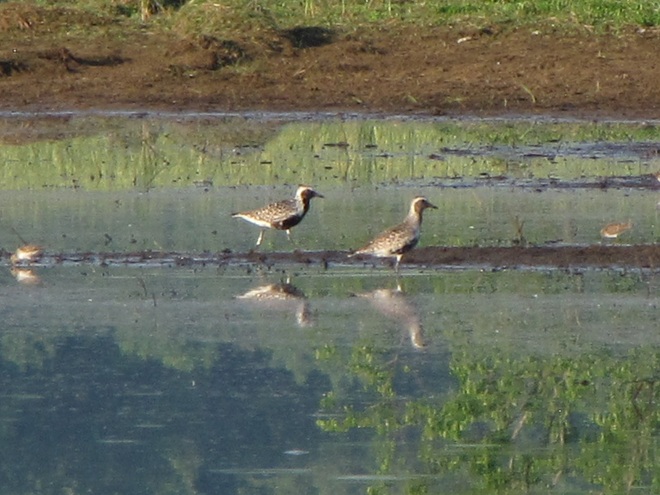
Black-bellied Plovers
Black-bellied Plovers acquire a handsome set of plumage in the spring as well.
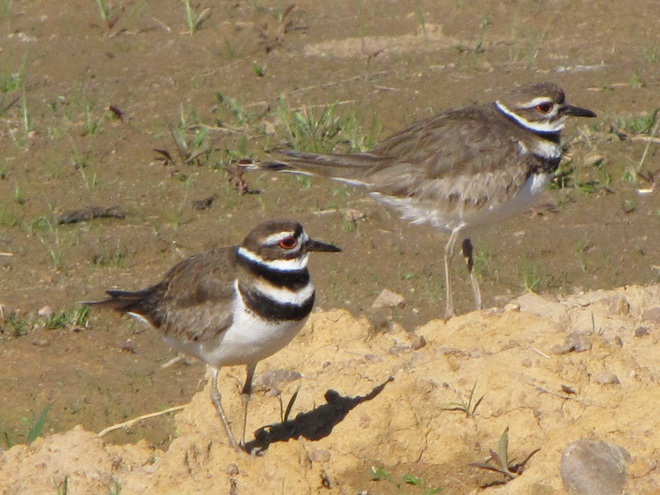
Killdeer
Killdeer too are plovers and this pair appears to have taken up residence on barren ground along the periphery of the new impoundment.
Semipalmated Plover
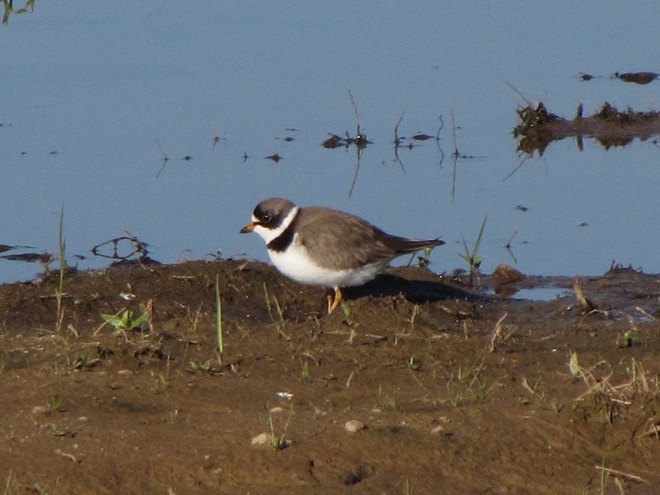
The Semipalmated Plover doesn’t have nearly the flair for ornament its close relatives the Killdeer do; these little shorebirds wear only one ring around their neck instead of two.  Think this plover is cute?,…
Killdeer
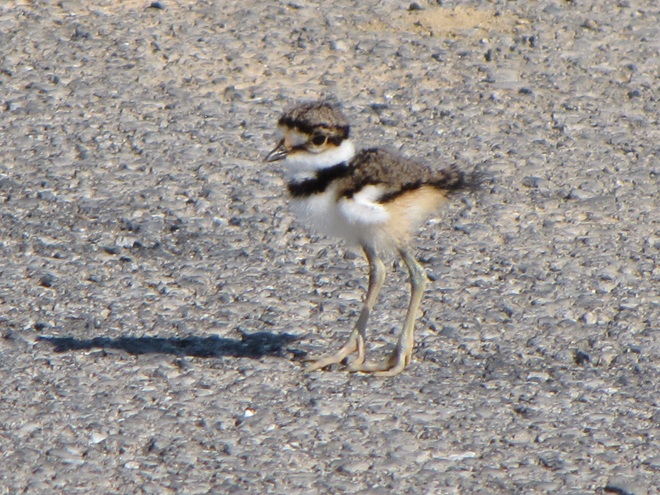
…then check out this newly hatched Killdeer.  It starts life with just one necklace too, but acquires a second as it grows.  Look at those legs!  (If you visit the new impoundment at Middle Creek, drive slowly and please watch where you’re going.  Baby Killdeer and other young birds, as well as mammals and turtles, are commonly crossing the paved surfaces right now.)
Lesser Yellowlegs
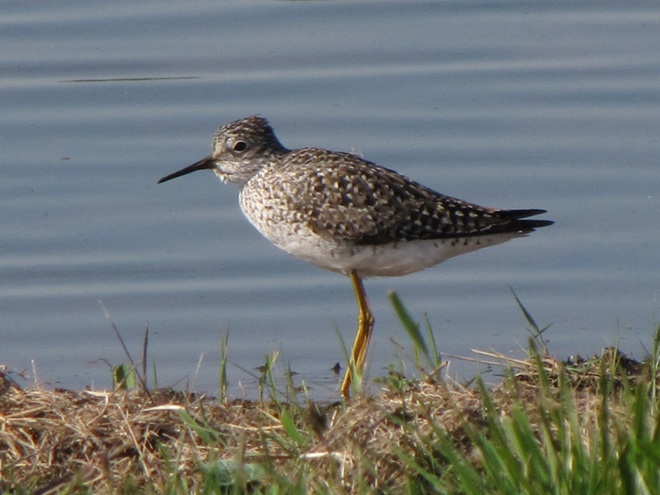
Speaking of legs, here’s one of dozens of Lesser Yellowlegs that visited the new impoundment during their recent northbound travels.
Greater Yellowlegs
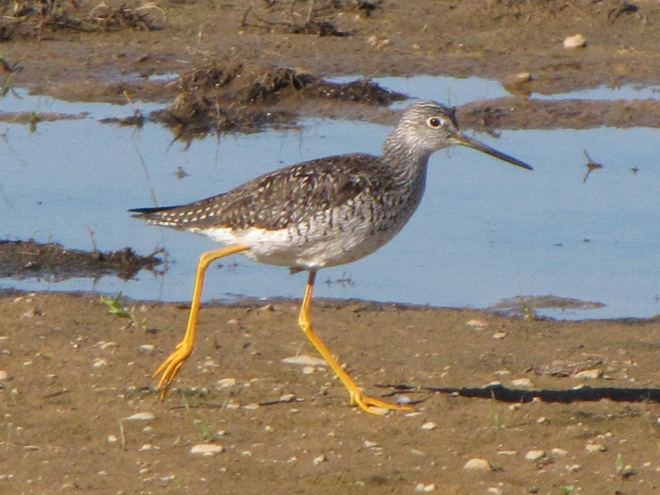
Though less numerous than the smaller Lesser Yellowlegs, a Greater Yellowlegs seldom goes unnoticed when dropping by the man-made pothole habitat.
Greater Yellowlegs
Have trouble telling a Greater Yellowlegs like this one from a Lesser Yellowlegs?  Look for the heavier, longer bill on the former, as well as dark barring along its flanks below the wings while the bird is in breeding (alternate) plumage during the spring migration.
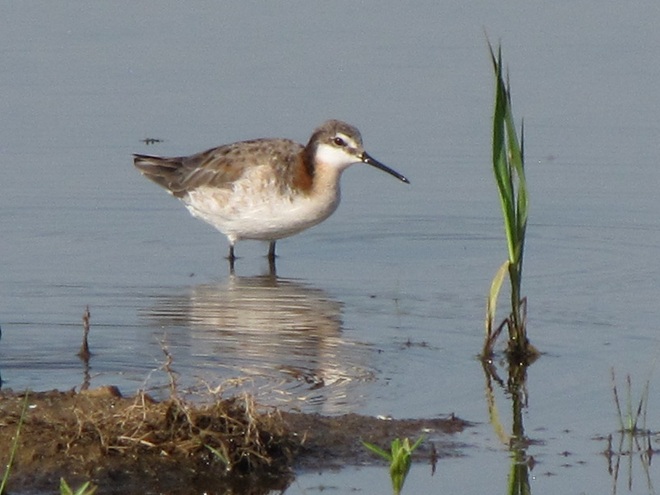
Wilson's Phalarope
Everyone likes to see something unusual every now and then, and this impoundment delivers.  Just yesterday, we photographed this migrating Wilson’s Phalarope (top center) among two Least Sandpipers (top left and right), a Lesser Yellowlegs (left and slightly forward of the phalarope), and a White-rumped Sandpiper (foreground).
Wilson's Phalarope
Renowned for spinning in circles as they feed in shallow water, Wilson’s Phalaropes (Phalaropus tricolor) passing through the lower Susquehanna basin are headed toward nesting areas in the prairie wetlands, including potholes, of the northern United States and adjacent sections of southern Canada.

Species of wildlife in addition to shorebirds and waterfowl have already found the new impoundment favorable…
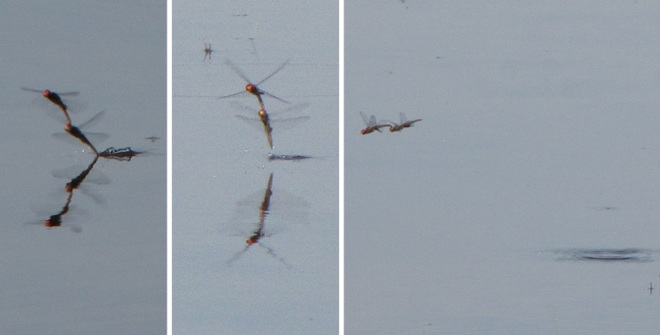
Spot-winged Gliders
Pairs of breeding Spot-winged Gliders (Pantala hymenaea), seen here in tandem while ovipositing, were swarming the impoundment after arriving earlier this week.  These dragonflies are ofttimes unpredictable nomads and are similar in appearance to the usually more numerous Wandering Gliders.  To recolonize seasonal portions of their range, both are famous for hitching a ride en masse on storm systems.  They share the behavior of finding ephemeral and new bodies of water favorable for egg laying due to their low density of aquatic predators.
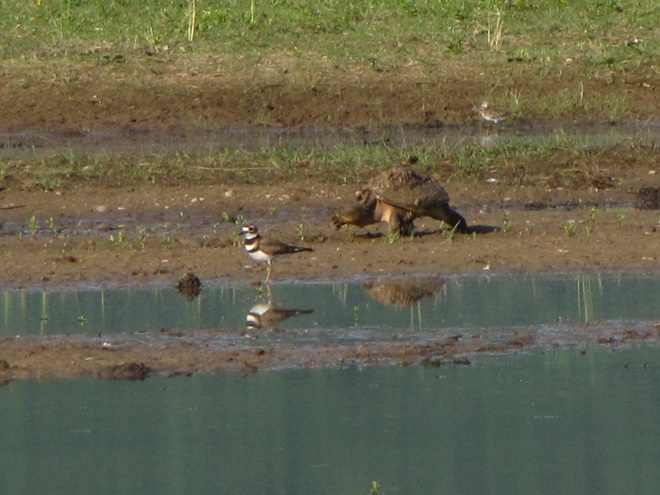
Snapping Turtle
We watched this Snapping Turtle arrive to apparently find the newly created waters to its liking.  Snapping Turtles are important consumers in a wetland ecosystem.  Larger specimens may fill the role of an upper trophic level or apex predator, eliminating vulnerable mid-level consumers including other Snapping Turtles.
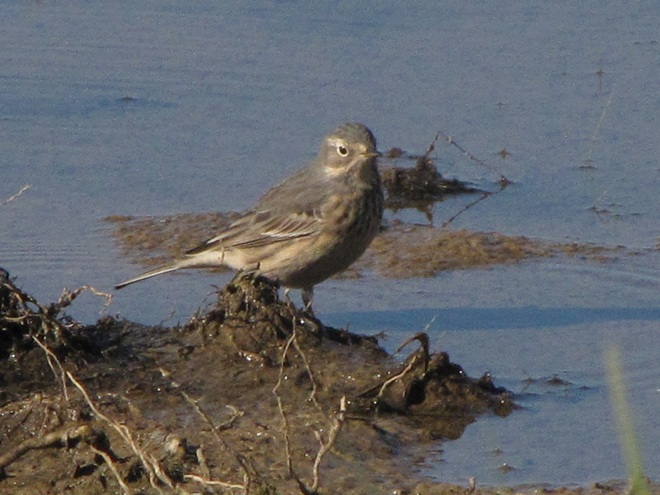
American Pipit
Because it bounces its tail up and down like a Spotted Sandpiper, you may at first glance mistake an American Pipit for a shorebird.  Long known as the Water Pipit, these songbirds have been visiting the impoundment while migrating north and stopping to feed in nearby croplands.
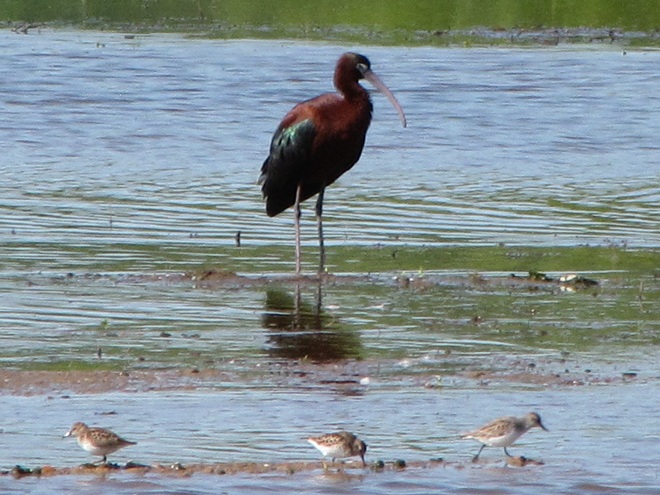
Glossy Ibis
Seen here with Least Sandpipers is a visiting Glossy Ibis.
Glossy Ibis
Sometimes twenty or more of these mostly coastal waders have made a pit stop at the “new Middle Creek pothole”, though none have thus far chosen to remain long.  Apparently, food sources sufficient to sustain a bird of their size have yet to develop in its benthos.
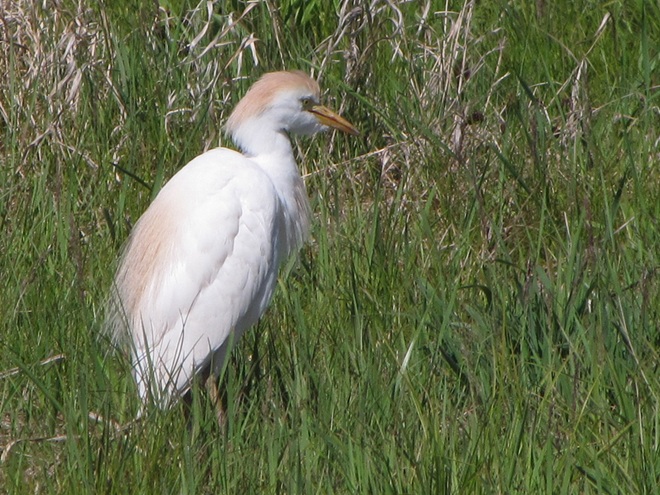
Western Cattle Egrets
Western Cattle Egrets visiting Middle Creek this spring have been frequenting the new impoundment.
Western Cattle Egret
With still little in the way of insects such as grasshoppers available in the surrounding landscape,…
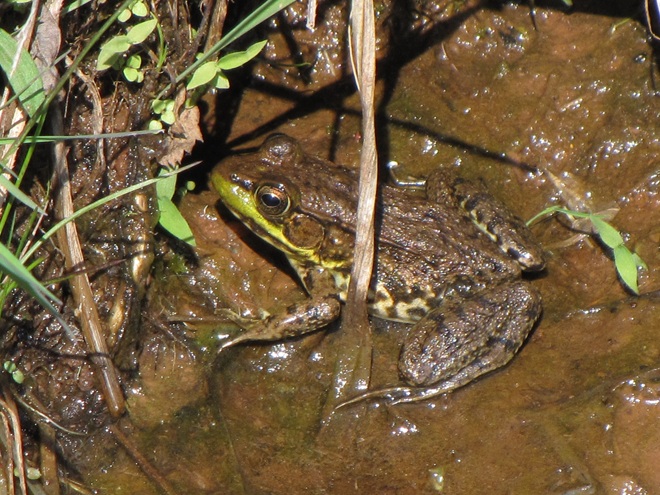
Green Frog
…cattle egrets are looking to find prey like this Green Frog.
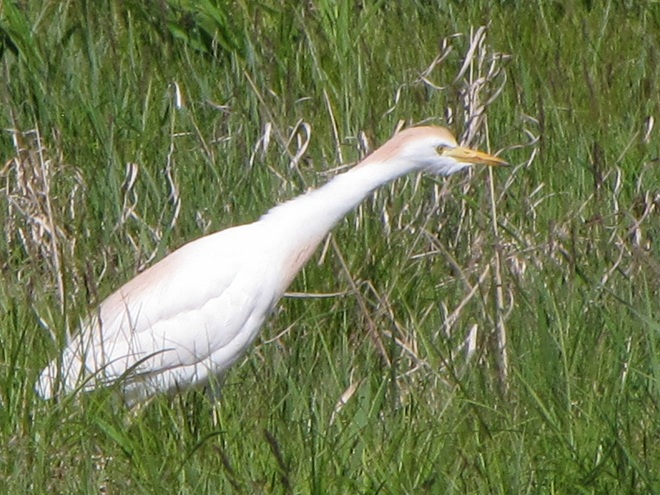
Western Cattle Egret
Many have been observed hunting the adjacent grasslands..
Western Cattle Egret
Where small mammals, mostly Meadow Voles, are being taken in abundance.

Managing saturation levels in shallow-water impoundments to resemble the seasonal variations in beaver pool and marsh systems can create lush growth and wildlife-rich environments.  Take a look at some images from a project in a headwaters area of a tributary to Conewago Creek (west)…
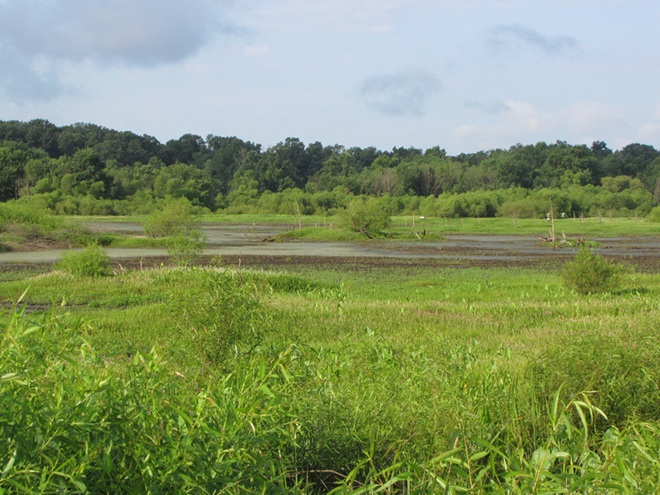
Well-established Shallow-water Impoundment
By late July, southbound shorebirds were already using these mudflats to feed and rest.  Other sections of the impoundment were dense with emergent and aquatic plants, the latter kept hydrated in deeper pools of the project by the inflow from several captured springs that supplement direct rainfall and sheet runoff to supply its water.  During a seasonal drawdown, the exposure of the impoundment’s soils to direct sunlight can provide a measure of disinfection to reduce the chances of disease transmission among its populations of visiting birds and other animals.
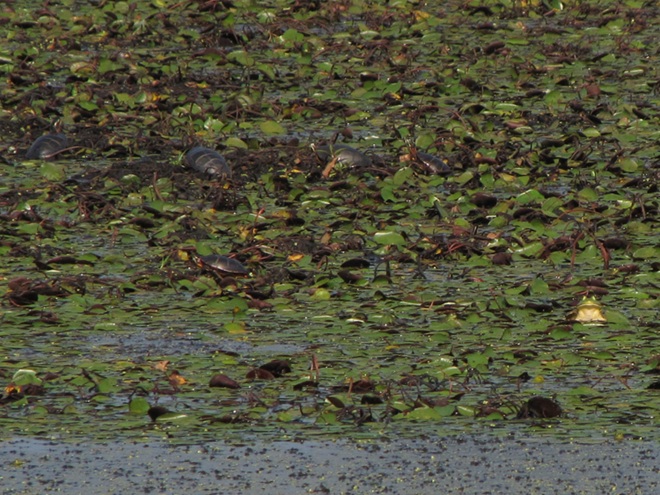
Water Lily Growth
In the deeper pools of the impoundment, water lilies and other aquatic plants grow in lush mats to provide cover and feeding areas for resident populations of breeding reptiles and amphibians.
Green Heron
An abundance of foods are available for waders including this Green Heron…
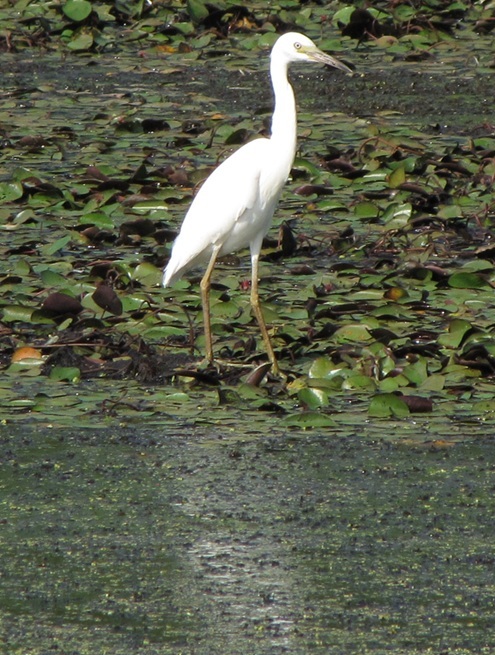
Immature Little Blue Heron
…and this immature Little Blue Heron, a wanderer typical of more southern latitudes.
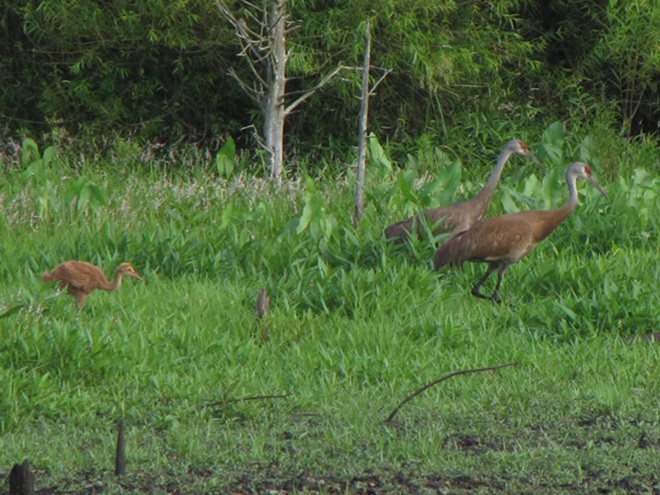
Sandhill Cranes
While walking the road among tall grasses in the supporting landscape surrounding this impoundment, we were at first startled when these Sandhill Cranes strode by going the other direction.  We quietly kept moving,…
Sandhill Cranes
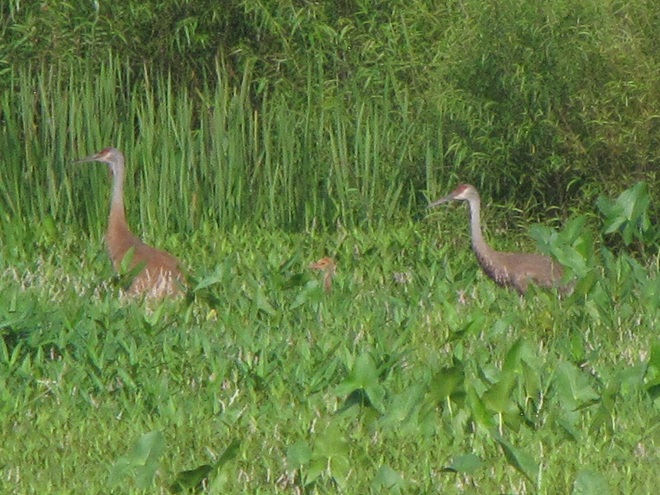
…then spotted them again as we looked across the impoundment to realize they weren’t alone, but were escorting a colt.
Sandhill Cranes with Colt
The hatching of this colt is testimony to the vital role wetland ecosystems play in the lives of hundreds of species.  Whether they be beaver pools and marshes on lotic waters or man-made shallow lentic waters, each of these habitats is filling a void that left floodplains and other critical lowland biomes faltering.  While they can’t replace the full-function floodplain management provided by an active beaver colony, shallow-water impoundments can provide relief for habitat-starved populations of the animals and plants that rely upon them.  A constellation of these projects on lands public or private across the lower Susquehanna watershed could help provide refuge for many of our flora and fauna with the most desperately fragmented of ranges.

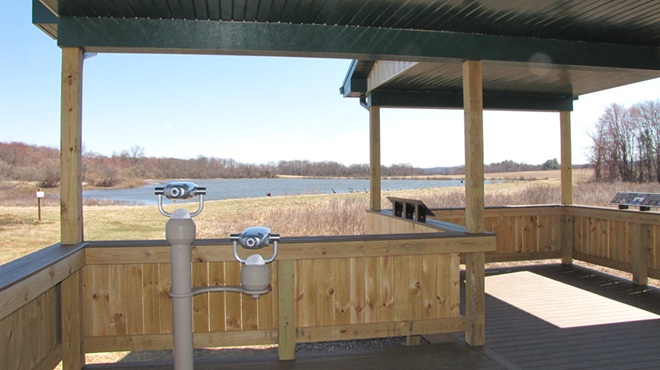
So that you can relax while observing the comings and goings at a pair of the lower Susquehanna valley’s man-made impoundments, the Pennsylvania Game Commission has erected two viewing pavilions for public use on its lands…
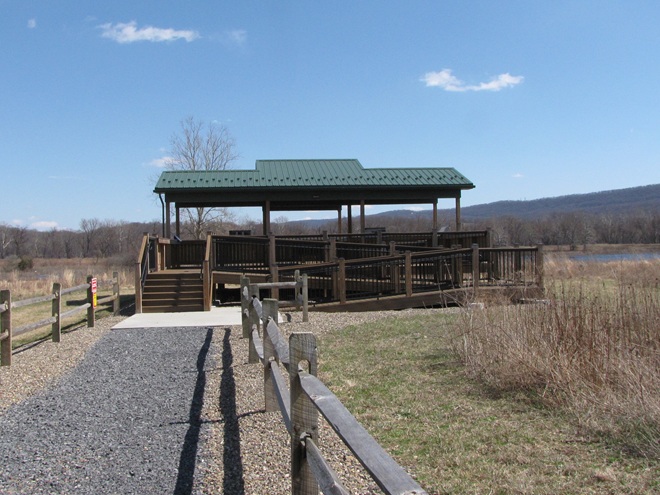
The Haldeman Island observation pavilion is located on State Game Lands 290  just upstream from the Juniata River’s mouth on the Susquehanna at Clark’s Ferry in Dauphin County.
Haldeman Island Pavilion
It overlooks not only the island’s man-made shallow-water impoundments and neighboring grasslands, but the tower used in the 1970s to reintroduce Bald Eagles from Saskatchewan to the lower Susquehanna.  Interpretive signs explain the conservation stories of habitats and the eagle reintroduction program.
Middle Creek W.M.A. Observation Pavilion
The observation pavilion at Middle Creek Wildlife Management Area is of similar construction to the one at Haldeman Island.  It is accessed from the parking pull-off along the tour road at its intersection with Chapel Road, just before the right turn and incline that leads to the “Stop 3” grassland overlook.
It too includes numerous interpretive signs to help visitors understand impoundment management.

During the next two weeks, the exodus of migrating shorebirds now staged and feeding upon Atlantic Horseshoe Crab eggs on Delaware Bay will commence.  During the evening of their departure from the bay, many of these birds cross portions of the Lower Susquehanna River Watershed, particularly east of the river.  Stormy weather and other climatic conditions may force some of them to seek a place to put down temporarily, so keeping a close eye on the new pothole-like impoundment at Middle Creek may be a prudent move.  After that, waders known as “post-breeding wanderers” can show up at any time.  Then, beginning as early as late June, shorebirds begin moving south on a migration that can provide us with viewing opportunities into September and beyond.  See you out there!

Five Flowering Plants for Cleaner Water

Currently in the Lower Susquehanna River Watershed, you can find these five species of herbaceous plants in full bloom.  As they grow, they and others like them help to purify waters within their respective ecosystems by taking up nutrients—namely, the nitrogen and phosphorus that can lead to detrimental algal blooms and eutrophication in ponds, lakes, streams, and rivers.

(United States Geological Survey image by Virginia-West Virginia Science Center)
Marsh Blue Violet
The Marsh Blue Violet (Viola cucullata) is most frequently found growing in the wet soils of forest bottomlands, usually where springs first break the earth’s surface and begin slowly trickling away to form a small brook or join an existing stream.  The blooms are recognized by their darker purple centers and their long stems.
Marsh Blue Violet
This particular Marsh Blue Violet was found at 750′ altitude in the running water at a mountainside spring seep on a south-facing slope in the Ridge and Valley Province.
Soft Rush
The seldom-noticed flowers of the Soft Rush (Juncus effusus), also known as the Common Rush, emerge from the sides of its quill-like stems.  This wetland species is found in damp soils, sometimes in standing water, and grows in stiff, erect clumps that persist through winter.  When found in pastures, Soft Rush is seldom of interest to cattle or other livestock.  It therefore doesn’t lure these animals into muddy, puddle-prone areas.  When subjected to heavy grazing in dry weather and flooding during wet spells, these puddle sites may host nearly pure stands of Soft Rush, the only plant able to thrive there.  When it comes to nutrient uptake in these soggy sections of the meadow, the soft Rush is the lone ranger.  Soft Rush seeds are available from Ernst Conservation Seeds in Meadville, PA, and are included in many of their mixes formulated for stormwater management basins and other wet soil applications.
Larger Blue Flag
Larger Blue Flag (Iris versicolor) is a plant of wetlands and shorelines.  It can be grown as an emergent in ponds and lakes where it will help to absorb nutrients from both the water and the underlying substrate.
Larger Blue Flag
Larger Blue Flag is a native species in the lower Susquehanna valley.
Yellow Iris
The Yellow Iris (Iris pseudacorus), also known as the Water Flag, is native to Eurasia and Africa.  Seen here growing as an emergent among native Common Cattails (a superb water purifier), the Yellow Iris can easily escape cultivation and become invasive.  The showy flowers and water-cleansing benefits of this plant make it attractive for use in the garden or farm pond, but considerations must be made for its aggressive growth and proclivity to escape to neighboring habitats.  If you’re purchasing irises for transplanting, you’re probably better off sticking with the native Larger Blue Flag; it is far less vigorous and you’ll be able to grow other aquatic species along with it.
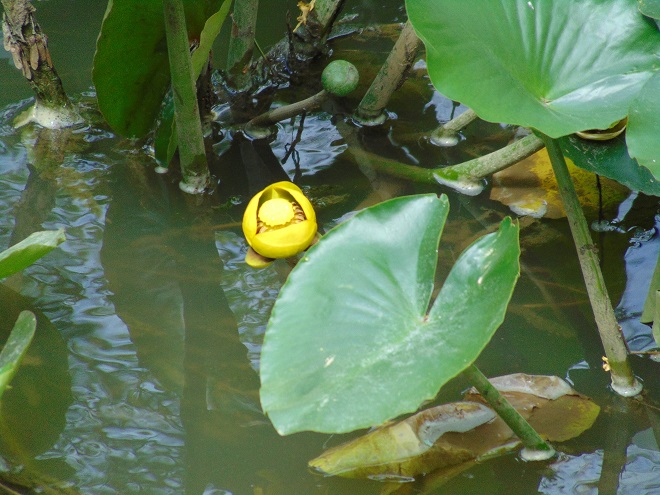
Spatterdock
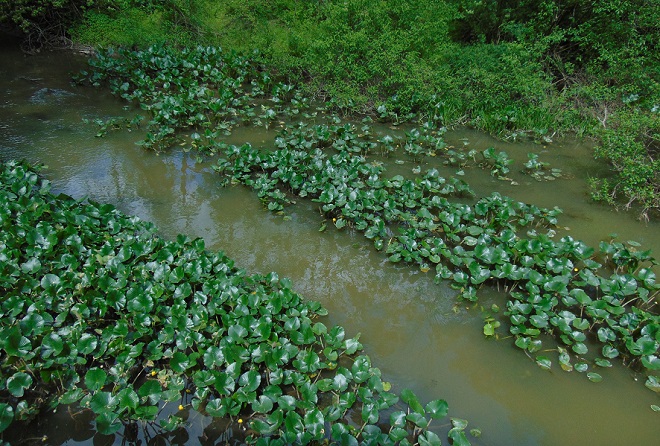
In large ponds, lakes, and low-gradient streams, one of the best aquatic plants for sequestering nutrients and clarifying water is Spatterdock, also known as Cow-lily or Yellow Pond Lily.  Spatterdock does best as an emergent in shallow water along the shoreline.  It grows well in full sunshine and makes excellent habitat for wildlife.  Depending on the nutrient load from fish, waterfowl, decaying vegetation, and other sources, plant cover may need to be as high as 30% or more of the surface area to keep algae from overtaking a lake or large pond.  Spatterdock can often be used to help fulfill these needs while still offering open water beneath the leaves and between the stems for fish, amphibians, reptiles, and macroinvertebrates to thrive.
Spatterdock
Though probably not suitable for small garden ponds, Spatterdock (Nuphar advena) can be an excellent choice for helping to clear up the nutrient-loaded waters of a farm pond or lake.  You can find it, the irises, and Soft Rush available through some pond nurseries and garden centers.  If you can’t get them locally, check out retail and wholesale suppliers online, but remember to inspect any livestock you bring in from outside the area for hitchhikers like non-native snails (native snails are O.K.).  To be safe, always quarantine and monitor your aquatic plants for 30 days.  Tubers can be given a bath in 3% hydrogen peroxide solution for up to five minutes, then rinsed with water.  Repeat the treatment as needed until no snails or eggs are seen.  Another option: local pond owners who have them may be willing to divide some Iris and/or Spatterdock tubers and provide them for sale or gift to those who ask.  Just a couple will get you started.

Schools of Juvenile Largemouth Bass Learning to Survive

Yesterday, while photographing damselflies on a rehabilitated segment of a warmwater lower Susquehanna valley stream, we noticed some oddly chunky small fish gathered on the surface of a pool along the shoreline.

Damselflies and Small Fish
Perched damselflies and some sort of robust little fish feeding nearby.

Upon further inspection, they appeared to be fingerlings of some type of sunfish or bass.  Time for a closer look.

Juvenile Largemouth Bass
At just one inch in length, these juvenile Largemouth Bass (Micropterus salmoides) are already showing signs of the dark lateral stripe that so easily identifies the adult fish.
Adult Largemouth Bass on Spawning Bed
Adult Largemouth Bass began spawning among nearby beds of Spatterdock and other emergent and submerged aquatic vegetation about one month ago, just as water temperatures stabilized to a minimum of the low sixties for several days and nights.  Each female can lay thousands of eggs.  Only those that are successfully fertilized by the attending male have a chance to hatch.
Juvenile Largemouth Bass
Largemouth Bass eggs can hatch as soon as ten days after being deposited in the nest by the female and fertilized by the male.  The fry linger in the nest for another week consuming the nutrition contained in their attached yolk sac.
Juvenile Largemouth Bass
The juvenile fish are then ready to leave the nest and begin feeding on zooplankton.
Juvenile Largemouth Bass
Young largemouths often gather in schools to feed in waters near their birthplace.  As they grow, they soon begin consuming small invertebrates and tiny fish.  But for young bass, the hazards are many.  These juveniles can become victims of a host of predatory insects, crayfish, piscivorous birds, and bigger fish.  Then too, Largemouth Bass, like most other species  of fishes, are cannibalistic and will consume others of their own kind.  Of the thousands of eggs produced by a mating pair, natural selection determines which, if any, of their progeny will survive to reproduce and sustain their genetic line.

In the Lower Susquehanna River Watershed, the Largemouth Bass is an introduced species, a native transplant from the Mississippi watershed and Atlantic Slope drainages south of the Chesapeake.

A Limpkin’s Journey to Pennsylvania: A Waffle House Serving Escargot at Every Exit

Mid-summer can be a less than exciting time for those who like to observe wild birds.  The songs of spring gradually grow silent as young birds leave the nest and preoccupy their parents with the chore of gathering enough food to satisfy their ballooning appetites.  To avoid predators, roving families of many species remain hidden and as inconspicuous as possible while the young birds learn how to find food and handle the dangers of the world.

But all is not lost.  There are two opportunities for seeing unique birds during the hot and humid days of July.

First, many shorebirds such as sandpipers, plovers, dowitchers, and godwits begin moving south from breeding grounds in Canada.  That’s right, fall migration starts during the first days of summer, right where spring migration left off.  The earliest arrivals are primarily birds that for one reason on another (age, weather, food availability) did not nest this year.  These individuals will be followed by birds that completed their breeding cycles early or experienced nest failures.  Finally, adults and juveniles from successful nests are on their way to the wintering grounds, extending the movement into the months we more traditionally start to associate with fall migration—late August into October.

For those of you who find identifying shorebirds more of a labor than a pleasure, I get it.  For you, July can bring a special treat—post-breeding wanderers.  Post-breeding wanderers are birds we find roaming in directions other than south during the summer months, after the nesting cycle is complete.  This behavior is known as “post-breeding dispersal”.  Even though we often have no way of telling for sure that a wandering bird did indeed begin its roving journey after either being a parent or a fledgling during the preceding nesting season, the term post-breeding wanderer still applies.  It’s a title based more on a bird sighting and it’s time and place than upon the life cycle of the bird(s) being observed.  Post-breeding wanderers are often southern species that show up hundreds of miles outside there usual range, sometimes traveling in groups and lingering in an adopted area until the cooler weather of fall finally prompts them to go back home.  Many are birds associated with aquatic habitats such as shores, marshes, and rivers, so water levels and their impact on the birds’ food supplies within their home range may be the motivation for some of these movements.  What makes post-breeding wanderers a favorite among many birders is their pop.  They are often some of our largest, most colorful, or most sought-after species.  Birds such as herons, egrets, ibises, spoonbills, stilts, avocets, terns, and raptors are showy and attract a crowd.

While it’s often impossible to predict exactly which species, if any, will disperse from their typical breeding range in a significant way during a given year, some seem to roam with regularity.  Perhaps the most consistent and certainly the earliest post-breeding wanderer to visit our region is the “Florida Bald Eagle”.  Bald Eagles nest in “The Sunshine State” beginning in the fall, so by early spring, many of their young are on their own.   By mid-spring, many of these eagles begin cruising north, some passing into the lower Susquehanna valley and beyond.  Gatherings of dozens of adult Bald Eagles at Conowingo Dam during April and May, while our local adults are nesting and after the wintering birds have gone north, probably include numerous post-breeding wanderers from Florida and other Gulf Coast States.

So this week, what exactly was it that prompted hundreds of birders to travel to Middle Creek Wildlife Management Area from all over the Mid-Atlantic States and from as far away as Colorado?

Birders observing something special at Middle Creek Wildlife Management Area on July 10, 2023.

Was it the majestic Great Blue Herons and playful Killdeer?

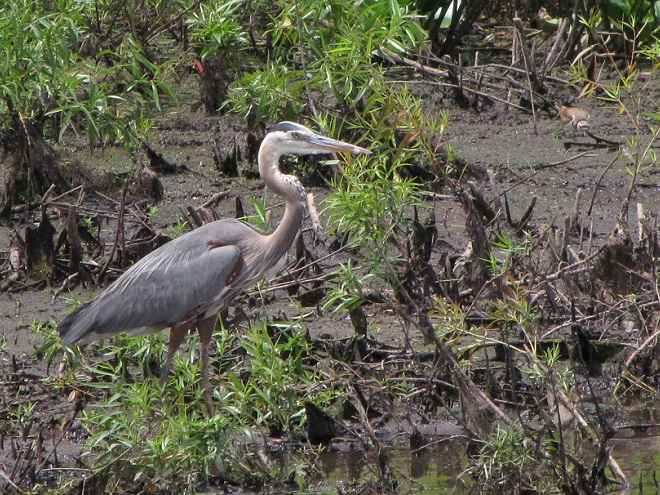
Great Blue Heron
Great Blue Heron and a Killdeer.

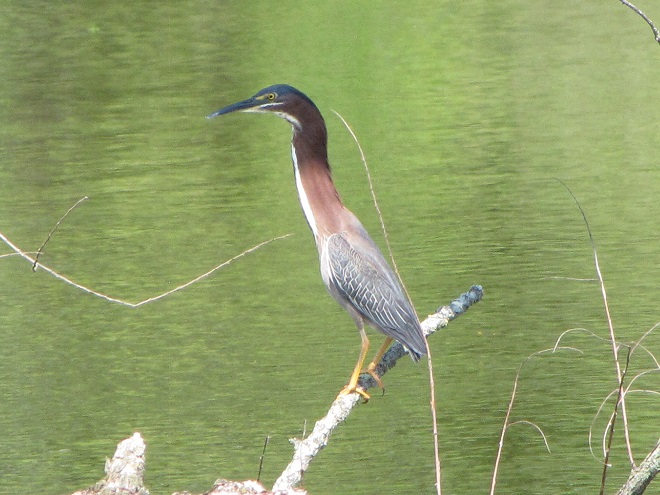
Was it the colorful Green Herons?

Green Heron
Green Heron

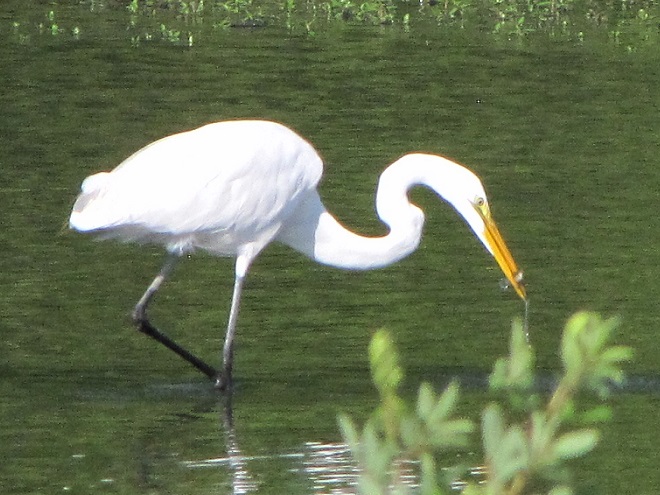
Was it the Great Egrets snapping small fish from the shallows?

Great Egret
Great Egret

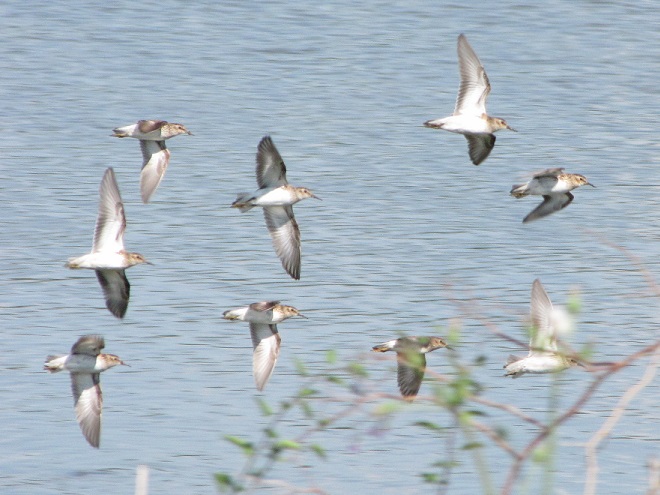
Was it the small flocks of shorebirds like these Least Sandpipers beginning to trickle south from Canada?

Least Sandpipers
Least Sandpipers

All very nice, but not the inspiration for traveling hundreds or even thousands of miles to see a bird.

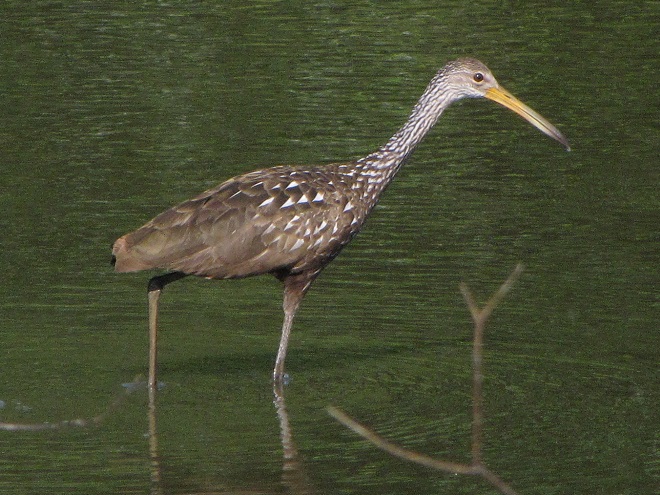
It was the appearance of this very rare post-breeding wanderer…

Limpkin at Middle Creek Wildlife Management Area
A Limpkin at Middle Creek Wildlife Management Area in Lancaster County.  The Limpkin (Aramus guarauna) is the only surviving member of the family Aramidae.

…Pennsylvania’s first record of a Limpkin, a tropical wading bird native to Florida, the Caribbean Islands, and South America.  Many observers visiting Middle Creek Wildlife Management Area had never seen one before, so if they happen to be a “lister”, a birder who keeps a tally of the wild bird species they’ve seen, this Limpkin was a “lifer”.

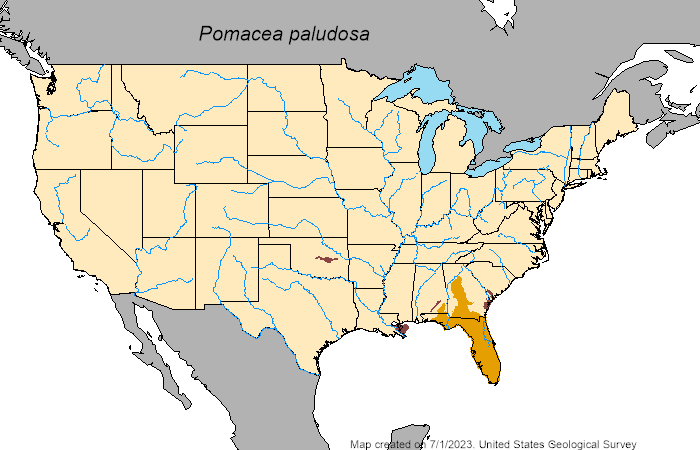
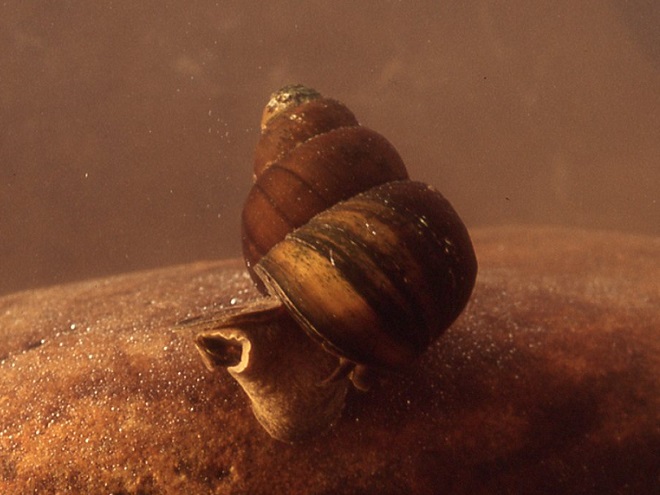
The Limpkin is an inhabitant of vegetated marshlands where it feeds almost exclusively upon large snails of the family Ampullariidae, including the Florida Applesnail (Pomacea paludosa), the largest native freshwater snail in the United States.

Native and Non-native Range of Florida Applesnail
In the United States, the native range of the Limpkin lies within the native range of the Florida Applesnail, shown here in gold.  Introduced populations of the snail are shown in brown.  (United States Geological Survey Nonindigenous Aquatic Species image)
A spectacular nineteenth-century rendition of the Florida Applesnail, including an egg mass, illustrated by Helen E. Lawson in Samuel S. Haldeman’s “Monograph of the Freshwater Univalve Mollusca of the United States”.

Observations of the Limpkin lingering at Middle Creek Wildlife Management Area have revealed a pair of interesting facts.  First, in the absence of Florida Applesnails, this particular Limpkin has found a substitute food source, the non-native Chinese Mystery Snail (Cipangopaludina chinensis).  And second, Chinese Mystery Snails have recently become established in the lakes, pools, and ponds at the refuge, very likely arriving as stowaways on Spatterdock (Nuphar advena) and/or American Lotus (Nelumbo lutea), native transplants brought in during recent years to improve wetland habitat and process the abundance of nutrients (including waterfowl waste) in the water.

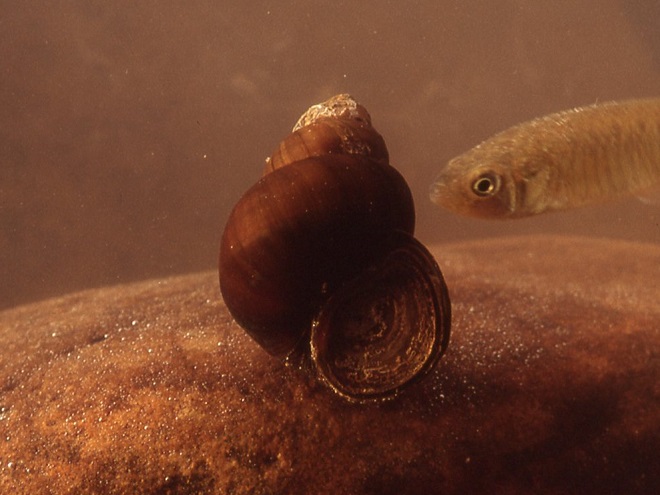
A Chinese Mystery Snail.
The Chinese Mystery Snail is the largest freshwater snail in the Lower Susquehanna River Watershed.  (Vintage 35 mm image)
By hitching a ride on aquatic transplants like this Spatterdock, non-native freshwater snails are easily vectored into new areas outside their previous range.
Spatterdock, a native species also known as Yellow Pond Lily or Cow Lily.
Spatterdock, a native species also known as Yellow Pond Lily or Cow Lily, flowering in August.
American Lotus in flower at Middle Creek Wildlife Management Area.
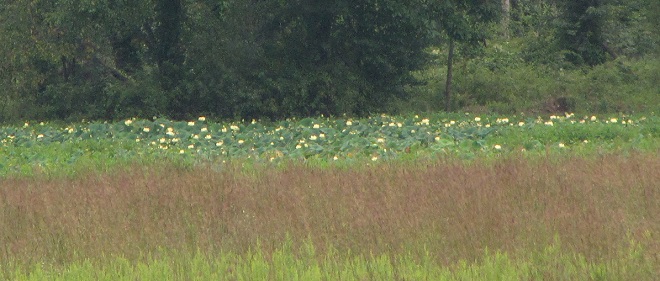
Blooming American Lotus transplants in a pool at Middle Creek Wildlife Management Area during August.
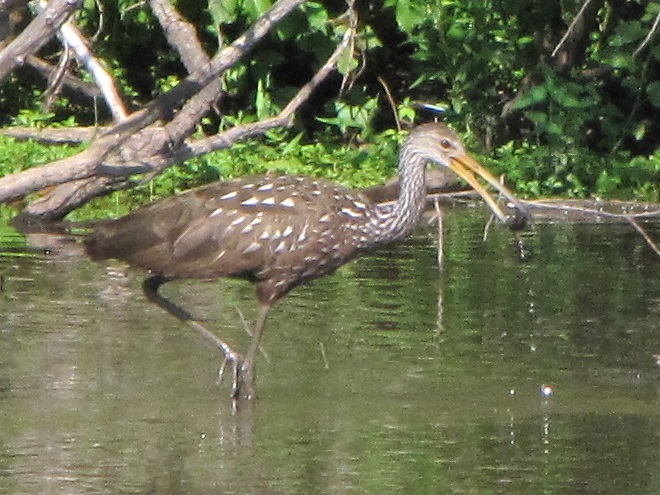
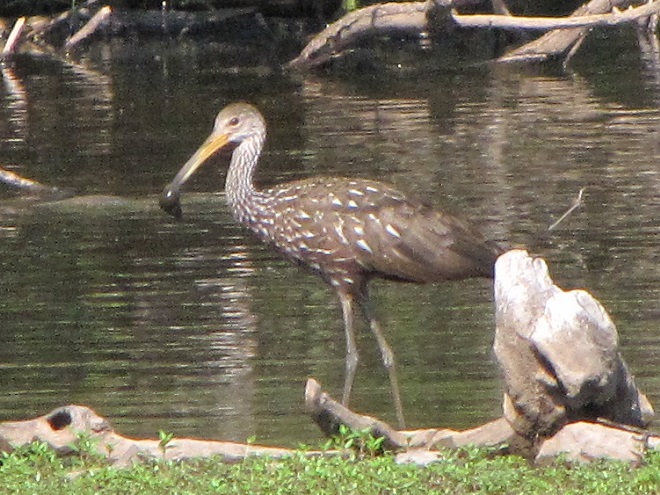
The Limpkin at Middle Creek W.M.A. capturing a Chinese Mystery Snail.
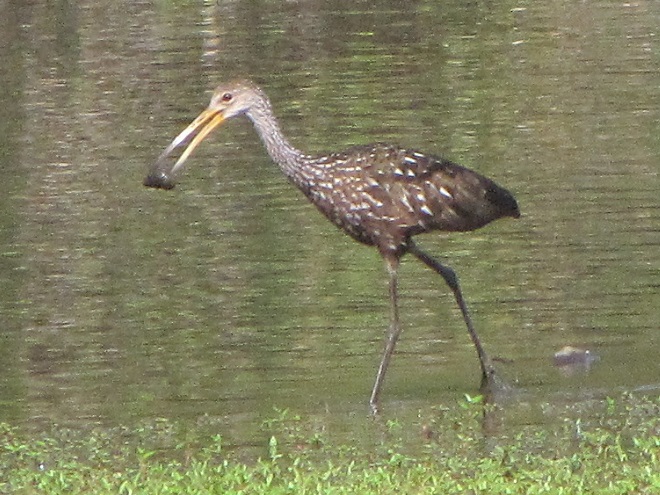
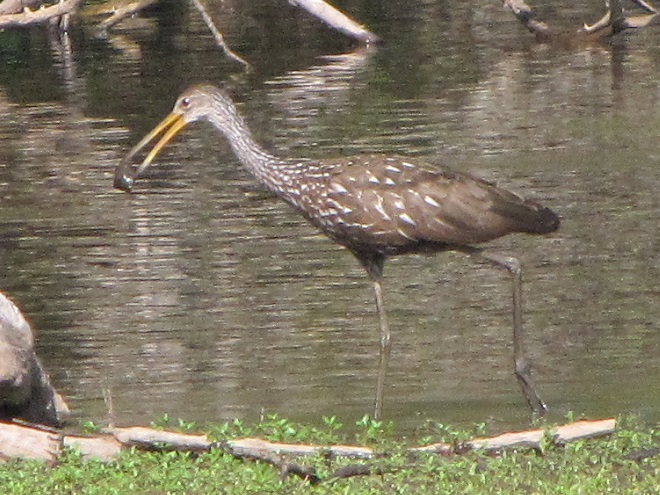
The Limpkin at Middle Creek carrying a Chinese Mystery Snail.
Limpkin holding Chinese Mystery Snail
The Limpkin is seen here maneuvering the the snail in its bill, a set of mandibles specially adapted for extracting the bodies of large freshwater snails from their shells.
Limpkin Grasping Chinese Mystery Snail
The tweezers-like tip of the bill is used to grasp the shell by the rim of the opening or by the “trapdoor” (operculum) that protects the snail inside.
Chinese Mystery Snail
A posed Chinese Mystery Snail showing its “trapdoor”, the operculum protecting the soft body tissue when the animal withdraws inside.  The tips of the Limpkin’s bill close tightly like the end of a tweezers to grasp the operculum and remove it and the snail’s body from the shell.  (Vintage 35 mm image)
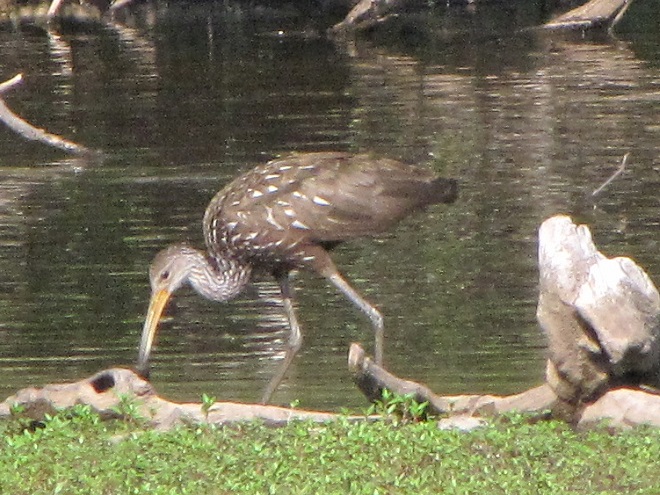
Limpkin Removing Chinese Mystery Snail from Shell
The tweezers-tipped bill, which is curved slightly to the right in some Limpkins, is slid into the shell to grasp the snails body and remove it for consumption.  The entire extraction process takes 10 to 30 seconds.

The Middle Creek Limpkin’s affinity for Chinese Mystery Snails may help explain how it was able to find its way to Pennsylvania in apparent good health.  Look again at the map showing the range of the Limpkin’s primary native food source, the Florida Applesnail.  Note that there are established populations (shown in brown) where these snails were introduced along the northern coast of Georgia and southern coast of South Carolina…

Native and Non-native Range of Florida Applesnail
Native (gold) and non-native (brown) ranges of the Florida Applesnail.  (United States Geological Survey Nonindigenous Aquatic Species image)

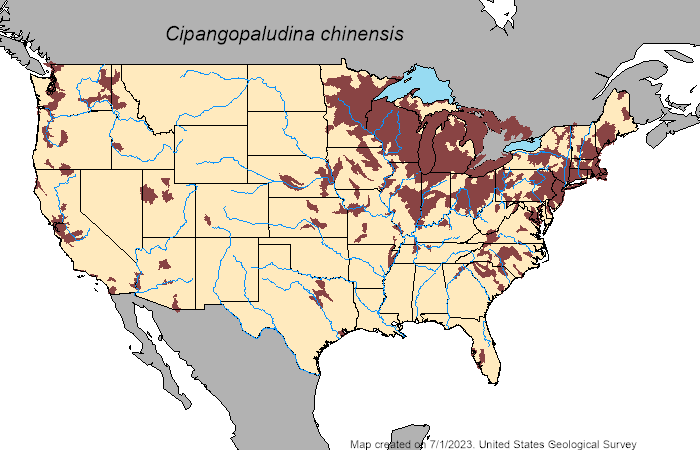
…now look at the latest U.S.G.S. Nonindigenous Aquatic Species map showing the ranges (in brown) of established populations of non-native Chinese Mystery Snails…

Range (in brown) of established populations of non-native Chinese Mystery Snails.  (United States Geological Survey Nonindigenous Aquatic Species image)

…and now imagine that you’re a happy-go-lucky Limpkin working your way up the Atlantic Coastal Plain toward Pennsylvania and taking advantage of the abundance of food and sunshine that summer brings to the northern latitudes.  It’s a new frontier.  Introduced populations of Chinese Mystery Snails are like having a Waffle House serving escargot at every exit along the way!

Be sure to click the “Freshwater Snails” tab at the top of this page to learn more about the Chinese Mystery Snail and its arrival in the Lower Susquehanna River Watershed.  Once there, you’ll find some additional commentary about the Limpkin and the likelihood of Everglade Snail Kites taking advantage of the presence of Chinese Mystery Snails to wander north.  Be certain to check it out.

Everglade Snail Kite
The endangered Everglade Snail Kite (Rostrhamus sociabilis plumbeus), a Florida Applesnail specialist, has survived in part due to its ability to adapt to eating the non-native Pomacea maculata applesnails which have become widespread in Florida following releases from aquaria.  The adaptation?…a larger body and bill for eating larger snails.  (National Park Service image)