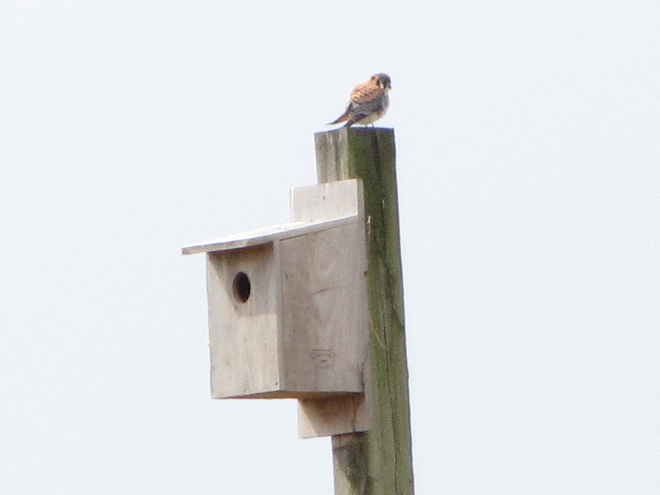
If you’ve visited Middle Creek Wildlife Management Area anytime during the past month, you may have noticed quite a bit of activity around the large pole-mounted nest boxes placed out in the open fields.
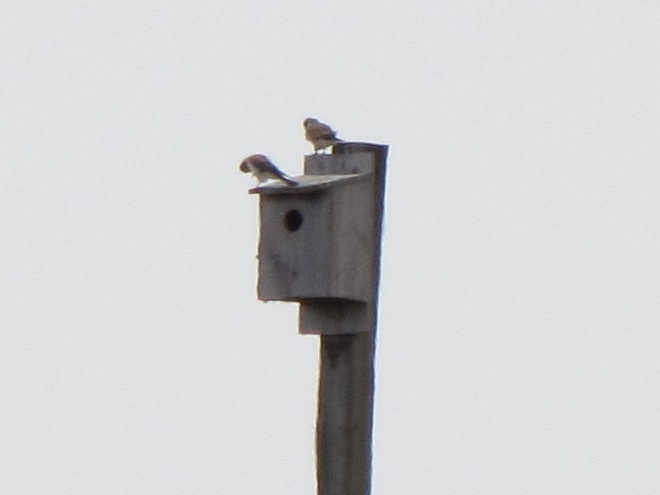
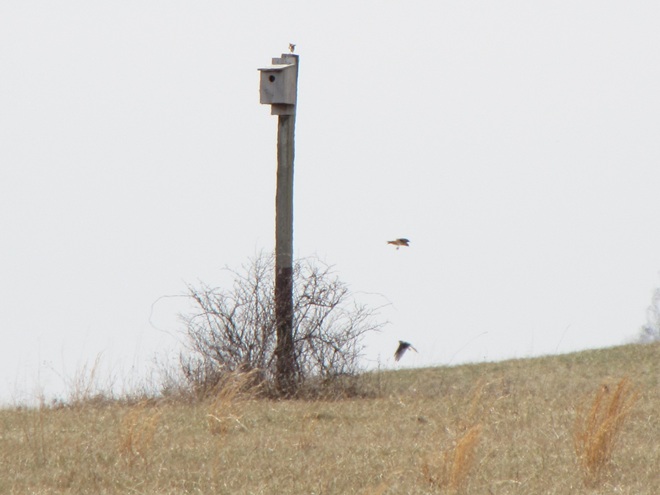
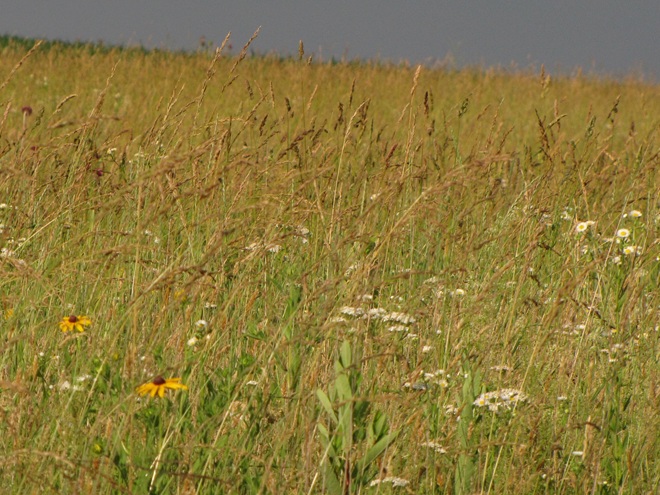
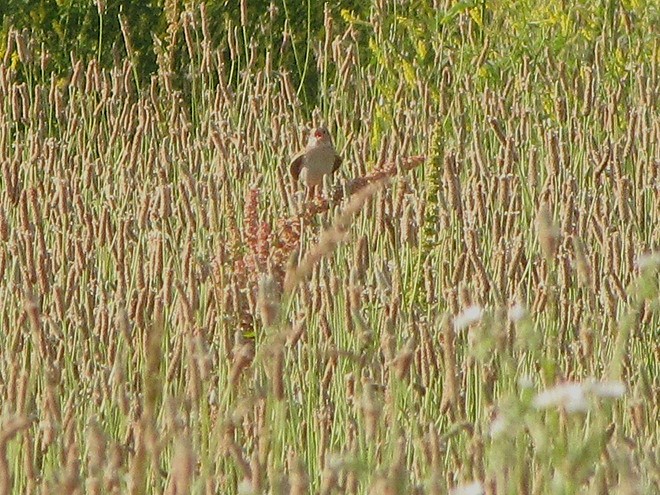
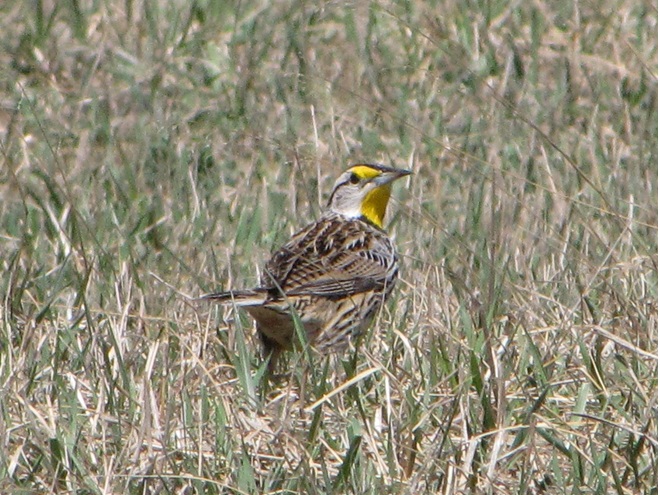
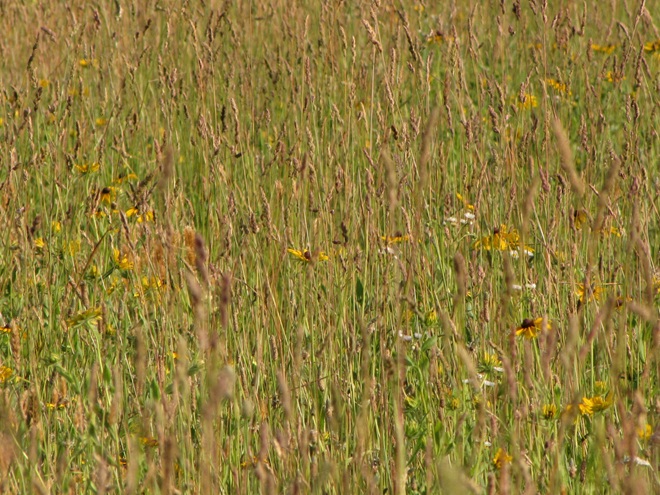
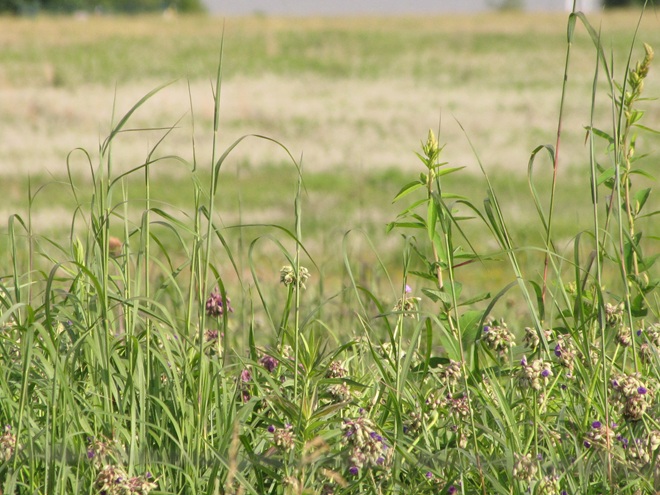
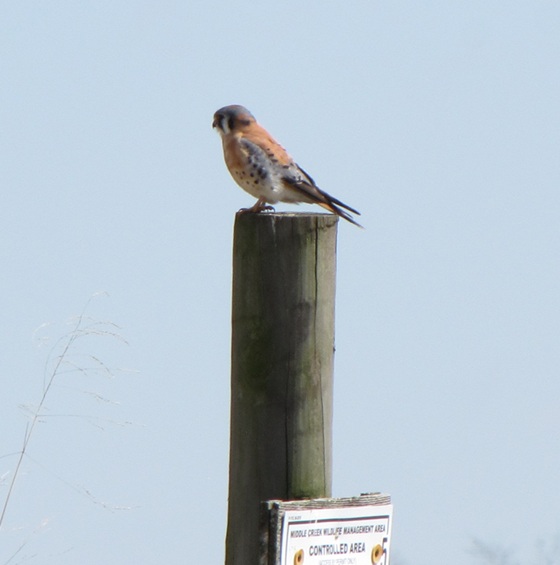
American Kestrels, a male and female, at a nest box at Middle Creek Wildlife Management Area.Within the past week, we noticed that kestrels are still competing for nesting sites and territory, driving away unwanted trespassers. A pair of kestrels seemed to be occupying each of the four box sites we observed. That’s good news, but the presence of these man-made nest cavities is in no way wholly responsible for this positive response from these declining birds. It’s a matter of habitat, much needed grassland habitat.Cool-season grasses including fescue (Lolium species) and non-native Orchard Grass (Dactylis glomerata) mature by late spring. If left standing, they continue to provide indispensable habitat for grassland wildlife through the summer. Mowing early and often for hay harvest has rendered most cool-season meadows death traps for nesting birds. By delaying cuttings until at least early August, ground-nesting birds are given adequate time to fledge their young and get the juvenile birds strong enough to fly away from a set of spinning blades.A male Grasshopper Sparrow sings to demarcate its nesting territory in a stand of Timothy, an introduced species cultivated for harvest as hay. An insectivore during the breeding season, he and his mate will attempt to raise their brood exclusively within the cover of these cool-season grasses.Eastern Meadowlarks arrive in cool-season grasslands by late-winter to begin their breeding cycle which typically extends into the hot summer days of July.Prior to being mowed, Orchard Grass provides the short, dense cover meadowlarks and other ground-nesting grassland birds need to successfully reproduce. Growing a cool season grassland can be as easy as delaying the mowing of a pasture, field, or oversize lawn until August, then have a farmer friend come and take off a cutting or two of hay or straw to prevent woody plants from becoming established.More durable stands of native warm-season grasses including Big Bluestem, Indiangrass, Switchgrass, and Little Bluestem thrive in the summer heat and provide wildlife habitat throughout the year. These perennial “prairie grasses”, fed by root systems five to eight feet deep, are especially drought tolerant . From these entrenched anchors, the plants would quickly bounce back after the once great herds of hungry bison had grazed the landscape bare of surface vegetation before moving on. This adaptation also assured “prairie grass” regeneration following naturally occurring seasonal fires, events mimicked in eastern North America by its pre-Columbian human residents. They used recurrent fire to perpetuate early successional habitat for wildlife propagation, foraging, and agriculture. Today in the lower Susquehanna watershed, establishing warm-season grassland meadows requires soil prep and seeding to get things going again.To prevent succession, warm-season grassland parcels are most commonly maintained using applications of prescribed fire every 3 to 5 years. Among their benefits, these burns invigorate native vegetation while inhibiting the invasive tendencies of many non-native plants. Well-planned periodic fire can significantly reduce fuel accumulations, particularly in tinderbox woodland tracts managed as fire-free zones for the past century or more. Many forest trees including oaks rely on sporadic fire events for regeneration.
LEARN HOW LAND MANAGERS UTILIZE PRESCRIBED FIRE
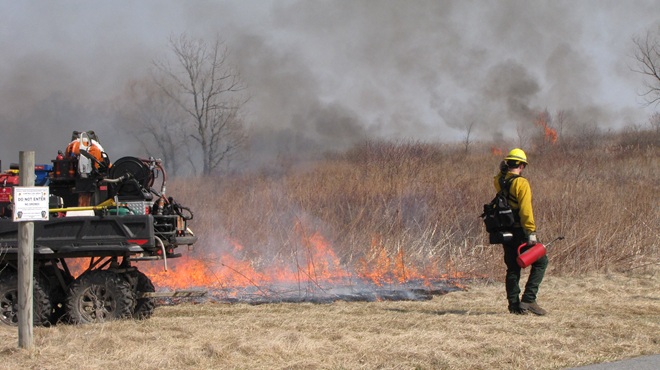
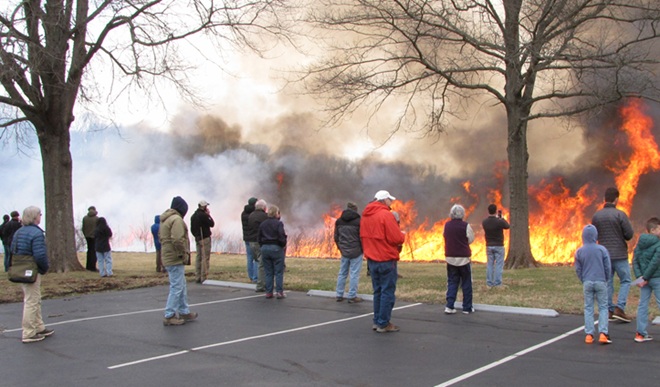
This coming Saturday, April 18, 2026, beginning at 10 A.M. (rain date April 25), the Pennsylvania Game Commission is hosting a “Prescribed Fire Festival” at Middle Creek Wildlife Management Area. Be certain to come out to the visitor’s center at 100 Museum Road, Stevens, PA, for this event. Land managers will be there to answer questions and to explain the planning and preparations involved in overseeing a prescribed burn. There will be guided walks of habitats preserved using fire of varying intensities. You’ll see the equipment and protective clothing used by certified personnel to administer a live prescribed fire burn right before your eyes. Then you can have lunch—food trucks will be available on site.
Visitors witness a prescribed fire demonstration at the Pennsylvania Game Commission’s Middle Creek Wildlife Management Area in 2025.
After the burn demonstration, why not go for a walk or drive around the refuge. You can take note of how grassland and early successional plant communities are responding to previous doses of prescribed fire…
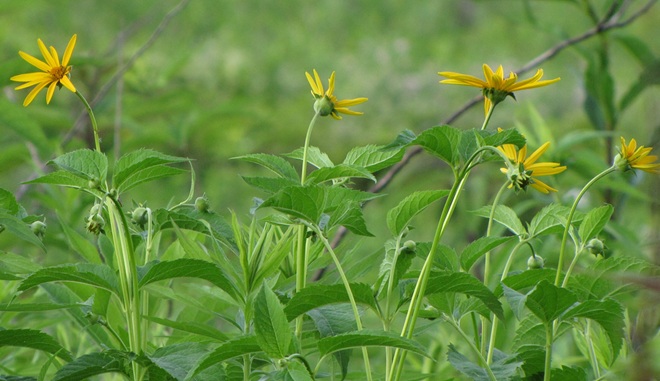
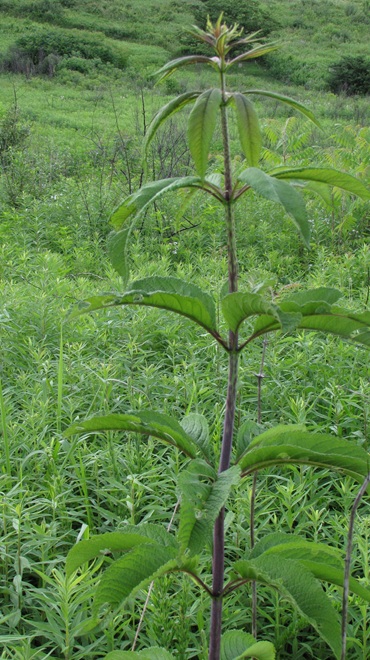
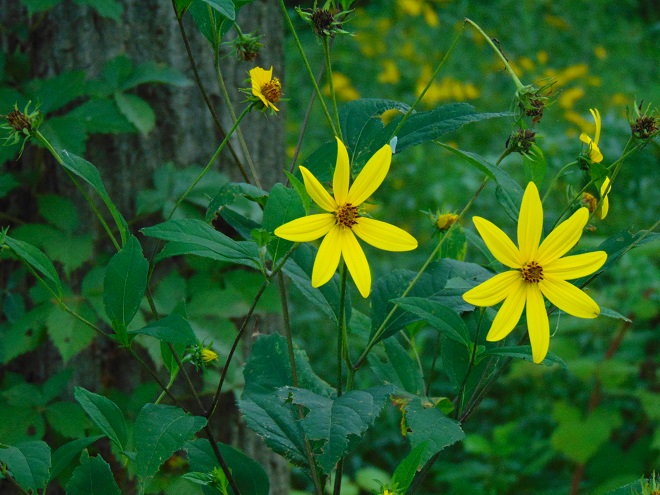
Greening up a week or two after the burn, Wingstem is blooming by June in areas treated using prescribed fire earlier in the spring.Another scene from June: Four-foot-tall Joe-Pye-Weed amidst lush growth of goldenrod in early successional habitat where a prescribed burn eliminated accumulating wildfire fuel and turned back the growth of invasive plant species in March.
And how the grassland animals respond as well…
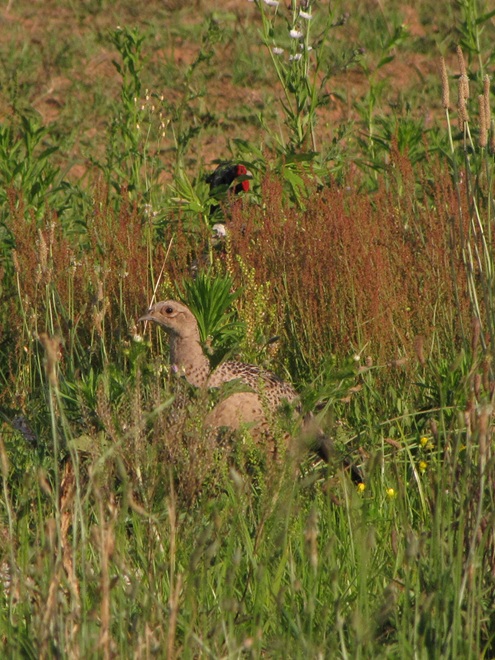
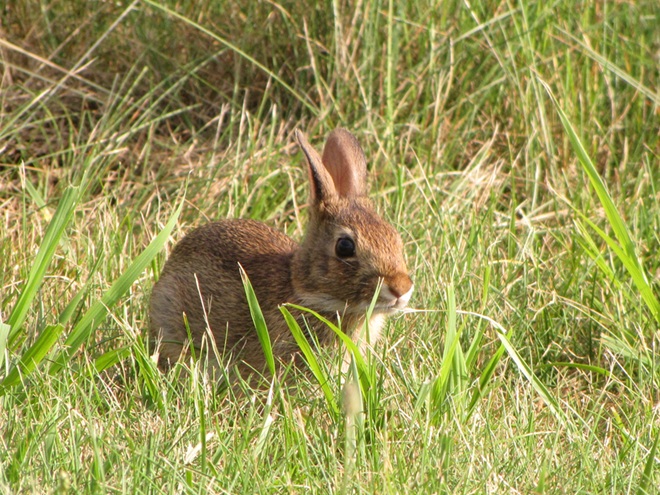
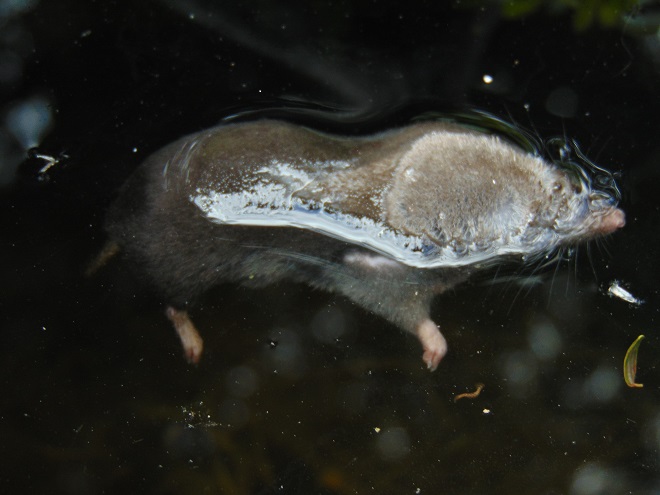
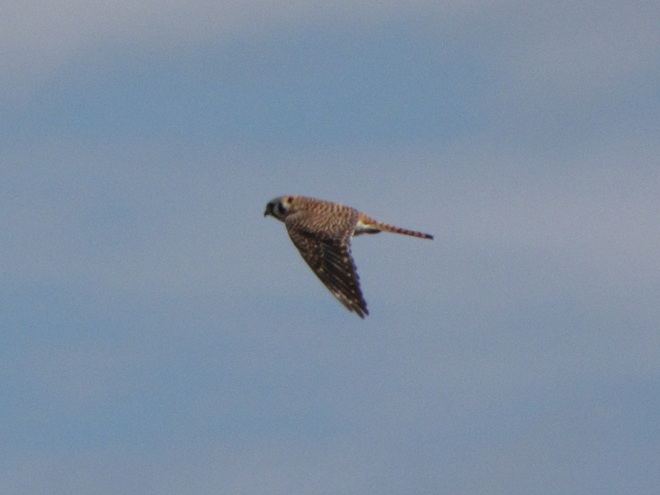
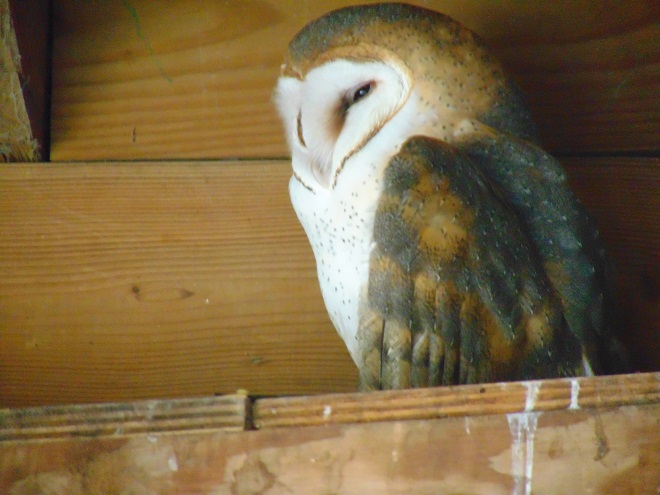
Ring-necked Pheasants in early successional habitat maintained by the periodic application of prescribed fire.Eastern Cottontails prosper in the mosaic of warm-season grasses and early successional thickets on lands sustained using prescribed fire. Rabbits are herbivores, primary consumers eating mostly legumes and other plants, the producers that through the process of photosynthesis convert the energy of the the sun into food energy.Other small vegetation-eating rodents including mice and voles thrive in managed grasslands. Similar in appearance are the shrews. Though seldom noticed, Northern Short-tailed Shrews spend day and night foraging for food, even in the shallow waters of wet meadows and thickets. Unlike the aforementioned herbivorous rodents, shrews are insectivores, secondary consumers feeding mostly on primary consumers including a variety of insects and other arthropods.Some years ago, we found this tiny Masked Shrew (Sorex cinereus) in a grassland area being preserved using prescribed fire. Like other shrews, Masked Shrews are secretive, but always on the go. They feed constantly to fuel their vast energy requirements, sometimes consuming three times their body weight in a single day. But their voracious appetite can get them into trouble, causing these incessant eaters to encounter numerous potentially infective parasites during their non-stop foraging missions.Patrolling the grasslands is the female American Kestrel, a secondary consumer. She’s on the lookout for primary consumers including large insects like grasshoppers or crickets. But perhaps more likely is a small rodent whose less-than-ideal vigor may cause it to slip up, creating an easy target. If she selects a careless shrew as her prey, she may be assuming the role of a tertiary consumer, eating a secondary consumer (the shrew) that fed on insects (the primary consumers) that derived their energy from photosynthesized plant matter.The strictly nocturnal American Barn Owl (Tyto furcata), another secondary and sometimes tertiary consumer, takes the night shift, hunting unwary voles, mice, and shrews, often by sensing the sounds they make among runways in the grass. As a native predator in its favored habitat, the owl’s selection of each victim actually helps to keep the prey species’ population healthy, eliminating the weak and vulnerable to provide a qualitative service to the surviving wildlife of the grasslands. While we may not think of the barn owl as a direct consumer of insects, its positive influence on insectivorous shrew populations makes it an important functionary in maintaining balance in the ecosystems it calls home.As food becomes increasing plentiful in the grasslands, a female kestrel will remain mostly out of sight, performing the majority of the egg incubation duties while her colorful mate stands guard nearby.The male not only keeps watch, but also continues the hunt for insects, small mammals, and other prey to feed not only the newborn nestlings, but also his mate while she tends the nest. As the young grow and no longer need brooding to stay warm, the female will join the male in a joint effort to snatch up enough food to keep their three to seven offspring nourished. Like other raptors, populations of these predators are abruptly regulated in the nest. The first hatched of these falcon’s young will receive the most food, giving them, particularly the oldest individual, the best chances of survival. The later-hatched and thus smaller offspring may have trouble competing for the available provisions brought to the nest. If food is plentiful, there may be enough for all of the birds to grow and survive. If food is scarce, only the oldest (which also happen to be the biggest, strongest, and most aggressive) baby falcon(s) will live to fledge and leave the nest. If hunting becomes really poor, the adults will sustain themselves at the expense of their young.
The fate of an avian predator such as a kestrel lies at the mercy of the fate of its quarry. Because, you see, the sun’s energy, after being converted to chemical energy by photosynthesizing plants, flows upward through the trophic levels of the food chain—herbivores (primary consumers) such as rodents and insects to carnivores (secondary and tertiary consumers) including kestrels. Grasslands, when abundant and diverse, are correspondingly abundant and diverse with small mammals and insects and will therefore support thriving populations of American Kestrels and other predators. These secondary and sometimes tertiary consumers fulfill a role in cultivating healthier populations of their prey—the primary and secondary consumers in the food web—as a balanced component of a flourishing grassland ecosystem. Sparse and fragmented grasslands, on the other hand, beget negligible small mammal and insect populations, are stricken with broken food webs, and champion few if any American Kestrels or other predators. If the land it occupies is neat, tidy, manicured, exploited, or sprayed sterile and dead, the energy flow cycle of the ecosystem is dead as well. There’s nothing animal introductions, reintroductions, rescues, culling, stocking, or harvesting can do about it, because in the end, it’s all about the habitat.
They get a touch of it here, and a sparkle or two there. Maybe, for a couple of hours each day, the glorious life-giving glow of the sun finds an opening in the canopy to warm and nourish their leaves, then the rays of light creep away across the forest floor, and it’s shade for the remainder of the day.
The flowering plants which thrive in the understory of the Riparian Woodlands often escape much notice. They gather only a fraction of the daylight collected by species growing in full exposure to the sun. Yet, by season’s end, many produce showy flowers or nourishing fruits of great import to wildlife. While light may be sparingly rationed through the leaves of the tall trees overhead, moisture is nearly always assured in the damp soils of the riverside forest. For these plants, growth is slow, but continuous. And now, it’s show time.
So let’s take a late-summer stroll through the Riparian Woodlands of Conewago Falls, minus the face full of cobwebs, and have a look at some of the strikingly beautiful plants found living in the shadows.
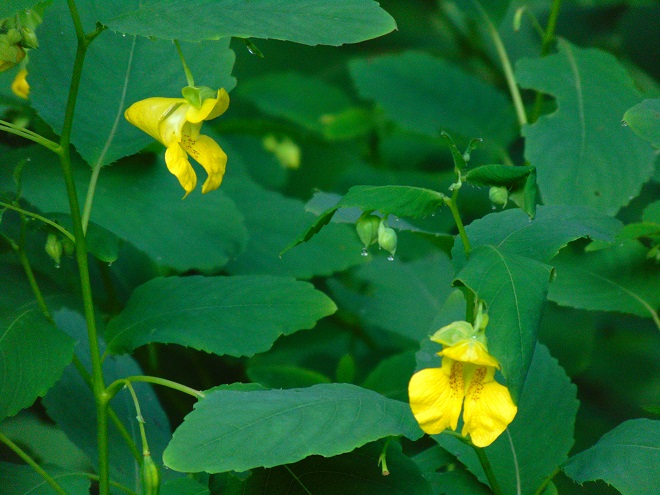
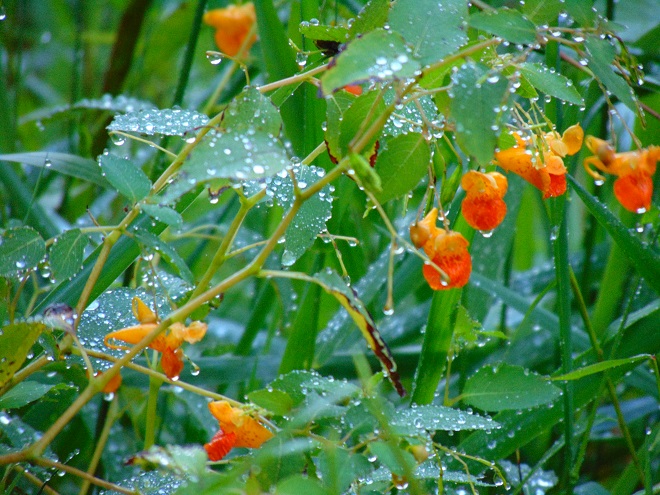
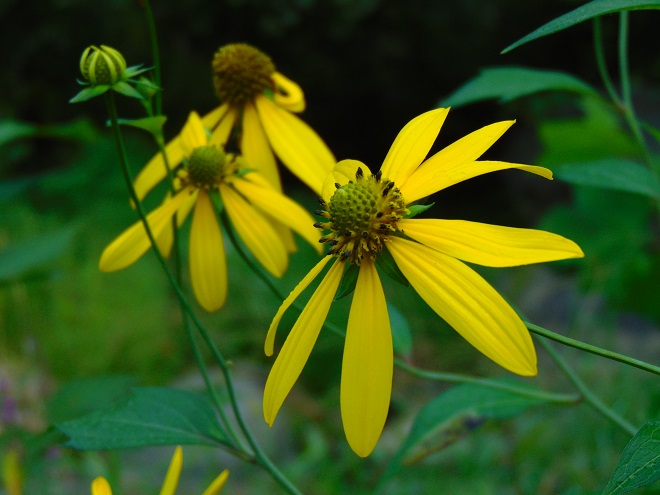
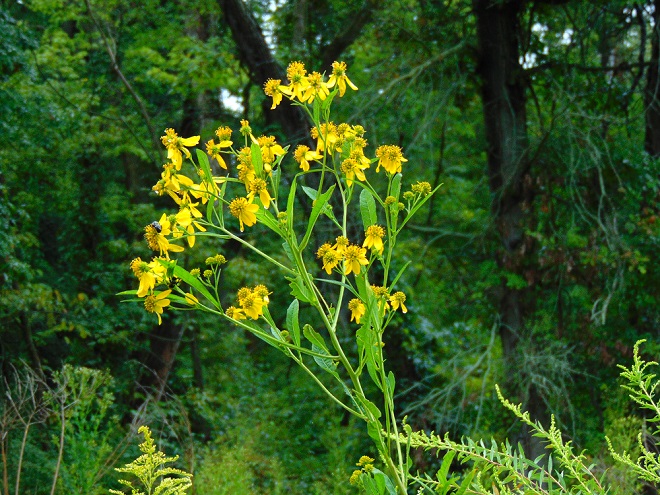
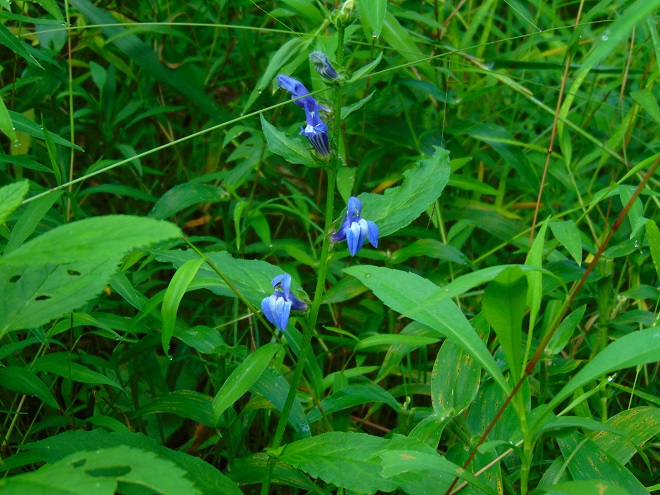
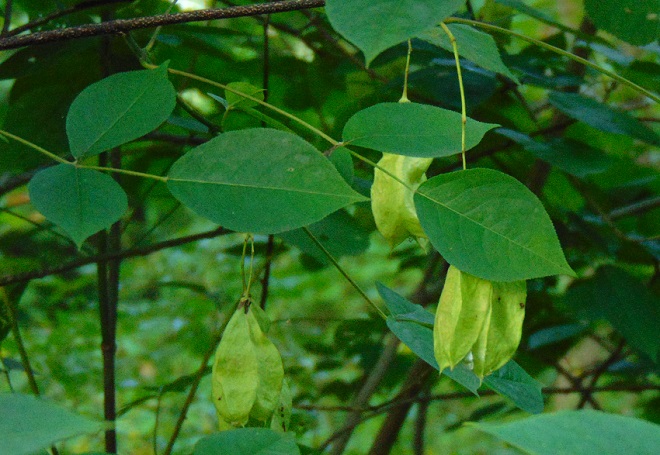
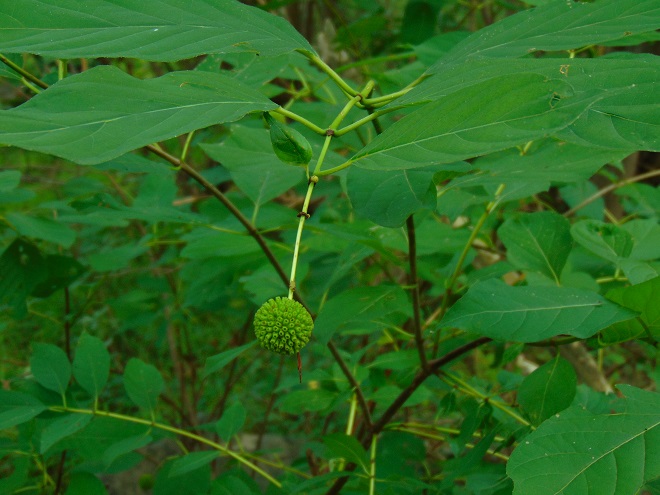
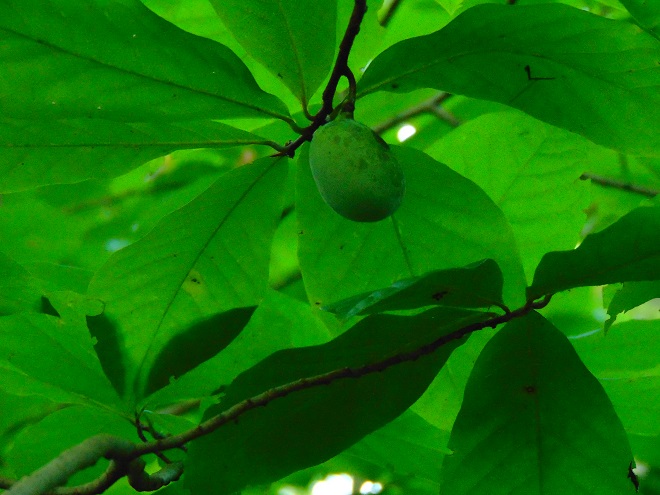
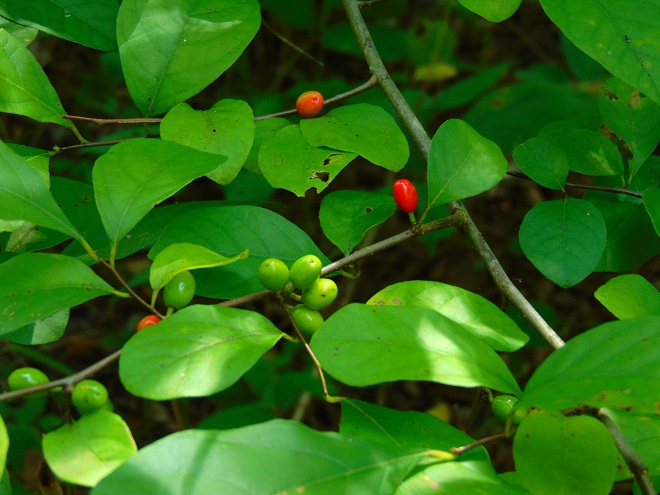
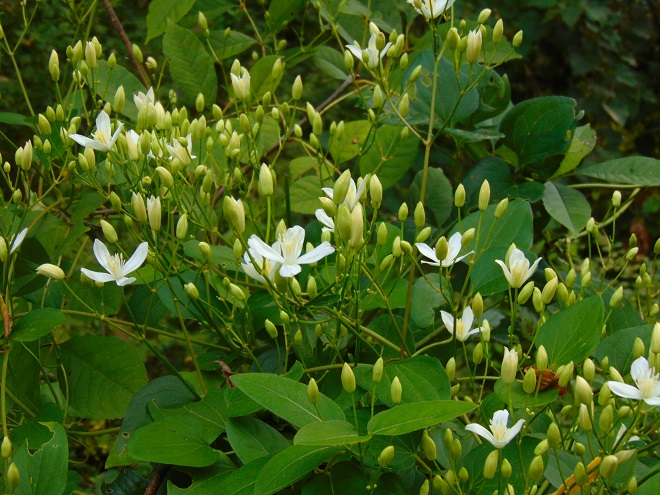
Oxeye (Heliopsis helianthoides) is common on the interior and along the edges of Riparian Woodland. Specimens in deep shade flower less profusely and average less than half the height of the five feet tall inhabitants of edge environs.Pale Touch-Me-Not (Impatiens pallida) is one of two species of native Impatiens foundin the river floodplain. Both are known as Jewelweed. The stems and leaves of the indigenous Impatiens retain a great quantity of water, so life in filtered sunlight is essential to prevent desiccation. Contrary to popular folklore, extracts of Jewelweed plants are not effective treatments of Poison Ivy (Toxicodendron radicans) contact dermatitis.Spotted Touch-Me-Not (Impatiens capensis) is typically found in wetter soil than I. pallida. Both Jewelweeds develop popping capsules which help to distribute the seeds of these annual wildflowers. “Touch Me Not”, or you’ll be wearing tiny seeds.Green-headed Coneflower (Rudbeckia laciniata) grows to heights of eight feet in full sun, hence its alternate common name, Tall Coneflower. In deep shade, it may not exceed two feet in height. Floodplains are the prime domain of this perennial.Wingstem (Verbesina alternifolia) normally flowers no earlier than late August. The bases of the leaves are continued onto the stem of the plant to form wings which extend downward along its length. This wildflower tolerates shade, but flowers more profusely along the woodland edge.Great Lobelia (Lobelia siphilitica), or Great Blue Lobelia, is a magnificent wetland and moist woodland wildflower, usually attaining three feet in height and adorned with a plant-topping spike of blossoms. Invasive Japanese Stiltgrass (Microstegium vimineum) can be seen here competing with this plant, resulting in a shorter, less productive Lobelia. Stiltgrass was not found in the Susquehanna River floodplain at Conewago Falls until sometime after 1997. It has spread to all areas of woodland shade, its tiny seeds being blown and translocated along roads, mowed lots, trails, and streams to quickly colonize and overtake new ground.American Bladdernut (Staphylea trifolia), a shrub of shaded woods, develops inflated capsules which easily float away during high water to distribute the seeds contained inside.Buttonbush (Cephalanthus occidentalis) is a shrub of wet soils which produces a strange spherical flower, followed by this globular seed cluster.Common Pawpaw (Asimina triloba) is a colony-forming small tree which produces a fleshy fruit. It is the host plant for the caterpillars of the Zebra Swallowtail. The plant and the butterfly approach the northern limit of their geographic range at Conewago Falls.Common Spicebush (Lindera benzoin) is a widespread understory shrub in wet floodplain soils. It is the host plant for the caterpillars of the Spicebush Swallowtail (Papilio troilus).Sweet Autumn Virgin’s Bower (Clematis terniflora) is an escape from cultivation which has recently naturalized in the edge areas of the Conewago Falls Riparian Woodlands. This vine is very showy when flowering and producing seed, but can be detrimental to some of the understory shrubs upon which it tends to climb.
SOURCES
Long, David; Ballentine, Noel H.; and Marks, James G., Jr. 1997. Treatment of Poison Ivy/Oak Allergic Contact Dermatitis With an Extract of Jewelweed. American Journal of Contact Dermatitis. 8(3): pp. 150-153.
Newcomb, Lawrence. 1977. Newcomb’s Wildflower Guide. Little, Brown and Company. Boston, Massachusetts.
She ate only toaster pastries…that’s it…nothing else. Every now and then, on special occasions, when a big dinner was served, she’d have a small helping of mashed potatoes, no gravy, just plain, thank you. She received all her nutrition from several meals a week of macaroni and cheese assembled from processed ingredients found in a cardboard box. It contains eight essential vitamins and minerals, don’t you know? You remember her, don’t you?
Adult female butterflies must lay their eggs where the hatched larvae will promptly find the precise food needed to fuel their growth. These caterpillars are fussy eaters, with some able to feed upon only one particular species or genus of plant to grow through the five stages, the instars, of larval life. The energy for their fifth molt into a pupa, known as a chrysalis, and metamorphosis into an adult butterfly requires mass consumption of the required plant matter. Their life cycle causes most butterflies to be very habitat specific. These splendid insects may visit the urban or suburban garden as adults to feed on nectar plants, however, successful reproduction relies upon environs which include suitable, thriving, pesticide-free host plants for the caterpillars. Their survival depends upon more than the vegetation surrounding the typical lawn will provide.
The Monarch (Danaus plexippus), a butterfly familiar in North America for its conspicuous autumn migrations to forests in Mexico, uses the milkweeds (Asclepias) almost exclusively as a host plant. Here at Conewago Falls, wetlands with Swamp Milkweed (Asclepias incarnata) and unsprayed clearings with Common Milkweed (A. syriaca) are essential to the successful reproduction of the species. Human disturbance, including liberal use of herbicides, and invasive plant species can diminish the biomass of the Monarch’s favored nourishment, thus reducing significantly the abundance of the migratory late-season generation.
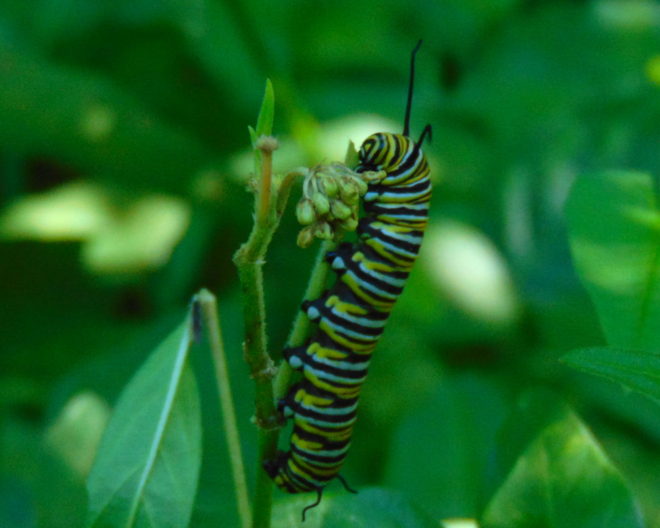
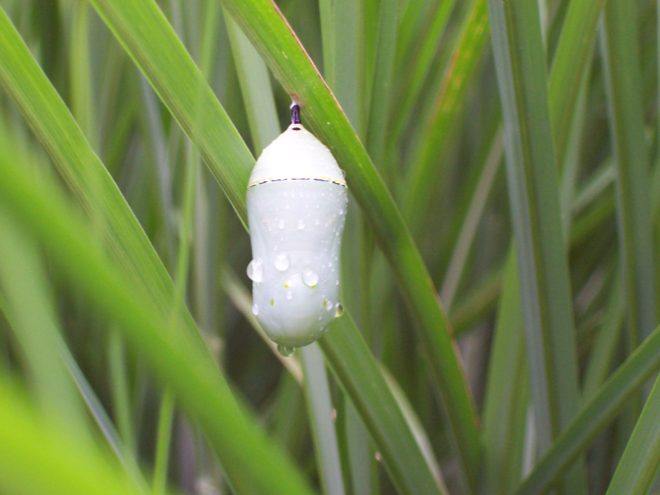
Monarch caterpillar after a fourth molt. The fifth instar feeding on Swamp Milkweed.A fifth molt begets the Monarch pupa, the chrysalis, from which the showy adult butterfly will emerge.Adult Monarch feeding on Goldenrod (Solidago) nectar.
Butterflies are good indicators of the ecological health of a given environment. A diversity of butterfly species in a given area requires a wide array of mostly indigenous plants to provide food for reproduction. Let’s have a look at some of the species seen around Conewago Falls this week…
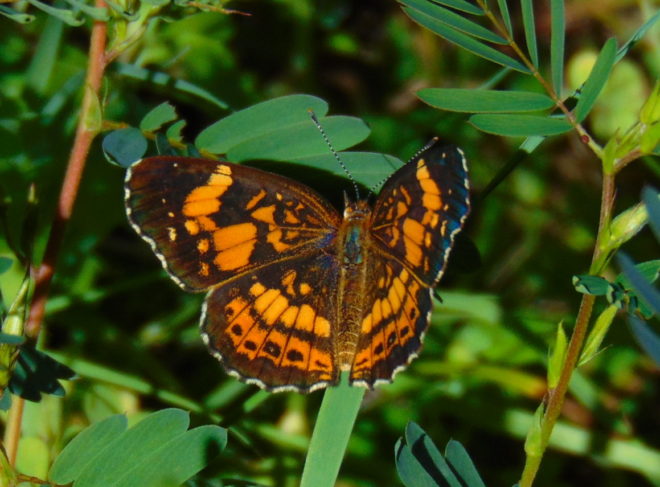
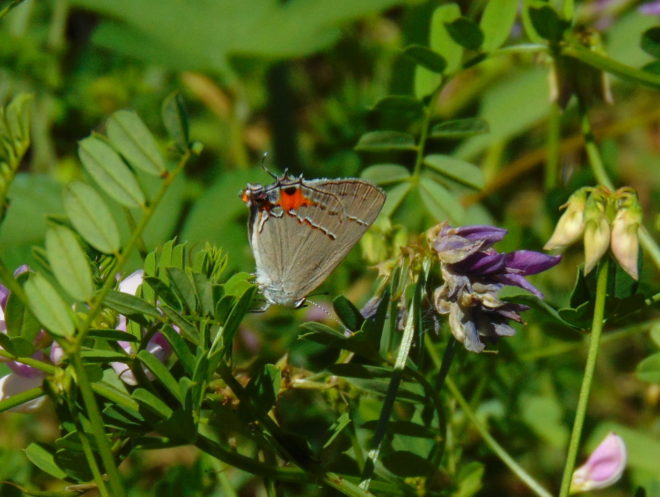
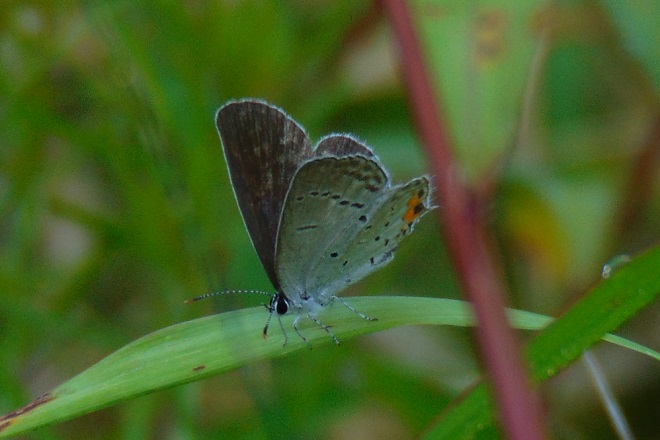
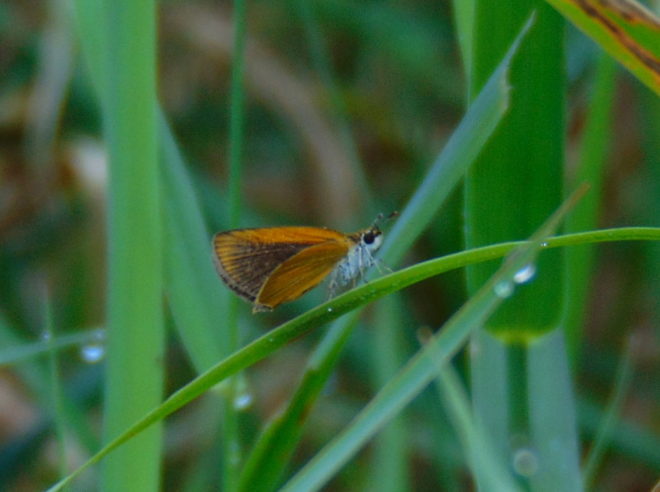
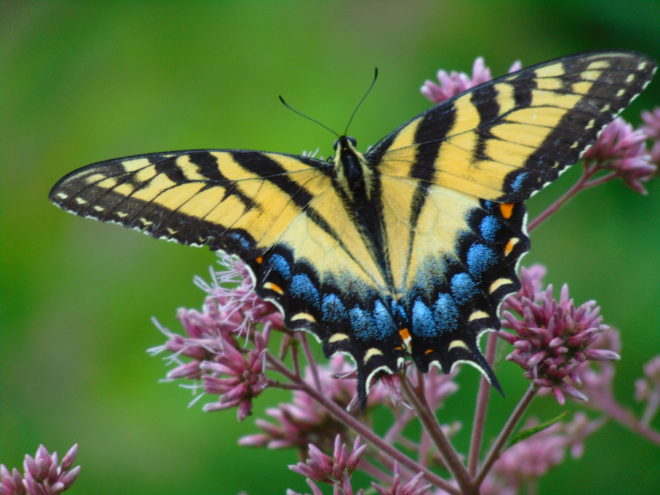
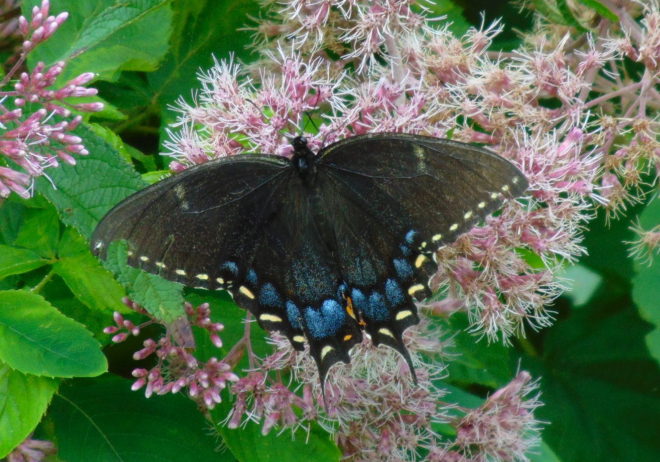
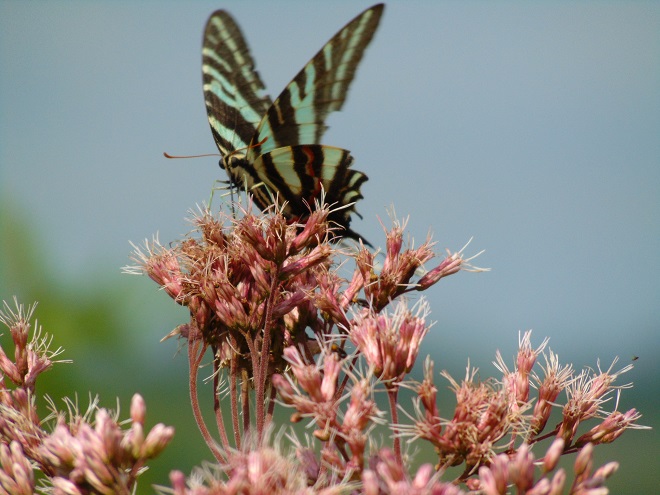
An adult Silvery Checkerspot (Chlosyne nycteis) visiting a nectar plant, Partridge Pea (Chamaecrista fasciculata). Wingstem (Verbesina alternifolia), a plant of the Riparian Woodlands, is among the probable hosts for the caterpillars.A Gray Hairstreak (Strymon melinus) visits Crown Vetch, a possible host plant. Other potential larval food in the area includes Partridge Pea, Halberd-leaved Rose Mallow (Hibiscus laevis) of the river shoreline, and Swamp Rose Mallow (Hibiscus moscheutos), a plant of wetlands.The Eastern Tailed Blue (Cupido comyntas) may use Partridge Pea , a native wildflower species, and the introduced Crown Vetch (Securigera/Coronilla varia) as host and nectar plants at Conewago Falls.The Least Skipper (Ancyloxypha numitor) is at home among tall grasses in woodland openings, at riverside, and in the scoured grassland habitat of the Pothole Rocks in the falls. Host plants available include Switchgrass (Panicum vigatum), Freshwater Cordgrass (Spartina pectinata), and Foxtails (Setaria).The Zabulon Skipper (Poanes zabulon) is an inhabitant of moist clearings where the caterpillars may feed upon Lovegrasses (Eragrostis) and Purpletop (Tridens flavus).The Eastern Tiger Swallowtail (Papilio glaucus), a female seen here gathering nectar from Joe-Pye Weed (Eutrochium), relies upon several forest trees as hosts. Black Cherry (Prunus serotina), Willow (Salix), Yellow Poplar (Liriodendron tulipifera), also known as Tuliptree, and Green Ash (Fraxinus pennsylvanica) are among the local species known to be used. The future of the latter food species at Conewago Falls is doubtful. Fortunately for the Eastern Tiger Swallowtail, the “generalist” feeding requirements of this butterfly’s larvae enable the species to survive the loss of a host plant.A female Eastern Tiger Swallowtail, black morph, gathering nectar from Joe-Pye Weed.The Zebra Swallowtail (Protographium marcellus), an adult seen here on Joe-Pye Weed, feeds exclusively upon Pawpaw (Asimina) trees as a caterpillar. This butterfly species may wander, but its breeding range is limited to the moist Riparian Woodlands where colonial groves of Pawpaw may be found. The Common Pawpaw (Asimina triloba), our native species in Pennsylvania, and the Zebra Swallowtail occur at the northern edge of their geographic ranges in the Lower Susquehanna River Watershed. Planting Pawpaw trees as an element of streamside reforestation projects certainly benefits this marvelous butterfly.
The spectacularly colorful butterflies are a real treat on a hot summer day. Their affinity for showy plants doubles the pleasure.
By the way, I’m certain by now you’ve recalled that fussy eater…and how beautiful she grew up to be.
SOURCES
Brock, Jim P., and Kaufman, Kenn. 2003. Butterflies of North America. Houghton Mifflin Company. New York, NY.