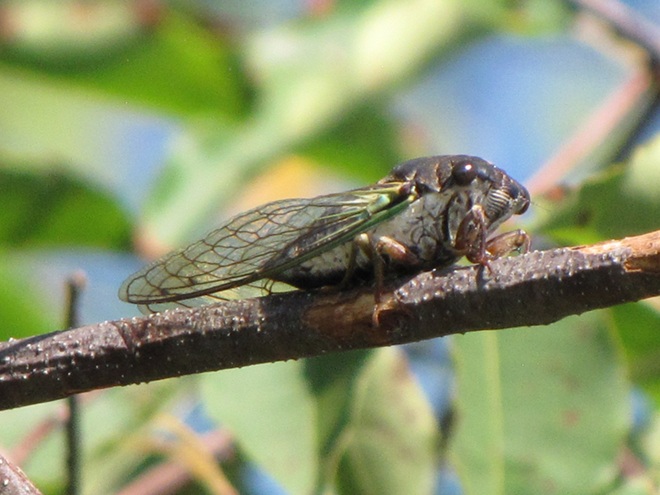
Today, after a wait of about a month, we finally began hearing the belated trills, whines, and rattles of notable numbers of annual cicadas. During the day’s excursions, we identified the songs of each of the five species commonly encountered in the lower Susquehanna valley, but were especially surprised to photograph and make a sound recording of something we had previously failed to observe well enough to identify in detail.
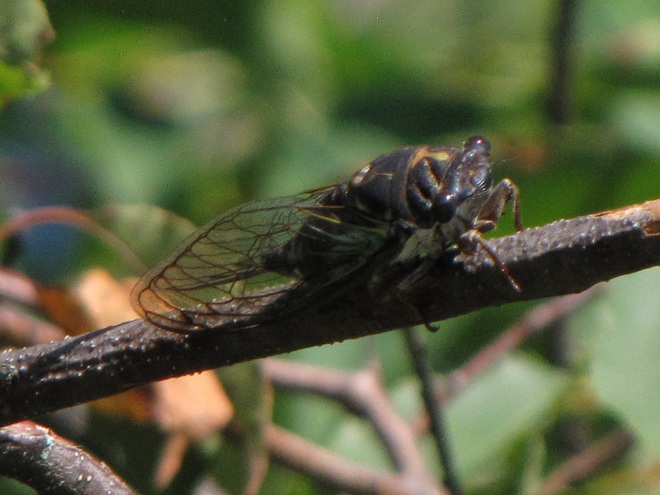
This annual cicada found on the lookout at Second Mountain Hawk Watch on the border between Fort Indiantown Gap Military Reservation and State Game Lands 211 (St. Anthony’s Wilderness) in northern Lebanon County, Pennsylvania, didn’t appear to be anything too special. Perhaps it was one of the numerous Swamp Cicadas we had detected nearby as they droned. Then no, by the sound of this individual’s song, it seemed to be one of the more difficult to observe species, a Lyric Cicada (Neotibicen lyricen), an insect most commonly found among treetops in deciduous woods and mature suburban gardens. It was another case of identification by ear, but then again, we hear them well at lot more often than we see them well.A close look at this second image of the same cicada shows something noteworthy, a yellow-green keyhole or pull-tab marking on its pronotum (just behind the eyes). This is an upland form of Lyric Cicada known as “Engelhardt’s Cicada”, an insect sometimes given subspecies status as Neotibicen lyricen engelhardti. This variant and its intergrades may constitute a majority of the N. lyricen cicadas found occurring in the Piedmont areas of the Lower Susquehanna River Watershed while sometimes greener, or browner, or still other times all-dark, Darth Vader-like Lyric Cicadas (N. l. lyricen) inhabit coastal plain areas to its south. In the mountainous areas of the Ridge and Valley Province, “pure” “Engelhardt’s Cicadas” resembling this one are probably most prevalent. For more details on Lyric Cicadas, “Engelhardt’s Cicadas”, and the other annual, semiannual, and periodical cicadas of the region (including their songs), be certain to visit our “Cicadas” page by clicking the “Cicadas” tab at the top of this page. It’s what the buzz is all about.