The Dungeon

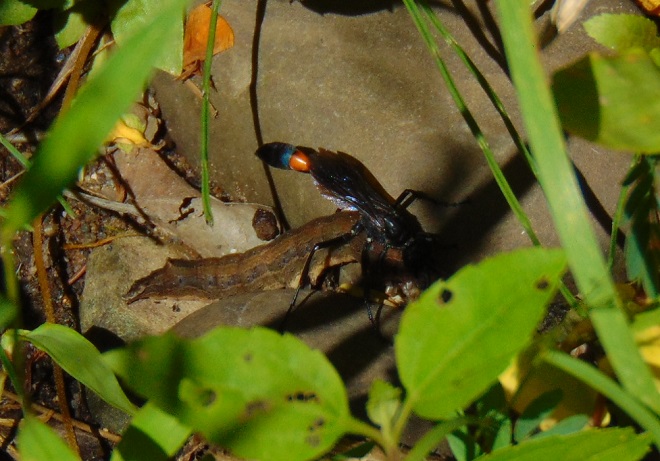
There’s something frightening going on down there.  In the sand, beneath the plants on the shoreline, there’s a pile of soil next to a hole it’s been digging.  Now, it’s dragging something toward the tunnel it made.  What does it have?  Is that alive?

We know how the system works, the food chain that is.  The small stuff is eaten by the progressively bigger things, and there are fewer of the latter than there are of the former, thus the whole network keeps operating long-term.  Some things chew plants, others devour animals whole or in part, and then there are those, like us, that do both.  In the natural ecosystem, predators keep the numerous little critters from getting out of control and decimating certain other plant or animal populations and wrecking the whole business.  When man brings an invasive and potentially destructive species to a new area, occasionally we’re fortunate enough to have a native species adapt and begin to keep the invader under control by eating it.  It maintains the balance.  It’s easy enough to understand.

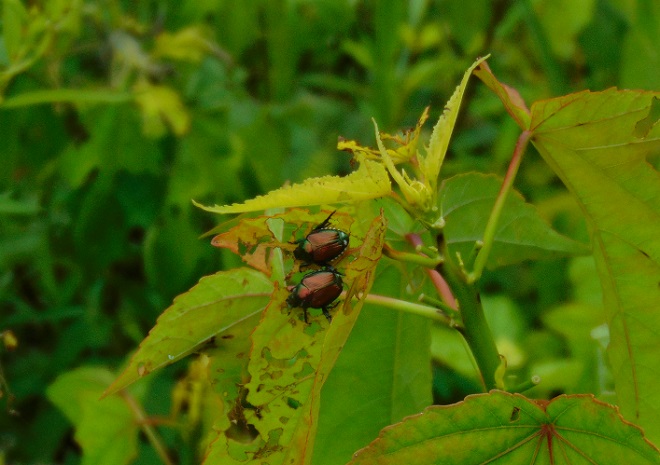
Japanese Beetles (Popillia japonica) seen here on Halberd-leaved Rose Mallow.  Without predation, exploding numbers of this invasive non-indigenous insect can defoliate and kill numerous species of plants in a given area.
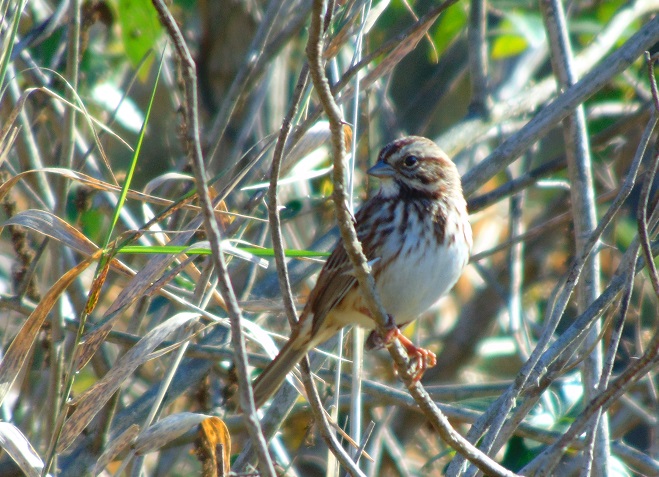
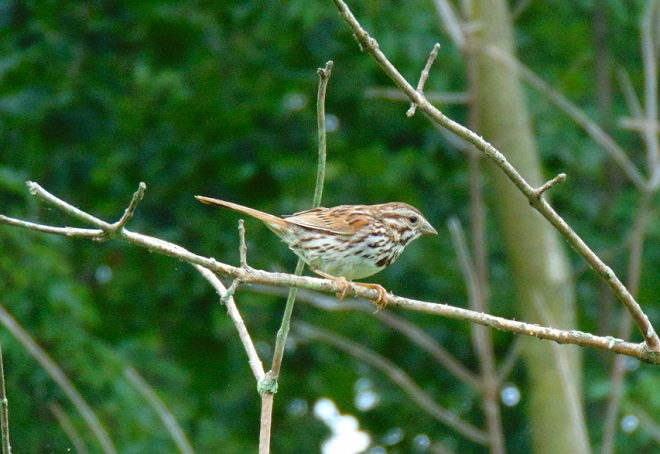
The Song Sparrow (Melospiza melodia) is a generalist feeder, eating seeds and invertebrates including Japanese Beetles.  This species is the omnipresent year-round occupant of shoreline vegetation along the lower Susquehanna River.

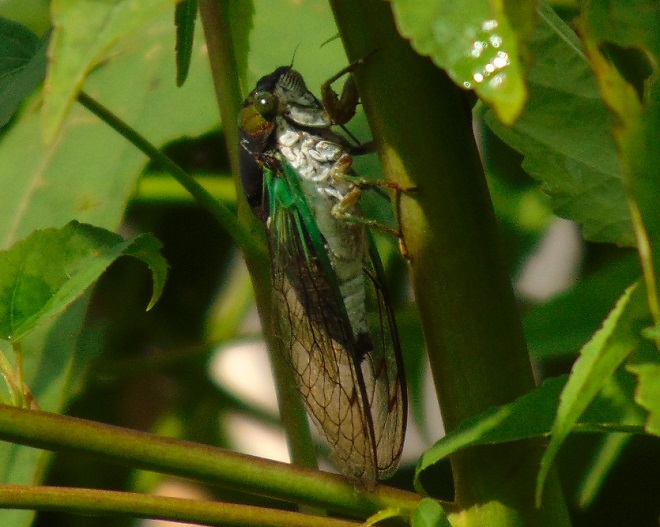
Late summer days are marked by a change in the sounds coming from the forests surrounding the falls.  For birds, breeding season is ending, so the males cease their chorus of songs and insects take over the musical duties.  The buzzing calls of male “annual cicadas” (Neotibicen species) are the most familiar.  The female “annual cicada” lays her eggs in the twigs of trees.  After hatching, the nymphs drop to the ground and burrow into the soil to live and feed along tree roots for the next two to five years.  A dry exoskeleton clinging to a tree trunk is evidence that a nymph has emerged from its subterranean haunts and flown away as an adult to breed and soon thereafter die.  Flights of adult “annual cicadas” occur every year, but never come anywhere close to reaching the enormous numbers of “periodical cicadas” (Magicicada species).  The three species of “periodical cicadas” synchronize their life cycles throughout their combined regional populations to create broods that emerge as spectacular flights once every 13 or 17 years.

An “annual cicada” also known as a “dog-day cicada”, clings to the stem of a Halberd-leaved Rose Mallow at Conewago Falls.

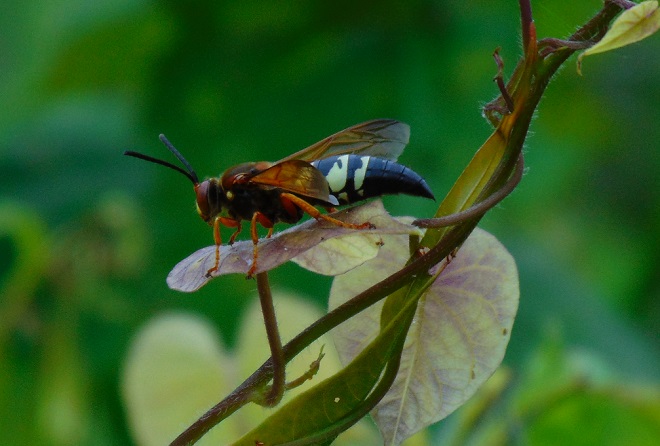
For the adult cicada, there is danger, and that danger resembles an enormous bee.  It’s an Eastern Cicada Killer (Specius speciosus) wasp, and it will latch onto a cicada and begin stinging while both are in flight.  The stings soon paralyze the screeching, panicked cicada.  The Cicada Killer then begins the task of airlifting and/or dragging its victim to the lair it has prepared.  The cicada is placed in one of more than a dozen cells in the tunnel complex where it will serve as food for the wasp’s larvae.  The wasp lays an egg on the cicada, then leaves and pushes the hole closed.  The egg hatches in a several days and the larval grub is on its own to feast upon the hapless cicada.

An Eastern Cicada Killer (Sphecius speciosus) along the river shoreline. Despite their intimidating appearance, they do not sting humans and can be quite docile when approached.

Other species in the Solitary Wasp family (Sphecidae) have similar life cycles using specific prey which they incapacitate to serve as sustenance for their larvae.

A Solitary Wasp, one of the Thread-waisted Wasps (Ammophila species), drags a paralyzed moth caterpillar to its breeding dungeon in the sandy soil at Conewago Falls.  For the victim, there is no escape from the crypt.

The Solitary Wasps are an important control on the populations of their respective prey.  Additionally, the wasp’s bizarre life cycle ensures a greater survival rate for its own offspring by providing sufficient food for each of its progeny before the egg beginning its life is ever put in place.  It’s complete family planning.

The cicadas reproduce quickly and, as a species, seem to endure the assault by Cicada Killers, birds, and other predators.  The periodical cicadas (Magicicada), with adult flights occurring as a massive swarm of an entire population every thirteen or seventeen years, survive as species by providing predators with so ample a supply of food that most of the adults go unmolested to complete reproduction.  Stay tuned, 2021 is due to be the next periodical cicada year in the vicinity of Conewago Falls.

SOURCES

Eaton, Eric R., and Kenn Kaufman.  2007.  Kaufman Field Guide to Insects of North America.  Houghton Mifflin Company.  New York.

Fussy Eaters

She ate only toaster pastries…that’s it…nothing else.  Every now and then, on special occasions, when a big dinner was served, she’d have a small helping of mashed potatoes, no gravy, just plain, thank you.  She received all her nutrition from several meals a week of macaroni and cheese assembled from processed ingredients found in a cardboard box.  It contains eight essential vitamins and minerals, don’t you know?  You remember her, don’t you?

Adult female butterflies must lay their eggs where the hatched larvae will promptly find the precise food needed to fuel their growth.  These caterpillars are fussy eaters, with some able to feed upon only one particular species or genus of plant to grow through the five stages, the instars, of larval life.  The energy for their fifth molt into a pupa, known as a chrysalis, and metamorphosis into an adult butterfly requires mass consumption of the required plant matter.  Their life cycle causes most butterflies to be very habitat specific.  These splendid insects may visit the urban or suburban garden as adults to feed on nectar plants, however, successful reproduction relies upon environs which include suitable, thriving, pesticide-free host plants for the caterpillars.  Their survival depends upon more than the vegetation surrounding the typical lawn will provide.

The Monarch (Danaus plexippus), a butterfly familiar in North America for its conspicuous autumn migrations to forests in Mexico, uses the milkweeds (Asclepias) almost exclusively as a host plant.  Here at  Conewago Falls, wetlands with Swamp Milkweed (Asclepias incarnata) and unsprayed clearings with Common Milkweed (A. syriaca) are essential to the successful reproduction of the species.  Human disturbance, including liberal use of herbicides, and invasive plant species can diminish the biomass of the Monarch’s favored nourishment, thus reducing significantly the abundance of the migratory late-season generation.

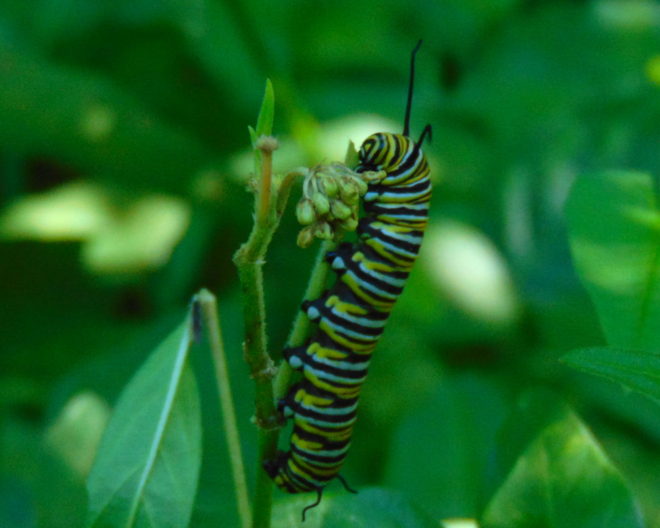
Monarch caterpillar after a fourth molt.  The fifth instar feeding on Swamp Milkweed.
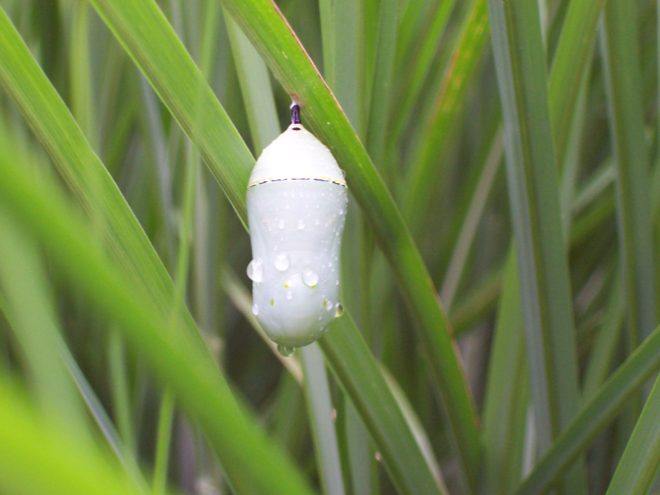
A fifth molt begets the Monarch pupa, the chrysalis, from which the showy adult butterfly will emerge.
Adult Monarch feeding on Goldenrod (Solidago) nectar.

Butterflies are good indicators of the ecological health of a given environment.  A diversity of butterfly species in a given area requires a wide array of mostly indigenous plants to provide food for reproduction.  Let’s have a look at some of the species seen around Conewago Falls this week…

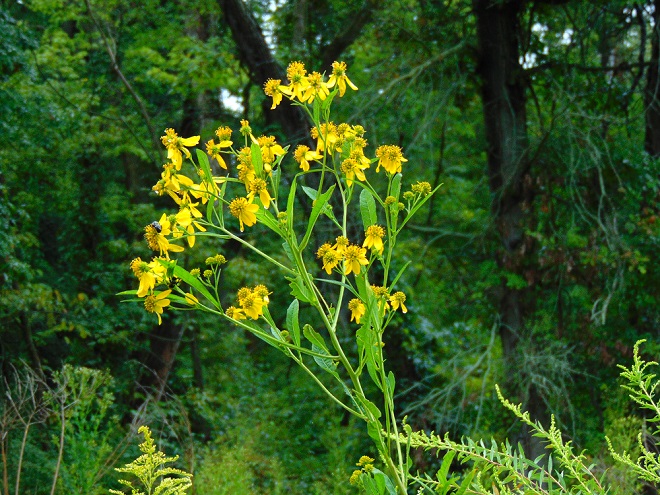
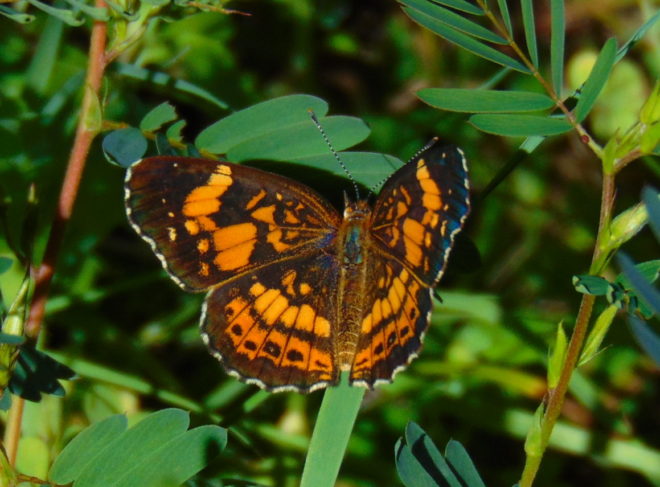
An adult Silvery Checkerspot (Chlosyne nycteis) visiting a nectar plant, Partridge Pea (Chamaecrista fasciculata).  Wingstem (Verbesina alternifolia), a plant of the Riparian Woodlands, is among the probable hosts for the caterpillars.
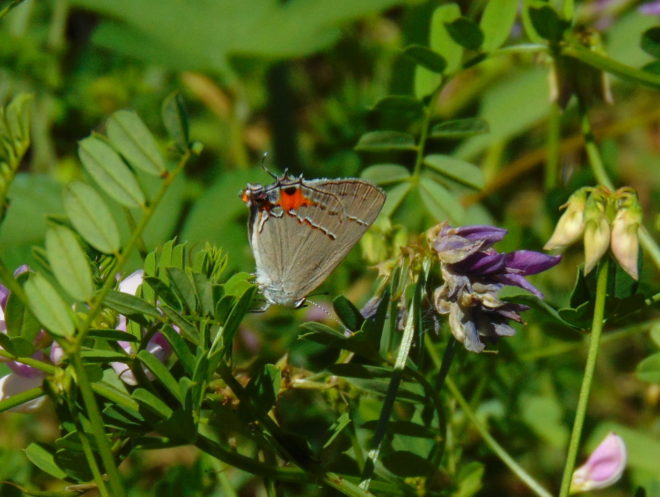
A Gray Hairstreak (Strymon melinus) visits Crown Vetch, a possible host plant.  Other potential larval food in the area includes Partridge Pea, Halberd-leaved Rose Mallow (Hibiscus laevis) of the river shoreline, and Swamp Rose Mallow (Hibiscus moscheutos), a plant of wetlands.
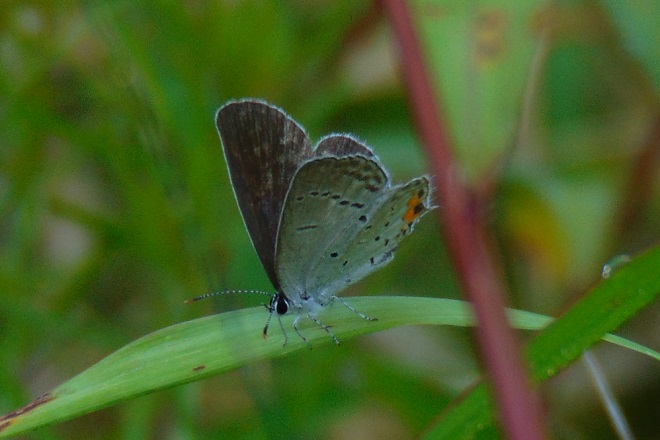
The Eastern Tailed Blue (Cupido comyntas) may use Partridge Pea , a native wildflower species, and the introduced Crown Vetch (Securigera/Coronilla varia) as host and nectar plants at Conewago Falls.
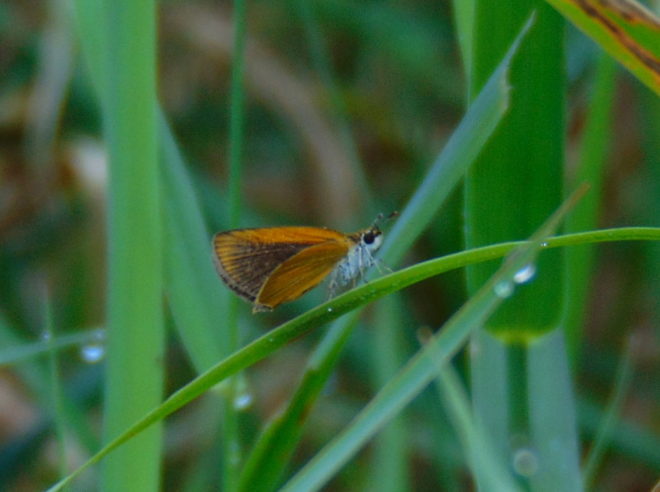
The Least Skipper (Ancyloxypha numitor) is at home among tall grasses in woodland openings, at riverside, and in the scoured grassland habitat of the Pothole Rocks in the falls.  Host plants available include Switchgrass (Panicum vigatum), Freshwater Cordgrass (Spartina pectinata), and Foxtails (Setaria).
The Zabulon Skipper (Poanes zabulon) is an inhabitant of moist clearings where the caterpillars may feed upon Lovegrasses (Eragrostis) and Purpletop (Tridens flavus).
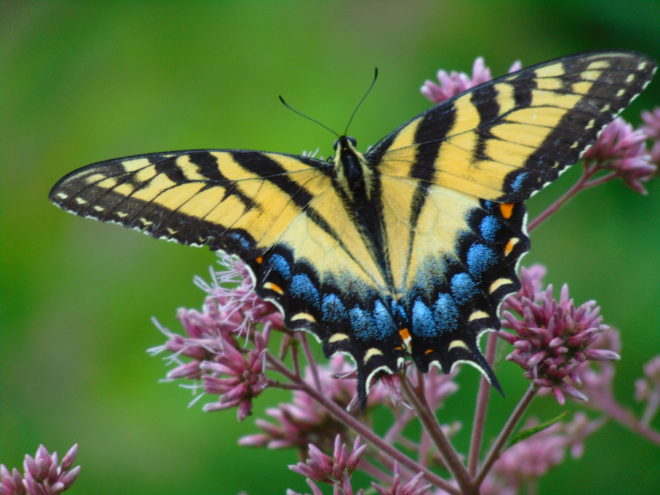
The Eastern Tiger Swallowtail (Papilio glaucus), a female seen here gathering nectar from Joe-Pye Weed (Eutrochium), relies upon several forest trees as hosts. Black Cherry (Prunus serotina), Willow (Salix), Yellow Poplar (Liriodendron tulipifera), also known as Tuliptree, and Green Ash (Fraxinus pennsylvanica) are among the local species known to be used.  The future of the latter food species at Conewago Falls is doubtful.  Fortunately for the Eastern Tiger Swallowtail, the “generalist” feeding requirements of this butterfly’s larvae enable the species to survive the loss of a host plant.
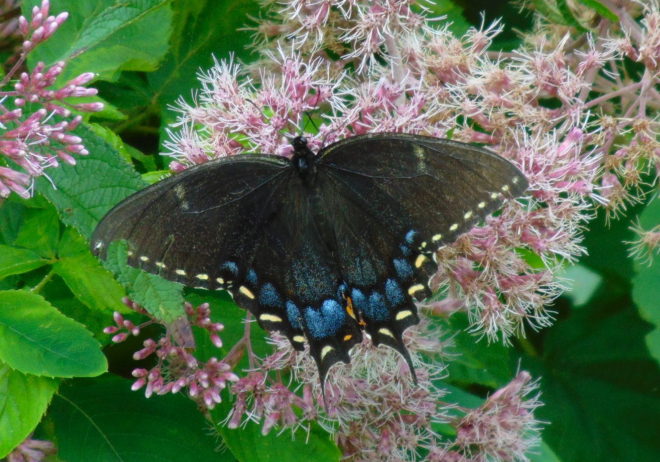
A female Eastern Tiger Swallowtail, black morph, gathering nectar from Joe-Pye Weed.
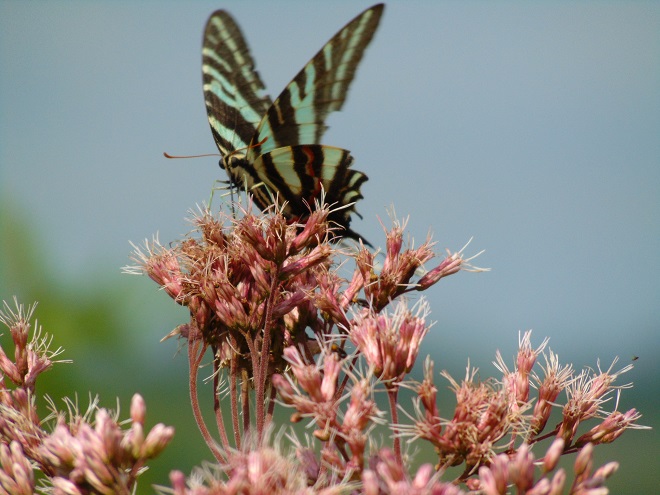
The Zebra Swallowtail (Protographium marcellus), an adult seen here on Joe-Pye Weed, feeds exclusively upon Pawpaw (Asimina) trees as a caterpillar.  This butterfly species may wander, but its breeding range is limited to the moist Riparian Woodlands where colonial groves of Pawpaw may be found.  The Common Pawpaw (Asimina triloba), our native species in Pennsylvania, and the Zebra Swallowtail occur at the northern edge of their geographic ranges in the Lower Susquehanna River Watershed.  Planting Pawpaw trees as an element of streamside reforestation projects certainly benefits this marvelous butterfly.

The spectacularly colorful butterflies are a real treat on a hot summer day.  Their affinity for showy plants doubles the pleasure.

By the way, I’m certain by now you’ve recalled that fussy eater…and how beautiful she grew up to be.

SOURCES

Brock, Jim P., and Kaufman, Kenn.  2003.  Butterflies of North America.  Houghton Mifflin Company.  New York, NY.