What better way to pass a bright, sunny afternoon than to beat the heat by loafing atop a bridge spanning a small coldwater stream? We just lingered in the shade cast by an overarching tree and watched to see what might come by…
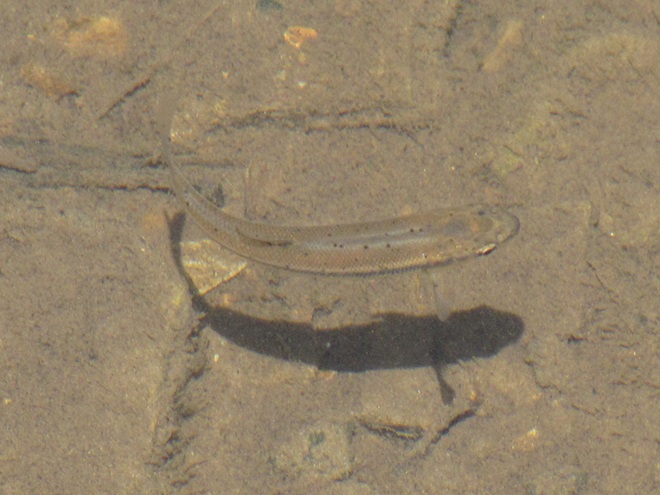
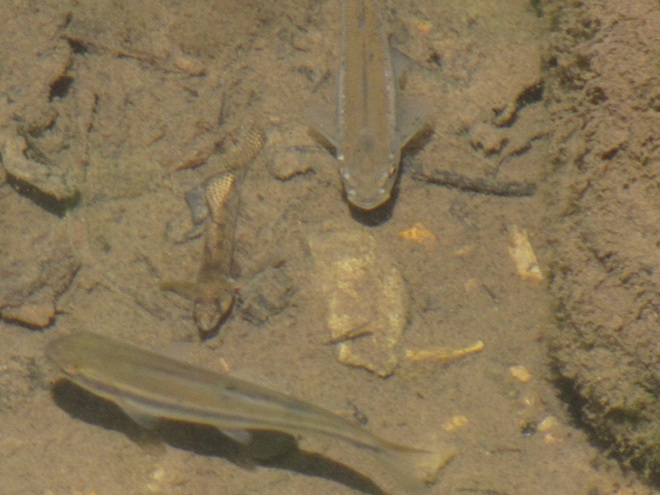
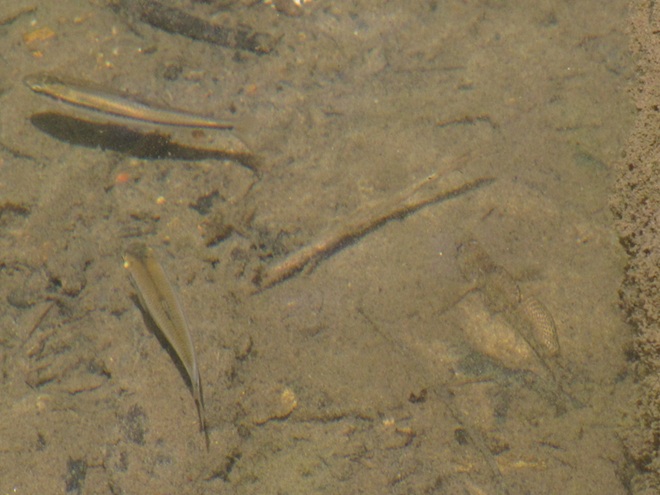
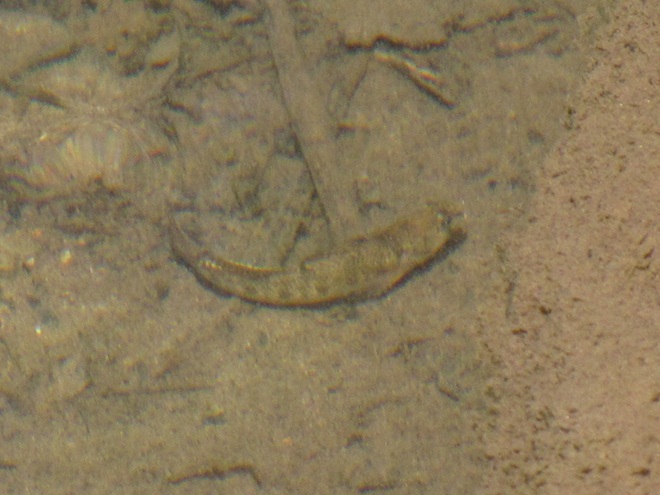
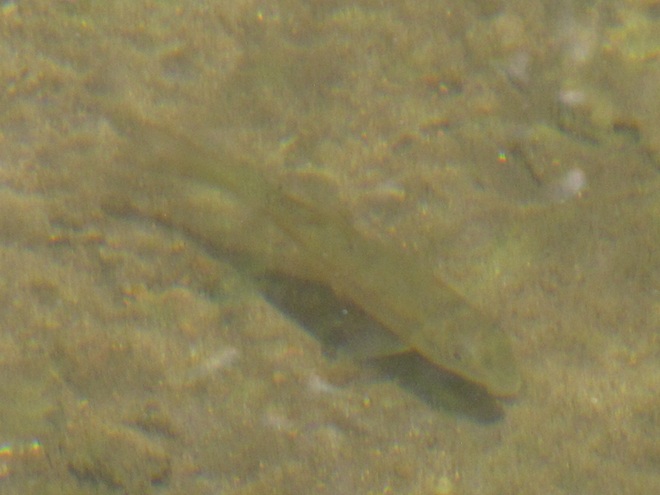
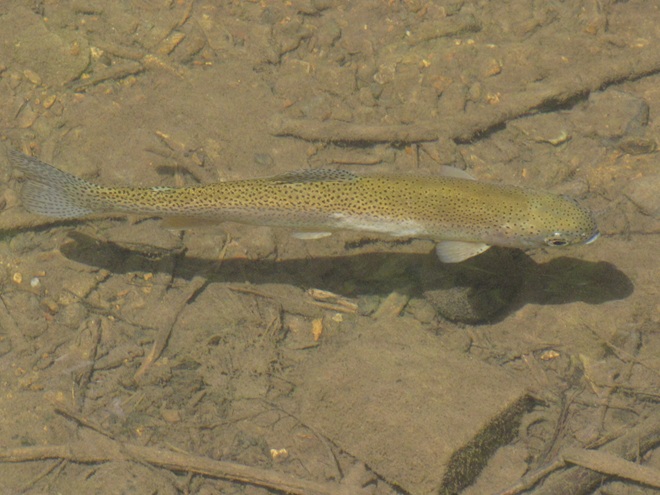
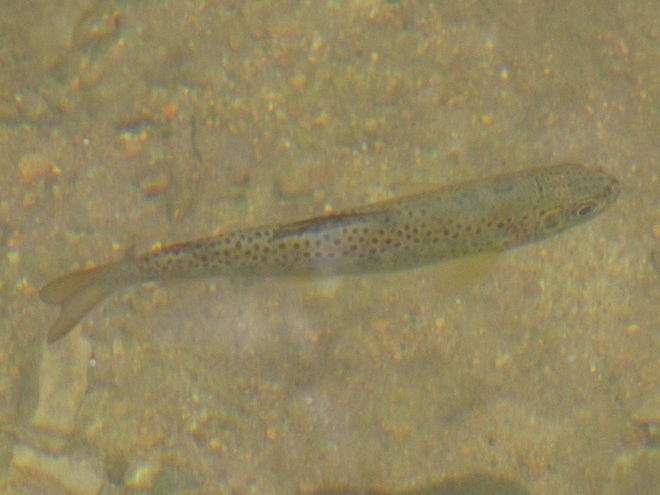
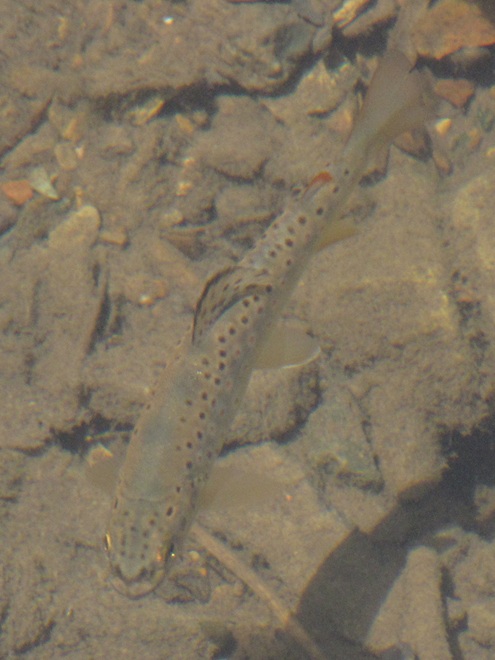
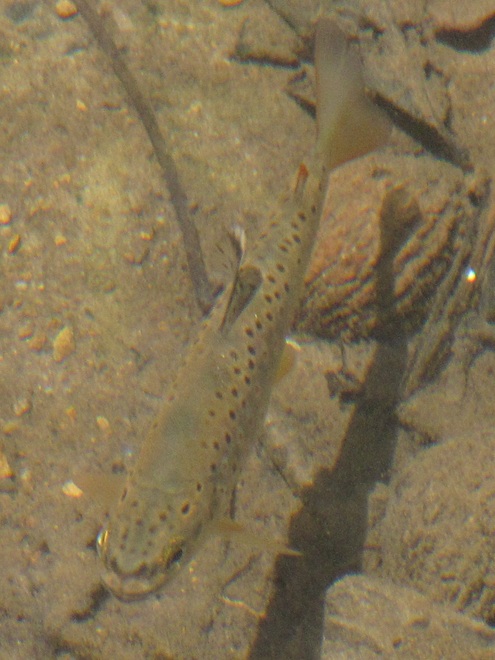
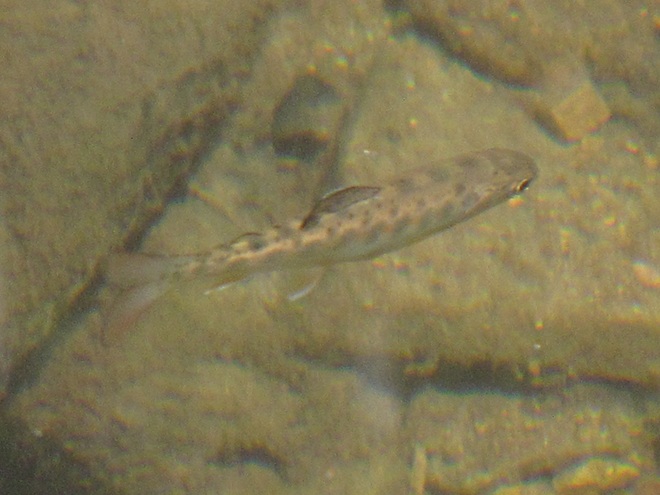
The Eastern Blacknose Dace is the most widespread and usually the most numerous minnow in coldwater streams throughout the Lower Susquehanna River Watershed. Sightings from our lookout at a crossing on the East Branch Standing Stone Creek, a tributary of the Juniata River, were in accordance with this generalization.The presence of these Eastern Blacknose Dace in close proximity to a male Tessellated Darter’s nest has him unfurling his flag-like dorsal fins in an attempt to intimidate the much larger minnows.He won’t be fully satisfied until they leave the area, so he’ll keep displaying his banners.Satisfied the invaders are gone, at least for now, he secures his sails, but continues to stand watch over the eggs, which are probably concealed beneath the boulder on the right.As it searches for invertebrates and other sources of food along the bottom of East Branch Standing Stone Creek, a juvenile White Sucker stirs up organic material derived chiefly from fallen leaves and other plant matter. Draining exclusively from dense woodlands in Rothrock State Forest, this waterway collects minimal quantities of water-polluting nutrients and sediments. The substrate is mostly sand, gravel, and cobble among boulders of various sizes.Except for some stormwater runoff from forest roads in its headwaters, the first significant source of thermal pollution on East Branch Standing Stone Creek as it tumbles toward the Juniata is a recreation impoundment at Greenwood Furnace State Park. This Rainbow Trout, which was probably stocked there for angling earlier this spring, is already showing the effects of warming water. As lake temperatures rise into and above the mid-seventies, trout become stressed and are especially susceptible to other factors that can prove fatal. These include parasites, poor nutrition, bacterial and fungal infections, and predation. Because they require well-oxygenated water to survive, trout are especially vulnerable to diminishing oxygen levels in warming and/or polluted waters, so hypoxia is a real concern. From our lookout just upstream from the lake, we watched as this struggling Rainbow Trout, apparently seeking refuge from the mid-day conditions in the sun-drenched impoundment, ascended the cold stream and took cover in some shade.In waters up the creek from the lake, trout with smaller proportions than those typically stocked for angling have been able to not only survive year-round, they are reproducing there. From our perch over East Branch Standing Stone Creek, we quietly observed this juvenile Brown Trout, a descendant of non-native individuals introduced in an attempt to establish a population of “wild trout” in the waterway.Brown Trout spawn in East Branch Standing Stone Creek in November. The eggs hatch within a month or two and the fry hide among the gravel, cobble, and rock of the stream bed. Still in its first year of life, this juvenile already resembles an adult, only traces of the vertical bars called “parr marks” remain along its flanks,……but this is still a petite little fish. Compare it to the walnuts on the stream bottom to the right. In a small stream, Brown Trout reach sexual maturity at a very small size, but could be in their third or fourth year of life when it happens.A population of the Susquehanna watershed’s native salmonid, the Brook Trout, lives and reproduces in East Branch Standing Stone Creek as well. This juvenile began life in much the same way and at about the same time of year as the non-native Brown Trout with which it will have to compete for survival. However, we noticed that this fingerling’s change in physical appearance is not as expedient as that of its introduced competitor. While telltale signs of an adult “brookie” are starting to show, the vertical “parr marks” of a young trout are still quite apparent, and will likely remain visible throughout its first year and beyond. Later in the summer, the dorsal surface of this fish will darken and the vermiculations of an adult Brook Trout should become evident. Most Brook Trout reach sexual maturity during their second year of life, so if all goes well, this could very well be one of next year’s breeders.
Greenwood Furnace State Park and East Branch Standing Stone Creek are located within Rothrock State Forest in northeastern Huntingdon County, Pennsylvania—just over Stone Mountain north of Belleville and the Kishacoquillas Valley on PA Route 305. To identify fish and other aquatic life in clear waters, you’ll need only a pair of close-focus binoculars or a camera with a telephoto lens. Polarized sunglasses really help penetrate the surface glare and shimmer, particularly on breezy days, making them a great fishwatching accessory for spotting your subjects of study.