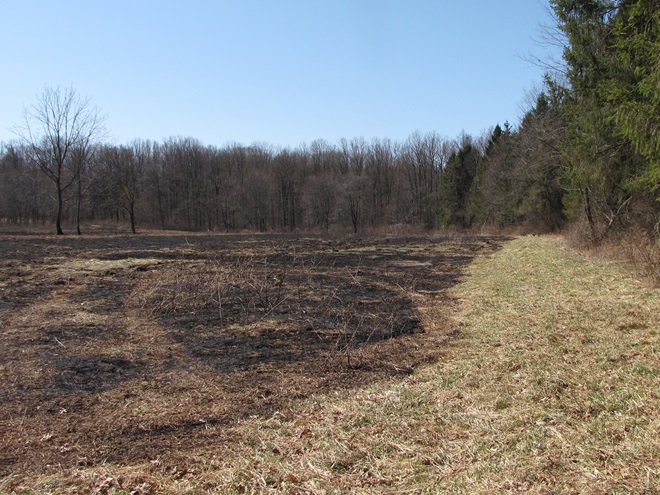
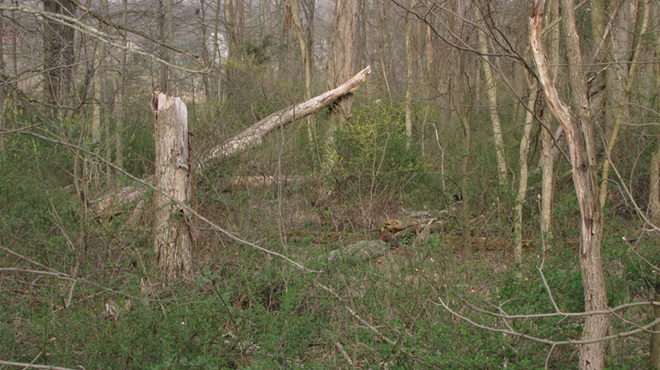
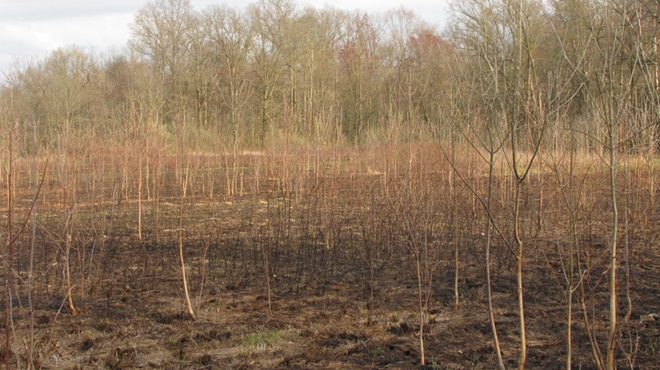
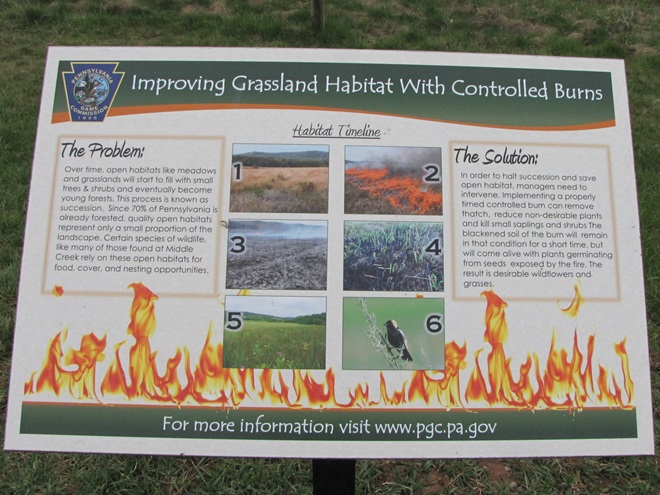
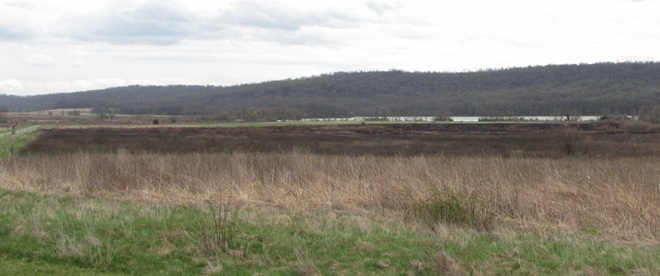
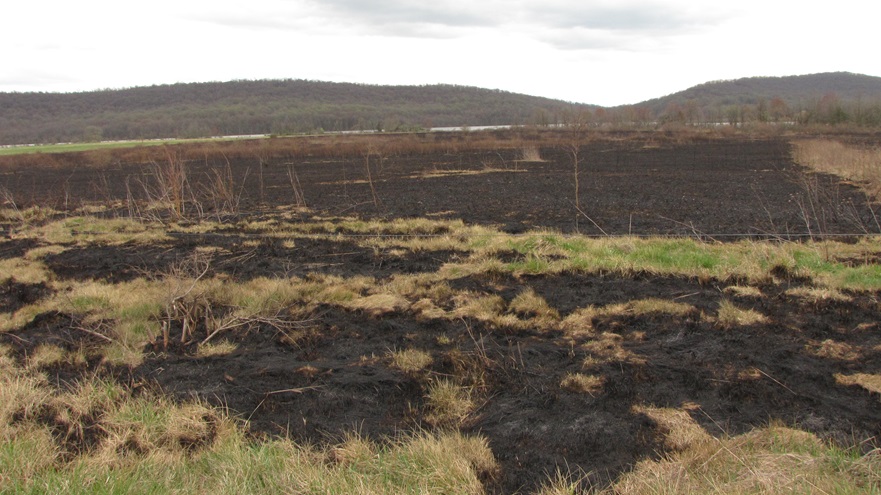
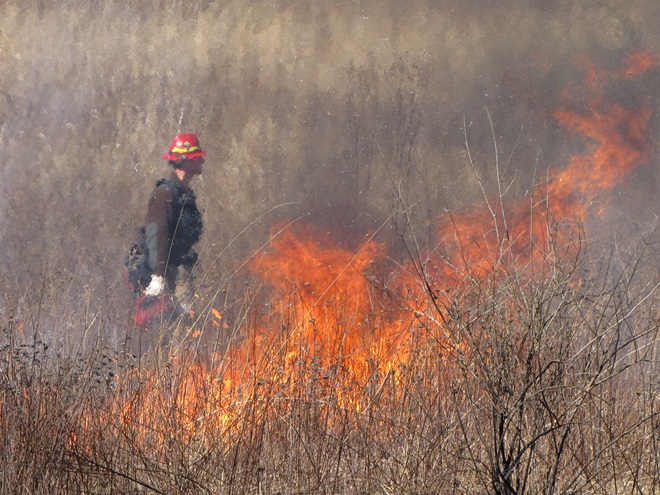
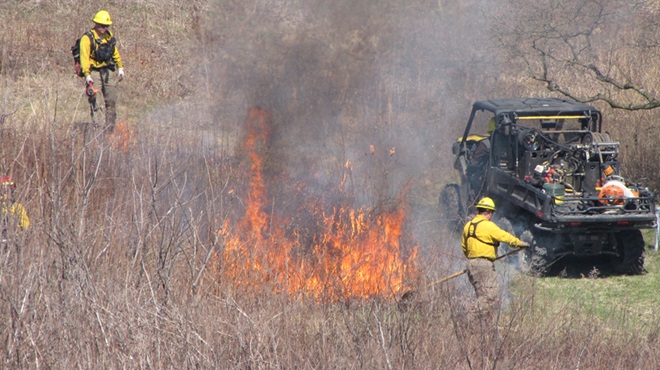
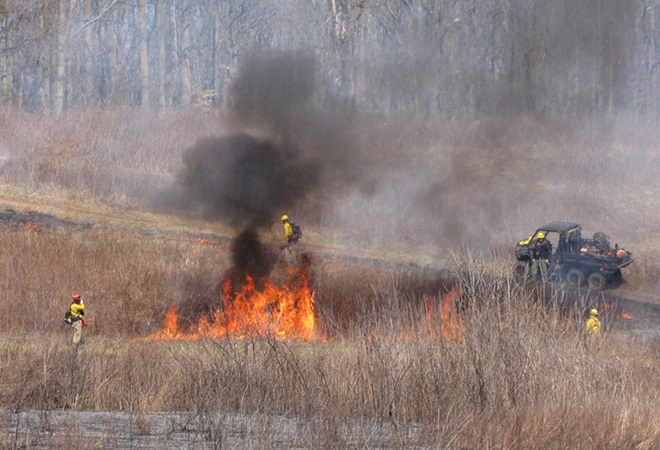
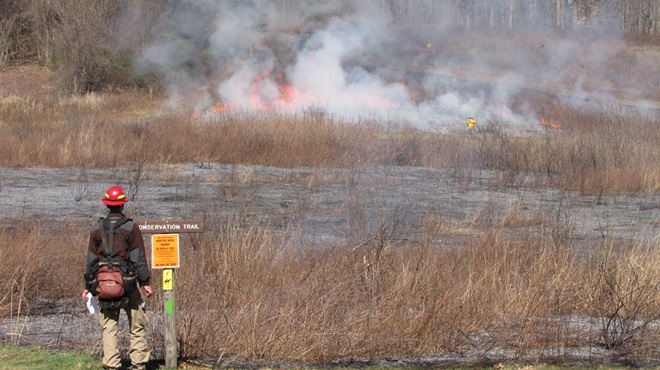
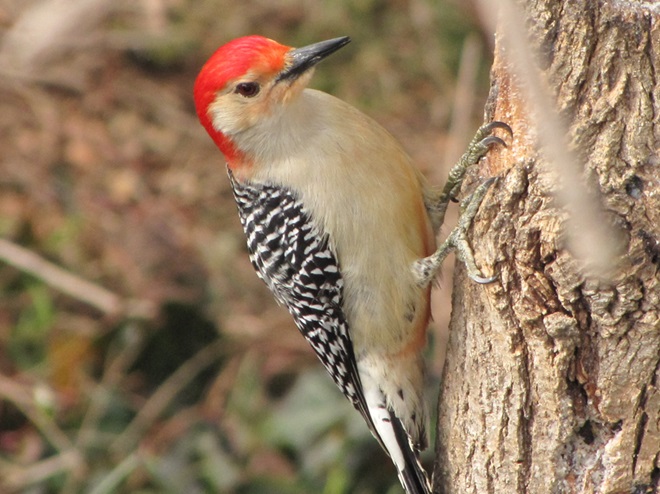
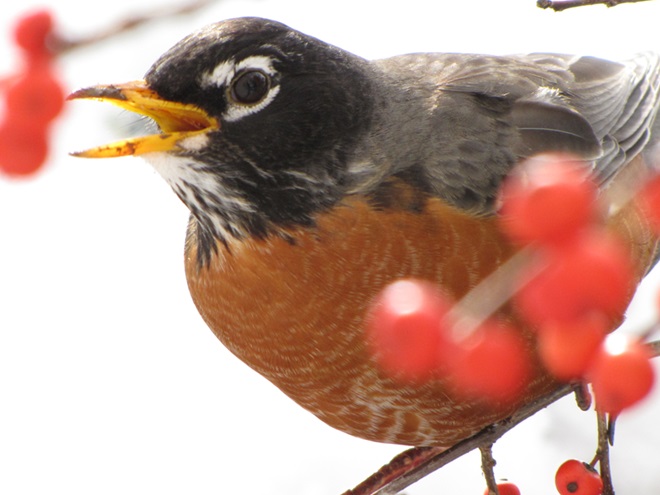
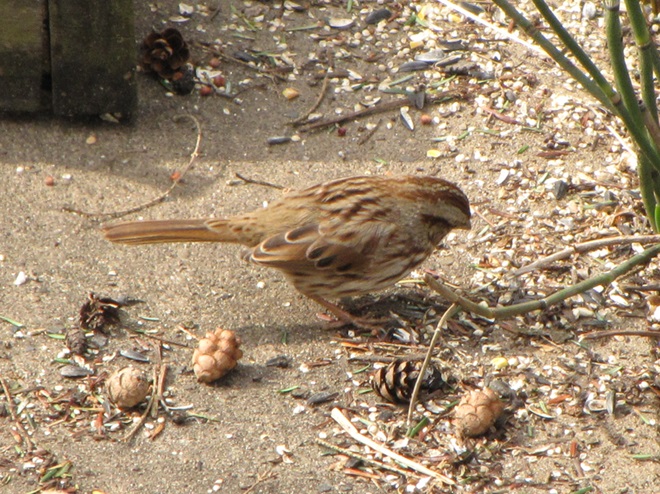
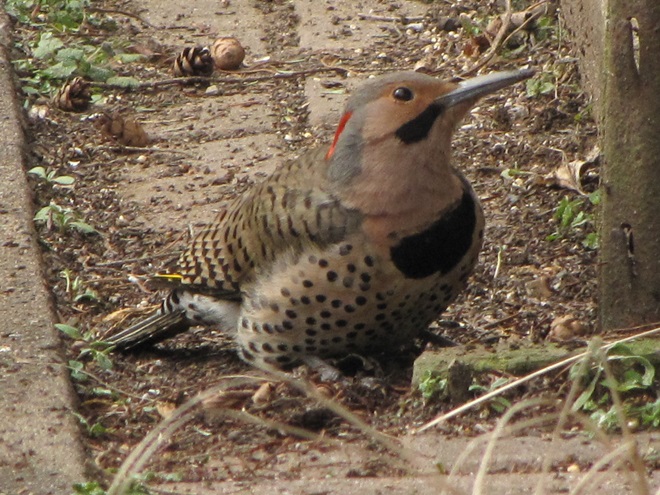
Back on March 24th, we took a detailed look at the process involved in administering prescribed fire as a tool for managing grassland and early successional habitat. Today we’re going turn back the hands of time to give you a glimpse of how the treated site fared during the five months since the controlled burn. Let’s go back to Middle Creek Wildlife Management Area for a photo tour to see how things have come along…
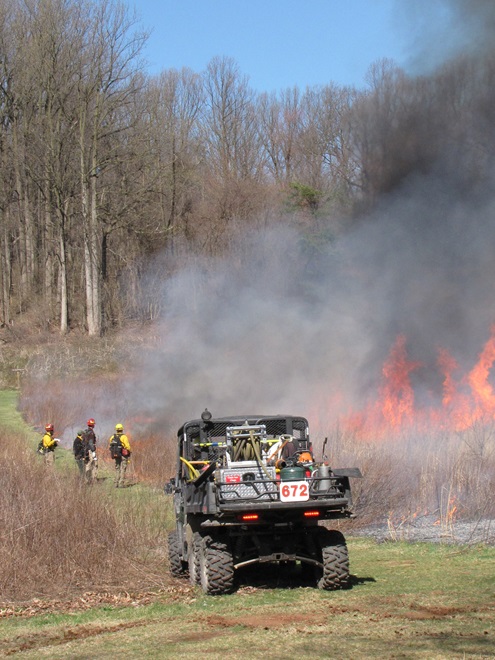
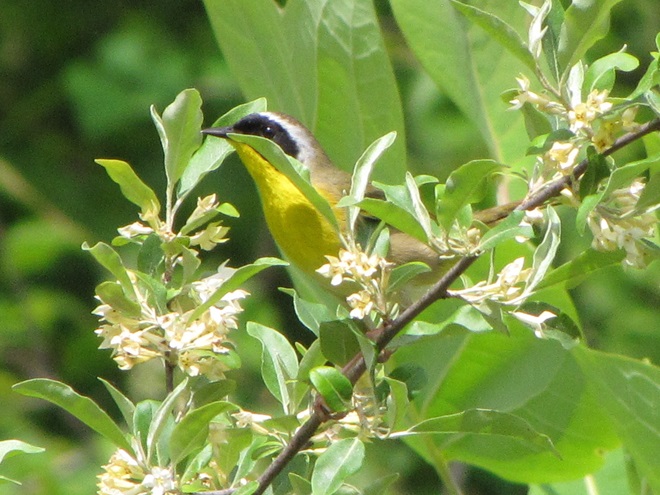
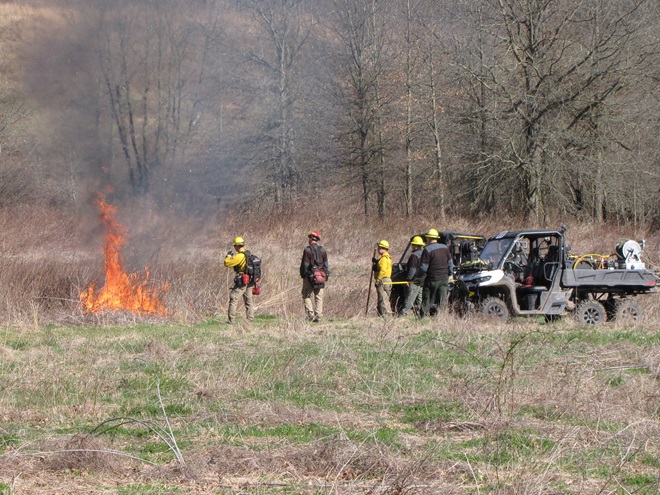
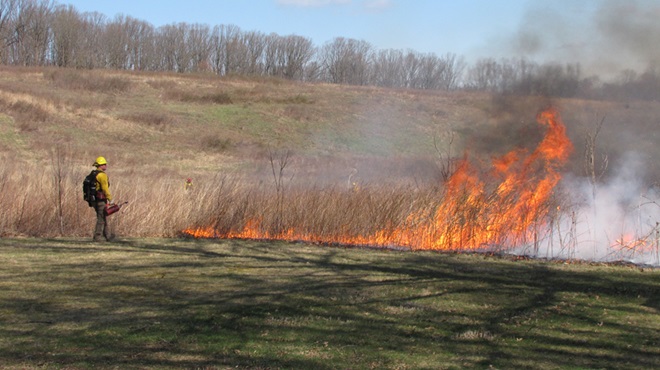
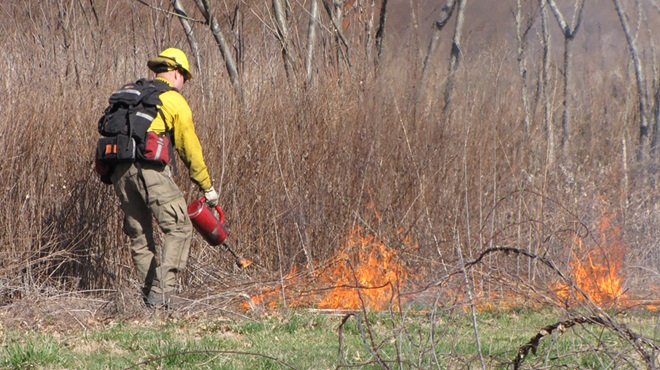
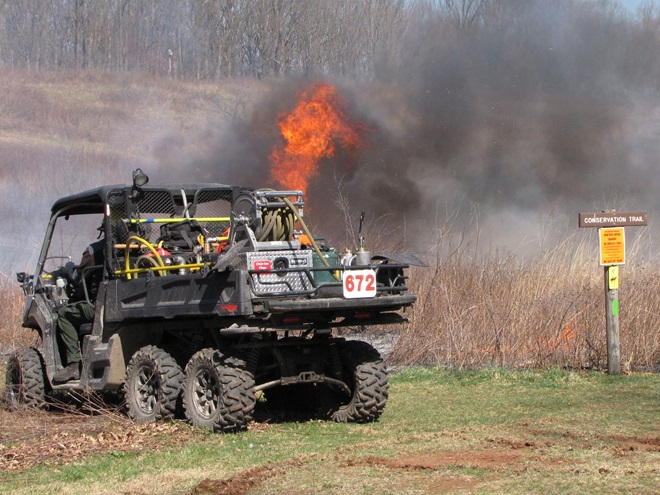
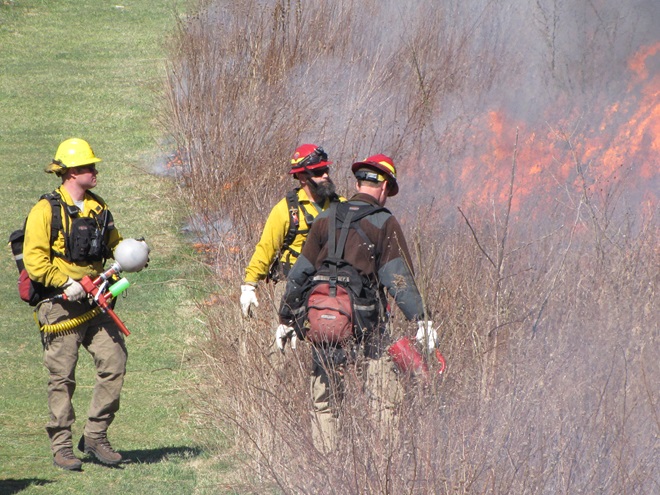
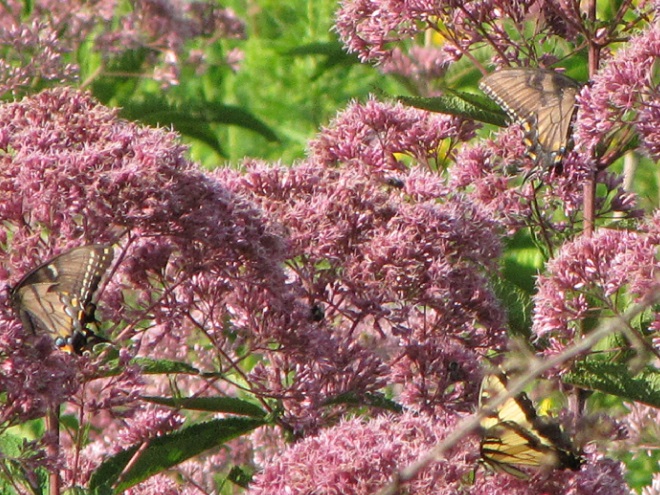
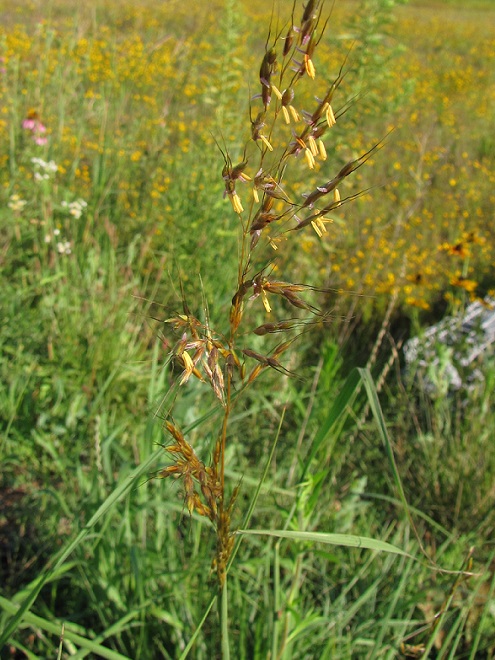
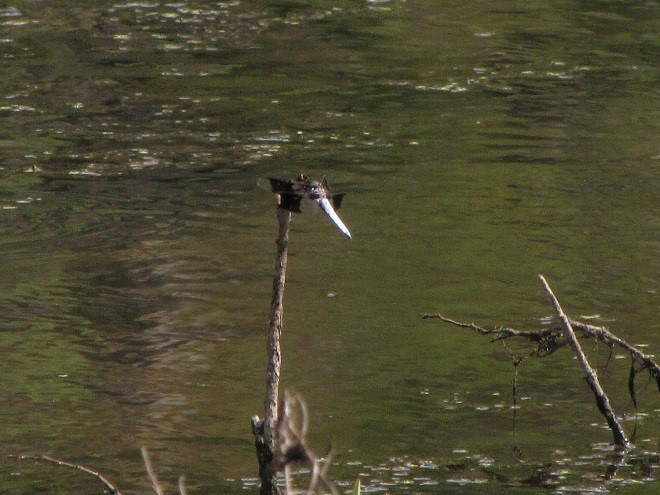
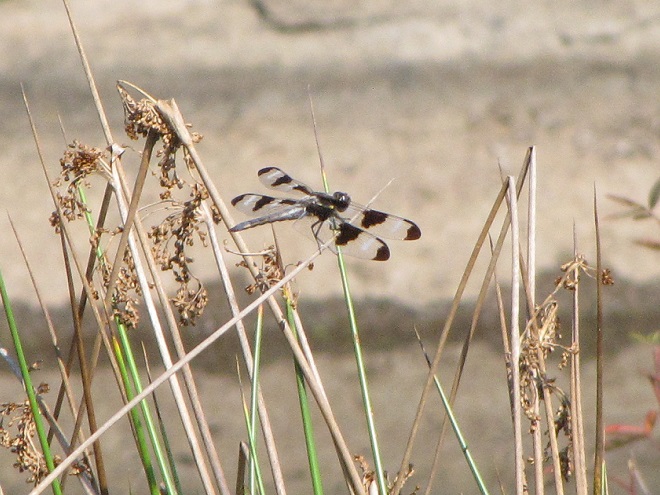
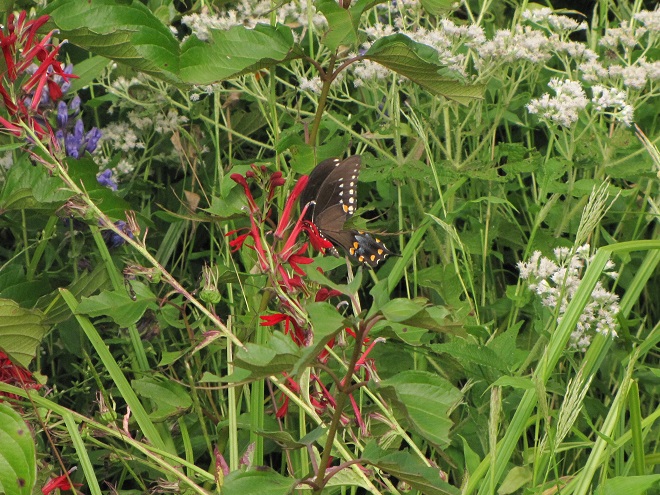
Pennsylvania Game Commission crews administering prescribed fire on a grassland demonstration site back on March 16.By late May, native herbaceous perennial wildflowers including Joe-pye Weed had re-greened the site. One of the goals of the burn was to kill fire-sensitive woody plants, thus preventing the process of succession from reforesting the site.The scorched, lifeless remains of small trees and shrubs indicate that that goal was met.Because prescribed fire is administered in a mosaic pattern that permits some early successional growth to remain until the next burn, birds including this thicket-nesting Yellow-breasted Chat are able to take advantage of the mixed habitat during their breeding season in May and June.By August, the site is a haven for native plants and animals.The burn has promoted the growth and late-summer bloom of fire-tolerant native wildflowers and warm-season grasses……including Indiangrass,……Big Bluestem……Thin-leaved Coneflower (Rudbeckia triloba), a plant also known as Brown-eyed Susan,……and Joe-pye Weed, a plant butterflies find irresistible.Eastern Tiger Swallowtail collecting nectar from Joe-pye Weed.A black-morph Eastern Tiger Swallowtail collecting nectar from Spotted Knapweed (Centaurea steobe micranthos), a non-native invasive plant found growing in an area of the burn site missed by this year’s fire. While many non-native plants are unable to survive the flames and heat produced by prescribed fire, it isn’t an absolute cure-all. It doesn’t eliminate all invasive plants, it just keeps them from dominating a landscape by out-competing native species. Left unmanaged, Spotted Knapweed is a tough perennial invasive that can easily become one the species able to overtake a vulnerable grassland. It can be a stubborn survivor of some prescribed burns. On the plus side, butterflies really like it.By August, native grassland plants in the prescribed fire area were already providing an abundance of seeds for birds including this American Goldfinch.For larger birds like turkeys and pheasants, an abundance of Carolina Grasshoppers are providing a protein-dense food source in managed grasslands.And tiny flying insects, a nuisance to us as we take a stroll alongside the grasslands, are a meal taken on the wing by dragonflies including this Black Saddlebags.
Elsewhere around the refuge at Middle Creek, prescribed fire and other management techniques are providing high-quality grassland habitat for numerous species of nesting birds…
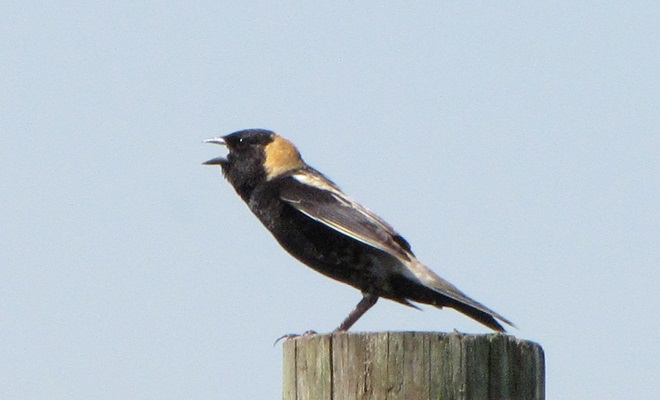
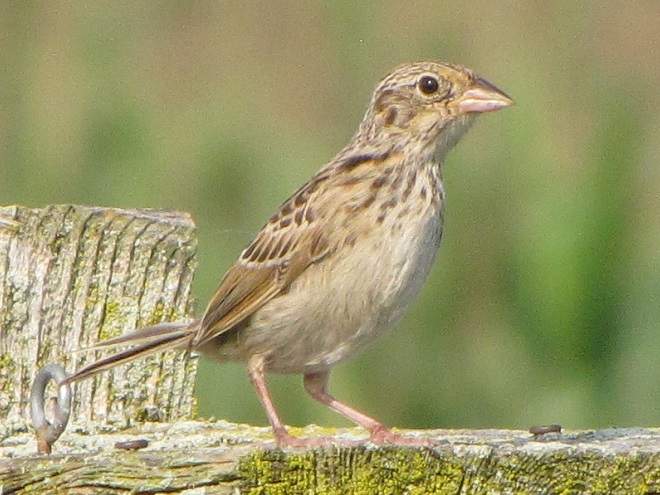
Bobolinks nested both in areas subjected to controlled burns……and in hay fields where mowing was delayed until the nesting season, including the fledging process, was completed earlier this month.As advertised, Grasshopper Sparrows nested in these fields as well.
We hope you enjoyed this short photo tour of grassland management practices. Now, we’d like to leave you with one last set of pictures—a set you may find as interesting as we found them. Each is of a different Eastern Cottontail, a species we found to be particularly common on prescribed fire sites when we took these images in late May. The first two are of the individuals we happened to be able to photograph in areas subjected to fire two months earlier in March. The latter two are of cottontails we happened to photograph elsewhere on the refuge in areas not in proximity to ground treated with a prescribed burn or exposed to accidental fire in recent years.
Eastern Cottontail at a site subjected to prescribed fire earlier in the spring.Eastern Cottontail at a site subjected to prescribed fire earlier in the spring.
These first two rabbits are living the good life in a warm-season grass wonderland.
Eastern Cottontail at a site not subjected to any recent fire activity.Eastern Cottontail at a site not subjected to any recent fire activity.
Oh Deer! Oh Deer! These last two rabbits have no clock to track the time; they have only ticks. Better not go for a stroll with them Alice—that’s no wonderland! I know, I know, it’s time to go. See ya later.
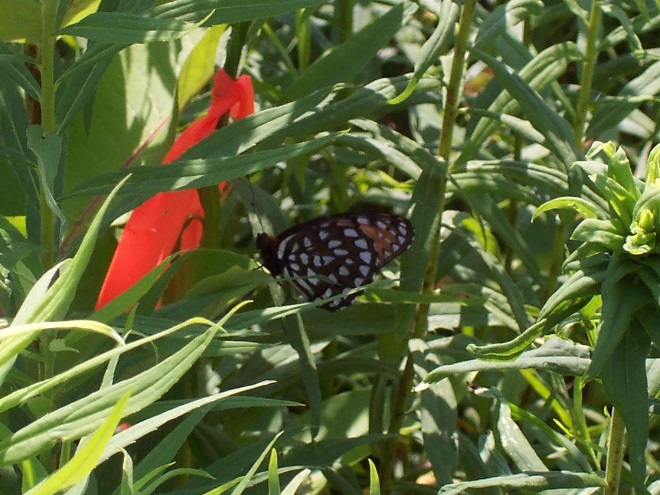
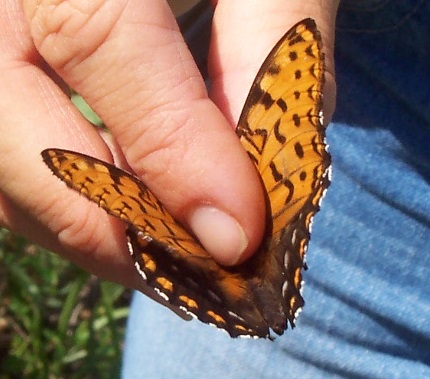
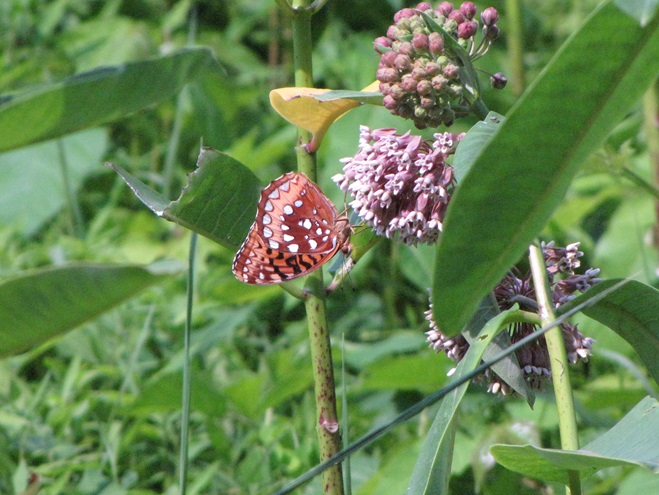
The Aphrodite Fritillary (Speyeria aphrodite), also known simply as the Aphrodite, is a brush-footed butterfly of deciduous, coniferous, and mixed forests. We found this female in a grassland margin between woodlots where prescribed fire was administered during the autumn of 2022 to reduce accumulations of natural fuels and an overabundance of invasive vegetation. A goal of the burn was to promote the growth of native species including the violets (Viola species) favored as larval host plants by this and other fritillaries.
A female Aphrodite Fritillary collecting nectar from a thistle flower.
By the time these adult butterflies make their reproductive flights in late summer, the violets that serve as larval host plants have gone dormant. To find patches of ground where the violets will come to life in spring, the female Aphrodite Fritillary has an ability to sense the presence of dormant roots, probably by smell. Upon finding an area where suitable violets will begin greening up next year, she’ll deposit her eggs. The eggs overwinter, then hatch to feed on the tender new violet leaves of spring.
A female Aphrodite Fritillary. A prescribed burn, when administered during spring to manage fritillary habitat, is applied only to a portion of the land parcel each year to avoid decimating an entire population of the larvae during the first instar of their life cycle, a time when they are vulnerable to fire.Our female Aphrodite Fritillary busily gathers nutritious nectar to provide sufficient energy for the critical process of mating and egg production. What’s the thistle that this goddess of love and procreation is pollinating?…It’s a non-native invasive, the Bull Thistle (Cirsium vulgare), a species that readily colonizes new areas by producing an abundance of airborne seeds. Continued management of this site with periodic applications of prescribed fire will prevent Bull Thistle and other invasives from overtaking the habitat during coming years.
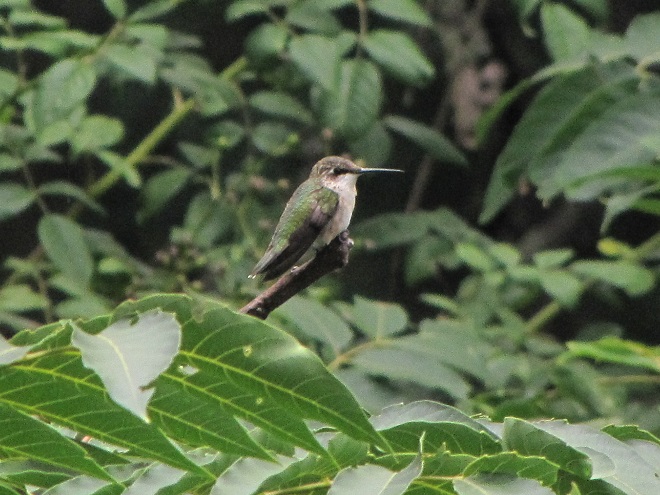
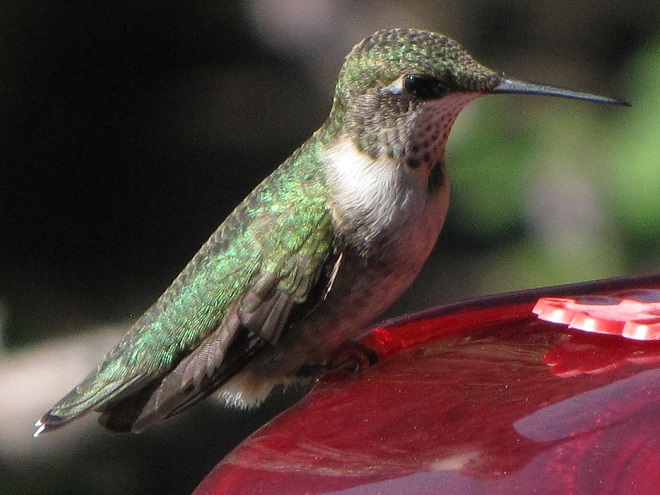
Here’s a native plant you don’t see very often, but Ruby-throated Hummingbirds have a knack for finding and adoring it within the limited habitat where it still exists.
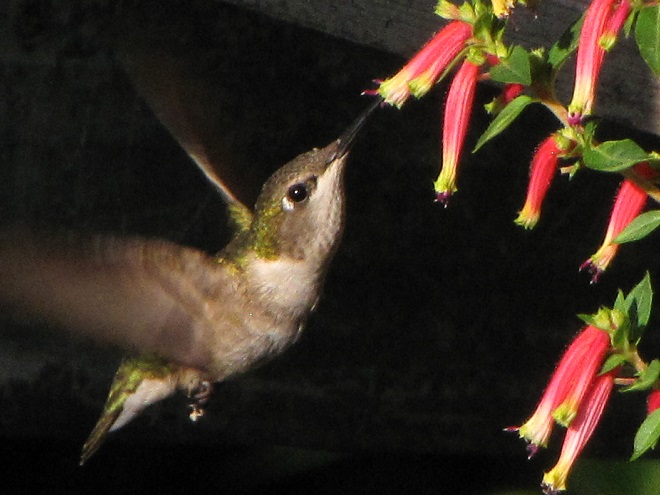
Allegheny Vine (Adlumia fungosa), also known as Climbing Fumitory or Mountain Fringe, is a seldom-found biennial herbaceous plant in the poppy family (Papaveraceae). Both its divided leaves and drooping clusters of flowers might remind the observer of a more familiar member of the poppy family, the spring-blooming Dutchman’s Breeches. But unlike the low-growing Dutchman’s Breeches, Allegheny Vine ascends nearby shrubs and small trees with trailing stems that add a garland-like pizzazz to the summertime foliage.Seen here creeping atop a small Sassafras (Sassafras albidum) tree, Allegheny Vine seldom escapes notice by the Ruby-throated Hummingbird, a primary pollinator of the plant.Allegheny Vine grows on moist, rocky slopes and blooms in late summer, just in time to refuel migrating Ruby-throated Hummingbirds.
Not likely to thrive in deep forest cover, Allegheny Vine is a denizen of edge habitat. The species is dependent on some type of disturbance to maintain suitable growing conditions. The plants seen here were found flowering in an area that had experienced a fire prior to last year’s growing season. It is therefore quite possible that the fire completed the stratification process and triggered long-dormant seeds to germinate last spring or summer to develop a basal plant which matured and flowered during this second summer of the biennial’s growth. On a forested slope opposite this site, a first-ever prescribed burn was conducted in March of this year to eliminate accumulated fuel and replicate a natural fire cycle. With a little luck, this forest management approach may prompt additional long-dormant Allegheny Vine seeds to germinate and form basal plants this year for maturation in 2025. Without man-made disturbances, Allegheny Vine may remain viable as a species by enduring seed dormancy periods of 40-100 years or more between fires, lightning strikes, wind storms, ice accumulations, and other events which clear the canopy and encourage growth.
Many years in the making, Allegheny Vine nectar must be delectable because the hummers can’t leave it alone. And another plus, with a little help from prescribed fire, this native creeping plant seems to be holding its own while in direct competition with invasive Mile-a-minute Weed (leaves in lower right).
It’s hard to believe, but for almost two months now, sandpipers, plovers, and terns have been filtering south through the Lower Susquehanna River Watershed on their way to the Atlantic coastline as they complete the first leg of their long autumn migration—a journey that will take some species all the way to the far reaches of the South American continent for winter.
Migrating Caspian Terns and an Osprey take a break on a lower Susquehanna valley gravel bar.
As August draws to a close, these early birds are being joined by widespread nocturnal flights of Neotropical migrants—those species, primarily songbirds, on their way to wintering grounds which lie exclusively south of the continental United States.
To catch a glimpse of these night-flying avians, your best bet may be to position yourself on the crest of a ridge or along a linear break in the forest such as a utility right-of-way where waves of warblers, vireos, flycatchers, and other Neotropical passerines sometimes feed on invertebrates after making landfall at daybreak. Pick a place where the trees are bathed in the warm light of the rising sun and be there by 7 A.M. E.D.T. The activity can be tremendous, but it usually ends between 8 and 9.
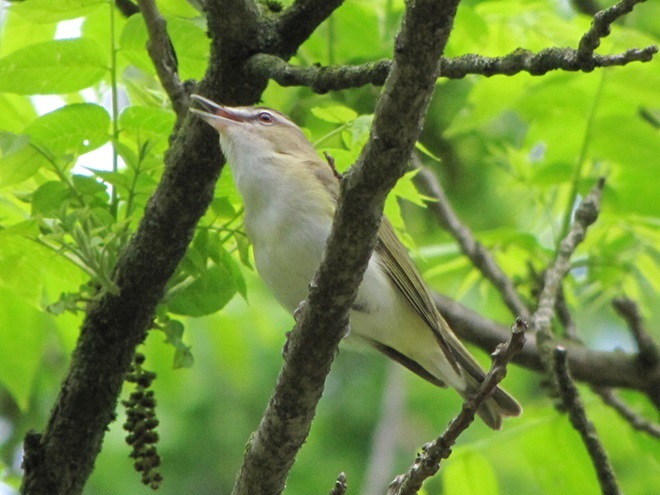
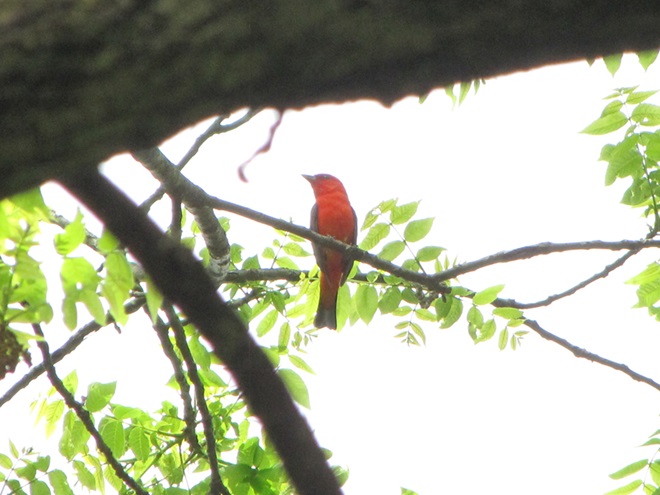
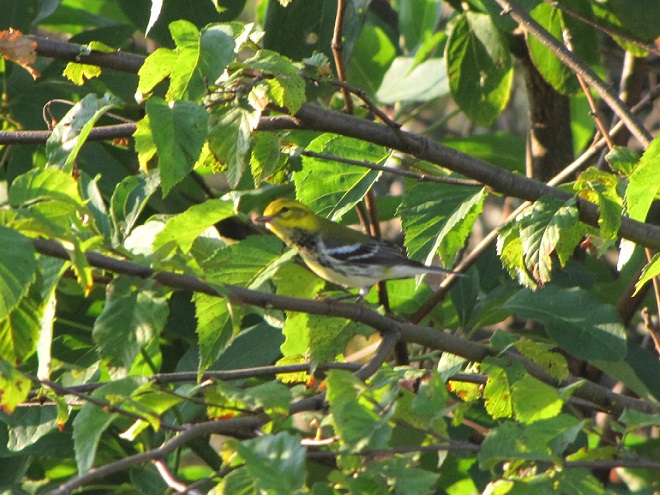
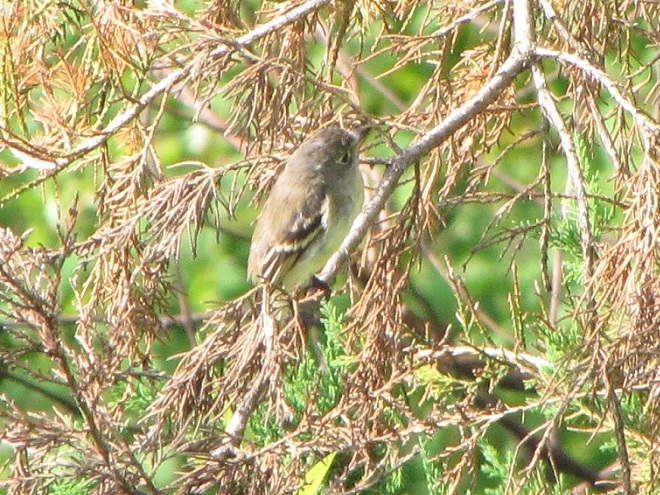
One of more than half a dozen Red-eyed Vireos seen during a daybreak fallout at Second Mountain Hawkwatch in Lebanon County earlier this week.During sunrise, a just-arrived Blackburnian Warbler checks the foliage of a ridgetop Red Maple for insects.A Least Flycatcher quietly searches the shrubby growth along the forest edge for a morning meal.A Black-and-white Warbler in the first hour of sunlight after a big nocturnal flight.A Scarlet Tanager having a look around. This individual and other migrating birds may be here for a few days before moving on.A Black-throated Green Warbler in a treetop glowing with the light of sunrise.A hungry Chestnut-sided Warbler inspects limbs, leaves, and twigs looking for nourishment after an all-night flight.
Diurnal migrants, birds that make their movements during the daylight hours, are ramping up their flights now as well. Broad-winged Hawks, Bald Eagles, and falcons are currently being tallied at hawk-counting stations throughout the northeast. Many of those lookouts are seeing Ruby-throated Hummingbirds, swallows, and other daytime migrants too.
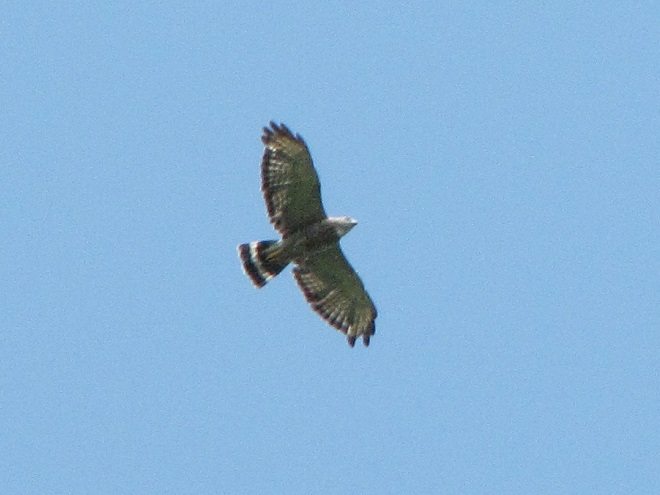
While many diurnal migrants gather in flocks as a method of defense against predators, Broad-winged Hawks congregate as a reconnaissance measure. Not waiting around for strong autumn winds to be deflected upwards by the region’s numerous ridges, these Neotropical birds migrate early enough in the season to rely upon thermal updrafts from sun-heated surfaces to provide lift, gain altitude, and save energy during their long trip. By traveling in groups, there are collectively able to better locate and utilize rising air columns as they progress southwesterly along their route. Broad-winged Hawks travel to Central and South America for winter. Their numbers in the Lower Susquehanna River Watershed will peak during the third week of September.Many American Kestrels transit our area in August and early September, a time coinciding with flights of migratory dragonflies, insects upon which they and another falcon, the Merlin, frequently prey.Chimney Swifts are fast-flying diurnal migrants. They are beginning to congregate into larger groups in preparation for their departure. Some are already on the move.Cedar Waxwings are currently being seen in roving flocks throughout the region. Their migration is less of a point-to-point flight and more of a continuous wandering in search of berries and other wild foods.Not everyone is yet ready to go. American Goldfinches are still in the midst of their nesting cycle and won’t begin leaving until the young are on their own and colorful adult males like this one are beginning to molt into their drab winter plumage.
Autumn migration flights are an ever-changing process, with different species peaking at different times throughout the season. In these months just after the nesting season, each of these species is more numerous than at any other time of the year. And of course, the more often we as observers get out and have a look, the more of them we’ll see.
Be certain to click the “Birds” tab at the top of this page for a photo guide to the species you’re likely to see passing through the lower Susquehanna valley this fall. Nearly four months of autumn hawk migration flights lie ahead, so don’t forget to click the “Hawkwatcher’s Helper: Identifying Bald Eagles and other Diurnal Raptors” tab to find a hawk-counting station near you, then stop by for a visit or two. See you there!
A large nightfall liftoff of nocturnal migrating birds is shown here on this evening’s State College, Pennsylvania, Doppler Radar base velocity loop. Returns indicating birds moving toward the radar site (the white dot in the center of the color mass) are shown in green, and those indicating birds moving away are indicated in red. This is a big flight headed generally in a south-southwest direction. (NOAA/National Weather Service Doppler Radar image)
In the forests and woodlots of the lower Susquehanna watershed, the Black Gum, also known as the Black Tupelo, is always the first of our native trees to pop with autumn color. Its crimson leaves glow in an otherwise green landscape to help lure hungry birds including waxwings, American Robins, and Pileated Woodpeckers to its soon-to-be-ripe berries. The seeds contained in the fruit are thus well-distributed as a by-product of this avian feast. While not among the most massive of our trees, the Black Gum can live for over five hundred years, an age not exceeded by any other non-clonal indigenous flowering plant.
Do you recall our “Photo of the Day” from seven months ago…
Here’s something to look forward to in the new year. The good citizens of East Donegal Township in Lancaster County have partnered with Alliance for the Chesapeake Bay to establish an extensive wildflower meadow on what had been a mowed field of turf grass at Riverside Park in the Susquehanna floodplain near Marietta. As the photo shows, the lawn plants have been eliminated in preparation for seeding with a diverse assortment of native grasses and wildflowers to provide habitat for birds and pollinators including butterflies, bees, and other insects. Once established, the meadow’s extensive vegetative growth will help reduce stormwater runoff by better infiltrating rainfall to recharge the aquifer. During flood events, the plantings will provide soil stabilization and increase the ability of the acreage to uptake nutrients, thus reducing the negative impact of major storms on the quality of water in the river and in Chesapeake Bay. Check the project’s progress by stopping by from time to time in 2024!
Well, here’s what that site looks like today…
The wildflowers, thousands of them, are now in bloom!Black-eyed Susan and Blue Vervain (Verbena hastata) dominate the assortment currently in flower.
And there are pollinating insects galore, most notably butterflies…
A Cabbage White collecting nectar on Blue Vervain.A Clouded or Orange Sulphur among the grasses in the meadow.A Silver-spotted Skipper.The Least Skipper is our tiniest butterfly.The Little Glassywing (Vernia verna), this one feeding on vervain nectar, deposits its eggs on Purpletop grass, which then functions as the host plant for this butterfly’s larvae.A Summer Azure (Celastrina neglecta) feeding on the nectar of a Black-eyed Susan.A Common Buckeye on a “Gloriosa Daisy”, a showy, large-flowered cultivar of Black-eyed Susan.A Red-winged Blackbird with a caterpillar found among the meadow’s lush growth.An Eastern Tiger Swallowtail on Blue Vervain. Nearby Yellow (Tulip) Poplars and other trees serve as host plants for this butterfly’s larvae.The black morph of the Eastern Tiger Swallowtail shows subdued shading in the wings that closely resembles the brilliant color patterns of the more familiar yellow form.The Sachem, this one visiting a Black-eyed Susan, is a variable species with a range that normally lies south of the 40th parallel, the line of latitude that intersects the Susquehanna in the area of the Conejohela Flats at Washington Boro.A Sachem visiting the blooms of Oxeye sunflower. During recent weeks, scorching winds from the south and southwest have transported an abundance of these vagrant skippers into the lower Susquehanna valley and beyond.A male Sachem approaching the bloom of a “Gloriosa Daisy”. Miles north of the 40th parallel, wandering Sachems are currently the most numerous of the butterflies at the Riverfront Park wildflower meadow.Here and there among the meadow’s plantings we noticed one of our favorites starting to flower, the Partridge Pea.Partridge Pea happens to be a host plant for another vagrant from the south, the big, lime-yellow Cloudless Sulphur. We saw at least half a dozen patrolling the meadow.The stars of the show are the Zebra Swallowtails, gorgeous butterflies that rely on stands of native Common Paw-paw trees in the river floodplain to host their eggs and larvae.The red-white-and-blue underside of a Zebra Swallowtail.WOW!
Why on earth would anyone waste their time, energy, and money mowing grass when they could have this? Won’t you please consider committing graminicide this fall? That’s right, kill that lawn—at least the majority of it. Then visit the Ernst Seed website, buy some “Native Northeast Wildlflower Mix” and/or other blends, and get your meadow planted in time for the 2025 growing season. Just think of all the new kinds of native plants and animals you’ll be seeing. It could change your life as well as theirs.
A Snowberry Clearwing (Hemaris diffinis), more commonly known as a hummingbird moth, visits the flowers of Blue Vervain in the Riverfront Park wildflower meadow.
Resilient to the pressures of flooding, ice scour, drought, and oft times really poor water quality, Water Willow (Dianthera americana, formerly Justicia americana) is the most common herbaceous plant on the Susquehanna’s non-forested alluvial islands. Yet, few know this native wildflower by name or reputation.
Pure stands of emergent Water Willow endure at times brutal conditions on non-forested islands in the Susquenanna.Alluvial deposits of sand, clay, gravel, and silt create ideal substrate for mats of Water Willow along shorelines of the Susquehanna and its larger tributaries. Provided the loose substrate remains moist, this emergent thrives even when water levels retreat during periods of dry weather. The woody plant in the background, the native Black Willow (Salix nigra), shares similar soil preferences but is found growing on slightly higher ground as a non-emergent tree or shrub. It is a member of the willow family (Salicaceae).In bloom now, the orchid-like flower of the Water Willow is a quick giveaway that it is not a close relative of the willow trees but is instead a member of the acanthus family (Acanthaceae) and is allied with the genus Ruellia, the wild petunias.
The spring of 2024 has been very kind to our beds of Water Willow. Rainfall in the Susquehanna watershed has been frequent enough to maintain river levels just high enough to keep the roots of the plants wet. During the interludes in storm activity, dry spells have rolled back any threat of flooding on the river’s main stem, thus eliminating chances of submerging the plants in muddy water and preventing the sun from keeping them warm, happy, and flowering early. Thundershowers throughout the basin earlier this week have now raised the river a few inches to inundate the base of the plants and make mats of Water Willow favorable places for newly hatched fry and other young fish to take refuge while they grow. Here’s a look…
The Spottail Shiner (Notropis hudsonius) is a common native minnow of the Susquehanna. This juvenile was found among several dozen small fish taking refuge in the cover of Water Willow below Conewago Falls.The Mimic Shiner (Notropis volucellus) is generally regarded to be a native transplant from the Mississippi drainage that has become established in the Susquehanna and many of its tributaries, possibly after introduction by way of bait buckets. However, the fish tends to be very fragile and dies quickly upon handling, so its use and transport as a bait species may be impractical. The Mimic Shiner is very common in around Conewago Falls.A juvenile Mimic Shiner less than one inch in length found among flooded Water Willow below Conewago Falls earlier this week.One of about a dozen juvenile Quillbacks (Carpiodes cyprinus) found in Water Willow just below Conewago Falls. For spawning, local populations of this compact native species of carpsucker favor the gravel-bottomed pools among the Jurassic-Triassic boulders of the falls’ pothole rocks. Probably hatched within the last eight weeks, this specimen was just one inch long.As summer progresses, stands of emergent Water Willow begin to expand their size by sending out rhizomes. Increasing numbers of small fish like this Spotfin/Satinfin Shiner (Cyprinella species) concentrate in the cover of the thickening vegetation.The importance of these patches of emergent wildflowers (sounds weird, doesn’t it?) is demonstrated by the numbers of fish gathered within their underwater forest of stems and leaves by summertime.To protect them from burial by silt and to prevent them from being swept away by current, spawning Spotfin/Satinfin Shiners deposit their eggs in crevices of submerged rocks and wood, often in or near mats of Water Willow. Males guard the eggs until hatching. The fry must then take shelter among boulders, cobble, and plant cover. Note the breeding-condition male in the upper right.Panfish like this non-native Green Sunfish (Lepomis cyanellus) will often choose nesting sites in deeper water adjacent to beds of Water Willow, particularly if submerged growth like this Water Stargrass adds to the availability of cover for their young after hatching.Smallmouth Bass gather in a pool adjacent to a Water Willow-covered island. These non-native predators rely on beds of these indigenous plants to provide habitat for their young, then, after spawning, lurk in the waters surrounding them to ambush less-than-vigilant minnows and other victims.
By now you’ve come to appreciate the importance of Water Willow to the sustainability of our populations of fish and other aquatic life. Like similar habitat features that reduce sediment runoff and nutrient pollution, undisturbed stands of terrestrial, emergent, and submerged native plant species are essential to the viability of our freshwater food webs.
The minuscule Long-legged Fly (Condylostylus species) is a predatory consumer of soft-bodied invertebrates. In the headquarters garden, we found this individual and others scurrying around on the leaves of Common Milkweed where they may be seeking to gobble up infesting aphids.
The bright-red flower buds of the Ninebark (Physocarpus opulifolius) precede clusters of white blooms that will, in coming weeks, attract a variety of butterflies and other pollinators to this indigenous shrub. Its peeling bark and colorful deciduous leaves attract interest throughout the year. In the lower Susquehanna watershed, Ninebark is most frequently found growing along stream banks. It will often thrive on steep slopes with moist soils, so is useful as an erosion control species as well. To add it to your refuge’s landscape, look for it at nurseries that stock native plants. Once there, you’ll find a variety of cultivars that are sure to satisfy even the fussiest of gardeners.
During the past week, we’ve been exploring wooded slopes around the lower Susquehanna region in search of recently arrived Neotropical birds—particularly those migrants that are singing on breeding territories and will stay to nest. Coincidentally, we noticed a good diversity of species in areas where tent caterpillar nests were apparent.
The conspicuous nest of the Eastern Tent Caterpillar (Malacosoma americanum), a native species of moth. The first instar of the larval caterpillars hatch in early spring from egg masses laid on the limbs of the host tree by an adult female moth during the previous spring. Soon after they begin feeding on the host tree’s first tender shoots, these tiny, seldom-noticed larvae start communal construction of a silk tent to act as a shelter and greenhouse-like solar collector that will both provide protection from the elements and expedite their growth.The familiar last instar of the Eastern Tent Caterpillar is the most consumptive stage of the animal’s life. After feeding in the treetops, they will descend to the ground and seek a sheltered location to pupate. Adult moths emerge in several weeks to take to the air, mate, and produce eggs to be deposited on a host tree for hatching next year. The favorite host tree in forests of the Lower Susquehanna River Watershed: native Black Cherry.
Here’s a sample of the variety of Neotropical migrants we found in areas impacted by Eastern Tent Caterpillars. All are arboreal insectivores, birds that feed among the foliage of trees and shrubs searching mostly for insects, their larvae, and their eggs.
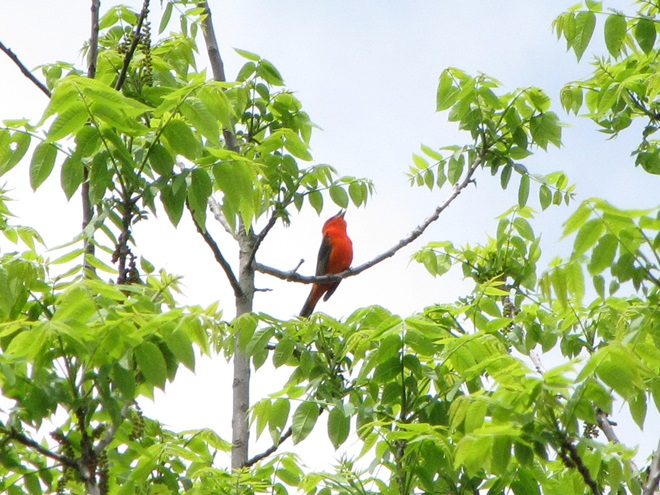
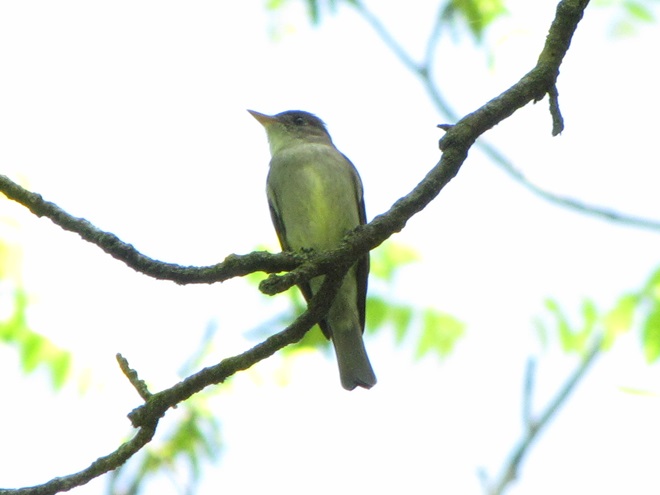
The Yellow-throated Vireo nests, feeds, and spends the majority of its time feeding among canopy foliage.The Eastern Wood-Pewee is a flycatcher found in mature woodlands. It feeds not only among the limbs and leaves, but is an aerial predator as well.The Northern Parula nests in mature forests along rivers and on mountainsides, particularly where mature trees are draped with thick vines.The Hooded Warbler (Setophaga citrina) is found among thick understory growth on forested slopes.The Ovenbird builds a domed, oven-like nest on the ground and forages in the canopy.The Kentucky Warbler (Geothlypis formosa) nests in woodland undergrowth, often near steep, forested slopes.The Worm-eating Warbler (Helmitheros vermivorum) nests among woody understory growth on forested hillsides.The Scarlet Tanager is often difficult to observe because of its affinity for the canopy of mature forest trees.
In the locations where these photographs were taken, ground-feeding birds, including those species that would normally be common in these habitats, were absent. There were no Gray Catbirds, Carolina Wrens, American Robins or other thrushes seen or heard. One might infer that the arboreal insectivorous birds chose to establish nesting territories where they did largely due to the presence of an abundance of tent caterpillars as a potential food source for their young. That could very well be true—but consider timing.
Already Gone- By the time Neotropical migrants arrive in our area, the larval stages of the Eastern Tent Caterpillar’s life cycle are already coming to an end. The nests that these native insects constructed to capture the energy of the springtime sun have allowed the larvae to exit and browse foliage when conditions were suitable, then return for shelter when they were not. While inside, the larvae could move among the chambers of their structure to find locations with a temperature that best suited their needs. Therein the solar heating and communal warmth sped up digestion and growth.Eastern Tent Caterpillar larvae are now in their bristly final-instar stage and the majority have already moved to the ground to each seek a place to pupate and metamorphose into an adult moth. Arboreal Neotropical birds have scarcely had a chance to feed upon them, and ground-feeding species seem to lack any temptation. As for the adult moths, they fly only at night and live for just one day, offering little in the way of food for aerial, arboreal, or ground-feeding birds.Having left arboreal environs, Eastern Tent Caterpillar larvae are now food for ground-feeding birds like our resident Wild Turkeys. They need only get past the bristly hairs on the caterpillar’s back and the foul taste that may result from its limited diet of cyanogenic Black Cherry leaves.The arboreal Yellow-billed Cuckoo (seen here) and its close relative the Black-billed Cuckoo (Coccyzus erythropthalmus) are the two species of birds in our area known to regularly feed on bristly tent caterpillars. But having just arrived from the tropics to nest, they’ll need to rely on other insects and their larvae as sources of food for their young.Final-instar Eastern Tent Caterpillars often defoliate Black Cherry trees before moving to the ground to pupate. Their timing allows them to feed on the fresh foliage while it is still young and tender, and to largely avoid becoming food for the waves of Neotropical birds that arrive in the lower Susquehanna basin in May.
So why do we find this admirable variety of Neotropical bird species nesting in locations with tent caterpillars? Perhaps it’s a matter of suitable topography, an appropriate variety of native trees and shrubs, and an attractive opening in the forest.
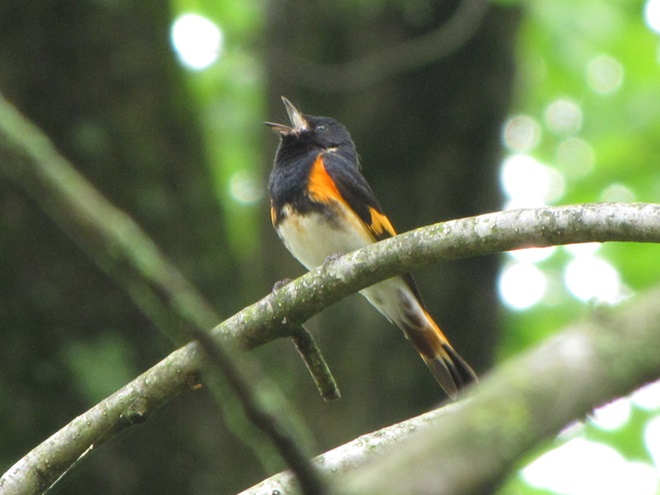
An American Redstart singing in a Black Cherry. Unlike others in the vicinity, this tree nestled among several very large Eastern White Pines showed no signs of tent caterpillar activity. It may be that for one reason or another, no adult female moth deposited her eggs on this particular tree. During our visits, Black Cherry was but one of the diverse variety of native trees and shrubs found growing on the sloping topography that created attractive habitat for the nesting birds we found. We happened to notice that a majority, but not all, of those Black Cherry trees were impacted by Eastern Tent Caterpillars.The end of the Eastern Tent Caterpillar’s larval surge may spell the end of their nests for the year, but it’s not the end for the Black Cherry and other host trees in the Prunus (cherry) and Malus (apple) genera. Because it’s still early in the season, they have plenty of time to re-leaf and many will still flower and produce fruit. Those flowers and foliage will attract numerous other insects (including pollinators) that benefit breeding birds.The Blue-winged Warbler inhabits shrubby breaks in the forest such as this utility right-of-way where Black Cherry trees have sprouted after their seeds arrived in waste deposited by fruit-eating (frugivorous) birds. Already attractive to a variety of insectivores, these openings soon lure egg-laying Eastern Tent Caterpillar moths to the cherry trees growing therein. Even in dense forest, a small clearing created by a cluster of dead trees makes good bird habitat and will sooner or later be visited by fruit-eating species that will inadvertently sow seeds of Black Cherry, starting yet another stand of host trees for Eastern Tent Caterpillars. It’s the gap in the forest that often attracts the birds, some of which plant the host trees, which sometimes entice Eastern Tent Caterpillar moths to lay their eggs.Adapt and Reuse- A Red-eyed Vireo visits an Eastern Tent Caterpillar nest……and ignores the few remaining occupants that could easily be seized to instead collect silk to reinforce its own nest.
Here in the Lower Susquehanna River Watershed, the presence of Eastern Tent Caterpillar nests can often be an indicator of a woodland opening, natural or man-made, that is being reforested by Black Cherry and other plants which improve the botanical richness of the site. For numerous migratory Neotropical species seeking favorable places to nest and raise young, these regenerative areas and the forests surrounding them can be ideal habitat. For us, they can be great places to see and hear colorful birds.
Our Lucky Break- This Scarlet Tanager descended from the treetops to feed on spiders in a small forest clearing.
While in flower, this extensive stand of Princess Trees (Paulownia tomentosa) straddling Second Mountain north of Harrisburg might be mistaken for a series of boulder outcrops. Native to eastern Asia, the fast-growing Princess Tree has escaped cultivation to become naturalized in many parts of eastern North America. You’ll currently notice the showy purple blooms on many forested ridges and hilltops throughout the Lower Susquehanna River Watershed. Paulownia tomentosa is also known as the Phoenix Tree, a name derived from its ability, due to its extensive root system, to regenerate following fire. This fast-growing invasive therefore calls for measures in addition to prescribed burns for control within infected forests. Mechanical and/or chemical methods of removal are frequently required.
The rain and clouds have at last departed. With blue skies and sunshine to remind us just how wonderful a spring afternoon can be, we took a stroll at Memorial Lake State Park in Lebanon County, Pennsylvania, to look for some migratory birds.
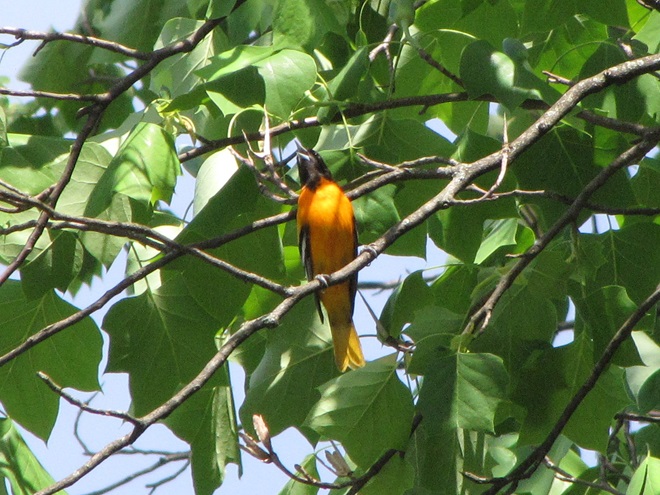
Though running just a few days later than usual, Indigo Buntings have arrived to begin nesting.This Common Loon dropped by Memorial Lake during a storm several days ago and decided to stay awhile. It’s a species that winters in oceanic waters along the Atlantic seaboard and nests on glacial lakes to our north.Because of the low level of turbidity in Memorial Lake, visibility is good enough to allow this benthic feeder an opportunity to see food before expending energy to dive down and retrieve it. Favorable foraging conditions might be part of the reason this bird is hanging around.Clear Water- Memorial Lake is one of the few man-made lakes in the Lower Susquehanna River Watershed to be appropriately vegetated with an abundance of submerged, floating, and emergent plants. As a result, the water from Indiantown Run that passes through the impoundment is minimally impacted by nutrient loads and the algal blooms they can cause. Buffers of woody and herbaceous growth along the lake’s shorelines provide additional nutrient sequestering and help prevent soil erosion and siltation.The breeding season has begun for Neotropical migrants including this Baltimore Oriole, which we found defending a nesting territory in a stand of Black Walnut trees.Along the edge of the lake, this Orchard Oriole and its mate were in yet another stand of tall walnut trees.Early in the season and early in the day, we started seeing Common Nighthawks flying above wooded areas north of the lake at 4 o’clock this afternoon. After all the raw and inclement weather they’ve experienced in recent days, the warm afternoon was probably their first opportunity to feed on flying insects in quite a while.Early birds, Common Nighthawks feeding at 4 P.M.
What? You thought we were gonna drop in on Maryland’s largest city for a couple of ball games and some oysters, clams, and crab cakes—not likely.
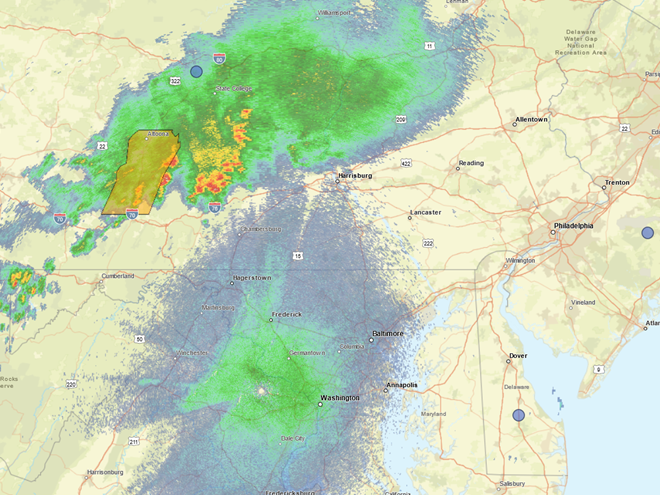
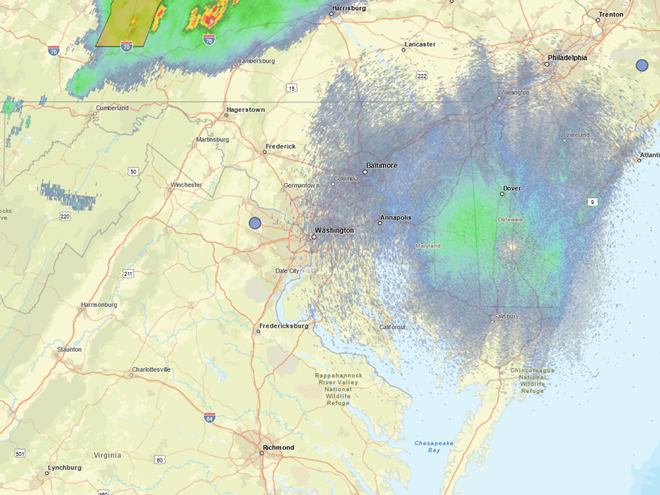
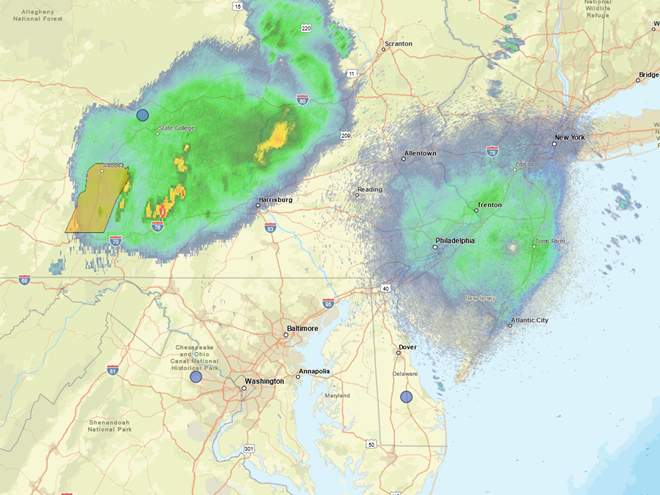
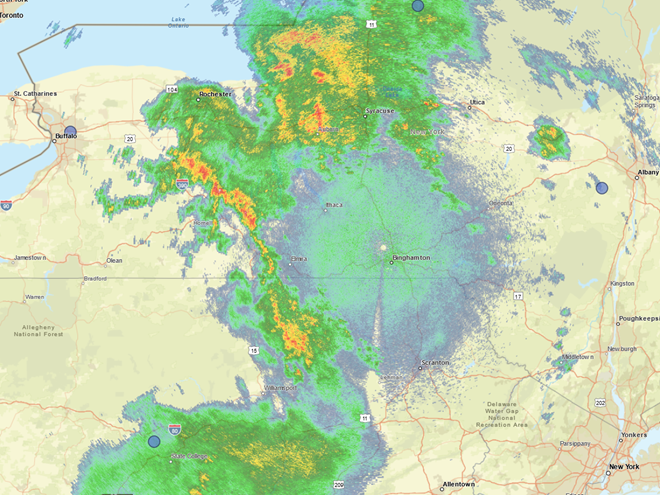
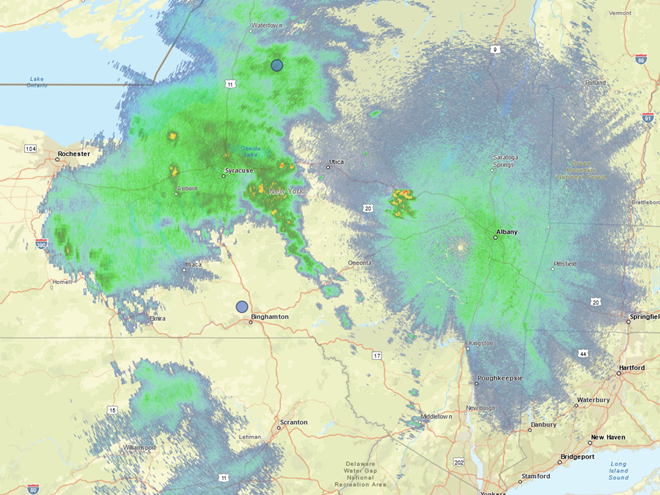
In recent days, the peak northbound push of migratory birds that includes the majority of our colorful Neotropical species has been slowed to a trickle by the presence of rain, fog, and low overcast throughout the Mid-Atlantic States. Following sunset last evening, the nocturnal flight resumed—only to be grounded this morning during the pre-dawn hours by the west-to-east passage of a fast-moving line of strong thundershowers. The NOAA/National Weather Service images that follow show the thunderstorms as well as returns created by thousands of migrating birds as they pass through the Doppler Radar coverage areas that surround the lower Susquehanna valley.
Sterling, Virginia, Doppler Radar west of Washington, D.C., at 4:00 A.M. E.D.T. indicates a dense flight of northbound migrating birds located just to the south of the approaching line of rain and thunderstorms over the State College, Pennsylvania, radar coverage area. (NOAA/National Weather Service image)More northbound birds are indicated at 4 A.M. by the radar station located at Dover, Delaware… (NOAA/National Weather Service image)…and by the Mount Holly, New Jersey, radar site. (NOAA/National Weather Service image)Many of the migrating birds shown here over the Binghamton, New York, radar station at 4 A.M. probably overflew the lower Susquehanna region earlier in the night. (NOAA/National Weather Service image)And these birds over Albany, New York’s, radar station at 4 A.M. are mostly migrants that passed north over New Jersey and easternmost Pennsylvania last evening and during the wee hours of this morning. (NOAA/National Weather Service image)
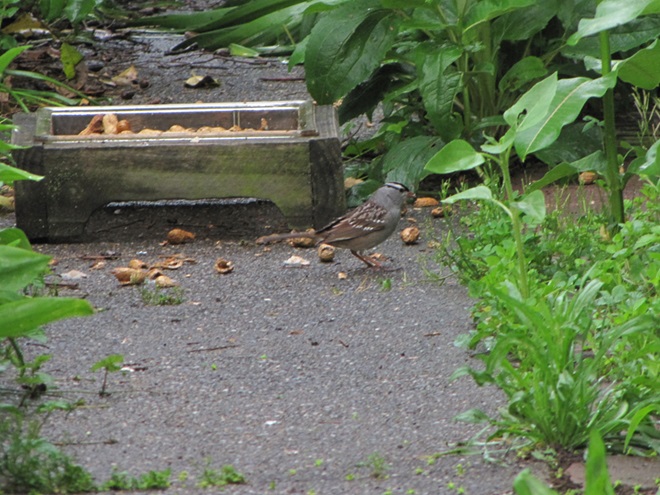
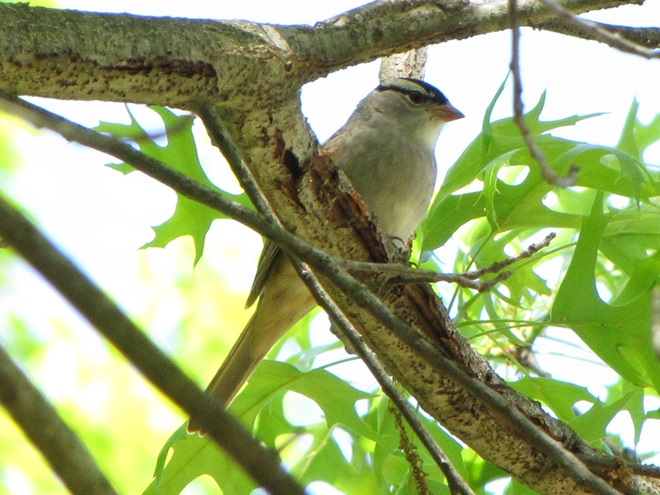
Just after 4 A.M., flashes of lightning in rapid succession repeatedly illuminated the sky over susquehannawildlife.net headquarters. Despite the rumbles of thunder and the din of noises typical for our urban setting, the call notes of nocturnal migrants could be heard as these birds descended in search of a suitable place to make landfall and seek shelter from the storm. At least one Wood Thrush and a Swainson’s Thrush (Catharus ustulatus) were in the mix of species passing overhead. A short time later at daybreak, a Great Crested Flycatcher was heard calling from a stand of nearby trees and a White-crowned Sparrow was seen in the garden searching for food. None of these aforementioned birds is regular here at our little oasis, so it appears that a significant and abrupt fallout has occurred.
A White-crowned Sparrow in the headquarters garden at daybreak. It’s the first visit by this species in a decade or more.
Looks like a good day to take the camera for a walk. Away we go!
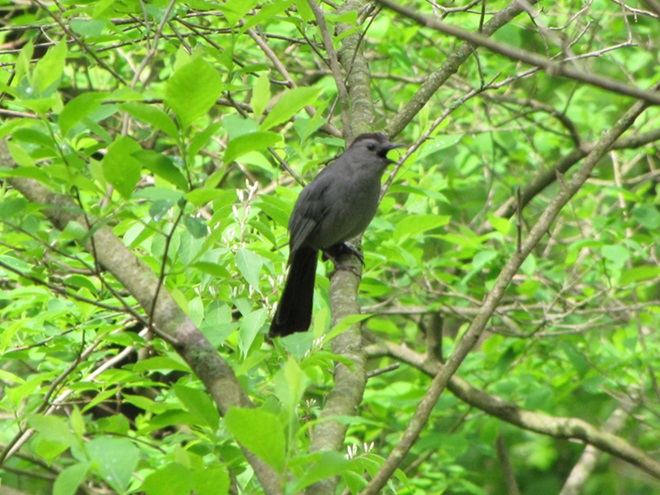
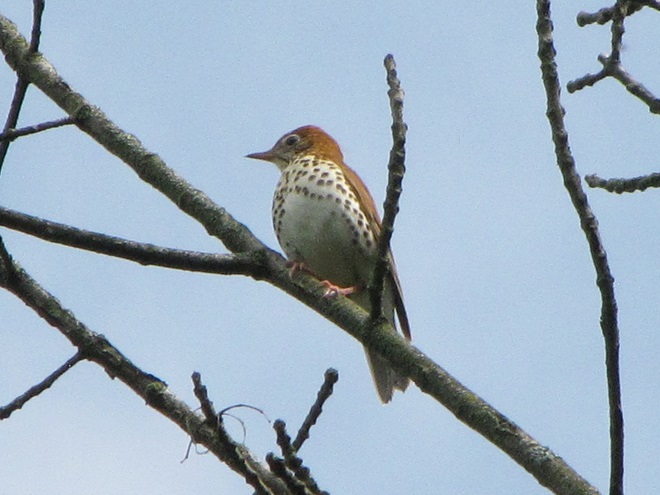
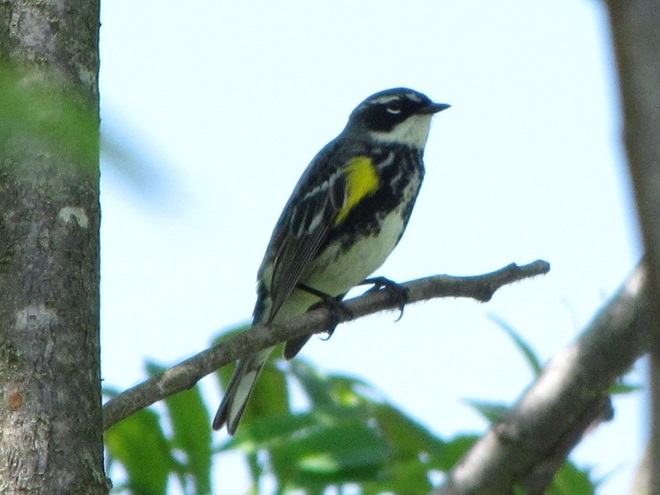
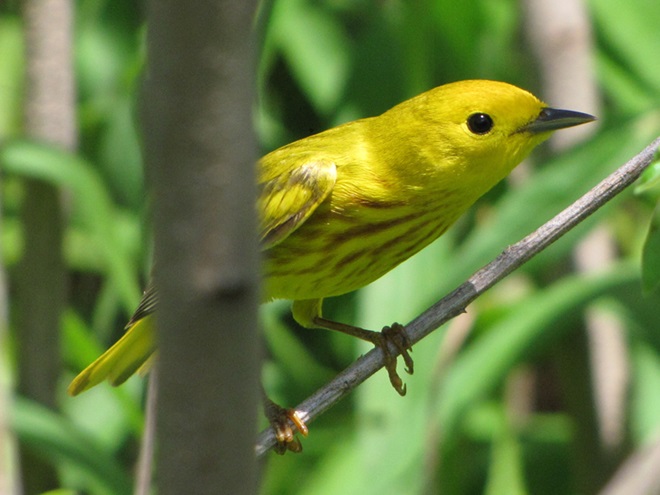
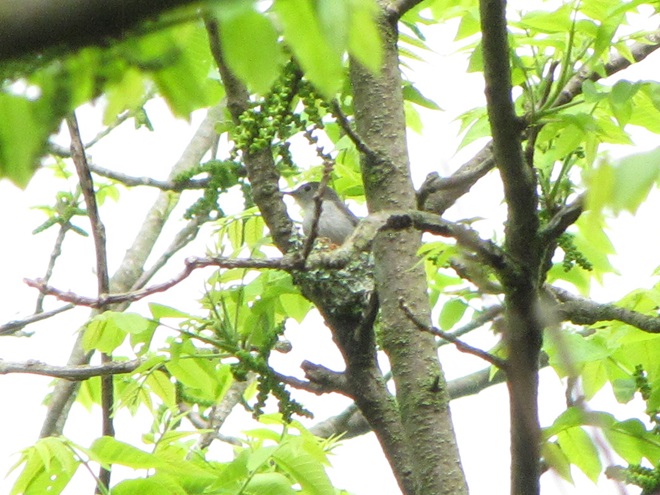
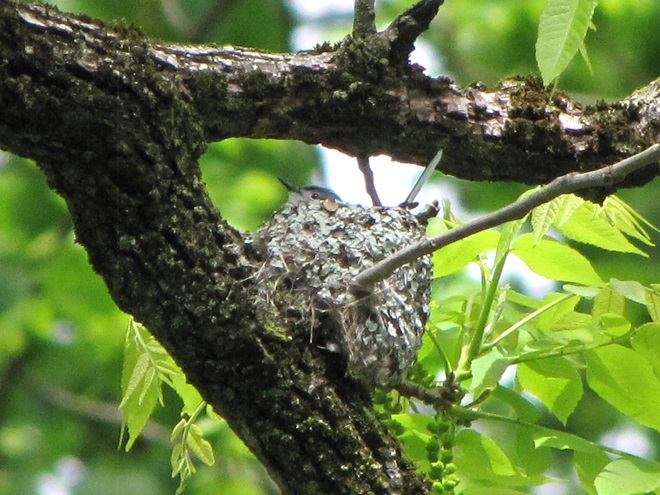
Along woodland edges, in thickets, and in gardens, Gray Catbirds were everywhere today. We heard and/or saw hundreds of them.During our travels, American Redstarts were the most frequently encountered warbler. Look for them in low-lying forested habitats.Many early-arriving Baltimore Orioles have already begun building nests. But widespread territorial fighting today may be an indication that some latecomer orioles became trespassers after dropping in on existing territories during the morning fallout.Red-eyed Vireos are difficult to see but easily heard in forested areas throughout the Lower Susquehanna River Watershed.If the oriole isn’t the showiest of the Neotropical migrants, then the Scarlet Tanager is certainly a contender…Listen for their burry, robin-like song in the treetops of mature upland forests.No woodland chorus is complete without the flute-like harmony of the Wood Thrush. Look and listen for them in rich forests with dense understory vegetation.The Eastern Wood-Pewee, another forest denizen, has an easy song to learn…a series of ascending “pee-a-wee” phrases interspersed with an occasional descending “pee-urr”. It was one of the few flycatchers we found today, but more are certainly on the way. Their numbers should peak in coming days.Yellow-rumped Warblers can be especially numerous during migration but tend to peak prior to the arrival of the bulk of the Neotropical species. This was the only “yellow-rump” we encountered today. The majority have already passed through on their way to breeding grounds to our north.If today you were to visit a streamside thicket or any type of early successional habitat, you would probably find this perky little warbler there, the Common Yellowthroat.The Yellow Warbler likes streamside thickets too. You can also find them along lakes, ponds, and wetlands, especially among shrubby willows and alders.While nowhere near the headquarters garden, we ran into another White-crowned Sparrow in less-than-ideal habitat. This one was in a row of trees in a paved parking lot.Not all songbirds migrate at night. The Bobolink is an example of a diurnal (day-flying) migrant. They’re currently arriving in hay fields that are spared the mower until after nesting season.While looking for Neotropical species and other late-season migrants, we also found numerous early arrivals that had already begun their breeding cycles. We discovered this Blue-gray Gnatcatcher on its nest in a Black Walnut tree……then, later in the day, we found this one in its nest, again in a Black Walnut tree. Note the freshly emerging set of leaves and flower clusters. With many tree species already adorned in a full set of foliage, open canopies in stands of walnuts we found growing in reforested areas seemed to be good places to see lots of migrants and other birds today. It’s hard to say whether birds were more numerous in these sections of woods or were just easier to observe among the sparse leaf cover. In either case, the nut-burying squirrels that planted these groves did us and the birds a favor.
There’s obviously more spring migration to come, so do make an effort to visit an array of habitats during the coming weeks to see and hear the wide variety of birds, including the spectacular Neotropical species, that visit the Lower Susquehanna River Watershed each May. You won’t regret it!
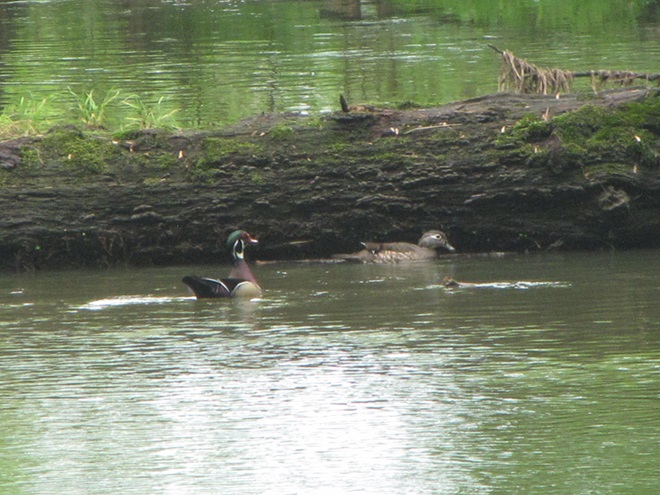
Wood Ducks arrived in February and March to breed in the lower Susquehanna valley. Soon after hatching in April or May, the young leave the nest cavity to travel under the watchful gaze of their ever-vigilant mother as they search for food along our local waterways. If you’re fortunate, you might catch a glimpse of a brood and hen while you’re out looking at the more than one hundred species of birds that occur in our region during the first half of May. Good luck!
Homo sapiens owes much of its success as a species to an acquired knowledge of how to make, control, and utilize fire. Using fire to convert the energy stored in combustible materials into light and heat has enabled humankind to expand its range throughout the globe. Indeed, humans in their furless incomplete mammalian state may have never been able to expand their populations outside of tropical latitudes without mastery of fire. It is fire that has enabled man to exploit more of the earth’s resources than any other species. From cooking otherwise unpalatable foods to powering the modern industrial society, fire has set man apart from the rest of the natural world.
In our modern civilizations, we generally look at the unplanned outbreak of fire as a catastrophe requiring our immediate intercession. A building fire, for example, is extinguished as quickly as possible to save lives and property. And fires detected in fields, brush, and woodlands are promptly controlled to prevent their exponential growth. But has fire gone to our heads? Do we have an anthropocentric view of fire? Aren’t there naturally occurring fires that are essential to the health of some of the world’s ecosystems? And to our own safety? Indeed there are. And many species and the ecosystems they inhabit rely on the periodic occurrence of fire to maintain their health and vigor.
For the war effort- The campaign to reduce the frequency of forest fires got its start during World War II with distribution of this poster in 1942. The goal was to protect the nation’s timber resources from accidental or malicious loss due to fire caused by man-made ignition sources. The release of the Walt Disney film “Bambi” during the same year and the adoption of the Smokey the Bear mascot in 1944 softened the message’s delivery, but the public relations outreach continued to be a key element of a no-fire policy to save trees for lumber. Protection and management of healthy forest ecosystems in their entirety has only recently become a priority. (National Archives image)
Man has been availed of the direct benefits of fire for possibly 40,000 years or more. Here in the Lower Susquehanna River Watershed, the earliest humans arrived as early as 12,000 years ago—already possessing skills for using fire. Native plants and animals on the other hand, have been part of the ever-changing mix of ecosystems found here for a much longer period of time—millions to tens of millions of years. Many terrestrial native species are adapted to the periodic occurrence of fire. Some, in fact, require it. Most upland ecosystems need an occasional dose of fire, usually ignited by lightning (though volcanism and incoming cosmic projectiles are rare possibilities), to regenerate vegetation, release nutrients, and maintain certain non-climax habitat types.
But much of our region has been deprived of natural-type fires since the time of the clearcutting of the virgin forests during the eighteenth and nineteenth centuries. This absence of a natural fire cycle has contributed to degradation and/or elimination of many forest and non-forest habitats. Without fire, a dangerous stockpile of combustible debris has been collecting, season after season, in some areas for a hundred years or more. Lacking periodic fires or sufficient moisture to sustain prompt decomposition of dead material, wildlands can accumulate enough leaf litter, thatch, dry brush, tinder, and fallen wood to fuel monumentally large forest fires—fires similar to those recently engulfing some areas of the American west. So elimination of natural fire isn’t just a problem for native plants and animals, its a potential problem for humans as well.
Indiangrass (seen here), Switchgrass, Big Bluestem, and Little Bluestem are native species requiring periodic forms of disturbance to eliminate competition by woody plants. These warm-season grasses develop roots that penetrate deep into the soil, sometimes to depths of six feet or more, allowing them to survive severe drought and flash fire events. In the tall grass prairies, these extensive root systems allow these grasses to return following heavy grazing by roaming herds of American Bison (Bison bison). Without these habitat disturbances, warm season grasslands succumb to succession in about seven years. With their periodic occurrence, the plants thrive and provide excellent wildlife habitat, erosion control, and grazing forage.
To address the habitat ailments caused by a lack of natural fires, federal, state, and local conservation agencies are adopting the practice of “prescribed fire” as a treatment to restore ecosystem health. A prescribed fire is a controlled burn specifically planned to correct one or more vegetative management problems on a given parcel of land. In the Lower Susquehanna River Watershed, prescribed fire is used to…
Eliminate dangerous accumulations of combustible fuels in woodlands.
Reduce accumulations of dead plant material that may harbor disease.
Provide top kill to promote oak regeneration.
Regenerate other targeted species of trees, wildflowers, grasses, and vegetation.
Kill non-native plants and promote growth of native plants.
Prevent succession.
Remove woody growth and thatch from grasslands.
Promote fire tolerant species of plants and animals.
Improve habitat for rare species (Regal Fritillary, etc.)
Recycle nutrients and minerals contained in dead plant material.
Let’s look at some examples of prescribed fire being implemented right here in our own neighborhood…
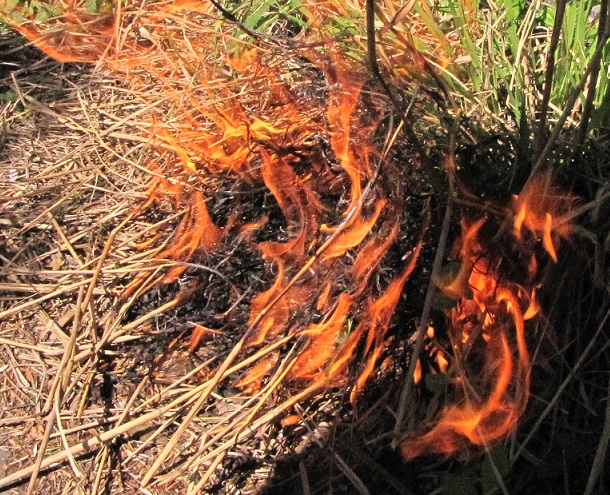
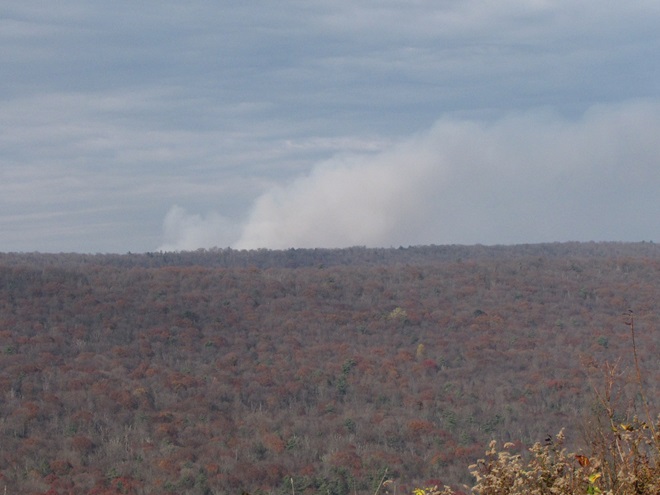
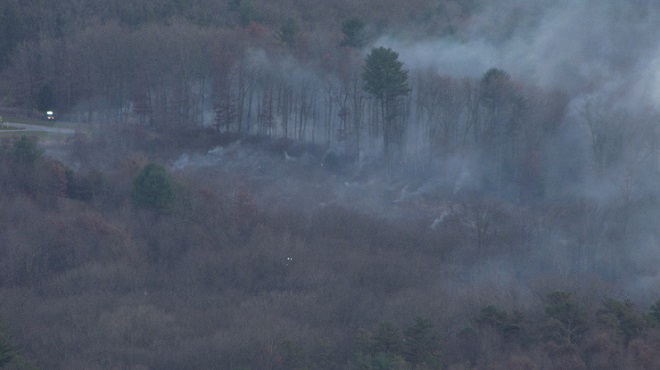
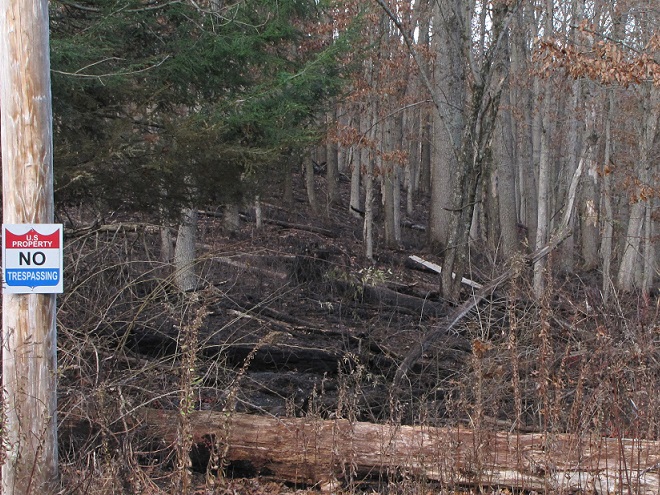
Prescribed fires are typically planned for the dormant season extending from late fall into early spring with burns best conducted on days when the relative humidity is low.Prescribed fire is used regularly at Fort Indiantown Gap Military Reservation in Lebanon County, Pennsylvania, to keep accumulations of woody and herbaceous fuels from accumulating on and around the training range areas where live ordinance and other sources of ignition could otherwise spark large, hard-to-control wildfires.Prescribed fires replace the periodic natural burns that would normally reduce the fuel load in forested areas. Where these fuels are allowed to accumulate, south-facing slopes are particularly susceptible to extreme fires due to their exposure to the drying effects of intense sunlight for much of the year. The majority of small oaks subjected to treatment by the prescribed fire shown here will have the chance to regenerate without immediate competition from other species including invasive plants. The larger trees are mostly unaffected by the quick exposure to the flames. Note too that these fires don’t completely burn everything on the forest floor, they burn that which is most combustible. There are still plenty of fallen logs for salamanders, skinks, and other animals to live beneath and within.
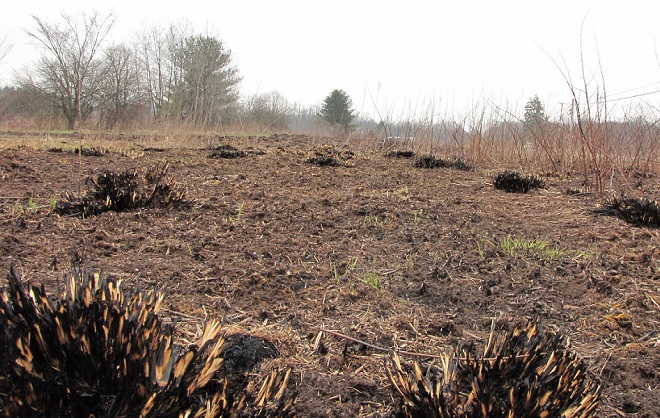
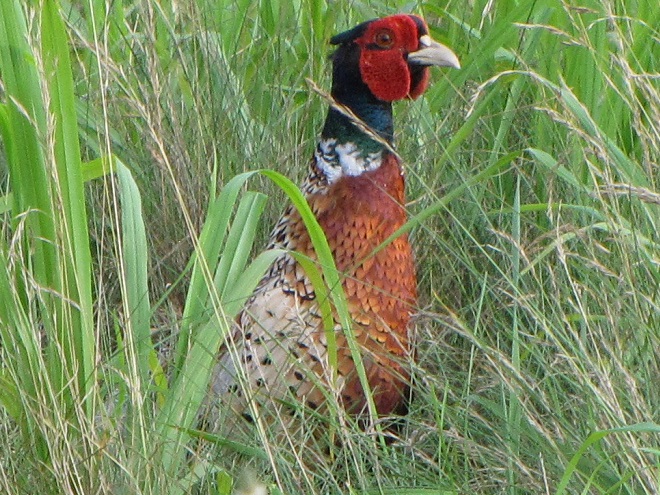
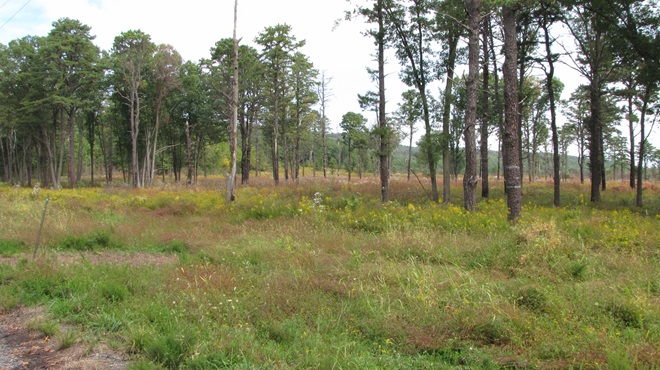
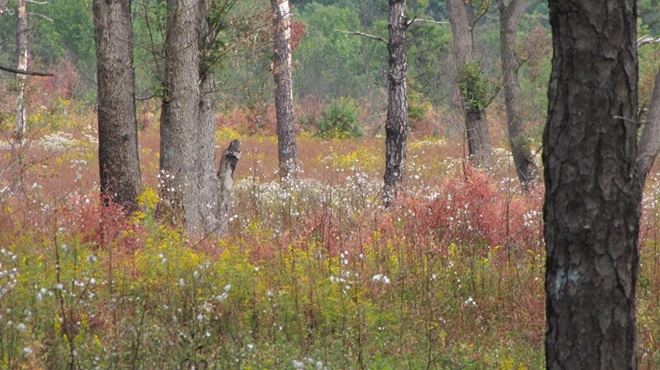
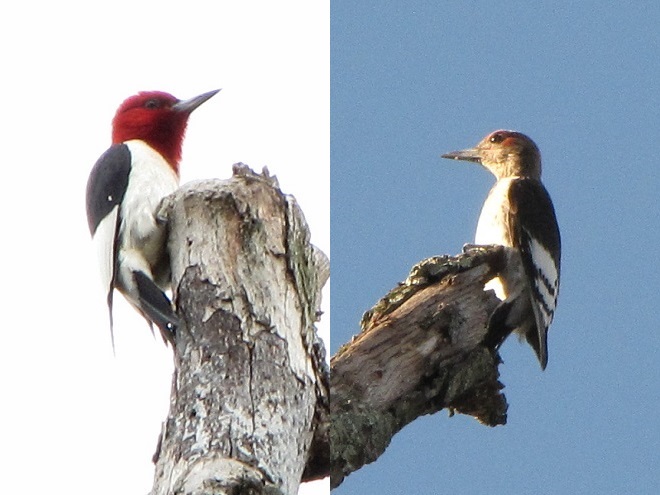
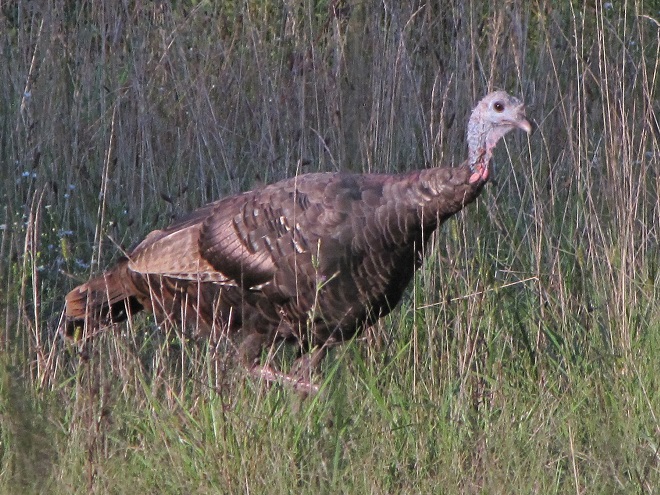
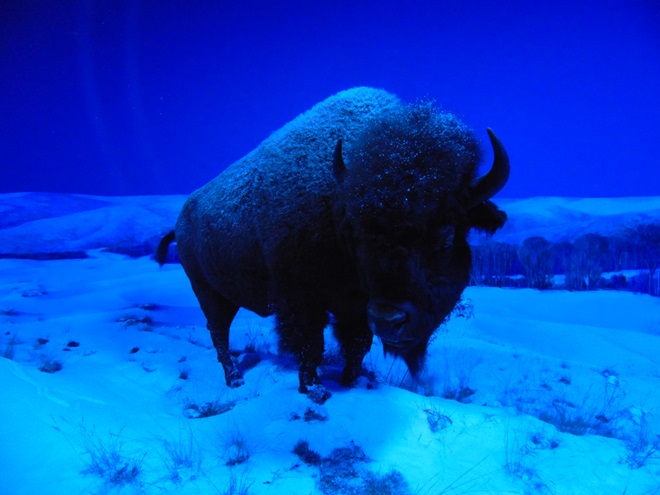
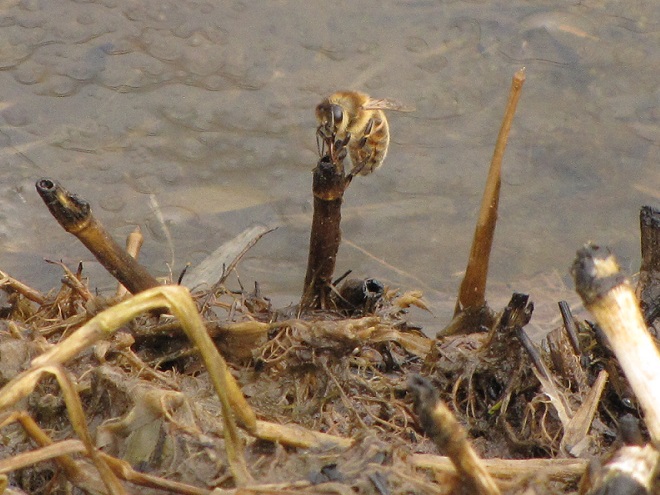
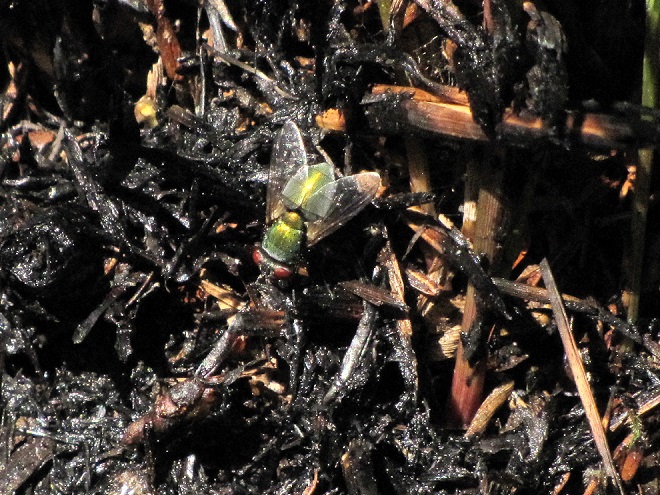
A prescribed fire in late winter prevents this grassland consisting of Big Bluestem and native wildflowers from being overtaken by woody growth and invasive species. Fires such as this that are intended to interrupt the process of succession are repeated at least every three to five years.In its wildlife food plots, prescribed fire is used by the Pennsylvania Game Commission to prevent succession and control invasive species such as Multiflora Rose, instead promoting the growth of native plants.An example of a woodlot understory choked with combustible fuels and dense tangles of invasive Multiflora Rose. A forester has the option of prescribing a dose of dormant-season fire for a site like this to reduce the fuel load, top kill non-native vegetation, and regenerate native plants.A dose of prescribed fire was administered on this grassland to kill the woody growth of small trees beginning to overtake the habitat by succession.The Pennsylvania Game Commission employs prescribed fire at Middle Creek Wildlife Management Area and on many of their other holdings to maintain grasslands.Prescribed fire is used to eliminate invasive species including Multiflora Rose from grasslands at Middle Creek W.M.A. Annual burns on the property are conducted in a mosaic pattern so that each individual area of the grassland is exposed to the effects of fire only once every two to five years. Without fire or some type of mechanical or chemical intervention, succession by woody trees and shrubs would take hold after about seven years.Prescribed fire is planned for a fraction of total grassland acreage at Middle Creek W.M.A. each year. Another section of the mosaic is targeted in the following year and yet another in the year that follows that. Because burns are conducted in the spring, grassland cover is available for wildlife throughout the winter. And because each year’s fire burns only a portion of the total grassland acreage, wildlife still has plenty of standing grass in which to take shelter during and after the prescribed fire.Prescribed fire at Middle Creek W.M.A. provides grassland habitat for dozens of species of birds and mammals including the not-so-common Grasshopper Sparrow……and stocked Ring-necked Pheasants that do nest and raise young there.On a few sites in the Lower Susquehanna River Watershed , prescribed fire is being used to establish and maintain savanna-like grasslands. This one, located on a dry, south-facing slope near numerous man-made sources of ignition, can easily be dosed with periodic prescribed burns to both prevent succession and reduce fuel accumulations that may lead to a devastating extreme fire.One year following a prescribed burn, this is the autumn appearance of a savanna-like habitat with fire-tolerant Pitch Pine (Pinus rigida), Bear Oak, warm-season grasses, and a variety of nectar-producing wildflowers for pollinators. These ecosystems are magnets for wildlife and may prove to be a manageable fit on sun-drenched sites adjacent to man-made land disturbances and their sources of ignition.Savanna-like grasslands with oaks and other scattered large trees, some of them dead, make attractive nesting habitat for the uncommon Red-headed Woodpecker.Prescribed fire can benefit hungry Wild Turkeys by maintaining savanna-like grasslands for an abundance of grasshoppers and other insects in summer and improving the success of mast-producing oaks for winter.In the Lower Susquehanna River Watershed, the caterpillar of the rare Eastern Buck Moth feeds on the foliage of the Bear Oak, also known as the Scrub Oak, a shrubby species that relies upon periodic fire to eliminate competition from larger trees in its early successional habitat.Leaves of the Bear Oak in fall. The Bear Oak regenerates readily from top kill caused by fire.Reed Canary Grass (Phalaris arundinacea) is a native cool-season grass with a colorful inflorescence in spring. But given the right situation, it can aggressively overtake other species to create a pure stand lacking biodiversity. It is one of the few native species which is sometimes labelled “invasive”.Prescribed fire can be used to reduce an overabundance of Reed Canary Grass and its thatch in wetlands. Periodic burning can help restore species diversity in these habitats for plants and animals including rare species such as the endangered Bog Turtle (Glyptemys muhlenbergii).On the range areas at Fort Indiantown Gap in Lebanon County, Pennsylvania, disturbances by armored vehicles mimic the effects of large mammals such as the American Bison which periodically trampled grasses to prevent succession and the establishment of woody plants on its prairie habitat. To supplement the activity of the heavy vehicles and to provide suitable habitat for the very rare Regal Fritillary (Speyeria idalia) butterflies found there, prescribed fire is periodically employed to maintain the grasslands on the range. These burns are planned to encourage the growth of “Fort Indiantown Gap Little Bluestem” grass as well as the violets used as host plants by the Regal Fritillary caterpillars. These fires also promote growth of a variety of native summer-blooming wildflowers to provide nectar for the adults butterflies.A last record of a wild American Bison killed in Pennsylvania was an animal taken in the Susquehanna watershed in Union County in 1801. The species is thereafter considered extirpated from the state. Since that time, natural disturbances needed to regenerate warm-season grasses have been limited primarily to fires and riverine ice scour. The waning occurrence of both has reduced the range of these grasses and their prairie-like ecosystems in the commonwealth. (Exhibit: State Museum of Pennsylvania, Harrisburg)A male Regal Fritillary on the range at Fort Indiantown Gap, where armored vehicles and prescribed fire provide suitable prairie-like habitat for this vulnerable species.Prescribed fires return the nutrients and minerals contained in dead plant material to the soil. Following these controlled burns, insects like this Honey Bee can often be seen collecting minerals from the ashes.A Greenbottle Fly gathering minerals from the ash following a prescribed burn.
In Pennsylvania, state law provides landowners and crews conducting prescribed fire burns with reduced legal liability when the latter meet certain educational, planning, and operational requirements. This law may help encourage more widespread application of prescribed fire in the state’s forests and other ecosystems where essential periodic fire has been absent for so very long. Currently in the Lower Susquehanna River Watershed, prescribed fire is most frequently being employed by state agencies on state lands—in particular, the Department of Conservation and Natural Resources on State Forests and the Pennsylvania Game Commission on State Game Lands. Prescribed fire is also part of the vegetation management plan at Fort Indiantown Gap Military Reservation and on the land holdings of the Hershey Trust. Visitors to the nearby Gettysburg National Military Park will also notice prescribed fire being used to maintain the grassland restorations there.
For crews administering prescribed fire burns, late March and early April are a busy time. The relative humidity is often at its lowest level of the year, so the probability of ignition of previous years’ growth is generally at its best. We visited with a crew administering a prescribed fire at Middle Creek Wildlife Management Area last week. Have a look…
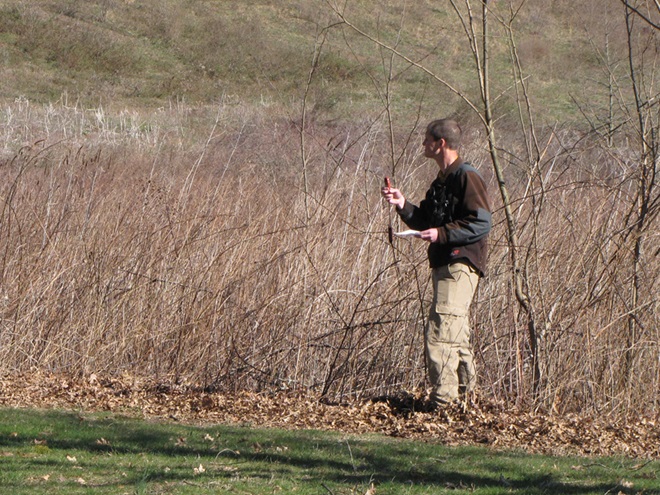
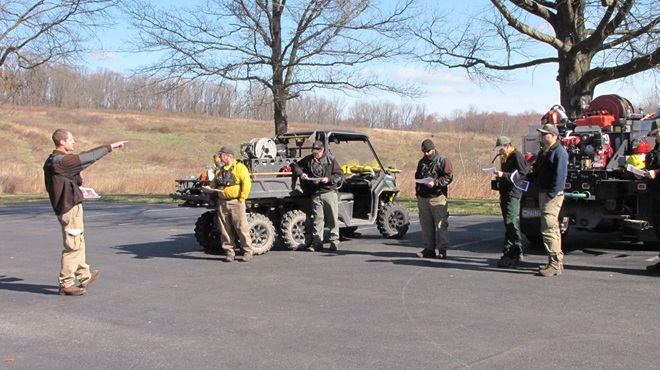
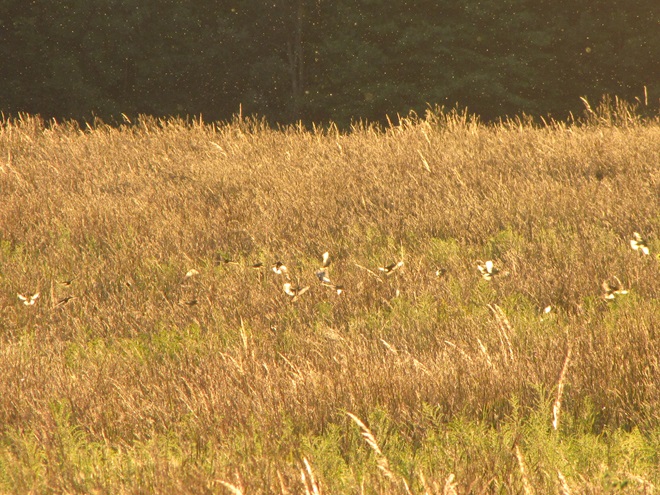
Members of a Pennsylvania Game Commission burn crew provide visitors to Middle Creek Wildlife Management Area with an overview of prescribed fire and the equipment and techniques they use to conduct a burn.Pennsylvania Game Commission Southeast Region Forester Andy Weaver will fulfill the role of Burn Boss for administering this day’s dose of fire. His responsibilities include assessing the weather before the burn and calculating a probability of ignition.The Burn Boss briefs personnel with information on site layout, water supply location(s), places of refuge, emergency procedures, the event’s goals and plan of action, crew assignments, and the results of the weather check: wind from the northwest at 5 miles per hour, temperature 48 degrees, and the relative humidity 63%. Today’s patient is a parcel of warm-season grasses receiving a dose of fire to eliminate invasive non-native plants, woody growth, and thatch. The probability of ignition is 20%, but improving by the minute.To begin the burn, a test fire is started in the downwind corner of the parcel, which also happens to be the bottom of the slope. Fuel ignition is good. The burn can proceed.Crews proceed uphill from the location of the test fire while igniting combustibles along both flanks of the area being treated.A drip torch is used to ignite the dried stems and leaves of warm-season grasses and wildflowers. Each member of the burn crew wears Nomex fire-resistant clothing and carries safety equipment including a two-way radio, a hydration pack, and a cocoon-like emergency fire shelter.An all-terrain vehicle equipped with various tools, a fire pump, hose, and a small water tank accompanies the crew on each flank of the fire.A mowed strip of cool-season grasses along the perimeter of the burn area is already green and functions as an ideal fire break. While the drip torch is perfect for lighting combustibles along the fire’s perimeter, the paintball gun-looking device is an effective tool used to lob incendiaries into the center areas of the burn zone for ignition.With green cool-season grasses already growing on the trails surrounding the burn zone, very little water was used to contain this prescribed fire. Where such convenient fire breaks don’t already exist, crews carry tools including chain saws, shovels, and leaf blowers to create their own. They also carry flame swatters, backpack water pumps, shovels, and other tools to extinguish fires if necessary. None of these items were needed to control this particular fire.This fast-burning fire provides enough heat to damage the cambium layer of the woody tree and shrub saplings in this parcel being maintained as a grassland/wildflower plot, thus the process of succession is forestalled. Burns conducted during previous years on this and adjacent fields have also controlled aggressive growth of invasive Multiflora Rose and Olives (Elaeagnus species).Crews proceed up the slope while maintaining the perimeter by igniting dry plant material along the flanks of the burn zone.Ignition complete, the crews monitor the fire.The Burn Boss surveys the final stages of a safe and successful prescribed fire. The fire has left behind a mosaic of burned and unburned areas, just as a naturally occurring event may have done. Wildlife dodging the flames may be taking refuge in the standing grasses, so there is no remedial attempt to go back and ignite these areas. They’ll be burned during prescribed fires in coming years.By June, this grassland will again be lush and green with warm-season grasses and blooming wildflowers like this Common Milkweed being visited by a Great Spangled Fritillary.And later in the summer, Eastern Tiger Swallowtails on Joe-pye Weed.Indiangrass in flower in mid-summer.Bobolinks glow in the late August sun while taking flight from a stand of warm-season grasses maintained using springtime prescribed fire. The small dots on the dark background at the top of the image are multitudes of flying insects, many of them pollinators. The vegetation is predominately Indiangrass, excellent winter cover for birds, mammals, and other wildlife.
Prescribed burns aren’t a cure-all for what ails a troubled forest or other ecosystem, but they can be an effective remedy for deficiencies caused by a lack of periodic episodes of naturally occurring fire. They are an important option for modern foresters, wildlife managers, and other conservationists.
It’s that time of year. Your local county conservation district is taking orders for their annual tree sale and it’s a deal that can’t be beat. Order now for pickup in April.
The prices are a bargain and the selection includes the varieties you need to improve wildlife habitat and water quality on your property. For species descriptions and more details, visit each tree sale web page (click the sale name highlighted in blue). And don’t forget to order packs of evergreens for planting in mixed clumps and groves to provide winter shelter and summertime nesting sites for our local native birds. They’re only $12.00 for a bundle of 10.
It’s the most desirable block in town, not because the houses are any different from others built during the post-war years of the mid-twentieth century, but because the first owners of these domiciles had the good taste and foresight to plant long-lived trees on their lots, the majority of them native species. Pin Oak, Northern Red Oak, Yellow Poplar, Flowering Dogwood (Cornus florida), Eastern Red Cedar, Eastern White Pine, Eastern Hemlock, Norway Spruce, and American Holly dominate the landscape and create excellent habitat for birds and other wildlife. These 75-year-old plantings provide an abundance of shade in summer and thermal stability in winter, making it a “cool” place to live or take a stroll at any time of the year.
Pickup on: Thursday, April 18, 2024 or Friday, April 19, 2024
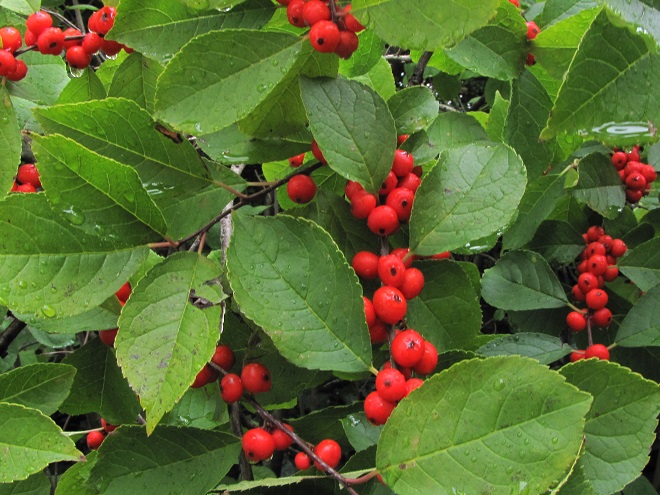
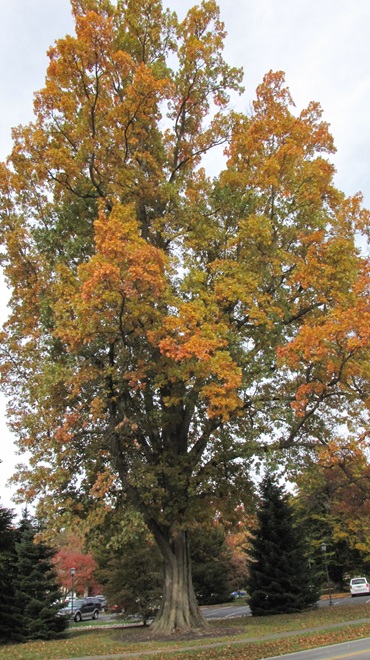
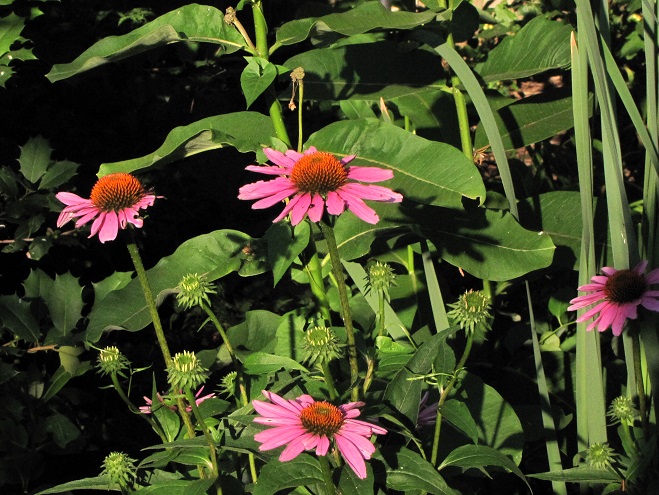
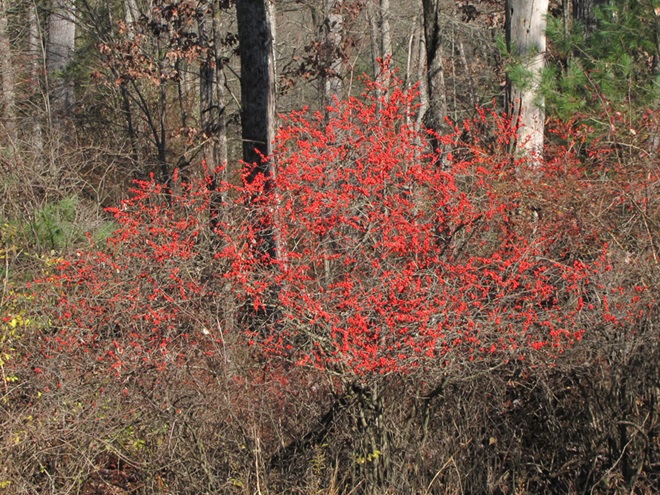
Cumberland County Conservation District is taking orders for Common Winterberry, the ideal small shrub for wet soil anywhere on your property. To get berries, you’ll need both males and females, so buy a bunch and plant them in a clump or scattered group.To live for a century or more like this towering giant, a Pin Oak needs to grow in well-drained soils with adequate moisture. These sturdy shade providers do well along streams and on low ground receiving clean runoff from hillsides, roofs, streets, and parking areas. As they age, Pin Oaks can fail to thrive and may become vulnerable to disease in locations where rainfall is not adequately infiltrated into the soil. Therefore, in drier areas such as raised ground or slopes, avoid the Pin Oak and select the more durable Northern Red Oak for planting. This year, Pin Oaks are available from the Cumberland and Lancaster County Conservation Districts, while Dauphin, Lancaster, Lebanon, and York Counties are taking orders for Northern Red Oaks.The Cumberland County Conservation District is again offering a “Showy Northeast Native Wildflower and Grass Mix” for seeding your own pollinator meadow or garden. It consists of more than twenty species including this perennial favorite, Purple Coneflower.
Pickup on: Thursday, April 18, 2024 or Friday, April 19, 2024
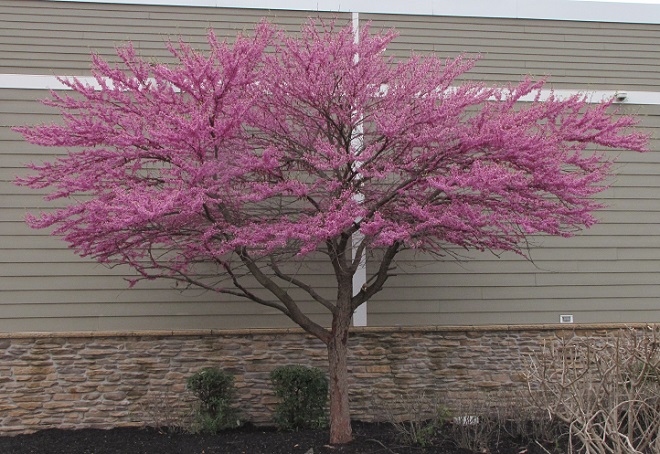
The Eastern Redbud is small tree native to our forest edges, particularly in areas of the Piedmont Province with Triassic geology (Furnace Hills, Conewago Hills, Gettysburg/Hammer Creek Formations, etc.) Also known as the Judas Tree, the redbud’s brilliant flowers are followed by heart-shaped leaves. As seen here, it is suitable for planting near houses and other buildings. Eastern Redbud seedlings are being offered through tree sales in Dauphin, Cumberland, and Lancaster Counties.
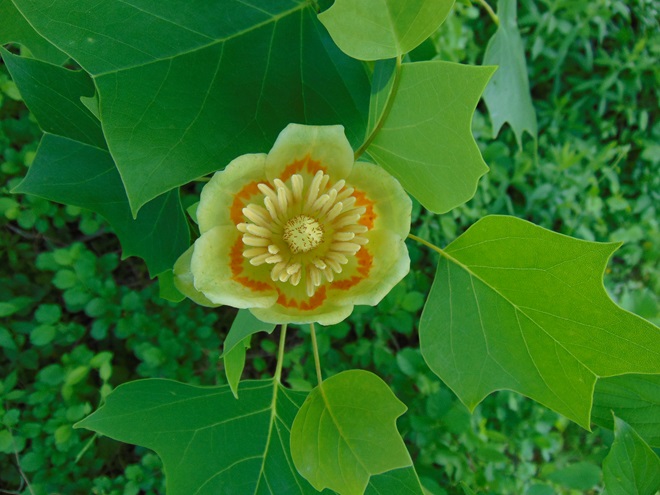
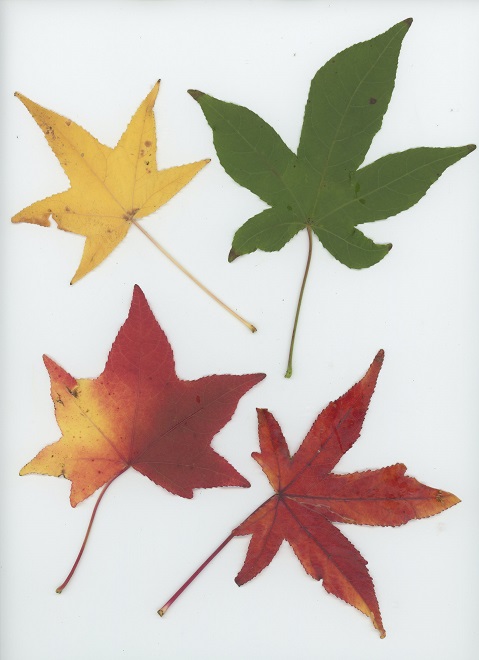
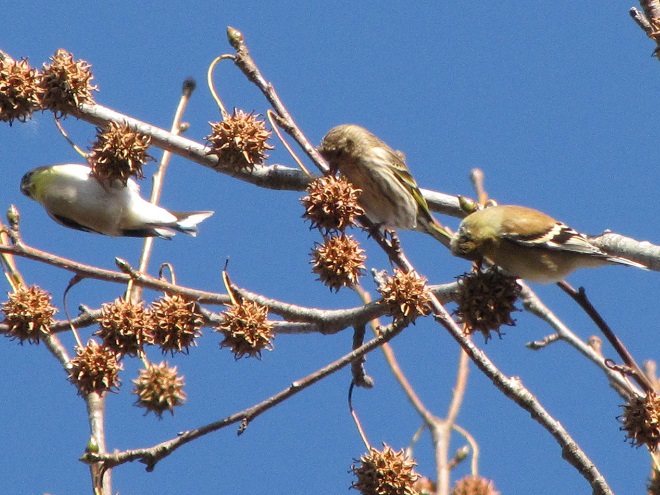
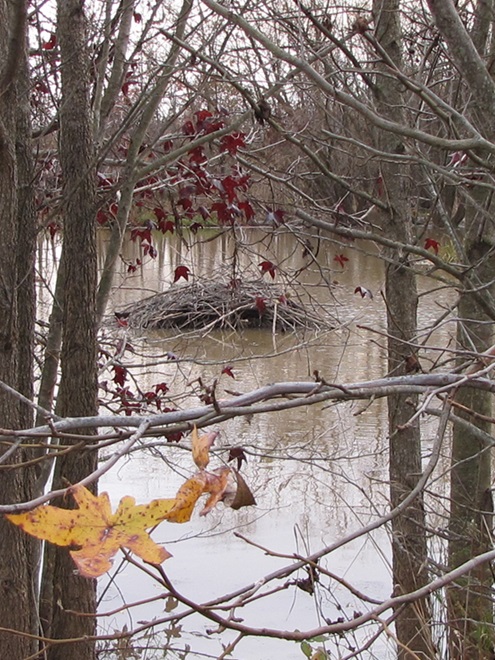
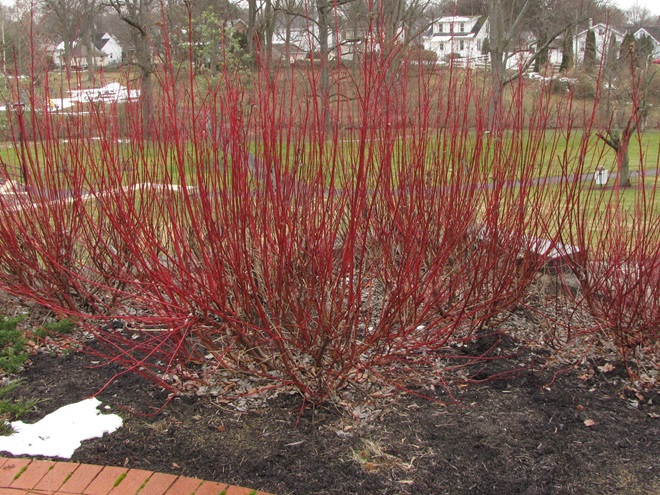
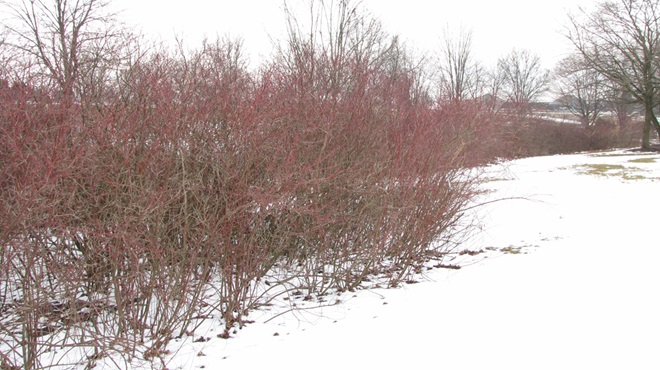
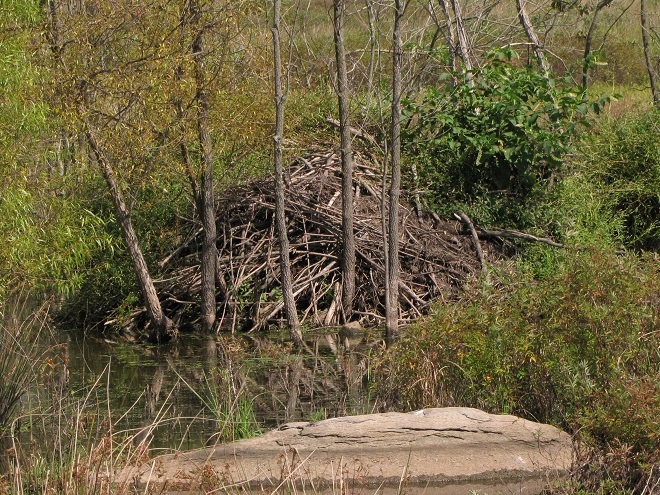
The Yellow Poplar, often called Tuliptree or Tulip Poplar for its showy flowers, is a sturdy, fast-growing deciduous tree native to forests throughout the Lower Susquehanna River Watershed. Its pole-straight growth habit in shady woodlands becomes more spreading and picturesque when the plant is grown as a specimen or shade tree in an urban or suburban setting. The Yellow Poplar can live for hundreds of years and is a host plant for the Eastern Tiger Swallowtail butterfly. It is available this year from the Lancaster County Conservation District.The American Sweetgum, also known as Sweet Gum, is a large, long-lived tree adorned with a mix of vibrant colors in autumn.Ever wonder where all the American Goldfinches and particularly the Pine Siskins go after passing through our region in fall? Well, many are headed to the lowland forests of the Atlantic Coastal Plain where they feed on an abundance of seeds contained in spiky American Sweetgum fruits. In the Piedmont and Ridge and Valley Provinces of the Lower Susquehanna River Watershed, American Sweetgum transplants can provide enough sustenance to sometimes lure our friendly finches into lingering through the winter.The American Sweetgum is a versatile tree. It can be planted on upland sites as well as in wet ground along streams, lakes, and rivers. In the beaver pond seen here it is the dominate tree species. This year, you can buy the American Sweetgum from the Lancaster County Conservation District.“Red-twig Dogwood” is a group of similar native shrubs that, in our region, includes Silky Dogwood and the more northerly Red-Osier Dogwood (Cornus sericea). Both have clusters of white flowers in spring and showy red twigs in winter. They are an excellent choice for wet soils. Landscapers often ruin these plants by shearing them off horizontally a foot or two from the ground each year. To produce flowers and fruit, and to preserve winter attractiveness, trim them during dormancy by removing three-year-old and older canes at ground level, letting younger growth untouched.“Red-twig Dogwoods” make ideal mass plantings for streamside buffers and remain showy through winter, even on a gloomy day. They not only mitigate nutrient and sediment pollution, they provide excellent food and cover for birds and other wildlife. Both Silky and Red-osier Dogwoods are available for sale through the Lancaster County Conservation District as part of their special multi-species offers, the former is included in its “Beauty Pack” and the latter in its “Wildlife Pack”. The similar Gray Dogwood (Cornus racemosa) is being offered for sale by the York County Conservation District.
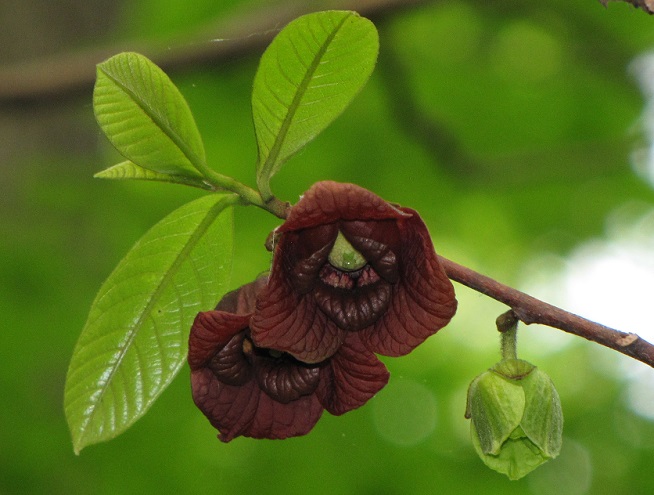
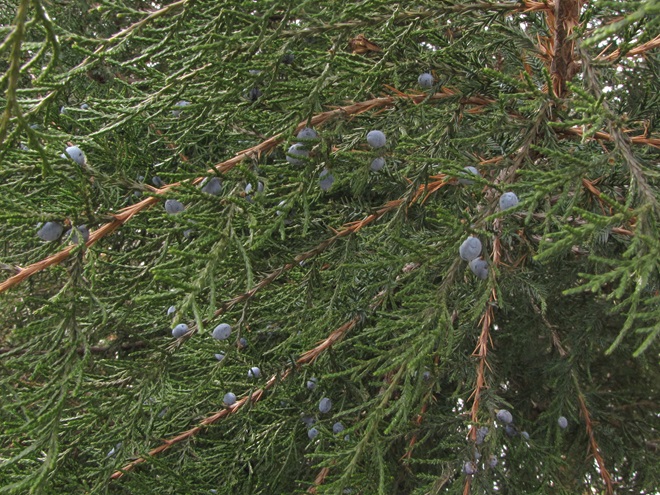
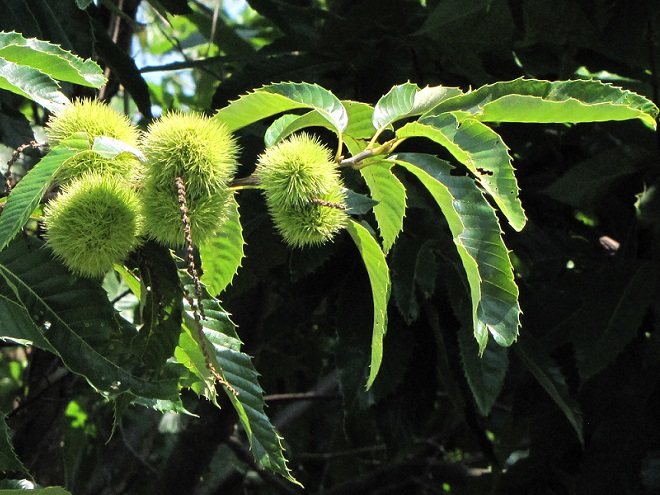
The unique maroon flowers of the Common Pawpaw produce banana-like fruits in summer. These small native trees grow best in damp, well-drained soils on slopes along waterways, where they often form clonal understory patches. To get fruit, plant a small grove to increase the probability of pollination. The Common Pawpaw is a host plant for the Zebra Swallowtail butterfly. It is available through both the Lebanon and Lancaster County sales.The Eastern Red Cedar provides excellent food, cover, and nesting sites for numerous songbirds. Planted in clumps of dozens or groves of hundreds of trees, they can provide winter shelter for larger animals including deer and owls. The Eastern Red Cedar is being offered for purchase through both the Lebanon and Lancaster County Conservation Districts.Care to try your hand at raising some chestnuts? Lebanon County Conservation District has hybrid American Chestnut seedlings for sale.Lebanon County Conservation District is offering Common Winterberry and Eastern White Pine during their 2024 Tree and Plant Sale. Plant them both for striking color during the colder months. Eastern White Pine is also available from the Cumberland, Dauphin, Lancaster, and York County sales.
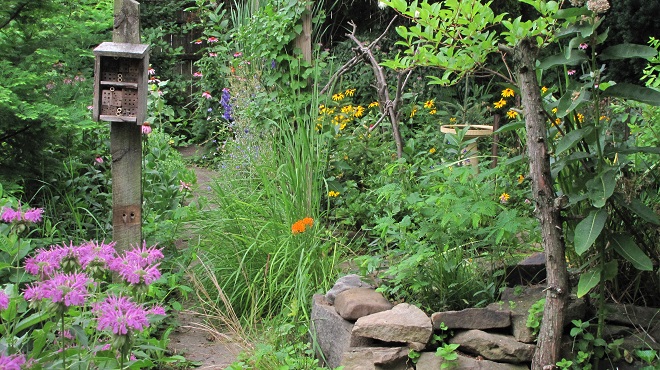
In addition to a selection of trees and shrubs, the Perry County Conservation District is again selling wildflower seed mixes for starting your own pollinator meadow or garden. For 2024, they have both a “Northeast Perennials and Annuals Mix” and a “Butterfly and Hummingbird Seed Mix” available. Give them a try so you can give up the mower!
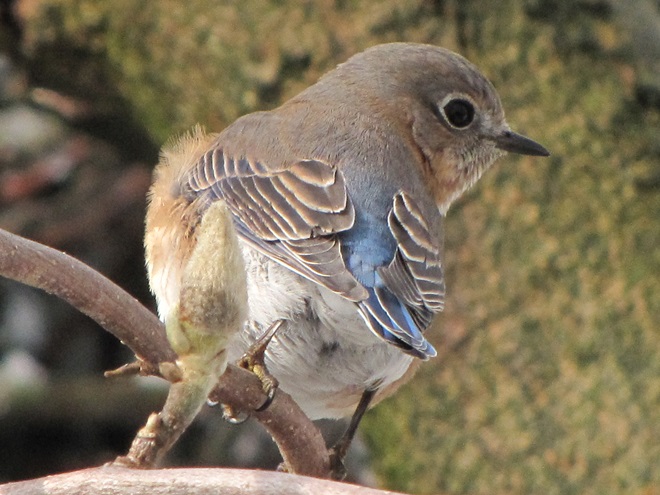
Again this year, Perry County is offering bluebird nest boxes for sale. The price?—just $12.00.
Wait, what?,…twelve bucks,…that’s cheaper than renting!
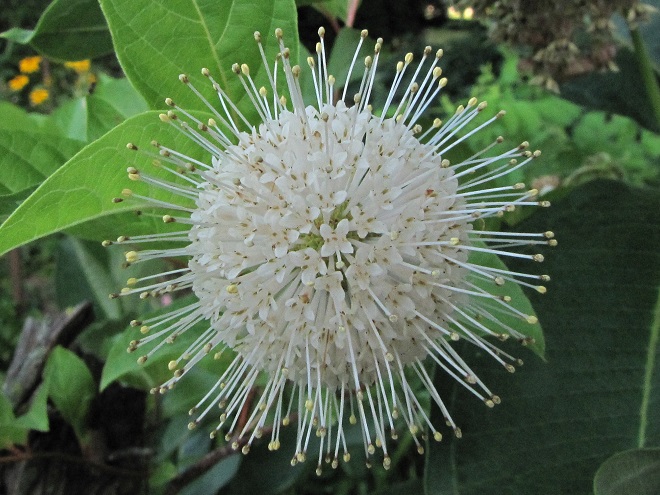
The Buttonbush, a shrub of wet soils, produces a cosmic-looking flower. It grows well in wetlands, along streams, and in rain gardens. Buttonbush seedlings are for sale from both the York and Lancaster County Conservation Districts.
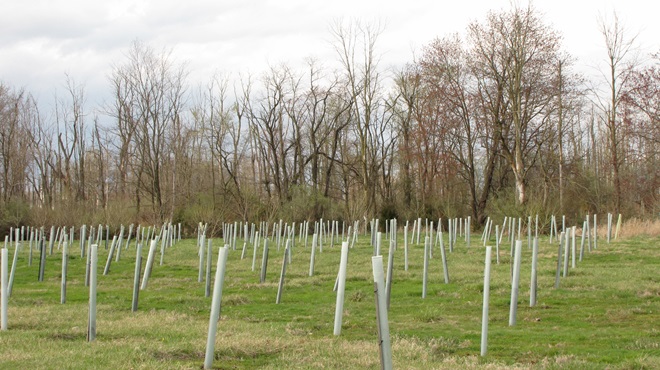
To get your deciduous trees like gums, maples, oaks, birches, and poplars off to a safe start, conservation district tree sales in Cumberland, Dauphin, Lancaster, and Perry Counties are offering protective tree shelters. Consider purchasing these plastic tubes and supporting stakes for each of your hardwoods, especially if you have hungry deer in your neighborhood.
Tree shelters protect newly transplanted seedlings from browsing deer, klutzy hikers, visually impaired mower operators, and other hazards.
There you have it. Be sure to check out each tree sale’s web page to find the selections you like, then get your order placed. The deadlines will be here before you know it and you wouldn’t want to miss values like these!
Since Tuesday’s snow storm, the susquehannawiildlife.net headquarters garden continues to bustle with bird activity.
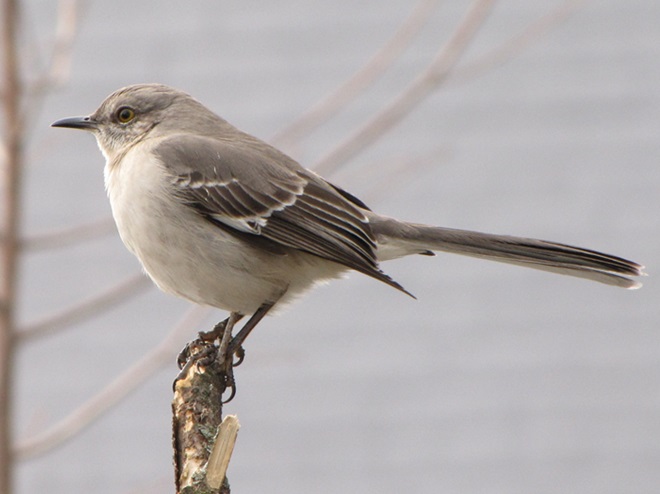
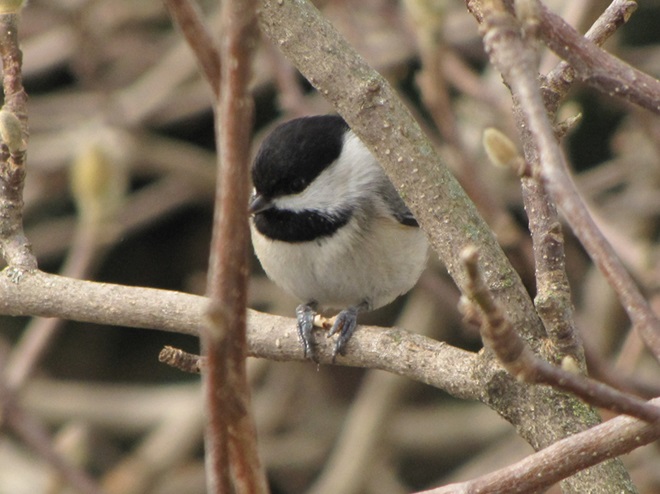
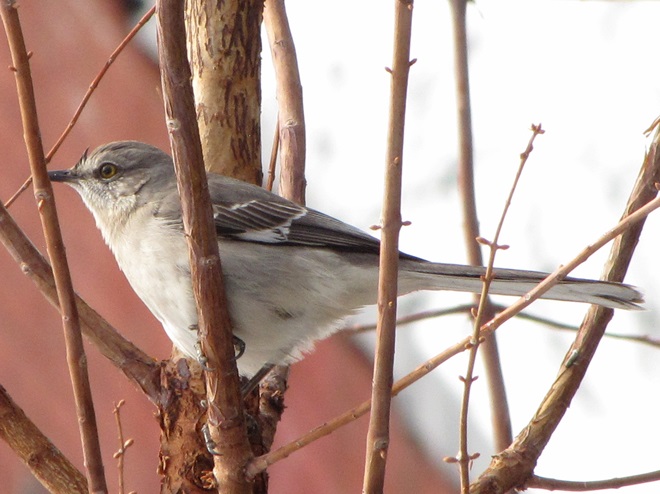
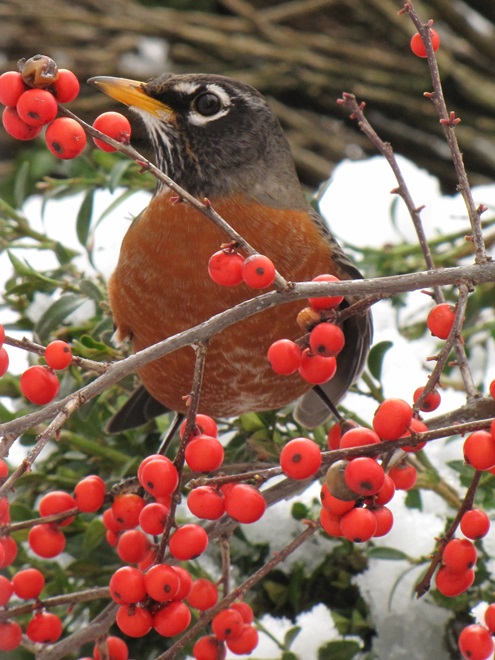
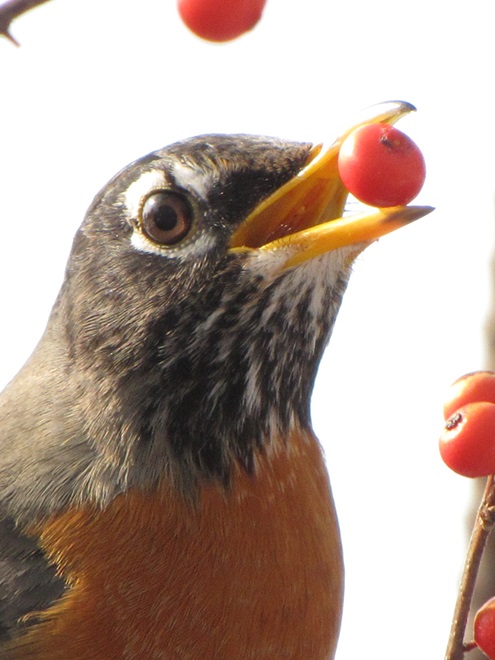
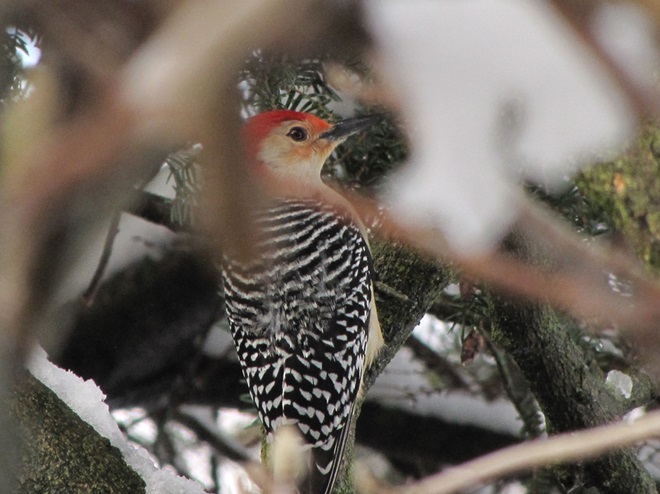
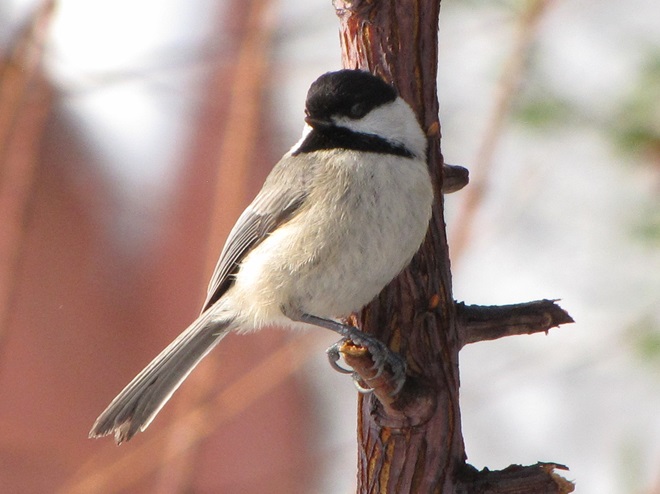
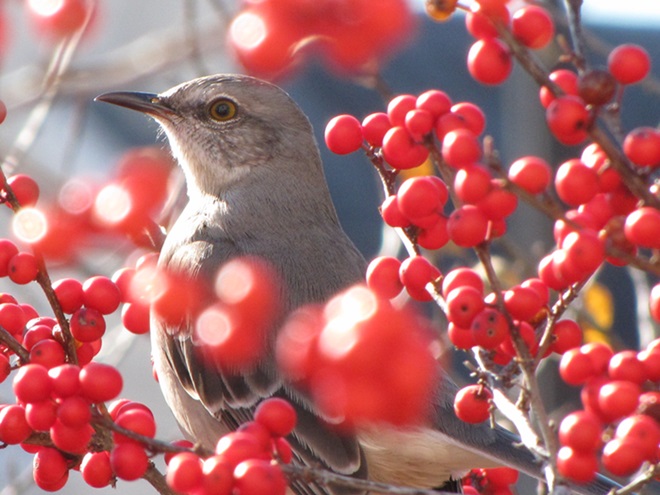
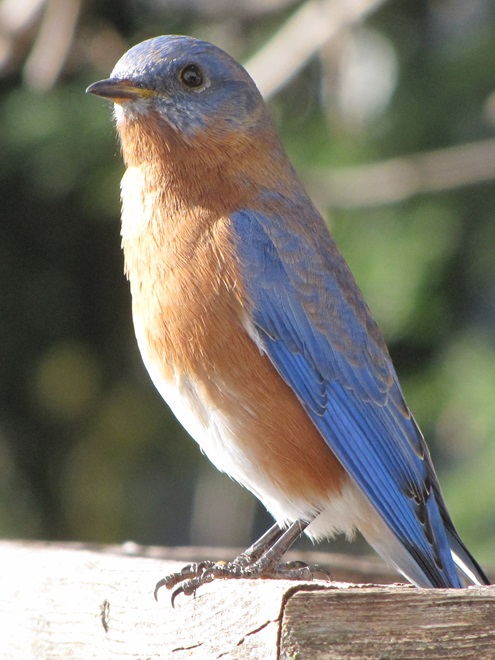
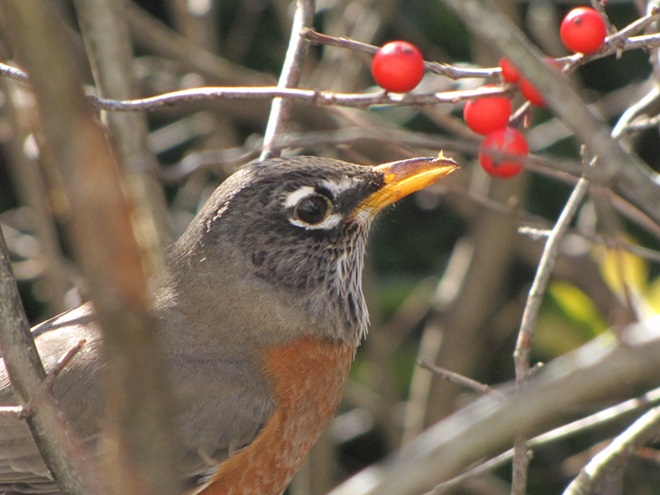
Our Northern Mockingbird remains ever vigilant in its attempts to discourage American Robins and Eastern Bluebirds from feeding on the berry crop. Slowly, the latter species are winning the contest.A Carolina Chickadee carefully dissects a sunflower seed to snack on the nutritious kernel.This beauty shows us that yes, Red-bellied Woodpeckers do indeed have red bellies.Getting energized for a big move north, the robins keep on gulping berries.
Today, there arrived three species of birds we haven’t seen here since autumn. These birds are, at the very least, beginning to wander in search of food. Then too, these may be individuals creeping slowly north to secure an advantage over later migrants by being the first to establish territories on the most favorable nesting grounds.
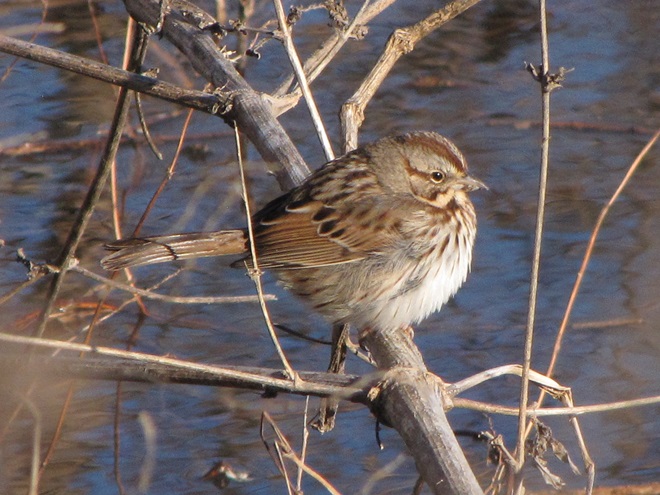
This Song Sparrow is the first we’ve seen in the garden since sometime last fall. Is it working its way north or did it just come to town in search of food?Northern Flickers regularly spend the winter in small numbers in the Lower Susquehanna River Watershed. This is the first one we’ve had visit the garden since late last autumn.Fish Crows, seen here feeding on the fruits adorning an Eastern Red Cedar, have returned after being absent in our neighborhood since November. In coming weeks, both they and the more numerous American Crows that remained through winter will begin constructing nests in nearby trees.
They say the early bird gets the worm. More importantly, it gets the most favorable nesting spot. What does the early birder get? He or she gets out of the house and enjoys the action as winter dissolves into the miracle of spring. Do make time to go afield and marvel a bit, won’t you? See you there!
In mid-February each year, large numbers of American Robins descend upon the susquehannawildlife.net headquarters garden to feast on the ripe fruits that adorn several species of our native shrubs and trees. This morning’s wet snowfall provided the needed motivation for these birds and others to make today the big day for the annual feeding frenzy.
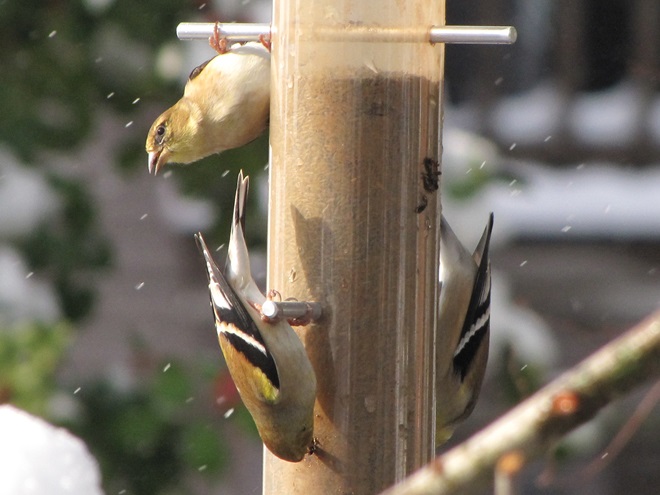
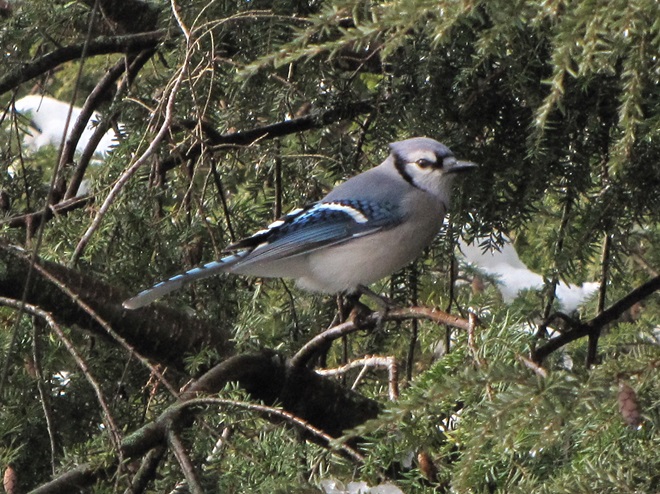
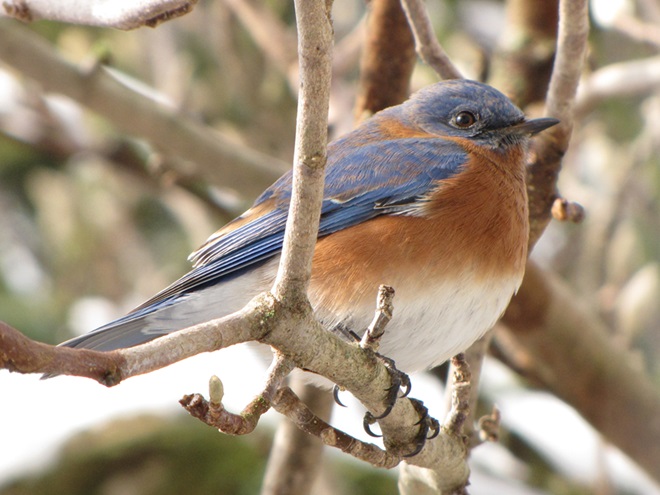
Early this morning, branches and limbs in the headquarters garden were loaded with clinging snow and more than one hundred American Robins.To have first grabs at suitable nesting sites, early American Robins are currently beginning to edge their way north. Spring migration is underway.The fruits of Common Winterberry are always a favorite of visiting robins.After selfishly guarding the garden’s berries through the entire season, our Northern Mockingbird finds chasing more than one hundred robins away from its food supply an impossible task.This and other visiting robins will strip the winterberry, cedar, American Holly, and other fruit-producing shrubs and trees within a day or two. To survive what remains of the season, our resident mockingbird will have to look elsewhere for provisions.Another American Robin devouring winterberry fruit.In addition to robins, there were, of course, other guests in the garden refuge on this snowy day.This Red-bellied Woodpecker tries to make sense of all the commotion.A pair of Carolina Chickadees established a family in the garden during the spring of 2023. At least five of the birds still stop by on a daily basis.As spring nears, our American Goldfinches are beginning to show a hint of their bright breeding colors.A Blue Jay peeks out from the cover of the Eastern Hemlocks.Our Carolina Wrens sing throughout the winter,……but today we noticed that this Mourning Dove has begun softly cooing to charm a mate……and the male House Finches are warbling away with the sounds of spring.With the local mockingbird busily harassing robins, our Eastern Bluebirds went unmolested long enough to stop by……for some raisins from their enclosed feeder.A showy male Eastern Bluebird on a snowy day in the garden. Spring must be just around the corner!
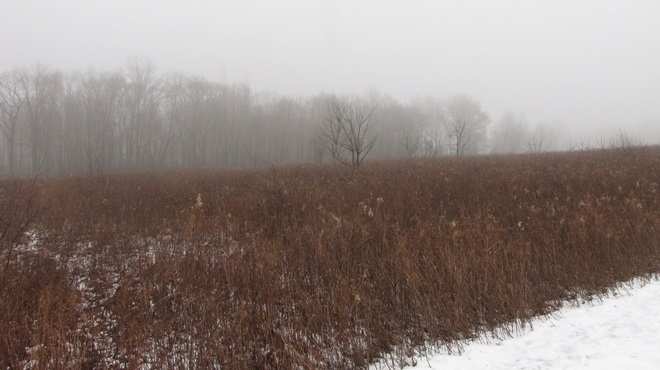
As week-old snow and ice slowly disappears from the Lower Susquehanna River Watershed landscape, we ventured out to see what might be lurking in the dense clouds of fog that for more than two days now have accompanied a mid-winter warm spell.
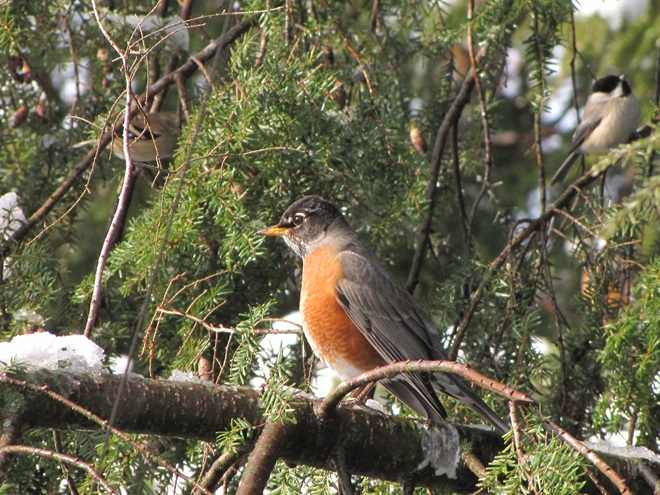
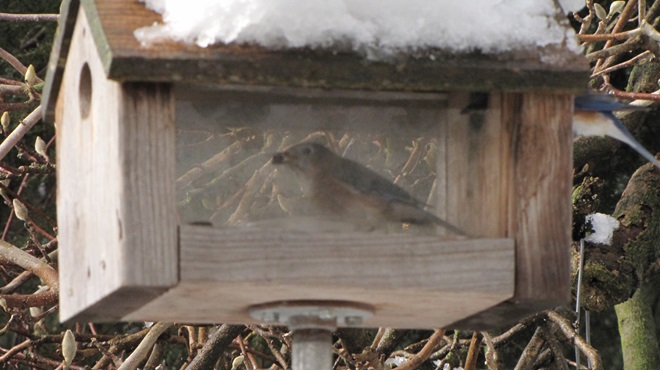
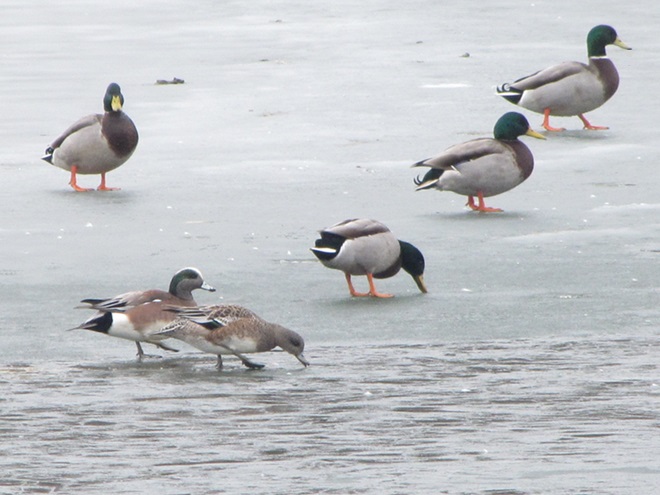
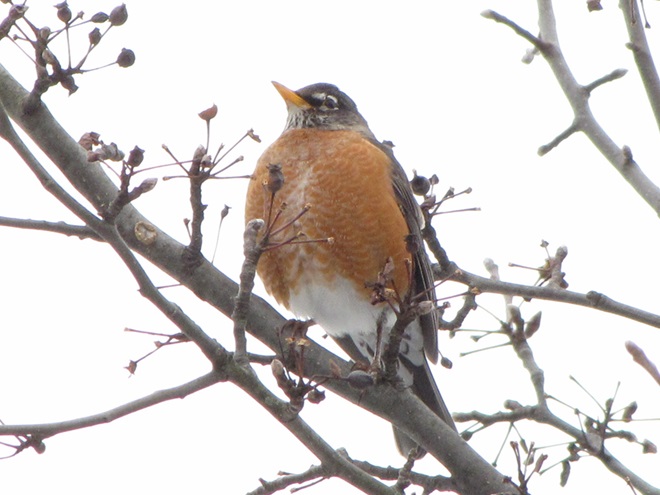
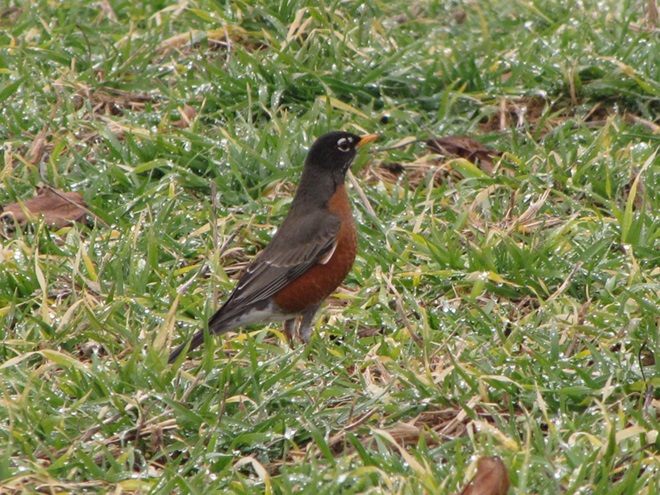
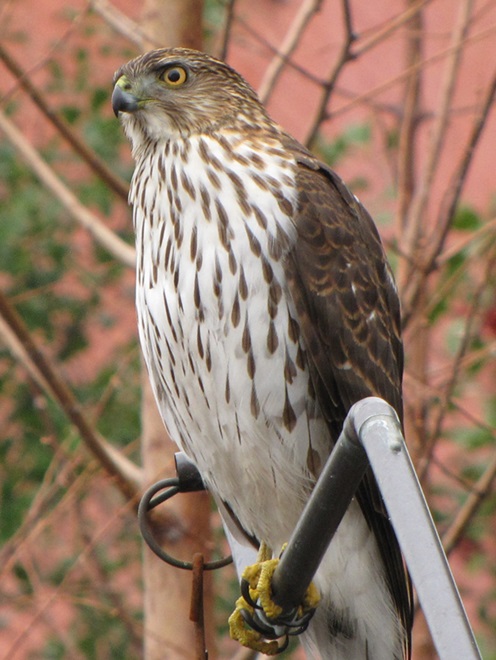
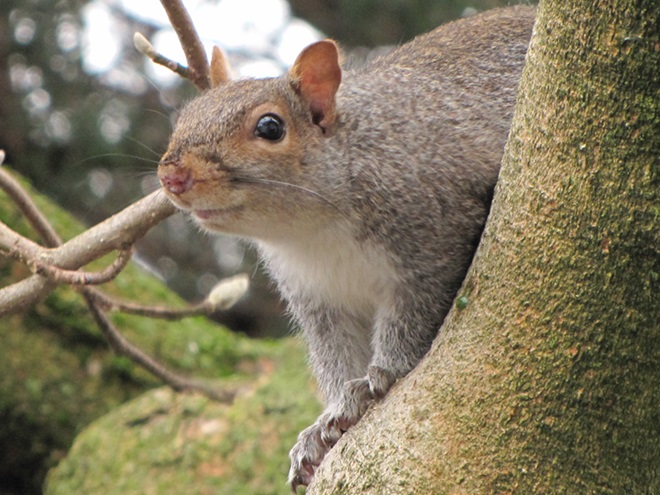
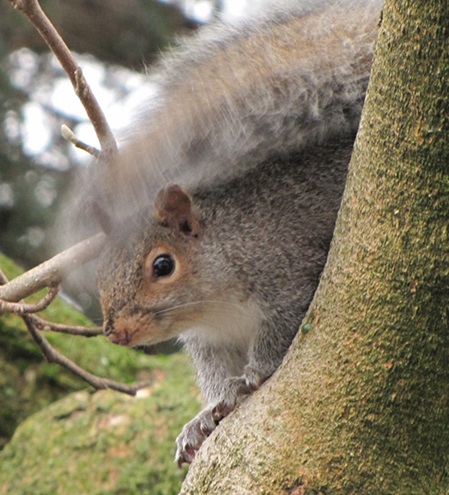
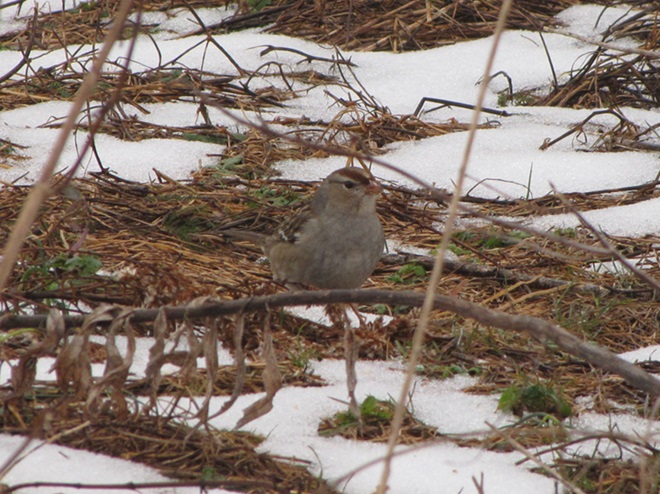
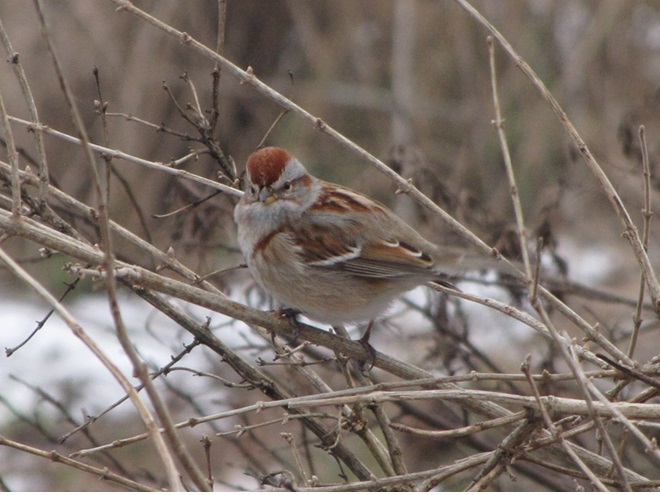
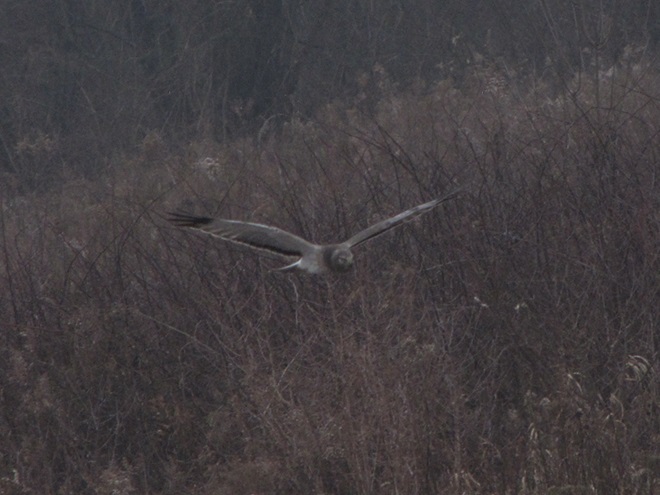
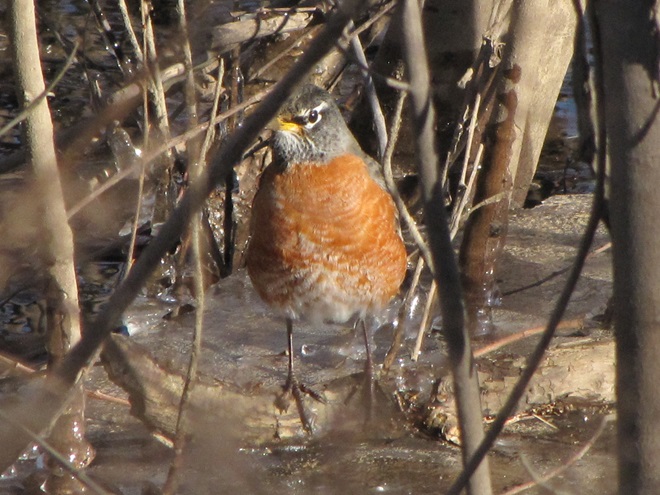
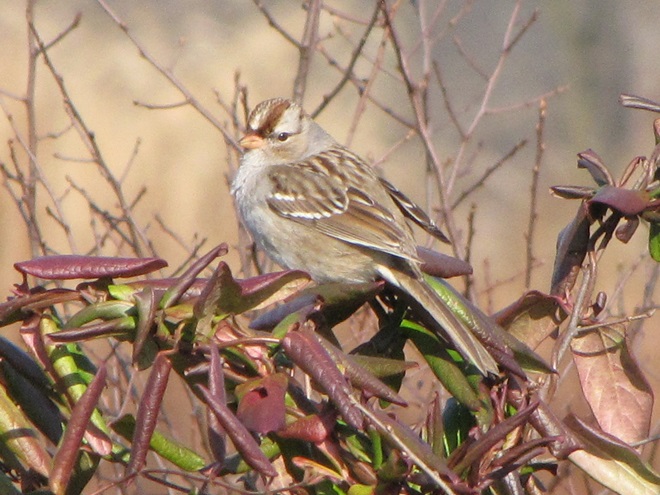
After freezing to a slushy consistency earlier this week, the Susquehanna is already beginning to thaw. Below the York Haven Dam at Conewago Falls, the water is open and ice-free.On frozen man-made lakes and ponds, geese and ducks like these Mallards and American Wigeon are presently concentrated around small pockets of open water.During the past ten days, American Robin numbers have exploded throughout the lower Susquehanna valley. The majority of these birds may be a mix of both those coming south to escape the late onset of wintry conditions to our north and those inching north into our region as early spring migrants.The January thaw has melted the snow from lawns and fields to provide thousands of visiting robins with a chance to forage for earthworms.A visit by this young Cooper’s Hawk to the susquehannnawildlife.net headquarters garden sent songbirds scrambling……but did nothing to unnerve our resident Eastern Gray Squirrels,……which promptly went into tail-waving mode to advertise their presence.But earlier in the week, when heavy snow cover in the rural areas surrounding our urbanized neighborhood made it difficult for rodent-eating raptors to find food, we received brief visits from both a Red-tailed Hawk……and this young Red-shouldered Hawk, an uncommon bird of prey most often found in wet woods and other lowlands.To escape notice during visits by these larger raptors, our squirrels remained motionless and commenced performance of their best bump-on-a-log impressions.Unimpressed, each of our visiting buteos remained for just a few minutes before moving on in search of more favorable hunting grounds and prey.As snow melted and exposed bare ground in fields of early successional growth, we encountered……a flock of White-crowned Sparrows, most in first-winter plumage……and at least a dozen American Tree Sparrows. During the twentieth century, these handsome songbirds were regular winter visitors to the lower Susquehanna region. During recent decades, they’ve become increasingly more difficult to find. Currently, moderate numbers appear to be arriving to escape harsher weather to our north.What could be more appropriate on a foggy, gray evening than finding a “gray ghost” (adult male Northern Harrier) patrolling the fields in search of mice and voles.
If scenes of a January thaw begin to awaken your hopes and aspirations for all things spring, then you’ll appreciate this pair of closing photographs…
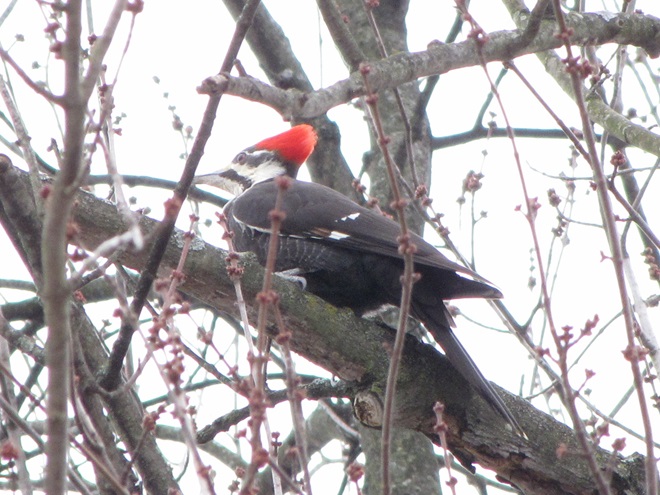
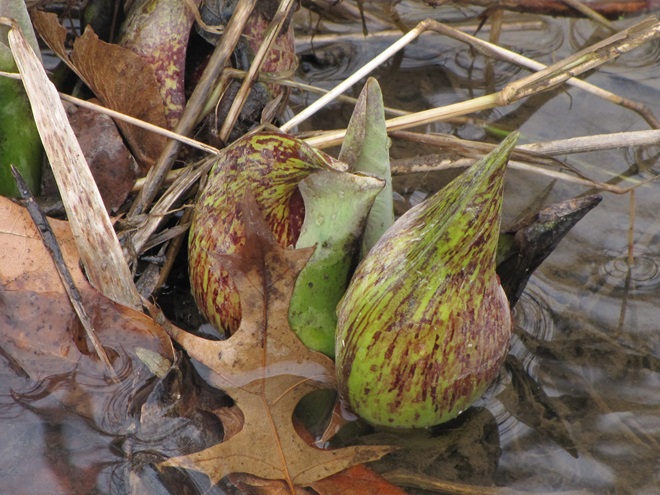
The maroon-red flower buds of Silver Maples are beginning to swell. And woodpeckers including Pileated Woodpeckers are beginning to drum, a timber-pounding behavior they use to establish breeding territories in habitats with suitable sites for cavity nesting.In wet soil surrounding spring seeps and streams, Skunk Cabbage is rising through the leaf litter to herald the coming of a new season. Spring must surely be just around the corner.
Just as bare ground along a plowed road attracts birds in an otherwise snow-covered landscape, a receding river or large stream can provide the same benefit to hungry avians looking for food following a winter storm.
Here is a small sample of some of the species seen during a brief stop along the Susquehanna earlier this week.
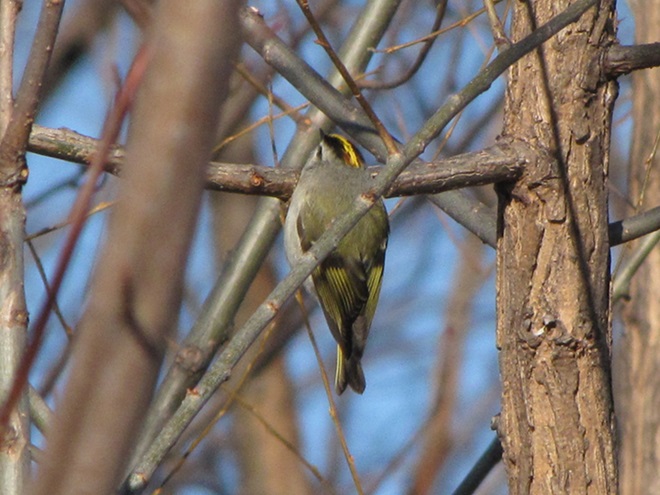
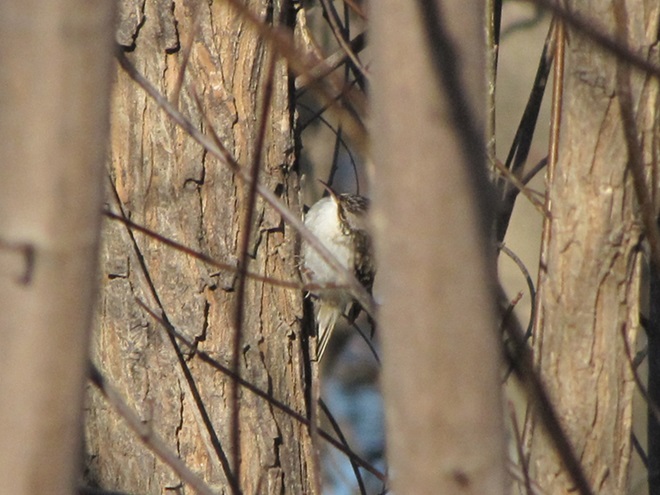
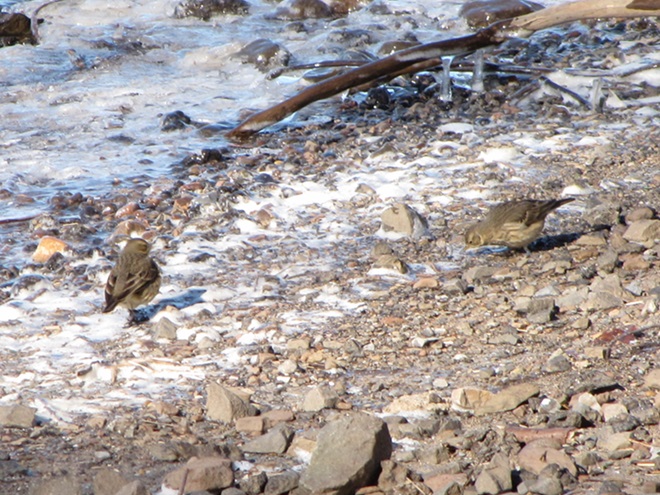
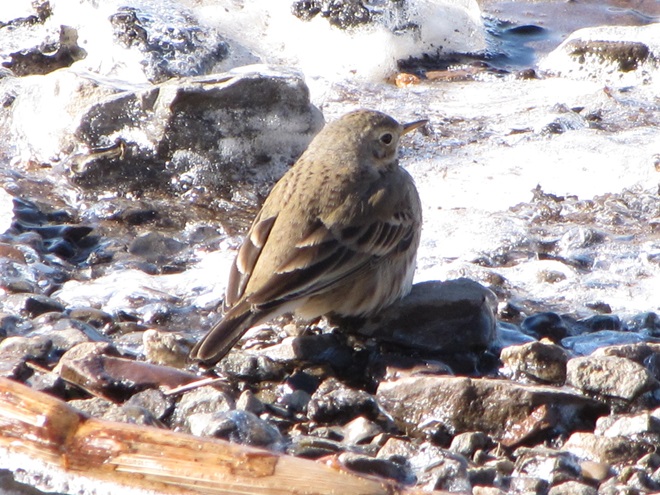
Along vegetated edges of the Susquehanna and its tributaries, the Song Sparrow is ubiquitous in its search for small seeds and other foods. As the river recedes from the effects of this month’s rains, the shoreline is left bare of more recently deposited snow cover. Song Sparrows and other birds are attracted to streamside corridors of frost-free ground to find sufficient consumables for supplying enough energy to survive the long cold nights of winter.Thousands of American Robins have been widespread throughout the lower Susquehanna valley during the past week. Due to the mild weather during this late fall and early winter, some may still be in the process of working their way south. Currently, many robins are concentrated along the river shoreline where receding water has exposed unfrozen soils to provide these birds with opportunities for finding earthworms (Lumbricidae) and other annelids.This Golden-crowned Kinglet was observed searching the trees and shrubs along the Susquehanna shoreline for tiny insects and spiders. Temperatures above the bare ground along the receding river can be a few degrees higher than in surrounding snow-covered areas, thus improving the chances of finding active prey among the trunks and limbs of the riparian forest.Not far from the kinglet, a Brown Creeper is seen searching the bark of a Silver Maple (Acer saccharinum) for wintering insects, as well as their eggs and larvae. Spiders in all their life stages are a favorite too.American Pipits not only inhabit farm fields during the winter months, they are quite fond of bare ground along the Susquehanna. Seen quite easily along a strip of pebbly shoreline exposed by receding water, these birds will often escape notice when spending time on mid-river gravel and sand bars during periods of low flow.An American Pipit on a bitterly cold afternoon along the Susquehanna.
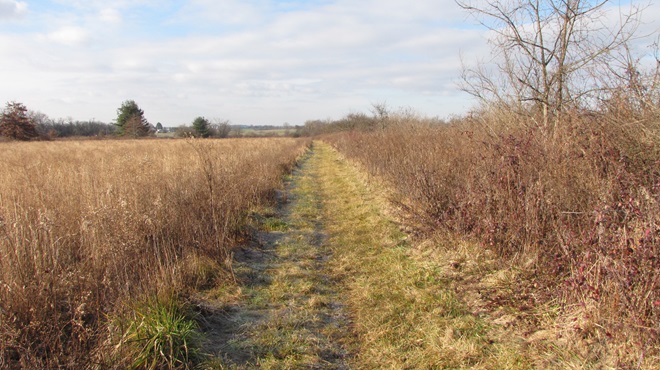
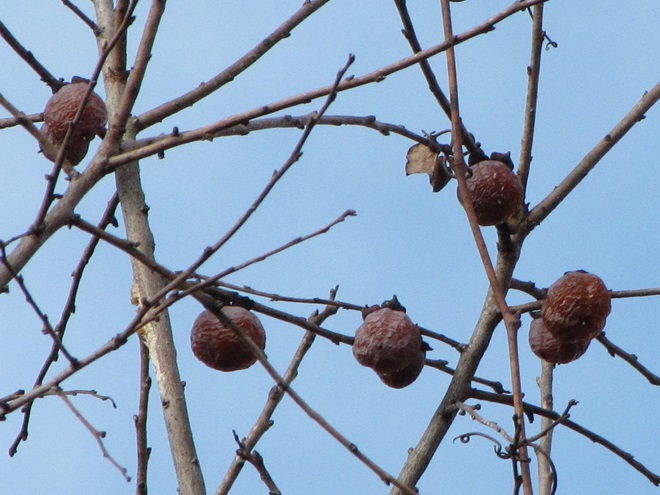
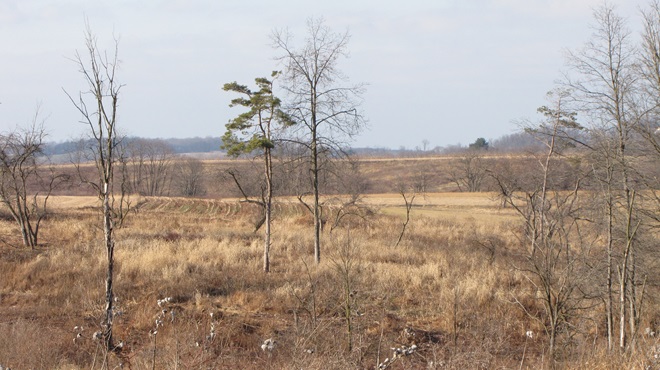
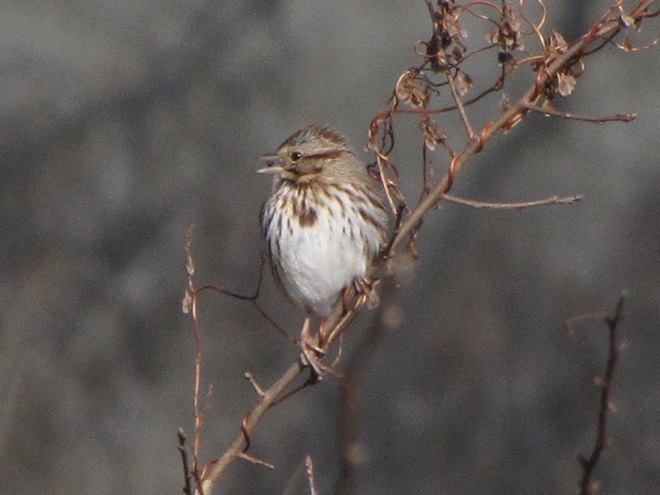
With the earth at perihelion (its closest approach to the sun) and with our home star just 27 degrees above the horizon at midday, bright low-angle light offered the perfect opportunity for doing some wildlife photography today. We visited a couple of grasslands managed by the Pennsylvania Game Commission to see what we could find…
On this State Game Lands parcel, prescribed fire is used to maintain a mix of grasslands and brushy early successional growth. In nearby areas, both controlled fire and mechanical cutting are used to remove invasive species from hedgerows and the understory of woodlots. Fire tolerant native species then have an opportunity to recolonize the forest and improve wildlife habitat. This management method also reduces the fuel load in areas with the potential for uncontrolled wildfires.The sun-dried fruits of a native Common Persimmon tree found growing in a hedgerow.Just one year ago, mechanical removal of invasive trees and shrubs (including Multiflora Rose) on this State Game Land was followed by a prescribed fire to create this savanna-like grassland.Hundreds of Song Sparrows were found in the grasses and thickets at both locations.White-throated Sparrows were also abundant, but prefer the tangles and shrubs of the thickets.Northern Mockingbirds were vigilantly guarding winter supplies of berries in the woodlots and hedgerows.In grasses and tangles on wetter ground, about a dozen Swamp Sparrows were discovered.The adult White-crowned Sparrow is always a welcome find.And seeing plenty of juvenile White-crowned Sparrows provides some assurance that there will be a steady stream of handsome adult birds arriving to spend the winter during the years to come.Dark-eyed Juncos were encountered only in the vicinity of trees and large shrubs.Several Savannah Sparrows were observed. Though they’re mostly found in treeless country, this particular one happened to pose atop a clump of shrubs located within, you guessed it, the new savanna-like grasslands.A tiny bird, even when compared to a sparrow, the Winter Wren often provides the observer with just a brief glimpse before darting away into the cover of a thicket.Within grasslands, scattered stands of live and dead timber can provide valuable habitat for many species of animals.Woodpeckers and other cavity-nesting birds rely upon an abundance of “snags” (standing dead trees) for breeding sites.This Red-bellied Woodpecker and about a dozen others were found in trees left standing in the project areas.A Yellow-bellied Sapsucker soaks up some sun.This very cooperative Pileated Woodpecker seemed to be preoccupied by insect activity on the sun-drenched bark of the trees. This denizen of mature forests will oft times wander into open country where larger lumber is left intact.
Just as things were really getting fun, some late afternoon clouds arrived to dim the already fading daylight. Just then, this Northern Harrier made a couple of low passes in search of mice and voles hidden in the grasses.It was a fitting end to a very short, but marvelously sunny, early winter day.
A glimpse of the rowdy guests crowding the Thanksgiving Day dinner table at susquehannawildlife.net headquarters…
A male White-breasted Nuthatch visits a peanut feeder……soon to be joined by a female White-breasted Nuthatch.A male Downy Woodpecker gets a bill full of suet.A Carolina Wren nibbles at a peanut.An Eastern Gray Squirrel stuffs itself on peanuts dropped by the birds.A territorial Northern Mockingbird stands guard over its supply of Common Winterberry fruit.To avoid the mockingbird’s aggression, the Eastern Bluebirds opted out of fresh fruit in favor of raisins offered at the feeders.This persistent American Robin has made an art of repeatedly sneaking in to quickly devour a few berries before being chased away by the vigilant mockingbird.After everyone has had their fill, Dark-eyed Juncos clean up the leftovers.
Recently, we found these Chestnut Oak acorns setting roots into the leaf litter to secure their place among the plants that will turn the forest understory green in the spring. Individual acorns that germinate soon after falling to the ground in autumn may avoid becoming food for squirrels, turkeys, deer, and other wildlife, thus increasing their chances of surviving to later become adult trees able to produce acorns that pass this quick-development trait to yet another generation of oaks.
Among the hardy wildflowers still in bloom in the forests of the lower Susquehanna valley is the Blue Wood Aster (Symphyotrichum cordifolium), a variable species also known as the Heart-leaved Aster.
It looks like Uncle Tyler Dyer had a fun-filled Halloween. Earlier this afternoon, we caught him drifting off into a nap during his work to make updates to his leaf scans. As he snoozed away, we found these lying on the floor next to his easy chair and decided to lend a hand by adding them to his collection. We’ll see how long it takes him to discover our dirty little deed. You can have a look at our mischief by clicking on the “Trees, Shrubs, and Woody Vines” tab at the top of this page.
Where should you go this weekend to see vibrantly colored foliage in our region? Where are there eye-popping displays of reds, oranges, yellows, and greens without so much brown and gray? The answer is Michaux State Forest on South Mountain in Adams, Cumberland, and Franklin Counties.
South Mountain is the northern extension of the Blue Ridge Section of the Ridge and Valley Province in Pennsylvania. Michaux State Forest includes much of the wooded land on South Mountain. Within or adjacent to its borders are located four state parks: King’s Gap Environmental Education Center, Pine Grove Furnace State Park, Caledonia State Park, and Mont Alto State Park. The vast network of trails on these state lands includes the Appalachian Trail, which remains in the mountainous Blue Ridge Section all the way to its southern terminus in Georgia.
In Pennsylvania, the forested highlands of the Blue Ridge Section of the Ridge and Valley Province are known as South Mountain. Much of South Mountain lies within the boundaries of Michaux State Forest. Stars indicate the locations of 1) King’s Gap Environmental Education Center, 2) Pine Grove Furnace State Park, 3) Caledonia State Park, and 4) Mont Alto State Park. A drive on US 30 between Gettysburg and Chambersburg will take you right through Michaux State Forest along an east to west axis while a scenic northbound or southbound trip along PA 233 will bring you in proximity to each of the state parks located therein. (Base image from NASA Earth Observatory Collection)
If you want a closeup look at the many species of trees found in Michaux State Forest, and you want them to be labeled so you know what they are, a stop at the Pennsylvania State University’s Mont Alto arboretum is a must. Located next door to Mont Alto State Park along PA 233, the Arboretum at Penn State Mont Alto covers the entire campus. Planting began on Arbor Day in 1905 shortly after establishment of the Pennsylvania State Forest Academy at the site in 1903. Back then, the state’s “forests” were in the process of regeneration after nineteenth-century clear cutting. These harvests balded the landscape and left behind the combustible waste which fueled the frequent wildfires that plagued reforestation efforts for more than half a century. The academy educated future foresters on the skills needed to regrow and manage the state’s woodlands.
Online resources can help you plan your visit to the Arboretum at Penn State Mont Alto. More than 800 trees on the campus are numbered with small blue tags. The “List of arboretum trees by Tag Number” can be downloaded to tell you the species or variety of each. The interactive map provides the locations of individual trees plotted by tag number while the Grove Map displays the locations of groups of trees on the campus categorized by region of origin. A Founder’s Tree Map will help you find some of the oldest specimens in the collection and a Commemorative Tree Map will help you find dedicated trees. There is also a species list of the common and scientific tree names.
The Yellow Buckeye (Aesculus flava) is a tree found in the forests of the Blue Ridge Section of the Ridge and Valley Province in West Virginia, Virginia, North Carolina and Georgia. You can see it in Pennsylvania by visiting the collection of trees in the Arboretum at Penn State Mont Alto.The American Chestnut can be difficult to find due to the impact of chestnut blight, but you can see it in the Arboretum at Penn State Mont Alto.Shagbark Hickory is a common tree in the forests of South Mountain.The Sweet Cherry (Prunus avium), a native of Europe, is naturalized throughout eastern and south-central Pennsylvania and is one of the more than 150 species of trees in the arboretum’s collection.Sweet Birch (Betula lenta) foliage is particularly bright yellow on South Mountain this autumn. It really “pops” against the backdrop of the evergreen Eastern White Pines and Eastern Hemlocks. During less-than-ideal years, Sweet Birch leaves can subtly transition from green to drab brown without much fanfare before falling.You might have a difficult time finding a Common Persimmon (Diospyros virginiana) growing wild in Pennsylvania, but you can find it in the Arboretum at Penn State Mont Alto.
The autumn leaves will be falling fast, so make it a point this weekend to check out the show on South Mountain.
Last October 3rd, a late-season Ruby-throated Hummingbird stopped by the garden at susquehannawildlife.net headquarters to take shelter from a rainy autumn storm. It was so raw and chilly that we felt compelled to do something we don’t normally do—put out the sugar water feeder to supplement the nectar produced by our fall-flowering plants. After several days of constant visits to the feeder and the flowers, our lingering hummer resumed its southbound journey on October 7th.
Fast forward to this afternoon and what do you know, at least two migrating hummingbirds have stopped by to visit the flowers in our garden. This year, we have an exceptional abundance of blooms on some of their favorite plants. In the ponds, aquatic Pickerelweed is topped with purple spikes and we still have bright orange tubular flowers on one of our Trumpet Vines—a full two to three months later than usual.
We checked each of our late-season visitors carefully to be reasonably certain that none was a stray western species of hummingbird. All appear to be female or juvenile “Ruby-throats”. If you have an abundance of flowering plants and/or you’re going to maintain your hummingbird feeders through the coming weeks, be on the lookout for western species. Most are more hardy than our Ruby-throats and some have remained in the lower Susquehanna valley through the winter.As is typically the case, Ruby-throated Hummingbirds quickly gravitate toward the tubular flowers of our Cuphea ignea, the Mexican Cigar. They find these showy plants to be absolutely irresistible.Mexican Cigar grows wild in parts of the Ruby-throated Hummingbird’s winter range. To them, it’s comfort food.We’re trying some new cultivars of Cuphea to see how they do. As this composite image shows, the hummingbirds won’t let our Bat-faced Cuphea (Cuphea llavea) alone. It’s another plant native to Mexico and Central America, right where some of our hummingbirds spend the winter.
Remember, keep those feeders clean and the provisions fresh! You’ll be glad you did.
What’s all this buzz about bees? And what’s a hymanopteran? Well, let’s see.
Hymanoptera—our bees, wasps, hornets and ants—are generally considered to be our most evolved insects. Some form complex social colonies. Others lead solitary lives. Many are essential pollinators of flowering plants, including cultivars that provide food for people around the world. There are those with stingers for disabling prey and defending themselves and their nests. And then there are those without stingers. The predatory species are frequently regarded to be the most significant biological controls of the insects that might otherwise become destructive pests. The vast majority of the Hymanoptera show no aggression toward humans, a demeanor that is seldom reciprocated.
Late summer and early autumn is a critical time for the Hymanoptera. Most species are at their peak of abundance during this time of year, but many of the adult insects face certain death with the coming of freezing weather. Those that will perish are busy, either individually or as members of a colony, creating shelter and gathering food to nourish the larvae that will repopulate the environs with a new generation of adults next year. Without abundant sources of protein and carbohydrates, these efforts can quickly fail. Protein is stored for use by the larval insects upon hatching from their eggs. Because the eggs are typically deposited in a cell directly upon the cache of protein, the larvae can begin feeding and growing immediately. To provide energy for collecting protein and nesting materials, and in some cases excavating nest chambers, Hymanoptera seek out sources of carbohydrates. Species that remain active during cold weather must store up enough of a carbohydrate reserve to make it through the winter. Honey Bees make honey for this purpose. As you are about to see, members of this suborder rely predominately upon pollen or insect prey for protein, and upon nectar and/or honeydew for carbohydrates.
We’ve assembled here a collection of images and some short commentary describing nearly two dozen kinds of Hymanoptera found in the Lower Susquehanna River Watershed, the majority photographed as they busily collected provisions during recent weeks. Let’s see what some of these fascinating hymanopterans are up to…
SOLITARY WASPS
A Great Black Wasp on goldenrod (Solidago species). Like other solitary wasps, a female Great Black Wasp will sting and paralyze a host insect upon which she’ll deposit her eggs. After hatching, the larvae will begin consuming the host’s body as a source of protein. The parasitized insects are often katydids or grasshoppers.A Great Black Wasp feeding on nectar, a source of carbohydrates. Unlike social bees and wasps, solitary wasps are equipped with a stinger solely used for immobilizing prey, not defending a nest. They are therefore quite docile and pose little threat to humans.A Great Black Wasp powdered with pollen. Hymanopterans that gather nectar and/or pollen are tremendously important pollinators of hundreds of species of plants.A female Thread-waisted wasp (Ammophilia species, probably A. nigricans) drags a paralyzed caterpillar to her excavated nest where she’ll deposit an egg on the body. After hatching, the larval wasp will feed on the disabled caterpillar. The protein will enable the larvae to grow, pupate, and later emerge as an adult wasp.The female Eastern Cicada Killer (Sphecius speciosus) excavates an underground nest with branch tunnels connecting a dozen chambers or more. As the common name suggests, the female wasp paralyzes a cicada, then makes a strenuous effort to fly and drag it back to the nest for placement in a cell. Each male wasp egg is deposited upon just one immobilized cicada, but a female egg is provided with a cache of several cicadas to provide adequate protein for growth to a larger size. Nest cells are sealed with soil, then the larvae hatch in just a couple of days. Within about two weeks, they have consumed the cicada protein and are fully grown. Wrapped in a cocoon, they spend the winter in the nest, then pupate in the spring before emerging as a new generation of adults.The Black-and-yellow Mud Dauber (Sceliphron caementarium) builds a mud-ball nest within which it packs paralyzed spiders to function as a source of protein for its larvae.A Black-and-yellow Mud Dauber at nest.The Pipe Organ Mud Dauber builds this elaborate nest in which their eggs and paralyzed spiders are deposited in cells sealed with mud partitions. After consuming the spiders, the larvae pupate, overwinter, then emerge from their cells as adults during the following spring. To escape the protection of the nest, the new generation of adults bore through the mud walls. Adult Pipe Organ Mud Daubers resemble the Great Black Wasp, but have a white or yellow distal segment on their rear legs resembling a pair of light-colored socks.A closeup of the previous image with the lengths of the nest tubes compressed to show four scavenger flies (Miltogramminae), possibly two species, that have invaded this Pipe Organ Mud Dauber nest. Scavenger flies are kleptoparasites that victimize various solitary bees and wasps, depositing larvae directly into the host species’ nest cells to consume the protein cache stored therein.
CUCKOO WASPS
Cuckoo Wasps (Chrysididae), also known as Emerald Wasps, parasitize the nests of other species of wasps. Females lay their eggs inside the host’s nest, then flee the scene. Upon hatching, larval Cuckoo Wasps feed on stockpiles of prey intended for the host species’ offspring. Like the adult mud daubers that have already matured and departed this nest by digging a hole through the wall of the cell within which they were hatched, the metallic green Cuckoo Wasp in the upper left has just emerged in much the same way.
SWEAT BEES
A Sweat Bee (Lasioglossum species) collecting nectar and pollen on White Snakeroot (Ageratina altissima).Sweat Bees (Lasioglossum species) visit human skin to lick up the electrolytes left behind by evaporating perspiration.Sweat Bees in the genus Lasioglossum demonstrate various social behaviors ranging from species that are solitary nesters to those that create colonies with work forces ranging in size from as few as four to as many as hundreds of bees. Some Lasioglossum practice kleptoparasitism, while others are quite accomplished foragers.A female Augochlorine Green Sweat Bee (Augochlorini) collecting nectar on White Snakeroot. Notice the pollen “baskets” on the rear leg.An Augochlorine Green Sweat Bee (Augochlorini). Sweat bees nest in subterranean cavities and in hollowed out sections of trees.A copper-colored Augochlorine Green Sweat Bee (Augochlorini) collecting nectar and dusted with pollen.
LEAFCUTTER AND MASON BEES
A Leafcutter Bee (Megachile species). Like Mason Bees, female Mason Bees deposit each of their eggs on a “pollen loaf” within an individual cell inside a preexisting tunnel-like cavity in wood, stone, or in the ground. Unlike Mason Bees, female Leafcutter Bees cut a circular piece of leaf to create each of the cells in their nest. After hatching, the larval bee feeds on the pollen loaf, pupates, then emerges from the shelter of the nest to start a new generation, usually during the following year.A Leafcutter Bee (Megachile species) visiting Wild Bergamot. Female Leafcutter and Mason Bees lack pollen “baskets” on their rear legs but instead have pollen “brushes” on the underside of the abdomen to gather the protein they need to create a “pollen loaf” for each nest cell.A Leafcutter Bee (Megachile species) collecting nectar from White Snakeroot.A Mason Bee (Osmia species) emerging from a nest in spring. Mason Bees create nesting cells within preexisting cavities in wood, stone, and other other supporting structures. Within the nest cavity, each egg is deposited atop a cache of pollen and nectar, a pollen loaf, then enclosed behind a partition of mud. The female Mason Bee will usually repeat this process until an entire cavity is filled with cells. During the following spring, a new generation of adult Mason Bees digs its way through the cell walls to emerge and repeat the process. These bees readily use paper straws or holes drilled in blocks of wood for nesting.A mason bee nest box with holes drilled into blocks of wood.Mason Bees seal each cell and the outer end of their nest cavity with mud. These outer nest cells can been parasitized by a variety of wasps. Here, the outer cell of a Mason Bee nest has been victimized by a tiny chalcid wasp (looks like another one to the lower left). Several species of female chalcid wasps (native Monodontomerus species or non-native Pteromalus venustus) enlarge weak points in the outer partition of a mason bee nest, then sting and paralyze the larval bee inside before depositing their eggs. Within the cell. the wasp larvae consume the larval Mason Bee and the “pollen loaf” provided for its growth. These same parasitic wasps prey upon Leafcutter Bees as well.
BUMBLE BEES, CARPENTER BEES, HONEY BEES, AND DIGGER BEES
A Common Eastern Bumble Bee (Bombus impatiens) collecting nectar and pollen on goldenrod. Bumble bees are our sole native group of social bees. Their wax nests are built in a burrow or other shelter. The eggs are deposited in cells along with a supply of pollen for nourishing the larvae upon hatching. Honey is stored in “honey pots” within the nest. New queens are produced along with male bees during the late-summer and fall. Only the new generation of fertilized queens survive the winter to lay eggs and produce workers to construct a new nest.A pair of Common Eastern Bumble Bees collecting nectar and becoming dusted with pollen. Their fuzzy coats and semi-warm-blooded metabolism allows them to be active in cooler weather than is tolerated by other bees.Flowering plants including the Great Rhododendron find success attracting pollinators to their reproductive blossoms by offering carbohydrate-rich nectar to insects like this Eastern Bumble Bee. The yellow spots on the flower’s upper petal help to guide visitors toward their sweet treat.An Eastern Carpenter Bee feeding on goldenrod nectar. Compare the almost hairless abdomen to that of the bumble bees. Carpenter bees are semi-social insects. Females lay their eggs in cells within galleries bored into wood. These nests are completed with great precision, avoiding creation of any second entrance by mistakenly breaching the outer surface of the excavated wood. Each egg/larvae is provided with a supply of protein-rich pollen. Males often hover outside their mate’s nest to prevent competing males from entering the area.A worker Honey Bee, a female member of a sisterhood of foragers from a nearby hive, visits goldenrod alongside Common Eastern Bumble Bees. Honey Bees were brought to North America during the 1620s, the earliest years of the trans-Atlantic migration of European colonists, to pollinate cultivated plants and to provide a reliable source of honey and beeswax. Within the Honey Bee’s social structure, the queen of each hive lays the eggs to produce the female worker bees. Once each year, male drones are produced along with a new generation of queens.In nature, Honey Bees build hives in tree cavities. Recently, this colony constructed a hive in a screech owl nest box at susquehannawildlife.net headquarters. To provide protein for the hatching larvae, worker bees collect pollen and deposit it within the hexagonal cells of the vertically aligned beeswax combs. After an egg is deposited upon the pollen cache, each cell is sealed with more beeswax. Young females tend these nest combs before maturing and becoming foraging worker bees.In apiculture, Honey Bees are raised in man-made hives. This Pennsylvania Association of Beekeepers display gives visitors to the Pennsylvania Farm Show in Harrisburg a look at the inner workings of a live bee hive. Nectar collected by worker bees is turned into honey to provide the supply of carbohydrates needed to fuel the colony through the winter. Note the honeycombs on the glass.A possible Small Carpenter Bee (Ceratina species) visiting White Snakeroot. Small Carpenter Bees nest inside hollow stems and twigs. Some species are eusocial, with a queen’s daughters and sisters sharing responsibility for finding food and rearing the young. Females overwinter inside a one of the excavated stems and begin a new nest there in the spring.A Digger Bee (possibly Melissodes species) with “pollen baskets” full of pollen collected from nearby flowers. Digger Bees in the genus Melissodes are often known as the Long-horned Bees. These social insects excavate underground nests and many species practice communal living.
SCOLIID WASPS
The Two-spotted Scoliid Wasp (Scolia dubia), also known as the Blue-winged Scoliid Wasp, is most frequently observed feeding on nectar. Scoliid wasps are solitary nesters, though they may assemble into groups while visiting flowers. They often ignore the presence of humans and are seldom disturbed by their presence. Females seek out the burrowing grubs of beetles including the Green June Bug (Cotinis nitida) and possibly the Japanese Beetle. After stinging a grub to paralyze it, the wasp will deposit her egg on its body, then bury it. Upon hatching, the larval wasp will feed on the grub for nourishment as it grows.Don’t like having your watermelon overrun by Green June Bugs while you’re eating? Then you ought to go out of your way to be nice to the Two-spotted Scoliid Wasp.The Double-banded Scoliid (Scolia bicincta) parasitizes beetle larvae as hosts for its larvae. For carbohydrates it relishes flower nectar.
PAPER WASPS
A Northern Paper Wasp (Polistes fuscatus). Paper wasps prey upon numerous garden pests, particularly caterpillars, to collect protein. Though they are social insects equipped with stingers to subdue their victims and defend their nests, paper wasps are surprisingly docile.A Northern Paper Wasp (Polistes fuscatus) feeding on nectar from a goldenrod flower.A Northern Paper Wasp harvesting wood pulp from the side of a mason bee nest box at susquehannawildlife.net headquarters. The pulp is chewed in the wasp’s saliva to create the paper used to construct the colony’s open-cell nest.Common Paper Wasps (Polistes exclamans), also known as Guinea Paper Wasps, at their open-cell nest. This and the nests of most other paper wasps are suspended on a filament or a pedicle. Many paper wasps can excrete an ant repellent on this section of the nest in an effort to prevent invasion. Like many other social hymenopterans, a defending wasp can secrete a pheromone venom during the stinging process to warn the colony of danger at the nest. In winter, Common Paper Wasps seek shelter in stumps and other locations to hibernate.The European Paper Wasp (Polistes dominula) is a non-native species which builds nests in man-made structures including bird houses. To collect protein, they prey on a wide selection of insects and other invertebrates. As such, European Paper Wasps are widespread and successful here in North America.
YELLOWJACKETS AND HORNETS
An Eastern Yellowjacket feeding on lanternfly honeydew. Eastern Yellowjackets derive much of their success from being generalists, collecting carbohydrates from nearly any sweet source, natural or man made. They are quite fond of ripe fruits, flower nectar, and sugary snacks and drinks, especially soda. Protein for nourishing their larvae is derived from the wide variety invertebrates upon which they prey and from carrion. These foods are chewed into a paste form in preparation for placement into the brood cells.A subterranean colony of Eastern Yellowjackets is started anew each spring by a young queen that has survived winter hibernation in diapause, a state of interrupted development. She constructs the new nest’s first cells using pulp made by chewing rotting wood. The first brood of workers scales up construction while the queen continues producing eggs. At the nest, these social insects will viciously attack anyone or anything perceived to be a threat, so give them their space and leave them alone. Many yellowjacket infestations of homes and other buildings are the work of non-native German Yellowjacket (Vespula germanica) [not shown], an invasive species that constructs paper nests in void spaces including walls and attics.Yellowjackets may be moody and aggressive, but they do fall victim to a number of predators. A Robber Fly (Promachus species) has taken down and is devouring this Eastern Yellowjacket.A Bald-faced Hornet (Dolichovespula maculata) feeding on Spotted Lanternfly honeydew on a Tree-of-heaven (Ailanthus altissima). In the absence of nectar-producing flowers, many bees, yellowjackets, and hornets have turned to the invasive lanternfly and Ailanthus combo to turn the sun’s energy into the carbohydrates they need. For protein, they prey upon spiders, flies, caterpillars, and a variety of other insects.To create paper for nest construction, this Bald-faced Hornet is collecting wood pulp from the surface of a weathered picnic table. Away from the nest, these hornets demonstrate a calm, carefree demeanor and can be closely observed.A Bald-faced Hornet nest in a pine tree. These hives are strictly temporary. Within the nest, a generation of drones (males) and new queens are produced late each year. These wasps leave the colony to mate. With the arrival of freezing weather, all inhabitants within the nest, including the old queen, perish, as do the drones that departed to breed. Only the new queens survive winter hibernation to propagate the next generation of wasps, starting with the workers needed to construct a fresh nest and reestablish the colony.Did you ever get the feeling you’re being watched? Don’t go messing around with Bald-faced Hornet nests. The occupants therein, like other social bees, wasps, and hornets, are equipped with stingers and venom for defending their colony. This is an adaptation that has developed over time to assure the survival of populations of these insects. Think about it this way, a solitary wasp that loses a nest loses only their individual brood of offspring. There is minimal impact on the wider local population of such insects. Conversely, a social wasp or hornet that loses a nest loses an entire colony, possibly negating the benefits of their cooperative behavior and threatening the survival of the species. Insects that cooperate to build societies for survival can be more vulnerable to the catastrophic impacts of certain circumstances like disease, weather, and invasion of their colonies. Therefore, natural selection has provided them with contingencies for these dangers, for example, the instinct to construct protective shelters and the adaptation of stingers and venom for defense against intruders and would-be predators. Oh, and by the way, the Bald-faced Hornet can spray venom, often aiming for the eyes, so keep your distance.European Hornets (Vespa crabro), an introduced species, are predatory on a variety of flying insects for protein. For carbohydrates they are attracted to sweets like this lanternfly honeydew on Tree-of-heaven.European Hornets constructing a paper nest in a tree cavity.
POTTER WASPS
A potter wasp (Eumenes species), probably a Fraternal Potter Wasp (E. fraternus), hovering near a European Paper Wasp on Partridge Pea. The female potter wasp builds a small mud nest resembling a tiny clay pot. One of her eggs is inserted and left hanging on a thin thread. Then a paralyzed caterpillar is deposited as a source of protein to nourish the larva upon hatching. Lastly, the pot is sealed with a lid made of wet mud. Upon maturing, the new generation of adult wasps perform a pottery breaking to emerge and take flight.
ANTS
Field Ants (Formica species, possibly Formica pallidefulva) clear the entrance to their underground nest. Field ants are eusocial insects, they work in concert to build, maintain, and defend the nest, rear young, and find food. There is no social caste system. Field Ants are predators and scavengers when collecting protein. For carbohydrates they often rely on the honeydew produced by aphids. As a method of improving and sustaining the production of honeydew, some ant species will tend colonies of aphids by moving the younger individuals from depleted portions of plants to more healthy tissue. Field Ant nests contain chambers used for a variety of functions including raising young and storing food. Some nests include multiple queens and some colonies consist of more than one nest. Ants in the genus Formica are weaponized; they can spray formic acid to repel intruders and defend their colony.
We hope this brief but fascinating look at some of our more common bees, wasps, hornets, and ants has provided the reader with an appreciation for the complexity with which their food webs and ecology have developed over time. It should be no great mystery why bees and other insects, particularly native species, are becoming scarce or absent in areas of the Lower Susquehanna River Watershed where the landscape is paved, hyper-cultivated, sprayed, mowed, and devoid of native vegetation, particularly nectar-producing plants. Late-summer and autumn can be an especially difficult time for hymanopterans seeking the sources of proteins and carbohydrates needed to complete preparations for next year’s generations of these valuable insects. An absence of these staples during this critical time of year quickly diminishes the diversity of species and begins to tear at the fabric of the food web. This degradation of a regional ecosystem can have unforeseen impacts that become increasingly widespread and in many cases permanent.
How can anyone be surprised by the absence of bees and other pollinators in farmland? Manicured and cultivated ground offers little in the way of year-round shelter and food sources for insects and other wildlife.This savanna-like habitat on a south-facing slope provides the abundance of nectar-producing, pollen-rich wildflowers needed to nourish a diverse population of insects including bees, wasps, hornets, and ants. Goldenrods, asters, and White Snakeroot are some of their late-season favorites.
Editor’s Note: No bees, wasp, hornets, or ants were harmed during this production. Neither was the editor swarmed, attacked, or stung. Remember, don’t panic, just observe.
SOURCES
Eaton, Eric R., and Kenn Kaufman. 2007. Kaufman Field Guide to Insects of North America. Houghton Mifflin Company. New York, NY.
To pass the afternoon, we sat quietly along the edge of a pond created recently by North American Beavers (Castor canadensis). They first constructed their dam on this small stream about five years ago. Since then, a flourishing wetland has become established. Have a look.
Vegetation surrounding the inundated floodplain helps sequester nutrients and sediments to purify the water while also providing excellent wildlife habitat.The beaver lodge was built among shrubs growing in shallow water in the middle of the pond.Woolgrass (Scirpus cyperinus) is a bulrush that thrives as an emergent and as a terrestrial plant in moist soils bordering the pond.A male Common Whitetail dragonfly keeping watch over his territory.A Twelve-spotted Skimmer perched on Soft Rush.A Blue Dasher dragonfly seizing a Fall Field Cricket (Gryllus pennsylvanicus).A Spicebush Swallowtail visiting a Cardinal Flower.A Green Heron looking for small fish, crayfish, frogs, and tadpoles.The Green Heron stalking potential prey.A Wood Duck feeding on the tiny floating plant known as Lesser Duckweed (Lemna minor).A Least Sandpiper poking at small invertebrates along the muddy edge of the beaver pond.A Solitary Sandpiper.A Solitary Sandpiper testing the waters for proper feeding depth.A Pectoral Sandpiper searches for its next morsel of sustenance.The Sora (Porzana carolina) is a seldom seen rail of marshlands including those created by North American Beavers. Common Cattails, sedges, and rushes provide these chicken-shaped wetland birds with nesting and loafing cover.
Isn’t that amazing? North American Beavers build and maintain what human engineers struggle to master—dams and ponds that reduce pollution, allow fish passage, and support self-sustaining ecosystems. Want to clean up the streams and floodplains of your local watershed? Let the beavers do the job!
“Waves” of warblers and other Neotropical songbirds continue to roll along the ridgetops of southern Pennsylvania. The majority of these migrants are headed to wintering habitat in the tropics after departing breeding grounds in the forests of southern Canada. At Second Mountain Hawk Watch, today’s early morning flight kicked off at sunrise, then slowed considerably by 8:30 A.M. E.D.T. Once again, in excess of 400 warblers were found moving through the trees and working their way southwest along the spine of the ridge. Each of the 12 species seen yesterday were observed today as well. In addition, there was a Northern Parula and a Canada Warbler. Today’s flight was dominated by Bay-breasted, Blackburnian, Black-throated Green, and Tennessee Warblers.
A Blackburnian Warbler at sunrise on Second Mountain.A hungry Blackburnian Warbler feeding on insects.Black-throated Green Warblers were a plentiful species among both yesterday’s and today’s waves of Neotropical migrants.A juvenile Black-throated Green Warbler.One of the scores of Tennessee Warblers seen on Second Mountain early this morning.Cape May Warblers were still common today, but not moving through in the numbers seen yesterday.A male Black-throated Blue Warbler.Compared to yesterday’s flight, lesser numbers of Magnolia Warblers were seen today.An adult male Wilson’s Warbler was a good find among the hundreds of birds swarming the ridgetop.This Nashville Warbler spent much of the day in the tangles of Mile-a-minute Weed surrounding the lookout.
Other interesting Neotropical migrants joined the “waves” of warblers…
Red-eyed Vireo numbers were higher than yesterday.This Warbling Vireo was found peering from the cover of the shady forest.A minimum of six Rose-breasted Grosbeaks were identified including the juvenile male seen here in first-fall plumage. Other good sightings were Scarlet Tanagers, an adult male Baltimore Oriole, and a dozen or more Ruby-throated Hummingbirds.Three Least Flycatchers were heard calling and seen chasing one another through a stand of dead timber on the south slope below the lookout.After the warbler flight settled, the task of counting migrating raptors commenced. Five Broad-winged Hawks including this one were tallied as they glided away to the southwest for a winter vacation in the tropics of Central and South America.
Ruby-throated Hummingbirds will be migrating south through the Lower Susquehanna River Watershed during the next few weeks.While on their journey, they refuel by frequently visiting nectar-producing native wildflowers as well as garden specimens like this Mexican Cigar.Hummingbirds supplement their diet by visiting feeders filled with a mixture of sugar and water. If you’re feeding hummingbirds, or thinking about feeding hummingbirds, be sure to review the helpful tips contained in our post from August 5, 2022, “Two Feeders Are Better Than One”. Their health and your peace of mind may depend on it.
It may be one of the most treasured plants among native landscape gardeners. The Cardinal Flower (Lobelia cardinalis) blooms in August each year with a startling blaze of red color that, believe it or not, will sometimes be overlooked in the wild.
Cardinal Flower is most often found in wet soil along forested bodies of water. The blooms of this shade-loving species may go unnoticed until rays of sunshine penetrate the canopy to strike their brilliant red petals.
The Cardinal Flower grows in wetlands as well as in a variety of moist soils along streams, rivers, lakes, and ponds. Shady locations with short periods of bright sun each day seem to be favored for an abundance of color.
Cardinal Flower in bloom in a riparian forest along the Susquehanna. To its right is its close relative, Great Lobelia, a plant sometimes known as Great Blue Lobelia or Blue Cardinal Flower.Cardinal Flower in a wet bottomland woods.The Cardinal Flower can find favorable growing conditions along stream, river, and lake shores. Even though they are perennial plants, their presence along such waters often seems temporary. Changing conditions cause them to suddenly disappear from known locations, then sometimes reappear at the same place or elsewhere nearby. Some of this phenomenon may be due to the fact that stressed plants can fail to bloom, so they easily escape notice. When producing flowers during favorable years, the plants seem to mysteriously return.Cardinal Flowers along a wave-swept shoreline light up the greenery of erosion-controlling riparian vegetation with glowing red color.
The Cardinal Flower can be an ideal plant for attracting hummingbirds, bees, butterflies, and other late-summer pollinators. It grows well in damp ground, especially in rain gardens and along the edges streams, garden ponds, and stormwater retention pools. If you’re looking to add Cardinal Flower to your landscape, you need first to…
REMEMBER the CARDINAL RULE…
Cardinal Flower plants are available at many nurseries that carry native species of garden and/or pond plants. Numerous online suppliers offer seed for growing your own Cardinal Flowers. Some sell potted plants as well. A new option is to grow Cardinal Flowers from tissue cultures. Tissue-cultured plants are raised in laboratory media, so the pitfalls of disease and hitchhikers like invasive insects and snails are eliminated. These plants are available through the aquarium trade from most chain pet stores. Though meant to be planted as submerged aquatics in fish tank substrate, we’ve reared the tissue-cultured stock indoors as emergent plants in sandy soil and shallow water through the winter and early spring. When it warms up, we transplant them into the edges of the outdoor ponds to naturalize. As a habit, we always grow some Cardinal Flower plants in the fish tanks to take up the nitrates in the water and to provide a continuous supply of cuttings for starting more emergent stock for outdoor use.
A tissue-cultured Cardinal Flower rooted in sandy substrate and being grown as a submerged aquatic plant in a fish tank. Cuttings from this plant will be used to grow emergent specimens in shallow water for transplanting outdoors around the garden pond.A Cardinal Flower grown from an aquarium store tissue culture blooms in the pond at susquehannawildlife.net headquarters.Grown as an emergent, Cardinal Flower may bloom very late in the season. This tissue-cultured specimen in the headquarters pond was photographed in early November, 2022.