Month-by-month and week-by-week changes in water temperatures and other stream parameters trigger the date-specific emergence of flights of particular species of mayflies from the lotic waters where they spend a year or more feeding and growing as substrate-dwelling nymphs. For each individual mayfly, these nuptial flights are only days in duration and include a molt from the sub-adult (subimago or dun) stage to the adult (imago or spinner) stage. Mayflies do not feed during these flights, their sole intention is to mate and reproduce. Conspicuous transitions of large numbers of nymphal mayflies into flying sub-adults are often referred to as “hatches”. So, what’s hatching right now? As local streams reach the upper sixties and seventies, we’ve noticed this mayfly gathering on walls and windows illuminated by man-made light, sometimes a half mile distant from the waterway where they spent the past year or more as a nymph before first taking flight…
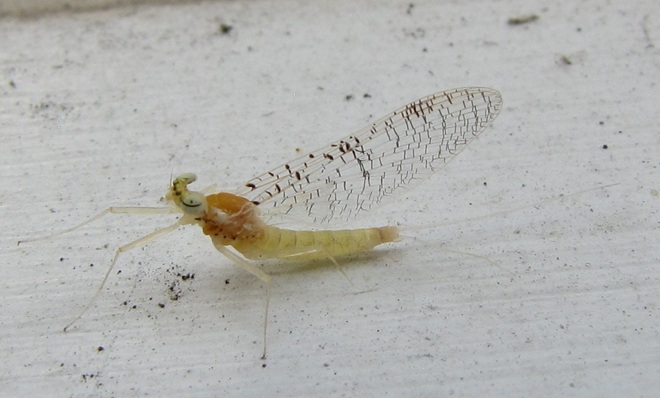
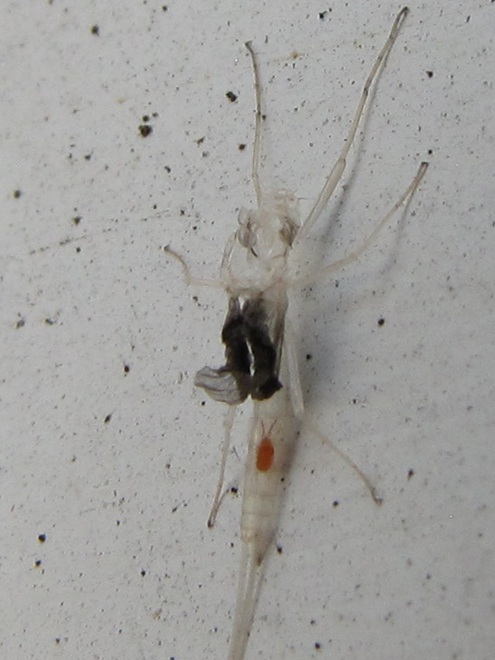
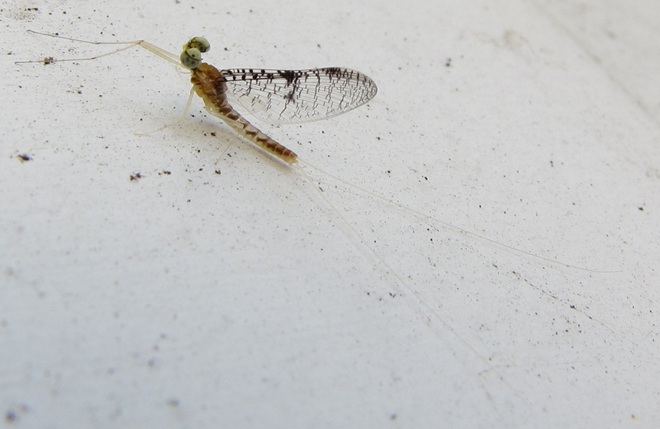
A possible subimago (sub-adult) Leucrocuta aphrodite, a flat-headed mayfly sometimes called the “Pale Evening Dun”, a common name applied primarily by fly-fishing anglers to several not-so-closely-related genera of mayflies also collectively known as sulfurs. Flat-headed mayflies (family Heptageniidae) are adapted to nymphal life in stream riffles where their low profile helps them cling to the rocks where they feed.Soon after taking flight, the sub-adult (subimago) Leucrocuta aphrodite molts into a second flying stage, that of the breeding adult (imago), leaving behind its final exuvia. This particular exuvia has a stranded hitchhiker on the abdominal section. Phoretic mites (Acariformes, in part) are thus named because they practice phoresy, attaching to hosts for no other purpose than transportation. Just how small is this little, red-brown mite? Well, the entire mayfly, including tails, is only about one-half-inch long.Freshly molted adult (imago) Leucrocuta aphrodite mayflies spend the day drying out and saturating all their tissues with blood before the search for a mate commences at dusk. Fertilized eggs will be deposited in flowing waters suitable for development of the nymphs.