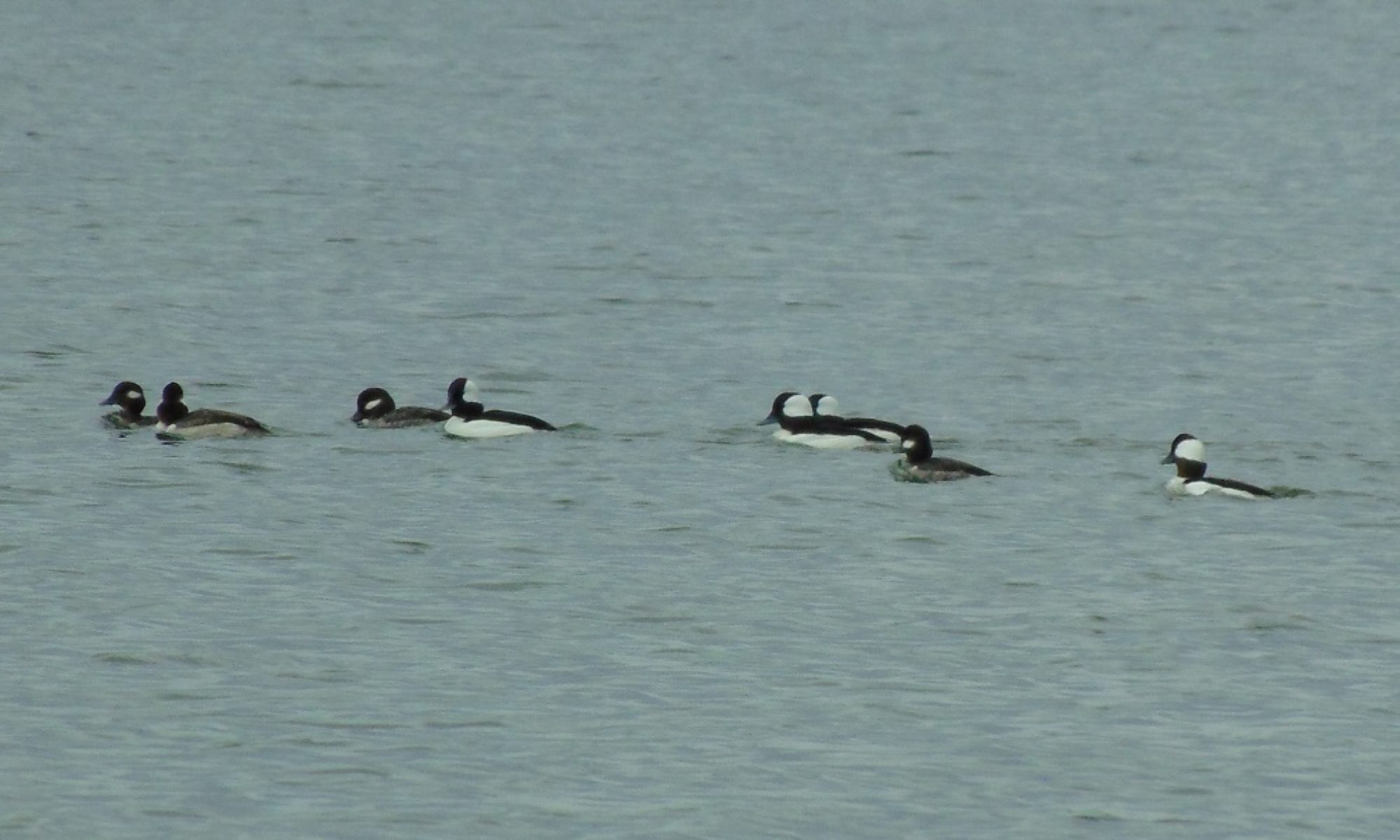
Migrating Waterfowl on Lotic Fresh Waters

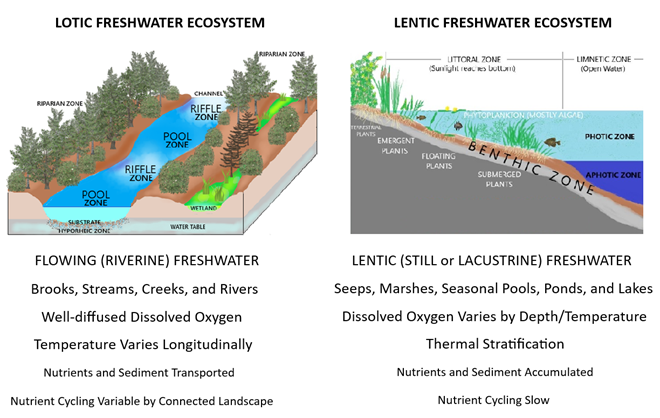
Lotic vs. Lentic Freshwater Ecosystems
Some comparative attributes of unspoiled lotic vs. lentic freshwater ecosystems.  Low-gradient (slow-moving) lotic waters often create, and remain connected to, accompanying riverine wetlands (a lentic freshwater ecosystem).  These swamps, marshes, and ditches absorb, purify, and infiltrate flood waters while supporting a diverse number of plant and animal species.

We frequently perceive all waterfowl migration to be synchronized with the conspicuous movements of familiar species like Snow Geese, Tundra Swans, and Canada Geese—big flights coming south in October and November, then a return to the north in late February and March.  And we’re all quite aware of the occurrence of large gatherings of some of these migrants while they make stopovers on some of our largest lentic (still) waters—the man-made lakes and reservoirs created by damming local streams.  But did you know that there are populations of colorful waterfowl with dynamic migrations that extend throughout the winter and early spring with movements that are often continuous.  Under favorable conditions, these birds favor the lotic (flowing) waters of the river and its larger tributaries as they transit the lower Susquehanna valley.  That’s because unpolluted lotic freshwater ecosystems support a greater diversity of plants and animals than lentic waters, and therefore offer more opportunities for hungry migrating waterfowl to find food.  Let’s have a look at some of the species that visit the river during their seasonal journeys…
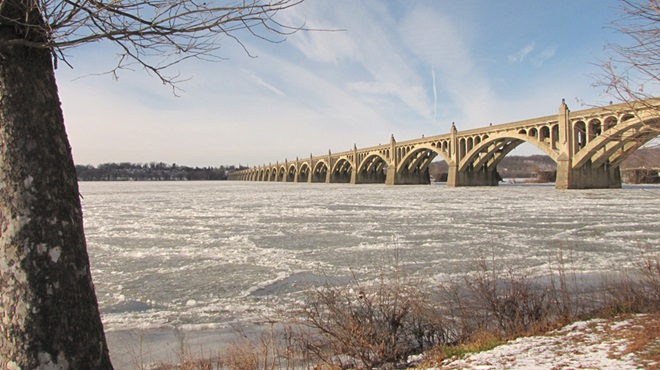
Ice on the Susquehanna
While the urge to head south in the autumn is largely stimulated by the shortening of the photoperiod, it is the presence of ice, particularly on glacial lakes throughout the lands to the north of the lower Susquehanna River basin, that pushes many diving ducks to finally make their way south toward the guarantee of open-water feeding areas along the coast.  This movement may occur at anytime between November and late February or, as we have seen during some of the mild winters of recent decades, it may scarcely be noticed at all.
Common Mergansers
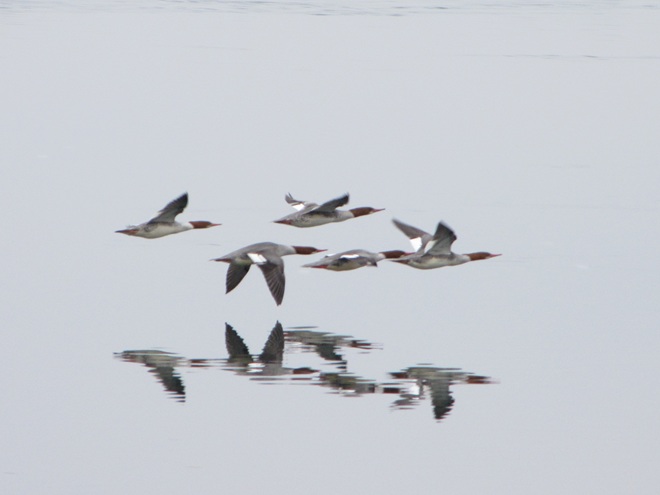
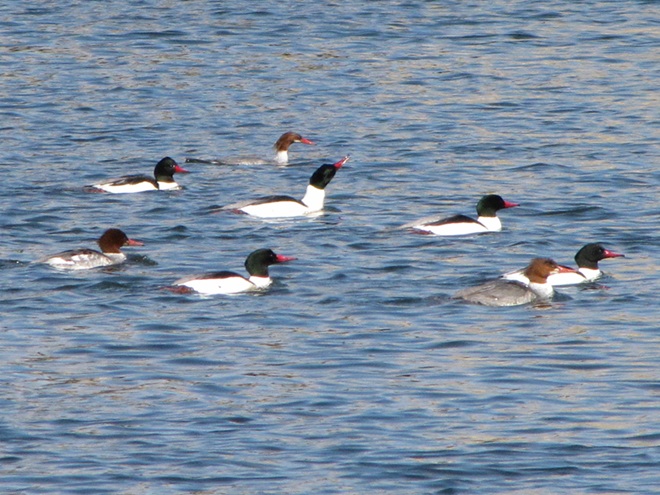
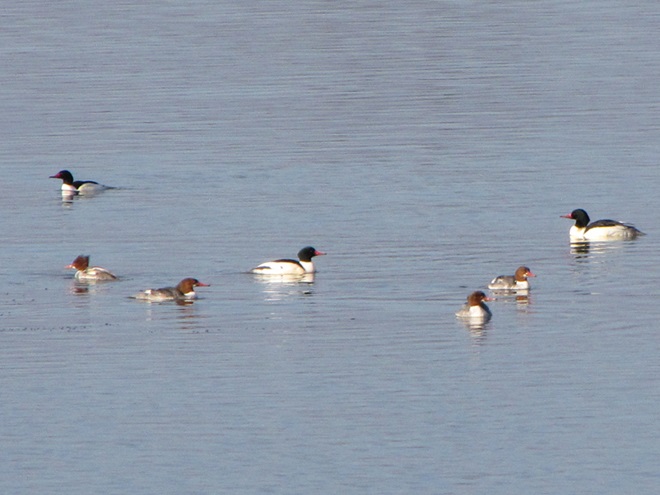
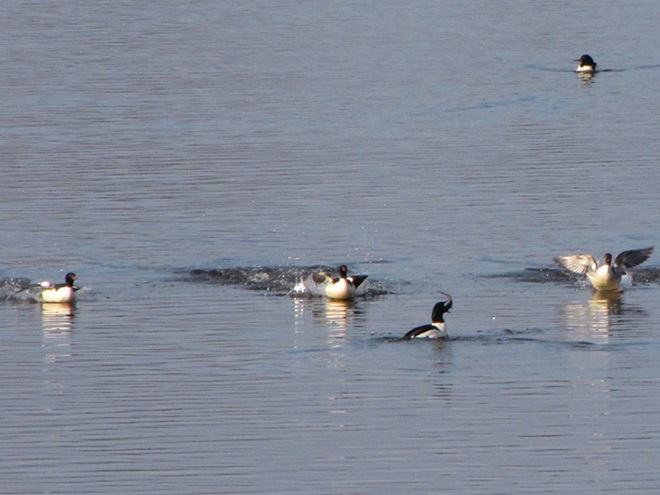
Common Mergansers often lead they way when it comes to migratory diving ducks.  They regularly move south in conspicuous numbers by late November and December and are regularly pushing north as soon as the ice begins to melt.  During a typical year, it is not unusual for some populations of these large diving birds to remain north of us during the winter.  Then, in the days after a sudden rush of frigid polar air, an appreciable increase in ice cover will force a mid-winter movement of birds down the Susquehanna.
Heat Flux Sources Impacting Temperature in Lotic Fresh Waters
Temperatures in lotic fresh waters vary over the length of the stream or river.  They are largely determined by the collective impact of the numerous sources of heat flux depicted in this graphic.  (Environmental Protection Agency image)
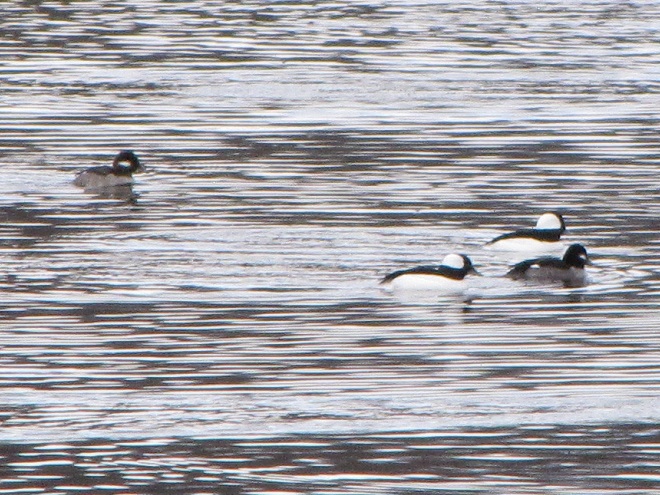
Buffleheads
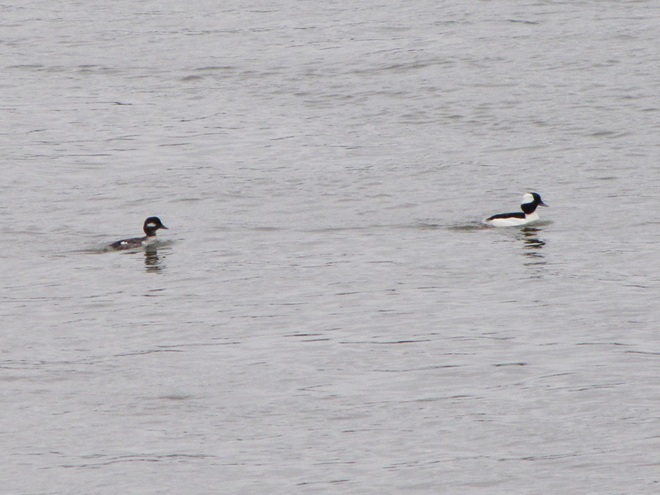
Buffleheads begin passing through the lower Susquehanna region in Novemeber on their way to coastal saltwater bays for the winter.  Lingering populations feed by diving in the river’s pools and riffles for benthic invertebrates including snails and insect larvae.  Lesser quantities of aquatic plant matter supplement their diet.
Common Goldeneye
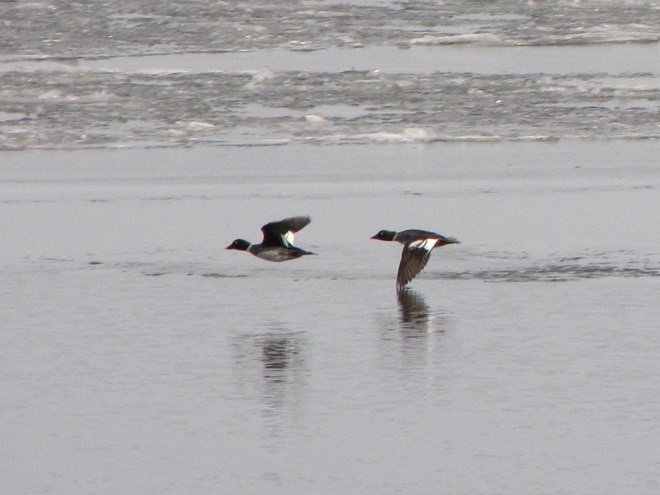
Many Common Goldeneyes will remain on shallow, ice-free waters of the northern lakes and rivers sculpted by the most recent glacial event, but only until they are forced south into and through the lower Susquehanna valley by the encroachment of freezing conditions.  On the river, they are among the dozen or so species of diving ducks we see visiting or passing through during the typical late fall and early river.


Geomorphological Zonation of a Stream or River
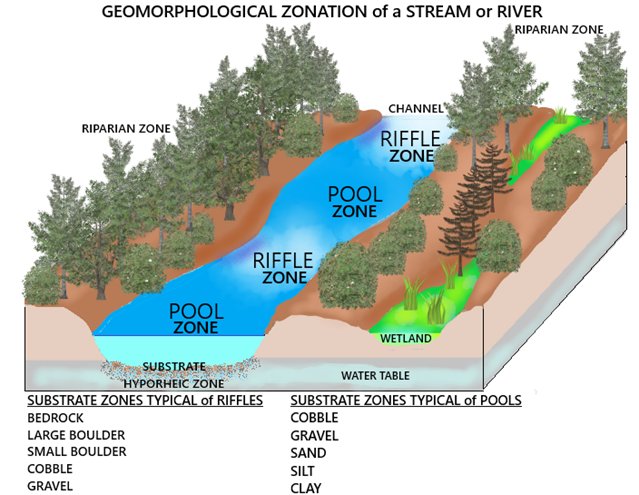
During their visits to the lotic (also known as riverine) fresh waters of the Susquehanna and its largest tributaries, benthic-feeding waterfowl make short dives to take advantage of the plants, small fish, invertebrates, and other food sources inhabiting the stream bottom in the riffles and pools of the free-flowing waterway.  Substrates, listed here by size (in descending order), along with other parameters influenced by this zonation determine the variety and abundance of the forage available to migrating waterfowl and other consumers.  Ice or high water and poor visibility due to flooding can render the riffles and pools of the channel unusable for feeding.  The birds must then choose to either linger and rest without feeding or leave the lotic freshwater habitat to seek sustenance.  During a flood, this may require relocation to a nearby lentic (still) body of fresh water such as a lake or reservoir.  The presence of ice will almost invariably force the birds to fly on to the Atlantic Coastal Plain and the tidal waters of its bays and estuaries.
Hooded Mergansers
Hooded Mergansers are one of the few species of diving ducks likely to utilize flooded shoreline timber and riverine (fluvial) wetlands as refuge from high water on Susquehanna.
Pied-billed Grebe and Canvasbacks
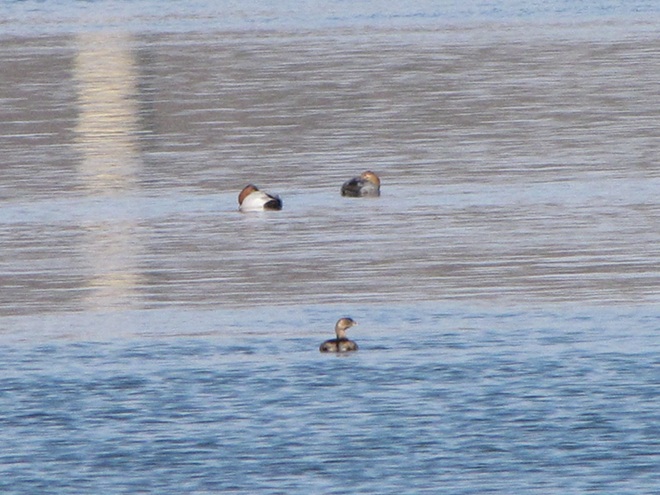
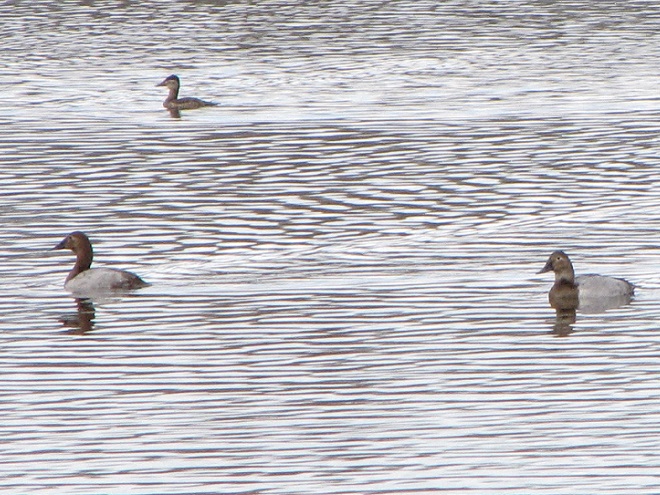
A Pied-billed Grebe and a pair of Canvasbacks on an ice-free stretch of the lower Susquehanna in mid-winter feed and loaf in a riffle-flanked pool where a large mat of American Eelgrass, a submerged aquatic plant also known as Tapegrass or Wild Celery, grows during the summer.  The vast mosaic of riffles and pools in a river this size offers tremendous opportunities for a diverse array of aquatic species to find their niche wherein they can survive and flourish.
Bufflehead
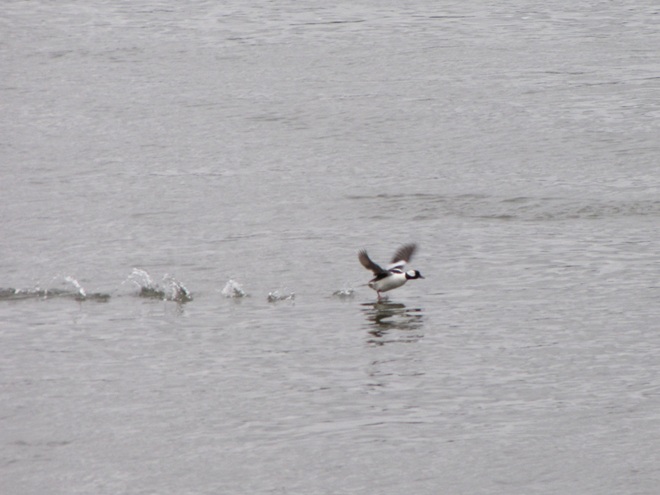
The presence of ice forces Buffleheads and other diving ducks to gather in turbulent open water, often below a riffle or dam.  Another alternative is to continue on toward the salty bays and estuaries of the coast.  High water may push these birds into the shallows among the flooded woods to feed, but they seldom utilize heavily forested riparian wetlands as a refuge due to their need for a running start to get airborne.


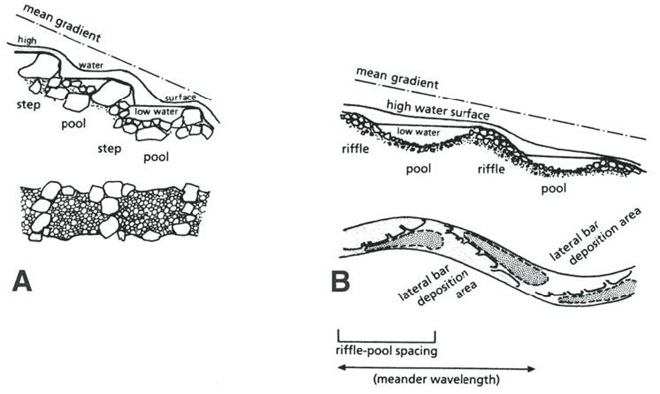
Riffle and Pool Characteristics of High Gradient (A) and Low Gradient (B) Streams.  This graphic illustrates the change in deposition characteristics of a stream or river as its gradient decreases.  A high-gradient stream (A) has a rapid velocity, often forms falls, and tends to carry away a high volume of all but the largest of particles of potential substrates as they erode from the surrounding landscape.  On a low-gradient stream, the loss in water velocity reduces the water column’s ability to transport even the smallest of substrate particles.  Deposition of this gravel, sand, silt, and clay forms lateral bars that over time create the familiar meandering path of a naturally flowing lowland stream.  (National Park Service image)
Benthic Life in Lotic Freshwaters
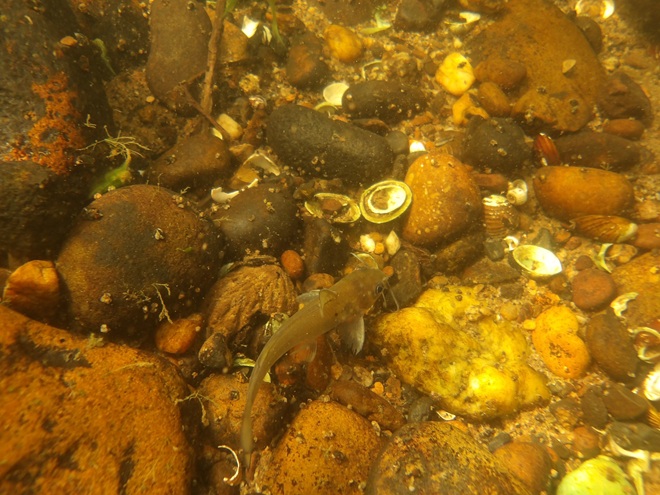
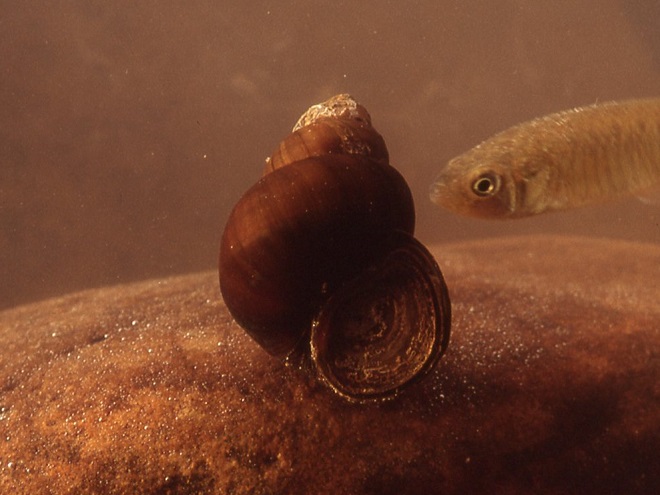
Benthic substrates in lotic freshwater pools and riffles support an abundance of life forms ranging from colorful diatoms on rocks and cobble, to invertebrates including snails and insect larvae, to fishes like this young Channel Catfish.  Free of accumulations of sediment, this river bottom not only provides habitat for a healthy fishery, it facilitates the bidirectional exchange of water between the Susquehanna and its underlying aquifer.
Quillback
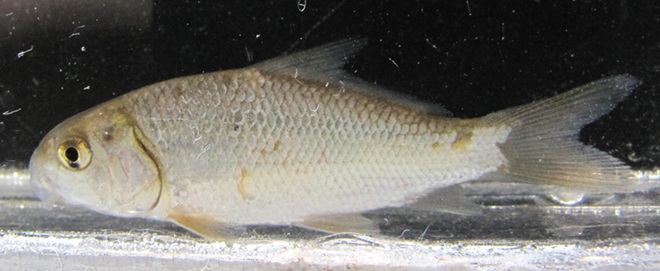
On the lower Susquehanna, populations of young Quillback suckers are found almost exclusively in clear, high-gradient pools.
Harlequin Duck
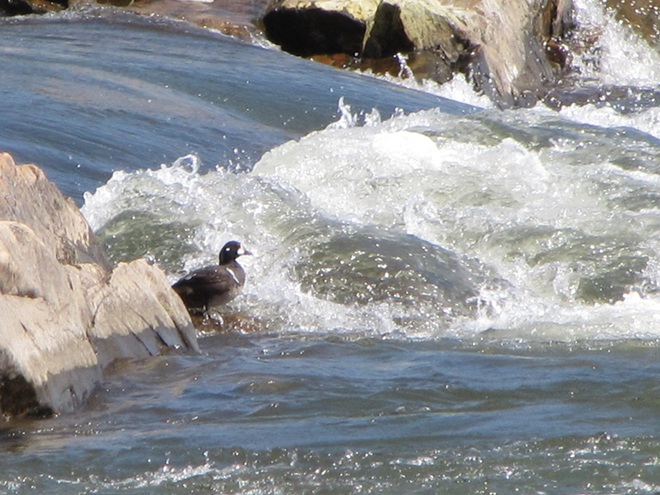
The Harlequin Duck winters along the rocky shores and man-made jetties of the Atlantic coast.  In summer, they nest on fast-moving, headwater streams well to our north.  Very rare on the Susquehanna, this is the first of two individuals found during March and April of 2025.  It was observed feeding in the swift waters of the high-gradient riffles and pools where the river cuts through Blue Mountain north of Harrisburg.  During previous weeks, Harlequin Ducks were being seen along the coast as far south as the mouth of the Chesapeake at Cape Charles, Virginia.  It’s very possible that some of these birds traveled north through the bay area and up the Susquehanna on their way north.


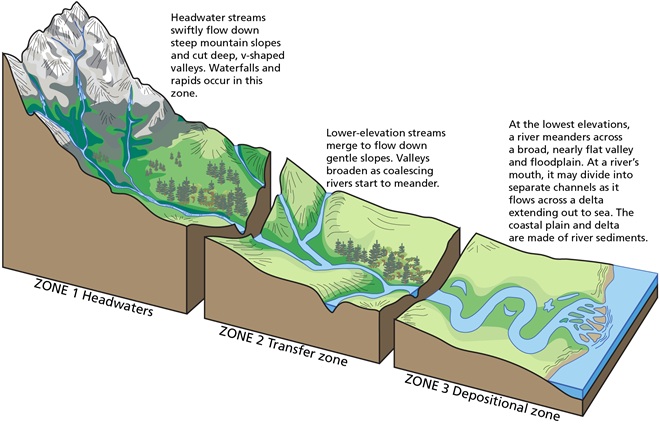
Fluvial Geomorphology of a Stream.  Many of the Susquehanna’s tributaries pass through each of these three erosional zones.  Along the way, they carry out the process of breaking down the mountains formed by the Allegheny orogeny, the collision of North America and Africa that created the supercontinent Pangea about 325 to 260 million years ago (during portions of both the Carboniferous and Permian periods).  Today’s main stem of the lower Susquehanna passes through a transfer zone (Zone 2), carrying eroded materials to a depositional  zone (Zone 3) located within the ancient Susquehanna canyon stretching from Havre de Grace, Maryland, to Norfolk Canyon on the edge of the continental shelf.  Within this zone, more than a 10,000-year accumulation of post-glacial sediments lies submerged by the rising waters of the Atlantic Ocean and Chesapeake Bay.  Although the present-day lower Susquehanna is largely a transfer zone, some deposition occurs along low-gradient segments of the river, particularly where its course parallels the watershed’s ridges both above and below the high-gradient rapids where its path has eroded passage through the highlands.  (National Park Service image)
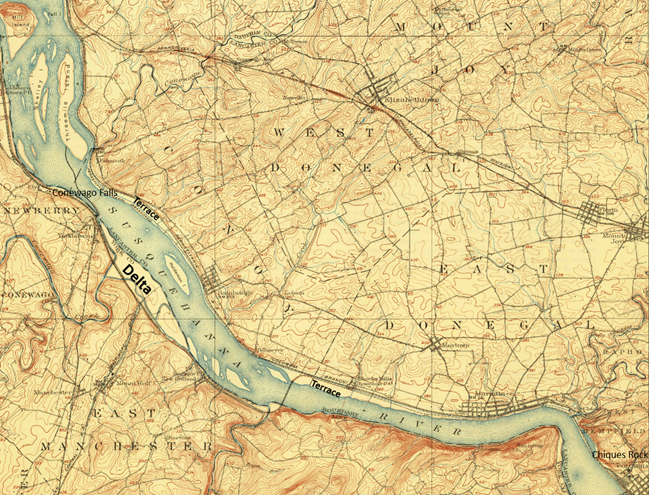
Although the present-day lower Susquehanna is largely a transfer zone, some deposition occurs along low-gradient segments of the river, particularly where its course parallels the watershed’s ridges both above and below the high-gradient rapids where its path continues to erode passage through the bedrock.  On this 1908 map of the Susquehanna at Conewago Falls, alluvial terraces of gravel, sand, silt, and clay can readily been seen as pale areas nearly lacking brown contour lines along the shorelines and islands of the river.  Deposits within most of these terraces date back to the melt period following the most recent glacial event and beyond.  The delta shown at the mouth of Conewago Creek (west) includes massive volumes of material deposited by both the creek and the river.  This delta is currently known as Brunner Island, much of it developed as the site of a coal/gas-fired electric generating station.  Terrace deposits along the Susquehanna’s shorelines created extensive perched marshes and swamps (wooded marshes) fed by rains, high river water, small streams, and springs, the latter often seeping from the base of the rocky escarpments carved by the ancient Susquehanna and defining the present-day inland border of the floodplain.  We call these sites “Alluvial Terrace Wetlands”.  Few of these critical components of river morphology survive.  Those not drained for farmland were obliterated by urbanization and canal, railroad, and highway construction.  (United States Geological Survey base image: Middletown, PA, quadrangle, 1908)
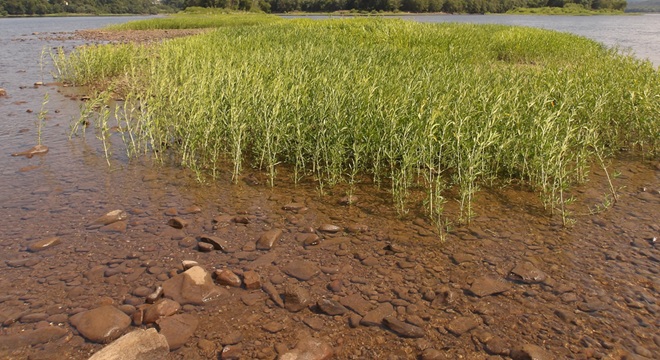
Water Willow
Water Willow is a familiar emergent plant that colonizes lateral bars and other alluvial deposits in low-gradient segments of the Susquehanna.
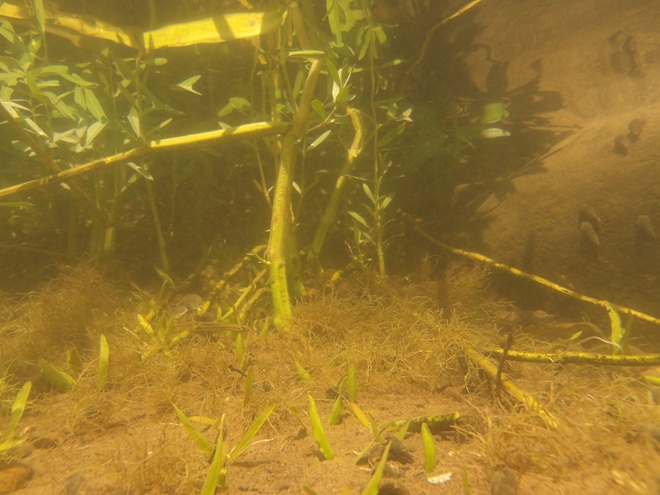
Water Willow Roots
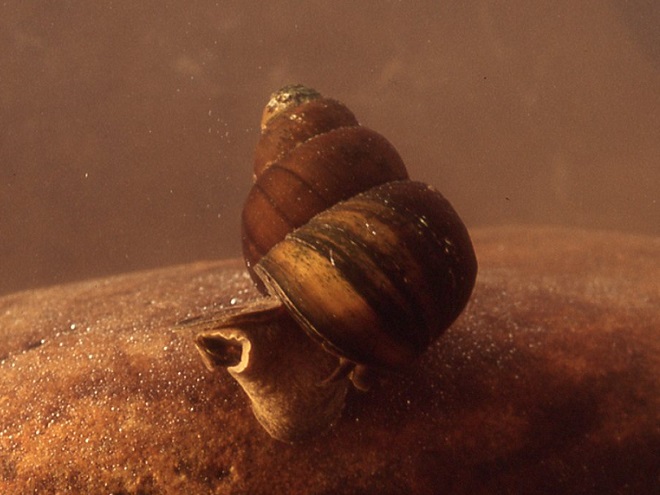
The fine roots of Water Willow collect sediment and absorb nutrients while creating dense cover for young fish and numerous species of invertebrates including the Virginian River Horn Snails seen here.

Prior to the nineteenth century, the low-gradient flow regime of the river both above and below the riffles at Chiques Rock (lower right on map) created prime wildlife habitat.  The natural accumulations of nutrients and substrates carried into and through the lotic waterway’s pools and riffles were cycled into an ideal growing medium for extensive mats of American Eelgrass and other aquatic plants.  This underwater forest hosted a seemingly endless abundance of invertebrates and fishes (both resident and migratory)—supporting a variety of consumer species including various populations of humans.  But soon after the mass clearing of much of the watershed’s land for farming and lumber, the mill ponds created by dams constructed on streams to power saw and grain mills became brimful with sediments eroded from the unprotected ground.  During storm events, torrents of these sediments then flowed full bore toward the Susquehanna, and began accumulating in the low-gradient segments of the river.
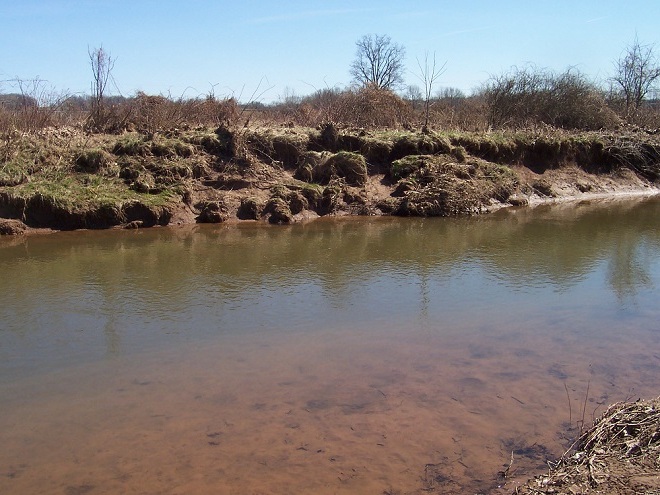
Legacy Sediments
Sediments left behind after the removal of mill dams are known as legacy sediments. They disconnect the stream from its historic floodplain and riverine (fluvial) wetlands, thus intensifying the impact of high water in the surrounding landscape.  As these nutrient-charged deposits wash away, they become a source of pollution in the waters of the Susquehanna and Chesapeake.
American Eelgrass
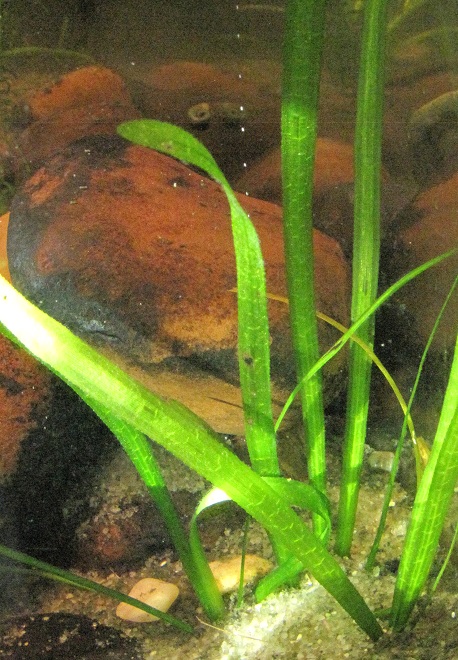
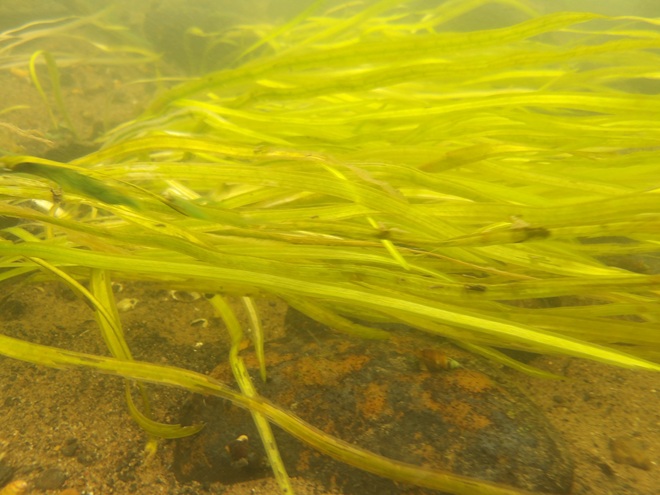
A mat of American Eelgrass growing in the flowing waters of the Susquehanna below Conewago Falls.  Eelgrass and other submerged aquatic plants provide essential habitat for a wide variety of small fish and invertebrates while also consuming nutrients deposited in the cobble, gravel, and sand substrate of the river’s pools.  Excess quantities of smaller particles of silt and clay can clog the substrate and thus inhibit the hyporheic exchange of water between the stream channel and the underlying aquifer, often diminishing the biomass and diversity of organisms inhabiting this benthic habitat.  Buried in these life-choking sediments, the river bottom becomes inhospitable to growth of submerged aquatics including eelgrass.
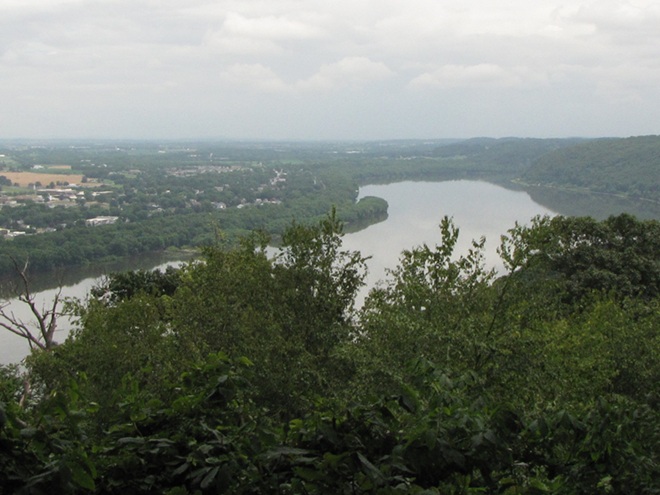
Susquehanna at Marietta
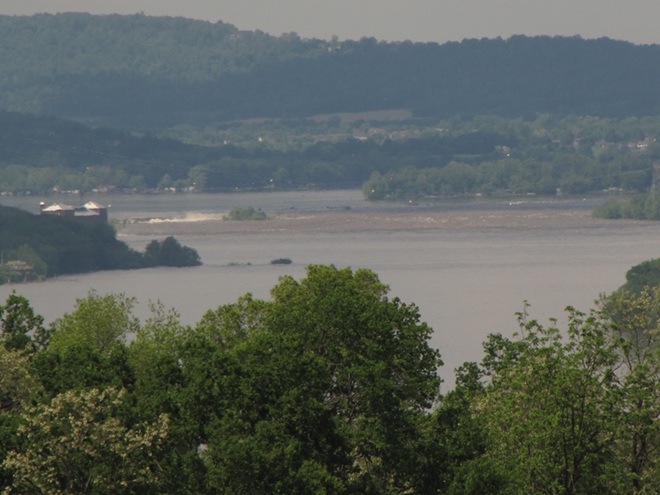
This low-gradient stretch of the Susquehanna at Marietta flows parallel to the Chickies Quartzite “Hellam Hills” before making a sharp right turn to punch through the ridge as a series of rapids at Chiques Rock.  Formerly a fully functional lotic ecosystem and a paradise for migrating waterfowl, this river segment is now impaired by accumulations of nutrient-laden sediments from agricultural and urban runoff.
Conewago Falls Flood Waters
Nutrient and sediment-loaded flood waters roar across the diabase boulders at the York Haven Dam and Conewago Falls, a high-gradient segment of the Susquehanna.
Flood Waters at Haldeman Riffles
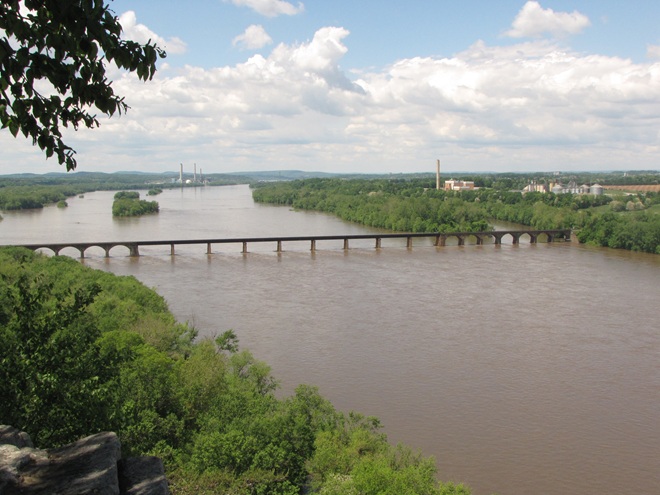
They continue past Brunner Island (left power plant stacks) and through Haldeman Riffles and the Shocks Mills Railroad Bridge…
Flooding on the Marietta Broads
…into the stretch of river known as the “Marietta broads” along the base of the Chickies Quartzite “Hellam Hills”.  The low stream gradient here produces a slower current and increased deposition of sediments.
Susquehanna Flooding at Chiques Rock
As the flood surges through the riffle and pool complex at Chiques Rock, the high stream gradient maintains a velocity in the water column sufficient to keep additional sediments in suspension until they reach the low-gradient river segment just downstream at Washington Boro, site of a naturally occurring lateral bar area known as the Conejohela Flats.  These bars now lie within the man-made depositional zone known as “Lake Clarke”.  Created nearly a century ago by construction of the Safe Harbor Dam, this impoundment is accumulating astounding volumes of nutrient-loaded sediments that continue to encapsulate the flats within a stream-impairing delta.
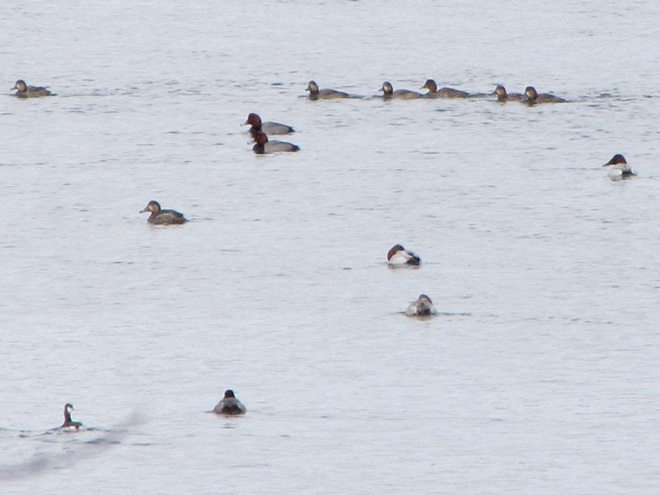
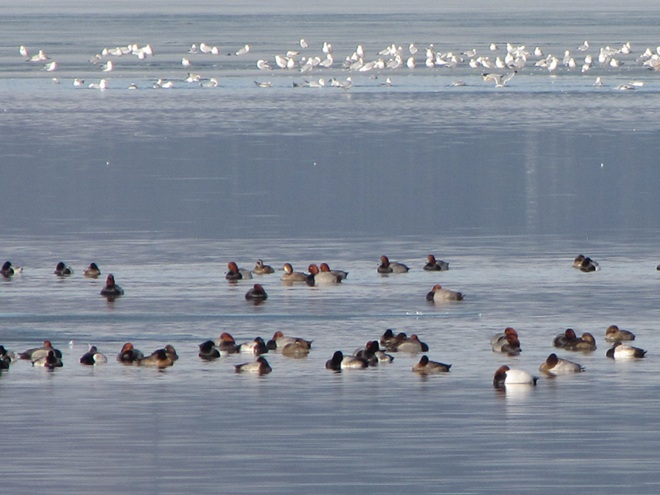
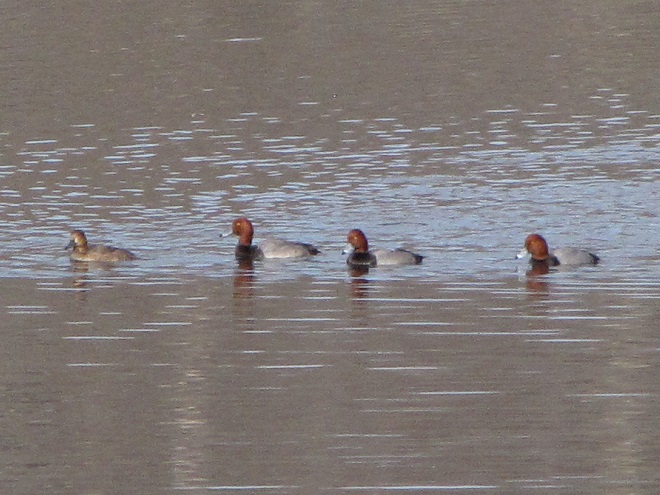
Redheads, Canvasbacks, and a Horned Grebe
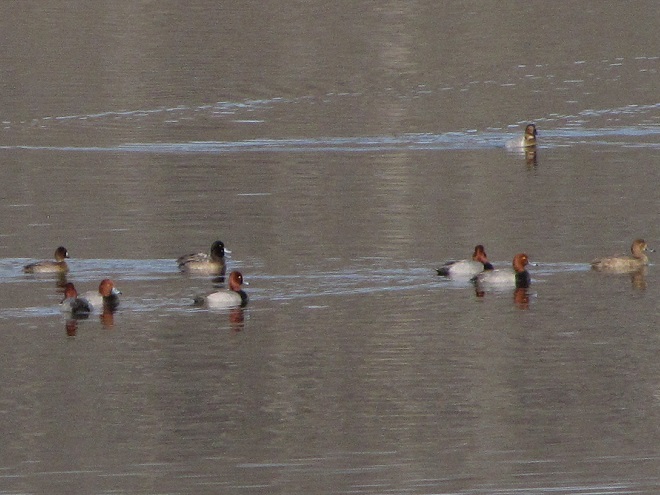
Anytime from November to April on the lower Susquehanna, a group of Redheads, Canvasbacks (3 birds to right of the middle of the picture), and a Horned Grebe (lower left) is a welcome sight in a riverine pool known to have a summertime growth of American Eelgrass.  Noted Dr. Herbert Beck in 1924 when describing the Canvasback, “Like all ducks, …, it stops to feed within the county (Lancaster) less frequently than formerly, principally because the vast beds of wild celery which existed earlier on broads of the Susquehanna, as at Marietta and Washington Borough, have now been almost entirely wiped out by sedimentation of culm.  Prior to 1875 the four or five square miles of quiet water off Marietta were often as abundantly spread with wild fowl as the Susquehanna Flats are now.  Sometimes there were as many as 500,000 ducks of various kinds on the Marietta broad at one time.”
Aythya genus ducks.
Today, seeing just dozens of Aythya genus ducks (Redheads, Canvasbacks, scaup) on the lower Susquehanna is a notable event.  If they happen to be forced down by inclement weather while migrating through, you might get lucky enough to see several hundred.
Aythya Genus Ducks
While the recovery of eelgrass/wild celery beds on the Susquehanna is trivial in scale and offers little support for numbers of waterfowl to return to historic levels, restorations on the upper Chesapeake in the vicinity of the Susquehanna Flats between Havre de Grace and Aberdeen Proving Grounds may have helped refuel a gathering of mostly Aythya genus ducks during the final days of February.  This mass of ducks, many of which were forced south from the frozen Great Lakes during the previous weeks (some by way of the ice-choked Susquehanna) were apparently making an abrupt turn to make their way back north.  Their stay was brief, but estimates by local birders put their numbers as high as one half million.  The vast majority of the concentration consisted of Aythya species: Redheads, Canvasbacks, Ring-necked Ducks, and both Lesser and Greater Scaup.  It probably included a mix of birds including both northbound migrants from further down the coast and the aforementioned refugees that had just arrived to pay a quick visit while escaping the late-season ice before turning around.
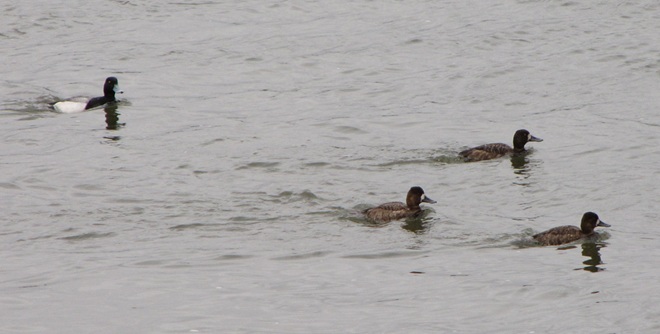
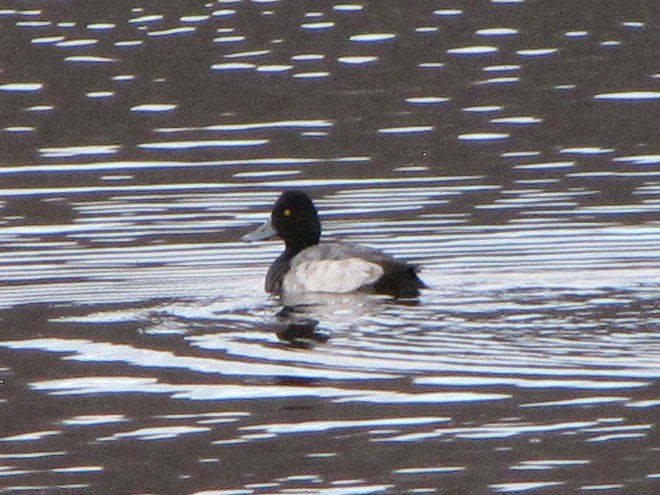
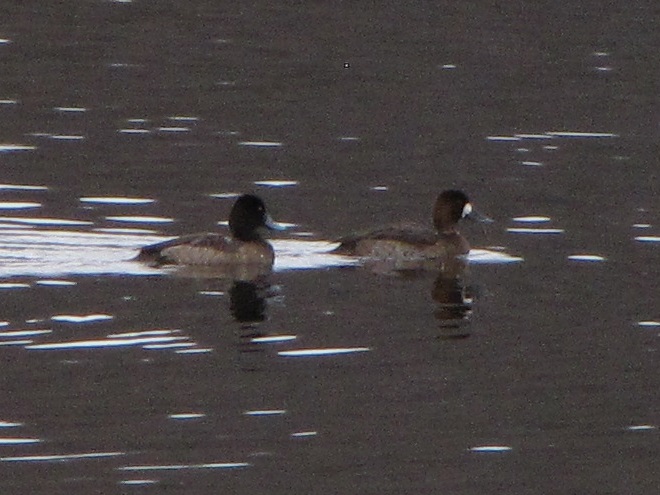
Lesser Scaup
During the past two centuries, as food supplies in the Susquehanna grew increasingly compromised for benthic feeders like these Lesser Scaup and other diving ducks, a change in distribution was necessary for survival.
Lesser Scaup in flight.
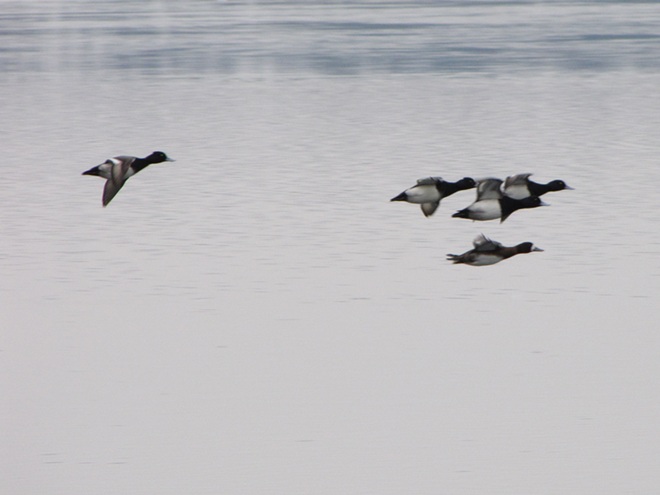
As individual species, Lesser Scaup and other waterfowl that fail to adapt to natural or man-made changes in their habitats and food supplies may see their overall global numbers falter.

Despite being located in the transfer zone, the lower Susquehanna has become a significant depositional zone along much of its length, mostly courtesy of the placement of sediment-trapping man-made dams.

Following construction of the mill dams and ponds on nearly every mile of the lower Susquehanna’s low-gradient tributary streams, enterprising parties moved on to the river.  The first significant spans were constructed using wide timber cribs filled with large rock.  They were placed to create water deep enough to allow canal boats to cross the Susquehanna at both Clark’s Ferry at the mouth of the Juniata River in Dauphin County and at Columbia/Wrightsville.  These dams also diverted water into the newly excavated canals—the Pennsylvania Eastern Division Canal (completed in 1833) which followed the river’s east shore from Clark’s Ferry to Columbia, and the Susquehanna and Tidewater Canal (completed in 1840) along the west shore from Wrightsville to Havre de Grace, Maryland.  Placement of these sediment-trapping man-made dams began a process of converting vast mileage of the lower Susquehanna from a transfer zone into a deposition zone.  In addition, layout of the canals and locks followed the contours along the base of the riverside ridges, seriously altering most of the alluvial terrace wetlands that the river had created as a feature of its floodplain during the post-glacial period.

Construction of the canal dams was just the beginning.  During the twentieth century, more massive dams would be added to the main stem of the river for hydroelectric energy production at York Haven, Safe Harbor, Holtwood, and Conowingo.  Upon their completion, the days of unassisted anadromous fish migrations were over.  On both the river and its tributaries, smaller dams including dangerous low-head dams maintain water levels for boating and recreation.  They too create current-diminishing, pseudo-lentic waters that blanket the lotic riffle and pool substrates with polluted sediments.

MAN-MADE DAMS TURN LOTIC WATERS INTO UNFLUSHED TOILETS
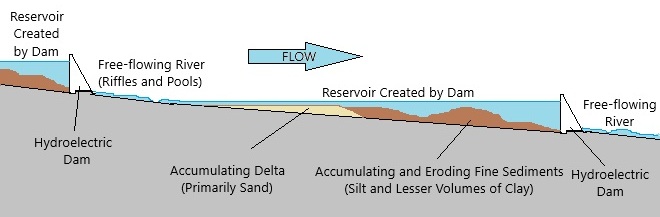
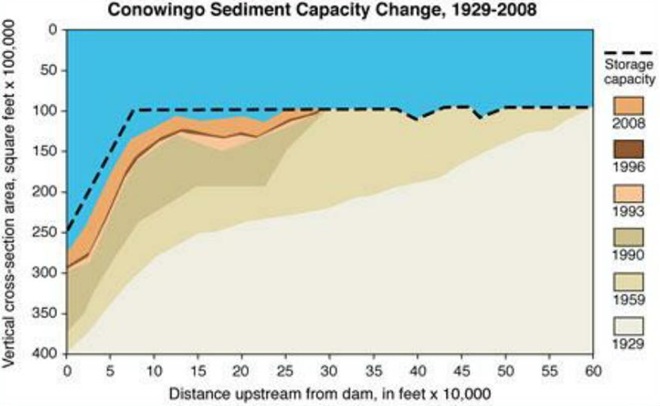
Sediment Deposition Behind Lower Susquehanna Dams
The construction of dams on the lower Susquehanna has converted vast mileage of the river from a lotic freshwater system into a series of man-made lentic freshwater lakes.  These areas have lost their function as a lotic transfer zone and are now a sort of dysfunctional series of depositional zones collecting vast volumes of sediment containing nutrients and other pollutants.  Within each impoundment, the reduced velocity of the river causes it to drop suspended sand first, then the finer particles of silt and clay closer to the dam.  The flow regime of riffles and pools is lost and the hyporheic zone that exchanges water between the river and the underlying aquifer is clogged.  These impaired segments of river become ripe for eutrophication: algal blooms followed by die offs that can lead to a fatal reduction of dissolved oxygen in the water column.
Gadwall
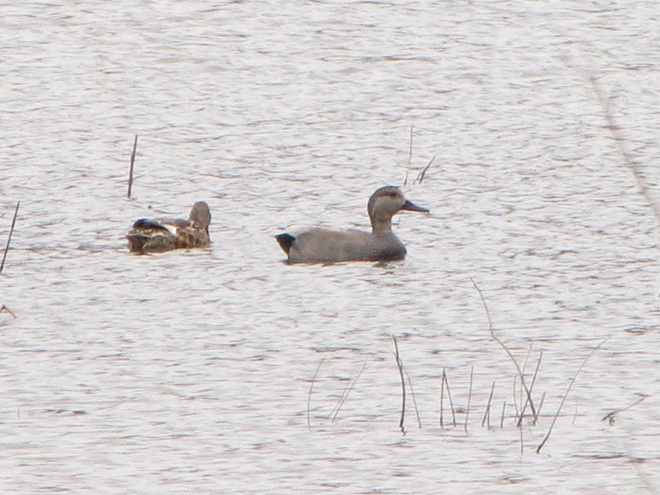
Deposits of lateral bars of sediment in low-gradient segments of the Susquehanna can create shallow water feeding habitat for puddle/dabbling ducks like these Gadwall.  Where sediment pollution is severe, benthic foods in these areas often consist mostly of invertebrates and plant matter deposited by the current, the buried substrates devoid of a functioning ecosystem and the waters subject to eutrophication.
Common Goldeneyes
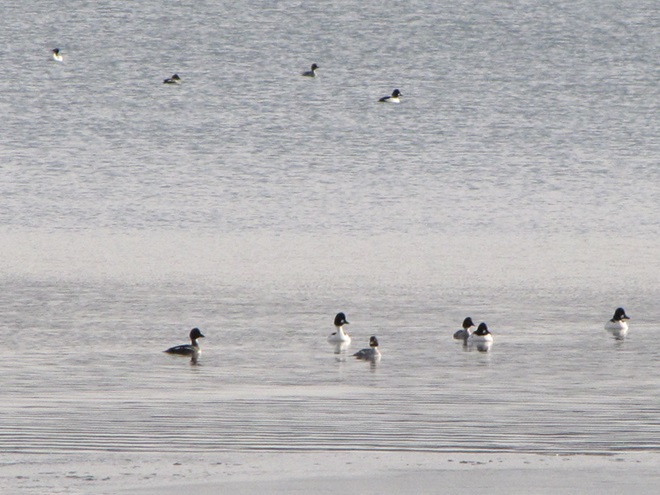
Common Goldeneyes on a patch of open water on an otherwise ice-covered “Lake Clarke”, the impoundment created by Safe Harbor Dam.  While they may find this spot advantageous for loafing, the food supply over the sediment-buried substrate will be limited.
By the end of the twentieth century, accumulations of polluted sediments behind lower Susquehanna dams were nearing capacity.  There is no working plan to attenuate the massive release of these pollutants that may be triggered by a catastrophic flood.  The effort to reduce nutrient and sediment runoff remains the focus so that new loading is kept to a minimum and won’t add to the capacity problems at the dams or continue downriver to the Chesapeake at full strength when the dams are full.  Alleviating the sediment aggregation problem within the river’s impoundments is a tall order and a dilemma not easily solved.  (United States Geological Survey image)
Common Mergansers
Common Mergansers will feed where benthic substrate supports the small fish and invertebrates they prefer. They will, however, gather in extraordinary numbers on the “lakes” created by riverine dams.  Though they can only feed on what floats in with the current, hundreds or sometimes thousands of Common Mergansers will concentrate on “Conowingo Pond” during the late fall or early winter.  There, safety in numbers gives them some guarantee of protection against the multitudes of eagles that simultaneously frequent the vicinity.  Another advantage of staging on “Conowingo Pond” is its close proximity to favorable feeding areas on upper Chesapeake Bay and stretches of the Susquehanna where lotic riffles and pools offer abundant opportunities below the river’s dams.
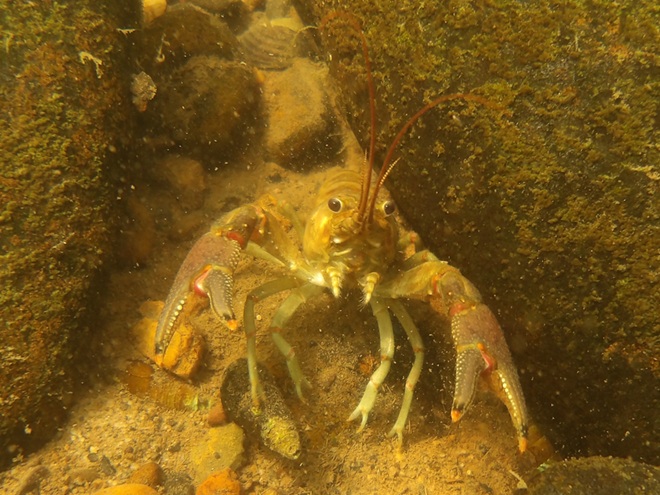
Rusty Crayfish
Fortunately for everything else living in the benthos, Common Mergansers are big enough to devour invasive, non-native Rusty Crayfish when they find them in our lotic waterways.

TIME TO CLEAN UP OUR ACT

WHERE DOES YOUR STORMWATER GO?
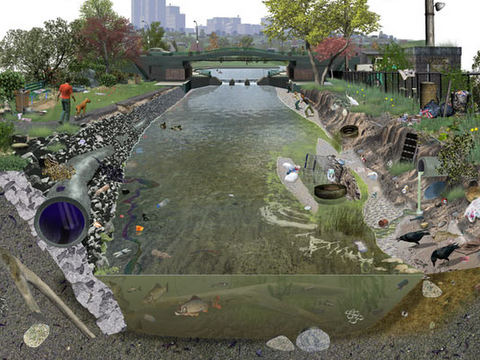
 

Channelized Urban/Suburban Streams Function as Sewers. They have no attached lowlands or floodplains to absorb, purify, and infiltrate runoff from rain events.  Pollutants including litter, pet waste, lawn chemicals, tire-wear particles, hazardous fluids, and sometimes untreated human excrement flush unchecked from the municipal storm drainage system into the waterway.  Thermal shock from summer downpours washing across sun-heated pavements can kill temperature sensitive fishes and other aquatic life.  Nutrient and sediment loads from these impaired tributaries later accumulate downstream in low-gradient segments of the Susquehanna, turning the river into an open-air cesspool.  Aggressively working to implement projects that eliminate these sources of pollution are the only effective way to keep the problem from getting worse.  Making things better requires a lot more dedication and effort.  (United States Geological Survey image by Frank Ippolito)

RIPARIAN BUFFERS MAKE A DIFFERENCE…WIDER IS BETTER
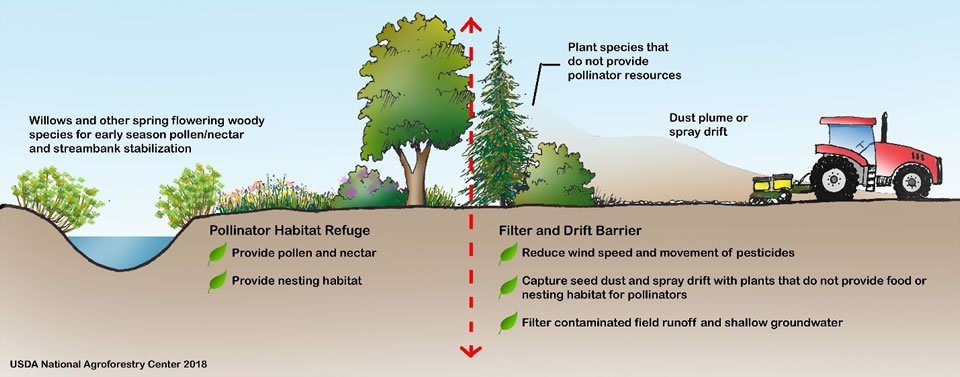
Riparian Buffer
To sequester sediment and cycle nutrients (primarily nitrogen and phosphorus) contained in farm runoff, the U.S.D.A. recommends installing riparian buffers between streams and lands used for grazing and raising crops.  To protect pollinating species including bees and butterflies from pesticide drift and eroding soils rich in fertilizers, they further recommend installing a stand of wind-pollinating plants such as conifers, oaks, and birches between the field and streamside plantings.  These same conservation practices improve water quality and wildlife habitat on waterways located in residential and commercial areas as well.  (United States Department of Agriculture image, click to enlarge)

FLOODPLAIN RESTORATION

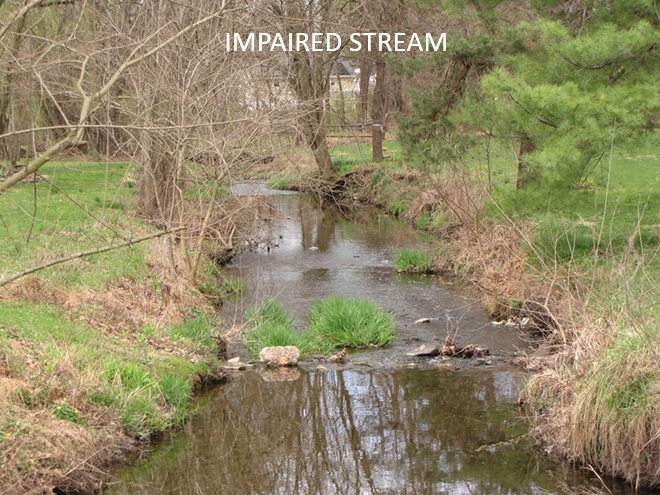
Regardless OF HOW LONG YOU’VE BEEN CONDITIONED TO THINK OTHERWISE, THIS IS A DYSFUNCTIONAL, POLLUTED CREEK—AND IT NEEDS HELP
Legacy Sediments
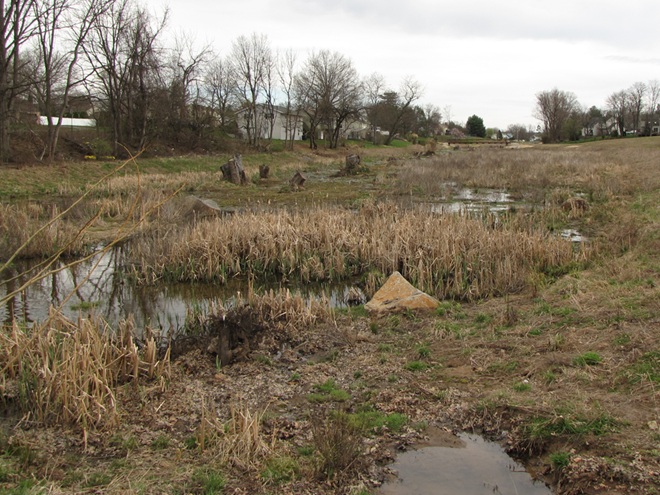
A channelized low-gradient stream eroding a path through deposits of legacy sediments displaces flood waters into previously unaffected areas and provides a continuing source of nutrient and sediment pollution during storm events.  These impaired waters have a diminished capacity for supporting aquatic life including fishes.
RESTORED TO ITS HISTORIC FUNCTIONS
Floodplain and Stream Restoration
On an adjacent segment of the same creek, this legacy sediment removal project restored a braided meandering channel and connected it to its newly liberated, historic floodplain.  In just their second year, the fluvial wetlands are effectively absorbing stormwater and sequestering nutrients as an attached component of the stream’s riffle and pool complex.  During our visit earlier this week, we found American Toads, Northern Leopard Frogs (Lithobates pipiens), and Northern Spring Peepers breeding here.  It’s just as Castor canadensis would have it!

“STOP HEMMING AND HAWING AROUND ALREADY”

“HEY COWBOY, HOW ‘BOUT GETTIN’ THEM FILTHY LITTLE DOGIES OUTTA DAT CRICK?”
Impaired Stream
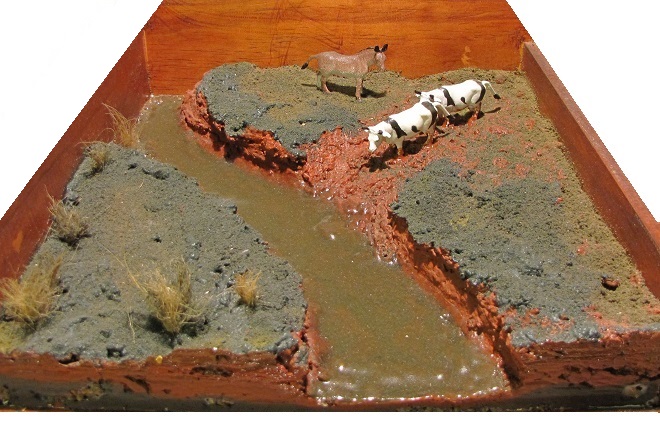
Here’s a polluted stream in a pasture with grazing livestock.  The site is a former mill pond within which the creek eroded a channel following removal of the dam.  The animals defecate and urinate where access to water is gained at a broken down embankment of the nutrient-loaded legacy sediments deposited in the pond more than a century ago.  It’s a haphazard form of animal husbandry and a reminder that all it takes is just one stubborn jackass to foul up the whole waterway.
DIRECT SOURCES OF NITROGEN (AMMONIA) POLLUTION IN STREAMS

DID YOU KNOW that a dairy cow produces about 80 pounds of waste (excrement and urine) every day?

DID YOU KNOW that a horse produces about 50 pounds of waste (excrement and urine) every day?
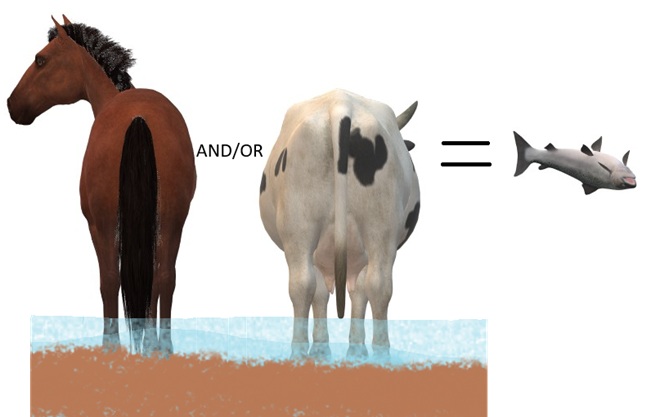
DID YOU KNOW that a human produces about 3 to 4 pounds of waste (excrement and urine) every day?  The exceptions, of course, are those who continue to insist that raising farm animals in and alongside a body of water is okey-doke—a harmless practice.  These individuals tend to retain the former constituent of human waste and are thus full of it.

“ATTABOY TEX, THAT’S MORE LIKE IT!”
Stream Fencing and Livestock Crossing
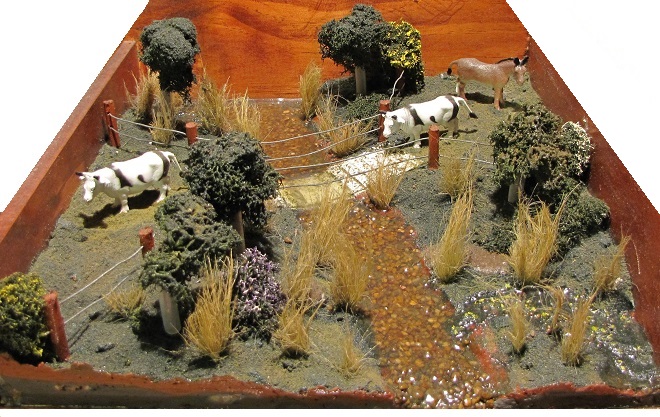
Now that’s better.  Legacy sediments have been removed to reconnect the stream to its floodplain.  A livestock crossing and exclusion fencing has been installed, and a nutrient-consuming riparian buffer has been planted.  This creek segment’s pollution woes have been mitigated.  Do you have a neighbor needing this type of remedial work on their farm?  Have them call your local conservation district office for advice.  Some programs include financial assistance covering the costs of installation as well as monetary incentives for helping to clean up the water.

AND FINALLY

WHEN IT COMES TO BUILDING DAMS ON LOTIC FRESH WATERS…
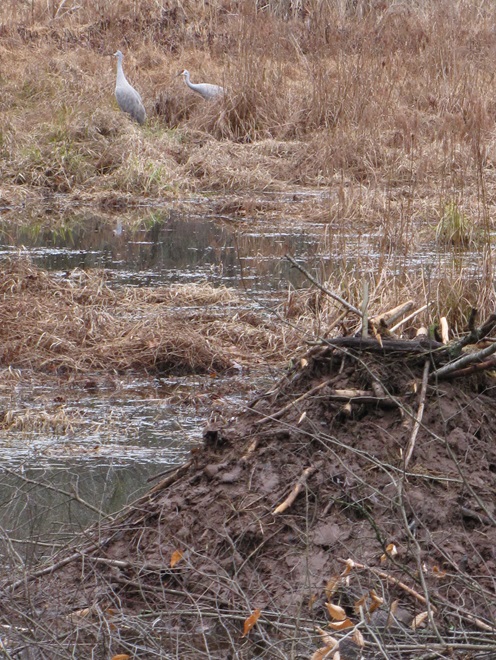
Sandhill Cranes in Beaver Pond

…LEAVE IT TO THE BEAVERS
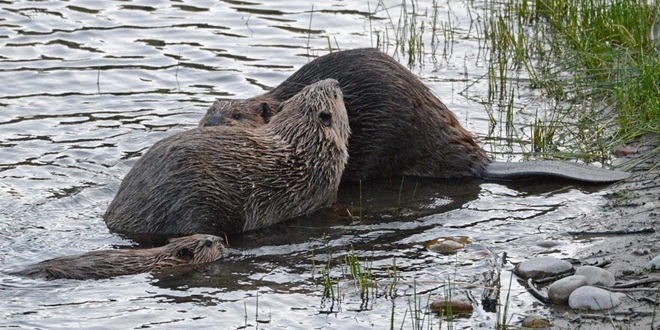
North American Beavers
North American Beavers (Castor canadensis) create habitats that connect the riffle and pool regime of a low-gradient stream to a surrounding fluvial wetland that retains sediments, cycles nutrients, and provides essential habitat for hundreds of plant and animal species.  Floodplains are for flooding.  And if a beaver floods an area, you can be guaranteed that it was already part of a floodplain.  You see, beavers don’t encroach upon humans, it’s humans doing the encroaching upon beavers.  (National Park Service image)
MAD HATTERS

DID YOU KNOW that even before the landscape was cleared for farms and a supply of timber, and before mill dams on local creeks began accumulating soil runoff from the consequently barren hillsides, all the North American Beavers, the keystone species of lower Susquehanna stream ecology, were killed and sold to make hats?  It’s no wonder things are fubar!

COMING SOON…
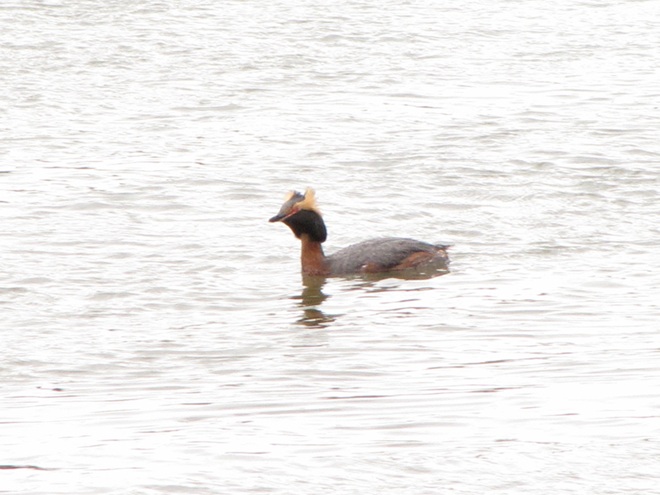
Horned Grebe
Horned Grebes are regular migrants and sometimes winter residents on ice-free stretches of the lower Susquehanna.  They spend their time plying the benthic substrate of the river’s clear riffles and pools for a variety of invertebrates and small fish.  Look for them moving north in coming days sporting this beautiful breeding plumage.
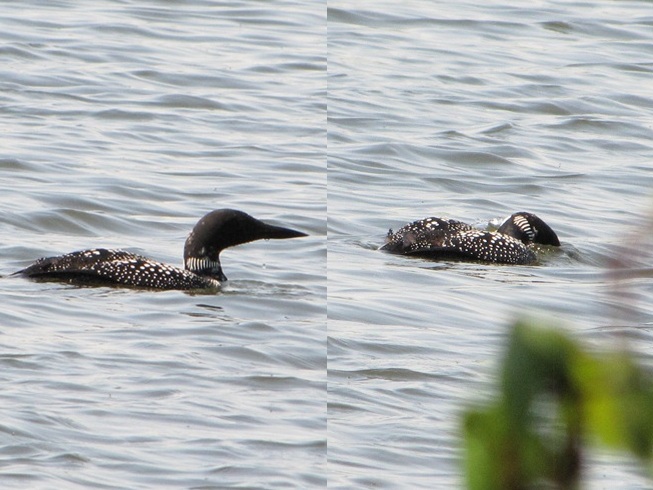
Common Loon
April and early May are prime time for observing Common Loons on the Susquehanna as they undertake a journey from the Atlantic surf where they spent the winter to nesting sites on northern lakes.  For this migrant in breeding plumage, clear water for sighting plenty of benthic life in the river’s riffles and pools assures a successful dive in search of energy-replenishing forage.

Cuisine to Crow About!

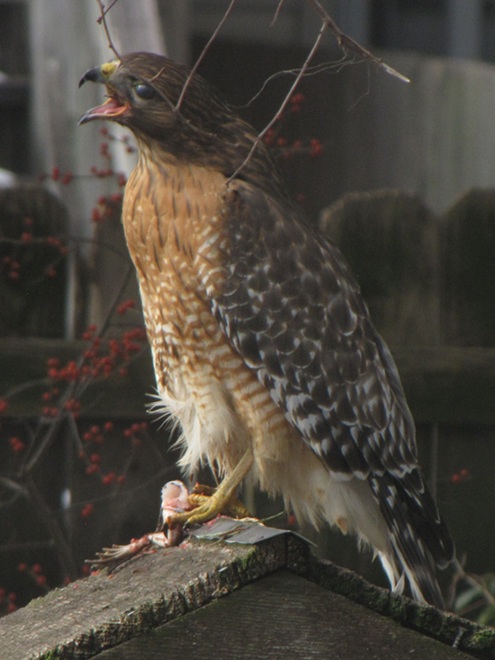
Red-shouldered Hawk and thigh of frog (cuisses de grenouille).
Our VIP guest, a discerning Red-shouldered Hawk, dining yet again on cuisses de grenouille (thigh of frog) at susquehannawildlife.net headquarters.

Maybe They’ll Stay, Maybe They Won’t

Here are a few more late-season migrants you might currently see passing through the lower Susquehanna valley.  Where adequate food and cover are available, some may remain into part or all of the winter…
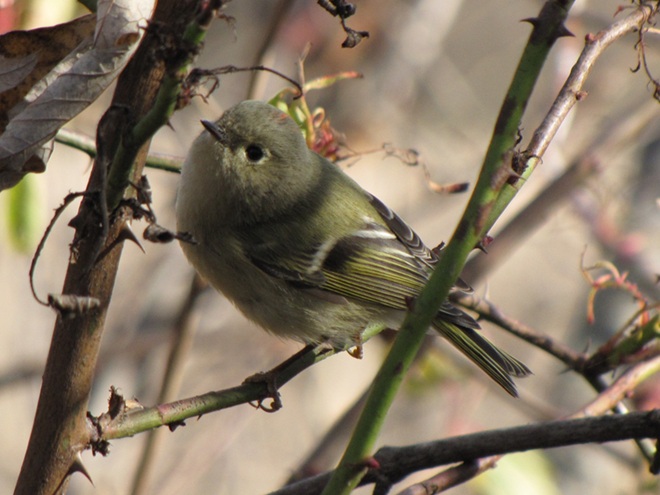
Ruby-crowned Kinglet
During the summer, Ruby-crowned Kinglets nest in northern coniferous forests.  Through the colder months, these petite songbirds can often subsist on tiny insects and other invertebrates found among the bark, limbs, and buds of leafless deciduous trees and shrubs.  In our region, look for wintering kinglets in woodlands that include at least a small percentage of evergreens to provide protection from frigid nighttime temperatures.
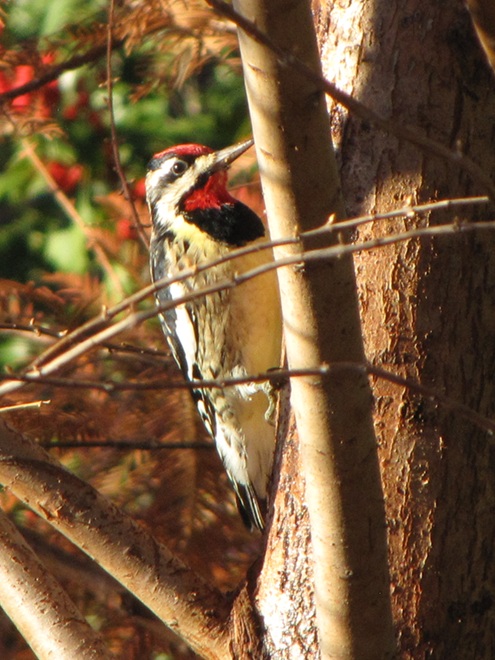
Yellow-bellied Sapsucker
The Yellow-bellied Sapsucker is our shiest of woodpeckers.  These migrants are still quite common among stands of deciduous and mixed woods, but local numbers will soon decrease as the majority of the population continues moving along to the forests of the southeastern United States for winter.
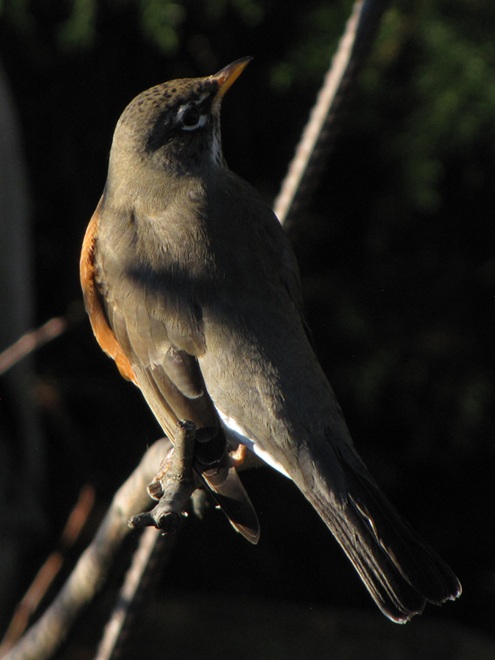
American Robin
Migrating American Robins are still transiting region, but an abundance of wild fruits can prompt hundreds to linger through winter.  Look for them near supplies of wild grape, Poison Ivy, dogwood, Virginia Creeper, hackberry, hawthorn, American Holly,…
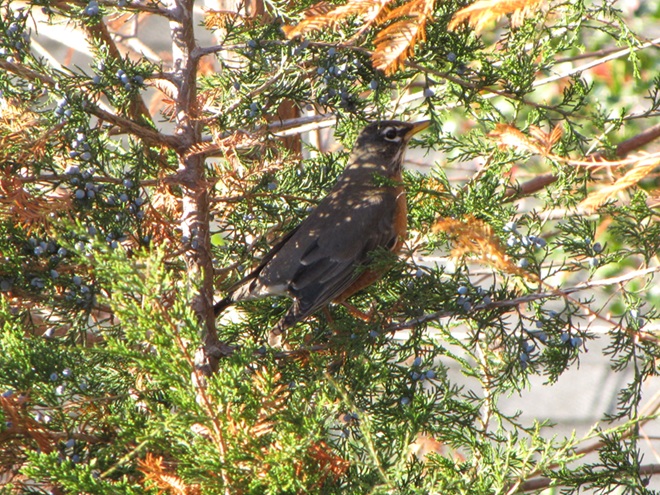
American Robin
…Eastern Red Cedar,…
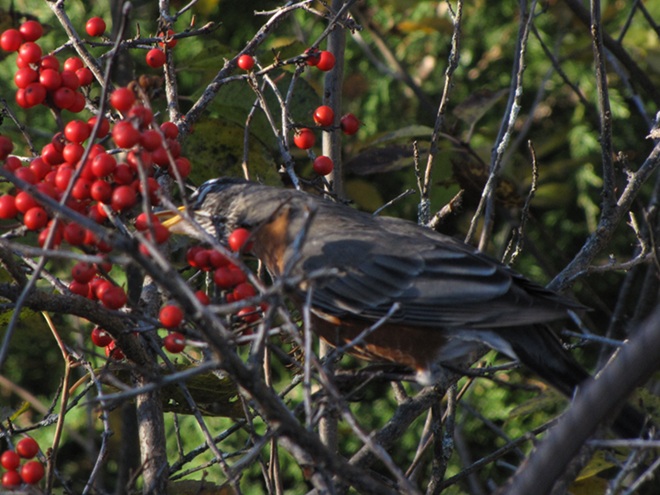
American Robin
…and Common Winterberry.
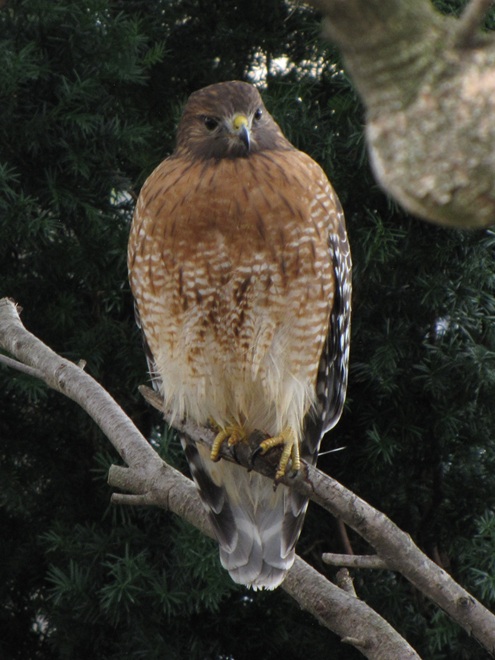
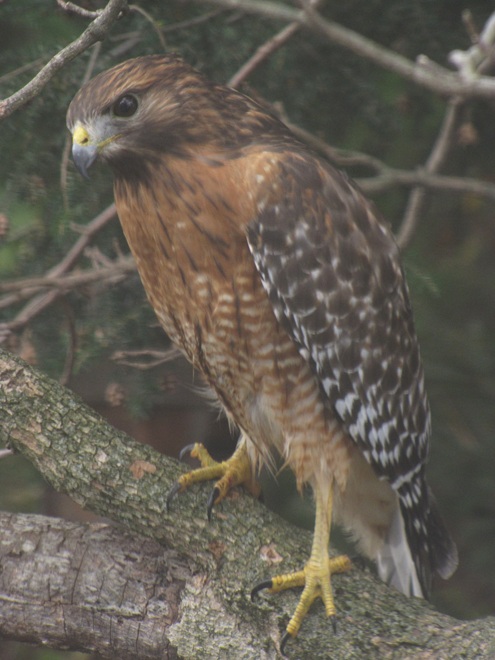
Red-shouldered Hawk
In case you were wondering…Yes, the adult Red-shouldered Hawk continues to visit the garden pond at susquehannawildlife.net headquarters.  Earlier today, we watched it plunge into the shallows after a Green Frog.  We’re enjoying the privilege of having it around, so we hope it decides to remain for as long as the food supply is accessible. 

Photo of the Day

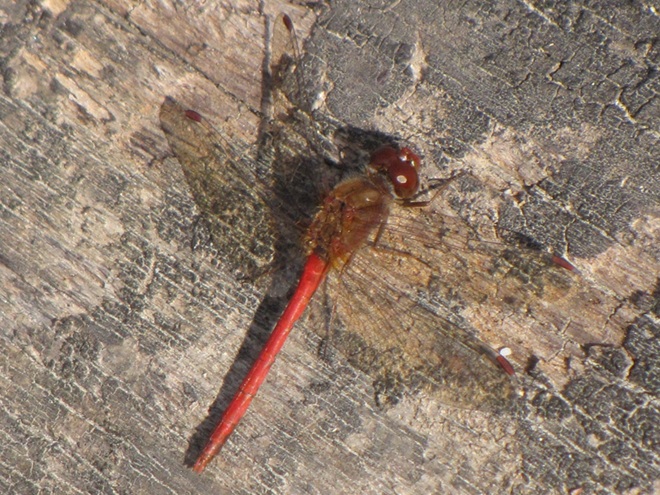
Autumn Meadowhawk
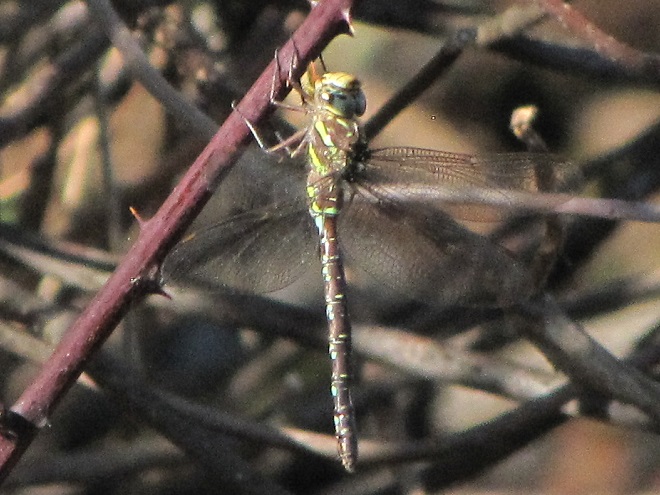
Among the last of the dragonflies to still be flying during late November is the Autumn Meadowhawk (Sympetrum vicinum).  Earlier today, we photographed this specimen as it basked in warm sunshine at Wildwood Lake in Harrisburg.  Elsewhere in the Lower Susquehanna River Watershed, look for Autumn Meadowhawks near lakes and ponds located within or near woodlands and forest.

Photo of the Day…Again

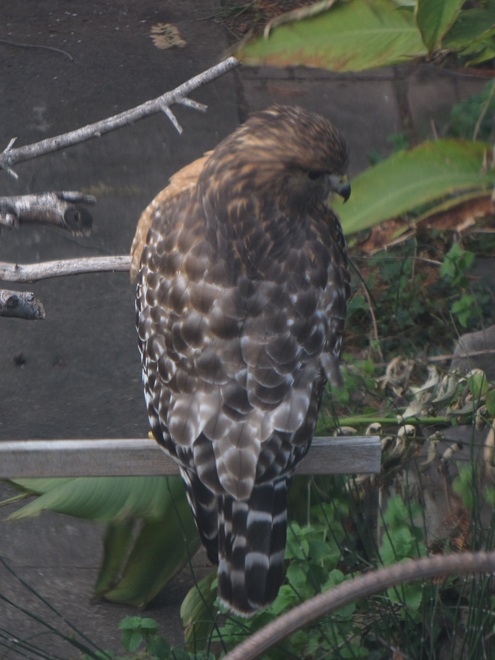
Red-shouldered Hawk
Back for an afternoon visit on a limb above the pond, our surprise guest seems to find our dining experience irresistible.  During recent winters, the Green Frogs in the headquarters habitat have continued to be active through at least New Year’s Day.  If it appears we’re going to have a Red-shouldered Hawk lingering that long, perhaps we’ll be motivated to clean our windows so we might get an even better look.

Photo of the Day

Red-shouldered Hawk
Earlier this morning, we photographed this adult Red-shouldered Hawk as it took a break from its southbound journey to eye up the Green Frogs in the susquehannawildlife.net headquarters pond.  Hunger must surely outweigh timidity because this bird persisted in its hunt despite the activity of a crew of contractors noisily grinding up asphalt in the street just 40 feet away!

Photo of the Day

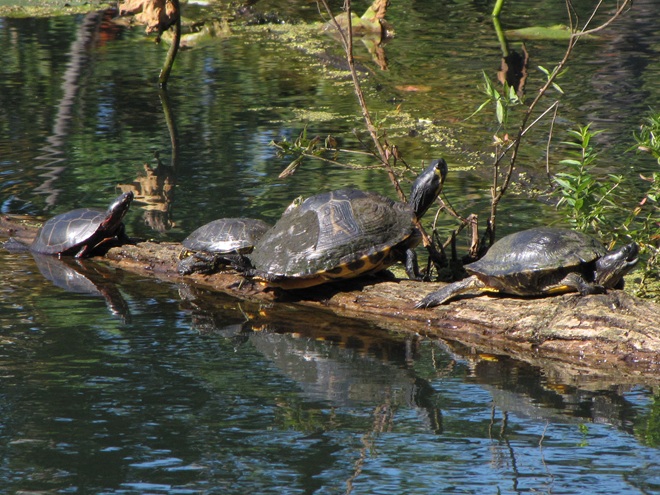
Painted Turtles and Invasive Red-eared Sliders
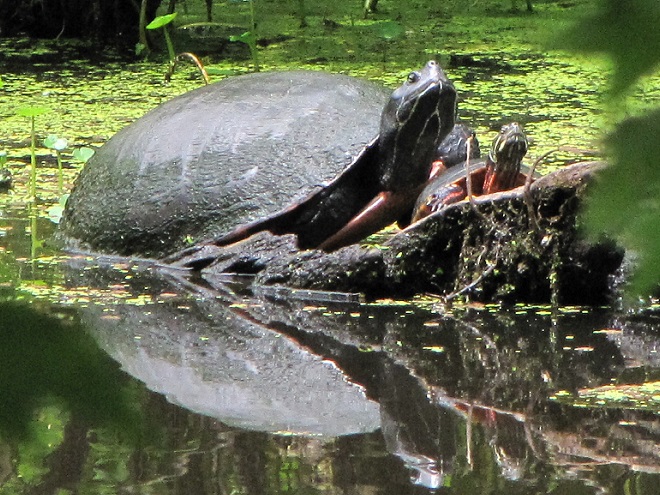
Invasive populations of Red-eared Sliders (right) continue to grow and threaten numbers of native freshwater testudines including the Painted Turtles seen here to the left.  Introduced primarily as unwanted pets, sliders are now freely reproducing throughout much of the lower Susquehanna watershed.  Their ability to feed aggressively and grow to sizes significantly larger than those of our most-imperiled wetland species including the Spotted Turtle (Clemmys guttata), Wood Turtle, and endangered Bog Turtle make Red-eared Sliders a menace rivaling habitat loss and illegal collecting.

Migratory Shorebirds on the Freshwater Impoundments at Bombay Hook National Wildlife Refuge

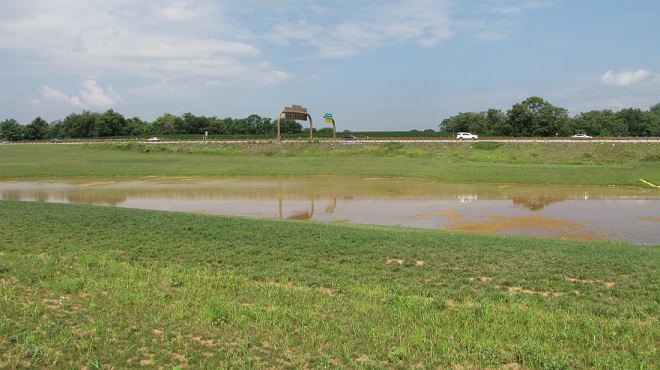
It may seem hard to believe, but the autumn migration of shorebirds and many Neotropical songbirds is now well underway.  To see the former in what we hope will be large numbers in good light, we timed a visit to the man-made freshwater impoundments at Bombay Hook National Wildlife Refuge near Smyrna, Delaware, to coincide with a high-tide during the mid-morning hours.  Come along for a closer look…

Bombay Hook NWR tour road at Shearness Pool
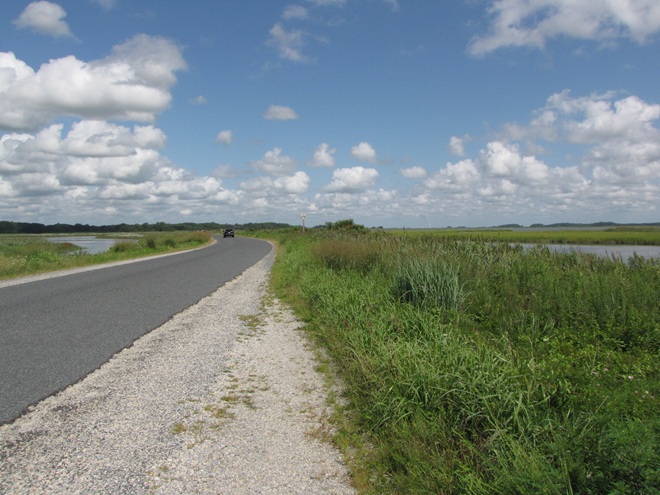
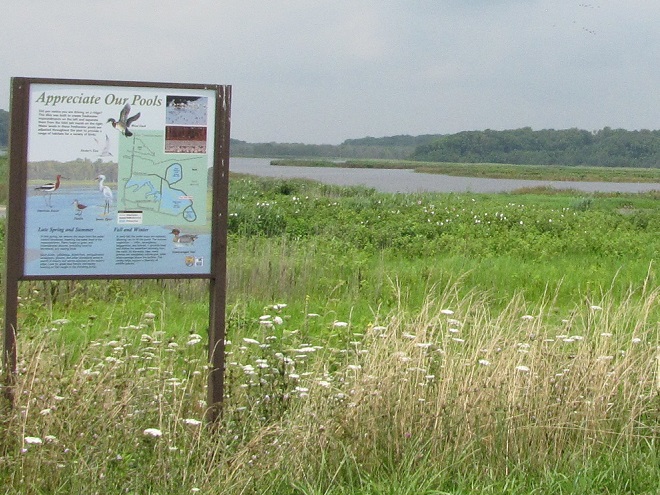
Along a large portion of its route, the tour road at Bombay Hook N.W.R. sits atop the man-made dikes that create several sizeable freshwater pools (left) along the inland border of one of the largest remaining salt marsh estuaries in the Mid-Atlantic States (right).
Tidal Creek at High Tide
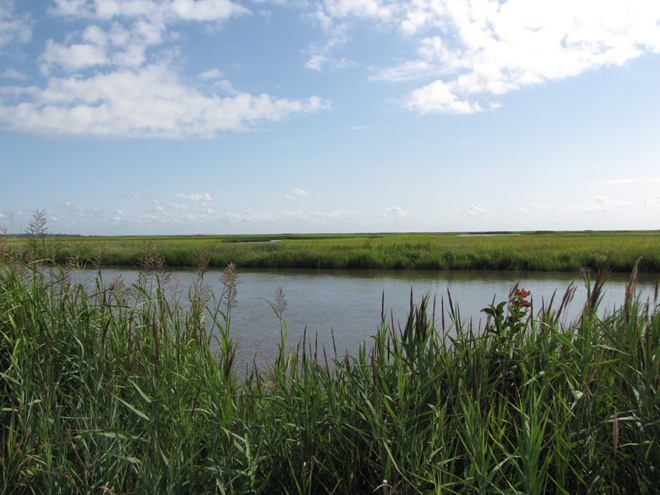
Twice daily, the rising tide from Delaware Bay flows along the tidal creeks to flood Bombay Hook’s extensive marshes.
High Tide in the Bombay Hook coastal estuary.
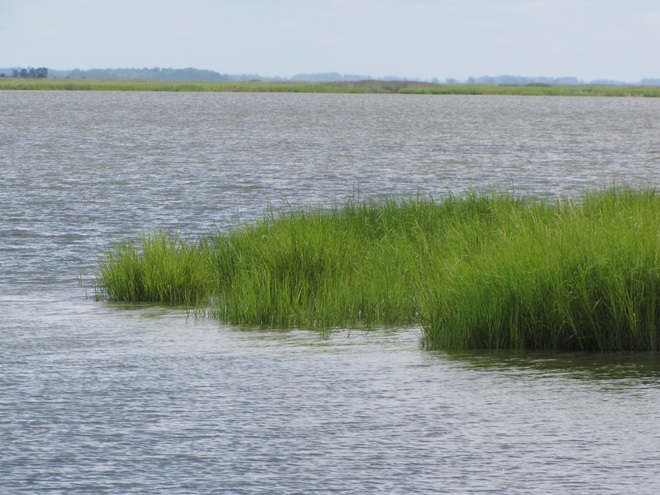
At high tide, mudflats in Bombay Hook’s coastal estuary become inundated by salt water, forcing migratory shorebirds to relocate to bay side beaches or other higher ground to rest and feed for several hours.
Shearness Pool
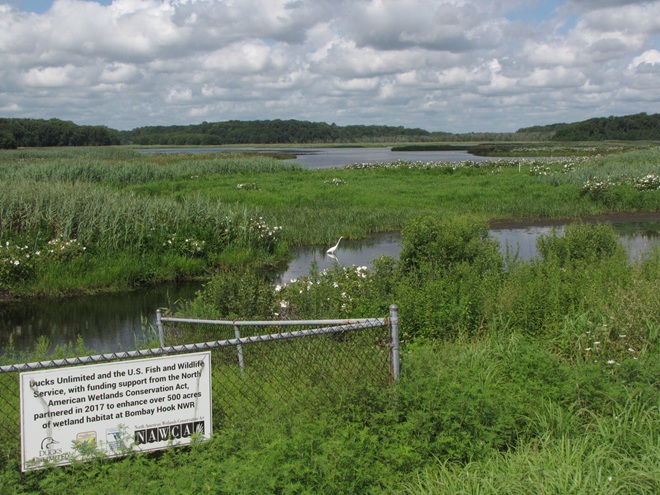
At Bombay Hook, migratory shorebirds, waterfowl, and waders can find refuge from high tide in the freshwater impoundments created by capturing water along the inland west side of a system of earthen dikes.
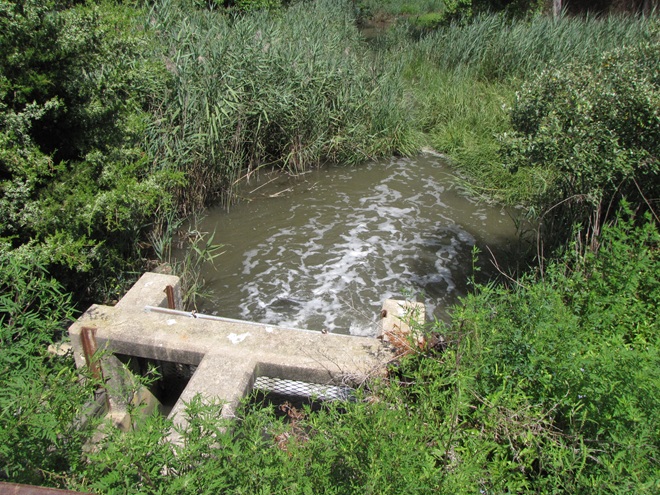
Water Level Control System
Mechanical or stacked-board gate systems are used to control water depth in the impoundments.  Levels can be adjusted seasonally to manage plant growth and create conditions favorable for use by specific groups of birds and other wildlife.
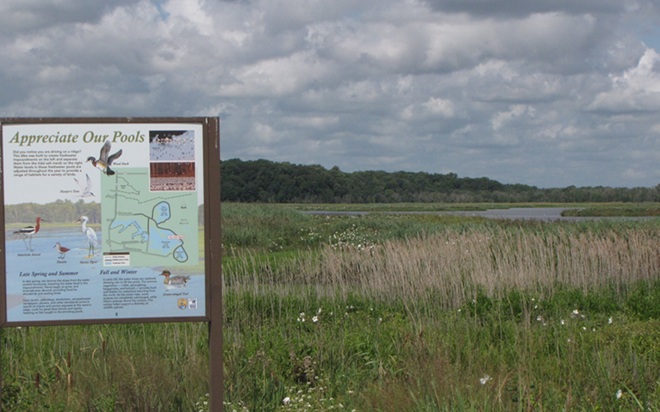
Shearness Pool
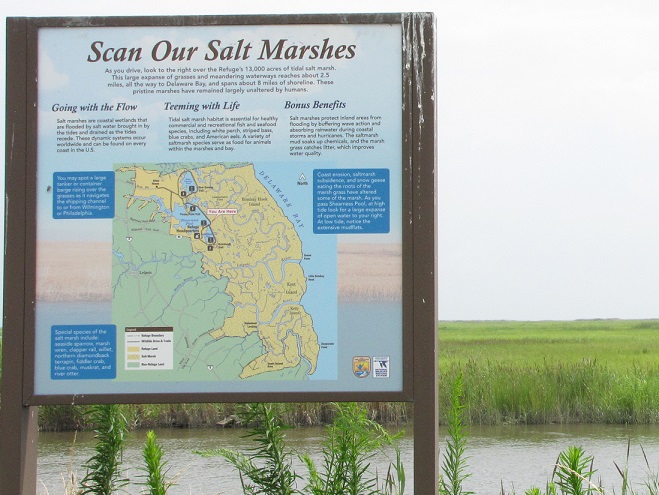
A map at Shearness Pool, the largest impoundment on the refuge, shows the location of other freshwater pools at Bombay Hook.
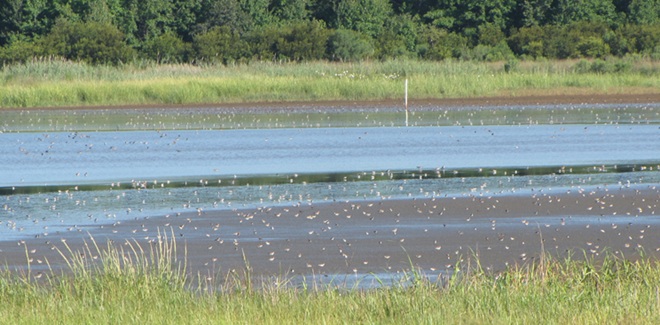
Shorebirds on Raymod Pool
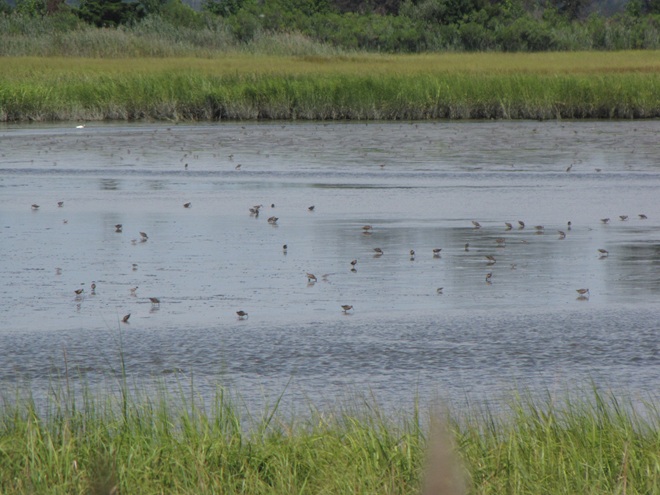
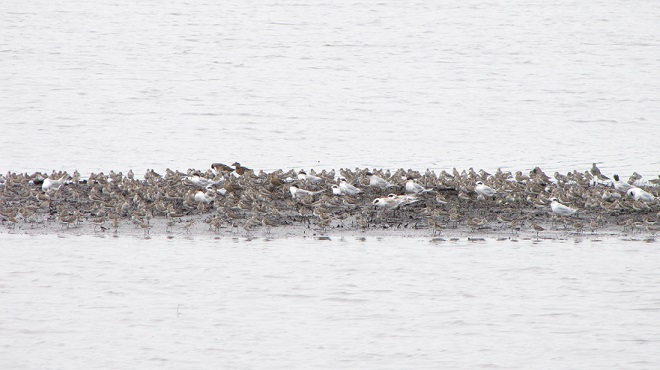
A mix of mudflats and shallow water on Raymond Pool provides ideal habitat for a variety of shorebirds forced from the vast tidal marshes by the rising tide.  For us, a mid-morning high tide places these birds in perfect light as they feed and loaf in the pools to the west of the tour road located atop the dikes.
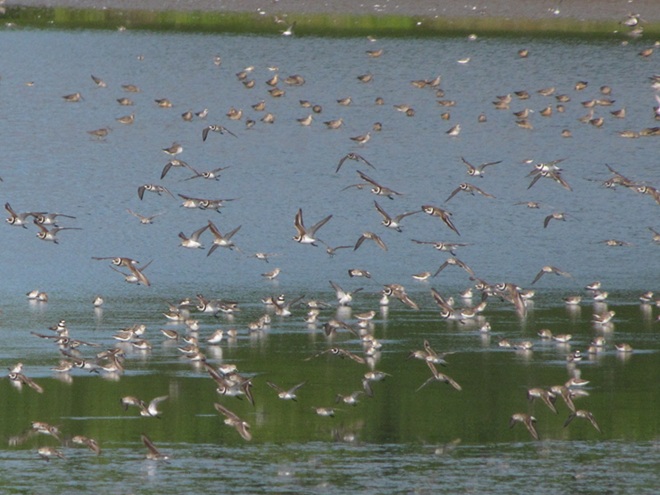
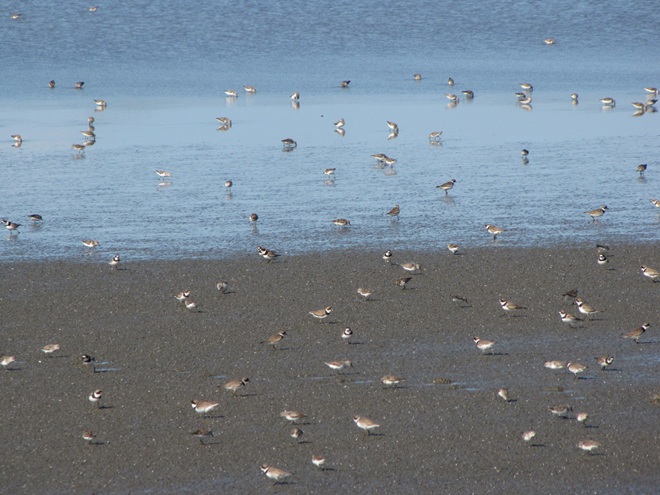
Shorebirds arrive on Raymond Pool during high tide.
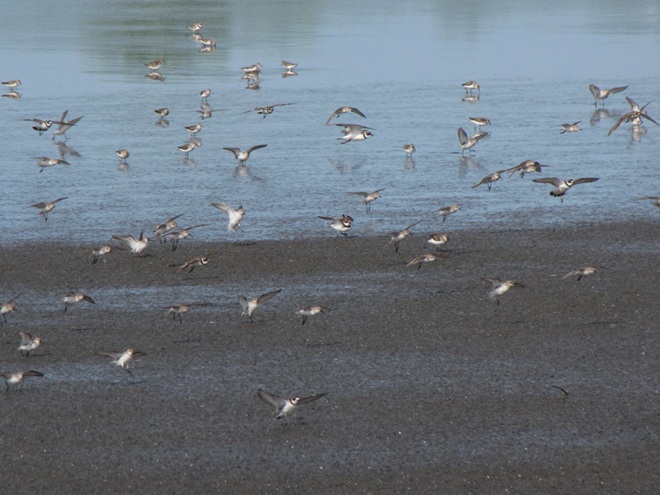
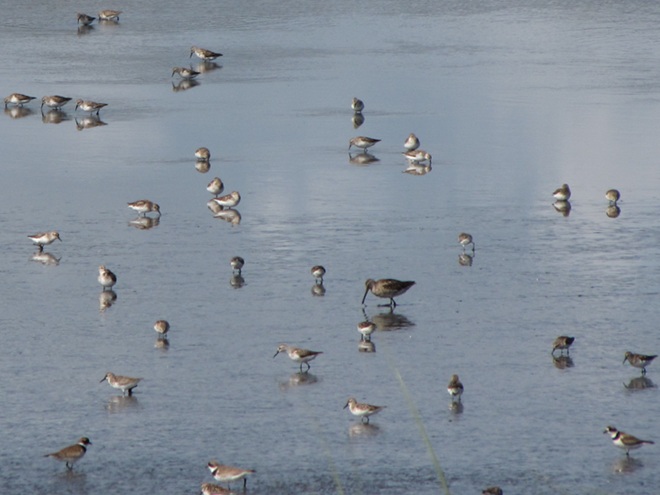
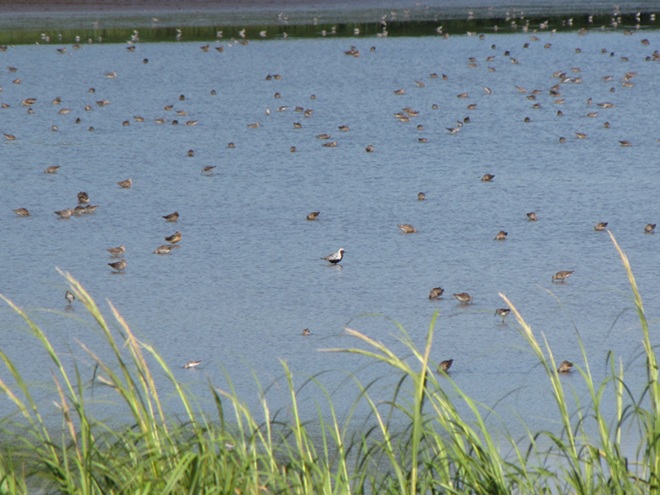
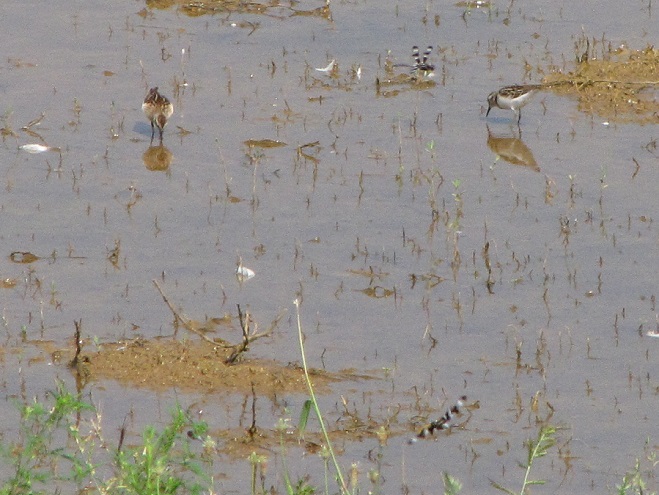
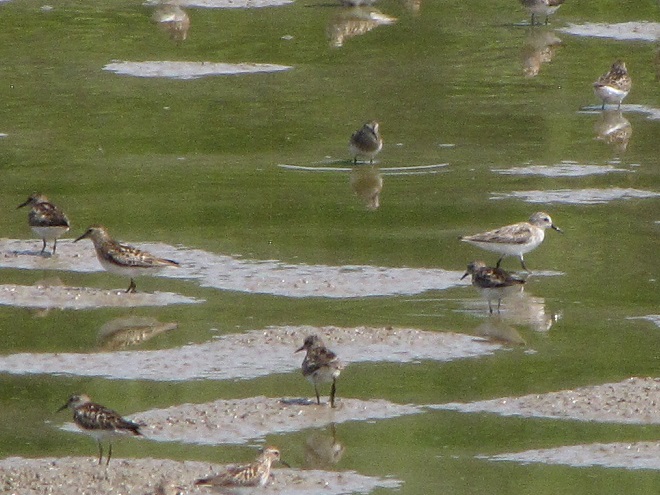
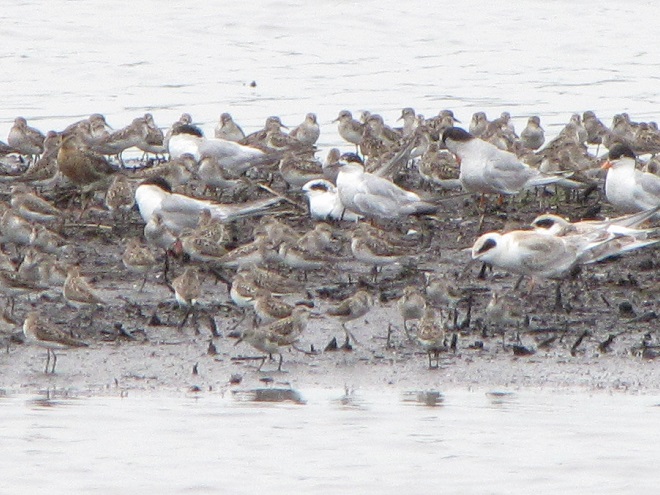
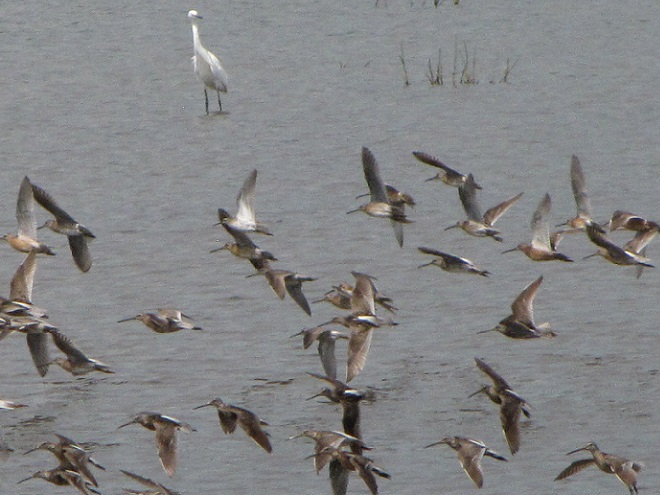
Migrating shorebirds arrive on Raymond Pool to find refuge from the rising tide to the east.  Showing a single ring around their breast, many Semipalmated Plovers can be seen here among the Semipalmated Sandpipers, the latter the most abundant shorebird presently populating Bombay Hook.  Feeding in deeper water in the background are Short-billed Dowitchers.  All of these birds consume a variety of invertebrates they find both in and on the mud.
Semipalmated Plovers and Semipalmated Sandpipers
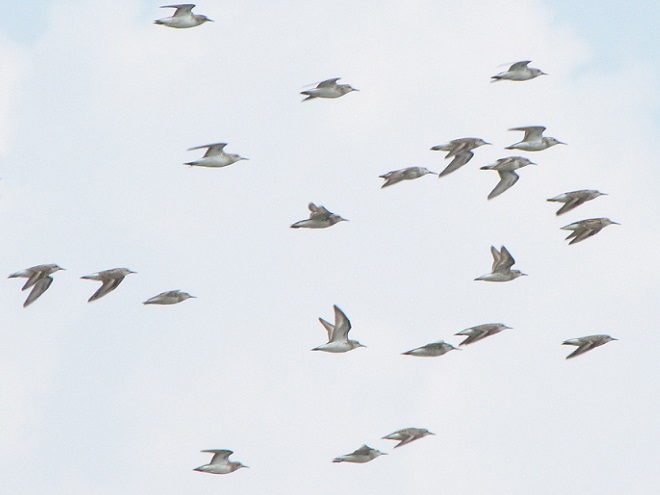
Semipalmated Plovers and Semipalmated Sandpipers arriving on a mudflat at Raymond Pool.
Short-billed Dowitcher
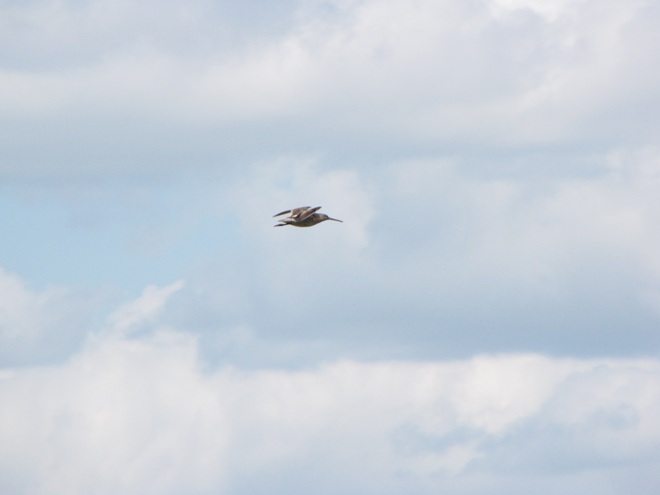
A Short-billed Dowitcher glides in from the salt marsh to visit the shallows of Raymond Pool for a couple of hours.
Short-billed Dowitcher and other Shorebirds
A Short-billed Dowitcher feeding among Semipalmated Plovers and Semipalmated Sandpipers.
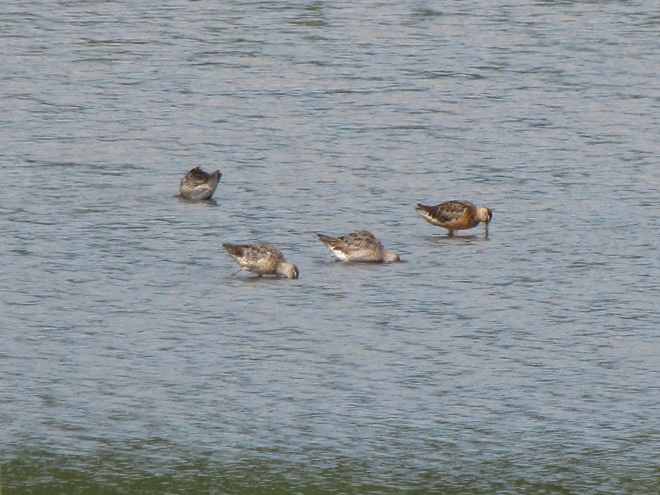
Short-billed Dowitchers
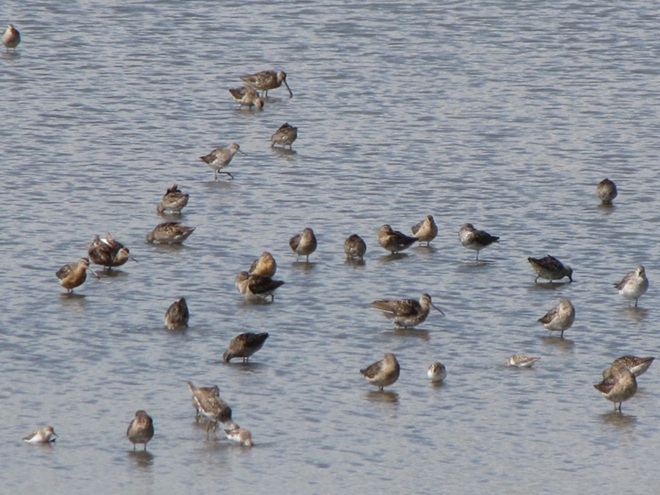
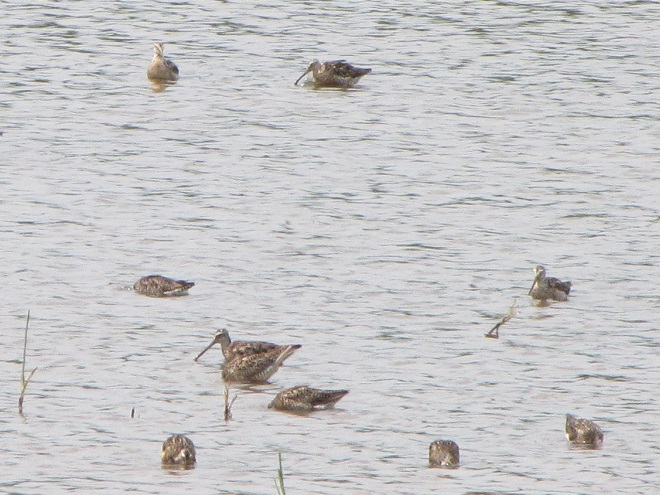
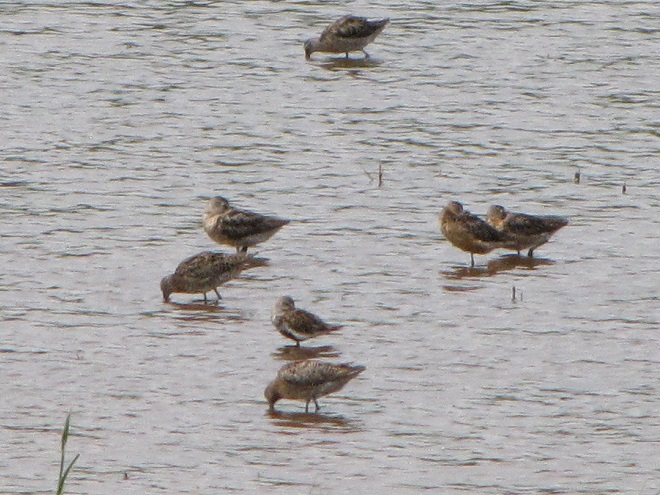
Short-billed Dowitchers in water almost too deep for the Semipalmated Sandpipers in their company.
Black-bellied Plover and Short-billed Dowitchers
A lone Black-bellied Plover (Pluvialis squatarola) among the abundance of Short-billed Dowitchers.
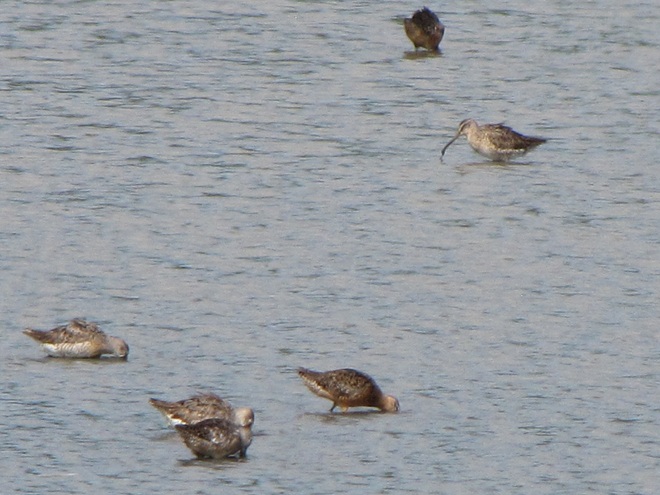
Short-billed Dowitchers
Short-billed Dowitchers probe the mud with their sewing machine-like feeding style.
Short-billed Dowitchers
Seldom do they take a break long enough for an observer to their bill in its entirety.
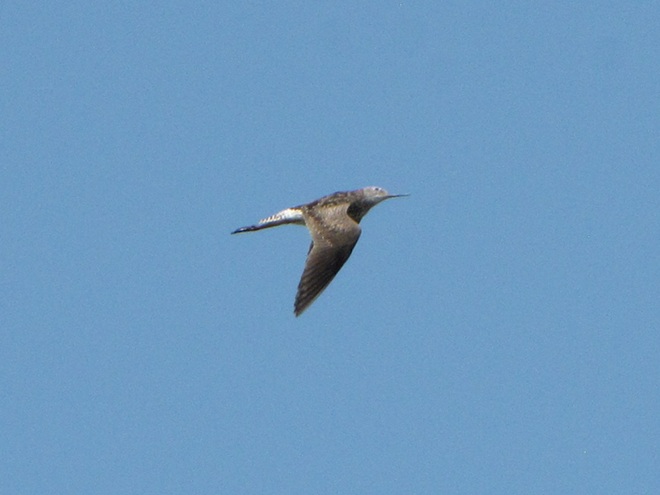
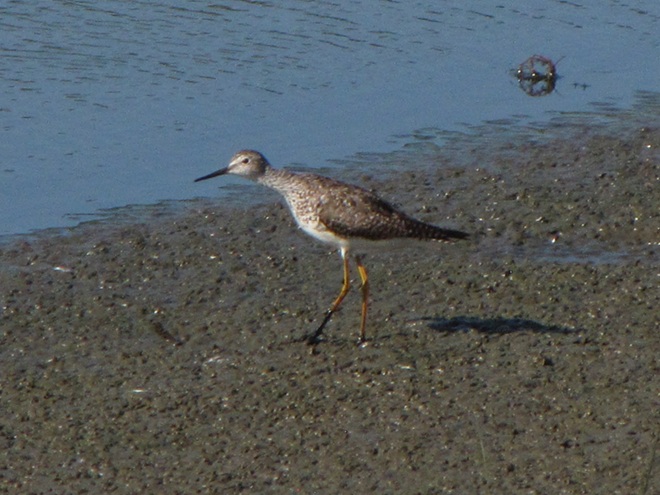
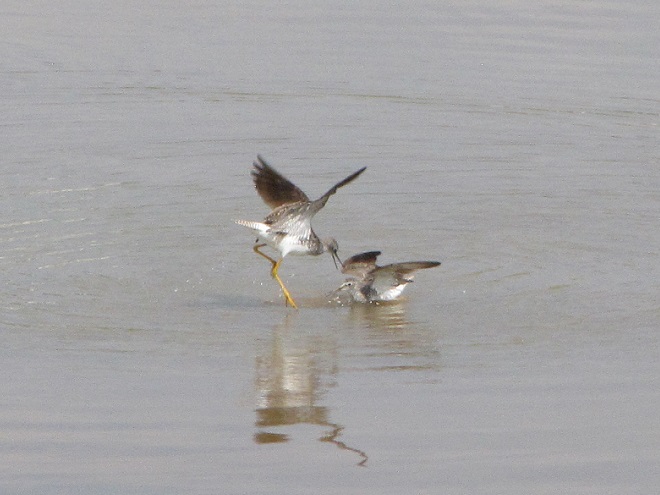
Lesser Yellowlegs
A Lesser Yellowlegs arrives at Raymond Pool as a high-tide refugee.
Lesser Yellowlegs
Another Lesser Yellowlegs on a mudflat.
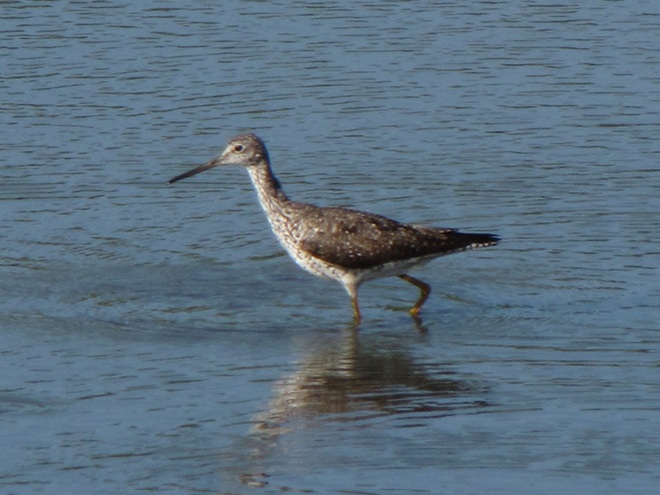
Greater Yellowlegs
A Greater Yellowlegs wades into shallow water to feed.
Semipalmated Plovers and Semipalmated Sandpipers
It’s difficult to estimate just how many Semipalmated Plovers and Semipalmated Sandpipers were seen.  There were at least 500 plovers, and they were very vocal.  The latter species was present in numbers measurable in the thousands.  We don’t think 10,000 Semipalmated Sandpipers is an overestimate.
Semipalmated Sandpipers
Searching through the Semipalmated Sandpipers, one could regularly find a very similar species among them.
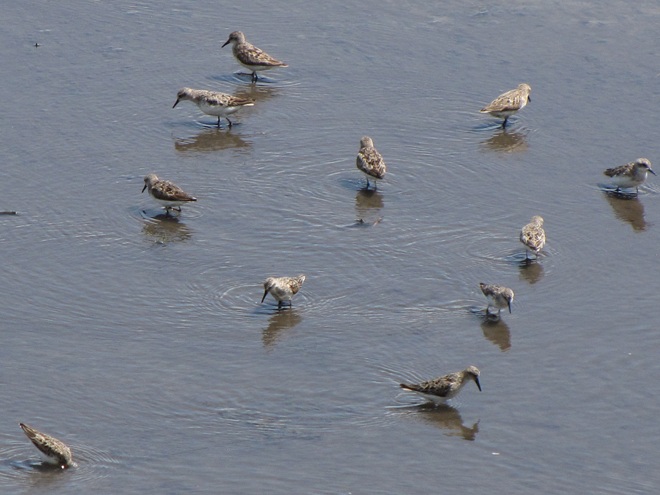
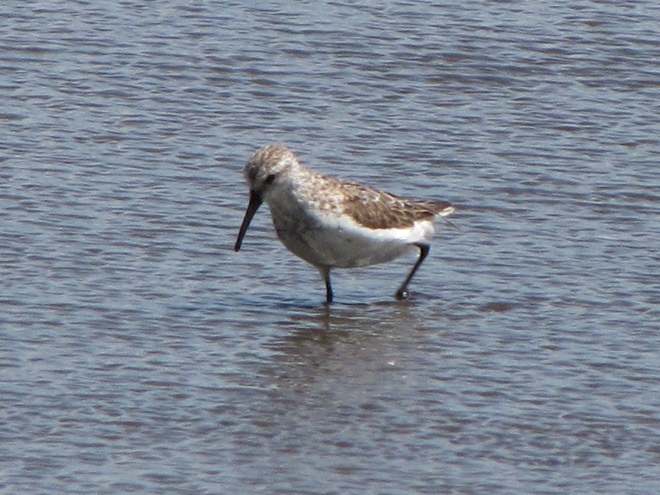
Western Sandpiper
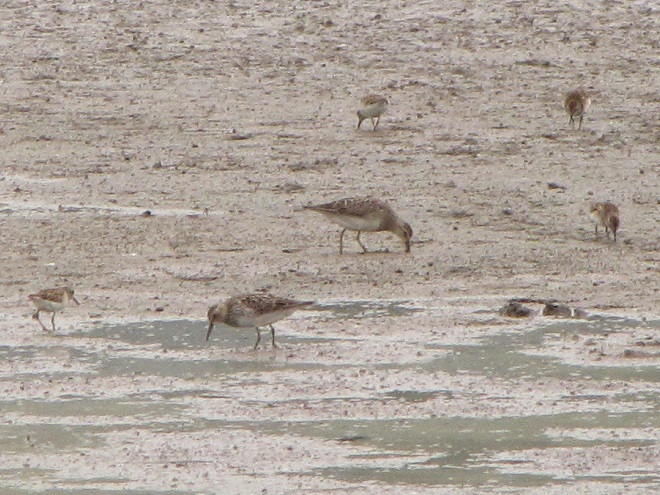
We identified the longer-billed and slightly larger Western Sandpiper (Calidris mauri) and found the species to be present possibly by the hundreds among the masses of thousands of Semipalmated Sandpipers.  These seem to be unusually high numbers for this more western species, but who’s complaining?
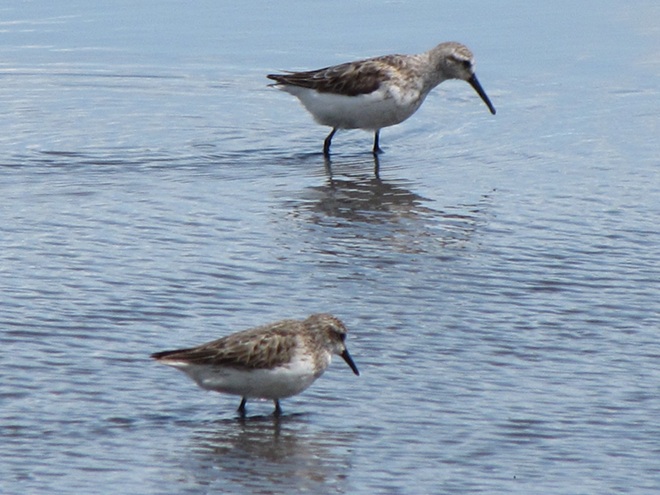
Western and Semipalmated Sandpipers
As we sifted through these groups of tiny shorebirds known as “peeps”, we found Western Sandpipers (top) regularly distributed among the multitudes of Semipalmated Sandpipers (bottom) we encountered.
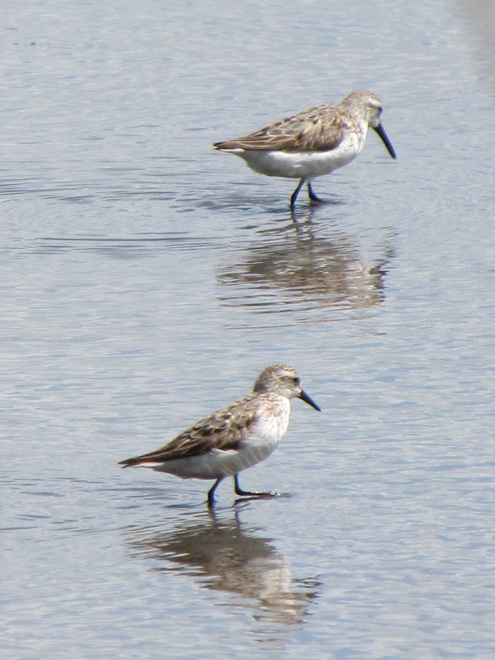
Western and Semipalmated Sandpipers
A Western Sandpiper (top) photographed with a Semipalmated Sandpiper (bottom) in Bear Swamp Pool.
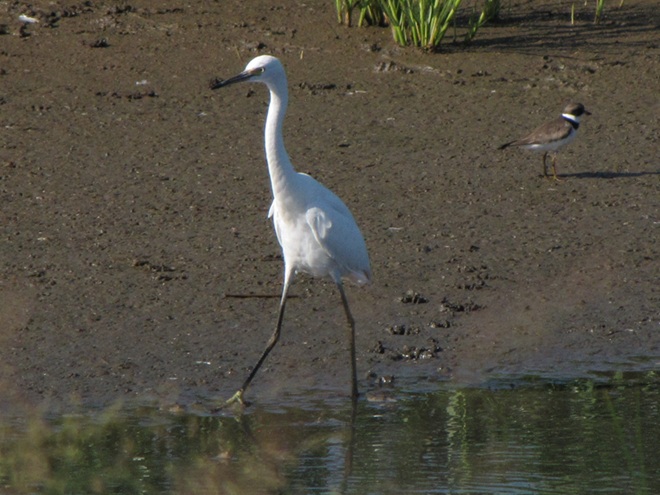
Snowy Egret
Of course, shorebirds aren’t all there is to see at Bombay Hook.  More than 100 Snowy Egrets were found on the freshwater pools alongside birds like this Semipalmated Plover.
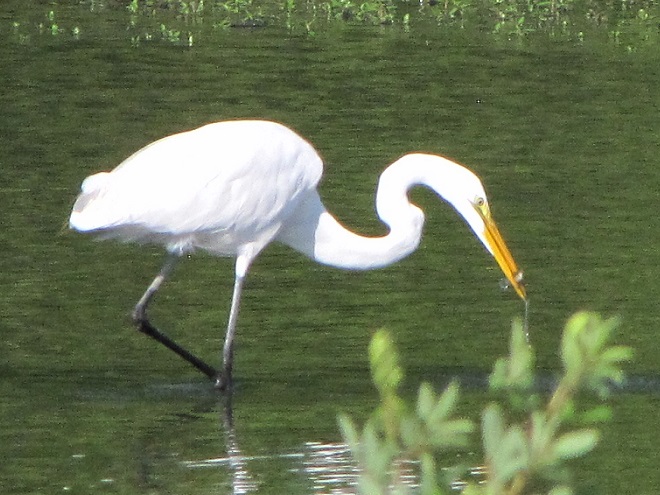
Great Egret
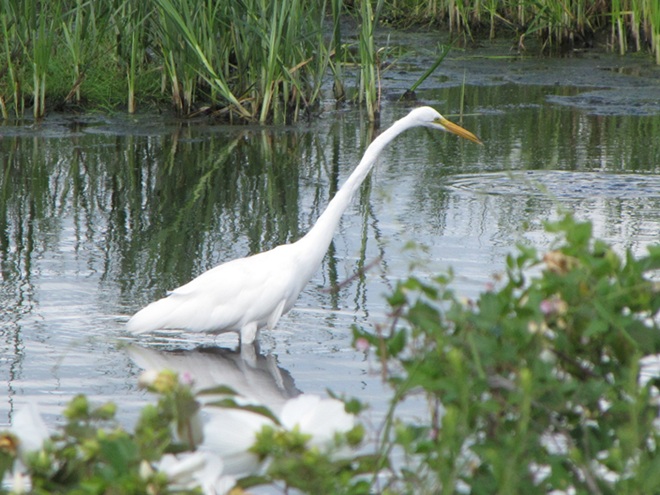
Great Egrets could be seen stalking small fish in the channels of the pools.
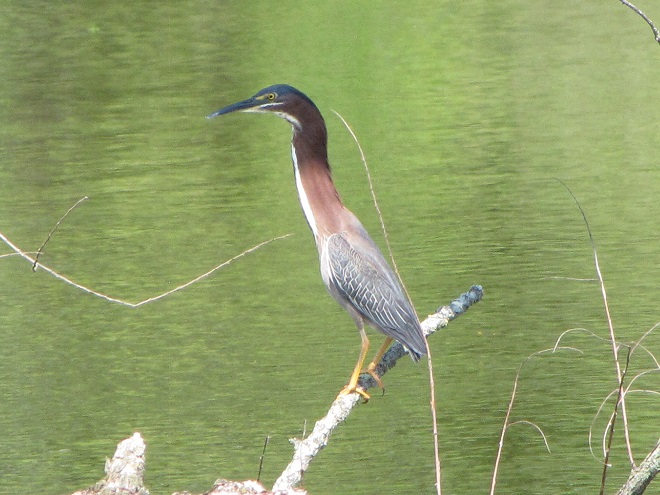
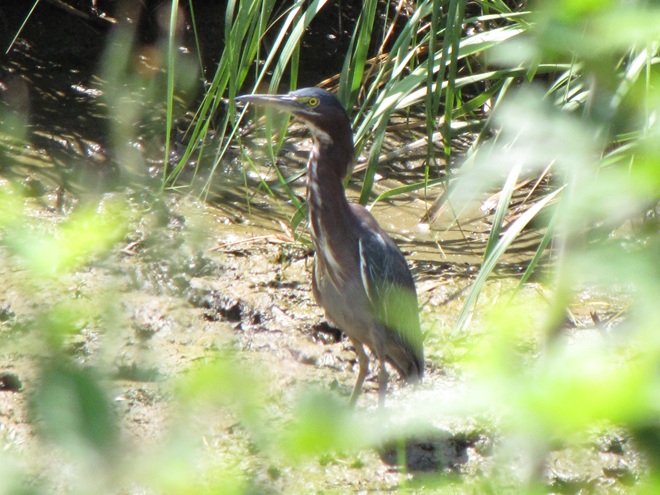
Green Heron
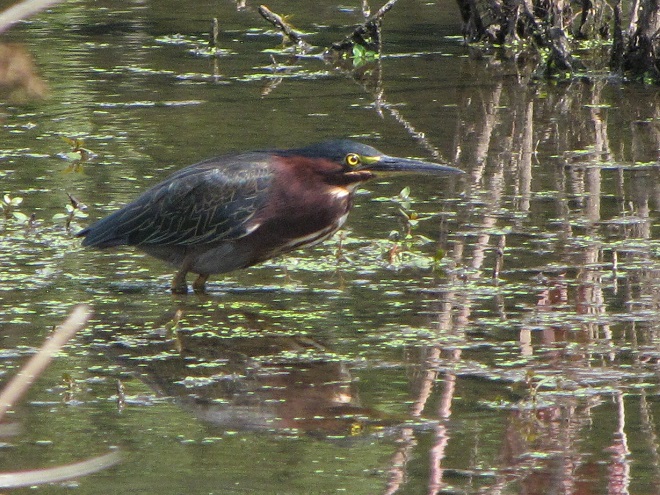
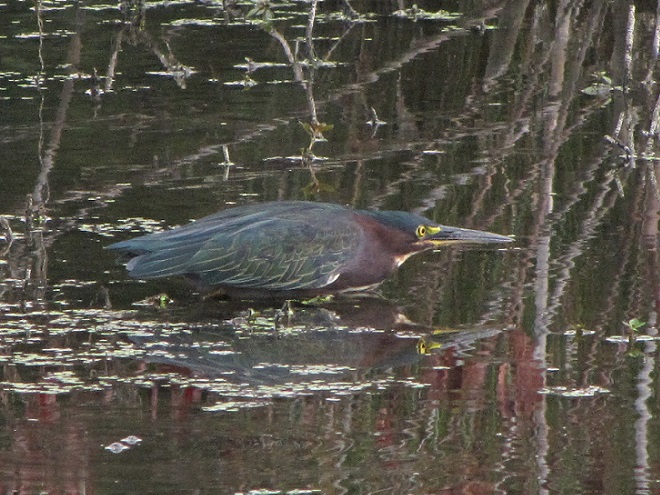
And a few Green Herons were found lurking in the vegetation.
Osprey
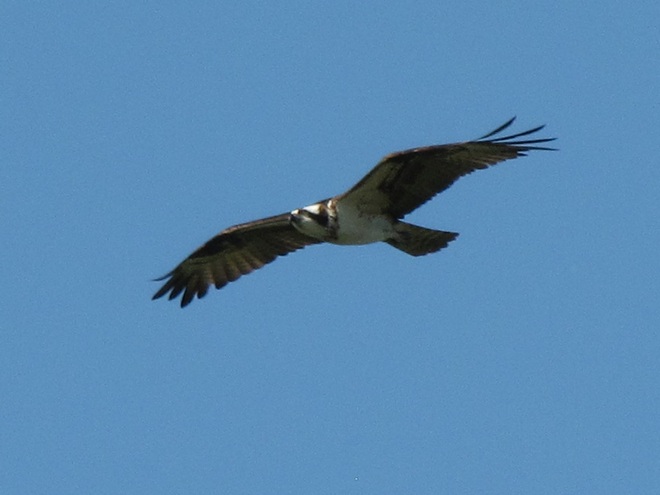
This Osprey briefly startled the shorebirds on Raymond Pool until they realized it posed no threat.
Shorebirds Feeding on Mudflat during Receding Tide
By early afternoon, we noticed the tide beginning to retreat from the saltwater marsh and mudflats opposite Shearness Pool.  As shorebirds began returning there to feed, we decided to make our way to Raymond Pool to watch the exodus.
Shorebirds Depart Raymond Pool
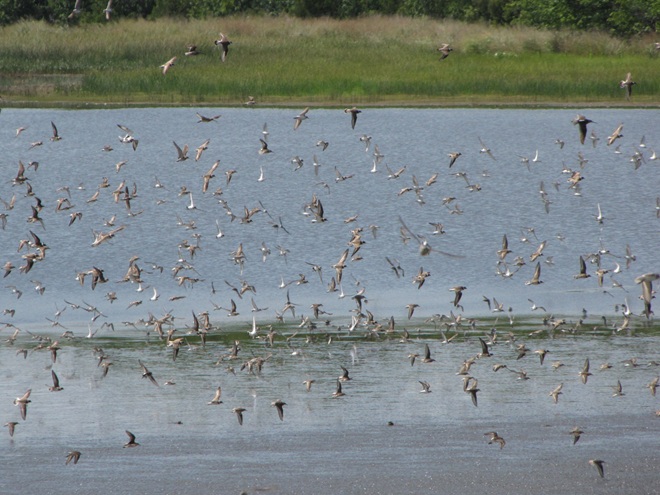
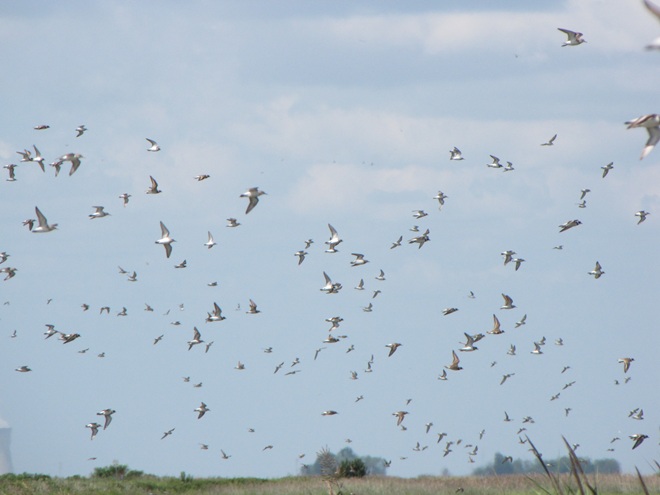
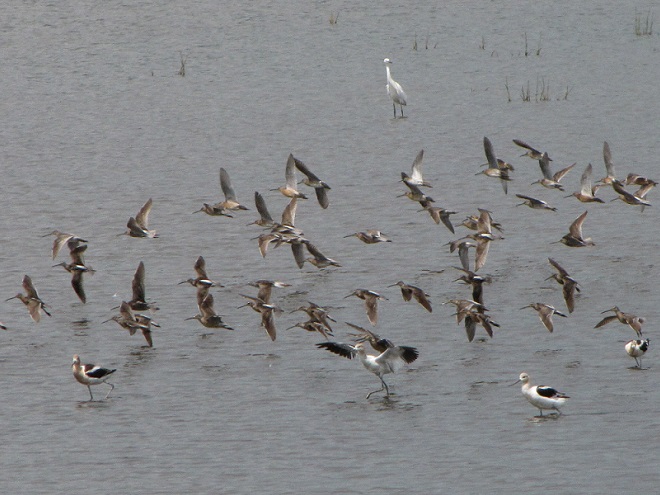
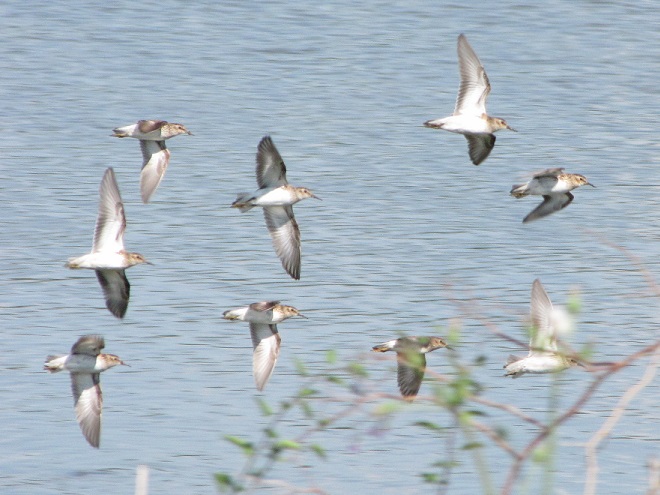
With the high tide receding from the coastal estuary back into Delaware Bay, shorebirds promptly departed their concentrated environs on Raymond Pool to spread out over thousands of acres of salt marsh to feed.
Black-bellied Plovers and other Shorebirds Leaving Raymond Pool
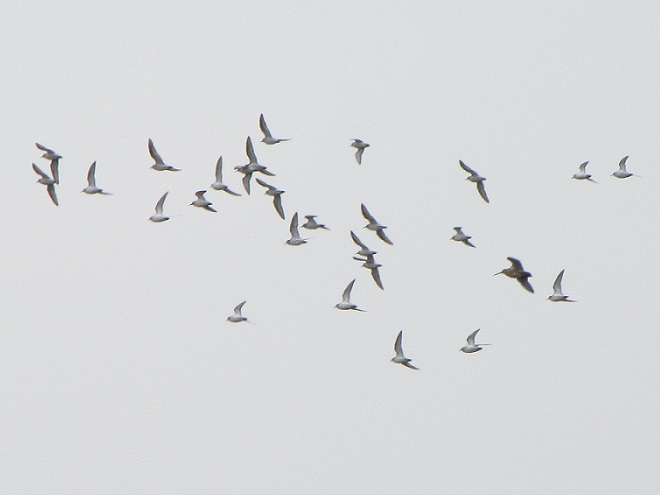
More shorebirds exit Raymond Pool en route to the adjacent tidal areas to feed.  This outbound group includes two Black-bellied Plovers (top center and four birds to the right).
Shorebirds Entering the Saltmarsh Estuary at Bombay Hook National Wildlife Refuge
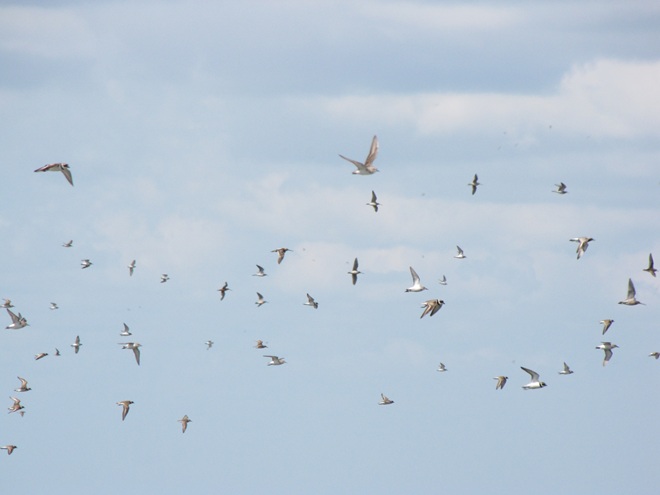
These migrants have just begun their autumn journey from breeding grounds in Canada and Alaska to wintering areas located as far south as southern South America.  For them, Bombay Hook and other refuges are irreplaceable feeding and resting locations to help them refuel for their long journey ahead.  For them, a little vacation along the coast is a matter of life and death.
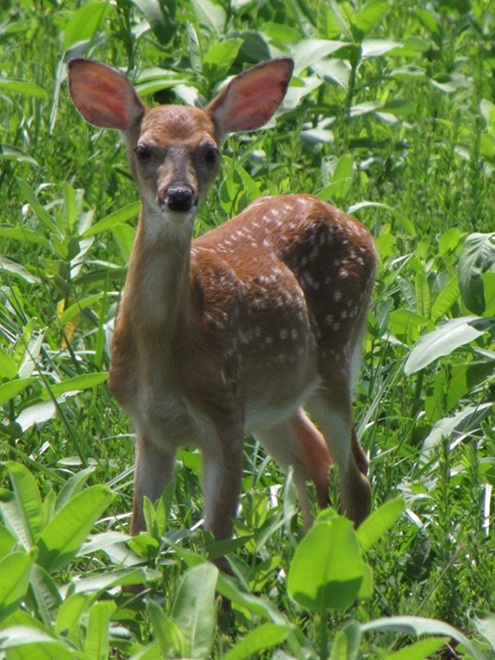
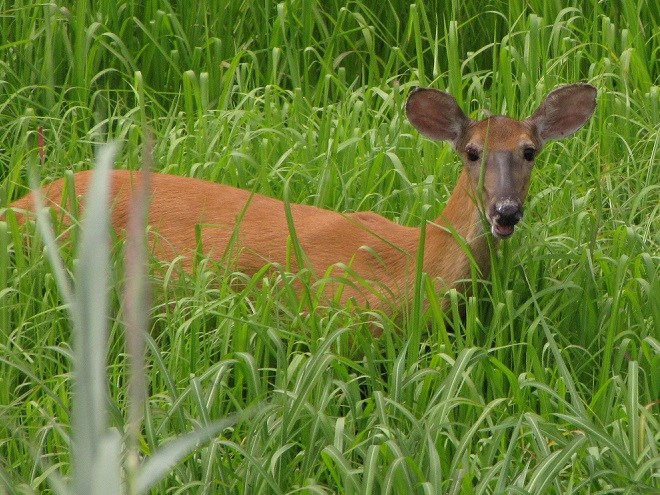
White-tailed Fawn
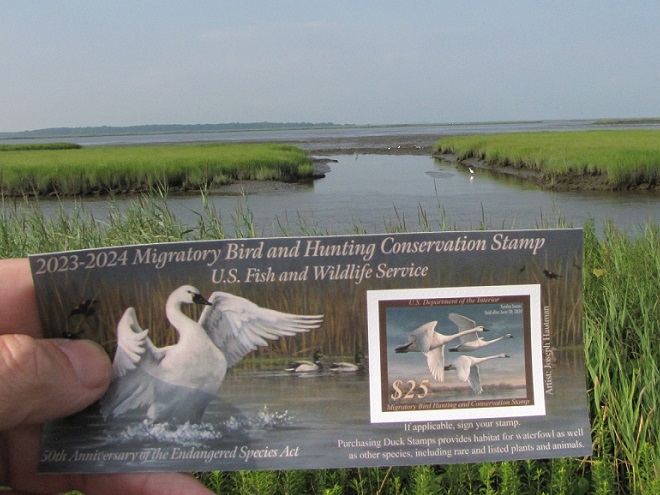
A goodwill ambassador bids us farewell at the end of our visit to Bombay Hook.  Remember to support your National Wildlife Refuges by purchasing your annual Federal Duck Stamp.  They’re available right now at your local United States Post Office, at the Bombay Hook visitor’s center, or online at the United States Fish and Wildlife Service website.

Planning a visit?  Here are some upcoming dates with morning high tides to coax the birds out of the tidal estuary and into good light in the freshwater impoundments on the west side of the tour road…

Tuesday, August 19 at approximately 07:00 AM EDT

Wednesday, August 20 at approximately 08:00 AM EDT

Thursday, August 21 at approximately 09:00 AM EDT

Friday, August 22 at approximately 10:00 AM EDT

Saturday, August 23 at approximately 11:00 AM EDT

Five Flowering Plants for Cleaner Water

Currently in the Lower Susquehanna River Watershed, you can find these five species of herbaceous plants in full bloom.  As they grow, they and others like them help to purify waters within their respective ecosystems by taking up nutrients—namely, the nitrogen and phosphorus that can lead to detrimental algal blooms and eutrophication in ponds, lakes, streams, and rivers.

(United States Geological Survey image by Virginia-West Virginia Science Center)
Marsh Blue Violet
The Marsh Blue Violet (Viola cucullata) is most frequently found growing in the wet soils of forest bottomlands, usually where springs first break the earth’s surface and begin slowly trickling away to form a small brook or join an existing stream.  The blooms are recognized by their darker purple centers and their long stems.
Marsh Blue Violet
This particular Marsh Blue Violet was found at 750′ altitude in the running water at a mountainside spring seep on a south-facing slope in the Ridge and Valley Province.
Soft Rush
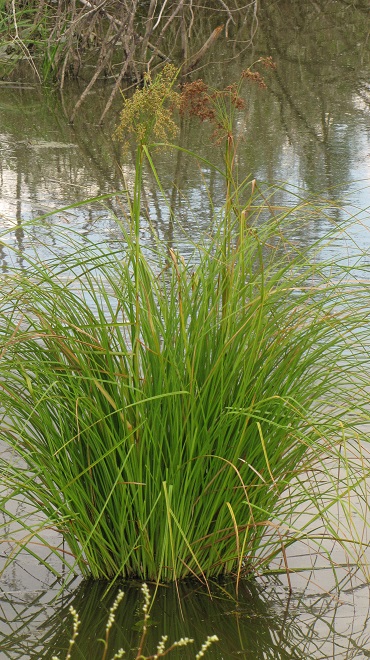
The seldom-noticed flowers of the Soft Rush (Juncus effusus), also known as the Common Rush, emerge from the sides of its quill-like stems.  This wetland species is found in damp soils, sometimes in standing water, and grows in stiff, erect clumps that persist through winter.  When found in pastures, Soft Rush is seldom of interest to cattle or other livestock.  It therefore doesn’t lure these animals into muddy, puddle-prone areas.  When subjected to heavy grazing in dry weather and flooding during wet spells, these puddle sites may host nearly pure stands of Soft Rush, the only plant able to thrive there.  When it comes to nutrient uptake in these soggy sections of the meadow, the soft Rush is the lone ranger.  Soft Rush seeds are available from Ernst Conservation Seeds in Meadville, PA, and are included in many of their mixes formulated for stormwater management basins and other wet soil applications.
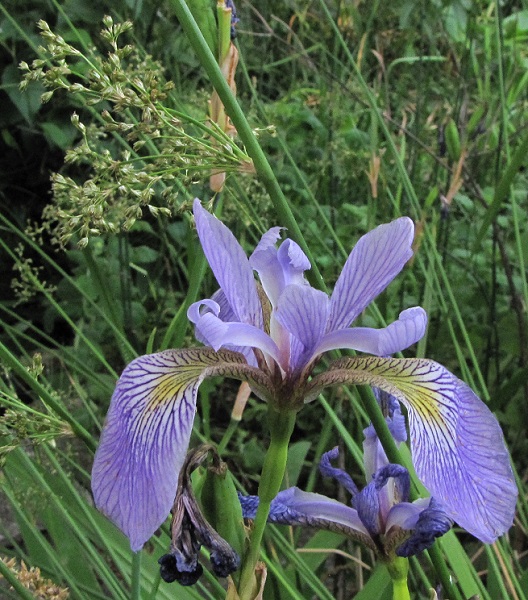
Larger Blue Flag
Larger Blue Flag (Iris versicolor) is a plant of wetlands and shorelines.  It can be grown as an emergent in ponds and lakes where it will help to absorb nutrients from both the water and the underlying substrate.
Larger Blue Flag
Larger Blue Flag is a native species in the lower Susquehanna valley.
Yellow Iris
The Yellow Iris (Iris pseudacorus), also known as the Water Flag, is native to Eurasia and Africa.  Seen here growing as an emergent among native Common Cattails (a superb water purifier), the Yellow Iris can easily escape cultivation and become invasive.  The showy flowers and water-cleansing benefits of this plant make it attractive for use in the garden or farm pond, but considerations must be made for its aggressive growth and proclivity to escape to neighboring habitats.  If you’re purchasing irises for transplanting, you’re probably better off sticking with the native Larger Blue Flag; it is far less vigorous and you’ll be able to grow other aquatic species along with it.
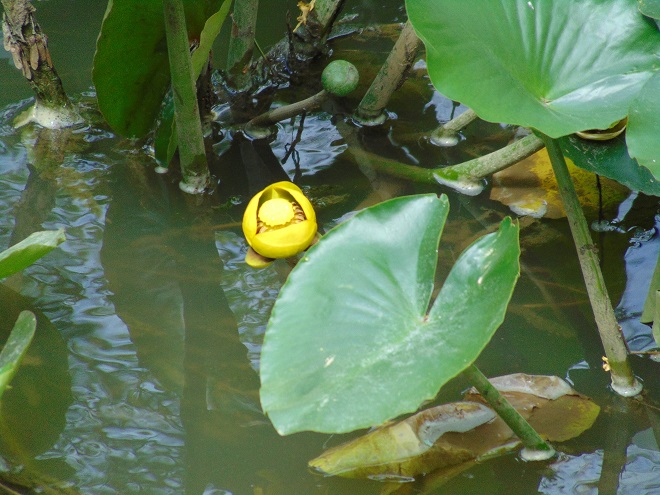
Spatterdock
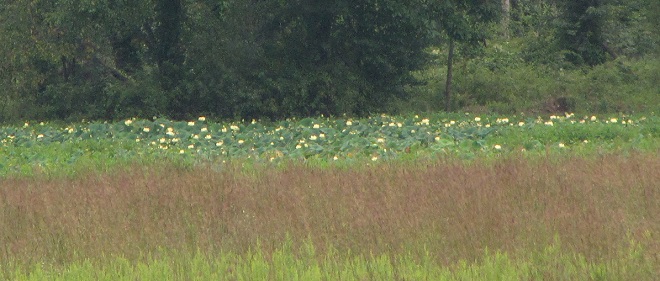
In large ponds, lakes, and low-gradient streams, one of the best aquatic plants for sequestering nutrients and clarifying water is Spatterdock, also known as Cow-lily or Yellow Pond Lily.  Spatterdock does best as an emergent in shallow water along the shoreline.  It grows well in full sunshine and makes excellent habitat for wildlife.  Depending on the nutrient load from fish, waterfowl, decaying vegetation, and other sources, plant cover may need to be as high as 30% or more of the surface area to keep algae from overtaking a lake or large pond.  Spatterdock can often be used to help fulfill these needs while still offering open water beneath the leaves and between the stems for fish, amphibians, reptiles, and macroinvertebrates to thrive.
Spatterdock
Though probably not suitable for small garden ponds, Spatterdock (Nuphar advena) can be an excellent choice for helping to clear up the nutrient-loaded waters of a farm pond or lake.  You can find it, the irises, and Soft Rush available through some pond nurseries and garden centers.  If you can’t get them locally, check out retail and wholesale suppliers online, but remember to inspect any livestock you bring in from outside the area for hitchhikers like non-native snails (native snails are O.K.).  To be safe, always quarantine and monitor your aquatic plants for 30 days.  Tubers can be given a bath in 3% hydrogen peroxide solution for up to five minutes, then rinsed with water.  Repeat the treatment as needed until no snails or eggs are seen.  Another option: local pond owners who have them may be willing to divide some Iris and/or Spatterdock tubers and provide them for sale or gift to those who ask.  Just a couple will get you started.

Photo of the Day

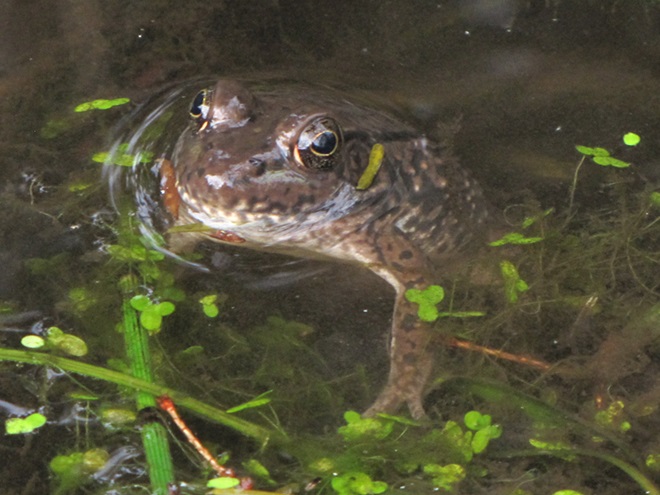
Green Frog
2025 begins as the fourth consecutive New Year’s Day with the Green Frogs out and about in the water garden at susquehannawildlife.net headquarters.  As colder weather arrives during the next 48 hours, these native amphibians will retreat to the bottom of the ponds and become motionless.  The breathing of atmospheric air through their lungs will cease and they will instead exchange oxygen and carbon dioxide by diffusion through their skin.  During this time, the pond must not freeze all the way to the bottom and dissolved oxygen levels in the water beneath the ice must remain sufficient to support the hibernating frogs and other life.

Photo of the Day

Red-eared Slider
Introduced species often exhibit greater vigor than the plants and animals that are indigenous to an ecosystem.  Today, we found this Red-eared Slider, a native of the lower Mississippi River basin, basking in the intermittent sunshine on the edge of a Susquehanna valley pond still partially covered with ice from the deep freeze earlier this month.  These turtles do not hibernate but instead brumate, remaining motionless on the bottom of the pond or under adjacent embankments.  During brumation, they eat nothing, but will come to the surface to bask on warm winter days.  This ability to be a “light sleeper” gives the invasive Red-eared Slider an advantage over the native turtles in our ponds, lakes, and rivers.  When spring finally does arrive, they’ll be the first to emerge and begin feeding, gaining the vitality they’ll need to start mating and depositing eggs before the local species.  Red-eared Sliders were released into the waters of the Lower Susquehanna River Watershed as unwanted pets and are now freely reproducing.  Their growing numbers are displacing some of our native species including several of our uncommon and rare turtles.

Photo of the Day

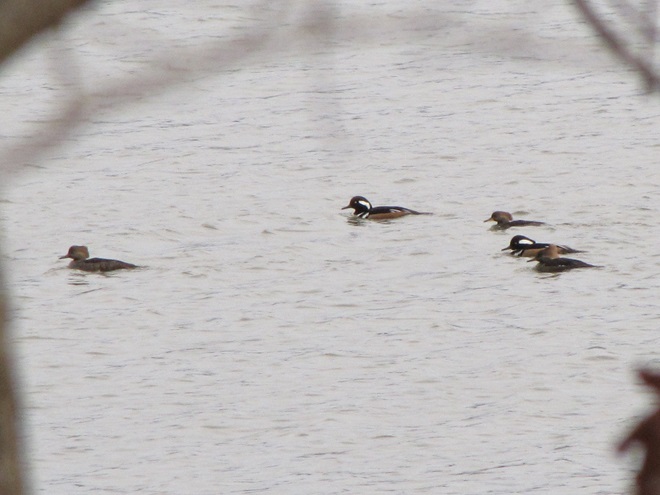
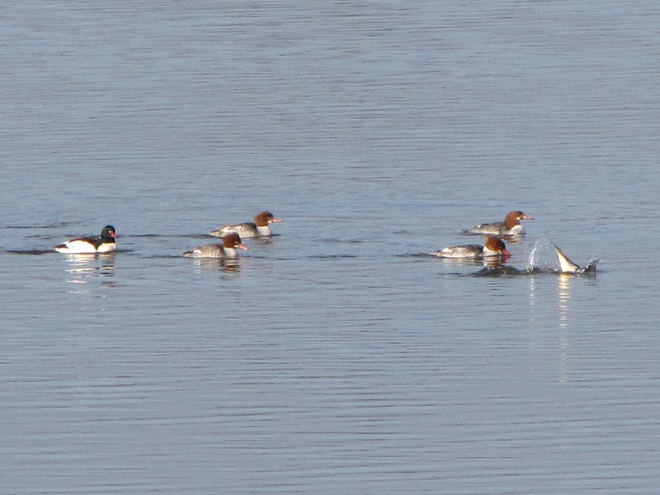
Hooded Mergansers
Freezing water to the north of the lower Susquehanna valley is currently pressuring migratory waterfowl including these Hooded Mergansers to come south.  As local ponds and lakes also become coated with ice, open water on the river offers many benthic feeders their only opportunity to forage.

Axanthism Gives Green Frogs the Blues

Among the Green Frogs in the ponds at susquehannawildlife.net headquarters, a specific recessive allele is present among the population of these native amphibians.  On occasions when male and female carriers of this particular recessive allele get together to produce offspring, about one quarter of the progeny will receive a copy of this mutated version of a gene from each parent.  The rare recipient of this pair of recessive alleles that happens to survive the process of hatching from its egg and metamorphosing through the tadpole stage to adulthood will reveal the uncommon appearance of an amphibian with the condition resulting from this inheritance—axanthism.

Axanthic Green Frog
Axanthic Green Frogs and other amphibians do not produce yellow pigment, therefore the normally yellow surfaces of their bodies appear white, the green surfaces blue.  Axanthism is expressed only in individuals possessing a pair of specific recessive alleles for a gene that affects the cells that produce the yellow pigment.  For the trait to be expressed, a frog must receive one copy of the recessive allele from each parent.
Axanthic and Typical Green Frogs
The last axanthic Green Frog we saw in the headquarters ponds was this male (seen here with a typical male Green Frog) found back in July, 2008.  Green Frogs that receive two copies of a dominant allele or a copy of a dominant and a recessive allele from their parents will not express the recessive trait for the axanthism gene.  Making observation of cases of axanthism even rarer is the fact that blue coloration can make these frogs exceptionally susceptible to predation.  Few live long enough to reproduce and thus increase the occurrence of the mutation in a population of frogs*.  This cyanic individual was present during a time when “outdoor” Domestic Cats were killing frogs to take home to their misguided humans.  After this brief sighting and single photograph, this blue Green Frog was never seen again. 

*The incidence of axanthic frogs can increase when a blue parent, which has a pair of the recessive alleles and is therefore said to be homozygous recessive, mates with a typical-looking frog that carries both a dominant and a recessive allele for the axanthism gene and is therefore said to be heterozygous.  Approximately 50% of the young from this pairing will express axanthism.  By comparison, a pair of frogs that are both heterozygous will produce 25% axanthic young, and a pair of frogs that are both blue (homozygous) will yield 100% axanthic young.  A pair of frogs that includes an individual that is herterozygous and a mate that is homozygous dominant for the gene will produce no axanthic frogs, but 50% of the young will be carriers of the recessive allele.  A pair of homozygous dominant frogs produces no axanthic young and no carriers of the recessive allele. 

Some Early Season Damselflies and Dragonflies

During recent weeks, as temperatures have warmed into the 70s and 80s, early season odonates—damselflies and dragonflies—have taken to the wing along our watercourses and wetlands to prey upon small flying insects.

Vegetated Stream
In addition to wetlands, many vegetated streams, ponds, lakes, and rivers are prime locations to find a variety of damselflies and dragonflies.
Common Whitetail and Eastern Amberwings
A male Common Whitetail (top) and some Eastern Amberwings (Perithemis tenera) patrol the edge of a verdant pond in search of small flying insects.  In addition to defending territories for hunting, many males will begin chasing off potential rivals as the breeding season gets underway.  Both of these dragonflies are tolerant of mud-bottomed waters during their aquatic larval stages of life and may be the only species found at places like farm ponds.
Male Fragile Forktail
The Fragile Forktail is common throughout the Lower Susquehanna River Watershed.  It is the most likely damselfly to colonize garden ponds, wet ditches, and other small bodies of water.
Female Fragile Forktail
Having just mated with the male seen in the previous image, this female Fragile Forktail prepares to oviposit (lay her eggs) among the submerged plant matter in the shallows of this pond.  After hatching, the larval damselflies will spend an entire year as aquatic predators before taking flight as adults next spring.
Male Blue Dasher
The Blue Dasher is a common dragonfly around streams, ponds, and wetlands.  It can frequently be found perched in sunny woodland clearings, even those quite a distance from their breeding area.
Male Eastern Forktail
The Eastern Forktail (Ischnura verticalis) is a common damselfly around almost any calm, vegetated waters.  They frequently perch on emergent plant leaves and stems.
Common Baskettail
The Common Baskettail (Epitheca cynosura) is currently numerous around tree-lined pond and lake shores.  They spend nearly all of their time on the wing and frequently dart in and out of the shade while hunting and defending their territory from other dragonflies.  Unless you happen to catch a quick glimpse of them in good sunlight, these hyperactive insects will appear completely black in color.
Common Baskettail
Another Common Baskettail, this one mostly lacking any black coloration on the base section of the hindwings.
Lancet Clubtail
The Lancet Clubtail is a handsome early season dragonfly of slow clear streams, ponds, and wetlands.  They spend much of their time perched, watching for prey.
Lancet Clubtail
We found this Lancet Clubtail about 100 yards from a mountain stream perched on the ground atop some debris on a seldom-traveled forest road,…
Lancet Clubtail
…and this one clinging to some shrubs along the shore of a clear woodland pond.

If you’re out and about in coming days, you’ll find that flights of Common Green Darners, Black Saddlebags, and other species are underway as well.  As the waters of the lower Susquehanna valley continue to warm, an even greater variety of these insects will take to the wing.  To help with the identification of those you see, be certain to click the “Damselflies and Dragonflies” tab at the top of this page.

See Food and an Oriole Doubleheader

The rain and clouds have at last departed.  With blue skies and sunshine to remind us just how wonderful a spring afternoon can be, we took a stroll at Memorial Lake State Park in Lebanon County, Pennsylvania, to look for some migratory birds.

Indigo Bunting
Though running just a few days later than usual, Indigo Buntings have arrived to begin nesting.
Common Loon
This Common Loon dropped by Memorial Lake during a storm several days ago and decided to stay awhile.  It’s a species that winters in oceanic waters along the Atlantic seaboard and nests on glacial lakes to our north.
Common Loon
Because of the low level of turbidity in Memorial Lake, visibility is good enough to allow this benthic feeder an opportunity to see food before expending energy to dive down and retrieve it.  Favorable foraging conditions might be part of the reason this bird is hanging around.
Shoreline Vegetation at Memorial Lake
Clear Water-  Memorial Lake is one of the few man-made lakes in the Lower Susquehanna River Watershed to be appropriately vegetated with an abundance of submerged, floating, and emergent plants.  As a result, the water from Indiantown Run that passes through the impoundment is minimally impacted by nutrient loads and the algal blooms they can cause.  Buffers of woody and herbaceous growth along the lake’s shorelines provide additional nutrient sequestering and help prevent soil erosion and siltation.
Baltimore Oriole
The breeding season has begun for Neotropical migrants including this Baltimore Oriole, which we found defending a nesting territory in a stand of Black Walnut trees.
Orchard Oriole
Along the edge of the lake, this Orchard Oriole and its mate were in yet another stand of tall walnut trees.
Common Nighthawks
Early in the season and early in the day, we started seeing Common Nighthawks flying above wooded areas north of the lake at 4 o’clock this afternoon.  After all the raw and inclement weather they’ve experienced in recent days, the warm afternoon was probably their first opportunity to feed on flying insects in quite a while.
Common Nighthawks
Early birds, Common Nighthawks feeding at 4 P.M.

What?  You thought we were gonna drop in on Maryland’s largest city for a couple of ball games and some oysters, clams, and crab cakes—not likely.

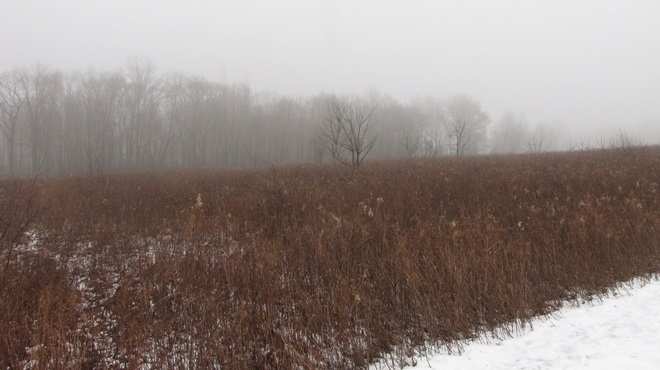
The Fog of a January Thaw

As week-old snow and ice slowly disappears from the Lower Susquehanna River Watershed landscape, we ventured out to see what might be lurking in the dense clouds of fog that for more than two days now have accompanied a mid-winter warm spell.

York Haven Dam Powerhouse
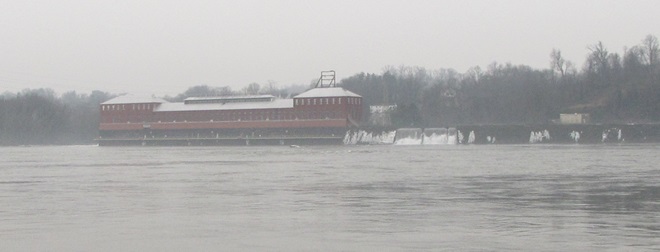
After freezing to a slushy consistency earlier this week, the Susquehanna is already beginning to thaw.   Below the York Haven Dam at Conewago Falls, the water is open and ice-free.
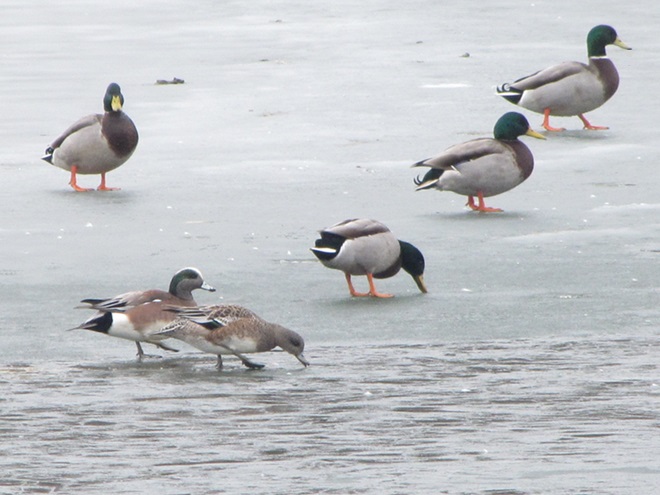
Mallards and a pair of American Wigeon on a frozen lake.
On frozen man-made lakes and ponds, geese and ducks like these Mallards and American Wigeon are presently concentrated around small pockets of open water.
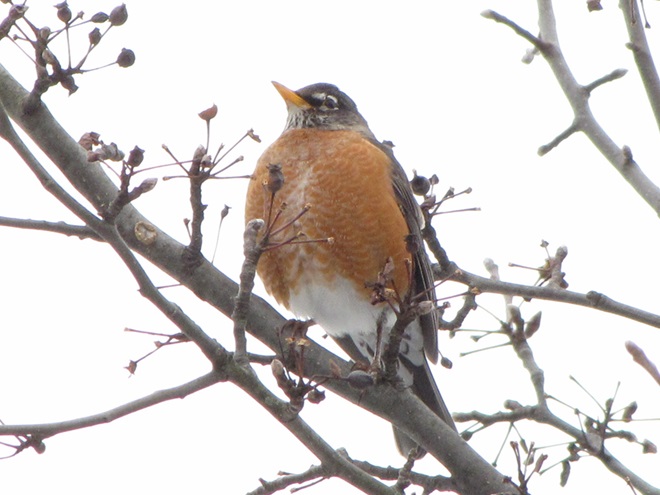
American Robin in a Callery pear
During the past ten days, American Robin numbers have exploded throughout the lower Susquehanna valley.  The majority of these birds may be a mix of both those coming south to escape the late onset of wintry conditions to our north and those inching north into our region as early spring migrants.
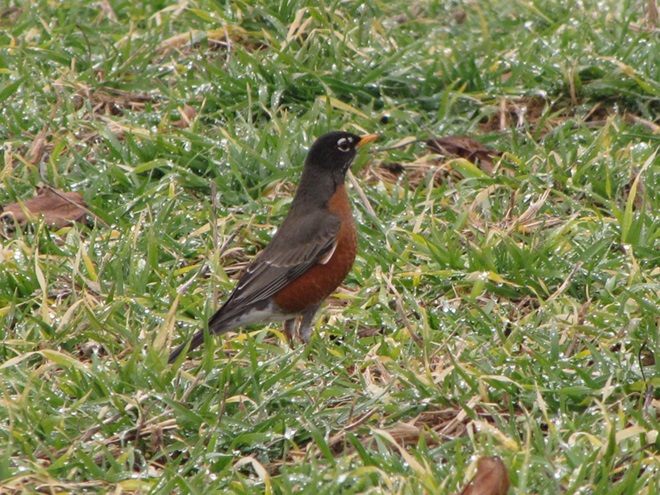
American Robin
The January thaw has melted the snow from lawns and fields to provide thousands of visiting robins with a chance to forage for earthworms.
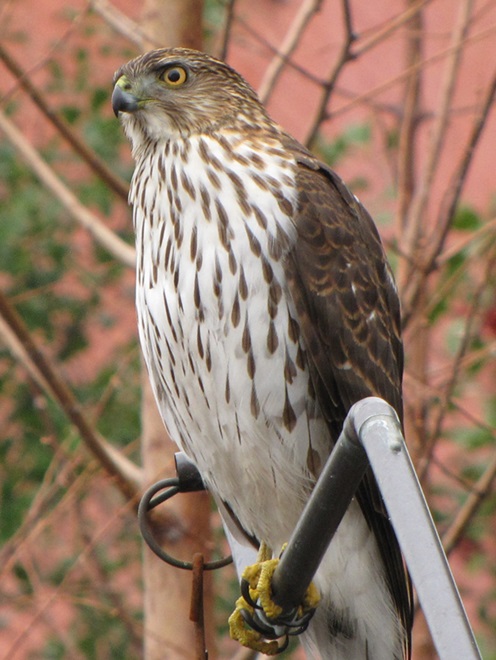
Cooper's Hawk
A visit by this young Cooper’s Hawk to the susquehannnawildlife.net headquarters garden sent songbirds scrambling…
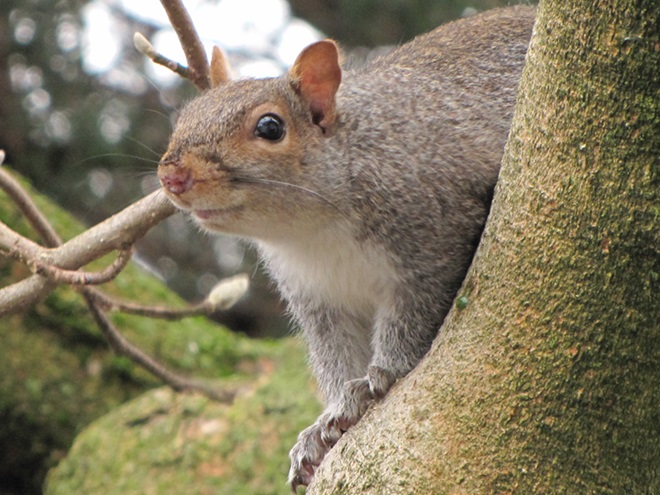
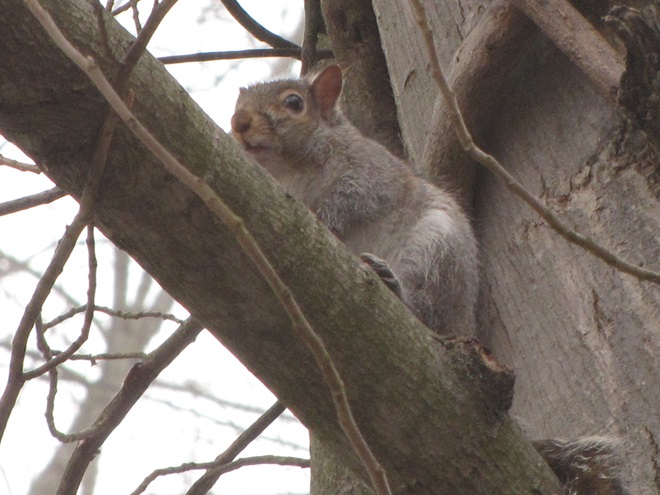
Eastern Gray Squirrel
…but did nothing to unnerve our resident Eastern Gray Squirrels,…
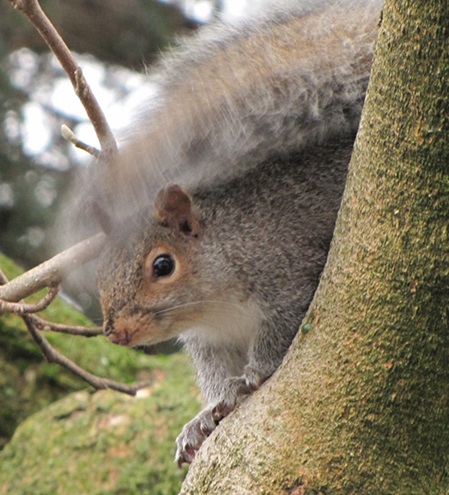
Eastern Gray Squirrel
…which promptly went into tail-waving mode to advertise their presence.
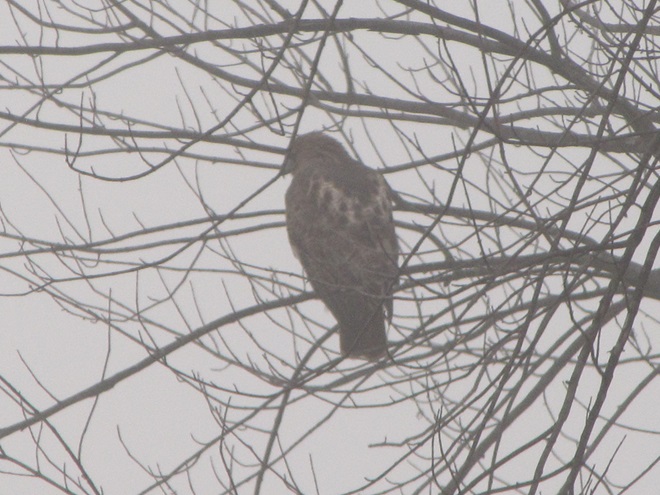
Red-tailed Hawk
But earlier in the week, when heavy snow cover in the rural areas surrounding our urbanized neighborhood made it difficult for rodent-eating raptors to find food, we received brief visits from both a Red-tailed Hawk…
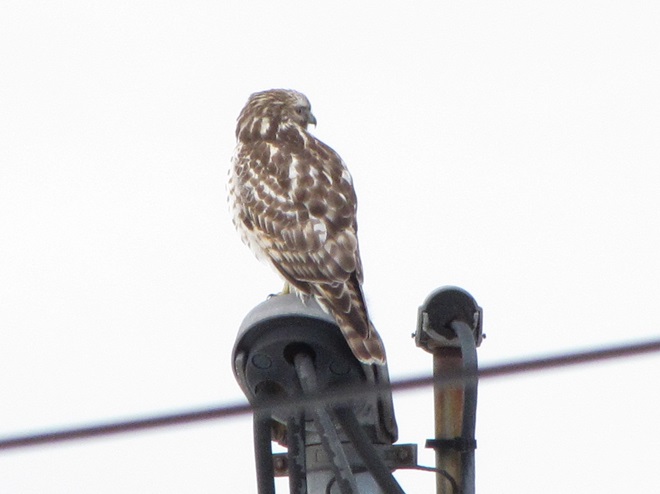
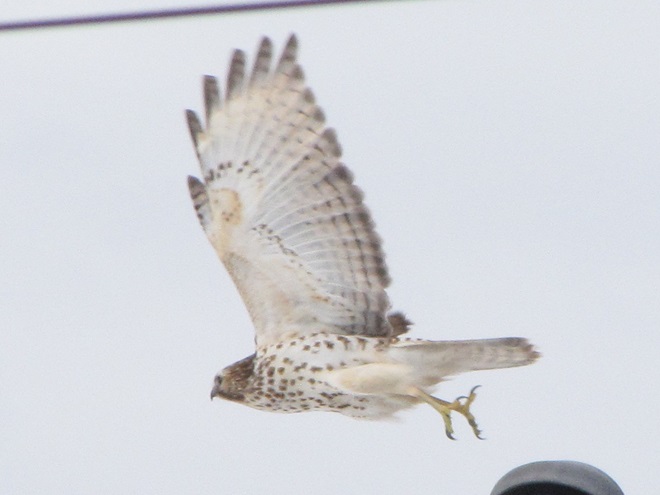
Red-shouldered Hawk
…and this young Red-shouldered Hawk, an uncommon bird of prey most often found in wet woods and other lowlands.
Eastern Gray Squirrel
To escape notice during visits by these larger raptors, our squirrels remained motionless and commenced performance of their best bump-on-a-log impressions.
Red-shouldered Hawk in flight.
Unimpressed, each of our visiting buteos remained for just a few minutes before moving on in search of more favorable hunting grounds and prey.
Early Successional Growth
As snow melted and exposed bare ground in fields of early successional growth, we encountered…
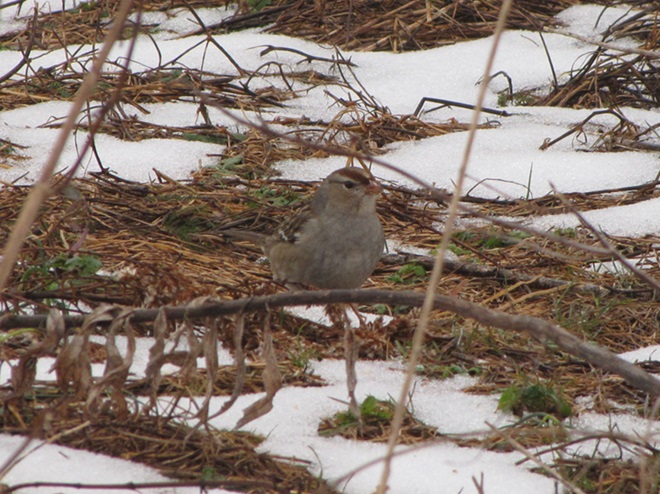
White-crowned Sparrow
…a flock of White-crowned Sparrows, most in first-winter plumage…
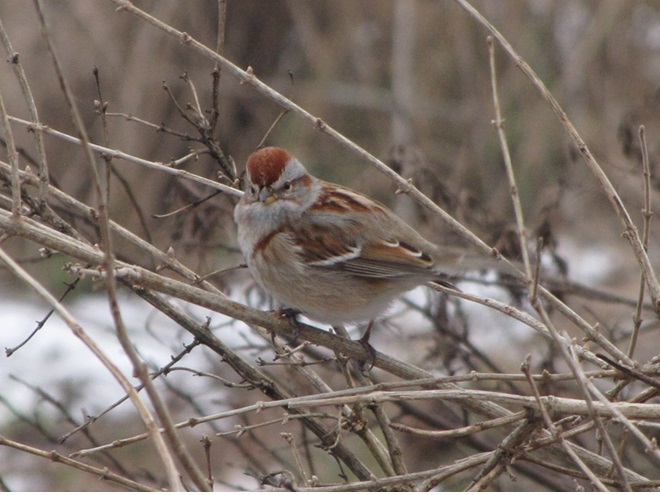
American Tree Sparrow
…and at least a dozen American Tree Sparrows.  During the twentieth century, these handsome songbirds were regular winter visitors to the lower Susquehanna region.  During recent decades, they’ve become increasingly more difficult to find.  Currently, moderate numbers appear to be arriving to escape harsher weather to our north.
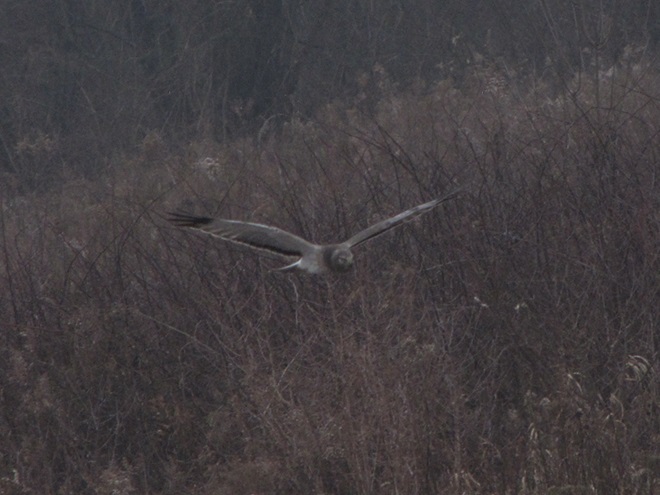
Adult Male Northern Harrier
What could be more appropriate on a foggy, gray evening than finding a “gray ghost” (adult male Northern Harrier) patrolling the fields in search of mice and voles.

If scenes of a January thaw begin to awaken your hopes and aspirations for all things spring, then you’ll appreciate this pair of closing photographs…

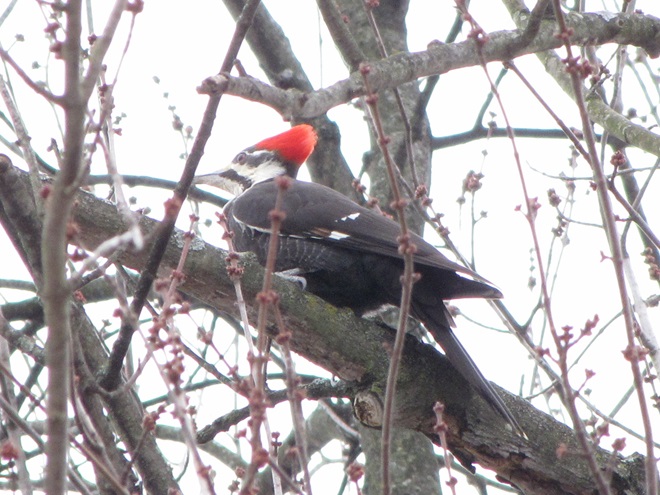
Pileated Woodpecker in Silver Maple
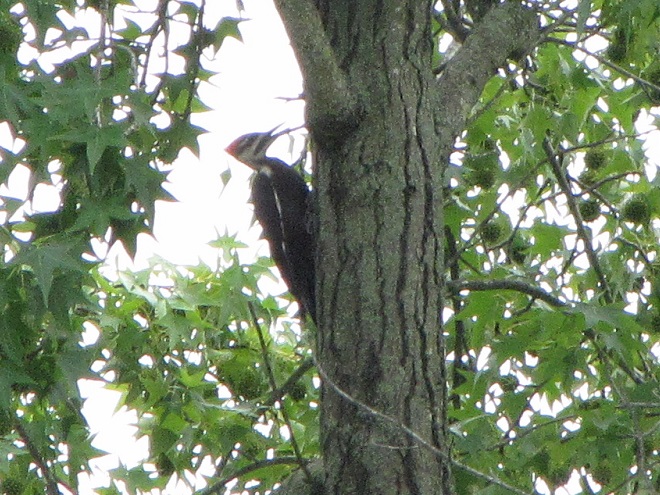
The maroon-red flower buds of Silver Maples are beginning to swell.  And woodpeckers including Pileated Woodpeckers are beginning to drum, a timber-pounding behavior they use to establish breeding territories in habitats with suitable sites for cavity nesting.
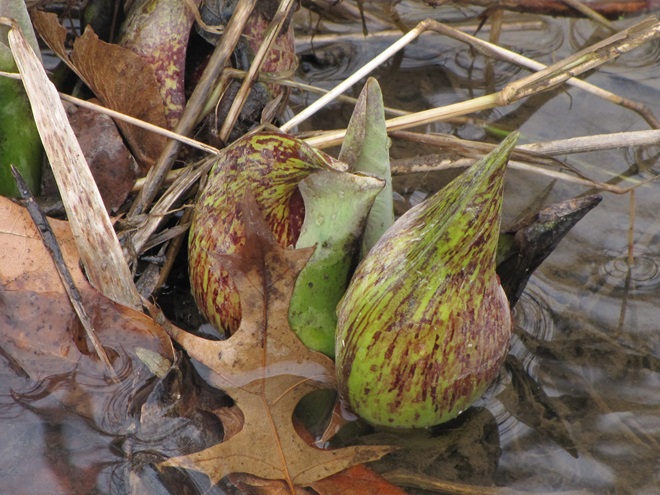
Skunk Cabbage
In wet soil surrounding spring seeps and streams, Skunk Cabbage is rising through the leaf litter to herald the coming of a new season.  Spring must surely be just around the corner.

Piscivorous Waterfowl Visiting Lakes and Ponds

Heavy rains and snow melt have turned the main stem of the Susquehanna and its larger tributaries into a muddy torrent.  For fish-eating (piscivorous) ducks, the poor visibility in fast-flowing turbid waters forces them to seek better places to dive for food.  With man-made lakes and ponds throughout most of the region still ice-free, waterfowl are taking to these sources of open water until the rivers and streams recede and clear.

Common Mergansers
The Common Merganser is a species of diving duck with a primary winter range that, along the Atlantic Coast, reaches its southern extreme in the lower Susquehanna and Potomac watersheds.  Recently, many have left the main stem of the muddy rivers to congregate on waters with better visibility at some of the area’s larger man-made lakes.
Common Mergansers Feeding
Common Mergansers dive to locate and capture prey, primarily small fish.  During this century, their numbers have declined along the southern edge of their winter range, possibly due to birds remaining to the north on open water, particularly on the Great Lakes.  In the lower Susquehanna valley, some of these cavity-nesting ducks can now be found year-round in areas where heavy timber again provides breeding sites in riparian forests.  After nesting, females lead their young to wander widely along our many miles of larger rivers and streams to feed.
Several Common Mergansers Intimidating a Male with a Freshly Caught Fish
The behavior of these mergansers demonstrates the stiff competition for food that can result when predators are forced away from ideal habitat and become compressed into less favorable space.  On the river, piscivores can feed on the widespread abundance of small fish including different species of minnows, shiners, darters, and more.  In man-made lakes stocked for recreational anglers with sunfish, bass, and other predators (many of them non-native), small forage species are usually nonexistent.  As a result, fish-eating birds can catch larger fish, but are successful far less often.  Seen here are several mergansers resorting to intimidation in an effort to steal a young bass away from the male bird that just surfaced with it.  While being charged by the aggressors, he must quickly swallow his oversize catch or risk losing it.

With a hard freeze on the way, the fight for life will get even more desperate in the coming weeks.  Lakes will ice over and the struggle for food will intensify.  Fortunately for mergansers and other piscivorous waterfowl, high water on the Susquehanna is expected to recede and clarify, allowing them to return to their traditional environs.  Those with the most suitable skills and adaptations to survive until spring will have a chance to breed and pass their vigor on to a new generation of these amazing birds.

Want Healthy Floodplains and Streams? Want Clean Water? Then Make Room for the Beaver

I’m worried about the beaver.  Here’s why.

Imagine a network of brooks and rivulets meandering through a mosaic of shrubby, sometimes boggy, marshland, purifying water and absorbing high volumes of flow during storm events.  This was a typical low-gradient stream in the valleys of the Lower Susquehanna River Watershed in the days prior to the arrival of the waves of trans-Atlantic human migrants that started to inundate the area during the seventeenth century.  Then, a frenzy of trapping, tree chopping, mill building, and stream channelization accompanied the east to west surge of settlement across the region.  The first casualty: the indispensable lowlands manager, the North American Beaver (Castor canadensis).

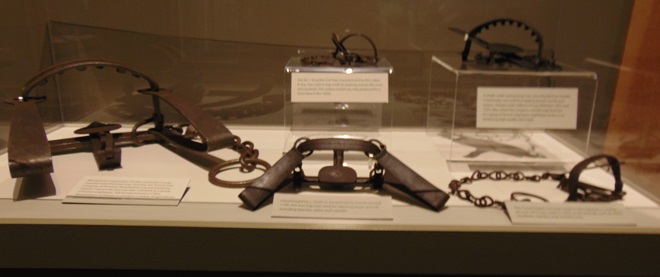
Beaver Traps
Nineteenth-century beaver traps on display in the collection of the State Museum of Pennsylvania in Harrisburg.  Soon after their arrival, trans-Atlantic migrants (Europeans) established trade ties to the “trans-Beringia”/”Pacific-rim” migrants (“Indians”) already living in the lower Susquehanna valley and recruited them to cull the then-abundant North American Beavers.  By the early 1700s, beaver populations (as well as numbers of other “game” animals) were seriously depleted, prompting the Conoy, the last of the Indian peoples to reside on the lower Susquehanna, to disperse to the north.  The traps pictured here are samples of the types which were subsequently used by the European settlers to eventually extirpate the North American Beaver from the Lower Susquehanna River Watershed during the 1800s.

Without the widespread presence of beavers, stream ecology quickly collapsed.  Pristine waterways were all at once gone, as were many of their floral and faunal inhabitants.  It was a streams-to-sewers saga completed in just one generation.  So, if we really want to restore our creeks and rivers, maybe we need to give the North American Beaver some space and respect.  After all, we as a species have yet to build an environmentally friendly dam and have yet to fully restore a wetland to its natural state.  The beaver is nature’s irreplaceable silt deposition engineer and could be called the 007 of wetland construction—doomed upon discovery, it must do its work without being noticed, but nobody does it better.

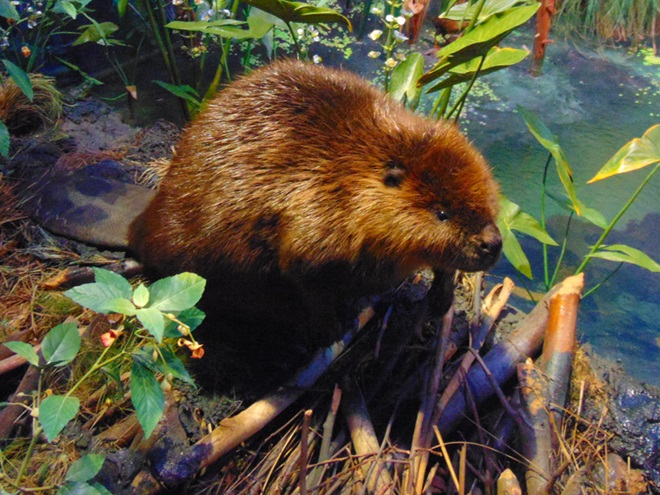
North American Beaver diorama on display in the State Museum of Pennsylvania in Harrisburg.
North American Beaver diorama on display in the State Museum of Pennsylvania in Harrisburg.  Beavers were reintroduced to the Susquehanna watershed during the second half of the twentieth century.
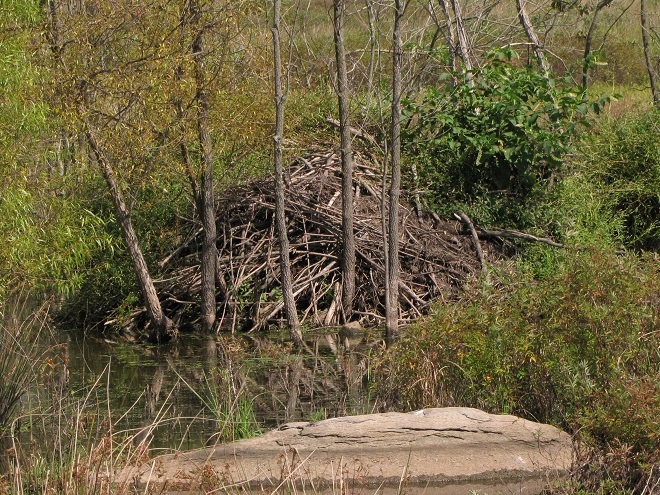
A beaver dam on a small stream in the Lower Susquehanna River Watershed.
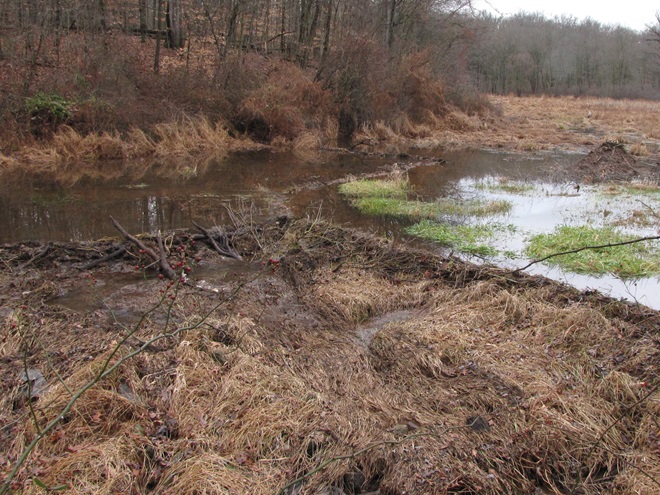
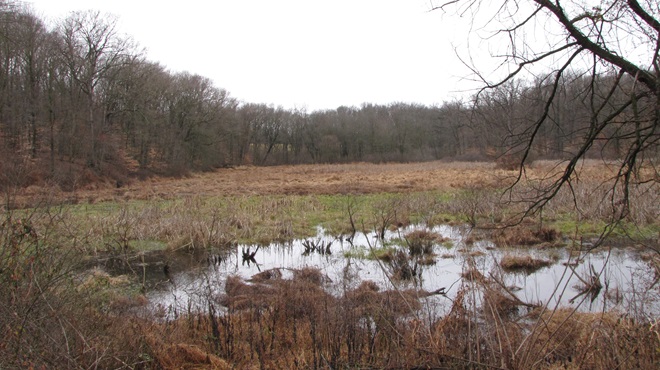
A beaver dam and pond on a small stream in the Lower Susquehanna River Watershed.
Floodplain Wetlands Managed by North American Beavers
Beaver dams not only create ponds, they also maintain shallow water levels in adjacent areas of the floodplain creating highly-functional wetlands that grow the native plants used by the beaver for food.  These ecosystems absorb nutrients and sediments.  Prior to the arrival of humans, they created some of the only openings in the vast forests and maintained essential habitat for hundreds of species of plants as well as animals including fish, amphibians, reptiles, and birds.  Without the beaver, many of these species could not, and in their absence did not, exist here.
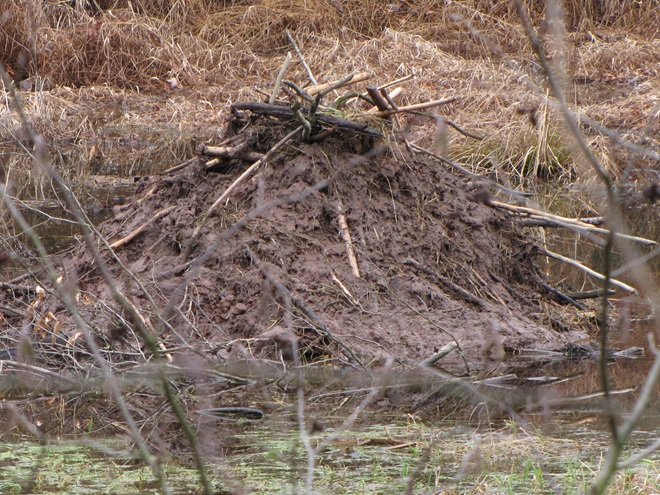
The beaver lodge provides shelter from the elements and predators for a family of North American Beavers.
Their newly constructed lodge provides shelter from the elements and from predators for a family of North American Beavers.
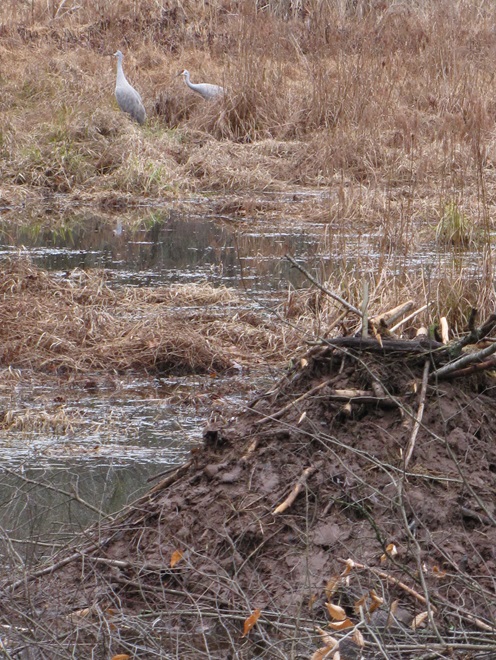
Sandhill Cranes Visit a Beaver-managed Floodplain in the lower Susquehanna valley
Floodplains managed by North American Beavers can provide opportunities for the recovery of the uncommon, rare, and extirpated species that once inhabited the network of streamside wetlands that stretched for hundreds of miles along the waterways of the Lower Susquehanna River Watershed.
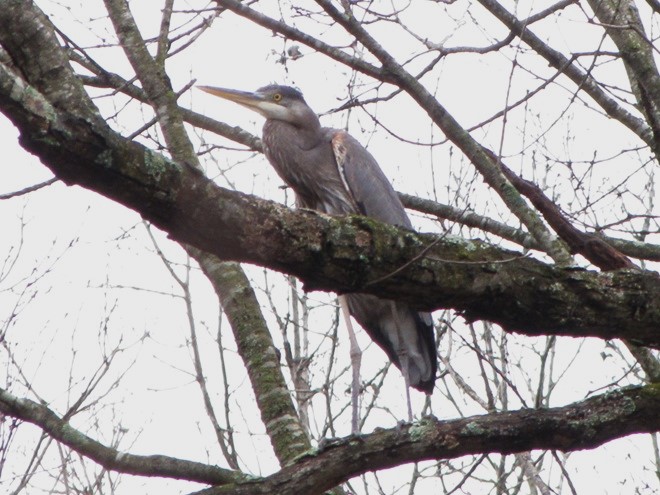
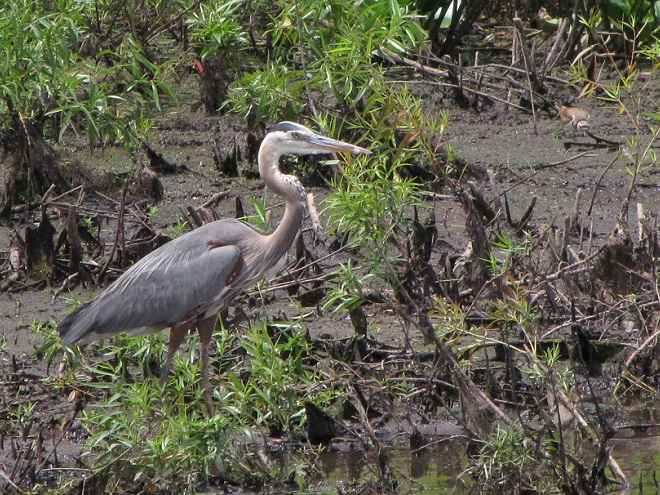
Great Blue Heron
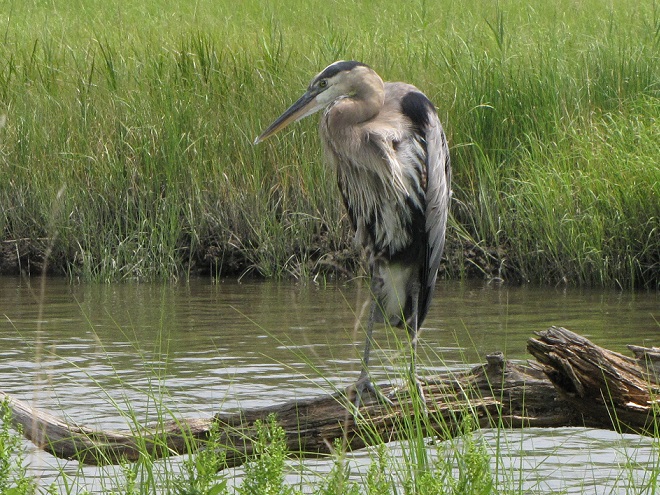
A wintering Great Blue Heron is attracted to a beaver pond by the abundance of fish in the rivulets that meander through its attached wetlands.
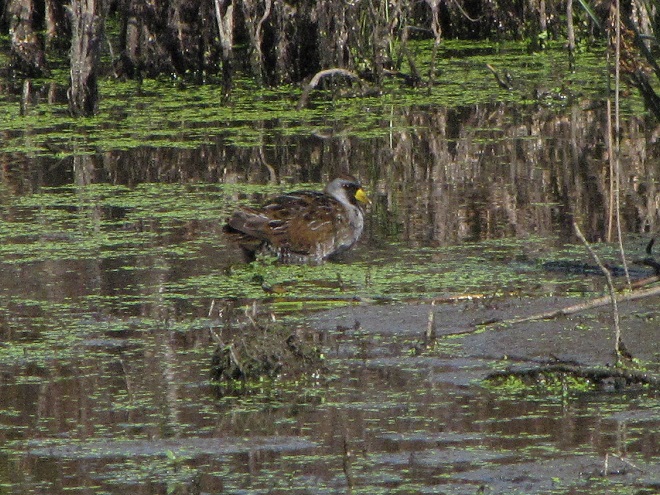
Sora Rail in Beaver Pond
Beaver Ponds and their attached wetlands provide nesting habitat for uncommon birds like this Sora rail.
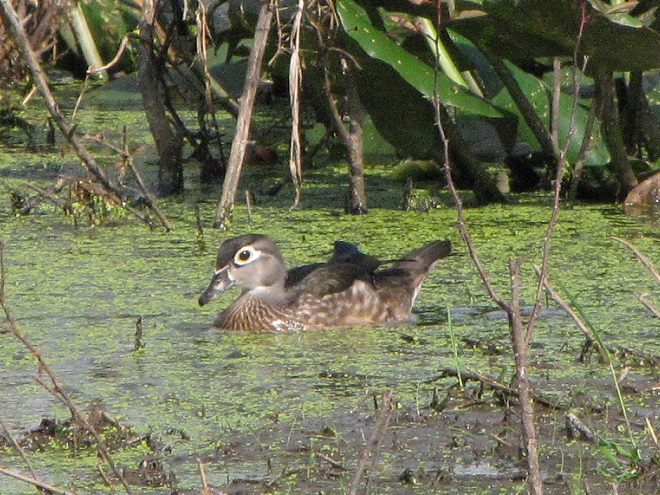
Wood Duck feeding on Lesser Duckweed in Beaver Pond
Lesser Duckweed grows in abundance in beaver ponds and Wood Ducks are particularly fond of it during their nesting cycle.
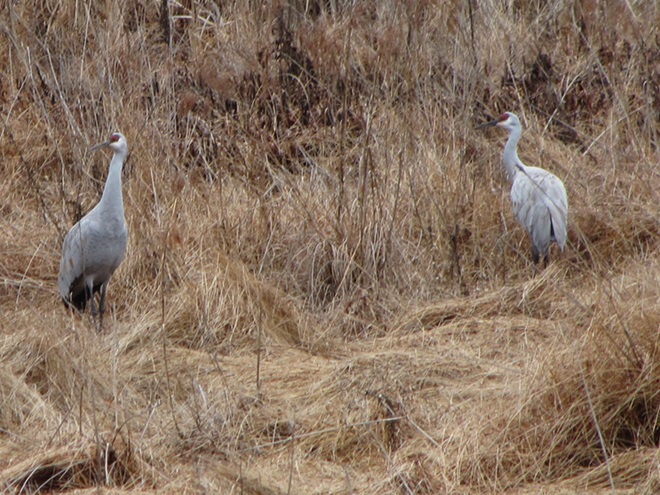
Sandhill Cranes feeding among Woolgrass in a Beaver Pond
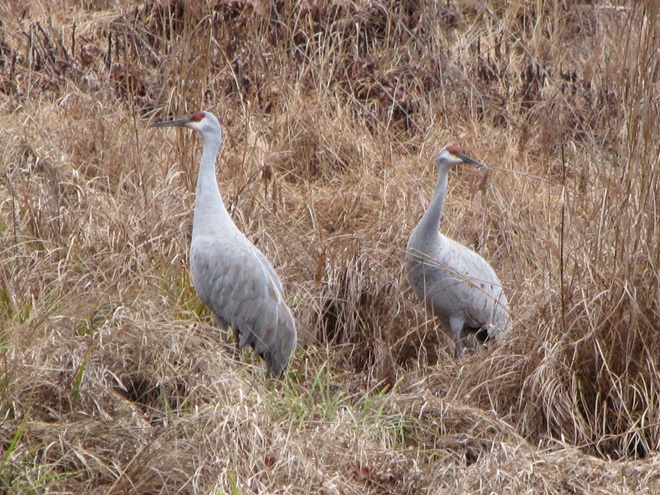
Beaver dams maintain areas of wet soil along the margins of the pond where plants like Woolgrass sequester nutrients and contain runoff while providing habitat for animals ranging in size from tiny insects to these rare visitors, a pair of Sandhill Cranes (Antigone canadensis).
Sandhill Cranes feeding among Woolgrass in a floodplain maintained by North American Beavers.

Few landowners are receptive to the arrival of North American Beavers as guests or neighbors.  This is indeed unfortunate.  Upon discovery, beavers, like wolves, coyotes, sharks, spiders, snakes, and so many other animals, evoke an irrational negative response from the majority of people.  This too is quite unfortunate, and foolish.

North American Beavers spend their lives and construct their dams, ponds, and lodges exclusively within floodplains—lands that are going to flood.  Their existence should create no conflict with the day to day business of human beings.  But humans can’t resist encroachment into beaver territory.  Because they lack any basic understanding of floodplain function, people look at these indispensable lowlands as something that must be eliminated in the name of progress.  They’ll fill them with soil, stone, rock, asphalt, concrete, and all kinds of debris.  You name it, they’ll dump it.  It’s an ill-fated effort to eliminate these vital areas and the high waters that occasionally inundate them.  Having the audacity to believe that the threat of flooding has been mitigated, buildings and poorly engineered roads and bridges are constructed in these “reclaimed lands”.  Much of the Lower Susquehanna River Watershed has now been subjected to over three hundred years-worth of these “improvements” within spaces that are and will remain—floodplains.  Face it folks, they’re going to flood, no matter what we do to try to stop it.  And as a matter of fact, the more junk we put into them, the more we displace flood waters into areas that otherwise would not have been impacted!  It’s absolute madness.

By now we should know that floodplains are going to flood.  And by now we should know that the impacts of flooding are costly where poor municipal planning and negligent civil engineering have been the norm for decades and decades.  So aren’t we tired of hearing the endless squawking that goes on every time we get more than an inch of rain?  Imagine the difference it would make if we backed out and turned over just one quarter or, better yet, one half of the mileage along streams in the Lower Susquehanna River Watershed to North American Beavers.  No more mowing, plowing, grazing, dumping, paving, spraying, or building—just leave it to the beavers.  Think of the improvements they would make to floodplain function, water quality, and much-needed wildlife habitat.  Could you do it?  Could you overcome the typical emotional response to beavers arriving on your property and instead of issuing a death warrant, welcome them as the talented engineers they are?  I’ll bet you could.

Photo of the Day

Green Frog on Christmas
It’s been a green Christmas at susquehannawildlife.net headquarters.  Among thick growth of Lesser Duckweed and other aquatic plants in the garden ponds, the Green Frogs and their tadpoles remain active.  The water’s open…still no ice here.

Flamingos and a Hurricane

During the past two weeks, over 150 American Flamingos (Phoenicopterus ruber) have been reported in the eastern half of the United States, well north of their usual range—northern South America; Cuba, the Bahamas, and other Caribbean Islands; and the Yucatan Peninsula of Mexico.  They are also found on the Galapagos Islands.  Prior to being extirpated by hunting during the early years of the twentieth century, American Flamingos nested in the Everglades of Florida as well.

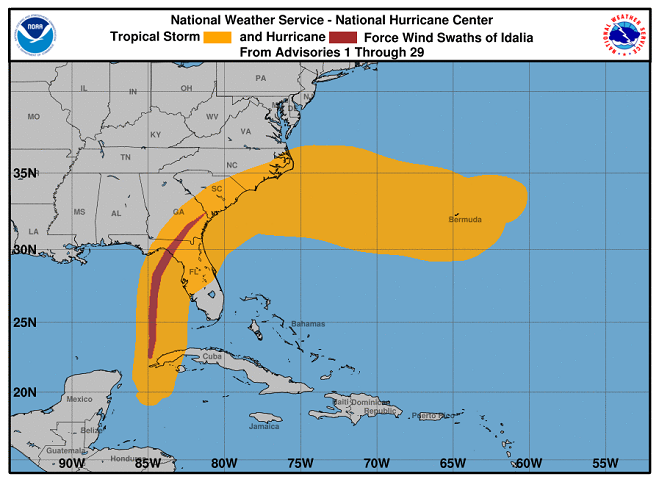
The recent influx of these tropical vagrants into the eastern states is attributed to Hurricane Idalia, a storm that formed in the midst of flamingo territory during the final week of August.  Idalia got its start over tropical waters off Yucatan before progressing north through the Gulf of Mexico off Cuba to make landfall in the “Big Bend” area of Florida.

Track of Hurricane Idalia.  (NOAA/National Weather Service/National Hurricane Center image)

Birds of warm water seas regularly become entangled within tropical storms and hurricanes.  In most cases, it’s oceanic seabirds including petrels, shearwaters, terns, and gulls that seek refuge from turbulent conditions by remaining inside the storm’s eye or within the margins of the rotating bands.  The duration of the experience and the fitness of each individual bird may determine just how many survive such an ordeal.  As a storm makes landfall, the survivors put down on inland bodies of water, often in unexpected places hundreds of miles from the nearest coastline.  Some may linger in these far-flung areas to feed and gain strength before finding their way down rivers back to sea.

For birds like American Flamingos, which don’t spend a large portion of their lives on the wing over vast oceanic waters, becoming entangled in a tropical weather system can easily be a life-ending event.  American Flamingos, despite their size and lanky appearance, are quite agile fliers.  When necessary, some populations travel significant distances in search of new food sources.  Some closely related migratory species of flamingos have been recorded at altitudes exceeding 10,000 feet.  But becoming trapped in a hurricane for an extended period of time could easily erode the endurance of even the strongest of fliers.  And once out over open water, there’s nowhere for a flamingo to come down for a rest.

It appears probable that, during the final week of August, hundreds of American Flamingos did find themselves drawn away from their familiar tidal flats and salty lagoons to be swept into the spinning clouds and gusty downpours of Hurricane Idalia as it churned off the Yucatan coast.  Despite the dangers, more than 150 of them completed a journey within its clutches to cross the Gulf of Mexico and land in the Eastern United States.

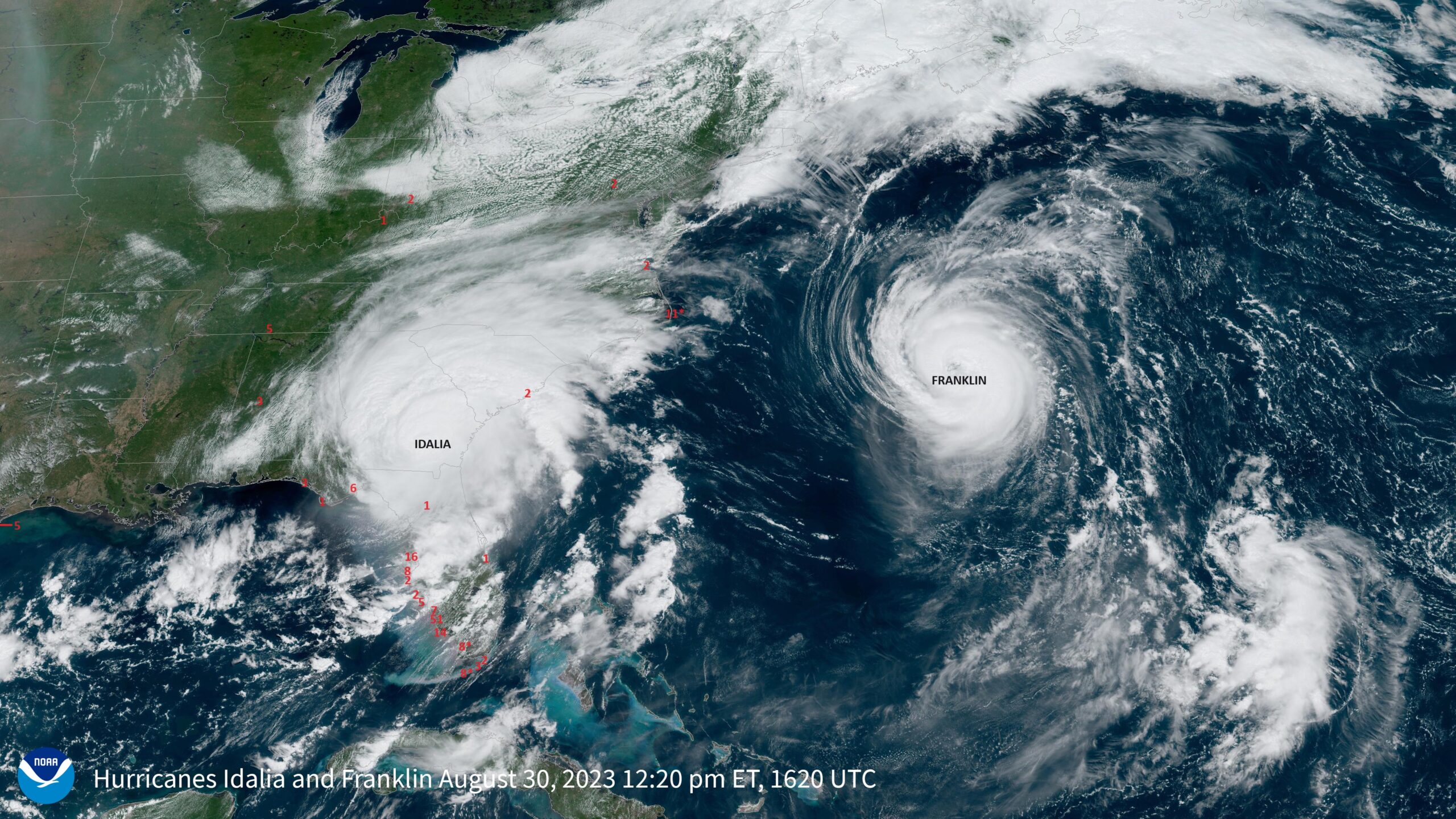
Amy Davis in a report for the American Birding Association compiled a list of American Flamingo sightings from the days following the landfall of Hurricane Idalia.  We’ve plotted those sightings on a satellite image of the storm.

Locations of American Flamingo sightings in the days following landfall of Hurricane Idalia, August 30 through September 7, 2023.  Numbers of birds in the plotted flock are indicated.  Those flocks marked with an asterisk contained a bird ringed with a leg band marking it as a member of the Ria Largartos population in Yucatan.  Click the image to enlarge.  (NOAA/GOES-16 base image of Hurricane Idalia landfall)

The majority of the flamingos that survived this harrowing trip found a place to put down along the coast.  But as the reader will notice, a significant number of the sightings were outside the path of the storm in areas not reached by even the outermost bands of clouds.  Flamingos in Alabama, Tennessee, Kentucky/Indiana, Ohio, and Pennsylvania were found at inland bodies of water, most on the days immediately following the storm’s landfall.  The lone exception, the Pennsylvania birds, were discovered a week after landfall (but may have been there days longer).  How and why did these birds find their way so far inland at places so distant from the storm…and home?  And how did they get there so quickly?  The counterclockwise rotation of the hurricane wouldn’t slingshot them in that direction, would it?

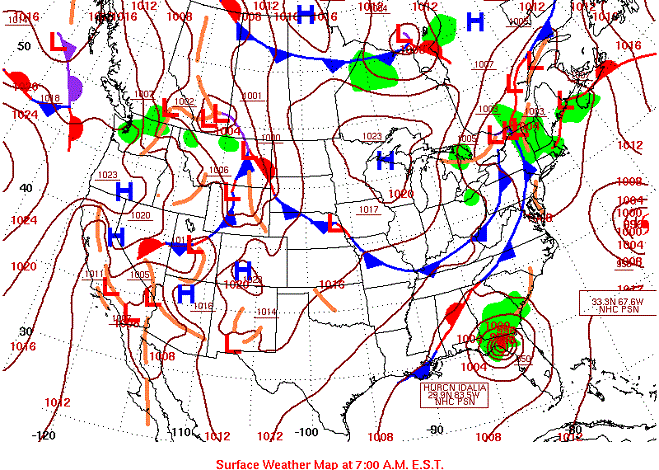
Let’s have a look at the surface map showing us the weather in the states outside the direct influence of Hurricane Idalia during the storm’s landfall on August 30, 2023…

Note the pair of cold fronts along the Appalachians by 7 A.M. E.S.T. (8 A.M. E.D.T.).  In the  hours following Idalia’s landfall, these fronts had begun slowly creeping through the areas where the inland flamingos were subsequently found.  (NOAA/National Centers for Environmental Prediction-Weather Prediction Center image)

Now check out this satellite view of the storm during the hours following landfall…

"Flamingo Highway"
The blue lines mark the approximate locations of the two cold fronts, the “spoilers” that helped steer Idalia out to sea. The pink arrows mark the “flamingo highway”, strong southwest to northeast winds blowing between the cold fronts along the inland edge of Idalia.  (GOES-16 imagery from Cooperative Institute for Research in the Atmosphere at Colorado State and the National Oceanic and Atmospheric Administration)

Click the image above to play a GIF animation of GOES-16 satellite photos showing Idalia after landfall and the strong “flamingo highway” winds between the fronts.  (It’s a big file, so give it a little time to load.)  You’ll also note the ferocious lightning associated with both Huricane Idalia and Hurricane Franklin.

Did the inland flamingos catch a ride on these stiff “flamingo highway” winds?  If not, they may have had a little help from a high pressure ridge that became established over the southern Appalachians as Idalia crept out to sea.  The clockwise rotation of this ridge kept a similar flow over the “flamingo highway” for much of the four days that followed.

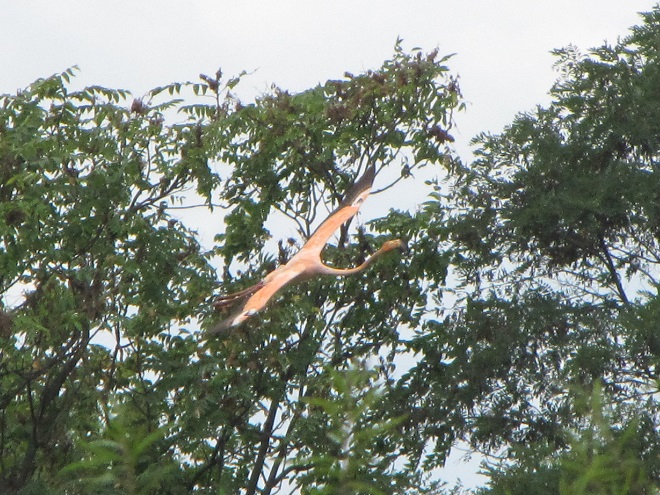
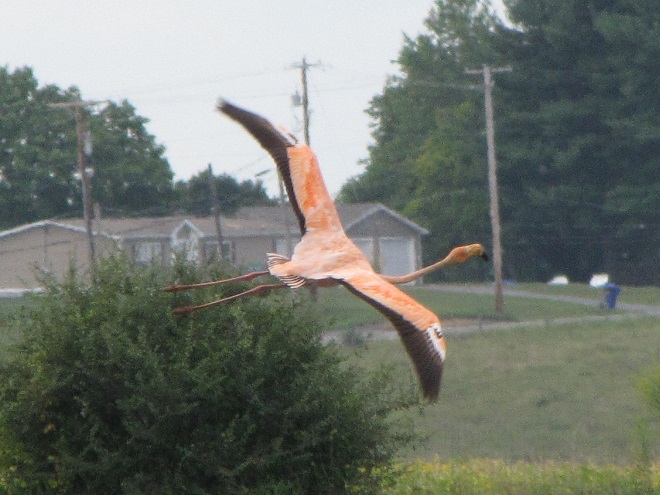
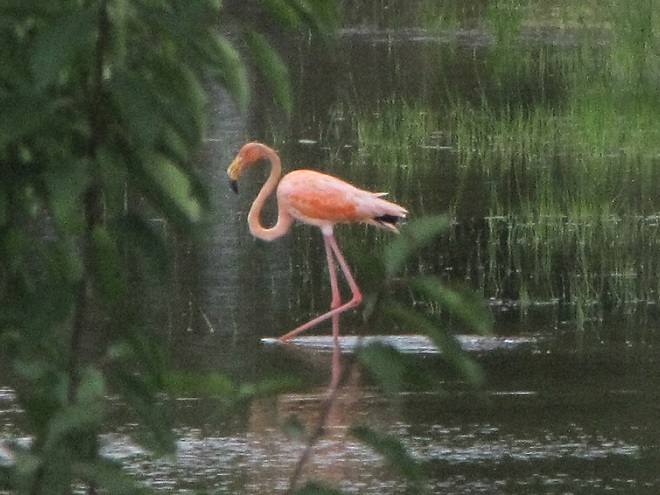
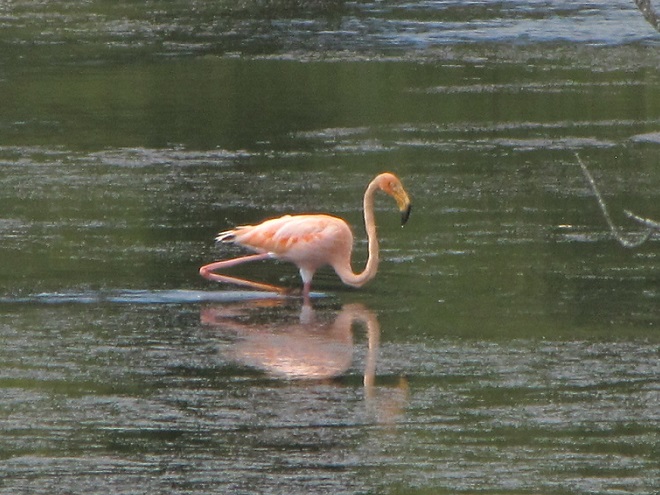
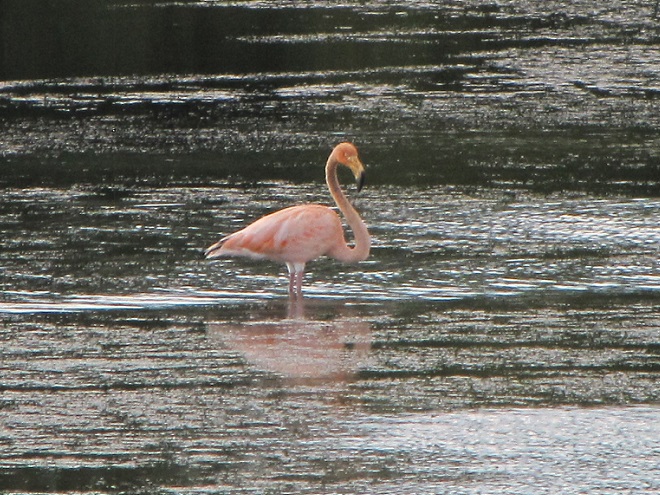
An American Flamingo circling to land in a farm pond near St. Thomas, Franklin County, Pennsylvania.
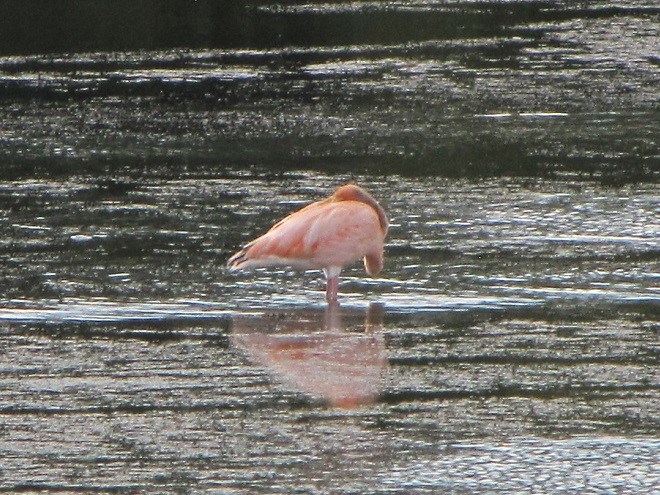
American Flamingo in Franklin County, Pennsylvania, following Hurricane Idalia.
Its a long way from Yucatan to central Pennsylvania.  The survivors of the storm were largely at the mercy of the winds that carried them.  The good news for this bird…not a single flight is feather missing.
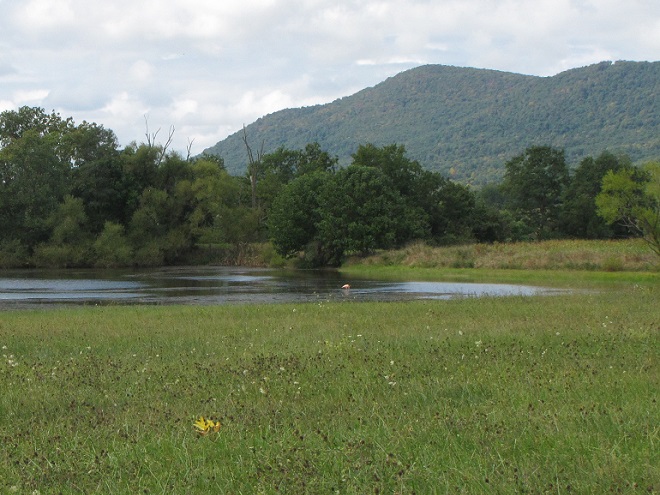
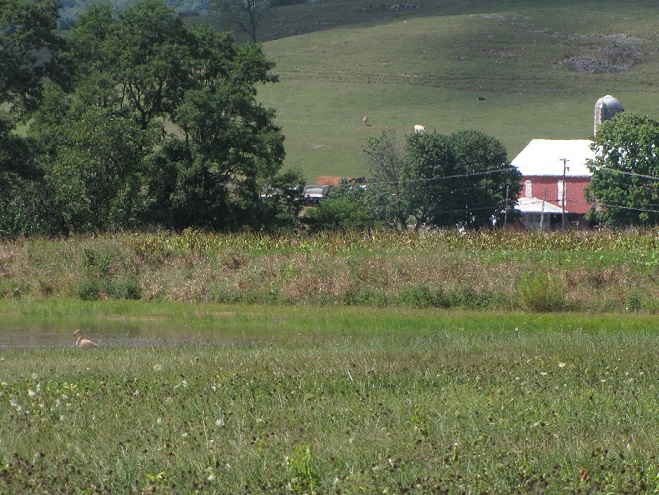
An American Flamingo at the foot of the Appalachians.
An American Flamingo at the foot of the Appalachians in Franklin County, Pennsylvania.
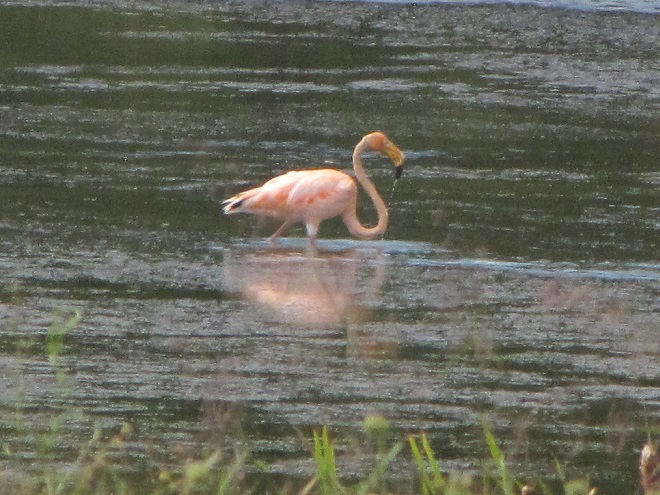
An American Flamingo on a farm pond near St. Thomas, Franklin County, Pennsylvania.  This bird is just one of at least 150 that arrived in the Eastern United States courtesy of Hurricane Idalia.
American Flamingo in Franklin County, Pennsylvania.
In deep water, American Flamingos feed by shuffling their feet to stir up benthic invertebrates, plankton, algae, and plant matter.  The flamingo that was accompanying this bird apparently shuffled its feet into a Snapping Turtle, which promptly latched onto its leg and injured tendons and other tissue.  Following surgery earlier today, the bird remains in hospital.
American Flamingo feeding.
To retrieve their fare from the bottom, flamingos roll their bill upside down, then swish it back-and-forth.
Finally, they raise their heads and upright their bills to expel water and debris while simultaneously filtering out the morsels of edibles for consumption.
American Flamingo in Franklin County, Pennsylvania.
To conserve body heat while under the shade of clouds, this American Flamingo in Franklin County, Pennsylvania, would stop feeding,…
American Flamingo in Pennsylvania conserving heat under cloud cover.
…then it would tuck its head between its wings.  Flamingos will also retain heat by standing on one leg while raising the other into the insulating cover of their belly feathers.

For vagrant birds including those carried away to distant lands by hurricanes and other storms, the challenges of finding food and avoiding hazards including disease, unfamiliar predators, and extreme weather can be a matter of life and death.  For American Flamingos now loafing and feeding in the Eastern United States outside Florida, the hardest part of their journey is yet to come. They need to find their way back south to suitable tropical habitat before cold weather sets in.  The perils are many.  Theirs is not an enviable predicament.

Sorry Pinky, but you can’t stay on the farm forever.

A Visit to a Beaver Pond

To pass the afternoon, we sat quietly along the edge of a pond created recently by North American Beavers (Castor canadensis).  They first constructed their dam on this small stream about five years ago.  Since then, a flourishing wetland has become established.  Have a look.

A Beaver Pond
Vegetation surrounding the inundated floodplain helps sequester nutrients and sediments to purify the water while also providing excellent wildlife habitat.
A beaver lodge.
The beaver lodge was built among shrubs growing in shallow water in the middle of the pond.
Woolgrass in a beaver pond.
Woolgrass (Scirpus cyperinus) is a bulrush that thrives as an emergent and as a terrestrial plant in moist soils bordering the pond.
A male Common Whitetail dragonfly keeping watch over his territory.
A Twelve-spotted Skimmer perched on Soft Rush.
A Blue Dasher dragonfly seizing a Fall Field Cricket (Gryllus pennsylvanicus).
A Spicebush Swallowtail visiting Cardinal Flower.
A Spicebush Swallowtail visiting a Cardinal Flower.
Green Heron
A Green Heron looking for small fish, crayfish, frogs, and tadpoles.
A Green Heron stalks potential prey.
The Green Heron stalking potential prey.
A Wood Duck feeding on Lesser Duckweed.
A Wood Duck feeding on the tiny floating plant known as Lesser Duckweed (Lemna minor).
A Least Sandpiper feeding along the muddy edge of a beaver pond.
A Least Sandpiper poking at small invertebrates along the muddy edge of the beaver pond.
Solitary Sandpiper
A Solitary Sandpiper.
A Solitary Sandpiper testing the waters for proper feeding depth.
Pectoral Sandpiper
A Pectoral Sandpiper searches for its next morsel of sustenance.
A Sora rail in a beaver pond.
The Sora (Porzana carolina) is a seldom seen rail of marshlands including those created by North American Beavers.  Common Cattails, sedges, and rushes provide these chicken-shaped wetland birds with nesting and loafing cover.

Isn’t that amazing?  North American Beavers build and maintain what human engineers struggle to master—dams and ponds that reduce pollution, allow fish passage, and support self-sustaining ecosystems.  Want to clean up the streams and floodplains of your local watershed?  Let the beavers do the job!

One of Nature’s Finest: The Cardinal Flower

It may be one of the most treasured plants among native landscape gardeners.  The Cardinal Flower (Lobelia cardinalis) blooms in August each year with a startling blaze of red color that, believe it or not, will sometimes be overlooked in the wild.

Cardinal Flower on a Stream
Cardinal Flower is most often found in wet soil along forested bodies of water.  The blooms of this shade-loving species may go unnoticed until rays of sunshine penetrate the canopy to strike their brilliant red petals.

The Cardinal Flower grows in wetlands as well as in a variety of moist soils along streams, rivers, lakes, and ponds.  Shady locations with short periods of bright sun each day seem to be favored for an abundance of color.

Cardinal Flower and Great Blue Lobelia
Cardinal Flower in bloom in a riparian forest along the Susquehanna.  To its right is its close relative, Great Lobelia, a plant sometimes known as Great Blue Lobelia or Blue Cardinal Flower.
Cardinal Flower in a wet bottomland woods.
The Cardinal Flower can find favorable growing conditions along stream, river and lake shores.
The Cardinal Flower can find favorable growing conditions along stream, river, and lake shores.  Even though they are perennial plants, their presence along such waters often seems temporary.  Changing conditions cause them to suddenly disappear from known locations, then sometimes reappear at the same place or elsewhere nearby.  Some of this phenomenon may be due to the fact that stressed plants can fail to bloom, so they easily escape notice.  When producing flowers during favorable years, the plants seem to mysteriously return.
Cardinal Flowers along a wave-swept shoreline light up the greenery of erosion-controlling riparian vegetation with glowing red color.

The Cardinal Flower can be an ideal plant for attracting hummingbirds, bees, butterflies, and other late-summer pollinators.  It grows well in damp ground, especially in rain gardens and along the edges streams, garden ponds, and stormwater retention pools.  If you’re looking to add Cardinal Flower to your landscape, you need first to…

REMEMBER the CARDINAL RULE…

Cardinal Flower plants are available at many nurseries that carry native species of garden and/or pond plants.  Numerous online suppliers offer seed for growing your own Cardinal Flowers.  Some sell potted plants as well.  A new option is to grow Cardinal Flowers from tissue cultures.  Tissue-cultured plants are raised in laboratory media, so the pitfalls of disease and hitchhikers like invasive insects and snails are eliminated.  These plants are available through the aquarium trade from most chain pet stores.  Though meant to be planted as submerged aquatics in fish tank substrate, we’ve reared the tissue-cultured stock indoors as emergent plants in sandy soil and shallow water through the winter and early spring.  When it warms up, we transplant them into the edges of the outdoor ponds to naturalize.  As a habit, we always grow some Cardinal Flower plants in the fish tanks to take up the nitrates in the water and to provide a continuous supply of cuttings for starting more emergent stock for outdoor use.

Tissue culture Cardinal Flower being grown as a submerged aquatic in a fish aquarium.
A tissue-cultured Cardinal Flower rooted in sandy substrate and being grown as a submerged aquatic plant in a fish tank.  Cuttings from this plant will be used to grow emergent specimens in shallow water for transplanting outdoors around the garden pond.
Cardinal Flower from Tissue Culture
A Cardinal Flower grown from an aquarium store tissue culture blooms in the pond at susquehannawildlife.net headquarters.
Cardinal Flower blooming in November.
Grown as an emergent, Cardinal Flower may bloom very late in the season.  This tissue-cultured specimen in the headquarters pond was photographed in early November, 2022.

Shorebirds and Stormwater Retention Ponds

Your best bet for finding migrating shorebirds in the lower Susquehanna region is certainly a visit to a sandbar or mudflat in the river.  The Conejohela Flats off Washington Boro just south of Columbia is a renowned location.  Some man-made lakes including the one at Middle Creek Wildlife Management Area are purposely drawn down during the weeks of fall migration to provide exposed mud and silt for feeding and resting sandpipers and plovers.  But with the Susquehanna running high due to recent rains and the cost of fuel trending high as well, maybe you want to stay closer to home to do your observing.

Fortunately for us, migratory shorebirds will drop in on almost any biologically active pool of shallow water and mud that they happen to find.  This includes flooded portions of fields, construction sites, and especially stormwater retention basins.  We stopped by a new basin just west of Hershey, Pennsylvania, and found more than two dozen shorebirds feeding and loafing there.  We took each of these photographs from the sidewalk paralleling the south shore of the pool, thus never flushing or disturbing a single bird.

Stormwater retentrion basin.
Designed to prevent stream flooding and pollution, this recently installed stormwater retention basin along US 322 west of Hershey, Pennsylvania, has already attracted a variety of migrating plovers and sandpipers.
Killdeer
Killdeer stick close to exposed mud as they feed.
Least Sandpipers
Two of more than a dozen Least Sandpipers found busily feeding in the inch-deep water.
Lesser Yellowlegs
A Lesser Yellowlegs searching for small invertebrates.
Lesser Yellowlegs
Two Lesser Yellowlegs work out a disagreement.
Male Twelve-spotted Skimmers patrol the airspace above a pair of Least Sandpipers.
Male Twelve-spotted Skimmers patrol the airspace above a pair of Least Sandpipers. Dragonflies and other aquatic insects are quick to colonize the waters held in well-engineered retention basins.  Proper construction and establishment of a functioning food chain/web in these man-made wetlands prevents them from becoming merely temporary cesspools for breeding mosquitos.

So don’t just drive by those big puddles, stop and have a look.  You never know what you might find.

A Semipalmated Sandpiper (middle right) joins a flock of Least Sandpipers.
Pectoral Sandpipers (two birds in the center) are regular fall migrants on the Susquehanna at this time of year.
Pectoral Sandpipers (two birds in the center) are regular fall migrants on the Susquehanna at this time of year.  They are most frequently seen on gravel and sand bars adjacent to the river’s grassy islands, but unusually high water for this time of year prevents them from using this favored habitat.  As a result, you might be lucky enough to discover Pectoral Sandpipers on almost any mudflat in the area.
Two Pectoral Sandpipers and five smaller but very similar Least Sandpipers.
Two Pectoral Sandpipers and five smaller, but otherwise very similar, Least Sandpipers.
A Killdeer (right), a Semipalmated Plover (upper right), and a Least and Pectoral Sandpiper (left).
A Killdeer (right), a Semipalmated Plover (upper right), and Least and Pectoral Sandpipers (left).

Be on the Lookout: Black-bellied Whistling Ducks

Those mid-summer post-breeding wanders continue to delight birders throughout the Mid-Atlantic States.  One colorful denizen of ponds and wetlands that has yet to put in an appearance in the Lower Susquehanna River Watershed this year is the Black-bellied Whistling Duck.  You might remember this species from earlier posts describing the fortieth anniversary of your editor’s journey to the Lower Rio Grande Valley of Texas.  Like many other birds, the Black-bellied Whistling Duck has been extending its range north from Texas, Florida, and other states along the Gulf Coastal Plain.  Populations of these waterfowl are chiefly resident birds with some short-distance movement to find suitable habitat for feeding and nesting.  They are not usually migratory, so summertime wandering may be the mechanism for their discovery of new habitats advantageous for nesting in areas north of their current home.

Presently, at least two dozen Black-bellied Whistling Ducks are being seen regularly at a stormwater retention pond in a housing subdivision along Amalfi Drive west of Smyrna, Delaware.  This small population of avian tourists has spent at least two summers in the area.  Just yesterday, Black-bellied Whistling Ducks were seen and photographed about ten miles to the east at Bombay Hook National Wildlife Refuge.  Nine were counted there while 27 were being watched simultaneously at the Amalfi site.  Earlier this week, a single Black-bellied Whistling Duck visited the John Heinz National Wildlife Refuge in Philadelphia, indicating that the influx of these vagrants has transited the entire Delmarva Peninsula and entered Pennsylvania.  So while you’re out watching for those first southbound migrants of the year, be on the lookout for wayward wanderers too—wanderers like Black-bellied Whistling Ducks!

Black-bellied Whistling Ducks in a stormwater retention pond west of Smyrna, Delaware.
Black-bellied Whistling Ducks
Summertime exploration of new areas outside their resident turf may enable Black-bellied Whistling Ducks to find favorable habitats for extending their breeding range north.
Black-bellied Whistling Ducks
Black-bellied Whistling Ducks favor vegetated ponds, pools, and wetlands for feeding and nesting.
Black-bellied Whistling Ducks
Did you remember to go to the post office and buy a Federal Duck Stamp?   Your purchase helps provide habitat for Black-bellied Whistling Ducks and so many other magnificent birds.  And don’t forget, it’s your ticket for admission to our National Wildlife Refuges for an entire year!

Shorebirds and More at Bombay Hook National Wildlife Refuge

Have you purchased your 2023-2024 Federal Duck Stamp?  Nearly every penny of the 25 dollars you spend for a duck stamp goes toward habitat acquisition and improvements for waterfowl and the hundreds of other animal species that use wetlands for breeding, feeding, and as migration stopover points.  Duck stamps aren’t just for hunters, purchasers get free admission to National Wildlife Refuges all over the United States.  So do something good for conservation—stop by your local post office and get your Federal Duck Stamp.

2023-2024 Federal Duck Stamp. Your Federal Duck Stamp is your free pass to visit the nation's National Wildlife Refuges including Bombay Hook National Wildlife Refuge on Delaware Bay near Smyrna, Delaware.
Your Federal Duck Stamp is your admission ticket for entry into many of the country’s National Wildlife Refuges including Bombay Hook National Wildlife Refuge on Delaware Bay near Smyrna, Delaware.

Still not convinced that a Federal Duck Stamp is worth the money?  Well then, follow along as we take a photo tour of Bombay Hook National Wildlife Refuge.  Numbers of southbound shorebirds are on the rise in the refuge’s saltwater marshes and freshwater pools, so we timed a visit earlier this week to coincide with a late-morning high tide.

Northern Bobwhite
This pair of Northern Bobwhite, a species now extirpated from the Lower Susquehanna River Watershed and the rest of Pennsylvania, escorted us into the refuge.  At Bombay Hook, they don’t waste your money mowing grass.  Instead, a mosaic of warm-season grasses and early successional growth creates ideal habitat for Northern Bobwhite and other wildlife.
Shearness Pool at Bombay Hook N.W.R.
Twice each day, high tide inundates mudflats in the saltwater tidal marshes at Bombay Hook prompting shorebirds to move into the four man-made freshwater pools.  Birds there can often be observed at close range.  The auto tour route through the refuge primarily follows a path atop the dikes that create these freshwater pools.  Morning light is best when viewing birds on the freshwater side of the road, late-afternoon light is best for observing birds on the tidal saltwater side.
Great Blue Heron
A Great Blue Heron at high tide on the edge of a tidal creek that borders Bombay Hook’s tour route at Raymond Pool.
Semipalmated Sandpipers
Semipalmated Sandpipers stream into Raymond Pool to escape the rising tide in the salt marsh.
Semipalmated Sandpipers and Short-billed Dowitcher
More Semipalmated Sandpipers and a single Short-billed Dowitcher (Limnodromus griseus) arrive at Raymond Pool.
Short-billed Dowitchers
Two more Short-billed Dowitchers on the way in.
Sandpipers, Avocets, Egrets, and Mallards
Recent rains have flooded some of the mudflats in Bombay Hook’s freshwater pools. During our visit, birds were often clustered in areas where bare ground was exposed or where water was shallow enough to feed.  Here, Short-billed Dowitchers in the foreground wade in deeper water to probe the bottom while Semipalmated Sandpipers arrive to feed along the pool’s edge.  Mallards, American Avocets, and egrets are gathered on the shore.
Short-billed Dowitchers
More Short-billed Dowitchers arriving to feed in Raymond Pool.
Semipalmated Sandpipers
Hundreds of Semipalmated Sandpipers gathered in shallow water where mudflats are usually exposed during mid-summer in Raymond Pool.
Hundreds of Semipalmated Sandpipers, several Short-billed Dowitchers, and some Forster’s Terns (Sterna forsteri) crowd onto a mud bar at Bear Swamp Pool.
Semipalmated Sandpipers, Forster's Terns, and a Short-billed Dowitcher
A zoomed-in view of the previous image showing a tightly packed crowd of Semipalmated Sandpipers, Forster’s Terns, and a Short-billed Dowitcher (upper left).
Short-billed Dowitchers
Short-billed Dowitchers wading to feed in the unusually high waters of Raymond Pool.
Short-billed Dowitchers, American Avocets, and a Snowy Egret
Short-billed Dowitchers, American Avocets, and a Snowy Egret in Raymond Pool.  A single Stilt Sandpiper (Calidris himantopus) can been seen flying near the top of the flock of dowitchers just below the egret.
Stilt Sandpiper among Short-billed Dowitchers
Zoomed-in view of a Stilt Sandpiper (Calidris himantopus), the bird with white wing linings.
American Avocets
American Avocets probe the muddy bottom of Raymond Pool.
Dunlin and Short-billed Dowitchers
Among these Short-billed Dowitchers, the second bird from the bottom is a Dunlin. This sandpiper, still in breeding plumage, is a little bit early.  Many migrating Dunlin linger at Bombay Hook into October and even November.
Least Sandpiper
This Least Sandpiper found a nice little feeding area all to itself at Bear Swamp Pool.
Lesser Yellowlegs
Lesser Yellowlegs at Bear Swamp Pool.
Lesser Yellowlegs
Lesser Yellowlegs at Bear Swamp Pool
Greater Yellowlegs
A Greater Yellowlegs at Bear Swamp Pool.
Caspian Tern
A Caspian Tern patrolling Raymond Pool.
Marsh Wren singing
The chattering notes of the Marsh Wren’s (Cistothorus palustris) song can be heard along the tour road wherever it borders tidal waters.
Marsh Wren Nest
This dome-shaped Marsh Wren nest is supported by the stems of Saltwater Cordgrass (Sporobolus alterniflorus), a plant also known as Smooth Cordgrass.  High tide licks at the roots of the cordgrass supporting the temporary domicile.
Seaside Dragonlet
By far the most common dragonfly at Bombay Hook is the Seaside Dragonlet (Erythrodiplax berenice).  It is our only dragonfly able to breed in saltwater.  Seaside Dragonlets are in constant view along the impoundment dikes in the refuge.
Red-winged Blackbird
Red-winged Blackbirds are still nesting at Bombay Hook, probably tending a second brood.
Bobolink
Look up!   A migrating Bobolink passes over the dike at Shearness Pool.
Mute Swans and Canada Geese
Non-native Mute Swans and resident-type Canada Geese in the rain-swollen Shearness Pool.
Trumpeter Swans
A pair of Trumpeter Swans (Cygnus buccinator) as seen from the observation tower at Shearness Pool.  Unlike gregarious Tundra and Mute Swans, pairs of Trumpeter Swans prefer to nest alone, one pair to a pond, lake, or sluggish stretch of river.  The range of these enormous birds was restricted to western North America and their numbers were believed to be as low as 70 birds during the early twentieth century.  An isolated population consisting of several thousand birds was discovered in a remote area of Alaska during the 1930s allowing conservation practices to protect and restore their numbers.  Trumpeter Swans are slowly repopulating scattered east coast locations following recent re-introduction into suitable habitats in the Great Lakes region.
Great Egret
A Great Egret prowling Shearness Pool.
Snowy Egret
A Snowy Egret in Bear Swamp Pool.
A hen Wood Duck (second from right) escorts her young.
Wood Ducks in Bear Swamp Pool.
Black-necked Stilt and young.
A Bombay Hook N.W.R. specialty, a Black-necked Stilt and young at Bear Swamp Pool.

As the tide recedes, shorebirds leave the freshwater pools to begin feeding on the vast mudflats exposed within the saltwater marshes.  Most birds are far from view, but that won’t stop a dedicated observer from finding other spectacular creatures on the bay side of the tour route road.

Bombay Hook National Wildlife Refuge protects a vast parcel of tidal salt marsh and an extensive network of tidal creeks. These areas are not only essential wildlife habitat, but are critical components for maintaining water quality in Delaware Bay and the Atlantic.
Atlantic Horseshoe Crab
The shells of expired Atlantic Horseshoe Crabs were formerly widespread and common among the naturally occurring flotsam along the high tide line on Delaware Bay.  We found just this one during our visit to Bombay Hook.  Man has certainly decimated populations of this ancient crustacean during recent decades.
As the tide goes out, it’s a good time for a quick walk into the salt marsh on the boardwalk trail opposite Raymond Pool.
Atlantic Marsh Fiddler Crabs
Among the Saltmarsh Cordgrass along the trail and on the banks of the tidal creek there, a visitor will find thousands and thousands of Atlantic Marsh Fiddler Crabs (Minuca pugnax).
Atlantic Marsh Fiddler Crabs
Atlantic Marsh Fiddler Crabs and their extensive system of burrows help prevent the compaction of tidal soils and thus help maintain ideal conditions for the pure stands of Saltwater Cordgrass that trap sediments and sequester nutrients in coastal wetlands.
Atlantic Marsh Fiddler Crab
A male Atlantic Marsh Fiddler Crab peers from its den.
Great Egret
Herons and egrets including this Great Egret are quite fond of fiddler crabs.  As the tide goes out, many will venture away from the freshwater pools into the salt marshes to find them.
Green Heron
A Green Heron seen just before descending into the cordgrass to find fiddler crabs for dinner.
Clapper Rail
A juvenile Clapper Rail (Rallus crepitans crepitans) emerges from the cover of the cordgrass along a tidal creek to search for a meal.
Glossy Ibis
Glossy Ibis leave their high-tide hiding place in Shearness Pool to head out into the tidal marshes for the afternoon.
Great Black-backed Gulls, Herring Gulls, and possibly other species feed on the mudflats exposed by low tide.
Great Black-backed Gulls, Herring Gulls, and possibly other species feed on the mudflats exposed by low tide in the marshes opposite Shearness Pool.
Ospey
An Osprey patrols the vast tidal areas opposite Shearness Pool.

No visit to Bombay Hook is complete without at least a quick loop through the upland habitats at the far end of the tour route.

Indigo Bunting
Indigo Buntings nest in areas of successional growth and yes, that is a Spotted Lanternfly on the grape vine at the far right side of the image.
Blue Grosbeak
Blue Grosbeaks (Passerina caerulea) are common nesting birds at Bombay Hook.  This one was in shrubby growth along the dike at the north end of Shearness Pool.
Trumpet Creeper and Poison Ivy
These two native vines are widespread at Bombay Hook and are an excellent source of food for birds. The orange flowers of the Trumpet Vine are a hummingbird favorite and the Poison Ivy provides berries for numerous species of wintering birds.
Pileated Woodpecker in Sweet Gum
The Pileated Woodpecker is one of the numerous birds that supplements its diet with Poison Ivy berries.  The tree this individual is visiting is an American Sweetgum (Liquidambar styraciflua), a species native to the Atlantic Coastal Plain in Delaware.  The seed balls are a favorite winter food of goldfinches and siskins.
Red-bellied Slider and Painted Turtle
Finis Pool has no frontage on the tidal marsh but is still worth a visit.  It lies along a spur road on the tour route and is located within a deciduous coastal plain forest.  Check the waters there for basking turtles like this giant Northern Red-bellied Cooter (Pseudemys rubiventris) and much smaller Painted Turtle.
White-tailed Deity
The White-tailed Deity is common along the road to Finis Pool.
Fowler's Toad
Fowler’s Toads (Anaxyrus fowleri) breed in the vernal ponds found in the vicinity of Finis Pool and elsewhere throughout the refuge.
Turk's Cap Lily
The National Wildlife Refuge System not only protects animal species, it sustains rare and unusual plants as well.  This beauty is a Turk’s Cap Lily (Lilium superbum), a native wildflower of wet woods and swamps.
Wild Turkey
Just as quail led us into the refuge this morning, this Wild Turkey did us the courtesy of leading us to the way out in the afternoon.

We hope you’ve been convinced to visit Bombay Hook National Wildlife Refuge sometime soon.  And we hope too that you’ll help fund additional conservation acquisitions and improvements by visiting your local post office and buying a Federal Duck Stamp.

A Limpkin’s Journey to Pennsylvania: A Waffle House Serving Escargot at Every Exit

Mid-summer can be a less than exciting time for those who like to observe wild birds.  The songs of spring gradually grow silent as young birds leave the nest and preoccupy their parents with the chore of gathering enough food to satisfy their ballooning appetites.  To avoid predators, roving families of many species remain hidden and as inconspicuous as possible while the young birds learn how to find food and handle the dangers of the world.

But all is not lost.  There are two opportunities for seeing unique birds during the hot and humid days of July.

First, many shorebirds such as sandpipers, plovers, dowitchers, and godwits begin moving south from breeding grounds in Canada.  That’s right, fall migration starts during the first days of summer, right where spring migration left off.  The earliest arrivals are primarily birds that for one reason on another (age, weather, food availability) did not nest this year.  These individuals will be followed by birds that completed their breeding cycles early or experienced nest failures.  Finally, adults and juveniles from successful nests are on their way to the wintering grounds, extending the movement into the months we more traditionally start to associate with fall migration—late August into October.

For those of you who find identifying shorebirds more of a labor than a pleasure, I get it.  For you, July can bring a special treat—post-breeding wanderers.  Post-breeding wanderers are birds we find roaming in directions other than south during the summer months, after the nesting cycle is complete.  This behavior is known as “post-breeding dispersal”.  Even though we often have no way of telling for sure that a wandering bird did indeed begin its roving journey after either being a parent or a fledgling during the preceding nesting season, the term post-breeding wanderer still applies.  It’s a title based more on a bird sighting and it’s time and place than upon the life cycle of the bird(s) being observed.  Post-breeding wanderers are often southern species that show up hundreds of miles outside there usual range, sometimes traveling in groups and lingering in an adopted area until the cooler weather of fall finally prompts them to go back home.  Many are birds associated with aquatic habitats such as shores, marshes, and rivers, so water levels and their impact on the birds’ food supplies within their home range may be the motivation for some of these movements.  What makes post-breeding wanderers a favorite among many birders is their pop.  They are often some of our largest, most colorful, or most sought-after species.  Birds such as herons, egrets, ibises, spoonbills, stilts, avocets, terns, and raptors are showy and attract a crowd.

While it’s often impossible to predict exactly which species, if any, will disperse from their typical breeding range in a significant way during a given year, some seem to roam with regularity.  Perhaps the most consistent and certainly the earliest post-breeding wanderer to visit our region is the “Florida Bald Eagle”.  Bald Eagles nest in “The Sunshine State” beginning in the fall, so by early spring, many of their young are on their own.   By mid-spring, many of these eagles begin cruising north, some passing into the lower Susquehanna valley and beyond.  Gatherings of dozens of adult Bald Eagles at Conowingo Dam during April and May, while our local adults are nesting and after the wintering birds have gone north, probably include numerous post-breeding wanderers from Florida and other Gulf Coast States.

So this week, what exactly was it that prompted hundreds of birders to travel to Middle Creek Wildlife Management Area from all over the Mid-Atlantic States and from as far away as Colorado?

Birders observing something special at Middle Creek Wildlife Management Area on July 10, 2023.

Was it the majestic Great Blue Herons and playful Killdeer?

Great Blue Heron
Great Blue Heron and a Killdeer.

Was it the colorful Green Herons?

Green Heron
Green Heron

Was it the Great Egrets snapping small fish from the shallows?

Great Egret
Great Egret

Was it the small flocks of shorebirds like these Least Sandpipers beginning to trickle south from Canada?

Least Sandpipers
Least Sandpipers

All very nice, but not the inspiration for traveling hundreds or even thousands of miles to see a bird.

It was the appearance of this very rare post-breeding wanderer…

Limpkin at Middle Creek Wildlife Management Area
A Limpkin at Middle Creek Wildlife Management Area in Lancaster County.  The Limpkin (Aramus guarauna) is the only surviving member of the family Aramidae.

…Pennsylvania’s first record of a Limpkin, a tropical wading bird native to Florida, the Caribbean Islands, and South America.  Many observers visiting Middle Creek Wildlife Management Area had never seen one before, so if they happen to be a “lister”, a birder who keeps a tally of the wild bird species they’ve seen, this Limpkin was a “lifer”.

The Limpkin is an inhabitant of vegetated marshlands where it feeds almost exclusively upon large snails of the family Ampullariidae, including the Florida Applesnail (Pomacea paludosa), the largest native freshwater snail in the United States.

Native and Non-native Range of Florida Applesnail
In the United States, the native range of the Limpkin lies within the native range of the Florida Applesnail, shown here in gold.  Introduced populations of the snail are shown in brown.  (United States Geological Survey Nonindigenous Aquatic Species image)
A spectacular nineteenth-century rendition of the Florida Applesnail, including an egg mass, illustrated by Helen E. Lawson in Samuel S. Haldeman’s “Monograph of the Freshwater Univalve Mollusca of the United States”.

Observations of the Limpkin lingering at Middle Creek Wildlife Management Area have revealed a pair of interesting facts.  First, in the absence of Florida Applesnails, this particular Limpkin has found a substitute food source, the non-native Chinese Mystery Snail (Cipangopaludina chinensis).  And second, Chinese Mystery Snails have recently become established in the lakes, pools, and ponds at the refuge, very likely arriving as stowaways on Spatterdock (Nuphar advena) and/or American Lotus (Nelumbo lutea), native transplants brought in during recent years to improve wetland habitat and process the abundance of nutrients (including waterfowl waste) in the water.

A Chinese Mystery Snail.
The Chinese Mystery Snail is the largest freshwater snail in the Lower Susquehanna River Watershed.  (Vintage 35 mm image)
By hitching a ride on aquatic transplants like this Spatterdock, non-native freshwater snails are easily vectored into new areas outside their previous range.
Spatterdock, a native species also known as Yellow Pond Lily or Cow Lily.
Spatterdock, a native species also known as Yellow Pond Lily or Cow Lily, flowering in August.
American Lotus in flower at Middle Creek Wildlife Management Area.
Blooming American Lotus transplants in a pool at Middle Creek Wildlife Management Area during August.
The Limpkin at Middle Creek W.M.A. capturing a Chinese Mystery Snail.
The Limpkin at Middle Creek carrying a Chinese Mystery Snail.
Limpkin holding Chinese Mystery Snail
The Limpkin is seen here maneuvering the the snail in its bill, a set of mandibles specially adapted for extracting the bodies of large freshwater snails from their shells.
Limpkin Grasping Chinese Mystery Snail
The tweezers-like tip of the bill is used to grasp the shell by the rim of the opening or by the “trapdoor” (operculum) that protects the snail inside.
Chinese Mystery Snail
A posed Chinese Mystery Snail showing its “trapdoor”, the operculum protecting the soft body tissue when the animal withdraws inside.  The tips of the Limpkin’s bill close tightly like the end of a tweezers to grasp the operculum and remove it and the snail’s body from the shell.  (Vintage 35 mm image)
Limpkin Removing Chinese Mystery Snail from Shell
The tweezers-tipped bill, which is curved slightly to the right in some Limpkins, is slid into the shell to grasp the snails body and remove it for consumption.  The entire extraction process takes 10 to 30 seconds.

The Middle Creek Limpkin’s affinity for Chinese Mystery Snails may help explain how it was able to find its way to Pennsylvania in apparent good health.  Look again at the map showing the range of the Limpkin’s primary native food source, the Florida Applesnail.  Note that there are established populations (shown in brown) where these snails were introduced along the northern coast of Georgia and southern coast of South Carolina…

Native and Non-native Range of Florida Applesnail
Native (gold) and non-native (brown) ranges of the Florida Applesnail.  (United States Geological Survey Nonindigenous Aquatic Species image)

…now look at the latest U.S.G.S. Nonindigenous Aquatic Species map showing the ranges (in brown) of established populations of non-native Chinese Mystery Snails…

Range (in brown) of established populations of non-native Chinese Mystery Snails.  (United States Geological Survey Nonindigenous Aquatic Species image)

…and now imagine that you’re a happy-go-lucky Limpkin working your way up the Atlantic Coastal Plain toward Pennsylvania and taking advantage of the abundance of food and sunshine that summer brings to the northern latitudes.  It’s a new frontier.  Introduced populations of Chinese Mystery Snails are like having a Waffle House serving escargot at every exit along the way!

Be sure to click the “Freshwater Snails” tab at the top of this page to learn more about the Chinese Mystery Snail and its arrival in the Lower Susquehanna River Watershed.  Once there, you’ll find some additional commentary about the Limpkin and the likelihood of Everglade Snail Kites taking advantage of the presence of Chinese Mystery Snails to wander north.  Be certain to check it out.

Everglade Snail Kite
The endangered Everglade Snail Kite (Rostrhamus sociabilis plumbeus), a Florida Applesnail specialist, has survived in part due to its ability to adapt to eating the non-native Pomacea maculata applesnails which have become widespread in Florida following releases from aquaria.  The adaptation?…a larger body and bill for eating larger snails.  (National Park Service image)

A Few Plants with Wildlife Impact in June

Here’s a look at some native plants you can grow in your garden to really help wildlife in late spring and early summer.

The Larger Blue Flag (Iris versicolor) and Soft Rush (Juncus effusus) in flower in mid-June.
The showy bloom of a Larger Blue Flag (Iris versicolor) and the drooping inflorescence of Soft Rush (Juncus effusus).  These plants favor moist soils in wetlands and damp meadows where they form essential cover and feeding areas for insects, amphibians, and marsh birds.  Each is an excellent choice for helping to absorb nutrients in a rain garden or stream-side planting.  They do well in wet soil or shallow water along the edges of garden ponds too.
Smooth Shadbush
The fruits of Smooth Shadbush (Amelanchier laevis), also known as Allegheny Serviceberry, Smooth Serviceberry, or Smooth Juneberry, ripen in mid-June and are an irresistible treat for catbirds, robins, bluebirds, mockingbirds, and roving flocks of Cedar Waxwings.
Common Milkweed and Eastern Carpenter Bee
Also in mid-June, the fragrant blooms of Common Milkweed attract pollinators like Eastern Carpenter Bees,…
Common Milkweed and Honey Bee
…Honey Bees,…
Common Milkweed and Banded Hairstreak
…and butterflies including the Banded Hairstreak (Satyrium calanus).  In coming weeks, Monarch butterflies will find these Common Milkweed plants and begin laying their eggs on the leaves.  You can lend them a hand by planting milkweed species (Asclepias) in your garden.  Then watch the show as the eggs hatch and the caterpillars begin devouring the foliage.  Soon, they’ll pupate and, if you’re lucky, you’ll be able to watch an adult Monarch emerge from a chrysalis!

Termite Terminators

With temperatures on the rise in this morning’s bright sunshine, a flight of Eastern Subterranean Termites (Reticulitermes flavipes) streamed from the shelter of this tree snag to ascend skyward in a spreading cloud of kings and queens looking to start new colonies of wood chompers.

Eastern Subterranean Termites swarming.
A nuptial flight of Eastern Subterranean Termites taking to the wing after ascending a dead tree alongside a small pond.

As the swarm cleared the treetops, it immediately attracted the attention of some recently-arrived migratory birds…

Barn Swallows and Chimney Swifts Attack an Ant Swarm
Barn Swallows and Chimney Swifts seized the opportunity to devour an easy meal…hundreds of flying termites.  Their timing was perfect.  The first Barn swallows of the season arrived here just two days ago, the first appearance of the swifts was concurrent with this morning’s swarm.
Barn Swallow and Chimney Swifts
Our squadron of predators quickly devoured the airborne insects.  The entire event was concluded in just five minutes.

Hidden Surprises

If you’re like us, you’re forgoing this year’s egg hunt due to the prices, and, well, because you’re a little bit too old for such a thing.

Instead, we took a closer look at some of our wildlife photographs from earlier in the week.  We’ve learned from experience that we don’t always see the finer details through the viewfinder, so it often pays to give each shot a second glance on a full-size screen.  Here are a few of our images that contained some hidden surprises.


Blue-winged Teal and American Black Ducks
We photographed these Blue-winged Teal and American Black Ducks as they were feeding in a meadow wetland…

..but upon closer inspection we located…

Common Green Darner
…a Common Green Darner patrolling for mosquitoes and other prey.  The Common Green Darner is a migratory species of dragonfly.  After mating, they deposit their eggs in wetland pools, ponds, and slow-moving streams.

Water Strider
We photographed this Water Strider as it was “walking” across a pool in a small stream that meanders through a marshy meadow…

..but after zooming in a little closer we found…

Water Strider with a Mosquito
…a mosquito coming to deposit its eggs had been seized as a mid-day meal.   Look at how the legs of the Water Strider use the surface tension of the pool to allow it to “walk on water”, even while clutching and subduing its prey.

Canada Geese
We photographed these resident Canada Geese in a small plowed cornfield in an area managed mostly as a mix of cool-season and warm-season grassland…

..but then, following further examination, we discovered…

Ring-necked Pheasant
…a hen Ring-necked Pheasant on a nest.

THE BAD EGG

Red-winged Blackbirds
We photographed this small group of migrating Red-winged Blackbirds while it was feeding among corn stubble in a plowed field…

…but a careful search of the flock revealed…

Brown-headed Cowbirds and Red-winged Blackbirds
…three female Brown-headed Cowbirds among them (the unstreaked brown birds, two to the far left and one among the “red-wings” to the right).  Cowbirds practice nest parasitism as a means of putting their young up for adoption.  Red-winged Blackbirds and numerous other species are the unknowing victims.  The female cowbird discreetly deposits her egg(s) in the adopting party’s nest and abandons it.  The cowbird egg and the hatchling that follows is cared for by the victim species, often at the expense of their own young.

Underwater View of Life in a Vernal Pool

It may look like just a puddle in the woods, but this is a very specialized wetland habitat, a habitat that is quickly disappearing from the Lower Susquehanna River Watershed.  It’s a vernal pool—also known as a vernal pond or an ephemeral (lasting a short time) pool or pond.

Viable vernal pools have several traits in common…

      • They contain water in the spring (hence the name vernal).
      • They have no permanent inflow or outflow of water.
      • They typically dry up during part of the year—usually in late summer.
      • They are fish-free.
      • They provide breeding habitat for certain indicator species of forest-dwelling amphibians and other animals.
      • They are surrounded by forest habitat that supports the amphibians and other vernal pool species during the terrestrial portion of their life cycle.

To have a closer look at what is presently living in this “black leaf” vernal pool, we’re calling on the crew of the S. S. Haldeman to go down under and investigate.

Along the surface of the pool we’re seeing clusters of amphibian eggs, a sign that this pond has been visited by breeding adult frogs and/or salamanders during recent weeks.
Amphibian eggs and the white tail filaments of an invertebrate of interest, Springtime Fairy Shrimp (Eubranchipus vernalis), an endemic of vernal ponds.

Let’s take it down for a better look.  Dive, all dive!

Algae provides food for the shrimp and other inhabitants of the pool.  Leaf litter furnishes hiding places for the pool’s many inhabitants.
These loose clusters of eggs appears to be those of Wood Frogs, a vernal pool indicator species.
Clusters of Wood Frog eggs, the embryos within those in the center of the image less developed than those to the left.
More Wood Frog eggs.  Hatching can take anywhere from two weeks to two months, depending on temperature.
Wood Frog eggs with developing larvae (tadpoles) plainly visible.  The green color of the eggs is created by a symbiotic algae, Oophila amblystomatis, a species unique to vernal pools.  The algae utilizes the waste produced by the developing embryos to fuel its growth and in return releases oxygen into the water during photosynthesis.  Upon hatching, the tadpoles rely upon the algae as one of their principle food sources.
A zoomed-in view showing development of the larvae and what appears to be a tiny invertebrate clinging on the white egg in the upper right.  White eggs don’t hatch and may be infected by a fungus.
Wood Frog eggs and Springtime Fairy Shrimp.
Springtime Fairy Shrimp swim upside-down.  Note the small, bluish clusters of eggs attached to the abdomens of these females.  Springtime Fairy Shrimp live their entire lives in the vernal pool.  After being deposited in the debris at the bottom of the pool, the eggs will dry out during the summer, then freeze and re-hydrate before hatching during the late winter.
A damselfly larva consuming fairy shrimp.  (Visible in the margin between the uppermost lobes of the dark-colored oak leaf to the right.)
Getting in close we see A) the damselfly larva eating a Springtime Fairy Shrimp and B) one of several discarded exoskeletons of consumed shrimp near this predator.
A fishfly larva (Chauliodinae).  Mosquito numbers are kept in check by the abundance of predators in these pools.
Springtime Fairy Shrimp and a Marbled Salamander (Ambystoma opacum) larva.  The presence of these species confirms this small body of water is a fully-functioning vernal pool.
Springtime Fairy Shrimp and two more larval Marbled Salamanders.  The salamanders’ enlarged gills are necessary to extract sufficient oxygen from the still waters of the pool.
The Marbled Salamander is one of three species of mole salamanders found in the Lower Susquehanna River Watershed.  All breed in vernal pools and live their air-breathing adult lives under the leaves of the forest in subterranean tunnels where they feed on worms and other invertebrates.  Photos of an adult Marbled Salamander and the other two species, Spotted Salamander (Ambystoma maculatum) and Jefferson Salamander (Ambystoma jeffersonianum), can be found by clicking the “Amphibians” tab at the top of this page.
Marbled Salamanders lay their eggs during the fall.  If the bed of the pool is dry at breeding time, the adult female will remain to guard the eggs until rain floods the pool.  The eggs hatch upon inundation, sometimes during the winter.
Marbled Salamanders, like all amphibians that develop in vernal pools, must complete transformation into their air-breathing terrestrial life stage before the pool dries up in the summer heat.
A larval Marbled Salamander explores the bottom of the pool.
A larval Marbled Salamander, Wood Frog eggs, and Springtime Fairy Shrimp, it’s an abundance of life in what at first glance may appear to be just a mud puddle.

We hope you enjoyed this quick look at life in a vernal pool.  While the crew of the S. S. Haldeman decontaminates the vessel (we always scrub and disinfect the ship before moving between bodies of water) and prepares for its next voyage, you can learn more about vernal pools and the forest ecosystems of which they are such a vital component.  Be sure to check out…

If you are a landowner or a land manager, you can find materials specifically providing guidance for protecting, restoring, and re-establishing vernal pool habitats at…

Wood Frogs mating
Wasted Effort-A pair of Wood Frogs mating in a dried-up vernal pool.

Migratory Waterfowl on Local Ponds and Lakes

Following the deep freeze of a week ago, temperatures soaring into the fifties and sixties during recent days have brought to mind thoughts of spring.  In the pond at susquehannawildlife.net headquarters, Green Frogs are again out and about.

Green Frogs
A pair of Green Frogs seen today alongside the headquarters pond.  A sign of spring?

But is this really an early spring?  Migrating waterfowl indicate otherwise.  Having been forced south from the Great Lakes during the bitter cold snap, a variety of our tardy web-footed friends belatedly arrived on the river and on the Susquehanna Flats of upper Chesapeake Bay about ten days ago.  Now, rising water from snow melt and this week’s rains have forced many of these ducks onto local lakes and ponds where ice coverage has been all but eliminated by the mild weather.  For the most part, these are lingering autumn migrants.  Here’s a sample of some of the waterfowl seen during a tour of the area today…

Snow Geese
Like other late-season migrants, Snow Geese take advantage of open water on area lakes until ice forces them south to the Atlantic Coastal Plain.  In a little more than a month from now, they’ll begin working their way north again.
Tundra Swans and American Black Ducks loafing on an ice-free lake.
Mute Swans
The non-native Mute Swan has become an invasive species.  Because they are predominantly non-migratory, groups of Mute Swans congregating in valuable wetland habitat can decimate these aquatic ecosystems with their persistent year-round feeding.  Their long necks help them consume enormous quantities of benthic foods that would otherwise be available to migratory diving ducks during their autumn and spring stopovers.
Gadwalls
Small flocks of Gadwalls will sometimes spend the winter on ice-free vegetated ponds in the lower Susquehanna region.
A mixed flock of diving ducks on a small lake.
A mixed flock of diving ducks on a small lake.  Let’s take a closer look!
Redheads, Lesser Scaup, and Canvasback
Six Redheads, three Lesser Scaup (top row left), and a Canvasback (upper right).
Redheads
Redheads.
Buffleheads
Buffleheads.
An adult male Lesser Scaup.
Lesser Scaup
A female (right) and a first-winter male (left) Lesser Scaup.
Canvasbacks and a Ruddy Duck
Canvasbacks and a Ruddy Duck.

With the worst of winter’s fury still to come, it’s time to say farewell to most of these travelers for a little while.  With a little luck, we’ll see them again in March or April.

Striped Skunk
Our official susquehannawildlife.net prognosticator climbed out of its winter hideout today to have a look around.   Then, without hesitation, the forecast for 2023 was issued, “Winter Stinks!”

Photo of the Day

Shadow Darner
If you happen to see a large dark dragonfly cruising around on a sunny November afternoon, it’s a pretty safe bet that it’s a Shadow Darner.  These hardy odonates often persist even after the flights of migratory species have ended for the year.  Shadow Darners are particularly fond of patrolling the shady edges of woodlands where they snag insects and devour them in midair.  Though they are most often found breeding in beaver ponds and other quiet waters, we’ve had them successfully reproduce in the fish-free frog and tadpole pond at susquehannawildlife.net headquarters.

Photo of the Day

Vallisneria "Pearling" as it Produces Oxygen
Submersed aquatic plants in streams, lakes, ponds, bays, and estuaries do more than take up nutrients and provide habitat for fish and other organisms, they produce oxygen during photosynthesis.  Here we see tapegrass (Vallisneria) in bright sunlight releasing a visible string of oxygen bubbles, an emission known as “pearling”.  British chemist, theologian, and philosopher Joseph Priestly (1733-1804), who spent his final decade residing along the Susquehanna in Northumberland, Pennsylvania, isolated oxygen during experiments in 1774 by exposing mercuric oxide to direct sunlight.  During the following year, Priestly published his findings in “An Account of Further Discoveries in Air”, describing what he called “dephlogisticated air”, the gas later named oxygen.  To observe and record the effects of pure oxygen in the absence of atmospheric air, Priestly first tested it on a mouse, then breathed it himself.