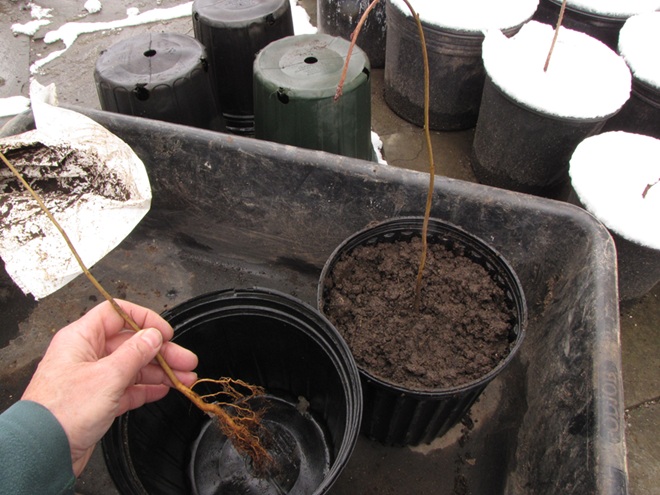
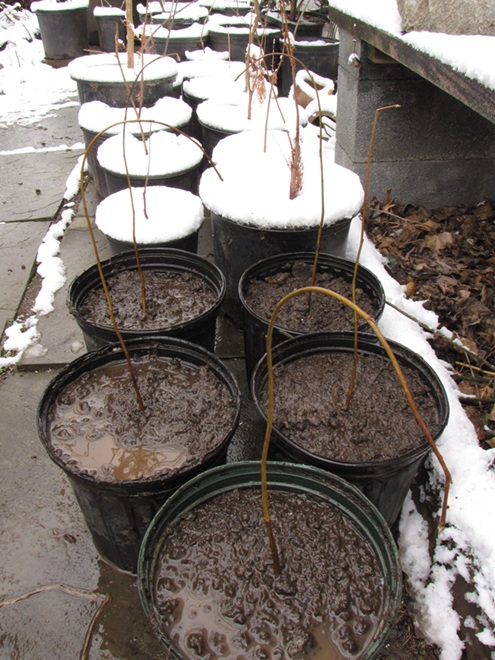
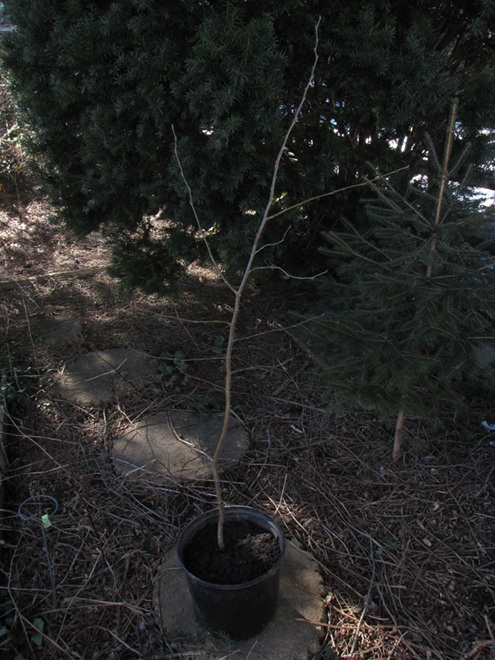
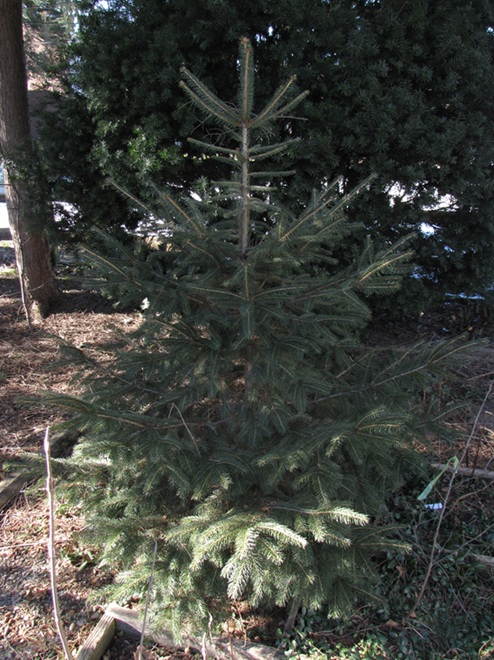
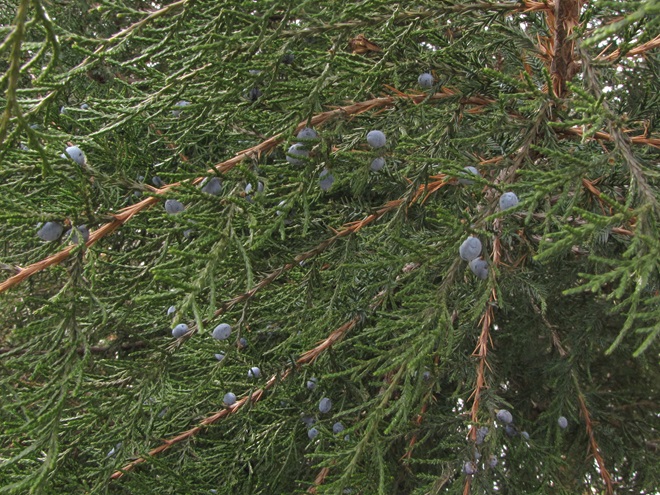
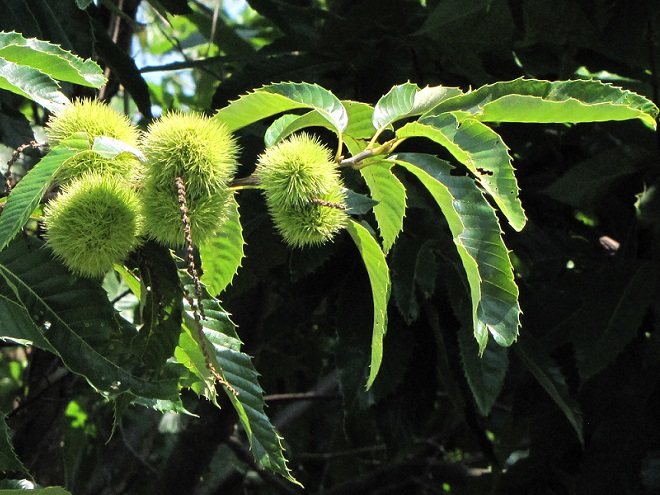
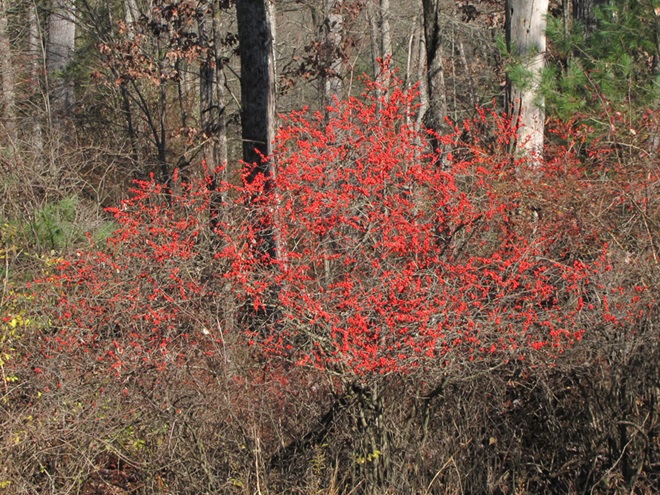
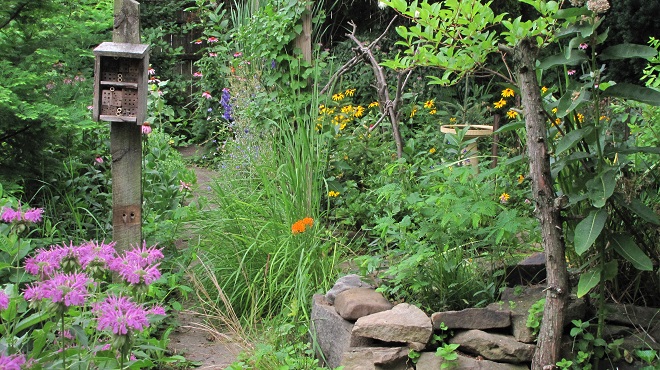
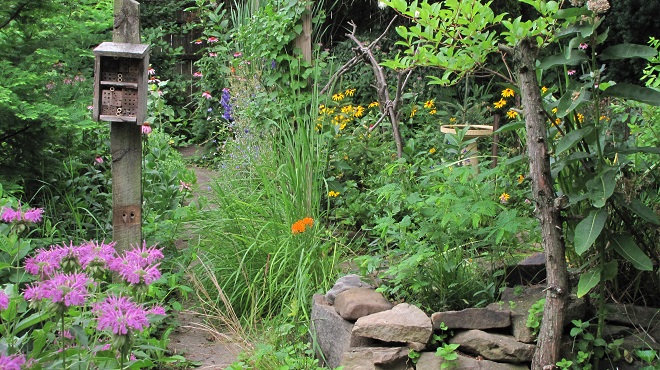
If maybe you would like to order trees but you’re not quite ready to put them in the ground, why not pot them up and start your own plant nursery. It’s a great way to build an inventory of hardy stock for planting around your own property or for use in community or civic conservation projects.
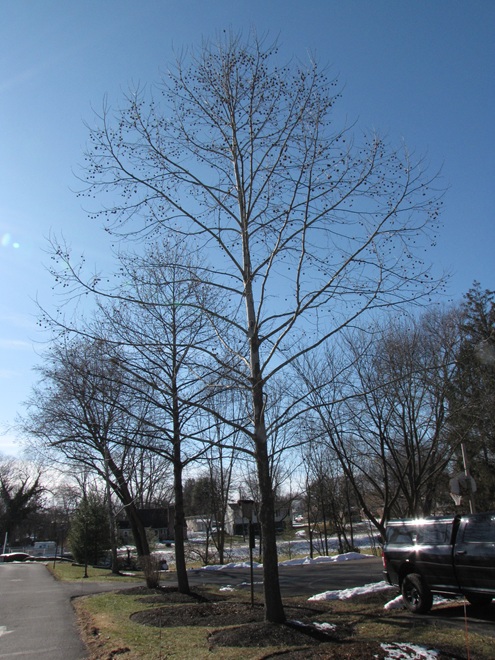
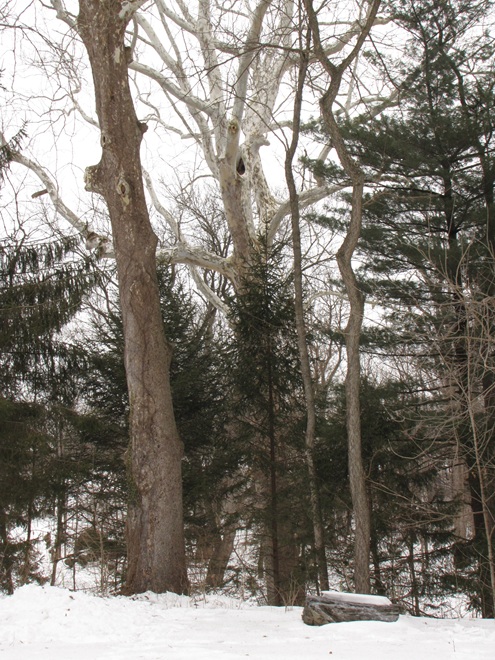
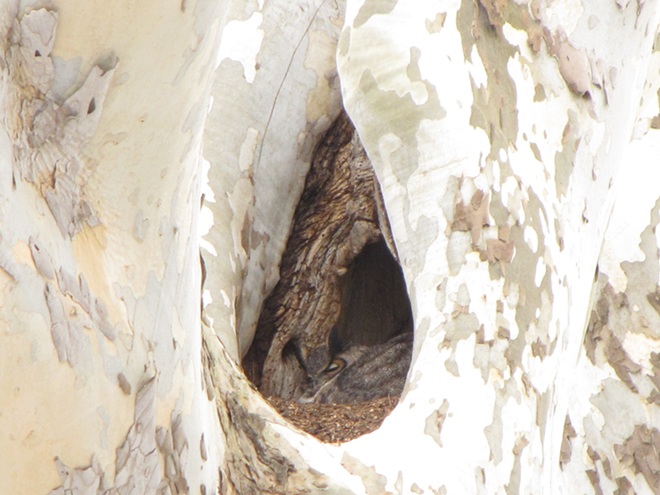
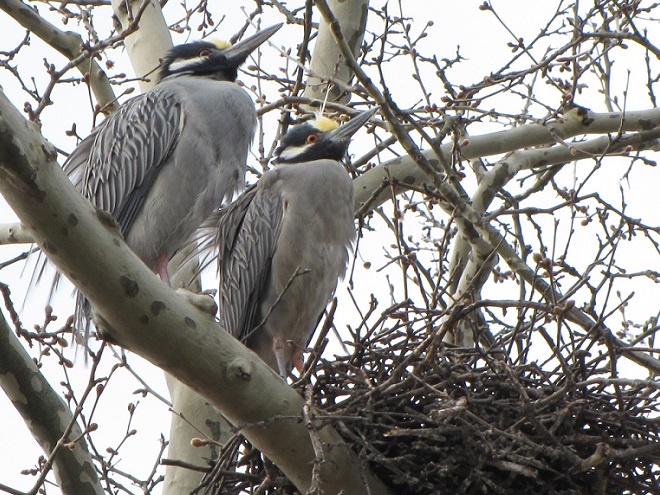
Earlier this week we potted up some bare-root seedlings in a mix of compost and sand to give them a head start before planting them in the ground either during the coming fall or in years to come. These happen to be some young American Sweetgum trees we purchased from a nursery in Perkasie, Bucks County, Pennsylvania.After watering them in, we added our new trees to the inventory we have available for stream buffers, rain gardens, reforestation, and other rewilding projects. We’ll either stake or trim them to remedy the curved stems.In just a season or two, we have nice robust saplings ready to install in a project or in the headquarters garden. Starting plants in the nursery gives them the size they need to improve their chances of survival.This is one of ten Norway Spruce trees we purchased in a pack from a local conservation district sale almost ten years ago. We started each two-year-old seedling in a pot, then transplanted them into the ground a year later. All have been thriving ever since.Since being installed as a potted sapling reared in the headquarters nursery about fifteen years ago, this sturdy Eastern Sycamore has matured and is producing seeds relished by American Goldfinches and other birds.Growing in a streamside woodland, a really massive sycamore that got its start in your nursery could continue to provide valuable wildlife habitat over a lifespan extending one hundred, two hundred, maybe even three hundred years or more. These long-lived denizens of the floodplain provide homes for such beloved breeding birds as Baltimore Orioles, Bald Eagles, Warbling Vireos, Yellow-throated Warblers, and several species of owls,……including this Great Horned Owl, seen currently incubating eggs inside a legacy sycamore that has been an active nest site among its neighboring Norway Spruces and Eastern White Pines for decades.Yellow-crowned Night Herons, an endangered species in Pennsylvania, nesting in an Eastern Sycamore planted during the early twentieth century as a street tree very near the Susquehanna in mid-town Harrisburg. Ordering and planting trees today is essential for their tomorrow.
With another round of single-digit and possibly sub-zero temperatures on the way, birds and other wildlife are taking advantage of a break in the extreme conditions to re-energize. During the past day, these species were among those attracted to the food and cover provided by the habitat plantings in the susquehannawildlife.net headquarters garden…
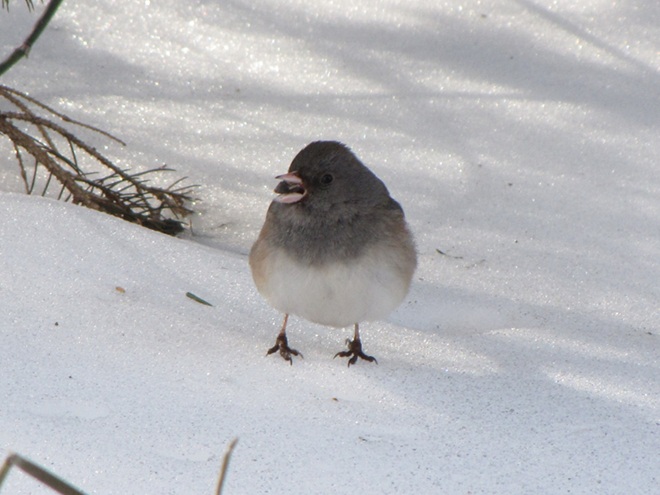
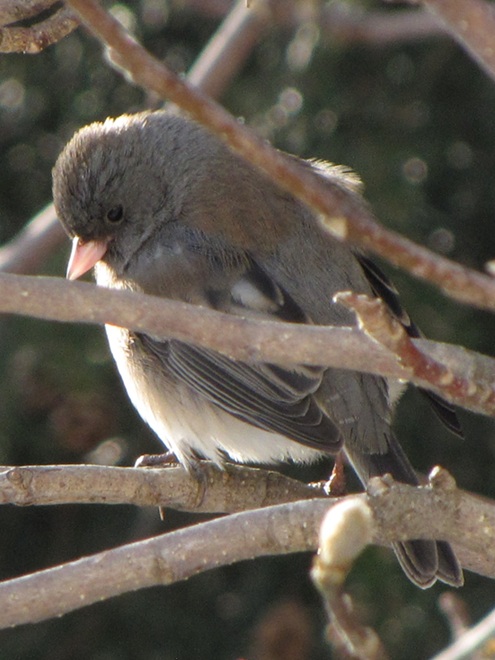
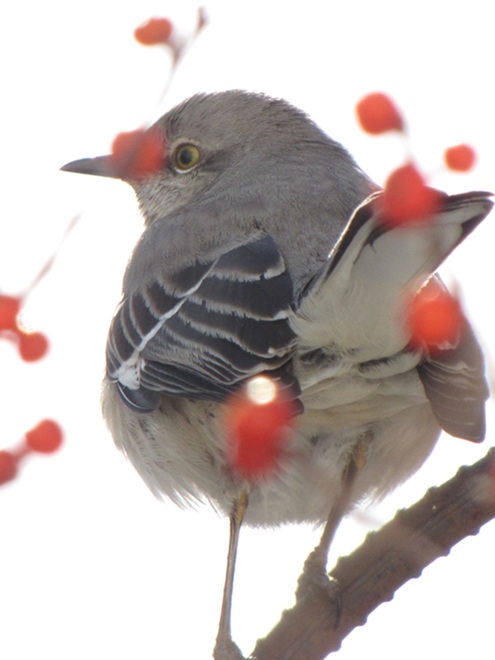
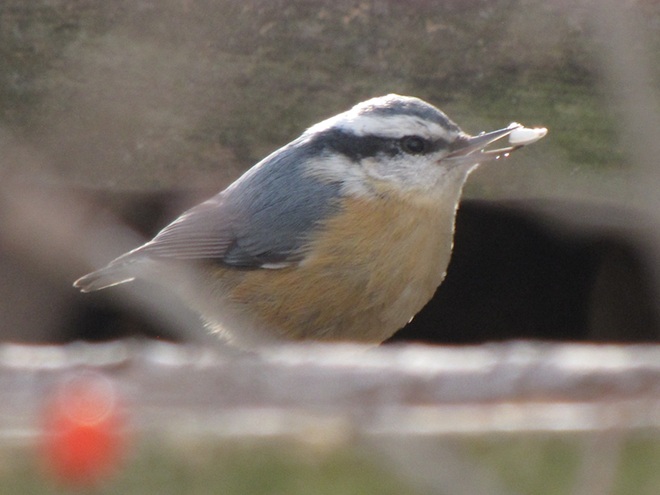
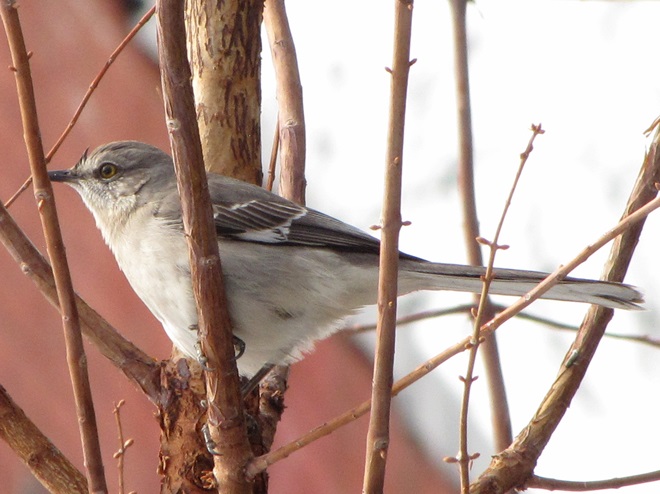
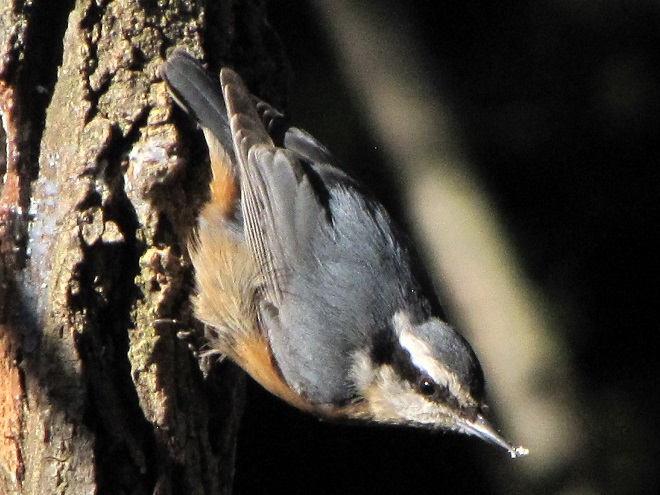
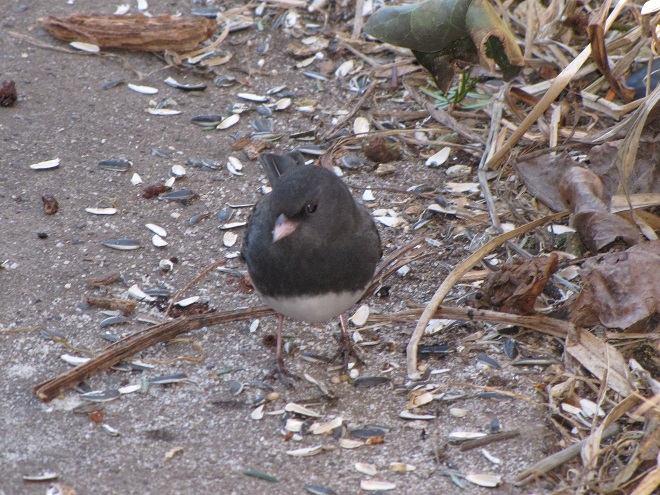
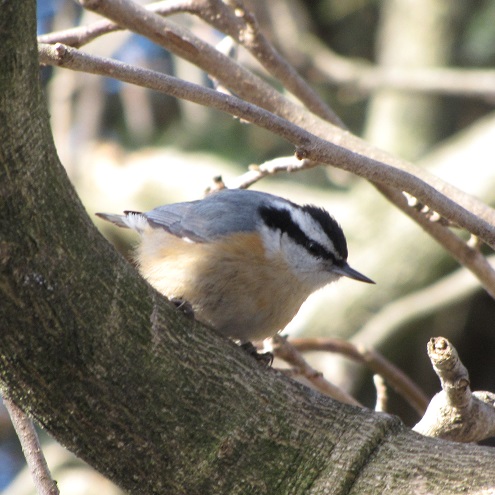
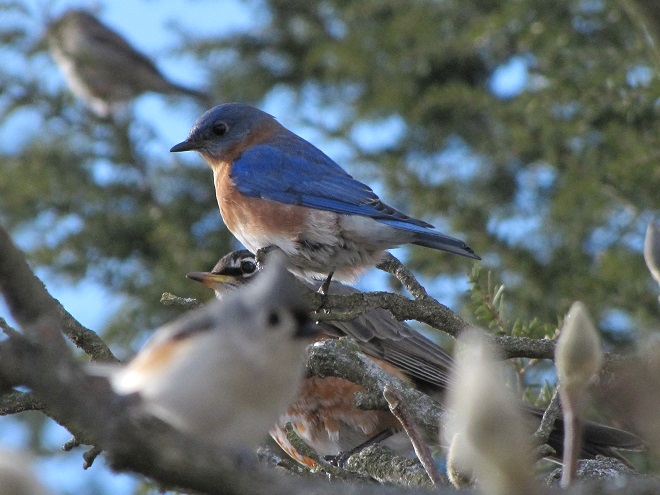
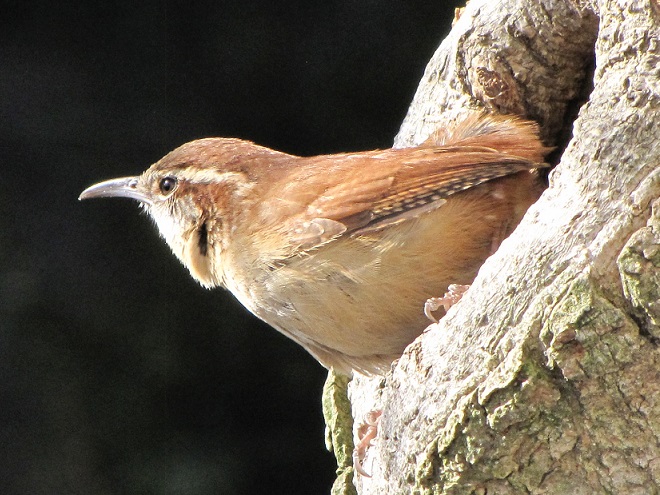
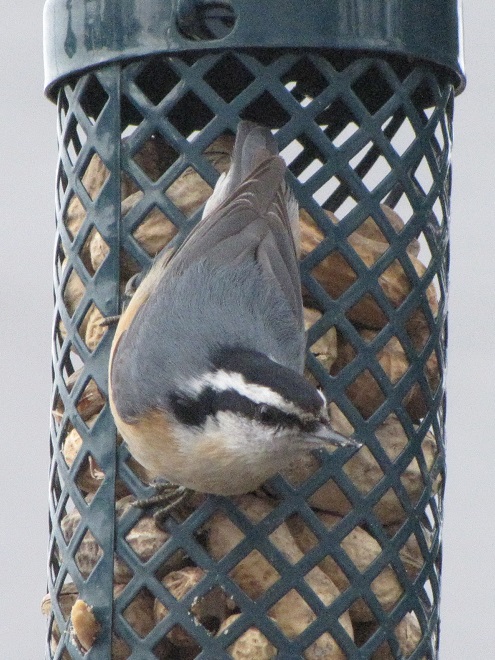
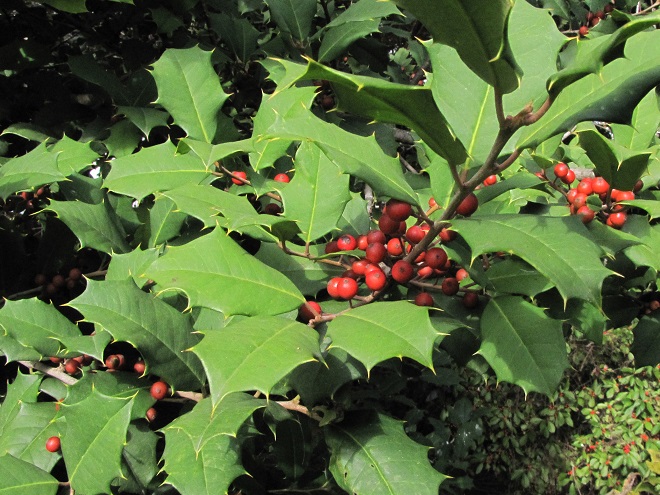
Dark-eyed Juncos, one of our numerous species of native sparrows, are sometimes called “snowbirds”, and for good reason. They spend the majority of their time on the ground searching for seeds and are particularly noticeable when the landscape is blanketed in white.Juncos are seldom seen far from trees, shrubs, and brushy patches of herbaceous growth where they can find both the foods and the protective cover they need to survive the cold.To make it through the winter, a Northern Mockingbird is again defending the garden’s supply of fruits adorning Common Winterberry, American Holly, and Eastern Red Cedar. Robins, starlings, waxwings, and bluebirds must be stealthy and quick if they want to grab a snack before the ever-alert mockingbird aggressively moves them on their way.As they mature, our plantings of junipers, hollies, Eastern Hemlock, Norway Spruce, and Eastern White Pine offer the environs needed by evergreen-loving species like this Red-breasted Nuthatch to remain as winter residents instead of just seasonal transients.
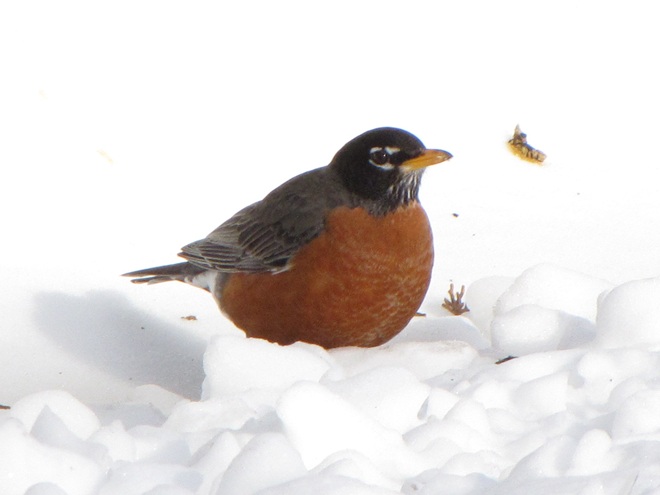
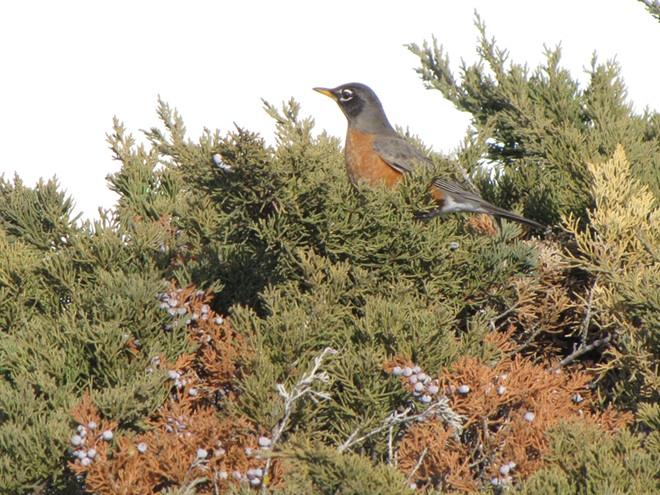
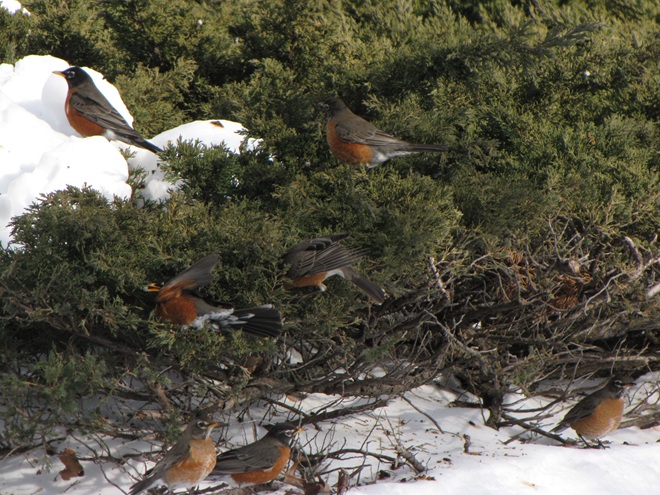
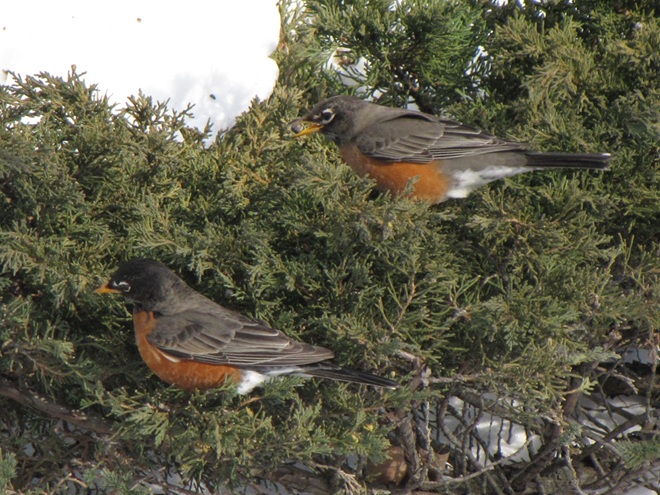
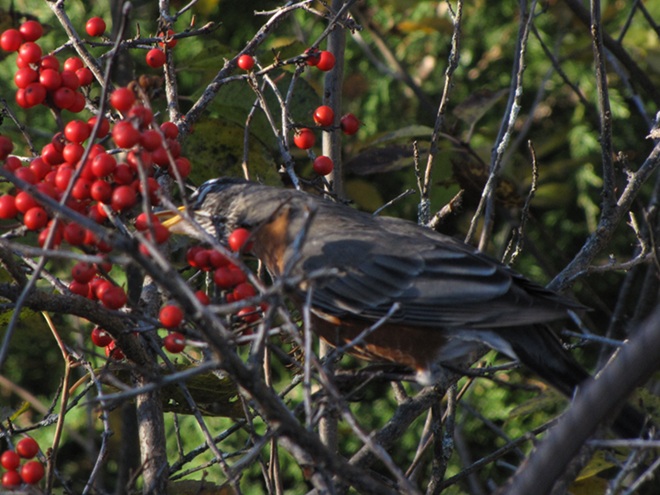
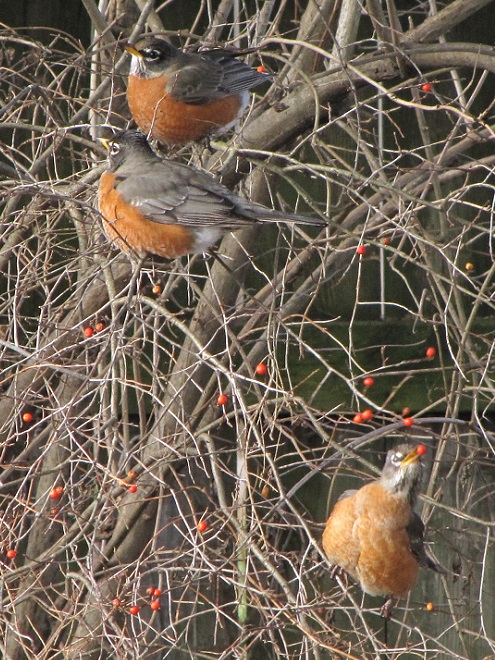
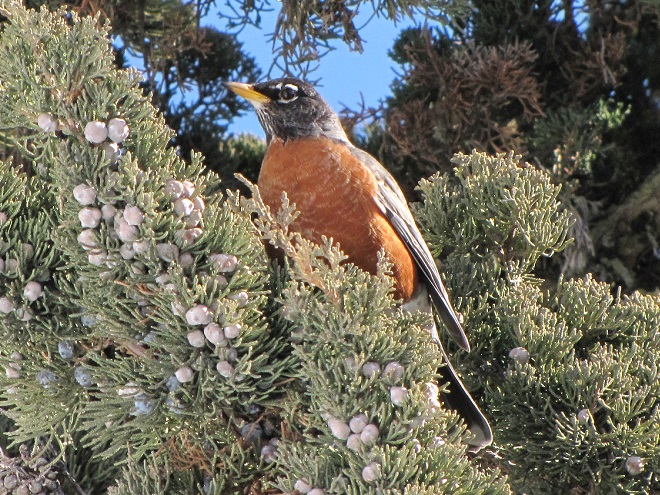
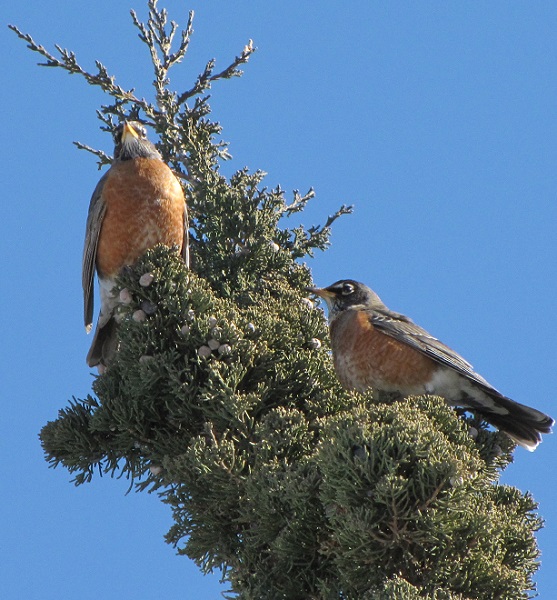
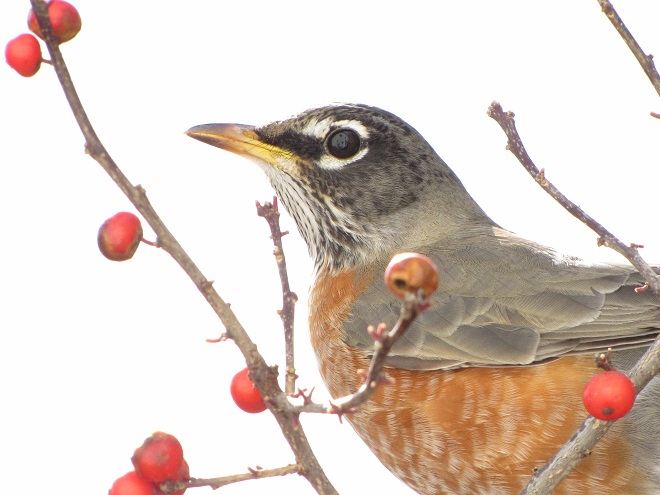
For overwintering birds and other animals, finding enough food is especially difficult when there’s snow on the ground. And nighttime temperatures in the single digits make critical the need to replenish energy during the daylight hours. Earlier this afternoon, we found these American Robins seizing the berry-like cones from ornamental junipers in a grocery store parking lot. It was an urgent effort in their struggle for survival.
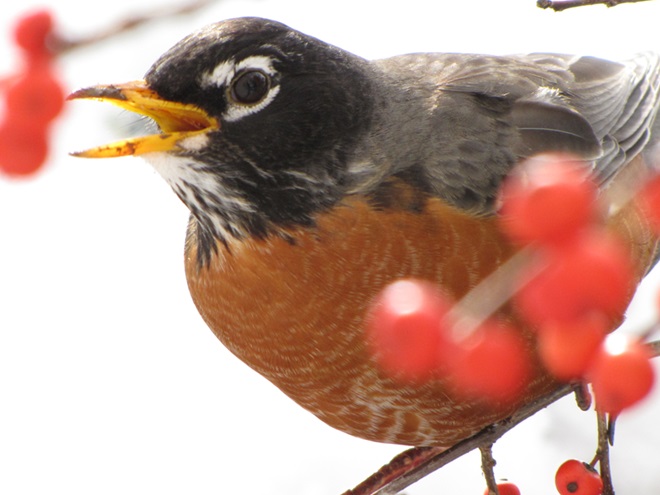
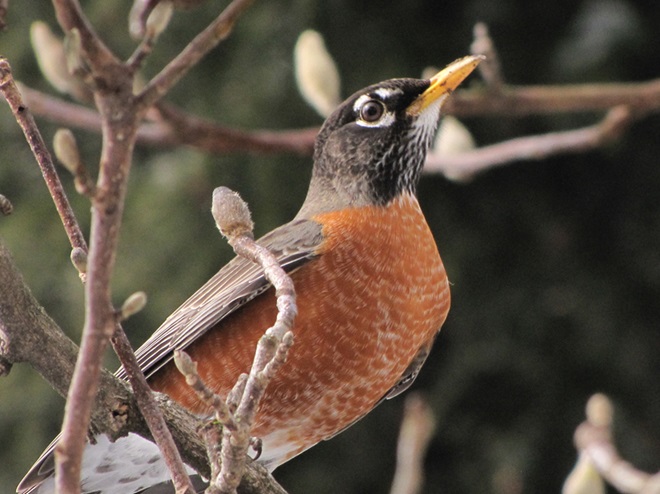
A hungry American Robin at the local Weis Market.Though seldom considered ideal wildlife plants, low-growing ornamental junipers often produce an abundance of seed-containing cones that resemble berries.In a pinch, they’ll attract dozens of robins and other fruit-eating birds as a quick source of nourishment on a windy, bitter-cold day.After all, these landscape shrubs are often derived from native species including the Creeping Juniper (Juniperus horizontalis) of Canada and the northernmost United States, a plant resembling a recumbent version of the local Eastern Red Cedar (Juniperus virginiana) with which these birds are quite familiar.
County conservation district offices will soon be taking orders for their spring tree sales. Be sure to load up on plenty of the species that offer food, cover, and nesting sites for birds and other wildlife. These sales are an economical way of adding dense-growing clusters or temperature-moderating groves of evergreens to your landscape. Plus, selecting four or five shrubs for every tree you plant can help establish a shelter-providing understory or hedgerow on your refuge. Nearly all of the varieties included in these sales produce some form of wildlife food, whether it be seeds, nuts, cones, berries, or nectar. Many are host plants for butterflies too. Acquiring plants from your county conservation district is a great opportunity to reduce the amount of ground you’re mowing and thus exposing to runoff and erosion as well!
Here are a few more late-season migrants you might currently see passing through the lower Susquehanna valley. Where adequate food and cover are available, some may remain into part or all of the winter…
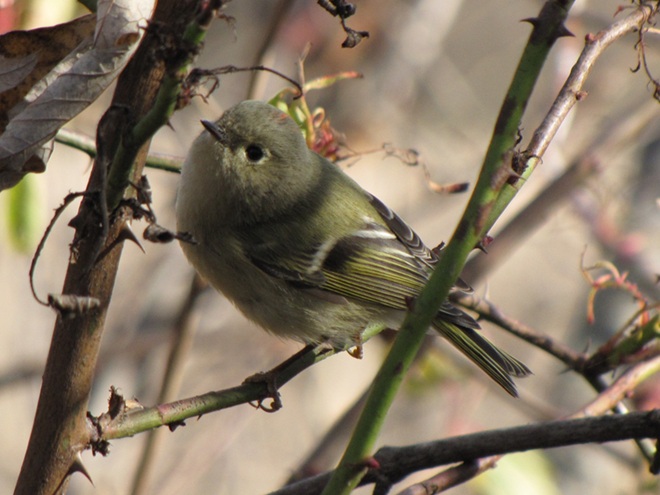
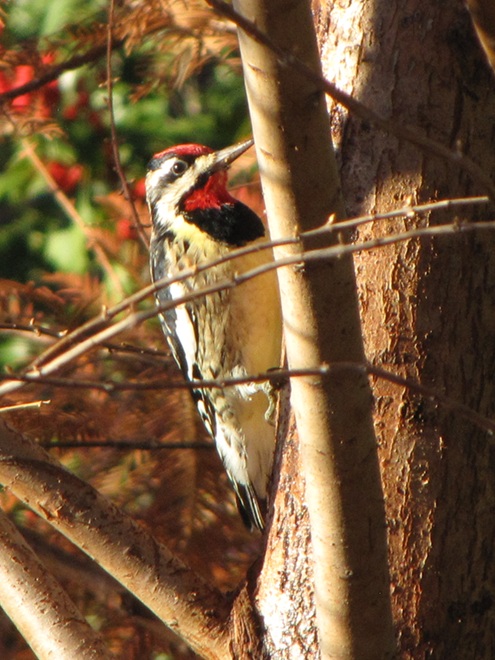
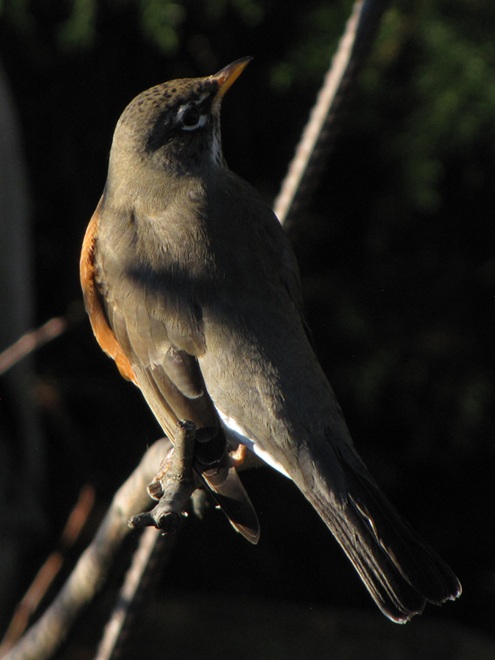
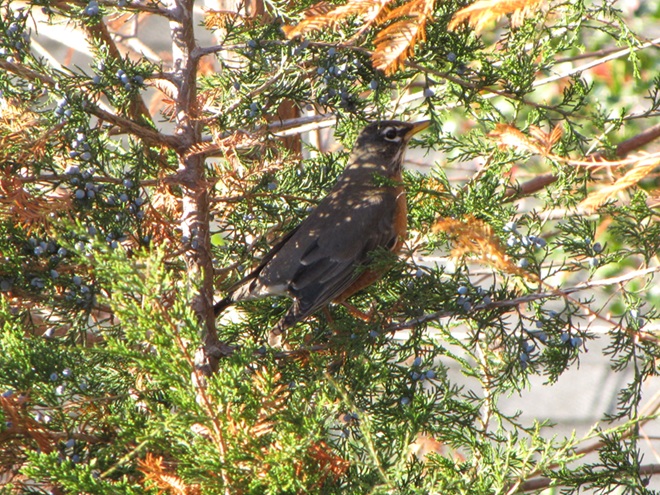
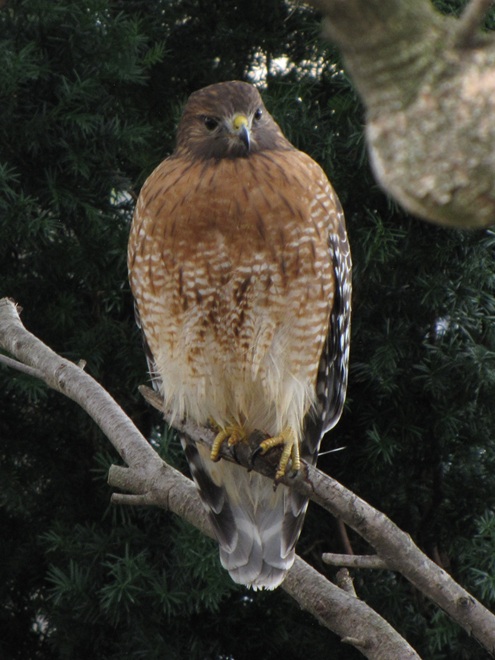
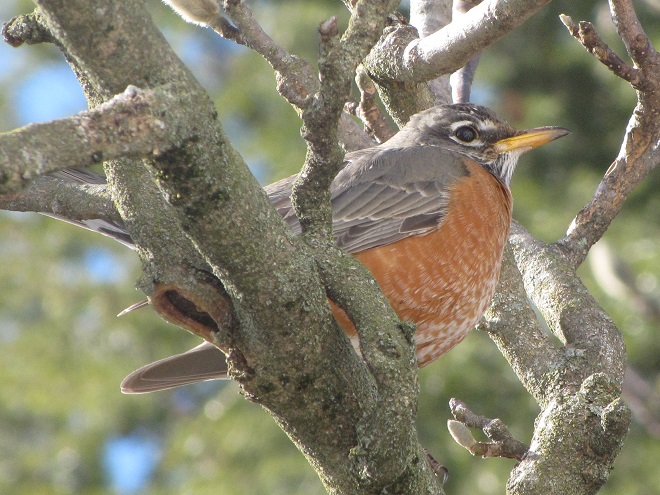
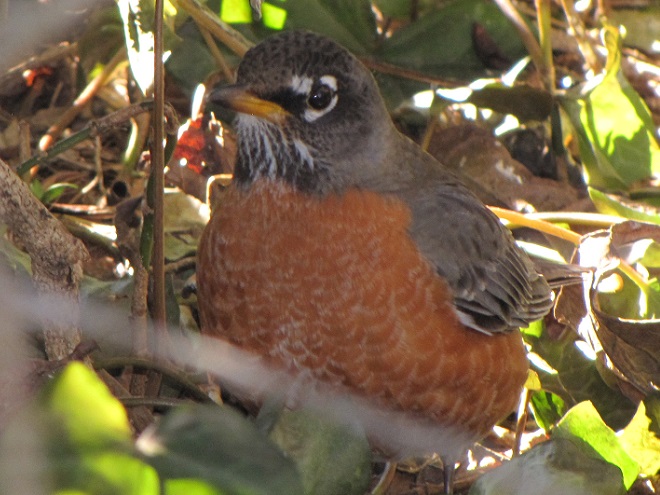
During the summer, Ruby-crowned Kinglets nest in northern coniferous forests. Through the colder months, these petite songbirds can often subsist on tiny insects and other invertebrates found among the bark, limbs, and buds of leafless deciduous trees and shrubs. In our region, look for wintering kinglets in woodlands that include at least a small percentage of evergreens to provide protection from frigid nighttime temperatures.The Yellow-bellied Sapsucker is our shiest of woodpeckers. These migrants are still quite common among stands of deciduous and mixed woods, but local numbers will soon decrease as the majority of the population continues moving along to the forests of the southeastern United States for winter.Migrating American Robins are still transiting region, but an abundance of wild fruits can prompt hundreds to linger through winter. Look for them near supplies of wild grape, Poison Ivy, dogwood, Virginia Creeper, hackberry, hawthorn, American Holly,……Eastern Red Cedar,……and Common Winterberry.In case you were wondering…Yes, the adult Red-shouldered Hawk continues to visit the garden pond at susquehannawildlife.net headquarters. Earlier today, we watched it plunge into the shallows after a Green Frog. We’re enjoying the privilege of having it around, so we hope it decides to remain for as long as the food supply is accessible.
As we begin the second half of October, frosty nights have put an end to choruses of annual cicadas in the lower Susquehanna valley. Though they are gone for yet another year, they are not forgotten. Here’s an update on one of our special finds in 2025.
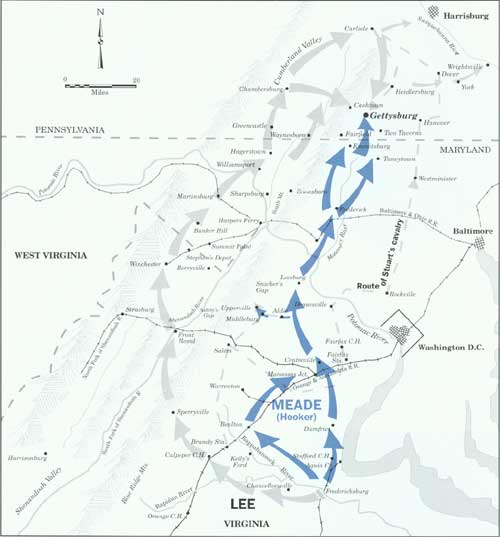
During late June of 1863, the beginning of the third summer of the American Civil War, there was great consternation among the populous of the lower Susquehanna region. Hoping to bring about Union capitulation and an end to the conflict, General Robert E. Lee and his 70,000-man Army of Northern Virginia were marching north into the passes and valleys on the west side of the river. The uncontested Confederate advances posed an immediate threat to Pennsylvania’s capital in Harrisburg and cities to the east. Marching north in pursuit of Lee was the First Corps of the Army of the Potomac, the lead element of the 100,000-man Union force under the direction of newly appointed commander General George G. Meade.
Upon belatedly learning of Meade’s pursuit, Lee hastily ordered the widely separated corps of his army to concentrate on the crossroads town of Gettysburg. As the southern army’s Third Corps under General A. P. Hill approached Gettysburg from the west, they were met by Union cavalry under the leadership of General John Buford. Dismounted and formed up south to north across the Chambersburg Pike, Buford’s men held off Confederate infantry until relieved by the arrival of the Union First Corps. As he deployed his men, the First Corps’ commander, General John F. Reynolds of Lancaster, was struck by a bullet and killed.
During the first day’s fighting at Gettysburg on July 1, 1863, the northernmost position in the Union First Corps’ line was held by its Second Division commanded by General John C. Robinson. His men would defend their right flank against attacks from Confederate General Richard S. Ewell’s Second Corps as they arrived from the north to face off against the Union Eleventh Corps which had arrived to take positions north of the town. During the afternoon, upon becoming outnumbered and overwhelmed, the Union forces would retreat south through the town to take up positions on Cemetery Hill by nightfall. Deployments extending south and east of Cemetery Hill would ultimately prove victorious for Union forces during the battle’s final day on July 3.John C. Robinson’s Second Division “invaded” Pennsylvania as one of Meade’s lead elements charged with intercepting Lee’s Confederate Army. (National Park Service image)
If you visit the Gettysburg battlefield, you can find the General John C. Robinson monument at the site of his division’s first-day position along Doubleday Avenue at Robinson Avenue near the Eternal Light Peace Memorial. But that’s not the Robinson we went to Gettysburg to see.
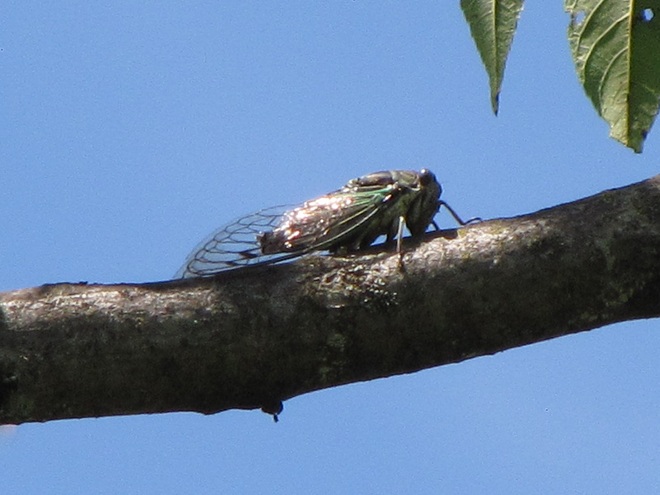
Following up on our sight and mostly sound experiences with some Robinson’s Cicadas, an annual species of singing insect we found thriving at Gifford Pinchot State Park in York County, Pennsylvania, during late July, we spent some time searching out other locations where this native invader from the southern United States could be occurring in the Lower Susquehanna River Watershed.
During mid-August, we stumbled upon a population of Robinson’s Cicadas east of the Susquehanna in the Conewago Creek (east) watershed in Londonderry Township, Dauphin County, and made some sound recordings.
After pondering this latest discovery, we decided to investigate places with habitat characteristics similar to those at both the new Londonderry Township and the earlier Gifford Pinchot State Park locations—successional growth with extensive stands of Eastern Red Cedar on the Piedmont’s Triassic Gettysburg Formation “redbeds”. We headed south towards known populations of Robinson’s Cicadas in Virginia and Maryland to look for suitable sites within Pennsylvania that might bridge the range gap.
Our search was a rapid success. On State Game Lands 249 in the Conewago Creek (west) watershed in Adams County, we found Robinson’s Cicadas to be widespread.
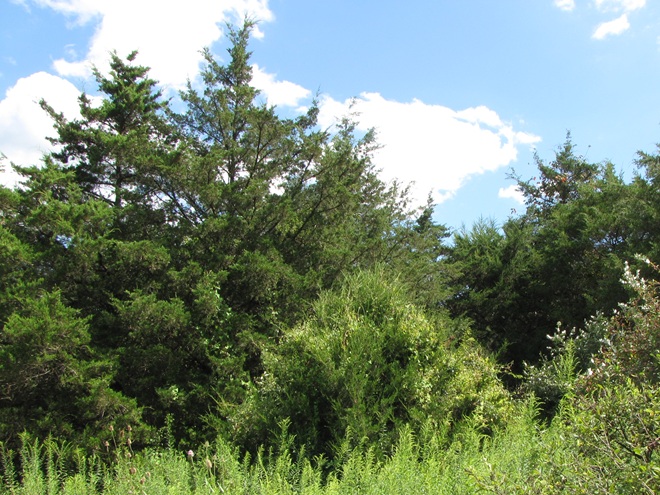
Eastern Red Cedar, a probable host tree for Robinson’s Cicada nymphs, among successional growth on State Game Lands 249. Cedar thickets often become established on shallow or depleted soils on lands originally cleared for farming. They provide excellent cover as well as much needed breeding and feeding areas for birds, mammals, insects, and other wildlife.A male Robinson’s Cicada singing at State Game Lands 249 in Adams County, Pennsylvania.
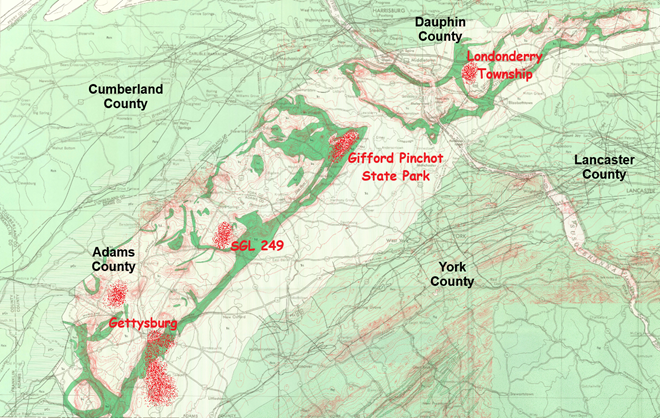
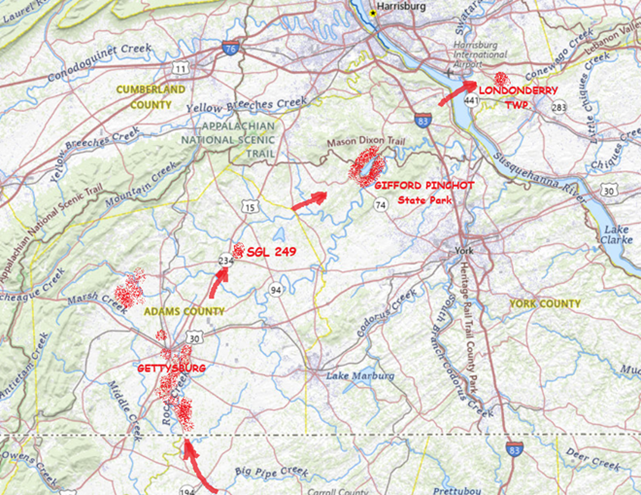
Following our hunch that these lower Susquehanna Robinson’s Cicadas extended their range north through the cedar thickets of the Gettysburg Basin as opposed to hopping the Appalachians from a population reported to inhabit southwest Pennsylvania, we made our way to the battlefield and surrounding lands. We found Robinson’s Cicadas to be quite common and widespread in these areas, even occurring in the town of Gettysburg itself.
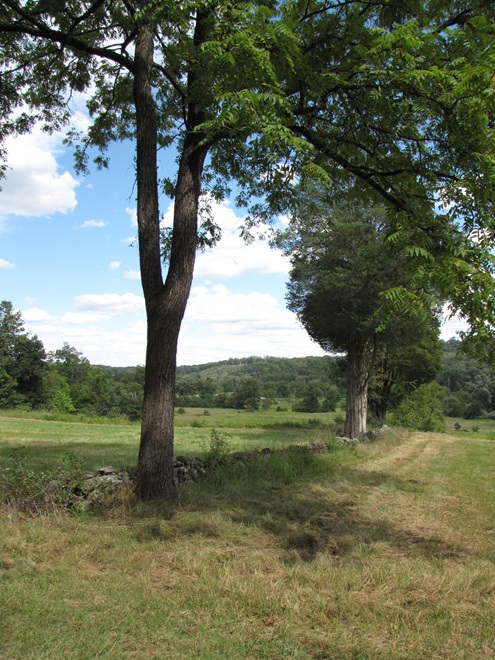
Populations of Robinson’s Cicadas (red) in the lower Susquehanna valley and adjacent areas of the Potomac watershed near Gettysburg. The Triassic Gettysburg Basin is shown in white with intrusions of igneous Triassic-Jurassic diabase in dark green. (United States Geological Survey base image)Robinson’s Cicadas are common on much of the Gettysburg National Military Park property, particularly in the southern reaches where outlying areas are dense with Eastern Red Cedar growth to within several miles of the Mason-Dixon Line. In these tall walnuts and cedars along Confederate Avenue (that’s Little Round Top and its diabase boulders in the background) we recorded the following sound clip of a singing male.Robinson’s Cicada probably extended its range into the lower Susquehanna valley in much the same way General John C. Robinson and the rest of the Army of the Potomac marched into Pennsylvania to meet Lee’s Confederates, by following the terrain of the Triassic Gettysburg Basin. Got a big stand of cedars near you? Be sure to have a listen for Robinson’s Cicadas next summer! (United States Geological Survey base image)
Having experienced our first frost throughout much of the lower Susquehanna valley last night, we can look forward to seeing some changes in animal behavior and distribution in the days and weeks to come. Here are a few examples…
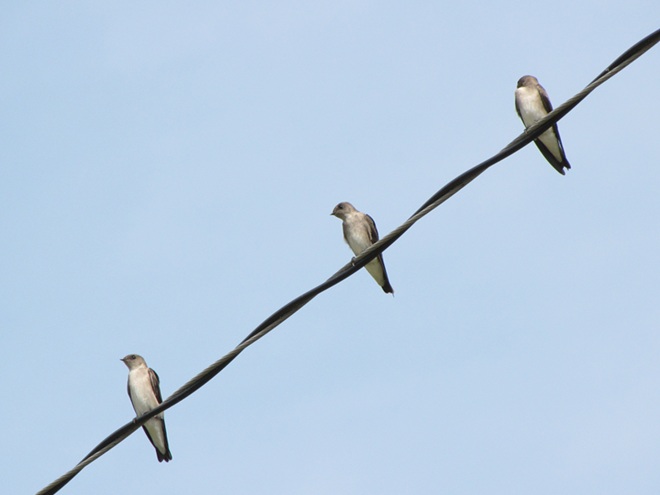
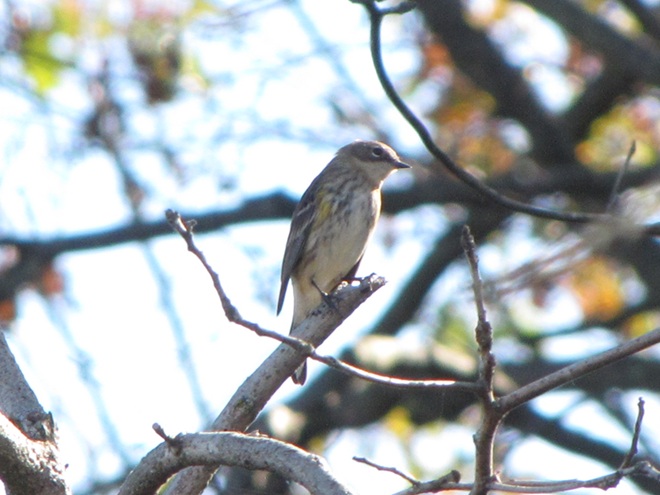
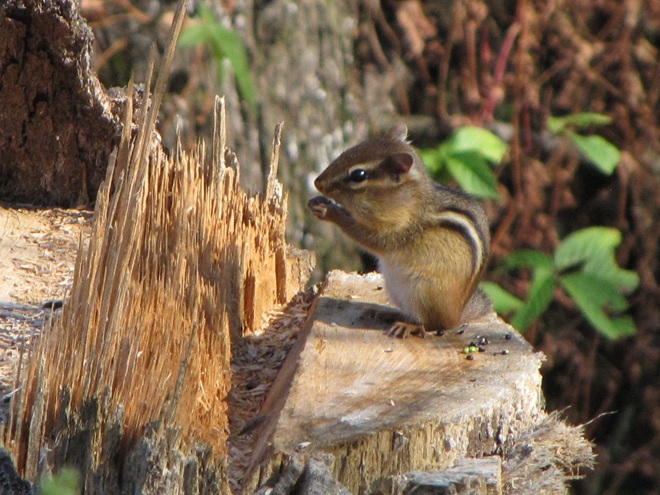
Unlike their close relatives the Tree Swallows, which include berries as well as invertebrates in their diet, Northern Rough-winged Swallows are strictly insectivores and will find it necessary to promptly move south to assure a frost-free environment where they can secure an adequate supply of food. Their one alternative: find a local sewage treatment plant where warm water attracts populations of flying insects through the remainder of autumn and maybe into winter.Warblers too are insect eaters. Look for most of our dozens of species to evacuate the area in coming days and leave behind only the Yellow-rumped Warbler, another bird with a fondness for berries during cold weather. Into the winter months, they remain in small numbers in habitats with an abundant supply of berries like Poison Ivy, holly, wild grape, bittersweet, and Eastern Red Cedar. For lingering Yellow-rumped Warblers, thickets of cedars and other evergreens provide essential protection from frigid nighttime winds.This Eastern Chipmunk will soon feel the pinch. Instead of eating the sweet, fruity portions of Mile-a-minute Weed berries, it’ll have to get serious about stocking its den with larger seeds, acorns, hickory nuts, and other foods to snack on through the winter. Better get busy, little friend!
Here are five common forest flowers that the average visitor to these environs may easily overlook during an early April visit.
The flowers of the Skunk Cabbage, a native member of the arum family, are contained within a spadix which is partially hidden inside the mottled maroon spathe at the base of the plant. In late winter, the closed spathe generates its own heat to melt through frozen water and soils to make its appearance in streamside and spring-fed wooded wetlands, just ahead of the emergence of the large green leaves.Common Spicebush is a native flowering shrub of damp woodland understories. Later in the season, its foliage provides food for Spicebush Swallowtail caterpillars. Pollinated blossoms yield bright-red oblong berries relished by a variety of birds in fall and winter.The flowers of the indigenous Red Maple will soon generate the familiar helicopter-like winged seeds which readily distribute this native tree into new ground ranging from lowlands to the crests of our highest ridges.Coltsfoot (Tussilago farfara) is non-native wildflower of Eurasian origin. Reminding one at first glance of a dandelion, it is commonly seen blooming in disturbed areas of woodlands. Coltsfoot often grows where it has little competition from other plants, such as among the debris left behind due to snow plowing and grading along forest roads.Though not particularly abundant, the non-native Sweet Cherry, an escape from cultivation, is widespread in forests and woodlots throughout the lower Susquehanna valley. Sweet Cherry is believed to be an ancestor of the Sour Cherry (Prunus cerasus) and is frequently used as rootstock for orchard and garden varieties of this popular fruit. Sweet Cherry is often called “Wild Cherry”, a name also applied to the Black Cherry, a native tree which blooms later in the spring.
Be certain to get out and enjoy this year’s blooming seasons of our hundreds of varieties of flowering plants. But, particularly when it comes to native species,…
Our wildlife has been having a tough winter. The local species not only contend with cold and stormy weather, but they also need to find food and shelter in a landscape that we’ve rendered sterile of these essentials throughout much of the lower Susquehanna valley’s farmlands, suburbs, and cities.
Planting trees, shrubs, flowers, and grasses that benefit our animals can go a long way, often turning a ho-hum parcel of property into a privately owned oasis. Providing places for wildlife to feed, rest, and raise their young can help assure the survival of many of our indigenous species. With a little dedication, you can be liberated from the chore of manicuring a lawn and instead spend your time enjoying the birds, mammals, insects, and other creatures that will visit your custom-made habitat.
What makes some neighborhoods so appealing? It’s the foresight property owners had a half a century or more ago when they planted their lawns and gardens with a variety of sturdy, long-lived trees and shrubs. They’ve not only minimized the need for mowing grass, they’ve provided the present-day residents of their home with added thermal stability during both the blazing heat of summer and the chilling cold of winter.
Fortunately for us, our local county conservation districts are again conducting springtime tree sales offering a variety of native and beneficial cultivated plants at discount prices. Listed here are links to information on how to pre-order your plants for pickup in April. Click away to check out the species each county is offering in 2025!
Pickup on: Thursday, April 24, 2025 or Friday, April 25, 2025
During its 2025 tree seedling sale, the Cumberland County Conservation District is offering Northeast Native Wildflower seed mix for four dollars per ounce. One ounce plants approximately 200 square feet of bare soil. This is a Zebra Swallowtail visiting nectar-rich flowers during July of the first year after sowing this mix at a site along the Susquehanna.
Pickup on: Thursday, April 24, 2025 or Friday, April 25, 2025
Able to thrive in wet soils, Red-osier and Silky Dogwood shrubs are ideal plants for intercepting and polishing stormwater in swales, detention/retention basins, and rain gardens. With their crimson twigs in winter, they look great along borders among clusters of cedars, pines, spruces, and other evergreens. They make an excellent choice for soil stabilization along the shorelines of streams, ponds, and other bodies of water too. Buy a dozen or more to create a showy mass planting in your soggy spot.
The Franklin County Conservation District is offering American Elm seedlings in bundles of 25 for 36 dollars. Start them in pots for a couple of years to really get ’em going, then find places with damp soil and plenty of room to give ’em a try. During autumn, they look great in the company of spruces, white pines, and other large evergreens.
We purchased these Eastern White Pine, Norway Spruce, and Common Winterberry plants from the Lancaster County Conservation District Tree Sale about four years ago. They’re filling in as understory growth in the margins beneath some thirty-year-old Eastern Hemlocks to create dense cover for resident and visiting fauna at susquehannawildlife.net headquarters.
For 2025, the Lebanon County Conservation District is offering Dawn Redwood (Metasequoia glyptostroboides) trees in packs of ten for twelve dollars. Though native to Asia, these adaptable trees present little threat of naturalizing and have many positive attributes in a conservation planting. Given ample space, the Dawn Redwood, a relative of the sequoias, will rapidly grow to a towering giant. They create a particularly dramatic landscape feature when planted in clumps of three to five trees or more. With age, the trunks become stout and very sturdy. Don’t like raking? The finely divided deciduous foliage can be left where it falls in autumn. It usually disintegrates by spring to enrich the soil and promote more growth.The genus Metasequoia was first described in 1941 based upon fossils collected in Jurassic and earlier strata from widespread locations in the northern hemisphere. Metasequoia were believed extinct until just a few years later when a small number of living Dawn Redwoods were first discovered in southern China. Now distributed around the world for cultivation, direct descendants of this wild population of Metasequoia glyptostroboides are available for nearly anyone in a temperate climate to plant and grow to exceptional size. (National Park Service image)The Lebanon County Conservation District is also selling Bald Cypress trees. They’re offered in bundles of ten for ten dollars. These long-lived trees resemble the Dawn Redwood. Both are tolerant of damp ground, but the native Bald Cypress is the species to choose for placement along streams, in wetlands, and on other sites with standing water or saturated soil.Wildlife rich Bald Cypress swamps currently occur on the Atlantic Coastal Plain as far north as Sussex County, Delaware. Just to the south, they’re also found along Chesapeake Bay in areas that, during the last glacial maximum when sea level was 300 to 400 feet below today’s tide lines, were the Lower Susquehanna River Watershed in portions of present-day Maryland and Virginia. The northward post-glacial range extension of Bald Cypresses is now blocked by centuries of human intervention that has eliminated, isolated, or fragmented the wetland habitats where they could potentially become established. Why not lend them a hand? Plant a cypress swamp in your flood-prone bottomland. (National Park Service image by Andrew Bennett)
A privacy planting of sturdy, native Eastern White Pines and Northern Red Oaks thriving around the border of a parking area where they also provide shade from the sun and help infiltrate a share of the stormwater that would otherwise become runoff.This year, the York County Conservation District is offering a Showy Northeast Native Wildflower and Grass seed mix for $19.99 per quarter pound. Sure beats mowing!
If you live in Adams County, Pennsylvania, you may be eligible to receive free trees and shrubs for your property from the Adams County Planting Partnership (Adams County Conservation District and the Watershed Alliance of Adams County). These trees are provided by the Chesapeake Bay Foundation’s Keystone 10-Million Trees Partnership which aims to close a seven-year project in 2025 by realizing the goal of planting 10 million trees to protect streams by stabilizing soils, taking up nutrients, reducing stormwater runoff, and providing shade. If you own property located outside of Adams County, but still within the Chesapeake Bay Watershed (which includes all of the Susquehanna, Juniata, and Potomac River drainages), you still may have an opportunity to get involved. Contact your local county conservation district office or watershed organization for information.
As they mature, tree and shrub plantings along streams return pollution-controlling functions to floodplains and provide critical habitat for wildlife. These riparian buffers not only improve water quality for fisheries, they also create travel corridors that prevent terrestrial animal populations from becoming isolated.Do you own a parcel of streamside or wetland acreage that you’d like to set aside and plant for the benefit of wildlife and water quality? Contact your local county conservation district office and ask them to tell you about CREP (Conservation Reserve Enhancement Program) and other programs that may offer incentives including payment of all or a portion of the costs of plantings and other habitat improvements.
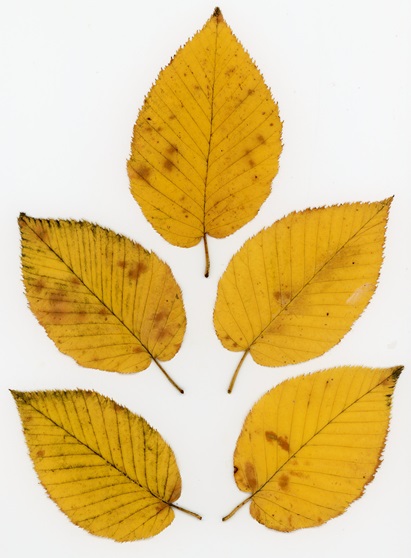
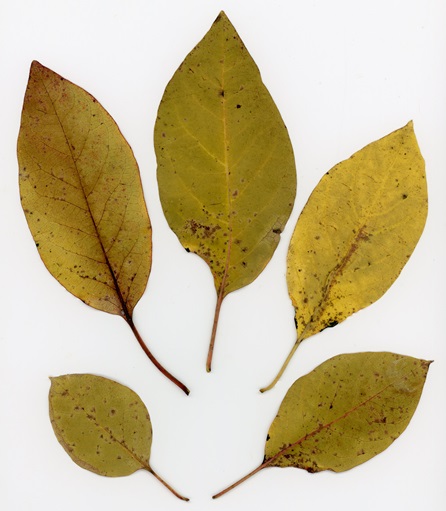
We hope you’re already shopping. Need help making your selections? Click on the “Trees, Shrubs, and Woody Vines” tab at the top of this page to check out Uncle Tyler Dyer’s leaf collection. He has most of the species labelled with their National Wetland Plant List Indicator Rating. You can consult these ratings to help find species suited to the soil moisture on your planting site(s). For example: if your site has sloped upland ground and/or the soils sometimes dry out in summer, select plants with a rating such as UPL or FACU. If your planting in soils that remain moist or wet, select plants with the OBL or FACW rating. Plants rated FAC are generally adaptable and can usually go either way, but may not thrive or survive under stressful conditions in extremely wet or dry soils.
NATIONAL WETLAND PLANT LIST INDICATOR RATING DEFINITIONS
OBL (Obligate Wetland Plants)—Almost always occur in wetlands.
FACW (Facultative Wetland Plants)—Usually occur in wetlands, but may occur in non-wetlands.
FAC (Facultative Wetland Plants)—Occur in wetlands and non-wetlands.
FACU (Facultative Upland Plants)—Usually occur in non-wetlands, but may occur in wetlands.
UPL (Upland Plants)—Almost never occur in wetlands.
Using these ratings, you might choose to plant Pin Oaks (FACW) and Swamp White Oaks (FACW) in your riparian buffer along a stream; Northern Red Oaks (FACU) and White Oaks (FACU) in the lawn or along the street, driveway, or parking area; and Chestnut Oaks (UPL) on your really dry hillside with shallow soil. Give it a try.
As the autumn bird migration draws to a close for 2024, we’re delighted to be finding five of our favorite visitors from the coniferous and mixed forests of Canada and the northernmost continental United States.
Yellow-bellied Sapsuckers drill evenly spaced holes which they repeatedly visit to harvest “sap” and the insects that become trapped therein. These surgically small excavations penetrate only the bark and the phloem, a shallow, spongy layer of the trunk that carries sugars from the leaves to other parts of the tree. Seldom do they puncture the thin, underlying cambium layer which protects the true sapwood. After healing, sapsucker holes leave linear rows of small scars which are sometimes still discernible decades after a bird’s final visit. This adult male will probably linger in the Lower Susquehanna River Watershed until colder weather renders the tree totally dormant, the flow of “sap” ebbs, and small insects become harder to find. Then he’ll make his way off toward southern forests of oak and pine for the remainder of the winter. Sapsuckers work their way north as sugary “sap” begins flowing again in the spring.The Hermit Thrush is another denizen of coniferous and mixed forests. In habitats with dense cover and sufficient food sources like fruit-bearing shrubs and vines, some will remain through the winter. The Hermit Thrush is the only spot-breasted thrush regularly seen in our region from November through March.Almost the size of a thrush, the largest of our native sparrows, the Fox Sparrow, is currently at the peak of its southbound migration. While taking a break from their nocturnal flights, some may stray from forest edges to visit suburban feeding stations. Most leave our area by mid-December, then begin returning north as early as mid-February.Not present every year, flocks of Pine Siskins are beginning to arrive in the lower Susquehanna region. They are currently most common along the mountain tops of the Ridge and Valley Province where they are feeding on the seeds of the Sweet Birch, a tree also known as Black Birch. Look for them around niger seed feeders and on the prickly seed balls of cultivated American Sweetgum, but don’t be surprised if they quickly pass us by to spend the winter on the Atlantic Coastal Plain to our south where this native tree grows in abundance.Since late October, Purple Finches have been widespread throughout the region. These female/juvenile male types are frequently being seen at feeders, particularly near woodlands and other areas with stands of conifers.Less frequently seen are the adult male Purple Finches in their raspberry-colored plumage. What a dandy.
While right now is the best time to get out and look for these species from the northern forests, any or all of them could linger into the winter months, particularly where the food supply is sufficient and conifers and other evergreens provide cover from the blustery weather.
For many species of terrestrial vertebrates living in the lower Susquehanna valley, it’s time to take refuge in a safe place below ground to enter a winter-long slumber. The numerous frosty nights of the past two weeks have expedited the stragglers’ efforts to find a suitable place to pass our coldest months.
Aside from the Eastern Box Turtle (Terrapene carolina carolina), the Wood Turtle (Glyptemys insculpta) is our most terrestrial species of testudine, however it is seldom found far from wet bottomlands. Last week, we found this pair preparing to burrow into alluvial soils along the edge of a floodplain wetland where they will spend the winter. In recent years, Wood Turtle numbers have plummeted due to habitat fragmentation and loss, and due to collecting by short-sighted petkeepers and profiteers.A sluggish Wood Turtle catching a few last rays of sunshine before digging in for the winter. If you encounter these or any turtles now or at any time of year, it’s important that they not be disturbed. Look and leave them be.
And now, just in time for Halloween, a look at some hibernating species that some of our more squeamish readers consider to be “scary”.
In the mountainous forests of the Ridge and Valley Province, there lives a seldom seen little mouse which, unlike the more familiar species found in the fields, farms, and homes of our valleys and Piedmont, spends almost half the year in true hibernation.
The Woodland Jumping Mouse (Napaeozapus insignis) is a nocturnal species of rodent found primarily on rocky forest slopes, particularly those with growths of Eastern White Pine and Eastern Hemlock. Unlike the similar White-footed Mouse, a species that sometimes enters homes in the fall and remains active year-round, the Woodland Jumping Mouse builds a small subterranean nest among rocks and boulders where it will enter a long winter slumber, often not emerging until the milder days of April. During the long hibernation, these mice sometimes fatally diminish the energy stored in their body fat; up to 75% may perish before spring arrives (Merritt, 1987).
In spring and fall, Eastern (Black) Ratsnakes are frequently seen basking in the sun as they absorb heat and get their metabolism going. During the hottest days of summer, when ambient air temperature is sufficient for their needs, they become nocturnal, hunting mice and other creatures that are also active at night. During October, they make their way back to a winter den where they will remain until March or April.
A last-minute Eastern (Black) Ratsnake makes a slow late-October trek across a mountain road toward a winter den on the south slope of the ridge.This Eastern Ratsnake is on its way to a cold-season hideout where it may spend the darker months in the company of other communal hibernators including……Eastern Copperheads……and Timber Rattlesnakes.
That’s right, all three of these snakes are known to cohabitate, not just during hibernation, but at other times of the year as well. And you thought they were mean and nasty to anything and everything in their path, didn’t you?
Here in the northeastern United States, fear of indigenous wild snakes is a totally irrational anxiety. It’s a figment of our indoctrination. Their wicked reputation is almost exclusively the result of a never-ending stream of demonizing propaganda from the pulpit, press, parents, panicked, and picture shows. All they want from you and I is to be left alone. Want something to really be afraid of this Halloween? Try domestic dogs. That’s right—the “friendly” pooch. In the United States, they’ll land hundreds of people in the emergency room today. Don’t like that one. How ’bout cars and trucks. They’ll kill and maim people all day long. And don’t forget about sugar. Yes friends, that sweet treat is pure poison that kills all day long. Happy Halloween!
SOURCES
Merritt, Joseph F. 1987. Guide to the Mammals of Pennsylvania. University of Pittsburgh Press. Pittsburgh, PA. pp.230-233.
Shaffer, Larry L. 1991. Pennsylvania Amphibians and Reptiles. Pennsylvania Fish Commission. Harrisburg, PA.
Here today, gone tomorrow. This Ruby-throated Hummingbird lingered around the numerous tubular flowers in the headquarters garden until near darkness last evening. It was last seen entering the cover provided by our Eastern Hemlocks where it presumably spent the night. Bright and early this morning, it made repeated visits to Mexican Cigar and this Bat-faced Cuphea to re-energize before resuming its long voyage to the tropics for winter. This marks the third consecutive year we’ve been visited by late-season hummingbirds during the first week of October. All were attracted to our nectar-rich plantings.
Clear, cool nights have provided ideal flight conditions for nocturnal Neotropical migrants and other southbound birds throughout the week. Fix yourself a drink and a little snack, then sit down and enjoy this set of photographs that includes just some of the species we found during sunrise feeding frenzies atop several of the Lower Susquehanna River Watershed’s ridges. Hurry up, because here they come…
A Black-throated Green Warbler.The Black-throated Green Warbler was perhaps the most frequently identified treetop warbler during the most recent four mornings.A Black-throated Green Warbler with a unique variation in the crown plumage.The Blackburnian Warbler was another plentiful species.Cape May Warblers have an affinity for conifers like this Eastern White Pine.But when traveling in mixed flocks with other migrants, Cape May Warblers can also be found feeding in the crown foliage of deciduous trees.This adult Tennessee Warbler appears to be adorned in a very worn set of plumage……and its traveling companion looks like it’s overdue for a new set of feathers as well.Like the Tennessee Warbler, the Nashville Warbler was common among mixed flocks.A Nashville Warbler atop a Black Cherry.This Chestnut-sided Warbler was one of several found among the more common species of migrants.A Chestnut-sided Warbler.We were lucky enough to spot this male Chestnut-sided Warbler sporting his namesake flank feathers.A Black-and-white Warbler uses its nuthatch-like feeding behavior to search the tree bark for edible invertebrates.To see the Common Yellowthroat, one must cease looking upward into the high canopy and instead give the aching neck a rest by peering into the low vegetation at the forest edge.While checking the low growth, keep an eye open for other migrants among the shrubs and tangles. This Magnolia Warbler glows in the rays of a rising sun as it searches for a meal after a long night of travel.Here we found a perky little House Wren.Back in the middle and upper reaches of the trees, we find what has been by far the most numerous of the flycatchers seen during our visits to fallout sunrises. Eastern Wood-Pewees are appearing in very good numbers and can be seen quarreling and battling for hunting perches from which they are ambushing flying insects.An Eastern Wood-Pewee fiercely defending its hunting perch.An Eastern Wood-Pewee.The numbers of migrating Least Flycatchers and other members of the genus Empidonax may be reaching their seasonal peak this week.Scarlet Tanagers are currently a common find following nocturnal flights.A Scarlet Tanager peers down from the top of a Red Maple.Did you hear a loud squeak in the treetops? It could be a southbound Rose-breasted Grosbeak stopping by for the day.A Rose-breasted Grosbeak in a dead tree snag.The Neotropical thrushes are beginning to move south now as well. We found this newly arrived Swainson’s Thrush at Rocky Ridge County Park in York County during sunrise this morning.Not surprisingly, the Red-eyed Vireo is one of the most numerous of the migrants seen feeding in the deciduous canopy following a nocturnal flight event. It’s not at all unusual to see dozens filing the trees around a ridgetop overlook or along a forest edge. Be certain to check these congregations carefully, especially the groups of birds feeding in the lower branches of tall timber or in the tops of smaller trees. This week we found……several hungry Yellow-throated Vireos arriving after nocturnal flights,……and a Philadelphia Vireo (Vireo philadelphicus) at the hawkwatch at Rocky Ridge County Park in York County.Though not a Neotropical migrant, the easier-heard-than-seen Red-breasted Nuthatch is beginning to wander south into the lower Susquehanna region. Most of these birds will eventually continue on to the pine forests of the southern United States for winter, but a few could remain to become seasonal visitors at feeding stations.Ruby-throated Hummingbirds are on the move; their migration to the tropics is well underway and nearing its peak. Ruby-throats are diurnal migrants that do a majority of their flying during the hours of daylight. The notable exception: the nighttime portion of the long southbound flight some of the birds make to cross the Gulf of Mexico.The Red-headed Woodpecker is another diurnal migrant. This denizen of temperate climates is currently beginning to move to its wintering grounds, an area that extends from the latitudes of the lower Susquehanna south to the Gulf of Mexico and central Texas.A juvenile Red-headed Woodpecker during a brief pit stop.The flights of roving bands of masked Cedar Waxwings continue. Their numbers appear to be an improvement over those of 2023.At regional hawk-counting stations, observers are seeing more Broad-winged Hawks and other species beginning to move through.The frequency of Broad-winged Hawks passing the lookouts one at a time is giving way to the occurrence of larger and larger “kettling” groups that search out thermal updrafts to save energy while migrating. By mid-September each of these “kettles” can include one hundred birds or more. On the peak days, the daily Broad-winged Hawk totals can reach one thousand or more.A Broad-winged Hawk soaring to gain lift from a thermal updraft above a hawkwatch lookout.
The migration is by no means over; it has only just begun. So plan to visit a local hawkwatch or other suitable ridgetop in coming weeks. Arrive early (between 7 and 8 AM) to catch a glimpse of a nocturnal migrant fallout, then stay through the day to see the hundreds, maybe even thousands, of Broad-winged Hawks and other diurnal raptors that will pass by. It’s an experience you won’t forget.
A Broad-winged Hawk gliding away to the southwest.
Be certain to click the “Birds” tab at the top of this page for a photo guide to the species you’re likely to see passing south through the lower Susquehanna valley in coming months. And don’t forget to click the “Hawkwatcher’s Helper: Identifying Bald Eagles and other Diurnal Raptors” tab to find a hawk-counting station near you.
More birds are on the way. Here’s a look at this evening’s liftoff of nocturnal migrants detected by National Weather Service Radar in State College, Pennsylvania. (NOAA/National Weather Service Doppler Radar image)
During the past week, we’ve been exploring wooded slopes around the lower Susquehanna region in search of recently arrived Neotropical birds—particularly those migrants that are singing on breeding territories and will stay to nest. Coincidentally, we noticed a good diversity of species in areas where tent caterpillar nests were apparent.
The conspicuous nest of the Eastern Tent Caterpillar (Malacosoma americanum), a native species of moth. The first instar of the larval caterpillars hatch in early spring from egg masses laid on the limbs of the host tree by an adult female moth during the previous spring. Soon after they begin feeding on the host tree’s first tender shoots, these tiny, seldom-noticed larvae start communal construction of a silk tent to act as a shelter and greenhouse-like solar collector that will both provide protection from the elements and expedite their growth.The familiar last instar of the Eastern Tent Caterpillar is the most consumptive stage of the animal’s life. After feeding in the treetops, they will descend to the ground and seek a sheltered location to pupate. Adult moths emerge in several weeks to take to the air, mate, and produce eggs to be deposited on a host tree for hatching next year. The favorite host tree in forests of the Lower Susquehanna River Watershed: native Black Cherry.
Here’s a sample of the variety of Neotropical migrants we found in areas impacted by Eastern Tent Caterpillars. All are arboreal insectivores, birds that feed among the foliage of trees and shrubs searching mostly for insects, their larvae, and their eggs.
The Yellow-throated Vireo nests, feeds, and spends the majority of its time feeding among canopy foliage.The Eastern Wood-Pewee is a flycatcher found in mature woodlands. It feeds not only among the limbs and leaves, but is an aerial predator as well.The Northern Parula nests in mature forests along rivers and on mountainsides, particularly where mature trees are draped with thick vines.The Hooded Warbler (Setophaga citrina) is found among thick understory growth on forested slopes.The Ovenbird builds a domed, oven-like nest on the ground and forages in the canopy.The Kentucky Warbler (Geothlypis formosa) nests in woodland undergrowth, often near steep, forested slopes.The Worm-eating Warbler (Helmitheros vermivorum) nests among woody understory growth on forested hillsides.The Scarlet Tanager is often difficult to observe because of its affinity for the canopy of mature forest trees.
In the locations where these photographs were taken, ground-feeding birds, including those species that would normally be common in these habitats, were absent. There were no Gray Catbirds, Carolina Wrens, American Robins or other thrushes seen or heard. One might infer that the arboreal insectivorous birds chose to establish nesting territories where they did largely due to the presence of an abundance of tent caterpillars as a potential food source for their young. That could very well be true—but consider timing.
Already Gone- By the time Neotropical migrants arrive in our area, the larval stages of the Eastern Tent Caterpillar’s life cycle are already coming to an end. The nests that these native insects constructed to capture the energy of the springtime sun have allowed the larvae to exit and browse foliage when conditions were suitable, then return for shelter when they were not. While inside, the larvae could move among the chambers of their structure to find locations with a temperature that best suited their needs. Therein the solar heating and communal warmth sped up digestion and growth.Eastern Tent Caterpillar larvae are now in their bristly final-instar stage and the majority have already moved to the ground to each seek a place to pupate and metamorphose into an adult moth. Arboreal Neotropical birds have scarcely had a chance to feed upon them, and ground-feeding species seem to lack any temptation. As for the adult moths, they fly only at night and live for just one day, offering little in the way of food for aerial, arboreal, or ground-feeding birds.Having left arboreal environs, Eastern Tent Caterpillar larvae are now food for ground-feeding birds like our resident Wild Turkeys. They need only get past the bristly hairs on the caterpillar’s back and the foul taste that may result from its limited diet of cyanogenic Black Cherry leaves.The arboreal Yellow-billed Cuckoo (seen here) and its close relative the Black-billed Cuckoo (Coccyzus erythropthalmus) are the two species of birds in our area known to regularly feed on bristly tent caterpillars. But having just arrived from the tropics to nest, they’ll need to rely on other insects and their larvae as sources of food for their young.Final-instar Eastern Tent Caterpillars often defoliate Black Cherry trees before moving to the ground to pupate. Their timing allows them to feed on the fresh foliage while it is still young and tender, and to largely avoid becoming food for the waves of Neotropical birds that arrive in the lower Susquehanna basin in May.
So why do we find this admirable variety of Neotropical bird species nesting in locations with tent caterpillars? Perhaps it’s a matter of suitable topography, an appropriate variety of native trees and shrubs, and an attractive opening in the forest.
An American Redstart singing in a Black Cherry. Unlike others in the vicinity, this tree nestled among several very large Eastern White Pines showed no signs of tent caterpillar activity. It may be that for one reason or another, no adult female moth deposited her eggs on this particular tree. During our visits, Black Cherry was but one of the diverse variety of native trees and shrubs found growing on the sloping topography that created attractive habitat for the nesting birds we found. We happened to notice that a majority, but not all, of those Black Cherry trees were impacted by Eastern Tent Caterpillars.The end of the Eastern Tent Caterpillar’s larval surge may spell the end of their nests for the year, but it’s not the end for the Black Cherry and other host trees in the Prunus (cherry) and Malus (apple) genera. Because it’s still early in the season, they have plenty of time to re-leaf and many will still flower and produce fruit. Those flowers and foliage will attract numerous other insects (including pollinators) that benefit breeding birds.The Blue-winged Warbler inhabits shrubby breaks in the forest such as this utility right-of-way where Black Cherry trees have sprouted after their seeds arrived in waste deposited by fruit-eating (frugivorous) birds. Already attractive to a variety of insectivores, these openings soon lure egg-laying Eastern Tent Caterpillar moths to the cherry trees growing therein. Even in dense forest, a small clearing created by a cluster of dead trees makes good bird habitat and will sooner or later be visited by fruit-eating species that will inadvertently sow seeds of Black Cherry, starting yet another stand of host trees for Eastern Tent Caterpillars. It’s the gap in the forest that often attracts the birds, some of which plant the host trees, which sometimes entice Eastern Tent Caterpillar moths to lay their eggs.Adapt and Reuse- A Red-eyed Vireo visits an Eastern Tent Caterpillar nest……and ignores the few remaining occupants that could easily be seized to instead collect silk to reinforce its own nest.
Here in the Lower Susquehanna River Watershed, the presence of Eastern Tent Caterpillar nests can often be an indicator of a woodland opening, natural or man-made, that is being reforested by Black Cherry and other plants which improve the botanical richness of the site. For numerous migratory Neotropical species seeking favorable places to nest and raise young, these regenerative areas and the forests surrounding them can be ideal habitat. For us, they can be great places to see and hear colorful birds.
Our Lucky Break- This Scarlet Tanager descended from the treetops to feed on spiders in a small forest clearing.
Homo sapiens owes much of its success as a species to an acquired knowledge of how to make, control, and utilize fire. Using fire to convert the energy stored in combustible materials into light and heat has enabled humankind to expand its range throughout the globe. Indeed, humans in their furless incomplete mammalian state may have never been able to expand their populations outside of tropical latitudes without mastery of fire. It is fire that has enabled man to exploit more of the earth’s resources than any other species. From cooking otherwise unpalatable foods to powering the modern industrial society, fire has set man apart from the rest of the natural world.
In our modern civilizations, we generally look at the unplanned outbreak of fire as a catastrophe requiring our immediate intercession. A building fire, for example, is extinguished as quickly as possible to save lives and property. And fires detected in fields, brush, and woodlands are promptly controlled to prevent their exponential growth. But has fire gone to our heads? Do we have an anthropocentric view of fire? Aren’t there naturally occurring fires that are essential to the health of some of the world’s ecosystems? And to our own safety? Indeed there are. And many species and the ecosystems they inhabit rely on the periodic occurrence of fire to maintain their health and vigor.
For the war effort- The campaign to reduce the frequency of forest fires got its start during World War II with distribution of this poster in 1942. The goal was to protect the nation’s timber resources from accidental or malicious loss due to fire caused by man-made ignition sources. The release of the Walt Disney film “Bambi” during the same year and the adoption of the Smokey the Bear mascot in 1944 softened the message’s delivery, but the public relations outreach continued to be a key element of a no-fire policy to save trees for lumber. Protection and management of healthy forest ecosystems in their entirety has only recently become a priority. (National Archives image)
Man has been availed of the direct benefits of fire for possibly 40,000 years or more. Here in the Lower Susquehanna River Watershed, the earliest humans arrived as early as 12,000 years ago—already possessing skills for using fire. Native plants and animals on the other hand, have been part of the ever-changing mix of ecosystems found here for a much longer period of time—millions to tens of millions of years. Many terrestrial native species are adapted to the periodic occurrence of fire. Some, in fact, require it. Most upland ecosystems need an occasional dose of fire, usually ignited by lightning (though volcanism and incoming cosmic projectiles are rare possibilities), to regenerate vegetation, release nutrients, and maintain certain non-climax habitat types.
But much of our region has been deprived of natural-type fires since the time of the clearcutting of the virgin forests during the eighteenth and nineteenth centuries. This absence of a natural fire cycle has contributed to degradation and/or elimination of many forest and non-forest habitats. Without fire, a dangerous stockpile of combustible debris has been collecting, season after season, in some areas for a hundred years or more. Lacking periodic fires or sufficient moisture to sustain prompt decomposition of dead material, wildlands can accumulate enough leaf litter, thatch, dry brush, tinder, and fallen wood to fuel monumentally large forest fires—fires similar to those recently engulfing some areas of the American west. So elimination of natural fire isn’t just a problem for native plants and animals, its a potential problem for humans as well.
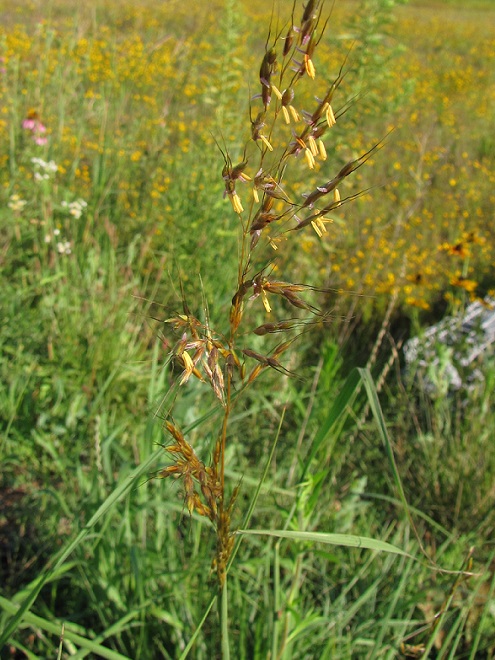
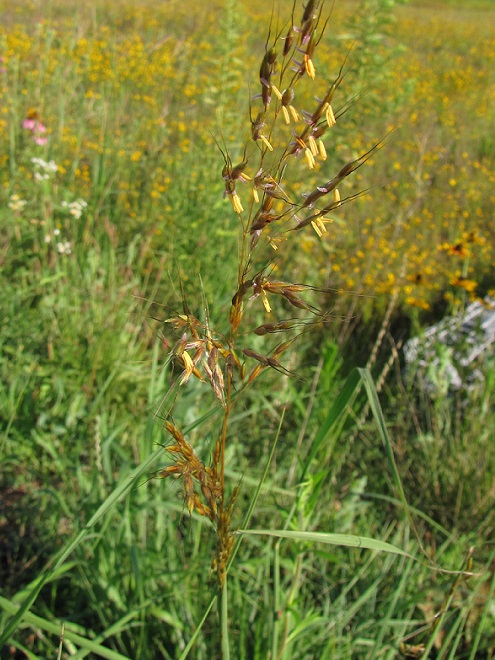
Indiangrass (seen here), Switchgrass, Big Bluestem, and Little Bluestem are native species requiring periodic forms of disturbance to eliminate competition by woody plants. These warm-season grasses develop roots that penetrate deep into the soil, sometimes to depths of six feet or more, allowing them to survive severe drought and flash fire events. In the tall grass prairies, these extensive root systems allow these grasses to return following heavy grazing by roaming herds of American Bison (Bison bison). Without these habitat disturbances, warm season grasslands succumb to succession in about seven years. With their periodic occurrence, the plants thrive and provide excellent wildlife habitat, erosion control, and grazing forage.
To address the habitat ailments caused by a lack of natural fires, federal, state, and local conservation agencies are adopting the practice of “prescribed fire” as a treatment to restore ecosystem health. A prescribed fire is a controlled burn specifically planned to correct one or more vegetative management problems on a given parcel of land. In the Lower Susquehanna River Watershed, prescribed fire is used to…
Eliminate dangerous accumulations of combustible fuels in woodlands.
Reduce accumulations of dead plant material that may harbor disease.
Provide top kill to promote oak regeneration.
Regenerate other targeted species of trees, wildflowers, grasses, and vegetation.
Kill non-native plants and promote growth of native plants.
Prevent succession.
Remove woody growth and thatch from grasslands.
Promote fire tolerant species of plants and animals.
Improve habitat for rare species (Regal Fritillary, etc.)
Recycle nutrients and minerals contained in dead plant material.
Let’s look at some examples of prescribed fire being implemented right here in our own neighborhood…
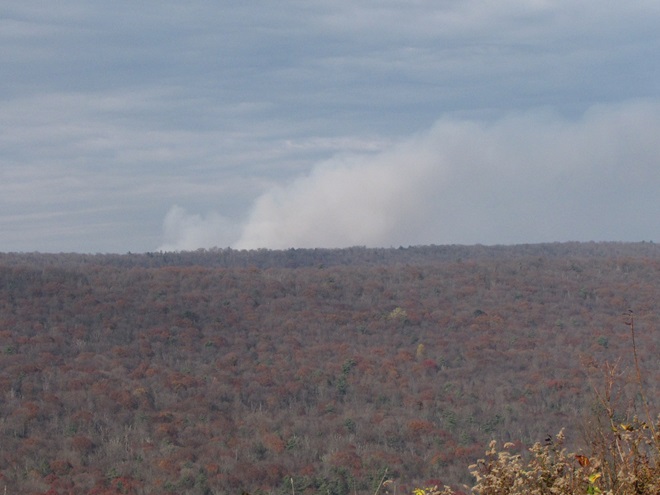
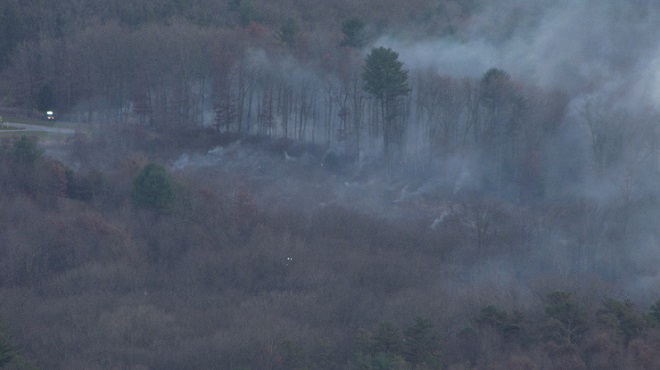
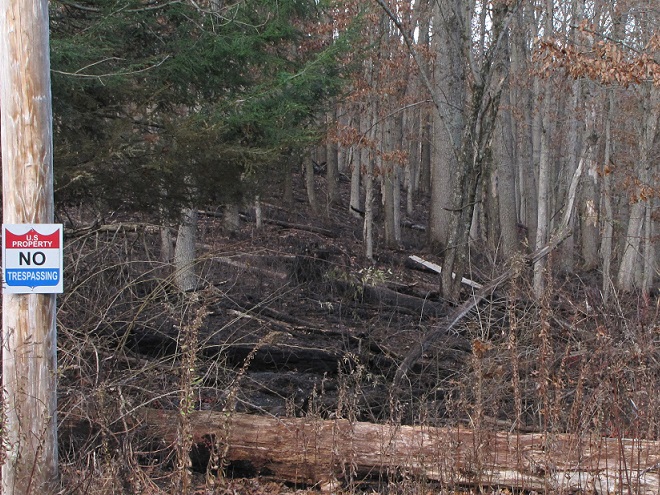
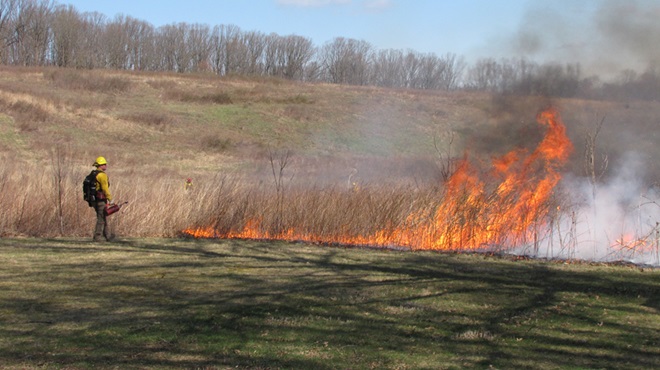
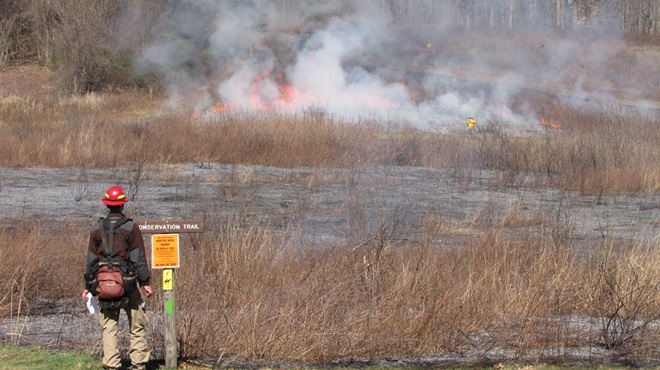
Prescribed fires are typically planned for the dormant season extending from late fall into early spring with burns best conducted on days when the relative humidity is low.Prescribed fire is used regularly at Fort Indiantown Gap Military Reservation in Lebanon County, Pennsylvania, to keep accumulations of woody and herbaceous fuels from accumulating on and around the training range areas where live ordinance and other sources of ignition could otherwise spark large, hard-to-control wildfires.Prescribed fires replace the periodic natural burns that would normally reduce the fuel load in forested areas. Where these fuels are allowed to accumulate, south-facing slopes are particularly susceptible to extreme fires due to their exposure to the drying effects of intense sunlight for much of the year. The majority of small oaks subjected to treatment by the prescribed fire shown here will have the chance to regenerate without immediate competition from other species including invasive plants. The larger trees are mostly unaffected by the quick exposure to the flames. Note too that these fires don’t completely burn everything on the forest floor, they burn that which is most combustible. There are still plenty of fallen logs for salamanders, skinks, and other animals to live beneath and within.
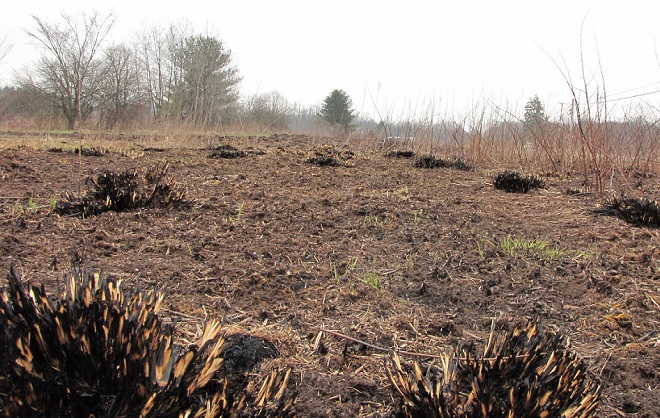
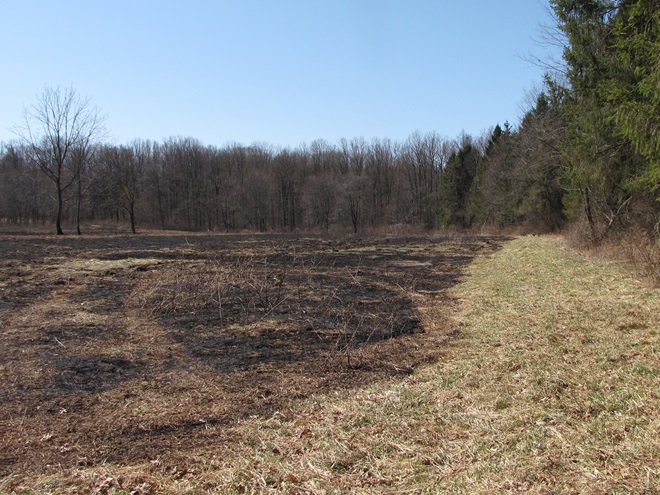
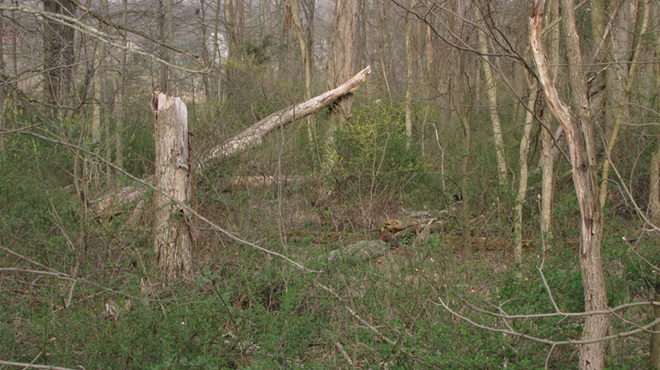
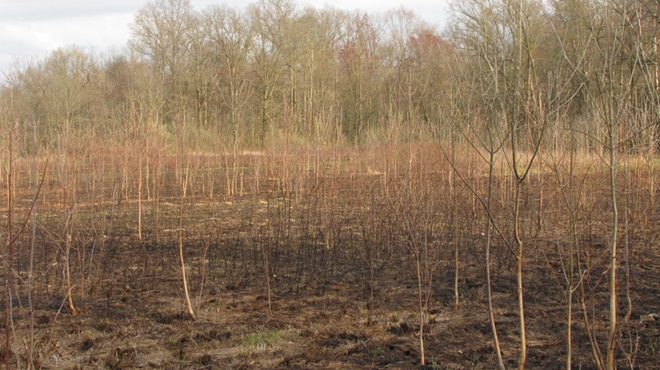
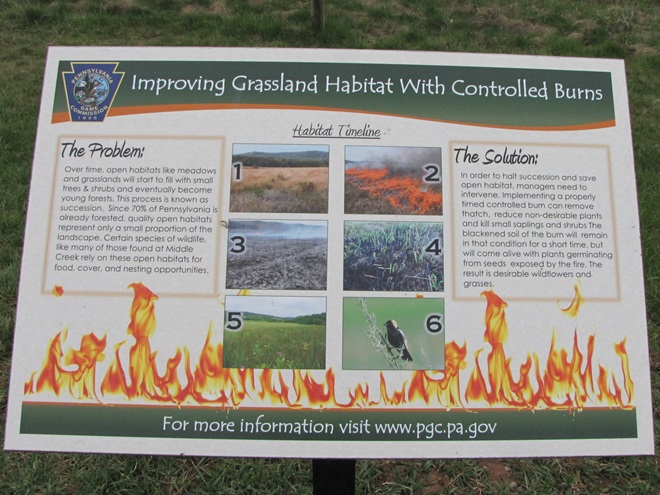
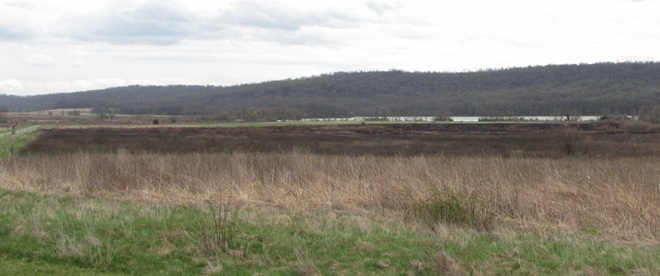
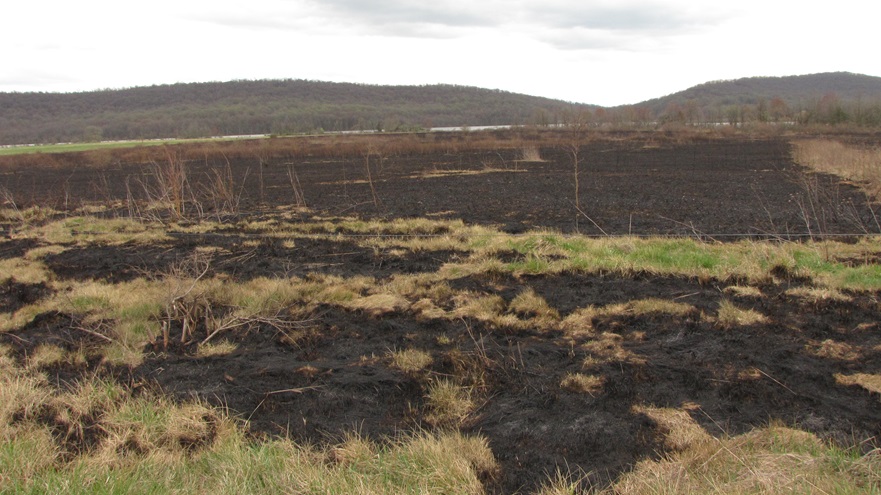
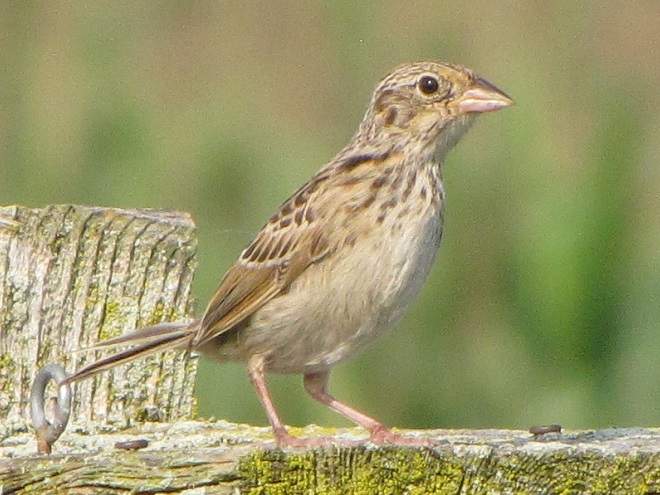
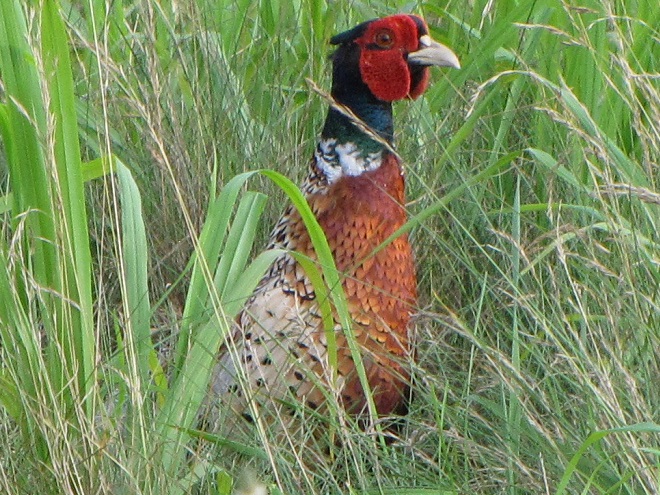
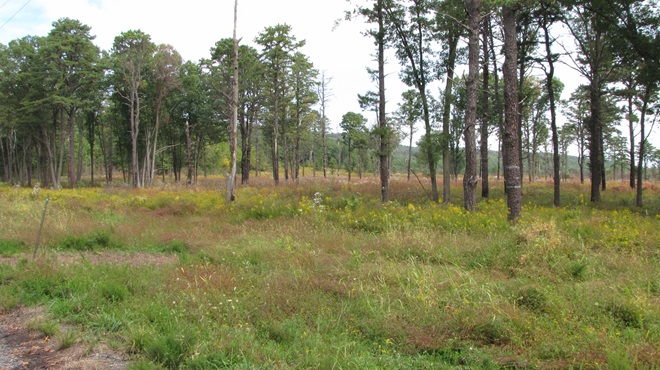
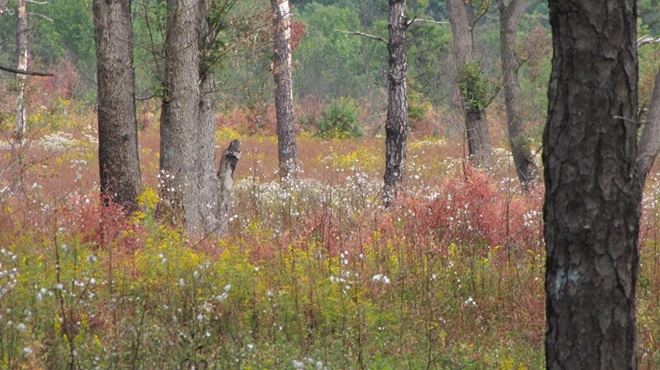
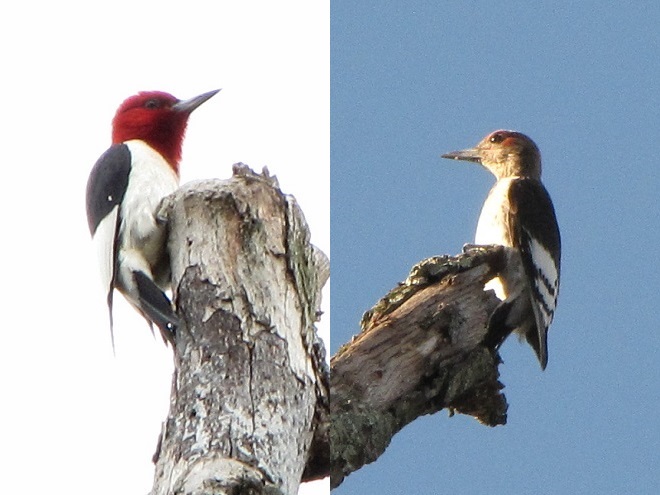
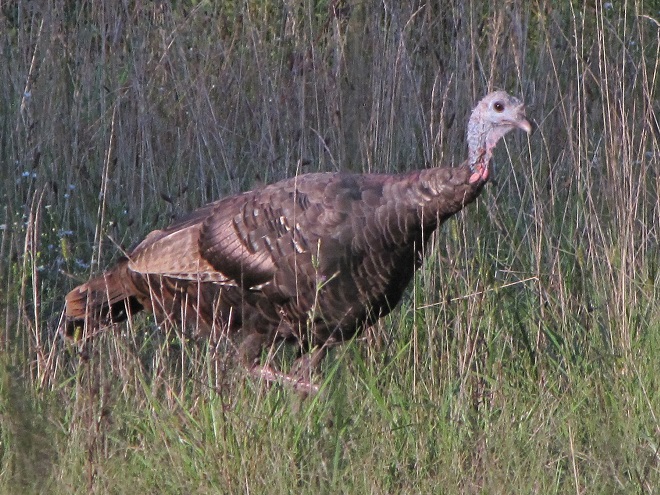
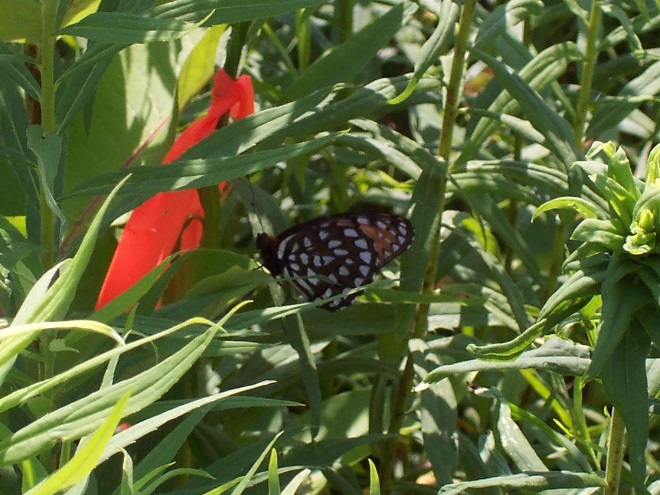
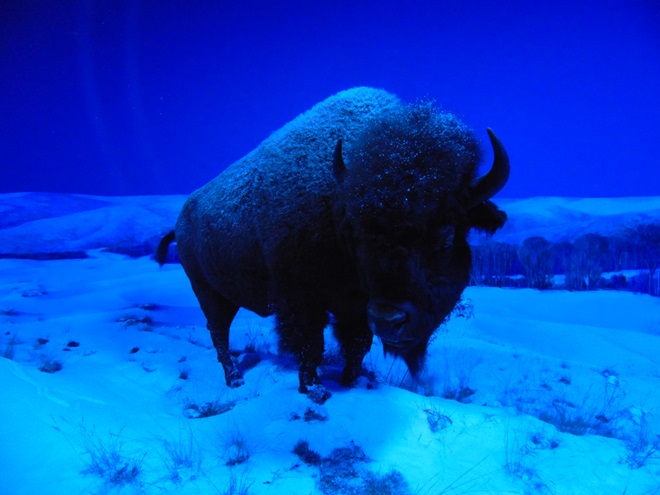
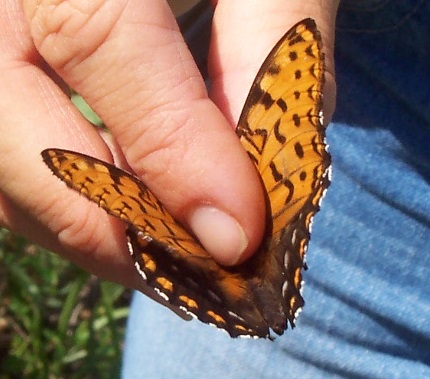
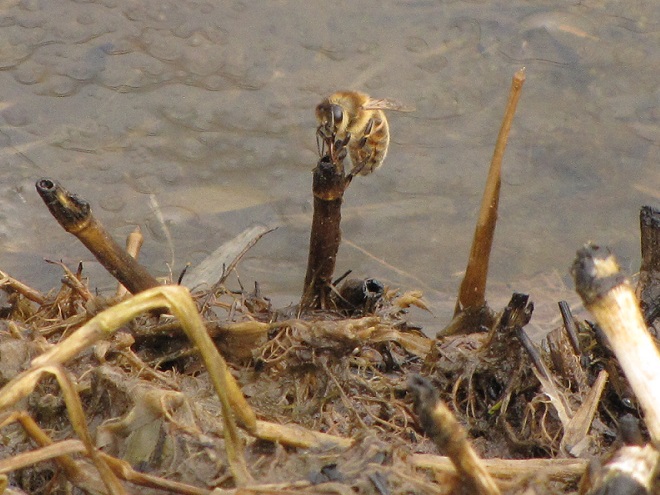
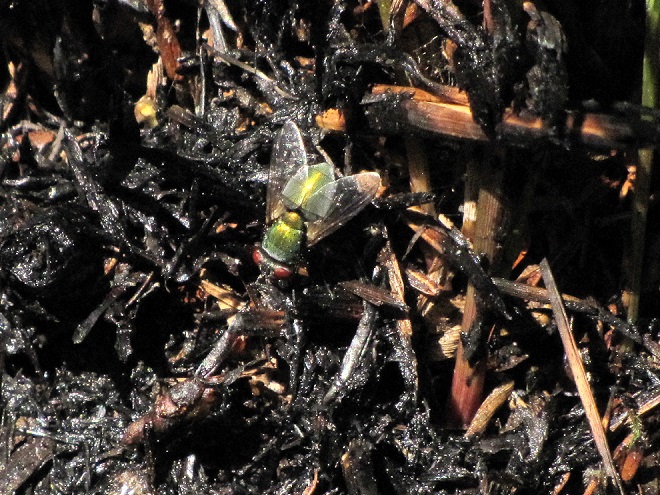
A prescribed fire in late winter prevents this grassland consisting of Big Bluestem and native wildflowers from being overtaken by woody growth and invasive species. Fires such as this that are intended to interrupt the process of succession are repeated at least every three to five years.In its wildlife food plots, prescribed fire is used by the Pennsylvania Game Commission to prevent succession and control invasive species such as Multiflora Rose, instead promoting the growth of native plants.An example of a woodlot understory choked with combustible fuels and dense tangles of invasive Multiflora Rose. A forester has the option of prescribing a dose of dormant-season fire for a site like this to reduce the fuel load, top kill non-native vegetation, and regenerate native plants.A dose of prescribed fire was administered on this grassland to kill the woody growth of small trees beginning to overtake the habitat by succession.The Pennsylvania Game Commission employs prescribed fire at Middle Creek Wildlife Management Area and on many of their other holdings to maintain grasslands.Prescribed fire is used to eliminate invasive species including Multiflora Rose from grasslands at Middle Creek W.M.A. Annual burns on the property are conducted in a mosaic pattern so that each individual area of the grassland is exposed to the effects of fire only once every two to five years. Without fire or some type of mechanical or chemical intervention, succession by woody trees and shrubs would take hold after about seven years.Prescribed fire is planned for a fraction of total grassland acreage at Middle Creek W.M.A. each year. Another section of the mosaic is targeted in the following year and yet another in the year that follows that. Because burns are conducted in the spring, grassland cover is available for wildlife throughout the winter. And because each year’s fire burns only a portion of the total grassland acreage, wildlife still has plenty of standing grass in which to take shelter during and after the prescribed fire.Prescribed fire at Middle Creek W.M.A. provides grassland habitat for dozens of species of birds and mammals including the not-so-common Grasshopper Sparrow……and stocked Ring-necked Pheasants that do nest and raise young there.On a few sites in the Lower Susquehanna River Watershed , prescribed fire is being used to establish and maintain savanna-like grasslands. This one, located on a dry, south-facing slope near numerous man-made sources of ignition, can easily be dosed with periodic prescribed burns to both prevent succession and reduce fuel accumulations that may lead to a devastating extreme fire.One year following a prescribed burn, this is the autumn appearance of a savanna-like habitat with fire-tolerant Pitch Pine (Pinus rigida), Bear Oak, warm-season grasses, and a variety of nectar-producing wildflowers for pollinators. These ecosystems are magnets for wildlife and may prove to be a manageable fit on sun-drenched sites adjacent to man-made land disturbances and their sources of ignition.Savanna-like grasslands with oaks and other scattered large trees, some of them dead, make attractive nesting habitat for the uncommon Red-headed Woodpecker.Prescribed fire can benefit hungry Wild Turkeys by maintaining savanna-like grasslands for an abundance of grasshoppers and other insects in summer and improving the success of mast-producing oaks for winter.In the Lower Susquehanna River Watershed, the caterpillar of the rare Eastern Buck Moth feeds on the foliage of the Bear Oak, also known as the Scrub Oak, a shrubby species that relies upon periodic fire to eliminate competition from larger trees in its early successional habitat.Leaves of the Bear Oak in fall. The Bear Oak regenerates readily from top kill caused by fire.Reed Canary Grass (Phalaris arundinacea) is a native cool-season grass with a colorful inflorescence in spring. But given the right situation, it can aggressively overtake other species to create a pure stand lacking biodiversity. It is one of the few native species which is sometimes labelled “invasive”.Prescribed fire can be used to reduce an overabundance of Reed Canary Grass and its thatch in wetlands. Periodic burning can help restore species diversity in these habitats for plants and animals including rare species such as the endangered Bog Turtle (Glyptemys muhlenbergii).On the range areas at Fort Indiantown Gap in Lebanon County, Pennsylvania, disturbances by armored vehicles mimic the effects of large mammals such as the American Bison which periodically trampled grasses to prevent succession and the establishment of woody plants on its prairie habitat. To supplement the activity of the heavy vehicles and to provide suitable habitat for the very rare Regal Fritillary (Speyeria idalia) butterflies found there, prescribed fire is periodically employed to maintain the grasslands on the range. These burns are planned to encourage the growth of “Fort Indiantown Gap Little Bluestem” grass as well as the violets used as host plants by the Regal Fritillary caterpillars. These fires also promote growth of a variety of native summer-blooming wildflowers to provide nectar for the adults butterflies.A last record of a wild American Bison killed in Pennsylvania was an animal taken in the Susquehanna watershed in Union County in 1801. The species is thereafter considered extirpated from the state. Since that time, natural disturbances needed to regenerate warm-season grasses have been limited primarily to fires and riverine ice scour. The waning occurrence of both has reduced the range of these grasses and their prairie-like ecosystems in the commonwealth. (Exhibit: State Museum of Pennsylvania, Harrisburg)A male Regal Fritillary on the range at Fort Indiantown Gap, where armored vehicles and prescribed fire provide suitable prairie-like habitat for this vulnerable species.Prescribed fires return the nutrients and minerals contained in dead plant material to the soil. Following these controlled burns, insects like this Honey Bee can often be seen collecting minerals from the ashes.A Greenbottle Fly gathering minerals from the ash following a prescribed burn.
In Pennsylvania, state law provides landowners and crews conducting prescribed fire burns with reduced legal liability when the latter meet certain educational, planning, and operational requirements. This law may help encourage more widespread application of prescribed fire in the state’s forests and other ecosystems where essential periodic fire has been absent for so very long. Currently in the Lower Susquehanna River Watershed, prescribed fire is most frequently being employed by state agencies on state lands—in particular, the Department of Conservation and Natural Resources on State Forests and the Pennsylvania Game Commission on State Game Lands. Prescribed fire is also part of the vegetation management plan at Fort Indiantown Gap Military Reservation and on the land holdings of the Hershey Trust. Visitors to the nearby Gettysburg National Military Park will also notice prescribed fire being used to maintain the grassland restorations there.
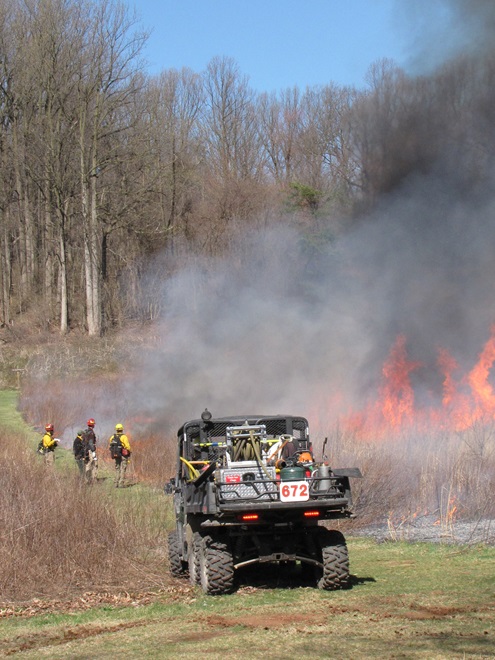
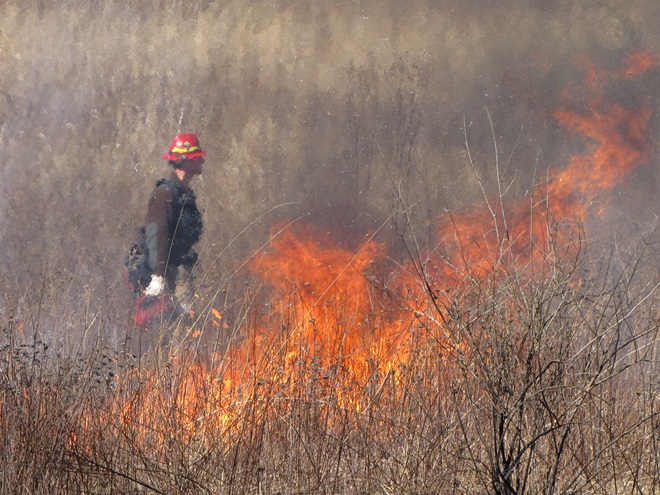
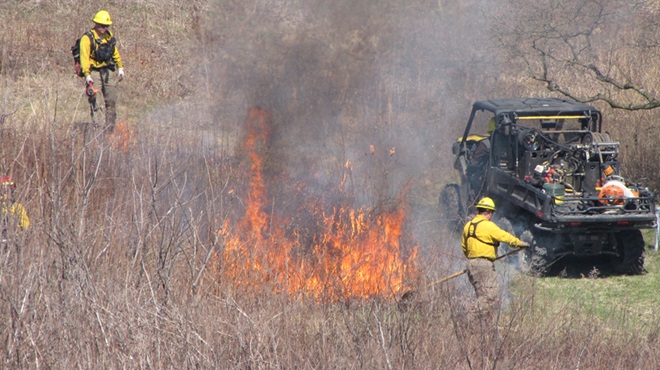
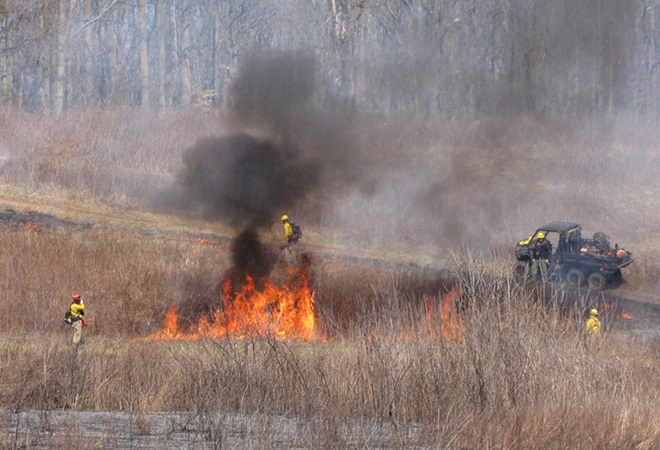
For crews administering prescribed fire burns, late March and early April are a busy time. The relative humidity is often at its lowest level of the year, so the probability of ignition of previous years’ growth is generally at its best. We visited with a crew administering a prescribed fire at Middle Creek Wildlife Management Area last week. Have a look…
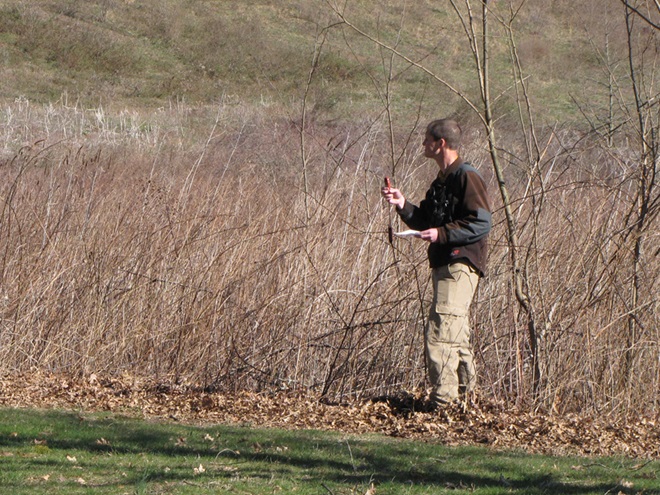
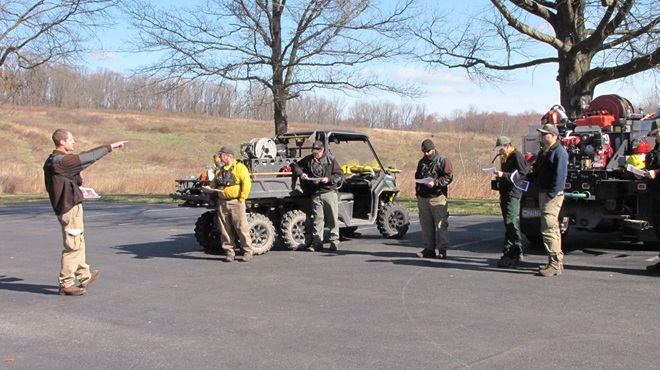
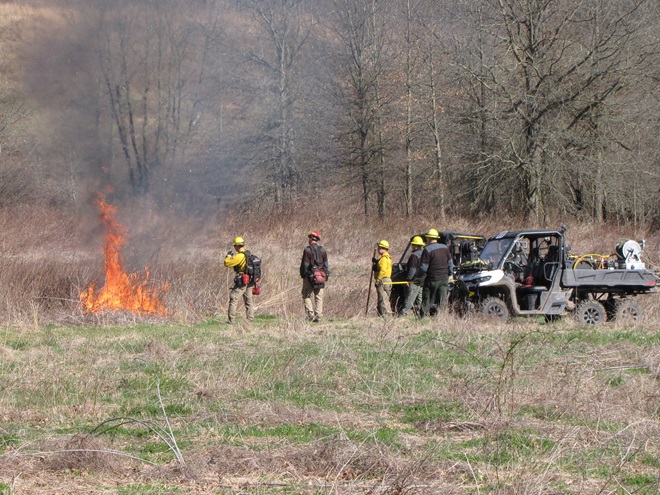
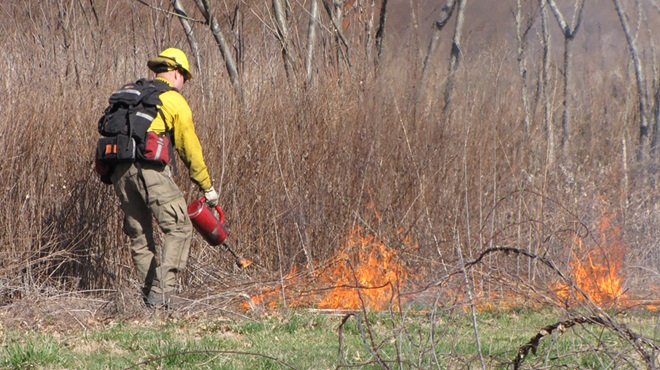
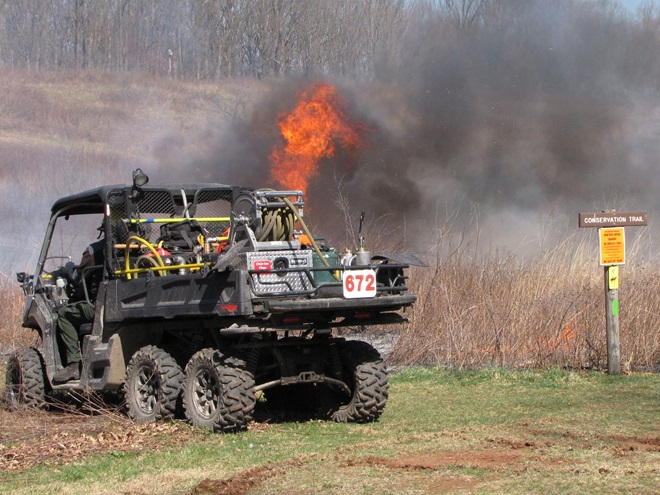
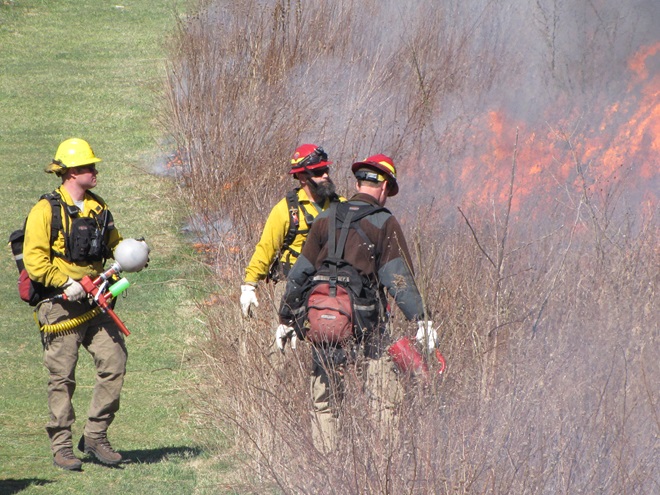
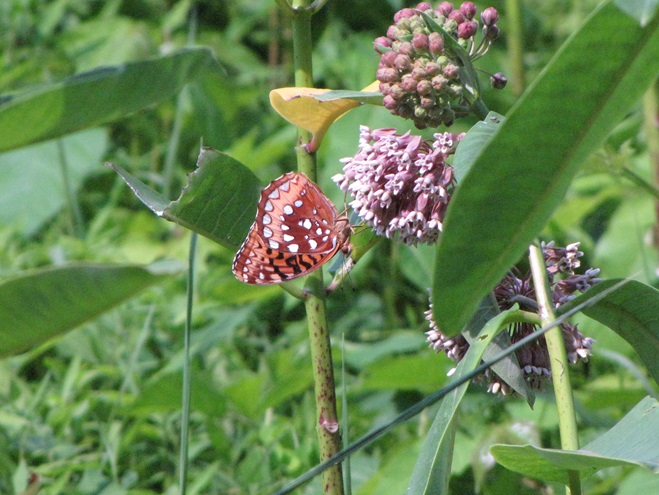
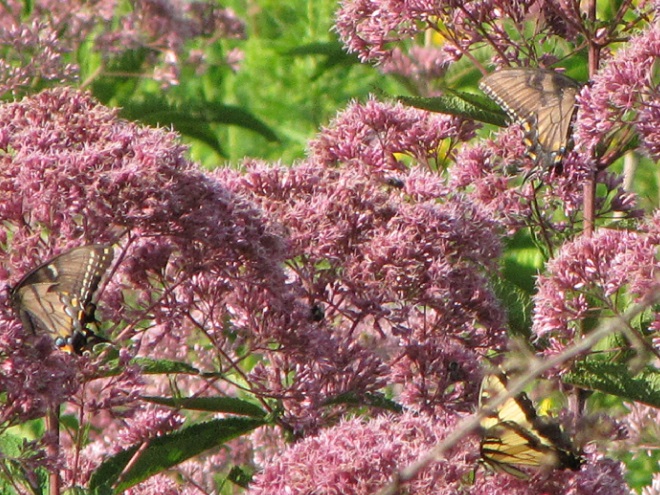
Members of a Pennsylvania Game Commission burn crew provide visitors to Middle Creek Wildlife Management Area with an overview of prescribed fire and the equipment and techniques they use to conduct a burn.Pennsylvania Game Commission Southeast Region Forester Andy Weaver will fulfill the role of Burn Boss for administering this day’s dose of fire. His responsibilities include assessing the weather before the burn and calculating a probability of ignition.The Burn Boss briefs personnel with information on site layout, water supply location(s), places of refuge, emergency procedures, the event’s goals and plan of action, crew assignments, and the results of the weather check: wind from the northwest at 5 miles per hour, temperature 48 degrees, and the relative humidity 63%. Today’s patient is a parcel of warm-season grasses receiving a dose of fire to eliminate invasive non-native plants, woody growth, and thatch. The probability of ignition is 20%, but improving by the minute.To begin the burn, a test fire is started in the downwind corner of the parcel, which also happens to be the bottom of the slope. Fuel ignition is good. The burn can proceed.Crews proceed uphill from the location of the test fire while igniting combustibles along both flanks of the area being treated.A drip torch is used to ignite the dried stems and leaves of warm-season grasses and wildflowers. Each member of the burn crew wears Nomex fire-resistant clothing and carries safety equipment including a two-way radio, a hydration pack, and a cocoon-like emergency fire shelter.An all-terrain vehicle equipped with various tools, a fire pump, hose, and a small water tank accompanies the crew on each flank of the fire.A mowed strip of cool-season grasses along the perimeter of the burn area is already green and functions as an ideal fire break. While the drip torch is perfect for lighting combustibles along the fire’s perimeter, the paintball gun-looking device is an effective tool used to lob incendiaries into the center areas of the burn zone for ignition.With green cool-season grasses already growing on the trails surrounding the burn zone, very little water was used to contain this prescribed fire. Where such convenient fire breaks don’t already exist, crews carry tools including chain saws, shovels, and leaf blowers to create their own. They also carry flame swatters, backpack water pumps, shovels, and other tools to extinguish fires if necessary. None of these items were needed to control this particular fire.This fast-burning fire provides enough heat to damage the cambium layer of the woody tree and shrub saplings in this parcel being maintained as a grassland/wildflower plot, thus the process of succession is forestalled. Burns conducted during previous years on this and adjacent fields have also controlled aggressive growth of invasive Multiflora Rose and Olives (Elaeagnus species).Crews proceed up the slope while maintaining the perimeter by igniting dry plant material along the flanks of the burn zone.Ignition complete, the crews monitor the fire.The Burn Boss surveys the final stages of a safe and successful prescribed fire. The fire has left behind a mosaic of burned and unburned areas, just as a naturally occurring event may have done. Wildlife dodging the flames may be taking refuge in the standing grasses, so there is no remedial attempt to go back and ignite these areas. They’ll be burned during prescribed fires in coming years.By June, this grassland will again be lush and green with warm-season grasses and blooming wildflowers like this Common Milkweed being visited by a Great Spangled Fritillary.And later in the summer, Eastern Tiger Swallowtails on Joe-pye Weed.Indiangrass in flower in mid-summer.Bobolinks glow in the late August sun while taking flight from a stand of warm-season grasses maintained using springtime prescribed fire. The small dots on the dark background at the top of the image are multitudes of flying insects, many of them pollinators. The vegetation is predominately Indiangrass, excellent winter cover for birds, mammals, and other wildlife.
Prescribed burns aren’t a cure-all for what ails a troubled forest or other ecosystem, but they can be an effective remedy for deficiencies caused by a lack of periodic episodes of naturally occurring fire. They are an important option for modern foresters, wildlife managers, and other conservationists.
It’s that time of year. Your local county conservation district is taking orders for their annual tree sale and it’s a deal that can’t be beat. Order now for pickup in April.
The prices are a bargain and the selection includes the varieties you need to improve wildlife habitat and water quality on your property. For species descriptions and more details, visit each tree sale web page (click the sale name highlighted in blue). And don’t forget to order packs of evergreens for planting in mixed clumps and groves to provide winter shelter and summertime nesting sites for our local native birds. They’re only $12.00 for a bundle of 10.
It’s the most desirable block in town, not because the houses are any different from others built during the post-war years of the mid-twentieth century, but because the first owners of these domiciles had the good taste and foresight to plant long-lived trees on their lots, the majority of them native species. Pin Oak, Northern Red Oak, Yellow Poplar, Flowering Dogwood (Cornus florida), Eastern Red Cedar, Eastern White Pine, Eastern Hemlock, Norway Spruce, and American Holly dominate the landscape and create excellent habitat for birds and other wildlife. These 75-year-old plantings provide an abundance of shade in summer and thermal stability in winter, making it a “cool” place to live or take a stroll at any time of the year.
Pickup on: Thursday, April 18, 2024 or Friday, April 19, 2024
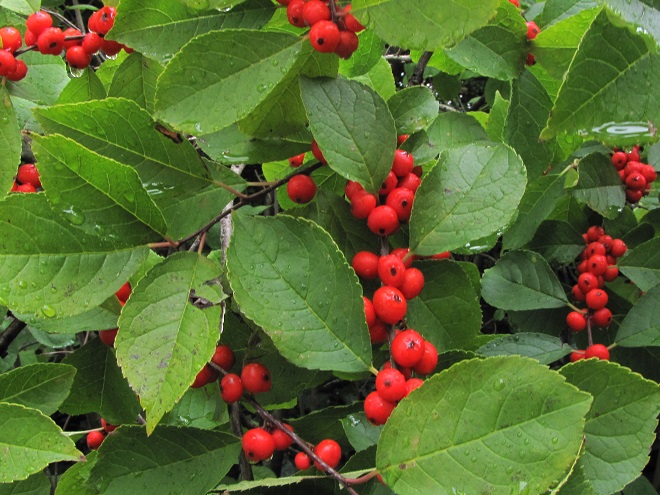
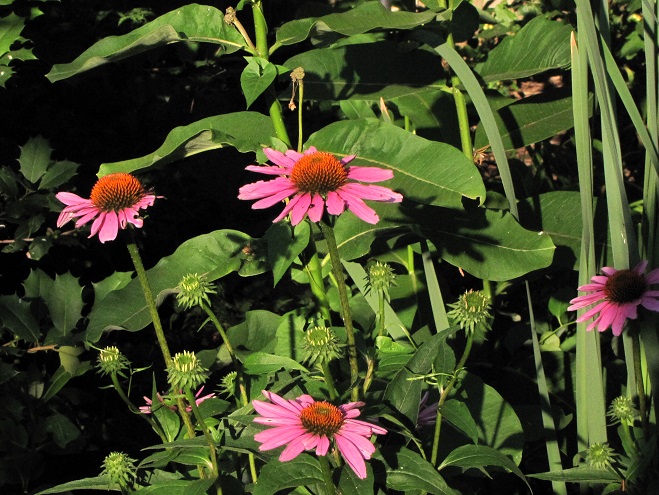
Cumberland County Conservation District is taking orders for Common Winterberry, the ideal small shrub for wet soil anywhere on your property. To get berries, you’ll need both males and females, so buy a bunch and plant them in a clump or scattered group.To live for a century or more like this towering giant, a Pin Oak needs to grow in well-drained soils with adequate moisture. These sturdy shade providers do well along streams and on low ground receiving clean runoff from hillsides, roofs, streets, and parking areas. As they age, Pin Oaks can fail to thrive and may become vulnerable to disease in locations where rainfall is not adequately infiltrated into the soil. Therefore, in drier areas such as raised ground or slopes, avoid the Pin Oak and select the more durable Northern Red Oak for planting. This year, Pin Oaks are available from the Cumberland and Lancaster County Conservation Districts, while Dauphin, Lancaster, Lebanon, and York Counties are taking orders for Northern Red Oaks.The Cumberland County Conservation District is again offering a “Showy Northeast Native Wildflower and Grass Mix” for seeding your own pollinator meadow or garden. It consists of more than twenty species including this perennial favorite, Purple Coneflower.
Pickup on: Thursday, April 18, 2024 or Friday, April 19, 2024
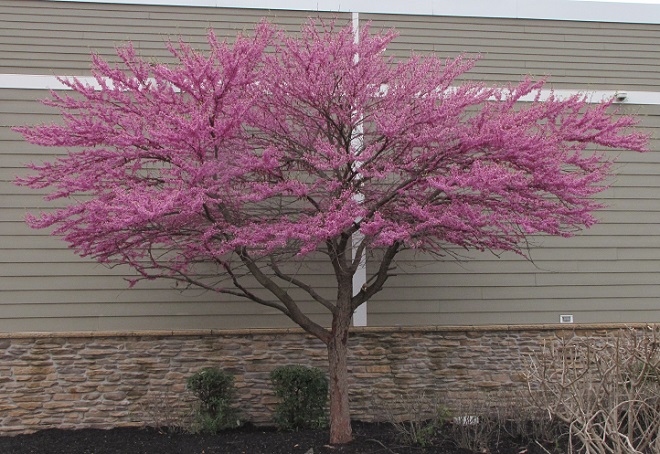
The Eastern Redbud is small tree native to our forest edges, particularly in areas of the Piedmont Province with Triassic geology (Furnace Hills, Conewago Hills, Gettysburg/Hammer Creek Formations, etc.) Also known as the Judas Tree, the redbud’s brilliant flowers are followed by heart-shaped leaves. As seen here, it is suitable for planting near houses and other buildings. Eastern Redbud seedlings are being offered through tree sales in Dauphin, Cumberland, and Lancaster Counties.
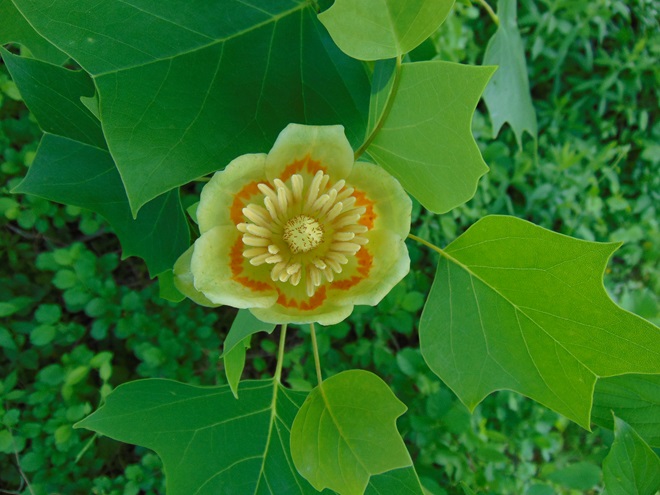
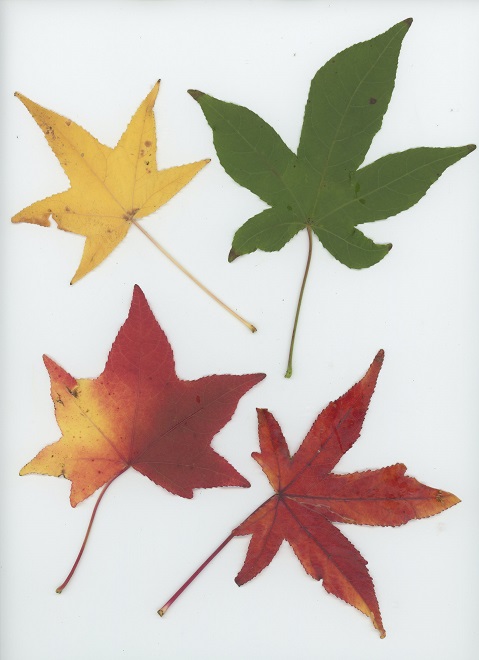
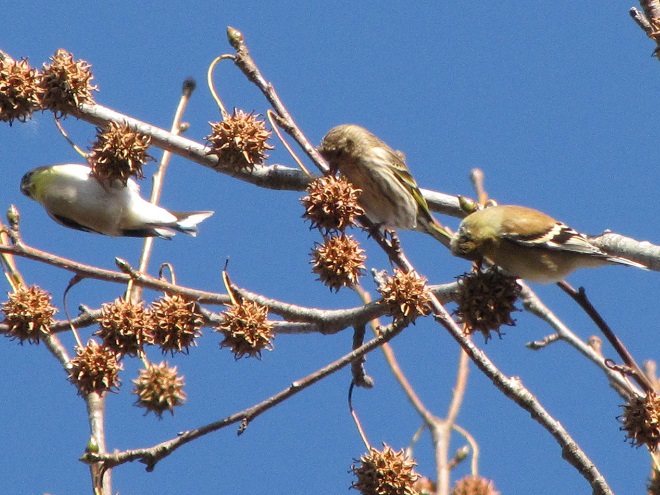
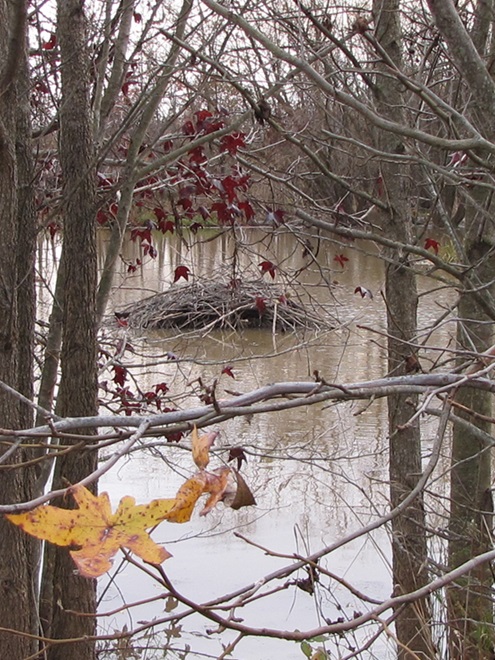
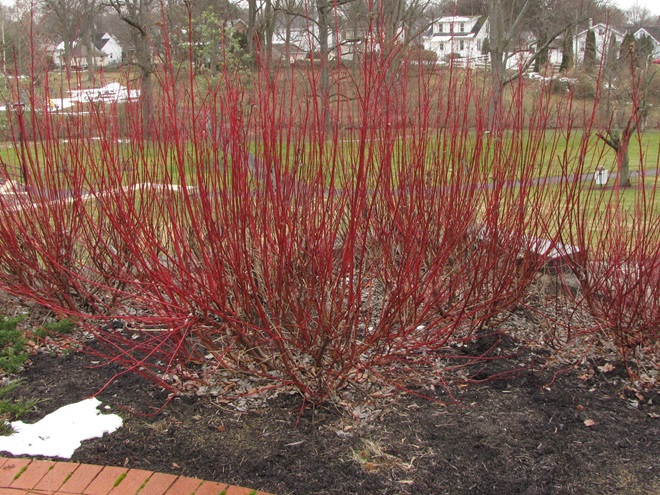
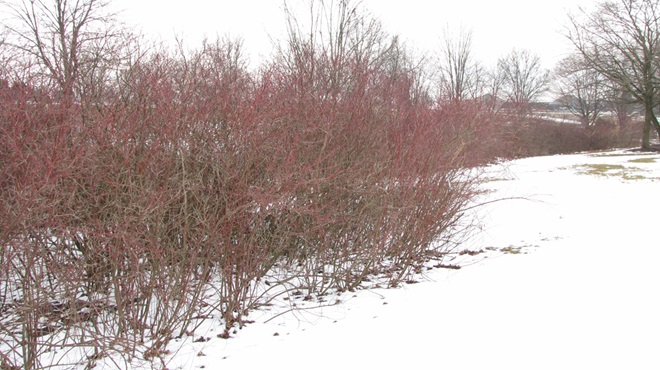
The Yellow Poplar, often called Tuliptree or Tulip Poplar for its showy flowers, is a sturdy, fast-growing deciduous tree native to forests throughout the Lower Susquehanna River Watershed. Its pole-straight growth habit in shady woodlands becomes more spreading and picturesque when the plant is grown as a specimen or shade tree in an urban or suburban setting. The Yellow Poplar can live for hundreds of years and is a host plant for the Eastern Tiger Swallowtail butterfly. It is available this year from the Lancaster County Conservation District.The American Sweetgum, also known as Sweet Gum, is a large, long-lived tree adorned with a mix of vibrant colors in autumn.Ever wonder where all the American Goldfinches and particularly the Pine Siskins go after passing through our region in fall? Well, many are headed to the lowland forests of the Atlantic Coastal Plain where they feed on an abundance of seeds contained in spiky American Sweetgum fruits. In the Piedmont and Ridge and Valley Provinces of the Lower Susquehanna River Watershed, American Sweetgum transplants can provide enough sustenance to sometimes lure our friendly finches into lingering through the winter.The American Sweetgum is a versatile tree. It can be planted on upland sites as well as in wet ground along streams, lakes, and rivers. In the beaver pond seen here it is the dominate tree species. This year, you can buy the American Sweetgum from the Lancaster County Conservation District.“Red-twig Dogwood” is a group of similar native shrubs that, in our region, includes Silky Dogwood and the more northerly Red-Osier Dogwood (Cornus sericea). Both have clusters of white flowers in spring and showy red twigs in winter. They are an excellent choice for wet soils. Landscapers often ruin these plants by shearing them off horizontally a foot or two from the ground each year. To produce flowers and fruit, and to preserve winter attractiveness, trim them during dormancy by removing three-year-old and older canes at ground level, letting younger growth untouched.“Red-twig Dogwoods” make ideal mass plantings for streamside buffers and remain showy through winter, even on a gloomy day. They not only mitigate nutrient and sediment pollution, they provide excellent food and cover for birds and other wildlife. Both Silky and Red-osier Dogwoods are available for sale through the Lancaster County Conservation District as part of their special multi-species offers, the former is included in its “Beauty Pack” and the latter in its “Wildlife Pack”. The similar Gray Dogwood (Cornus racemosa) is being offered for sale by the York County Conservation District.
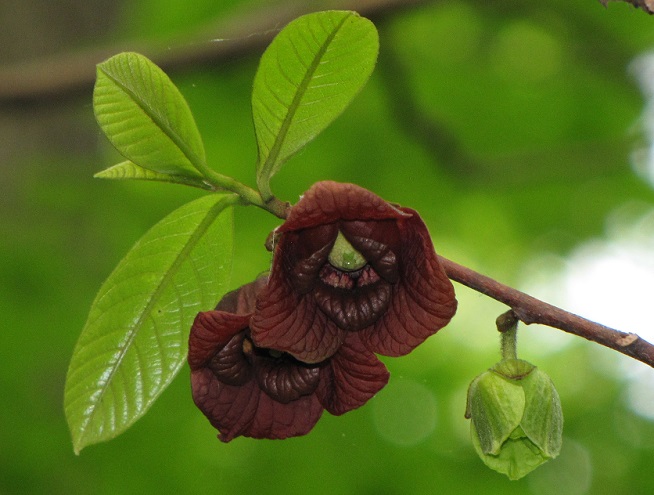
The unique maroon flowers of the Common Pawpaw produce banana-like fruits in summer. These small native trees grow best in damp, well-drained soils on slopes along waterways, where they often form clonal understory patches. To get fruit, plant a small grove to increase the probability of pollination. The Common Pawpaw is a host plant for the Zebra Swallowtail butterfly. It is available through both the Lebanon and Lancaster County sales.The Eastern Red Cedar provides excellent food, cover, and nesting sites for numerous songbirds. Planted in clumps of dozens or groves of hundreds of trees, they can provide winter shelter for larger animals including deer and owls. The Eastern Red Cedar is being offered for purchase through both the Lebanon and Lancaster County Conservation Districts.Care to try your hand at raising some chestnuts? Lebanon County Conservation District has hybrid American Chestnut seedlings for sale.Lebanon County Conservation District is offering Common Winterberry and Eastern White Pine during their 2024 Tree and Plant Sale. Plant them both for striking color during the colder months. Eastern White Pine is also available from the Cumberland, Dauphin, Lancaster, and York County sales.
In addition to a selection of trees and shrubs, the Perry County Conservation District is again selling wildflower seed mixes for starting your own pollinator meadow or garden. For 2024, they have both a “Northeast Perennials and Annuals Mix” and a “Butterfly and Hummingbird Seed Mix” available. Give them a try so you can give up the mower!
Again this year, Perry County is offering bluebird nest boxes for sale. The price?—just $12.00.
Wait, what?,…twelve bucks,…that’s cheaper than renting!
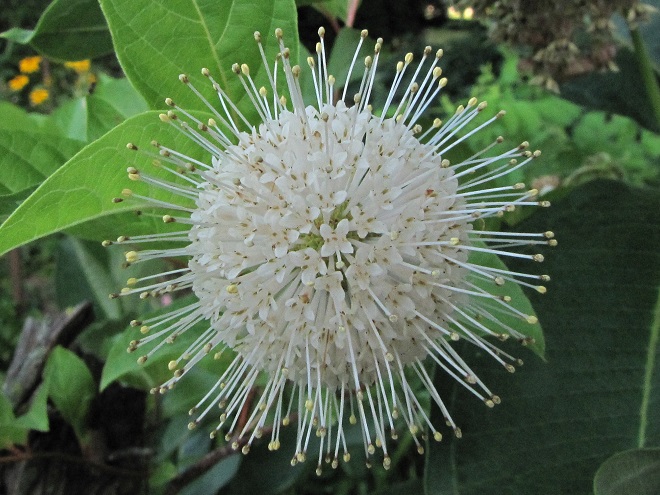
The Buttonbush, a shrub of wet soils, produces a cosmic-looking flower. It grows well in wetlands, along streams, and in rain gardens. Buttonbush seedlings are for sale from both the York and Lancaster County Conservation Districts.
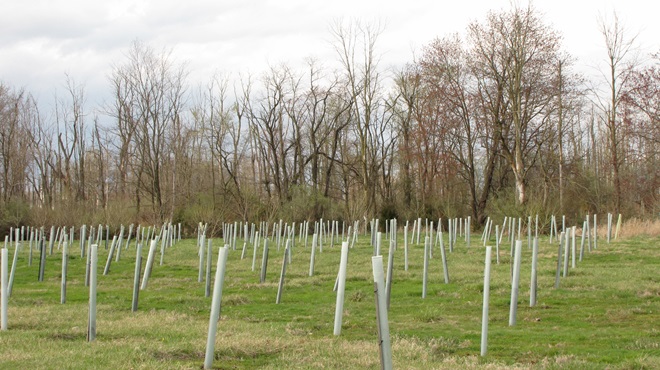
To get your deciduous trees like gums, maples, oaks, birches, and poplars off to a safe start, conservation district tree sales in Cumberland, Dauphin, Lancaster, and Perry Counties are offering protective tree shelters. Consider purchasing these plastic tubes and supporting stakes for each of your hardwoods, especially if you have hungry deer in your neighborhood.
Tree shelters protect newly transplanted seedlings from browsing deer, klutzy hikers, visually impaired mower operators, and other hazards.
There you have it. Be sure to check out each tree sale’s web page to find the selections you like, then get your order placed. The deadlines will be here before you know it and you wouldn’t want to miss values like these!
Since Tuesday’s snow storm, the susquehannawiildlife.net headquarters garden continues to bustle with bird activity.
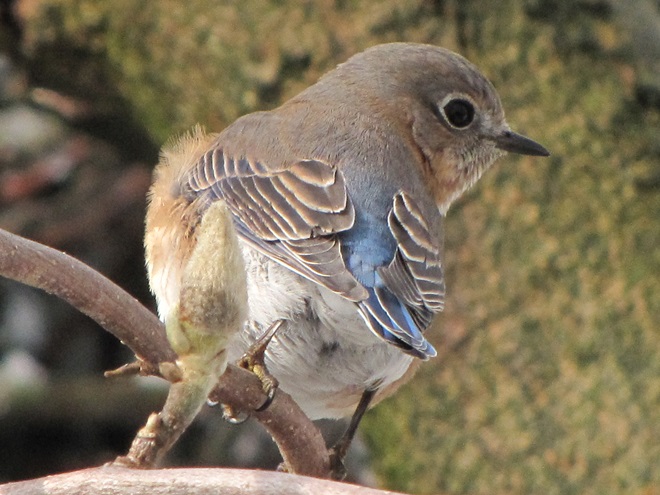
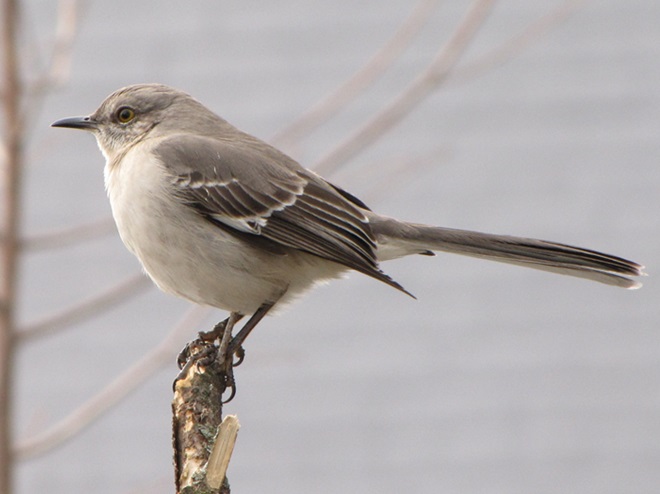
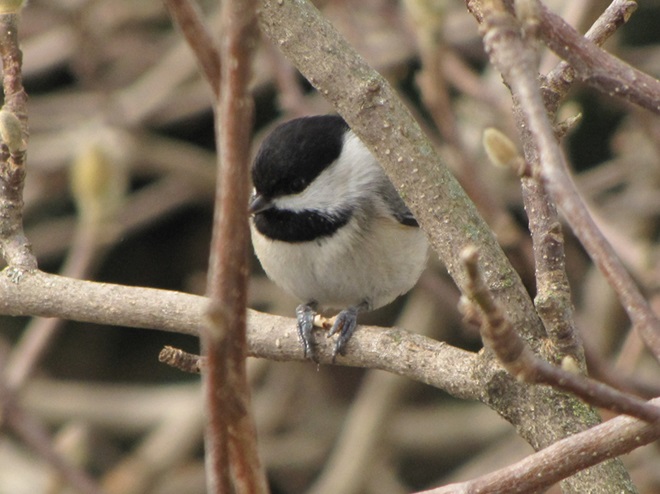
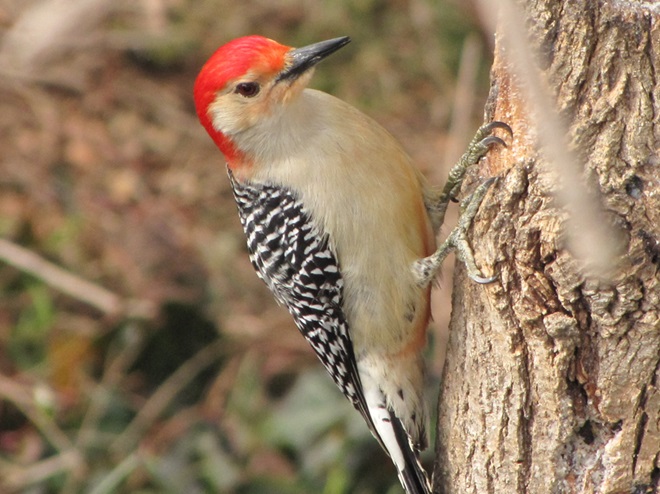
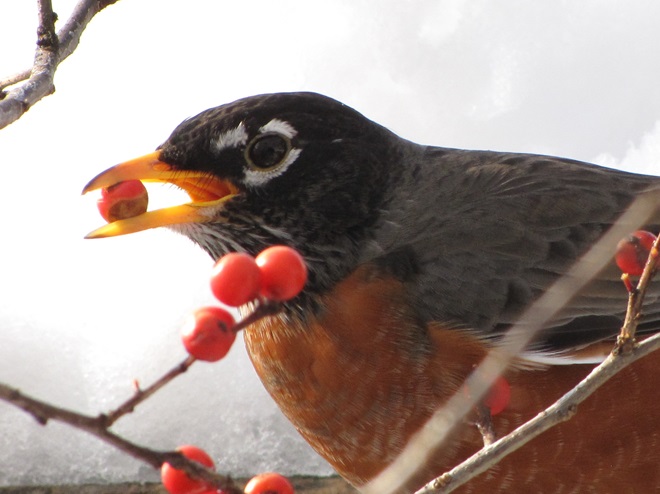
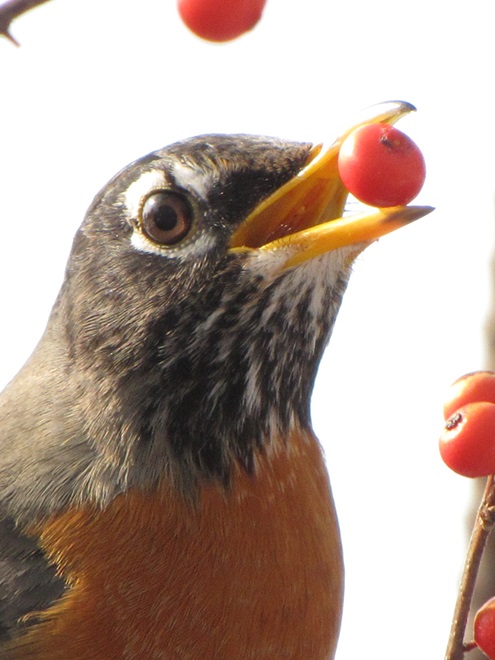
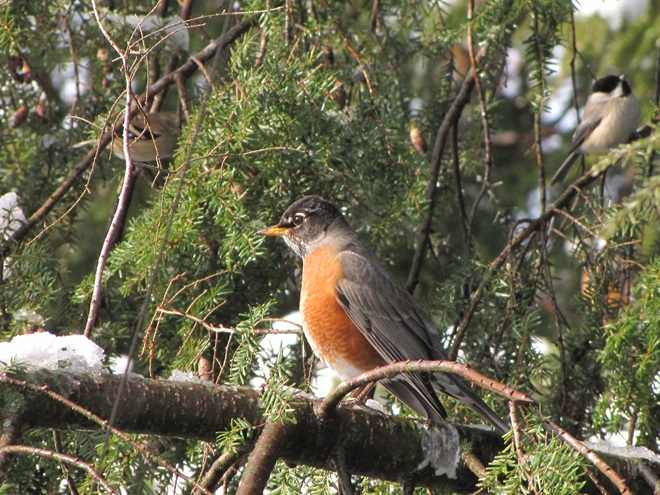
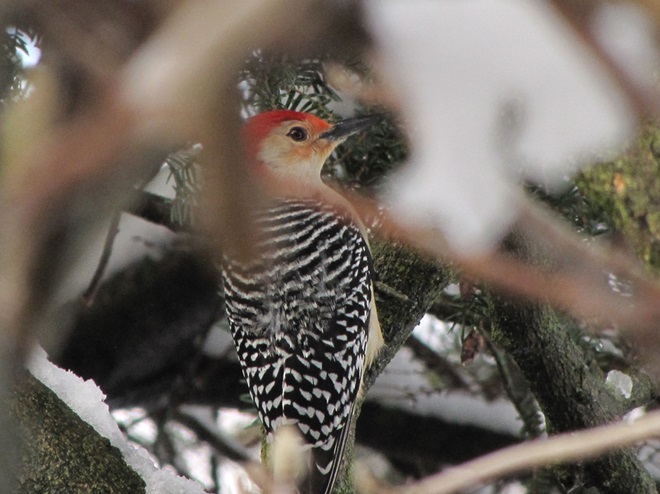
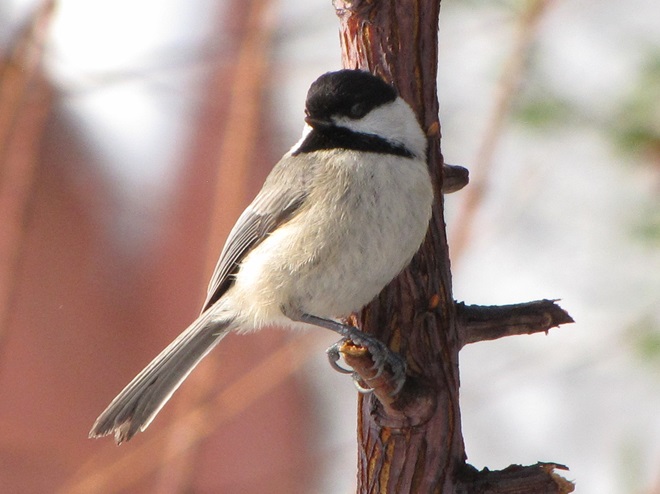
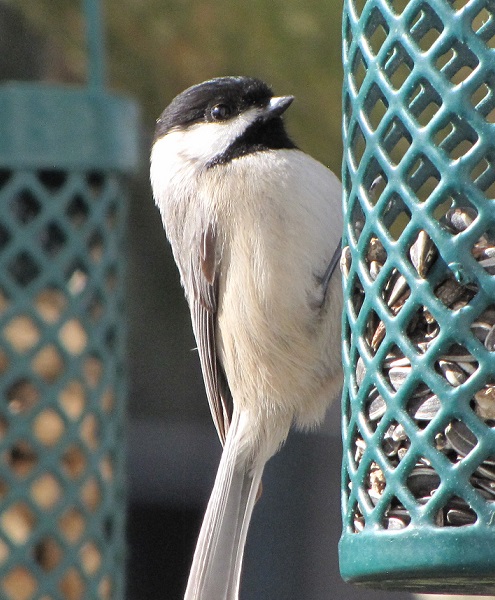
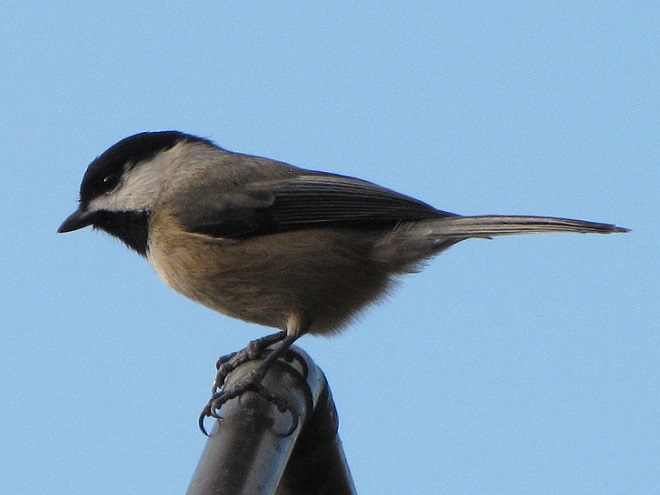
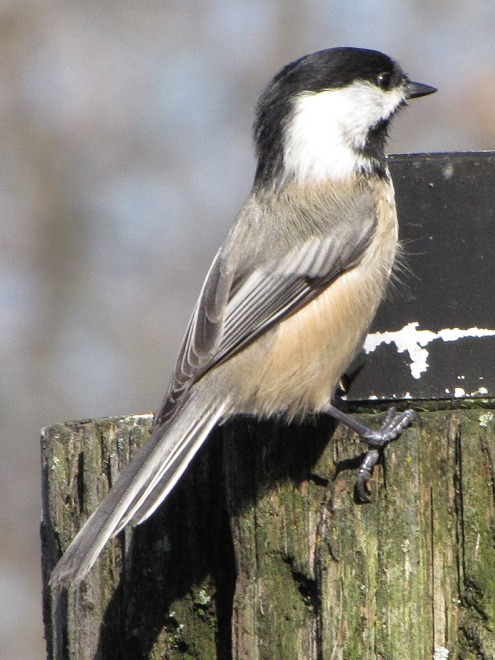
Our Northern Mockingbird remains ever vigilant in its attempts to discourage American Robins and Eastern Bluebirds from feeding on the berry crop. Slowly, the latter species are winning the contest.A Carolina Chickadee carefully dissects a sunflower seed to snack on the nutritious kernel.This beauty shows us that yes, Red-bellied Woodpeckers do indeed have red bellies.Getting energized for a big move north, the robins keep on gulping berries.
Today, there arrived three species of birds we haven’t seen here since autumn. These birds are, at the very least, beginning to wander in search of food. Then too, these may be individuals creeping slowly north to secure an advantage over later migrants by being the first to establish territories on the most favorable nesting grounds.
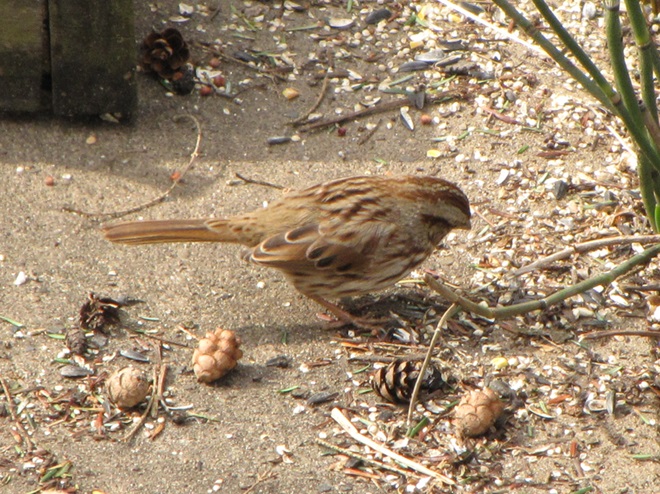
This Song Sparrow is the first we’ve seen in the garden since sometime last fall. Is it working its way north or did it just come to town in search of food?Northern Flickers regularly spend the winter in small numbers in the Lower Susquehanna River Watershed. This is the first one we’ve had visit the garden since late last autumn.Fish Crows, seen here feeding on the fruits adorning an Eastern Red Cedar, have returned after being absent in our neighborhood since November. In coming weeks, both they and the more numerous American Crows that remained through winter will begin constructing nests in nearby trees.
They say the early bird gets the worm. More importantly, it gets the most favorable nesting spot. What does the early birder get? He or she gets out of the house and enjoys the action as winter dissolves into the miracle of spring. Do make time to go afield and marvel a bit, won’t you? See you there!
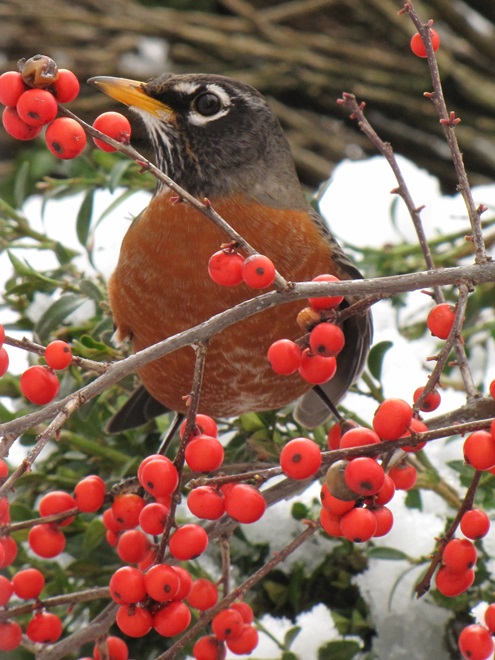
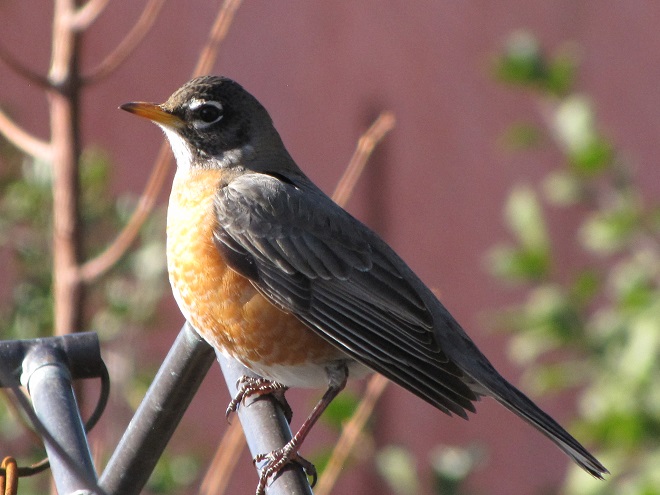
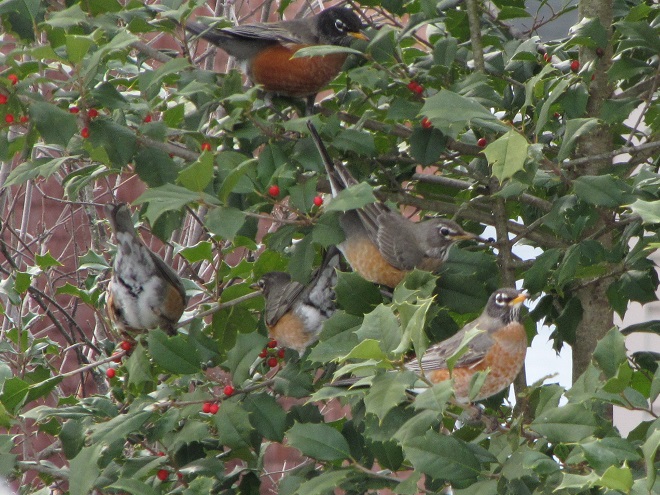
In mid-February each year, large numbers of American Robins descend upon the susquehannawildlife.net headquarters garden to feast on the ripe fruits that adorn several species of our native shrubs and trees. This morning’s wet snowfall provided the needed motivation for these birds and others to make today the big day for the annual feeding frenzy.
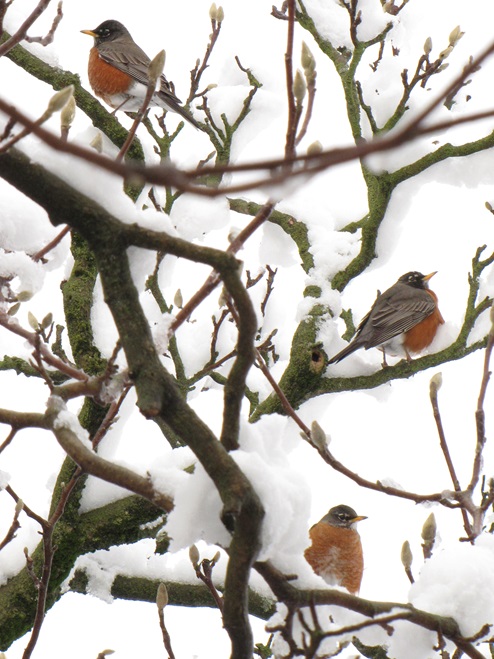
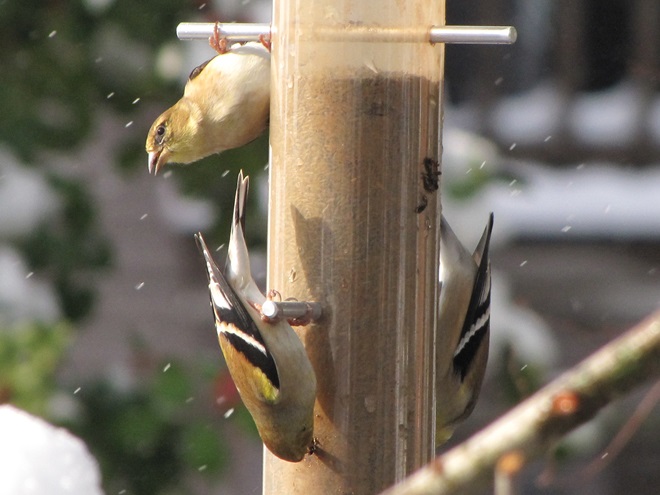
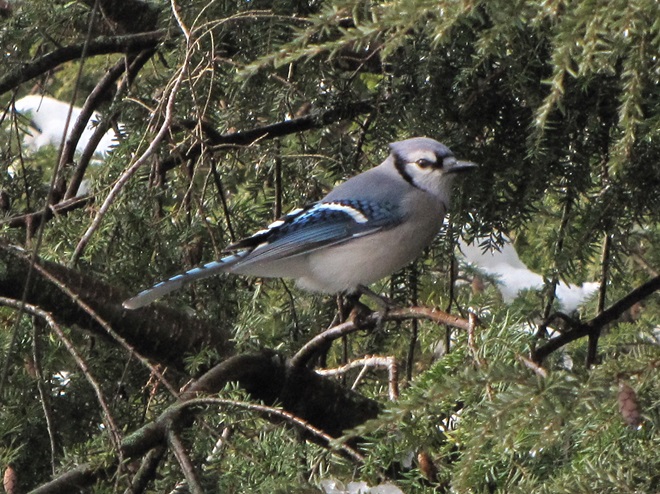
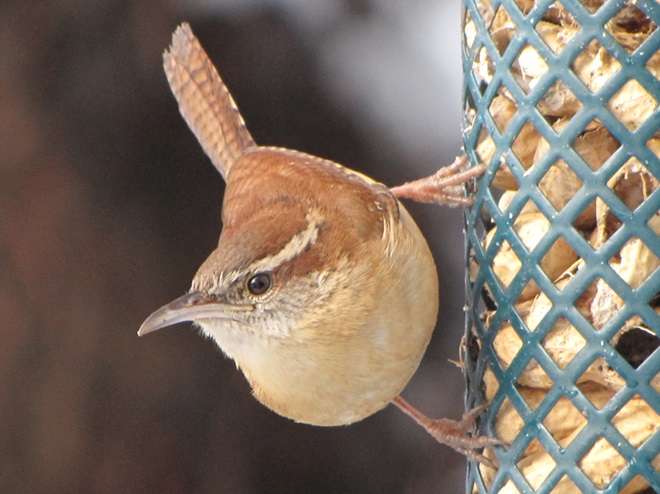
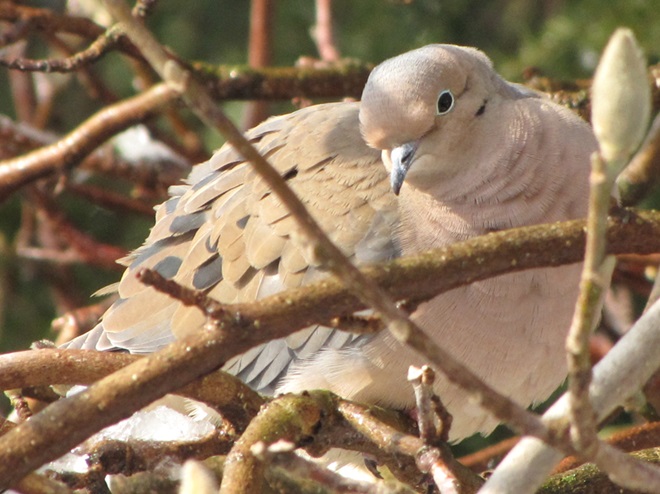
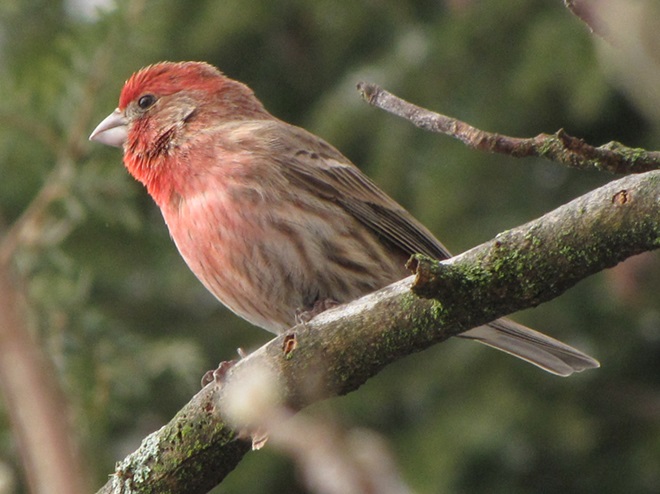
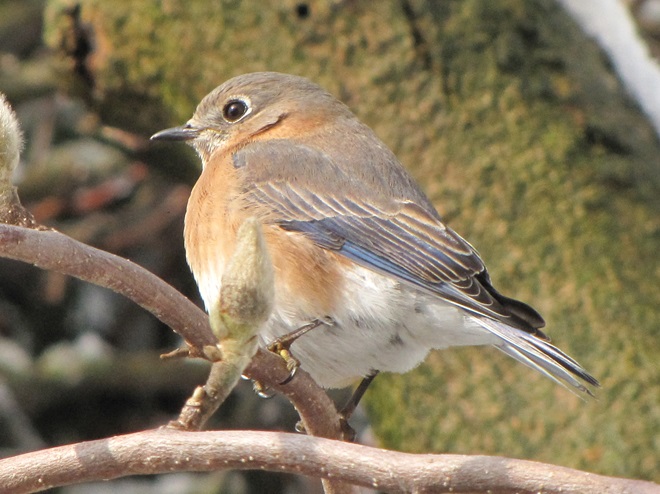
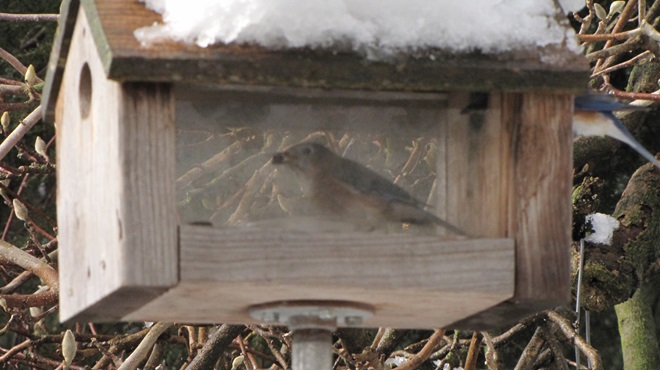
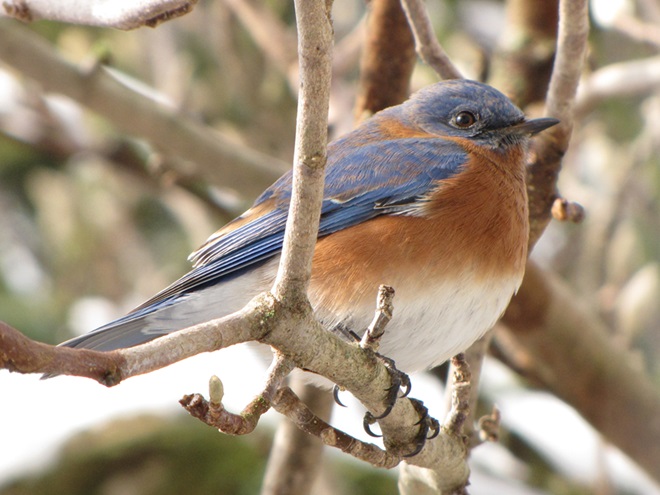
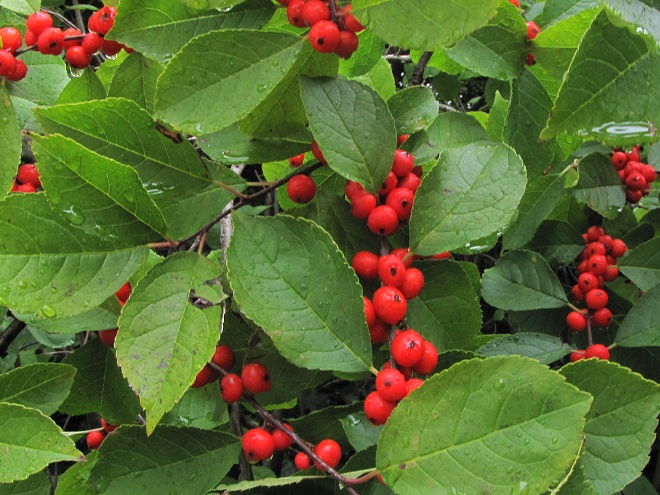
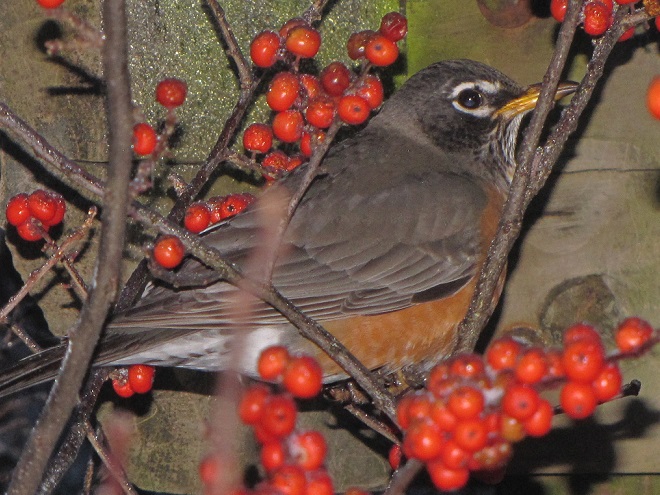
Early this morning, branches and limbs in the headquarters garden were loaded with clinging snow and more than one hundred American Robins.To have first grabs at suitable nesting sites, early American Robins are currently beginning to edge their way north. Spring migration is underway.The fruits of Common Winterberry are always a favorite of visiting robins.After selfishly guarding the garden’s berries through the entire season, our Northern Mockingbird finds chasing more than one hundred robins away from its food supply an impossible task.This and other visiting robins will strip the winterberry, cedar, American Holly, and other fruit-producing shrubs and trees within a day or two. To survive what remains of the season, our resident mockingbird will have to look elsewhere for provisions.Another American Robin devouring winterberry fruit.In addition to robins, there were, of course, other guests in the garden refuge on this snowy day.This Red-bellied Woodpecker tries to make sense of all the commotion.A pair of Carolina Chickadees established a family in the garden during the spring of 2023. At least five of the birds still stop by on a daily basis.As spring nears, our American Goldfinches are beginning to show a hint of their bright breeding colors.A Blue Jay peeks out from the cover of the Eastern Hemlocks.Our Carolina Wrens sing throughout the winter,……but today we noticed that this Mourning Dove has begun softly cooing to charm a mate……and the male House Finches are warbling away with the sounds of spring.With the local mockingbird busily harassing robins, our Eastern Bluebirds went unmolested long enough to stop by……for some raisins from their enclosed feeder.A showy male Eastern Bluebird on a snowy day in the garden. Spring must be just around the corner!
Where should you go this weekend to see vibrantly colored foliage in our region? Where are there eye-popping displays of reds, oranges, yellows, and greens without so much brown and gray? The answer is Michaux State Forest on South Mountain in Adams, Cumberland, and Franklin Counties.
South Mountain is the northern extension of the Blue Ridge Section of the Ridge and Valley Province in Pennsylvania. Michaux State Forest includes much of the wooded land on South Mountain. Within or adjacent to its borders are located four state parks: King’s Gap Environmental Education Center, Pine Grove Furnace State Park, Caledonia State Park, and Mont Alto State Park. The vast network of trails on these state lands includes the Appalachian Trail, which remains in the mountainous Blue Ridge Section all the way to its southern terminus in Georgia.
In Pennsylvania, the forested highlands of the Blue Ridge Section of the Ridge and Valley Province are known as South Mountain. Much of South Mountain lies within the boundaries of Michaux State Forest. Stars indicate the locations of 1) King’s Gap Environmental Education Center, 2) Pine Grove Furnace State Park, 3) Caledonia State Park, and 4) Mont Alto State Park. A drive on US 30 between Gettysburg and Chambersburg will take you right through Michaux State Forest along an east to west axis while a scenic northbound or southbound trip along PA 233 will bring you in proximity to each of the state parks located therein. (Base image from NASA Earth Observatory Collection)
If you want a closeup look at the many species of trees found in Michaux State Forest, and you want them to be labeled so you know what they are, a stop at the Pennsylvania State University’s Mont Alto arboretum is a must. Located next door to Mont Alto State Park along PA 233, the Arboretum at Penn State Mont Alto covers the entire campus. Planting began on Arbor Day in 1905 shortly after establishment of the Pennsylvania State Forest Academy at the site in 1903. Back then, the state’s “forests” were in the process of regeneration after nineteenth-century clear cutting. These harvests balded the landscape and left behind the combustible waste which fueled the frequent wildfires that plagued reforestation efforts for more than half a century. The academy educated future foresters on the skills needed to regrow and manage the state’s woodlands.
Online resources can help you plan your visit to the Arboretum at Penn State Mont Alto. More than 800 trees on the campus are numbered with small blue tags. The “List of arboretum trees by Tag Number” can be downloaded to tell you the species or variety of each. The interactive map provides the locations of individual trees plotted by tag number while the Grove Map displays the locations of groups of trees on the campus categorized by region of origin. A Founder’s Tree Map will help you find some of the oldest specimens in the collection and a Commemorative Tree Map will help you find dedicated trees. There is also a species list of the common and scientific tree names.
The Yellow Buckeye (Aesculus flava) is a tree found in the forests of the Blue Ridge Section of the Ridge and Valley Province in West Virginia, Virginia, North Carolina and Georgia. You can see it in Pennsylvania by visiting the collection of trees in the Arboretum at Penn State Mont Alto.The American Chestnut can be difficult to find due to the impact of chestnut blight, but you can see it in the Arboretum at Penn State Mont Alto.Shagbark Hickory is a common tree in the forests of South Mountain.The Sweet Cherry (Prunus avium), a native of Europe, is naturalized throughout eastern and south-central Pennsylvania and is one of the more than 150 species of trees in the arboretum’s collection.Sweet Birch (Betula lenta) foliage is particularly bright yellow on South Mountain this autumn. It really “pops” against the backdrop of the evergreen Eastern White Pines and Eastern Hemlocks. During less-than-ideal years, Sweet Birch leaves can subtly transition from green to drab brown without much fanfare before falling.You might have a difficult time finding a Common Persimmon (Diospyros virginiana) growing wild in Pennsylvania, but you can find it in the Arboretum at Penn State Mont Alto.
The autumn leaves will be falling fast, so make it a point this weekend to check out the show on South Mountain.
With nearly all of the Neotropical migrants including Broad-winged Hawks gone for the year, observers and counters at eastern hawk watches are busy tallying numbers of the more hardy species of diurnal raptors and other birds. The majority of species now coming through will spend the winter months in temperate and sub-tropical areas of the southern United States and Mexico.
Here is a quick look at the raptors seen this week at two regional counting stations: Kiptopeke Hawk Watch near Cape Charles, Virginia, and Second Mountain Hawk Watch at Fort Indiantown Gap, Pennsylvania.
The hawk-watching platform at Kiptopeke State Park is located along Chesapeake Bay near the southern tip of Delmarva Peninsula. In autumn, thousands of raptors and other birds migrate through the Atlantic Coastal Plain Province. Those that follow the shorelines south frequently concentrate in spectacular numbers before crossing the mouths of the bays they encounter. This phenomenon makes both Cape May, New Jersey, on Delaware Bay and Kiptopeke, Virginia, on Chesapeake Bay exceptional places to experience fall flights of migrating birds.A Sharp-shinned Hawk is counted as it swoops by the owl decoy at Second Mountain Hawk Watch at Fort Indiantown Gap Military Reservation. Migrating raptors save energy by riding updrafts of air created by winds blowing against the slopes of the mountainsides in the Ridge and Valley Province.A Sharp-shinned Hawk passes the lookout at Second Mountain Hawk Watch. “Sharp-shins” are currently the most numerous migrants both on the coast and at inland counting stations.A Sharp-shinned Hawk nearly passes observers unnoticed as it skims the treetops.A Sharp-shinned Hawk eyes up an owl decoy. Under cover of darkness, nocturnal owls could rather easily prey upon young and small adult hawks and falcons, both on the nest or at roost. Accordingly, many diurnal raptors instinctively harass owls to drive them from their presence. An owl decoy at the lookout helps attract migrating birds for a closer look.An adult Cooper’s Hawk flaps its way past a counting station. Like the similar Sharp-shinned Hawk, the larger Cooper’s Hawk is a member of the genus Accipiter. As a proportion of the annual fall Accipiter flight, the Cooper’s Hawk is more numerous at coastal hawk watches than at inland sites. (Editor’s Update: As of autumn, 2024, the Cooper’s Hawk and the American Goshawk have been placed in the genus Astur. The Sharp-shinned Hawk remains in the genus Accipiter. Though the Cooper’s Hawk and Sharp-shinned Hawk are oft times confused by observers due to their like appearance, it turns out that the two are not as closely related as originally believed. Neither is an offshoot of the other, nor do they descend from an immediate common ancestor. Their resemblance may instead be a case of convergent evolution, most readily characterized by acquisition of similar physical traits due to shared demands for survival within their environment.)The majority of Osprey migrate along the coast, but a few are still being seen at inland hawk watches.Bald Eagles are commonly seen at both coastal and inland lookouts. Their movements continue well into late fall.A Northern Harrier illuminated by a setting sun. Northern Harriers are often still flying when many other species have gone to roost for the day.An adult male Northern Harrier, the “gray ghost”, flying in misty weather, at a time when few other birds were in the air.The American Kestrel, like our other falcons, is seen in greatest concentrations at coastal counting stations. It is our most numerous falcon.The Merlin provides only a brief observation opportunity as it passes the lookout. These falcons are dark, speedy, and easily missed as they fly by.While moving south, Merlins often accompany flights of migrating Tree Swallows, a potential food source.A Merlin consumes a dragonfly. Eating is no reason to stop moving.The “Tundra Peregrine” is an arctic-breeding Peregrine Falcon that travels a distance of over 6,000 miles to southern South America for winter. It is strictly a migratory species in our region with numbers peaking during the first two weeks of October each year. These strong fliers have little need for the updrafts from mountain ridges, inland birds often observed flying in a north to south direction. The majority of “Tundra Peregrines” are observed following coastlines, with some migrating offshore to make landfall at points as far south as Florida and the Caribbean islands before continuing across water again to reach the northern shores of Central and South America. This “Tundra Peregrine” is a juvenile bird on its first southbound trip.
During coming days, fewer and fewer of these birds will be counted at our local hawk watches. Soon, the larger raptors—Red-tailed Hawks, Red-shouldered Hawks, and Golden Eagles—will be thrilling observers. Cooler weather will bring several flights of these spectacular species. Why not plan a visit to a lookout near you? Click on the “Hawkwatcher’s Helper: Identifying Bald Eagles and other Diurnal Raptors” tab at the top of this page for site information and a photo guide to identification. See you at the hawk watch!
It’s not all hawks at the hawk watch. Even the coastal sites are now seeing fun birds like the playful Common Raven on a regular basis.Coastal locations are renowned places to see migrating songbirds in places outside of their typical habitat. Here a flock of Eastern Meadowlarks has set down in the top of a Loblolly Pine (Pinus taeda) in downtown Cape Charles, Virginia, not far from Kiptopeke Hawk Watch.
With warbler migration winding down, it’s time to keep an eye open for the tiny kinglets, particularly in coniferous trees. This Ruby-crowned Kinglet was spotted yesterday in the boughs of an Eastern Hemlock. While common during autumn migration in October, only a few will remain in the Lower Susquehanna River Watershed for winter.
As we enter September, autumn bird migration is well underway. Neotropical species including warblers, vireos, flycatchers, and nighthawks are already headed south. Meanwhile, the raptor migration is ramping up and hawk watch sites throughout the Mid-Atlantic States are now staffed and counting birds. In addition to the expected migrants, there have already been sightings of some unusual post-breeding wanderers. Yesterday, a Wood Stork (Mycteria americana) was seen passing Hawk Mountain Sanctuary and a Swallow-tailed Kite (Elanoides forficatus) that spent much of August in Juniata County was seen from Waggoner’s Gap Hawk Watch while it was hunting in a Perry County field six miles to the north of the lookout! Both of these rarities are vagrants from down Florida way.
A Peregrine Falcon speeds past the lookout at Second Mountain Hawk Watch yesterday.Later this month, numbers of high-flying Broad-winged Hawks moving past counting stations will reach their peak. Most sites will experience one or more days with hundreds or perhaps thousands of these Neotropical migrants streaming by.This Black-and-white Warbler was found among a “wave” of migrating songbirds moving through some ridgetop trees.A juvenile Cape May Warbler peers from the cover of an Eastern Hemlock.
To plan a visit to a hawk watch near you, click on the “Hawkwatcher’s Helper: Identifying Bald Eagles and other Diurnal Raptors” tab at the top of this page to find a list and brief description of suggested sites throughout the Mid-Atlantic region. “Hawkwatcher’s Helper” also includes an extensive photo guide for identifying the raptors you’re likely to see.
And to identify those confusing fall warblers and other migrants, click the “Birds” tab at the top of this page and check out the photo guide contained therein. It includes nearly all of the species you’re likely to see in the lower Susquehanna valley.
Back in late May of 1983, four members of the Lancaster County Bird Club—Russ Markert, Harold Morrrin, Steve Santner, and your editor—embarked on an energetic trip to find, observe, and photograph birds in the Lower Rio Grande Valley of Texas. What follows is a daily account of that two-week-long expedition. Notes logged by Markert some four decades ago are quoted in italics. The images are scans of 35 mm color slide photographs taken along the way by your editor.
DAY TWO—May 22, 1983
Our goal today was to continue traveling and reach western Louisiana.
“We were on our way at 6:08. Stopped for a quick lunch in the camper and drove to Vinton, Louisiana, KOA. Lots of hard rain through Tennessee, Georgia, and Alabama.
Day Two: Sweetwater, Tennessee, to Vinton, Louisiana, a distance of 786 miles. (United States Geological Survey base image)
As we crossed Mississippi and entered Louisiana, we left the rain and the Appalachians behind. Upon crossing the Mississippi River, we had arrived in the West Gulf Coastal Plain, the physiographic province that extends all the way south along the Texas coast to Mexico and includes the Lower Rio Grande Valley. West of Baton Rouge, we began seeing waders in the picturesque Bald Cypress swamps—Great Egrets, Green Herons (Butorides virescens), Little Blue Herons (Egretta caerulea), and Glossy Ibis (Plegadis falcinellus) were identified. A Pileated Woodpecker was observed as it flew above the roadside treetops.
The rains we endured earlier in the trip had left there mark in much of Louisiana and Texas. Flooding in agricultural fields was widespread and the flat landscape often appeared inundated as far as the eye could see. Along the highway near Vinton, we spotted the first two of the many southern specialties we would find on the trip, a Loggerhead Shrike (Lanius ludovicianus) and a Scissor-tailed Flycatcher (Tyrannus forficatus), both perched on utility wires and searching for a meal.
Near Vinton, Louisiana, a Loggerhead Shrike was on the lookout for either a large insect or small bird upon which it could prey. (Vintage 35 mm image)
Rain is on the way. so the tree you planted on Earth Day is about to get a good soaking. What’s that? You say you didn’t plant a tree on Earth Day? Well, you’re in luck. Tomorrow happens to be Arbor Day. For more than a century, it’s been an occasion solely devoted to the planting of trees. If you look carefully, you can find native species in most local nurseries. About six years ago, we picked up this Bald Cypress (Taxodium distichum) at a lumberyard garden center. As you can see, it’s already towering for the sky. The Bald Cypress is an excellent choice for wet soil and can even be planted in standing water. Upon showering the ground in autumn, its finely-divided deciduous foliage requires no raking. So why not mark this year’s Arbor Day weekend by planting a native tree or two at your place? Sure beats mowing grass!
The Yellow-rumped Warbler is a common migrant throughout the Lower Susquehanna River Watershed right now. Look for it and other colorful species along woodland edges, particularly where conifers are intermingled among deciduous growth.
Are you participating in the Great Backyard Bird Count this weekend? Have you seen a Red-breasted Nuthatch at your feeders? If not, then maybe you should see the post from earlier today so that you might order some White Pine and Eastern Hemlock trees to spruce up the habitat around your pad and improve your chances of seeing them and other interesting winter birds in coming years.
County Conservation District Tree Sales are underway throughout the Lower Susquehanna River Watershed. Now is the time to order for pickup in April. The prices are a bargain and the selection is fabulous. For species descriptions and more details, visit each tree sale web page (click the sale name highlighted in blue). And don’t forget to order bundles of evergreens for planting in mixed clumps and groves to provide winter shelter and summertime nesting sites for our local birds. They’re only $12.00 for a bundle of 10—can’t beat that deal!
Pickup on: Thursday, April 20, 2023 or Friday, April 21, 2023
Don’t mow it. Plant a meadow or pollinator garden instead.Both Cumberland and Perry Counties are offering a native warm-season grass and wildflower seed mix for planting your own meadow or pollinator garden. Perry County is also taking orders for a seed mix specifically formulated to grow plants for attracting hummingbirds and butterflies.
Pickup on: Thursday, April 20, 2023 or Friday, April 21, 2023
The Eastern Hemlock, Pennsylvania’s official state tree, is an excellent choice for addition to your landscape or reforestation project. It tolerates rocky soils and its cones are an prime source of food for birds ranging from chickadees to finches.
The handsome yet underused Northern Red Oak is a sturdy long-lived native tree that is ideal for street-side, lawn, and reforestation plantings. In spring, it can be a magnet for migrating Neotropical birds when its flowers attract a wide variety of tiny insects to its upper reaches. Unlike many other oaks, this species is a relatively fast grower.
In autumn, even after the bright red foliage is gone, the berries of mature Black Gum (Nyssa sylvatica) trees attract a wide variety of birds like this Pileated Woodpecker. The Lebanon County Conservation District is offering Black Gum, also known as Black Tupelo, during their 2023 tree sale. Why not order and plant a half dozen or more?
The Perry County Conservation District is not only offering plants during this year’s sale, you can also purchase bluebird nest boxes for just $12.00 each!For less than the cost of one year of mowing, this stream corridor in Conewago Township, Dauphin County was reforested by the owner with hundreds of native trees, the majority purchased through County Conservation District Tree Sale events spanning a period of several years. By replacing bare soil and mowed areas, the riparian buffer created by these plantings has significantly reduced the nutrient and sediment loads that were polluting the small stream therein known as Brill’s Run. With determination and not a lot of money, you can do it too.But don’t forget the Eastern White Pines!
The annual arrival of hoards of American Robins to devour the fruits found on the various berry-producing shrubs and trees in the garden at susquehannawildlife.net headquarters happened to coincide with this morning’s bitter cold temperatures. Here are photos of some of those hungry robins—plus shots of the handful of other songbirds that joined them for a frosty feeding frenzy.
American Robins consuming Common Winterberry fruits.One of between one hundred and two hundred American Robins seen feeding on berries at susquehannawildife.net headquarters this morning.A Dark-eyed Junco searching the ground for seeds.An American Robin in the boughs of a “Hollywood Juniper”, a cultivar of the Chinese Juniper (Juniperus chinensis ‘Torulosa’, also known as J. c. ‘Kaizuka’).A Carolina Wren on the peanut feeder.An American Robin searching for fallen berries beneath a holly.A female Eastern Bluebird.An American Robin takes a break from the buffet.A Carolina Chickadee preparing to pluck a sunflower seed from a tube feeder.American Robins feeding on “Hollywood Juniper” berries.One of two Red-breasted Nuthatches spending the week at susquehannawildlife.net headquarters.A male Eastern Bluebird among the crowd in the garden’s trees.An American Robin and Common Winterberry, a native deciduous holly.A Carolina Wren investigates a tree cavity, a potential nest site in coming weeks.
Snow days are often good days to keep an eye on the bird feeders for something unusual. Today was no exception. Two Red-breasted Nuthatches including this one were attracted to a tube full of peanuts and to the abundance of cones on the Eastern Hemlocks at susquehannawildlife.net headquarters. During autumn migration, Red-breasted Nuthatches can be somewhat common in our region but they rarely stick around, preferring instead to spend the winter in southern pine forests.
From a lookout atop an Eastern Hemlock, a Northern Mockingbird maintains a vigil over a garden full of berry-producing plants. To assure their survival during cold weather, these bold birds will vigorously defend winter food supplies on hollies, viburnums, poison-ivy, bittersweet, and other fruit-producing trees, shrubs, and vines, often swooping in to startle and flush birds and other animals that approach its stores too closely.
Our cute lovable chickadees are resident birds, remaining in the same general area throughout the year, often throughout their lives. In the Mid-Atlantic States, there are two species. The tiny Carolina Chickadee is at the northern limit of its geographic range in the Piedmont Province of southcentral Pennsylvania. The slightly larger Black-capped Chickadee is a year-round resident mostly to the north of the Lower Susquehanna River Watershed. Within the Susquehanna basin, an intergrade zone of the two species occurs in the mountains and bottomlands of the southern portion of the Ridge and Valley Province just to the north of the Pennsylvania cities of Carlisle, Harrisburg, and Lebanon. The range of the Carolina Chickadee, as well as the hybrid zone, has gradually crept north during the last fifty years—as much as twenty or thirty miles—while the range of the pure-bred Black-capped Chickadee has simultaneously withdrawn almost entirely from the lower Susquehanna, particularly in the valleys.
Every few years, presumably when their numbers are too great for the sustenance available from the wild food crop in their home range, Black-capped Chickadees invade the more southerly range of both Carolina Chickadees and the hybrids in the intergrade zone. This appears to be one of those years. Black-capped Chickadees are working their way south and showing up at feeding stations stocked with sunflower seeds, safflower seeds, and/or peanuts—sometimes in flocks numbering five to ten birds or more.
Let’s take a closer look at the two species…
In the Lower Susquehanna River Watershed from the Great Valley (Cumberland/Lebanon Valley) south into Maryland, the Carolina Chickadee is the resident species of “tit”.The Black-capped Chickadee, usually a resident of highlands to the north of the lower Susquehanna valley, is slightly larger than the Carolina Chickadee. The most conspicuous difference is the extensive amount of white in the “black-cap’s” wings, both on the edges of the flight feathers and on the set of coverts at the “shoulder”. Black-capped Chickadees often appear longer tailed and bigger headed than Carolina Chickadees and the edge of the black bib is often more ragged. The buffy wash on the flanks is usually more noticeable on the Black-capped Chickadee than on a Carolina. Hybrids from the intergrade zone, having a varying blend of characteristics, are more difficult to identify.
Not only is now a good time to carefully check the chickadees you see, but it’s an opportune time to watch for other invaders from the north, specifically the “winter fiches” including Pine Siskins, Evening Grosbeaks, Purple Finches, Red Crossbills (Loxia curvirostra), and White-winged Crossbills (Loxia leucoptera). During recent weeks, each of these species has been reported by observers at hawk-counting stations on local ridgetops, an indication that they too are experiencing inadequate food resources in their home ranges.
So, as winter approaches, you’ll want to keep an eye on those feeders—and don’t forget to keep an ear on the pines and hemlocks. The rewards could be many!
White-winged Crossbills during an invasion of the lower Susquehanna region in February 2009. Previously unnoticed in the shade, the sounds of their bills crunching the cones led to the discovery of this female (left) and male (right) among a small flock of six crossbills found feeding on Eastern Hemlock seeds at ground level.
You probably know that fall is an excellent time for planting. Roots continue to grow in the warm soil even after the air becomes cool and leaves change color, setting the stage for your new trees and shrubs to sport splendid foliage and flowers in spring.
But did you know that autumn can be the best time to visit your local nursery/garden center to select the native trees and shrubs that produce berries for attracting and feeding overwintering birds and other wildlife? Here are three of our favorites. Each is looking its best from now through at least the first half of winter.
American Holly is a favorite small evergreen tree for winter beauty in the landscape. The showy red berries are produced only on female plants, so you’ll need to select at least one of each gender to grow fruit. They do best in acidic soils, responding well to a mulching of plenty of dead leaves each fall.American Robins eating American Holly berries in February.Common Winterberry is a slow-growing deciduous shrub and a member of the holly family; you’ll need both a male and a female plant to get a crop of berries. It just so happens that fall is the best time to visit the nursery for selecting a female that’s a good fruit producer. Winterberry is at its best under full sun in moist, acidic soils. These plants are very happy to receive the water from your downspouts and a mulching from the leaves in your garden.An American Robin feeds on Common Winterberry on a snowy February evening.American Beautyberry (Callicarpa americana) is a low-growing arching deciduous shrub of sunny locations in various well-drained soils. It is a plant of the southern United States that, given current temperature trends, will thrive in the Lower Susquehanna River Watershed, particularly on south-facing slopes. And yes, it does well in mass plantings on embankments.The fruits of American Beautyberry may be the most colorful of any native species.
There’s still time to get the shovel dirty, so visit your local native plant dealer this week and invest in some fruit-producing trees and shrubs. Fall is also a good time to plant pines, spruces, and hemlocks. Who knows, you might just get a good end-of-season deal.
When planted in mixed clumps, conifers like these White Pines, Norway Spruces, and Eastern Red Cedar provide excellent winter food and cover for birds and other wildlife.
This month, the International Union for Conservation of Nature (I.U.C.N.) added the Migratory Monarch Butterfly (Danaus plexippus plexippus) to its “Red List of Threatened Species”, classifying it as endangered. Perhaps there is no better time than the present to have a look at the virtues of replacing areas of mowed and manicured grass with a wildflower garden or meadow that provides essential breeding and feeding habitat for Monarchs and hundreds of other species of animals.
A recently arrived Monarch visits a cluster of fragrant Common Milkweed flowers in the garden at the susquehannawildlife.net headquarters. Milkweeds included among a wide variety of plants in a garden or meadow habitat can help local populations of Monarchs increase their numbers before the autumn flights to wintering grounds commence in the fall. Female Monarchs lay their eggs on milkweed leaves, then, after hatching, the larvae (caterpillars) feed on them before pupating.
If you’re not quite sure about finally breaking the ties that bind you to the cult of lawn manicuring, then compare the attributes of a parcel maintained as mowed grass with those of a space planted as a wildflower garden or meadow. In our example we’ve mixed native warm season grasses with the wildflowers and thrown in a couple of Eastern Red Cedars to create a more authentic early successional habitat.
* Particularly when native warm-season grasses are included (root depth 6′-8′)
Still not ready to take the leap. Think about this: once established, the wildflower planting can be maintained without the use of herbicides or insecticides. There’ll be no pesticide residues leaching into the soil or running off during downpours. Yes friends, it doesn’t matter whether you’re using a private well or a community system, a wildflower meadow is an asset to your water supply. Not only is it free of man-made chemicals, but it also provides stormwater retention to recharge the aquifer by holding precipitation on site and guiding it into the ground. Mowed grass on the other hand, particularly when situated on steep slopes or when the ground is frozen or dry, does little to stop or slow the sheet runoff that floods and pollutes streams during heavy rains.
What if I told you that for less than fifty bucks, you could start a wildflower garden covering 1,000 square feet of space? That’s a nice plot 25′ x 40′ or a strip 10′ wide and 100′ long along a driveway, field margin, roadside, property line, swale, or stream. All you need to do is cast seed evenly across bare soil in a sunny location and you’ll soon have a spectacular wildflower garden. Here at the susquehannawildllife.net headquarters we don’t have that much space, so we just cast the seed along the margins of the driveway and around established trees and shrubs. Look what we get for pennies a plant…
Some of the wildflowers and warm-season grasses grown from scattered seed in the susquehannawildlife.net headquarters garden.
Here’s a closer look…
Lance-leaved Coreopsis (Coreopsis lanceolata), a perennial.Black-eyed Susan, a biennial or short-lived perennial.“Gloriosa Daisy”, a variety of Black-eyed Susan, a biennial or short-lived perennial.Purple Coneflower, an excellent perennial for pollinators. The ripe seeds provide food for American Goldfinches.A short variety of Common Sunflower, an annual and a source of free bird seed.Another short variety of Common Sunflower, an annual.
All this and best of all, we never need to mow.
Around the garden, we’ve used a northeast wildflower mix from American Meadows. It’s a blend of annuals and perennials that’s easy to grow. On their website, you’ll find seeds for individual species as well as mixes and instructions for planting and maintaining your wildflower garden. They even have a mix specifically formulated for hummingbirds and butterflies.
When planted in spring and early summer, annuals included in a wildflower mix will provide vibrant color during the first year. Many varieties will self-seed to supplement the display provided by biennials and perennials in subsequent years.A northeast wildflower mix from American Meadows. There are no fillers. One pound of pure live seed easily plants 1,000 square feet.
Nothing does more to promote the spread and abundance of non-native plants, including invasive species, than repetitive mowing. One of the big advantages of planting a wildflower garden or meadow is the opportunity to promote the growth of a community of diverse native plants on your property. A single mowing is done only during the dormant season to reseed annuals and to maintain the meadow in an early successional stage—preventing reversion to forest.
For wildflower mixes containing native species, including ecotypes from locations in and near the Lower Susquehanna River Watershed, nobody beats Ernst Conservation Seeds of Meadville, Pennsylvania. Their selection of grass and wildflower seed mixes could keep you planting new projects for a lifetime. They craft blends for specific regions, states, physiographic provinces, habitats, soils, and uses. Check out these examples of some of the scores of mixes offered at Ernst Conservation Seeds…
Pipeline Mixes
Pasture, Grazing, and Hay Mixes
Cover Crops
Pondside Mixes
Warm-season Grass Mixes
Retention Basin Mixes
Wildlife Mixes
Pollinator Mixes
Wetland Mixes
Floodplain and Riparian Buffer Mixes
Rain Garden Mixes
Steep Slope Mixes
Solar Farm Mixes
Strip Mine Reclamation Mixes
We’ve used their “Showy Northeast Native Wildflower and Grass Mix” on streambank renewal projects with great success. For Monarchs, we really recommend the “Butterfly and Hummingbird Garden Mix”. It includes many of the species pictured above plus “Fort Indiantown Gap” Little Bluestem, a warm-season grass native to Lebanon County, Pennsylvania, and milkweeds (Asclepias), which are not included in their northeast native wildflower blends. More than a dozen of the flowers and grasses currently included in this mix are derived from Pennsylvania ecotypes, so you can expect them to thrive in the Lower Susquehanna River Watershed.
Swamp Milkweed, a perennial species, is included in the Ernst Seed “Butterfly and Hummingbird Garden Mix”. It is a favorite of female Monarchs seeking a location to deposit eggs.A Monarch larva (caterpillar) feeding on Swamp Milkweed.Butterfly Weed (Asclepias tuberosa) is included in the Ernst Seed “Butterfly and Hummingbird Garden Mix”. This perennial is also known as Butterfly Milkweed.Eastern Tiger Swallowtails are among the dozens of species of pollinators that will visit Butterfly Weed.
In addition to the milkweeds, you’ll find these attractive plants included in Ernst Conservation Seed’s “Butterfly and Hummingbird Garden Mix”, as well as in some of their other blends.
The perennial Wild Bergamot, also known as Bee Balm, is an excellent pollinator plant, and the tubular flowers are a favorite of hummingbirds.Oxeye is adorned with showy clusters of sunflower-like blooms in mid-summer. It is a perennial plant.Plains Coreopsis (Coreopsis tinctoria), also known as Plains Tickseed, is a versatile annual that can survive occasional flooding as well as drought.Gray-headed Coneflower (Ratibida pinnata), a tall perennial, is spectacular during its long flowering season.Goldenrods are a favorite nectar plant for migrating Monarchs in autumn. They seldom need to be sown into a wildflower garden; the seeds of local species usually arrive on the wind. They are included in the “Butterfly and Hummingbird Garden Mix” from Ernst Conservation Seeds in low dose, just in case the wind doesn’t bring anything your way.Is something missing from your seed mix? You can purchase individual species from the selections available at American Meadows and Ernst Conservation Seeds. Partridge Pea is a good native annual to add. It is a host plant for the Cloudless Sulphur butterfly and hummingbirds will often visit the flowers. It does really well in sandy soils.Indiangrass is a warm-season species that makes a great addition to any wildflower meadow mix. Its deep roots make it resistant to drought and ideal for preventing erosion.
Why not give the Monarchs and other wildlife living around you a little help? Plant a wildflower garden or meadow. It’s so easy, a child can do it.
Volunteers sow a riparian buffer on a recontoured stream bank using wildflower and warm-season grass seed blended uniformly with sand. By casting the sand/seed mixture evenly over the planting site, participants can visually assure that seed has been distributed according to the space calculations.The same seeded site less than four months later.A Monarch pupa from which the adult butterfly will emerge.
With the gasoline and gunpowder gang’s biggest holiday of the year now upon us, wouldn’t it be nice to get away from the noise and the enduring adolescence for just a little while to see something spectacular that isn’t exploding or on fire? Well, here’s a suggestion: head for the hills to check out the flowers of our native rhododendron, the Great Rhododendron (Rhododendronmaximum), also known as Rosebay.
The Great Rhododendron is an evergreen shrub found growing in the forest understory on slopes with consistently moist (mesic) soils. The large, thick leaves make it easy to identify. During really cold weather, they may droop and curl, but they still remain green and attached to the plant.
Thickets composed of our native heathers/heaths (Ericaceae) including Great Rhododendron, Mountain Laurel, and Pinxter Flower (Rhododendron periclymenoides), particularly when growing in association with Eastern Hemlock and/or Eastern White Pine, provide critical winter shelter for forest wildlife. The flowers of native heathers/heaths attract bees and other pollinating insects and those of the deciduous Pinxter Flower, which blooms in May, are a favorite of butterflies and Ruby-throated Hummingbirds.
A close relative of the Great Rhododendron is the Pinxter Flower, also known as the Pink Azalea.
Forests with understories that include Great Rhododendrons do not respond well to logging. Although many Great Rhododendrons regenerate after cutting, the loss of consistent moisture levels in the soil due to the absence of a forest canopy during the sunny summertime can, over time, decimate an entire population of plants. In addition, few rhododendrons are produced by seed, even under optimal conditions. Great Rhododendron seeds and seedlings are very sensitive to the physical composition of forest substrate and its moisture content during both germination and growth. A lack of humus, the damp organic matter in soil, nullifies the chances of successful recolonization of a rhododendron understory by seed. In locations where moisture levels are adequate for their survival and regeneration after logging, impenetrable Great Rhododendron thickets will sometimes come to dominate a site. These monocultures can, at least in the short term, cause problems for foresters by interrupting the cycle of succession and excluding the reestablishment of native trees. In the case of forests harboring stands of Great Rhododendron, it can take a long time for a balanced ecological state to return following a disturbance as significant as logging.
Ruffed Grouse (Bonasa umbellus) may be particularly sensitive to the loss of winter shelter and travel lanes provided by thickets of Great Rhododendron and other members of the heather/heath family. (Vintage 35 mm image)
In the lower Susquehanna region, the Great Rhododendron blooms from late June through the middle of July, much later than the ornamental rhododendrons and azaleas found in our gardens. Set against a backdrop of deep green foliage, the enormous clusters of white flowers are hard to miss.
Great Rhododendrons sport an attractive blossom cluster. The colors of the flower, especially the markings found only on the uppermost petal, guide pollinators to the stamens (male organs) and pistil (female organ).To this Bumble Bee (Bombus species), the yellowish spots on the uppermost petal of the Great Rhododendron may appear to be clumps of pollen and are thus an irresistible lure.
In the Lower Susquehanna River Watershed, there are but a few remaining stands of Great Rhododendron. One of the most extensive populations is in the Ridge and Valley Province on the north side of Second Mountain along Swatara Creek near Ravine (just off Interstate 81) in Schuylkill County, Pennsylvania. Smaller groves are found in the Piedmont Province in the resort town of Mount Gretna in Lebanon County and in stream ravines along the lower river gorge at the Lancaster Conservancy’s Ferncliff and Wissler’s Run Preserves. Go have a look. You’ll be glad you did.
Great Rhododendron along Route 125 along the base of the north slope of Second Mountain north of Ravine, Schuylkill County, Pennsylvania.Great Rhododendrons beginning to bloom during the second week of July along Swatara Creek north of Ravine, Schuylkill County, Pennsylvania. Note how acid mine drainage has stained the rocks in the upper reaches of this tributary of the lower Susquehanna. Mitigation of leachate pollutants from legacy mines has facilitated the return of over two dozen species of fish to this waterway, but the telltale discoloration of the stream substrate will remain for some time.