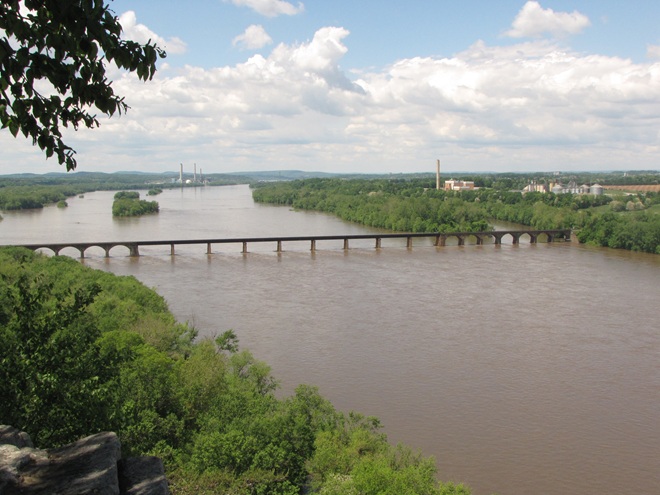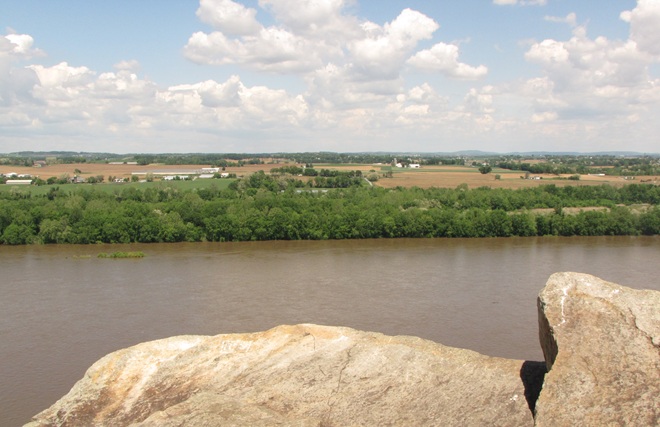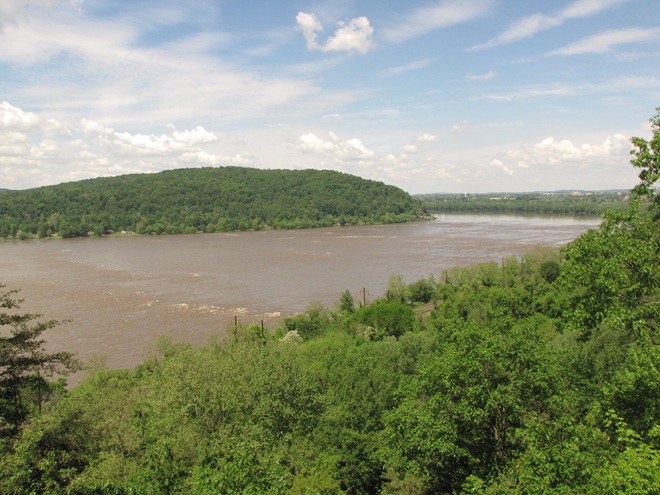
Migrating Waterfowl on Lotic Fresh Waters

Lotic vs. Lentic Freshwater Ecosystems
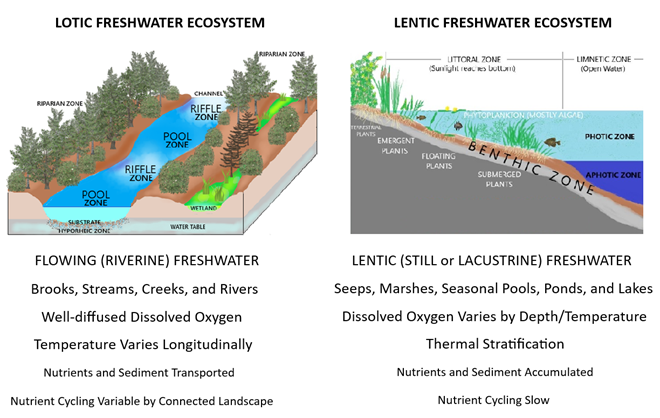
Some comparative attributes of unspoiled lotic vs. lentic freshwater ecosystems.  Low-gradient (slow-moving) lotic waters often create, and remain connected to, accompanying riverine wetlands (a lentic freshwater ecosystem).  These swamps, marshes, and ditches absorb, purify, and infiltrate flood waters while supporting a diverse number of plant and animal species.

We frequently perceive all waterfowl migration to be synchronized with the conspicuous movements of familiar species like Snow Geese, Tundra Swans, and Canada Geese—big flights coming south in October and November, then a return to the north in late February and March.  And we’re all quite aware of the occurrence of large gatherings of some of these migrants while they make stopovers on some of our largest lentic (still) waters—the man-made lakes and reservoirs created by damming local streams.  But did you know that there are populations of colorful waterfowl with dynamic migrations that extend throughout the winter and early spring with movements that are often continuous.  Under favorable conditions, these birds favor the lotic (flowing) waters of the river and its larger tributaries as they transit the lower Susquehanna valley.  That’s because unpolluted lotic freshwater ecosystems support a greater diversity of plants and animals than lentic waters, and therefore offer more opportunities for hungry migrating waterfowl to find food.  Let’s have a look at some of the species that visit the river during their seasonal journeys…
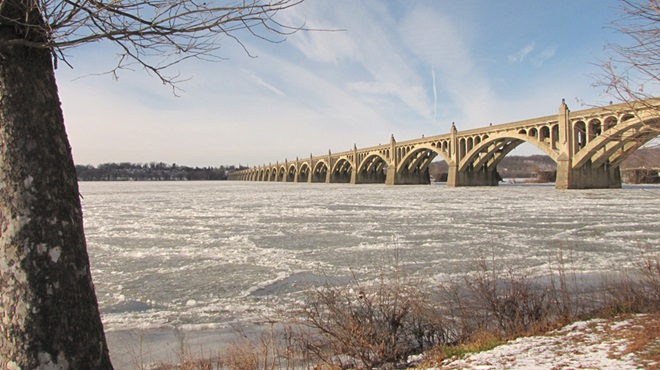
Ice on the Susquehanna
While the urge to head south in the autumn is largely stimulated by the shortening of the photoperiod, it is the presence of ice, particularly on glacial lakes throughout the lands to the north of the lower Susquehanna River basin, that pushes many diving ducks to finally make their way south toward the guarantee of open-water feeding areas along the coast.  This movement may occur at anytime between November and late February or, as we have seen during some of the mild winters of recent decades, it may scarcely be noticed at all.
Common Mergansers
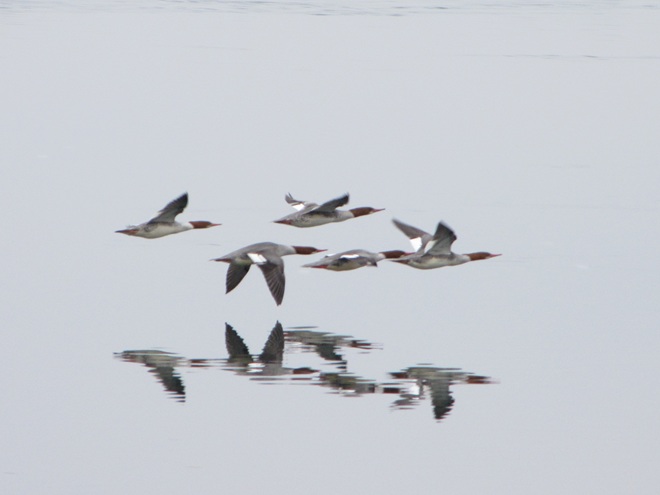
Common Mergansers often lead they way when it comes to migratory diving ducks.  They regularly move south in conspicuous numbers by late November and December and are regularly pushing north as soon as the ice begins to melt.  During a typical year, it is not unusual for some populations of these large diving birds to remain north of us during the winter.  Then, in the days after a sudden rush of frigid polar air, an appreciable increase in ice cover will force a mid-winter movement of birds down the Susquehanna.
Heat Flux Sources Impacting Temperature in Lotic Fresh Waters
Temperatures in lotic fresh waters vary over the length of the stream or river.  They are largely determined by the collective impact of the numerous sources of heat flux depicted in this graphic.  (Environmental Protection Agency image)
Buffleheads
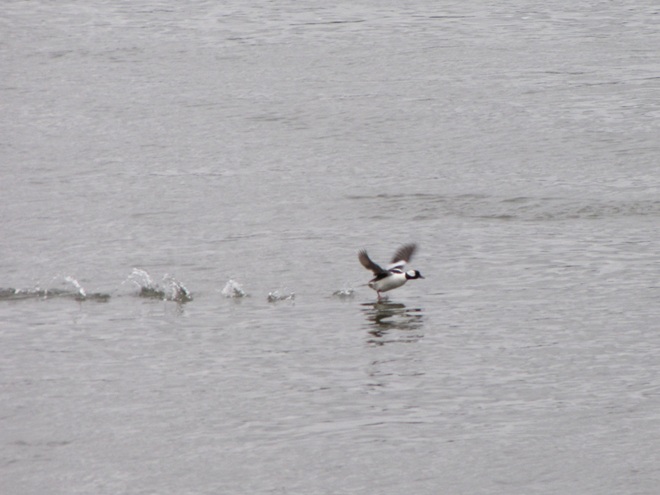
Buffleheads begin passing through the lower Susquehanna region in Novemeber on their way to coastal saltwater bays for the winter.  Lingering populations feed by diving in the river’s pools and riffles for benthic invertebrates including snails and insect larvae.  Lesser quantities of aquatic plant matter supplement their diet.
Common Goldeneye
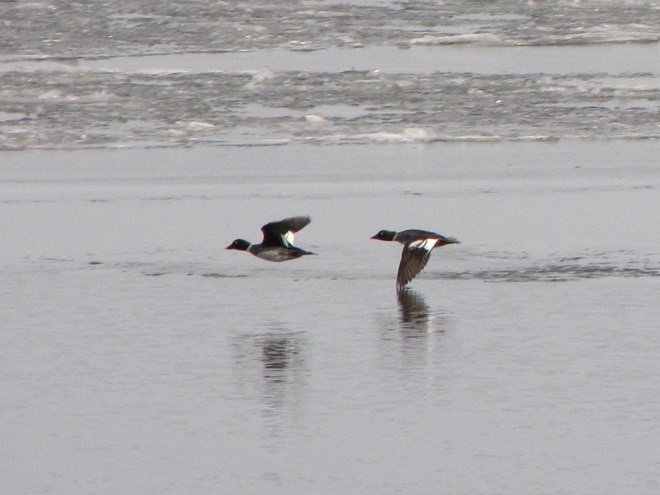
Many Common Goldeneyes will remain on shallow, ice-free waters of the northern lakes and rivers sculpted by the most recent glacial event, but only until they are forced south into and through the lower Susquehanna valley by the encroachment of freezing conditions.  On the river, they are among the dozen or so species of diving ducks we see visiting or passing through during the typical late fall and early river.


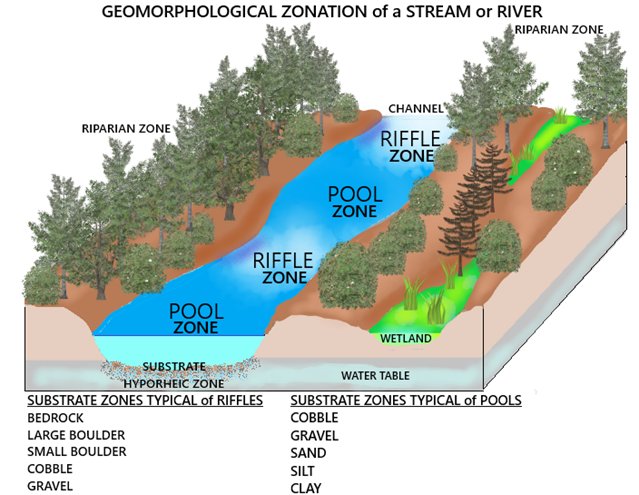
Geomorphological Zonation of a Stream or River
During their visits to the lotic (also known as riverine) fresh waters of the Susquehanna and its largest tributaries, benthic-feeding waterfowl make short dives to take advantage of the plants, small fish, invertebrates, and other food sources inhabiting the stream bottom in the riffles and pools of the free-flowing waterway.  Substrates, listed here by size (in descending order), along with other parameters influenced by this zonation determine the variety and abundance of the forage available to migrating waterfowl and other consumers.  Ice or high water and poor visibility due to flooding can render the riffles and pools of the channel unusable for feeding.  The birds must then choose to either linger and rest without feeding or leave the lotic freshwater habitat to seek sustenance.  During a flood, this may require relocation to a nearby lentic (still) body of fresh water such as a lake or reservoir.  The presence of ice will almost invariably force the birds to fly on to the Atlantic Coastal Plain and the tidal waters of its bays and estuaries.
Hooded Mergansers
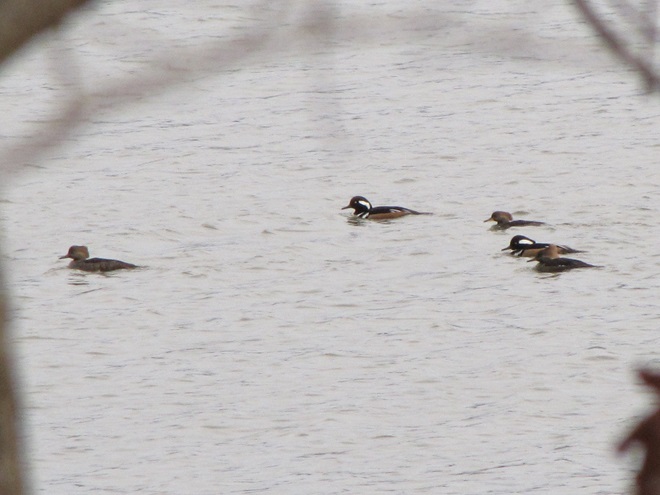
Hooded Mergansers are one of the few species of diving ducks likely to utilize flooded shoreline timber and riverine (fluvial) wetlands as refuge from high water on Susquehanna.
Pied-billed Grebe and Canvasbacks
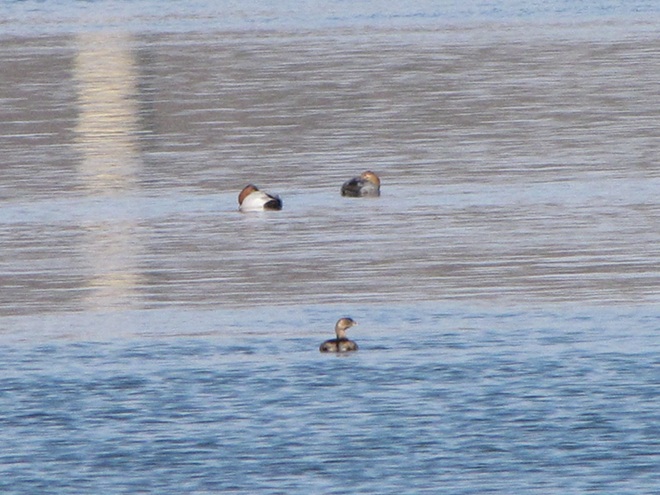
A Pied-billed Grebe and a pair of Canvasbacks on an ice-free stretch of the lower Susquehanna in mid-winter feed and loaf in a riffle-flanked pool where a large mat of American Eelgrass, a submerged aquatic plant also known as Tapegrass or Wild Celery, grows during the summer.  The vast mosaic of riffles and pools in a river this size offers tremendous opportunities for a diverse array of aquatic species to find their niche wherein they can survive and flourish.
Bufflehead
The presence of ice forces Buffleheads and other diving ducks to gather in turbulent open water, often below a riffle or dam.  Another alternative is to continue on toward the salty bays and estuaries of the coast.  High water may push these birds into the shallows among the flooded woods to feed, but they seldom utilize heavily forested riparian wetlands as a refuge due to their need for a running start to get airborne.


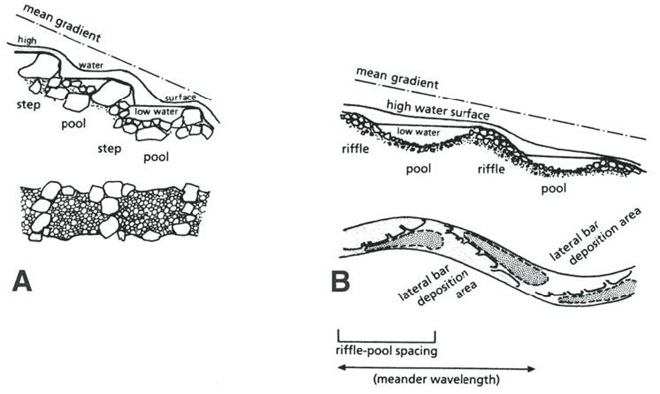
Riffle and Pool Characteristics of High Gradient (A) and Low Gradient (B) Streams.  This graphic illustrates the change in deposition characteristics of a stream or river as its gradient decreases.  A high-gradient stream (A) has a rapid velocity, often forms falls, and tends to carry away a high volume of all but the largest of particles of potential substrates as they erode from the surrounding landscape.  On a low-gradient stream, the loss in water velocity reduces the water column’s ability to transport even the smallest of substrate particles.  Deposition of this gravel, sand, silt, and clay forms lateral bars that over time create the familiar meandering path of a naturally flowing lowland stream.  (National Park Service image)
Benthic Life in Lotic Freshwaters
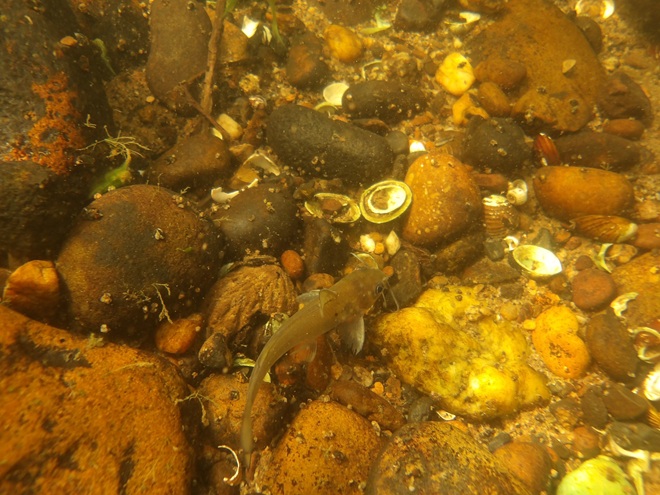
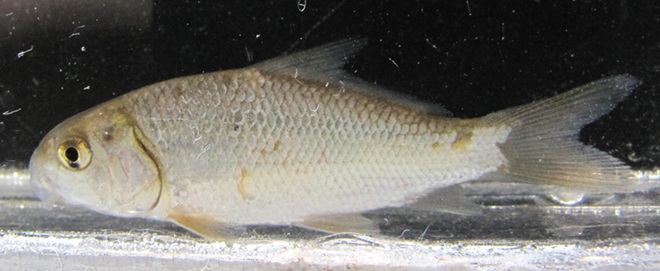
Benthic substrates in lotic freshwater pools and riffles support an abundance of life forms ranging from colorful diatoms on rocks and cobble, to invertebrates including snails and insect larvae, to fishes like this young Channel Catfish.  Free of accumulations of sediment, this river bottom not only provides habitat for a healthy fishery, it facilitates the bidirectional exchange of water between the Susquehanna and its underlying aquifer.
Quillback
On the lower Susquehanna, populations of young Quillback suckers are found almost exclusively in clear, high-gradient pools.
Harlequin Duck
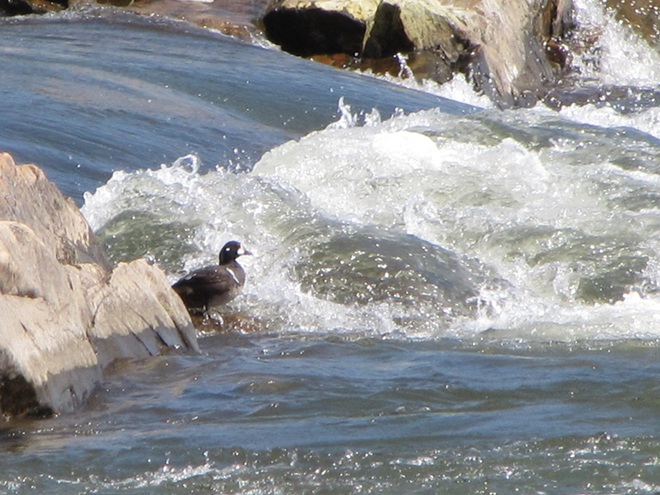
The Harlequin Duck winters along the rocky shores and man-made jetties of the Atlantic coast.  In summer, they nest on fast-moving, headwater streams well to our north.  Very rare on the Susquehanna, this is the first of two individuals found during March and April of 2025.  It was observed feeding in the swift waters of the high-gradient riffles and pools where the river cuts through Blue Mountain north of Harrisburg.  During previous weeks, Harlequin Ducks were being seen along the coast as far south as the mouth of the Chesapeake at Cape Charles, Virginia.  It’s very possible that some of these birds traveled north through the bay area and up the Susquehanna on their way north.


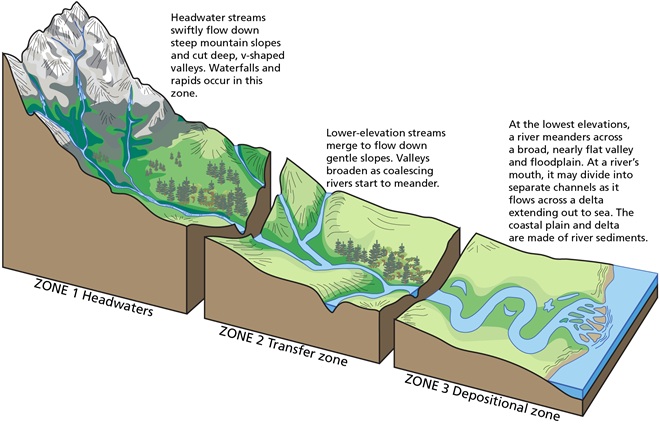
Fluvial Geomorphology of a Stream.  Many of the Susquehanna’s tributaries pass through each of these three erosional zones.  Along the way, they carry out the process of breaking down the mountains formed by the Allegheny orogeny, the collision of North America and Africa that created the supercontinent Pangea about 325 to 260 million years ago (during portions of both the Carboniferous and Permian periods).  Today’s main stem of the lower Susquehanna passes through a transfer zone (Zone 2), carrying eroded materials to a depositional  zone (Zone 3) located within the ancient Susquehanna canyon stretching from Havre de Grace, Maryland, to Norfolk Canyon on the edge of the continental shelf.  Within this zone, more than a 10,000-year accumulation of post-glacial sediments lies submerged by the rising waters of the Atlantic Ocean and Chesapeake Bay.  Although the present-day lower Susquehanna is largely a transfer zone, some deposition occurs along low-gradient segments of the river, particularly where its course parallels the watershed’s ridges both above and below the high-gradient rapids where its path has eroded passage through the highlands.  (National Park Service image)
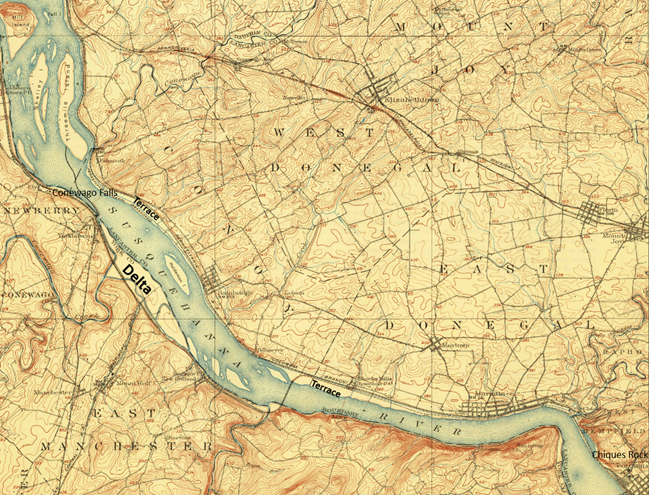
Although the present-day lower Susquehanna is largely a transfer zone, some deposition occurs along low-gradient segments of the river, particularly where its course parallels the watershed’s ridges both above and below the high-gradient rapids where its path continues to erode passage through the bedrock.  On this 1908 map of the Susquehanna at Conewago Falls, alluvial terraces of gravel, sand, silt, and clay can readily been seen as pale areas nearly lacking brown contour lines along the shorelines and islands of the river.  Deposits within most of these terraces date back to the melt period following the most recent glacial event and beyond.  The delta shown at the mouth of Conewago Creek (west) includes massive volumes of material deposited by both the creek and the river.  This delta is currently known as Brunner Island, much of it developed as the site of a coal/gas-fired electric generating station.  Terrace deposits along the Susquehanna’s shorelines created extensive perched marshes and swamps (wooded marshes) fed by rains, high river water, small streams, and springs, the latter often seeping from the base of the rocky escarpments carved by the ancient Susquehanna and defining the present-day inland border of the floodplain.  We call these sites “Alluvial Terrace Wetlands”.  Few of these critical components of river morphology survive.  Those not drained for farmland were obliterated by urbanization and canal, railroad, and highway construction.  (United States Geological Survey base image: Middletown, PA, quadrangle, 1908)
Water Willow
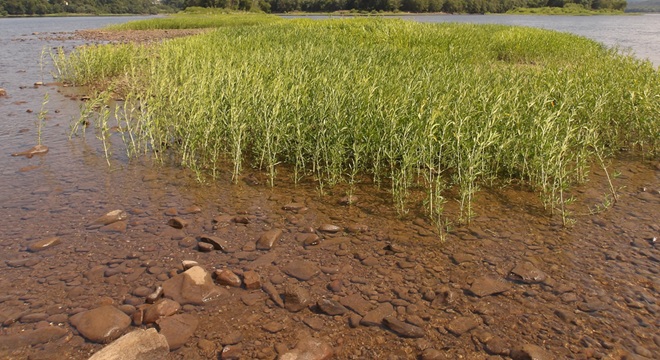
Water Willow is a familiar emergent plant that colonizes lateral bars and other alluvial deposits in low-gradient segments of the Susquehanna.
Water Willow Roots
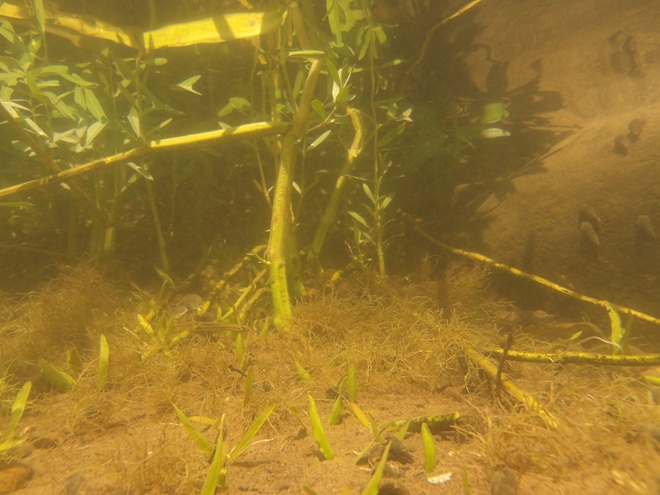
The fine roots of Water Willow collect sediment and absorb nutrients while creating dense cover for young fish and numerous species of invertebrates including the Virginian River Horn Snails seen here.

Prior to the nineteenth century, the low-gradient flow regime of the river both above and below the riffles at Chiques Rock (lower right on map) created prime wildlife habitat.  The natural accumulations of nutrients and substrates carried into and through the lotic waterway’s pools and riffles were cycled into an ideal growing medium for extensive mats of American Eelgrass and other aquatic plants.  This underwater forest hosted a seemingly endless abundance of invertebrates and fishes (both resident and migratory)—supporting a variety of consumer species including various populations of humans.  But soon after the mass clearing of much of the watershed’s land for farming and lumber, the mill ponds created by dams constructed on streams to power saw and grain mills became brimful with sediments eroded from the unprotected ground.  During storm events, torrents of these sediments then flowed full bore toward the Susquehanna, and began accumulating in the low-gradient segments of the river.
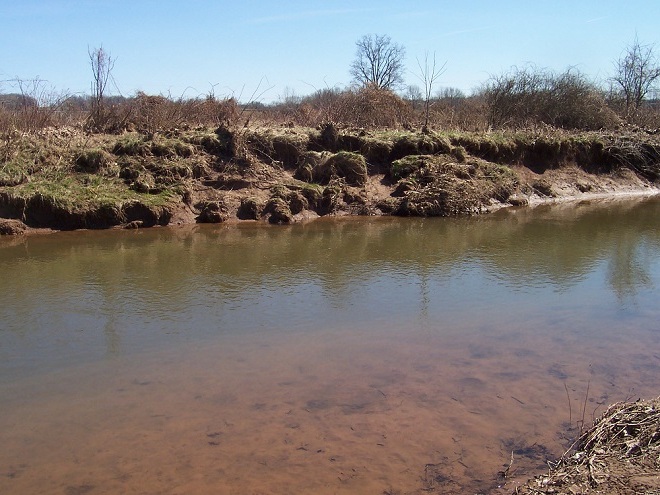
Legacy Sediments
Sediments left behind after the removal of mill dams are known as legacy sediments. They disconnect the stream from its historic floodplain and riverine (fluvial) wetlands, thus intensifying the impact of high water in the surrounding landscape.  As these nutrient-charged deposits wash away, they become a source of pollution in the waters of the Susquehanna and Chesapeake.
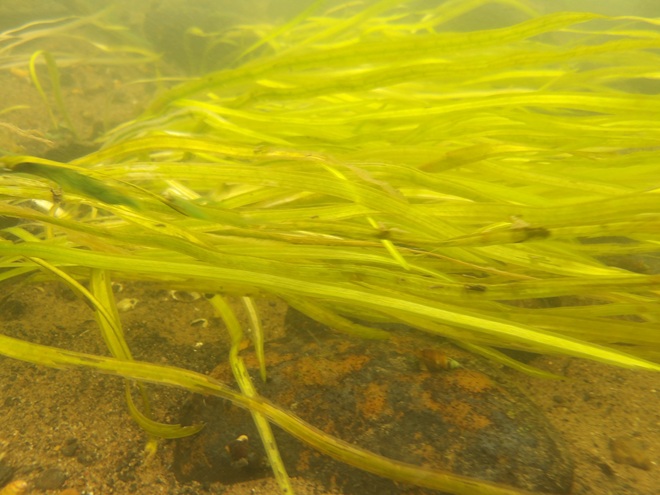
American Eelgrass
A mat of American Eelgrass growing in the flowing waters of the Susquehanna below Conewago Falls.  Eelgrass and other submerged aquatic plants provide essential habitat for a wide variety of small fish and invertebrates while also consuming nutrients deposited in the cobble, gravel, and sand substrate of the river’s pools.  Excess quantities of smaller particles of silt and clay can clog the substrate and thus inhibit the hyporheic exchange of water between the stream channel and the underlying aquifer, often diminishing the biomass and diversity of organisms inhabiting this benthic habitat.  Buried in these life-choking sediments, the river bottom becomes inhospitable to growth of submerged aquatics including eelgrass.
Susquehanna at Marietta
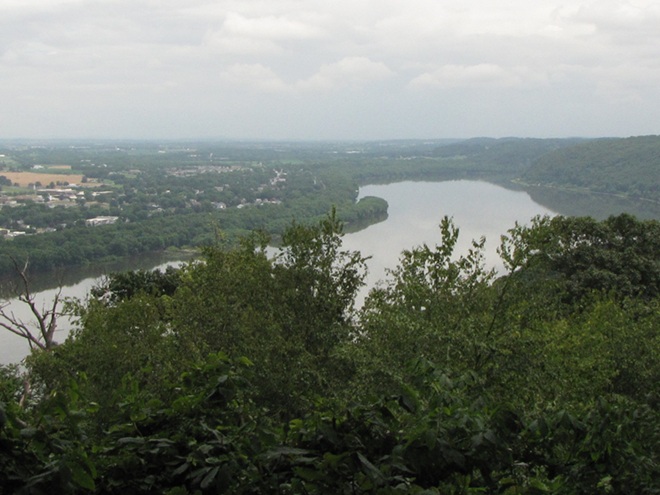
This low-gradient stretch of the Susquehanna at Marietta flows parallel to the Chickies Quartzite “Hellam Hills” before making a sharp right turn to punch through the ridge as a series of rapids at Chiques Rock.  Formerly a fully functional lotic ecosystem and a paradise for migrating waterfowl, this river segment is now impaired by accumulations of nutrient-laden sediments from agricultural and urban runoff.
Conewago Falls Flood Waters
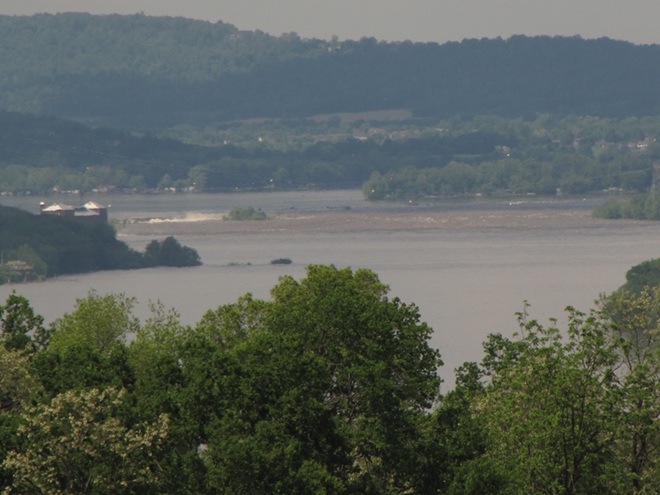
Nutrient and sediment-loaded flood waters roar across the diabase boulders at the York Haven Dam and Conewago Falls, a high-gradient segment of the Susquehanna.
Flood Waters at Haldeman Riffles
They continue past Brunner Island (left power plant stacks) and through Haldeman Riffles and the Shocks Mills Railroad Bridge…
Flooding on the Marietta Broads
…into the stretch of river known as the “Marietta broads” along the base of the Chickies Quartzite “Hellam Hills”.  The low stream gradient here produces a slower current and increased deposition of sediments.
Susquehanna Flooding at Chiques Rock
As the flood surges through the riffle and pool complex at Chiques Rock, the high stream gradient maintains a velocity in the water column sufficient to keep additional sediments in suspension until they reach the low-gradient river segment just downstream at Washington Boro, site of a naturally occurring lateral bar area known as the Conejohela Flats.  These bars now lie within the man-made depositional zone known as “Lake Clarke”.  Created nearly a century ago by construction of the Safe Harbor Dam, this impoundment is accumulating astounding volumes of nutrient-loaded sediments that continue to encapsulate the flats within a stream-impairing delta.
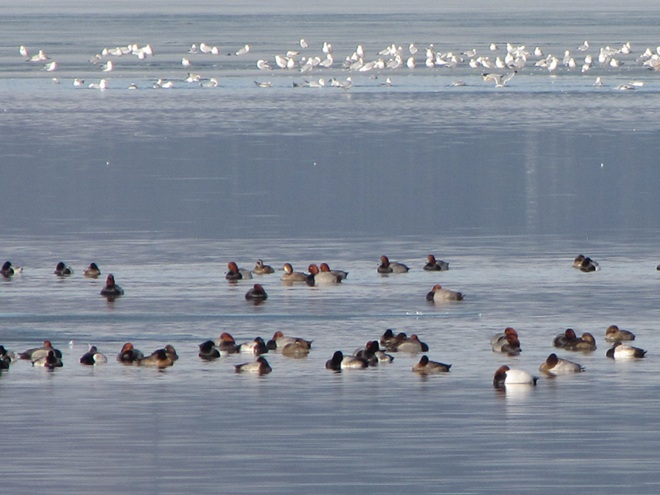
Redheads, Canvasbacks, and a Horned Grebe
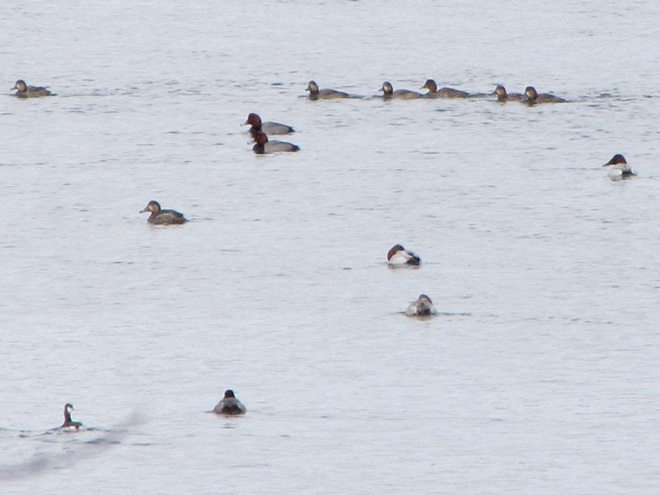
Anytime from November to April on the lower Susquehanna, a group of Redheads, Canvasbacks (3 birds to right of the middle of the picture), and a Horned Grebe (lower left) is a welcome sight in a riverine pool known to have a summertime growth of American Eelgrass.  Noted Dr. Herbert Beck in 1924 when describing the Canvasback, “Like all ducks, …, it stops to feed within the county (Lancaster) less frequently than formerly, principally because the vast beds of wild celery which existed earlier on broads of the Susquehanna, as at Marietta and Washington Borough, have now been almost entirely wiped out by sedimentation of culm.  Prior to 1875 the four or five square miles of quiet water off Marietta were often as abundantly spread with wild fowl as the Susquehanna Flats are now.  Sometimes there were as many as 500,000 ducks of various kinds on the Marietta broad at one time.”
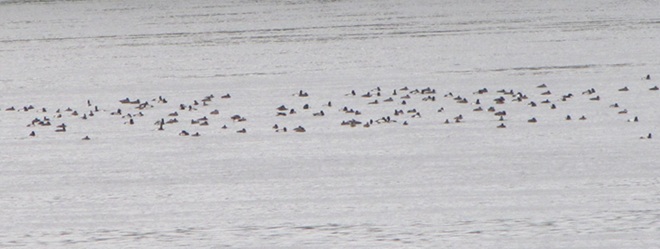
Aythya genus ducks.
Today, seeing just dozens of Aythya genus ducks (Redheads, Canvasbacks, scaup) on the lower Susquehanna is a notable event.  If they happen to be forced down by inclement weather while migrating through, you might get lucky enough to see several hundred.
Aythya Genus Ducks
While the recovery of eelgrass/wild celery beds on the Susquehanna is trivial in scale and offers little support for numbers of waterfowl to return to historic levels, restorations on the upper Chesapeake in the vicinity of the Susquehanna Flats between Havre de Grace and Aberdeen Proving Grounds may have helped refuel a gathering of mostly Aythya genus ducks during the final days of February.  This mass of ducks, many of which were forced south from the frozen Great Lakes during the previous weeks (some by way of the ice-choked Susquehanna) were apparently making an abrupt turn to make their way back north.  Their stay was brief, but estimates by local birders put their numbers as high as one half million.  The vast majority of the concentration consisted of Aythya species: Redheads, Canvasbacks, Ring-necked Ducks, and both Lesser and Greater Scaup.  It probably included a mix of birds including both northbound migrants from further down the coast and the aforementioned refugees that had just arrived to pay a quick visit while escaping the late-season ice before turning around.
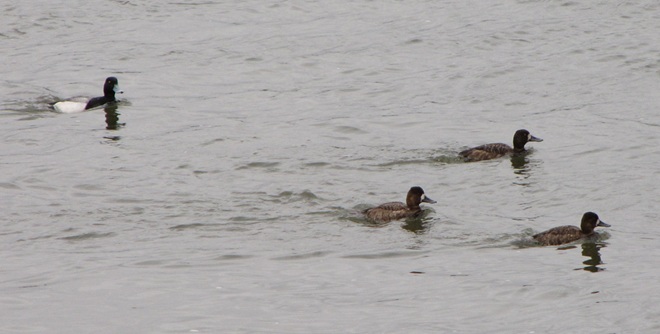
Lesser Scaup
During the past two centuries, as food supplies in the Susquehanna grew increasingly compromised for benthic feeders like these Lesser Scaup and other diving ducks, a change in distribution was necessary for survival.
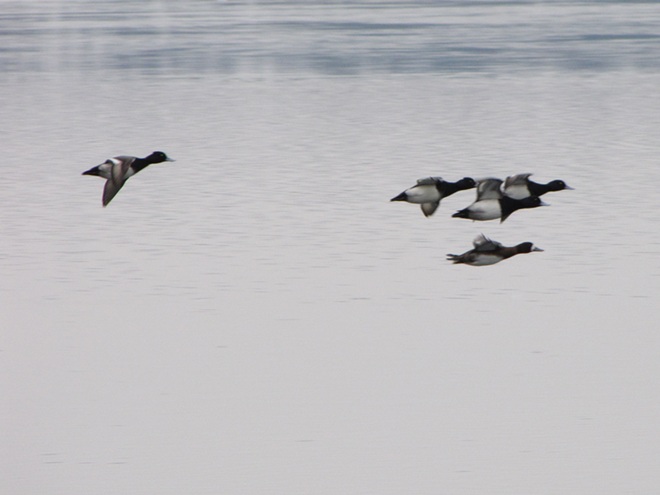
Lesser Scaup in flight.
As individual species, Lesser Scaup and other waterfowl that fail to adapt to natural or man-made changes in their habitats and food supplies may see their overall global numbers falter.

Despite being located in the transfer zone, the lower Susquehanna has become a significant depositional zone along much of its length, mostly courtesy of the placement of sediment-trapping man-made dams.

Following construction of the mill dams and ponds on nearly every mile of the lower Susquehanna’s low-gradient tributary streams, enterprising parties moved on to the river.  The first significant spans were constructed using wide timber cribs filled with large rock.  They were placed to create water deep enough to allow canal boats to cross the Susquehanna at both Clark’s Ferry at the mouth of the Juniata River in Dauphin County and at Columbia/Wrightsville.  These dams also diverted water into the newly excavated canals—the Pennsylvania Eastern Division Canal (completed in 1833) which followed the river’s east shore from Clark’s Ferry to Columbia, and the Susquehanna and Tidewater Canal (completed in 1840) along the west shore from Wrightsville to Havre de Grace, Maryland.  Placement of these sediment-trapping man-made dams began a process of converting vast mileage of the lower Susquehanna from a transfer zone into a deposition zone.  In addition, layout of the canals and locks followed the contours along the base of the riverside ridges, seriously altering most of the alluvial terrace wetlands that the river had created as a feature of its floodplain during the post-glacial period.

Construction of the canal dams was just the beginning.  During the twentieth century, more massive dams would be added to the main stem of the river for hydroelectric energy production at York Haven, Safe Harbor, Holtwood, and Conowingo.  Upon their completion, the days of unassisted anadromous fish migrations were over.  On both the river and its tributaries, smaller dams including dangerous low-head dams maintain water levels for boating and recreation.  They too create current-diminishing, pseudo-lentic waters that blanket the lotic riffle and pool substrates with polluted sediments.

MAN-MADE DAMS TURN LOTIC WATERS INTO UNFLUSHED TOILETS
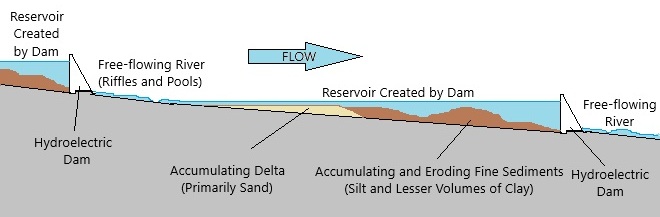
Sediment Deposition Behind Lower Susquehanna Dams
The construction of dams on the lower Susquehanna has converted vast mileage of the river from a lotic freshwater system into a series of man-made lentic freshwater lakes.  These areas have lost their function as a lotic transfer zone and are now a sort of dysfunctional series of depositional zones collecting vast volumes of sediment containing nutrients and other pollutants.  Within each impoundment, the reduced velocity of the river causes it to drop suspended sand first, then the finer particles of silt and clay closer to the dam.  The flow regime of riffles and pools is lost and the hyporheic zone that exchanges water between the river and the underlying aquifer is clogged.  These impaired segments of river become ripe for eutrophication: algal blooms followed by die offs that can lead to a fatal reduction of dissolved oxygen in the water column.
Gadwall
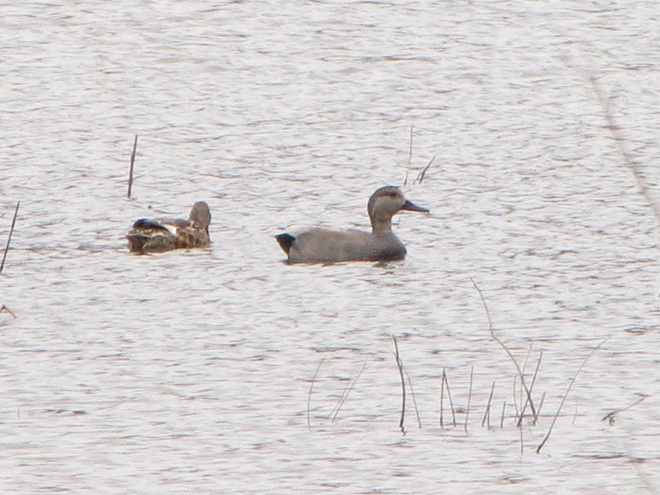
Deposits of lateral bars of sediment in low-gradient segments of the Susquehanna can create shallow water feeding habitat for puddle/dabbling ducks like these Gadwall.  Where sediment pollution is severe, benthic foods in these areas often consist mostly of invertebrates and plant matter deposited by the current, the buried substrates devoid of a functioning ecosystem and the waters subject to eutrophication.
Common Goldeneyes
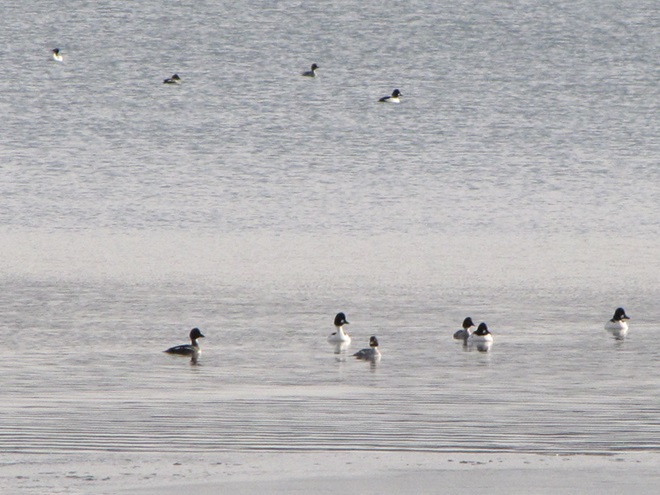
Common Goldeneyes on a patch of open water on an otherwise ice-covered “Lake Clarke”, the impoundment created by Safe Harbor Dam.  While they may find this spot advantageous for loafing, the food supply over the sediment-buried substrate will be limited.
By the end of the twentieth century, accumulations of polluted sediments behind lower Susquehanna dams were nearing capacity.  There is no working plan to attenuate the massive release of these pollutants that may be triggered by a catastrophic flood.  The effort to reduce nutrient and sediment runoff remains the focus so that new loading is kept to a minimum and won’t add to the capacity problems at the dams or continue downriver to the Chesapeake at full strength when the dams are full.  Alleviating the sediment aggregation problem within the river’s impoundments is a tall order and a dilemma not easily solved.  (United States Geological Survey image)
Common Mergansers
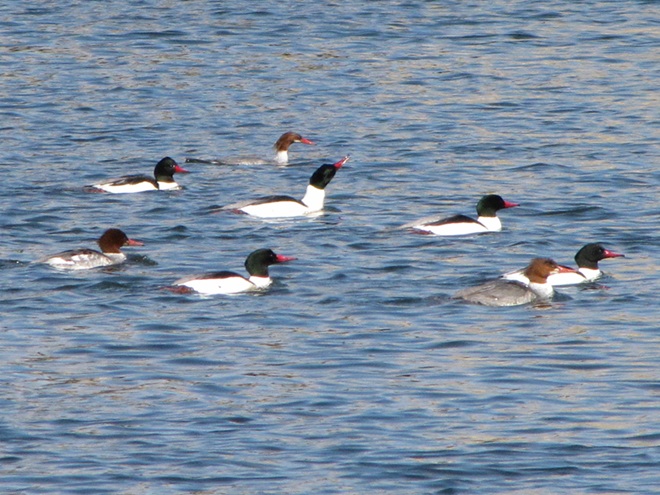
Common Mergansers will feed where benthic substrate supports the small fish and invertebrates they prefer. They will, however, gather in extraordinary numbers on the “lakes” created by riverine dams.  Though they can only feed on what floats in with the current, hundreds or sometimes thousands of Common Mergansers will concentrate on “Conowingo Pond” during the late fall or early winter.  There, safety in numbers gives them some guarantee of protection against the multitudes of eagles that simultaneously frequent the vicinity.  Another advantage of staging on “Conowingo Pond” is its close proximity to favorable feeding areas on upper Chesapeake Bay and stretches of the Susquehanna where lotic riffles and pools offer abundant opportunities below the river’s dams.
Rusty Crayfish
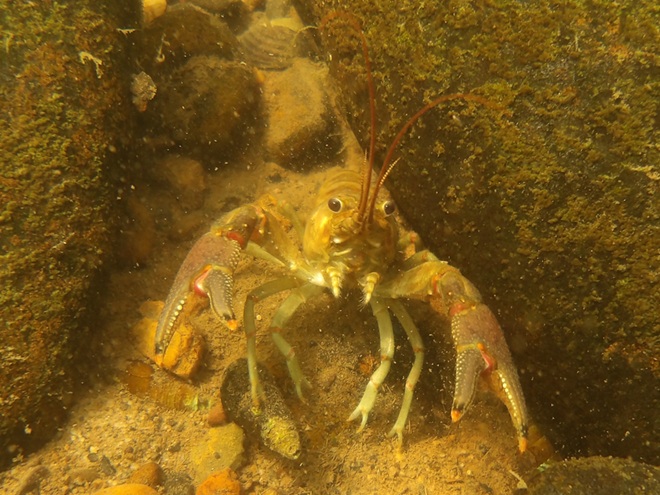
Fortunately for everything else living in the benthos, Common Mergansers are big enough to devour invasive, non-native Rusty Crayfish when they find them in our lotic waterways.

TIME TO CLEAN UP OUR ACT

WHERE DOES YOUR STORMWATER GO?
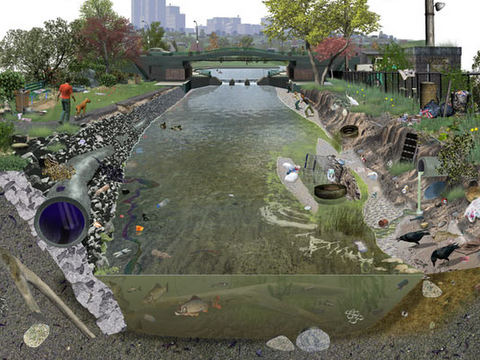
 

Channelized Urban/Suburban Streams Function as Sewers. They have no attached lowlands or floodplains to absorb, purify, and infiltrate runoff from rain events.  Pollutants including litter, pet waste, lawn chemicals, tire-wear particles, hazardous fluids, and sometimes untreated human excrement flush unchecked from the municipal storm drainage system into the waterway.  Thermal shock from summer downpours washing across sun-heated pavements can kill temperature sensitive fishes and other aquatic life.  Nutrient and sediment loads from these impaired tributaries later accumulate downstream in low-gradient segments of the Susquehanna, turning the river into an open-air cesspool.  Aggressively working to implement projects that eliminate these sources of pollution are the only effective way to keep the problem from getting worse.  Making things better requires a lot more dedication and effort.  (United States Geological Survey image by Frank Ippolito)

RIPARIAN BUFFERS MAKE A DIFFERENCE…WIDER IS BETTER
Riparian Buffer
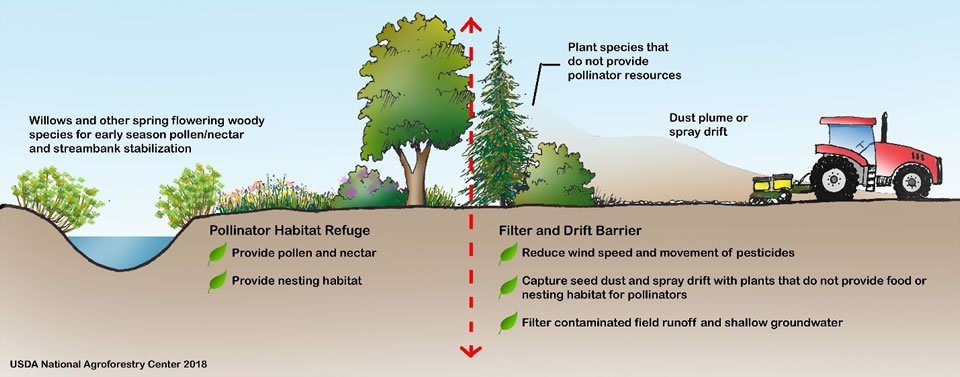
To sequester sediment and cycle nutrients (primarily nitrogen and phosphorus) contained in farm runoff, the U.S.D.A. recommends installing riparian buffers between streams and lands used for grazing and raising crops.  To protect pollinating species including bees and butterflies from pesticide drift and eroding soils rich in fertilizers, they further recommend installing a stand of wind-pollinating plants such as conifers, oaks, and birches between the field and streamside plantings.  These same conservation practices improve water quality and wildlife habitat on waterways located in residential and commercial areas as well.  (United States Department of Agriculture image, click to enlarge)

FLOODPLAIN RESTORATION

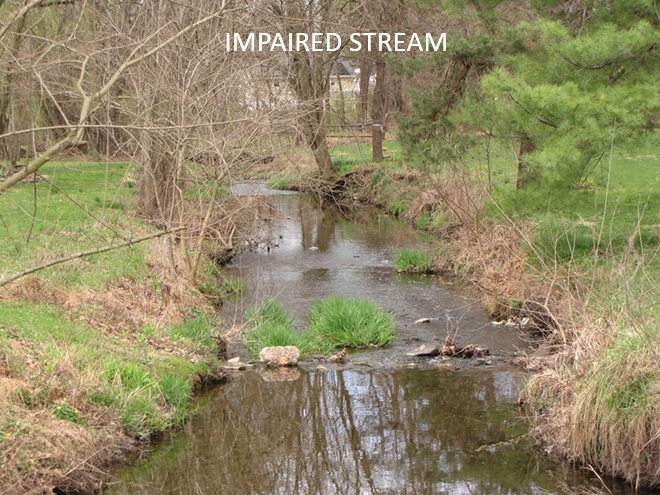
Regardless OF HOW LONG YOU’VE BEEN CONDITIONED TO THINK OTHERWISE, THIS IS A DYSFUNCTIONAL, POLLUTED CREEK—AND IT NEEDS HELP
Legacy Sediments
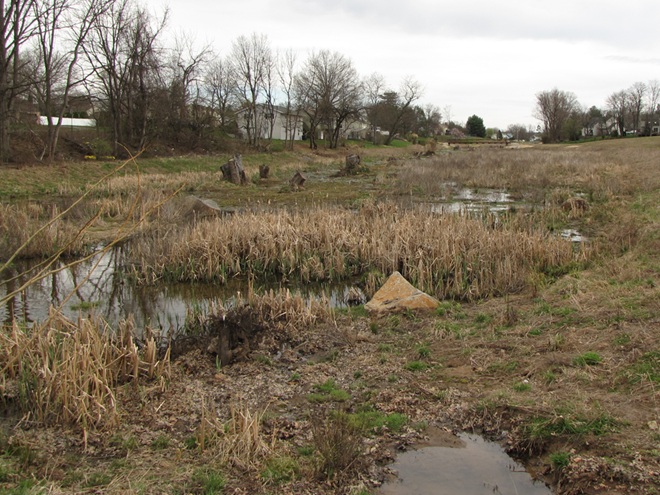
A channelized low-gradient stream eroding a path through deposits of legacy sediments displaces flood waters into previously unaffected areas and provides a continuing source of nutrient and sediment pollution during storm events.  These impaired waters have a diminished capacity for supporting aquatic life including fishes.
RESTORED TO ITS HISTORIC FUNCTIONS
Floodplain and Stream Restoration
On an adjacent segment of the same creek, this legacy sediment removal project restored a braided meandering channel and connected it to its newly liberated, historic floodplain.  In just their second year, the fluvial wetlands are effectively absorbing stormwater and sequestering nutrients as an attached component of the stream’s riffle and pool complex.  During our visit earlier this week, we found American Toads, Northern Leopard Frogs (Lithobates pipiens), and Northern Spring Peepers breeding here.  It’s just as Castor canadensis would have it!

“STOP HEMMING AND HAWING AROUND ALREADY”

“HEY COWBOY, HOW ‘BOUT GETTIN’ THEM FILTHY LITTLE DOGIES OUTTA DAT CRICK?”
Impaired Stream
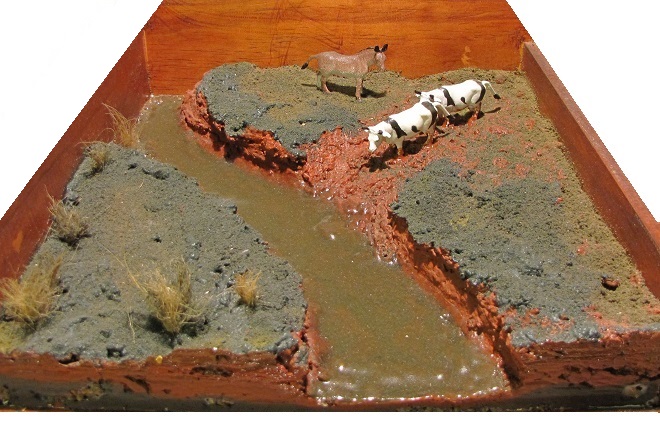
Here’s a polluted stream in a pasture with grazing livestock.  The site is a former mill pond within which the creek eroded a channel following removal of the dam.  The animals defecate and urinate where access to water is gained at a broken down embankment of the nutrient-loaded legacy sediments deposited in the pond more than a century ago.  It’s a haphazard form of animal husbandry and a reminder that all it takes is just one stubborn jackass to foul up the whole waterway.
DIRECT SOURCES OF NITROGEN (AMMONIA) POLLUTION IN STREAMS

DID YOU KNOW that a dairy cow produces about 80 pounds of waste (excrement and urine) every day?

DID YOU KNOW that a horse produces about 50 pounds of waste (excrement and urine) every day?
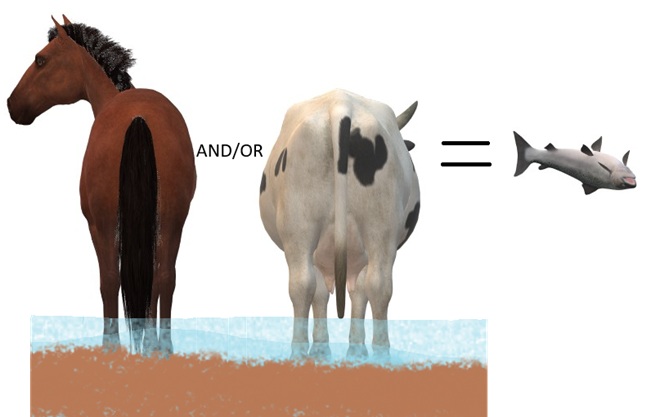
DID YOU KNOW that a human produces about 3 to 4 pounds of waste (excrement and urine) every day?  The exceptions, of course, are those who continue to insist that raising farm animals in and alongside a body of water is okey-doke—a harmless practice.  These individuals tend to retain the former constituent of human waste and are thus full of it.

“ATTABOY TEX, THAT’S MORE LIKE IT!”
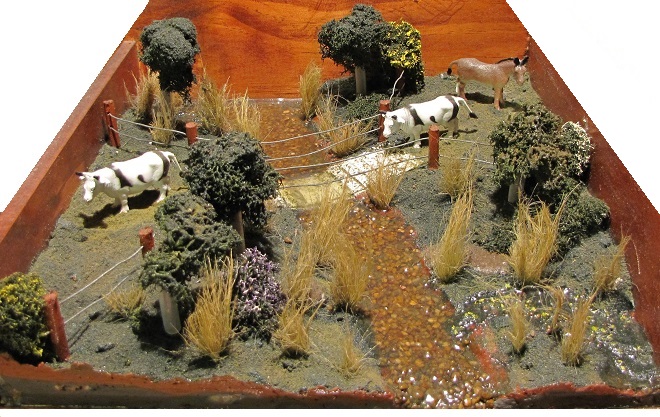
Stream Fencing and Livestock Crossing
Now that’s better.  Legacy sediments have been removed to reconnect the stream to its floodplain.  A livestock crossing and exclusion fencing has been installed, and a nutrient-consuming riparian buffer has been planted.  This creek segment’s pollution woes have been mitigated.  Do you have a neighbor needing this type of remedial work on their farm?  Have them call your local conservation district office for advice.  Some programs include financial assistance covering the costs of installation as well as monetary incentives for helping to clean up the water.

AND FINALLY

WHEN IT COMES TO BUILDING DAMS ON LOTIC FRESH WATERS…
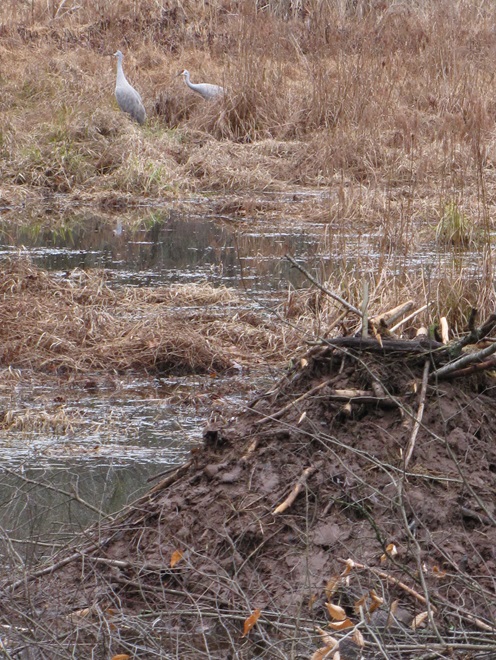
Sandhill Cranes in Beaver Pond

…LEAVE IT TO THE BEAVERS
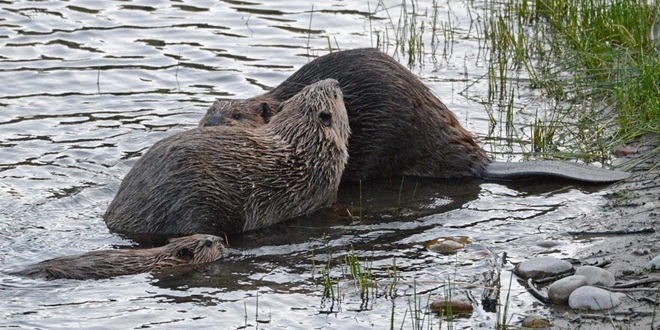
North American Beavers
North American Beavers (Castor canadensis) create habitats that connect the riffle and pool regime of a low-gradient stream to a surrounding fluvial wetland that retains sediments, cycles nutrients, and provides essential habitat for hundreds of plant and animal species.  Floodplains are for flooding.  And if a beaver floods an area, you can be guaranteed that it was already part of a floodplain.  You see, beavers don’t encroach upon humans, it’s humans doing the encroaching upon beavers.  (National Park Service image)
MAD HATTERS

DID YOU KNOW that even before the landscape was cleared for farms and a supply of timber, and before mill dams on local creeks began accumulating soil runoff from the consequently barren hillsides, all the North American Beavers, the keystone species of lower Susquehanna stream ecology, were killed and sold to make hats?  It’s no wonder things are fubar!

COMING SOON…
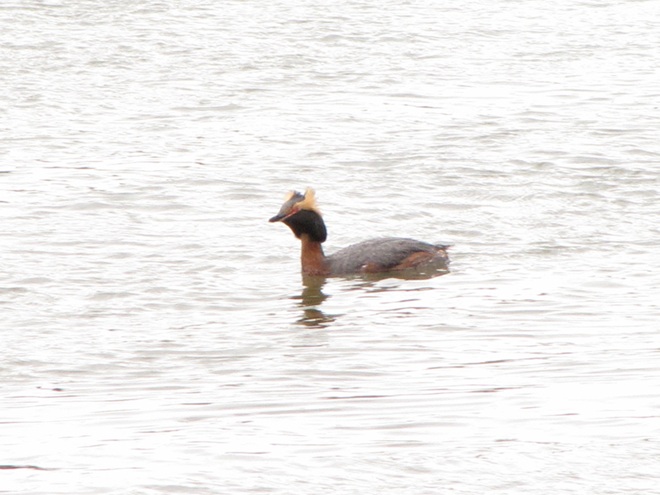
Horned Grebe
Horned Grebes are regular migrants and sometimes winter residents on ice-free stretches of the lower Susquehanna.  They spend their time plying the benthic substrate of the river’s clear riffles and pools for a variety of invertebrates and small fish.  Look for them moving north in coming days sporting this beautiful breeding plumage.
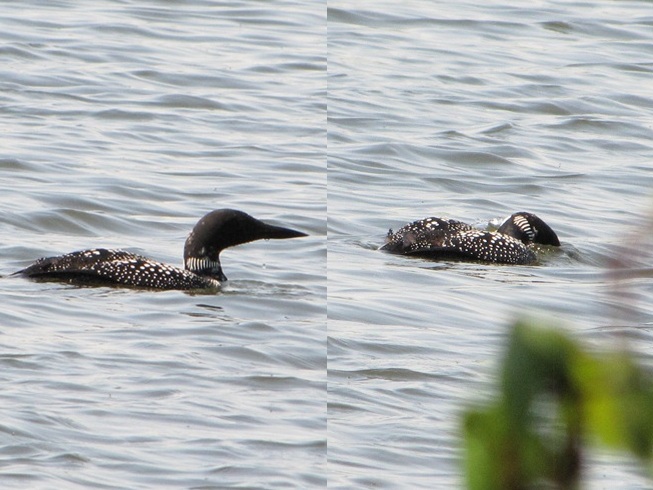
Common Loon
April and early May are prime time for observing Common Loons on the Susquehanna as they undertake a journey from the Atlantic surf where they spent the winter to nesting sites on northern lakes.  For this migrant in breeding plumage, clear water for sighting plenty of benthic life in the river’s riffles and pools assures a successful dive in search of energy-replenishing forage.

Start Your Own Tree Nursery

Just a reminder—there’s still time to order trees and shrubs from your local county conservation district’s annual sale, but you need to act soon…
Cumberland County Conservation District 48th Annual Tree Seedling Sale

Order by Friday, March 20, 2026

Pick Up on Thursday, April 16, 2026, or Friday, April 17, 2026


Dauphin County Conservation District Seedling Sale

Order by Monday, March 16, 2026

Pick Up on Thursday, April 23, 2026, or Friday, April 24, 2026


Franklin County Conservation District Tree Seedling Sale

Order by Tuesday, March 17, 2026

Pick Up on Thursday, April 23, 2026


Huntingdon County Conservation District Tree/Seedling Sale

Order by Friday, April 3, 2026

Pick Up on Thursday, April 16, 2026, or Friday, April 17, 2026


Lancaster County Conservation District Annual Tree Seedling Sale

Order by Friday, March 6, 2026

Pick Up on Friday, April 10, 2026


Lebanon County Conservation District ALL NATIVE! Tree & Plant Sale

Order by Monday, March 2, 2026

Pick Up on Friday, April 17, 2026


Mifflin County Conservation District Tree Sale

Order by Friday, March 6, 2026

Pick Up on Wednesday, April 15, 2026, or Thursday, April 16, 2026


Schuylkill County Conservation District/Sweet Arrow Lake Conservation Association 51st Annual Seedling Sale

Order by Saturday, March 21, 2026

Pick Up on Saturday, May 2, 2026


Snyder County Conservation District Tree Seedling Sale

Order by Monday, March 30, 2026

Pick Up on Wednesday, April 15, 2026


York County Conservation District Seedling Sale

Order by Sunday, March 15, 2026

Pick Up on Thursday, April 16, 2026


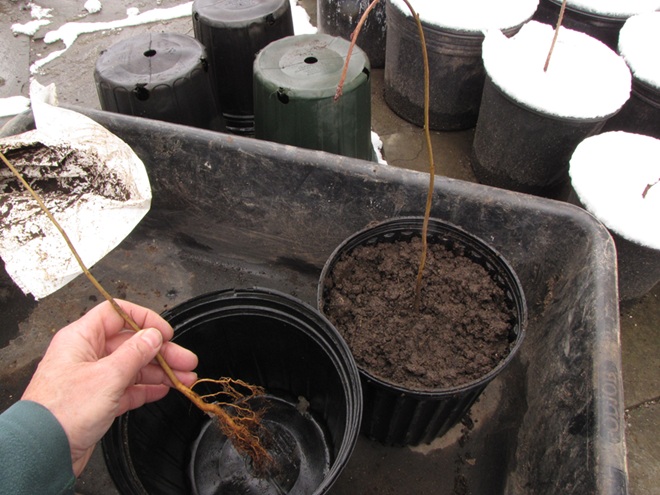
If maybe you would like to order trees but you’re not quite ready to put them in the ground, why not pot them up and start your own plant nursery.  It’s a great way to build an inventory of hardy stock for planting around your own property or for use in community or civic conservation projects.

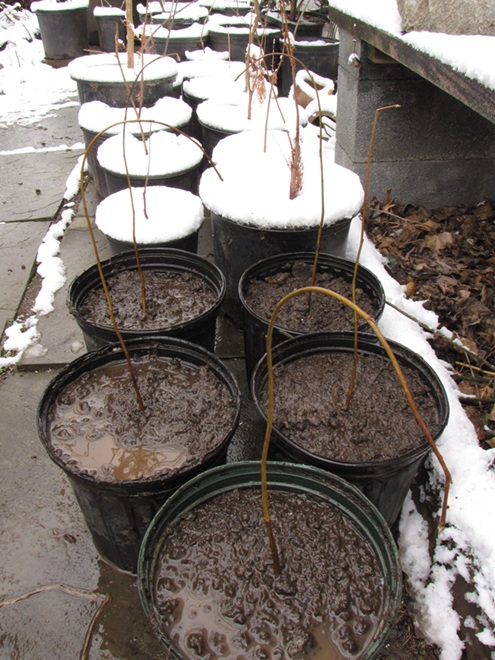
Potting Sweetgum Seedlings
Earlier this week we potted up some bare-root seedlings in a mix of compost and sand to give them a head start before planting them in the ground either during the coming fall or in years to come.  These happen to be some young American Sweetgum trees we purchased from a nursery in Perkasie, Bucks County, Pennsylvania.
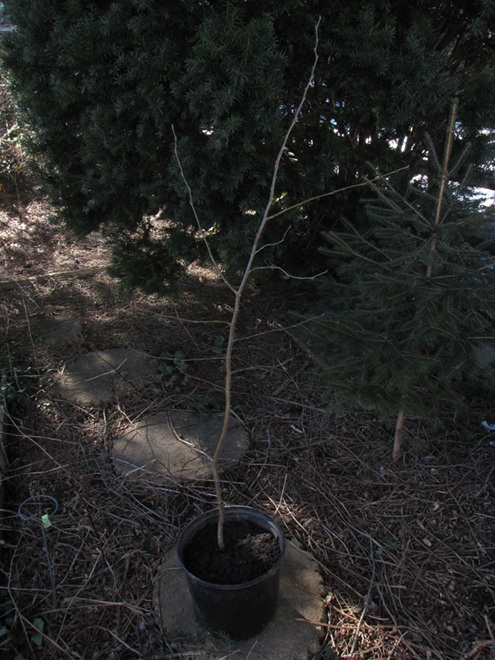
Native Tree Nursery
After watering them in, we added our new trees to the inventory we have available for stream buffers, rain gardens, reforestation, and other rewilding projects.  We’ll either stake or trim them to remedy the curved stems.
Yellow Birch Sapling
In just a season or two, we have nice robust saplings ready to install in a project or in the headquarters garden.  Starting plants in the nursery gives them the size they need to improve their chances of survival.
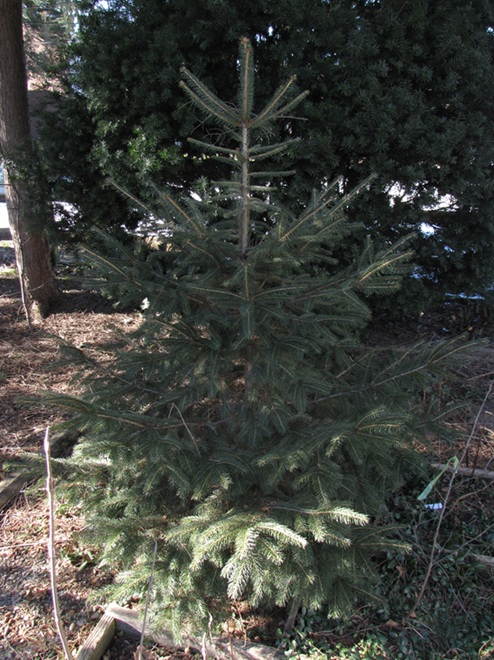
Norway Spruce
This is one of ten Norway Spruce trees we purchased in a pack from a local conservation district sale almost ten years ago.  We started each two-year-old seedling in a pot, then transplanted them into the ground a year later.  All have been thriving ever since.
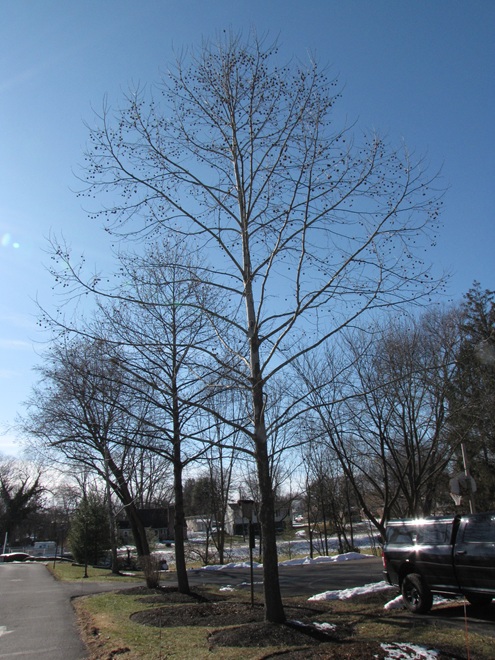
Eastern Sycamore
Since being installed as a potted sapling reared in the headquarters nursery about fifteen years ago, this sturdy Eastern Sycamore has matured and is producing seeds relished by American Goldfinches and other birds.
Eastern Sycamore and Conifers
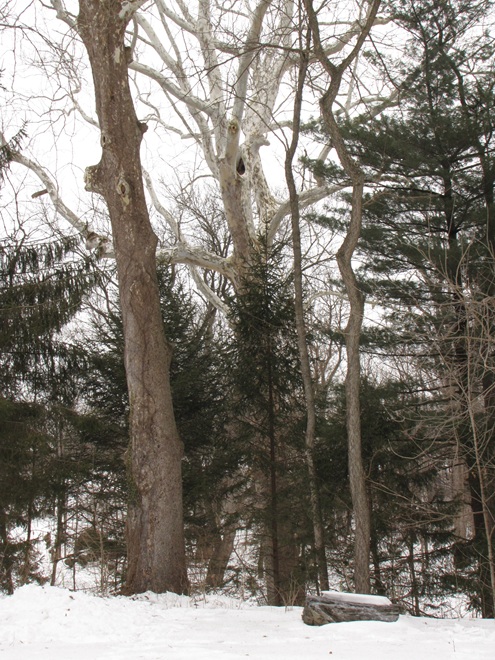
Growing in a streamside woodland, a really massive sycamore that got its start in your nursery could continue to provide valuable wildlife habitat over a lifespan extending one hundred, two hundred, maybe even three hundred years or more.  These long-lived denizens of the floodplain provide homes for such beloved breeding birds as Baltimore Orioles, Bald Eagles, Warbling Vireos, Yellow-throated Warblers, and several species of owls,…
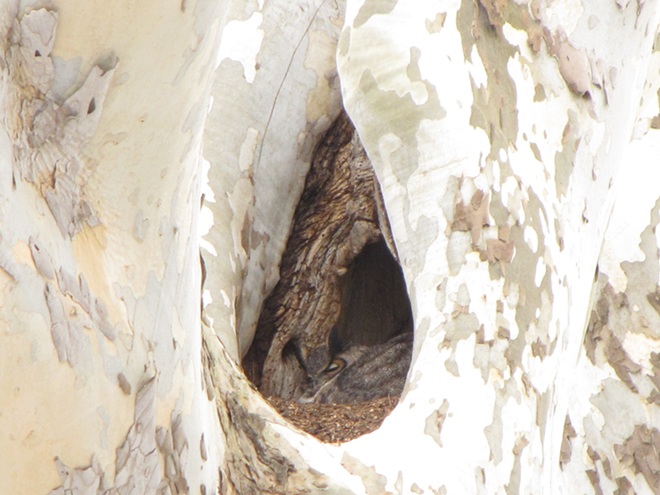
Great Horned Owl Nest in Eastern Sycamore
…including this Great Horned Owl, seen currently incubating eggs inside a legacy sycamore that has been an active nest site among its neighboring Norway Spruces and Eastern White Pines for decades.
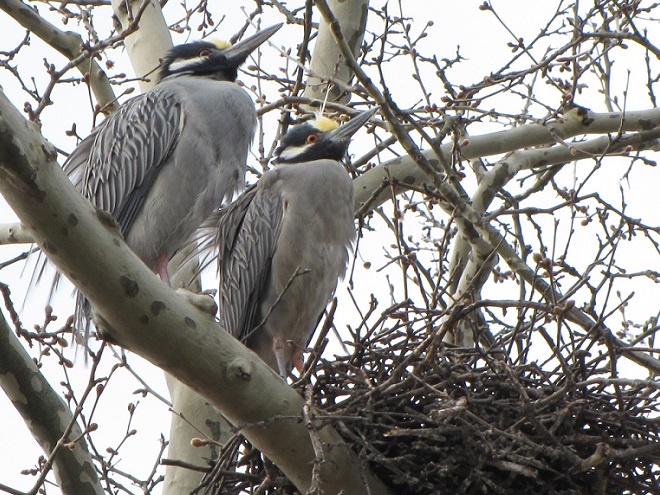
Yellow-crowned Night Herons at Nest
Yellow-crowned Night Herons, an endangered species in Pennsylvania, nesting in an Eastern Sycamore planted during the early twentieth century as a street tree very near the Susquehanna in mid-town Harrisburg.  Ordering and planting trees today is essential for their tomorrow.

Adapting to Winter Extremes

During winter’s harshest conditions, one must frequently marvel at the methods various forms of wildlife have to survive.  Take a look at some of the animals we found using their life-sustaining adaptations to find food amidst the snow-covered landscape and bitter cold air.

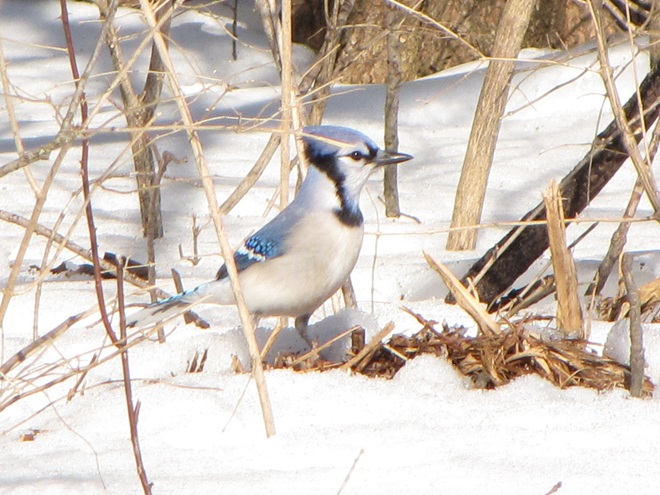
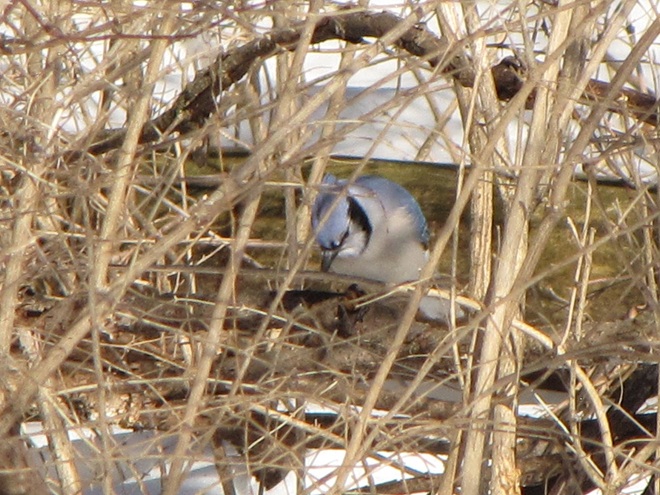
Blue Jay
We watched this Blue Jay digging to retrieve an acorn from beneath the tuft of leaves and dried grasses where it had apparently concealed it earlier in the season.
Blue Jay Eating Acorn
It then carried it to a nearby limb and chiseled away the husk to devour the nutritious contents.  Blue Jays are known to cache hundreds or even thousands of seeds, nuts, and acorns for winter consumption.  Want to see it for yourself?  Just put out some unshelled no-salt peanuts and watch the jays haul them away, that is if the hoarding squirrels don’t get them first!
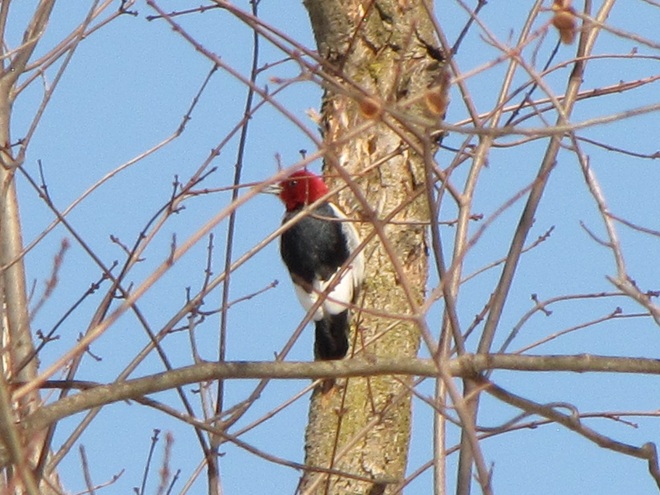
Red-headed Woodpecker
Like other members of the Picidae family, Red-headed Woodpeckers pry and chisel away at decaying and insect-infested trees to find food during the winter.
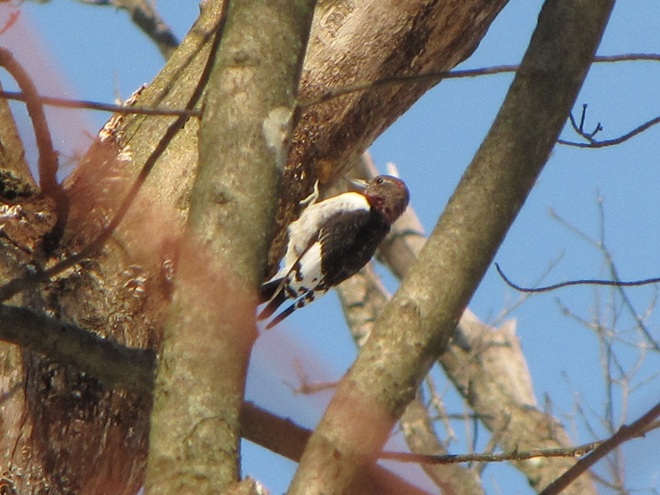
First-winter Red-headed Woodpecker
Like jays, Red-headed Woodpeckers including this first-winter bird are very fond of acorns and will often collect them from the ground.  And like jays, they’ll cache acorns for use as a backup supply when a blanket of snow may prevent them from gathering those that remain beneath the oaks.
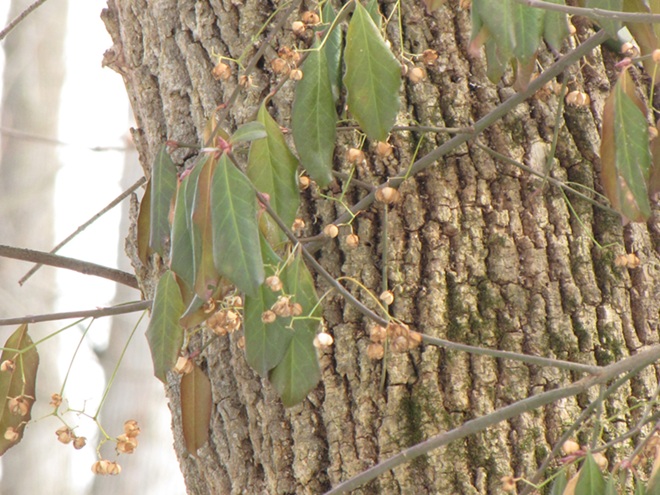
Wintercreeper
Native to eastern Asia, Wintercreeper (Euonymus fortunei) has escaped from mostly urban cultivation to become naturalized and often invasive in some wooded areas of the lower Susquehanna River watershed.  It can be quite aggressive, usually found growing as a climbing vine or less frequently as a shrub.  In the absence of native and more palatable foods, the berries are an attractive survival fare for members of the Turidae (thrush) family and other birds.
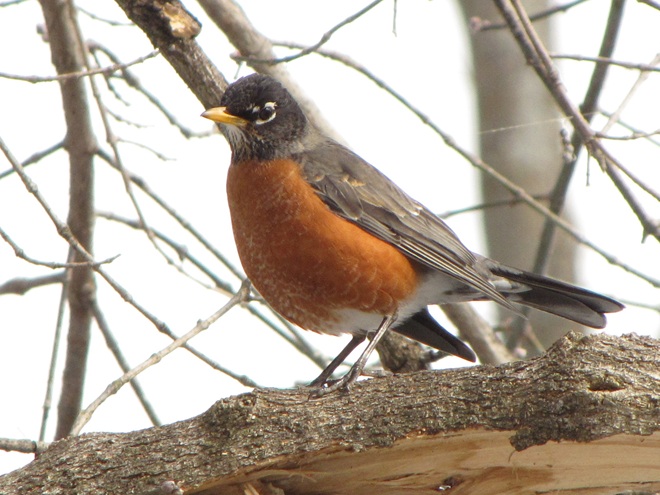
American Robin
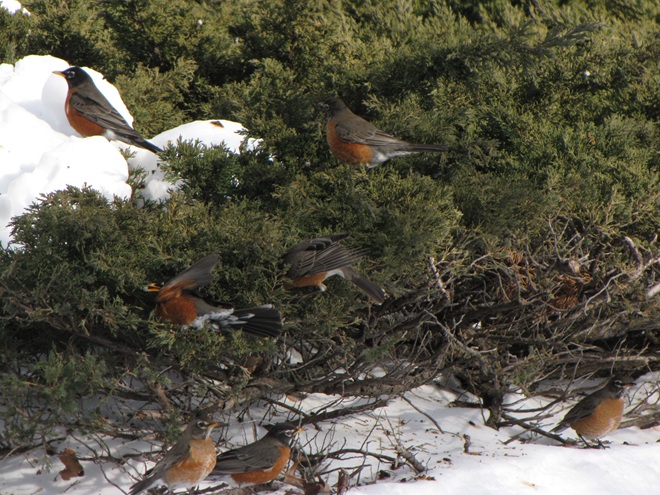
We found this and several hundred more American Robins surviving the current winter weather while feeding on Wintercreeper in a suburban woods with a heavy growth of the invasive plant.
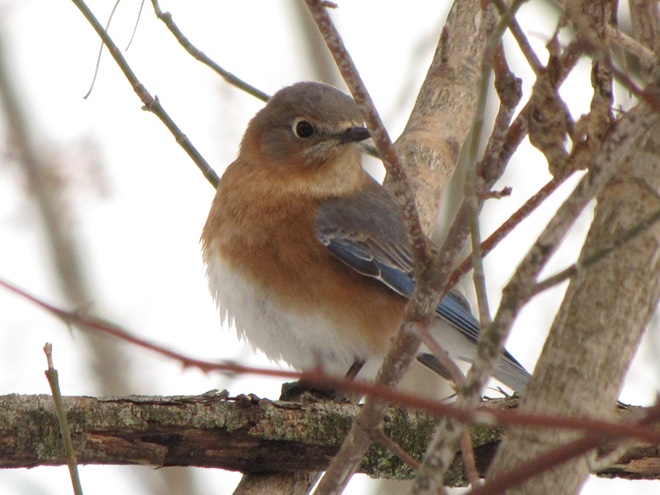
Eastern Bluebird
Several Eastern Bluebirds were seen among the Wintercreeper tangles as well.  They too are relying upon this non-native plant to provide at least a portion of the energy they need to make through blustery February nights.
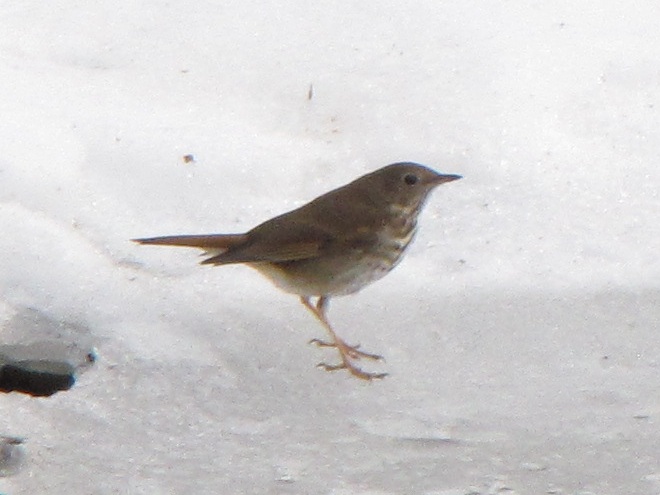
Hermit Thrush
The Hermit Thrush, a species that nests in the coniferous and mixed forests of the northern United States and Canada, winters sparingly in the lower Susquehanna valley.  We found this one among the robins and bluebirds of the Wintercreeper thicket where it too was probably attracted by the supply of berries.
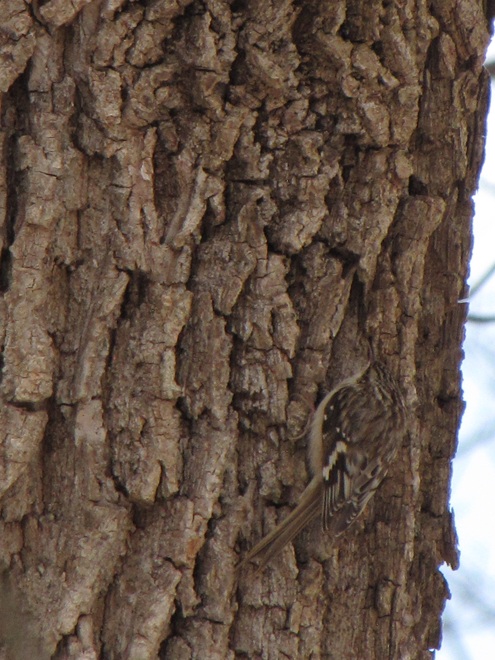
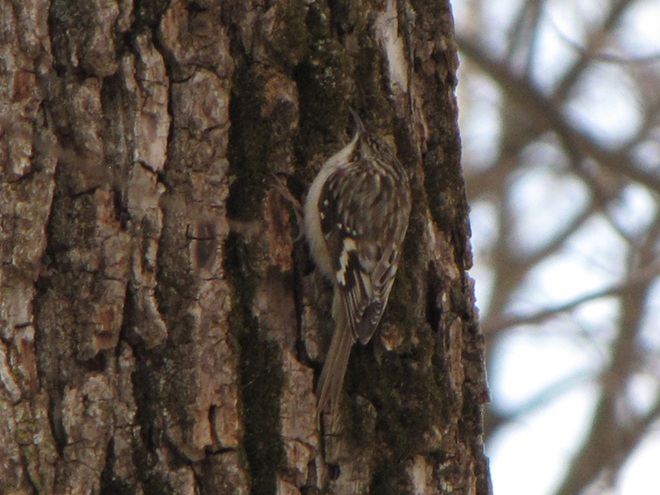
Brown Creeper
Frequently escaping notice in the winter woods is the Brown Creeper, another species that nests primarily in coniferous and mixed forests to our north, though it does breed in our area at scattered locations, primarily in mountainous or swampy terrain.
Brown Creeper
As their name suggests, Brown Creepers spend nearly all of their time creeping along the bark of mature trees searching for small insects, spiders, and other arthropods and their eggs.  The creeper’s diet changes little with the seasons, but you may occasionally see them visit your bird feeders in winter for a nip of suet.
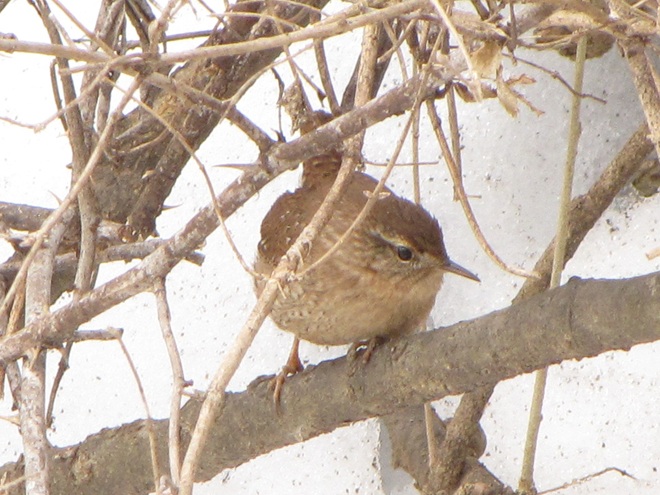
Winter Wren
The petite Winter Wren exhibits mouse-like behavior as it hops and crawls among logs, rocks, and brush along the banks of wooded waterways.  Like the creeper, it is primarily an insectivore, spending much of its time escaping notice searching beneath streamside structure for its daily nourishment.  In summer, Winter Wrens nest in damp coniferous forests.
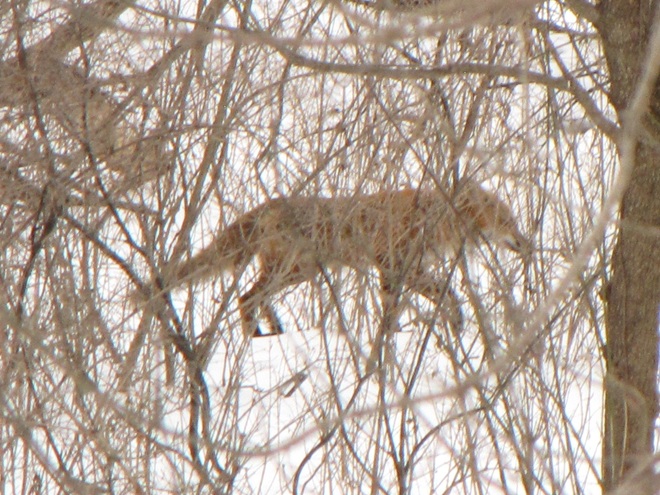
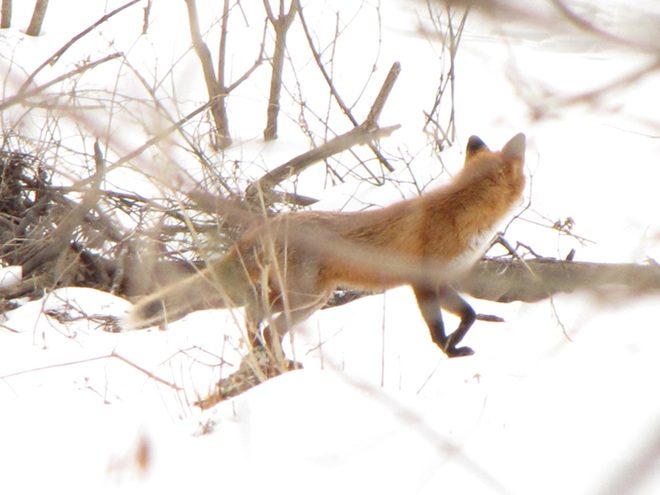
Red Fox
Seeing a Red Fox repeatedly during daylight hours is typically considered to be a sign that one may be observing a diseased animal, but we soon determined that there was nothing at all wrong with this vulpid we found patrolling a large woodland lying along the outskirts of a lower Susquehanna city.
Red Fox
Typically when the ground is covered with snow, a Red Fox will hunt for voles or mice by listening for their movements in the runways below, then leaping and pouncing to plunge snout first into the fluff to grab the pinpointed prey.  But the recent rain-soaked snow which is now frozen rock hard prohibits the usual hunting tactic, so this canine has adapted to current conditions.
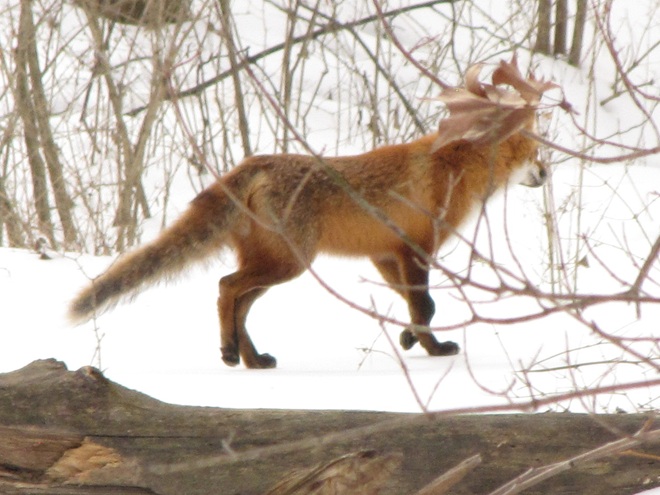
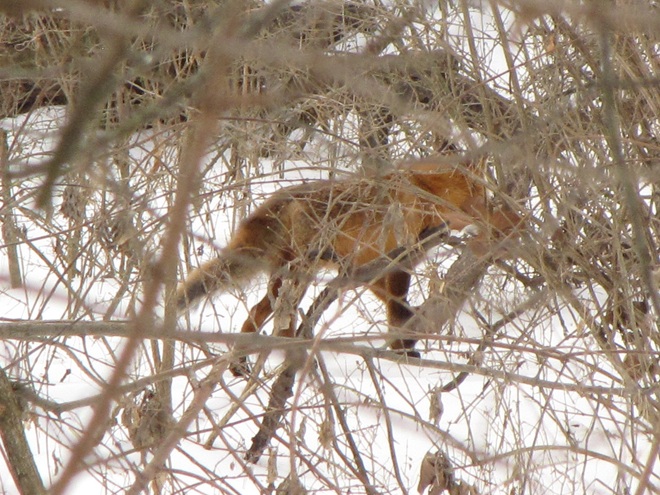
Red Fox
It has switched from its habitually nocturnal schedule to a day shift in pursuit of a diurnal species of prey rodent which can currently be found in abundance at ground level.  After about forty minutes of watching this fox dart back and forth through the understory growth without ever paying much attention to us, we became certain of its target when the alarm chatter turned to a series of screams as one of the numerous Eastern Gray Squirrels that had been scurrying around fell into the fox’s grip.
Red Fox
Just as suddenly as it had begun, our Red Fox encounter ended as our visitor opted to carry away its quarry and dine in peace.  From all appearances, this particular fox’s only ailment was hunger.  By adapting to prevailing conditions, it was able to fully utilize its opportunistic feeding traits and may thus survive to pass on these qualities to the next generation of Red Foxes.  As for the squirrel, it exhibited a vulnerability that led to its demise.  This vulnerability will not be passed on to a future generation of squirrels.  Though it may run counter to public perception and understanding, the event strengthens local populations of both native species.  And so it goes.

To Stave Off Starvation, Nip It in the Bud

It looks like the worst of the cold may be behind us.  With temperatures trending upwards during the coming days and weeks, some species of wildlife will soon find their search for food made a whole lot easier.

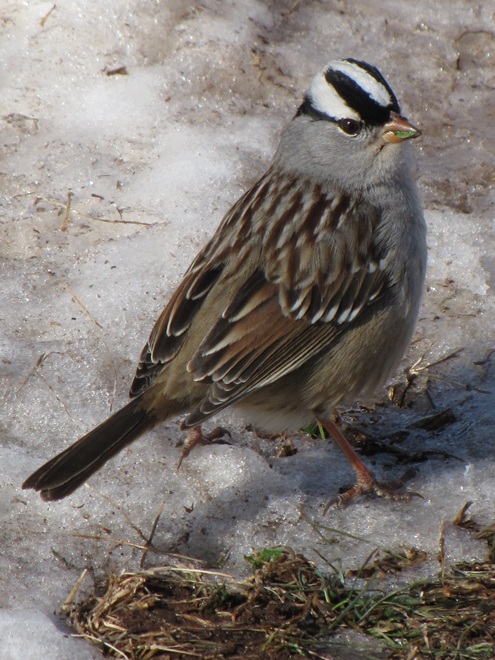
White-crowned Sparrow
White-crowned Sparrows spend the winter seeking shelter in dense tangles of early successional growth, particularly among thorny shrubs and vines.  Extended periods with snow cover can  make their search for food a real challenge, but we spotted this one hitting the jackpot on a bare patch of sun-drenched ground along the edge of a thicket of briars.  It has found the earliest green buds of a clover or other herbaceous plant.  Many songbirds in the finch, cardinal, and sparrow families turn to buds in late winter and early spring as a source of energy-rich sugars.
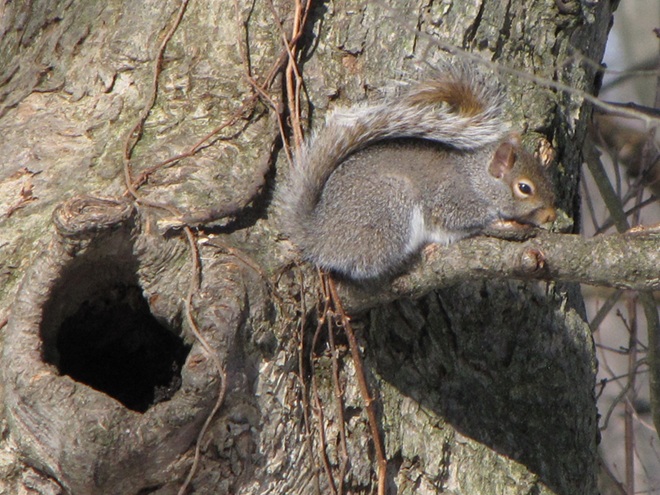
Eastern Gray Squirrel
In woodlands, sweet sap will soon swell the buds of maples, much to the delight of Eastern Gray Squirrels whose favorite dining spot will suddenly become the treetops instead of the leaf litter.  Often selected by property owners for their colorful autumn foliage and fast growth, the prevalence of both native and non-native maples in the suburban landscape helps more squirrels survive the winter to expand their numbers in the spring.
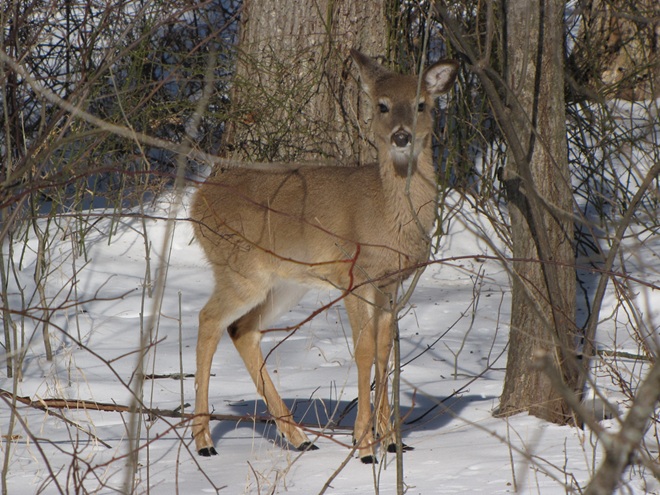
White-tailed Deity
Nibbling late-winter buds is a daylong pastime for the hungry White-tailed Deity.  While high-intensity twig browsing can alter forest ecology and practically eliminate understory growth and regeneration, bud snacking only tends to make some of the trees more stout than others.  It’s similar to the trimming and snipping a bonsai artist may do to maintain a  prized specimen.
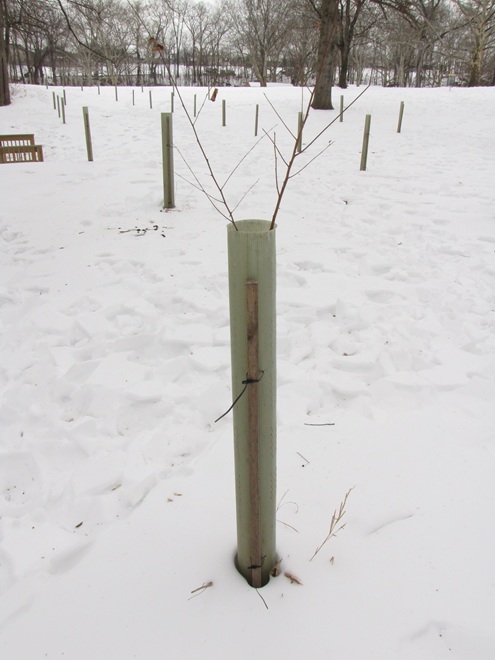
Tree Shelters Protecting Saplings
Those of you installing stream buffers or reforesting all or part of your property may not want your newly planted trees turned into bonsai or lost entirely to hungry ungulates.  If you’re seeking some relief from a browsing problem, you’ve got to nip it in the bud.  Tree shelters offer protection during the first half a decade or more of your sapling’s new life.  You can find these tubes for sale from many online sources including some of the local county conservation districts during their annual spring tree sales (which happen to be underway right now, hint-hint).  Installing these plastic protectors may not only relieve you from the frustration of worrying about your new trees, it might also excuse you from risking involvement in the sometimes heated quarrel between the worshipers of the White-tailed Deity who practice sacrifice and those who religiously oppose it.

An Intermission Between Deep Freezes

With another round of single-digit and possibly sub-zero temperatures on the way, birds and other wildlife are taking advantage of a break in the extreme conditions to re-energize.  During the past day, these species were among those attracted to the food and cover provided by the habitat plantings in the susquehannawildlife.net headquarters garden…

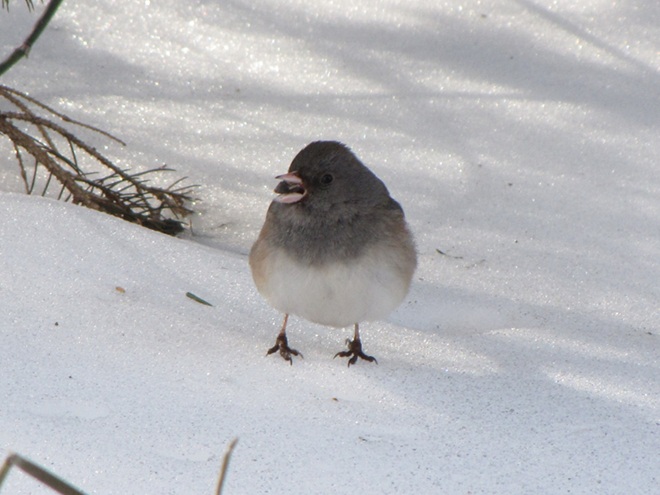
Dark-eyed Junco
Dark-eyed Juncos, one of our numerous species of native sparrows, are sometimes called “snowbirds”, and for good reason.  They spend the majority of their time on the ground searching for seeds and are particularly noticeable when the landscape is blanketed in white.
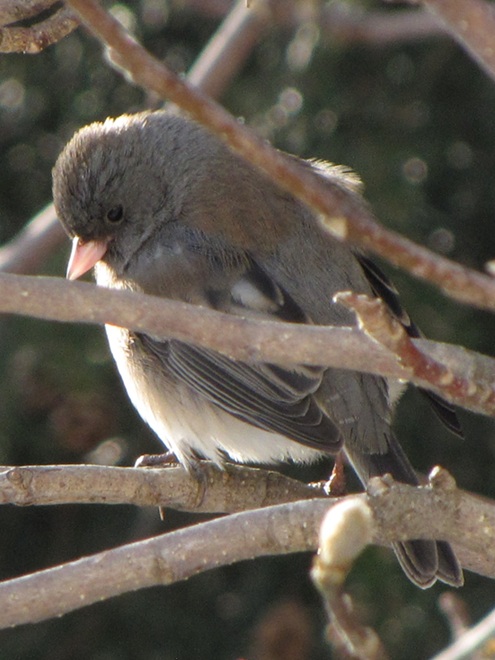
Dark-eyed Junco
Juncos are seldom seen far from trees, shrubs, and brushy patches of herbaceous growth where they can find both the foods and the protective cover they need to survive the cold.
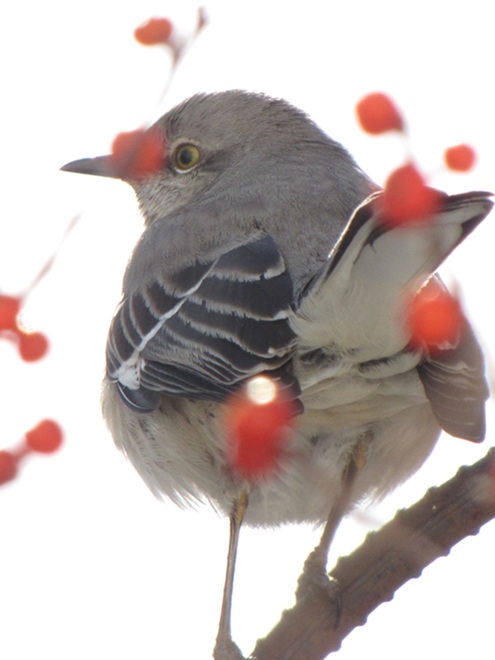
Northern Mockingbird
To make it through the winter, a Northern Mockingbird is again defending the garden’s supply of fruits adorning Common Winterberry, American Holly, and Eastern Red Cedar.  Robins, starlings, waxwings, and bluebirds must be stealthy and quick if they want to grab a snack before the ever-alert mockingbird aggressively moves them on their way.
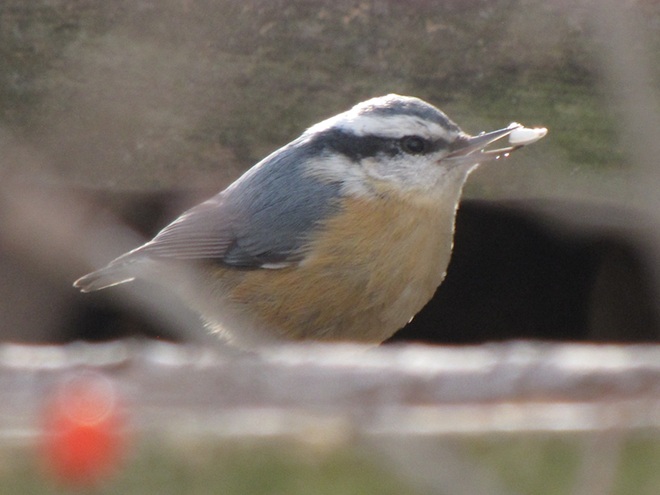
Red-breasted Nuthatch
As they mature, our plantings of junipers, hollies, Eastern Hemlock, Norway Spruce, and Eastern White Pine offer the environs needed by evergreen-loving species like this Red-breasted Nuthatch to remain as winter residents instead of just seasonal transients. 

In the Frozen Foods Aisle

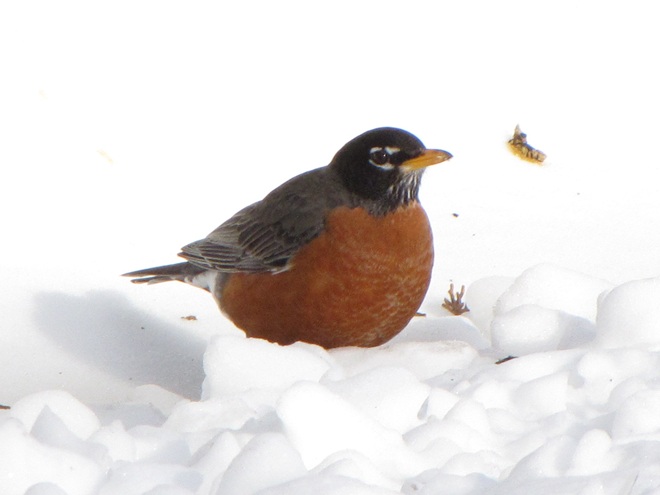
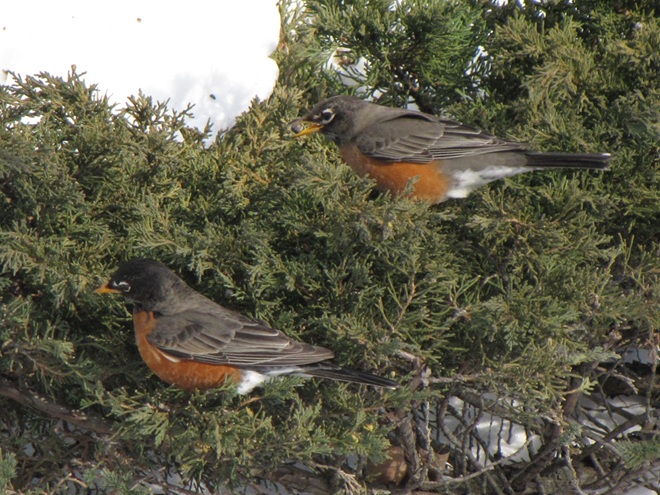
For overwintering birds and other animals, finding enough food is especially difficult when there’s snow on the ground.  And nighttime temperatures in the single digits make critical the need to replenish energy during the daylight hours.  Earlier this afternoon, we found these American Robins seizing the berry-like cones from ornamental junipers in a grocery store parking lot.  It was an urgent effort in their struggle for survival.

American Robin
A hungry American Robin at the local Weis Market.
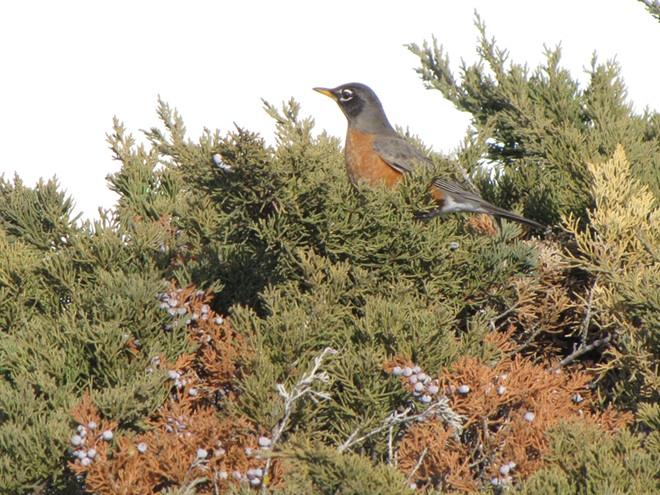
American Robin on Juniper
Though seldom considered ideal wildlife plants, low-growing ornamental junipers often produce an abundance of seed-containing cones that resemble berries.
American Robins Eating Juniper
In a pinch, they’ll attract dozens of robins and other fruit-eating birds as a quick source of nourishment on a windy, bitter-cold day.
American Robins Feeding on Juniper "Berries"
After all, these landscape shrubs are often derived from native species including the Creeping Juniper (Juniperus horizontalis) of Canada and the northernmost United States, a plant resembling a recumbent version of the local Eastern Red Cedar (Juniperus virginiana) with which these birds are quite familiar.

County conservation district offices will soon be taking orders for their spring tree sales.  Be sure to load up on plenty of the species that offer food, cover, and nesting sites for birds and other wildlife.  These sales are an economical way of adding dense-growing clusters or temperature-moderating groves of evergreens to your landscape.  Plus, selecting four or five shrubs for every tree you plant can help establish a shelter-providing understory or hedgerow on your refuge.  Nearly all of the varieties included in these sales produce some form of wildlife food, whether it be seeds, nuts, cones, berries, or nectar.  Many are host plants for butterflies too.  Acquiring plants from your county conservation district is a great opportunity to reduce the amount of ground you’re mowing and thus exposing to runoff and erosion as well!

Maybe They’ll Stay, Maybe They Won’t

Here are a few more late-season migrants you might currently see passing through the lower Susquehanna valley.  Where adequate food and cover are available, some may remain into part or all of the winter…

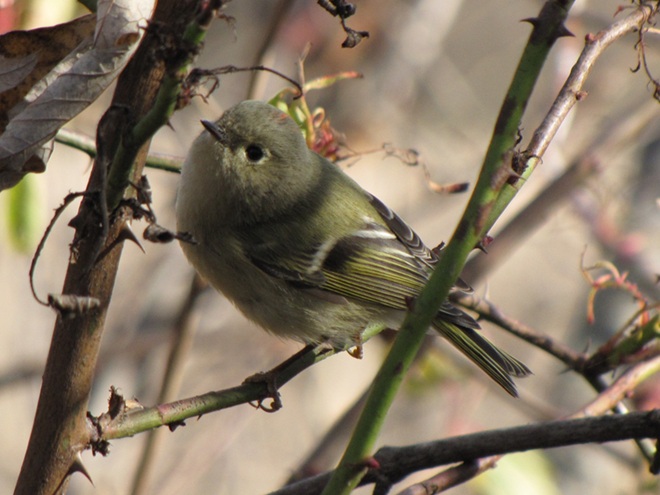
Ruby-crowned Kinglet
During the summer, Ruby-crowned Kinglets nest in northern coniferous forests.  Through the colder months, these petite songbirds can often subsist on tiny insects and other invertebrates found among the bark, limbs, and buds of leafless deciduous trees and shrubs.  In our region, look for wintering kinglets in woodlands that include at least a small percentage of evergreens to provide protection from frigid nighttime temperatures.
Yellow-bellied Sapsucker
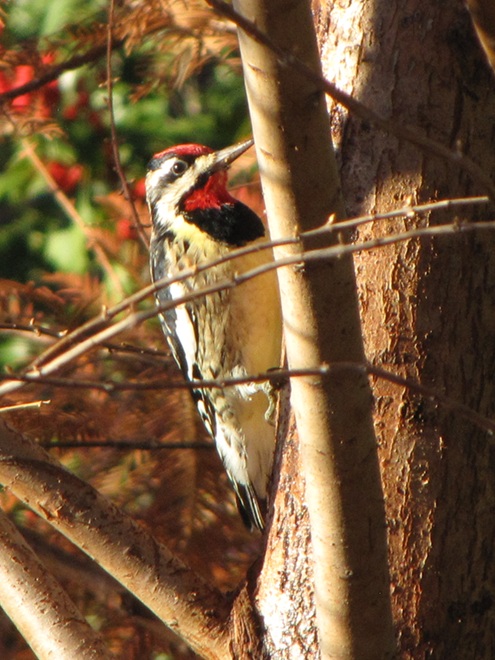
The Yellow-bellied Sapsucker is our shiest of woodpeckers.  These migrants are still quite common among stands of deciduous and mixed woods, but local numbers will soon decrease as the majority of the population continues moving along to the forests of the southeastern United States for winter.
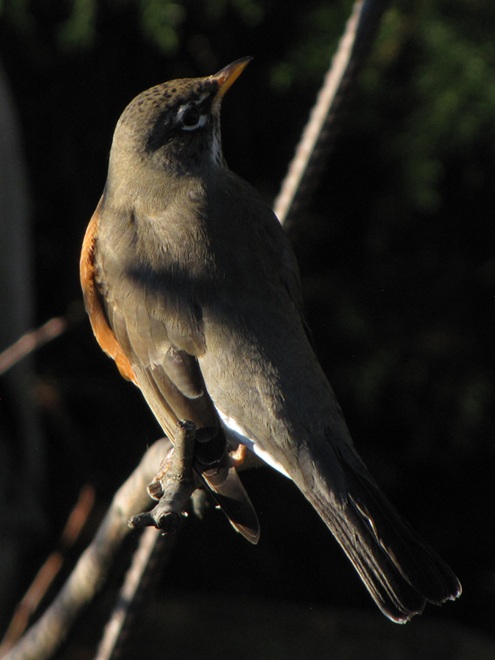
American Robin
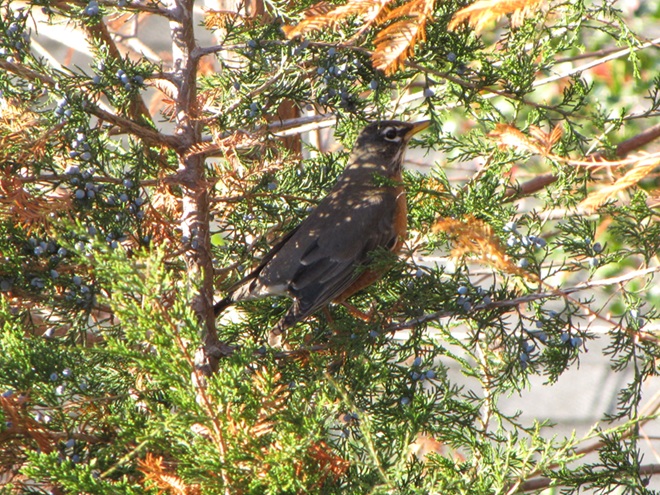
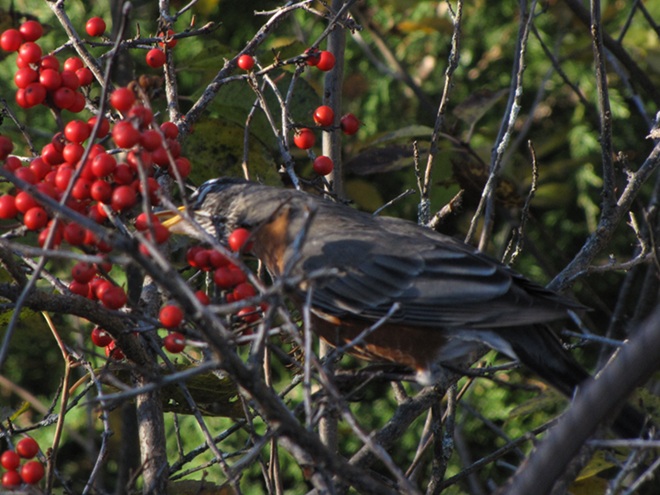
Migrating American Robins are still transiting region, but an abundance of wild fruits can prompt hundreds to linger through winter.  Look for them near supplies of wild grape, Poison Ivy, dogwood, Virginia Creeper, hackberry, hawthorn, American Holly,…
American Robin
…Eastern Red Cedar,…
American Robin
…and Common Winterberry.
Red-shouldered Hawk
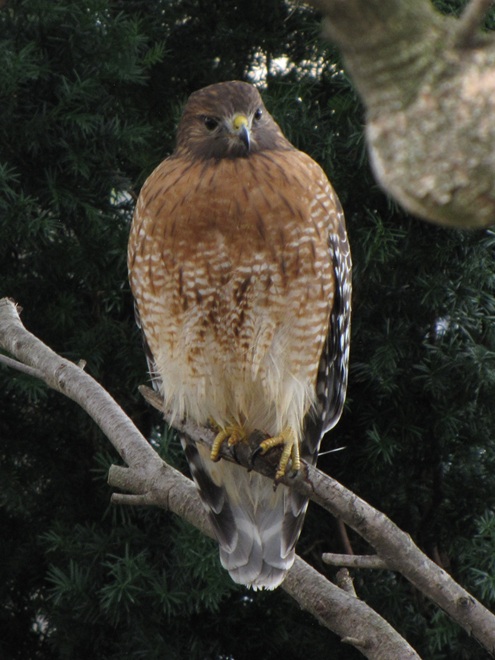
In case you were wondering…Yes, the adult Red-shouldered Hawk continues to visit the garden pond at susquehannawildlife.net headquarters.  Earlier today, we watched it plunge into the shallows after a Green Frog.  We’re enjoying the privilege of having it around, so we hope it decides to remain for as long as the food supply is accessible. 

Leaf ID

Out and about doing some autumn “leaf peeping” this week?

Well, you’ll certainly want to check out Uncle Tyler Dyer’s fall foliage collection to help identify your finds…

Click the Trees, Shrubs, and Woody Vines tab at the top of this page to take a leap over to Uncle Ty’s leaf spectacular!

Robinson’s Invasion

As we begin the second half of October, frosty nights have put an end to choruses of annual cicadas in the lower Susquehanna valley.  Though they are gone for yet another year, they are not forgotten.  Here’s an update on one of our special finds in 2025.

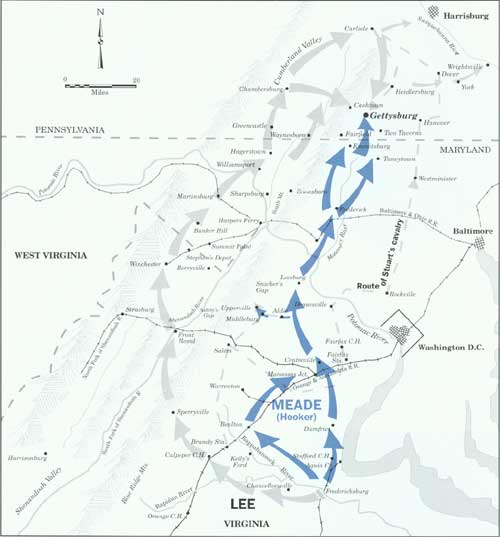
During late June of 1863, the beginning of the third summer of the American Civil War, there was great consternation among the populous of the lower Susquehanna region.  Hoping to bring about Union capitulation and an end to the conflict, General Robert E. Lee and his 70,000-man Army of Northern Virginia were marching north into the passes and valleys on the west side of the river.  The uncontested Confederate advances posed an immediate threat to Pennsylvania’s capital in Harrisburg and cities to the east.  Marching north in pursuit of Lee was the First Corps of the Army of the Potomac, the lead element of the 100,000-man Union force under the direction of newly appointed commander General George G. Meade.

Upon belatedly learning of Meade’s pursuit, Lee hastily ordered the widely separated corps of his army to concentrate on the crossroads town of Gettysburg.  As the southern army’s Third Corps under General A. P. Hill approached Gettysburg from the west, they were met by Union cavalry under the leadership of General John Buford.  Dismounted and formed up south to north across the Chambersburg Pike, Buford’s men held off Confederate infantry until relieved by the arrival of the Union First Corps.  As he deployed his men, the First Corps’ commander, General John F. Reynolds of Lancaster, was struck by a bullet and killed.

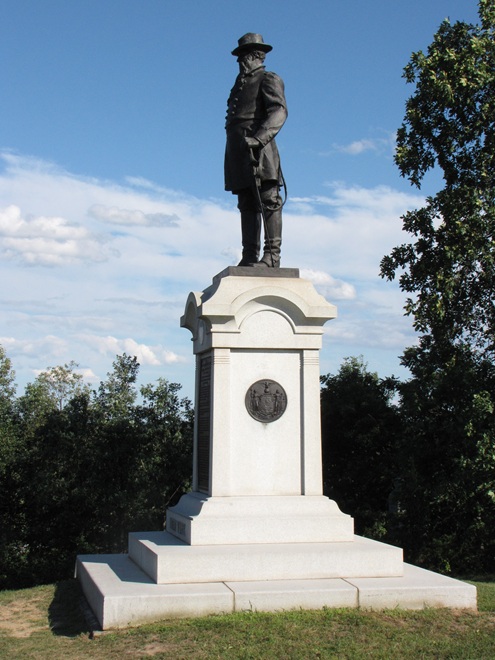
General John C. Robinson Monument at Gettysburg
During the first day’s fighting at Gettysburg on July 1, 1863, the northernmost position in the Union First Corps’ line was held by its Second Division commanded by General John C. Robinson.  His men would defend their right flank against attacks from Confederate General Richard S. Ewell’s Second Corps as they arrived from the north to face off against the Union Eleventh Corps which had arrived to take positions north of the town.  During the afternoon, upon becoming outnumbered and overwhelmed, the Union forces would retreat south through the town to take up positions on Cemetery Hill by nightfall.  Deployments extending south and east of Cemetery Hill would ultimately prove victorious for Union forces during the battle’s final day on July 3.
John C. Robinson’s Second Division “invaded” Pennsylvania as one of Meade’s lead elements charged with intercepting Lee’s Confederate Army.  (National Park Service image)

If you visit the Gettysburg battlefield, you can find the General John C. Robinson monument at the site of his division’s first-day position along Doubleday Avenue at Robinson Avenue near the Eternal Light Peace Memorial.  But that’s not the Robinson we went to Gettysburg to see.

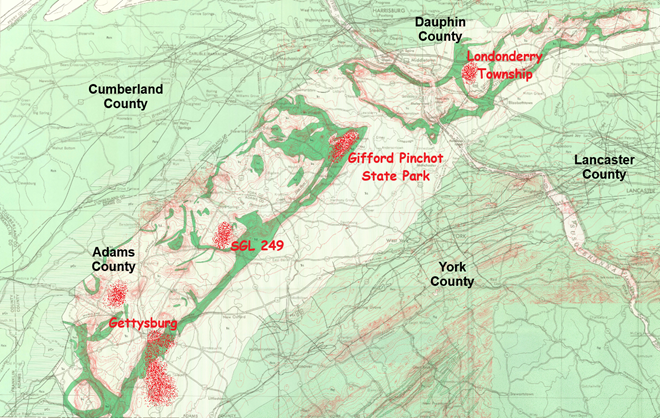
Following up on our sight and mostly sound experiences with some Robinson’s Cicadas, an annual species of singing insect we found thriving at Gifford Pinchot State Park in York County, Pennsylvania, during late July, we spent some time searching out other locations where this native invader from the southern United States could be occurring in the Lower Susquehanna River Watershed.

During mid-August, we stumbled upon a population of Robinson’s Cicadas east of the Susquehanna in the Conewago Creek (east) watershed in Londonderry Township, Dauphin County, and made some sound recordings.

After pondering this latest discovery, we decided to investigate places with habitat characteristics similar to those at both the new Londonderry Township and the earlier Gifford Pinchot State Park locations—successional growth with extensive stands of Eastern Red Cedar on the Piedmont’s Triassic Gettysburg Formation “redbeds”.  We headed south towards known populations of Robinson’s Cicadas in Virginia and Maryland to look for suitable sites within Pennsylvania that might bridge the range gap.

Our search was a rapid success.  On State Game Lands 249 in the Conewago Creek (west) watershed in Adams County, we found Robinson’s Cicadas to be widespread.

Robinson's Cicada Habitat
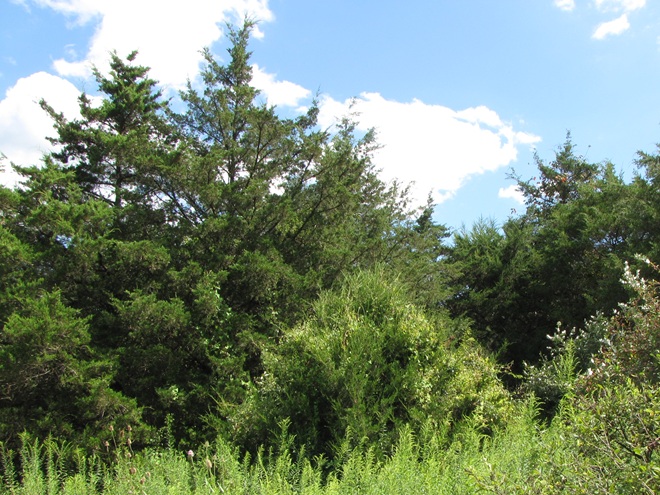
Eastern Red Cedar, a probable host tree for Robinson’s Cicada nymphs, among successional growth on State Game Lands 249.  Cedar thickets often become established on shallow or depleted soils on lands originally cleared for farming.  They provide excellent cover as well as much needed breeding and feeding areas for birds, mammals, insects, and other wildlife.
Robinson's Cicada
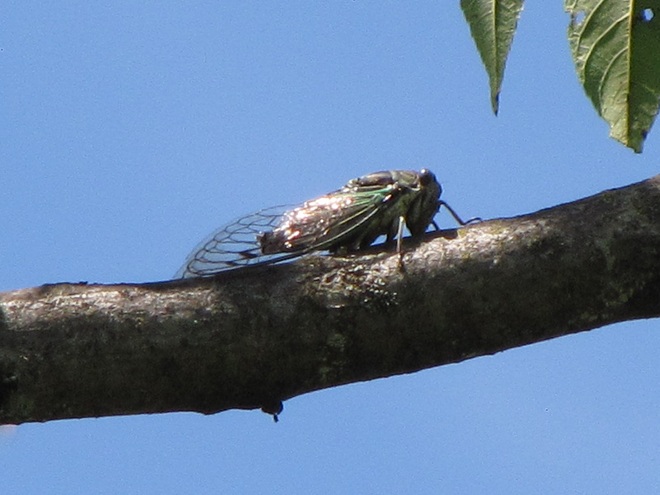
A male Robinson’s Cicada singing at State Game Lands 249 in Adams County, Pennsylvania.

Following our hunch that these lower Susquehanna Robinson’s Cicadas extended their range north through the cedar thickets of the Gettysburg Basin as opposed to hopping the Appalachians from a population reported to inhabit southwest Pennsylvania, we made our way to the battlefield and surrounding lands.  We found Robinson’s Cicadas to be quite common and widespread in these areas, even occurring in the town of Gettysburg itself.

Robinson's Cicada Range in Central Pennsylvania
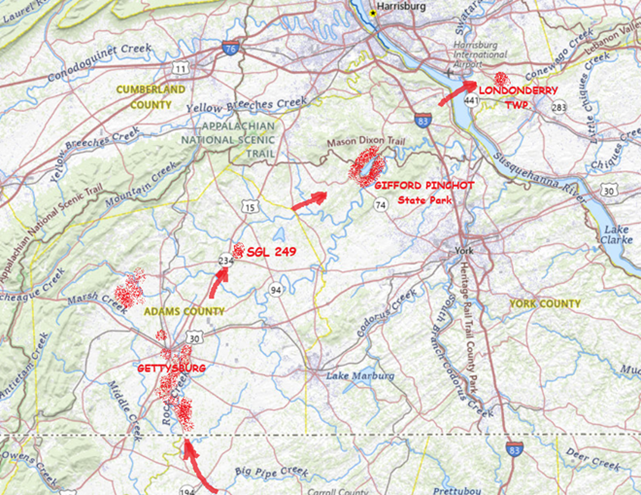
Populations of Robinson’s Cicadas (red) in the lower Susquehanna valley and adjacent areas of the Potomac watershed near Gettysburg.  The Triassic Gettysburg Basin is shown in white with intrusions of igneous Triassic-Jurassic diabase in dark green.  (United States Geological Survey base image)
Robinson's Cicada Habitat on Gettysburg Battlefield
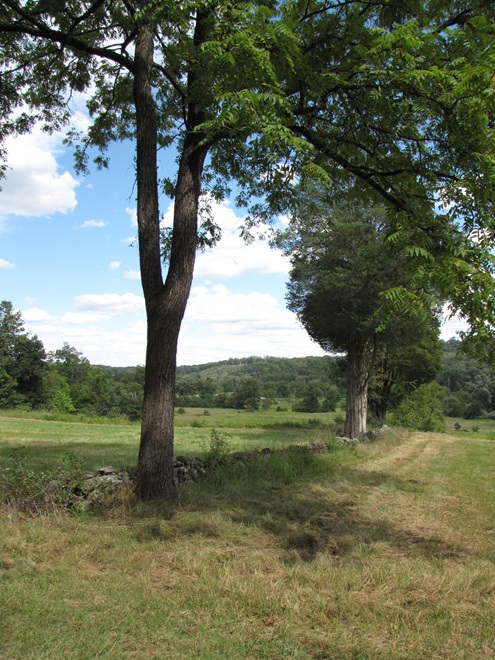
Robinson’s Cicadas are common on much of the Gettysburg National Military Park property, particularly in the southern reaches where outlying areas are dense with Eastern Red Cedar growth to within several miles of the Mason-Dixon Line.  In these tall walnuts and cedars along Confederate Avenue (that’s Little Round Top and its diabase boulders in the background) we recorded the following sound clip of a singing male.
Robinson’s Cicada probably extended its range into the lower Susquehanna valley in much the same way General John C. Robinson and the rest of the Army of the Potomac marched into Pennsylvania to meet Lee’s Confederates, by following the terrain of the Triassic Gettysburg Basin.  Got a big stand of cedars near you?  Be sure to have a listen for Robinson’s Cicadas next summer!  (United States Geological Survey base image)

Changes Following the Season’s First Frost

Having experienced our first frost throughout much of the lower Susquehanna valley last night, we can look forward to seeing some changes in animal behavior and distribution in the days and weeks to come.  Here are a few examples…

Northern Rough-winged Swallows
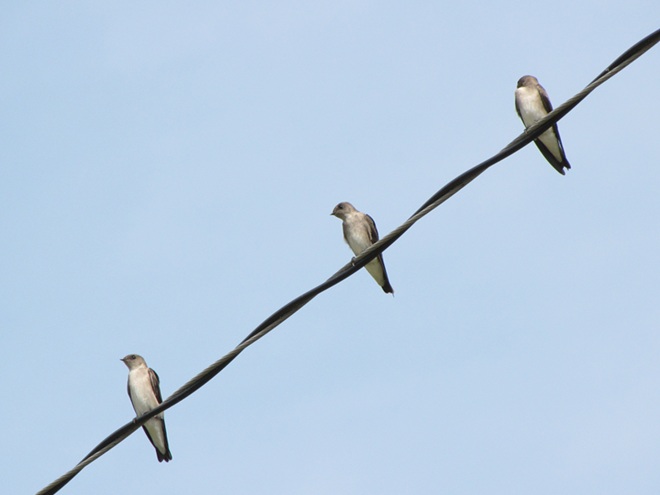
Unlike their close relatives the Tree Swallows, which include berries as well as invertebrates in their diet, Northern Rough-winged Swallows are strictly insectivores and will find it necessary to promptly move south to assure a frost-free environment where they can secure an adequate supply of food.  Their one alternative: find a local sewage treatment plant where warm water attracts populations of flying insects through the remainder of autumn and maybe into winter.
Yellow-rumped Warbler
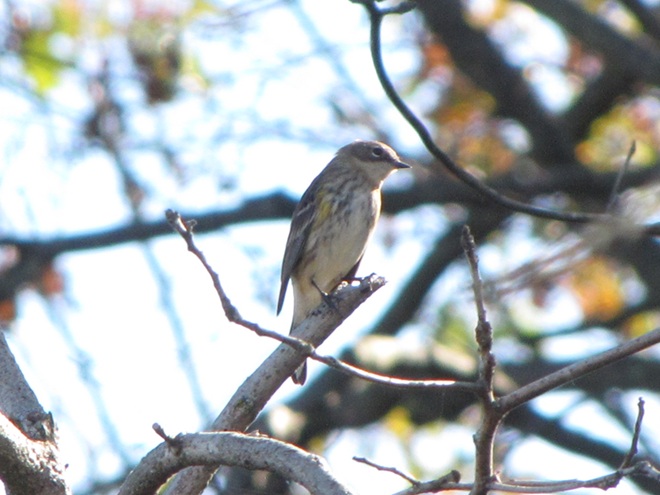
Warblers too are insect eaters.  Look for most of our dozens of species to evacuate the area in coming days and leave behind only the Yellow-rumped Warbler, another bird with a fondness for berries during cold weather.   Into the winter months, they remain in small numbers in habitats with an abundant supply of berries like Poison Ivy, holly, wild grape, bittersweet, and Eastern Red Cedar.  For lingering Yellow-rumped Warblers, thickets of cedars and other evergreens provide essential protection from frigid nighttime winds.
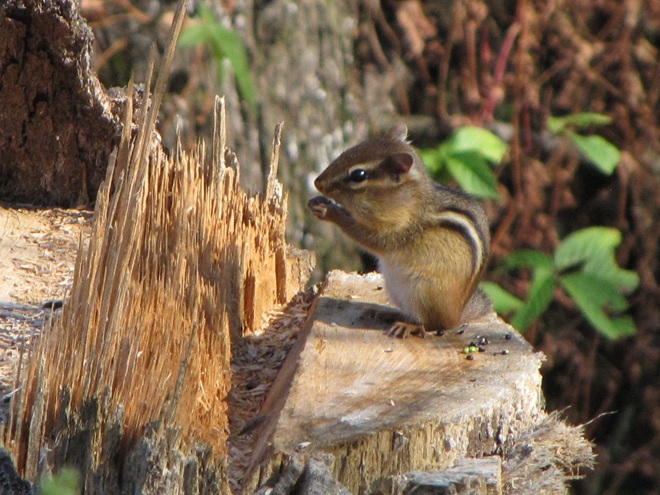
Eastern Chipmunk
This Eastern Chipmunk will soon feel the pinch.  Instead of eating the sweet, fruity portions of Mile-a-minute Weed berries, it’ll have to get serious about stocking its den with larger seeds, acorns, hickory nuts, and other foods to snack on through the winter.  Better get busy, little friend!

Tropical Treats and an Early Surprise

Crisp cool nights have the Neotropical birds that visit our northern latitudes to nest during the summer once again headed south for the winter.

Flying through the night and zipping through the forest edges at sunrise to feed are the many species of migrating vireos, warblers, and other songbirds.

Tennessee Warbler
A Tennessee Warbler peers from the cover of a Staghorn Sumac (Rhus typhina), a small native tree which is not, as many assume, a poisonous plant.  Staghorn Sumac is in fact an excellent wildlife species with brilliant autumn colors.
Yellow-throated Vireo
Though its breeding season has come to an end, this southbound Yellow-throated Vireo was found singing its heart out in the limbs of a Staghorn Sumac early this morning.
Northern Parula
Not to be outdone, this Northern Parula joined in with a cheery tune from yet another Staghorn Sumac.
Black-throated Green Warbler
Black-throated Green Warblers are particularly numerous right now.  To see them, visit a ridgetop forest clearing at sunrise.

As the nocturnal migrants fade into the foliage to rest for the day, the movement of diurnal migrants picks up the pace.

Ruby-throated Hummingbird
Southbound flights of Ruby-throated Hummingbirds are reaching their peak this week with chilly temperatures hustling them along.  Remember to keep your feeders clean and your nectar fresh through at least early October; they may really need the supplemental energy.
Broad-winged Hawks
Migrating Broad-winged Hawks, sometimes traveling in large flocks known as kettles, seek out thermal updrafts to gain altitude before gliding away on a southwest heading bound for Houston, Texas.  Once there, they’ll make a turn to the south and follow the gulf coastline toward the tropics for winter.
Broad-winged Hawks
While passing through the lower Susquehanna valley in fall, Broad-winged Hawks can be seen ascending to greater heights above almost any sun-drenched surface including large parking lots or barren fields.  But to get your best look, visit a ridgetop hawk watch where these birds circle on the rising air created by solar heating of the south-facing slopes.
Sharp-shinned Hawk
While on the crest, you might notice that the Neotropicals aren’t the only bird species heading through.  Migrants like this Sharp-shinned Hawk are beginning to show up in increasing numbers with a peak expected in about two to three weeks.

To find a hawk-counting station near you, check out our “Hawkwatcher’s Helper: Identifying Bald Eagles and other Diurnal Raptors” page by clicking the tab at the top of this page.  And plan to spend some time on the lookout during your visit, you never know what you might see…

Second-year Golden Eagle
This very early Golden Eagle surprised observers at Second Mountain Hawk Watch in Lebanon County, Pennsylvania, this morning.  It appears to be an immature, more specifically a second-year bird beginning molt (replacing its innermost primaries), so it may not have traveled all the way to the eastern population’s breeding areas in northern Canada for the summer.  Instead, it may have wandered the vast wilderness hundreds of miles further south.  Expect to see these regal eagles more regularly when adults and hatch-year juveniles from the nesting region start passing through our area, primarily during the period between Halloween and Thanksgiving.  In the meantime, you’ll have time to check out our “Aging Golden Eagles” page by clicking the tab at the top of this page.

It’s Prime Time for Hummingbirds

Ruby-throated Hummingbird at Scarlet Bee Balm
Now that the nesting season is drawing to a close, Ruby-throated Hummingbirds are a bit less fussy about where they spend their time.  Even in urban settings, gardens with an abundance of nectar-producing flowers like this Scarlet Bee Balm (Monarda didyma) have a good chance of attracting them.  Hummingbirds will be wandering the landscape and starting to drift south during the coming two months, so keep your feeders clean and filled with a fresh blend of sugar water to keep them energized and happy.  If you’re feeding hummingbirds, or thinking about feeding hummingbirds, be sure to review the helpful tips contained in our post from August 5, 2022, “Two Feeders Are Better Than One”.  Their health and your peace of mind may depend on it.

Sorry, But We Have No Steamed Crabs Today

Goldenrod Crab Spider
Earlier today, we collected some mint leaves from the garden to make a batch of iced tea.  Just prior to plunging them into boiling water, we noticed this Goldenrod Crab Spider (Misumena vatia) hiding in the foliage.
Goldenrod Crab Spider
Goldenrod Crab Spiders live among the stems and leaves of flowering plants.  They are particularly fond of goldenrods, milkweeds, and other species that attract an abundance of flying insects.  When the plants bloom, the spiders will use their white or yellow coloration to hide among the petals and disks of the flowers.  From there, they ambush the visitors that stop by for a sample of nectar or pollen.  In an effort to lure prey directly into their clutches, these acrobatic arachnids will even dangle among the clusters of blossoms with their legs spread like petals surrounding their disk-like body.  This behavior helps inspire their other common name: Flower Crab Spider. 
Goldenrod Crab Spider
Needless to say, this crab was spared the pot and instead returned to the garden to help keep the plants healthy and ecosystem in balance in our wildflower patch.  So we’ll just be having tea, thank you.

Brood XIV Periodical Cicada Wrap Up

While the heat and humidity of early summer blankets the region, Brood XIV Periodical Cicadas are wrapping up their courtship and breeding cycle for 2025.  We’ve spent the past week visiting additional sites in and near the Lower Susquehanna River Watershed where their emergence is evident.

We begin in York County just to the west of the river and Conewago Falls in mostly forested terrain located just southeast of Gifford Pinchot State Park.  Within this area, often called the Conewago Hills, a very localized population of cicadas could be heard in the woodlands surrounding the scattered homes along Bull Road.  Despite the dominant drone of an abundance of singing Pharaoh Periodical Cicadas, we were able to hear and record the courtship song of a small number of the rare Little Seventeen-year Cicadas.  Their lawn sprinkler-like pulsating songs help mate-seeking males penetrate the otherwise overwhelming chorus of the Pharaoh cicadas in the area.

Little Seventeen-year Cicada
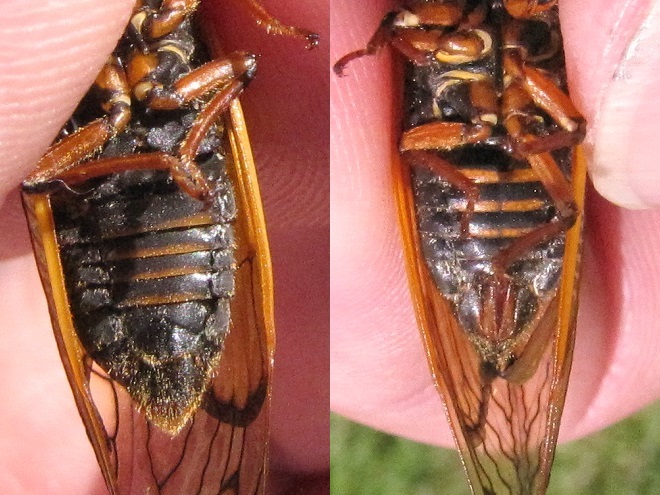
The Little Seventeen-year Cicada’s (Magicicada septendecula) thorax is black between the eye and the origin of the wings.  It is the rarest of the three species of seventeen-year cicadas.
Little Seventeen-year Cicada
The underside of male (left) and female (right) Little Seventeen-year Cicadas shows narrow orange edges on the abdominal segments.

From the Conewago Hills we moved northwest into the section of southern Cumberland County known as South Mountain.  Here, Pharaoh Periodical Cicadas were widespread in ridgetop forests along the Appalachian Trail, particularly in the area extending from Long Mountain in the east through Mount Holly to forests south of King’s Gap Environmental Education Center in the west.

Pharaoh Periodical Cicadas
Pharaoh Periodical Cicadas along the Appalachian Trail on South Mountain, Cumberland County, Pennsylvania.  Like the cicadas we visited last week on the east side of the Susquehanna, this population is surviving on lands with a history of timber harvest and charcoal production to fuel nearby iron furnaces during the nineteenth century.

While on South Mountain, we opted for a side trip into the neighboring Potomac watershed of Frederick County, Maryland, where these hills ascend to greater altitude and are known as the Blue Ridge Mountains, a name that sticks with them all the way through Shenandoah National Park, the Great Smoky Mountains, and to their southern terminus in northwestern Georgia.  We found a fragmented emergence of Pharaoh Periodical Cicadas atop the Catoctin Mountain section of the Blue Ridge just above the remains of Catoctin Furnace, again on lands that had been timbered to make charcoal to fuel iron production prior to their protection as vast expanses of forest.

Pharaoh Periodical Cicada
A Pharaoh Periodical Cicada on Catoctin Mountain near Catoctin Furnace south of Thurmont, Maryland.  These cicadas are not part of a Brood XIV emergence, but are instead a population of Brood X (2021) stragglers.
Pharaoh Periodical Cicada
A female Brood X Pharaoh Periodical Cicada straggler on Catoctin Mountain.  The website “cicadamania.com” notes, “Experts (Gaye Williams, State Entomologist of Maryland, John Cooley of UCONN) have confirmed that there will be no Brood XIV cicadas for Maryland.”

Back in Pennsylvania, we’re on our way to the watersheds of the northernmost tributaries of the lower Susquehanna’s largest tributary, the Juniata River.  There, we found Brood XIV cicadas more widespread and in larger numbers than occurred at previous sites.  Both Pharaoh and Cassin’s Periodical Cicadas were seen and heard along Jack’s Mountain and the Kishacoquillas Creek north of Lewistown/Burnham in Mifflin County.  To the north of the Kishacoquillas Valley and Stone Mountain in northernmost Huntingdon County, the choruses of the two species were again widespread, particularly along the forest edges in Greenwood Furnace State Park, Rothrock State Forest, and adjacent areas of the Standing Stone Creek watershed.

Tymbal on the male Pharaoh Periodical Cicada
A view of the sound-generating tymbal on a male Pharaoh Periodical Cicada at Greenwood Furnace State Park.  Rapid vibration of the tymbals by a set of specialized muscles generates the distinctive calls and courtship songs of the various cicada species.  When handled, these tymbals can produce a harsh “panic call”.  This distress sound could startle a would-be predator and provide the cicada with an opportunity to escape.
Tymbal on a Cassin's Periodical Cicada
The sound organs comprised of ribbed tymbals and specialized muscles on the male Cassin’s Periodical Cicada generate a “panic call” as well as the distinctive calls and songs used to penetrate the droning choruses of the more numerous Pharaoh Periodical Cicadas with which it shares a seventeen-year flight.
Cassin's Periodical Cicadas
Using their specialized sound organs, Cassin’s Periodical Cicadas generate a courtship song that usually includes buzzy phrases and ticking notes (first sound clip).  The buzzing and ticking helps the male Cassin’s cicada penetrate the songs of the more numerous Pharaoh Periodical Cicadas in the area (second sound clip).  When synchronized into a chorus that surges in volume, the songs of Cassin’s Periodical Cicadas can overcome the overwhelming drone of the nearby Pharaoh cicadas (third sound clip).
Pharaoh Periodical Cicada Depositing Eggs
After mating and before the lives of these seventeen-year cicadas draw to a close, the females need to deposit their fertilized eggs into the small end twigs of suitable trees.  On a small hawthorn tree (Cretaegus species) along the edge of the forest at Greenwood Furnace State Park, this Pharaoh Periodical Cicada is using her ovipositor to make a slit in a twig and place her eggs.
Cassin's Periodical Cicada Ovipositing
Simultaneously on the same little hawthorn tree, this female Cassin’s Periodical Cicada is depositing her fertilized eggs.

Within the last 48 hours, we visited one last location in the Lower Susquehanna River Watershed where Brood XIV Periodical Cicadas have emerged during 2025.  In the anthracite coal country of Northumberland County, a flight of Pharaoh Periodical Cicadas is nearing its end.  We found them to be quite abundant in forested areas of Zerbe Run between Big and Little Mountains around Trevorton and on the wooded slopes of Mahanoy Mountain south of nearby Shamokin.  Line Mountain south of Gowen City had a substantial emergence as well.

Pharaoh Periodical Cicada
A Brood XIV Pharaoh Periodical Cicada near Zerbe Run west of Trevorton, Northumberland County, Pennsylvania.  The following sound clip features the fading chorus of these cicadas and some of the nesting birds that may actually be preying upon them: Yellow-billed Cuckoo, Red-eyed Vireo, and Northern Cardinal.   
Foliage with Evidence of Ovipositing
Brown leaves reveal the end twigs where female Pharaoh Periodical Cicadas have deposited eggs during the last several weeks.  During July, the larvae will hatch and drop to the ground to start a new generation of Brood XIV cicadas.  As subterranean nymphs, they’ll spend the coming seventeen years feeding on small amounts of xylem sap from tree roots.  In 2042, during the next Brood XIV emergence, these nymphs will come to the surface and take flight as adults.
Foliage with Evidence of Ovipositing
Evidence of egg deposition among foliage on Line Mountain at State Game Lands 229.
Dead Pharaoh Periodical Cicadas
Accumulations of deceased Pharaoh Periodical Cicadas on Line Mountain.
Eastern Gartersnake
Fallen cicadas that show any sign of life are being snatched up by predators such as this Eastern Gartersnake (Thamnophis sirtalis sirtalis).  Meanwhile, the remainder of the biomass is picked apart by scavengers or is left to reducers for breakdown into fertilizer and organic matter for the forest.  Nothing goes to waste.

To chart our travels, we’ve put together this map plotting the occurrence of significant flights of Periodical Cicadas during the 2025 emergence.  Unlike the more densely distributed Brood X cicadas of 2021, the range of Brood XIV insects is noticeably fragmented, even in areas that are forested.  We found it interesting how frequently we found Brood XIV cicadas on lands used as sources of lumber to make charcoal for fueling nineteenth-century iron furnace operations.

Greenwood Furnace
The furnaces at Greenwood Furnace State Park required the daily cutting of one acre of timber to make enough charcoal to fuel the iron-making process.  Did keeping thousands of acres in various stages of forest succession to supply the charcoal needs of these operations aid the survival of earlier generations of Periodical Cicadas on these lands?  Or, after the furnaces converted to coal for fuel, did the preservation of many of these parcels as state, federal, and private forests allow the cicadas to find refuge from the widespread impacts of agriculture and expanding urbanization in adjacent lands?  Maybe it’s a little of both.  We always bear in mind that annual insects and other animals are more than one hundred generations removed from the negative or positive impacts of the early years of the industrial age, but only about ten generations have passed since populations of seventeen-year Periodical Cicadas were directly influenced by these factors.  What do you think?

Well, that’s a wrap.  Please don’t forget to check out our new Cicadas page by clicking the “Cicadas” tab at the top of this page.  Soon after the Periodical Cicadas are gone, the annual cicadas will be emerging and our page can help you identify the five species found regularly in the lower Susquehanna valley.  ‘Til next time, keep buzzing!

Brood XIV Periodical Cicadas in the Lower Susquehanna River Watershed

Here are some sights and sounds from the ongoing emergence of Brood XIV Periodical Cicadas in the Lower Susquehanna River Watershed.

We begin in the easternmost spur of the lower basin where a sizeable emergence of cicadas can be seen and heard in the woodlands surrounding the headwaters of the Conestoga River in Berks County north of Morgantown.  This flight extends east into Chester County and the French Creek drainage of the Schuylkill River watershed on State Game Lands 43 north of Elverson and consists of Pharaoh Periodical Cicadas (Magicicada septendecim), the most common species among 17-year broods.

Pharaoh Periodical Cicada
A Brood XIV Pharaoh Periodical Cicada at State Game Lands 43 identified by the red bar extending from the eye to the wing root.
Pharaoh Periodical Cicada
The underside of the abdomen on a male Pharaoh Periodical Cicada showing the wide orange bars on each segment.
Pharaoh Periodical Cicadas exuvia
Exuvia of a recently emerged Pharaoh Periodical Cicada.
Pharaoh Periodical Cicada singing
Soon after landing on a perch, a male Pharaoh Periodical Cicada will usually announce his presence by singing.  It’s an attempt to quickly attract potential mates that may be in the vicinity.
Pharaoh Periodical Cicadas
Pharaoh Periodical Cicadas ascending the branches of an oak.
Pharaoh Periodical Cicadas singing chorus
Gatherings of thousands of singing male Pharaoh Periodical Cicadas create a distinctive droning chorus.
Pharaoh Periodical Cicadas
A receptive female will make a click sound with her wings to summon a suitable singing male for mating.
Pharaoh Periodical Cicadas
While usually occurring in the safety of the trees, the breeding frenzy can spill over onto the ground where we happened to find this copulating pair.
Chestnut Oak Hosting Cicadas
After mating, female cicadas make slits in the end twigs of selected trees into which they lay their eggs.  The process of egg-laying and larval emergence will usually wilt and kill end growth on the affected branches, causing little harm to healthy trees.  It’s similar to the trim you might give to a bonsai plant to keep it stout and sturdy.
Pharaoh Periodical Cicadas
How long do Periodical Cicadas live?  Well, by last week, we were already finding dead specimens by the thousands.  Most of them had already completed their breeding cycle and planted the seeds for a new generation of Brood XIV cicadas.
A deceased Pharaoh Periodical Cicada at the Fire Tower Parking Area at French Creek State Park.  This specimen and a chorus on the hill’s forested south slope were the northeastern-most evidence of Brood XIV Periodical Cicadas we could find for the population cluster in portions of Berks, Chester, and Lancaster Counties around Morgantown.
Second-year Mississippi Kite Feeding on Cicadas
The abundance of Pharaoh Periodical Cicadas on State Game Lands 43 in Chester County has attracted numerous raptors, particularly wandering one-year-old birds that aren’t quite mature enough to nest.  Among the sightings have been Red-tailed Hawks, Red-shouldered Hawks, Broad-winged Hawks, and at least three Mississippi Kites, a rarity on the Piedmont this far inland from the coastal plain.  (See the post from June 5, 2021, for details on the occurrence of Mississippi Kites in northernmost Delaware during the Brood X emergence.)

From Route 82 north of Elverson to the west through the forested areas along Route 10 north of Morgantown and the Pennsylvania Turnpike, we found an abundance of Cassin’s Periodical Cicadas (Magicicada cassini) calling among the Pharaohs.  This mix of Pharaoh and Cassin’s Periodical Cicadas extends west along the north side of the turnpike into Lancaster County and State Game Lands 52 on Black Creek north of Churchtown.

Cassin's Periodical Cicada
A Brood XIV Cassin’s Periodical Cicada at State Game Lands 52 is identified by the all-black margin between the eye and the wing root and…
Cassin's Periodical Cicada
…the black underside of the abdomen with no orange stripes.
Cassin's Periodical Cicadas singing chorus
To penetrate the sounds of the more common Pharaoh Periodical Cicadas, male Cassin’s Periodical Cicadas gather in large concentrations to generate a loud, oscillating chorus.  Its surging volume will usually exceed that of the Pharaohs singing in the vicinity.
Cassin's Periodical Cicadas
Mated Cassin’s Periodical Cicadas copulating at State Game Lands 52.
Cassin's Periodical Cicadas mating
The underside of copulating Cassin’s Periodical Cicadas.
Cassin's Periodical Cicadas mating
A pair of Cassin’s Periodical Cicadas at state Game Lands 52 in Lancaster County.

Further west in Cornwall, Lebanon County, a Brood XIV emergence can be found on similar forested terrain: the Triassic hills of the Newark Basin—rich in iron ore and renowned for furnace operations during the eighteenth and nineteenth centuries.  Pharaoh Periodical Cicadas were the only species heard among this population that extends from Route 72 east through the woodlands along Route 322 into the northern edge of State Game Lands 156 in Lancaster County.

On the west side of the Susquehanna, yet another isolated population of Brood XIV Periodical Cicadas can be found in Perry County, just south of Duncannon on State Game Lands 170 on the slopes of “Cove Mountain”, the canoe-shaped convergence of the western termini of Peters and Second Mountains.

Pharaoh Periodical Cicadas dominated this Perry County chorus,…

…but we did detect at least one Cassin’s Cicada trying to find a mate.

Cassin's Periodical Cicada
A solitary Cassin’s Periodical Cicada issues a lonely song of short buzzes and ticking notes on State Game Lands 170.  Fragmented populations, especially those that are only able to fly and increase their distribution every 17 years, often have a challenging time expanding and reuniting their disjointed ranges.

Not to say they aren’t present, but we have yet to detect the rarest species, Magicicada septendecula, the “Little Seventeen-year Cicada”, among the various populations of Brood XIV Periodical Cicadas emerging in the lower Susquehanna valley.  For the coming two weeks or so until this brood is gone for another 17 years, the search continues.

For more on both annual and periodical cicada species in the Lower Susquehanna River Watershed, be sure to click the “Cicadas” tab at the top of this page!

Photo of the Day

Great Spangled Fritillary
Along a quiet forest road, a Great Spangled Fritillary visits Red Clover (Trifolium pratense) to feed on nectar.

Photo of the Day

Common Carp
We came across this photo from a dive we did back in 1999 and thought it timely.  Here a large non-native Common Carp churns up a cloud of nutrient-charged sediment as it roots its way through a bed of American Eelgrass and Water Stargrass in the Susquehanna below Conewago Falls.  (Vintage 35 mm image)

Photo of the Day

Cedar Waxwing Feeding on Juneberries
One of dozens of Cedar Waxwings seen descending upon ripe juneberries in a mini grove consisting of either Smooth Shadbush (Amelanchier laevis) or the allied and very similar-looking hybrid juneberry Amelanchier x lamarkii.  Smooth Shadbush can be grown as a shrub or small tree and is also known as Smooth Serviceberry, Allegheny Serviceberry, or Smooth Juneberry.  The hybrid Amelanchier x lamarkii is believed to be a naturally occurring cross between Smooth Shadbush (A. laevis) and either Canadian Serviceberry (A. canadensis) or Downy Serviceberry (A. arborea).  Juneberries/serviceberries/shadbushes, including a number of man-made cultivars, produce white flowers in early spring and can be obtained through numerous suppliers for inclusion in conservation projects, home gardens, or for use as street trees.  Believe it or not, the very productive planting seen here was located in a parking lot island at a busy Walmart store.

Beechnuts in a Jam

Renowned for its smooth, light-gray bark and its large size, the American Beech is one the most easily recognized trees found in climax forests throughout the lower Susquehanna valley.  Preferring rich soils, this shade tolerant native produces an abundance of nutritious nuts for wildlife including deer, turkey, grouse, squirrels, woodpeckers, and a variety of songbirds.

If you’ve visited a stand of beech trees lately, you may have noticed that the canopy seems a little sparse in comparison to the foliage of the oaks, poplars, and other hardwood species in the vicinity.

American Beech Canopy
Sunlight reaching the forest floor through gaps in the canopy of American Beech trees.

A closer look reveals the cause.  And yes, it’s big, big trouble.

American Beech with Beech Leaf Disease
Many newly emerged leaves on this American Beech are thickened and curling in comparison to apparently healthy leaves on the same branch.  These sickly leaves are being afflicted by Beech Leaf Disease (BLD), the result of infection by a parasitic roundworm, Litylenchus crenatae mccannii, a microscopic nematode that reaches its greatest abundance within the victim’s new buds.  After increasing their population density there during the summer and fall, the nematodes overwinter within the dormant buds, then cause progressive cell damage in the foliage that emerges during the spring to make the leaves appear “striped” before withering and falling away.
American Beech with Beech Leaf Disease
Early season leaves on an American Beech perishing from infection by Litylenchus crenatae mccannii, the nematode responsible for Beech Leaf Disease.  BLD also affects Oriental Beech (Fagus orientalis) and European Beech (F. sylvatica), both imported to North America for ornamental cultivation.  BLD was first detected Lake County, Ohio, during 2012 and has already spread to every county in Pennsylvania and into much of the northeastern United States and neighboring portions of Canada.  The nematode responsible for BLD possibly originated among F. orientalis stocks in Japan, but its exact origins remain unconfirmed.
Beech Infected by Litylenchus crenatae mccannii
Cell damage from Litylenchus crenatae mccannii makes the new foliage on this American Beech appear “striped” before total deterioration.
Stand of American Beech with BLD
A sparse canopy in a stand of native American Beech trees being destroyed by the nematode, Litylenchus crenatae mccannii.  Defoliation over a period of 5 to 8 years will probably prove fatal to trees of this size.  Smaller trees may succumb in just 2 to 4 years.  Other sources of stress such as the extended period of drought we recently experienced may hasten the demise of afflicted trees.

While treatment for BLD is possible, it must be done early.  Protecting an entire stand in a forest can be prohibitively expensive, but if you have a specimen tree or small grove you think you might like to save, click here for a Penn State Extension guide with more information.

Late May Action in the Forest

Here’s a short preview of some of the finds you can expect during an outing in the Lower Susquehanna River Watershed’s forests this week…

Mountain Laurel
The Mountain Laurel, designated as Pennsylvania’s state flower, is now in bloom.
Mountain Laurel Flower Buds
The buds of the Mountain Laurel remind us of a sugary frosting freshly squeezed from a baker’s pastry bag.
Mountain Laurel Flowers
The flowers of the Mountain Laurel, an evergreen understory shrub, invite pollinators to stop by for a sweet treat.
Little Wood-Satyr
Little Wood-Satyrs (Megisto cymela) are patrolling forest edges looking for mates and, to host their eggs and larvae, the stands of grasses they find most suitable.
Zabulon Skipper
Many of the species of small butterflies we call skippers are now active. The Zabulon Skipper can be found patrolling grassy forest edges, particularly near streams, ponds, and wetlands.
Red-spotted Purple
Among the showiest of our butterflies, the Red-spotted Purple (Limenitis arthemis astyanax) is seen here on the leaves of a Black Cherry, its favored host plant.
Red-spotted Purple
Another red-spotted Purple seen picking up minerals from a dried up puddle depression on a gravel road.
Susquehanna Riverlands State Park
Butterfly observers will do well to pay a visit to the new Susquehanna Riverlands State Park on Furnace Road north of Hellam in York County, Pennsylvania.
Trail to Schull's Rock Overlook
Upon arrival at Susquehanna Riverlands, drive back the gravel road for about a mile to the parking area at the edge of the agricultural field.  Then, hike the trail through the woods and farm hedgerow to the Schull’s Rock overlook on the river.  In the forests along this route, the understory is dominated by colonial stands of Common Pawpaw trees.
Common Pawpaw
Along the lookout trail to Schull’s Rock, the Common Pawpaws’ large leaves help them to shade out potentially fast-growing competition.  In proper growing situations, pawpaws develop clonal suckers that mature over time to create colonial stands of a single genetic plant.
Common Pawpaw understory.
A Common Pawpaw understory along the approach to Schull’s Rock.
Common Pawpaw
A colonial stand of Common Pawpaw along the trail leading to Schull’s Rock.
Zebra Swallowtail
During our recent visit to Schull’s Rock, dozens of Zebra Swallowtails were seen along the trail, many in the vicinity of their sole host plant, the Common Pawpaw.  But even more were observed along the edges of the fields and woods where nectar sources like this Multiflora Rose were being visited by numbers of butterflies we normally see only among abundant species like Cabbage Whites.  Absolutely amazing!
Scull's Rock Overlook
And the view of the Susquehanna and the Shock’s Mills railroad bridge at the mouth of Codorus Creek is pretty good too!
Common Pawpaw and Hooded Warbler
You can look for colonial stands of Common Pawpaw at other parks and preserves along the lower Susquehanna as well.  Birds like this Hooded Warbler can sometimes be found among them in mature riparian forests along the steep slopes of the river gorge.
Common Pawpaw and Baltimore Oriole
A Baltimore Oriole in a Common Pawpaw along a forest edge.
Blackpoll Warbler
Meanwhile in the treetops, the spring thrust of Neotropical migrants is drawing to a close.  The Blackpoll Warbler is typically one of the last to transit the lower Susquehanna valley on its way to northern coniferous forests for summer.  They’ve had an unusually protracted movement through the region this spring, the earliest individuals reported during late April.  Though very difficult to see in the canopy of the mature trees where it feeds and sings, hearing one is often a benchmark for senior birders each spring.  Older observers have often said of the Blackpoll Warbler’s high-pitched song, a rapid series of insect-like staccato “tseet” notes, that it was the first they could no longer detect as their ears started losing sensitivity.
American Redstart
In many tracts along the lower Susquehanna this spring, the American Redstart is turning out to be the most common nesting warbler.  Conditions favoring their reproductive success in recent cycles, as well as good survival rates during their migrations and stays on wintering grounds, have filled many lowland forests with redstart songs in 2025.  Is this the start of a trend or just an exceptionally good year?  Time will tell.
Rose-breasted Grosbeak
Yet one more reason for a stroll in local forests this week is the chance to see and hear the Rose-breasted Grosbeak.  Look for these Neotropical relatives of the cardinal nesting on territories in mature stands of deciduous trees like this Yellow Poplar, a species also known as the Tuliptree.
They spend nearly all their time among the canopy foliage of the largest timber…
Rose-breasted Grosbeak
…but pause frequently to repeat a song often described as something akin to that which might be performed by a robin subjected to voice lessons.  The Rose-breasted Grosbeak is certainly a bird worth seeing and hearing.

Five Flowering Plants for Cleaner Water

Currently in the Lower Susquehanna River Watershed, you can find these five species of herbaceous plants in full bloom.  As they grow, they and others like them help to purify waters within their respective ecosystems by taking up nutrients—namely, the nitrogen and phosphorus that can lead to detrimental algal blooms and eutrophication in ponds, lakes, streams, and rivers.

(United States Geological Survey image by Virginia-West Virginia Science Center)
Marsh Blue Violet
The Marsh Blue Violet (Viola cucullata) is most frequently found growing in the wet soils of forest bottomlands, usually where springs first break the earth’s surface and begin slowly trickling away to form a small brook or join an existing stream.  The blooms are recognized by their darker purple centers and their long stems.
Marsh Blue Violet
This particular Marsh Blue Violet was found at 750′ altitude in the running water at a mountainside spring seep on a south-facing slope in the Ridge and Valley Province.
Soft Rush
The seldom-noticed flowers of the Soft Rush (Juncus effusus), also known as the Common Rush, emerge from the sides of its quill-like stems.  This wetland species is found in damp soils, sometimes in standing water, and grows in stiff, erect clumps that persist through winter.  When found in pastures, Soft Rush is seldom of interest to cattle or other livestock.  It therefore doesn’t lure these animals into muddy, puddle-prone areas.  When subjected to heavy grazing in dry weather and flooding during wet spells, these puddle sites may host nearly pure stands of Soft Rush, the only plant able to thrive there.  When it comes to nutrient uptake in these soggy sections of the meadow, the soft Rush is the lone ranger.  Soft Rush seeds are available from Ernst Conservation Seeds in Meadville, PA, and are included in many of their mixes formulated for stormwater management basins and other wet soil applications.
Larger Blue Flag
Larger Blue Flag (Iris versicolor) is a plant of wetlands and shorelines.  It can be grown as an emergent in ponds and lakes where it will help to absorb nutrients from both the water and the underlying substrate.
Larger Blue Flag
Larger Blue Flag is a native species in the lower Susquehanna valley.
Yellow Iris
The Yellow Iris (Iris pseudacorus), also known as the Water Flag, is native to Eurasia and Africa.  Seen here growing as an emergent among native Common Cattails (a superb water purifier), the Yellow Iris can easily escape cultivation and become invasive.  The showy flowers and water-cleansing benefits of this plant make it attractive for use in the garden or farm pond, but considerations must be made for its aggressive growth and proclivity to escape to neighboring habitats.  If you’re purchasing irises for transplanting, you’re probably better off sticking with the native Larger Blue Flag; it is far less vigorous and you’ll be able to grow other aquatic species along with it.
Spatterdock
In large ponds, lakes, and low-gradient streams, one of the best aquatic plants for sequestering nutrients and clarifying water is Spatterdock, also known as Cow-lily or Yellow Pond Lily.  Spatterdock does best as an emergent in shallow water along the shoreline.  It grows well in full sunshine and makes excellent habitat for wildlife.  Depending on the nutrient load from fish, waterfowl, decaying vegetation, and other sources, plant cover may need to be as high as 30% or more of the surface area to keep algae from overtaking a lake or large pond.  Spatterdock can often be used to help fulfill these needs while still offering open water beneath the leaves and between the stems for fish, amphibians, reptiles, and macroinvertebrates to thrive.
Spatterdock
Though probably not suitable for small garden ponds, Spatterdock (Nuphar advena) can be an excellent choice for helping to clear up the nutrient-loaded waters of a farm pond or lake.  You can find it, the irises, and Soft Rush available through some pond nurseries and garden centers.  If you can’t get them locally, check out retail and wholesale suppliers online, but remember to inspect any livestock you bring in from outside the area for hitchhikers like non-native snails (native snails are O.K.).  To be safe, always quarantine and monitor your aquatic plants for 30 days.  Tubers can be given a bath in 3% hydrogen peroxide solution for up to five minutes, then rinsed with water.  Repeat the treatment as needed until no snails or eggs are seen.  Another option: local pond owners who have them may be willing to divide some Iris and/or Spatterdock tubers and provide them for sale or gift to those who ask.  Just a couple will get you started.

Back in the Day: Down on the Farm

Let us travel through time for just a little while to recall those sunny, late-spring days down on the farm—back when the rural landscape was a quiet, semi-secluded realm with little in the way of traffic, housing projects, or industrialized agriculture.  Those among us who grew up on one of these family homesteads, or had friends who did, remember the joy of exploring the meadows, thickets, soggy springs, and woodlots they protected.

Low-intensity Farming
During much of the twentieth century, low-intensity agriculture provided a haven for wildlife.  Periodic disturbances helped maintain cool-season grassland and early successional habitat for a number of species we currently find in decline.

For many of us, farmland was the first place we encountered and began to understand wildlife.  Vast acreage provided an abundance of space to explore.  And the discovery of each new creature provided an exciting experience.

Distributed by the Pennsylvania Game Commission, artist Ned Smith’s wildlife posters introduced many residents of the lower Susquehanna region to its birds and mammals.  This poster of “Birds of Field and Garden” helped us learn what to expect and search for during our forays to the farm.

Today, high-intensity agriculture, relentless mowing, urban sprawl, and the increasing costs and demand for land have all conspired to seriously deplete habitat quality and quantity for many of the species we used to see on the local farm.  Unfortunately for them, farm wildlife has largely been the victim of modern economics.

For old time’s sake, we recently passed a nostalgic afternoon at Middle Creek Wildlife Management Area examining what maintenance of traditional farm habitat has done and can do for breeding birds.  Join us for a quick tour to remember how it used to be at the farm next door…

Barn Swallow
Always found nesting under the forebay of the barn, the Barn Swallow relentlessly pursued flying insects over the pond and meadow.
Eastern Meadowlark
Eastern Meadowlarks arrived during March and April to begin nesting in their namesake.  Their song, “spring-of-the-year”, heralded the new season.
Eastern Kingbird
Arriving in meadows and pastures during early May, the Eastern Kingbird provided for its nestlings by ambushing a variety of flying insects.  By August, congregations of these birds could be found gathering along ponds and streams ahead of their fall migration.
Orchard Oriole
In the cherry grove down by the creek, the Orchard Oriole would be singing incessantly to defend its territory.
American Goldfinches
Normally seed eaters through the colder months, American Goldfinches would regularly find a source of protein in the occupants of Eastern Tent Caterpillar nests.
Yellow Warbler
Along the wet margins of the creek, Yellow Warblers would nest in the shrubs and small trees.
Willow Flycatcher
The “Traill’s Flycatcher” was a familiar find in low-lying areas of successional shrubs and small trees.  Today, “Traill’s Flycatcher” is recognized as two distinct species, the Alder Flycatcher (Empidonax alnorum) and the Willow Flycatcher.  In the lower Susquehanna valley, the latter (seen here) is by far the most common of the two.
Eastern Bluebirds
During the nineteenth century, Eastern Bluebirds became a rarity on lower Susquehanna farms due to a combination of factors: pesticide (DDT) use, habitat loss, and competition with other birds for nest sites.  The species saw a resurgence beginning in the 1970s with discontinuation of DDT applications and widespread provision of nesting boxes.  Around human habitations, competition with invasive House Sparrows continues to be detrimental to their success.
Purple Martins and Tree Swallows
Purple Martins suffered a similar fate to the bluebirds.  The potential for their recovery remains dubious and they continue to be very local breeders, fussy about selection of suitable man-made provisions for nesting.  After considerable effort, Purple Martins have at last been attracted to nest in the condos placed for their use at Middle Creek Wildlife Management Area.  In the artificial gourds, there are nesting Tree Swallows, a species which also benefits from the placement of boxes intended for bluebirds.
Field Sparrow
Abandoned fields and other successional habitats were and continue to be favored homes for Field Sparrows.
Cedar Waxwing
At almost any time of year, roving bands of Cedar Waxwings would suddenly visit old field habitat looking for berries among the shrubs and other pioneering woody growth.  In early summer, after most species have already hatched their young, nesting would commence and these fruit eaters would transform into accomplished fly catchers.
Ring-necked Pheasant
During the twentieth century prior to the 1980s, Ring-necked Pheasant populations in the Lower Susquehanna River Watershed were comprised of breeding descendants of introduced birds supplemented by additional releases to maintain numbers sufficient for hunting.  Year-round populations did and can reside in mosaic landscapes of early successional and grassland habitats, the latter including hay fields left unmowed through the nesting season.
Red-winged Blackbird
Red-winged Blackbirds have always been a fixture of hay fields and meadows on farms.  While the increase in mowing frequency has reduced their nesting success, they have persevered as a species by nesting earlier than other birds and by utilizing other landscape features such as densely vegetated stormwater basins for breeding sites.
Bobolink
Do you recall the last time you saw a Bobolink nesting in a hay field near you?  Arriving in early May as a Neotropical migrant, the Bobolink requires a cool-season grassland such as hay field through at least July to complete its nesting cycle.  Even earlier this century, we remember nesting Bobolinks being more widespread on farms throughout the region.  Now, you almost have to go to Middle Creek if you want to see them.
Grasshopper Sparrow
Formerly more widespread in hay fields throughout the lower Susquehanna valley, the native Grasshopper Sparrow is yet another species falling victim to early mowing and intensive farming.
Grasshopper Sparrow
The solution to their dilemma is as advertised.  Instead of cutting the grass, why not take heed of the example set here and cut back on the tens of thousands of acres that are excessively or needlessly mowed in the Lower Susquehanna River Watershed?  How ’bout letting a significant percentage of your property regenerate as successional habitat as well?  It can and does make a difference!
Cool-season Grasses
Beautiful cool-season grasses waving in the spring breeze.  Meadows and hay fields can be managed to function as cool-season grasslands to provide nesting opportunities for many of the species we used to find down on the farm.

Nest Builders at Work

For many animals, an adequate shelter is paramount for their successful reproduction.  Here’s a sample of some of the lower Susquehanna valley’s nest builders in action…

Pileated Woodpecker Excavating Nest
Many of our year-round resident bird species get a head start on the breeding season as cavity nesters.  Some of these mated pairs use naturally occurring hollows, while still others take advantage of the voids left vacant by the more industrious previous occupants.  Woodpeckers in particular are responsible for excavating many of the cavities that are later used as homes by a variety of birds and mammals to both rear their young and provide winter shelter.  Pileated Woodpeckers, like other members of the family Picidae, have an almost mystic ability to locate diseased or insect-infested trees for selection as feeding and nesting sites.  In this composite image, a pair is seen already working on a potential nursery during mid-January.  After use by the woodpeckers, abandoned cavities of this size can become nesting sites for a variety of animals including bees, small owls, Great Crested Flycatchers, Wood Ducks, Hooded Mergansers, and squirrels.
Downy Woodpecker at Nest
After use as a nesting site, a void excavated by Downy Woodpeckers can be occupied in subsequent years by chickadees, titmice, nuthatches, wrens, and other cavity-dwelling species.
Muskrat with Leafy Twig
This Muskrat (Ondatra zibethicus) with a leafy twig in tow takes advantage of spring’s new growth to construct or repair its house,…
Muskrat with Leafy Twig
…a process that can be repeated or renewed as necessary throughout the year.
Muskrat House
A Muskrat house in March.  In the absence of leafy twigs, dried cattail stems will suffice.  As it ages and decays, the house’s organic matter generates heat and makes an ideal location for turtles to deposit and hatch their eggs.
Wood Thrush
Soon after Neotropical migrants begin arriving in the forests of the lower Susquehanna watershed, they begin constructing their nests.  The majority of these species build “outdoors”, not within the confines of a tree cavity.  Here we see a Wood Thrush with its bill full of dried leaves and other materials…
Wood Thrush Nest
…ready to line the cup of its nest in the fork of a small understory tree.
Blue-gray Gnatcatcher
Though it often arrives during early April after spending the winter in sub-tropical and even some temperate climes, the Blue-gray Gnatcatcher must wait to start construction of its nest until many of the Neotropical migrants arrive in early May.
Blue-gray Gnatcatcher
You see, the Blue-gray Gnatcatcher relies on plenty of web-spinning spider activity to supply the construction materials it needs.
Blue-gray Gnatcatcher
A Blue-gray Gnatcatcher pulling apart a spider’s web on a warm May morning.
Blue-gray Gnatcatchers
Back at the nest site…
Blue-gray Gnatcatcher
…the sticky spider webs bind together lichens and small bits of bark…
Blue-gray Gnatcatcher
…to form a perfect little cup for the nesting Blue-gray Gnatcatchers.
Baltimore Oriole with Nesting Material
Baltimore Orioles weave one the most unique nests of any species occurring in eastern North America.
Baltimore Oriole Nest
Unfortunately for them, man-made litter can often seem to be the ideal material for binding the nest together.  In an area only sporadically visited by anglers, this oriole had no trouble finding lots of monofilament fishing line, trash that can fatally entangle both adult and young birds of any species.  If you see any fishing line at all, please pick it up and dispose of it properly.
Baltimore Oriole
Always keep an eye open for fishing line and get it before the birds do!
Brown-headed Cowbirds
Like many other avians, male Brown-headed Cowbirds are now relentlessly pursuing females of their kind.
Brown-headed Cowbirds
All his effort is expended in an attempt to impress her and thus have a chance to mate.
Brown-headed Cowbirds
This male can indeed put all his energy into the courtship ritual because Brown-headed Cowbirds toil not to build a nest.  They instead locate and “parasitize” the nests of a variety of other songbirds.  After mating, the female will lay an egg in a host’s abode, often selecting a slightly smaller species like a Yellow Warbler or native sparrow as a suitable victim.  If undetected, the egg will be incubated by the host species.  Upon hatching, the larger cowbird nestling will dominate the brood, often ejecting the host’s young and/or eggs from the nest.  The host parents then concentrate all their efforts to feed and fledge only the young cowbird.
Indigo Bunting
Watching and waiting.  The Indigo Bunting evades cowbird parasitism by first recognizing the invader’s egg.  They then either add a new layer of nest lining over it or they abandon the nest completely and construct a new one.  Some patient buntings may delay their breeding cycle until after cowbird courting behavior ceases in coming weeks.

Their Songs Give Them Away

After repeatedly hearing the songs of these Neotropical migrants from among the foliage, we were finally able to get a look at them—but it required persistent effort.

Magnolia Warbler
Often found closer to the ground among shrubs and small trees, this Magnolia Warbler was a challenge to find in the upper reaches of a Chestnut Oak.
Yellow-rumped Warbler
Not far away, we spied this Yellow-rumped Warbler.
Red-eyed Vireo
Despite its status as probably the most common Neotropical songbird to nest in the deciduous woodlands of the lower Susquehanna valley, the Red-eyed Vireo is nevertheless notoriously difficult to locate among the leaves.
Ovenbird
The Ovenbird spends much of its time on the forest floor where it builds a domed, oven-like nest.
Ovenbird
A fortunate observer may catch a glimpse of one perched in an understory shrub or small tree.
Ovenbird
But hearing the Ovenbird’s song, “teacher-teacher-teacher”, is frequently the only way to detect it.
Worm-eating Warbler
The Worm-eating Warbler nests in understory thickets on steep forested slopes.  Its rich chipping song is often the only indication of its presence.
American Redstart
Frequently easier to locate is the American Redstart, a Neotropical warbler that calls out its territory in damp woodlands from perches atop shrubs or among the lower limbs of trees.
Warbling Vireo
Warbling Vireos nest near streams or other bodies of water in large deciduous trees like this Northern Hackberry.
Gray Catbird
Gray Catbirds are abundant in shrubby gardens and thickets.  Most will come out of hiding to investigate disturbances like an observer making a pishing sound.
Common Yellowthroat
Another inhabitant of brushy successional growth is the Common Yellowthroat.  It too is curious and responds quickly to squeaky sounds made by human visitors to their home ground.
Yellow-breasted Chat
The Yellow-breasted Chat is a bird of early successional growth.  To establish and defend a breeding territory, this one adopted a perch along the edge of a woodlands overlooking a field in which prescribed fire was administered less than two months ago.
Yellow-breasted Chat
Like the mockingbird and thrasher, the Yellow-breasted Chat is a mimic.  Its song is a repertoire of the calls and songs of the bird species with which it may compete for food and nesting space.  Unique to the chat is an occasional pause, whistle, or “chuck” note that creates a bridge between many of its song’s elements.
Yellow-breasted Chat
The intensely territorial chat dropping down to look us over.

Sometimes we have to count ourselves lucky if we see just one in five, ten, or even twenty of the birds we hear in the cover of the forest canopy or thicket.  But that’s what makes this time of year so rewarding for the dedicated observer.  The more time you spend out there, the more you’ll eventually discover.  See you afield!

Scarlet Tanager
A singing Scarlet Tanager lurking in the shade of an oak.
Scarlet Tanager
Seeing is believing.

Singing in the Rain

Neotropical birds are fairly well acquainted with repetitive periods of thundershowers.  With that in mind, we decided not to waste this stormy Tuesday by remaining indoors.

Thundershower
Periods of rain need not put a damper on a day outdoors observing birds that wintered in a rain forest or other tropical environment.
Utility Right-of-way with Successional Habitat
We hiked this utility right-of-way to the north of a heavy thunderstorm and found plenty of activity in the shrubby successional habitat there.
Indigo Bunting
Rain or shine, male Indigo Buntings were busy singing.  All this exuberance is intended not only to establish and defend a nesting territory…
Indigo Bunting
…but to attract the attention of a mate as well.
Blue-winged Warbler
Prior to the implementation of the intensive manicuring practices we see currently applied to most utility right-of-ways, shrubby thickets filled miles of these linear corridors to create a webbed network of early successional growth throughout the lower Susquehanna valley.  Loss of this specialized habitat has led to the almost total elimination of the formerly common Blue-winged Warbler as a breeding species here.
Blue-winged Warbler
We found three male Blue-winged Warblers singing on territories in this bushy clearing where electric transmission lines pass over Third/Stony Mountain on State Game Lands 211.
Blue-winged Warbler
Their presence at this site is testament to the importance of maintaining corridors of quality successional habitat in the landscape.
Blue-winged Warbler
The Blue-winged Warbler is a Neotropical migrant with an easy-to-learn song.  It’s a very simple, buzzy sounding “beeee-bzzz”.
Prairie Warbler
Another Neotropical species that nests in successional thickets is the Prairie Warbler (Setophaga discolor), seen here during one of this morning’s downpours.
Prairie Warbler
The Prairie Warbler can sometimes be found in stands of pioneer plants like Eastern Red Cedar on sites with barren soils or those that have been subjected to wildfire.
Hooded Warbler
The Hooded Warbler is fond of wooded thickets along the edge of forested land such as those in the Third/Stony Mountain utility right-of-way.
Hooded Warbler
The presence of a Mountain Laurel thicket also enhances a forest’s ability to host breeding Hooded Warblers.

We hope you enjoyed our walk in the rain as much as we did.  If you venture out on a similar excursion, please remember this.  The majority of the wild animals around us have busy lives, particularly at this time of year.  Most don’t take a day off just because it rains—that includes ticks.

Female Deer Tick
Be certain to check yourself for ticks, especially these very small Deer Ticks (Ixodes scapularis), also known as Black-legged Ticks.  Deer Ticks are vigilantly looking for something to latch onto, even in the rain, and they can be vectors of Lyme disease.  We found this adult female as a stowaway on the editor’s neck just before heading home from today’s stroll.

Shad Run at Conowingo Dam

As the Flowering Dogwoods remind us, it’s time for adult sea-run shad and other fishes to ascend the Susquehanna to spawn.  So yep, we’re off to Fisherman’s Park on the river’s west shoreline below Conowingo Dam in Harford County, Maryland, to check it out.

Anglers at Conowingo Dam
Anglers were in the water and seeing action as we arrived below Conowingo Dam’s powerhouse at Fisherman’s Park.  The east lift, which was constructed during the 1990s to raise American Shad and other migratory fish over the dam during their spring spawning runs, sits idle at the impoundment end of the wing wall in the distance.
The entrance to the idle east fish lift at Conowingo Dam.
Northern Snakehead
Within minutes, we watched one of the culprits responsible for the lift’s shutdown being reeled in.  The invasive population of introduced Northern Snakeheads continues to thrive in the waters of the Susquehanna and its tributaries below the dam.  To prevent it from expanding its range to upriver sections of the watershed, all American Shad are being manually separated from among the snakeheads and other fish species deposited into sorting tanks using the west lift near the powerhouse.
Shad Transport Truck
One of several specialized transport vehicles returns from a “shad run” to the waters of the Susquehanna above York Haven Dam at Conewago Falls after delivering and releasing American Shad sorted from among the fish collected at Conowingo’s west lift earlier in the day.
American Shad began their run up the Susquehanna as water temperatures reached 60 degrees Fahrenheit…just about the time the Flowering Dogwoods started to bloom within the river’s riparian woodlands.  Later this month, spawning activity peaks when the water warms to about 65 degrees.  Earlier in the season, when the water reached about 55 degrees, another anadromous species, the Hickory Shad (seen here), began their spring spawning run from sea to freshwater rivers and streams.
While American Shad are seldom caught on hook and line, Hickory Shad are a popular catch-and-release target.  Though they will energetically strike baits like the small shad dart seen here, Hickory Shad are very cautious while ascending the river; they very rarely enter the fish lifts to join the dozens of other species that readily accept their use.  With water temperatures now in the sixties, an angler is seen here bringing in what may be among the last of this season’s Hickory Shad.  Their spawning run is presently drawing to a close for the year.
Gizzard Shad
The most commonly caught herring at Fisherman’s Park is the Gizzard Shad.  This plankton feeder seldom takes bait; it is instead foul-hooked.  Though not a sea-run species, Gizzard Shad by the tens of thousands leave open waters to seek shallower flowing riffles and pools to spawn.
Gizzard Shad
Unlike the other herring occurring in the Susquehanna, the Gizzard Shad has a blunt, snub-nosed appearance to the snout. The mouth is small and often unnoticeable.
Gizzard Shad
The Gizzard Shad is the only species of Susquehanna herring that can legally be harvested.  All others are sea-run migrants in varying degrees of population peril and must be returned to the water without delay.
Gizzard Shad
Note the elongated last ray on the dorsal fin of this foul-hooked Gizzard Shad.  It’s a not-often-visible but nevertheless tell-tale field mark.
Double-crested Cormorant
Humans aren’t the only creatures attracted by the fish migration on the lower Susquehanna.  This is just one of hundreds of Double-crested Cormorants we watched during our visit.
Cormorant along the base of Conowingo Dam
Hungry cormorants gather along the base of the dam where ascending fish congregate and become further disoriented by water turbulence.
Double-crested Cormorants
Fishing efforts here can bring great success to these accomplished piscivores.
Double-crested Cormorant with Gizzard Shad
Latching onto an oversize Gizzard Shad can make you very popular with your peers.
Double-crested Cormorant with Gizzard Shad
So popular that you may never have the opportunity to eat your lunch.
Double-crested Cormorant with Gizzard Shad
Take it from this old bird: you’ve gotta swallow ’em fast, head first, tail and all.
Bald Eagle with Gizzard Shad
A Bald Eagle hauls off a Gizzard Shad.
Osprey with Gizzard Shad
An Osprey saw this Gizzard Shad swimming close enough to the water’s surface to dive in and snag it with its talons.
Bald Eagle with Gizzard Shad
And yet another successful Bald Eagle calls out to its mate as it approaches its nest and hungry young.
Striped Bass
An angler releases a small Striped Bass caught on a shad dart while fishing for Hickory Shad.  To reduce pressure on their populations during the spring spawning run, the “Striper” harvest is presently closed.  The fishing season resumes later this month in some areas, in June within others.  On the Susquehanna Flats and other Chesapeake Bay waters, Striped Bass are also known as “Rockfish”.
Angler in Action
This angler is reeling in a big one.
Channel Catfish
A nice Channel Catfish weighed in at about six pounds and was released.
White Perch
This angler brought in yet another interesting catch.
White Perch
The White Perch (Morone americana) is a bay species that ascends the Chesapeake’s tributaries to spawn during the spring.  On the lower Susquehanna, numbers of this relative of the Striped Bass are falling, very possibly due to depredation by invasive snakeheads, Blue Catfish, and Flathead Catfish.
Double-crested Cormorant with Blue Catfish
A Double-crested Cormorant does its duty and snatches up an invasive Blue Catfish.   Very large Blue Catfish exceeding 24 inches in length are becoming increasingly plentiful on the upper Chesapeake and its tributaries resulting in a significant negative impact on the aquatic ecosystems there.  Like the Northern Snakehead and Flathead Catfish, these invasive species are very palatable and anglers are encouraged to catch and keep as many as they like.
Maryland DNR sign at Fisherman’s Park.
Angler with Northern Snakehead
What can we do about the plague of Northern Snakeheads (Channa argus) in the Susquehanna?  Well, let’s start by answering a question with a question…Why deplete ocean stocks when you can follow this angler’s example and harvest excellent fillets while helping to control an invasive species at the same time?  And no, you don’t have to call them “Chesapeake Channa” if you don’t want to.  Though you will make us laugh if you start calling them “Susquehanna Channa” or  just “Susquechanna” from time to time.

Six Flowering Woody Plants

Here’s a look at six native shrubs and trees you can find blooming along forest edges in the lower Susquehanna valley right now.

Black Locust
The Black Locust (Robinia pseudoacacia), a member of the pea or legume family (Fabaceae), can be a dominant pioneer plant of sunny successional habitats, particularly on poor soils.  Nodules along its roots fix nitrogen to help facilitate the growth of the intermediate and climax species of trees and shrubs that replace the pioneers.  Initially armed with protective spines to reduce browsing, the Black Locust’s branches become mostly thornless as the tree matures.
Pinxter Flower
The Pinxter Flower, also known as the Pink Azalea, is certainly a contender for our most spectacular native blossoming shrub;…
Spicebush Swallowtail on Pinxter Flower
…this Spicebush Swallowtail seems to like it too.
Black Cherry
When in bloom, the Black Cherry is a common sight in regional woodlands.  Often seen already covered with blossoms when young and shrub-like, many of these trees will continue flowering and producing fruit throughout the decades required to reach a mature height of 60 feet or more.
Blackhaw
The Blackhaw is an understory shrub preferential to sun-dappled areas beneath a break in the forest canopy.  Pollinated flowers later produce clusters of blue-black berries for birds and other wildlife.
Common Pawpaw
It’s easy to overlook the flowers of the Common Pawpaw.  By the time the leaves are fully emerged and casting shade, blooming time is over.
Flowering Dogwood
Nowadays, the Flowering Dogwood is most frequently encountered as a transplanted cultivar in city and suburban landscapes.  In the wild, it is sparingly distributed throughout the region’s deciduous forests.  These slow-growing little trees produce bright red berries that are quickly seized by a variety of birds upon ripening in the fall.

Local old timers might remember hearing folklore that equates the northward advance of the blooming of the Flowering Dogwoods with the progress of the American Shad’s spring spawning run up the river.  While this is hardly a scientific proclamation, it is likely predicated on what had been some rather consistent observation prior to the construction of the lower Susquehanna’s hydroelectric dams.  In fact, we’ve found it to be a useful way to remind us that it’s time for a trip to the river shoreline below Conowingo Dam to witness signs of the spring fish migration each year.  We’re headed that way now and will summarize our sightings for you in days to come.

Flowering Dogwood
Tree blossoms open in response to the presence of adequate moisture and exposure to the warming effects of sunshine.  Shad ascend the Susquehanna to spawn in response to suitable river flow and increasing water temperature.  Sun and rain in the appropriate proportions can often conspire to synchronize otherwise unrelated events.  Hence, a Flowering Dogwood in bloom along the edge of a mature forest means it’s time to go check out the shad run.

Fresh Foliage and Plumes

Despite what seemed to be a chilly early spring, the bright green leaves that unfold to close the canopy of our deciduous forests were dense and casting shade by the last days of April.  For northbound migrants, this fresh foliage provides the cover they need for foraging, resting, and, for those that will stick around to breed in the lower Susquehanna valley, nesting.

We recall many occasions when sparse foliage during the first days of May seemed to delay the big push of Neotropical species, but the seasonal arrival of these birds in 2025 is thus far mostly ahead of schedule.  This absence of delay is due in part to the lushness of the oaks.  Some stands have not only leafed out, but are finished flowering and have added up to 12 inches of new branch growth.  We spent these early hours of May among the oaks.  Here’s a look at the Neotropical migrants and other species we found…

Cape May Warbler
Dozens of species of Neotropical warblers have arrived in the Lower Susquehanna River Watershed.  Some will nest locally while others will continue along flight paths that will ultimately take them far to our north.  We spotted this Cape May Warbler in the upper reaches of a Northern Red Oak feeding among its spent flowers.  Its destination: the spruce forests of northern New England and Canada.
Yellow-throated Vireo
Slightly larger than the warblers are the vireos, including this Yellow-throated Vireo that has arrived to nest in an oak-maple bottomland.
Baltimore Oriole
Always a fan favorite, we found this marvelously tropical Baltimore Oriole among the foliage of a flowering White Oak.
Red-tailed Hawk
This young Red-tailed Hawk has survived its first winter.  It appears to have learned from experience how to hunt from advantageous locations such as this Chestnut Oak along a utility right-of-way where prey may include numerous squirrels as well as mice and other small mammals.
American Kestrel
We were taking a break beneath this Pin Oak when suddenly an American Kestrel arrived to begin scolding a trespasser that was straying a bit too close to its nest;…
Northern Harrier
…the intruder, a Northern Harrier, soon took the hint and continued on its way.
Veery
While among the oaks, it pays to check the understory where Neotropical thrushes including the Veery are arriving to fill the forests with their melodious songs.
White-throated Sparrow
Following their nocturnal flights, the last of the season’s northbound White-throated Sparrows may presently be found spending the day in the cover of the oak woodland understory.

The movements of our migratory birds typically continue through much of the month of May.  And peak numbers of Neotropical species often occur sometime during the second week of the month.  But with habitat at the ready, favorable flight conditions could facilitate quick arrival and/or passage of the bulk of the remaining migrants during the coming week.  You may want to venture out sooner rather than later—but watch your step!

Mayapple
The Mayapple, a native wildflower also known as the Mandrake, is now in bloom among the oak leaf litter.
Canada Mayflower
And the Canada Mayflower (Maianthemum canadense), a native species also known as Wild Lily-of-the-valley, is blooming in moist mixed-oak forests.
White-crowned Sparrow
At the edge of an oak-maple woodland, we found this lingering White-crowned Sparrow foraging among the leaf litter and fresh, shiny foliage of Poison Ivy.  Songbirds can spend their days scratching the ground among these leaves of three.  If you do it, you’ll be scratching something else, and you may need an ocean of calamine lotion to boot!

Photo of the Day

Juvenile Eastern Cottontail
This petite Eastern Cottontail somehow found a path through weekend traffic to discover an abundant supply of lush green Indian Strawberry (Potentilla indica) leaves in the garden at susquehannawildlife.net headquarters.  The widely naturalized Indian Strawberry, also known as Mock Strawberry, is native to Asia.  It is most easily recognized by its bright yellow flowers which soon yield edible, but not very tasty, little red fruits.  I wonder, might the berries be more palatable if dipped in a melted-down chocolate bunny?  Food for thought, unless of course you have an aversion to hare in your romantic confections.

Early Season Wildflowers

Here are five common forest flowers that the average visitor to these environs may easily overlook during an early April visit.

Skunk Cabbage
The flowers of the Skunk Cabbage, a native member of the arum family, are contained within a spadix which is partially hidden inside the mottled maroon spathe at the base of the plant.  In late winter, the closed spathe generates its own heat to melt through frozen water and soils to make its appearance in streamside and spring-fed wooded wetlands, just ahead of the emergence of the large green leaves.
Common Spicebush
Common Spicebush is a native flowering shrub of damp woodland understories.  Later in the season, its foliage provides food for Spicebush Swallowtail caterpillars.  Pollinated blossoms yield bright-red oblong berries relished by a variety of birds in fall and winter.
Red Maple
The flowers of the indigenous Red Maple will soon generate the familiar helicopter-like winged seeds which readily distribute this native tree into new ground ranging from lowlands to the crests of our highest ridges.
Coltsfoot
Coltsfoot (Tussilago farfara) is non-native wildflower of Eurasian origin.  Reminding one at first glance of a dandelion, it is commonly seen blooming in disturbed areas of woodlands.  Coltsfoot often grows where it has little competition from other plants, such as among the debris left behind due to snow plowing and grading along forest roads.
Sweet Cherry
Though not particularly abundant, the non-native Sweet Cherry, an escape from cultivation, is widespread in forests and woodlots throughout the lower Susquehanna valley.  Sweet Cherry is believed to be an ancestor of the Sour Cherry (Prunus cerasus) and is frequently used as rootstock for orchard and garden varieties of this popular fruit.  Sweet Cherry is often called “Wild Cherry”, a name also applied to the Black Cherry, a native tree which blooms later in the spring.

Be certain to get out and enjoy this year’s blooming seasons of our hundreds of varieties of flowering plants.  But, particularly when it comes to native species,…

Wildlife in the Burn Zone

During Saturday’s Prescribed Fire Demonstration at the Pennsylvania Game Commission’s Middle Creek Wildlife Management Area, we noticed just how fast some species of wildlife return to areas subjected to burns administered to maintain grassland habitat and reduce the risk of high-intensity blazes.

Back Fire Ignition during prescribed burn demonstration.
Pennsylvania Game Commission crews ignite a back fire to contain a prescribed burn along its downwind/upslope perimeter during a demonstration at Middle Creek Wildlife Management Area on Saturday.
Prescribed Fire Demonstration
Visitors observe a fire planned to maintain this section of the refuge as warm-season grassland.  A species with roots several feet deep, the light-colored vegetation is Indiangrass, a plant adapted to thrive following periodic episodes of wildfire.  Prescribed fire can be used to replace naturally occurring infernos with much safer controlled burns that eliminate successional and invasive plants to promote the establishment of Indiangrass and other native warm-season species including Big Bluestem, Little Bluestem, Switchgrass, and a variety of wildflowers as well.
Prescribed Fire Demonstration
Even as the fire reached its brief peak of intensity, we noticed birds already attracted to the site…
Tree Swallow
Dozens of recently arrived Tree Swallows swept in to patrol for flying insects as the burn was in progress.
Tree Swallow
One even stopped by to have a look inside the kestrel nest box as fire approached the dry stand of goldenrod on the slope behind.
Red-tailed Hawk
Red-tailed Hawks and other raptors, including nocturnal owls, are frequently the first visitors attracted to the scene of a prescribed burn or wildfire.  In grassland and successional habitats, they come looking for any vulnerable voles or mice that may be moving about looking for cover.

Eastern Meadowlarks

Eastern Meadowlarks

Eastern Meadowlarks
These three Eastern Meadowlarks spent the morning in the grassland areas adjacent to the prescribed fire site, mostly where a burn had been conducted one week prior.  During the demonstration, one even perched and sang from the oak trees in the museum/visitor’s center parking lot.

Following the Prescribed Fire Demonstration, we decided to pay a visit to some of the parcels where burns had been administered one week earlier on the north side of Middle Creek’s main impoundment.  We found a surprising amount of activity.

White-crowned and White-throated Sparrows
Apparently feeding upon slightly heat-treated seeds, sparrows were found by the dozens. White-crowned (left), White-throated (right), Song, and Savannah Sparrows were identified.
Downy Woodpecker
This Downy Woodpecker was finding something to its liking among the scorched leaves, stems, and twigs.
American Robins seem to find areas with lightly burnt vegetation and ash-dusted soil advantageous for finding invertebrates following a fire.
Mixed Flock of Blackbirds
We found this flock of Red-winged Blackbirds, Browned-headed Cowbirds, and a few European Starlings feeding throughout a grassland field cleared of early-successional growth by a prescribed fire administered one week ago.
Mixed Flock of Blackbirds
They seemed to favor gleaning seeds from among the lightly burned areas of the plot.
Eastern Meadowlark
Nearby, in an island of unburned grass in the same field, we found yet another Eastern Meadowlark, our fourth of the day.  High-intensity agriculture, particularly early hay mowing and pesticide treatments, have mostly eliminated this and other grassland species from modern farms.  Management practices like prescribed fire and delayed mowing (no spinning blades until at least early August) can maintain ideal grassland habitat for stunningly colorful blackbirds including nesting Eastern Meadowlarks, Bobolinks, and many other species as well.
American Kestrel at Nest Box
A male American Kestrel at a nest box located among Middle Creek’s warm-season and cool-season grassland habitats, the former maintained by prescribed fire, the latter by delayed mowing.

Early-spring Maples: Clouds of Color Across the Forest Canopy

By late winter, sunshine and warming temperatures awaken the sleeping maples of the lower Susquehanna basin and the sap begins to flow.  The new growing season is evident by the first days of spring when their swelling buds and flowers paint the drab gray canopy of deciduous woodlands with an overlying coat of red, orange, and maroon.

Red Maples in Early Spring
Red Maples, renowned for their vibrant autumn foliage, are just as conspicuous in the early spring landscape.
Eastern Gray Squirrel Feeding on Red Maple Buds
For birds and mammals like this Eastern Gray Squirrel, the buds and flowers of maples mean relief from the diminished natural food supplies that helped them survive winter’s worst.  The season of abundance has arrived and these animals instantly recognize this source of sweet, fresh energy, just in time for the breeding season.  The flowers of maples, which later in the spring yield those familiar helicopter-like seeds, are an important early season source of energy for many species of bees and other pollinators.

They Go Together Like Corned Beef and Cabbage

Red-winged Blackbird
Find a stand of Common Cattails in a marsh, a stormwater basin, or along a pond edge right now and you’re almost certain to find a male Red-winged Blackbird …
Red-winged Blackbird
…singing and displaying to defend a territory and attract a partner.  Upon their arrival and selection of a mate, the brown-streaked females will weave well-hidden nests among the stems and leaves of these essential water-purifying wetland plants.