The Neotropical birds that raised their young in Canada and in the northern United States have now logged many miles on their journey to warmer climates for the coming winter. As their density decreases among the masses of migrating birds, a shift to species with a tolerance for the cooler winter weather of the temperate regions will be evident.
Though it is unusually warm for this late in September, the movement of diurnal migrants continues. This morning at Conewago Falls, five Broad-winged Hawks (Buteo platypterus) lifted from the forested hills to the east, then crossed the river to continue a excursion to the southwest which will eventually lead them and thousands of others that passed through Pennsylvania this week to wintering habitat in South America. Broad-winged Hawks often gather in large migrating groups which swarm in the rising air of thermal updrafts, then, after gaining substantial altitude, glide away to continue their trip. These ever-growing assemblages from all over eastern North America funnel into coastal Texas where they make a turn to south around the Gulf of Mexico, then continue on toward the tropics. In the coming weeks, a migration count at Corpus Christi in Texas could tally 100,000 or more Broad-winged Hawks in a single day as a large portion of the continental population passes by. You can track their movement and that of other diurnal raptors as recorded at sites located all over North America by visiting hawkcount.org on the internet. Check it out. You’ll be glad you did.
Nearly all of the other migrants seen today have a much shorter flight ahead of them. Red-bellied Woodpeckers (Melanerpes carolinus), Red-headed Woodpeckers (Melanerpes erythrocephalus), and Northern Flickers (Colaptes auratus) were on the move. Migrating American Robins (Turdus migratorius) crossed the river early in the day, possibly leftovers from an overnight flight of this primarily nocturnal migrant. The season’s first Great Black-backed Gulls (Larus marinus) arrived. American Goldfinches are easily detected by their calls as they pass overhead. Look carefully at the goldfinches visiting your feeder, the birds of summer are probably gone and are being replaced by migrants currently passing through.
By far, the most conspicuous migrant today was the Blue Jay. Hundreds were seen as they filtered out of the hardwood forests of the diabase ridge to cautiously cross the river and continue to the southwest. Groups of five to fifty birds would noisily congregate in trees along the river’s edge, then begin flying across the falls. Many wary jays abandoned their small crossing parties and turned back. Soon, they would try the trip again in a larger flock.
Sensing that they are being watched, Blue Jays are hesitant to fly across the narrow Susquehanna at Conewago Falls without first assembling into a flock. The local constabulary often penalizes those who freelance and do not move in orderly groups.
A look at this morning’s count reveals few Neotropical migrants. With the exception of the Broad-winged Hawks and warblers, the migratory species seen today will winter in a sub-tropical temperate climate, primarily in the southern United States, but often as far north as the lower Susquehanna River valley. The individual birds observed today will mostly continue to a winter home a bit further south. Those that will winter in the area of Conewago Falls will arrive in October and later.
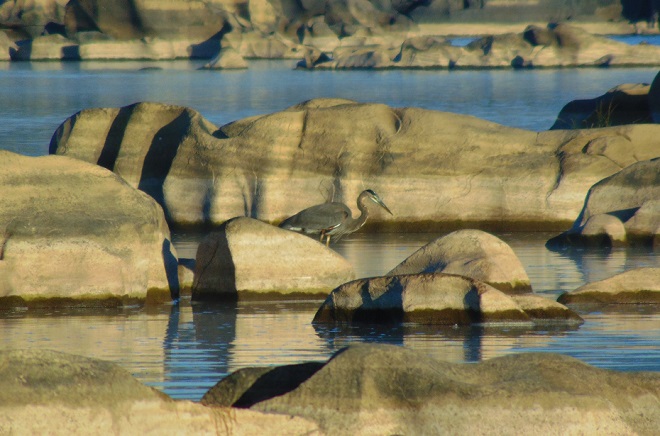
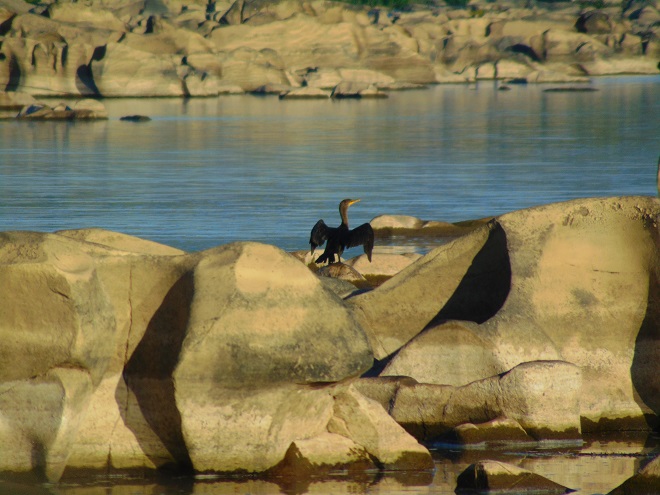
The Great Blue Heron (Ardea herodius) can be found year-round at Conewago Falls, provided there is open water and adequate food. Migrants from breeding colonies to the north will soon supplement the local population.The Double-crested Cormorant (Phalacrocorax auritus) is a summer resident at Conewago Falls. Migration of the local population and of those from further north will soon begin. All will be gone by the time ice forms on the river. Cormorants are often seen drying their feathers in sunlight following a series of feeding dives.
The long-distance migrating insect so beloved among butterfly enthusiasts shows signs of improving numbers. Today, more than two dozen Monarchs were seen crossing the falls and slowly flapping and gliding their way to Mexico.
CLICK ON THE LOGO FOR TODAY’S MIGRATION COUNT TOTALS
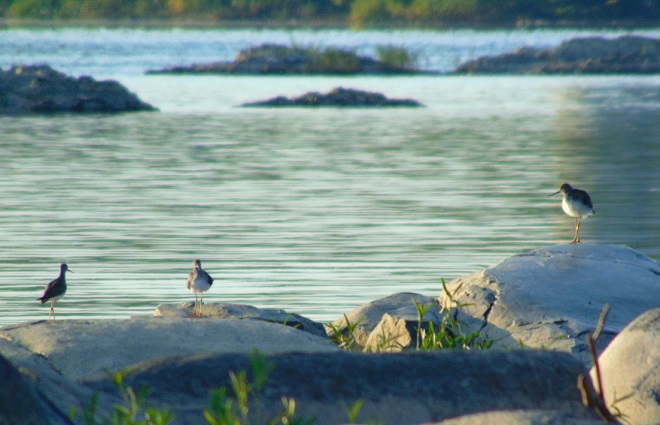
A few nocturnal migrants flew through the moonlit night to arrive at Conewago Falls for a sunrise showing this morning. A dozen warblers were in the treetops and a Wood Thrush (Hylocichla mustelina) chattered away in the understory of the Riparian Woodlands. Three species of shorebirds were in the falls and on the Pothole Rocks: Least Sandpiper (Calidris minutilla), Lesser Yellowlegs (Tringa flavipes), and Greater Yellowlegs (Tringa melanoleuca).
A Greater Yellowlegs (right) and two Lesser Yellowlegs sandpipers dropped by for breakfast.
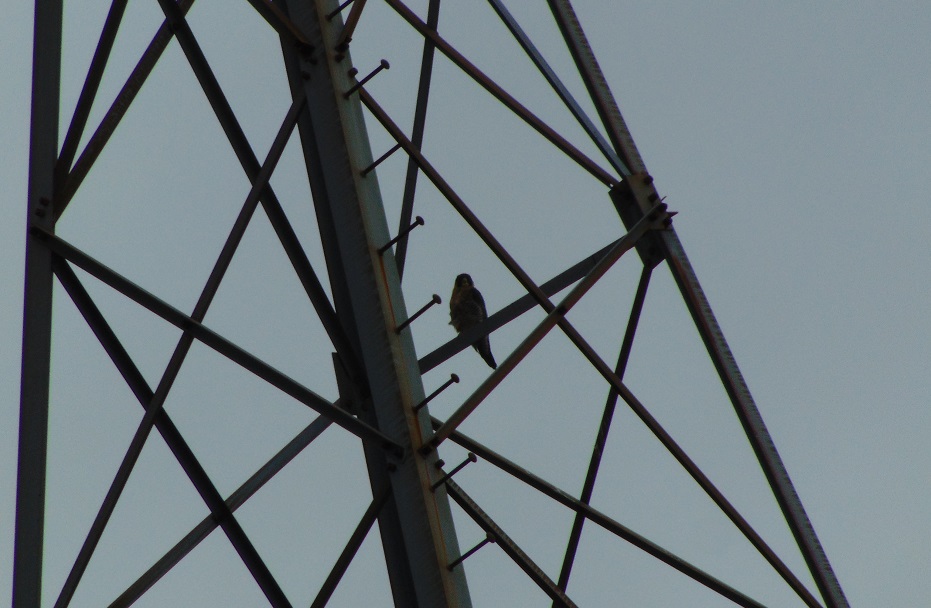
The diurnal migration was highlighted by a Merlin (Falco columbarius), an Osprey, and a Bald Eagle, each flying down the river. Most of the other birds in the falls seemed content to linger and feed. There’s no need to hurry folks, only trouble lurks down there in paradise at the moment.
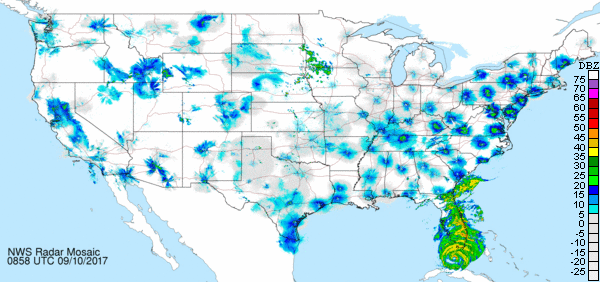
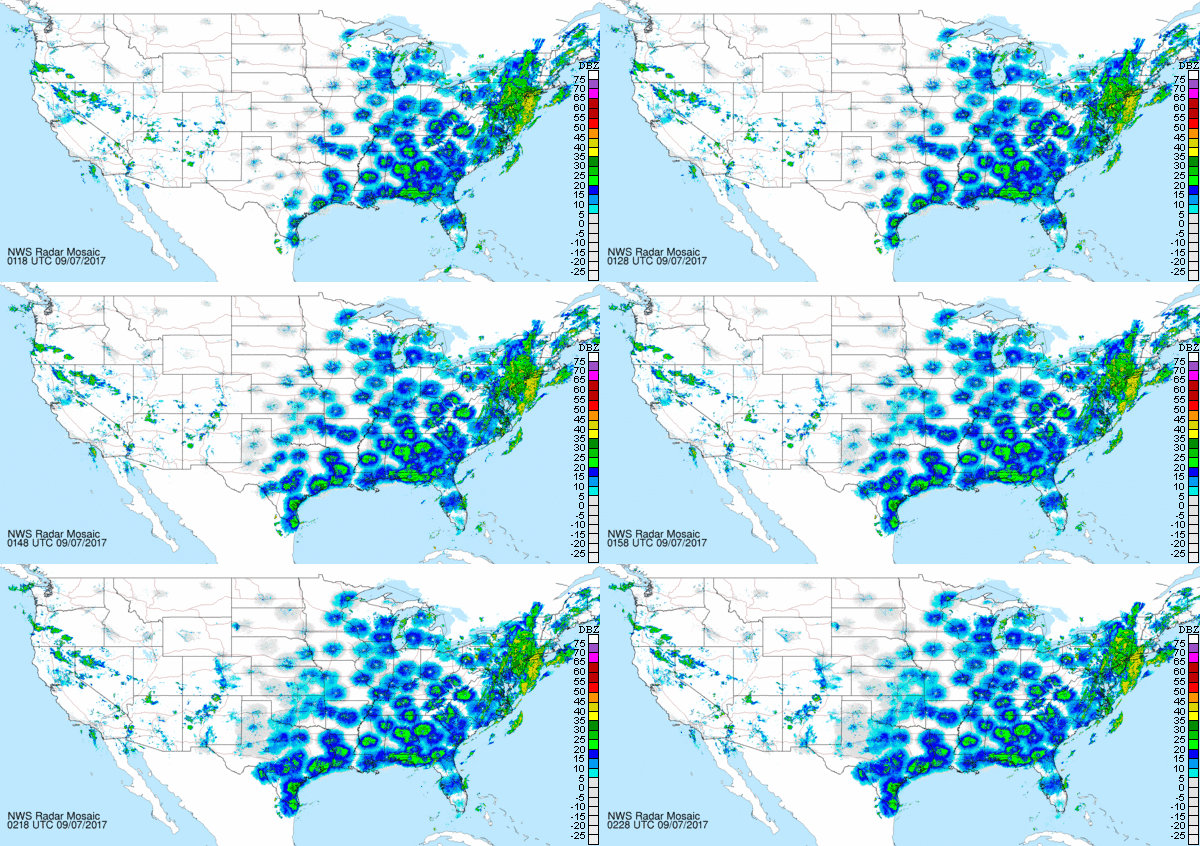
A light to moderate flight of nocturnal migrants in the eastern United States is displayed on NOAA National Weather Service NEXRAD radar at 4:58 AM EDT. The eye of Hurricane Irma can be seen approaching the Florida Keys. (NOAA/National Weather Service image)CLICK ON THE LOGO FOR TODAY’S MIGRATION COUNT TOTALS
A couple of inches of rain this week caused a small increase in the flow of the river, just a burp, nothing major. This higher water coincided with some breezy days that kicked up some chop on the open waters of the Susquehanna upstream of Conewago Falls. Apparently it was just enough turbulence to uproot some aquatic plants and send them floating into the falls.
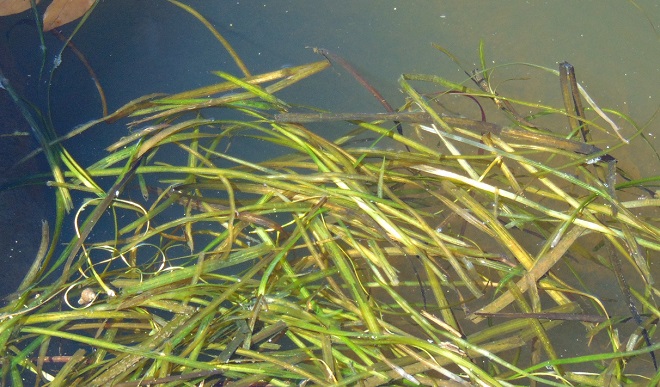
Piled against and upon the upstream side of many of the Pothole Rocks were thousands of two to three feet-long flat ribbon-like opaque green leaves of Tapegrass, also called Wild Celery, but better known as American Eelgrass (Vallisneria americana). Some leaves were still attached to a short set of clustered roots. It appears that most of the plants broke free from creeping rootstock along the edge of one of this species’ spreading masses which happened to thrive during the second half of the summer. You’ll recall that persistent high water through much of the growing season kept aquatic plants beneath a blanket of muddy current. The American Eelgrass colonies from which these specimens originated must have grown vigorously during the favorable conditions in the month of August. A few plants bore the long thread-like pistillate flower stems with a fruit cluster still intact. During the recent few weeks, there have been mats of American Eelgrass visible, the tops of their leaves floating on the shallow river surface, near the east and west shorelines of the Susquehanna where it begins its pass through the Gettysburg Basin near the Pennsylvania Turnpike bridge at Highspire. This location is a probable source of the plants found in the falls today.
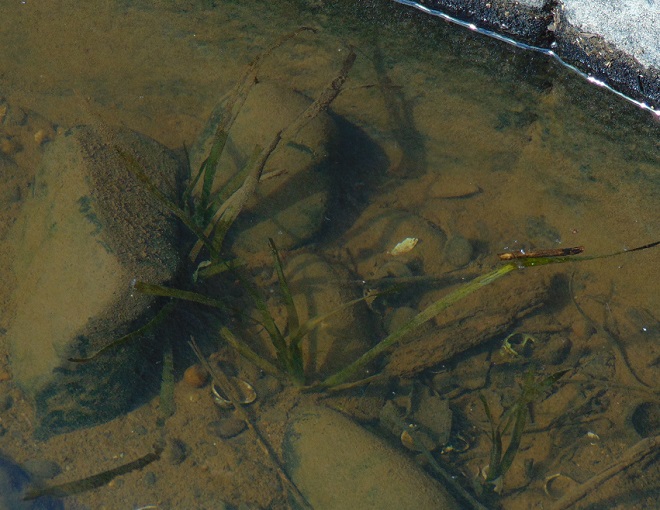
Uprooted American Eelgrass floating into the Pothole Rocks under the power of a north wind. Note the white thread-like pistillate flower stem to the left and the small rooted specimen to the upper right. The latter is likely a plant from the creeping rootstock on the edge of a colony. As a native aquatic species, American Eelgrass is a critical link in the Susquehanna River and Chesapeake Bay food chain. Its decimation by pollution during the twentieth century led to migration pattern alterations and severe population losses for the Canvasback (Aythya valisineria) duck.American Eelgrass, a very small specimen, found growing in a low-lying Pothole Rock alongside the accumulations of freshly arriving material from upstream. Note that the creeping rootstock has leaves growing from at least three nodes on this plant. Eelgrass dislocations are regular occurrences which sometimes begin new colonies, like the small one seen here in this Diabase Pothole Rock Microhabitat.
The cool breeze from the north was a perfect fit for today’s migration count. Nocturnal migrants settling down for the day in the Riparian Woodlands at sunrise included more than a dozen warblers and some Gray Catbirds (Dumetella carolinensis). Diurnal migration was underway shortly thereafter.
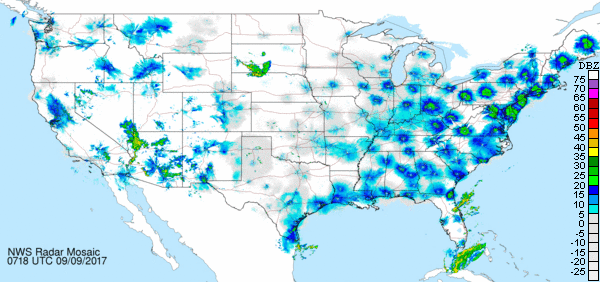
A moderate flight of nocturnal migrants is indicated around NEXRAD sites in the northeastern states at 3:18 AM EDT. The outer rain bands of Hurricane Irma can be seen approaching the Florida Keys as the storm closes in on the peninsula. (NOAA/National Weather Service image)
Four Bald Eagles were counted as migrants this morning. Based on plumage, two were first-year eagles (Juvenile) seen up high and flying the river downstream, one was a second-year bird (Basic I) with a jagged-looking wing molt, and a third was probably a fourth year (Basic III) eagle looking much like an adult with the exception of a black terminal band on the tail. These birds were the only ones which could safely be differentiated from the seven or more Bald Eagles of varying ages found within the past few weeks to be lingering at Conewago Falls. There were as many as a dozen eagles which appeared to be moving through the falls area that may have been migrating, but the four counted were the only ones readily separable from the locals.
Red-tailed Hawks (Buteo jamaicensis) were observed riding the wind to journey not on a course following the river, but flying across it and riding the updraft on the York Haven Diabase ridge from northeast to southwest.
Bank Swallows (Riparia riparia) seem to have moved on. None were discovered among the swarms of other species today.
Ruby-throated Hummingbirds, Caspian Terns, Cedar Waxwings (Bombycilla cedrorum), and Chimney Swifts (Chaetura pelagica) were migrating today, as were Monarch butterflies.
Not migrating, but always fun to have around, all four wise guys were here today. I’m referring to the four members of the Corvid family regularly found in the Mid-Atlantic states: Blue Jay (Cyanocitta cristata), American Crow (Corvus brachyrhynchos), Fish Crow (Corvus ossifragus), and Common Raven (Corvus corax).
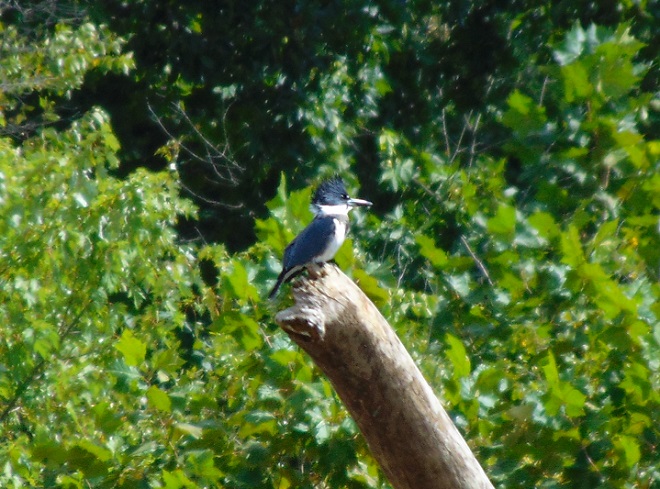
It looks like a big Blue Jay, but it’s not. This Belted Kingfisher (Megaceryle alcyon) takes a break after flying around the falls trying to shake a marauding Ruby-throated Hummingbird off its tail.CLICK ON THE LOGO FOR TODAY’S MIGRATION COUNT TOTALS
SOURCES
Klots, Elsie B. 1966. The New Field Book of Freshwater Life. G. P. Putnam’s Sons. New York, NY.
We all know that birds (and many other animals) migrate. It’s a survival phenomenon which, above all, allows them to utilize their mobility to translocate to a climate which provides an advantage for obtaining food, enduring seasonal weather, and raising offspring.
In the northern hemisphere, most migratory birds fly north in the spring to latitudes with progressively greater hours of daylight to breed, nest, and provide for their young. In the southern hemisphere there are similar movements, these to the south during their spring (our autumn). The goal is the same, procreation, though the landmass offering sustenance for species other than seabirds is limited “down under”. Interestingly, there are some seabirds that breed in the southern hemisphere during our winter and spend our summer (their winter) feeding on the abundant food sources of the northern oceans.
Each autumn, migratory breeding birds leave their nesting grounds as the hours of sunlight slowly recede with each passing day. They fly to lower latitudes where the nights aren’t so long and the climate is less brutal. There, they pass their winter season.
Food supply, weather, the start/finish of the nesting cycle, and other factors motivate some birds to begin their spring and autumn journeys. But overall, the hours of daylight and the angle of the sun prompt most species to get going.
But what happens after birds begin their trips to favorable habitats? Do they follow true north and south routes? Do they fly continuously, day and night? Do they ease their way from point to point, stopping to feed along the way? Do they all migrate in flocks? Well, the tactics of migration differ widely from bird species to species, from population to population, and sometimes from individual to individual. The variables encountered when examining the dynamics of bird migration are seemingly endless, but fascinatingly so. Bird migration is well-studied, but most of its intricacies and details remain a mystery.
Consider for a moment that just 10,000 years ago, an Ice Age was coming to an end, with the southernmost edge of the most recent glaciers already withdrawn into present-day Canada from points as near as the upper Susquehanna River watershed. Back then, the birds migrating to the lower portion of the drainage basin each spring probably weren’t forest-dwelling tropical warblers, orioles, and other songbirds. The migratory birds that nested in the lower Susquehanna River valley tens of millennia ago were probably those species found nesting today in taiga and tundra much closer to the Arctic Circle. And the ancestors of most of the tropical migrants that nest here now surely spent their entire lives much closer to the Equator, finding no advantage by journeying to the frigid Susquehanna valley to nest. It’s safe to say that since those times, and probably prior to them, migration patterns have been in a state of flux.
During the intervening years since the great ice sheets, birds have been able to adapt to the shifts in their environment on a gradual basis, often using their unmatched mobility to exploit new opportunities. Migration patterns change slowly, but continuously, resulting in differences that can be substantial over time. If the natural transformations of habitat and climate have kept bird migration evolving, then man’s impact on the planet shows great potential to expedite future changes, for better or worse.
Now, let’s look at two different bird migration strategies, that of day-fliers or diurnal migrants, and that of night-fliers, the nocturnal migrants.
Diurnal migrants are the most familiar to people who notice birds on the move. The majority of these species have one thing in common, some form of defense to lessen the threat of becoming the victim of a predator while flying in daylight. Of course the vultures, hawks, and eagles fly during the day. Swallows and swifts employ speed and agility on the wing to avoid becoming prey, as do hummingbirds. Finches have an undulating flight, never flying on a horizontal plane, which makes their capture more difficult. Other songbirds seen migrating by day, Red-winged Blackbirds for example, congregate into flocks soon after breeding season to avoid being alone. Defense flocks change shape constantly as birds position themselves toward the center and away from the vulnerable fringes of the swarm. The larger the flock, the safer the individual. For a lone bird, large size can be a form of protection against all but the biggest of predators. Among the more unusual defenses is that of birds like Indigo Buntings and other tropical migrants that fly across the Gulf of Mexico each autumn (often completing a portion of the flight during the day), risking exhaustion at sea to avoid the daylight hazards, including numerous predators, found in the coastal and arid lands of south Texas. Above all, diurnal migrants capture our attention and provide a spectacle which fascinates us. Perhaps diurnal migrants attract our favor because we can just stand or sit somewhere and watch them go by. We can see, identify, and even count them. It’s fantastic.
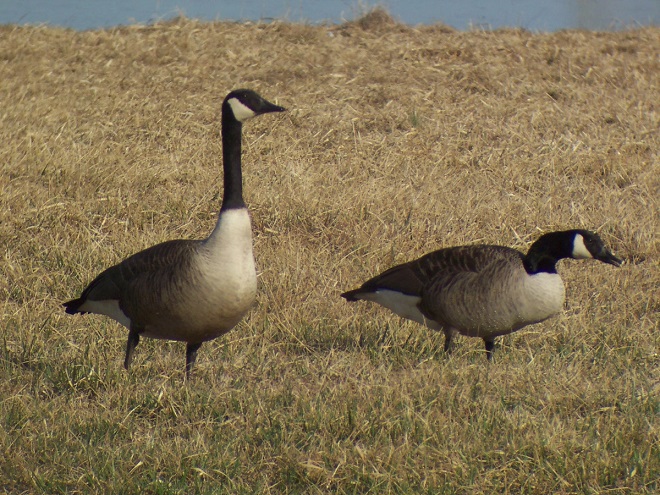
What about a bird like the Canada Goose (Branta canadensis)? It is often seen migrating in flocks during the day (the truly migratory ones flying much higher than the local year-round resident “transplants”), but then, during the big peak movements of spring and fall, they can be heard overhead all through the night. Perhaps the Canada Goose and related waterfowl bridge the gap between day and night, introducing us to the secretive starlight and moonshine commuters, the nocturnal migrants.
The high-flying migratory Canada Goose can be seen during the daytime and heard at night when passing over the lower Susquehanna River valley. A large flight exiting from Chesapeake Bay in late February or early March often results in a 12 to 24 hour-long stream of northbound flocks.
The skies are sometimes filled with thousands of them, mostly small perching birds and waders. These strangers in the night fly inconspicuously in small groups or individually, and most can be detected when passing above us only when heard making short calls to remain in contact with their travel partners. They need not worry about predators, but instead must have a method of finding their way. Many, like the Indigo Bunting, can navigate by the stars, a capability which certainly required many generations to refine. The nocturnal migrants begin moving just after darkness falls and ascend without delay to establish a safe flight path void of obstacles (though lights and tall structures can create a deadly counter to this tactic). Often, the only clue we have that a big overnight flight has occurred is the sudden appearance of new bird species or individuals, on occasion in great numbers, in a place where we observe regularly. Just days ago, the arrival of various warbler species at Conewago Falls indicated that there was at least a small to moderate movement of these birds during previous nights.
In recent years, the availability of National Weather Service radar has brought the capability to observe nocturnal migrants into easy reach. Through the night, you can log on to your local National Oceanic and Atmospheric Administration’s National Weather Service radar page (State College for the Conewago Falls area) and watch on the map as the masses of migrating bird pass through the sweep of the radar beam. As they lift off just after nightfall, rising birds will create an echo as they enter the sweeping beam close to the radar site. Then, due to the incline of the transmitted signal and the curvature of the earth, migrants will be displayed as an expanding donut-like ring around the radar’s map location as returns from climbing birds are received from progressively higher altitudes at increasing distances from the center of the site’s coverage area. On a night with a local or regional flight, several radar locations may show signs of birds in the air. On nights with a widespread flight, an exodus of sorts, the entire eastern half of the United States may display birds around the sites. You’ll find the terrain in the east allows it to be well-covered while radars in the west are less effective due to the large mountains. At daybreak, the donut-shaped displays around each radar site location on the map contract as birds descend out of the transmitted beam and are no longer detected.
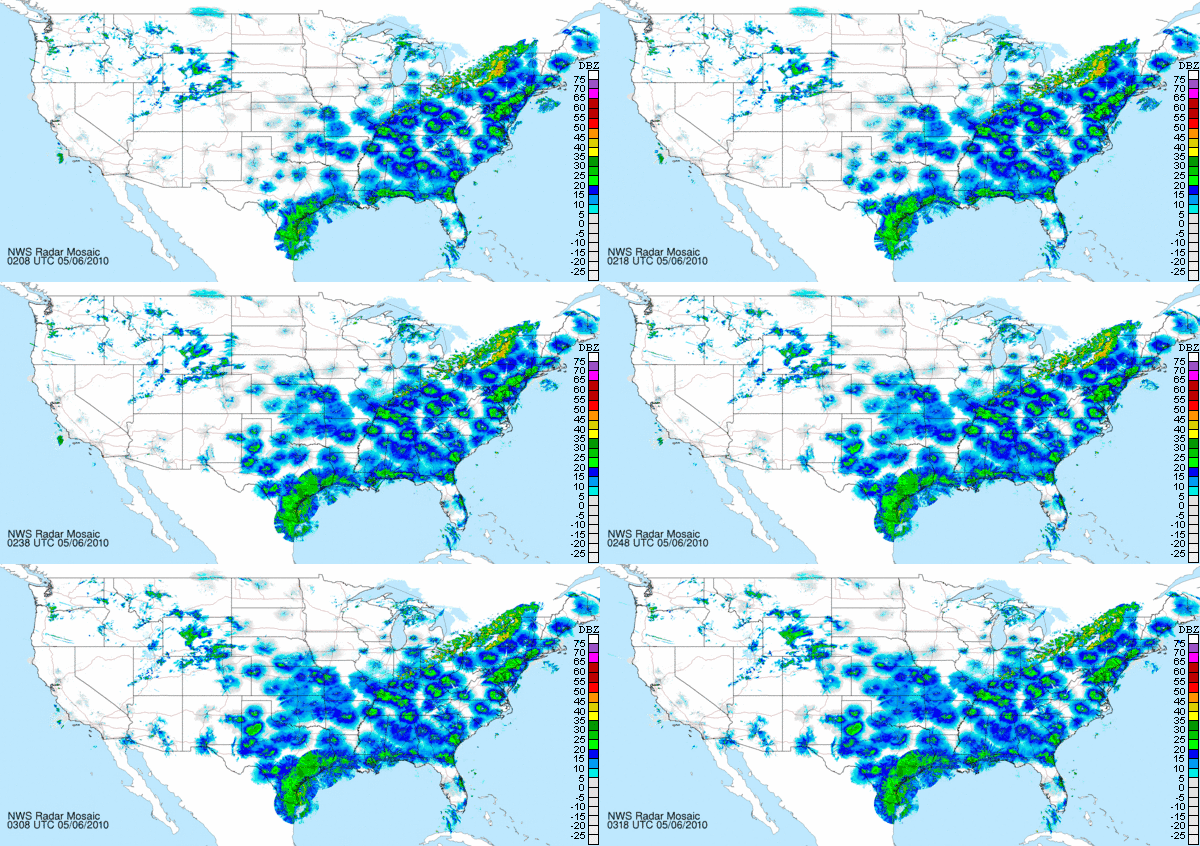
Weather systems sometimes seem to motivate some flights and stifle others. The first example seen below is a northbound spring exodus, the majority of which is probably migrants from the tropics, the Neotropical migrants, including our two dozen species of warblers. A cold front passing into the northeastern United States appears to have stifled any flight behind it, while favorable winds from the southwest are motivating a heavy concentration ahead of the front.
National Oceanic and Atmospheric Administration/National Weather Service radar image from May 5, 2010, at 11:18 PM EDT, shows rain associated with a cold front moving east from the border of Ontario, Canada, and the United States into New England and the Mid-Atlantic region. The heavy blue and green reflections surrounding the radar locations ahead of the front are nocturnal migrating birds taking advantage of favorable conditions for flight including a tail wind from the southwest. Note the lighter migration behind the advancing front. Heavy radar echoes on the gulf coast, particularly in Texas, indicate dense bird concentrations exiting the tropics to fan out into North American breeding areas. The westward progression of expanding echoes surrounding individual radar sites indicates birds rising into the radar beam at local nightfall.
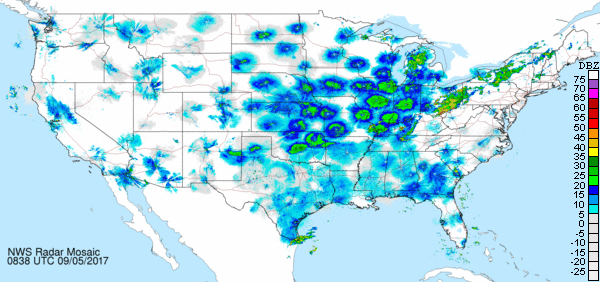
The second and third examples seen below are an autumn nocturnal migration movement, probably composed of many of the same tropics-bound species which were on the way north in the previous example. Note that during autumn, the cold front seems to motivate the flight following its passage. Ahead of the front, there is a reduced and, in places, undetectable volume of birds. The two images below are separated by about 42 hours.
National Oceanic and Atmospheric Administration/National Weather Service radar image (still) from September 5, 2017, at 2:38 AM EDT, shows rain in the northeast associated with a slow-moving cold front stretching from Maine southwest to New Mexico. Heaviest nocturnal bird flights can be seen behind the advancing front where there are favorable tail winds from the north or northwest.Nearly two full days later, the slow-moving cold front from the previous image has crossed Pennsylvania. As nightfall progresses from east to west, ascending nocturnal migrants enter NEXRAD radar beams, their echoes creating expanding rings around individual sites. Concentrations of southbound birds can be seen along the gulf coast. Many will follow the Texas coastline into Mexico. The Neotropical migrants that try to cross the Gulf of Mexico this night could be in for a perilous voyage. Hurricane Katia is churning in the southern gulf and a much stronger storm, Hurricane Irma, is rolling toward the Bahamas and Florida from the southeast. Masses of birds that follow learned routes or instinct to venture offshore and cross seas under such circumstances could suffer catastrophic losses. (NOAA/National Weather Service image)
You can easily learn much more about birds (and insects and bats) on radar, including both diurnal and nocturnal migrants, by visiting the Clemson University Radar Ornithology Laboratory (CUROL) website. There you’ll find information on using the various mode settings on NEXRAD (Next-Generation Radar) to differentiate between birds, other flying animals, and inanimate airborne or grounded objects. It’s superbly done and you’ll be glad you gave it a try.
SOURCES
Clemson University Radar Ornithology Laboratory (CUROL) website: http://virtual.clemson.edu/groups/birdrad/ as accessed September 6, 2017.
A Baltimore Oriole (Icterus galbula) glowed in the first sunlight of the day as it began illuminating the treetops. I’m not certain of the cause, but I often have the urge to dig into a bowl of orange sherbet after seeing one these magnificent blackbirds. That’s right, in the Americas, orioles and blackbirds are members of the same family, Icteridae. Look at blackbirds more carefully, you might see the resemblance.
Sunshine at dawn and migrating warblers were again active in the foliage. Eight species were identified today. Off to the tropics they go. To the land of palm and citrus, yes citrus…limes, lemons, grapefruits, and oranges.
The Ruby-throated Hummingbirds (Archilochus colubris) are on the way toward the gulf states, then on to Central and South America. Five dashed by the rocky lookout in the falls this morning. Remember, keep your feeders clean, wash and rinse all the parts, and refill them with a fresh batch of “nectar”, four or five parts water to one part sugar. Repeating this process daily during hot weather should keep contamination from overtaking your feeder. It’s not a bad idea to rotate two feeders. Have one cleaned, rinsed, and air drying while the second is filled and in use at your feeding station, then just swap them around. Your equipment will be just as clean as it is at the sanitary dairy…you know, where they make sherbet.
The first of the season Caspian Terns (Hydroprogne caspia), giant freshwater versions of the terns you see at the seashore, passed through the falls late this morning. Their bills are blood-red, not orange like the more familiar terns on the coast. They’re stunning.
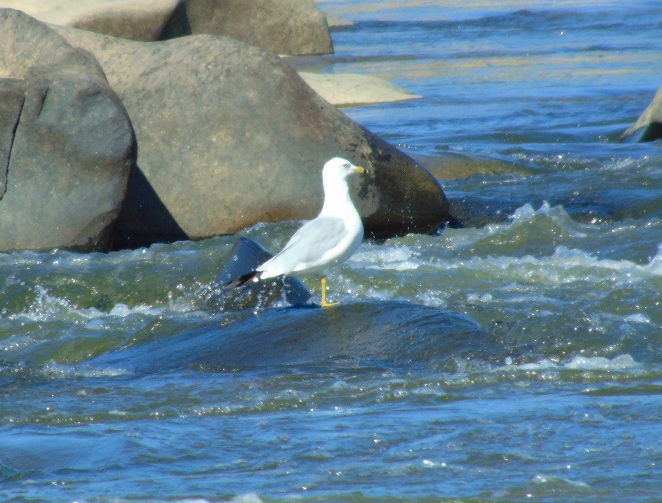
Ring-billed Gulls (Larus delawarensis) have been at the falls for several weeks. Total numbers and the composition of the age groups in the flock change over the days, so birds appear to be trickling through and are then replaced by others coming south. The big push of southbound migrants for this and many other species that winter locally in the Mid-Atlantic region and in the southern United States is still more than a month away. There are still plenty more birds to come after the hours of daylight are reduced and the temperatures take a dip.
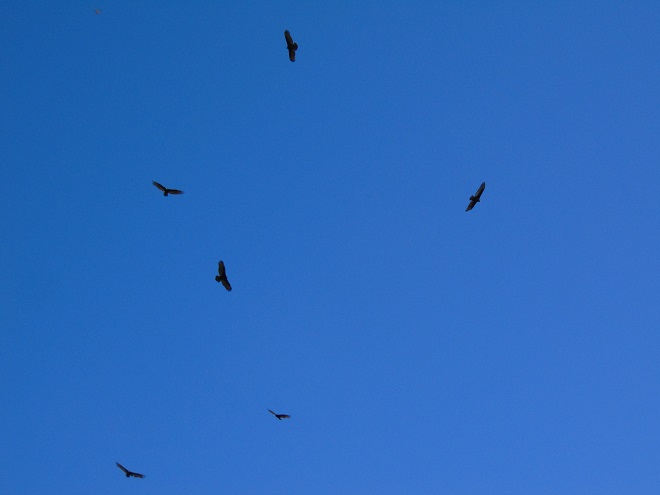
A Ring-billed Gull on the lookout for a morning snack. They’ll eat almost anything and do a good job of keeping the river picked clean of the remains of animals that have met misfortune. They’ll linger around landfills, hydroelectric dams, and fast-food restaurant parking lots through the winter.Turkey Vultures (Cathartes aura) are common around the falls due to the abundance of carrion in the vicinity and because of the strong thermal updrafts of air over the sun-heated Pothole Rocks. These rising currents provide lift for circling vultures. We would expect migrating birds of a number of species will also take advantage of these thermals to gain altitude and extend the distance of their glides.
Some migrating butterflies were counted today. Cloudless Sulphurs, more of a vagrant than a migrant, and, of course, Monarchs. I’ll bet you know the Monarch, it’s black and orange. How can you miss them, colored orange.
That’s it, that’s all for now, I bid you adieu…I’m going to have a dip of orange sherbet, or two.
CLICK ON THE LOGO FOR TODAY’S MIGRATION COUNT TOTALS
Rain from the remnants of Hurricane/Tropical Storm Harvey ended just after daybreak this morning. Locally, the precipitation was mostly absorbed into the soil. There was little runoff and no flooding. The river level at Conewago Falls is presently as low as it has been all summer. Among the pools and rapids of the Pothole Rocks, numbers of migrating birds are building.
Mist and a low cloud ceiling created poor visibility while trying to see early morning birds, but they’re here. The warblers are moving south and a small wave of them was filtering through the foliage on the edge of the Riparian Woodlands. One must bend backwards to have a look, and most could not be identified due to the poor lighting in the crowns of the trees where they were zipping about. Five species of warblers and two species of vireos were discerned.
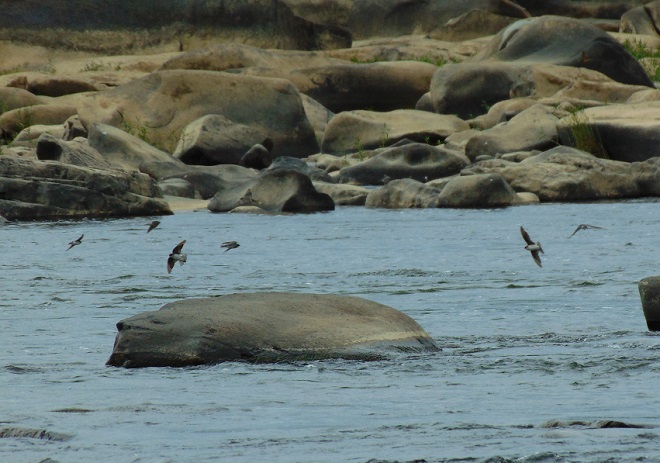
There are increasing concentrations of swallows feeding on insects over the falls. Hundreds were here today, mostly Tree Swallows (Tachycineta bicolor). Bank Swallows (Stelgidopteryx riparia) numbered in the hundreds, far below the thousands, often 10,000, which staged here for migration and peaked during the first week of September annually during the 1980s and 1990s. Their numbers have been falling steadily. Loss of nesting locations in embankments near water may be impacting the entire population. A reduction in the abundance of late-summer flying insects here on the lower Susquehanna River may be cause for them to abandon this area as a migration staging point.
Bank and Tree Swallows by the hundreds were feeding upon flying insects above the waters of Conewago Falls today. Lesser numbers of Northern Rough-winged Swallows (Stelgidopteryx serripennis) and Barn Swallows (Hirundo rustica) joined the swarm.
Clear weather in the coming nights and days may get the migrants up and flying in large numbers. For those species headed to the tropics for winter, the time to get moving has arrived.
CLICK ON THE LOGO FOR TODAY’S MIGRATION COUNT TOTALS
When we look at birds, we are fascinated by the unique structure and appearance of their feathers. They set birds apart from all other life forms on the planet. Feathers enable most birds to achieve a feat long envied by humans…flight. Birds on the wing awaken a curiosity in man. They are generally the largest animals one will see in the air. People want to know the name of a bird they see flying by, and want to know more about it. The method and style of bird flight can aid an observer who attempts to determine which of the world’s 10,000 bird species he or she is studying. Body shape and bird sounds often tell us a lot about the birds we encounter. But most often, we rely on the unique colors, patterns, and shapes of the feathers, the plumage, to identify the bird we are seeing.
To birds, feathers are survival. They are lightweight and strong to support the mechanics of flight. Feathers are superb insulators against the elements, and provide additional buoyancy for birds spending time on the water. For most birds, feathers provide a coloration and a texture similar to their surroundings, enabling them to hide from predators or to stalk prey. In the case of some species, extravagant showy plumage is acquired, at least during the breeding season, and often only by males, as a way to attract a mate, intimidate rivals, defend a territory, or lure an intruder away from a nest site. Because they become worn and damaged, all feathers are periodically molted and replaced by fresh plumage.
The feathers worn by a young bird leaving the nest are called the juvenile plumage. Typically, this is followed by a molt into a basic (non-breeding) plumage. The oft times extravagant breeding feathers are the result of a molt into an alternate (breeding) plumage.
While making field observations, the species, subspecies, gender, age, and other vital statistics of a bird can often by discerned easily by noting the plumage. In the case of some other birds, diligence, experience, research, and an exceptionally good look and/or a photograph may be required to interpret these particulars. In still other instances, a trained expert with a specimen in the hand is the only method of learning the bird’s identity and background.
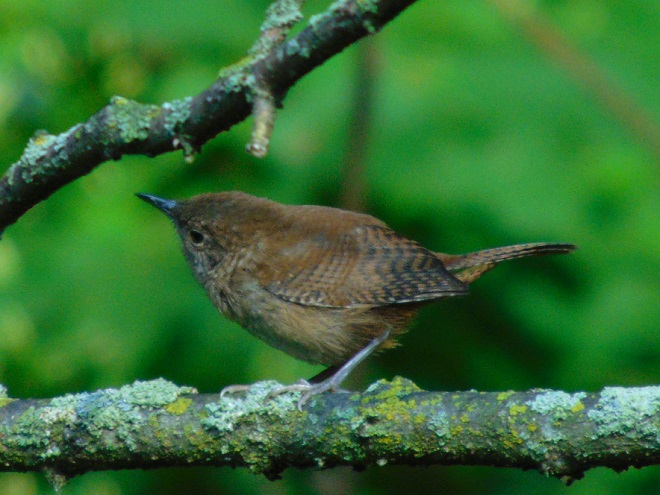
This juvenile House Wren (Troglodytes aedon) left the nest wearing plumage very similar to that of its parents. In lieu of bright colors, the male House Wren relies upon a vigorous bubbly song and a scrappy demeanor to defend its breeding territory. This species nests in cavities on the edges of the Riparian Woodlands of Conewago Falls. Males may have more than one mate. House Wrens probably migrate at night and will winter in the southern border states and further south.
The age at which birds acquire adult breeding and non-breeding plumages varies by species. Many juvenile birds resemble adults in basic (non-breeding) plumage as soon as they leave the nest. For these birds, there is little difference between their juvenile plumage and the appearance of the feathers which follow the molt into their first basic (non-breeding) plumage. Bird species which sexually mature within their first year may acquire their first basic (non-breeding) plumage before arrival of their first winter, followed by an alternate (breeding) plumage by their first spring. This is particularly true for smaller short-lived birds. Other species, normally larger long-lived ones, may experience a sequence of molts through multiple basic (non-breeding) plumages over a period of years prior to resembling an adult. Some of these species, such as eagles, retain their juvenile plumage for as long as a year before extensive molting into a first basic (non-breeding) plumage begins. Still others, including many gulls, attain a first-winter (formative) plumage prior to molting into their first basic (non-breeding) set of feathers. Sexual maturity and initiation of an annual molt to alternate (breeding) plumage, if there is one, may take as long as three to five years for these bigger birds.
For nearly all species of birds, the molts which produce basic (non-breeding) plumage occur on at least an annual basis and include a total replacement of feathers. This process renews worn and missing plumes including the flight feathers of the wings and tail. Any molt to alternate (breeding) plumage often excludes the replacement of the feathers of the wings and tail. There are many exceptions to these generalities.
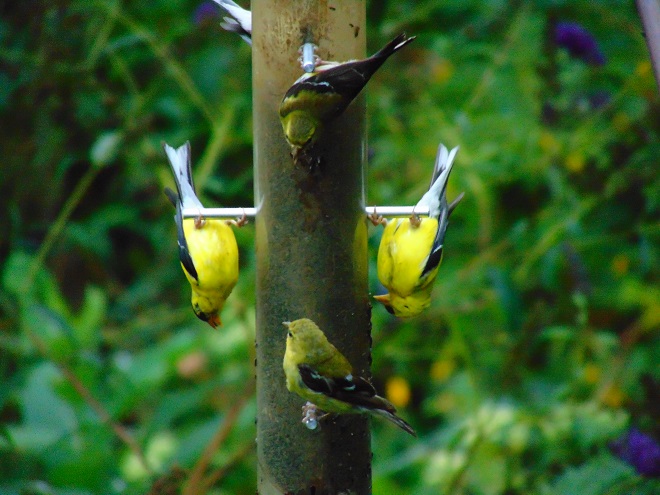
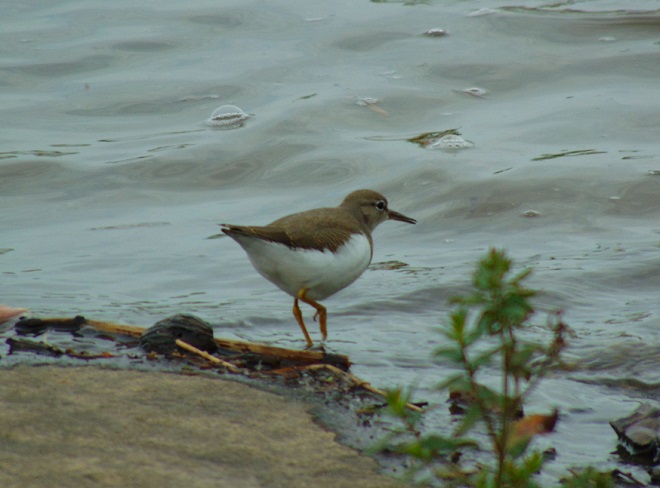
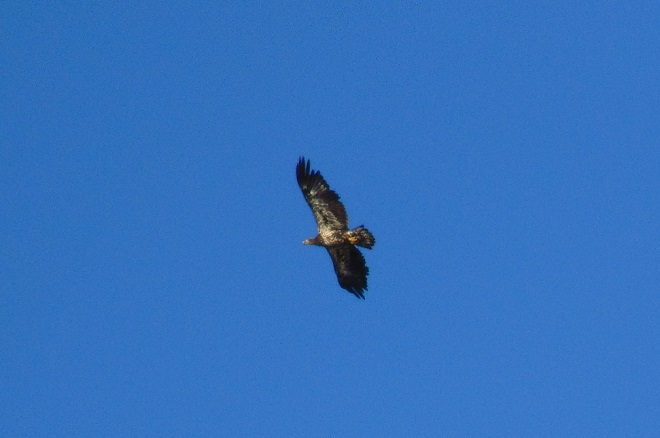
A mid-summer nesting species, the American Goldfinch, Spinus tristis, male (left and right) molts into a glamorous alternate plumage for the breeding season. The adult female’s alternate plumage (top) is a subdued green-yellow and black. Her feathers resemble the foliage around the nest and offer protection from discovery during incubation. Juvenile plumage (bottom) is similar to that of the female, but duller with a buffy tone. By November each of these birds will have molted into a tan-buff basic (non-breeding) plumage, the male’s with a slight yellow hue. During their first spring, juveniles attain sexual maturity and, like the adults from the previous year, molt into alternate (breeding) plumage. The breeding birds seen here will probably winter in the southern United States, and birds that nested to our north will arrive to remain as winter residents. Various stages of molt can be seen simultaneously during spring and autumn migrations as populations of goldfinches from multiple latitudes intermingle as they pass through the Susquehanna River watershed.This juvenile Spotted Sandpiper (Actitis macularius), lacks the namesake dark markings on its white underside, thus it presently resembles an adult in basic (non-breeding) plumage. Upon reaching sexual maturity, it will molt into a spotted alternate (breeding) plumage for the nesting season during each remaining year of its life. Females of this species defend a territory and lay eggs in a nest located among cover near the shoreline. A female may have as many as five mates. Males alone incubate the eggs, usually four, for 20-24 days. The young leave the nest upon hatching and are escorted by the male for about two to three additional weeks. They are the only sandpiper to nest on the Susquehanna River shoreline. Spotted Sandpipers migrate to the southern border states and further south for winter. At Conewago Falls, they arrive in late April to nest, with birds, possibly migrants from further north, remaining until well into October. In any plumage, you can easily recognize the Spotted Sandpiper by its habit of teetering its body at the hips to pump the tail up and down.Bald Eagles go through a series of five molts before reaching adult plumage. The first plumage, Juvenile, is nearly all dark brown with white linings along the forward underside of the wings. The wing and tail feathers are a bit longer than in later plumages to aid the inexperienced birds during their clumsy first flights. Due to the additional feather length, Juveniles look larger than older birds, but they are not as heavy as their seniors. The bird seen here flying above Conewago Falls is probably in its second year. This plumage, Basic I, also known as “White Belly I”, is characterized by a nearly full set of new flight feathers. Note that some of the longer Juvenile feathers are still present, giving the wings a jagged sloppy look, particularly near the center of the trailing edge. Third-year (Basic II) birds often have at least some white belly feathers and are sometimes known as “White Belly II” Bald Eagles. Basic II birds typically possess a complete set of adult flight feathers, so the trailing edge of the wing has a neater and more uniform appearance.
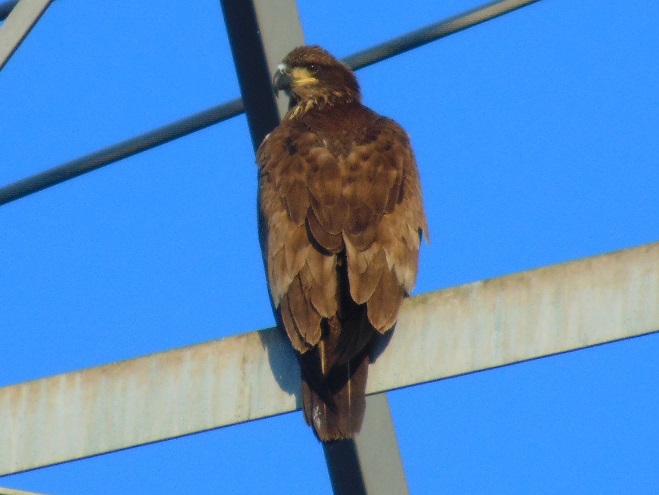
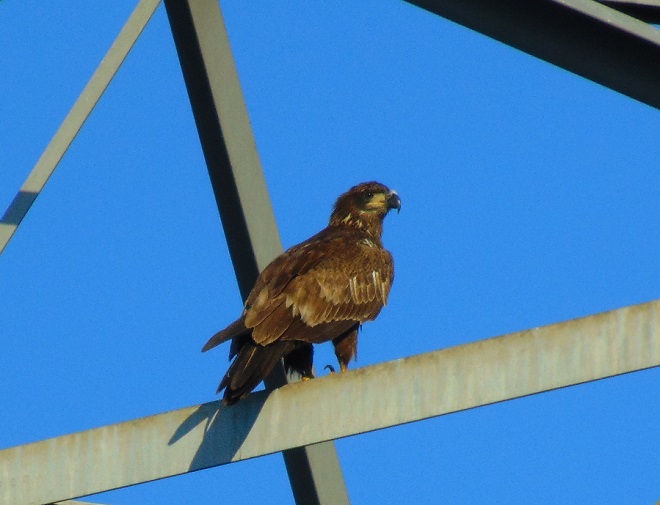
The Bald Eagle in the two photographs above is in its first year. This plumage, known as “Juvenile”, is characterized by dark flight feathers which appear uniformly long in length when the bird is airborne. The eye is dark brown. The iris of the eye will lighten in the second year (Basic I) and will become cream-colored by the third year (Basic II). The bill, which is all dark gray when the bird is in the nest, has begun the slow progression to a yellow color that will be complete in the bird’s fifth year (Basic IV). Third year (Basic II) birds molt to white crown and throat feathers, but have a dark set of feathers through the eye producing an “Osprey face” in most individuals. In its fourth year (Basic III), this eagle will molt to a white tail with just a thin dark brown terminal band. The head will become nearly all white except for a few dark spots through the eye, which will have a yellow iris. A cleaner white head and tail will develop during the fifth year (Basic IV) and will persist through the familiar adult Bald Eagle plumages (Definitive Plumage) for the remainder of its life.
The Juvenile and non-breeding (basic) plumages of late-summer may seem drab and confusing, but learning them is a worthwhile endeavor. Consider that most of the birds coming south during the migration will be adorned in this fashion. The birds of North America are in their greatest numerical mass of the year right now, and nearly all are females, juveniles, other non-adults, or molting males. There are few males in breeding plumage among the autumn waves of migrants. In the coming months, there will be an abundance of opportunities to enjoy these marvels on wings, so getting to know the birds in non-breeding feathers is time well spent. Make haste and get ready. For our feathered friends, it’s autumn and they’re on their way south.
Here come the confusing fall migrants. Twelve Semipalmated Sandpipers (Calidris pusilla) and sixteen unidentified “peep” sandpipers (Calidris species) were seen feeding in Conewago Falls on August 27. This Semipalmated Sandpiper is either an adult in worn alternate (breeding) plumage or a Juvenile. Adults of this species molt into basic plumage on the wintering grounds. The Semipalmated Sandpiper breeds in the high arctic tundra and winters in the West Indies and northern South America.CLICK ON THE LOGO FOR TODAY’S MIGRATION COUNT TOTALS
SOURCES
Dunne, Pete. 2006. Pete Dunne’s Essential Field Guide Companion. Houghton Mifflin Company. New York.
Hayman, Peter; John Marchant, and Tony Prater. 1986. Shorebirds, An Identification Guide to the Waders of the World. Houghton Mifflin Company. New York.
Kauman, Kenn. 1996. Lives of North American Birds. Houghton Mifflin Company. New York.
McCullough, Mark A. 1989. Molting Sequence and Aging Of Bald Eagles. The Wilson Bulletin. 101:1-10.
Let’s imagine that you spend your summer as a singer and you have to strut your stuff in a blue suit all day long just so the other guys know that you’re not going to tolerate any nonsense with either of your two gals. And…you’re responsible for feeding the adolescent kids while each of the girls begins a second family. Wouldn’t you be ready for a break by late August?
The boys must think so. They’re quiet now. This week was the end. They’ve done their duty. They protected their homes and got the youngsters out on their own. It’s time to eat, get out of the dress blues, and prepare to take a flight to warmer climates, maybe even the tropics…for a holiday of sorts.
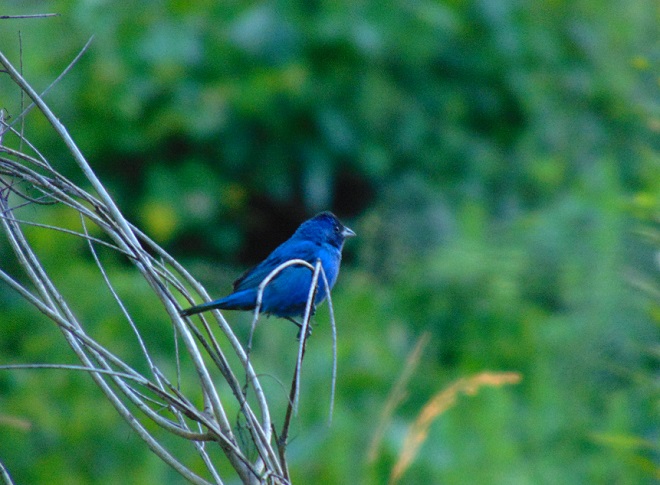
The male Indigo Bunting (Passerina cyanea) has a busy schedule. Before arriving at Conewago Falls in early May, he has molted from the plainest of plain brown plumage and donned an iridescent set of feathers that glow a brilliant blue and purple in sunlight. He chooses a territory with plenty of shrubby and weedy growth along the edge of a woodland, and begins to sing and defend his parcel, often from a dead tree or other perch.
At Conewago Falls, the Indigo Bunting is a common breeding bird, finding the mosaic of electric transmission wire right-of-ways, railroads, and the Riverine Grasslands to be absolutely perfect habitat. The female, inconspicuous in her uniformly brown plumage, builds the nest, incubates the 3 to 4 eggs (11 to 14 days), and feeds the young in the nest (9 to 12 days). Being quite the showboats, some males will have more than one mate nesting in their territory. In addition to defending the nest(s), the male Indigo Bunting will sometimes feed the fledged young so that the female(s) can begin incubating a second brood. The summertime diet is mostly invertebrates, but seeds are also consumed.
A male Indigo Bunting defends nesting territory from a perch on a dead tree.
By late August, the young of the year are mostly on their own. The male’s territorial urges, including the nearly non-stop singing, come to an end. Soon, his blue feathers are beginning to drop and a molt is underway into a brown plumage resembling that of the females and juveniles.
Indigo Buntings evacuate their breeding range in eastern North America to winter mostly south of the United States. These nocturnal travelers have been the subject of migration behavior studies. They are among a number of small bird species known to cross the Gulf of Mexico on their way south. Also, Indigo Buntings can navigate by the stars.
On the wintering grounds, Indigo Buntings are flocking birds. At this time of year, they consume more seeds as a component of their diet and are known to visit bird feeders.
By April, the blue suit is back, and the males and females are on the way north. Hope to see you then pal.
SOURCES
Dunne, Pete. 2006. Pete Dunne’s Essential Field Guide Companion. Houghton Mifflin Company. New York.
Kaufman, Kenn. 1996. Lives of North American Birds. Houghton Mifflin Company. New York.
There’s something frightening going on down there. In the sand, beneath the plants on the shoreline, there’s a pile of soil next to a hole it’s been digging. Now, it’s dragging something toward the tunnel it made. What does it have? Is that alive?
We know how the system works, the food chain that is. The small stuff is eaten by the progressively bigger things, and there are fewer of the latter than there are of the former, thus the whole network keeps operating long-term. Some things chew plants, others devour animals whole or in part, and then there are those, like us, that do both. In the natural ecosystem, predators keep the numerous little critters from getting out of control and decimating certain other plant or animal populations and wrecking the whole business. When man brings an invasive and potentially destructive species to a new area, occasionally we’re fortunate enough to have a native species adapt and begin to keep the invader under control by eating it. It maintains the balance. It’s easy enough to understand.
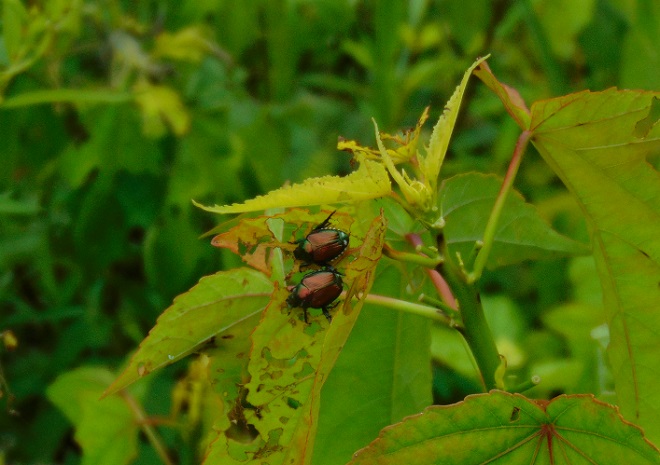
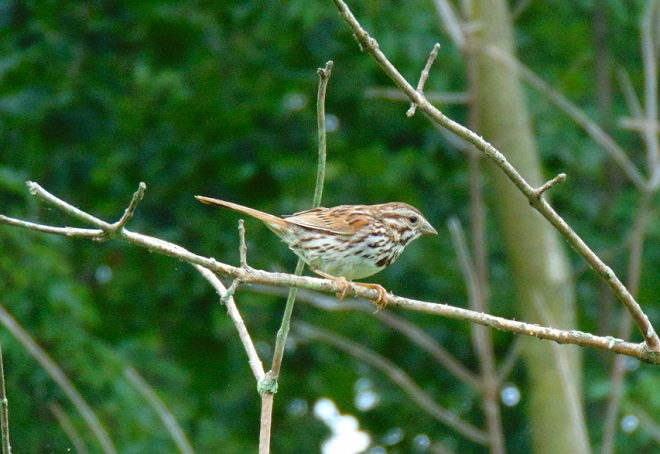
Japanese Beetles (Popillia japonica) seen here on Halberd-leaved Rose Mallow. Without predation, exploding numbers of this invasive non-indigenous insect can defoliate and kill numerous species of plants in a given area.The Song Sparrow (Melospiza melodia) is a generalist feeder, eating seeds and invertebrates including Japanese Beetles. This species is the omnipresent year-round occupant of shoreline vegetation along the lower Susquehanna River.
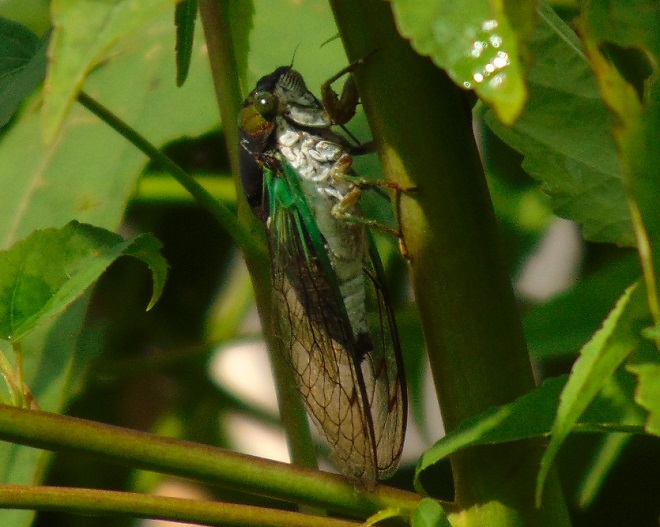
Late summer days are marked by a change in the sounds coming from the forests surrounding the falls. For birds, breeding season is ending, so the males cease their chorus of songs and insects take over the musical duties. The buzzing calls of male “annual cicadas” (Neotibicen species) are the most familiar. The female “annual cicada” lays her eggs in the twigs of trees. After hatching, the nymphs drop to the ground and burrow into the soil to live and feed along tree roots for the next two to five years. A dry exoskeleton clinging to a tree trunk is evidence that a nymph has emerged from its subterranean haunts and flown away as an adult to breed and soon thereafter die. Flights of adult “annual cicadas” occur every year, but never come anywhere close to reaching the enormous numbers of “periodical cicadas” (Magicicada species). The three species of “periodical cicadas” synchronize their life cycles throughout their combined regional populations to create broods that emerge as spectacular flights once every 13 or 17 years.
An “annual cicada” also known as a “dog-day cicada”, clings to the stem of a Halberd-leaved Rose Mallow at Conewago Falls.
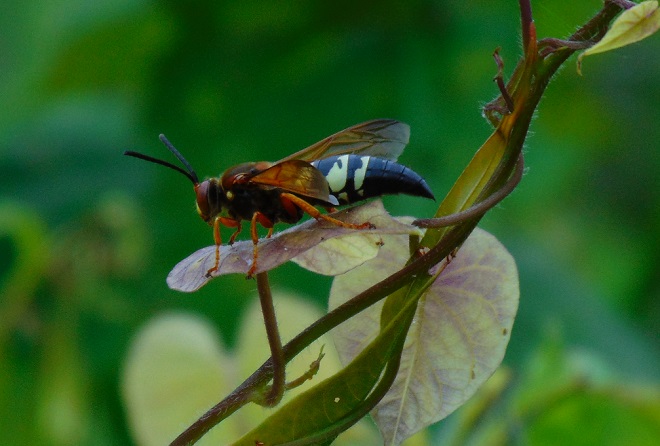
For the adult cicada, there is danger, and that danger resembles an enormous bee. It’s an Eastern Cicada Killer (Specius speciosus) wasp, and it will latch onto a cicada and begin stinging while both are in flight. The stings soon paralyze the screeching, panicked cicada. The Cicada Killer then begins the task of airlifting and/or dragging its victim to the lair it has prepared. The cicada is placed in one of more than a dozen cells in the tunnel complex where it will serve as food for the wasp’s larvae. The wasp lays an egg on the cicada, then leaves and pushes the hole closed. The egg hatches in a several days and the larval grub is on its own to feast upon the hapless cicada.
An Eastern Cicada Killer (Sphecius speciosus) along the river shoreline. Despite their intimidating appearance, they do not sting humans and can be quite docile when approached.
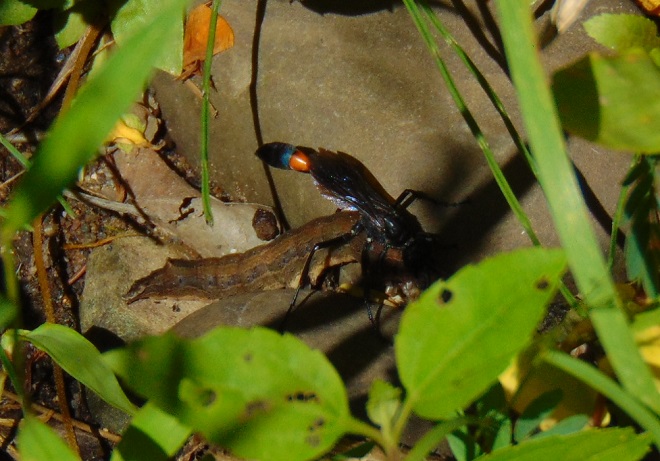
Other species in the Solitary Wasp family (Sphecidae) have similar life cycles using specific prey which they incapacitate to serve as sustenance for their larvae.
A Solitary Wasp, one of the Thread-waisted Wasps (Ammophila species), drags a paralyzed moth caterpillar to its breeding dungeon in the sandy soil at Conewago Falls. For the victim, there is no escape from the crypt.
The Solitary Wasps are an important control on the populations of their respective prey. Additionally, the wasp’s bizarre life cycle ensures a greater survival rate for its own offspring by providing sufficient food for each of its progeny before the egg beginning its life is ever put in place. It’s complete family planning.
The cicadas reproduce quickly and, as a species, seem to endure the assault by Cicada Killers, birds, and other predators. The periodical cicadas (Magicicada), with adult flights occurring as a massive swarm of an entire population every thirteen or seventeen years, survive as species by providing predators with so ample a supply of food that most of the adults go unmolested to complete reproduction. Stay tuned, 2021 is due to be the next periodical cicada year in the vicinity of Conewago Falls.
SOURCES
Eaton, Eric R., and Kenn Kaufman. 2007. Kaufman Field Guide to Insects of North America. Houghton Mifflin Company. New York.