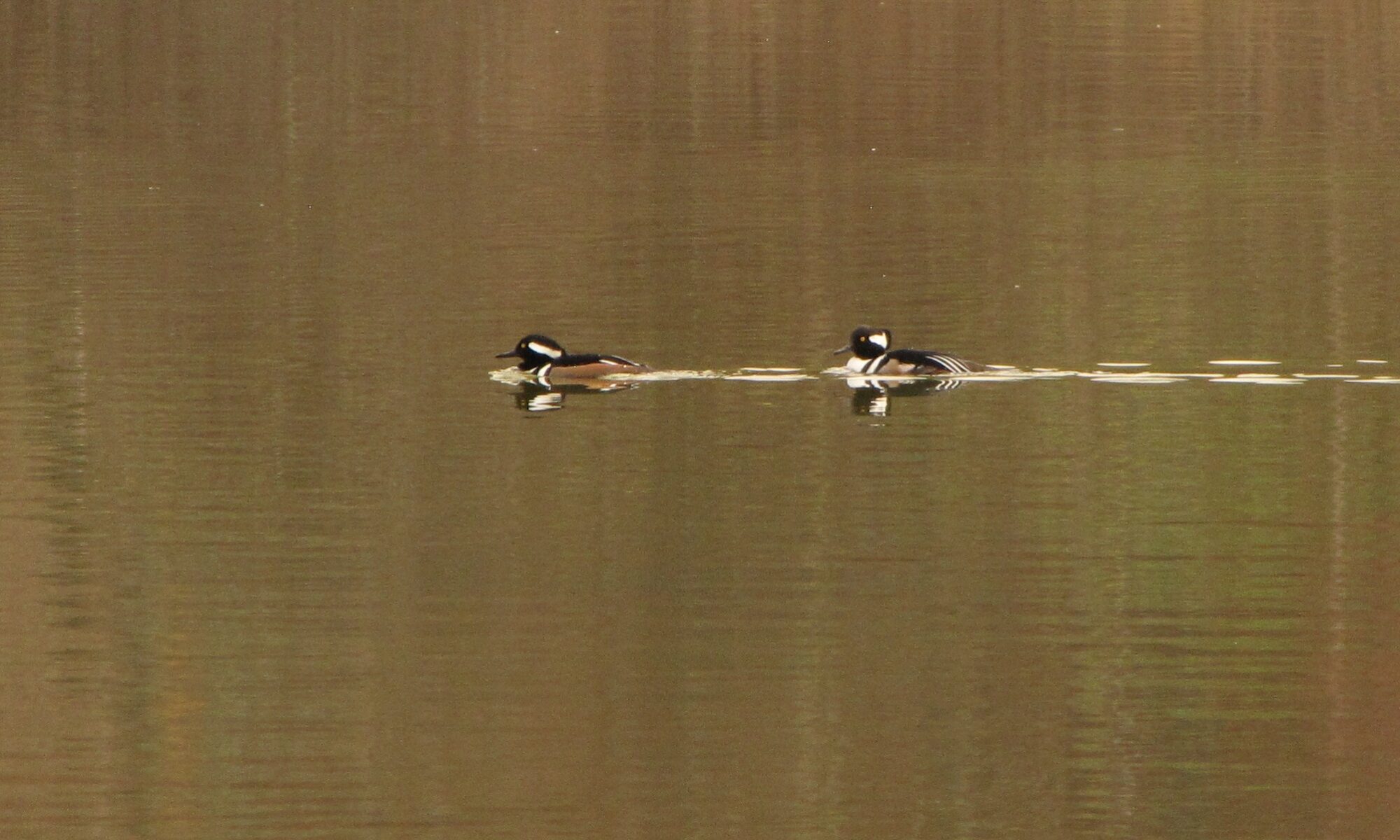
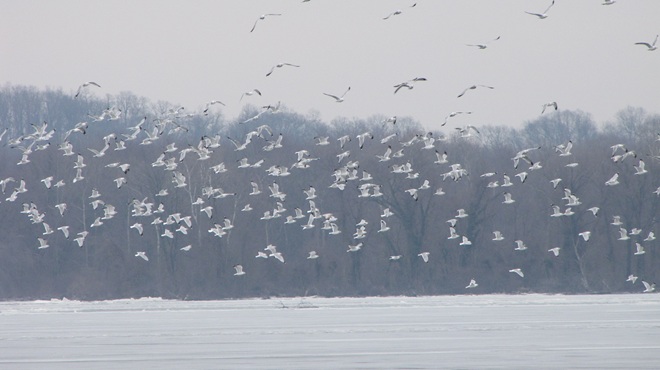
You may find this hard to believe, but during the colder months in the lower Susquehanna valley, gulls aren’t as numerous as they used to be. In the years since their heyday in the late twentieth century, many of these birds have chosen to congregate in other areas of the Mid-Atlantic region where the foods they crave are more readily available.
As you may have guessed, the population boom of the 1980s and 1990s was largely predicated on human activities. These four factors were particularly beneficial for wintering gulls…
Disposal of food-bearing waste in open landfills
High-intensity agriculture with disc plowing
Gizzard Shad population boom in nutrient-impaired river/Hydroelectric power generation
Fumbled Fast Food
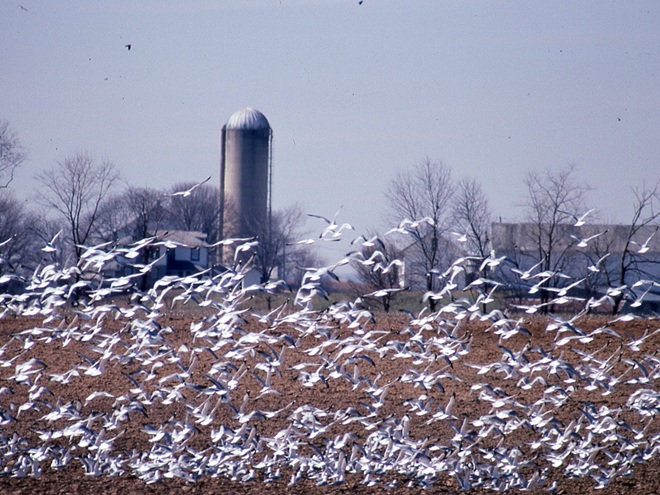
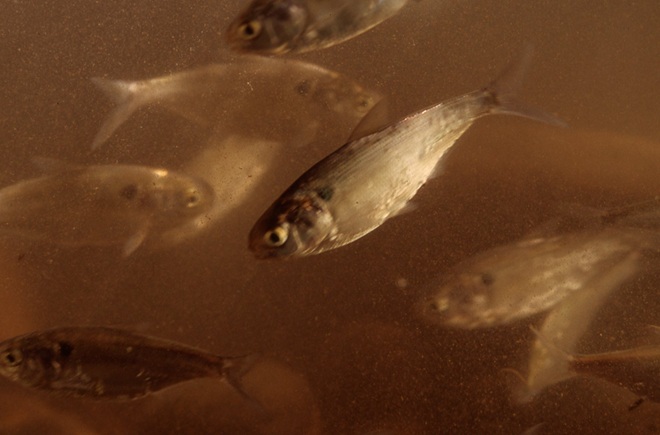
Earthworms lifted to the soil’s surface by plowing attracted Ring-billed Gulls by the thousands to Susquehanna Valley farmlands during the late twentieth century. (Vintage 35 mm image)Filter-feeding Gizzard Shad populations thrive in nutrient-rich waters like the Susquehanna. Their rambunctious feeding style stirs up benthic sediment deposits to release more nutrients into the water column and promote the algal blooms that often lead to detrimental eutrophic conditions. Decades ago, hundreds and sometimes thousands of gulls gathered below the river’s hydroelectric dams to feed on the seemingly endless supply of small Gizzard Shad disoriented by their passage through the turbines during electric generation. (Vintage 35 mm image)
So what happened? Why are wintering gulls going elsewhere and no longer concentrating on the Susquehanna? Well, let’s look at what has changed with our four man-made factors…
A larger percentage of the lower Susquehanna basin’s household and food industry waste is now incinerated/Landfills practice “cover as you go” waste burial.
Implementation of “no-till” farming has practically eliminated availability of earthworms and other sub-surface foods for gulls.
The population explosion of invasive Asiatic Clams has reduced the Gizzard Shad’s relative abundance and biomass among filter feeders.
Hold on tight! Fast food has become too expensive to waste.
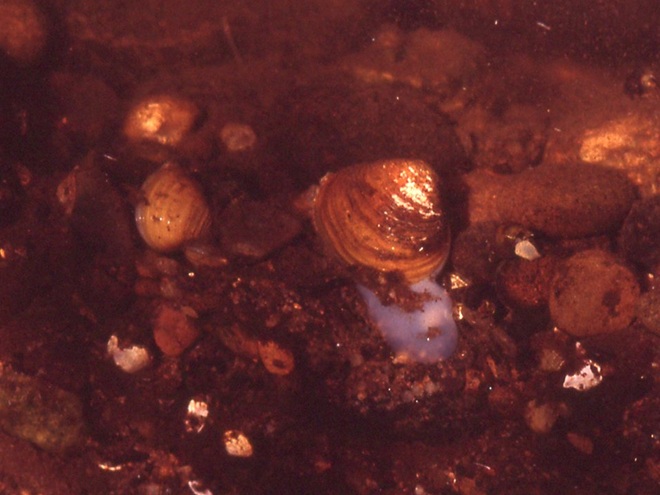
The non-native population of Asiatic Clams in the Susquehanna and most of its larger tributaries exploded during the last two decades of the twentieth century. Its present-day biomass in the river is exceeded by no other macroinvertebrate species. The share of plankton and other tiny foods that the Asiatic Clam harvests from the water column is no longer available to native filter-feeders including Gizzard Shad. Hence, Gizzard Shad biomass has been reduced and far fewer are available to attract amazingly enormous flocks of hungry gulls to hydroelectric dams. (Vintage 35 mm image)
GULLS THIS WINTER
Despite larid abundance on the lower Susquehanna not being the spectacle it was during the man-made boom days, an observer can still find a variety of medium and large-sized gulls wintering in the region. We ventured out to catch a glimpse of some of the species being seen both within the watershed and very nearby.
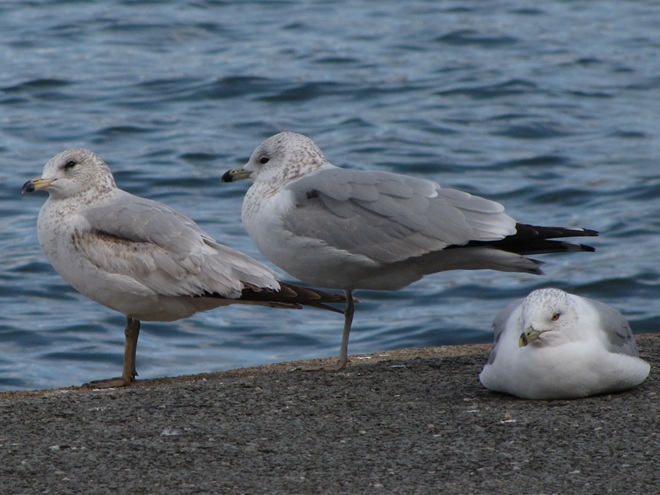
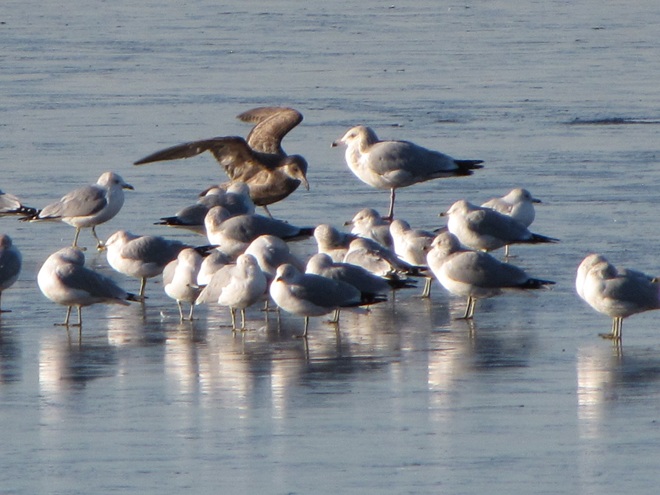
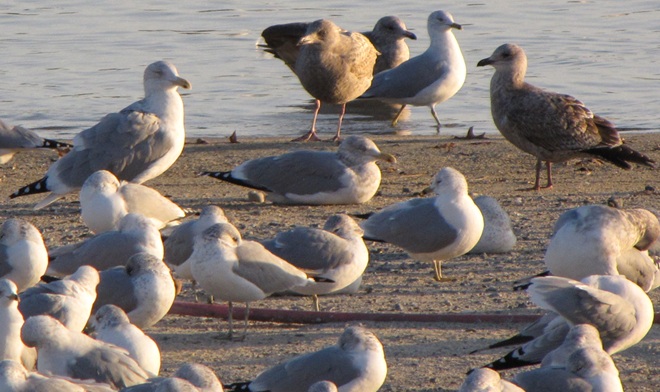
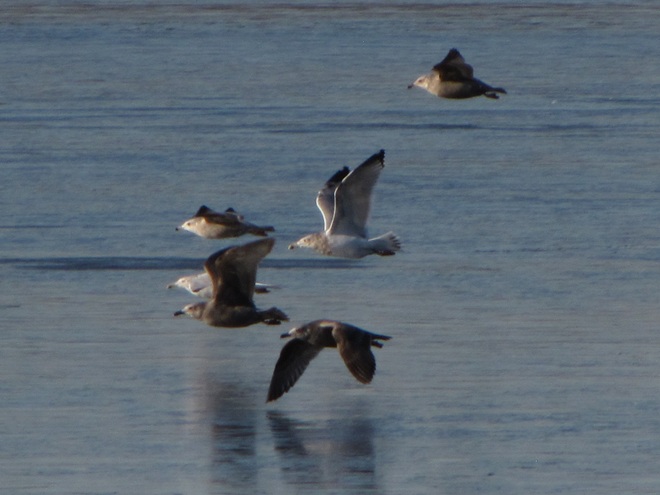
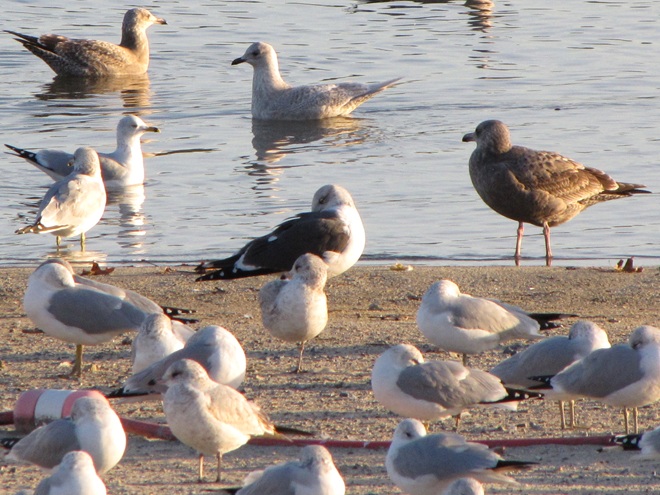
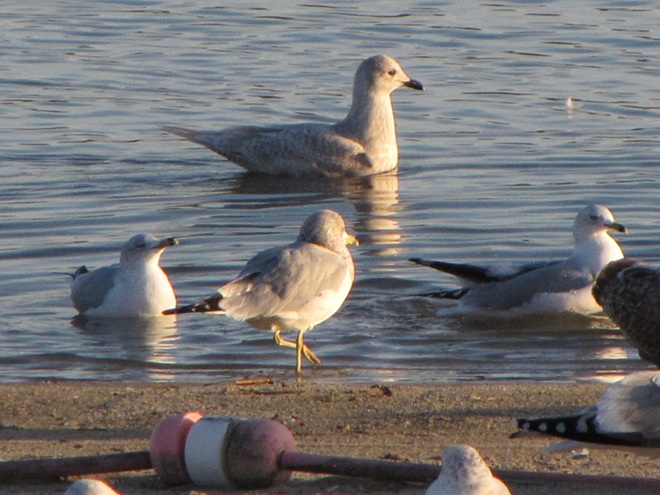
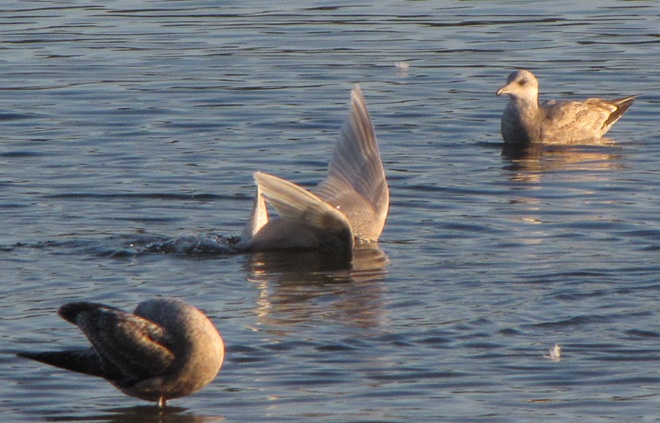
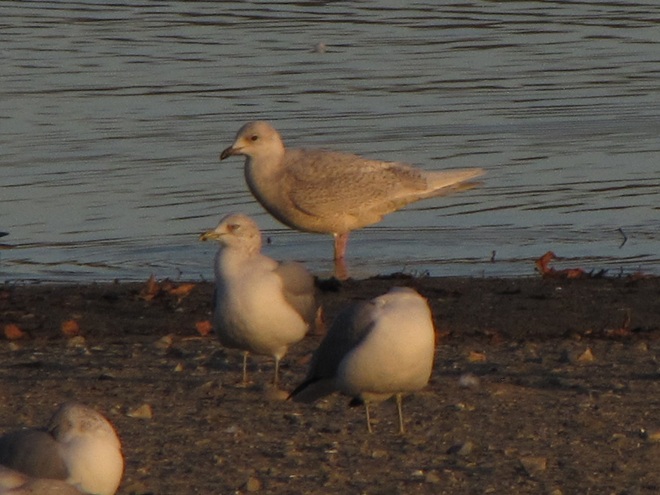
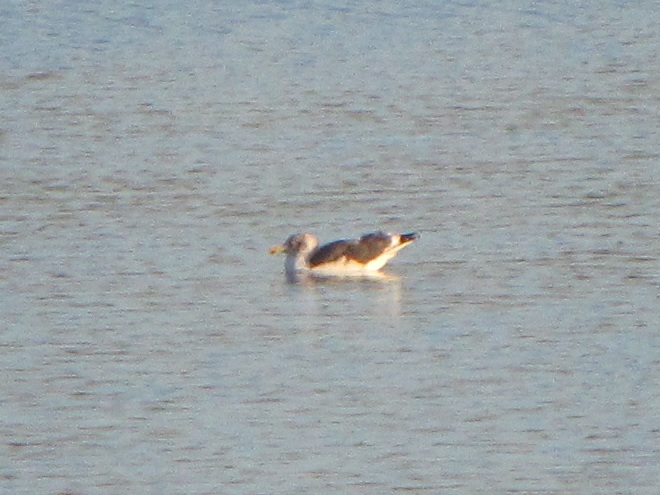
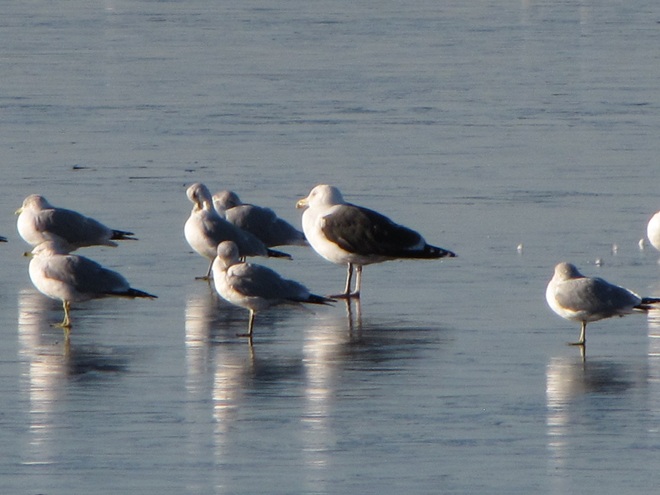
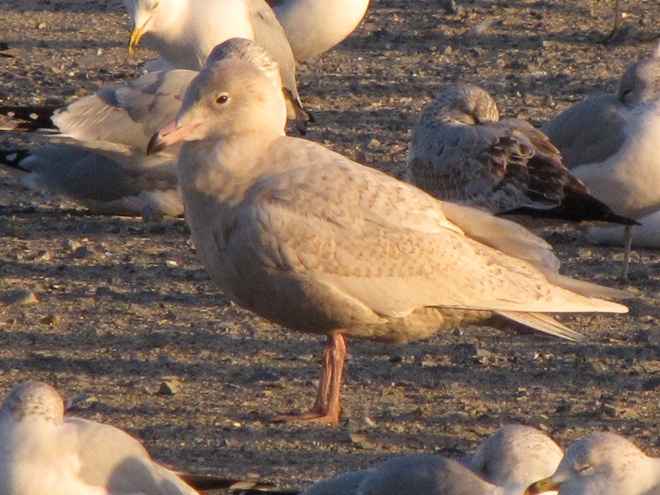
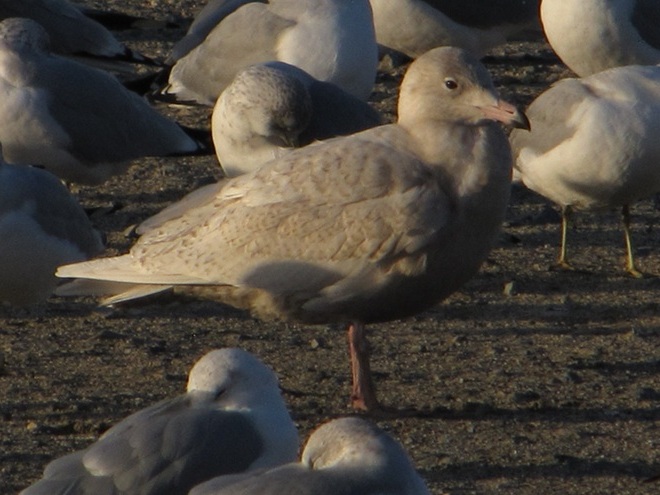
By far, most of the gulls you’ll encounter in the Lower Susquehanna River Watershed right now are Ring-billed Gulls. Some of them still drop by at the business end of the drive-thru lane looking for a lost order of fries and maybe a cheeseburger in paradise.First-winter (left), second-winter (center), and adult Ring-billed Gulls on the Susquehanna.Nearly every flock of gulls found in our area right now is composed exclusively of Ring-billed Gulls. The trick to finding other species, particularly rarities, is to look for slightly larger birds mixed among them, particularly American Herring Gulls like the first-winter (back row left) and third-winter (back row right) birds seen here. Herring and other species of similar-sized gulls seem to prefer each other’s company while on the wintering grounds.Five American Herring Gulls with smaller Ring-billed Gulls. The bird to the upper left and the bird hunkered down to its right are adult American Herring Gulls, the three brownish birds are in their first winter.Non-adult American Herring Gulls in flight. Always look for birds with all-pale wing tips when encountering herring gulls in flight.Midway in size between the Ring-billed Gulls in the foreground and the first-winter American Herring Gulls in the upper left and middle right of this image is a Lesser Black-backed Gull (dark-mantled bird resting at center). The similar-sized bird in the water behind it is a first-winter Iceland Gull (Larus glaucoides), a rare visitor from the arctic.Another look at the first-winter Iceland Gull from the previous image. Did you notice the all-white primary feathers and compare them to the dark wing tips on the Ring-billed Gulls seen here in its company?The conspicuously pale wings of the first-winter Iceland Gull, seen here bathing in the presence of two first-winter American Herring Gulls.Both this first-winter Iceland Gull and the bird from the previous three images are currently being seen just east of the Susquehanna watershed at Blue Marsh Lake in Berks County, Pennsylvania. Additional Iceland Gulls are currently being reported in Maryland on the Susquehanna at Conowingo Dam; on upper Chesapeake Bay in Baltimore County, Maryland; and in southeastern-most Bucks County, near Tullytown, Pennsylvania, at a busy landfill site that attracts tens of thousands of gulls each winter. Double-digit numbers of Iceland Gulls have been reported at this latter site during recent weeks.Lesser Black-backed Gulls like this one observed at Blue Marsh Lake are uncommon in the Lower Susquehanna River Watershed. They are progressively more likely as you travel east toward the aforementioned Bucks County landfills where hundreds of these birds make up a core Atlantic seaboard population.Great Black-backed Gulls are the most frequently encountered large gull on the Susquehanna. They’re easily identified by their enormous size and, as adults, their dark mantle.Rivaling the Great Black-backed Gull in size is the Glaucous Gull (Larus hyperboreus), another rare arctic visitor with pale wing tips. There are numerous reports of these unusual winter visitors from sites on Delaware Bay north to the Tullytown landfills on Delaware River where half a dozen or more have been occurring. Seen near the mouth of the Susquehanna on Chesapeake Bay at North East, Maryland, has been a first-winter bird similar to this one that we photographed at Blue Marsh Lake in Berks County, Pennsylvania.
For us, seeing a Glaucous Gull brought back memories of the last time we saw the species. It was forty-five years ago on New Year’s Day 1981 that we discovered two first-winter birds feeding on Gizzard Shad in open water on an otherwise ice-choked Susquehanna below the York Haven Dam powerhouse at Conewago Falls. Hey Doc Robert, do you remember that day?
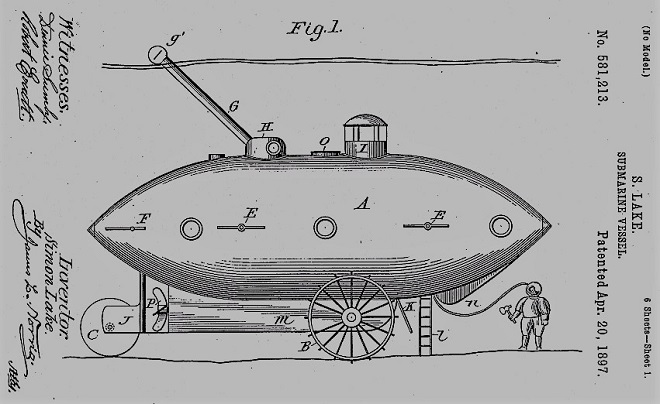
First there was the Nautilus. Then there was the Seaview. And who can forget the Yellow Submarine? Well, now there’s the S. S. Haldeman, and today we celebrated her shakedown cruise and maiden voyage. The Haldeman is powered by spent fuel that first saw light of day near Conewago Falls at a dismantled site that presently amounts to nothing more than an electrical substation. Though antique in appearance, the vessel discharges few emissions, provided there aren’t any burps or hiccups while underway. So, climb aboard as we take a cruise up the Susquehanna at periscope depth to have a quick look around!
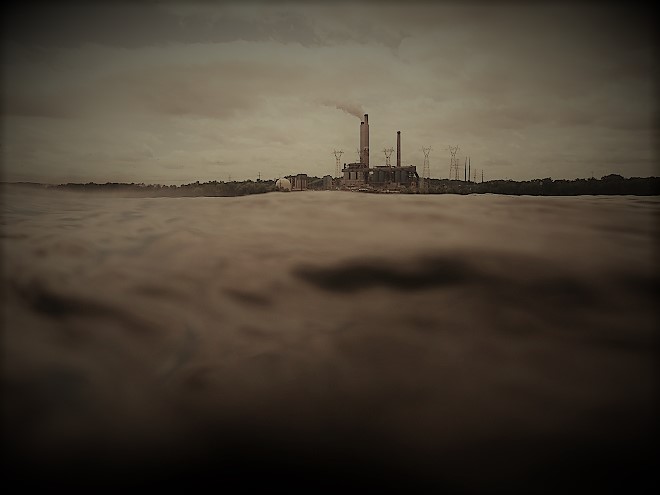
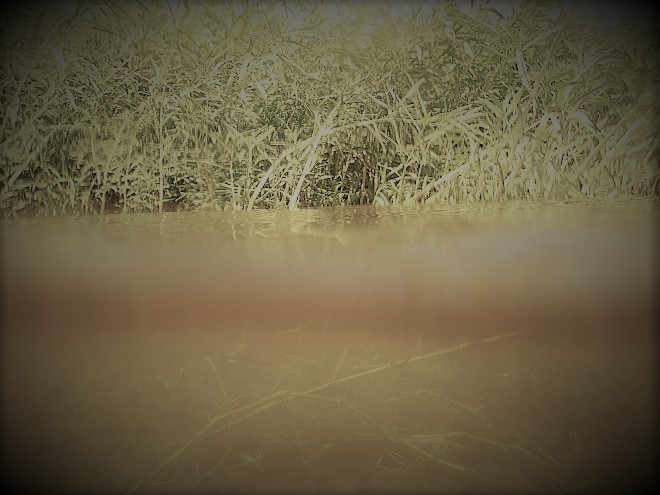
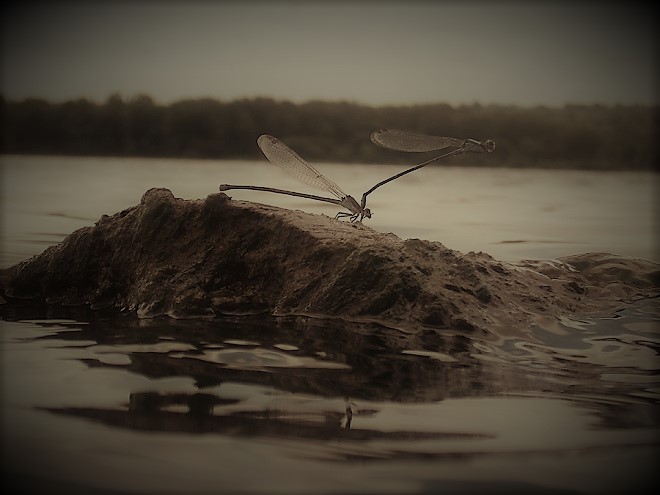
Brunner Island as seen from the east channel.Close-in approach to emergent Water Willow growing on an alluvial Island.The approach to York Haven Dam and Conewago Falls from the west channel.A pair of Powdered Dancers on a midriver log.
Watertight and working fine. Let’s flood the tanks and have a peek at the benthos. Dive, all dive!
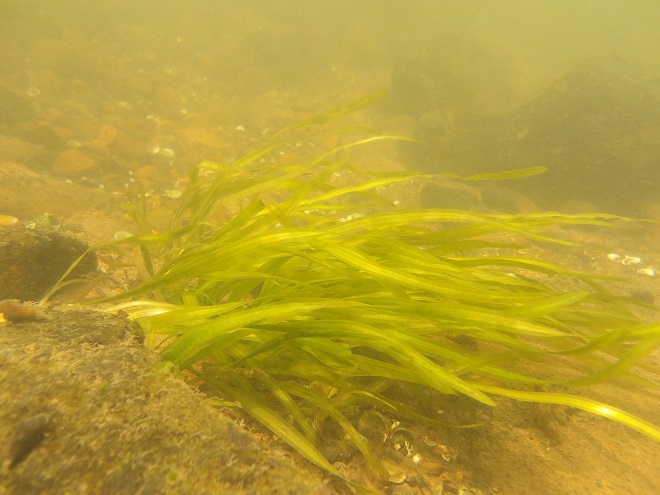
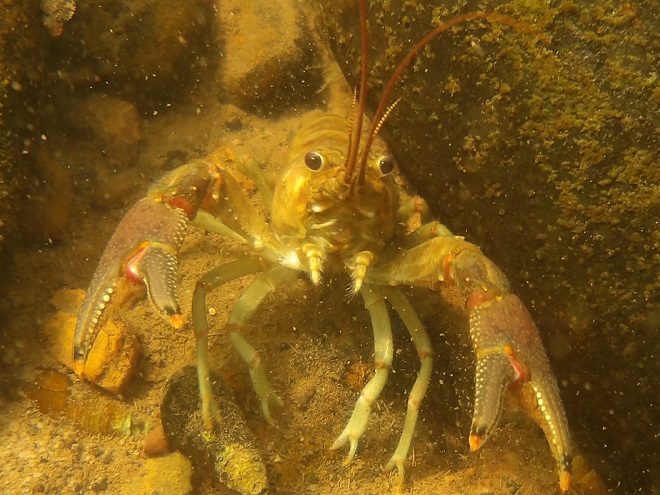
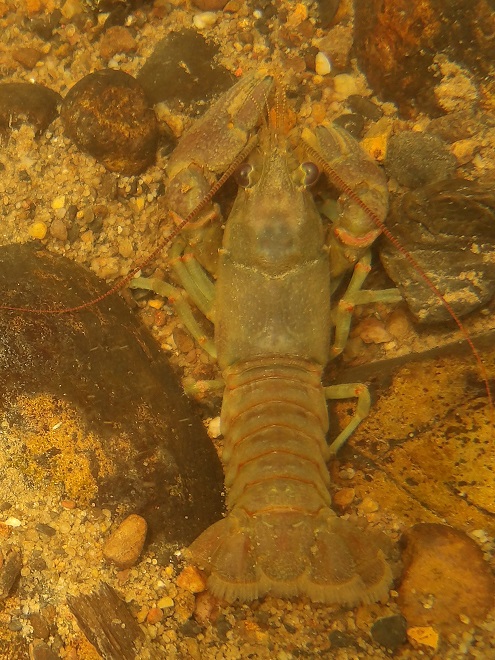
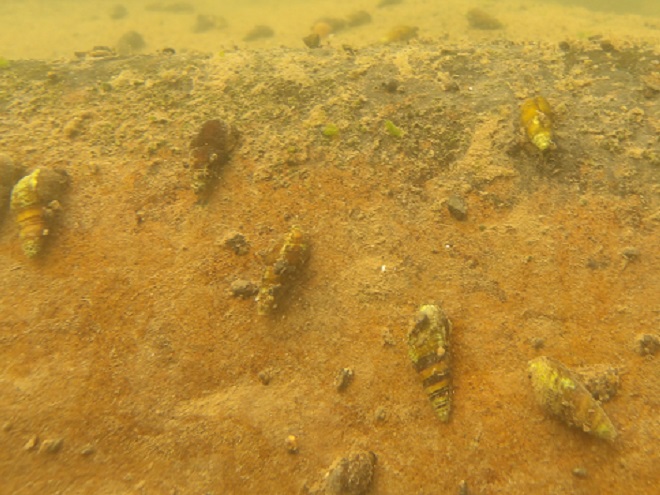
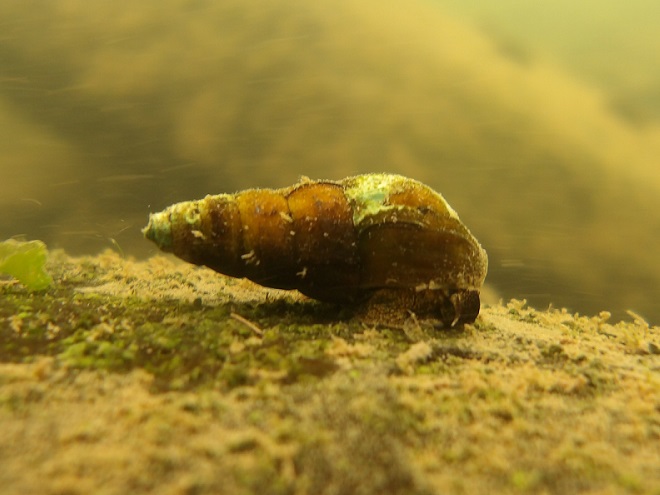
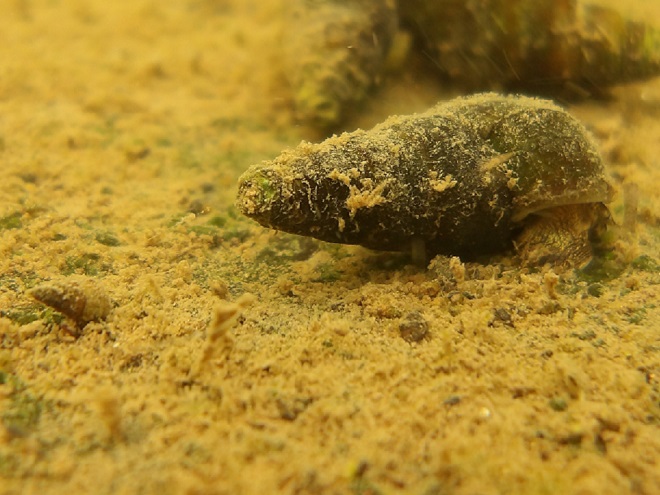
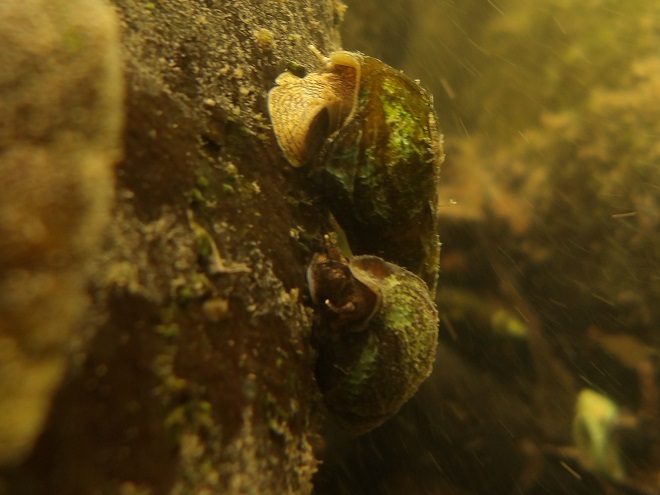
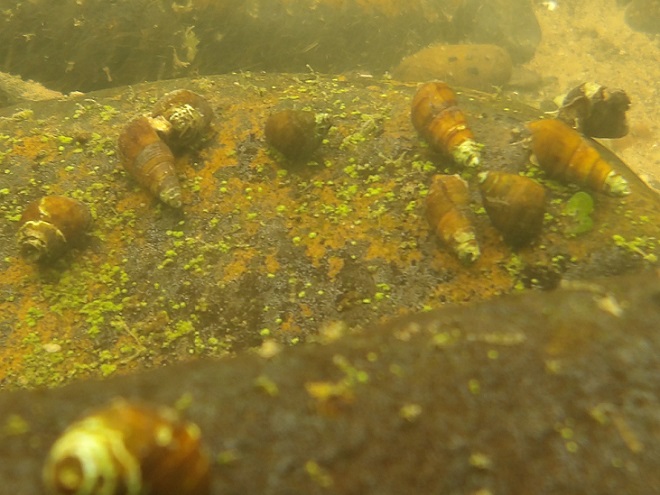
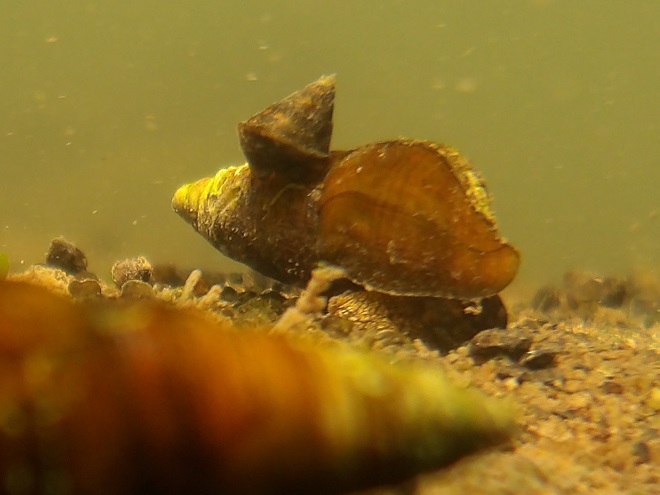
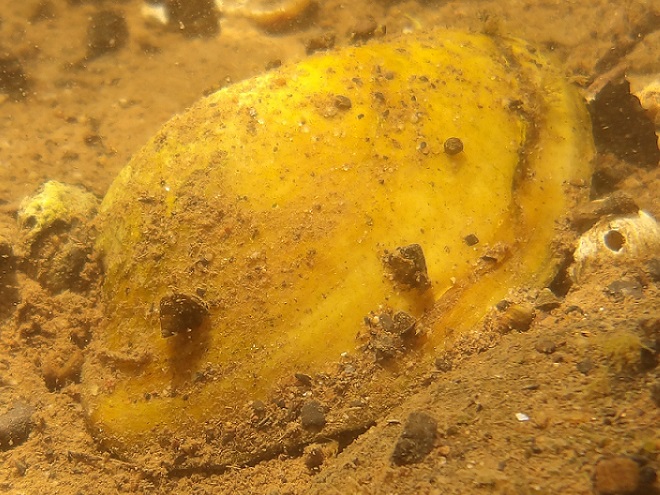
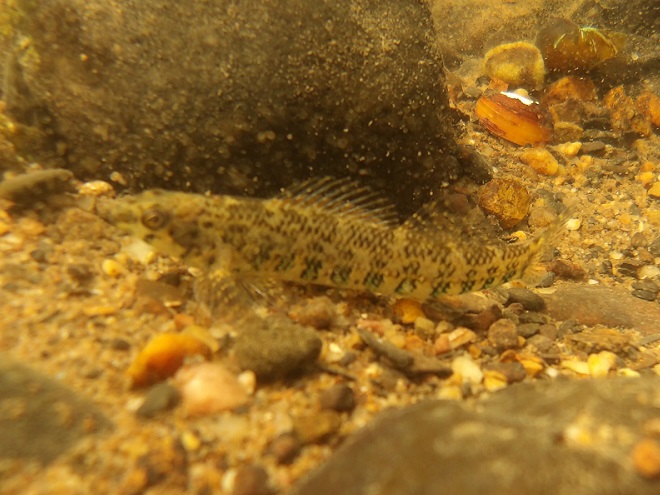
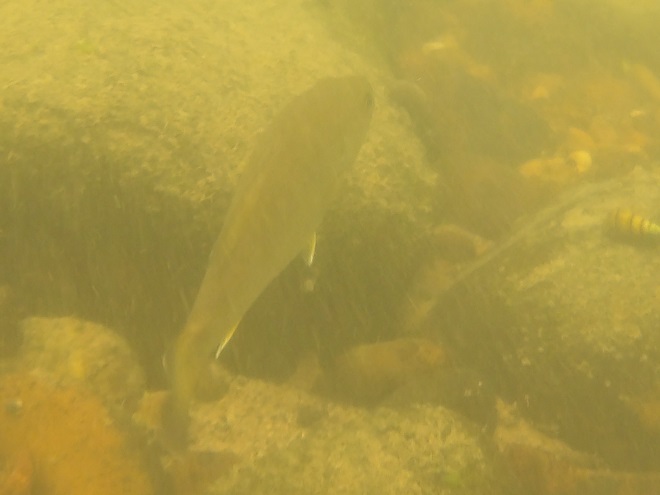
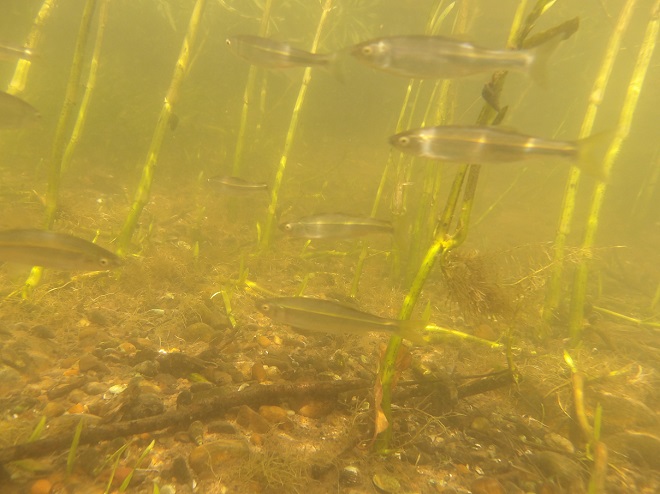
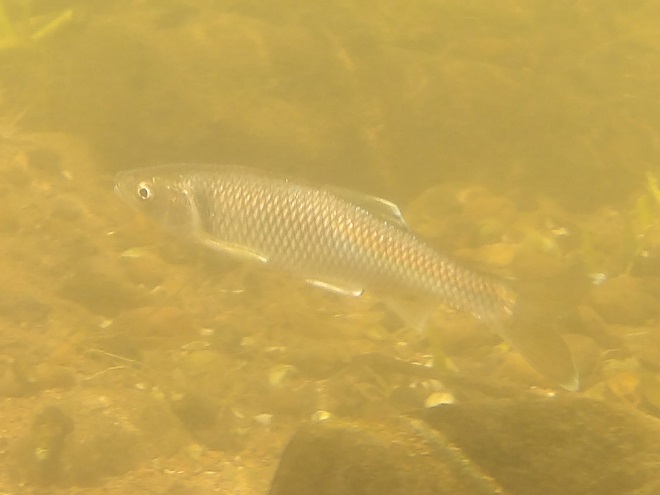
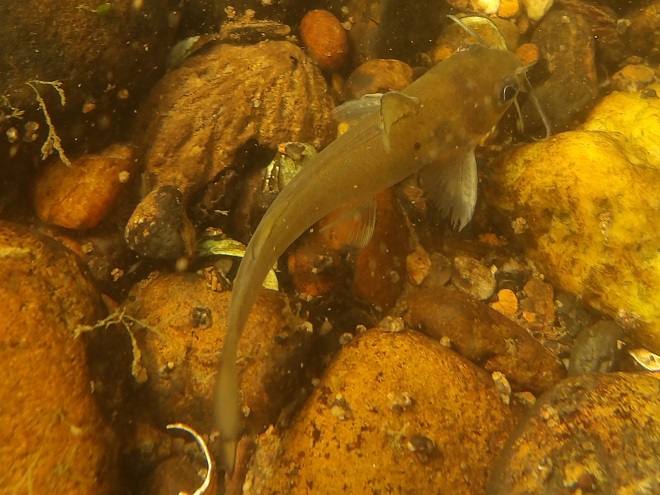
American Eelgrass, also known as Tapegrass, looks to be growing well in the channels. Historically, vast mats of this plant were the primary food source for the thousands of Canvasback ducks that once visited the lower Susquehanna each autumn.As is Water Stargrass (Heteranthera dubia). When mature, both of these native plants provide excellent cover for young fish. Note the abundance of shells from deceased Asiatic Clams (Corbicula fluminea) covering the substrate.A three-tailed mayfly (Ephemeroptera) nymph and a several exoskeletons cling to the downstream side of a rock.This hollowed-out stick may be a portable protective shelter belonging to a Comb-lipped Casemaker Caddisfly larva (Calamoceratidae). The larva itself appears to be extending from the end of the “case” in the upper right of the image. Heteroplectron americanum, a species known for such behavior, is a possibility. In the Susquehanna and its tributaries, the Rusty Crayfish (Faxonius rusticus) is an introduced invasive species. It has little difficulty displacing native species due to its size and aggressiveness.A Rusty Crayfish.Summers with conditions that promote eelgrass and stargrass growth tend to be big years for Virginian River Horn Snails (Elimia virginica). 2022 appears to be one of those years. They’re abundant and they’re everywhere on the rocks and gravel substrate in midriver. Feeding almost incessantly on algae and detritus, these snails are an essential component of the riverine ecosystem, breaking down organic matter for final decomposition by bacteria and fungi.Bits of debris suspended in the flowing water streak by this Virginian River Horn Snail. The spire-shaped shell is a streamlining adaptation for maneuvering and holding fast in the strong current.A young Virginian River Horn Snail following a mature adult. Note the green algae growing among the decaying plant and animal remains that blanket the river bottom.Two of a population that may presently include millions of Virginian River Horn Snails living downstream of Conewago Falls.Virginian River Horn Snails with Lesser Mystery Snails (Campeloma decisum), another native species commonly encountered at Conewago Falls and in surrounding waters.A River Snail (Leptoxis carinata), also known as a Crested Mudalia, hitching a ride on a Virginian River Horn Snail. The two species are frequently found together.A River Snail cleaning the shell of a native freshwater Unionidae mussel, Lampsilis cariosa, commonly called the Yellow Lampmussel or Carried Lampmussel. Because of their general decline in abundance and range, all Unionidae mussels are protected in Pennsylvania.The Banded Darter (Etheostoma zonale) is a member of the perch family (Percidae).A Smallmouth Bass in strong current.Along the edge of an alluvial island at midriver, Cyprinella (Spotfin or Satinfin) Shiners gather in the cover of an emergent stand of Water Willow. The closely related Spotfin Shiner (Cyprinella spiloptera) and Satinfin Shiner (Cyprinella analostanus) are nearly impossible to differentiate in the field.A breeding condition male Cyprinella (Spotfin or Satinfin) Shiner.A juvenile Channel Catfish.
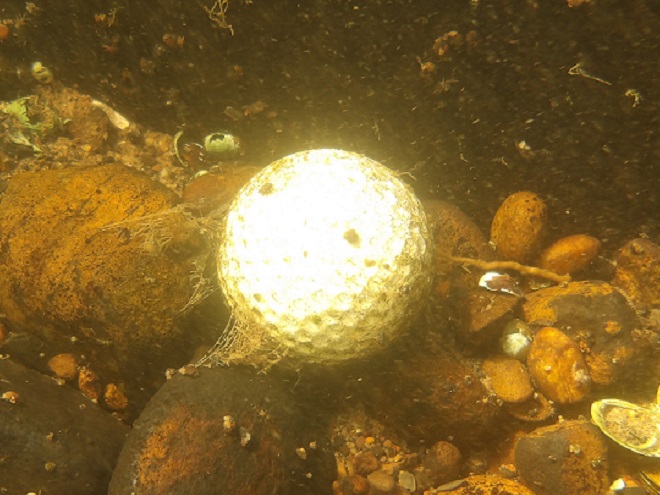
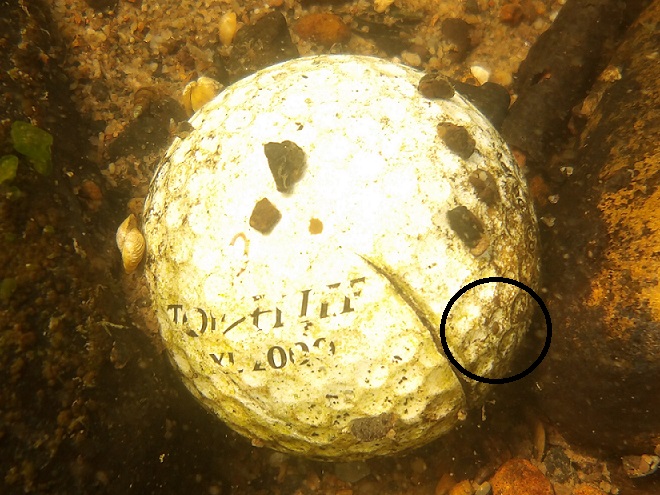
We’re finding that a sonar “pinger” isn’t very useful while running in shallow water. Instead, we should consider bringing along a set of Pings—for the more than a dozen golf balls seen on the river bottom. It appears they’ve been here for a while, having rolled in from the links upstream during the floods. Interestingly, several aquatic species were making use of them.
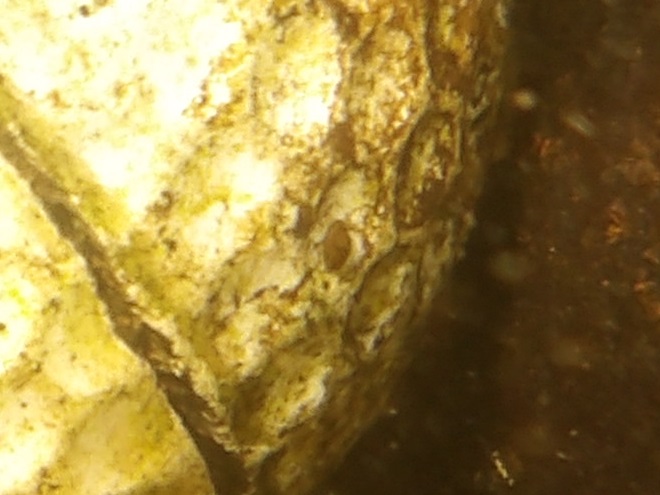
River Snail cleaning a golf ball.A golf ball used as an anchor point for silk cases woven by Net-spinning Caddisfly (Hydropsychidae) larvae to snare food from the water column.A Creeping Ancylid (Ferrissia species), a tiny gastropod also known as a Coolie Hat Snail, River Limpet, or Brook Freshwater Limpet, inhabits the dimple on a “Top Flight”.A closeup view of the Creeping Ancylid. The shell sits atop the snail’s body like a helmet.We now know why your golf balls always end up in the drink, it’s where they go to have their young.
Well, it looks like the skipper’s tired and grumpy, so that’s all for now. Until next time, bon voyage!