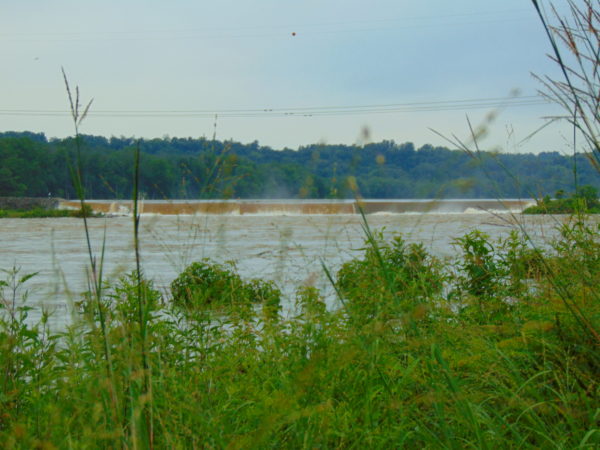
Rain from the remnants of Hurricane/Tropical Storm Harvey ended just after daybreak this morning. Locally, the precipitation was mostly absorbed into the soil. There was little runoff and no flooding. The river level at Conewago Falls is presently as low as it has been all summer. Among the pools and rapids of the Pothole Rocks, numbers of migrating birds are building.
Mist and a low cloud ceiling created poor visibility while trying to see early morning birds, but they’re here. The warblers are moving south and a small wave of them was filtering through the foliage on the edge of the Riparian Woodlands. One must bend backwards to have a look, and most could not be identified due to the poor lighting in the crowns of the trees where they were zipping about. Five species of warblers and two species of vireos were discerned.
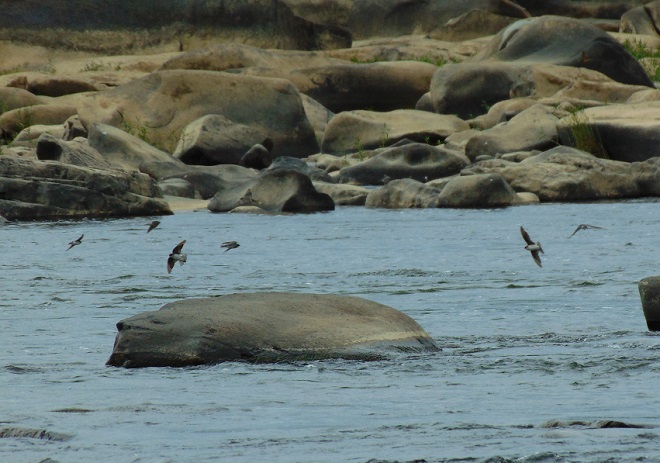
There are increasing concentrations of swallows feeding on insects over the falls. Hundreds were here today, mostly Tree Swallows (Tachycineta bicolor). Bank Swallows (Stelgidopteryx riparia) numbered in the hundreds, far below the thousands, often 10,000, which staged here for migration and peaked during the first week of September annually during the 1980s and 1990s. Their numbers have been falling steadily. Loss of nesting locations in embankments near water may be impacting the entire population. A reduction in the abundance of late-summer flying insects here on the lower Susquehanna River may be cause for them to abandon this area as a migration staging point.
Bank and Tree Swallows by the hundreds were feeding upon flying insects above the waters of Conewago Falls today. Lesser numbers of Northern Rough-winged Swallows (Stelgidopteryx serripennis) and Barn Swallows (Hirundo rustica) joined the swarm.
Clear weather in the coming nights and days may get the migrants up and flying in large numbers. For those species headed to the tropics for winter, the time to get moving has arrived.
CLICK ON THE LOGO FOR TODAY’S MIGRATION COUNT TOTALS
When we look at birds, we are fascinated by the unique structure and appearance of their feathers. They set birds apart from all other life forms on the planet. Feathers enable most birds to achieve a feat long envied by humans…flight. Birds on the wing awaken a curiosity in man. They are generally the largest animals one will see in the air. People want to know the name of a bird they see flying by, and want to know more about it. The method and style of bird flight can aid an observer who attempts to determine which of the world’s 10,000 bird species he or she is studying. Body shape and bird sounds often tell us a lot about the birds we encounter. But most often, we rely on the unique colors, patterns, and shapes of the feathers, the plumage, to identify the bird we are seeing.
To birds, feathers are survival. They are lightweight and strong to support the mechanics of flight. Feathers are superb insulators against the elements, and provide additional buoyancy for birds spending time on the water. For most birds, feathers provide a coloration and a texture similar to their surroundings, enabling them to hide from predators or to stalk prey. In the case of some species, extravagant showy plumage is acquired, at least during the breeding season, and often only by males, as a way to attract a mate, intimidate rivals, defend a territory, or lure an intruder away from a nest site. Because they become worn and damaged, all feathers are periodically molted and replaced by fresh plumage.
The feathers worn by a young bird leaving the nest are called the juvenile plumage. Typically, this is followed by a molt into a basic (non-breeding) plumage. The oft times extravagant breeding feathers are the result of a molt into an alternate (breeding) plumage.
While making field observations, the species, subspecies, gender, age, and other vital statistics of a bird can often by discerned easily by noting the plumage. In the case of some other birds, diligence, experience, research, and an exceptionally good look and/or a photograph may be required to interpret these particulars. In still other instances, a trained expert with a specimen in the hand is the only method of learning the bird’s identity and background.
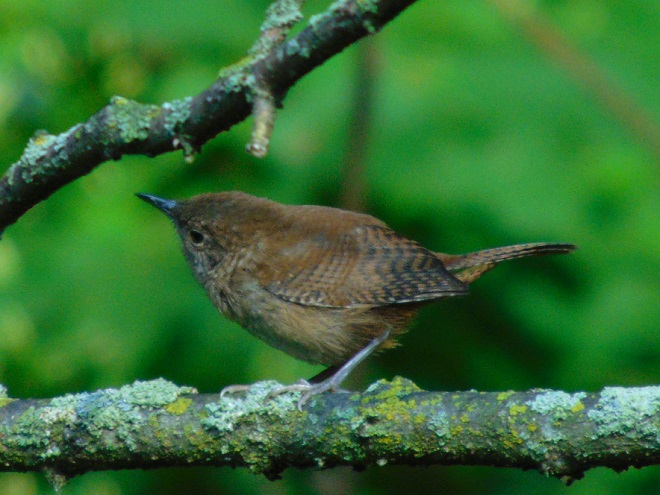
This juvenile House Wren (Troglodytes aedon) left the nest wearing plumage very similar to that of its parents. In lieu of bright colors, the male House Wren relies upon a vigorous bubbly song and a scrappy demeanor to defend its breeding territory. This species nests in cavities on the edges of the Riparian Woodlands of Conewago Falls. Males may have more than one mate. House Wrens probably migrate at night and will winter in the southern border states and further south.
The age at which birds acquire adult breeding and non-breeding plumages varies by species. Many juvenile birds resemble adults in basic (non-breeding) plumage as soon as they leave the nest. For these birds, there is little difference between their juvenile plumage and the appearance of the feathers which follow the molt into their first basic (non-breeding) plumage. Bird species which sexually mature within their first year may acquire their first basic (non-breeding) plumage before arrival of their first winter, followed by an alternate (breeding) plumage by their first spring. This is particularly true for smaller short-lived birds. Other species, normally larger long-lived ones, may experience a sequence of molts through multiple basic (non-breeding) plumages over a period of years prior to resembling an adult. Some of these species, such as eagles, retain their juvenile plumage for as long as a year before extensive molting into a first basic (non-breeding) plumage begins. Still others, including many gulls, attain a first-winter (formative) plumage prior to molting into their first basic (non-breeding) set of feathers. Sexual maturity and initiation of an annual molt to alternate (breeding) plumage, if there is one, may take as long as three to five years for these bigger birds.
For nearly all species of birds, the molts which produce basic (non-breeding) plumage occur on at least an annual basis and include a total replacement of feathers. This process renews worn and missing plumes including the flight feathers of the wings and tail. Any molt to alternate (breeding) plumage often excludes the replacement of the feathers of the wings and tail. There are many exceptions to these generalities.
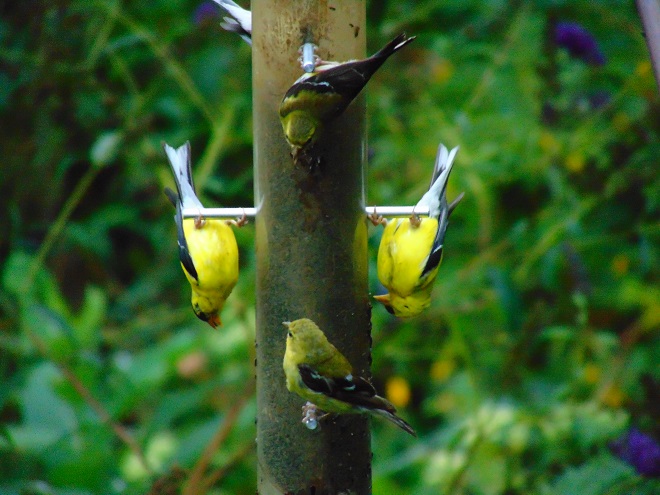
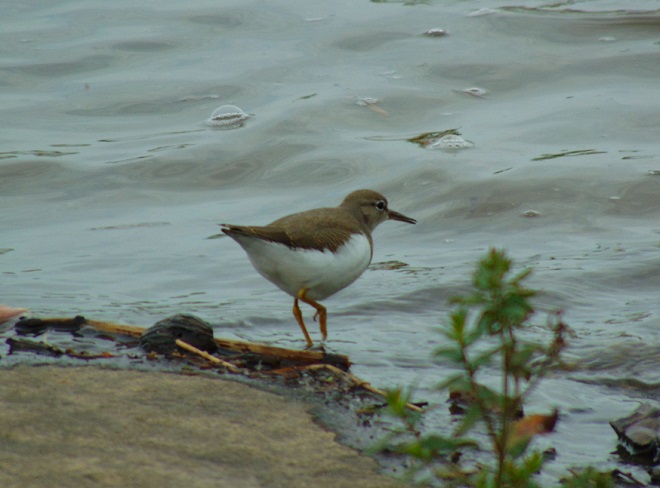
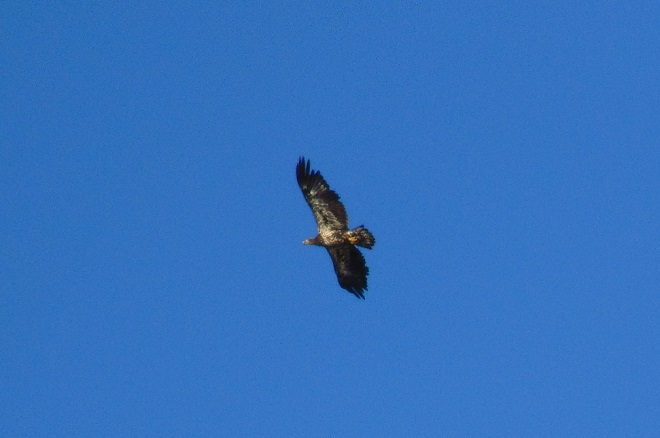
A mid-summer nesting species, the American Goldfinch, Spinus tristis, male (left and right) molts into a glamorous alternate plumage for the breeding season. The adult female’s alternate plumage (top) is a subdued green-yellow and black. Her feathers resemble the foliage around the nest and offer protection from discovery during incubation. Juvenile plumage (bottom) is similar to that of the female, but duller with a buffy tone. By November each of these birds will have molted into a tan-buff basic (non-breeding) plumage, the male’s with a slight yellow hue. During their first spring, juveniles attain sexual maturity and, like the adults from the previous year, molt into alternate (breeding) plumage. The breeding birds seen here will probably winter in the southern United States, and birds that nested to our north will arrive to remain as winter residents. Various stages of molt can be seen simultaneously during spring and autumn migrations as populations of goldfinches from multiple latitudes intermingle as they pass through the Susquehanna River watershed.This juvenile Spotted Sandpiper (Actitis macularius), lacks the namesake dark markings on its white underside, thus it presently resembles an adult in basic (non-breeding) plumage. Upon reaching sexual maturity, it will molt into a spotted alternate (breeding) plumage for the nesting season during each remaining year of its life. Females of this species defend a territory and lay eggs in a nest located among cover near the shoreline. A female may have as many as five mates. Males alone incubate the eggs, usually four, for 20-24 days. The young leave the nest upon hatching and are escorted by the male for about two to three additional weeks. They are the only sandpiper to nest on the Susquehanna River shoreline. Spotted Sandpipers migrate to the southern border states and further south for winter. At Conewago Falls, they arrive in late April to nest, with birds, possibly migrants from further north, remaining until well into October. In any plumage, you can easily recognize the Spotted Sandpiper by its habit of teetering its body at the hips to pump the tail up and down.Bald Eagles go through a series of five molts before reaching adult plumage. The first plumage, Juvenile, is nearly all dark brown with white linings along the forward underside of the wings. The wing and tail feathers are a bit longer than in later plumages to aid the inexperienced birds during their clumsy first flights. Due to the additional feather length, Juveniles look larger than older birds, but they are not as heavy as their seniors. The bird seen here flying above Conewago Falls is probably in its second year. This plumage, Basic I, also known as “White Belly I”, is characterized by a nearly full set of new flight feathers. Note that some of the longer Juvenile feathers are still present, giving the wings a jagged sloppy look, particularly near the center of the trailing edge. Third-year (Basic II) birds often have at least some white belly feathers and are sometimes known as “White Belly II” Bald Eagles. Basic II birds typically possess a complete set of adult flight feathers, so the trailing edge of the wing has a neater and more uniform appearance.
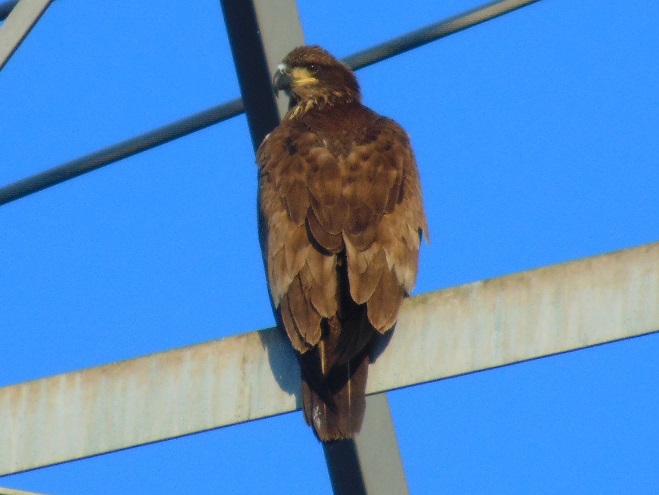
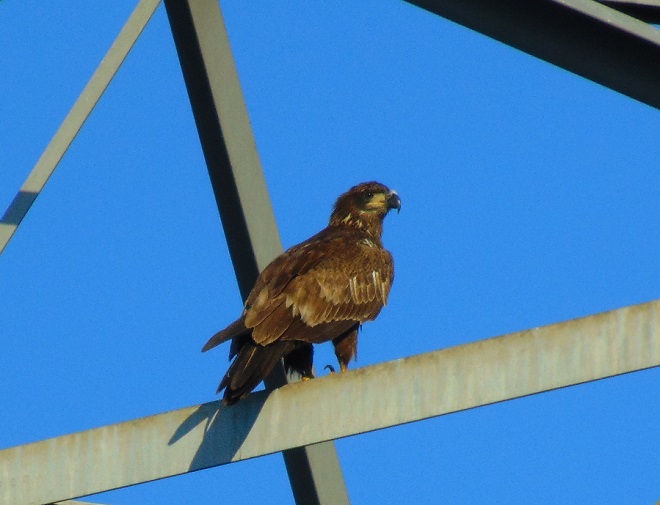
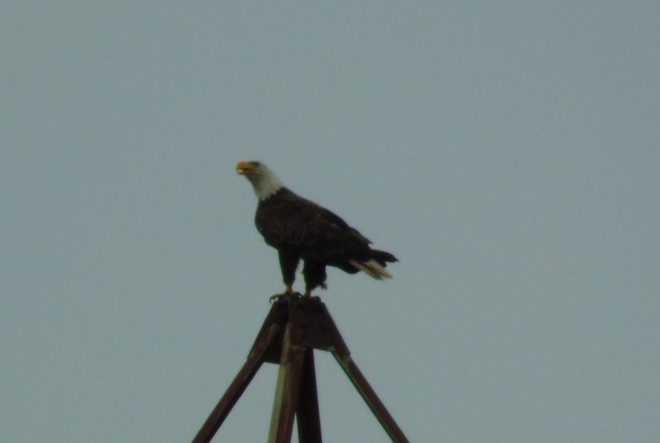
The Bald Eagle in the two photographs above is in its first year. This plumage, known as “Juvenile”, is characterized by dark flight feathers which appear uniformly long in length when the bird is airborne. The eye is dark brown. The iris of the eye will lighten in the second year (Basic I) and will become cream-colored by the third year (Basic II). The bill, which is all dark gray when the bird is in the nest, has begun the slow progression to a yellow color that will be complete in the bird’s fifth year (Basic IV). Third year (Basic II) birds molt to white crown and throat feathers, but have a dark set of feathers through the eye producing an “Osprey face” in most individuals. In its fourth year (Basic III), this eagle will molt to a white tail with just a thin dark brown terminal band. The head will become nearly all white except for a few dark spots through the eye, which will have a yellow iris. A cleaner white head and tail will develop during the fifth year (Basic IV) and will persist through the familiar adult Bald Eagle plumages (Definitive Plumage) for the remainder of its life.
The Juvenile and non-breeding (basic) plumages of late-summer may seem drab and confusing, but learning them is a worthwhile endeavor. Consider that most of the birds coming south during the migration will be adorned in this fashion. The birds of North America are in their greatest numerical mass of the year right now, and nearly all are females, juveniles, other non-adults, or molting males. There are few males in breeding plumage among the autumn waves of migrants. In the coming months, there will be an abundance of opportunities to enjoy these marvels on wings, so getting to know the birds in non-breeding feathers is time well spent. Make haste and get ready. For our feathered friends, it’s autumn and they’re on their way south.
Here come the confusing fall migrants. Twelve Semipalmated Sandpipers (Calidris pusilla) and sixteen unidentified “peep” sandpipers (Calidris species) were seen feeding in Conewago Falls on August 27. This Semipalmated Sandpiper is either an adult in worn alternate (breeding) plumage or a Juvenile. Adults of this species molt into basic plumage on the wintering grounds. The Semipalmated Sandpiper breeds in the high arctic tundra and winters in the West Indies and northern South America.CLICK ON THE LOGO FOR TODAY’S MIGRATION COUNT TOTALS
SOURCES
Dunne, Pete. 2006. Pete Dunne’s Essential Field Guide Companion. Houghton Mifflin Company. New York.
Hayman, Peter; John Marchant, and Tony Prater. 1986. Shorebirds, An Identification Guide to the Waders of the World. Houghton Mifflin Company. New York.
Kauman, Kenn. 1996. Lives of North American Birds. Houghton Mifflin Company. New York.
McCullough, Mark A. 1989. Molting Sequence and Aging Of Bald Eagles. The Wilson Bulletin. 101:1-10.
Let’s imagine that you spend your summer as a singer and you have to strut your stuff in a blue suit all day long just so the other guys know that you’re not going to tolerate any nonsense with either of your two gals. And…you’re responsible for feeding the adolescent kids while each of the girls begins a second family. Wouldn’t you be ready for a break by late August?
The boys must think so. They’re quiet now. This week was the end. They’ve done their duty. They protected their homes and got the youngsters out on their own. It’s time to eat, get out of the dress blues, and prepare to take a flight to warmer climates, maybe even the tropics…for a holiday of sorts.
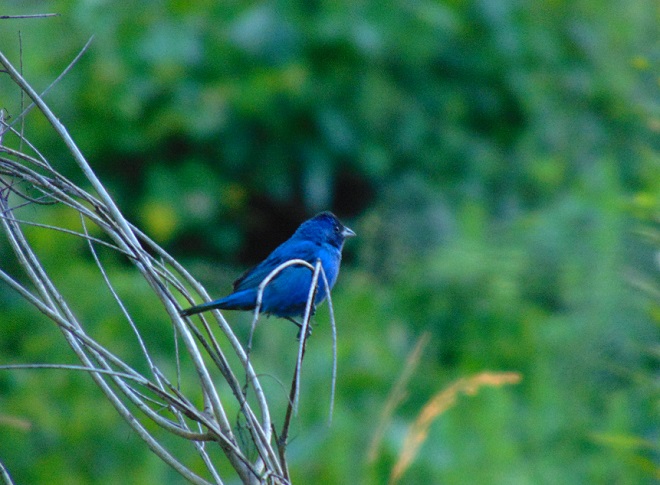
The male Indigo Bunting (Passerina cyanea) has a busy schedule. Before arriving at Conewago Falls in early May, he has molted from the plainest of plain brown plumage and donned an iridescent set of feathers that glow a brilliant blue and purple in sunlight. He chooses a territory with plenty of shrubby and weedy growth along the edge of a woodland, and begins to sing and defend his parcel, often from a dead tree or other perch.
At Conewago Falls, the Indigo Bunting is a common breeding bird, finding the mosaic of electric transmission wire right-of-ways, railroads, and the Riverine Grasslands to be absolutely perfect habitat. The female, inconspicuous in her uniformly brown plumage, builds the nest, incubates the 3 to 4 eggs (11 to 14 days), and feeds the young in the nest (9 to 12 days). Being quite the showboats, some males will have more than one mate nesting in their territory. In addition to defending the nest(s), the male Indigo Bunting will sometimes feed the fledged young so that the female(s) can begin incubating a second brood. The summertime diet is mostly invertebrates, but seeds are also consumed.
A male Indigo Bunting defends nesting territory from a perch on a dead tree.
By late August, the young of the year are mostly on their own. The male’s territorial urges, including the nearly non-stop singing, come to an end. Soon, his blue feathers are beginning to drop and a molt is underway into a brown plumage resembling that of the females and juveniles.
Indigo Buntings evacuate their breeding range in eastern North America to winter mostly south of the United States. These nocturnal travelers have been the subject of migration behavior studies. They are among a number of small bird species known to cross the Gulf of Mexico on their way south. Also, Indigo Buntings can navigate by the stars.
On the wintering grounds, Indigo Buntings are flocking birds. At this time of year, they consume more seeds as a component of their diet and are known to visit bird feeders.
By April, the blue suit is back, and the males and females are on the way north. Hope to see you then pal.
SOURCES
Dunne, Pete. 2006. Pete Dunne’s Essential Field Guide Companion. Houghton Mifflin Company. New York.
Kaufman, Kenn. 1996. Lives of North American Birds. Houghton Mifflin Company. New York.
There’s something frightening going on down there. In the sand, beneath the plants on the shoreline, there’s a pile of soil next to a hole it’s been digging. Now, it’s dragging something toward the tunnel it made. What does it have? Is that alive?
We know how the system works, the food chain that is. The small stuff is eaten by the progressively bigger things, and there are fewer of the latter than there are of the former, thus the whole network keeps operating long-term. Some things chew plants, others devour animals whole or in part, and then there are those, like us, that do both. In the natural ecosystem, predators keep the numerous little critters from getting out of control and decimating certain other plant or animal populations and wrecking the whole business. When man brings an invasive and potentially destructive species to a new area, occasionally we’re fortunate enough to have a native species adapt and begin to keep the invader under control by eating it. It maintains the balance. It’s easy enough to understand.
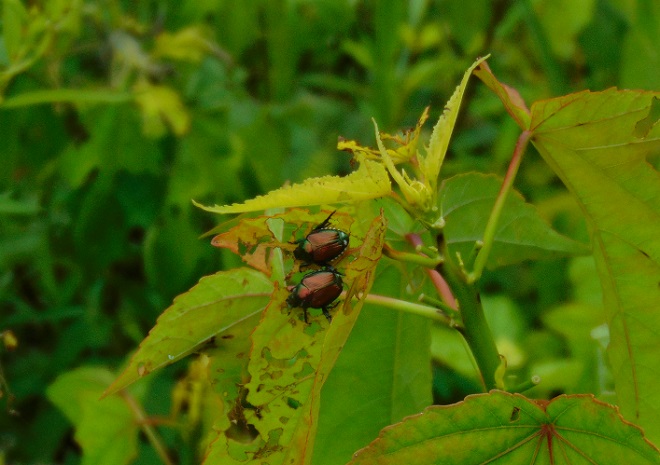
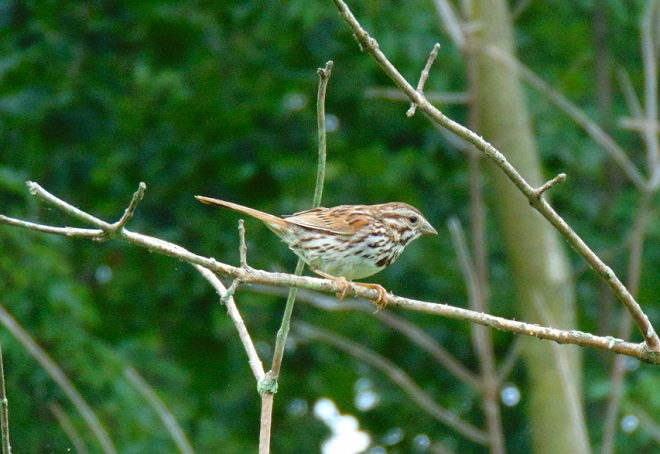
Japanese Beetles (Popillia japonica) seen here on Halberd-leaved Rose Mallow. Without predation, exploding numbers of this invasive non-indigenous insect can defoliate and kill numerous species of plants in a given area.The Song Sparrow (Melospiza melodia) is a generalist feeder, eating seeds and invertebrates including Japanese Beetles. This species is the omnipresent year-round occupant of shoreline vegetation along the lower Susquehanna River.
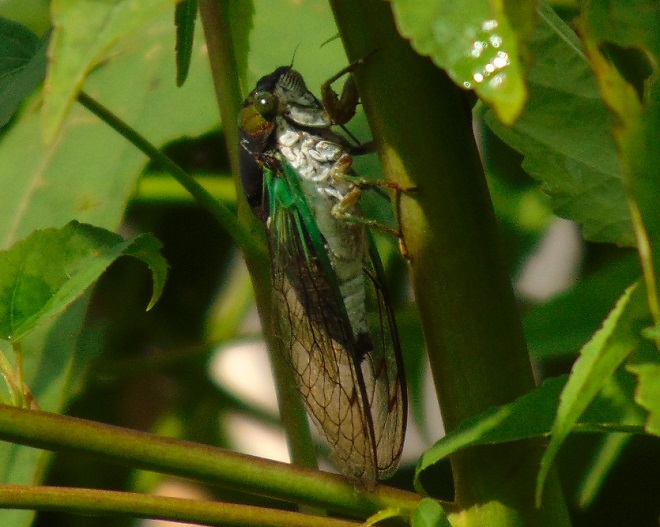
Late summer days are marked by a change in the sounds coming from the forests surrounding the falls. For birds, breeding season is ending, so the males cease their chorus of songs and insects take over the musical duties. The buzzing calls of male “annual cicadas” (Neotibicen species) are the most familiar. The female “annual cicada” lays her eggs in the twigs of trees. After hatching, the nymphs drop to the ground and burrow into the soil to live and feed along tree roots for the next two to five years. A dry exoskeleton clinging to a tree trunk is evidence that a nymph has emerged from its subterranean haunts and flown away as an adult to breed and soon thereafter die. Flights of adult “annual cicadas” occur every year, but never come anywhere close to reaching the enormous numbers of “periodical cicadas” (Magicicada species). The three species of “periodical cicadas” synchronize their life cycles throughout their combined regional populations to create broods that emerge as spectacular flights once every 13 or 17 years.
An “annual cicada” also known as a “dog-day cicada”, clings to the stem of a Halberd-leaved Rose Mallow at Conewago Falls.
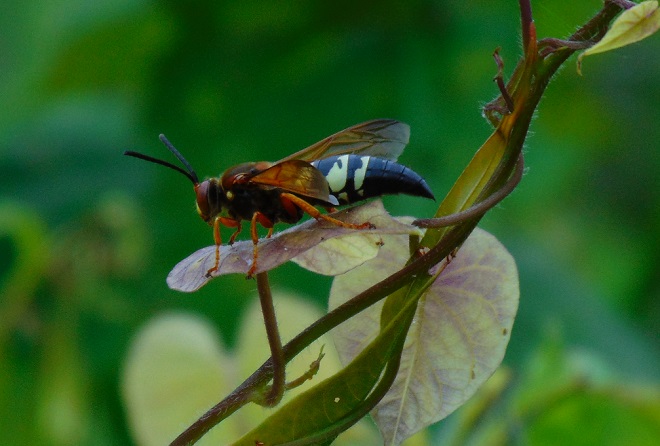
For the adult cicada, there is danger, and that danger resembles an enormous bee. It’s an Eastern Cicada Killer (Specius speciosus) wasp, and it will latch onto a cicada and begin stinging while both are in flight. The stings soon paralyze the screeching, panicked cicada. The Cicada Killer then begins the task of airlifting and/or dragging its victim to the lair it has prepared. The cicada is placed in one of more than a dozen cells in the tunnel complex where it will serve as food for the wasp’s larvae. The wasp lays an egg on the cicada, then leaves and pushes the hole closed. The egg hatches in a several days and the larval grub is on its own to feast upon the hapless cicada.
An Eastern Cicada Killer (Sphecius speciosus) along the river shoreline. Despite their intimidating appearance, they do not sting humans and can be quite docile when approached.
Other species in the Solitary Wasp family (Sphecidae) have similar life cycles using specific prey which they incapacitate to serve as sustenance for their larvae.
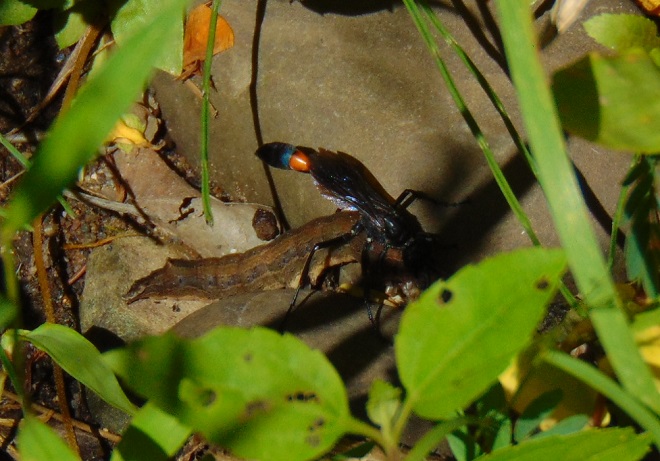
A Solitary Wasp, one of the Thread-waisted Wasps (Ammophila species), drags a paralyzed moth caterpillar to its breeding dungeon in the sandy soil at Conewago Falls. For the victim, there is no escape from the crypt.
The Solitary Wasps are an important control on the populations of their respective prey. Additionally, the wasp’s bizarre life cycle ensures a greater survival rate for its own offspring by providing sufficient food for each of its progeny before the egg beginning its life is ever put in place. It’s complete family planning.
The cicadas reproduce quickly and, as a species, seem to endure the assault by Cicada Killers, birds, and other predators. The periodical cicadas (Magicicada), with adult flights occurring as a massive swarm of an entire population every thirteen or seventeen years, survive as species by providing predators with so ample a supply of food that most of the adults go unmolested to complete reproduction. Stay tuned, 2021 is due to be the next periodical cicada year in the vicinity of Conewago Falls.
SOURCES
Eaton, Eric R., and Kenn Kaufman. 2007. Kaufman Field Guide to Insects of North America. Houghton Mifflin Company. New York.
It has not been a good summer if you happen to be a submerged plant species in the lower Susquehanna River. Regularly occurring showers and thunderstorms have produced torrents of rain and higher than usual river stages. The high water alone wouldn’t prevent you from growing, colonizing a wider area, and floating several small flowers on the surface, however, the turbidity, the suspended sediment, would. The muddy current casts a dirty shadow on the benthic zone preventing bottom-rooted plants from getting much headway. There will be smaller floating mats of the uppermost leaves of these species. Fish and invertebrates which rely upon this habitat for food and shelter will find sparse accommodation…better luck next year.
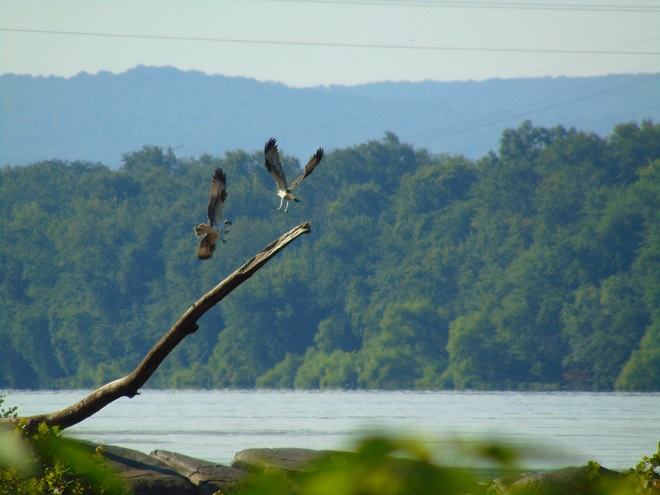
Due to the dirty water, fish-eating birds are having a challenging season as they try to catch sufficient quantities of prey to feed themselves and their offspring. A family of Ospreys (Pandion haliaetus) at Conewago Falls, including recently fledged young, were observed throughout this morning and had no successful catches. Of the hundred or more individual piscivores of various species present, none were seen retrieving fish from the river. The visibility in the water column needs to improve before fishing is a viable enterprise again.
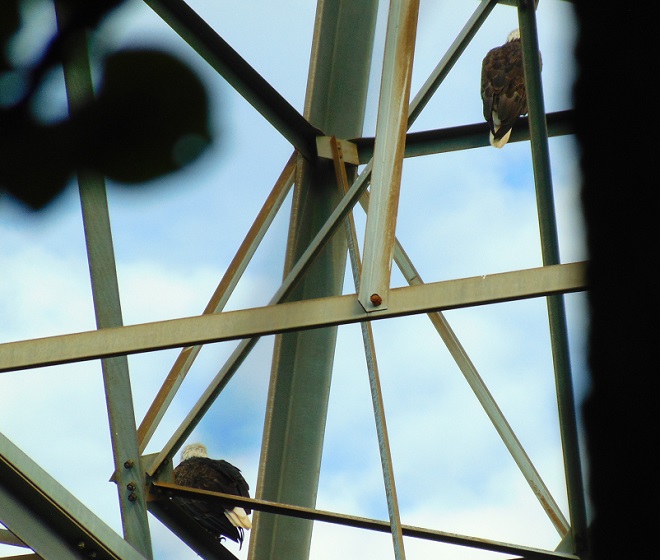
Ospreys competing for a suitable fishing perch. Improving water conditions in the coming week should increase their success as predators.Versatile at finding food, adult Bald Eagles are experienced and know to be on the lookout for Ospreys with fish, a meal they can steal through intimidation.
While the submerged plant communities may be stunted by 2017’s extraordinary water levels, there is a very unique habitat in Conewago Falls which endures summer flooding and, in addition, requires the scouring effects of river ice to maintain its mosaic of unique plants. It is known as a Riverine Grassland or scour grassland.
The predominant plants of the Riverine Grasslands are perennial warm-season grasses. The deep root systems of these hardy species have evolved to survive events which prevent the grassland from reverting to woodland through succession. Fire, intense grazing by wild herd animals, poor soils, drought, and other hardships, including flooding and ice scour, will eliminate intolerant plant species and prevent an area from reforesting. In winter and early spring, scraping and grinding by flood-driven chunk ice mechanically removes large woody and poorly rooted herbaceous growth from susceptible portions of the falls. These adverse conditions clear the way for populations of species more often associated with North America’s tall grass prairies to take root. Let’s have a look at some of the common species found in the “Conewago Falls Pothole Rocks Prairie”.
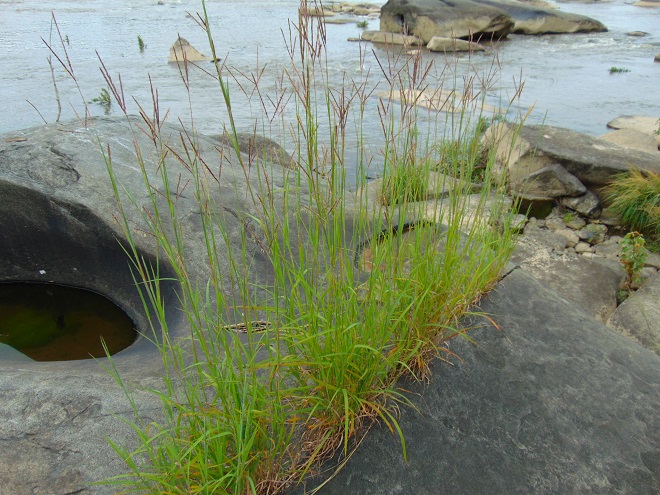
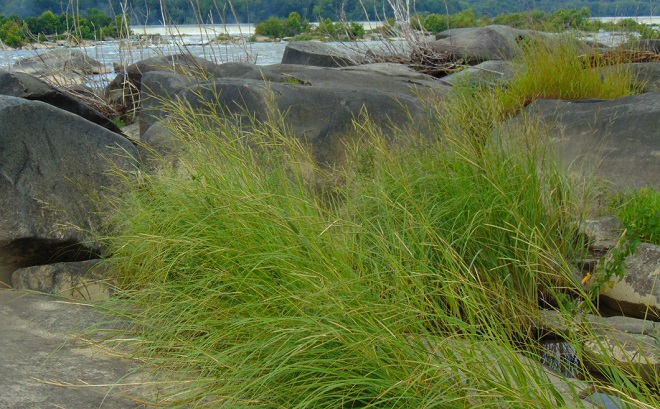
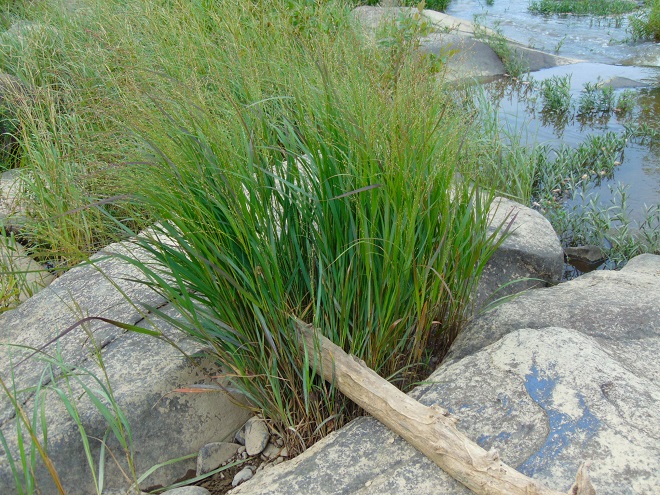
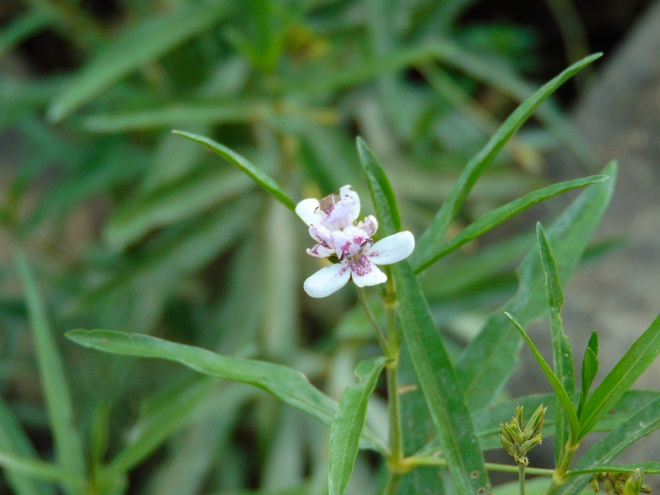
Big Bluestem (Andropogon gerardi), seen heregrowing in the cracks of a pothole rock. High water nourishes the plant by filling the crevices with nutrient-loaded sediment. This species evolved with roots over three feet deep to survive fires, trampling by bison, and drought.Freshwater Cordgrass (Spartina pectinata) does well with its roots in water. It creates exceptional bird habitat and grows in the falls and on ice-scoured small islands in free-flowing segments of the Susquehanna River downstream.Switchgrass (Panicum virgatum), like Big Bluestem, is one of the tall grass prairie species and, like Freshwater Cordgrass, grows in near pure stands on ice-scoured islands. It takes flooding well and its extensive root system prevents erosion.Though not a grass, Water Willow (Justicia americana) is familiar as a flood-enduring emergent plant of river islands, gravel bars, and shorelines where its creeping rhizome root system spreads the plant into large masses. These stands are often known locally as “grass beds”. This member of the acanthus family provides habitat for fish and invertebrates among its flooded leaves and stems. Its presence is critical to aquatic life in a year such as this.
The Conewago Falls Riverine Grassland is home to numerous other very interesting plants. We’ll look at more of them next time.
SOURCES
Brown, Lauren. 1979. Grasses, An Identification Guide. Houghton Mifflin Company. New York, NY.
They can be a pesky nuisance. The annoying high-frequency buzzing is bad enough, but it’s the quiet ones that get you. While you were swatting at the noisy one, the silent gender sticks you and begins to feed. Maybe you know it, or maybe you don’t. She could make you itch and scratch. If she’s carrying a blood-borne pathogen, you could get sick and possibly die.
To humans, mosquitos are the most dangerous animal in the world (though not in the United States where man himself and the domestic dog are more of a threat). Globally, the Anopheles mosquitos that spread Malaria have been responsible for millions and millions of human deaths. Some areas of Africa are void of human habitation due to the prevalence of Malaria-spreading Anopheles mosquitos. In the northeastern United States, the Northern House Mosquito (Culex pipiens), as the carrier of West Nile Virus, is the species of greatest concern. Around human habitations, standing water in tires, gutters, and debris are favorite breeding areas. Dumping stagnant water helps prevent the rapid reproduction of this mosquito.
In recent years, the global distribution of these mosquito-borne illnesses has been one of man’s inadvertent accomplishments. An infected human is the source of pathogens which the feeding mosquito transmits to another unsuspecting victim. Infectious humans, traveling the globe, have spread some of these diseases to new areas or reintroduced them to sectors of the world where they were thought to have been eliminated. Additionally, where the specific mosquito carrier of a disease is absent, the mobility of man and his cargos has found a way to transport them there. Aedes aegypti, the “Yellow Fever Mosquito”, carrier of its namesake and the Zeka Virus, has found passage to much of the world including the southern United States. Unlike other species, Aedes aegypti dwells inside human habitations, thus transmitting disease rapidly from person to person. Another non-native species, the Asian Tiger Mosquito (Aedes albopictus), vector of Dengue Fever in the tropics, arrived in Houston in 1985 in shipments of used tires from Japan and in Los Angeles in 2001 in wet containers of “lucky bamboo” from Taiwan…some luck.
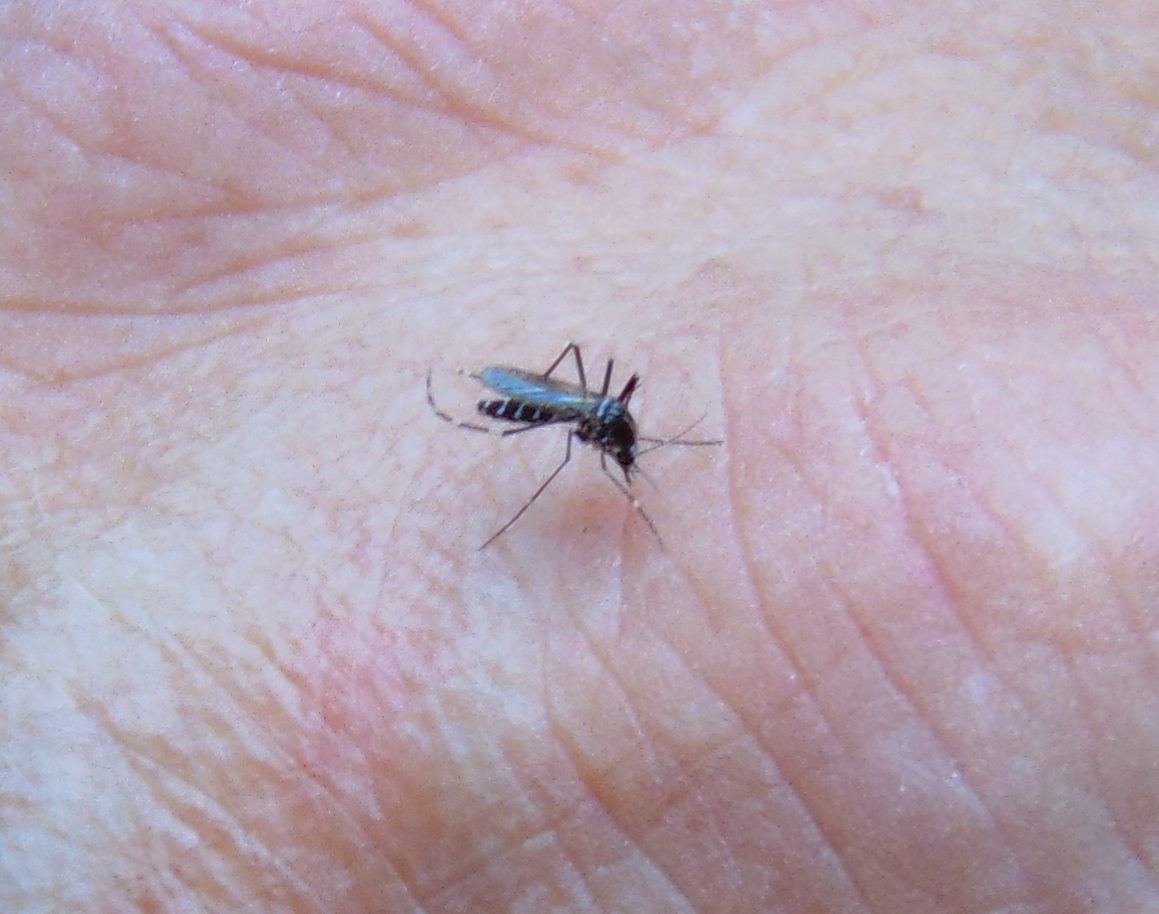
Asian Tiger Mosquito in action during the daylight hours, typical behavior of the genus. This species has been found in the area of Conewago Falls since at least 2013.
Poor mosquito, despite the death, suffering, and misery it has brought to Homo sapiens and other species around the planet, it will never be the most destructive animal on earth. You, my bloodthirsty friends, will place second at best. You see, mosquitos get no respect, even if they do create great wildlife sanctuaries by scaring people away.
The winner knows how to wipe out other species and environs not only to ensure its own survival, but, in many of its populations, to provide leisure, luxury, gluttony, and amusement. This species possesses the cognitive ability to think and reason. It can contemplate its own existence and the concepts of time. It is aware of its history, the present, and its future, though its optimism about the latter may be its greatest delusion. Despite possessing intellect and a capacity to empathize, it is devious, sinister, and selfish in its treatment of nearly every other living thing around it. Its numbers expand and its consumption increases. It travels the world carrying pest and disease to all its corners. It pollutes the water, land, and air. It has developed language, culture, and social hierarchies which create myths and superstitions to subdue the free will of its masses. Ignoring the gift of insight to evaluate the future, it continues to reproduce without regard for a means of sustenance. It is the ultimate organism, however, its numbers will overwhelm its resources. The crowning distinction will be the extinction.
Homo sapiens will be the first animal to cause a mass extinction of life on earth. The forces of nature and the cosmos need to wait their turn; man will take care of the species annihilation this time around. The plants, animals, and clean environment necessary for a prosperous healthy life will cease to exist. In the end, humans will degenerate, live in anguish, and leave no progeny. Fate will do to man what he has done to his co-inhabitants of the planet.
The Bald Eagle (Haliaeetus leucocephalus) is again a breeding species in the Susquehanna River watershed. It is generally believed that during the mid-twentieth century, Dichlorodiphenyltrichloroethane (DDT) pesticide residues accumulated in female top-of-the-food-chain birds including Bald Eagles. As a result, thinner egg shells were produced. These shells usually cracked during incubation, leading to failed reproduction in entire populations of birds, particularly those that fed upon fish or waterfowl. In much of the developed world, DDT was used liberally during the mid-twentieth century to combat Malaria by killing mosquitos. It was widely used throughout the United States as a general insecticide until it was banned here in 1972. (Editors Note: There is the possibility that polychlorinated biphenyls [P.C.B.s] and other industrial pollutants contributed to the reproductive failure of birds at the apex of aquatic food chains. Just prior to the recovery of these troubled species, passage of the Clean Water Act in 1972 initiated reductions in toxic discharges from point sources into streams, rivers, lakes, bays, and oceans. Production of P.C.B.s was banned in the United States in 1978. Today, P.C.B.s from former discharge and dumping sites continue to be found in water. Spills can still occur from sources including old electric transformers.)To substitute any other beast would be folly. Man, the human, Homo sapiens, the winner and champion, will repeatedly avail himself as the antagonist during our examination of the wonders of wildlife. He is the villain. The tragedy of his self-proclaimed dominion over the living things of the world will wash across these pages like muddy water topping a dam. There’s nothing I can do about it, aside from fabricating a bad novel with a fictional characterization of man. So let’s get on with it and take a look at “A Natural History of Conewago Falls”. Let’s discover the protagonist, the heroic underdog of our story, “Life in the Lower Susquehanna River Watershed.”
Over the top today.
SOURCES
Avery, Dennis T. 1995. Saving the Planet with Pesticides and Plastic: The Environmental Triumph of High-Yield Farming. Hudson Institute. Indianapolis, Indiana.
Eaton, Eric R., and Kenn Kaufman. 2007. Kaufman Field Guide to Insects of North America. Houghton Mifflin Co. New York.
Newman, L.H. 1965. Man and Insects. The Natural History Press. Garden City, New York.