She ate only toaster pastries…that’s it…nothing else. Every now and then, on special occasions, when a big dinner was served, she’d have a small helping of mashed potatoes, no gravy, just plain, thank you. She received all her nutrition from several meals a week of macaroni and cheese assembled from processed ingredients found in a cardboard box. It contains eight essential vitamins and minerals, don’t you know? You remember her, don’t you?
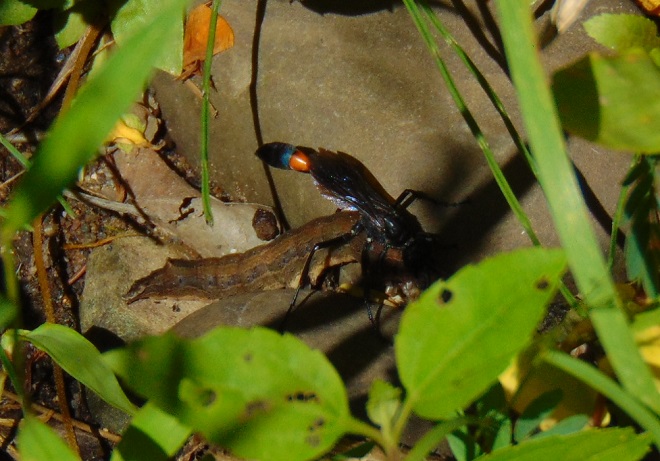
Adult female butterflies must lay their eggs where the hatched larvae will promptly find the precise food needed to fuel their growth. These caterpillars are fussy eaters, with some able to feed upon only one particular species or genus of plant to grow through the five stages, the instars, of larval life. The energy for their fifth molt into a pupa, known as a chrysalis, and metamorphosis into an adult butterfly requires mass consumption of the required plant matter. Their life cycle causes most butterflies to be very habitat specific. These splendid insects may visit the urban or suburban garden as adults to feed on nectar plants, however, successful reproduction relies upon environs which include suitable, thriving, pesticide-free host plants for the caterpillars. Their survival depends upon more than the vegetation surrounding the typical lawn will provide.
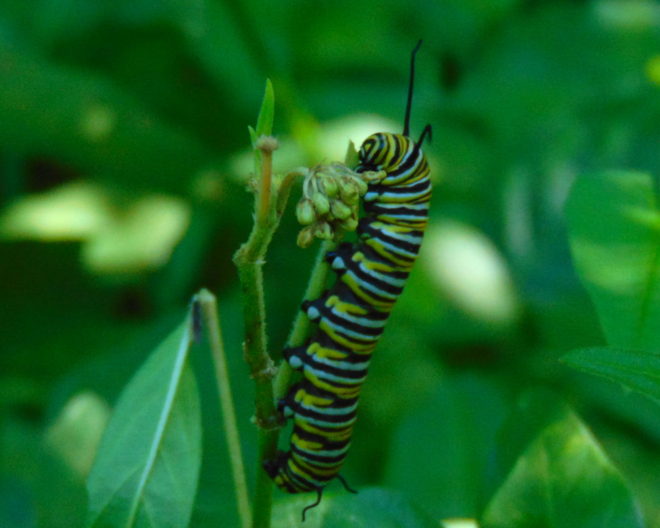
The Monarch (Danaus plexippus), a butterfly familiar in North America for its conspicuous autumn migrations to forests in Mexico, uses the milkweeds (Asclepias) almost exclusively as a host plant. Here at Conewago Falls, wetlands with Swamp Milkweed (Asclepias incarnata) and unsprayed clearings with Common Milkweed (A. syriaca) are essential to the successful reproduction of the species. Human disturbance, including liberal use of herbicides, and invasive plant species can diminish the biomass of the Monarch’s favored nourishment, thus reducing significantly the abundance of the migratory late-season generation.
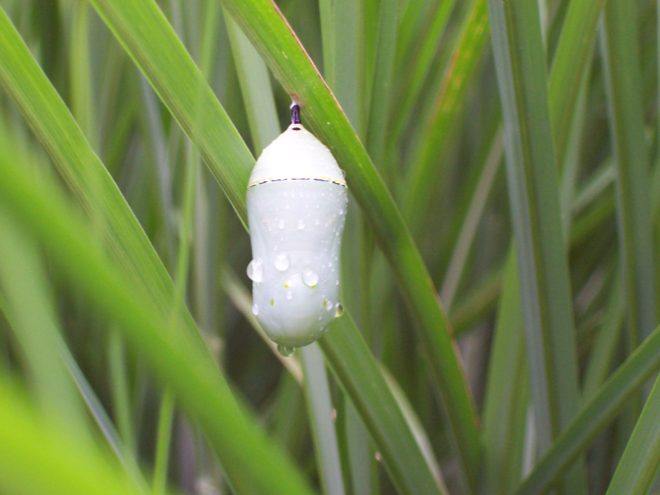
Monarch caterpillar after a fourth molt. The fifth instar feeding on Swamp Milkweed.A fifth molt begets the Monarch pupa, the chrysalis, from which the showy adult butterfly will emerge.Adult Monarch feeding on Goldenrod (Solidago) nectar.
Butterflies are good indicators of the ecological health of a given environment. A diversity of butterfly species in a given area requires a wide array of mostly indigenous plants to provide food for reproduction. Let’s have a look at some of the species seen around Conewago Falls this week…
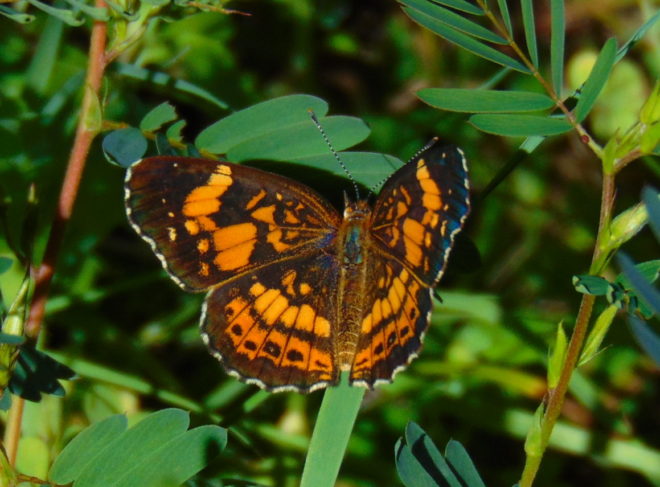
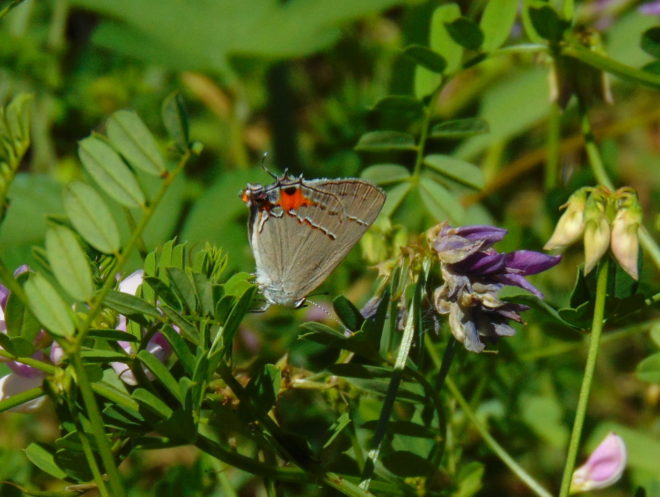
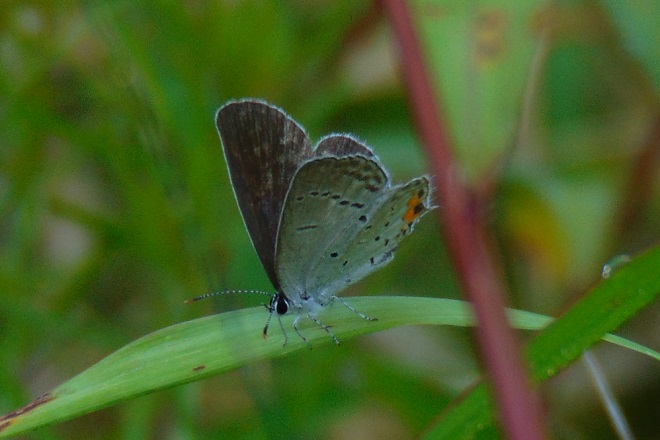
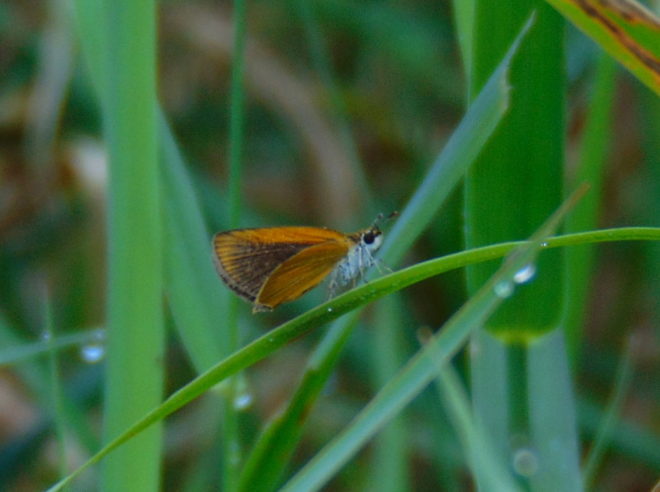
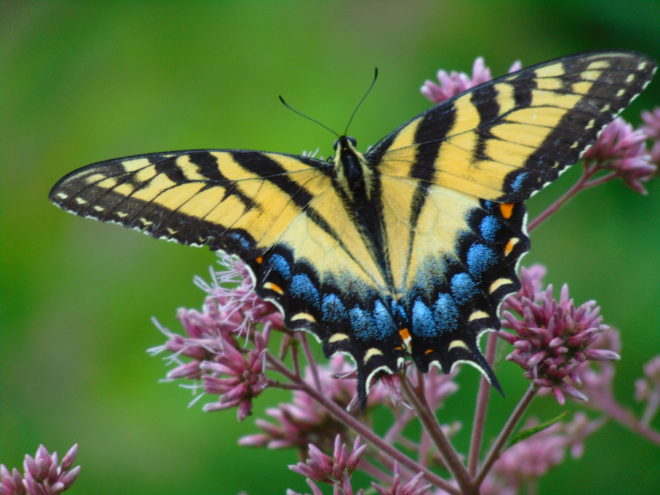
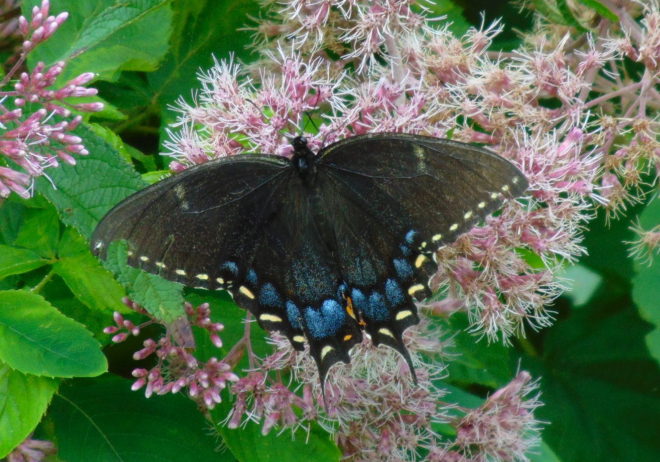
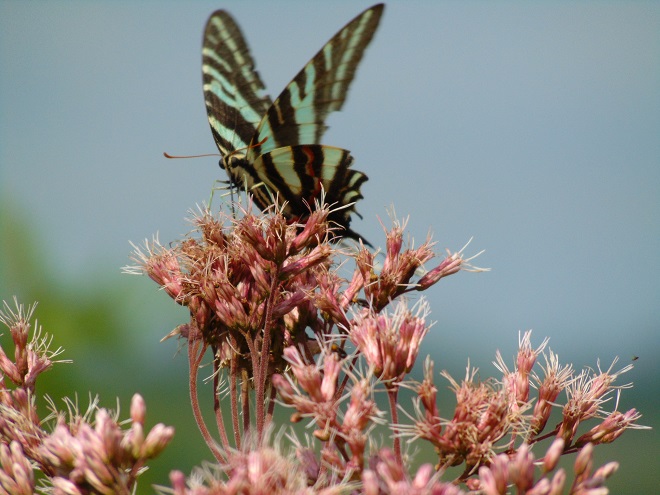
An adult Silvery Checkerspot (Chlosyne nycteis) visiting a nectar plant, Partridge Pea (Chamaecrista fasciculata). Wingstem (Verbesina alternifolia), a plant of the Riparian Woodlands, is among the probable hosts for the caterpillars.A Gray Hairstreak (Strymon melinus) visits Crown Vetch, a possible host plant. Other potential larval food in the area includes Partridge Pea, Halberd-leaved Rose Mallow (Hibiscus laevis) of the river shoreline, and Swamp Rose Mallow (Hibiscus moscheutos), a plant of wetlands.The Eastern Tailed Blue (Cupido comyntas) may use Partridge Pea , a native wildflower species, and the introduced Crown Vetch (Securigera/Coronilla varia) as host and nectar plants at Conewago Falls.The Least Skipper (Ancyloxypha numitor) is at home among tall grasses in woodland openings, at riverside, and in the scoured grassland habitat of the Pothole Rocks in the falls. Host plants available include Switchgrass (Panicum vigatum), Freshwater Cordgrass (Spartina pectinata), and Foxtails (Setaria).The Zabulon Skipper (Poanes zabulon) is an inhabitant of moist clearings where the caterpillars may feed upon Lovegrasses (Eragrostis) and Purpletop (Tridens flavus).The Eastern Tiger Swallowtail (Papilio glaucus), a female seen here gathering nectar from Joe-Pye Weed (Eutrochium), relies upon several forest trees as hosts. Black Cherry (Prunus serotina), Willow (Salix), Yellow Poplar (Liriodendron tulipifera), also known as Tuliptree, and Green Ash (Fraxinus pennsylvanica) are among the local species known to be used. The future of the latter food species at Conewago Falls is doubtful. Fortunately for the Eastern Tiger Swallowtail, the “generalist” feeding requirements of this butterfly’s larvae enable the species to survive the loss of a host plant.A female Eastern Tiger Swallowtail, black morph, gathering nectar from Joe-Pye Weed.The Zebra Swallowtail (Protographium marcellus), an adult seen here on Joe-Pye Weed, feeds exclusively upon Pawpaw (Asimina) trees as a caterpillar. This butterfly species may wander, but its breeding range is limited to the moist Riparian Woodlands where colonial groves of Pawpaw may be found. The Common Pawpaw (Asimina triloba), our native species in Pennsylvania, and the Zebra Swallowtail occur at the northern edge of their geographic ranges in the Lower Susquehanna River Watershed. Planting Pawpaw trees as an element of streamside reforestation projects certainly benefits this marvelous butterfly.
The spectacularly colorful butterflies are a real treat on a hot summer day. Their affinity for showy plants doubles the pleasure.
By the way, I’m certain by now you’ve recalled that fussy eater…and how beautiful she grew up to be.
SOURCES
Brock, Jim P., and Kaufman, Kenn. 2003. Butterflies of North America. Houghton Mifflin Company. New York, NY.
They can be a pesky nuisance. The annoying high-frequency buzzing is bad enough, but it’s the quiet ones that get you. While you were swatting at the noisy one, the silent gender sticks you and begins to feed. Maybe you know it, or maybe you don’t. She could make you itch and scratch. If she’s carrying a blood-borne pathogen, you could get sick and possibly die.
To humans, mosquitos are the most dangerous animal in the world (though not in the United States where man himself and the domestic dog are more of a threat). Globally, the Anopheles mosquitos that spread Malaria have been responsible for millions and millions of human deaths. Some areas of Africa are void of human habitation due to the prevalence of Malaria-spreading Anopheles mosquitos. In the northeastern United States, the Northern House Mosquito (Culex pipiens), as the carrier of West Nile Virus, is the species of greatest concern. Around human habitations, standing water in tires, gutters, and debris are favorite breeding areas. Dumping stagnant water helps prevent the rapid reproduction of this mosquito.
In recent years, the global distribution of these mosquito-borne illnesses has been one of man’s inadvertent accomplishments. An infected human is the source of pathogens which the feeding mosquito transmits to another unsuspecting victim. Infectious humans, traveling the globe, have spread some of these diseases to new areas or reintroduced them to sectors of the world where they were thought to have been eliminated. Additionally, where the specific mosquito carrier of a disease is absent, the mobility of man and his cargos has found a way to transport them there. Aedes aegypti, the “Yellow Fever Mosquito”, carrier of its namesake and the Zeka Virus, has found passage to much of the world including the southern United States. Unlike other species, Aedes aegypti dwells inside human habitations, thus transmitting disease rapidly from person to person. Another non-native species, the Asian Tiger Mosquito (Aedes albopictus), vector of Dengue Fever in the tropics, arrived in Houston in 1985 in shipments of used tires from Japan and in Los Angeles in 2001 in wet containers of “lucky bamboo” from Taiwan…some luck.
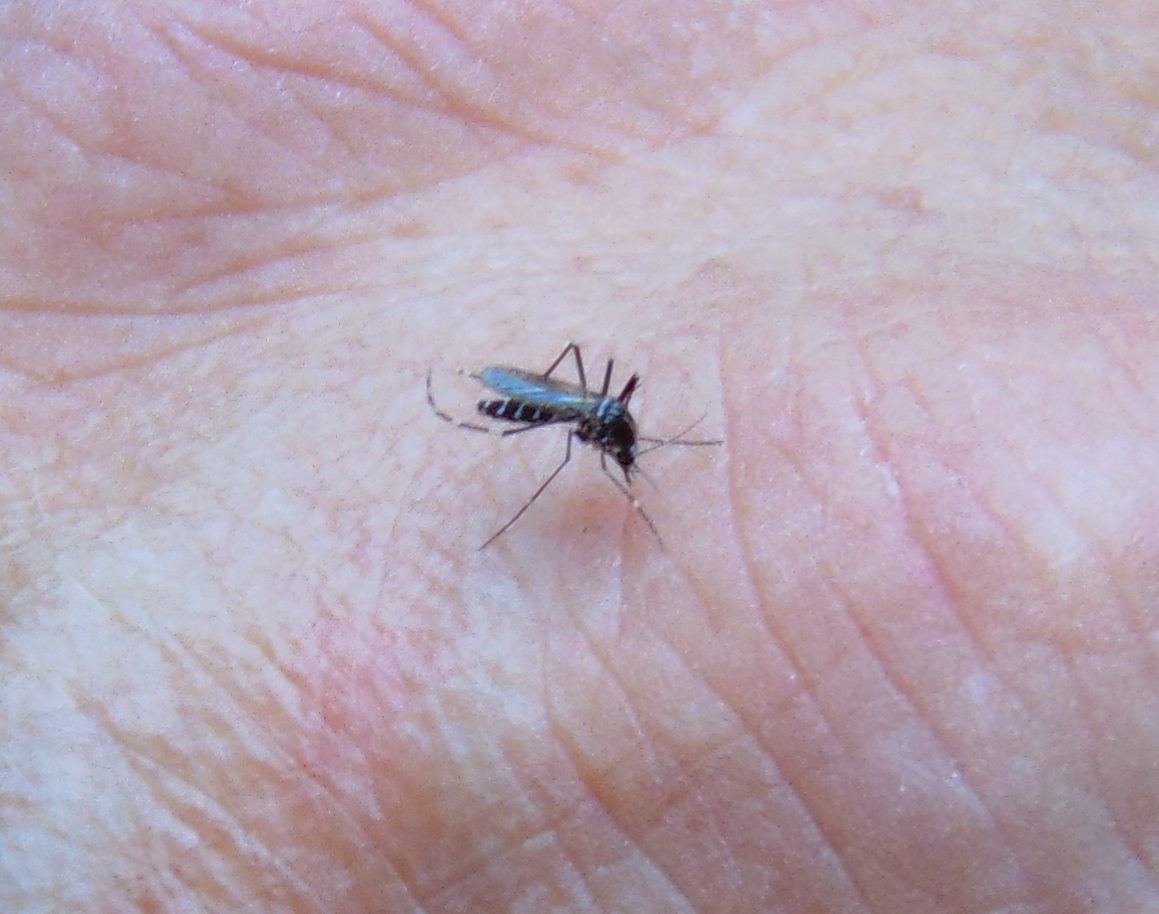
Asian Tiger Mosquito in action during the daylight hours, typical behavior of the genus. This species has been found in the area of Conewago Falls since at least 2013.
Poor mosquito, despite the death, suffering, and misery it has brought to Homo sapiens and other species around the planet, it will never be the most destructive animal on earth. You, my bloodthirsty friends, will place second at best. You see, mosquitos get no respect, even if they do create great wildlife sanctuaries by scaring people away.
The winner knows how to wipe out other species and environs not only to ensure its own survival, but, in many of its populations, to provide leisure, luxury, gluttony, and amusement. This species possesses the cognitive ability to think and reason. It can contemplate its own existence and the concepts of time. It is aware of its history, the present, and its future, though its optimism about the latter may be its greatest delusion. Despite possessing intellect and a capacity to empathize, it is devious, sinister, and selfish in its treatment of nearly every other living thing around it. Its numbers expand and its consumption increases. It travels the world carrying pest and disease to all its corners. It pollutes the water, land, and air. It has developed language, culture, and social hierarchies which create myths and superstitions to subdue the free will of its masses. Ignoring the gift of insight to evaluate the future, it continues to reproduce without regard for a means of sustenance. It is the ultimate organism, however, its numbers will overwhelm its resources. The crowning distinction will be the extinction.
Homo sapiens will be the first animal to cause a mass extinction of life on earth. The forces of nature and the cosmos need to wait their turn; man will take care of the species annihilation this time around. The plants, animals, and clean environment necessary for a prosperous healthy life will cease to exist. In the end, humans will degenerate, live in anguish, and leave no progeny. Fate will do to man what he has done to his co-inhabitants of the planet.
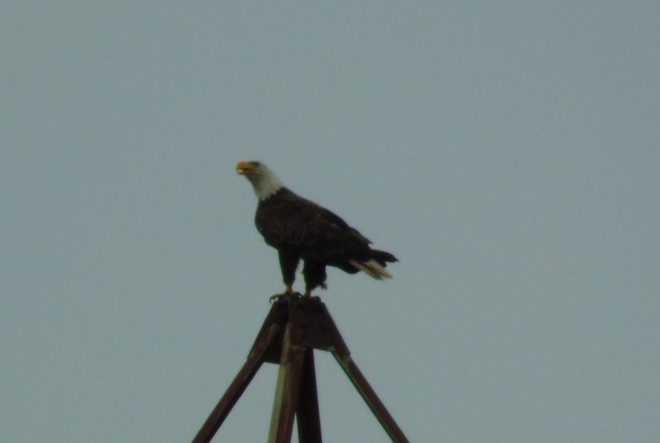
The Bald Eagle (Haliaeetus leucocephalus) is again a breeding species in the Susquehanna River watershed. It is generally believed that during the mid-twentieth century, Dichlorodiphenyltrichloroethane (DDT) pesticide residues accumulated in female top-of-the-food-chain birds including Bald Eagles. As a result, thinner egg shells were produced. These shells usually cracked during incubation, leading to failed reproduction in entire populations of birds, particularly those that fed upon fish or waterfowl. In much of the developed world, DDT was used liberally during the mid-twentieth century to combat Malaria by killing mosquitos. It was widely used throughout the United States as a general insecticide until it was banned here in 1972. (Editors Note: There is the possibility that polychlorinated biphenyls [P.C.B.s] and other industrial pollutants contributed to the reproductive failure of birds at the apex of aquatic food chains. Just prior to the recovery of these troubled species, passage of the Clean Water Act in 1972 initiated reductions in toxic discharges from point sources into streams, rivers, lakes, bays, and oceans. Production of P.C.B.s was banned in the United States in 1978. Today, P.C.B.s from former discharge and dumping sites continue to be found in water. Spills can still occur from sources including old electric transformers.)To substitute any other beast would be folly. Man, the human, Homo sapiens, the winner and champion, will repeatedly avail himself as the antagonist during our examination of the wonders of wildlife. He is the villain. The tragedy of his self-proclaimed dominion over the living things of the world will wash across these pages like muddy water topping a dam. There’s nothing I can do about it, aside from fabricating a bad novel with a fictional characterization of man. So let’s get on with it and take a look at “A Natural History of Conewago Falls”. Let’s discover the protagonist, the heroic underdog of our story, “Life in the Lower Susquehanna River Watershed.”
Over the top today.
SOURCES
Avery, Dennis T. 1995. Saving the Planet with Pesticides and Plastic: The Environmental Triumph of High-Yield Farming. Hudson Institute. Indianapolis, Indiana.
Eaton, Eric R., and Kenn Kaufman. 2007. Kaufman Field Guide to Insects of North America. Houghton Mifflin Co. New York.
Newman, L.H. 1965. Man and Insects. The Natural History Press. Garden City, New York.