Clean Slate for 2020

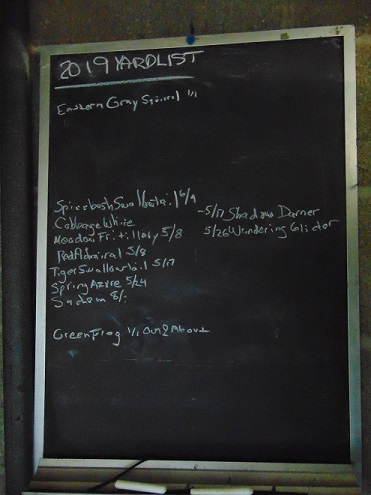
Inside the doorway that leads to your editor’s 3,500 square foot garden hangs a small chalkboard upon which he records the common names of the species of birds that are seen there—or from there—during the year.  If he remembers to, he records the date when the species was first seen during that particular year.  On New Year’s Day, the results from the freshly ended year are transcribed onto a sheet of notebook paper.  On the reverse, the names of butterflies, mammals, and other animals that visited the garden are copied from a second chalkboard that hangs nearby.  The piece of paper is then inserted into a folder to join those from previous New Year’s Days.  The folder then gets placed back into the editor’s desk drawer beneath a circular saw blade and an old scratched up set of sunglasses—so that he knows exactly where to find it if he wishes to.

A quick glance at this year’s list calls to mind a few recollections.
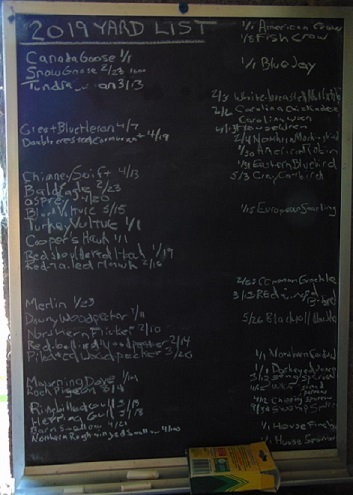
The 2019 bird list included 48 species, the 47 on the board plus Ruby-throated Hummingbird, which was logged on a slip of paper found tucked into the edge of the frame.

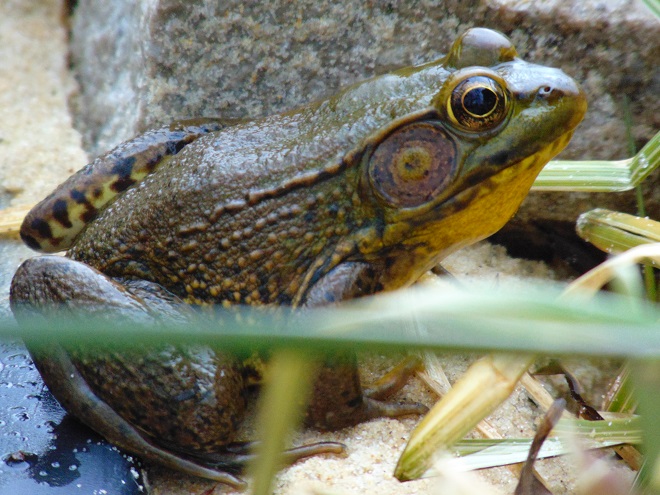
This Green Frog, photographed on New Year’s Day 2019, was “out and about” along the edge of the editor’s garden pond.  Due to the recent mild weather, Green Frogs were active during the current New Year’s holiday as well.
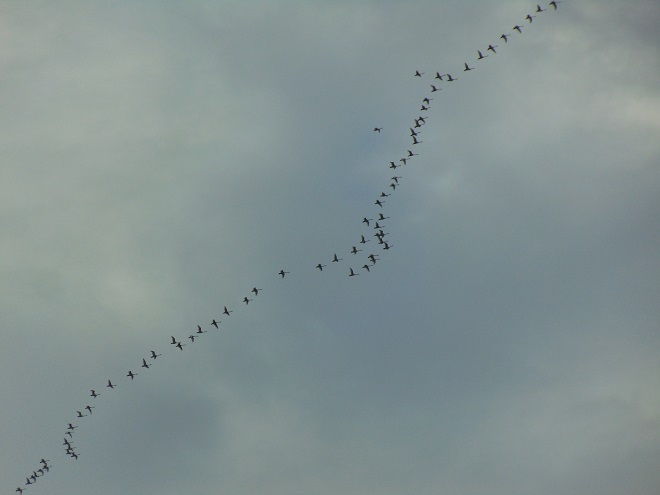
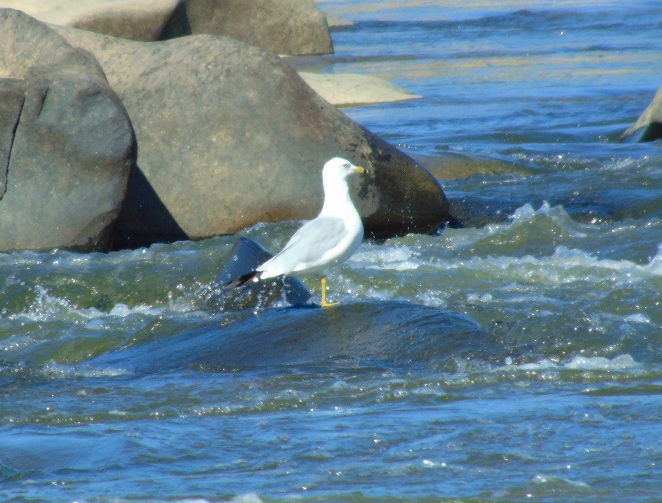
On a day with strong south winds in late February or during the first two weeks of March, there is often a conspicuous northbound spring flight of migrating waterfowl, gulls, and songbirds that crosses the lower Susquehanna valley as it departs Chesapeake Bay.  These Tundra Swans were among the three thousand seen from the garden patio on March 13, 2019.  A thousand migrating Canada Geese, 500 Red-winged Blackbirds, numerous Ring-billed Gulls, and some American Herring Gulls were seen during the same afternoon.
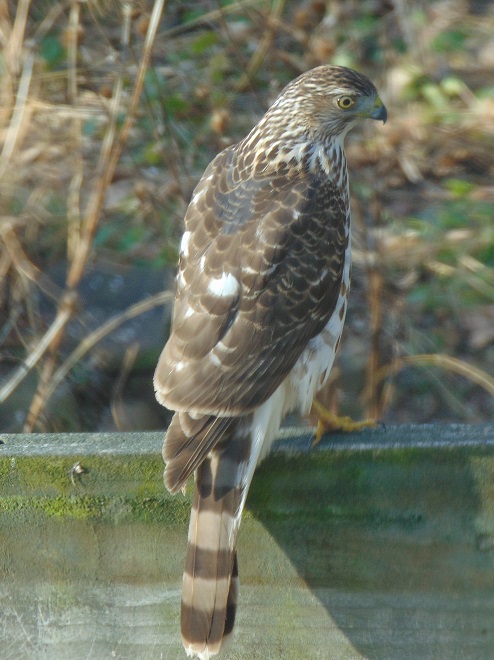
This juvenile Cooper’s Hawk was photographed through the editor’s kitchen window.  From its favorite perch on this arbor it would occasionally find success snagging a House Sparrow from the large local flock.  It first visited the garden in November, the species being absent there since early spring.  Unlike previous years, there was no evidence of a breeding pair in the vicinity during 2019.
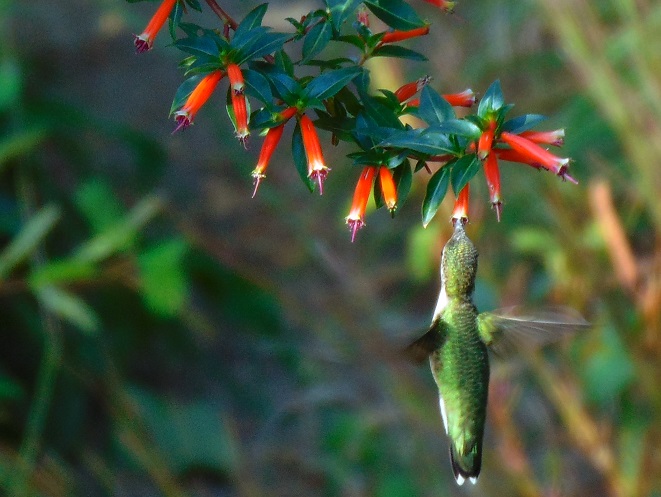
Plantings that provide food and cover for wildlife are essential to their survival.  Native flowers including Trumpet Vine (Campsis radicans) and Partridge Pea provide nourishment for the Ruby-throated Hummingbirds that visit the editor’s garden, but they really love a basket or pot filled with Mexican Cigar (Cuphea ignea) too.  The latter (seen here) can be grown as a houseplant and moved outdoors to a semi-shaded location in summer and early fall.  But remember, it’s tropical, so you’ll need to bring it back inside when frost threatens.
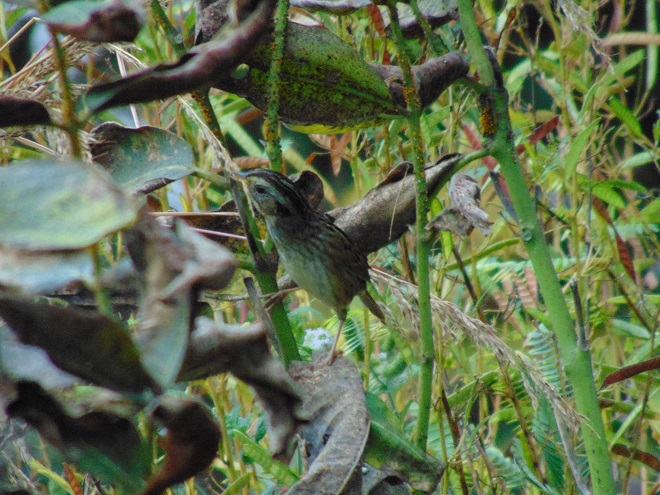
A Swamp Sparrow is an unusual visitor to a small property surrounded by paved parking lots and treeless lawns.  Nevertheless, aquatic gardens and native plants helped to attract this nocturnal migrant, seen here eating seeds from Indiangrass.  It arrived on September 30 and was gone on October 2.

Before putting the folder back into the drawer for another year, the editor decided to count up the species totals on each of the sheets and load them into the chart maker in the computer.
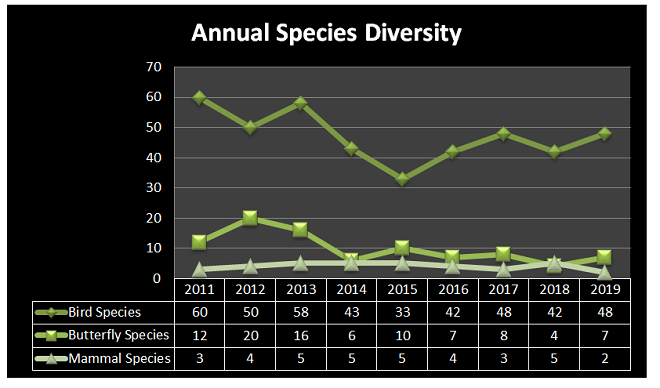
Despite the habitat improvements in the garden, the trend is apparent.  Bird diversity has not cracked the 50 species mark in 6 years.  Despite native host plants and nectar species in abundance, butterfly diversity has not exceeded 10 species in 6 years.

It appears that, at the very least, the garden habitat has been disconnected from the home ranges of many species by fragmentation.  His little oasis is now isolated in a landscape that becomes increasingly hostile to native wildlife with each passing year.  The paving of more parking areas, the elimination of trees, shrubs, and herbaceous growth from the large number of rental properties in the area, the alteration of the biology of the nearby stream by hand-fed domestic ducks, light pollution, and the outdoor use of pesticides have all contributed to the separation of the editor’s tiny sanctuary from the travel lanes and core habitats of many of the species that formerly visited, fed, or bred there.  In 2019, migrants, particularly “fly-overs”, were nearly the only sightings aside from several woodpeckers, invasive House Sparrows (Passer domesticus), and hardy Mourning Doves.  Even rascally European Starlings became sporadic in occurrence—imagine that!   It was the most lackluster year in memory.
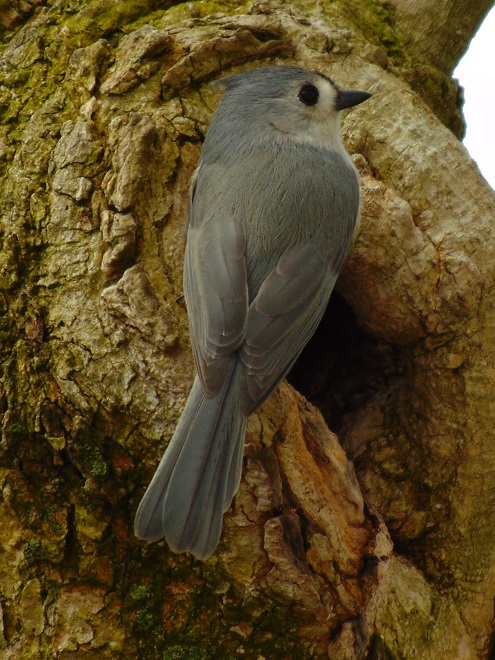
The Tufted Titmouse was a daily visitor to the garden through 2018.  This one was photographed investigating holes in an old magnolia there during the spring of that year.  There were no Tufted Titmouse sightings in the garden in 2019.  This and other resident species, especially cavity nesters, appear to be experiencing at least a temporary decline.
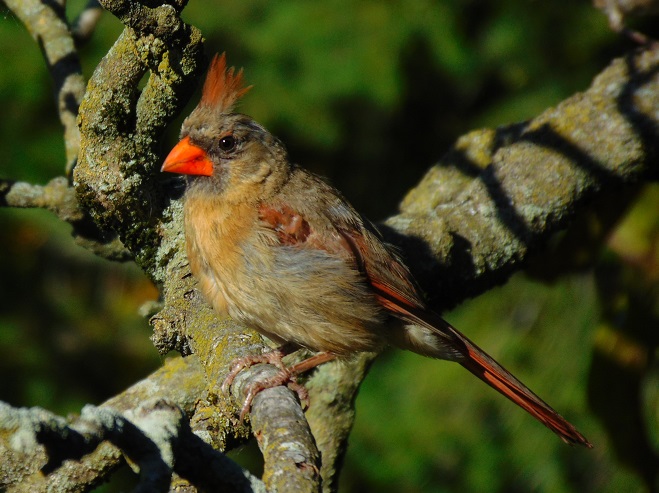
Breeding birds including Northern Cardinals may have had a difficult year.  In the editor’s garden, a pair were still feeding and escorting one of their young in early October.  The infestation of the editor’s town by domestic house and feral cats may have contributed to the failure of earlier broods, but a lack of food is also a likely factor.

If habitat fragmentation were the sole cause for the downward trend in numbers and species, it would be disappointing, but comprehensible.  There would be no cause for greater alarm.  It would be a matter of cause and effect.  But the problem is more widespread.

Although the editor spent a great deal of time in the garden this year, he was also out and about, traveling hundreds of miles per week through lands on both the east and the west shores of the lower Susquehanna.  And on each journey, the number of birds seen could be counted on fingers and toes.  A decade earlier, there were thousands of birds in these same locations, particularly during the late summer.
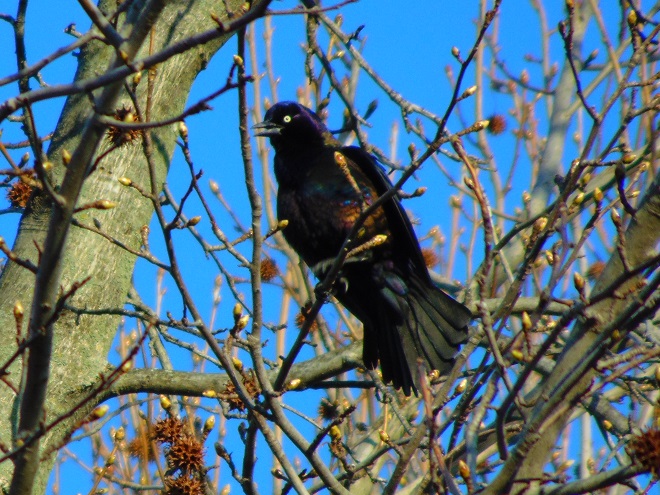
At about the time of summer solstice in June each year, Common Grackles begin congregating into roving summer flocks that will grow in size to assure their survival during the autumn migration, winter season, and return north in the spring.  From his garden, the editor saw just one flock of less than a dozen birds during the summer of 2019.  He saw none during his journeys through other areas of the Susquehanna valley.  Flocks of one hundred birds or more did not materialize until the southbound movements of grackles passed through the region in October and November.

In the lower Susquehanna valley, something has drastically reduced the population of birds during breeding season, post-breeding dispersal, and the staging period preceding autumn migration.  In much of the region, their late-spring through summer absence was, in 2019, conspicuous.  What happened to the tens of thousands of swallows that used to gather on wires along rural roads in August and September before moving south?  The groups of dozens of Eastern Kingbirds (Tyrannus tyrannus) that did their fly-catching from perches in willows alongside meadows and shorelines—where are they?

Several studies published during the autumn of 2019 have documented and/or predicted losses in bird populations in the eastern half of the United States and elsewhere.  These studies looked at data samples collected during recent decades to either arrive at conclusions or project future trends.  They cite climate change, the feline infestation, and habitat loss/degradation among the factors contributing to alterations in range, migration, and overall numbers.

There’s not much need for analysis to determine if bird numbers have plummeted in certain Lower Susquehanna Watershed habitats during the aforementioned seasons—the birds are gone.  None of these studies documented or forecast such an abrupt decline.  Is there a mysterious cause for the loss of the valley’s birds?  Did they die off?  Is there a disease or chemical killing them or inhibiting their reproduction?  Is it global warming?  Is it Three Mile Island?  Is it plastic straws, wind turbines, or vehicle traffic?

The answer might not be so cryptic.  It might be right before our eyes.  And we’ll explore it during 2020.

A clean slate for 2020.

In the meantime, Uncle Ty and I going to the Pennsylvania Farm Show in Harrisburg.  You should go too.  They have lots of food there.
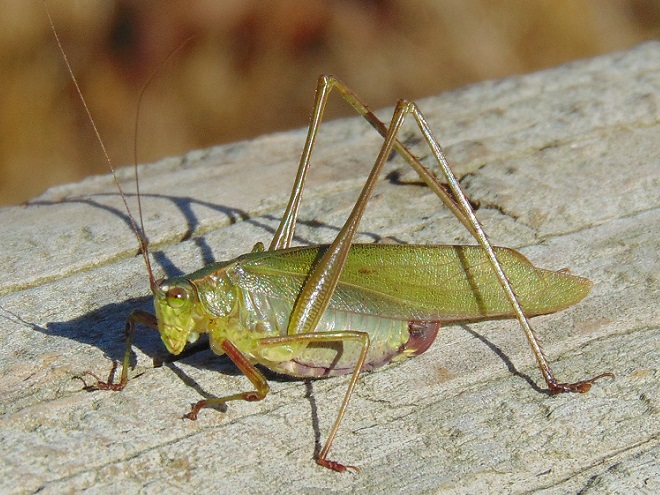
Some Autumn Insects

With autumn coming to a close, let’s have a look at some of the fascinating insects (and a spider) that put on a show during some mild afternoons in the late months of 2019.

Bush Katydids (Scudderia species) are found in brushy habitats and along rural roadsides.  Their green summer color fades to brown, maroon, and gold to match the autumn foliage where they hide.  Bush katydids often remain active until a hard freeze finally does them in.
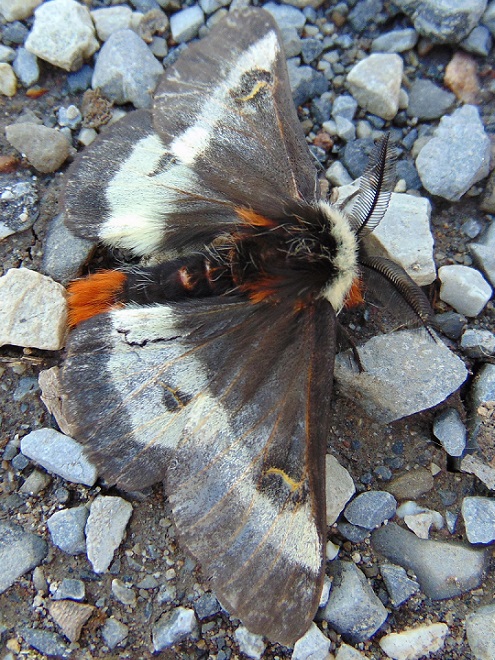
The Eastern Buck Moth (Hemileuca maia) is fuzzy, appearing to wear a warm coat for its autumn expeditions.  Adults emerge in October and may fly as late as December.  Females deposit their eggs on the twigs of Bear Oak (Quercus ilicifolia), Blackjack Oak (Q. marilandica), or Chestnut Oak (Q. montana), trees that, in our region, seem most favorable for the moth’s use when growing on burned barrens and mountain slopes.  The spiny caterpillars are known to feed only on the foliage of these few trees.  In the lower Susquehanna valley, the Eastern Buck Moth is rare because its specialized habitat is in short supply, and it’s all Smokey The Bear’s fault.
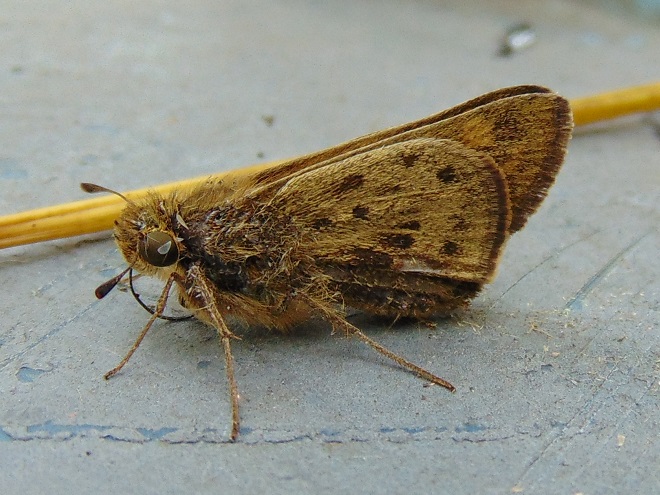
The Sachem (Atalopedes campestris) wanders north from the Atlantic Coastal Plain into the Susquehanna valley each summer.  In some years they become the most numerous small orange butterfly of all, particularly around home gardens.  The larvae will feed on Crabgrass (Digitaria species), but have not found success overwintering this far north.  By November, adults begin to look pretty drab.
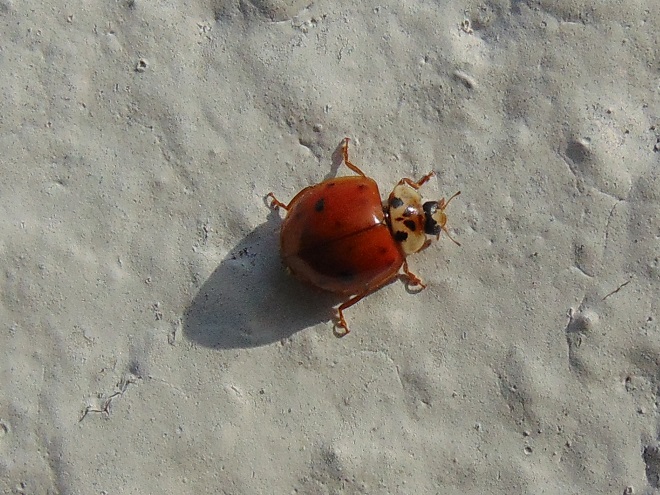
From 1978 through 1982, the Asian Multicolored Lady Beetle (Harmonia axyridis) was introduced into the eastern states by the United States Department of Agriculture.  It has become a nuisance in many areas where it swarms, sometimes bites, and often overwinters in large smelly masses within homes and other warm buildings.  As you may have guessed, it’s possibly displacing some of the less aggressive native lady beetle species.
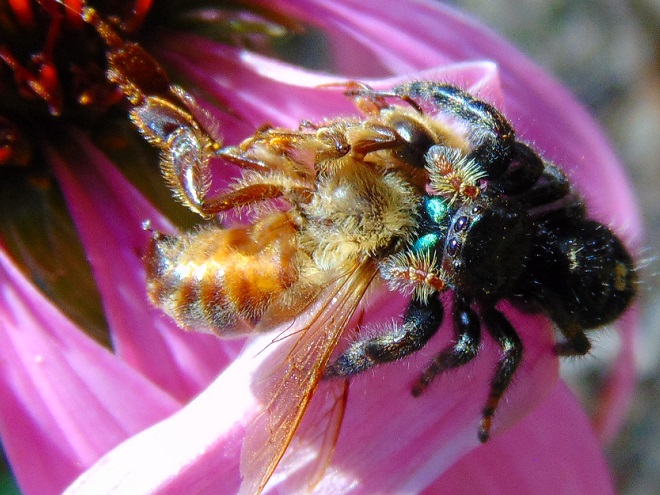
On a chilly afternoon, a sun-warmed Bold Jumping Spider (Phidippus audax) pounced and dispatched this sluggish worker Honey Bee (Apis mellifera) that was trying to gather pollen from a late-season Purple Coneflower bloom.  This spider is bold indeed.
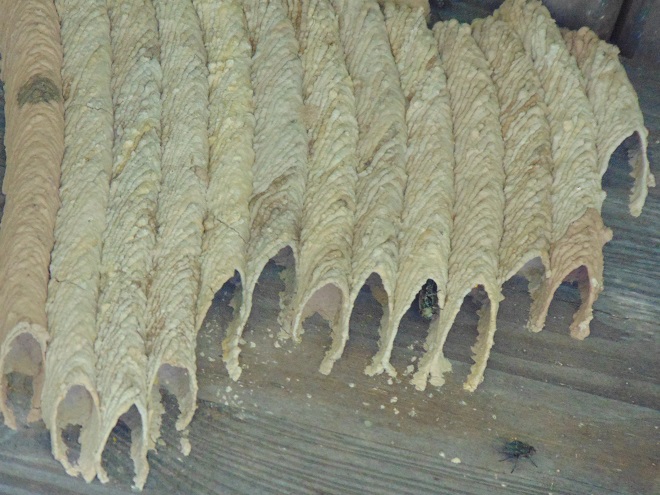
Under bridges, inside bird nest boxes, and sometimes beneath porches, the female Pipe Organ Mud Dauber (Trypoxylon politum), a predatory wasp, builds these elaborate nests composed of long rows (pipes) of nursery cells.  Into each cell one or more paralyzed spiders is deposited along with one of the female’s eggs.  When hatched, each larva will feed upon the paralyzed spider(s) inside its cell, then pupate.  The pupae overwinter, then emerge from their cells as adults during the following spring.  In the autumn, males often stand guard at an entrance to the nest to prevent parasitic species, including some flies (look at the fifth pipe from the right), from laying eggs on the pupae.  These wasps are not aggressive toward humans.
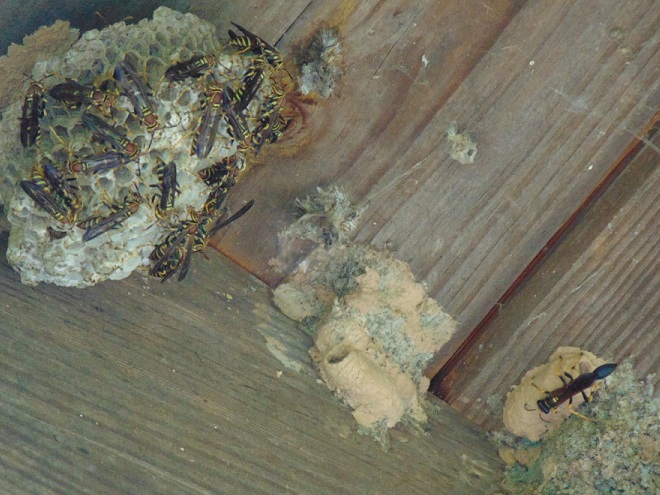
A Black-and-yellow Mud Dauber (Sceliphron caementarium) observes a neighboring nest of Common Paper Wasps (Polistes exclamans).  The Common Paper Wasp, a species also known as the Guinea Paper Wasp, is a native of the southern United States.  It is currently expanding its range into the lower Susquehanna valley from the Atlantic Coastal Plain.  These two wasp species and the Pipe Organ Mud Dauber are known to regularly coexist.  All three will take advantage of man-made structures for their nest sites.  People using the picnic tables beneath this pavilion roof never noticed the hundreds of docile wasps above.
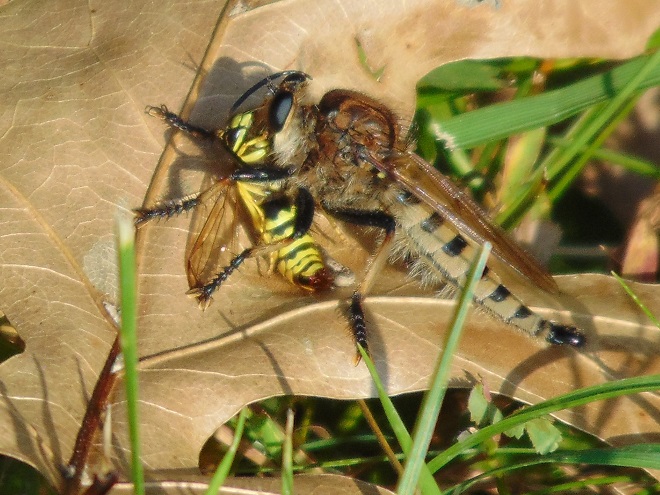
Those moody Eastern Yellowjackets (Vespula maculifrons) can get very temperamental during warm autumn days.  These wasps may appear to have no enemies, but away from areas impacted by man’s everyday activities, they do.  The Robber Fly (Promachus species) hunts like a flycatcher or other woodland bird, waiting on a perch along the forest’s edge for prey to pass by, then ambushing it, yellowjackets included.
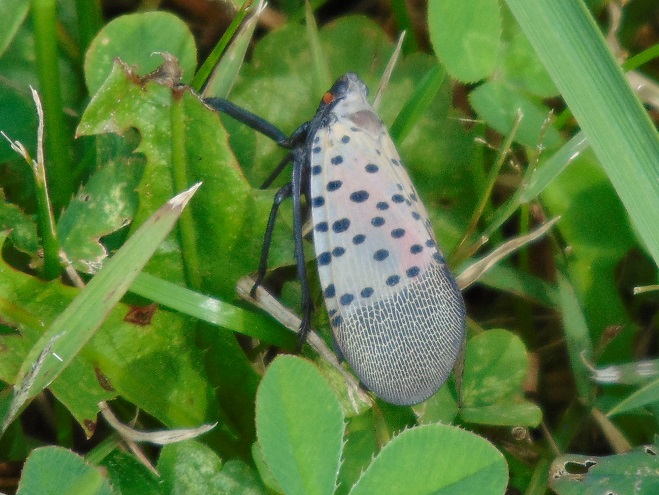
The invasive Spotted Lanternfly, a native of eastern Asia, continues to spread destruction.  It established itself throughout much of the east side of the lower Susquehanna River during the summer and fall of 2019.  Their route of travel across the farmlands of the region intersects with plenty of vineyards to obliterate and few, if any, natural enemies.  Expect them to begin colonizing the west shore en masse during 2020.
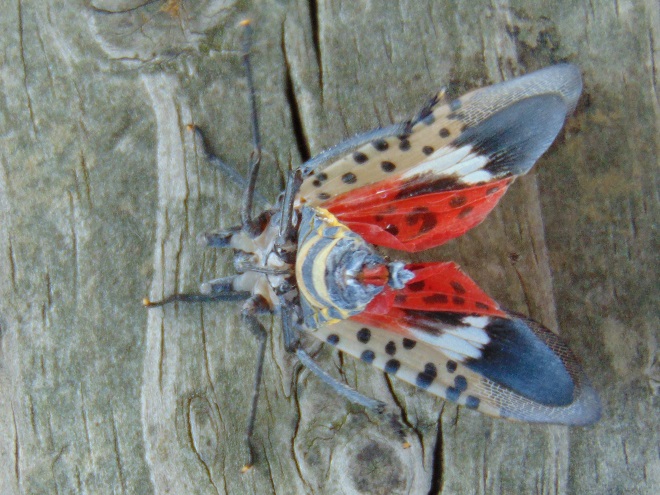
In 2020, plan to roll a few Spotted Lanternflies over, enjoy the view, and wait for the crimson tide to pass.  With any luck, they’ll peak in a year or two.

SOURCES

Eaton, Eric R., and Kenn Kaufman.  2007.  Kaufman Field Guide to Insects of North America.  Houghton Mifflin Company.  New York, NY.

Spotted Lanternfly in the Lower Susquehanna River Watershed

Second Mountain Hawk Watch is located on a ridge top along the northern edge of the Fort Indiantown Gap Military Reservation and the southern edge of State Game Lands 211 in Lebanon County, Pennsylvania.  The valley on the north side of the ridge, also known as St. Anthony’s Wilderness, is drained to the Susquehanna by Stony Creek.  The valley to the south is drained toward the river by Indiantown Run, a tributary of Swatara Creek.

The hawk watch is able to operate at this prime location for observing the autumn migration of birds, butterflies, dragonflies, and bats through the courtesy of the Pennsylvania Game Commission and the Garrison Commander at Fort Indiantown Gap.  The Second Mountain Hawk Watch Association is a non-profit organization that staffs the count site daily throughout the season and reports data to the North American Hawk Watch Association (posted daily at hawkcount.org).

Today, Second Mountain Hawk Watch was populated by observers who enjoyed today’s break in the rainy weather with a visit to the lookout to see what birds might be on the move.  All were anxiously awaiting a big flight of Broad-winged Hawks, a forest-dwelling Neotropical species that often travels back to its wintering grounds in groups exceeding one hundred birds.  Each autumn, many inland hawk watches in the northeast experience at least one day in mid-September with a Broad-winged Hawk count exceeding 1,000 birds.  They are an early-season migrant and today’s southeast winds ahead of the remnants of Hurricane Florence (currently in the Carolinas) could push southwest-heading “Broad-wings” out of the Piedmont Province and into the Ridge and Valley Province for a pass by the Second Mountain lookout.

The flight turned out to be steady through the day with over three hundred Broad-winged Hawks sighted.  The largest group consisted of several dozen birds.  We would hope there are probably many more yet to come after the Florence rains pass through the northeast and out to sea by mid-week.  Also seen today were Bald Eagles, Ospreys, American Kestrels, and a migrating Red-headed Woodpecker.

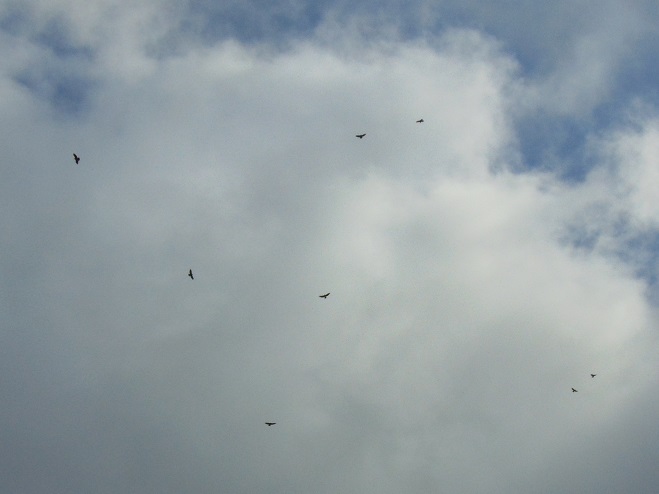
Migrating Broad-winged Hawks circle on a thermal updraft above Second Mountain Hawk Watch to gain altitude before gliding away to the southwest.

Migrating insects included Monarch butterflies, and the three commonest species of migratory dragonflies: Wandering Glider, Black Saddlebags, and Common Green Darner.  The Common Green Darners swarmed the lookout by the dozens late in the afternoon and attracted a couple of American Kestrels, which had apparently set down from a day of migration.  American Kestrels and Broad-winged Hawks feed upon dragonflies and often migrate in tandem with them for at least a portion of their journey.

Still later, as the last of the Broad-winged Hawks descended from great heights and began passing by just above the trees looking for a place to settle down, a most unwelcome visitor arrived at the lookout.  It glided in from the St. Anthony’s Wilderness side of the ridge on showy crimson-red wings, then became nearly indiscernible from gray tree bark when it landed on a limb.  It was the dreaded and potentially invasive Spotted Lanternfly (Lycorma delicatula).  This large leafhopper is native to Asia and was first discovered in North America in the Oley Valley of eastern Berks County, Pennsylvania in 2014.  The larval stage is exceptionally damaging to cultivated grape and orchard crops.  It poses a threat to forest trees as well.  Despite efforts to contain the species through quarantine and other methods, it’s obviously spreading quickly.  Here on the Second Mountain lookout, we know that wind has a huge influence on the movement of birds and insects.  The east and southeast winds we’ve experienced for nearly a week may be carrying Spotted Lanternflies well out of their most recent range and into the forests of the Ridge and Valley Province.  We do know for certain that the Spotted Lanternfly has found its way into the Lower Susquehanna River Watershed.

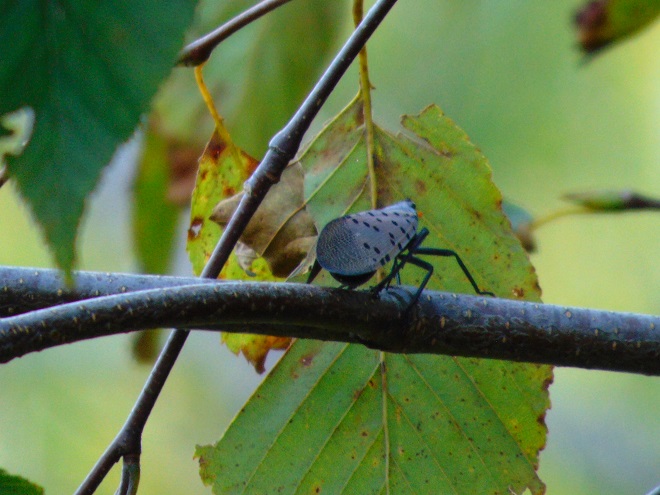
This adult Spotted Lanternfly landed in a birch tree behind the observers at the Second Mountain Hawk Watch late this afternoon.  It was first recognized by its bright red wings as it glided from treetops on the north side of the lookout.

Noxious Benefactor

It’s sprayed with herbicides.  It’s mowed and mangled.  It’s ground to shreds with noisy weed-trimmers.  It’s scorned and maligned.  It’s been targeted for elimination by some governments because it’s undesirable and “noxious”.  And it has that four letter word in its name which dooms the fate of any plant that possesses it.   It’s the Common Milkweed, and it’s the center of activity in our garden at this time of year.  Yep, we said milk-WEED.

Now, you need to understand that our garden is small—less than 2,500 square feet.  There is no lawn, and there will be no lawn.  We’ll have nothing to do with the lawn nonsense.  Those of you who know us, know that the lawn, or anything that looks like lawn, are through.

Anyway, most of the plants in the garden are native species.  There are trees, numerous shrubs, some water features with aquatic plants, and filling the sunny margins is a mix of native grassland plants including Common Milkweed.  The unusually wet growing season in 2018 has been very kind to these plants.  They are still very green and lush.  And the animals that rely on them are having a banner year.  Have a look…

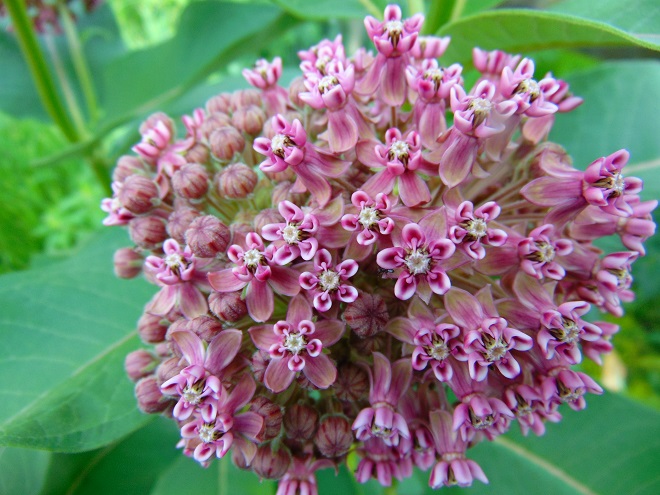
The flowers of the Common Milkweed were exceptionally fragrant this year.  At their peak in early June, their hyacinth-or lilac-like aroma was so prevalent, it drifted into our building and overwhelmed the stink of the neighbor’s filthy dumpster that he had placed 12 feet away from our walls (100 feet from his).
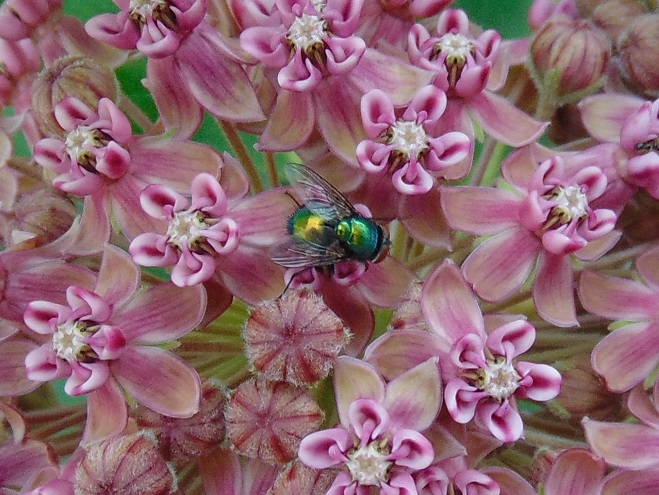
Common Milkweed attracts a pollinating Greenbottle Fly (Lucilia species).  The dumpster attracts the invasive House Fly (Musca domestica), carrier of dysentery, typhoid, and other wonderful diseases.  Are you following this?  Remember as we proceed, milkweed is “noxious”.
Busy Eastern Carpenter Bees (Xylocopa virginica) load up with pollen from the flowers of the Common Milkweed.
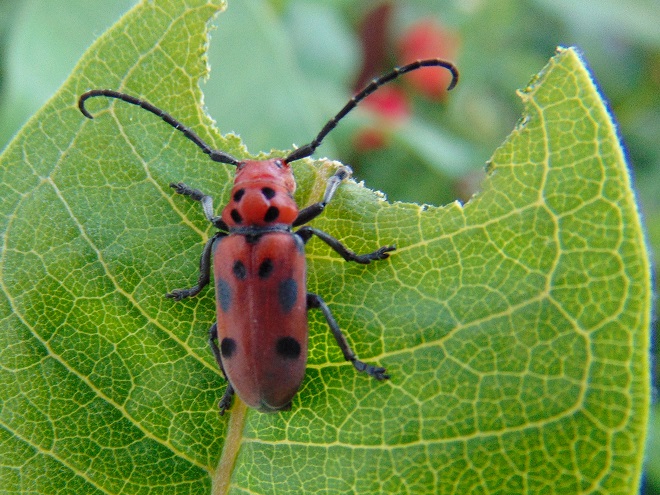
A Red Milkweed Beetle (Tetraopes tetrophthalmus) munches on a tender fresh Common Milkweed leaf in mid-June.
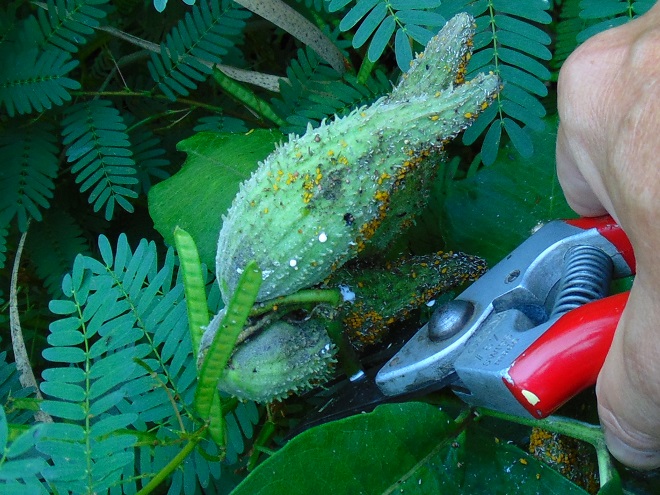
Following the pollination of the flowers, seed pods will begin to grow.  We trim these off the plants.  The removal of the extra weight allows most of the stems to remain erect through stormy weather.  You’ll still get new plants from underground runners.  As you may have guessed, we’re trying to keep these plants upright and strong to host Monarch butterfly larvae.

We’ve planted a variety of native grassland species to help support the milkweed structurally and to provide a more complete habitat for Monarch butterflies and other native insects.  This year, these plants are exceptionally colorful for late-August due to the abundance of rain.  The warm season grasses shown below are the four primary species found in the American tall-grass prairies and elsewhere.

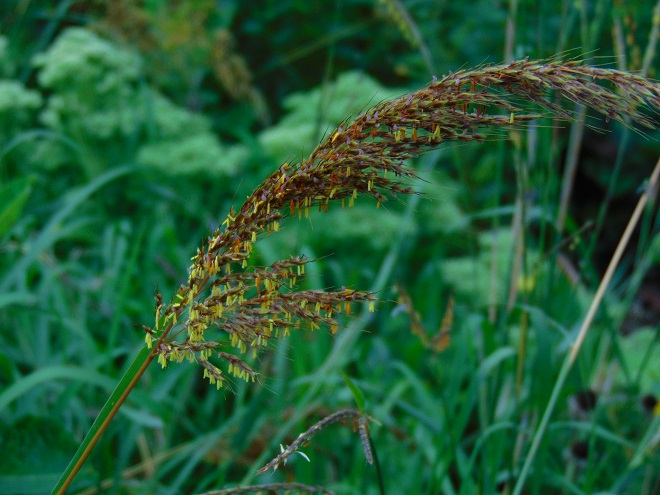
Big Bluestem, a native warm-season grass in flower.
Little Bluestem (Schizachyrium scoparium “Fort Indiantown Gap”) in flower.  This variety grows on the tank range at the military base where the armored vehicles and prescribed burns substitute for the  herd animals and fires of the prairie to prevent succession and allow it to thrive.
Partridge Pea can tolerate sandy soil and is a host plant for vagrant Cloudless Sulphur butterflies.
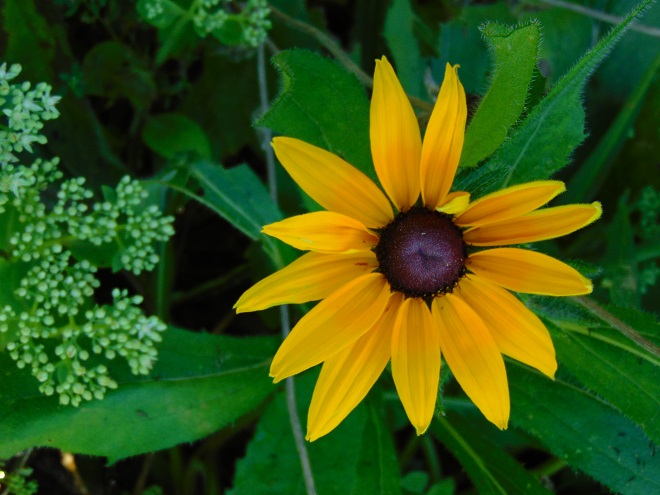
Black-eyed Susan (Rudbeckia hirta) is a popular native grassland wildflower.
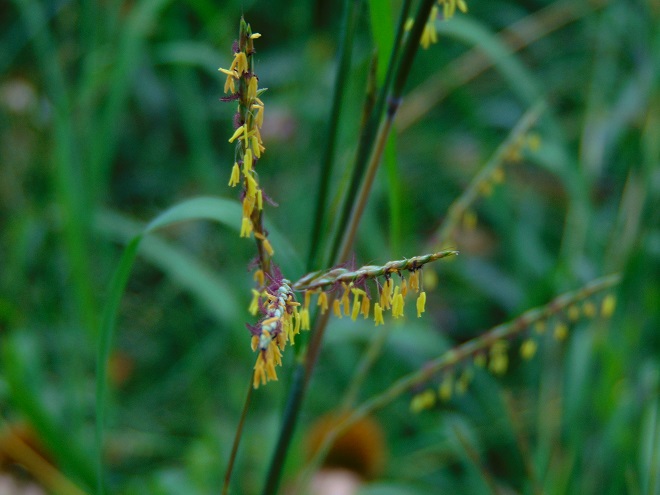
Indiangrass (Sorghastrum nutans) in flower.  This and the other native plants shown here are available as seed from Ernst Seed Company in Meadville (PA).  They have an unbelievably large selection of indigenous species.  You can plant a small plot or acres and acres using really good mixes blended for purposes ranging from reclaiming pipeline right-of-ways and strip mines to naturalizing backyard gardens.
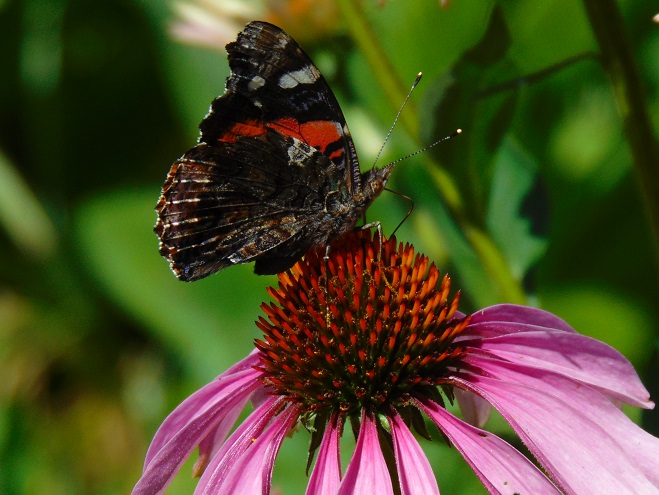
A Red Admiral (Vanessa atalanta) butterfly, a migratory species like the Monarch, on Purple Coneflower (Echinacea purpurea).  Yes, it is that Echinacea, the same one used as a supplement and home remedy.

There was Monarch activity in the garden today like we’ve never seen before—and it revolved around milkweed and the companion plants.

A female Monarch laying eggs on a Common Milkweed leaf.
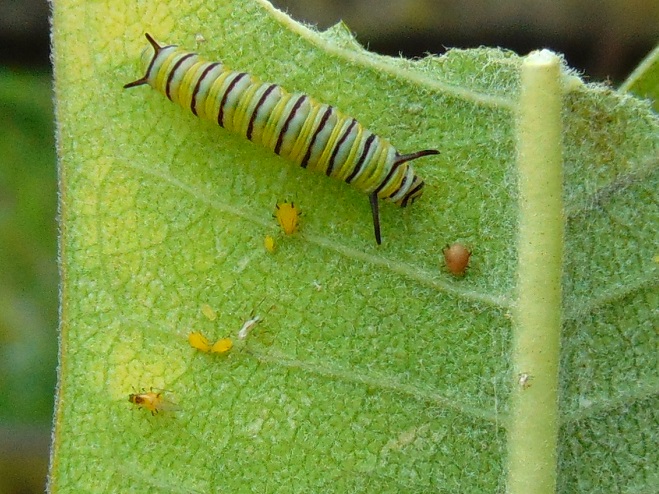
A third instar Monarch caterpillar with Oleander Aphids (Aphis nerii) on a Common Milkweed leaf.  Both of these insect species absorb toxins from the milkweed which makes them distasteful to predators.
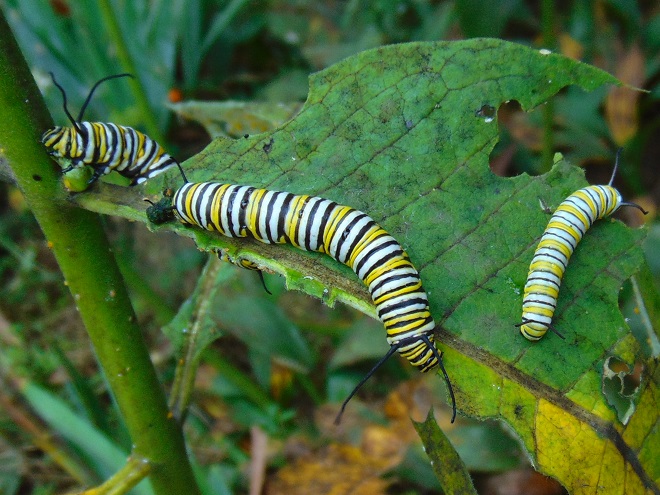
Fifth instar (left and center) and fourth instar (right) monarch caterpillars devour a Common Milkweed leaf.  There were over thirty of these caterpillars in just a ten by ten feet area this morning.  We hope that if you’re keeping a habitat for Monarchs, you’re enjoying the same fortune right now!
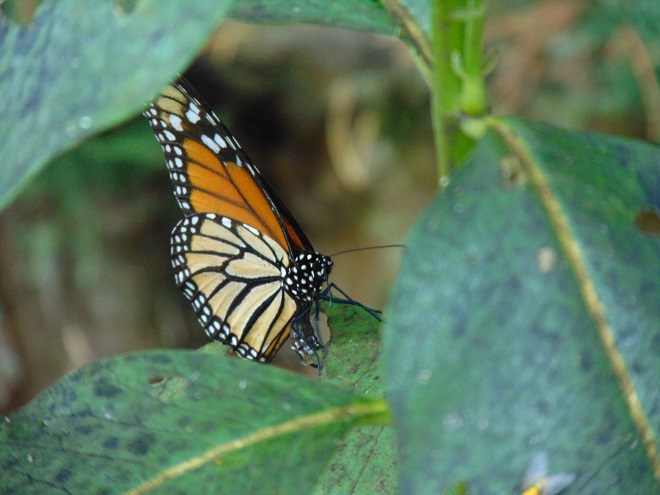
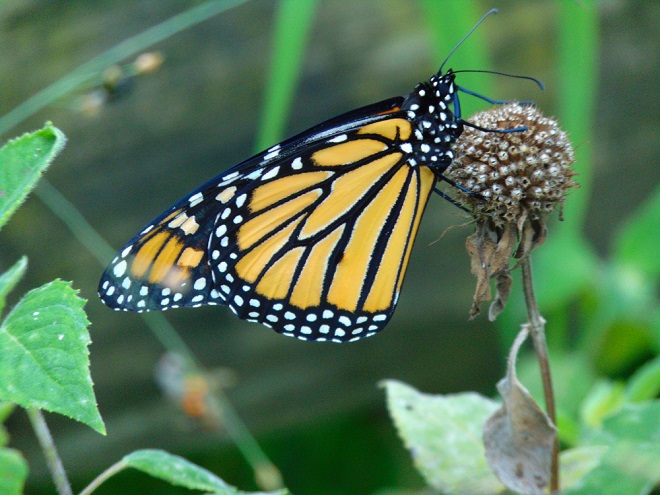
A slow-moving Monarch stopped for a break after making the circuit to deposit eggs on milkweed throughout the garden.
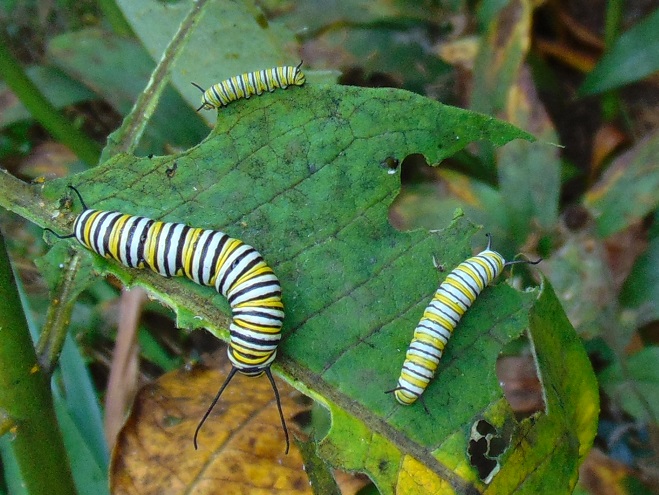
Third instar (top), fourth instar (right), and fifth instar (left) Monarch caterpillars quickly consume the leaf of a Common Milkweed plant.  Caterpillars emerging from eggs deposited today may not have sufficient late-season food to complete the larval segment of their life cycle.  Need more milkweed!
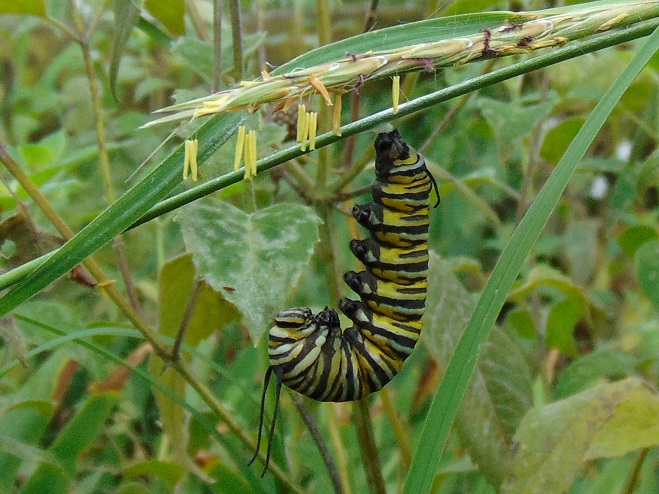
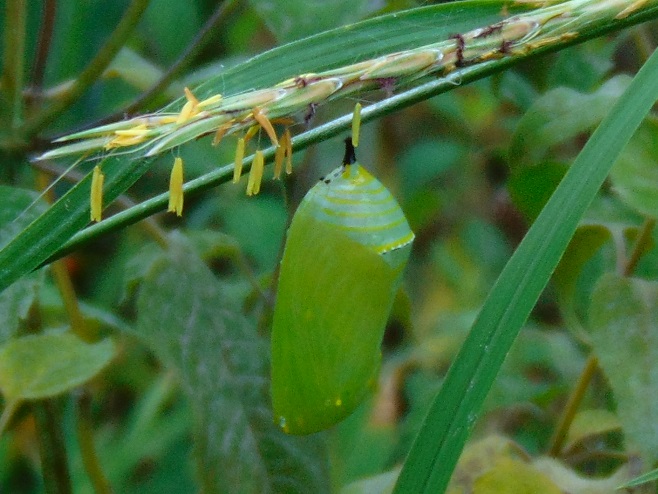
After benefiting from the nourishment of the Common Milkweed plant, a fifth instar Monarch caterpillar begins pupation on Big Bluestem grass.
Two hours later, the chrysalis is complete.
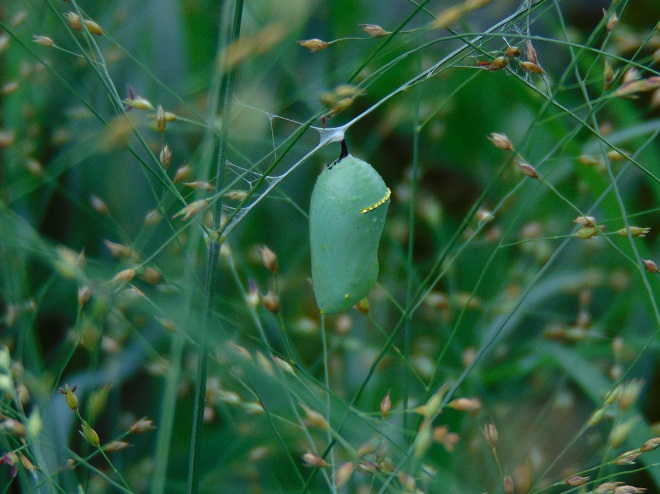
Another chrysalis, this one on flowering Switchgrass just two feet away from the previous one.  An adult Monarch will emerge from this pupa to become part of what we hope will be the most populated southbound exodus for the species in over five years.
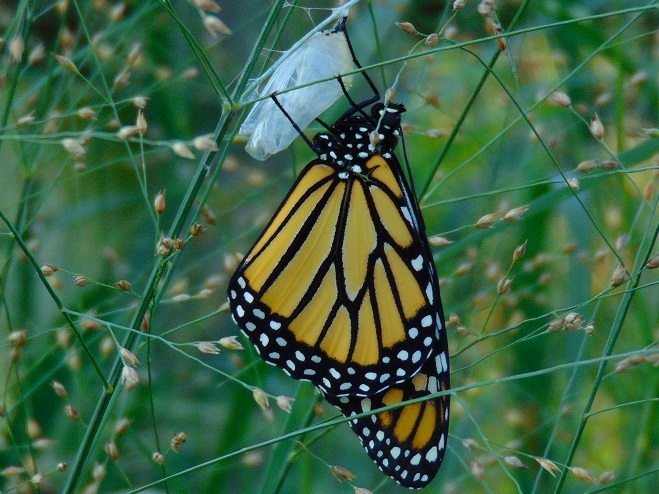
There it is, soon ready to fly away.  And all courtesy of the noxious milkweed.
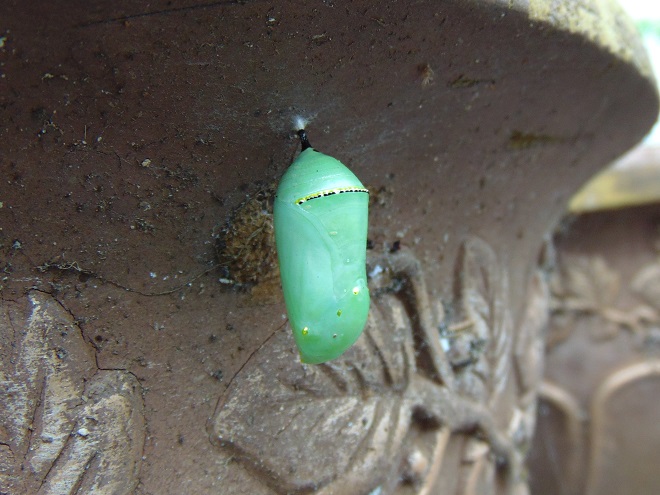
A chrysalis can often be found on man-made objects too.  This one is on the rim of a flower pot.
Ornamental flowers can attract adult Monarch butterflies seeking nectar.  We’re now more careful to select seeds and plants that have not been treated with neonicotinoid insecticides.  There’s growing concern over the impact these compounds may be having on pollinating species of animals.  Oh…and we don’t mow, whack, cut, mutilate, or spray herbicides on our milkweed, but you probably figured that out already.

 SOURCES

Eaton, Eric R., and Kenn Kaufman.  2007.  Kaufman Field Guide to Insects of North America.  Houghton Mifflin Company.  New York.

Feathered Fallout

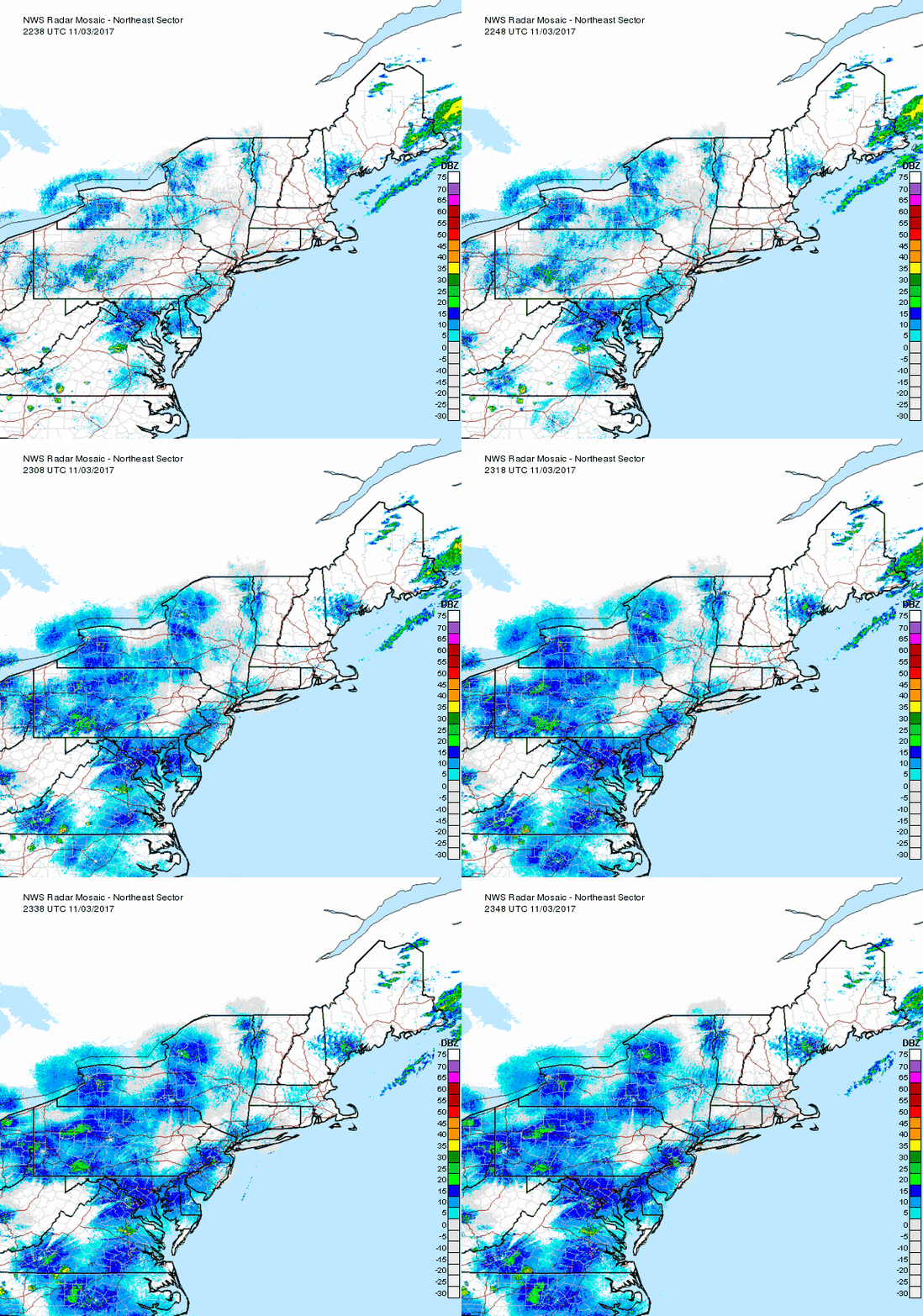
The NOAA National Weather Service radar images from last evening provided an indication that there may be a good fallout of birds at daybreak in the lower Susquehanna valley.  The moon was bright, nearly full, and there was a gentle breeze from the north to move the nocturnal migrants along.  The conditions were ideal.

Rising from daytime roosts in New York and Pennsylvania, then streaming south in moonlit skies, migrating birds are recorded as echoes on this post-sunset composite NEXRAD loop from last evening.  (NOAA/National Weather Service image)

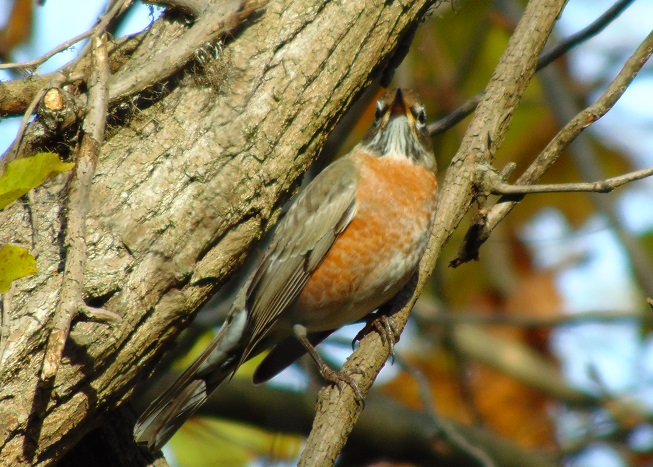
The Riparian Woodlands at Conewago Falls were alive with migrants this morning.  American Robins and White-throated Sparrows were joined by new arrivals for the season: Brown Creeper (Certhia americana), Ruby-crowned Kinglets (Regulus calendula), Golden-crowned Kinglets (Regulus satrapa), Dark-eyed Junco (Junco hyemalis), and Yellow-rumped Warbler (Setophaga coronata).  These are the perching birds one would expect to have comprised the overnight flight.  While the individuals that will remain may not yet be among them, these are the species we will see wintering in the Mid-Atlantic states.  No trip to the tropics for these hardy passerines.

American Robins continued migratory flight into the first hour of daylight this morning.  Their calls are commonly heard at night as migrating individuals pass overhead.
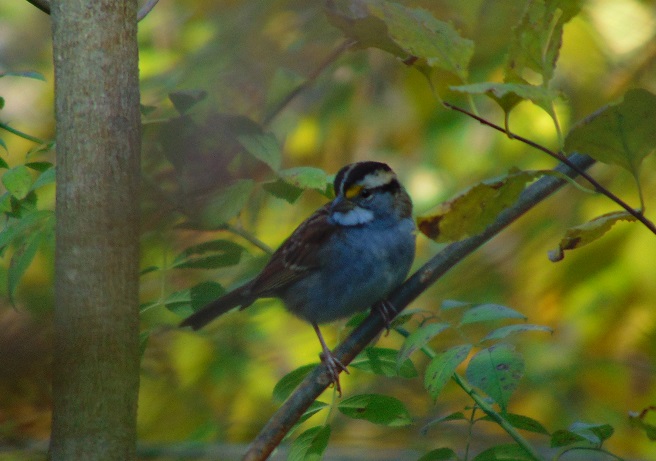
White-throated Sparrows are nocturnal migrants, and are a familiar find on woodland edges and at suburban feeding stations through the winter.
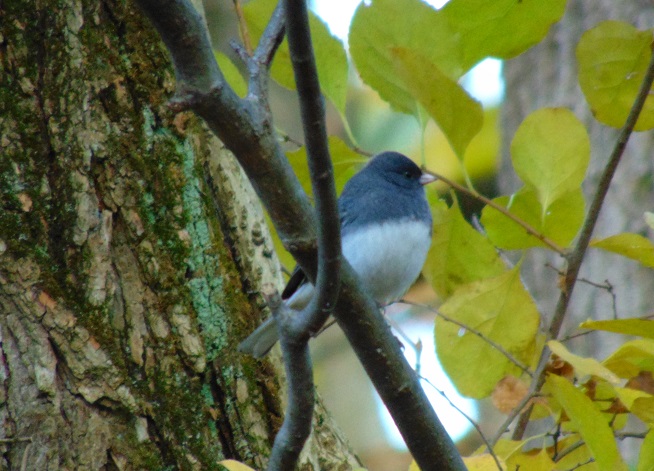
Dark-eyed Juncos, also nocturnal migrants, are common winter residents in the Lower Susquehanna River Watershed, frequently visiting bird feeders.
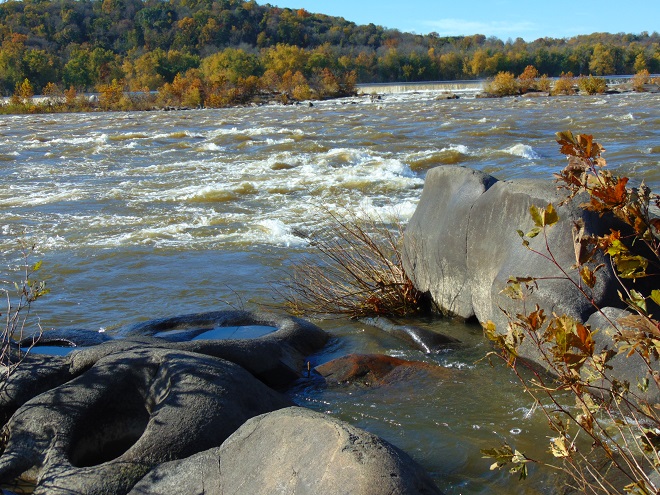
Heavy rain earlier this week in the Susquehanna River drainage basin has flooded most of the Pothole Rocks; the rapids of Conewago Falls have returned.
CLICK ON THE LOGO FOR TODAY’S MIGRATION COUNT TOTALS

A Quick Getaway

It was a placid morning on Conewago Falls with blue skies dotted every now and then by a small flock of migrating robins or blackbirds.  The jumbled notes of a singing Winter Wren (Troglodytes hiemalis) in the Riparian Woodland softly mixed with the sounds of water spilling over the dam.  The season’s first Wood Ducks (Aix sponsa), Blue-winged Teal (Spatula discors), American Herring Gull (Larus smithsonianus), Horned Larks (Eremophila alpestris), and White-throated Sparrows (Zonotrichia albicollis) were seen.

There was a small ruckus when one of the adult Bald Eagles from a local pair spotted an Osprey passing through carrying a fish.  This eagle’s effort to steal the Osprey’s catch was soon interrupted when an adult eagle from a second pair that has been lingering in the area joined the pursuit.  Two eagles are certainly better than one when it’s time to hustle a skinny little Osprey, don’t you think?

But you see, this just won’t do.  It’s a breach of eagle etiquette, don’t you know?  Soon both pairs of adult eagles were engaged in a noisy dogfight.  It was fussing and cackling and the four eagles going in every direction overhead.  Things calmed down after about five minutes, then a staring match commenced on the crest of the dam with the two pairs of eagles, the “home team” and the “visiting team”, perched about 100 feet from each other.  Soon the pair which seems to be visiting gave up and moved out of the falls for the remainder of the day.  The Osprey, in the meantime, was able to slip away.

In recent weeks, the “home team” pair of Bald Eagles, seen regularly defending territory at Conewago Falls, has been hanging sticks and branched tree limbs on the cross members of the power line tower where they often perch.  They seem only to collect and display these would-be nest materials when the “visiting team” pair is perched in the nearby tower just several hundred yards away…an attempt to intimidate by homesteading.  It appears that with winter and breeding time approaching, territorial behavior is on the increase.

The second migrating Osprey of the day ran the gauntlet of marauding eagles without incident.

In the afternoon, a fresh breeze from the south sent ripples across the waters among the Pothole Rocks.  The updraft on the south face of the diabase ridge on the east shore was like a highway for some migrating hawks, falcons, and vultures.  Black Vultures (Coragyps atratus) and Turkey Vultures streamed off to the south headlong into the wind after leaving the ridge and crossing the river.  A male and female Northern Harrier (Circus hudsonius), ten Red-tailed Hawks, two Red-shouldered Hawks (Buteo lineatus), six Sharp-shinned Hawks, and two Merlins crossed the river and continued along the diabase ridge on the west shore, accessing a strong updraft along its slope to propel their journey further to the southwest.  Four high-flying Bald Eagles migrated through, each following the east river shore downstream and making little use of the ridge except to gain a little altitude while passing by.

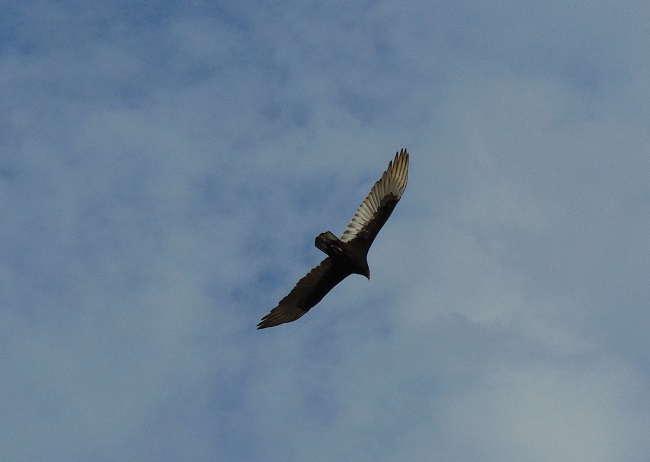
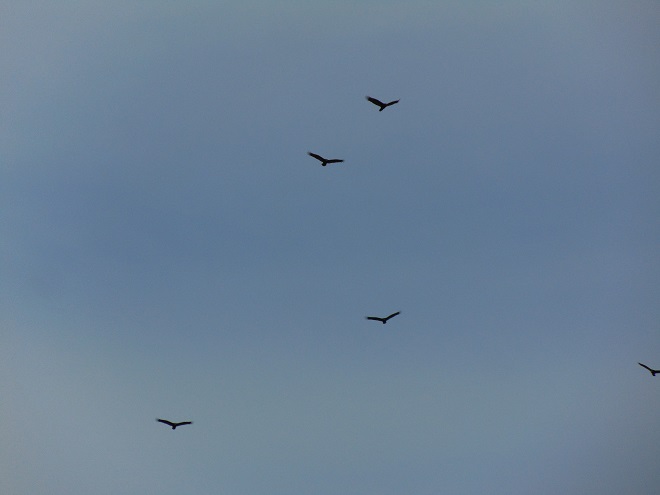
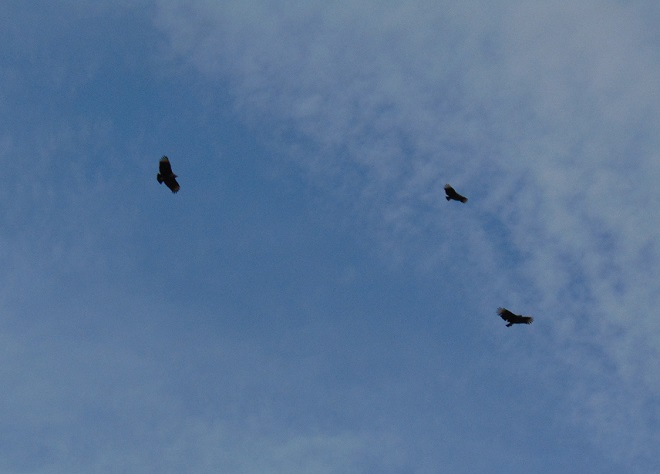
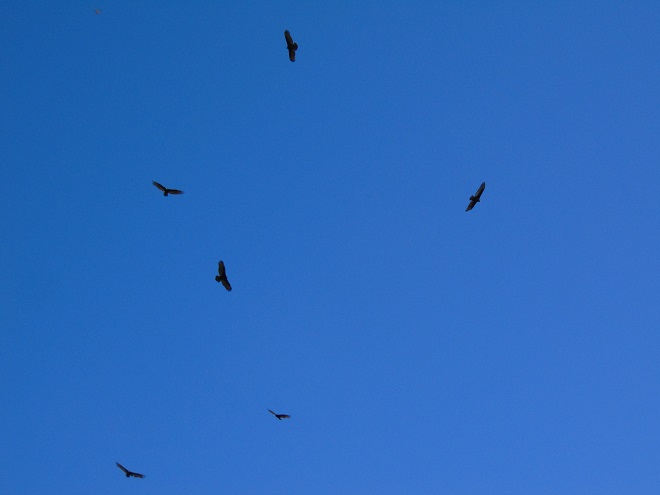
(Top and Middle) Turkey Vultures riding the fresh breeze and teetering to-and-fro on up-tilted wings.  This wing posture is known as a dihedral.  (Bottom) More than 100 migrating Black Vultures climbed high on the afternoon breeze to make an oblique crossing of the river and maintain a southbound course.

Late in the afternoon, the local Bald Eagles were again airborne and cackling up a storm.  This time they intercepted an eagle coming down the ridge toward the river and immediately forced the bird to climb if it intended to pass.  It turned out to be the best sighting of the day, and these “home team” eagles found it first.  It was a Golden Eagle (Aquila chrysaetos) in crisp juvenile plumage.  On its first southward voyage, it seemed to linger after climbing high enough for the Bald Eagles to loose concern, then finally selected the ridge route and crossed the river to head off to the southwest.

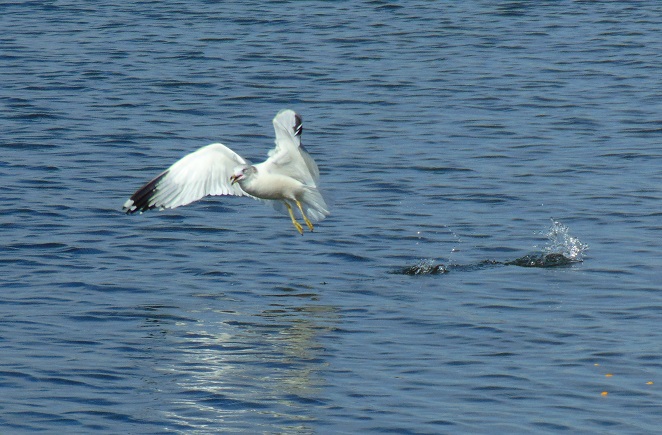
Ring-billed Gulls began feeding during the afternoon as clouds preceding stormy weather approached.
CLICK ON THE LOGO FOR TODAY’S MIGRATION COUNT TOTALS

State of Confusion

The humid rainy remains of Hurricane Nate have long since passed by Pennsylvania, yet mild wet weather lingers to confuse one’s sense of the seasons.  This gloomy misty day was less than spectacular for watching migrating birds and insects, but some did pass by.  Many resident animals of the falls are availing themselves of the opportunity to continue active behavior before the cold winds of autumn and winter force a change of lifestyle.

Warm drizzle at daybreak prompted several Northern Spring Peepers (Pseudacris crucifer crucifer) to begin calling from the wetlands in the Riparian Woodlands of Conewago Falls.  An enormous chorus of these calls normally begins with the first warm rains of early spring to usher in this tiny frog’s mating season.  Today, it was just a few “peeps” among anxious friends.

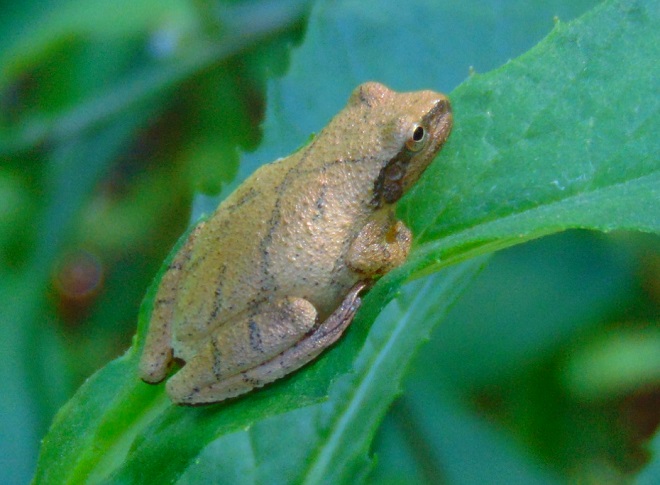
The tiny Northern Spring Peeper is recognized by the dark “X” across its back.  Soon, shelter must be found among loose bark and fallen logs to commence hibernation.  Emergence, often prompted by warm spring rains, will quickly be followed by a growing chorus of breeding calls as sometimes hundreds of these frogs assemble in vernal pools where mating will then occur.

Any additional river flow that resulted from the rains of the previous week is scarcely noticeable among the Pothole Rocks.  The water level remains low, the water column is fairly clear, and the water temperatures are in the 60s Fahrenheit.

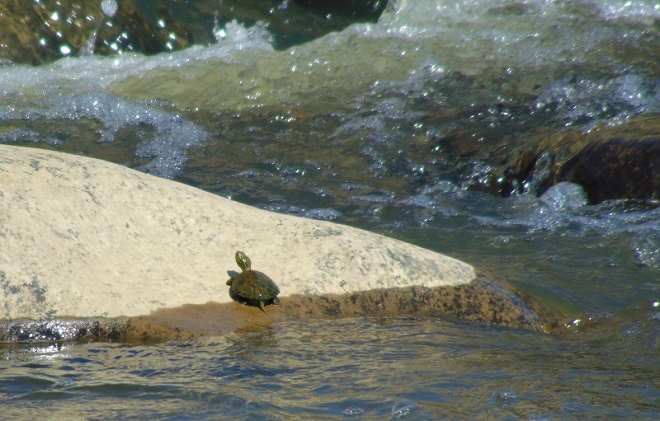
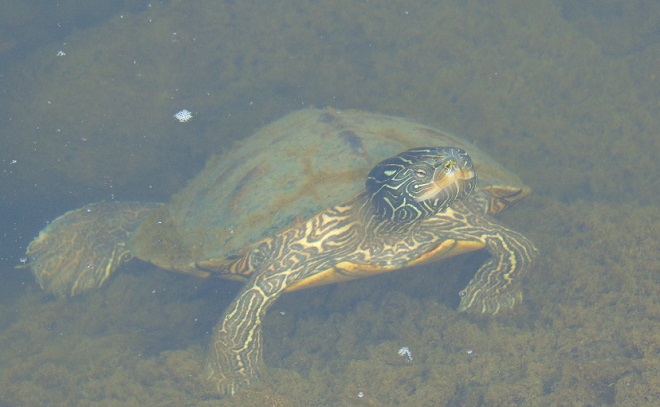
It’s no real surprise then to see aquatic turtles climbing onto the boulders in the falls to enjoy a little warmth, if not from the sun, then from the stored heat in the rocks.  As usual, they’re quick to slide into the depths soon after sensing someone approaching or moving nearby.  Seldom found anywhere but on the river, these skilled divers are Common Map Turtles (Graptemys geographica), also known as Northern Map Turtles.  Their paddle-like feet are well adapted to swimming in strong current.  They are benthic feeders, feasting upon a wide variety of invertebrates found among the stone and substrate of the river bottom.

Adult Common Map Turtles hibernate communally on the river bottom in a location protected from ice scour and turbulent flow, often using boulders, logs, or other structures as shelter from strong current.  The oxygenation of waters tumbling through Conewago Falls may be critical to the survival of the turtles overwintering downstream.  Dissolved oxygen in the water is absorbed by the nearly inactive turtles as they remain submerged at their hideout through the winter.  Though Common Map Turtles, particularly males, may occasionally move about in their hibernation location, they are not seen coming to the surface to breathe.

The Common Map Turtles in the Susquehanna River basin are a population disconnected from that found in the main range of the species in the Great Lakes and upper Mississippi basin.  Another isolated population exists in the Delaware River.

Common Map Turtles, including this recently hatched young seen in August, are often observed climbing onto rocks in the river.
Note the oversize swimming fin adaptations of the feet on this adult Common Map Turtle found among the Pothole Rocks in Conewago Falls.  Young and adults are capable of navigating some strong current to feed and escape danger.
CLICK ON THE LOGO FOR TODAY’S MIGRATION COUNT TOTALS

SOURCES

Committee on the Status of Endangered Wildlife in Canada.  2002.  Status Report of the Northern Map Turtle.  Canadian Wildlife Service.  Ottawa, Ontario.

Summer Breeze

A moderate breeze from the south placed a headwind into the face of migrants trying to wing their way to winter quarters.  The urge to reach their destination overwhelmed any inclination a bird or insect may have had to stay put and try again another day.

Blue Jays were joined by increasing numbers of American Robins crossing the river in small groups to continue their migratory voyages.  Killdeer (Charadrius vociferous) and a handful of sandpipers headed down the river route.  Other migrants today included a Cooper’s Hawk (Astur cooperii), Eastern Bluebirds (Sialia sialis), and a few Common Mergansers (Mergus merganser), House Finches (Haemorhous mexicanus), and Common Grackles (Quiscalus quiscula).

The afternoon belonged to the insects.  The warm wind blew scores of Monarchs toward the north as they persistently flapped on a southwest heading.  Many may have actually lost ground today.  Painted Lady (Vanessa cardui) and Cloudless Sulphur butterflies were observed battling their way south as well.  All three of the common migrating dragonflies were seen: Common Green Darner (Anax junius), Wandering Glider (Pantala flavescens), and Black Saddlebags (Tramea lacerata).

The warm weather and summer breeze are expected to continue as the rain and wind from Hurricane Nate, today striking coastal Alabama and Mississippi, progresses toward the Susquehanna River watershed during the coming forty-eight hours.

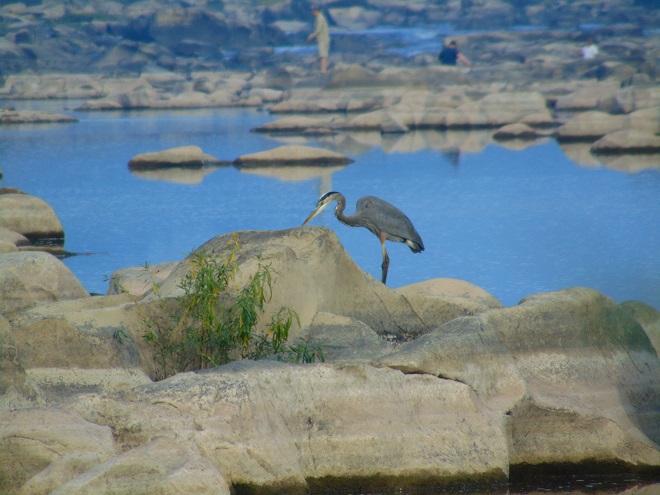
This Great Blue Heron was joined by numerous other fishermen and a good number of sightseers in the falls today.
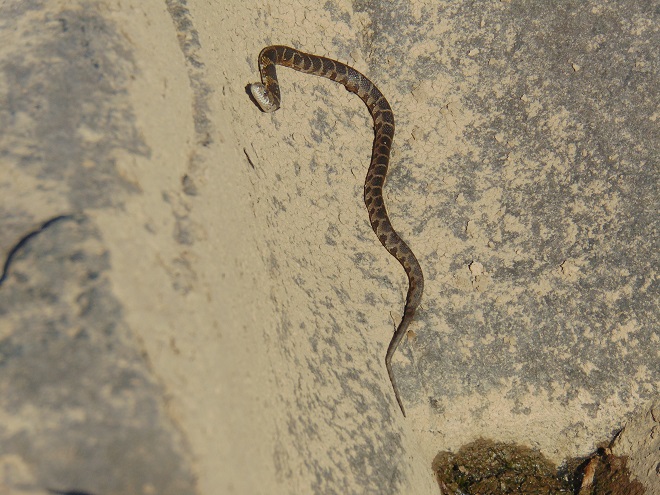
A colorful young Northern Water Snake (Nerodia sipedon) takes advantage of the sun-heated surface of a Pothole Rock to remain nimble and active.  Cooler weather will soon compel this and other reptiles to find shelter for winter hibernation.
CLICK ON THE LOGO FOR TODAY’S MIGRATION COUNT TOTALS

Blue Jay Way

The Neotropical birds that raised their young in Canada and in the northern United States have now logged many miles on their journey to warmer climates for the coming winter.  As their density decreases among the masses of migrating birds, a shift to species with a tolerance for the cooler winter weather of the temperate regions will be evident.

Though it is unusually warm for this late in September, the movement of diurnal migrants continues.  This morning at Conewago Falls, five Broad-winged Hawks (Buteo platypterus) lifted from the forested hills to the east, then crossed the river to continue a excursion to the southwest which will eventually lead them and thousands of others that passed through Pennsylvania this week to wintering habitat in South America.  Broad-winged Hawks often gather in large migrating groups which swarm in the rising air of thermal updrafts, then, after gaining substantial altitude, glide away to continue their trip.  These ever-growing assemblages from all over eastern North America funnel into coastal Texas where they make a turn to south around the Gulf of Mexico, then continue on toward the tropics.  In the coming weeks, a migration count at Corpus Christi in Texas could tally 100,000 or more Broad-winged Hawks in a single day as a large portion of the continental population passes by.  You can track their movement and that of other diurnal raptors as recorded at sites located all over North America by visiting hawkcount.org on the internet.  Check it out.  You’ll be glad you did.

Nearly all of the other migrants seen today have a much shorter flight ahead of them.  Red-bellied Woodpeckers (Melanerpes carolinus), Red-headed Woodpeckers (Melanerpes erythrocephalus), and Northern Flickers (Colaptes auratus) were on the move.  Migrating American Robins (Turdus migratorius) crossed the river early in the day, possibly leftovers from an overnight flight of this primarily nocturnal migrant.  The season’s first Great Black-backed Gulls (Larus marinus) arrived.  American Goldfinches are easily detected by their calls as they pass overhead.  Look carefully at the goldfinches visiting your feeder, the birds of summer are probably gone and are being replaced by migrants currently passing through.

By far, the most conspicuous migrant today was the Blue Jay.  Hundreds were seen as they filtered out of the hardwood forests of the diabase ridge to cautiously cross the river and continue to the southwest.  Groups of five to fifty birds would noisily congregate in trees along the river’s edge, then begin flying across the falls.  Many wary jays abandoned their small crossing parties and turned back.  Soon, they would try the trip again in a larger flock.

Sensing that they are being watched, Blue Jays are hesitant to fly across the narrow Susquehanna at Conewago Falls without first assembling into a flock.  The local constabulary often penalizes those who freelance and do not move in orderly groups.

A look at this morning’s count reveals few Neotropical migrants.  With the exception of the Broad-winged Hawks and warblers, the migratory species seen today will winter in a sub-tropical temperate climate, primarily in the southern United States, but often as far north as the lower Susquehanna River valley.  The individual birds observed today will mostly continue to a winter home a bit further south.  Those that will winter in the area of Conewago Falls will arrive in October and later.

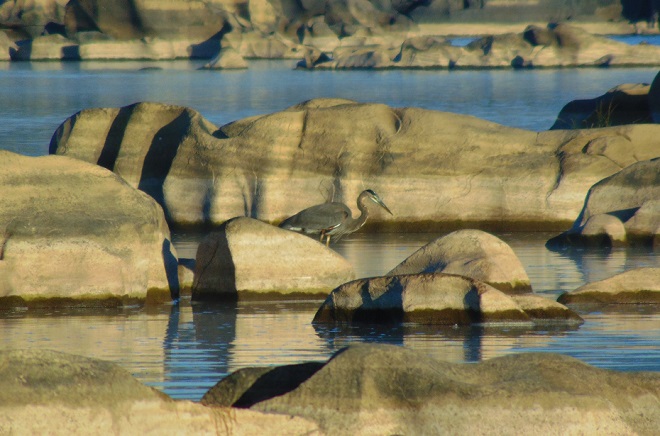
The Great Blue Heron (Ardea herodius) can be found year-round at Conewago Falls, provided there is open water and adequate food.  Migrants from breeding colonies to the north will soon supplement the local population.
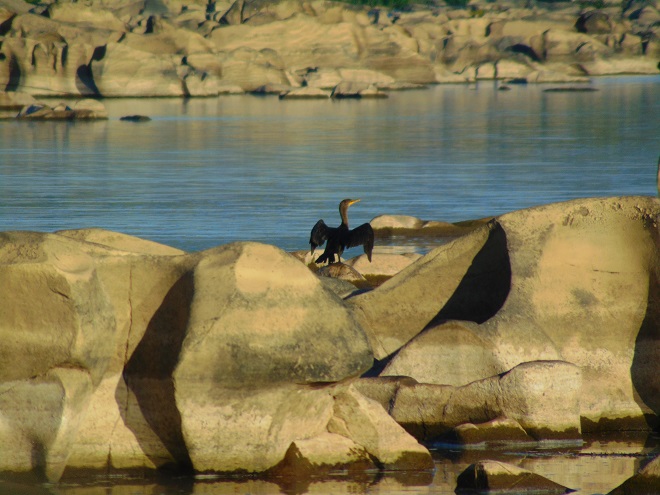
The Double-crested Cormorant (Phalacrocorax auritus) is a summer resident at Conewago Falls.  Migration of the local population and of those from further north will soon begin.  All will be gone by the time ice forms on the river.  Cormorants are often seen drying their feathers in sunlight following a series of feeding dives.

The long-distance migrating insect so beloved among butterfly enthusiasts shows signs of improving numbers.  Today, more than two dozen Monarchs were seen crossing the falls and slowly flapping and gliding their way to Mexico.

CLICK ON THE LOGO FOR TODAY’S MIGRATION COUNT TOTALS

Living in the Shadows

They get a touch of it here, and a sparkle or two there.  Maybe, for a couple of hours each day, the glorious life-giving glow of the sun finds an opening in the canopy to warm and nourish their leaves, then the rays of light creep away across the forest floor, and it’s shade for the remainder of the day.
The flowering plants which thrive in the understory of the Riparian Woodlands often escape much notice.  They gather only a fraction of the daylight collected by species growing in full exposure to the sun.  Yet, by season’s end, many produce showy flowers or nourishing fruits of great import to wildlife.  While light may be sparingly rationed through the leaves of the tall trees overhead, moisture is nearly always assured in the damp soils of the riverside forest.  For these plants, growth is slow, but continuous.  And now, it’s show time.

So let’s take a late-summer stroll through the Riparian Woodlands of Conewago Falls, minus the face full of cobwebs, and have a look at some of the strikingly beautiful plants found living in the shadows.

Oxeye (Heliopsis helianthoides) is common on the interior and along the edges of Riparian Woodland.  Specimens in deep shade flower less profusely and average less than half the height of the five feet tall inhabitants of edge environs.
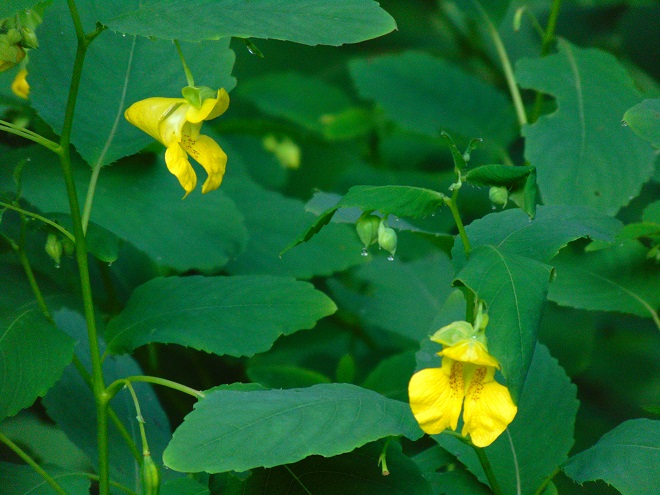
Pale Touch-Me-Not (Impatiens pallida) is one of two species of native Impatiens found in the river floodplain.  Both are known as Jewelweed.  The stems and leaves of the indigenous Impatiens retain a great quantity of water, so life in filtered sunlight is essential to prevent desiccation.  Contrary to popular folklore, extracts of Jewelweed plants are not effective treatments of Poison Ivy (Toxicodendron radicans) contact dermatitis.
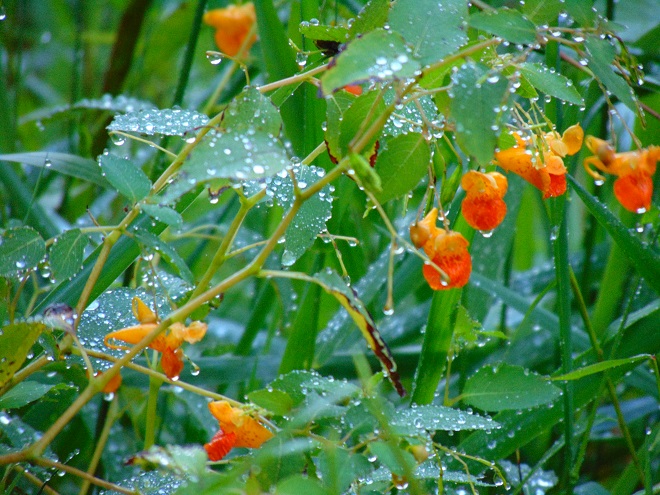
Spotted Touch-Me-Not (Impatiens capensis) is typically found in wetter soil than I. pallida.  Both Jewelweeds develop popping capsules which help to distribute the seeds of these annual wildflowers.  “Touch Me Not”, or you’ll be wearing tiny seeds.
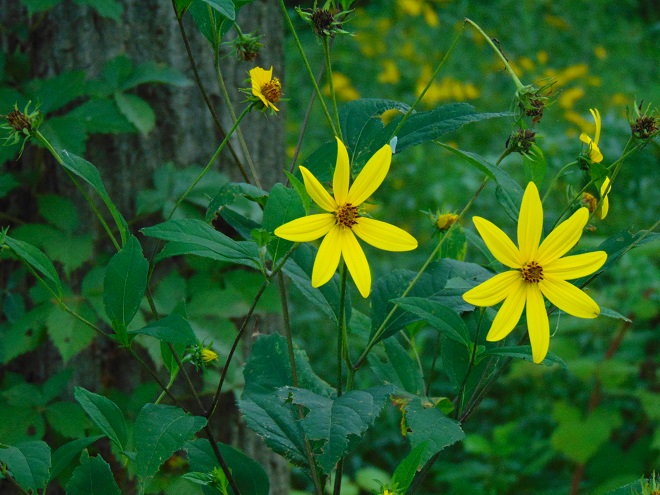
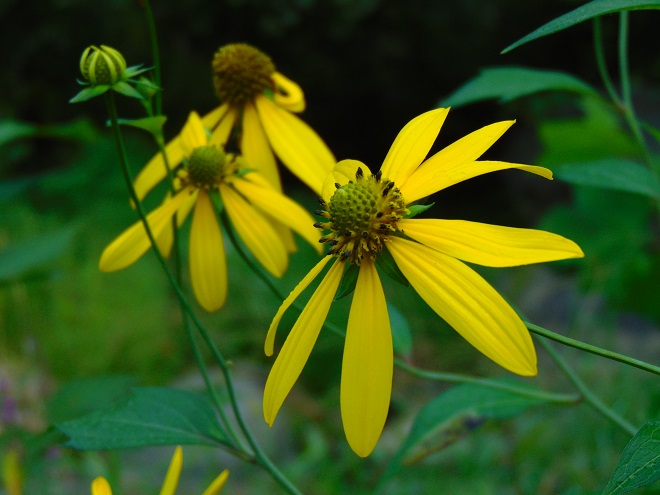
Green-headed Coneflower (Rudbeckia laciniata) grows to heights of eight feet in full sun, hence its alternate common name, Tall Coneflower.  In deep shade, it may not exceed two feet in height.  Floodplains are the prime domain of this perennial.
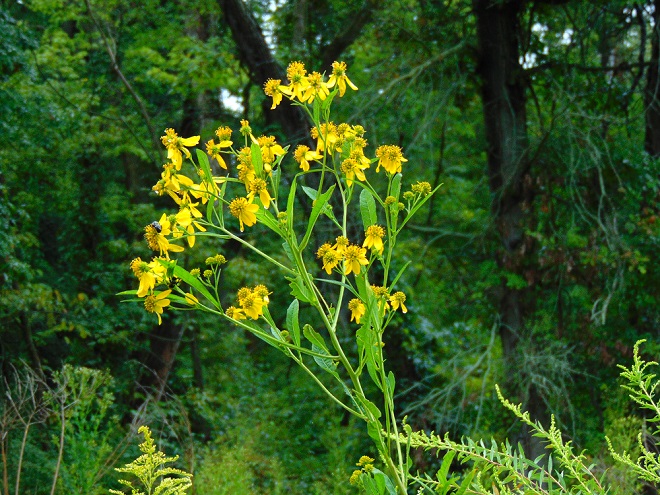
Wingstem (Verbesina alternifolia) normally flowers no earlier than late August.  The bases of the leaves are continued onto the stem of the plant to form wings which extend downward along its length.  This wildflower tolerates shade, but flowers more profusely along the woodland edge.
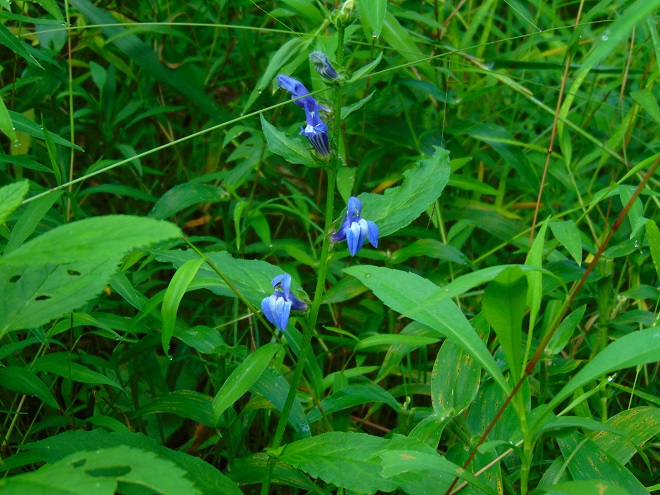
Great Lobelia (Lobelia siphilitica), or Great Blue Lobelia, is a magnificent wetland and moist woodland wildflower, usually attaining three feet in height and adorned with a plant-topping spike of blossoms.  Invasive Japanese Stiltgrass (Microstegium vimineum) can be seen here competing with this plant, resulting in a shorter, less productive Lobelia.  Stiltgrass was not found in the Susquehanna River floodplain at Conewago Falls until sometime after 1997.  It has spread to all areas of woodland shade, its tiny seeds being blown and translocated along roads, mowed lots, trails, and streams to quickly colonize and overtake new ground.
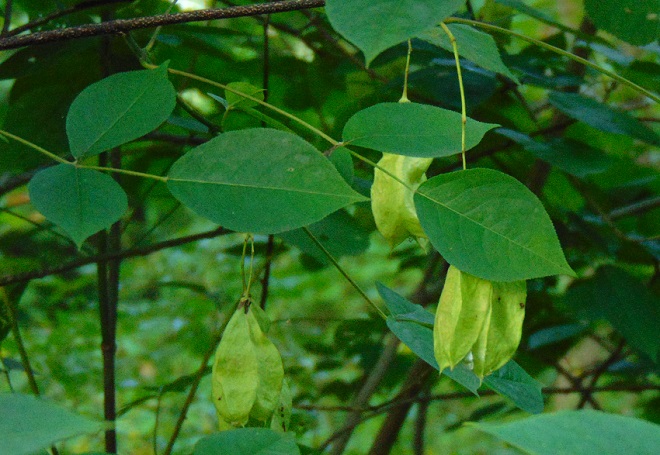
American Bladdernut (Staphylea trifolia), a shrub of shaded woods, develops inflated capsules which easily float away during high water to distribute the seeds contained inside.
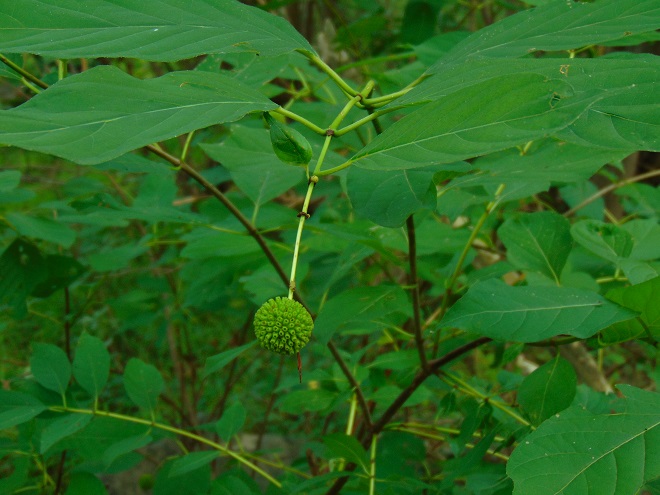
Buttonbush (Cephalanthus occidentalis) is a shrub of wet soils which produces a strange spherical flower, followed by this globular seed cluster.
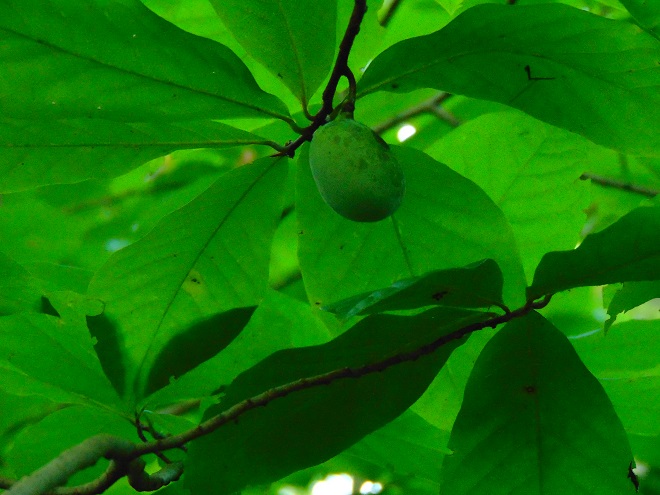
Common Pawpaw (Asimina triloba) is a colony-forming small tree which produces a fleshy fruit.  It is the host plant for the caterpillars of the Zebra Swallowtail.  The plant and the butterfly approach the northern limit of their geographic range at Conewago Falls.
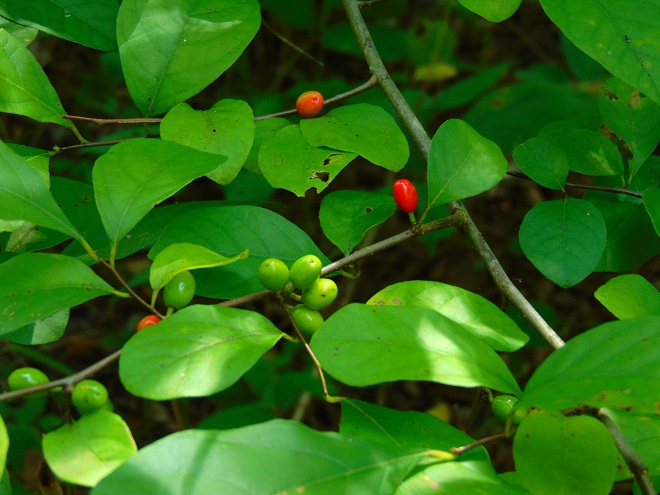
Common Spicebush (Lindera benzoin) is a widespread understory shrub in wet floodplain soils.  It is the host plant for the caterpillars of the Spicebush Swallowtail (Papilio troilus).
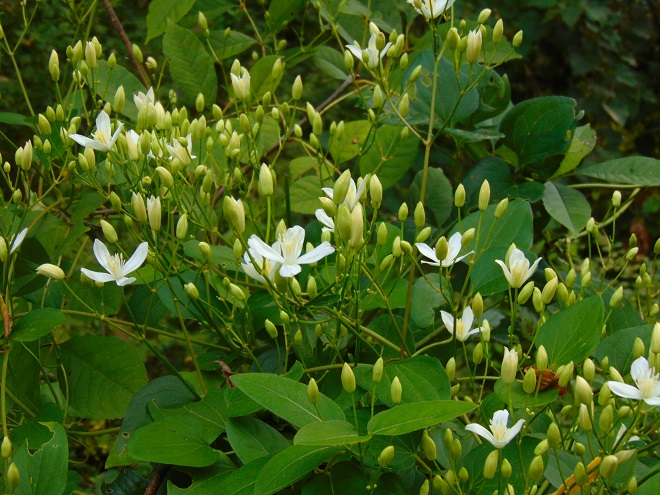
Sweet Autumn Virgin’s Bower (Clematis terniflora) is an escape from cultivation which has recently naturalized in the edge areas of the Conewago Falls Riparian Woodlands.  This vine is very showy when flowering and producing seed, but can be detrimental to some of the understory shrubs upon which it tends to climb.

SOURCES

Long, David; Ballentine, Noel H.; and Marks, James G., Jr.  1997.  Treatment of Poison Ivy/Oak Allergic Contact Dermatitis With an Extract of Jewelweed.  American Journal of Contact Dermatitis.  8(3): pp. 150-153.

Newcomb, Lawrence.  1977.  Newcomb’s Wildflower Guide.  Little, Brown and Company.  Boston, Massachusetts.

Yellowlegs for Breakfast

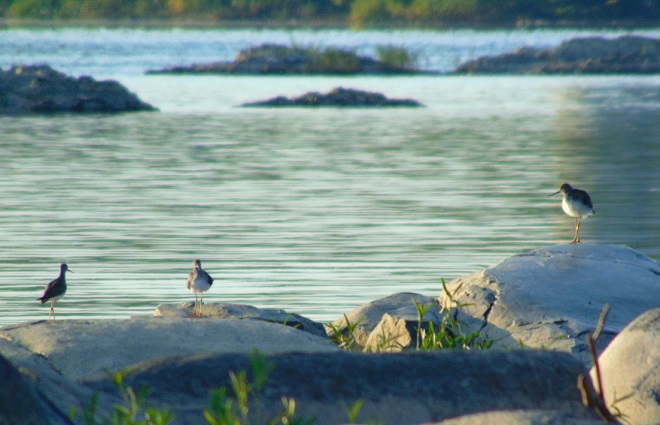
A few nocturnal migrants flew through the moonlit night to arrive at Conewago Falls for a sunrise showing this morning.  A dozen warblers were in the treetops and a Wood Thrush (Hylocichla mustelina) chattered away in the understory of the Riparian Woodlands.  Three species of shorebirds were in the falls and on the Pothole Rocks: Least Sandpiper (Calidris minutilla), Lesser Yellowlegs (Tringa flavipes), and Greater Yellowlegs (Tringa melanoleuca).

A Greater Yellowlegs (right) and two Lesser Yellowlegs sandpipers dropped by for breakfast.

The diurnal migration was highlighted by a Merlin (Falco columbarius), an Osprey, and a Bald Eagle, each flying down the river.  Most of the other birds in the falls seemed content to linger and feed.  There’s no need to hurry folks, only trouble lurks down there in paradise at the moment.

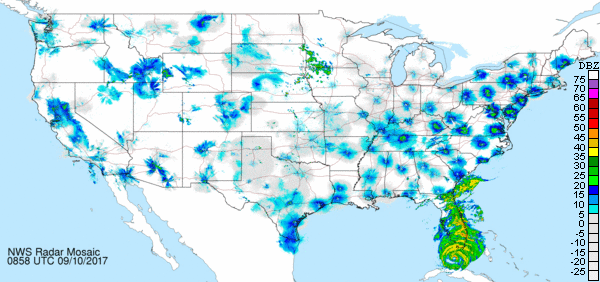
A light to moderate flight of nocturnal migrants in the eastern United States is displayed on NOAA National Weather Service NEXRAD radar at 4:58 AM EDT.  The eye of Hurricane Irma can be seen approaching the Florida Keys.  (NOAA/National Weather Service image)
CLICK ON THE LOGO FOR TODAY’S MIGRATION COUNT TOTALS

Piles of Green Tape

A couple of inches of rain this week caused a small increase in the flow of the river, just a burp, nothing major.  This higher water coincided with some breezy days that kicked up some chop on the open waters of the Susquehanna upstream of Conewago Falls.  Apparently it was just enough turbulence to uproot some aquatic plants and send them floating into the falls.

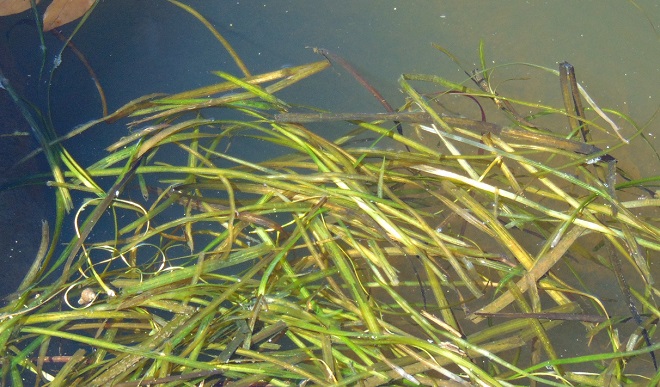
Piled against and upon the upstream side of many of the Pothole Rocks were thousands of two to three feet-long flat ribbon-like opaque green leaves of Tapegrass, also called Wild Celery, but better known as American Eelgrass (Vallisneria americana).  Some leaves were still attached to a short set of clustered roots.  It appears that most of the plants broke free from creeping rootstock along the edge of one of this species’ spreading masses which happened to thrive during the second half of the summer.  You’ll recall that persistent high water through much of the growing season kept aquatic plants beneath a blanket of muddy current.  The American Eelgrass colonies from which these specimens originated must have grown vigorously during the favorable conditions in the month of August.  A few plants bore the long thread-like pistillate flower stems with a fruit cluster still intact.  During the recent few weeks, there have been mats of American Eelgrass visible, the tops of their leaves floating on the shallow river surface, near the east and west shorelines of the Susquehanna where it begins its pass through the Gettysburg Basin near the Pennsylvania Turnpike bridge at Highspire.  This location is a probable source of the plants found in the falls today.

Uprooted American Eelgrass floating into the Pothole Rocks under the power of a north wind.  Note the white thread-like pistillate flower stem to the left and the small rooted specimen to the upper right.  The latter is likely a plant from the creeping rootstock on the edge of a colony.  As a native aquatic species, American Eelgrass is a critical link in the Susquehanna River and Chesapeake Bay food chain.  Its decimation by pollution during the twentieth century led to migration pattern alterations and severe population losses for the Canvasback (Aythya valisineria) duck.
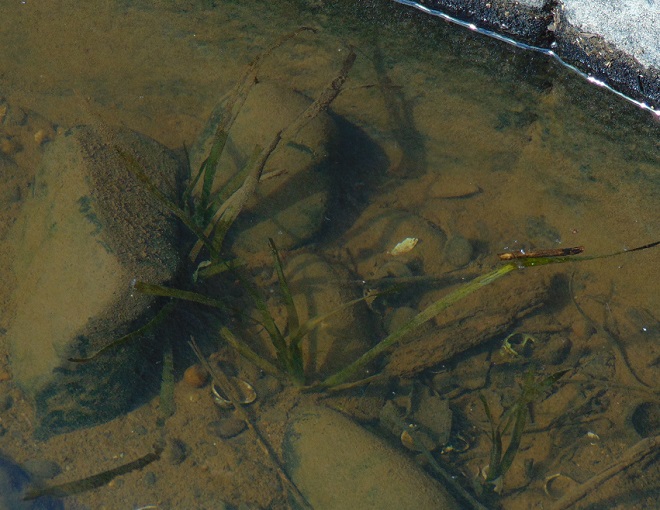
American Eelgrass, a very small specimen, found growing in a low-lying Pothole Rock alongside the accumulations of freshly arriving material from upstream.  Note that the creeping rootstock has leaves growing from at least three nodes on this plant.  Eelgrass dislocations are regular occurrences which sometimes begin new colonies, like the small one seen here in this Diabase Pothole Rock Microhabitat.

The cool breeze from the north was a perfect fit for today’s migration count.  Nocturnal migrants settling down for the day in the Riparian Woodlands at sunrise included more than a dozen warblers and some Gray Catbirds (Dumetella carolinensis).  Diurnal migration was underway shortly thereafter.

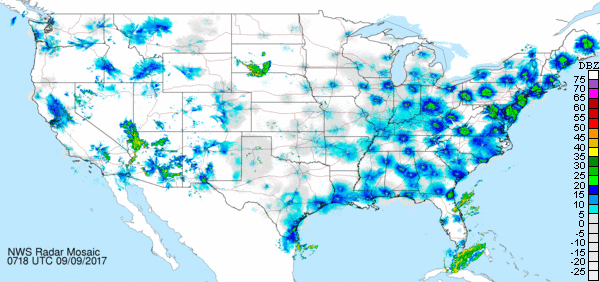
A moderate flight of nocturnal migrants is indicated around NEXRAD sites in the northeastern states at 3:18 AM EDT.  The outer rain bands of Hurricane Irma can be seen approaching the Florida Keys as the storm closes in on the peninsula.  (NOAA/National Weather Service image)

Four Bald Eagles were counted as migrants this morning.  Based on plumage, two were first-year eagles (Juvenile) seen up high and flying the river downstream, one was a second-year bird (Basic I) with a jagged-looking wing molt, and a third was probably a fourth year (Basic III) eagle looking much like an adult with the exception of a black terminal band on the tail.  These birds were the only ones which could safely be differentiated from the seven or more Bald Eagles of varying ages found within the past few weeks to be lingering at Conewago Falls.  There were as many as a dozen eagles which appeared to be moving through the falls area that may have been migrating, but the four counted were the only ones readily separable from the locals.

Red-tailed Hawks (Buteo jamaicensis) were observed riding the wind to journey not on a course following the river, but flying across it and riding the updraft on the York Haven Diabase ridge from northeast to southwest.

Bank Swallows (Riparia riparia) seem to have moved on.  None were discovered among the swarms of other species today.

Ruby-throated Hummingbirds, Caspian Terns, Cedar Waxwings (Bombycilla cedrorum), and Chimney Swifts (Chaetura pelagica) were migrating today, as were Monarch butterflies.

Not migrating, but always fun to have around, all four wise guys were here today.  I’m referring to the four members of the Corvid family regularly found in the Mid-Atlantic states: Blue Jay (Cyanocitta cristata), American Crow (Corvus brachyrhynchos), Fish Crow (Corvus ossifragus), and Common Raven (Corvus corax).

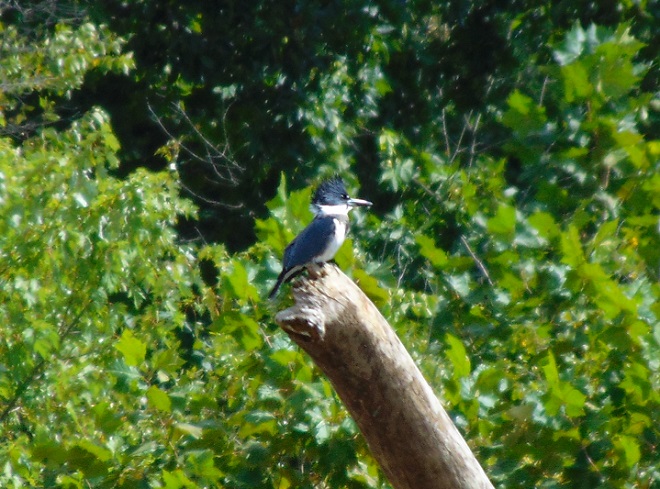
It looks like a big Blue Jay, but it’s not.  This Belted Kingfisher (Megaceryle alcyon) takes a break after flying around the falls trying to shake a marauding Ruby-throated Hummingbird off its tail.
CLICK ON THE LOGO FOR TODAY’S MIGRATION COUNT TOTALS

SOURCES

Klots, Elsie B.  1966.  The New Field Book of Freshwater Life.  G. P. Putnam’s Sons.  New York, NY.

Suggestive Selling

A Baltimore Oriole (Icterus galbula) glowed in the first sunlight of the day as it began illuminating the treetops.  I’m not certain of the cause, but I often have the urge to dig into a bowl of orange sherbet after seeing one these magnificent blackbirds.  That’s right, in the Americas, orioles and blackbirds are members of the same family, Icteridae.  Look at blackbirds more carefully, you might see the resemblance.

Sunshine at dawn and migrating warblers were again active in the foliage.  Eight species were identified today.  Off to the tropics they go.  To the land of palm and citrus, yes citrus…limes, lemons, grapefruits, and oranges.

The Ruby-throated Hummingbirds (Archilochus colubris) are on the way toward the gulf states, then on to Central and South America.  Five dashed by the rocky lookout in the falls this morning.  Remember, keep your feeders clean, wash and rinse all the parts, and refill them with a fresh batch of “nectar”, four or five parts water to one part sugar.  Repeating this process daily during hot weather should keep contamination from overtaking your feeder.  It’s not a bad idea to rotate two feeders.  Have one cleaned, rinsed, and air drying while the second is filled and in use at your feeding station, then just swap them around.  Your equipment will be just as clean as it is at the sanitary dairy…you know, where they make sherbet.

The first of the season Caspian Terns (Hydroprogne caspia), giant freshwater versions of the terns you see at the seashore, passed through the falls late this morning.  Their bills are blood-red, not orange like the more familiar terns on the coast.  They’re stunning.

Ring-billed Gulls (Larus delawarensis) have been at the falls for several weeks.  Total numbers and the composition of the age groups in the flock change over the days, so birds appear to be trickling through and are then replaced by others coming south.  The big push of southbound migrants for this and many other species that winter locally in the Mid-Atlantic region and in the southern United States is still more than a month away.  There are still plenty more birds to come after the hours of daylight are reduced and the temperatures take a dip.

A Ring-billed Gull on the lookout for a morning snack.  They’ll eat almost anything and do a good job of keeping the river picked clean of the remains of animals that have met misfortune.  They’ll linger around landfills, hydroelectric dams, and fast-food restaurant parking lots through the winter.
Turkey Vultures (Cathartes aura) are common around the falls due to the abundance of carrion in the vicinity and because of the strong thermal updrafts of air over the sun-heated Pothole Rocks.  These rising currents provide lift for circling vultures.  We would expect migrating birds of a number of species will also take advantage of these thermals to gain altitude and extend the distance of their glides.

Some migrating butterflies were counted today.  Cloudless Sulphurs, more of a vagrant than a migrant, and, of course, Monarchs.  I’ll bet you know the Monarch, it’s black and orange.  How can you miss them, colored orange.

That’s it, that’s all for now, I bid you adieu…I’m going to have a dip of orange sherbet, or two.

CLICK ON THE LOGO FOR TODAY’S MIGRATION COUNT TOTALS

Beauties

It’s tough being good-looking and liked by so many.  You’ve got to watch out, because popularity makes you a target.  Others get jealous and begin a crusade to have you neutralized and removed from the spotlight.  They’ll start digging to find your little weaknesses and flaws, then they’ll exploit them to destroy your reputation.  Next thing you know, people look at you as some kind of hideous scoundrel.

Today, bright afternoon sunshine and a profusion of blooming wildflowers coaxed butterflies into action.  It was one of those days when you don’t know where to look first.

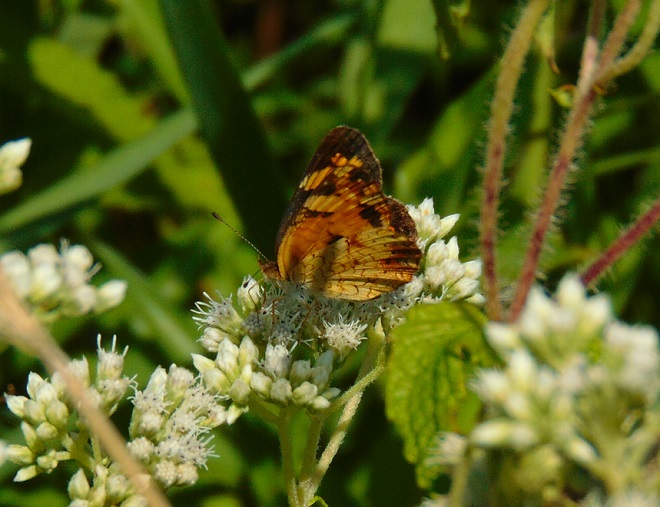
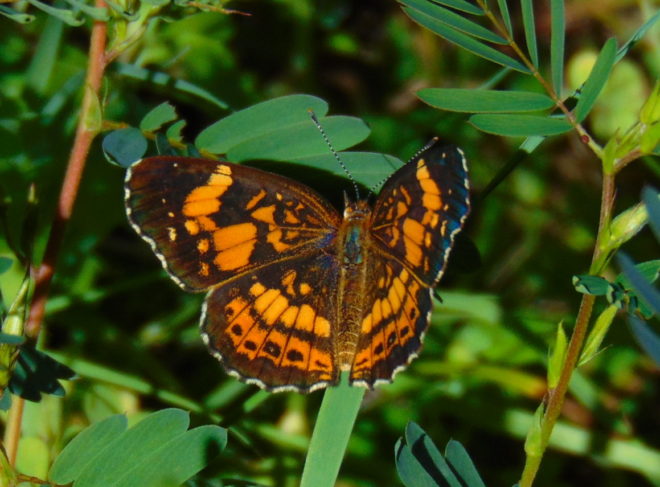
A Pearl Crescent (Phyciodes tharos) sipping nectar from Rough Boneset (Eupatorium pilosum) flowers.  Asters (Aster) are the host plants for the larvae of this butterfly.
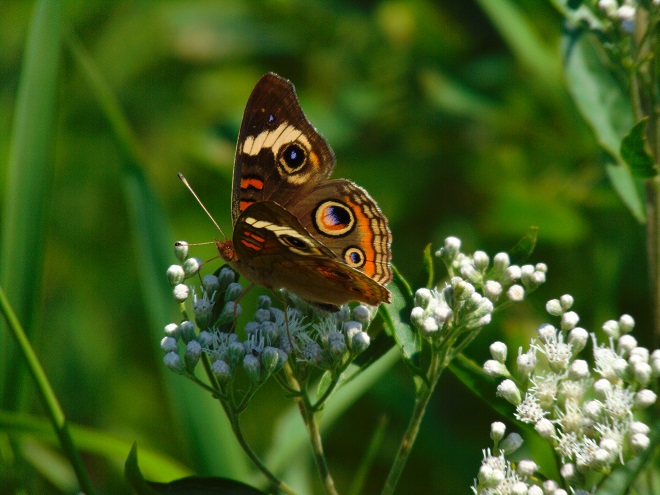
A Common Buckeye (Junonia coenia) on Rough Boneset.  Its caterpillars are known to feed on members of the Acanthus family, possibly including the Water Willow (Justicia americana) which is so abundant in Conewago Falls.
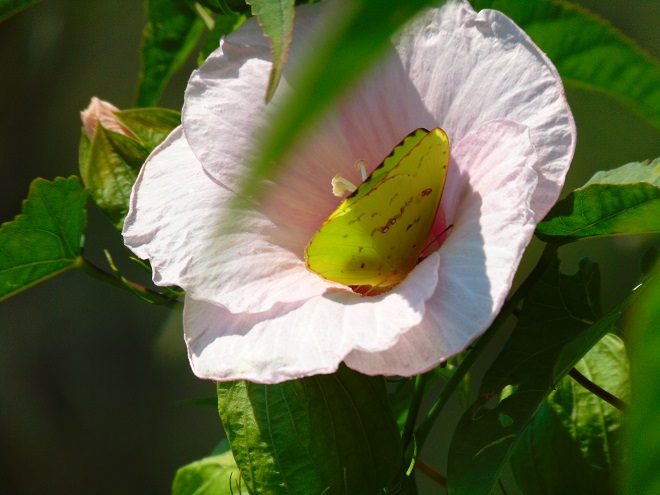
Visitors from south of the Mason-Dixon Line arrived on the recent warm winds.  Two Cloudless Sulphurs (Phoebis sennae) patrolled the Riverine Grasslands, especially near the stands of Partridge Pea, a possible host plant.  One is seen here visiting a Halbred-leaved Rose Mallow blossom.  These large yellow butterflies are always a standout.

Purple Loosestrife (Lythrum salicaria) has a bad reputation.  Not native to the Americas, this prolific seed producer began spreading aggressively into many wetlands following its introduction.  It crowds out native plant species and can have a detrimental impact on other aquatic life.  Stands of loosestrife in slow-moving waters can alter flows, trap sediment, and adversely modify the morphology of waterways.  Expensive removal and biological control are often needed to protect critical habitat.

The dastardly Purple Loosestrife may have only two positive attributes.  First, it’s a beautiful plant.  And second, it’s popular; butterflies and other pollinators find it to be irresistible and go wild over the nectar.

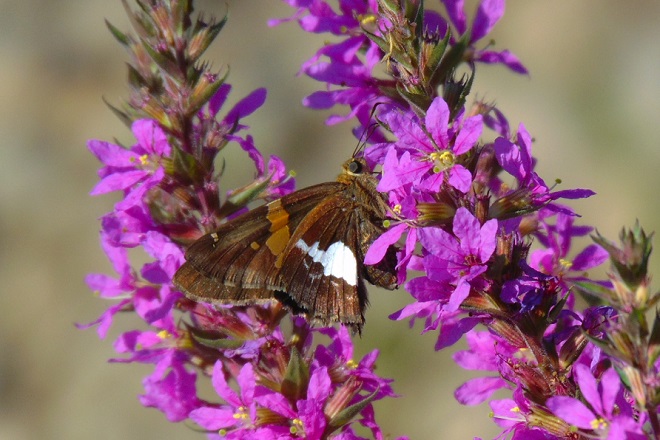
A Silver-spotted Skipper (Epargyreus clarus) feeding on Purple Loosestrife nectar.  The host plants for this common butterfly’s caterpillars are a wide variety of Legumes.
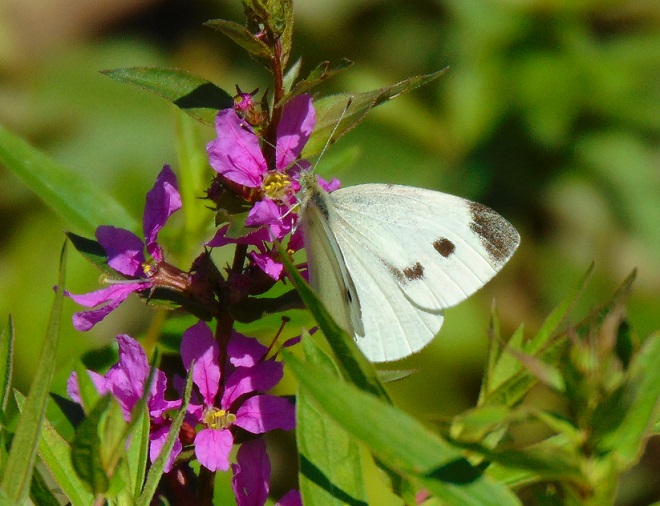
A Cabbage White (Pieris rapae), a butterfly introduced from Europe in the 1800s, feeds on introduced Purple Loosestrife.
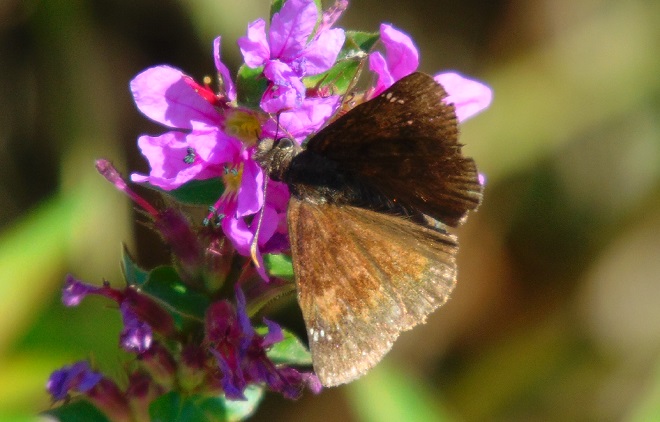
A Wild Indigo Duskywing (Erynnis baptisiae) feeding on Purple Loosestrife. This butterfly has expanded its population and range by using the introduced Crown Vetch as a host plant.

Don’t you just adore the wonderful butterflies.  Everybody does.  Just don’t tell anyone that they’re pollinating those dirty filthy no-good Purple Loosestrife plants.

SOURCES

Brock, Jim P., and Kenn Kaufman.  2003.  Butterflies of North America.  Houghton Mifflin Company.  New York.

Newcomb, Lawrence.  1977.  Newcomb’s Wildflower Guide.  Little, Brown and Company.  Boston, Massachusetts.

The Dungeon

There’s something frightening going on down there.  In the sand, beneath the plants on the shoreline, there’s a pile of soil next to a hole it’s been digging.  Now, it’s dragging something toward the tunnel it made.  What does it have?  Is that alive?
We know how the system works, the food chain that is.  The small stuff is eaten by the progressively bigger things, and there are fewer of the latter than there are of the former, thus the whole network keeps operating long-term.  Some things chew plants, others devour animals whole or in part, and then there are those, like us, that do both.  In the natural ecosystem, predators keep the numerous little critters from getting out of control and decimating certain other plant or animal populations and wrecking the whole business.  When man brings an invasive and potentially destructive species to a new area, occasionally we’re fortunate enough to have a native species adapt and begin to keep the invader under control by eating it.  It maintains the balance.  It’s easy enough to understand.

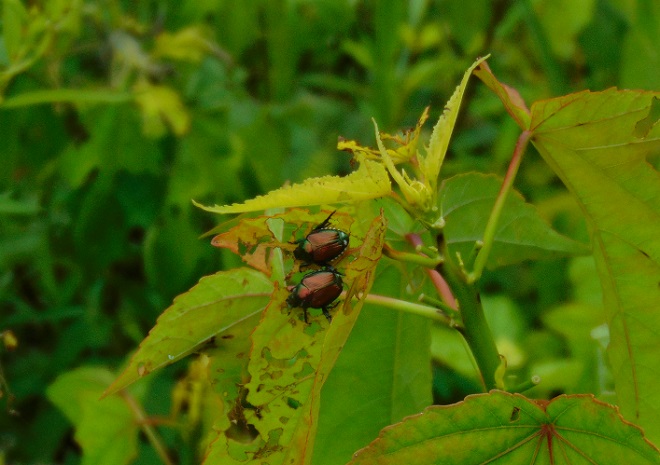
Japanese Beetles (Popillia japonica) seen here on Halberd-leaved Rose Mallow.  Without predation, exploding numbers of this invasive non-indigenous insect can defoliate and kill numerous species of plants in a given area.
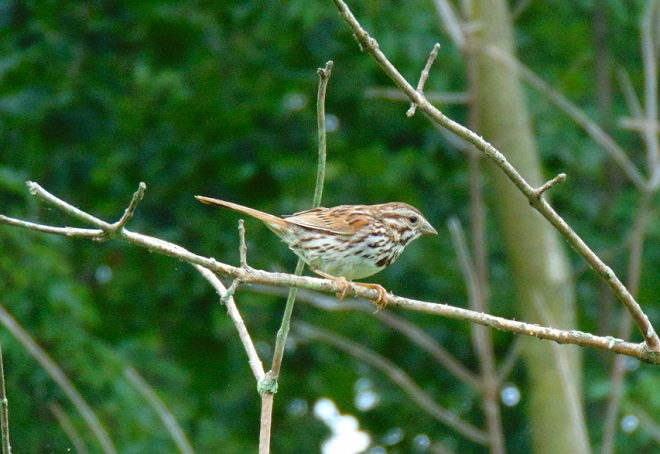
The Song Sparrow (Melospiza melodia) is a generalist feeder, eating seeds and invertebrates including Japanese Beetles.  This species is the omnipresent year-round occupant of shoreline vegetation along the lower Susquehanna River.

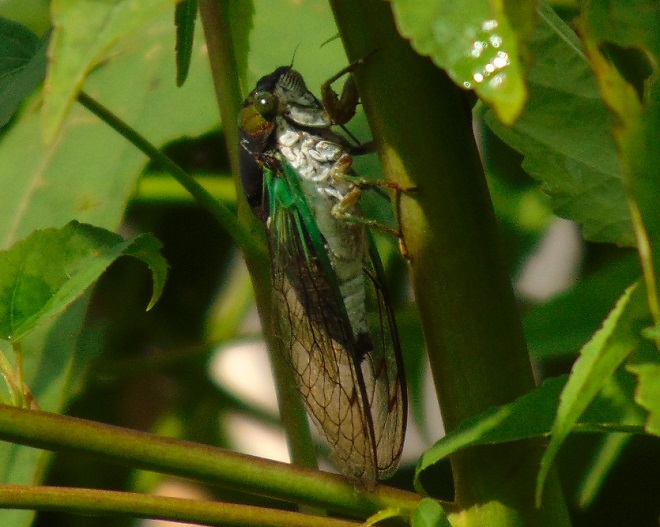
Late summer days are marked by a change in the sounds coming from the forests surrounding the falls.  For birds, breeding season is ending, so the males cease their chorus of songs and insects take over the musical duties.  The buzzing calls of male “annual cicadas” (Neotibicen species) are the most familiar.  The female “annual cicada” lays her eggs in the twigs of trees.  After hatching, the nymphs drop to the ground and burrow into the soil to live and feed along tree roots for the next two to five years.  A dry exoskeleton clinging to a tree trunk is evidence that a nymph has emerged from its subterranean haunts and flown away as an adult to breed and soon thereafter die.  Flights of adult “annual cicadas” occur every year, but never come anywhere close to reaching the enormous numbers of “periodical cicadas” (Magicicada species).  The three species of “periodical cicadas” synchronize their life cycles throughout their combined regional populations to create broods that emerge as spectacular flights once every 13 or 17 years.

An “annual cicada” also known as a “dog-day cicada”, clings to the stem of a Halberd-leaved Rose Mallow at Conewago Falls.

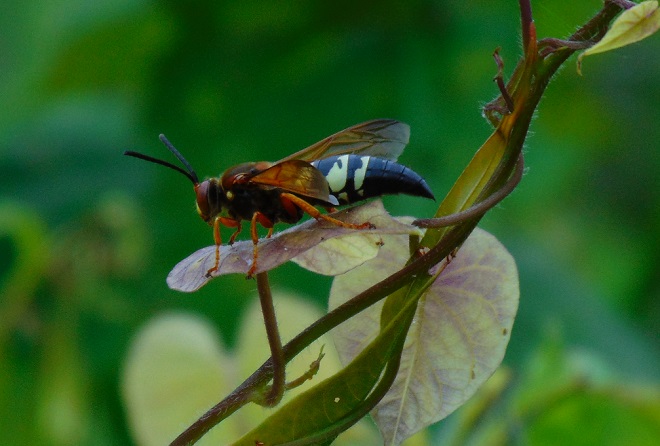
For the adult cicada, there is danger, and that danger resembles an enormous bee.  It’s an Eastern Cicada Killer (Specius speciosus) wasp, and it will latch onto a cicada and begin stinging while both are in flight.  The stings soon paralyze the screeching, panicked cicada.  The Cicada Killer then begins the task of airlifting and/or dragging its victim to the lair it has prepared.  The cicada is placed in one of more than a dozen cells in the tunnel complex where it will serve as food for the wasp’s larvae.  The wasp lays an egg on the cicada, then leaves and pushes the hole closed.  The egg hatches in a several days and the larval grub is on its own to feast upon the hapless cicada.

An Eastern Cicada Killer (Sphecius speciosus) along the river shoreline. Despite their intimidating appearance, they do not sting humans and can be quite docile when approached.

Other species in the Solitary Wasp family (Sphecidae) have similar life cycles using specific prey which they incapacitate to serve as sustenance for their larvae.

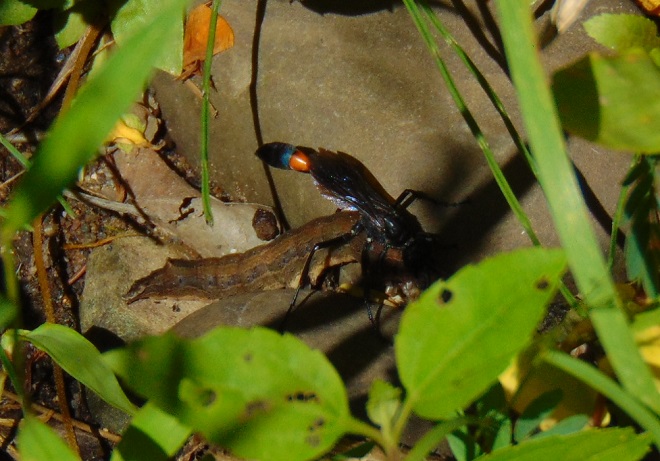
A Solitary Wasp, one of the Thread-waisted Wasps (Ammophila species), drags a paralyzed moth caterpillar to its breeding dungeon in the sandy soil at Conewago Falls.  For the victim, there is no escape from the crypt.

The Solitary Wasps are an important control on the populations of their respective prey.  Additionally, the wasp’s bizarre life cycle ensures a greater survival rate for its own offspring by providing sufficient food for each of its progeny before the egg beginning its life is ever put in place.  It’s complete family planning.

The cicadas reproduce quickly and, as a species, seem to endure the assault by Cicada Killers, birds, and other predators.  The periodical cicadas (Magicicada), with adult flights occurring as a massive swarm of an entire population every thirteen or seventeen years, survive as species by providing predators with so ample a supply of food that most of the adults go unmolested to complete reproduction.  Stay tuned, 2021 is due to be the next periodical cicada year in the vicinity of Conewago Falls.

SOURCES

Eaton, Eric R., and Kenn Kaufman.  2007.  Kaufman Field Guide to Insects of North America.  Houghton Mifflin Company.  New York.

Fussy Eaters

She ate only toaster pastries…that’s it…nothing else.  Every now and then, on special occasions, when a big dinner was served, she’d have a small helping of mashed potatoes, no gravy, just plain, thank you.  She received all her nutrition from several meals a week of macaroni and cheese assembled from processed ingredients found in a cardboard box.  It contains eight essential vitamins and minerals, don’t you know?  You remember her, don’t you?

Adult female butterflies must lay their eggs where the hatched larvae will promptly find the precise food needed to fuel their growth.  These caterpillars are fussy eaters, with some able to feed upon only one particular species or genus of plant to grow through the five stages, the instars, of larval life.  The energy for their fifth molt into a pupa, known as a chrysalis, and metamorphosis into an adult butterfly requires mass consumption of the required plant matter.  Their life cycle causes most butterflies to be very habitat specific.  These splendid insects may visit the urban or suburban garden as adults to feed on nectar plants, however, successful reproduction relies upon environs which include suitable, thriving, pesticide-free host plants for the caterpillars.  Their survival depends upon more than the vegetation surrounding the typical lawn will provide.

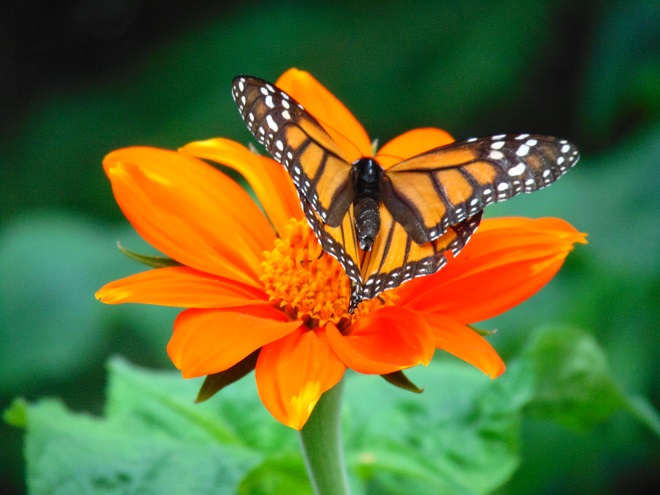
The Monarch (Danaus plexippus), a butterfly familiar in North America for its conspicuous autumn migrations to forests in Mexico, uses the milkweeds (Asclepias) almost exclusively as a host plant.  Here at  Conewago Falls, wetlands with Swamp Milkweed (Asclepias incarnata) and unsprayed clearings with Common Milkweed (A. syriaca) are essential to the successful reproduction of the species.  Human disturbance, including liberal use of herbicides, and invasive plant species can diminish the biomass of the Monarch’s favored nourishment, thus reducing significantly the abundance of the migratory late-season generation.

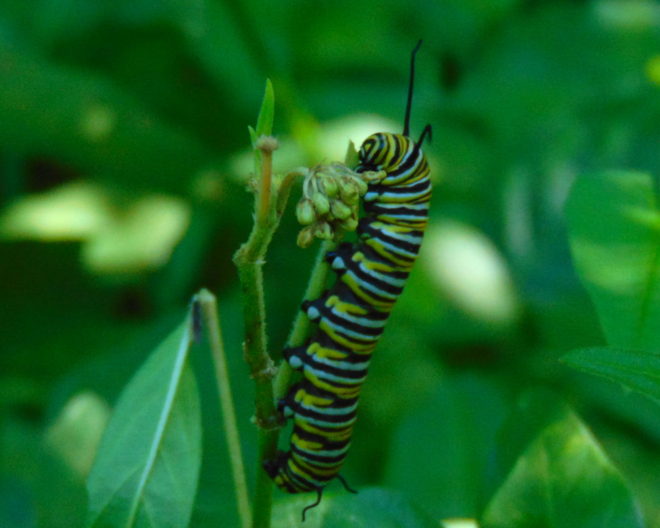
Monarch caterpillar after a fourth molt.  The fifth instar feeding on Swamp Milkweed.
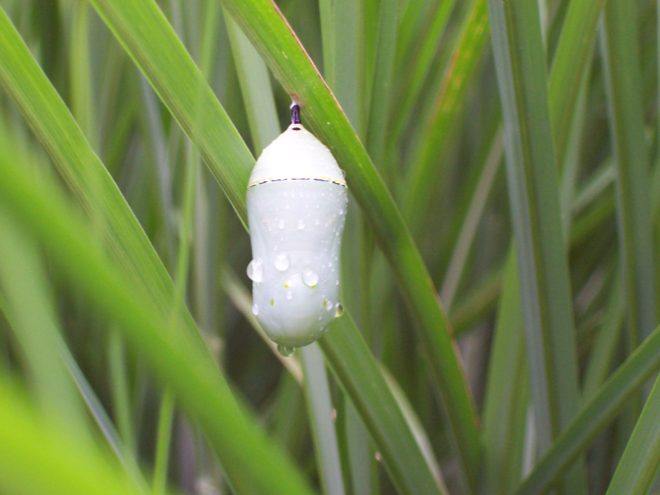
A fifth molt begets the Monarch pupa, the chrysalis, from which the showy adult butterfly will emerge.
Adult Monarch feeding on Goldenrod (Solidago) nectar.

Butterflies are good indicators of the ecological health of a given environment.  A diversity of butterfly species in a given area requires a wide array of mostly indigenous plants to provide food for reproduction.  Let’s have a look at some of the species seen around Conewago Falls this week…

An adult Silvery Checkerspot (Chlosyne nycteis) visiting a nectar plant, Partridge Pea (Chamaecrista fasciculata).  Wingstem (Verbesina alternifolia), a plant of the Riparian Woodlands, is among the probable hosts for the caterpillars.
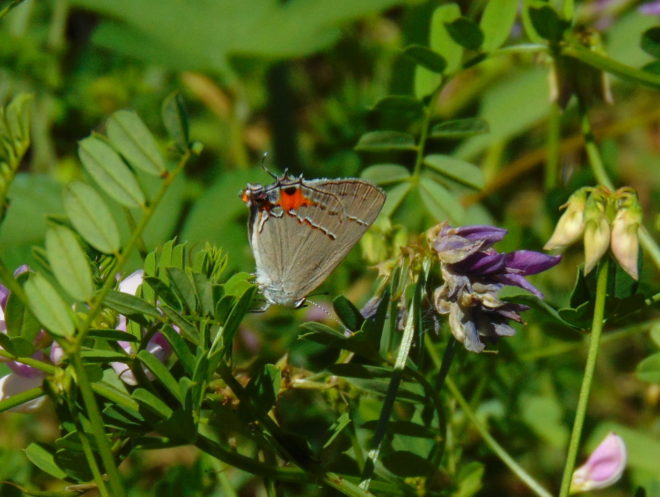
A Gray Hairstreak (Strymon melinus) visits Crown Vetch, a possible host plant.  Other potential larval food in the area includes Partridge Pea, Halberd-leaved Rose Mallow (Hibiscus laevis) of the river shoreline, and Swamp Rose Mallow (Hibiscus moscheutos), a plant of wetlands.
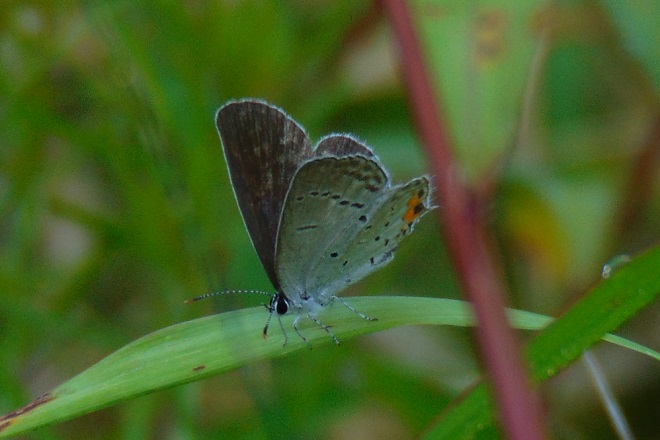
The Eastern Tailed Blue (Cupido comyntas) may use Partridge Pea , a native wildflower species, and the introduced Crown Vetch (Securigera/Coronilla varia) as host and nectar plants at Conewago Falls.
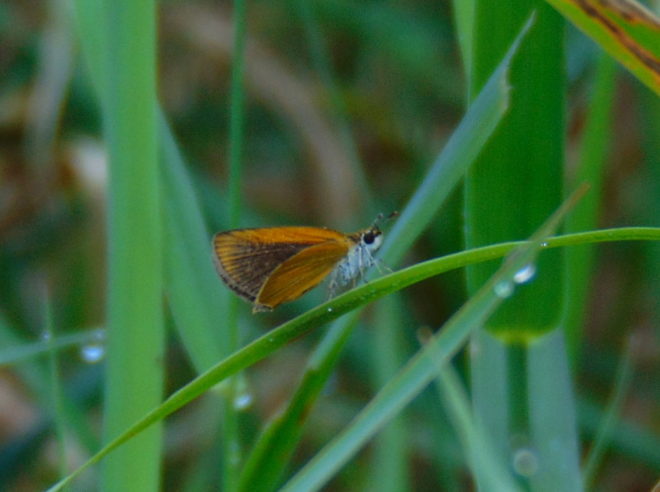
The Least Skipper (Ancyloxypha numitor) is at home among tall grasses in woodland openings, at riverside, and in the scoured grassland habitat of the Pothole Rocks in the falls.  Host plants available include Switchgrass (Panicum vigatum), Freshwater Cordgrass (Spartina pectinata), and Foxtails (Setaria).
The Zabulon Skipper (Poanes zabulon) is an inhabitant of moist clearings where the caterpillars may feed upon Lovegrasses (Eragrostis) and Purpletop (Tridens flavus).
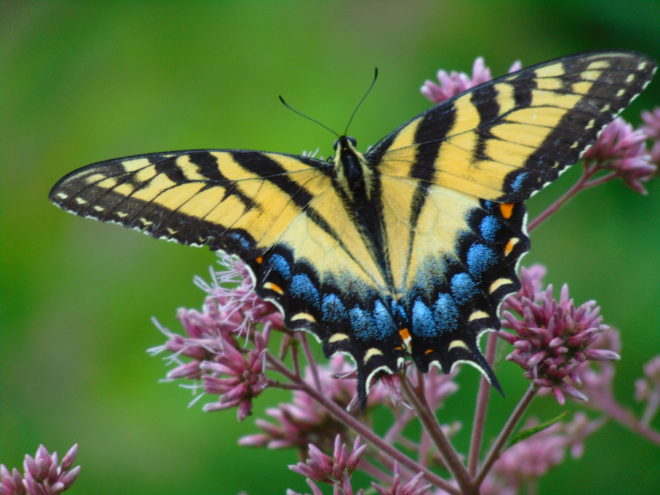
The Eastern Tiger Swallowtail (Papilio glaucus), a female seen here gathering nectar from Joe-Pye Weed (Eutrochium), relies upon several forest trees as hosts. Black Cherry (Prunus serotina), Willow (Salix), Yellow Poplar (Liriodendron tulipifera), also known as Tuliptree, and Green Ash (Fraxinus pennsylvanica) are among the local species known to be used.  The future of the latter food species at Conewago Falls is doubtful.  Fortunately for the Eastern Tiger Swallowtail, the “generalist” feeding requirements of this butterfly’s larvae enable the species to survive the loss of a host plant.
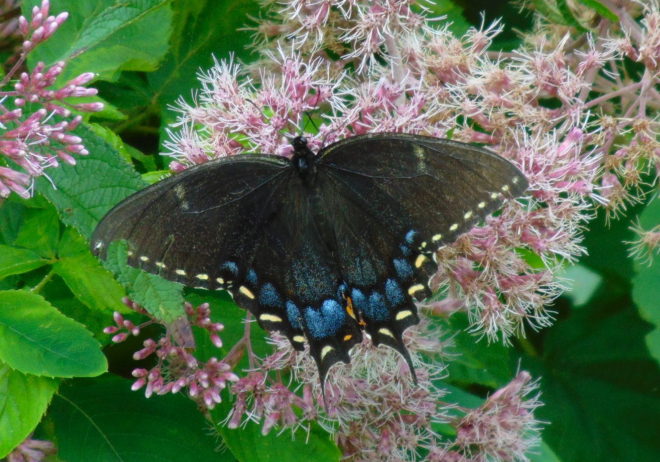
A female Eastern Tiger Swallowtail, black morph, gathering nectar from Joe-Pye Weed.
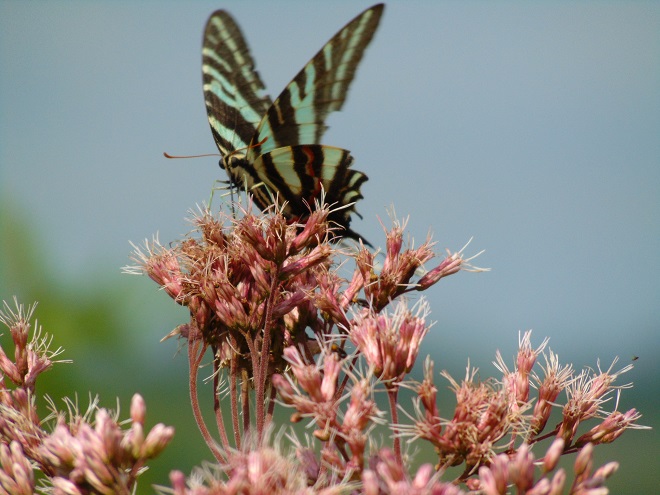
The Zebra Swallowtail (Protographium marcellus), an adult seen here on Joe-Pye Weed, feeds exclusively upon Pawpaw (Asimina) trees as a caterpillar.  This butterfly species may wander, but its breeding range is limited to the moist Riparian Woodlands where colonial groves of Pawpaw may be found.  The Common Pawpaw (Asimina triloba), our native species in Pennsylvania, and the Zebra Swallowtail occur at the northern edge of their geographic ranges in the Lower Susquehanna River Watershed.  Planting Pawpaw trees as an element of streamside reforestation projects certainly benefits this marvelous butterfly.

The spectacularly colorful butterflies are a real treat on a hot summer day.  Their affinity for showy plants doubles the pleasure.
By the way, I’m certain by now you’ve recalled that fussy eater…and how beautiful she grew up to be.
SOURCES

Brock, Jim P., and Kaufman, Kenn.  2003.  Butterflies of North America.  Houghton Mifflin Company.  New York, NY.