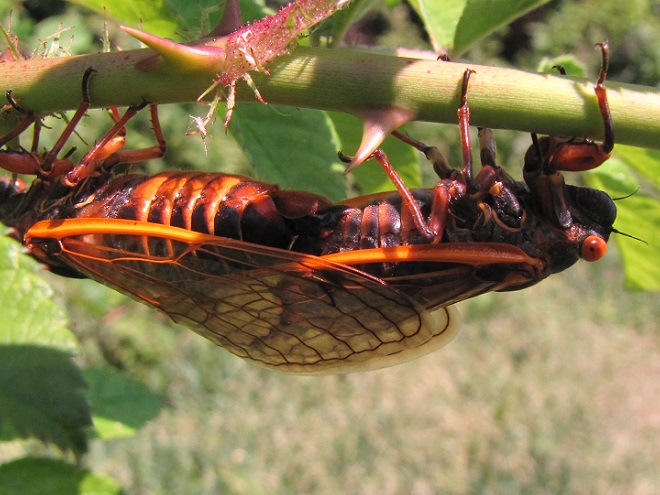
Common sense tells us that Brood X Periodical Cicada emergence begins in the southern part of the population zone, where the ground temperatures reach 64° first, then progresses to the north as the weather warms. In the forested hills where the lower Piedmont falls away onto the flat landscape of the Atlantic Coastal Plain in Maryland’s Cecil and Harford Counties, the hum of seventeen-year-old insects saturates a listener’s ears from all directions—the climax nears.
Periodical cicadas, mostly Magicicada septendecim, are well into their breeding cycle along the Piedmont-Atlantic Coastal Plain border right now. Love is in the air.
With all that food flying around, you just knew something unusual was going to show up to eat it. It’s a buffet. It’s a smorgasbord. It’s free, it’s all-you-can-eat, and it seems, at least for the moment, like it’s going to last forever. You know it’ll draw a crowd.
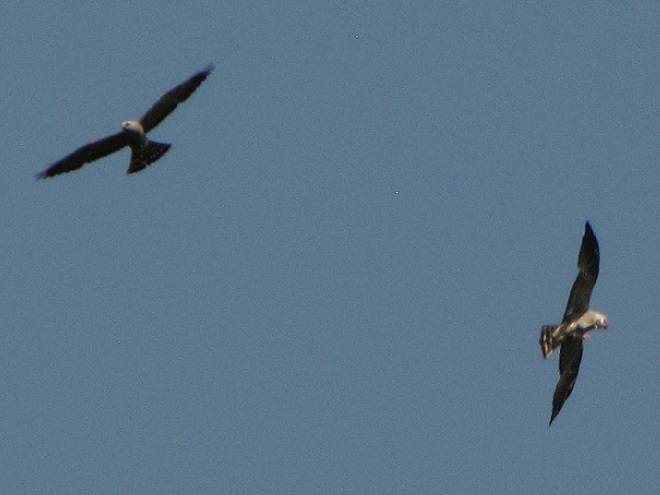
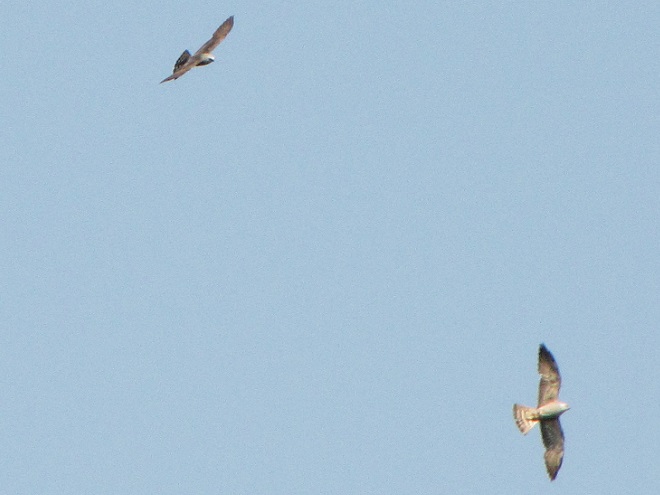
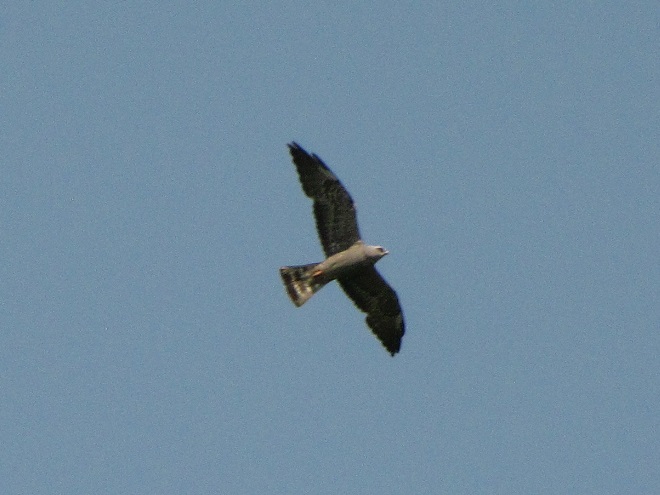
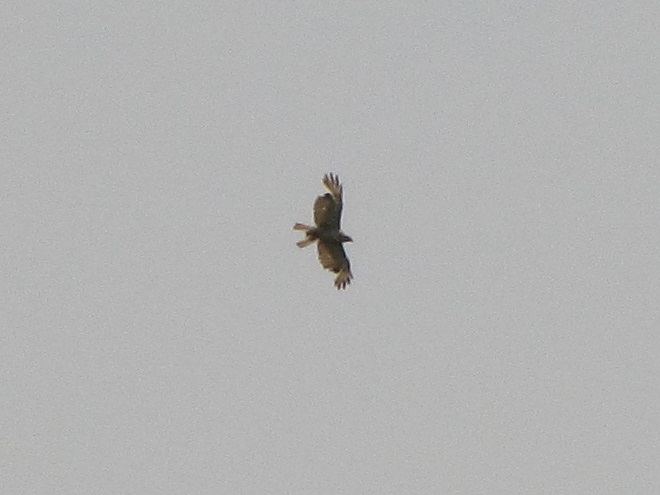
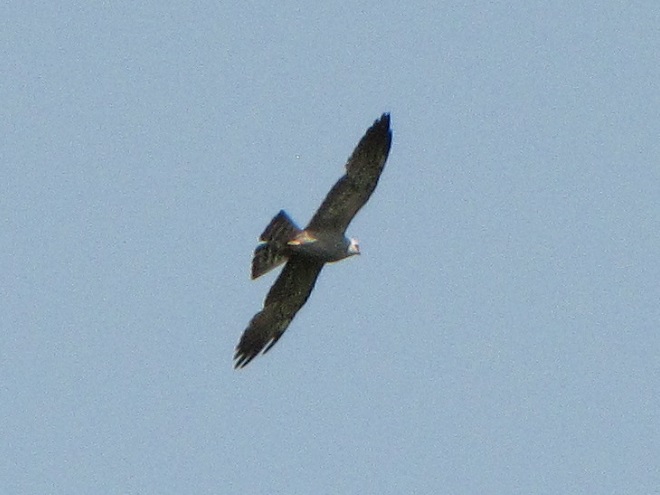
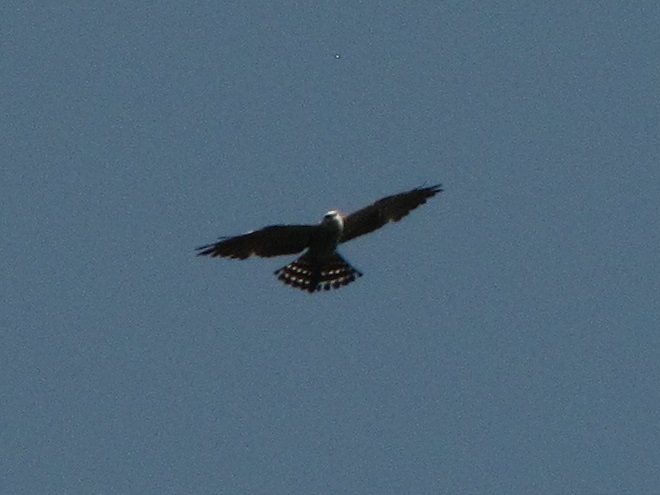
The Mississippi Kite (Ictiniamississippiensis), a trim long-winged bird of prey, is a Neotropical migrant, an insect-eating friend of the farmer, and, as the name “kite” suggests, a buoyant flier. It experiences no winter—breeding in the southern United States from April to July, then heading to South America for the remainder of the year. Its diet consists mostly of large flying insects including beetles, leafhoppers, grasshoppers, dragonflies, and, you guessed it, cicadas. Mississippi Kites frequently hunt in groups—usually catching and devouring their food while on the wing. Pairs nest in woodlands, swamps, and in urban areas with ample prey. They are well known for harmlessly swooping at people who happen to get too close to their nest.
Mississippi Kites nest regularly as far north as southernmost Virginia. For at least three decades now, non-breeding second-year birds known as immatures have been noted as wanderers in the Mid-Atlantic States, particularly in late May and early June. They are seen annually at Cape May, New Jersey. They are rare, but usually seen at least once every year, along the Piedmont-Atlantic Coastal Plain border in northern Delaware, northeastern Maryland, and/or southeastern Pennsylvania. Then came the Brood X Periodical Cicadas of 2021.
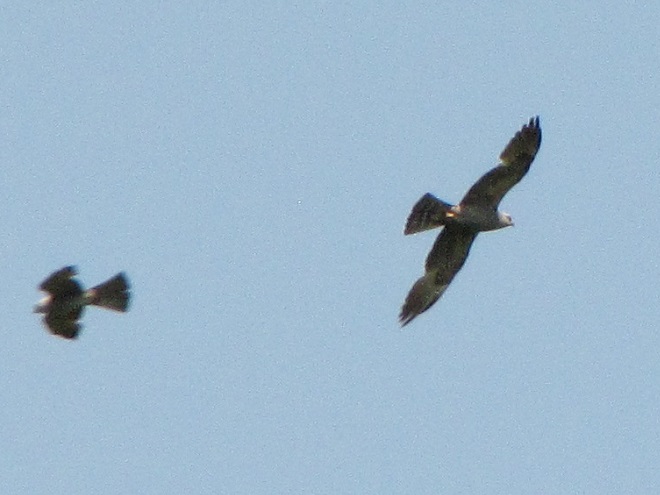
During the last week of May and these first days of June, there have been dozens of sightings of cicada-eating Mississippi Kites in locations along the lower Piedmont slope in Harford and Cecil Counties in Maryland, at “Bucktoe Creek Preserve” in southern Chester County, Pennsylvania, and in and near Newark in New Castle County, Delaware. They are being seen daily right on the lower Susquehanna watershed’s doorstep.
Today, we journeyed just south of Mason’s and Dixon’s Delaware-Maryland-Pennsylvania triangle to White Clay Creek State Park along Route 896 north of Newark, Delaware. Once there, we took a short bicycle ride into a wooded neighborhood across the street in Maryland to search for the Mississippi Kites that have been reported there in recent days.
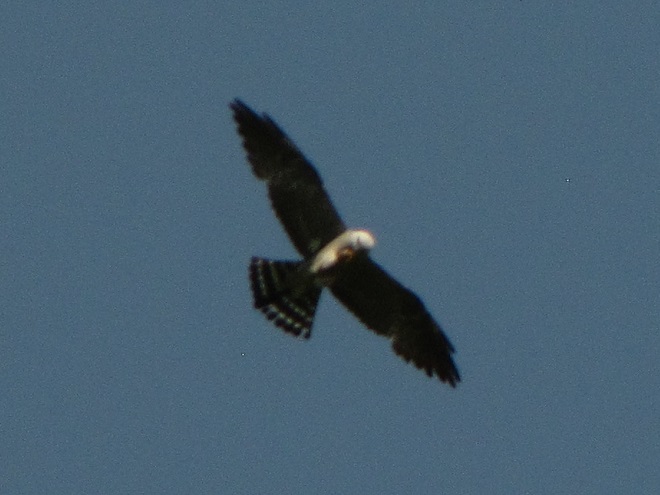
Periodical cicadas filled the treetops and the airspace just above them.It wasn’t long before Mississippi Kites appeared over the trees along a hilltop clearing to snatch up cicadas for a morning meal.This kite glides on autopilot as it holds a captured cicada in its talons and tears it apart with its hook-shaped bill.At least ten Mississippi Kites have been seen simultaneously at this site or in nearby Newark during recent days. This morning, we saw six.All the Mississippi Kites we saw today were second-year birds. The banded tail is characteristic of both hatch-year (juvenile) and second-year (immature) Mississippi Kites. Of course, at this time of year, hatch-year birds are still in the nest and not flying around pigging out on periodical cicadas.The banded tail, gray underside, and white head of a second-year Mississippi Kite. Though known as immature or subadult birds during their second year, there are records of Mississippi Kites successfully breeding at this age. Recent wanderings into the Mid-Atlantic States and New England have led to a spotty expansion of the nesting range there.Mississippi Kites in their second year undergo molt of their flight feathers. The timing can vary greatly among individual birds with diet among the factors affecting the process. This bird is just beginning the replacement of its juvenile remiges and rectrices.Tail molt beginning on this second-year Mississippi Kite. These banded juvenile tail feathers will be replaced by a set of all-dark adult rectrices.A second-year Mississippi Kite with an all-dark adult tail feather (rectrix). An abundance of protein-rich cicadas should provide ample nutrition to keep the molt process going for this maturing bird, at least for another couple of weeks. Relocating inland on the Piedmont could keep this and other kites well-nourished for even longer.
Will groups of Mississippi Kites develop a taste for our seventeen-year cicadas and move north into the Lower Susquehanna River Watershed? Ah, to be young and a nomad—that’s the life. Wandering on a whim with one goal in mind—food. It could very well be that now’s the time to be on the lookout for Mississippi Kites, especially where Brood X Periodical Cicadas are abundant.
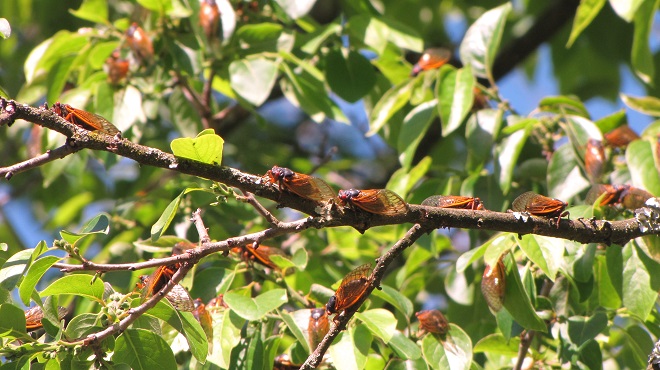
The emergence of Brood X Periodical Cicadas is now in full swing. If you visit a forested area, you may hear the distant drone of very large concentrations of one or more of the three species that make up the Brood X event. The increasing volume of a chorus tends to attract exponentially greater numbers of male cicadas from within an expanding radius, causing a swarm to grow larger and louder—attracting more and more females to the breeding site.
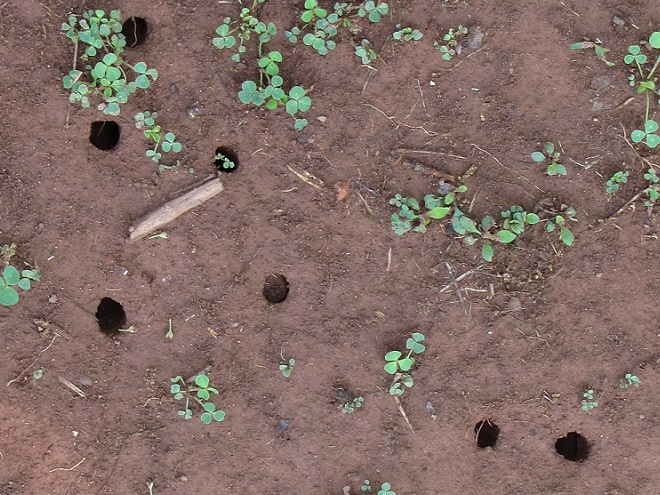
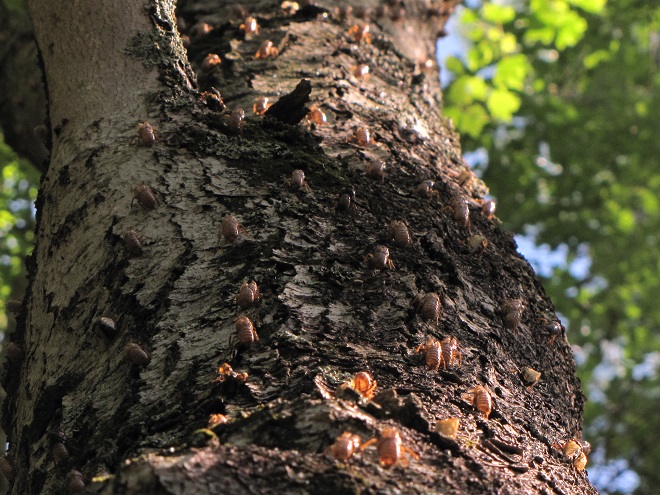
Holes in the ground where emerging Brood X Periodical Cicadas have come to the surface.Having ascended the trunk of this Eastern White Pine after emerging from the soil, massive numbers of periodical cicadas have left behind hundreds of opaque exuviae. The exuvia is the exoskeletal remains of the cicada’s final molt from a nymph into a flying adult.A freshly molted Magicicada cassini periodical cicada.
Each periodical cicada species has a distinctive song. This song concentrates males of the same species at breeding sites—then draws in an abundance of females of the same species to complete the mating process. Large gatherings of periodical cicadas can include all three species, but a close look at swarms on State Game Lands 145 in Lebanon County and State Game Lands 46 (Middle Creek Wildlife Management Area) in Lancaster County during recent days found marked separation by two of the three. Most swarms were dominated by Magicicada septendecim, the largest, most widespread, and most common species. However, nearly mono-specific swarms of M. cassini, the second most numerous species, were found as well. An exceptionally large one was northwest of the village of Colebrook on State Game Lands 145. It was isolated by a tenth of a mile or more from numerous large gatherings of M. septendecim cicadas in the vicinity. These M. cassini cicadas, with a chorus so loud that it outdistanced the songs made by the nearby swarms of M. septendecim, seized the opportunity to separate both audibly and physically from the more dominant species, thus providing better likelihood of maximizing their breeding success.
Some of the tens of thousands of M. cassini periodical cicadas in a concentration on State Game Lands 145 northwest of Colebrook in Lebanon County, Pennsylvania. This swarm occupied deciduous and evergreen trees on several acres of a south-facing hillside. To provide protection from predators and assure the chance of finding a mate “in the crowd”, lesser numbers of this and the rarer species, Magicicada septendecula, would need to merge into the swarms of the abundant M. septendecim periodical cicadas to breed.
The process of identifying periodical cicadas is best begun by listening to their choruses, songs, and calls. After all, the sounds of cicadas will lead one to the locations where they are most abundant. The two most common species, M. septendecim and M. cassini, produce a buzzy chorus that, when consisting of hundreds or thousands of cicadas “singing” in unison, creates a droning wail that can carry for a quarter of a mile or more. It’s a surreal humming sound that may remind one of a space ship from a science fiction film.
Listen to the songs of individual cicadas at close range and you’ll hear a difference between the widespread M. septendecim “Pharaoh Periodical Cicada” and the other two species. M. septendecim‘s song is often characterized as a drawn out version of the word “Pharaoh”, hence one of the species’ common names (another is “Seventeen-year Locust”). As part of their courtship ritual, “Pharaoh Periodical Cicadas” sometimes make a purring or cooing sound, which is often extended to sound like kee-ow, then sometimes revved up further to pha-raoh. M. cassini, often known as “Cassin’s Periodical Cicada” or “Dwarf Periodical Cicada”, and the least common species, M. septendecula, often make scratchy clicking or rattling calls as a lead-in to their song. Most observers will find little difficulty locating the widespread M. septendecim “Pharaoh Periodical Cicada” by sound, so listening for something different—the clicking call—is an easy way to zero in on the two less common species.
To penetrate the droning choruses of large numbers of “Pharaoh” and/or “Cassin’s Periodical Cicadas”, sparingly distributed M. septendecula cicadas have a noise-penetrating song consisting of a series of quick raspy notes with a staccato rhythm reminiscent of a pulsating lawn sprinkler. It can often be differentiated by a listener even in the presence of a roaring chorus of one or both of the commoner species. However, a word of caution is due. To call in others of their kind, “Cassin’s Periodical Cicadas” can produce a courtship song similar to that of M. septendecula so that they too can penetrate the choruses of the enormous numbers of “Pharaoh Periodical Cicadas” that concentrate in many areas. To play it safe, it’s best to have a good look at the cicadas you’re trying to identify.
M. cassini periodical cicadas “singing” from a treetop at Colebrook, Lebanon County, Pennsylvania. Clicking phrases are sure sign of the presence of this species and/or M. septendecula, the least likely of the three species to be encountered. When in close proximity to a swarm, a listener will often notice the rising and falling volume of a chorus in a cycle that repeats every few seconds, an effect caused by cicadas attempting to synchronize their songs in a harmony with others in the group. When courtship and mating is complete, female periodical cicadas will begin laying eggs in slits made in fresh new growth at the ends of branches on deciduous trees like the one seen here.
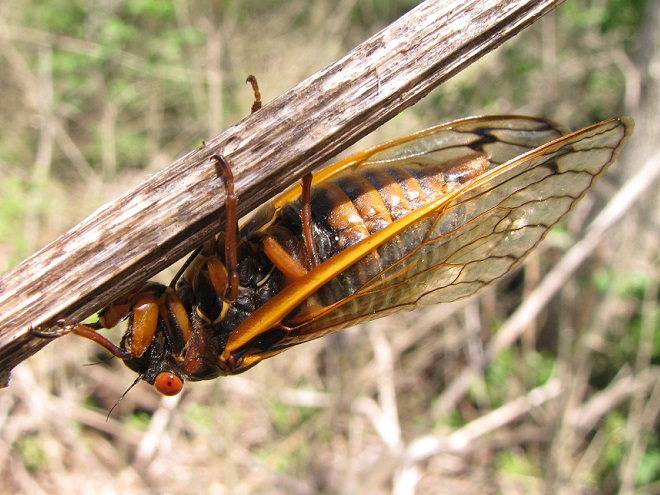
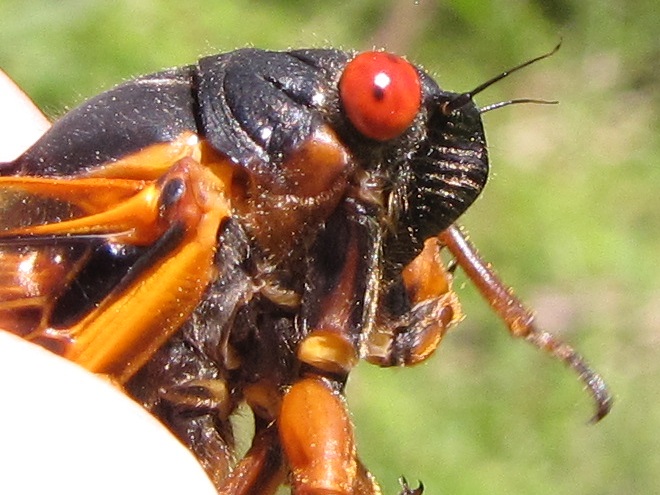
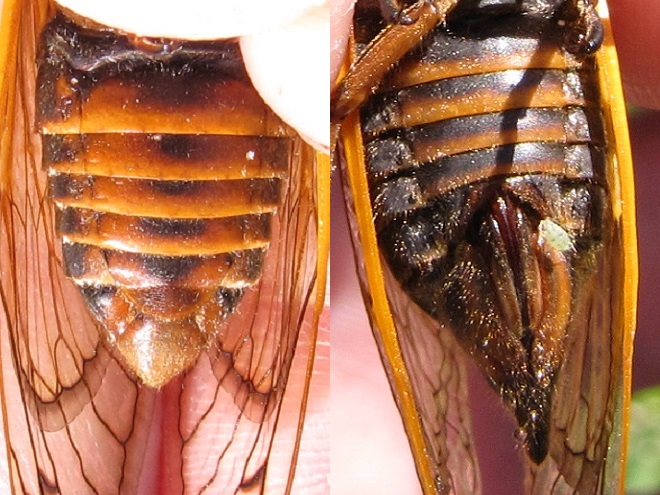
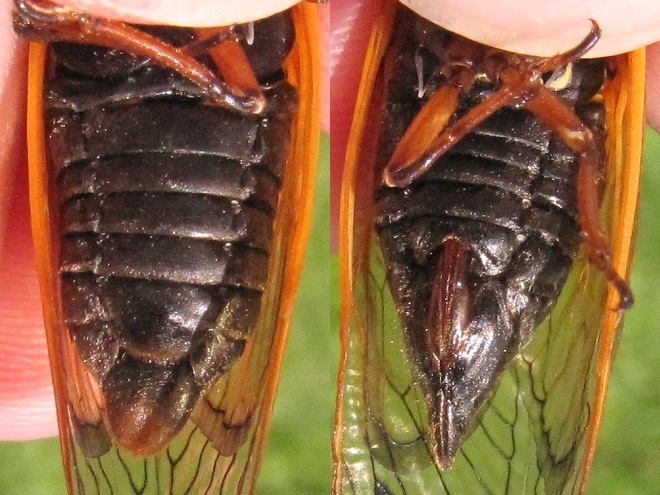
Visually identifying Brood X Periodical Cicadas to the species level is best done by looking for two key field marks—first, the presence or absence of orange between the eye and the root of the wings, and second, the presence or absence of orange bands on the underside of the abdomen. Seeing these field marks clearly requires in-hand examination of the cicada in question.
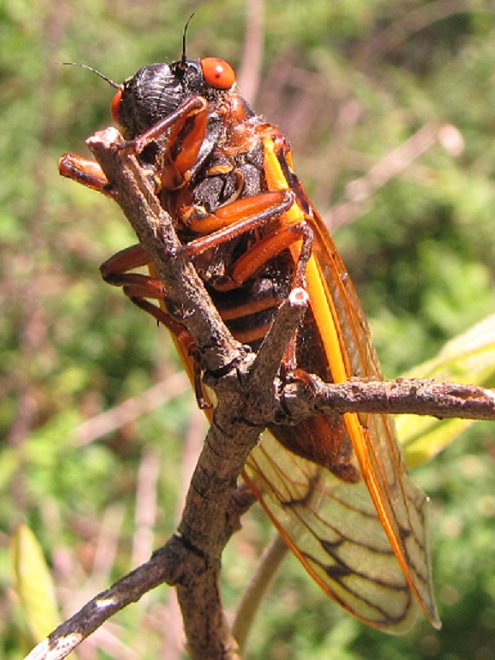
Observing a perched Brood X Periodical Cicada can sometimes provide a view of the key field marks needed for identification of the species. On the M. septendecim “Pharaoh Periodical Cicada” seen here, the orange patch between the eye and wing root and the orange bands on the underside of the abdomen are visible.The abdomen of this perched M. cassini “Cassin’s Periodical Cicada” appears, when viewed through the wings, to have orange bands. But, examination in hand would show an all-black abdomen with glossy surfaces shining in the sunlight. For accuracy, the up-close-and-personal look is necessary.In the hand, cicadas can be better studied for key field marks. M. septendecim (top) is larger than M. cassini (bottom) and M. septendecula, but the difference is not always apparent, particularly when a direct comparison cannot be made.
To reliably separate Brood X Periodical Cicadas by species, it is necessary to get a closeup view of the section of the thorax between the eye and the root (insertion) of the wings, plus a look at the underside of the abdomen. Here’s what you’ll see…
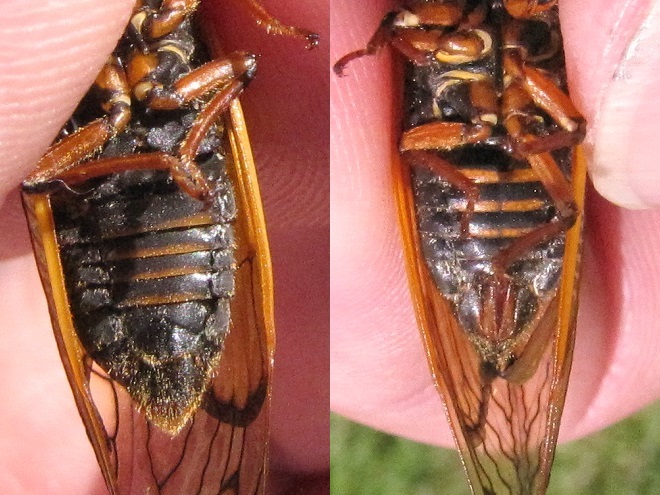
M. septendecim has an orange patch between the eye and the root of the wings.The underside of M. septendecim’s abdomen has orange bands or stripes along the trailing edge of each segment. The width of the bands can vary, but is typically wider on males (left) than on females (right).
Magicicada cassini—“Cassin’s Periodical Cicada”
The thorax of M. cassini is black between the eye and the wing insertion.In both the male (left) and female (right), the underside of M. cassini’s abdomen is all black without orange bands or stripes.
Magicicada septendecula
M. septendecula’s thorax is black between the eye and root of the wings.The underside of M. septendecula’s abdomen has narrow orange bands or stripes along the trailing edge of each segment. The width of the bands can differ. Those of this male (left) are minimal and the bands on this female (right) are near the maximum for the species.
There you have it. Get out and take a closer look at the Brood X Periodical Cicadas near you.
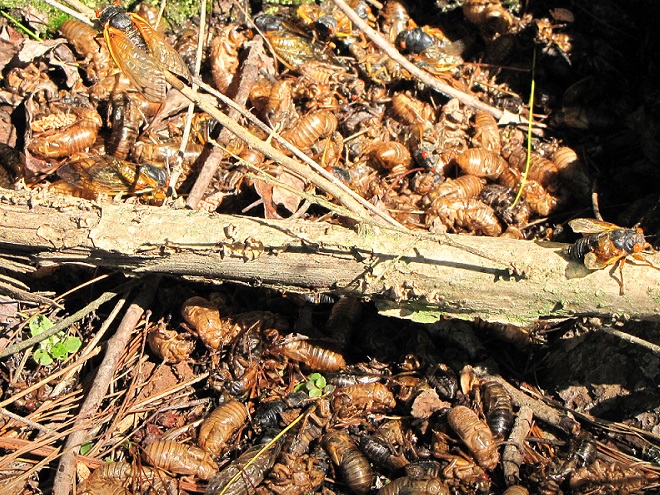
The abundant and widespread “Pharaoh Periodical Cicada” (M. septendecim).It’ll all be over before long. Accumulating remains of M. cassini “Cassin’s Periodical Cicadas” beneath an Eastern White Pine at the site of the Colebrook State Game Lands swarm.