Forty Years Ago in the Lower Rio Grande Valley: Day Three


Back in late May of 1983, four members of the Lancaster County Bird Club—Russ Markert, Harold Morrrin, Steve Santner, and your editor—embarked on an energetic trip to find, observe, and photograph birds in the Lower Rio Grande Valley of Texas.  What follows is a daily account of that two-week-long expedition.  Notes logged by Markert some four decades ago are quoted in italics.  The images are scans of 35 mm color slide photographs taken along the way by your editor.


DAY THREE—May 23, 1983

For Russ, Harold, and Steve, this trip would target several bird species each individual had never observed at any prior time in their lives.  Upon seeing a new bird, they could add it to their personal “life list”.  They, like thousands of other “listers”, were dedicated to the goal of having a life list that included over 600 species seen in the American Birding Association (A.B.A.) area—North America north of Mexico.  Harold had traveled throughout much of North America (and the world) and had an A.B.A. life list well in excess of 600 species, thus he had seen nearly all of the regularly occurring birds in the coverage area.  His chance for seeing new species was limited to vagrants that might wander into North America or tropical birds that, over time, had extended their range north of Mexico into the United States.  I don’t recall  how many species Russ and Steve had seen, but I know each had very few opportunities for new finds east of the Rocky Mountains.  For all three of these men, the Lower Rio Grande Valley presented a best bet to add multiple species to their lists.  I had never been south of Cape Hatteras or west of Pennsylvania, so I had the opportunity to add dozens of species to a life list.  Throughout the trip, Russ, Harold, and Steve enthusiastically helped me locate and see new species.  As a result, I saw over 50 new birds to add to my list.

One of the functions of the American Birding Association was to decide which bird species an observer could add to the life list.  The official A.B.A. list was revised regularly to include not only regularly occurring native species, but vagrants as well.  One of the trickier determinations was the status of introduced species.  Back in 1983, a birder could count a Ring-necked Pheasant seen in Pennsylvania on their A.B.A. life list because they were thought to be freely reproducing with a population sustainably established in the state.  Today, they are considered an exotic release and are not countable under A.B.A. rules.

Enter the Black Francolin (Francolinus francolinus), a member of the pheasant family that back in 1983, was countable under A.B.A. rules.  Native to India, the Black Francolin was introduced into southwest Louisiana in 1961 and was apparently reproducing and established.  Russ had a tip that they were seen with some regularity in areas of farmland, marsh, and oil fields south of Vinton, Louisiana.  It was one of this trip’s target species for his life list.

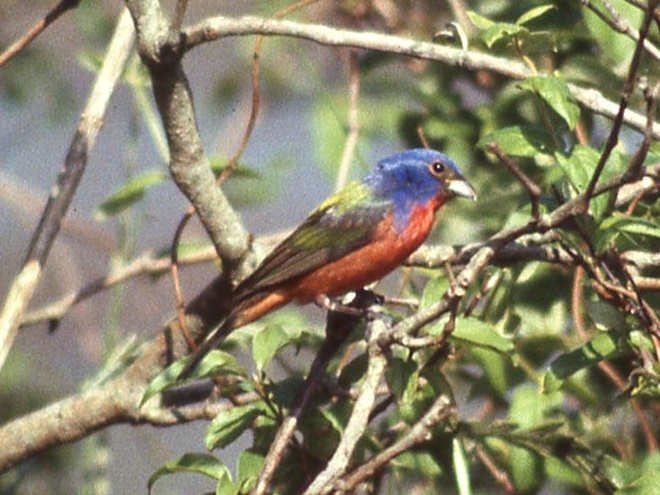
“Ready for Black Francolin.  Up at 5:30 — After breakfast, we went to Gum Cove Road.  No Francolins, but at the end of the blacktop road, we had 5 Purple Gallinules in the scope at one time.  King Rails were plentiful.  We found a dead male Painted Bunting.  Later, we saw a very beautiful live one.  Water everywhere.  Flooded fields everywhere.  The road was flooded for about 50 yards at one point.  White Ibis were abundant.”
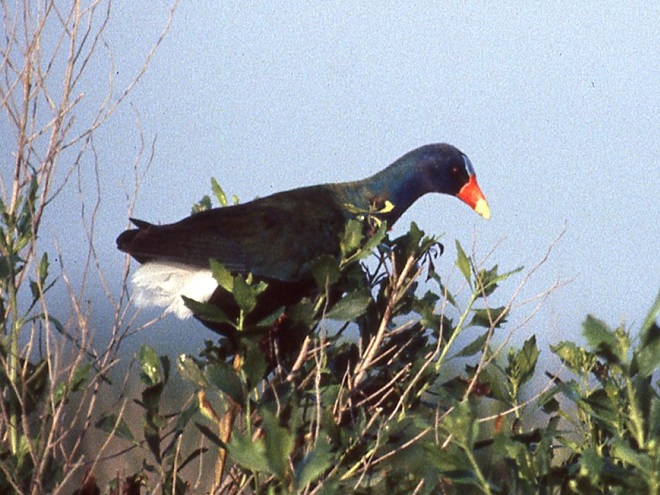
Purple Gallinule
Purple Gallinules (Porphyrio martinicus) were common along Gum Cove Road.  In silhouette from a distance, those that were perching atop the shrubs raised hopes that we had located the sought after Blank Francolin, but they were all Purple Gallinules.  We weren’t overly disappointed.  (Vintage 35 mm image)
Painted Bunting
The live male Painted Bunting (Passerina cirus) seen along Gum Cove Road.  (Vintage 35 mm image)

Other sightings of note along Gum Cove Road included: Northern Bobwhite, Common Nighthawk, Cattle Egret, Green Heron, American Bittern, Snowy Egret, Glossy Ibis, Black-necked Stilt (Himantopus mexicanus), Forster’s Tern, Black Tern, Yellow-billed Cuckoo, Eastern Kingbird, Purple Martin, Barn Swallow, Brown Thrasher, Loggerhead Shrike, Red-winged Blackbird, Brown-headed Cowbird, Eastern Meadowlark, Boat-tailed Grackle (Quiscalus major), and Great-tailed Grackle (Quiscalus mexicanus)—a very large and noisy blackbird I had never seen before.
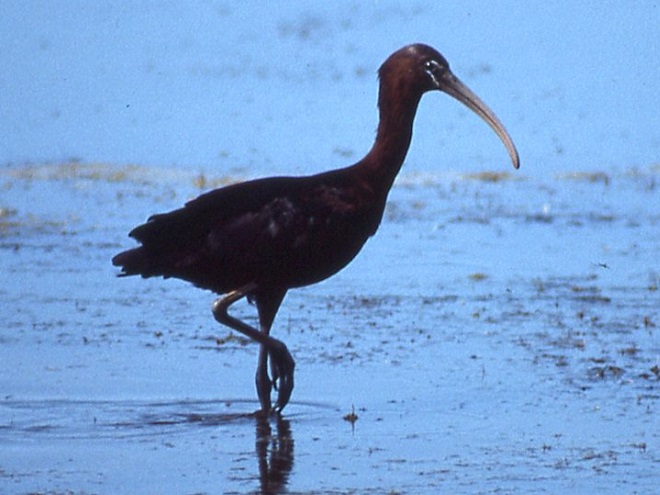
Glossy Ibis
A Glossy Ibis (Plegadis falcinellus) in a flooded area along Gum Cove Road.  (Vintage 35 mm image)

The reader may be interested to know that today, the area between Vinton and the Gulf of Mexico has largely been surrendered to the forces of the hurricanes that strike the region with some regularity.  Cameron Parish* is a sparsely populated buffer zone of marshes, abundant wildlife, and oil and gas wells.  Its population of more than 9,000 in 1983 has plunged to less than 6,000 today.  Hurricane Rita (2005) and Hurricane Ike (2008) precipitated the sharp decline.  The latter hurricane had a 22-foot storm surge that flooded areas 60 miles inland of the coastline.  Following these storms, the majority of severely damaged and destroyed homes were not rebuilt and residents in the most affected areas relocated.  In 2020, Hurricane Laura made landfall at Cameron Parish with record-tying 150 mph winds and a storm surge that pushed flood waters inland to Lake Charles.  Six weeks later, Hurricane Delta followed with 100 mph winds.  For government agencies, the emergency response required by these two storms was minimized by the reduced presence of people and/or their personal property.

* A parish in Louisiana is similar to a county in other states.
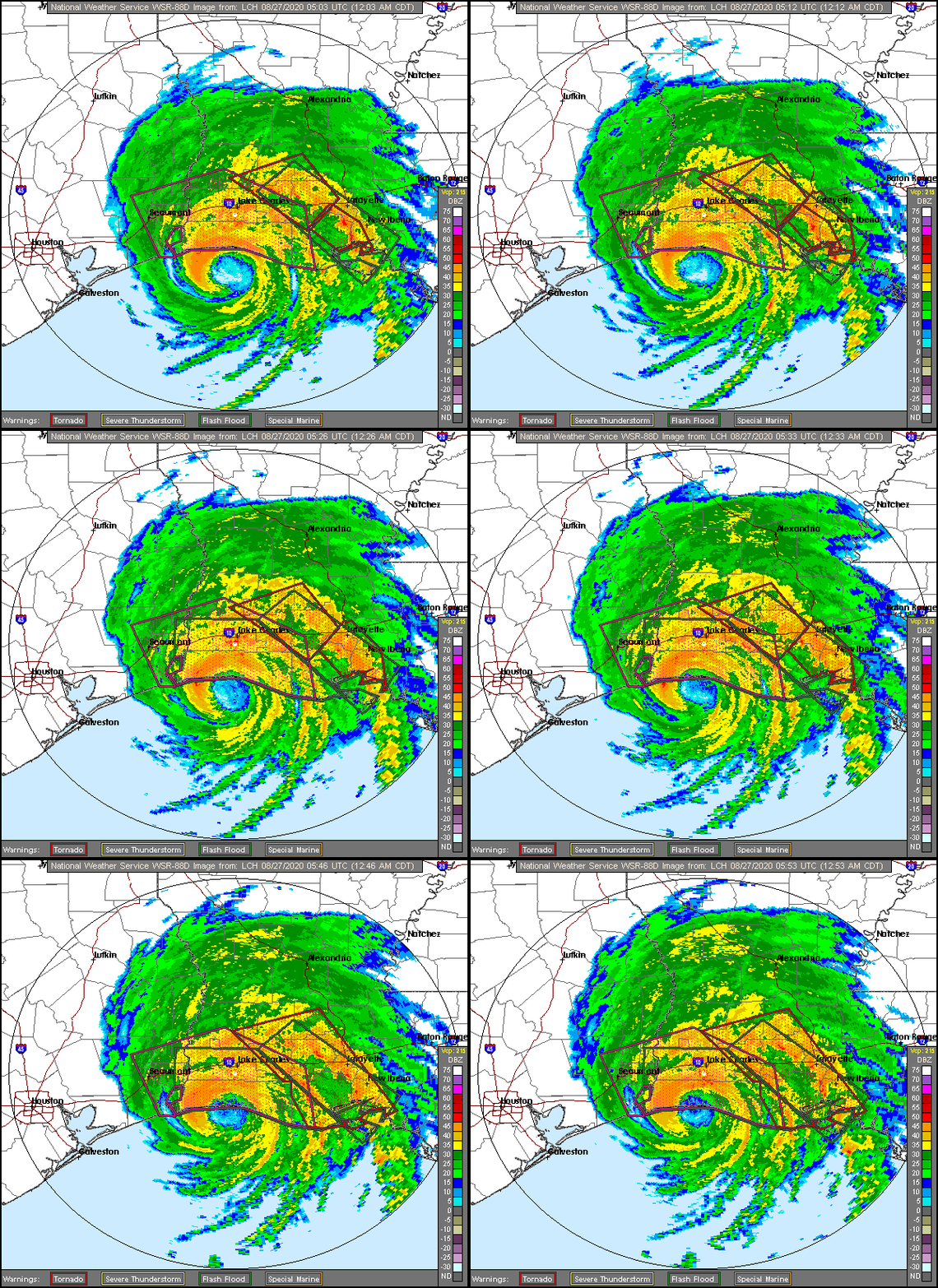
Category 4 Hurricane Laura making landfall at Cameron Parish, Louisiana, on August 27, 2020, with wind speeds of 150 mph.  Had this storm come ashore to the east at New Orleans or to the west at Houston, it would have catastrophically impacted a million people or more.  (N.O.A.A./National Weather Service image)

“After a quick stop at the camp grounds, where I slipped and fell in the shower last nite, we headed south.  Larry saw many birds en route.”

Russ took a bad fall on a slippery wet concrete floor and had bruises to show for it.  It worried me; he was 71 years old at the time.  But he was adamant about continuing on and did so with great vigor.

Just hours after a sojourn through the swampy parcels south of Vinton, we were cruising through the metropolis of Houston, Texas, then across a landscape with less cultivated cropland and more scrubland with grazing.  Here and there, but primarily to the east of Houston, blankets of roadside wildflowers painted the landscape with eye-popping color.  Lady Bird Johnson encouraged the plantings soon after she and Lyndon returned to Texas upon leaving life in the White House in 1969.  The sight of those vivid blooms was so memorable and so beautiful.  One couldn’t resist making nasty comparisons to the gobs of mowed grass and mangled trash along the highways back in Pennsylvania.

Birds along the way: Ruby-throated Hummingbird, Common Nighthawk, Black-bellied Whistling Duck, Yellow-crowned Night Heron, Great Blue, Heron, Great Egret, Black Vulture, Turkey Vulture, Red-tailed Hawk, Laughing Gull, Black Tern, Scissor-tailed Flycatcher, Cliff Swallow, Loggerhead Shrike, and Painted Bunting.  I saw my first Black-bellied Whistling Ducks (Dendrocygna autumnalis) and Golden-fronted Woodpecker (Melanerpes aurifrons) near Woodsboro, Texas, and added both to my life list.

“We stopped for the nite at an A OK camp ground 7 miles south of Kingsville.”
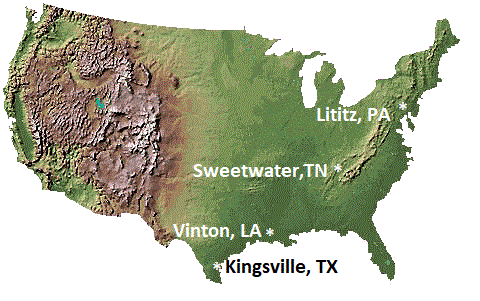
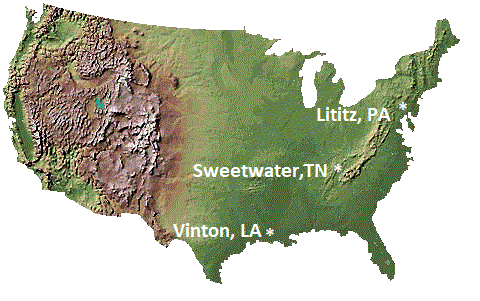
Day Three: Vinton, Louisiana, to Kingsville, Texas, a distance of 404 miles.  (United States Geological Survey base image)

Birds at the camp included two Black-bellied Whistling Ducks flying overhead, Common Nighthawk, Golden-fronted Woodpecker, Blue Grosbeak, and another “lifer”—Curve-billed Thrasher (Toxostoma curvirostre).

We also saw a Mexican Ground Squirrel (Ictidomys mexicanus), easily identified by the rows of white spots running the length of its back.

While relaxing at the campsite that evening, we watched the landscape darken and remarked how interesting it was that the glowing red sun had yet to set below the distant horizon—a land so very flat and air so hazy and humid.
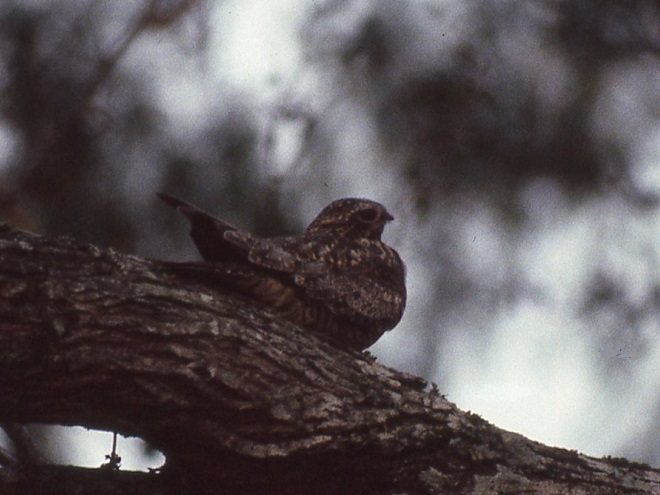
Common Nighthawk
We found this Common Nighthawk roosting on a tree limb near our campsite.  During our first few days in Louisiana and Texas, it became increasingly evident that we were in the midst of their peak northbound spring movement.  (Vintage 35 mm image)

Forty Years Ago in the Lower Rio Grande Valley: Day Two


Back in late May of 1983, four members of the Lancaster County Bird Club—Russ Markert, Harold Morrrin, Steve Santner, and your editor—embarked on an energetic trip to find, observe, and photograph birds in the Lower Rio Grande Valley of Texas.  What follows is a daily account of that two-week-long expedition.  Notes logged by Markert some four decades ago are quoted in italics.  The images are scans of 35 mm color slide photographs taken along the way by your editor.


DAY TWO—May 22, 1983

Our goal today was to continue traveling and reach western Louisiana.

“We were on our way at 6:08.  Stopped for a quick lunch in the camper and drove to Vinton, Louisiana, KOA.  Lots of hard rain through Tennessee, Georgia, and Alabama.

Day Two: Sweetwater, Tennessee, to Vinton, Louisiana, a distance of 786 miles.  (United States Geological Survey base image)

As we crossed Mississippi and entered Louisiana, we left the rain and the Appalachians behind.  Upon crossing the Mississippi River, we had arrived in the West Gulf Coastal Plain, the physiographic province that extends all the way south along the Texas coast to Mexico and includes the Lower Rio Grande Valley.  West of Baton Rouge, we began seeing waders in the picturesque Bald Cypress swamps—Great Egrets, Green Herons (Butorides virescens), Little Blue Herons (Egretta caerulea), and Glossy Ibis (Plegadis falcinellus) were identified.  A Pileated Woodpecker was observed as it flew above the roadside treetops.

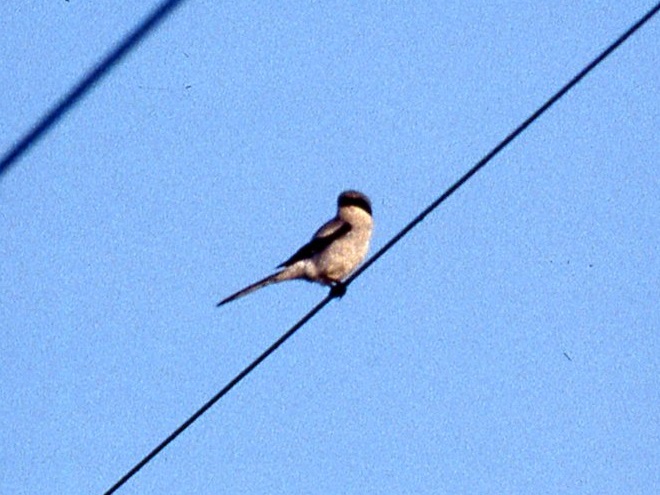
The rains we endured earlier in the trip had left there mark in much of Louisiana and Texas.  Flooding in agricultural fields was widespread and the flat landscape often appeared inundated as far as the eye could see.  Along the highway near Vinton, we spotted the first two of the many southern specialties we would find on the trip, a Loggerhead Shrike (Lanius ludovicianus) and a Scissor-tailed Flycatcher (Tyrannus forficatus), both perched on utility wires and searching for a meal.

Loggerhead Shrike
Near Vinton, Louisiana, a Loggerhead Shrike was on the lookout for either a large insect or small bird upon which it could prey.  (Vintage 35 mm image)

Forty Years Ago in the Lower Rio Grande Valley: Day One


Back in late May of 1983, four members of the Lancaster County Bird Club—Russ Markert, Harold Morrrin, Steve Santner, and your editor—embarked on an energetic trip to find, observe, and photograph birds in the Lower Rio Grande Valley of Texas.  What follows is a daily account of that two-week-long expedition.  Notes logged by Markert some four decades ago are quoted in italics.  The images are scans of 35 mm color slide photographs taken along the way by your editor.


The trip was scheduled to coincide with breeding season in order to provide a good chance of locating a number of tropical species that happen to reach the northern limit of their range along the Lower Rio Grande.  In addition, there was the possibility of seeing many northbound end-of-season spring migrants funneling through the valley as they followed the Gulf Coast on their way to nesting grounds in eastern and central sections of the United States and Canada.

DAY ONE—May 21, 1983

The trip began at Russ Markert’s home in Lititz, Pennsylvania where I slept the night before departure.  Markert’s van camper would be both our mode of transportation and accommodation for the journey.  Upon arrival in south Texas, we would pick up Harold Morrin and Steve Santner at the Brownsville Airport.  They would join us for a week before returning by air to Pennsylvania.

“Larry slept at my house last night so we could get an early start today — camper packed and read to go.  Arose at 5:30.  We alternated driving, about every two hours.  Heavy rain through Virginia and West Virginia.  Arrived at Sweetwater KOA, Tennessee, at 5:30 P.M.  The weather turned to rain.”

Day One: Lititz, Pennsylvania, to Sweetwater, Tennessee, a distance of 656 miles.  (United States Geological Survey base image)

Northern Bobwhite were among the many birds of farm and field at the Sweetwater KOA campground.  After dinner and before the rain began, I recall going for a swim in the pool, something I craved being able to do during the sweltering evenings we would experience in south Texas during the week to follow.

Photo of the Day

Baltimore Oriole
How ’bout those Baltimore Orioles, eh?  This was a banner day for them both in the trees and on the diamond.  Their migration may be peaking now, but the season shows potential for much more to follow.

What’s Flying Right Now

Here’s a quick look at just a few of the birds that have been moving northward in recent days…

Gray Catbird
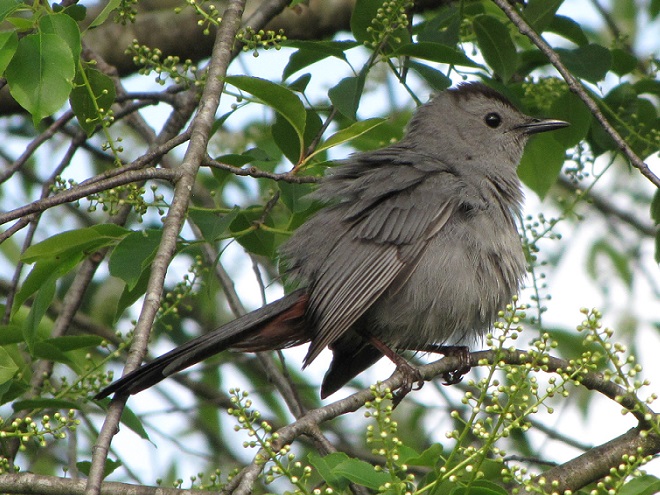
Find a thicket, a garden with plenty of shrubs, or a brushy woodland and you’ll find Gray Catbirds.  Many will stay in the Lower Susquehanna River Watershed to nest.
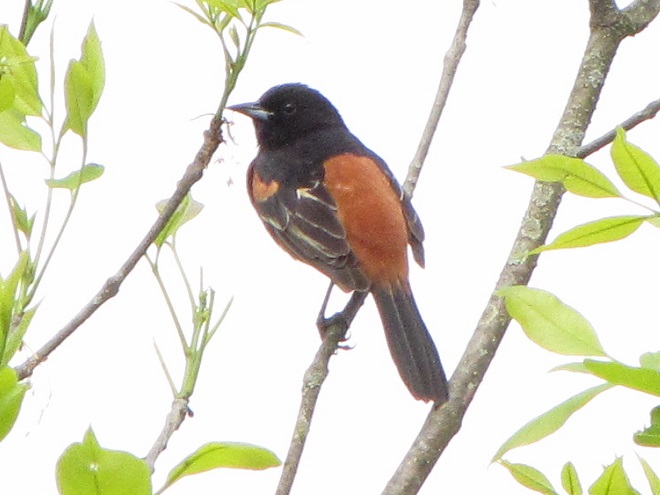
Orchard Oriole
Orchard Orioles favor old meadows with large shade trees.  Some remain to nest.
Common Yellowthroat
The Common Yellowthroat is one of the more than two dozen species of warblers found regularly during spring migration.   It nests locally in wet thickets.
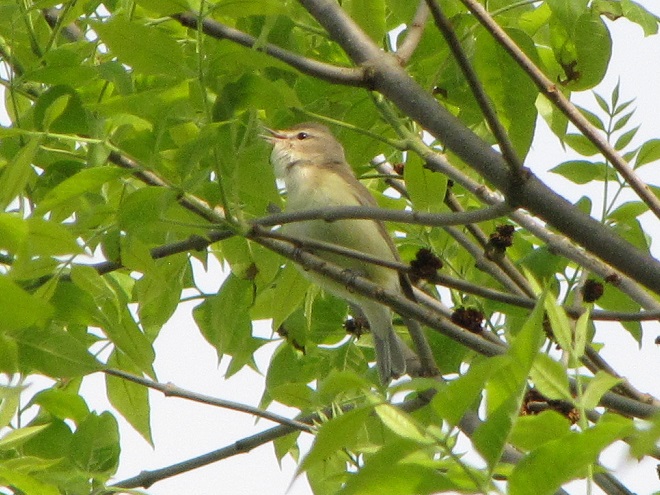
Warbling Vireo
The Warbling Vireo can be found singing among the branches of large streamside trees like this Green Ash.
Blue Jay
Unlike the preceding species which do the majority of their migrating by night, Blue Jays move north by daylight.  Keep an eye on the sky and you just might see a flock or two go by!

Stalled Migration About to Resume

For nearly a week now, a slow-moving low pressure system has not only brought heavy rain and cold temperatures to the northeastern United States, it has also stalled the northbound flights of migrating Neotropical birds.  As this weather system at last drifts offshore, birds including warblers, thrushes, vireos, flycatchers, catbirds, hummingbirds, orioles, tanagers, and others should again resume their northward movements.

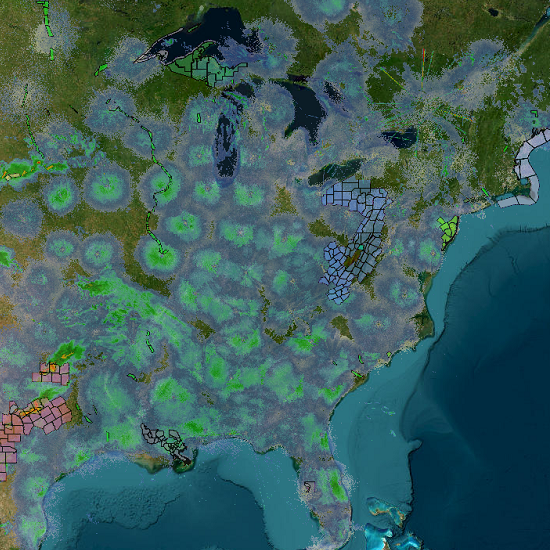
National Weather Service radar presently displays returns of these airborne nocturnal migrants in clear storm-free skies throughout the eastern half of the United States and Canada.  As the showers and clouds depart the lower Susquehanna valley and areas to the north, the birds immediately to our south will begin to fill the void.
Gray and green halos surrounding radar stations indicate nocturnal bird migration across much of the eastern United States and Canada.  Note their absence north of Maryland where the effects of the low pressure system currently located over New England are temporarily blocking these flights.  (NOAA/National Weather Service radar image)

Our advice to you…plan to spend some time outdoors this weekend looking for our colorful Neotropical visitors.  Their springtime songs should fill the warm air of forest and thicket.  You won’t want to miss it.

Photo of the Day

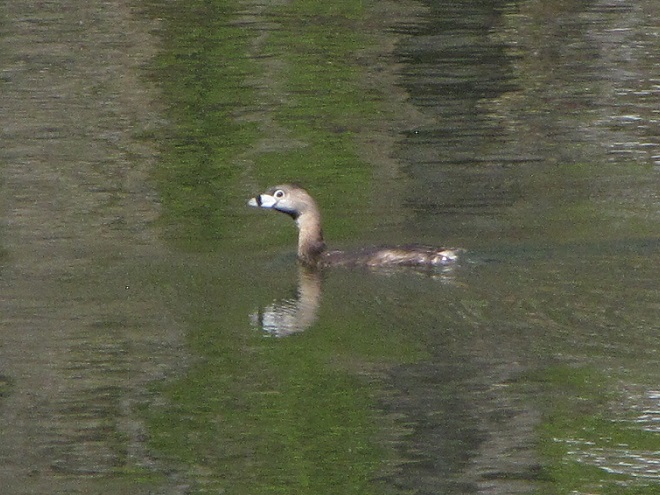
Pied-billed Grebe
The Pied-billed Grebe is an elusive visitor to local ponds and lakes during migration.  Like a submarine, it can sink out of sight to avoid detection.

Photo of the Day: It’s the Daily Double

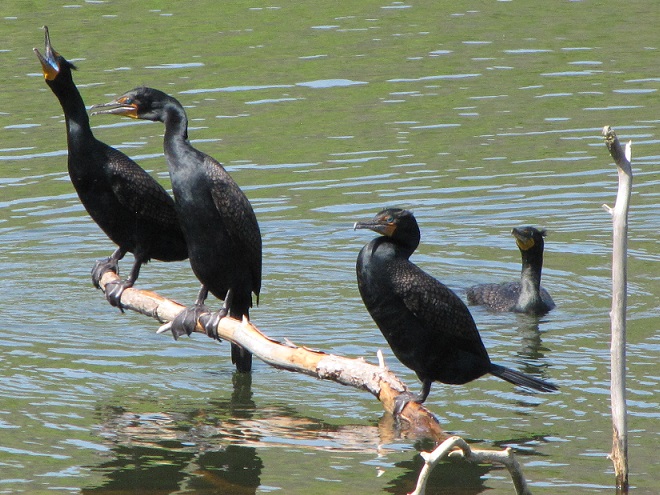
Double-crested Cormorants in breeding plumage.
In addition to the pair of small tufts of feathers on the head, Double-crested Cormorants have seldom-noticed blue eyes and mouths during the breeding season.
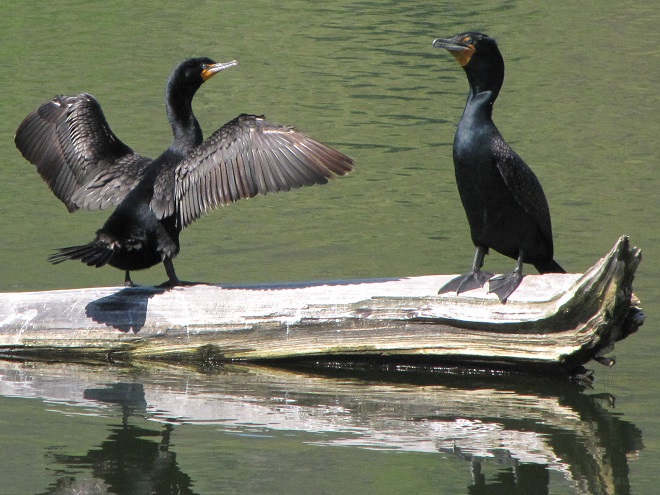
Double-crested Cormorants in breeding plumage.
After underwater forays in search of fish, they can often be seen drying their wings in the warm sunshine.

Photo of the Day

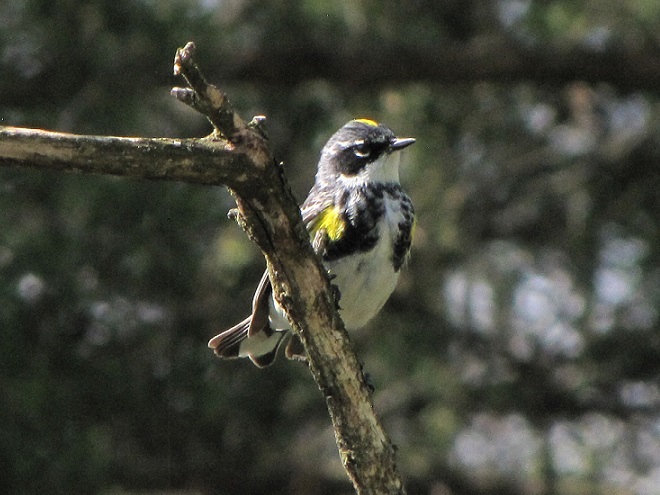
Yellow-rumped Warbler
The Yellow-rumped Warbler is a common migrant throughout the Lower Susquehanna River Watershed right now.  Look for it and other colorful species along woodland edges, particularly where conifers are intermingled among deciduous growth.

Termite Terminators

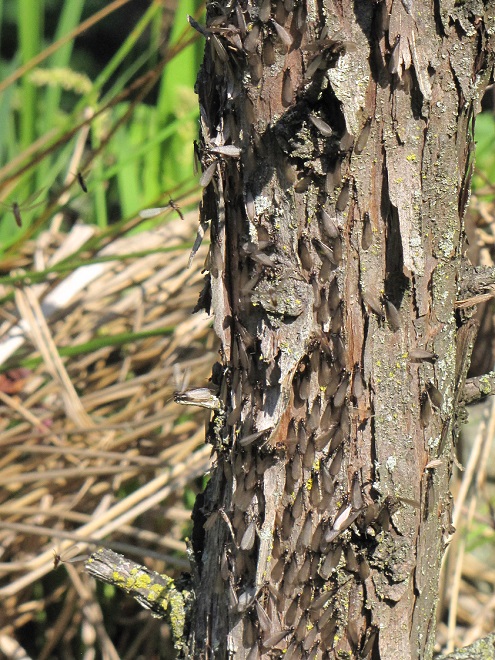
With temperatures on the rise in this morning’s bright sunshine, a flight of Eastern Subterranean Termites (Reticulitermes flavipes) streamed from the shelter of this tree snag to ascend skyward in a spreading cloud of kings and queens looking to start new colonies of wood chompers.

Eastern Subterranean Termites swarming.
A nuptial flight of Eastern Subterranean Termites taking to the wing after ascending a dead tree alongside a small pond.
As the swarm cleared the treetops, it immediately attracted the attention of some recently-arrived migratory birds…

Barn Swallows and Chimney Swifts Attack an Ant Swarm
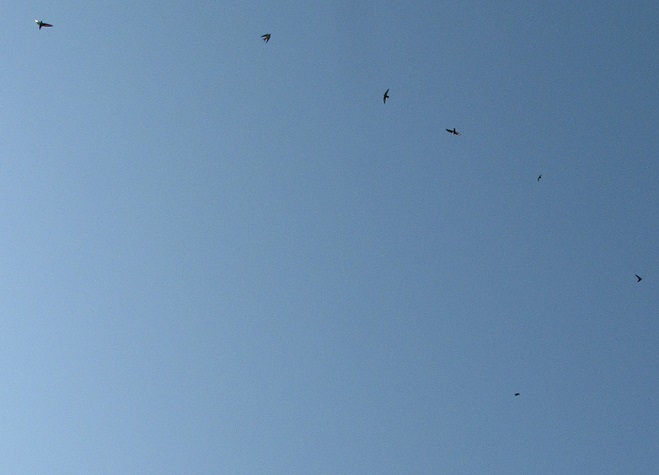
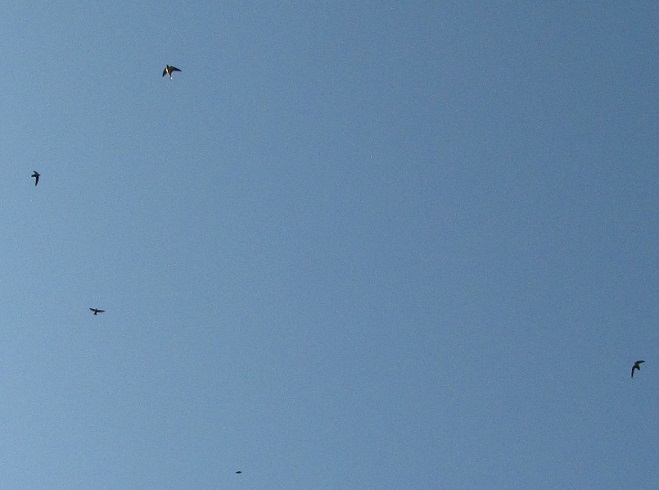
Barn Swallows and Chimney Swifts seized the opportunity to devour an easy meal…hundreds of flying termites.  Their timing was perfect.  The first Barn swallows of the season arrived here just two days ago, the first appearance of the swifts was concurrent with this morning’s swarm.
Barn Swallow and Chimney Swifts
Our squadron of predators quickly devoured the airborne insects.  The entire event was concluded in just five minutes.

Photo of the Day

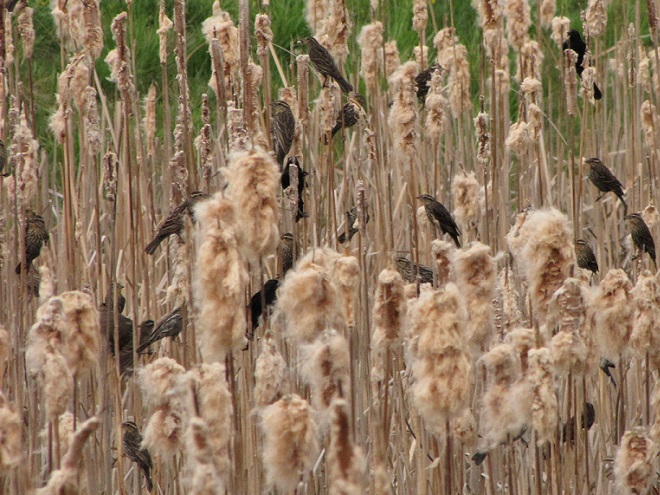
Female Red-winged Blackbirds in a cattail wetland.
This year’s unseasonably mild weather has hastened the northward migration of many birds.  Neotropical species including warblers and Broad-winged Hawks are already pushing through the lower Susquehanna region in numbers.  But it seems the spring movement may be a little bit protracted for female Red-winged Blackbirds, which are still rolling through by the hundreds despite the males being here, some of them defending nesting territories, since late February.  No sense of urgency?
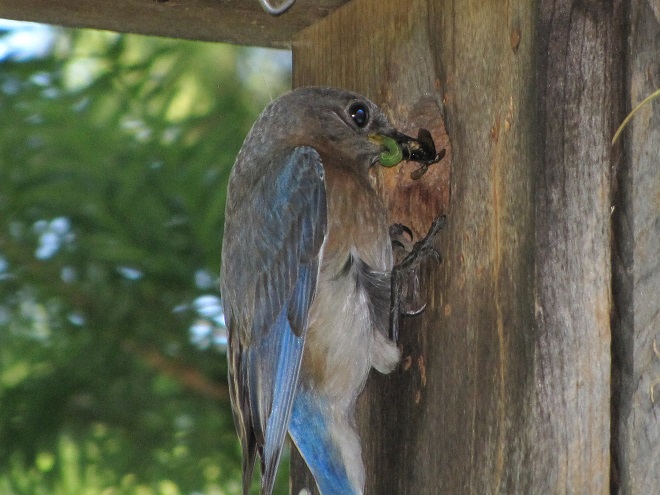
Photo of the Day

Osprey
The race north toward a favorable breeding territory is priority one for a migrating Osprey, even on a rainy day.  Then again, you may see one stop along the way to do a little fishing. That’s priority two.

Photo of the Day

A Reforestation Project
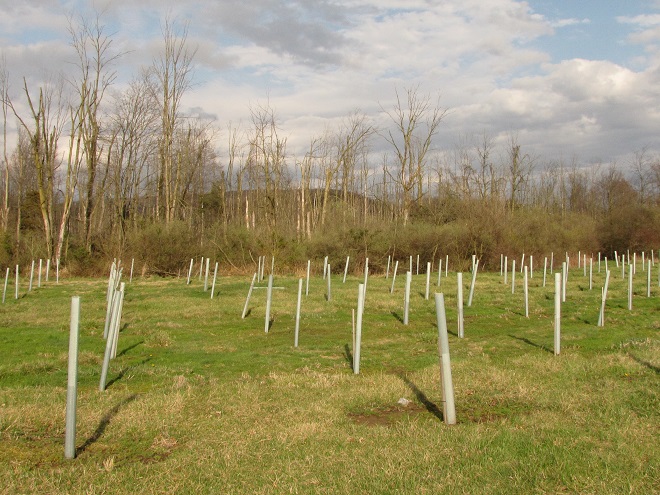
Visible in the background of this image, an infestation of invasive Emerald Ash Borer larvae has killed the trees in a woodlot composed exclusively of Green Ash.  Left standing, the dead snags provide excellent habitat for a number of animal species including cavity-nesting birds like woodpeckers, known consumers of these destructive larvae.  To reforest the mowed field in the foreground, a variety of native deciduous trees have been planted.  In areas where a diversity of trees are not present to furnish a source of seeds for natural succession, manually planting an array of seedlings provides some insurance against the risk of allowing establishment of a single pioneer species such as the vulnerable Green Ash.  The white plastic tubes on the young trees offer protection from the ever-browsing White-tailed Deity.

Photo of the Day

Wilson's Snipe
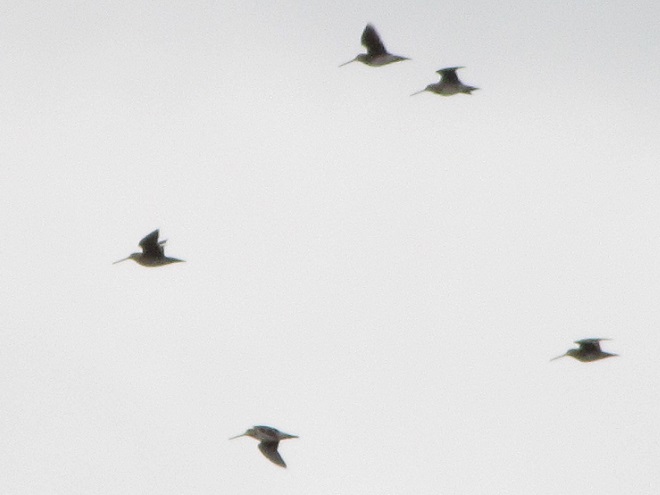
A northbound flock of migrating Wilson’s Snipe.  In coming weeks, other shorebird/sandpiper species are on the way as well.

Hidden Surprises

If you’re like us, you’re forgoing this year’s egg hunt due to the prices, and, well, because you’re a little bit too old for such a thing.

Instead, we took a closer look at some of our wildlife photographs from earlier in the week.  We’ve learned from experience that we don’t always see the finer details through the viewfinder, so it often pays to give each shot a second glance on a full-size screen.  Here are a few of our images that contained some hidden surprises.


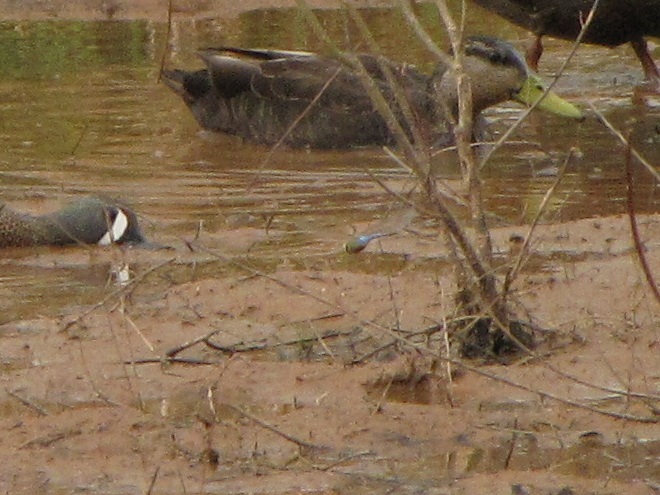
Blue-winged Teal and American Black Ducks
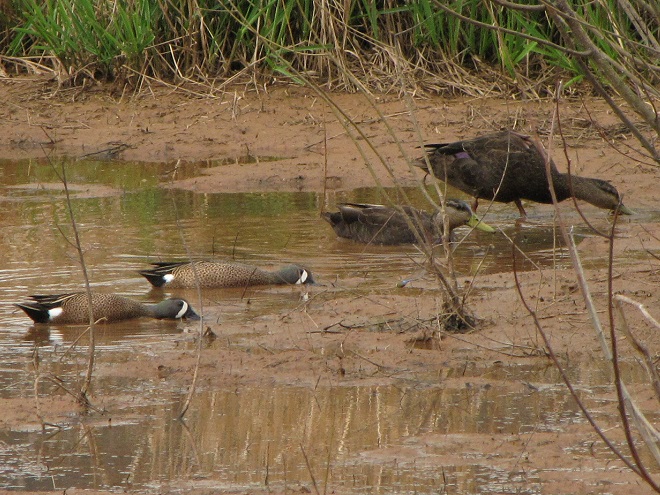
We photographed these Blue-winged Teal and American Black Ducks as they were feeding in a meadow wetland…

..but upon closer inspection we located…

Common Green Darner
…a Common Green Darner patrolling for mosquitoes and other prey.  The Common Green Darner is a migratory species of dragonfly.  After mating, they deposit their eggs in wetland pools, ponds, and slow-moving streams.

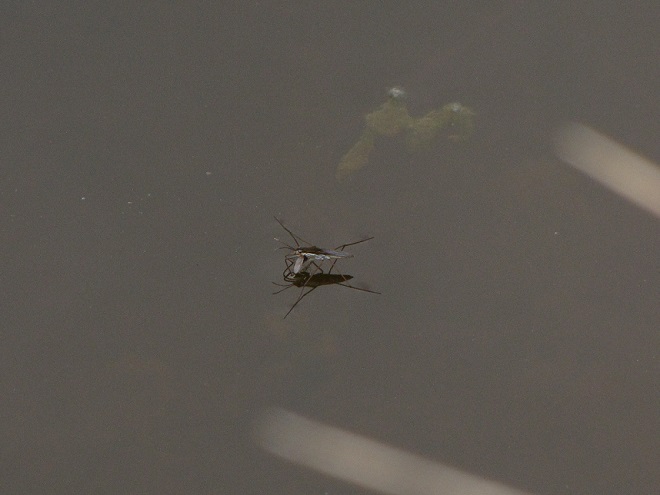
Water Strider
We photographed this Water Strider as it was “walking” across a pool in a small stream that meanders through a marshy meadow…

..but after zooming in a little closer we found…

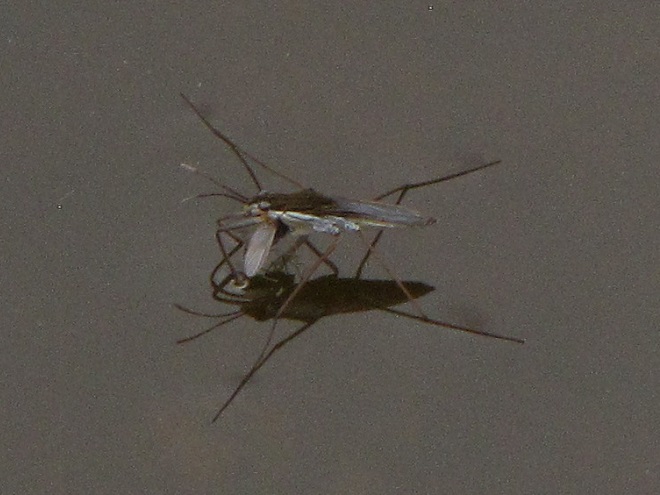
Water Strider with a Mosquito
…a mosquito coming to deposit its eggs had been seized as a mid-day meal.   Look at how the legs of the Water Strider use the surface tension of the pool to allow it to “walk on water”, even while clutching and subduing its prey.

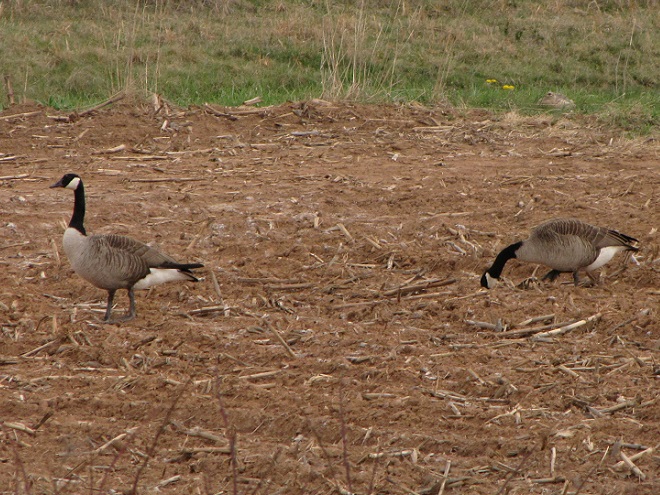
Canada Geese
We photographed these resident Canada Geese in a small plowed cornfield in an area managed mostly as a mix of cool-season and warm-season grassland…

..but then, following further examination, we discovered…

Ring-necked Pheasant
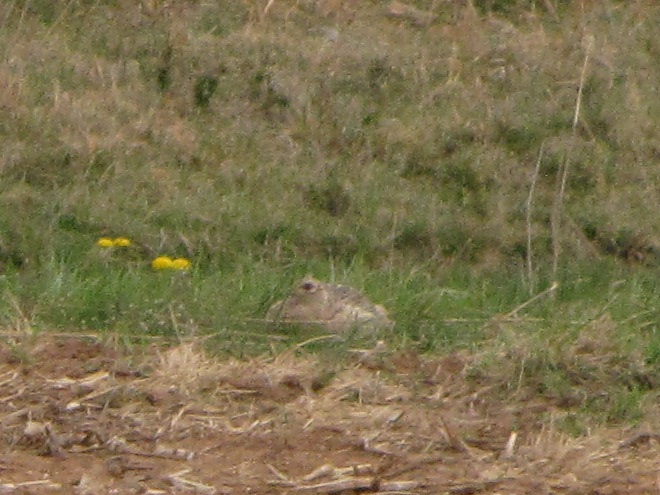
…a hen Ring-necked Pheasant on a nest.

THE BAD EGG

Red-winged Blackbirds
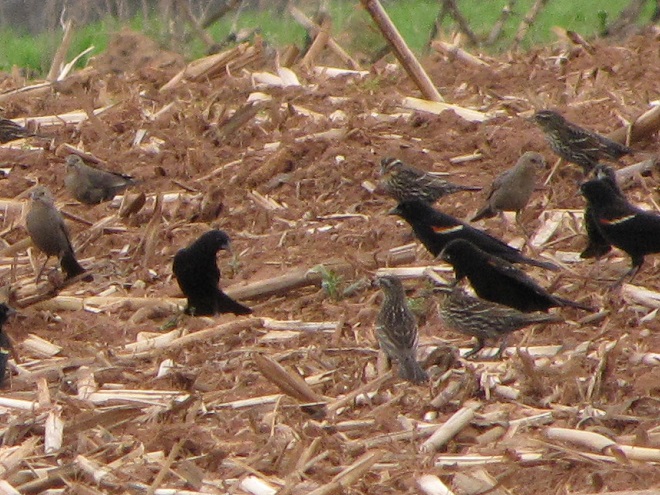
We photographed this small group of migrating Red-winged Blackbirds while it was feeding among corn stubble in a plowed field…

…but a careful search of the flock revealed…

Brown-headed Cowbirds and Red-winged Blackbirds
…three female Brown-headed Cowbirds among them (the unstreaked brown birds, two to the far left and one among the “red-wings” to the right).  Cowbirds practice nest parasitism as a means of putting their young up for adoption.  Red-winged Blackbirds and numerous other species are the unknowing victims.  The female cowbird discreetly deposits her egg(s) in the adopting party’s nest and abandons it.  The cowbird egg and the hatchling that follows is cared for by the victim species, often at the expense of their own young.

Photo of the Day

Painted Turtle
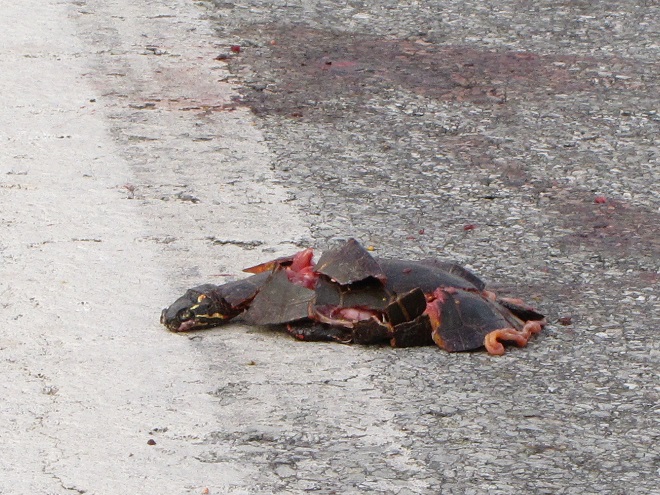
How about slowing down for a change?  Some of us have no choice but to be out along the highways this weekend and frankly, we don’t have very much sympathy for the urgency of your “journey”.  And while you’re at it, hang up the phone, you can “twitface” your B.F.F. later.

Purple Haze Across the Fields

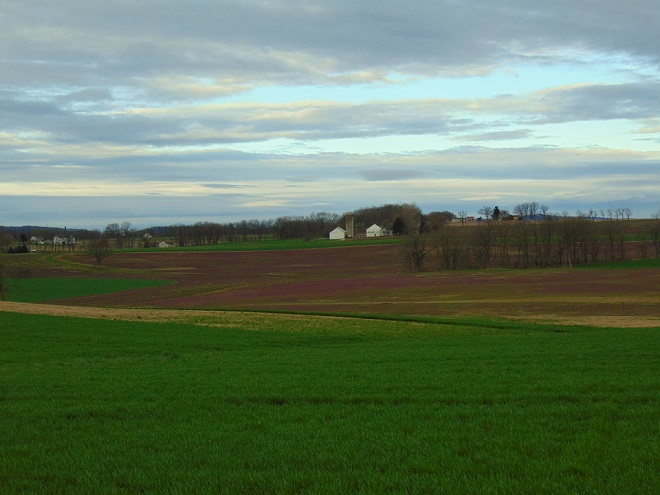
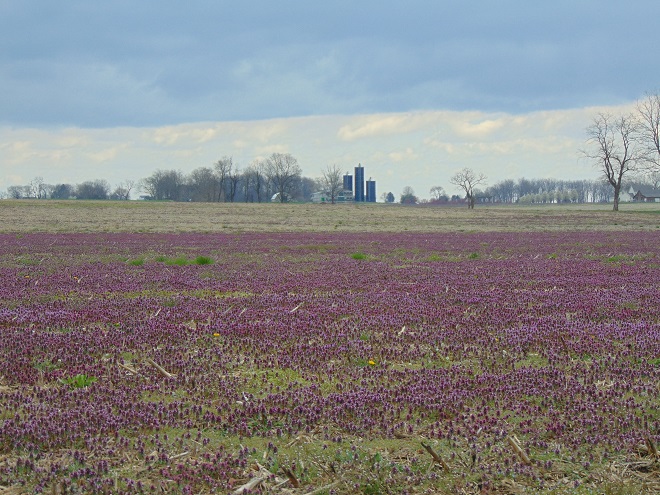
Have you noticed a purple haze across the fields right now?  If so, you may have wondered, “What kind of flowers are they?”

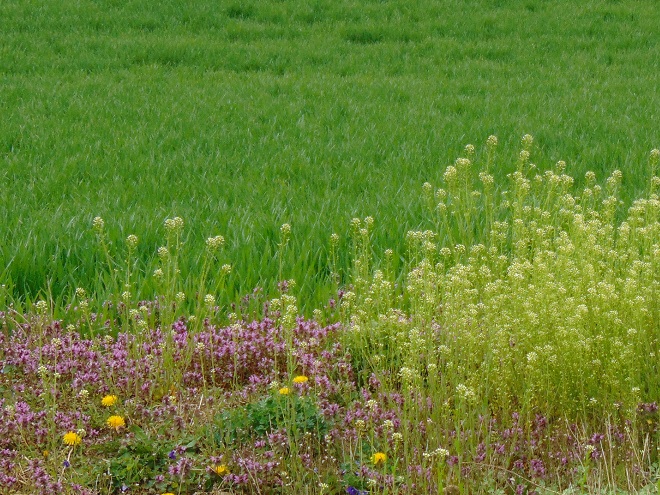
A purple haze of color stretches across fields not already green with cold-season crops like winter wheat.

Say hello to Purple Dead Nettle (Lamium purpureum), a non-native invasive species that has increased its prevalence in recent years by finding an improved niche in no-till cropland.  Purple Dead Nettle, also known as Red Dead Nettle, is native to Asia and Europe.  It has been a familiar early spring “weed” in gardens, along roadsides, and in other disturbed ground for decades.

Purple Dead Nettle owes its new-found success to the timing of its compressed growing season.  Its tiny seeds germinate during the fall and winter, after crops have been harvested and herbicide application has ended for the season.  The plants flower early in the spring and are thus particularly attractive to Honey Bees and other pollinators looking for a source of energy-rich nectar as they ramp up activity after winter lock down.  In many cases, Purple Dead Nettle has already completed its flowering cycle and produced seeds before there is any activity in the field to prepare for planting the summer crop.  The seeds spend the warmer months in dormancy, avoiding the hazards of modern cultivation that expel most other species of native and non-native plants from the agricultural landscape.

Purple Dead Nettle in Bloom
Flowering Purple Dead Nettle as a volunteer cover crop among last year’s corn stubble in a no-till field.
Purple Dead Nettle
Like the flowers of orchids, Purple Hedge Nettle blossoms are described as yoke shaped or bilateral (zygomorphic).  Psychedelic experiences are produced only through observation, not by ingestion.  A member of the mint family, its edible young leaves and tops have nutritional value, making a unique addition to salads and soups.
Purple Dead Nettle, Common Dandelion, and Shepherd's Purse
We call them “weeds”, but what do we know?  Purple Dead Nettle, Common Dandelion, and Shepherd’s Purse (Capsella bursa-pastoris), three edible non-native invasive species with similar life cycles seen here flowering along a rural road among fields where intensive farming is practiced.  Shepard’s Purse, like many members of the mustard family, is already producing seeds at the bottom of the flower cluster by the time the uppermost buds open for business.
Spraying Herbicide
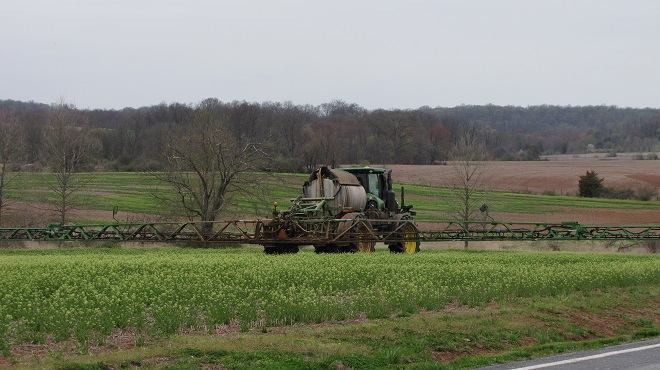
In preparation for seeding of a warm-season crop,  herbicide is applied on a no-till field to kill Shepherd’s Purse and other cool-season plants.  To help prevent sediment and nutrient discharge from lands where high-intensity agriculture is practiced, no-till methods are used to reduce runoff from the areas of bare soil that would otherwise be created by traditional plowing.

While modern farming has eliminated a majority of native plant and animal species from agricultural lands of the lower Susquehanna valley, its crop management practices have simultaneously invited vigorous invasion by a select few non-native species.   High-intensity farming devotes its acreage to providing food for a growing population of people—not to providing wildlife habitat.  That’s why it’s so important to minimize our impact on non-farm lands throughout the remainder of the watershed.  If we continue subdividing, paving, and mowing more and more space, we’ll eventually be living in a polluted semi-arid landscape populated by little else but non-native invasive plants and animals.  We can certainly do better than that.

Photo of the Day

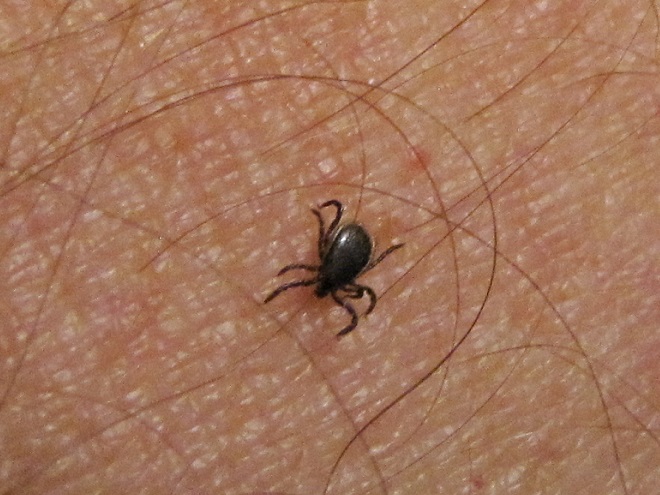
A male Deer Tick
It’s so tiny, you can’t even feel it crawling on your skin.  It’s the Deer Tick (Ixodes scapularis), also known as the Black-legged Tick, and it’s already looking for someone to latch on to.   Don’t let it be you.  After your foray outdoors, be certain to shower and conduct a full body search for these little hitchhikers.  Then, remember to launder the clothing you were wearing.  Deer Ticks in the Lower Susquehanna River Watershed frequently transmit Borrelia burgdorferi, the bacteria that causes Lyme disease, and can be vectors of other microbiological pathogens as well.  The specimen in this photograph is an adult male.  Adult females are similar, but the edge of the abdomen has a crescent-shaped reddish border.  The nymphal stage tick, which is half the size of an adult, is even more likely to infect humans with the Lyme disease bacteria, so be extra vigilant. 

Underwater View of Life in a Vernal Pool

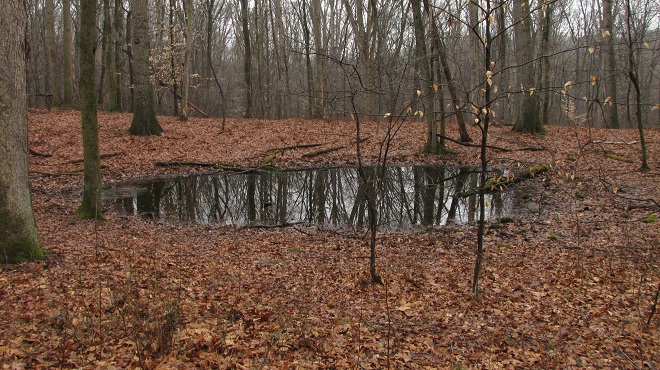
It may look like just a puddle in the woods, but this is a very specialized wetland habitat, a habitat that is quickly disappearing from the Lower Susquehanna River Watershed.  It’s a vernal pool—also known as a vernal pond or an ephemeral (lasting a short time) pool or pond.

Viable vernal pools have several traits in common…

      • They contain water in the spring (hence the name vernal).
      • They have no permanent inflow or outflow of water.
      • They typically dry up during part of the year—usually in late summer.
      • They are fish-free.
      • They provide breeding habitat for certain indicator species of forest-dwelling amphibians and other animals.
      • They are surrounded by forest habitat that supports the amphibians and other vernal pool species during the terrestrial portion of their life cycle.

To have a closer look at what is presently living in this “black leaf” vernal pool, we’re calling on the crew of the S. S. Haldeman to go down under and investigate.

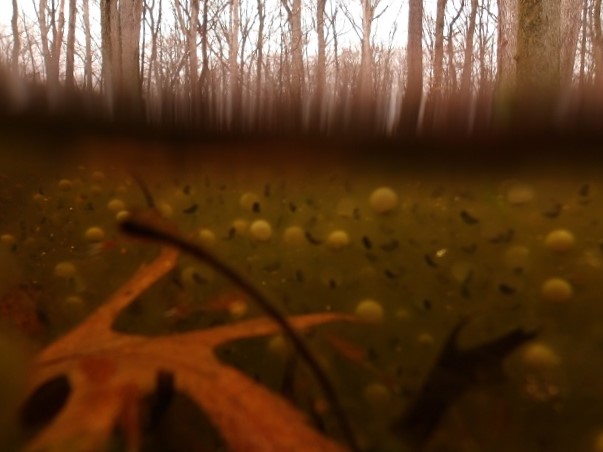
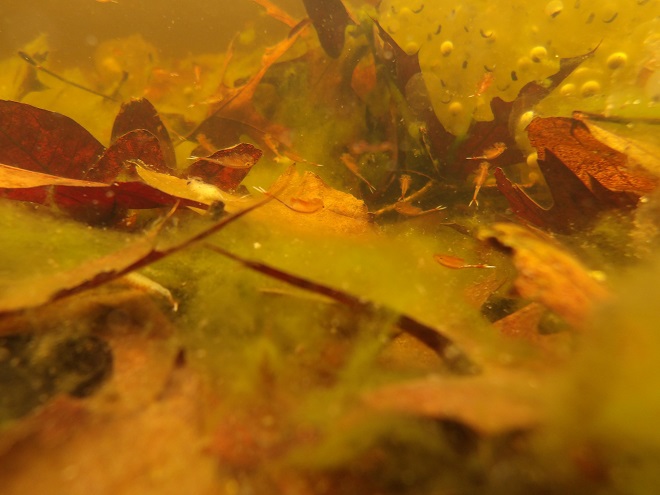
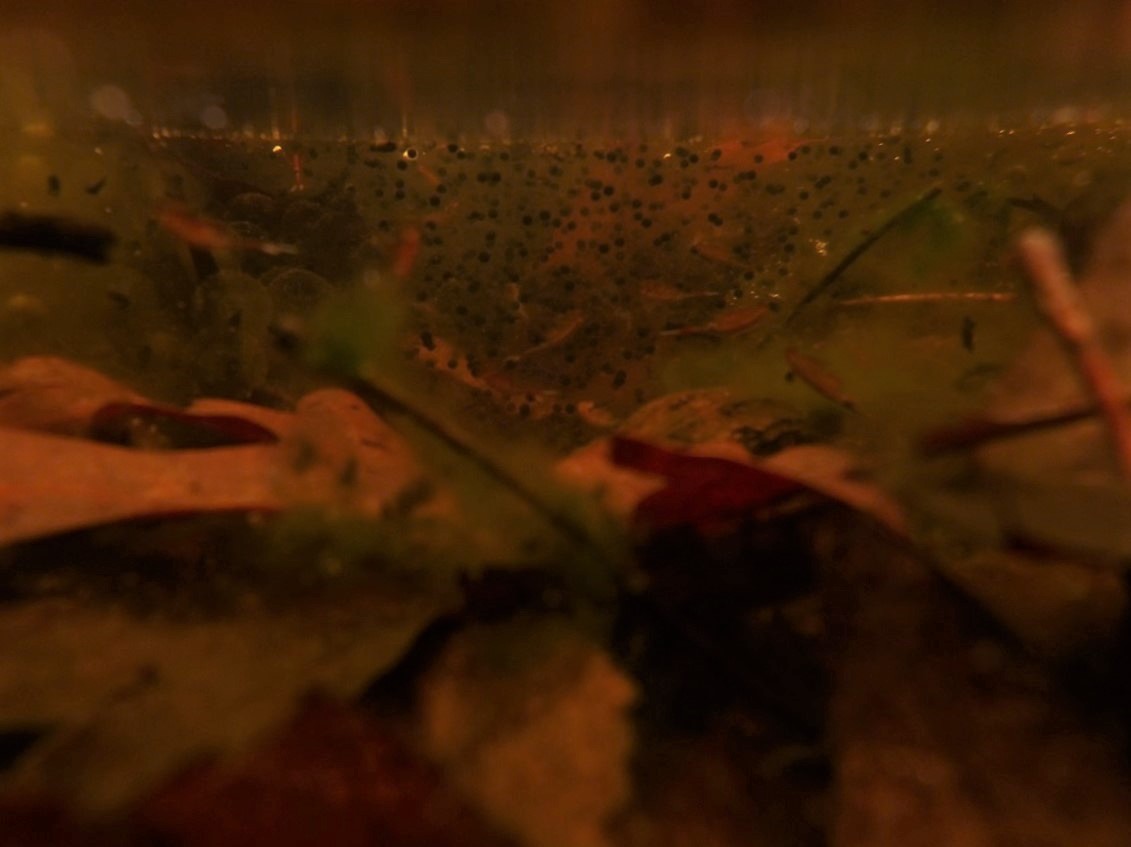
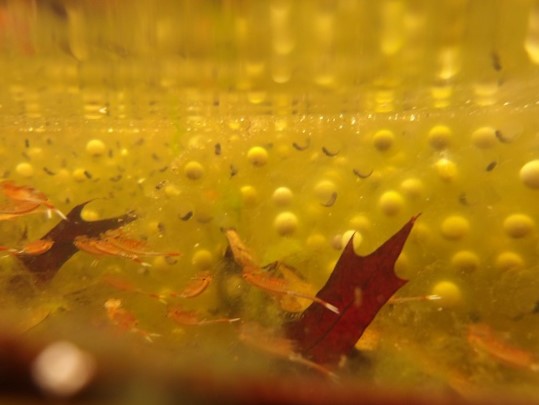
Along the surface of the pool we’re seeing clusters of amphibian eggs, a sign that this pond has been visited by breeding adult frogs and/or salamanders during recent weeks.
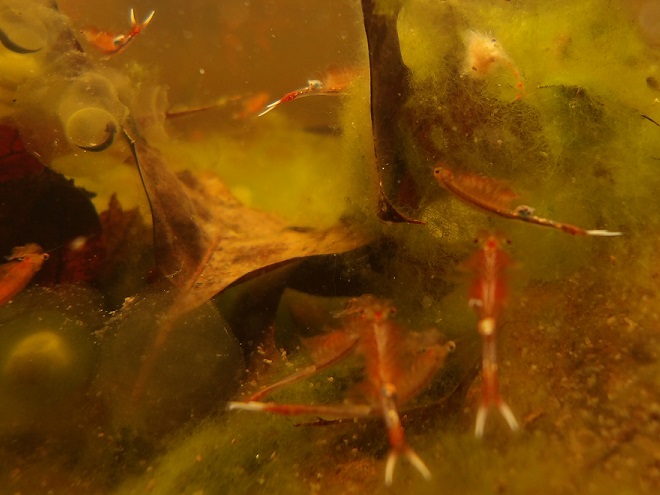
Amphibian eggs and the white tail filaments of an invertebrate of interest, Springtime Fairy Shrimp (Eubranchipus vernalis), an endemic of vernal ponds.

Let’s take it down for a better look.  Dive, all dive!

Algae provides food for the shrimp and other inhabitants of the pool.  Leaf litter furnishes hiding places for the pool’s many inhabitants.
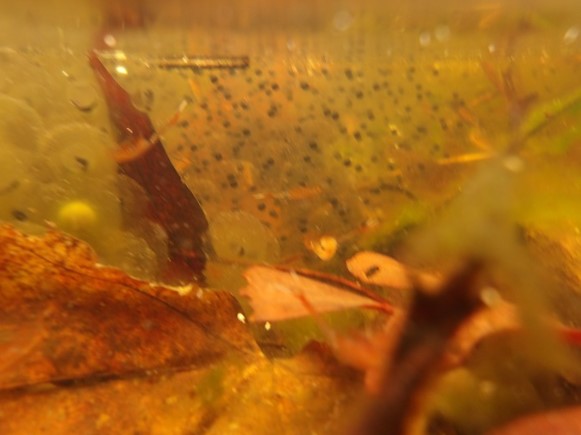
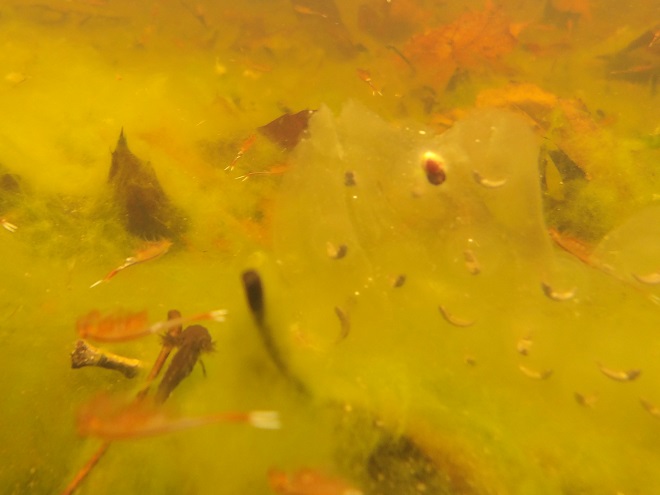
These loose clusters of eggs appears to be those of Wood Frogs, a vernal pool indicator species.
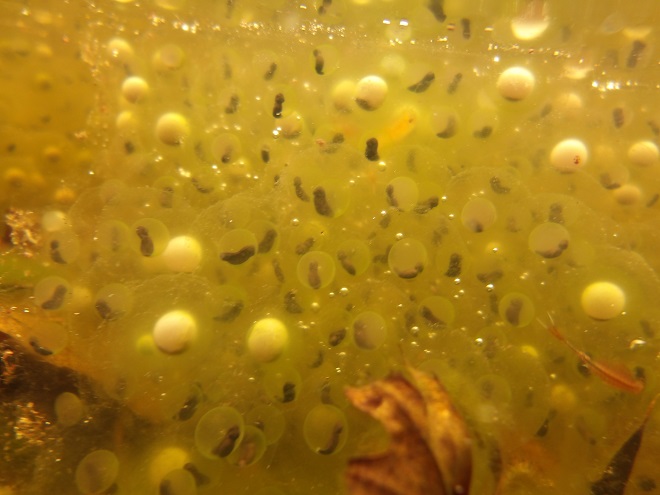
Clusters of Wood Frog eggs, the embryos within those in the center of the image less developed than those to the left.
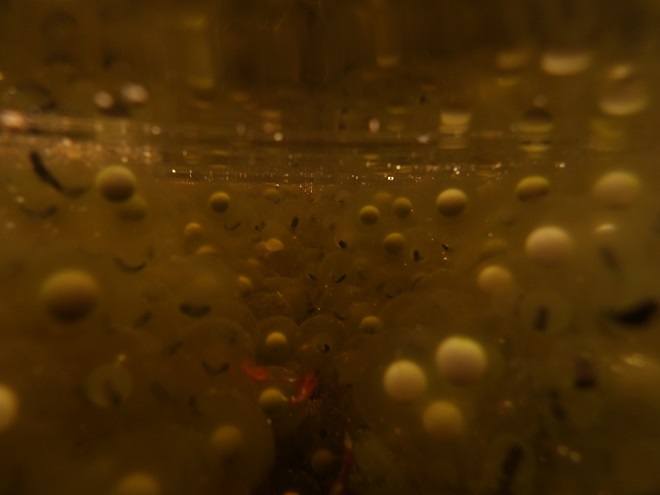
More Wood Frog eggs.  Hatching can take anywhere from two weeks to two months, depending on temperature.
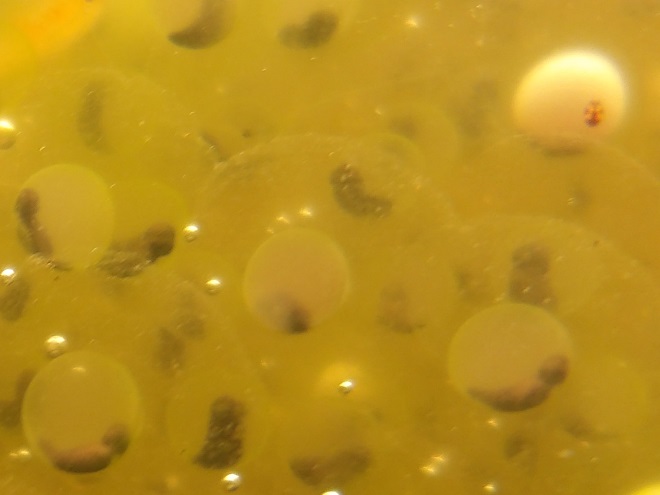
Wood Frog eggs with developing larvae (tadpoles) plainly visible.  The green color of the eggs is created by a symbiotic algae, Oophila amblystomatis, a species unique to vernal pools.  The algae utilizes the waste produced by the developing embryos to fuel its growth and in return releases oxygen into the water during photosynthesis.  Upon hatching, the tadpoles rely upon the algae as one of their principle food sources.
A zoomed-in view showing development of the larvae and what appears to be a tiny invertebrate clinging on the white egg in the upper right.  White eggs don’t hatch and may be infected by a fungus.
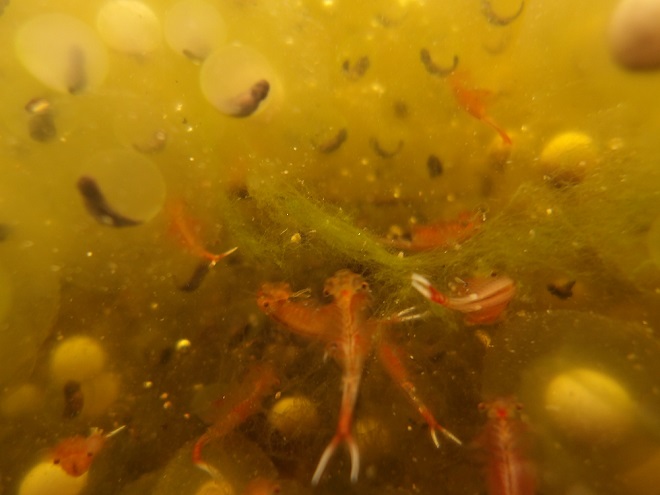
Wood Frog eggs and Springtime Fairy Shrimp.
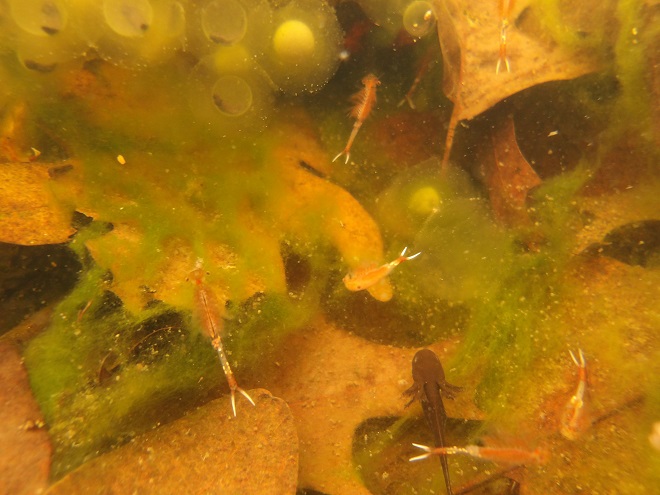
Springtime Fairy Shrimp swim upside-down.  Note the small, bluish clusters of eggs attached to the abdomens of these females.  Springtime Fairy Shrimp live their entire lives in the vernal pool.  After being deposited in the debris at the bottom of the pool, the eggs will dry out during the summer, then freeze and re-hydrate before hatching during the late winter.
A damselfly larva consuming fairy shrimp.  (Visible in the margin between the uppermost lobes of the dark-colored oak leaf to the right.)
Getting in close we see A) the damselfly larva eating a Springtime Fairy Shrimp and B) one of several discarded exoskeletons of consumed shrimp near this predator.
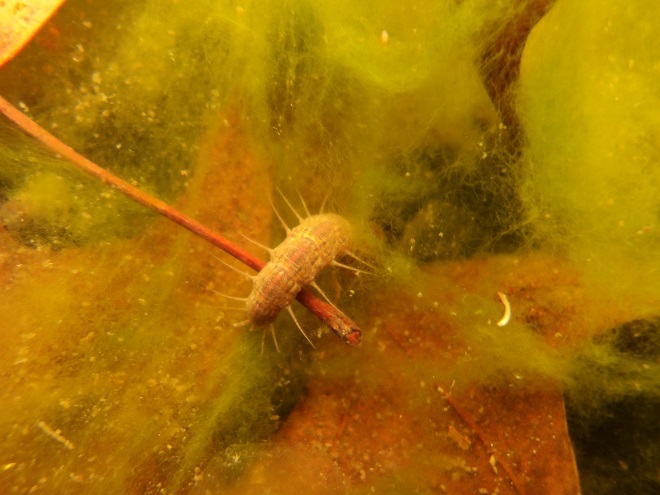
A fishfly larva (Chauliodinae).  Mosquito numbers are kept in check by the abundance of predators in these pools.
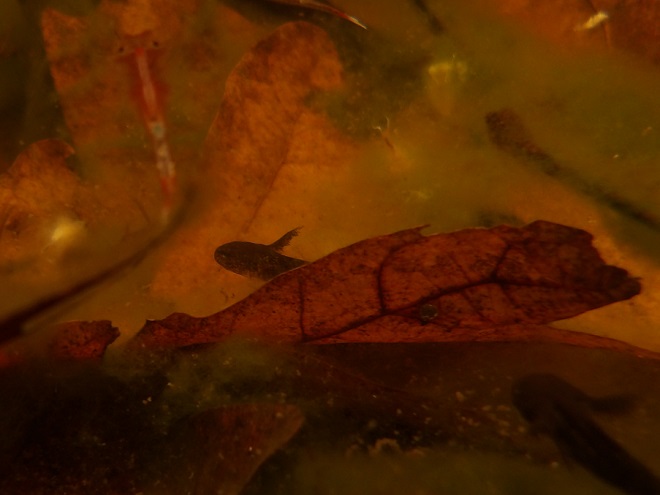
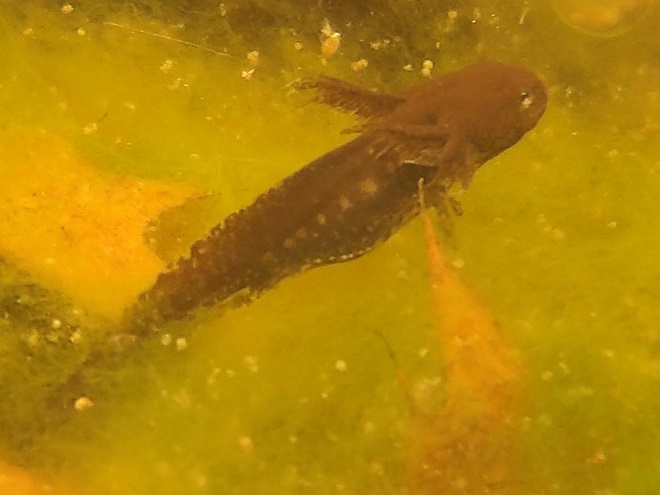
Springtime Fairy Shrimp and a Marbled Salamander (Ambystoma opacum) larva.  The presence of these species confirms this small body of water is a fully-functioning vernal pool.
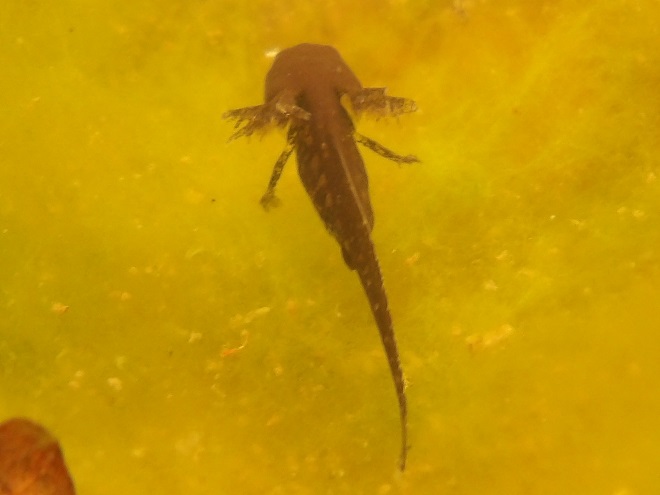
Springtime Fairy Shrimp and two more larval Marbled Salamanders.  The salamanders’ enlarged gills are necessary to extract sufficient oxygen from the still waters of the pool.
The Marbled Salamander is one of three species of mole salamanders found in the Lower Susquehanna River Watershed.  All breed in vernal pools and live their air-breathing adult lives under the leaves of the forest in subterranean tunnels where they feed on worms and other invertebrates.  Photos of an adult Marbled Salamander and the other two species, Spotted Salamander (Ambystoma maculatum) and Jefferson Salamander (Ambystoma jeffersonianum), can be found by clicking the “Amphibians” tab at the top of this page.
Marbled Salamanders lay their eggs during the fall.  If the bed of the pool is dry at breeding time, the adult female will remain to guard the eggs until rain floods the pool.  The eggs hatch upon inundation, sometimes during the winter.
Marbled Salamanders, like all amphibians that develop in vernal pools, must complete transformation into their air-breathing terrestrial life stage before the pool dries up in the summer heat.
A larval Marbled Salamander explores the bottom of the pool.
A larval Marbled Salamander, Wood Frog eggs, and Springtime Fairy Shrimp, it’s an abundance of life in what at first glance may appear to be just a mud puddle.

We hope you enjoyed this quick look at life in a vernal pool.  While the crew of the S. S. Haldeman decontaminates the vessel (we always scrub and disinfect the ship before moving between bodies of water) and prepares for its next voyage, you can learn more about vernal pools and the forest ecosystems of which they are such a vital component.  Be sure to check out…

If you are a landowner or a land manager, you can find materials specifically providing guidance for protecting, restoring, and re-establishing vernal pool habitats at…

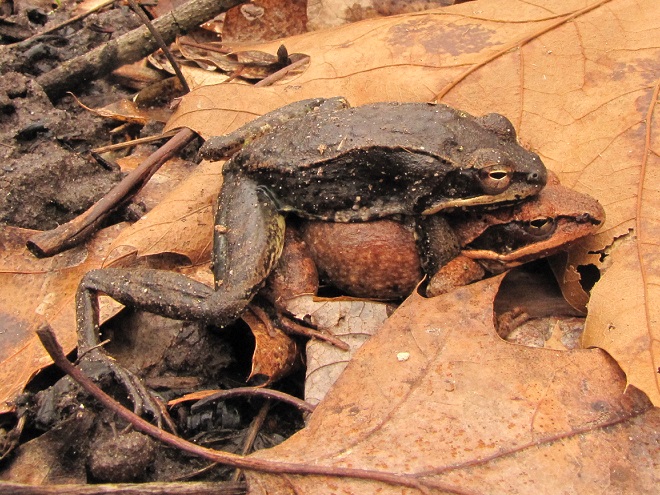
Wood Frogs mating
Wasted Effort-A pair of Wood Frogs mating in a dried-up vernal pool.

Photo of the Day

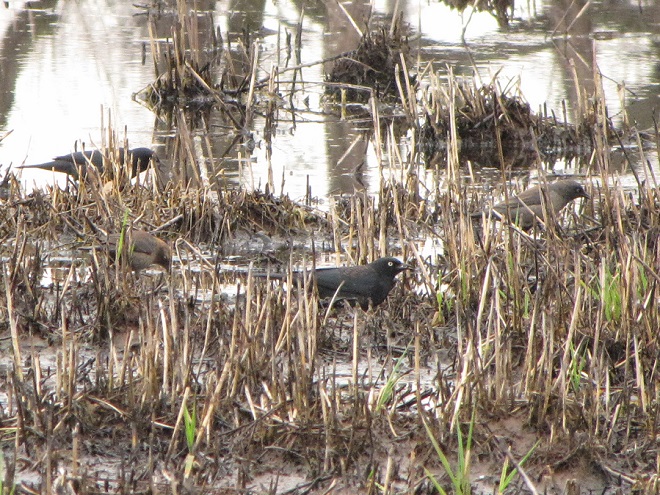
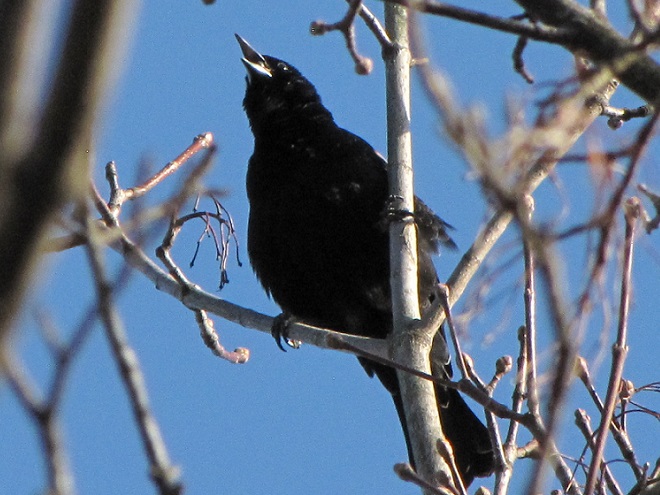
Rusty Blackbirds
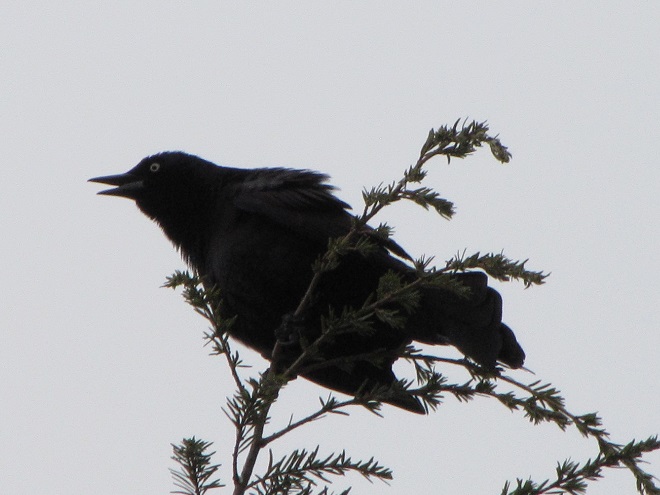
Though uncommon, Rusty Blackbirds are regular spring migrants from late March into early May each year.  As they make their way north through the Lower Susquehanna River Watershed, floodplain wetlands are their favored habitat.  Rusty Blackbirds get their common name not only from the color of their winter plumage, but from their call note as well.  It closely resembles the squeaky sound made by a rusty gate hinge. 

Photo of the Day

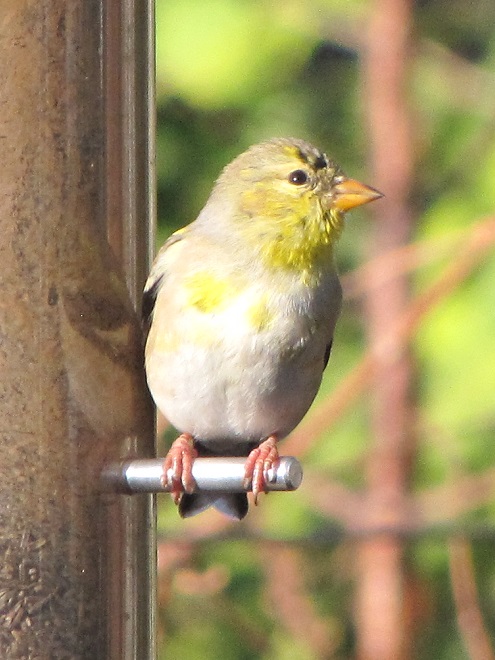
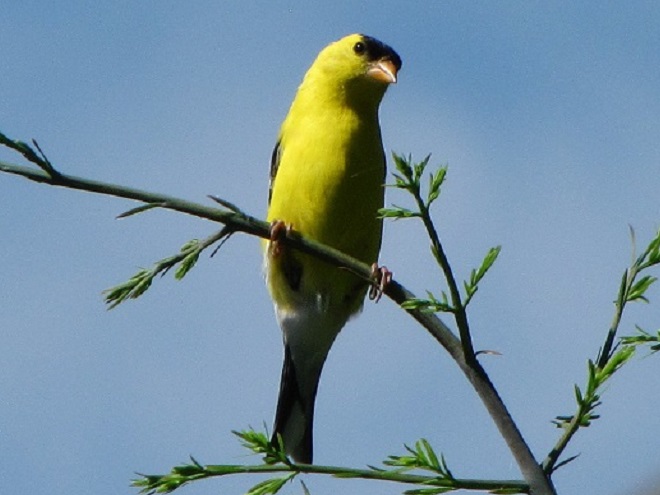
American Goldfinch
‘Tis the first day of spring and this male American Goldfinch is beginning the molt from its drab winter garb into the spectacular feathers of its breeding plumage.

Off To The Races

Trying to get a favorable place to nest before others arrive, the “early birds” are presently racing north through the lower Susquehanna valley.  Check out these sightings from earlier today…

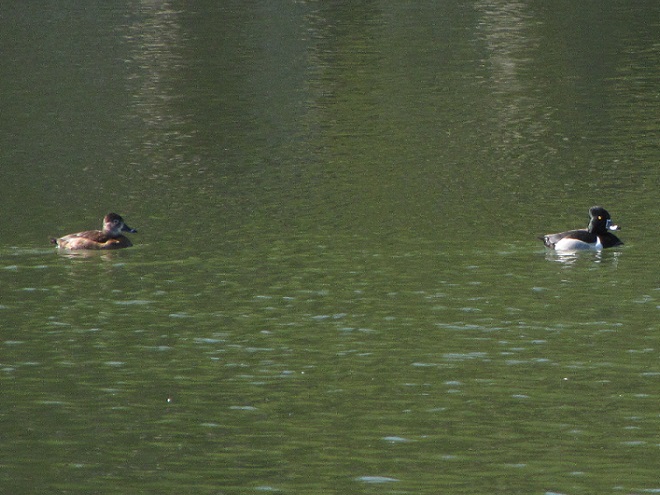
Ring-necked Ducks
A pair of Ring-necked Ducks.
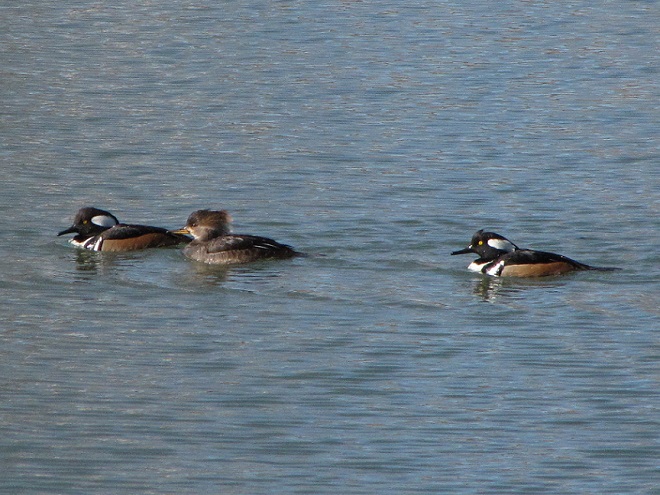
Hooded Mergansers
Hooded Mergansers, two males and a female.
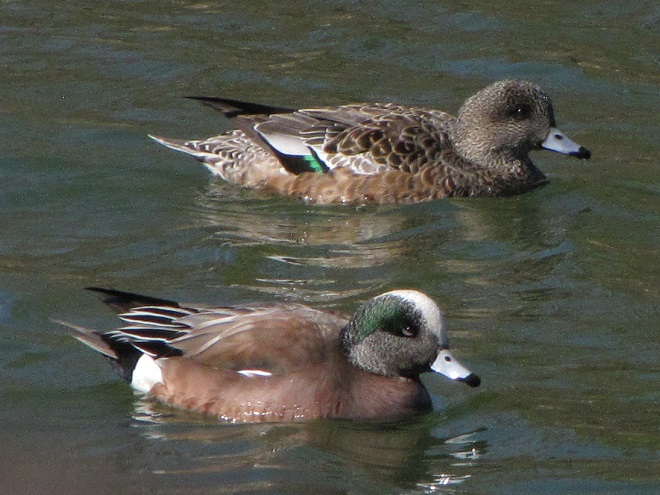
American Wigeons
A pair of American Wigeons.
A male Canvasback.
A male Canvasback.
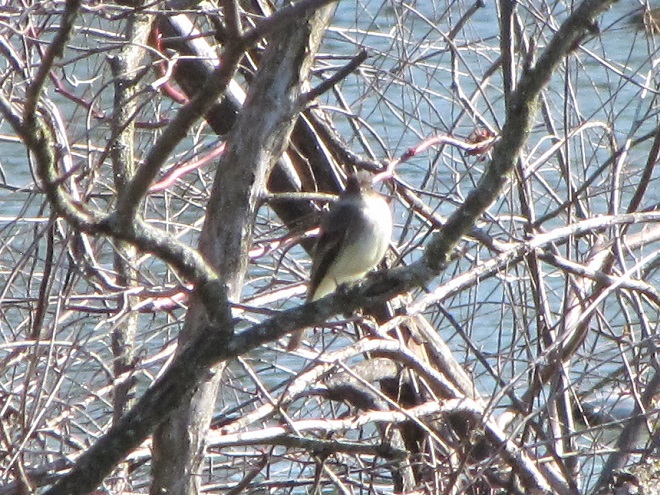
Eastern Phoebe
During these chilly days of late winter, this hardy Eastern Phoebe finds sustenance by seizing flying insects along the water’s edge.
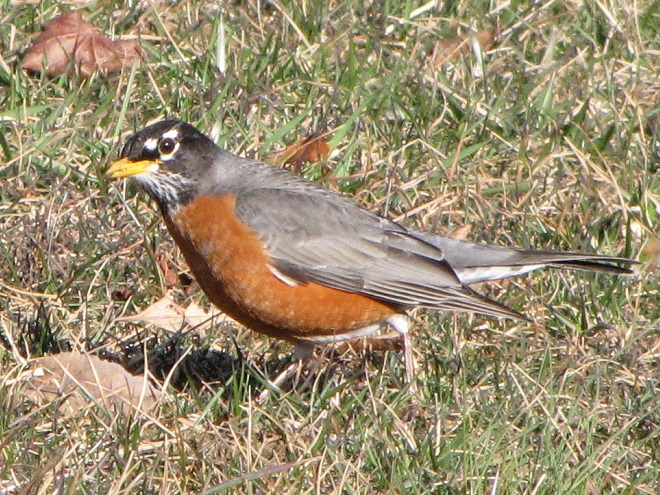
An American Robin in classic worm-hunting posture.
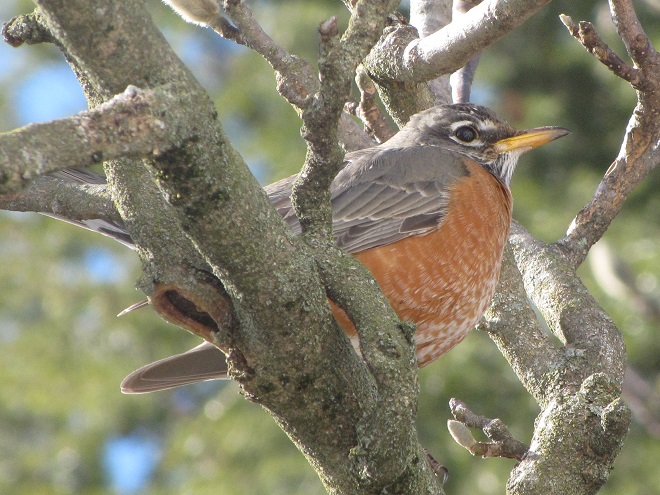
Possibly our most familiar sign of spring, an American Robin in classic worm-hunting posture.
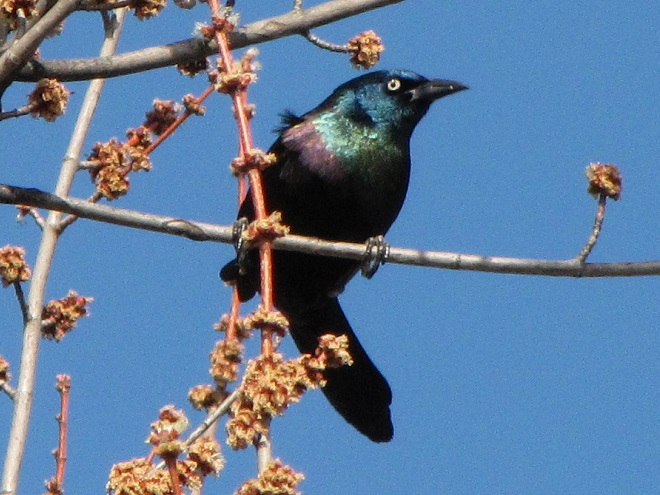
A Common Grackle in a maple tree that is starting to flower.
An iridescent Common Grackle in a maple tree that is beginning to flower.
A male Red-winged Blackbird singing near a small patch of cattails.
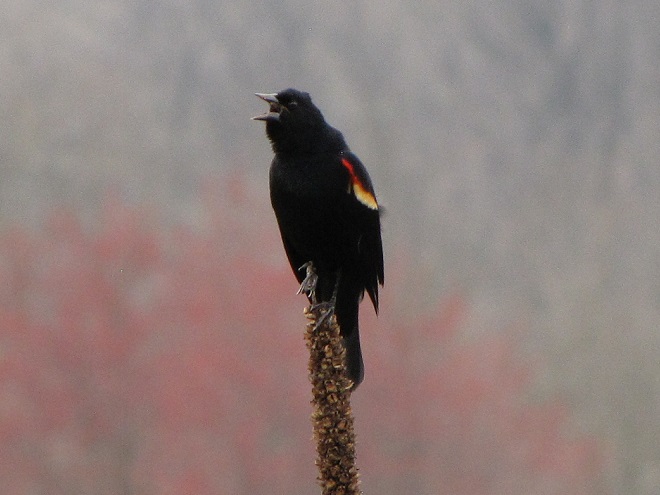
A male Red-winged Blackbird singing from a perch near a small patch of cattails.  During the spring migration, noisy flocks of males compete for a breeding territory at these sites.  Each of the victors defends his spot and awaits the arrival of a female mate while the losers move on to vie for their own breeding location farther north.

Time to get outside and have a look.  The spectacle of spring migration passes quickly.  You don’t want to miss it!

Plantings for Wet Lowlands

This linear grove of mature trees, many of them nearly one hundred years old, is a planting of native White Oaks (Quercus alba) and Swamp White Oaks (Quercus bicolor).

Imagine the benefit of trees like this along that section of stream you’re mowing or grazing right now.  The Swamp White Oak in particular thrives in wet soils and is available now for just a couple of bucks per tree from several of the lower Susquehanna’s County Conservation District Tree Sales.  These and other trees and shrubs planted along creeks and rivers to create a riparian buffer help reduce sediment and nutrient pollution.  In addition, these vegetated borders protect against soil erosion, they provide shade to otherwise sun-scorched waters, and they provide essential wildlife habitat.  What’s not to love?

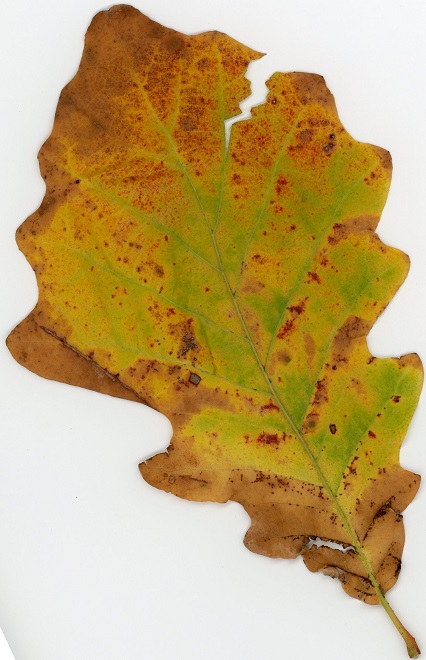
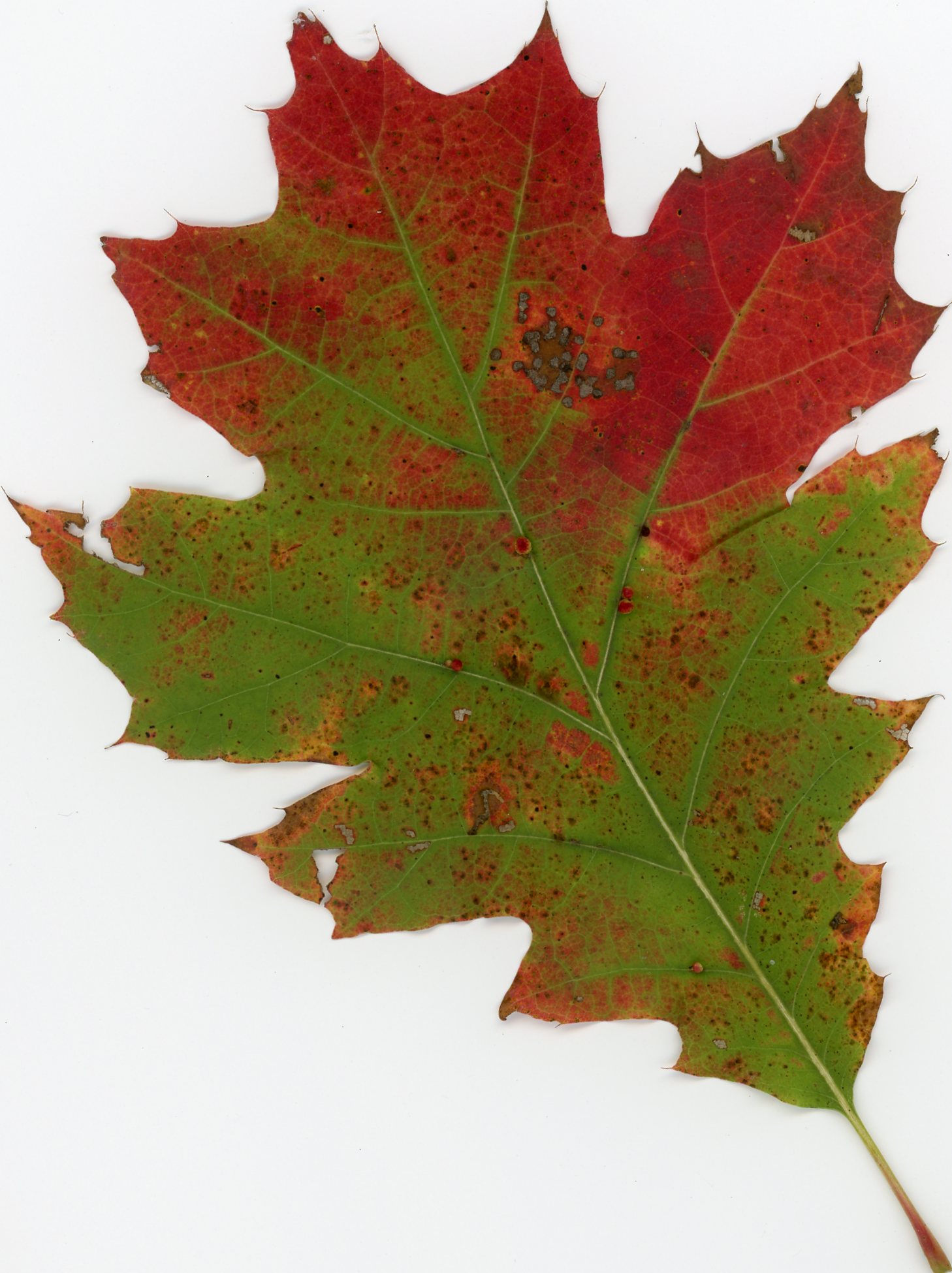
Swamp White Oak
Autumn leaf of a Swamp White Oak

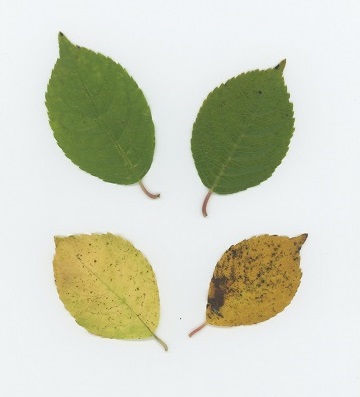
The following native species make great companions for Swamp White Oaks in a lowland setting and are available at bargain prices from one or more of the County Conservation District Tree Sales now underway…

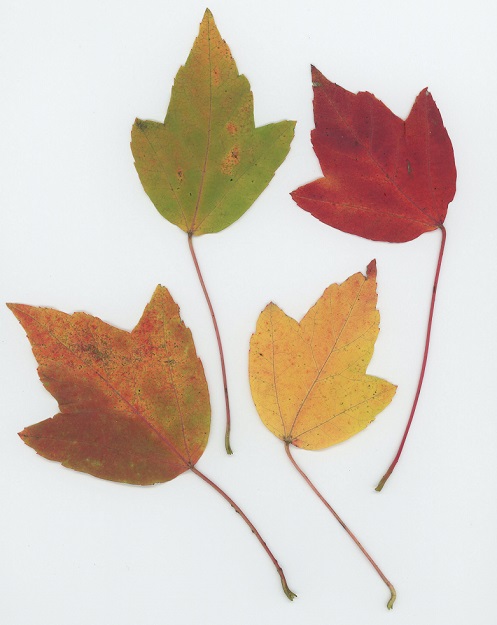
Red Maple
The Red Maple is an ideal tree for a stream buffer project. They do so well that you should limit them to 10% or less of the plants in your project so that they don’t overwhelm slower-growing species.
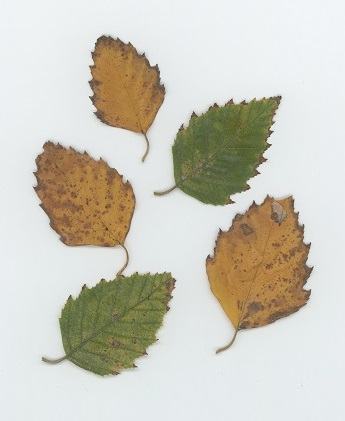
River Birch
The River Birch (Betula nigra) is a multi-trunked tree of lowlands.  Large specimens with arching trunks help shade waterways and provide a source of falling insects for surface-feeding fish.  Its peeling bark is a distinctive feature.
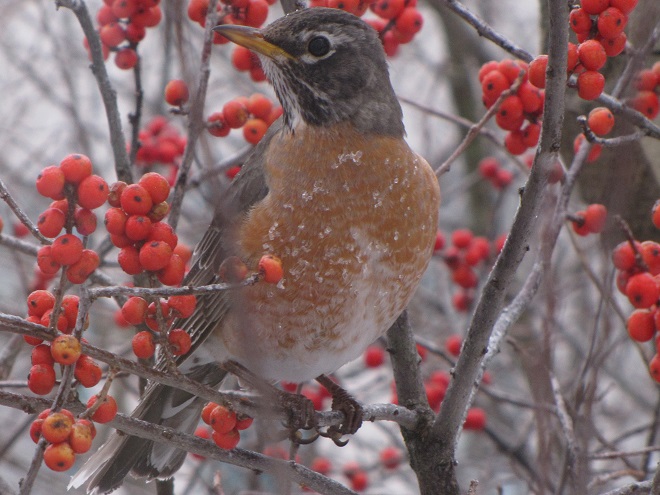
Common Winterberry
The Common Winterberry with its showy red winter-time fruit is a slow-growing shrub of wet soils.  Only female specimens of this deciduous holly produce berries, so you need to plant a bunch to make sure you have both genders for successful pollination.
American Robins feeding on Common Winterberry.
An American Robin feeding on Common Winterberry.
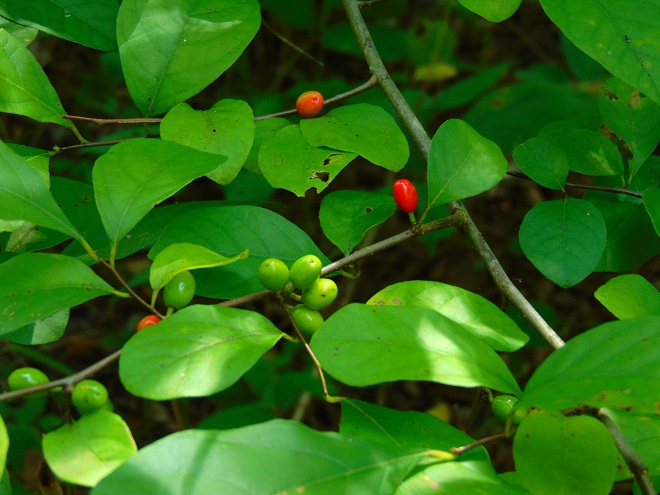
Common Spicebush
Common Spicebush is a shrub of moist lowland soils.  It is the host plant for the Spicebush Swallowtail butterfly and produces small red berries for birds and other wildlife.  Plant it widely among taller trees to provide native vegetation in the understory of your forest.
Common Spicebush foliage and berries.
Common Spicebush foliage and berries in the shade beneath a canopy of tall trees.
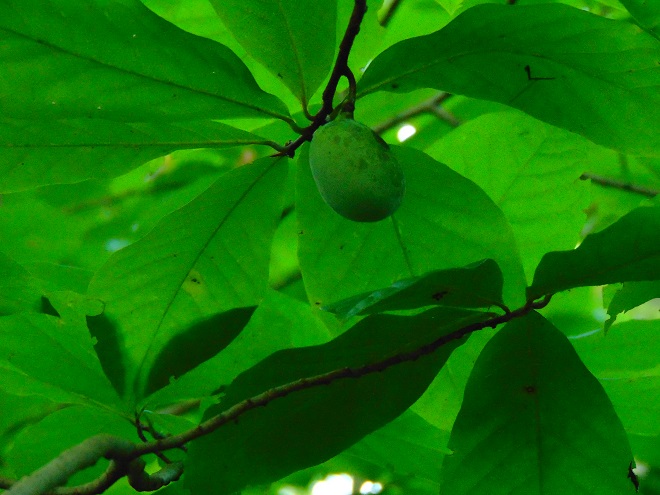
Common Pawpaw
The Common Pawpaw a small shade-loving tree of the forest understory.
Common Pawpaw
Common Pawpaw is a colony-forming small tree which produces a fleshy fruit.  It is the host plant for the caterpillars of the Zebra Swallowtail.
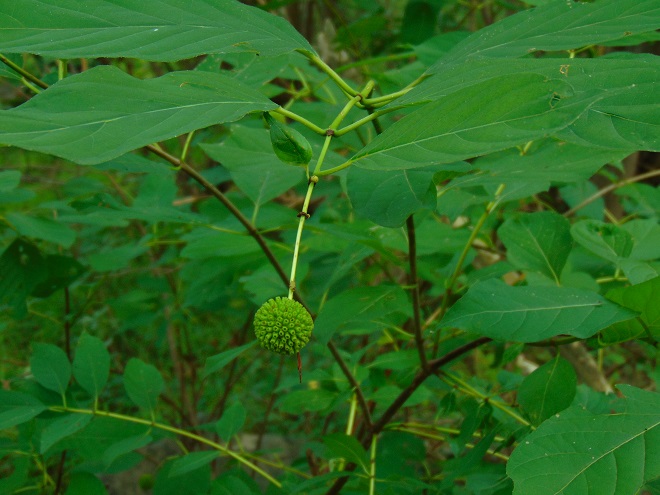
Buttonbush
The Buttonbush is a shrub of wet soils.  It produces a round flower cluster, followed by this globular seed cluster.
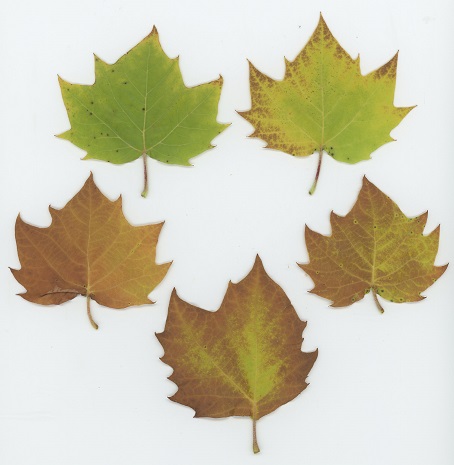
Eastern Sycamore
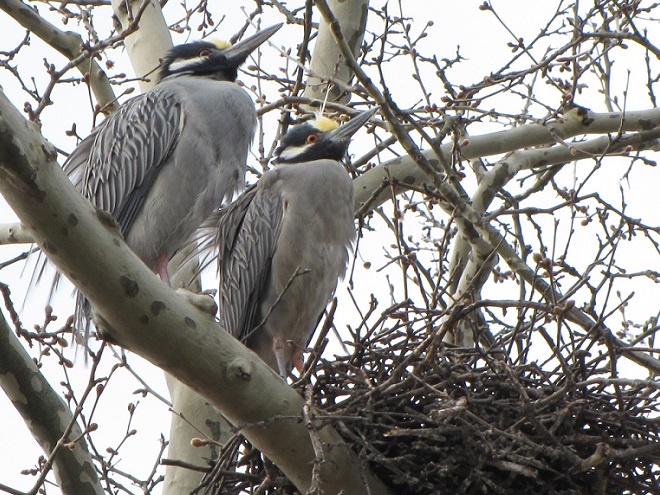
And don’t forget the Eastern Sycamore, the giant of the lowlands.  At maturity, the white-and-tan-colored bark on massive specimens makes them a spectacular sight along stream courses and river shores.  Birds ranging from owls, eagles, and herons to smaller species including the Yellow-throated Warbler rely upon them for nesting sites.
Yellow-crowned Night Herons Nesting in an Eastern Sycamore
Yellow-crowned Night Herons, an endangered species in Pennsylvania, nesting in an Eastern Sycamore.

So don’t mow, do something positive and plant a buffer!

Act now to order your plants because deadlines are approaching fast.  For links to the County Conservation District Tree Sales in the Lower Susquehanna River Watershed, see our February 18th post.

Photo of the Day

Red-bellied Woodpecker
So that colorful birds like the Red-bellied Woodpecker have places to feed, nest, and roost eighty years from now, we need to plant large-growing native trees today.  Your local County Conservation District Tree Sale is presently underway and there’s still time to make your selections and place an order.   See the post from February 18th for details!

Photo of the Day

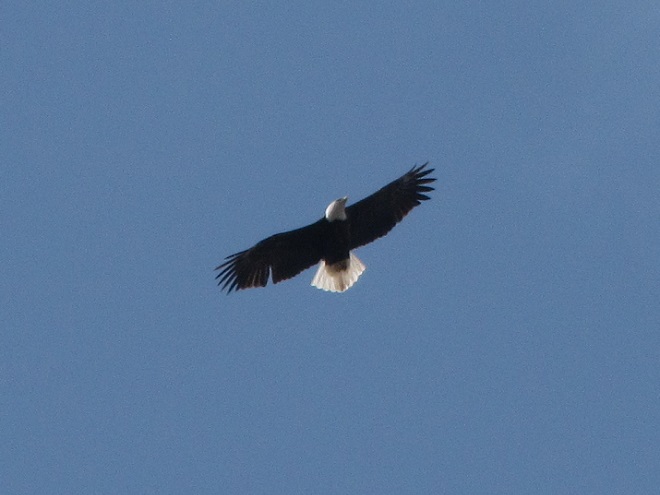
Soaring Bald Eagle
It’s time to keep an eye on the sky when you’re out and about.  Not only are mated pairs of Bald Eagles beginning their nesting cycle throughout the Lower Susquehanna River Watershed, but migrating birds are passing through the area on their way to breeding grounds farther north. This one drew the ire of pairs of Fish Crows and American Crows as it soared above the susquehannawildlife.net headquarters earlier today.

These Geese are Outta Here!

Flies?  Cabbage White butterflies?  Can it really be a late-February day?  It certainly is.  Here are a few more signs of an early spring.

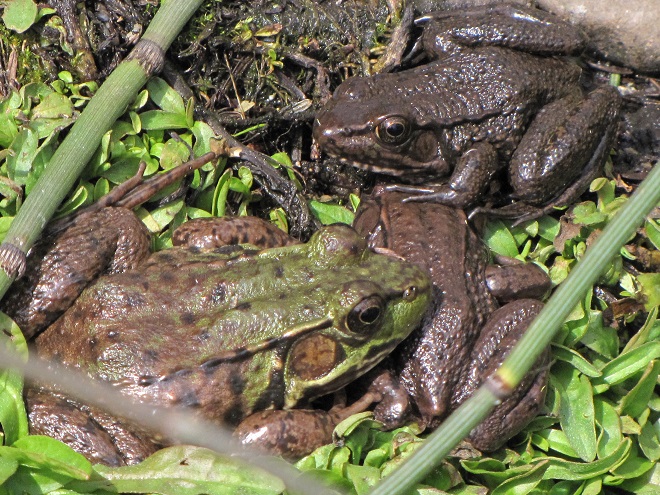
Green Frog
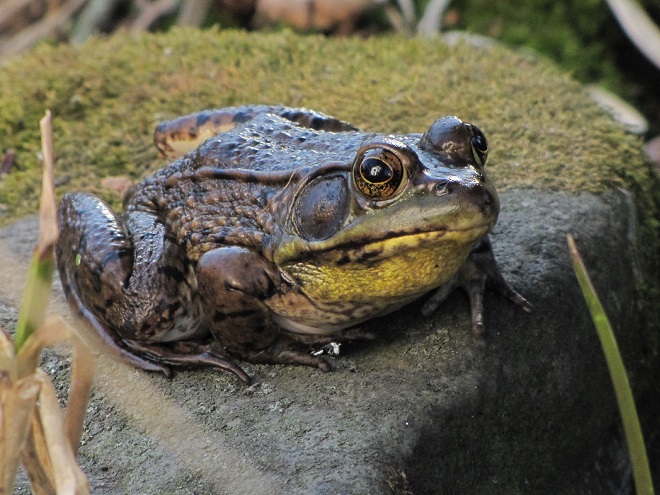
Green Frogs were out and about on this balmy February day trying to latch on to one of those flying insects.  Their long winter’s nap lasted just over six weeks.
Common Grackle
Approximately two hundred Common Grackles passed by susquehannawildlife.net headquarters today.  This one stopped to have a look around before continuing its northbound expedition.
Migrating Canada Geese
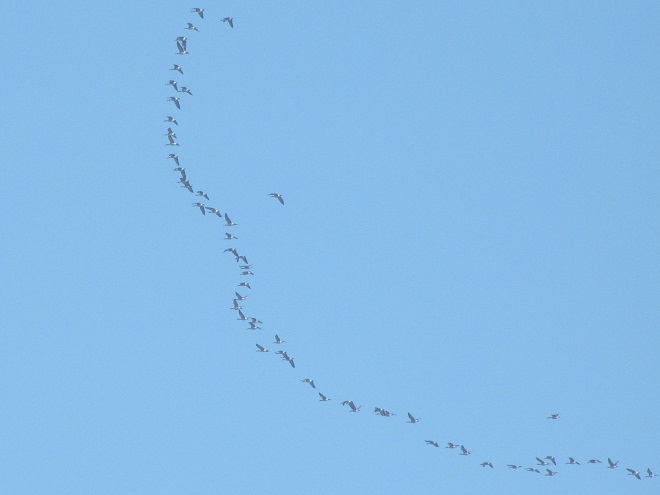
Difficult to spot, hundreds of high-flying Canada Geese were seen in the hazy sky above the headquarters garden during the late morning.  These migrants are working their way north from Chesapeake Bay and won’t be seen again in our region until fall.

Photo of the Day

Female Red-breasted Nuthatch
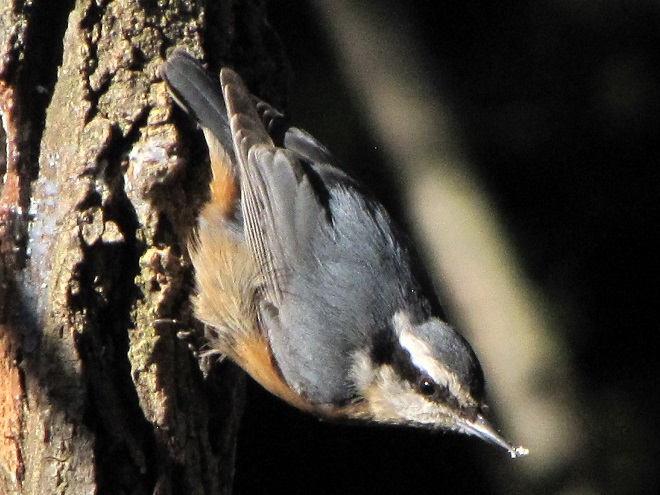
Are you participating in the Great Backyard Bird Count this weekend?  Have you seen a Red-breasted Nuthatch at your feeders?  If not, then maybe you should see the post from earlier today so that you might order some White Pine and Eastern Hemlock trees to spruce up the habitat around your pad and improve your chances of seeing them and other interesting winter birds in coming years.

Time to Order Your Trees for Spring Planting

County Conservation District Tree Sales are underway throughout the Lower Susquehanna River Watershed.  Now is the time to order for pickup in April.  The prices are a bargain and the selection is fabulous.  For species descriptions and more details, visit each tree sale web page (click the sale name highlighted in blue).  And don’t forget to order bundles of evergreens for planting in mixed clumps and groves to provide winter shelter and summertime nesting sites for our local birds.  They’re only $12.00 for a bundle of 10—can’t beat that deal!

Cumberland County Conservation District Annual Tree Seedling Sale—

Orders due by: Friday, March 24, 2023

Pickup on: Thursday, April 20, 2023 or Friday, April 21, 2023

Showy Northeast Meadow Mix
Don’t mow it.  Plant a meadow or pollinator garden instead.
Showy Northeast Meadow Mix
Both Cumberland and Perry Counties are offering a native warm-season grass and wildflower seed mix for planting your own meadow or pollinator garden.  Perry County is also taking orders for a seed mix specifically formulated to grow plants for attracting hummingbirds and butterflies.

Dauphin County Conservation District Seedling Sale—

Orders due by: Monday, March 20, 2023

Pickup on: Thursday, April 20, 2023 or Friday, April 21, 2023

American Goldfinch atop an Eastern Hemlock
The Eastern Hemlock, Pennsylvania’s official state tree, is an excellent choice for addition to your landscape or reforestation project.  It tolerates rocky soils and its cones are an prime source of food for birds ranging from chickadees to finches.

Lancaster County Annual Tree Seedling Sale—

Orders due by: Friday, March 10, 2023

Pickup on: Thursday, April 13, 2023

Northern Red Oak
The handsome yet underused Northern Red Oak is a sturdy long-lived native tree that is ideal for street-side, lawn, and reforestation plantings.  In spring, it can be a magnet for migrating Neotropical birds when its flowers attract a wide variety of tiny insects to its upper reaches.  Unlike many other oaks, this species is a relatively fast grower.

Lebanon County Conservation District Tree and Plant Sale—

Orders due by: Wednesday, March 8, 2023

Pickup on: Friday, April 7, 2023

Pileated Woodpecker feeding on Black Gum berries.
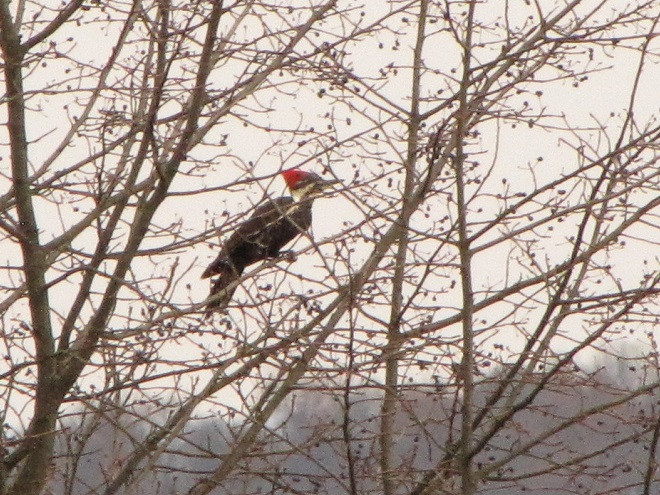
In autumn, even after the bright red foliage is gone, the berries of mature Black Gum (Nyssa sylvatica) trees attract a wide variety of birds like this Pileated Woodpecker.  The Lebanon County Conservation District is offering Black Gum, also known as Black Tupelo, during their 2023 tree sale.  Why not order and plant a half dozen or more?

Perry County Conservation District Tree Sale—(click on 2023 Tree Sale Brochure tab when it scrolls across the page)

Orders due by: March 22, 2023

Pickup on: Thursday, April 13, 2023

Female Eastern Bluebird with Food for Young
The Perry County Conservation District is not only offering plants during this year’s sale, you can also purchase bluebird nest boxes for just $12.00 each!
Riparian Buffer at 15 Years
For less than the cost of one year of mowing, this stream corridor in Conewago Township, Dauphin County was reforested by the owner with hundreds of native trees, the majority purchased through County Conservation District Tree Sale events spanning a period of several years.  By replacing bare soil and mowed areas, the riparian buffer created by these plantings has significantly reduced the nutrient and sediment loads that were polluting the small stream therein known as Brill’s Run.  With determination and not a lot of money, you can do it too.
Maples, Pin Oaks, Eastern White Pines, and other trees in the Brill's Run riparian buffer.
But don’t forget the Eastern White Pines!

Berries and More on a Bitter Cold Morning

The annual arrival of hoards of American Robins to devour the fruits found on the various berry-producing shrubs and trees in the garden at susquehannawildlife.net headquarters happened to coincide with this morning’s bitter cold temperatures.  Here are photos of some of those hungry robins—plus shots of the handful of other songbirds that joined them for a frosty feeding frenzy.

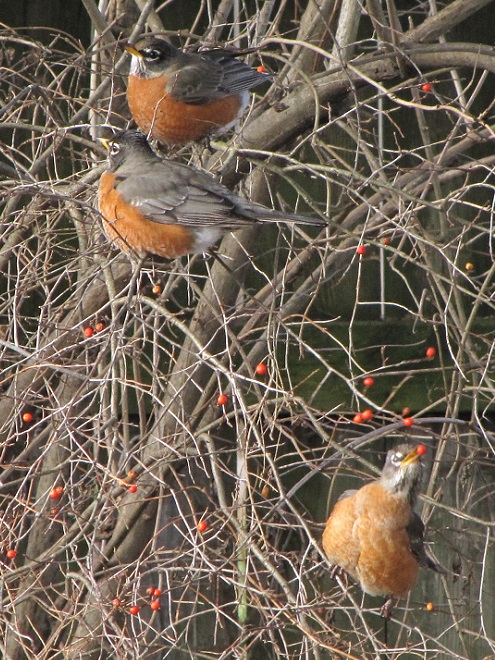
American Robins consuming Common Winterberry fruits.
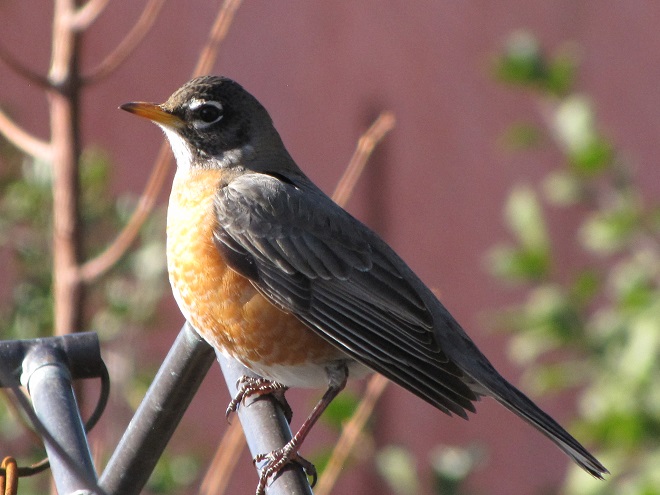
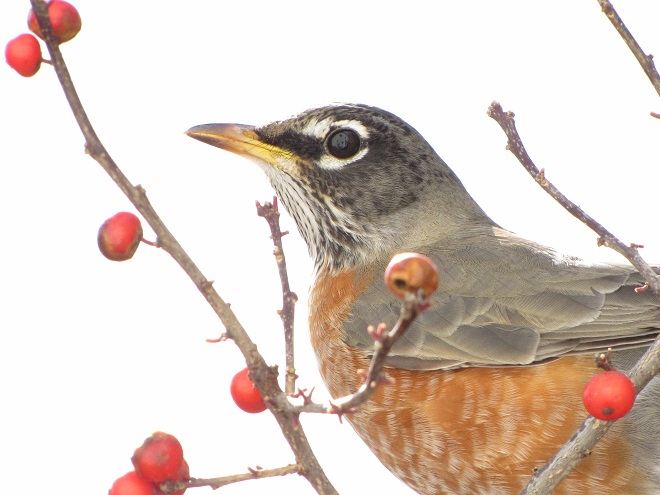
American Robin
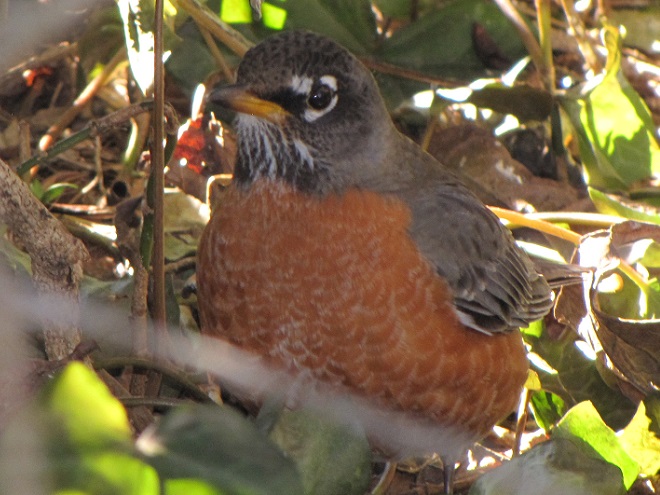
One of between one hundred and two hundred American Robins seen feeding on berries at susquehannawildife.net headquarters this morning.
Dark-eyed junco
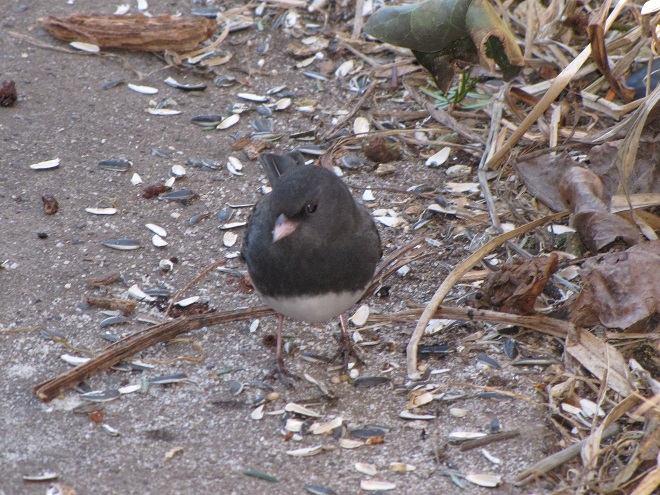
A Dark-eyed Junco searching the ground for seeds.
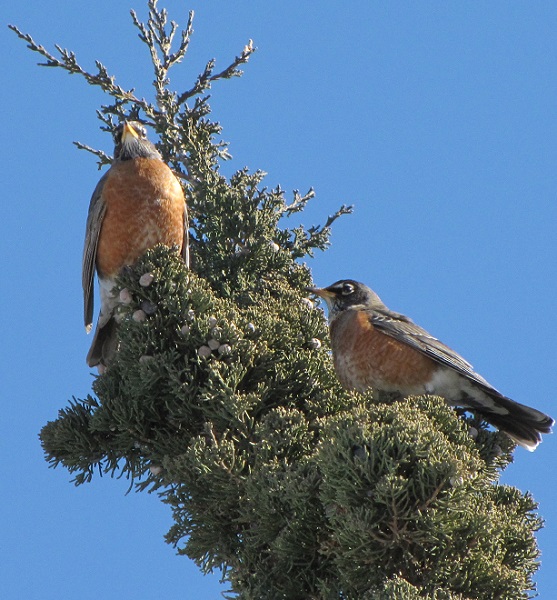
American Robin in a "Hollywood Juniper".
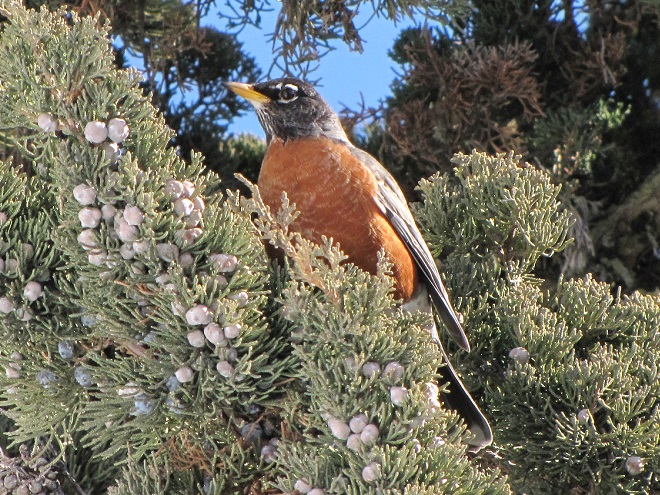
An American Robin in the boughs of a “Hollywood Juniper”, a cultivar of the Chinese Juniper (Juniperus chinensis ‘Torulosa’, also known as J. c. ‘Kaizuka’).
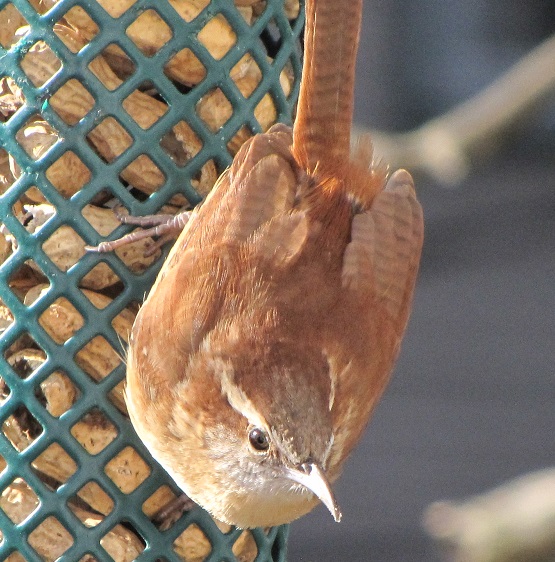
A Carolina Wren on the peanut feeder.
American Robin
An American Robin searching for fallen berries beneath a holly.
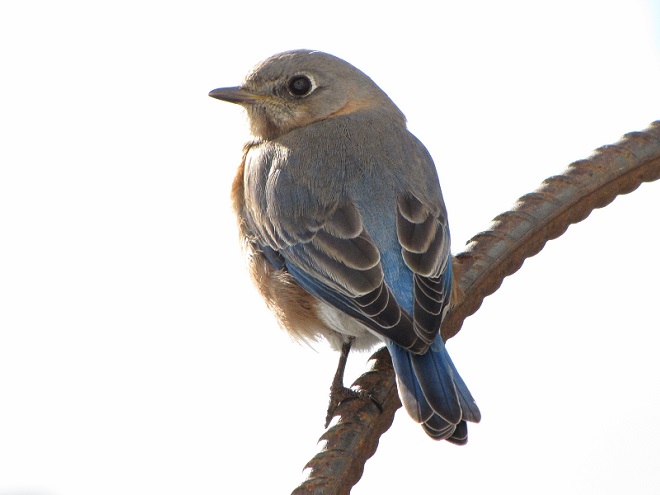
A female Eastern Bluebird.
American Robin
An American Robin takes a break from the buffet.
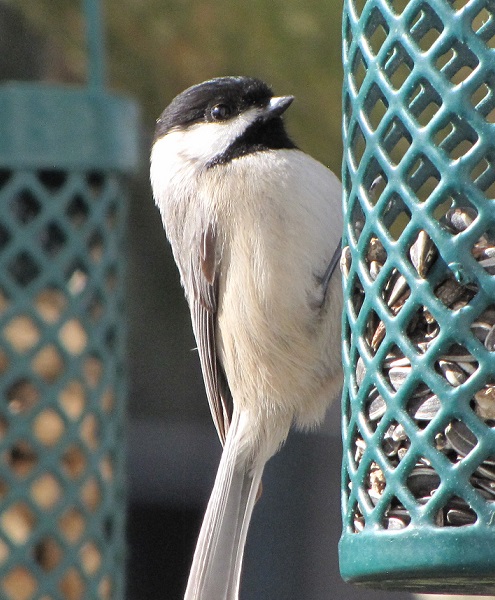
A Carolina Chickadee preparing to pluck a sunflower seed from a tube feeder.
American Robins feeding on "Hollywood Juniper" berries.
American Robins feeding on “Hollywood Juniper” berries.
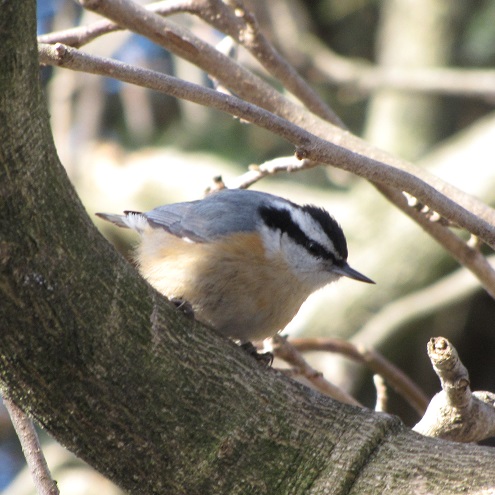
Red-breasted Nuthatch
One of two Red-breasted Nuthatches spending the week at susquehannawildlife.net headquarters.
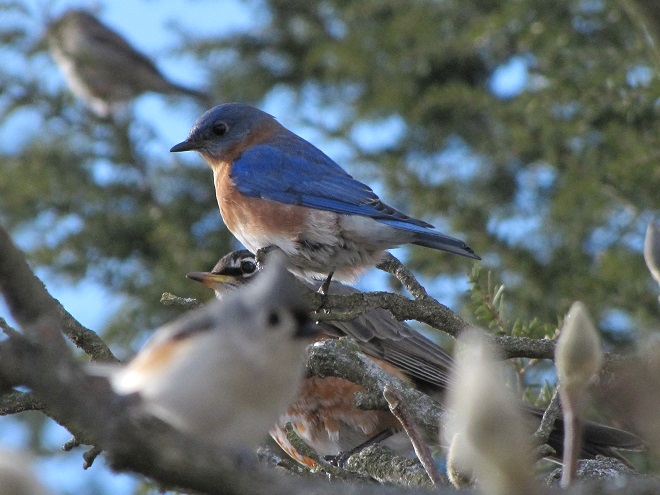
Eastern Bluebird. American Robin, and Tufted Titmouse.
A male Eastern Bluebird among the crowd in the garden’s trees.
American Robin and Common Winterberry, a native deciduous holly.
An American Robin and Common Winterberry, a native deciduous holly.
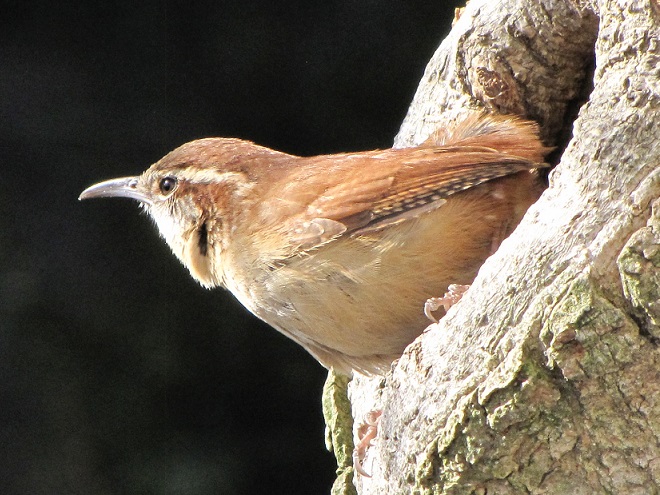
A Carolina Wren investigates a tree cavity, a potential nest site.
A Carolina Wren investigates a tree cavity, a potential nest site in coming weeks.